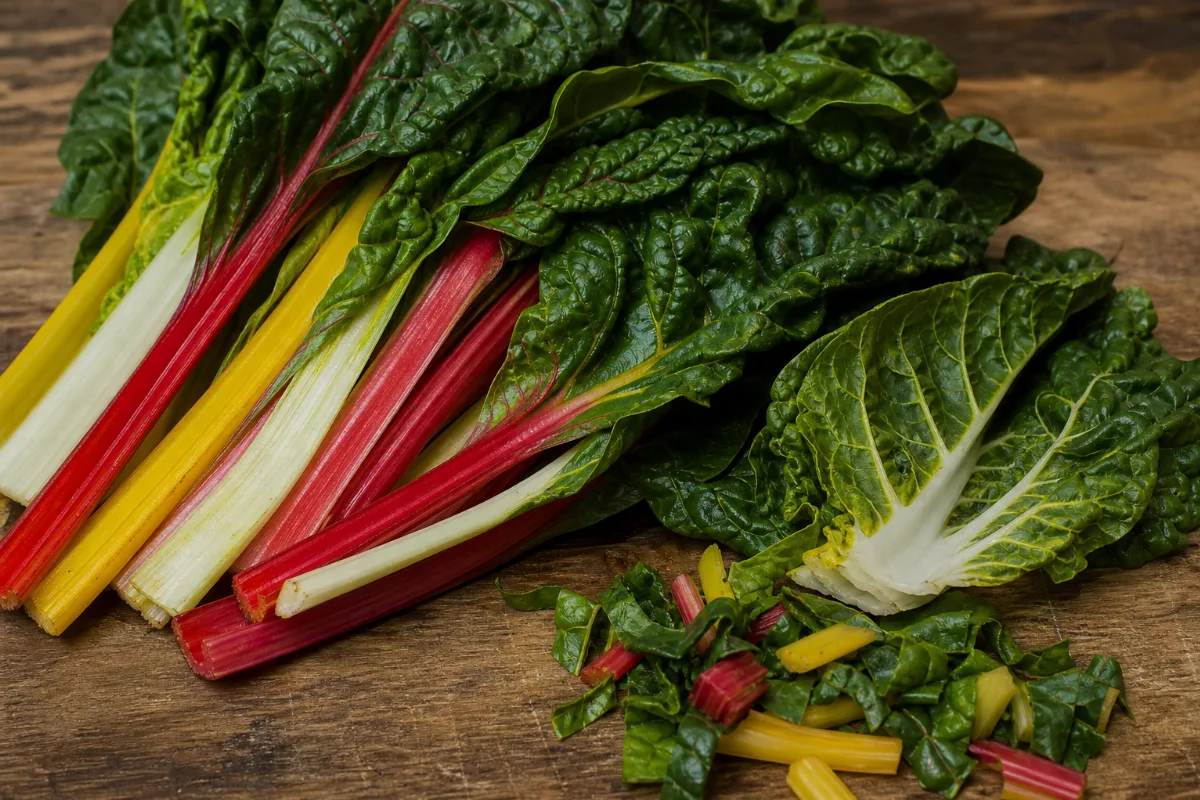
Vegetables · Vegetable
Swiss Chard
Beta vulgaris subsp. vulgaris · also called Chard, leaf beet, acelga (Spanish)
Swiss chard is a leafy vegetable with large green leaves and coloured stalks, eaten raw or cooked. It is a very rich source of vitamin K, and a good source of potassium, magnesium and the eye pigments lutein and zeaxanthin. Studies link eating more leafy greens with less heart disease, but trials have not shown a blood pressure benefit, and none tested chard alone. The main cautions are warfarin (keep vitamin K steady), kidney stones and kidney disease (oxalate and potassium).
General information, not medical advice. Last substantive update · Not medically reviewed. A named clinician has not signed off on this page. How this page is made
About Swiss Chard
Swiss chard is a nutritious leafy vegetable, very rich in vitamin K. It is a food, not a proven remedy: most health findings are for leafy greens as a group, and the main cautions are warfarin, kidney stones and kidney disease.
What it is
Swiss chard (Beta vulgaris subsp. vulgaris) is the same species as beetroot, grown for its large leaves and thick, often brightly coloured stalks. Both parts are eaten, raw or cooked.
USDA data for raw chard: 19 kcal per 100 g. One cup of raw leaf (36 g) has about 7 kcal, 0.6 g fibre, 136 mg potassium, 29 mg magnesium, 11 mg vitamin C, 110 micrograms vitamin A (RAE) and 299 micrograms vitamin K. It also has 77 mg of sodium, which is a lot for a vegetable. Cooked chard packs more leaf into a cup, and no source read says how cooking changes its nutrients.
What the research shows
The firmest fact is about the nutrient: vitamin K is needed for blood clotting, and chard is a very rich source. That is a nutrient fact, not a chard trial.
Studies of people who eat more green leafy vegetables link them with less heart disease. These are observational and cannot show cause. Trials of leafy greens did not show lower blood pressure or better vessel function, and a 5-week trial of nitrate-rich greens found no blood pressure effect.
Links with thinking skills in older age and with diabetes risk are weak or borderline. No trial of eating chard itself was found for any of these.
Chard as food versus extracts and supplements
The heart and thinking results are for leafy greens eaten as food, as a group. The liver and blood fat finding is a leaf extract in rats. The eye trial used lutein plus zeaxanthin supplements. None of these tells you what a chard powder, juice or supplement does.
Amounts
This page gives no amounts to eat. Ask a doctor, pharmacist or dietitian what is right for you, especially if you take warfarin or have kidney stones or kidney disease.
At a glance
Traditional uses history, not proof
- Eaten as a cooked or raw leafy vegetable, both the leaves and the colourful stalks
- Used as a food, not as a medicine; long use as food is not proof that it treats any condition
Studied for research
- Vitamin K for normal blood clotting, high certainty for the nutrient, no chard trial
- Heart disease risk (leafy greens as a group), low certainty (observational)
- Blood pressure, against (a 5-week trial of nitrate-rich leafy greens found no effect)
- Thinking skills in older age (leafy greens), low certainty
- Type 2 diabetes risk, low certainty; eye health, insufficient evidence
Main compounds
- Vitamin K1 (phylloquinone)
- Lutein and zeaxanthin (eye pigments)
- Beta-carotene
- Betalains (red and yellow pigments) and flavonoids
- Nitrate
- Potassium, magnesium and sodium
- Oxalate (no chard value found in the sources read)
Common forms
- Fresh raw leaves and stalks (the food measured by USDA)
- Cooked leaves and stalks
- Leafy-green juice or smoothie 'cleanses' (linked to oxalate kidney injury in one case)
- Leaf extract (used in a rat study; not the same as the vegetable)
Research links: MedlinePlus: Vitamin K · 2026 review: green leafy vegetables and cardiovascular disease · 2026 case report: acute kidney failure after fresh Swiss chard · Research Library · Genes & Biomarkers Library
What it is and its history
- Accepted scientific name
- Beta vulgaris subsp. vulgaris
- Naming authority
- L. (GBIF accepted, exact match, usageKey 7068845)
- Common names
- Swiss chard (English); Chard (English); Acelga (Spanish)
- Family or group
- Amaranthaceae (the amaranth family), which also includes beetroot and spinach.
- Classification
- Plantae > Tracheophyta > Magnoliopsida > Caryophyllales > Amaranthaceae > Beta > Beta vulgaris
- Native range
- Not verified from a source read.
- Habitat
- Not verified from a source read.
- What it looks like
- Roots: Not verified.; Stems: Eaten as the coloured stalks (stems) of the plant; stems are high in potassium (p32746613).; Leaves: Large green leaves, the part most studied (p32746613).; Flowers: Not verified.
- Cultivation
- Not verified from a source read.
- Harvest and processing
- Eaten fresh, raw or cooked. Studies read used fresh chard samples, chard leaf extract in rats and chard powder as a curing agent in sausages (not a health study).
- Look-alikes and adulterants
- Name: Beetroot (Beta vulgaris, same species); Note: Grown for the root. Beet and chard share the species name; nutrition and oxalate values for one should not be assumed for the other.; Name: Spinach (Spinacia oleracea); Note: A different plant in the same family. NIDDK names spinach, not chard, for oxalate.
- Sustainability and conservation
- Not assessed.
Photographs
Traditional use and history history, not clinical proof
| Tradition or era | Documented use | Source |
|---|---|---|
| Food use | Swiss chard is eaten as a leafy vegetable, raw or cooked (general knowledge; no historical source was read). | Not verified |
Traditional use shows how it was used. It does not show that it works or is safe today.
What is inside, and how it may work
What it contains and how those compounds act in cells and animals. Laboratory and animal mechanisms are not proven effects in people.
Main compounds
| Compound | Family | Where it is concentrated | Activity studied | Level of evidence |
|---|---|---|---|---|
| Vitamin K1 (phylloquinone) PubChem 5284607 | vitamin | Leaf USDA: 830 micrograms per 100 g raw (about 299 micrograms in 1 cup, 36 g) | Needed for blood clotting. Affects warfarin. 23 19 22 | Human data |
| Lutein and zeaxanthin PubChem 5281243 | carotenoid | Leaf USDA: 11,000 micrograms of lutein plus zeaxanthin per 100 g raw | Yellow pigments concentrated in the macula of the eye. No trial of chard for eye disease was found. 23 3 22 | Composition only |
| Beta-carotene PubChem 5280489 | carotenoid | Leaf USDA: 3,650 micrograms per 100 g raw | Provitamin A pigment. In the cognition cohort it was the one component not clearly linked to slower decline. 23 13 22 | Composition only |
| Betalains | pigments | Leaf and stalk | Betalains were 20% of the compound data reported in a review of chard. No human health trial of them in chard was read. 6 | Composition only |
| Flavonoids | polyphenols | Leaf | New flavonoids were isolated from chard leaves, and a leaf extract protected rat livers and lowered blood fats in rats. Animal work only. 7 6 | Animal research |
| Nitrate PubChem 943 | inorganic anion | Leaf Mean 2,522.6 mg per kg fresh weight in Italian chard samples | Can be turned into nitric oxide in the body. A trial of nitrate-rich leafy greens did not lower blood pressure. 8 15 22 | Human data |
| Oxalate (oxalic acid) PubChem 971 | organic acid | Not established for chard | Oxalate crystals were found in the kidney biopsy of a woman who ate a large meal of fresh chard. No chard oxalate value was read. 9 22 | Case report |
Mechanisms, receptors and pathways
| Target or pathway | Gene or receptor | What was found | Level |
|---|---|---|---|
| Vitamin K and blood clotting | Clotting factors II, VII, IX and X | MedlinePlus says vitamin K is needed for the liver to make these clotting factors. Warfarin acts against this; sudden changes in vitamin K intake can change its effect. 19 20 | Human data |
| Nitrate to nitric oxide | Not specified | The 2020 trial tested the idea that nitrate in leafy greens is turned into nitric oxide to lower blood pressure. It found no blood pressure difference after 5 weeks. 15 | Human data |
| Macular pigment | Not specified | A review says lutein and zeaxanthin from food or supplements are concentrated in the macula, where they absorb blue light and act as local antioxidants. 3 | Human data |
| Oxalate crystal deposition in kidney tubules | Not specified | In the case report, biopsy showed oxalate crystals blocking kidney tubules. The authors say the threshold amount of crystals that causes disease is not known. 9 | Case report |
Absorption, metabolism and elimination
- Absorption
- Not studied for chard.
- Distribution
- Not found.
- Metabolism
- Not found.
- Elimination
- Not found.
- Bioavailability
- Not established for chard.
Isolated compounds versus whole extracts
All the heart and thinking results are for green leafy vegetables as a group eaten as food. The rat result is for a leaf extract. The eye trial used lutein plus zeaxanthin supplements. None of these can be read as results for a chard supplement or powder. A chard powder study in sausage curing was a food-science test of Listeria growth and says nothing about health.
Nutritional composition
Nutrition from USDA FoodData Central (Chard, swiss, raw, FDC 169991, SR Legacy, last updated 4/1/2019, read 2026-10-26). Per 100 g: 19 kcal, 1.8 g protein, 0.2 g fat, 3.7 g carbohydrate, 1.6 g fibre, 1.1 g total sugars, 92.7 g water, 51 mg calcium, 1.8 mg iron, 81 mg magnesium, 379 mg potassium, 213 mg sodium, 30 mg vitamin C, 14 micrograms folate (DFE), 306 micrograms vitamin A (RAE), 1.89 mg vitamin E, 830 micrograms vitamin K, 3,650 micrograms beta-carotene and 11,000 micrograms lutein plus zeaxanthin. One cup of raw leaf (36 g): about 7 kcal, 0.6 g fibre, 18 mg calcium, 29 mg magnesium, 136 mg potassium, 77 mg sodium, 11 mg vitamin C, 110 micrograms vitamin A (RAE), 299 micrograms vitamin K and 3,960 micrograms lutein plus zeaxanthin. One leaf (48 g): about 9 kcal, 182 mg potassium, 102 mg sodium and 398 micrograms vitamin K. Per-portion figures are the USDA per-100-g values scaled by the portion weight and rounded. Chard is unusually high in sodium for a vegetable. USDA gives no oxalate or nitrate value. Values vary with variety, ripeness and storage; cooked chard packs more leaf into a cup, and no source read says how cooking changes its nutrients.
1 high certainty3 low certainty1 very low certainty1 not enough evidence1 evidence against
What was looked at
The 7 benefits and uses checked for Swiss Chard, each with how strong the evidence is. Tap one to open it.
- Heart disease risk (green leafy vegetables as a group)Low certainty
- Blood pressure (leafy greens and their nitrate)Evidence against
- Thinking and memory in older age (green leafy vegetables)Low certainty
- Vitamin K for normal blood clottingHigh certainty
- Type 2 diabetes risk (green leafy vegetables as a group)Low certainty
- Eye health (lutein and zeaxanthin in chard)Not enough evidence
- Liver protection and blood fats (leaf extract, rats only)Very low certainty
Lab markers tracked in the studies
Cardiovascular disease events24-hour systolic blood pressureBlood vessel functionNew cases of type 2 diabetesProgression to advanced age-related macular degeneration
What is Swiss Chard good for?
The main studied uses and how strong the human evidence is for each. Most results are for green leafy vegetables as a group, not chard alone.
Benefits, one by one
Each card is a research question, not a promise. Tap a goal to filter. Open a card to see the studies, doses and limits.
Heart disease risk (green leafy vegetables as a group)
Low certaintyPeople who eat more green leafy vegetables have less heart disease in observational studies. A 2026 review found about 11% lower risk. This cannot prove the greens are the cause, and the studies were not about chard alone.
2 studiesWhole green leafy vegetables eaten as food.
Studies, doses and limits
What the trials found
A 2026 systematic review pooled observational studies and found higher green leafy vegetable intake linked to lower cardiovascular disease (relative risk 0.89, 95% CI 0.82 to 0.97) and lower cardiovascular death (relative risk 0.79, 0.62 to 0.97), with high heterogeneity (I2 80%). A 2017 meta-analysis of 95 prospective studies found, for fruit and vegetables combined, a relative risk of 0.92 for cardiovascular disease per 200 g a day (0.90 to 0.95), and said inverse associations were seen for green leafy vegetables with cardiovascular disease and all-cause mortality.
Results
Observational studies link more leafy greens to less cardiovascular disease. Trials in the same review did not show clear changes in blood pressure or vessel function (see the next result).
Effect sizes as reported
Leafy greens: CVD RR 0.89 (0.82-0.97); CVD death RR 0.79 (0.62-0.97). Fruit and vegetables combined: CVD RR 0.92 per 200 g/day (0.90-0.95).
Why this rating
Low, because the evidence is observational: people who eat more greens differ from others in many ways, heterogeneity is high (I2 80%), and the studies are about green leafy vegetables as a group, not chard alone.
Form and dose studied
Whole green leafy vegetables eaten as food.
Who was studied
Adults in prospective cohort studies.
Limits
Cannot show cause. Chard was not analysed on its own in the abstracts read. Intake amounts and definitions of 'leafy' differ between studies.
Why researchers looked
Leafy greens are rich in vitamins, minerals and plant pigments, and population studies ask whether eating them goes with healthier hearts.
Traditional use
Swiss chard is eaten as a leafy vegetable, raw or cooked. Long use as food is not proof that it treats any condition.
Proposed mechanism Human data
Not established. The studies read do not show which nutrient or plant compound in leafy greens might matter, if any.
A proposed mechanism does not show that the effect happens in people.
None specific beyond the warfarin, kidney and potassium cautions on the Safety tab.
Blood pressure (leafy greens and their nitrate)
Evidence againstIn a 5-week trial in 243 people with mildly raised blood pressure, eating leafy greens rich in nitrate did not lower 24-hour blood pressure more than a placebo diet. A 2026 review of trials of leafy greens also found no clear effect on blood pressure or on how well blood vessels work.
2 studiesLeafy green vegetables eaten as food (kinds not named in the trial ab…
Studies, doses and limits
What the trials found
A 2020 randomised trial in 243 adults aged 50 to 70 with clinic systolic pressure of 130 to 159 mm Hg compared, for 5 weeks, leafy greens providing 300 mg nitrate, low-nitrate vegetables with placebo pills, or low-nitrate vegetables with 300 mg nitrate pills. Change in 24-hour systolic pressure was -0.5, -0.6 and -1.2 mm Hg: no significant difference. The 2026 review pooled seven trials of green leafy vegetables and found no significant effect on vascular function, systolic or diastolic blood pressure.
Results
No blood pressure benefit was seen in the trials read. No trial of chard alone was found.
Effect sizes as reported
24-hour systolic change: leafy greens -0.5 mm Hg, placebo -0.6, nitrate pills -1.2 (no significant difference). Vascular function MD -0.37 (-1.90 to 1.16).
Why this rating
A well-sized randomised trial and a pooled review of trials both found no effect. The trials were short and used leafy greens as a group, so a small or long-term effect is not ruled out.
Form and dose studied
Leafy green vegetables eaten as food (kinds not named in the trial abstract) compared with nitrate pills.
Who was studied
Adults aged 50 to 70 with mildly raised blood pressure; adults in seven small trials.
Limits
5 weeks only. Chard is not named in either abstract. Trials in the review differed a lot (I2 88%).
Why researchers looked
Chard, like other leafy vegetables, contains nitrate, which the body can turn into nitric oxide, a gas that relaxes blood vessels.
Traditional use
Swiss chard is eaten as a leafy vegetable, raw or cooked. Long use as food is not proof that it treats any condition.
Proposed mechanism Preliminary mechanism
Nitrate from leafy vegetables can be converted in the body to nitric oxide, which widens blood vessels. This is the idea the trial tested; it did not show a blood pressure effect.
A proposed mechanism does not show that the effect happens in people.
Nitrate levels in chard vary; see the contamination section on the Safety tab.
Thinking and memory in older age (green leafy vegetables)
Low certaintyIn 960 older adults followed for about 5 years, those who ate the most green leafy vegetables (about 1.3 servings a day) lost thinking skills more slowly than those who ate the least. This is an association from food questionnaires and cannot show that greens are the cause.
1 studiesGreen leafy vegetables eaten as food.
Studies, doses and limits
What the trials found
In the 2018 Memory and Aging Project analysis (960 people aged 58 to 99, mean 4.7 years of follow-up), the highest fifth of green leafy vegetable intake had slower cognitive decline than the lowest (beta 0.05 standardised units, p = 0.0001), described by the authors as the equivalent of being 11 years younger. Intakes of vitamin K, lutein, folate, nitrate, alpha-tocopherol and kaempferol were each linked to slower decline; beta-carotene was not (p = 0.08).
Results
Slower decline in people who ate more greens, in one cohort. No trial of chard and thinking skills was found.
Effect sizes as reported
Highest versus lowest fifth: beta 0.05 standardised units (p = 0.0001).
Why this rating
One observational cohort; food questionnaires; many differences between people who eat more or fewer greens; greens as a group.
Form and dose studied
Green leafy vegetables eaten as food.
Who was studied
Older adults (58 to 99).
Limits
Observational. Chard was not analysed alone. No randomised trial of leafy greens for cognition was read.
Why researchers looked
Leafy greens contain vitamin K, lutein, folate, nitrate and other compounds that have been linked to brain health in observational work.
Traditional use
Swiss chard is eaten as a leafy vegetable, raw or cooked. Long use as food is not proof that it treats any condition.
Proposed mechanism Human data
Not established. The researchers looked at several nutrients in greens and found most were each linked to slower decline, so no single one is identified.
A proposed mechanism does not show that the effect happens in people.
None specific.
Vitamin K for normal blood clotting
High certaintySwiss chard is a very rich food source of vitamin K, which the body needs to make blood-clotting proteins. This is a nutrient fact about the food, not a trial of chard. The same fact is why chard matters for people who take warfarin.
2 studiesRaw chard leaf, as measured by USDA. Cooking changes how much leaf fi…
Studies, doses and limits
What the trials found
USDA lists 830 micrograms of vitamin K in 100 g raw chard, about 299 micrograms in 1 cup (36 g). MedlinePlus names Swiss chard among foods rich in vitamin K and gives adequate intakes of 120 micrograms a day for men and 90 for women aged 19 and over. MedlinePlus says deficiency is very rare and occurs when the vitamin cannot be absorbed.
Results
One cup of raw chard has more vitamin K than the adult adequate intakes MedlinePlus lists. No trial was needed or done on chard for this role.
Effect sizes as reported
830 micrograms per 100 g; about 299 micrograms per cup raw (USDA).
Why this rating
High for the nutrient role of vitamin K and for the USDA content figure. This is not a health-outcome trial of chard.
Form and dose studied
Raw chard leaf, as measured by USDA. Cooking changes how much leaf fits in a cup; USDA data here are for raw chard.
Who was studied
General population.
Limits
Food values vary with variety, ripeness and storage. No data were read on how cooking changes the vitamin K in chard.
Why researchers looked
Vitamin K is essential for clotting, and leafy greens are the main food source.
Traditional use
Swiss chard is eaten as a leafy vegetable, raw or cooked. Long use as food is not proof that it treats any condition.
Proposed mechanism Authoritative guidance
MedlinePlus says the liver needs vitamin K to make the clotting factors II, VII, IX and X.
A proposed mechanism does not show that the effect happens in people.
People taking warfarin should keep vitamin K food steady from day to day. See the Safety tab.
Type 2 diabetes risk (green leafy vegetables as a group)
Low certaintyA large cohort in Singapore found no clear link between dark green leafy vegetables and type 2 diabetes. A pooled analysis of 11 studies found a borderline link, with the authors saying the evidence for benefit is not convincing.
1 studiesGreen leafy vegetables eaten as food.
Studies, doses and limits
What the trials found
In the Singapore Chinese Health Study (45,411 adults, 5,207 new cases of type 2 diabetes), dark green leafy vegetables were not clearly linked to type 2 diabetes (top versus bottom fifth, HR 1.05, 95% CI 0.96 to 1.15). The updated meta-analysis of 11 studies (754,729 people, 58,297 cases) found a borderline inverse link for green leafy vegetables (RR 0.91, 0.84 to 1.00) with moderate-to-high heterogeneity.
Results
Little to no clear link. The authors concluded evidence of benefit is not convincing.
Effect sizes as reported
Cohort HR 1.05 (0.96-1.15); meta-analysis RR 0.91 (0.84-1.00).
Why this rating
Observational studies only, borderline result, high heterogeneity, and greens as a group rather than chard.
Form and dose studied
Green leafy vegetables eaten as food.
Who was studied
Adults, mostly in observational cohorts (the large new cohort was Chinese adults in Singapore).
Limits
Cannot show cause. No trial of chard for blood sugar was read.
Why researchers looked
Vegetable fibre and nutrients have been suggested to help blood sugar control, so researchers checked diabetes risk.
Traditional use
Swiss chard is eaten as a leafy vegetable, raw or cooked. Long use as food is not proof that it treats any condition.
Proposed mechanism Human data
Not established.
A proposed mechanism does not show that the effect happens in people.
None specific.
Eye health (lutein and zeaxanthin in chard)
Not enough evidenceUSDA measures large amounts of lutein plus zeaxanthin in chard. These are yellow plant pigments that collect in the centre of the retina. No trial has tested chard for eye disease, and a large trial of lutein plus zeaxanthin supplements did not significantly slow advanced macular degeneration.
3 studiesChard as food (USDA composition). The trial used supplements.
Studies, doses and limits
What the trials found
USDA lists 11,000 micrograms of lutein plus zeaxanthin per 100 g raw chard. In the AREDS2 randomised trial (4,203 people at risk of advanced macular degeneration, median 5 years), adding lutein (10 mg) plus zeaxanthin (2 mg) supplements did not significantly reduce progression to advanced disease (hazard ratio 0.90, 98.7% CI 0.76 to 1.07, P = .12).
Results
No chard or vegetable trial was found. The best trial used supplements and was not significant in its primary analysis.
Effect sizes as reported
AREDS2 primary analysis: HR 0.90 (98.7% CI 0.76-1.07), P = .12.
Why this rating
Composition data and a null supplement trial; no trial of chard.
Form and dose studied
Chard as food (USDA composition). The trial used supplements.
Who was studied
People aged 50 to 85 at risk of advanced macular degeneration (AREDS2).
Limits
Supplements are not the food. Only the primary AREDS2 result is used here.
Why researchers looked
Lutein and zeaxanthin concentrate in the macula, the part of the retina used for sharp central vision, and green leafy vegetables are a dietary source.
Traditional use
Swiss chard is eaten as a leafy vegetable, raw or cooked. Long use as food is not proof that it treats any condition.
Proposed mechanism Human data
A 2016 review says lutein and zeaxanthin must come from food or supplements and are concentrated in the macula, where they absorb blue light and act as local antioxidants. This describes the biology; it does not show a benefit from eating chard.
A proposed mechanism does not show that the effect happens in people.
None specific.
Liver protection and blood fats (leaf extract, rats only)
Very low certaintyOne laboratory paper found that an extract of Swiss chard leaves protected the livers of rats given acetaminophen and lowered blood fats in rats fed a high-fat diet. This is animal work on an extract and says nothing yet about people eating chard.
1 studiesLeaf extract of Beta vulgaris subsp. cicla var. flavescens given to r…
Studies, doses and limits
What the trials found
No human data. The 2016 paper used rats with liver injury from acetaminophen and rats with high-fat-diet cholesterol. The abstract gives no numbers.
Results
Signals in rats only.
Effect sizes as reported
Not given in the abstract.
Why this rating
Animal study of an extract; no human data; no figures in the abstract.
Form and dose studied
Leaf extract of Beta vulgaris subsp. cicla var. flavescens given to rats.
Who was studied
Rats.
Limits
Animal work only. An extract is not the vegetable.
Why researchers looked
Researchers isolated flavonoids from chard leaves and tested the leaf extract in rats.
Traditional use
Swiss chard is eaten as a leafy vegetable, raw or cooked. Long use as food is not proof that it treats any condition.
Proposed mechanism Animal research
The authors attribute the effects in rats to the extract, which contains flavonoids. They did not test a mechanism in people.
A proposed mechanism does not show that the effect happens in people.
None specific.
Connections to the rest of health
How Swiss Chard connects to the rest of our health knowledge graph. Every link says what kind of connection it is. A safety link (for example to the liver) is a warning, not a benefit. A study that merely mentions a topic never creates a benefit link.
Explore every connection: goals, body systems, organs, symptoms, genes
B. Body systems
| Connected to | Kind of connection | Evidence status | Context | Studies |
|---|---|---|---|---|
| Cardiovascular System | Biological association | Low certainty | Studied for: Heart disease risk (green leafy vegetables as a group) Studied for: Blood pressure (leafy greens and their nitrate) | 11 2 15 23 19 7 |
| Nervous System | Biological association | Low certainty | Studied for: Thinking and memory in older age (green leafy vegetables) | 13 |
| Blood And Immune | Biological association | High certainty | Studied for: Vitamin K for normal blood clotting | 23 19 |
| Metabolism Weight | Biological association | Low certainty | Studied for: Type 2 diabetes risk (green leafy vegetables as a group) | 5 |
| Blood Sugar Support | Biological association | Low certainty | Studied for: Type 2 diabetes risk (green leafy vegetables as a group) | 5 |
| Eyes And Vision | Biological association | Not enough evidence | Studied for: Eye health (lutein and zeaxanthin in chard) | 23 3 1 |
| Digestive System | Biological association | Very low certainty | Studied for: Liver protection and blood fats (leaf extract, rats only) | 7 |
C. Body parts and organs
| Connected to | Kind of connection | Evidence status | Context | Studies |
|---|---|---|---|---|
| Kidneys | Adverse effect or risk | Case reports | A 2026 case report links one large meal of fresh chard to oxalate kidney injury. A 2026 case report links a large meal of fresh chard to oxalate kidney injury. Preparation or compound: Oxalate in leafy greens |
9 12 |
I. Biomarkers
| Connected to | Kind of connection | Evidence status | Context | Studies |
|---|---|---|---|---|
| Cardiovascular disease events | Biological association | Low certainty | Measured in trials: lowered. A lab change is not the same as a health benefit. | 11 2 |
| 24-hour systolic blood pressure | Biological association | Evidence against | Measured in trials: no-change. A lab change is not the same as a health benefit. | 15 11 |
| Blood vessel function | Biological association | Not enough evidence | Measured in trials: no-change. A lab change is not the same as a health benefit. | 11 |
| New cases of type 2 diabetes | Biological association | Low certainty | Measured in trials: mixed. A lab change is not the same as a health benefit. | 5 |
| Progression to advanced age-related macular degeneration | Biological association | Not enough evidence | Measured in trials: no-change. A lab change is not the same as a health benefit. | 1 |
K. Biological pathways
| Connected to | Kind of connection | Evidence status | Context | Studies |
|---|---|---|---|---|
| Vitamin K | Preliminary mechanism | Human | Chard is a very rich food source; vitamin K is needed for clotting and interacts with warfarin. | 23 19 |
| Potassium | Preliminary mechanism | Human | Chard supplies potassium; kidney disease may require limiting it. | 23 18 |
| Oxalate | Preliminary mechanism | Case report | Oxalate kidney injury was reported after a large meal of fresh chard. | 9 |
L. Active compounds
| Connected to | Kind of connection | Evidence status | Context | Studies |
|---|---|---|---|---|
| Vitamin K1 (phylloquinone) | Biological association | Human | Needed for blood clotting. Affects warfarin. Preparation or compound: Leaf |
23 19 22 |
| Lutein and zeaxanthin | Biological association | Composition only | Yellow pigments concentrated in the macula of the eye. No trial of chard for eye disease was found. Preparation or compound: Leaf |
23 3 22 |
| Beta-carotene | Biological association | Composition only | Provitamin A pigment. In the cognition cohort it was the one component not clearly linked to slower decline. Preparation or compound: Leaf |
23 13 22 |
| Betalains | Biological association | Composition only | Betalains were 20% of the compound data reported in a review of chard. No human health trial of them in chard was read. Preparation or compound: Leaf and stalk |
6 |
| Flavonoids | Biological association | Animal | New flavonoids were isolated from chard leaves, and a leaf extract protected rat livers and lowered blood fats in rats. Animal work only. Preparation or compound: Leaf |
7 6 |
| Nitrate | Biological association | Human | Can be turned into nitric oxide in the body. A trial of nitrate-rich leafy greens did not lower blood pressure. Preparation or compound: Leaf |
8 15 22 |
| Oxalate (oxalic acid) | Biological association | Case report | Oxalate crystals were found in the kidney biopsy of a woman who ate a large meal of fresh chard. No chard oxalate value was read. Preparation or compound: Not established for chard |
9 22 |
Each connection is stored with the ingredient, the connected record, the kind of connection, the evidence status, the supporting studies, the preparation or compound involved, and a review date (last reviewed October 26, 2026).
Evidence at a glance: what changed in 5 lab markers
Tap a number to show only those markers. Counts are markers, not people.
The evidence
The research centre for Swiss Chard. Every record here was checked against PubMed or the publisher's page; we never list a study we have not verified.
Evidence by outcome
Bars show how many studies we found for each outcome, not how well it works. People are added up across trials only (reviews are not added, to avoid double counting).
How we rate evidence
High certainty
Several well-run trials or reviews agree; further research is unlikely to change the picture much.
Moderate certainty
Good trials point the same way, but some doubt remains.
Low certainty
Small, short or inconsistent trials. The finding could change with better research.
Very low certainty
Very little or very weak human data. Treat as a possibility only.
Mixed findings
Trials or reviews disagree with each other.
Not enough evidence
Not enough human research to say either way.
Evidence against
Good research found no benefit, or found harm.
We take the reviewers' own risk-of-bias and GRADE statements where they exist, and otherwise judge from study size, design, consistency, directness and whether a product matches what is sold. Many publications do not make evidence high. Method note: We started from our existing Swiss chard summary, re-checked nutrition at USDA FoodData Central, read MedlinePlus, NHS, NIDDK and FDA pages, and searched PubMed for reviews, trials, cohort studies, case reports and food analyses. Only abstracts were read for studies. Items we could not verify are flagged in the research gaps.
Study library: every study we checked 23
| Study | Design | People | Product, dose, length | Result |
|---|---|---|---|---|
| Age-Related Eye Disease Study 2 Research Group 2013 Lutein + zeaxanthin and omega-3 fatty acids for age-related macular degeneration: the Age-Related Eye Disease Study 2 (AREDS2) randomized clinical trial. JAMA · PMID 23644932 · DOI |
Controlled trial |
4203 4,203 people aged 50-85 at risk of advanced age-related macular degeneration |
Lutein (10 mg) plus zeaxanthin (2 mg) supplements (not chard) As stated Median 5 years · vs Placebo |
Adding lutein plus zeaxanthin supplements did not significantly reduce progression to advanced macular degeneration in the primary analyses. Progression by 5 years: 29% (lutein plus zeaxanthin) versus 31% (placebo); HR 0.90 (HR 0.90 (98.7% CI 0.76-1.07), P=.12) Methods, limits and fundingOutcomes: Progression to advanced age-related macular degeneration Limitations: Supplements in a high-risk group, not a vegetable. The abstract notes more detailed secondary results; only the primary result is used here. Funding and conflicts: Not stated in the abstract (the record lists NIH research support). Read: abstract |
| Aune 2017 Fruit and vegetable intake and the risk of cardiovascular disease, total cancer and all-cause mortality-a systematic review and dose-response meta-analysis of prospective studies. Int J Epidemiol · PMID 28338764 · DOI |
Systematic review meta analysis |
Adults in 95 prospective studies (142 publications) | Fruit and vegetable intake as food Fruit and vegetables Per 200 g/day (analysis unit, not advice) Prospective follow-up · vs Lower intake |
For fruit and vegetables combined, each 200 g/day was linked to lower risk of coronary heart disease, stroke, cardiovascular disease, total cancer and death from any cause. The abstract says inverse associations were seen for green leafy vegetables, apples and pears, citrus, cruciferous vegetables and salads with cardiovascular disease and all-cause mortality. A figure for green leafy vegetables alone is not given in the abstract. Combined fruit and vegetables per 200 g/day: CVD RR 0.92; all-cause mortality RR 0.90 (CVD RR 0.92 (95% CI 0.90-0.95); all-cause mortality 0.90 (0.87-0.93)) Methods, limits and fundingOutcomes: Cardiovascular disease, total cancer, all-cause mortality Limitations: Prospective observational studies cannot show cause. The combined figures are not for chard. Funding and conflicts: Not stated in the abstract. Read: abstract |
| Bernstein 2016 Lutein, zeaxanthin, and meso-zeaxanthin: The basic and clinical science underlying carotenoid-based nutritional interventions against ocular disease. Prog Retin Eye Res · PMID 26541886 · DOI |
Review |
Review of the science and clinical studies | Lutein and zeaxanthin from food or supplements |
The review says the macula concentrates lutein, zeaxanthin and meso-zeaxanthin, and that lutein and zeaxanthin must come from food such as green leafy vegetables, or supplements. It discusses epidemiology and large trials such as AREDS2 on possible benefits against age-related macular degeneration. Narrative review Methods, limits and fundingOutcomes: Eye health, macular degeneration Limitations: A review; it does not test chard. Funding and conflicts: Not stated in the abstract (the record lists NIH research support). Read: abstract |
| Booth 1999 Vitamin K: a practical guide to the dietary management of patients on warfarin. Nutr Rev · PMID 10568341 · DOI |
Review |
Review of people taking warfarin | Dietary vitamin K |
The review says patients are usually told to keep a constant dietary vitamin K intake to avoid interfering with stable anticoagulation. It names dark green vegetables as primary sources of vitamin K, and says there are enough data to suggest a constant vitamin K intake that meets current recommendations is the most acceptable practice. A dose-response of vitamin K on warfarin has not been established. Narrative review Methods, limits and fundingOutcomes: Warfarin anticoagulation Limitations: An older review (1999); does not mention chard in the abstract. Funding and conflicts: Not stated in the abstract. Read: abstract |
| Chen 2018 Green leafy and cruciferous vegetable consumption and risk of type 2 diabetes: results from the Singapore Chinese Health Study and meta-analysis. Br J Nutr · PMID 29457582 · DOI |
Meta-analysis |
45411 45,411 adults in the Singapore Chinese Health Study; meta-analysis of 11 studies (754,729 people, 58,297 cases) |
Green leafy vegetables eaten as food Leaves Top versus bottom fifth of intake About 10-17 years of follow-up · vs Lowest intake |
In the Singapore cohort, dark green leafy vegetables were not clearly linked to type 2 diabetes. In the meta-analysis, the link was borderline (summary RR 0.91) with moderate-to-high heterogeneity. The authors conclude the evidence for benefit is not convincing. Cohort HR 1.05; meta-analysis RR 0.91 (Cohort HR 1.05 (0.96-1.15); meta-analysis RR 0.91 (0.84-1.00)) Methods, limits and fundingOutcomes: New type 2 diabetes Limitations: Observational; heterogeneity; leafy greens as a group. Funding and conflicts: Not stated in the abstract (the record lists NIH research support). Read: abstract |
| Gamba 2021 Bioactive compounds and nutritional composition of Swiss chard (Beta vulgaris L. var. cicla and flavescens): a systematic review. Crit Rev Food Sci Nutr · PMID 32746613 · DOI |
Systematic review n/a |
28 articles on the chemical composition of Swiss chard | Swiss chard, chemical analysis Mostly leaves |
The review found 192 compounds in 23 groups. Betalains made up 20% of the reported data, then fats (16%), flavonoids (11%), non-flavonoid phenolics (11%), terpenes (8%), carbohydrates (7%) and minerals (6%). Leaves had the most fibre, sodium, magnesium, flavonoids and vitamin C; stems were high in potassium. The authors say more research is needed to understand health effects. Composition review Methods, limits and fundingOutcomes: Nutrients and bioactive compounds Limitations: A review of lab analyses; it does not test health effects. Funding and conflicts: Not stated in the abstract. Read: abstract |
| Hashem 2016 Beta vulgaris subspecies cicla var. flavescens (Swiss chard): flavonoids, hepatoprotective and hypolipidemic activities. Pharmazie · PMID 27209705 |
Animal research rat |
Rats (liver injury from acetaminophen; high-fat-diet cholesterol) | Leaf extract of Beta vulgaris subsp. cicla var. flavescens Leaf Not given in the abstract Not given · vs Not given |
The extract showed hepatoprotective effects in rats given acetaminophen and lowered blood fats in rats made hypercholesterolaemic by a high-fat diet. The paper also describes new flavonoids isolated from the leaves. Not given in the abstract Methods, limits and fundingOutcomes: Liver enzymes, blood fats, liver tissue slides Limitations: Animal and laboratory work only; an extract, not food; no numbers in the abstract. Funding and conflicts: Not stated in the abstract. Read: abstract |
| Iammarino 2022 Determination of Nitrate and Nitrite in Swiss Chard (Beta vulgaris L. subsp. vulgaris) and Wild Rocket (Diplotaxis tenuifolia (L.) DC.) and Food Safety Evaluations. Foods · PMID 36076757 · DOI |
Food analysis n/a |
124 124 samples of Swiss chard and wild rocket |
Swiss chard and wild rocket, measured in the lab Leaves |
Mean nitrate in Swiss chard samples was 2,522.6 mg per kg fresh weight, slightly higher than values in the literature for spinach and lettuce. High nitrite (up to 219.5 mg per kg) was found in one chard sample and three rocket samples; one margin-of-safety value was below 1. For nitrate, no margin of safety was below 1. The authors suggest legal limits for nitrate and nitrite in Swiss chard. Mean nitrate 2,522.6 mg/kg (chard) Methods, limits and fundingOutcomes: Nitrate and nitrite concentrations, margin of safety Limitations: Lab measurements of market samples, not a health study; the abstract does not give chard-only sample counts. Funding and conflicts: Not stated in the abstract. Read: abstract |
| Jankowski 2026 Acute renal failure after dietary change - a case report. BMC Nephrol · PMID 41877053 · DOI |
Case report |
1 59-year-old woman with previously healthy kidneys |
One meal of freshly harvested Swiss chard, during a longer-term vegetarian diet change Leaves One meal (amount not given in the abstract) Single meal |
She developed acute renal failure with enlarged kidneys. Biopsy showed acute tubular damage with blockage by oxalate crystals. With conservative treatment and a low-oxalate diet, kidney function improved and kidney size returned to normal 4 weeks later. After a year on a low-oxalate diet, kidney function was back to baseline. Single case Methods, limits and fundingOutcomes: Kidney function, kidney biopsy Limitations: One person. The abstract does not give the amount eaten or how the chard was prepared, and the diet change itself may have contributed. It cannot show how common this is. Funding and conflicts: Not stated in the abstract. Read: abstract |
| Jurkovic 2025 Heavy Metals and Microbiological Assessment of the Soil-Plant System of Flooded Areas Applied on Chard (Beta vulgaris). ACS Omega · PMID 41476486 · DOI |
Food analysis n/a |
21 Chard and 21 soil and sludge samples from flooded and non-flooded areas in Bosnia and Herzegovina (autumn 2024 floods) |
Chard plants, measured in the lab Roots, stems and leaves · vs Areas outside the floods |
Chard accumulated copper, zinc, nickel, iron, manganese and cobalt. In some cases chard contained more cadmium than the permissible amount, but the authors say this was not a consequence of flooding. Highest metal concentrations were in roots and leaves. The authors state that fresh vegetables submerged in floodwater or exposed to contaminated water are not safe to consume. Not summarised Methods, limits and fundingOutcomes: Heavy metals and bacteria in soil and plant tissue Limitations: One region and one flood event; soil background lead and cadmium were high in places; the abstract gives no cadmium figures. Funding and conflicts: Not stated in the abstract. Read: abstract |
| Kaewpradup 2026 Dietary Green Leafy Vegetables and Cardiovascular Disease Risk: A Systematic Review and Meta-Analysis. Foods · PMID 42587937 · DOI |
Systematic review meta analysis |
Adults in observational studies and randomised trials of green leafy vegetables | Green leafy vegetables as food (not chard alone) Leaves Intake categories (analysis, not advice) Cohort follow-up; trials vary · vs Lower intake or control |
Higher green leafy vegetable intake was linked to lower cardiovascular disease risk and lower cardiovascular death in observational studies. Seven randomised trials showed no significant improvement in vascular function, and no significant effect on systolic or diastolic blood pressure. CVD RR 0.89; CVD death RR 0.79; vascular function MD -0.37 (trials) (CVD RR 0.89 (95% CI 0.82-0.97, I2 80%); CVD death RR 0.79 (0.62-0.97); vascular function MD -0.37 (-1.90 to 1.16, p=0.64, I2 88%)) Methods, limits and fundingOutcomes: Cardiovascular disease, cardiovascular death, blood pressure, vascular function Limitations: Observational links cannot show cause; heterogeneity is high; the vegetables are green leafy vegetables as a group, not chard alone. The authors call trial evidence limited and inconclusive. Funding and conflicts: Not stated in the abstract. Read: abstract |
| Makkapati 2018 "Green Smoothie Cleanse" Causing Acute Oxalate Nephropathy. Am J Kidney Dis · PMID 29203127 · DOI |
Case report |
1 65-year-old woman with a history of gastric bypass and recent prolonged antibiotic therapy |
Juice 'cleanse' made from oxalate-rich green leafy vegetables and fruits (kinds not named in the abstract) Leaves and fruit Not given Not given in the abstract |
Acute kidney injury with abundant calcium oxalate crystals on biopsy, progressing to end-stage renal disease. The authors say such cleanses increase oxalate absorption and that people with risk factors such as chronic kidney disease, gastric bypass and antibiotic use are susceptible. Single case Methods, limits and fundingOutcomes: Kidney function, kidney biopsy Limitations: One person with several risk factors. Chard is not named in the abstract. Funding and conflicts: Not stated in the abstract. Read: abstract |
| Morris 2018 Nutrients and bioactives in green leafy vegetables and cognitive decline: Prospective study. Neurology · PMID 29263222 · DOI |
Cohort study |
960 960 older adults (ages 58-99) in the Memory and Aging Project, followed on average 4.7 years |
Green leafy vegetables eaten as food (food frequency questionnaire) Leaves Highest fifth of intake: median 1.3 servings a day Mean 4.7 years · vs Lowest fifth of intake |
After adjustment, people in the highest fifth of green leafy vegetable intake had slower cognitive decline than the lowest fifth. The authors describe the gap as the equivalent of being 11 years younger. Higher intakes of vitamin K, lutein, folate, nitrate and several other components were each linked to slower decline; beta-carotene was not. Slower decline, beta 0.05 standardised units (p=0.0001) (Not given in the abstract) Methods, limits and fundingOutcomes: Rate of decline on cognitive tests Limitations: Observational; food questionnaires; people who eat more greens differ in other ways; greens as a group, chard not analysed alone. Funding and conflicts: Not stated in the abstract (the record lists NIH and US government research support). Read: abstract |
| Orahovac 2026 Assessment of nitrate concentrations and dietary exposure from leafy vegetables in Montenegro. Food Addit Contam Part A Chem Anal Control Expo Risk Assess · PMID 41747156 · DOI |
Food analysis n/a |
71 71 leafy vegetable samples (lettuce, spinach, chard, rocket, cabbage and others); dietary data from 1,513 adults |
Leafy vegetables bought in Montenegro, measured in the lab Leaves |
Nitrate ranged from 387 to 4,275 mg per kg fresh weight, highest in rocket and spinach. Mean adult exposure was 10.4% of the ADI and high consumers (95th percentile) reached 52% of the ADI. The authors say nitrate from leafy vegetables is not a health concern for adults in Montenegro under realistic consumption. The abstract gives no chard-only result. Mean 10.4% of ADI; P95 52% of ADI Methods, limits and fundingOutcomes: Nitrate concentration and estimated adult exposure compared with the acceptable daily intake (ADI) Limitations: Montenegro only; chard is one of several vegetables; no chard-only figure in the abstract. Funding and conflicts: Not stated in the abstract. Read: abstract |
| Sundqvist 2020 A randomized clinical trial of the effects of leafy green vegetables and inorganic nitrate on blood pressure. Am J Clin Nutr · PMID 32091599 · DOI |
Controlled trial |
243 243 adults aged 50-70 with clinic systolic blood pressure 130-159 mm Hg (231 finished) |
Leafy green vegetables containing 300 mg nitrate (kinds not named in the abstract) Leaves Daily (amount not given in the abstract) 5 weeks after a 2-week run-in · vs Low-nitrate vegetables plus placebo pills, or low-nitrate vegetables plus nitrate pills |
Change in 24-hour systolic blood pressure was -0.5 mm Hg with leafy greens, -0.6 with placebo and -1.2 with nitrate pills. There was no significant difference between the three groups. No significant difference between groups (Changes -0.5 +/- 6.6 (leafy greens), -0.6 +/- 6.2 (placebo), -1.2 +/- 6.8 (nitrate pills) mm Hg (mean +/- SD)) Methods, limits and fundingOutcomes: 24-hour ambulatory systolic blood pressure Limitations: Leafy greens as a group, chard not named in the abstract; 5 weeks; people with mildly raised blood pressure. Funding and conflicts: Not stated in the abstract (the record lists non-US government research support). Registration: NCT02916615 Read: abstract |
| s-fda-produce FDA: Selecting and Serving Produce Safely · Source |
Regulator n/a |
Methods, limits and fundingRead: full-text | ||
| s-gbif-beta-vulgaris-vulgaris GBIF species match: Beta vulgaris subsp. vulgaris L. · Source |
Reference database n/a |
Methods, limits and fundingRead: full-text | ||
| s-medlineplus-potassium MedlinePlus: Potassium · Source |
Health agency n/a |
Methods, limits and fundingRead: full-text | ||
| s-medlineplus-vitk MedlinePlus Medical Encyclopedia: Vitamin K · Source |
Health agency n/a |
Methods, limits and fundingRead: full-text | ||
| s-nhs-warfarin NHS: Warfarin · Source |
Health agency n/a |
Methods, limits and fundingRead: full-text | ||
| s-niddk-stones NIDDK: Eating, Diet, & Nutrition for Kidney Stones · Source |
Health agency n/a |
Methods, limits and fundingRead: full-text | ||
| s-pubchem-compounds PubChem compound records (phylloquinone CID 5284607; lutein CID 5281243; zeaxanthin CID 5280899; beta-carotene CID 5280489; oxalic acid CID 971; nitrate CID 943) · Source |
Reference database n/a |
Methods, limits and fundingRead: full-text | ||
| s-usda-fdc-169991 USDA FoodData Central: Chard, swiss, raw (FDC 169991) · Source |
Reference database n/a |
Methods, limits and fundingRead: full-text |
What we do not know yet
- No trial of eating Swiss chard itself was found for heart health, blood pressure, thinking skills or diabetes.
- No oxalate value for chard was found, so it cannot be compared with spinach.
- The kidney injury report is a single case; how common it is is unknown.
- Eye, liver and blood fat findings are from supplements or animal work.
- Allergy, pesticide residues, and how cooking changes chard nutrients were not researched. Pregnancy and children were checked only against the MedlinePlus vitamin K figures.
How new research is added
New studies are found by a saved PubMed search and placed in a review queue before the page changes.
Lab markers
What changed in blood or saliva tests during trials. A changed number is not the same as feeling or being healthier, and we give no "normal ranges".
Other 5
Cardiovascular disease events
Lowered in trials
New heart attacks, strokes and other cardiovascular disease, and death from them, counted in long-term population studies.
Low certaintyResults and what it means
Why it was measured
Cohort studies compare disease rates between people who eat more or fewer leafy greens.
Statistical vs. clinical meaning
A link in observational data, not proof that eating greens prevents disease.
Safety implication
None specific.
| Study | Result | People | Product |
|---|---|---|---|
| 11 | Cardiovascular disease RR 0.89 (95% CI 0.82-0.97); cardiovascular death RR 0.79 (0.62-0.97), high heterogeneity (I2 80%) | Adults in prospective observational studies | Higher versus lower green leafy vegetable intake (not chard alone) |
24-hour systolic blood pressure
No clear change in trials
The top blood pressure number, averaged over a full day with a wearable monitor.
Evidence againstResults and what it means
Why it was measured
It shows whether leafy greens or their nitrate lower blood pressure over a normal day.
Statistical vs. clinical meaning
No blood pressure effect was found in this trial or in the pooled trials of the 2026 review.
Safety implication
None specific.
| Study | Result | People | Product |
|---|---|---|---|
| 15 | Change -0.5 mm Hg (leafy greens), -0.6 (placebo), -1.2 (nitrate pills); no significant difference between groups | 243 adults aged 50-70 with systolic 130-159 mm Hg | Leafy greens with 300 mg nitrate daily for 5 weeks (kinds not named in the abstract) |
Blood vessel function
No clear change in trials
How well blood vessels widen when needed, measured in several ways in trials.
Not enough evidenceResults and what it means
Why it was measured
Nitrate in leafy greens is thought to help vessels relax.
Statistical vs. clinical meaning
The authors call the trial evidence limited and inconclusive (I2 88%).
Safety implication
None specific.
| Study | Result | People | Product |
|---|---|---|---|
| 11 | Seven randomised trials of green leafy vegetables: vascular function mean difference -0.37 (95% CI -1.90 to 1.16, p=0.64; units not stated in the abstract) | Adults in randomised trials | Green leafy vegetables as food (not chard alone) |
New cases of type 2 diabetes
Mixed results in trials
How many people in a group are newly diagnosed with type 2 diabetes over years of follow-up.
Low certaintyResults and what it means
Why it was measured
Cohort studies compare diabetes rates between people who eat more or fewer leafy greens.
Statistical vs. clinical meaning
The authors say evidence of a benefit is not convincing.
Safety implication
None specific.
| Study | Result | People | Product |
|---|---|---|---|
| 5 | Singapore cohort HR 1.05 (0.96-1.15); meta-analysis of 11 studies RR 0.91 (0.84-1.00), borderline, moderate-to-high heterogeneity | 45,411 adults in the cohort; 754,729 people in the meta-analysis | Higher versus lower dark green leafy vegetable intake (not chard alone) |
Progression to advanced age-related macular degeneration
No clear change in trials
Whether early macular degeneration worsens to the advanced stage that threatens central vision.
Not enough evidenceResults and what it means
Why it was measured
It is the main outcome in the large trial of lutein plus zeaxanthin supplements.
Statistical vs. clinical meaning
Supplement result in a high-risk group; it does not tell us what eating chard does.
Safety implication
None specific.
| Study | Result | People | Product |
|---|---|---|---|
| 1 | Progression to advanced AMD by 5 years: 29% with lutein plus zeaxanthin versus 31% with placebo; HR 0.90 (98.7% CI 0.76-1.07), P = .12 | 4,203 people aged 50-85 at risk of advanced AMD | Lutein 10 mg plus zeaxanthin 2 mg supplements (not chard) |
Safety
What studies and official sources say about side effects, medicines and who should check first. Each point shows what kind of evidence it comes from.
Main points to know 4
- Warfarin and vitamin K: keep chard steady, not necessarily absent. Chard is very rich in vitamin K (about 299 micrograms in a cup of raw leaf, USDA), and MedlinePlus names Swiss chard as a vitamin K food. MedlinePlus says people taking warfarin may need to eat less vitamin K food and, more importantly, the same amount every day, because sudden changes can change how the medicine works. The NHS says you can still eat green leafy vegetables but should talk to your warfarin clinic. Do not change how much chard you eat without asking the prescriber or clinic. Authoritative guidance 19 20 4 23
- Oxalate and the kidneys: rare but serious reports. A 2026 case report describes a 59-year-old woman whose kidneys failed suddenly after one meal of freshly harvested Swiss chard during a diet change; biopsy showed oxalate crystals, and kidney function returned with a low-oxalate diet. An earlier case linked a leafy-green juice cleanse to oxalate kidney injury in a woman with gastric bypass and recent antibiotics. These are single cases and do not show how common this is. We found no oxalate figure for chard in the sources read. Case report 9 12
- Kidney stones: ask which stone type you had. NIDDK says people who have had calcium oxalate stones may want to avoid foods such as spinach and rhubarb to lower urine oxalate, and should ask a health care professional about other sources of oxalate. NIDDK does not name chard. Do not assume chard is lower or higher in oxalate than spinach: no source read gives a value. Authoritative guidance 21
- Potassium and kidney disease. Raw chard has 379 mg of potassium per 100 g (USDA). MedlinePlus says people with chronic kidney disease may not clear extra potassium, some medicines can also raise it, and a special lower-potassium diet may be needed. Ask your care team. Authoritative guidance 18 23
Side effects 3
| Effect | How often | Severity and recovery | Evidence |
|---|---|---|---|
| Sudden kidney injury from oxalate crystals after a large meal of chard (one case) One person; amount eaten not stated in the abstract. | Not established | severe (one case) In the case, kidney function improved over weeks and returned to baseline after a year on a low-oxalate diet | Case report 9 |
| Change in warfarin effect if chard intake changes suddenly MedlinePlus: sudden changes in vitamin K intake can change the effect of the medicine. | Not established | varies Not stated; managed by the warfarin clinic | Authoritative guidance 19 20 |
| Higher blood potassium in people whose kidneys cannot clear it MedlinePlus describes the general risk in chronic kidney disease; it does not name chard. | Not established | varies Not stated | Authoritative guidance 18 |
Liver
No liver injury from eating chard was found in the sources read. LiverTox was not checked for chard. A rat study of a chard leaf extract reported liver protection, which is animal work only. 7
How often. No frequency was found.
Monitoring. No agency monitoring advice was found.
This is a safety connection. It is not evidence that Swiss Chard supports liver health.
Medicines and supplements 3
| With | Why it matters | Importance | Evidence | What to do |
|---|---|---|---|---|
| Warfarin (Coumadin) prescription | Vitamin K helps the body make clotting factors, and warfarin works by blocking its action. MedlinePlus names Swiss chard among vitamin K foods. | Sudden changes in how much vitamin K food you eat can change the effect of warfarin. A 1999 review notes that a dose-response of vitamin K on warfarin has not been established. | Authoritative guidance Moderate certainty 19 20 4 | Keep your intake of chard and other leafy greens steady and ask your warfarin clinic or pharmacist before changing it. |
| Medicines or conditions that raise blood potassium prescription | MedlinePlus says some medicines can raise potassium and that kidneys with chronic kidney disease may not remove extra potassium. Chard is a potassium source (379 mg per 100 g, USDA). | Relevant mainly to people on a potassium-limited diet. The MedlinePlus page does not name chard or the medicines. | Authoritative guidance Low certainty 18 23 | Ask your doctor, pharmacist or dietitian if you have kidney disease or take medicine that affects potassium. |
| Vitamin K supplements supplement | The NHS says not to take vitamin K supplements while taking warfarin. | This is the NHS warning about supplements; food is handled by keeping intake steady. | Authoritative guidance Moderate certainty 20 | Do not add vitamin K supplements without asking the prescriber. |
Who should check first 4
| Situation | Advice | Evidence |
|---|---|---|
| Taking warfarin | You do not have to avoid chard, but keep the amount steady day to day and tell your warfarin clinic about changes in diet. | Authoritative guidance 19 20 |
| Calcium oxalate kidney stones, or other risks for oxalate kidney injury (kidney disease, gastric bypass, long antibiotic courses) | Ask a clinician or dietitian before eating large amounts of chard, juicing it or using a leafy-green cleanse. | Case report 21 9 12 |
| Chronic kidney disease or a potassium-limited diet | Ask your care team how leafy greens fit your potassium limit. | Authoritative guidance 18 |
| Pregnancy and breastfeeding | No source read warns against chard as an ordinary food. MedlinePlus gives the same adequate vitamin K intake for pregnant and breastfeeding women as for other women aged 19 and over (90 micrograms a day). Ask your midwife or doctor about your own diet. | Authoritative guidance 19 |
Overdose, product quality and regulators
Summary. No toxicity from chard eaten as normal food was found in the sources read. The documented concerns are rare oxalate kidney injury, the warfarin interaction and potassium in kidney disease.
Animal. Not reviewed.
Human doses studied. Trials used leafy green vegetables providing 300 mg of nitrate daily for 5 weeks (kinds not named in the abstract); the abstract reports no safety problems.
High dose or long term signals. One case report of acute kidney injury after a single large meal of fresh chard (59-year-old woman). No long-term signals were found.
Overdose response. Not found.
Genotoxicity. Not researched.
Toxic or hazardous parts. No toxic part was identified in the sources read. Oxalate is present in the leaves of some leafy greens but no chard value was read.
Chard can take up nitrate and some metals from soil and water. Washing reduces bacteria and dirt but does not remove everything.
Nitrate and nitrite. In 124 Italian samples of chard and wild rocket, mean chard nitrate was 2,522.6 mg per kg, and one chard sample had nitrite up to 219.5 mg per kg. The authors suggest legal limits for nitrate and nitrite in chard. A Montenegro survey including chard estimated that adults' mean nitrate exposure from leafy vegetables was 10.4% of the acceptable daily intake (52% for high consumers) and was not a health concern. 8 14
Heavy metals and floodwater. A 2025 Bosnian study found chard can accumulate several metals, and in some cases had cadmium above the permissible amount, which the authors say was not caused by flooding. They state that vegetables submerged in floodwater are not safe to eat. 10
Food safety handling. The FDA says to wash all produce under running water, avoid soap or produce wash, and keep perishable produce, including pre-cut or packaged produce, at 40 F (4 C) or below. 16
| Body | Action | Date |
|---|---|---|
| MedlinePlus (US National Library of Medicine) (United States) | Vitamin K page: lists Swiss chard as a vitamin K food; people taking warfarin should keep vitamin K intake the same each day source | 2025-01-21 |
| NHS (UK) (United Kingdom) | Warfarin page: foods high in vitamin K, such as broccoli, spinach and other green leafy vegetables, can affect warfarin; talk to your warfarin clinic. Do not take vitamin K supplements with warfarin source | 2026-02-24 |
| NIDDK (US National Institutes of Health) (United States) | Kidney stone diet page: people with calcium oxalate stones may want to avoid foods such as spinach and rhubarb; ask about the type of stone you had source | 2017-05-01 |
| MedlinePlus (US National Library of Medicine) (United States) | Potassium page: leafy greens are a potassium source; people with chronic kidney disease may need a lower-potassium diet source | |
| FDA (US Food and Drug Administration) (United States) | Produce safety guidance: wash, refrigerate perishable and pre-cut produce source |
When to get medical help
- Trouble breathing, swelling of the lips, face or throat, or widespread hives after eating chard
- Little or no urine, new swelling, severe back or side pain, nausea or vomiting after a very large leafy-green meal or juice cleanse (possible kidney injury)
- Unusual bleeding, large bruises, black stools or blood in urine in someone taking warfarin
- Muscle weakness, a very slow or irregular heartbeat or fainting in someone with kidney disease (possible high potassium)
- Severe pain in the side or back, fever or blood in urine in someone with kidney stones
Stop using the product and contact a clinician or emergency service. In the US, Poison Control is 1-800-222-1222.
General information only, not medical advice. Ask a clinician or pharmacist before use, especially with medicines, in pregnancy or with a health condition. See the Natural Remedy Safety guide.
Frequently asked questions
What is Swiss chard good for?
Is Swiss chard high in vitamin K?
Can I eat Swiss chard if I take warfarin?
Is Swiss chard high in oxalate?
We found no oxalate value for chard in the sources read. NIDDK names spinach and rhubarb, not chard, for people with calcium oxalate stones. Do not assume chard is lower than spinach.
Can Swiss chard hurt the kidneys?
Does Swiss chard lower blood pressure?
Is Swiss chard good for the heart?
Does Swiss chard help with diabetes?
No good evidence. A large Singapore cohort found no clear link, and a pooled analysis found a borderline link that the authors call not convincing.
Is Swiss chard good for the eyes?
Is Swiss chard high in potassium?
Does Swiss chard contain nitrate?
Is Swiss chard safe in pregnancy?
No source read warns against chard as an ordinary food. MedlinePlus gives the same vitamin K adequate intake for pregnant and breastfeeding women as for other adult women. Ask your midwife or doctor.
Explore by health goal
Editorial transparency
- Written by
- AlternativeMed editorial team. Research compiled with AI assistance, then checked against the sources listed.
- Medical review
- None. This page has not been reviewed by a physician or pharmacist.
- First published
- 2026-10-26
- Last substantive update
- 2026-10-26
- How we research
- We started from our existing Swiss chard summary, re-checked nutrition at USDA FoodData Central, read MedlinePlus, NHS, NIDDK and FDA pages, and searched PubMed for reviews, trials, cohort studies, case reports and food analyses. Only abstracts were read for studies. Items we could not verify are flagged in the research gaps.
- How we rate evidence
- See "How we rate evidence" in the Evidence tab.
- Independence
- No product is promoted on this page. No affiliate links are shown.
Sources 23
Each source was opened and checked. Where we read only the abstract, it says so. The small numbers in the text point here.
- Age-Related Eye Disease Study 2 Research Group. Lutein + zeaxanthin and omega-3 fatty acids for age-related macular degeneration: the Age-Related Eye Disease Study 2 (AREDS2) randomized clinical trial.. JAMA. 2013. PMID 23644932. DOI 10.1001/jama.2013.4997. (abstract)
- Aune D, Giovannucci E, Boffetta P, et al.. Fruit and vegetable intake and the risk of cardiovascular disease, total cancer and all-cause mortality-a systematic review and dose-response meta-analysis of prospective studies.. Int J Epidemiol. 2017. PMID 28338764. DOI 10.1093/ije/dyw319. (abstract)
- Bernstein PS, Li B, Vachali PP, et al.. Lutein, zeaxanthin, and meso-zeaxanthin: The basic and clinical science underlying carotenoid-based nutritional interventions against ocular disease.. Prog Retin Eye Res. 2016. PMID 26541886. DOI 10.1016/j.preteyeres.2015.10.003. (abstract)
- Booth SL, Centurelli MA.. Vitamin K: a practical guide to the dietary management of patients on warfarin.. Nutr Rev. 1999. PMID 10568341. DOI 10.1111/j.1753-4887.1999.tb01815.x. (abstract)
- Chen GC, Koh WP, Yuan JM, et al.. Green leafy and cruciferous vegetable consumption and risk of type 2 diabetes: results from the Singapore Chinese Health Study and meta-analysis.. Br J Nutr. 2018. PMID 29457582. DOI 10.1017/S0007114518000119. (abstract)
- Gamba M, Raguindin PF, Asllanaj E, et al.. Bioactive compounds and nutritional composition of Swiss chard (Beta vulgaris L. var. cicla and flavescens): a systematic review.. Crit Rev Food Sci Nutr. 2021. PMID 32746613. DOI 10.1080/10408398.2020.1799326. (abstract)
- Hashem AN, Soliman MS, Hamed MA, et al.. Beta vulgaris subspecies cicla var. flavescens (Swiss chard): flavonoids, hepatoprotective and hypolipidemic activities.. Pharmazie. 2016. PMID 27209705. (abstract)
- Iammarino M, Berardi G, Vita V, et al.. Determination of Nitrate and Nitrite in Swiss Chard (Beta vulgaris L. subsp. vulgaris) and Wild Rocket (Diplotaxis tenuifolia (L.) DC.) and Food Safety Evaluations.. Foods. 2022. PMID 36076757. DOI 10.3390/foods11172571. (abstract)
- Jankowski E, Reindl J, Hauptmann L, et al.. Acute renal failure after dietary change - a case report.. BMC Nephrol. 2026. PMID 41877053. DOI 10.1186/s12882-026-04906-0. (abstract)
- Jurkovic J, Alkic-Subasic M, Sijahovic E, et al.. Heavy Metals and Microbiological Assessment of the Soil-Plant System of Flooded Areas Applied on Chard (Beta vulgaris).. ACS Omega. 2025. PMID 41476486. DOI 10.1021/acsomega.5c08533. (abstract)
- Kaewpradup T, Chusak C, Chantarasinlapin P, et al.. Dietary Green Leafy Vegetables and Cardiovascular Disease Risk: A Systematic Review and Meta-Analysis.. Foods. 2026. PMID 42587937. DOI 10.3390/foods15152678. (abstract)
- Makkapati S, D'Agati VD, Balsam L.. "Green Smoothie Cleanse" Causing Acute Oxalate Nephropathy.. Am J Kidney Dis. 2018. PMID 29203127. DOI 10.1053/j.ajkd.2017.08.002. (abstract)
- Morris MC, Wang Y, Barnes LL, et al.. Nutrients and bioactives in green leafy vegetables and cognitive decline: Prospective study.. Neurology. 2018. PMID 29263222. DOI 10.1212/WNL.0000000000004815. (abstract)
- Orahovac A, Djurovic D, Ivanovic L, et al.. Assessment of nitrate concentrations and dietary exposure from leafy vegetables in Montenegro.. Food Addit Contam Part A Chem Anal Control Expo Risk Assess. 2026. PMID 41747156. DOI 10.1080/19440049.2026.2631560. (abstract)
- Sundqvist ML, Larsen FJ, Carlstrom M, et al.. A randomized clinical trial of the effects of leafy green vegetables and inorganic nitrate on blood pressure.. Am J Clin Nutr. 2020. PMID 32091599. DOI 10.1093/ajcn/nqaa024. (abstract)
- . FDA: Selecting and Serving Produce Safely. . . (full-text)
- . GBIF species match: Beta vulgaris subsp. vulgaris L.. . . (full-text)
- . MedlinePlus: Potassium. . . (full-text)
- . MedlinePlus Medical Encyclopedia: Vitamin K. . . (full-text)
- . NHS: Warfarin. . . (full-text)
- . NIDDK: Eating, Diet, & Nutrition for Kidney Stones. . . (full-text)
- . PubChem compound records (phylloquinone CID 5284607; lutein CID 5281243; zeaxanthin CID 5280899; beta-carotene CID 5280489; oxalic acid CID 971; nitrate CID 943). . . (full-text)
- . USDA FoodData Central: Chard, swiss, raw (FDC 169991). . . (full-text)


