Functional Foods · Vegetable
Beetroot
Beta vulgaris · also called Beets, red beet, garden beet, table beet
Beetroot is the swollen red root of Beta vulgaris, eaten raw or cooked. It is a source of folate, potassium and fibre and is naturally rich in nitrate. Beet juice lowered clinic systolic blood pressure a little in trials, with low certainty, and eating the whole root has been tested in only two small studies. The main cautions are pink or red urine, oxalate for people who form kidney stones, and questions for people who take blood pressure medicine.
General information, not medical advice. Last substantive update · Not medically reviewed. A named clinician has not signed off on this page. How this page is made
About Beetroot
Beetroot is a red root vegetable that is naturally rich in nitrate. It is a food, not a proven remedy: the blood pressure findings come mostly from beetroot juice, and eating the whole root has been tested in only two small studies.
What it is
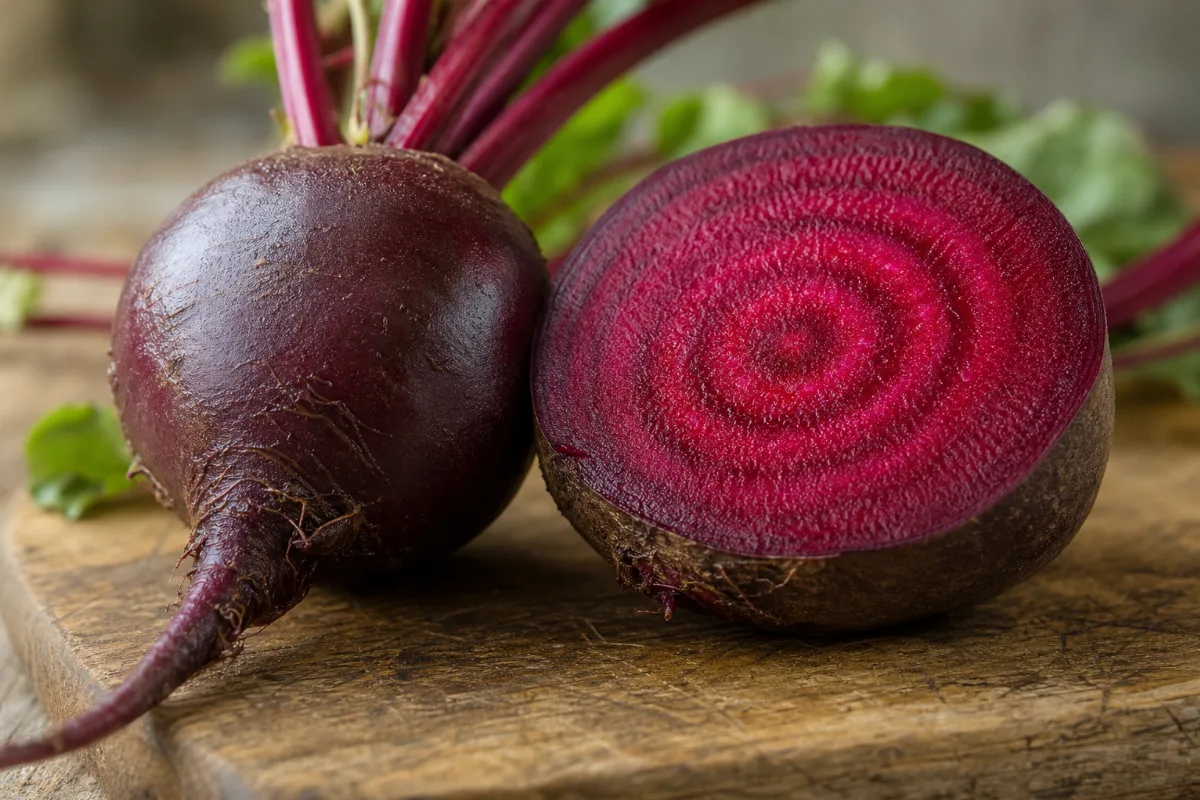
Beetroot is the swollen root of Beta vulgaris, a plant in the Amaranthaceae family (GBIF). It is eaten raw, boiled, baked or pickled, and is also made into juice and baked into bread. Its red colour comes from betacyanin pigments.
Beet juice has its own page, and this page is about the whole root vegetable. Where studies used juice, we say so.
What is in it
USDA data for raw beets, per 100 g: 43 kcal, 1.61 g protein, 9.56 g carbohydrate (6.76 g of it sugars), 2.8 g fibre, 109 micrograms folate (DFE), 325 mg potassium, 0.329 mg manganese and 4.9 mg vitamin C. A cup of raw beets (136 g) has about 58 kcal, 3.8 g fibre, 148 micrograms folate and 442 mg potassium.
Boiled beets are a little different: per 100 g, 44 kcal, 2.0 g fibre, 80 micrograms folate and 305 mg potassium. Cooking lowered folate and potassium per 100 g in the USDA tables. Canned, pickled and juice products were not read, so check their labels for added salt or sugar.
What the research shows on blood pressure
Beets are rich in inorganic nitrate. The body can turn it into nitrite and then nitric oxide, a molecule that relaxes blood vessels. A 2024 pooled analysis of 11 trials in 349 adults with high blood pressure found beetroot juice lowered clinic systolic pressure by 5.31 mmHg compared with placebo. There was no significant effect on diastolic or 24-hour pressure, and the authors rate certainty as low.
A 2023 pooled analysis of 19 nitrate trials found a small fall in systolic pressure in healthy people (2.42 mmHg) but no significant fall in people with high blood pressure. The two reviews disagree because they pooled different kinds of trials. All of these are small changes in a marker, not in heart attacks or strokes.
Exercise results are trivial. In 118 trials of nitrate- and polyphenol-rich foods, beetroot showed a small benefit for endurance performance, but there was no effect in females or in highly trained athletes.
Whole beet versus juice
Most trials used juice, which is a concentrated form and has less fibre than the root. Only two small studies tested beet as food. In 2012, healthy men who ate bread made with 100 g of red beetroot had lower blood pressure over 24 hours in one-time tests. In a 2016 pilot, 24 adults with high blood pressure had lower blood pressure after 2 weeks of cooked beet and after 2 weeks of raw juice, but there was no no-beet group.
In that pilot, raw juice did more than cooked beet for inflammation markers, blood vessel widening and cholesterol. That does not show that the whole root is weaker in everyday use; it is one small pilot. Eating beets as part of a varied diet is a normal food choice, not a treatment.
Food versus juice and other products
The blood pressure findings are mostly for beetroot juice. The nutrient figures are for raw and boiled beets. Powders, concentrates and capsules are different products and no source read tested them. Check bottled juice labels for added sugar, and see the beet juice page for juice-specific points.
At a glance
Traditional uses history, not proof
- Eaten as a root vegetable in many cuisines, raw, boiled, baked or pickled
- Long use as food is not proof that it treats any condition
Studied for research
- Folate, potassium, manganese and fibre, high certainty for the nutrient content
- Blood pressure with beet juice in people with high blood pressure, low certainty
- Blood pressure and dietary nitrate in healthy people, mixed results
- Blood pressure with whole beet or beet bread, very low certainty
- Endurance exercise, low certainty and trivial in size
- Blood vessel widening, inflammation markers and cholesterol, very low certainty (one small pilot)
- Heart attacks and strokes, insufficient evidence
Main compounds
- Inorganic nitrate
- Betacyanin pigments
- Dietary fibre
- Folate
- Potassium
- Manganese
- Oxalate
Common forms
- Raw beets and boiled beets, as food (USDA values read)
- Beetroot juice: most blood pressure trials used it; it has its own page
- Beetroot-enriched bread and cooked beet in two small studies
- Canned, pickled and powdered beet products (not covered)
Research links: 2024 review: beetroot juice and blood pressure (11 trials) · 2023 review: dietary nitrate and blood pressure (19 trials) · 2012 trial: beetroot juice and beetroot bread, blood pressure · Research Library · Genes & Biomarkers Library
What it is and its history
- Accepted scientific name
- Beta vulgaris L.
- Naming authority
- L. (GBIF accepted; the plant whose swollen root is eaten as beetroot)
- Common names
- Beetroot (English); Beets (English); Red beet (English); Garden beet (English); Table beet (English)
- Family or group
- Amaranthaceae, as given by GBIF.
- Classification
- Plantae > Tracheophyta > Magnoliopsida > Caryophyllales > Amaranthaceae > Beta > Beta vulgaris
- Native range
- Not verified from a source read.
- Habitat
- Not verified from a source read.
- What it looks like
- Roots: The eaten part is the swollen root. USDA gives household portions of 1 cup of raw beets (136 g) and one beet 2 inches across (82 g).; Stems: Not verified.; Leaves: Not verified. Beet greens were not researched.; Flowers: Not verified.
- Cultivation
- Not verified from a source read.
- Harvest and processing
- Eaten raw, boiled or baked, made into bread or juice. USDA lists raw and boiled beets, which are the two items read. Canned and pickled beets have separate USDA items that were not read. A 2012 trial used beetroot-enriched bread.
- Look-alikes and adulterants
- Name: Beet juice; Note: A drink with its own page; most blood pressure trials used juice.; Name: Beet greens and Swiss chard; Note: Leaves of related plants with different nutrients; not covered here.
- Sustainability and conservation
- Not assessed.
Photographs
What is inside, and how it may work
What it contains and how those compounds act in cells and animals. Laboratory and animal mechanisms are not proven effects in people.
Main compounds
| Compound | Family | Where it is concentrated | Activity studied | Level of evidence |
|---|---|---|---|---|
| Inorganic nitrate | inorganic anion | Root Described as high in beetroot; no per-100 g figure was read. The 2024 review describes the juice used in trials as supplying 200 to 800 mg of nitrate a day. | The body can turn it into nitrite and then nitric oxide, which relaxes blood vessels. This is the proposed route for the blood pressure results. 4 5 6 | Human data |
| Betacyanin pigments (red beet pigments) | pigment (betalain) | Root Not read. | Give beets their red colour and are the reason urine can turn pink or red (beeturia). A 2012 trial found a similar blood pressure effect with or without the red pigments in bread. 8 5 | Human data |
| Dietary fibre | carbohydrate | Root 2.8 g per 100 g raw; about 3.8 g in a cup of raw beets (USDA). Boiled: 2.0 g per 100 g. | Provides fibre in the diet. Not tested here as a treatment. 13 14 | Composition data |
| Folate | vitamin (B9) | Root 109 micrograms DFE per 100 g raw; 80 micrograms boiled (USDA). | A B vitamin; the content is a nutrient fact, not a trial result. 13 14 | Composition data |
| Potassium | mineral | Root 325 mg per 100 g raw; 305 mg boiled (USDA). | A mineral in the normal diet; the content is a nutrient fact. 13 14 | Composition data |
| Manganese | mineral | Root 0.329 mg per 100 g raw; 0.326 mg boiled (USDA). | A trace mineral in the normal diet; the content is a nutrient fact. 13 14 | Composition data |
| Oxalate | organic acid salt | Root No figure read; beet is named as a high-oxalate food in a 1999 review. | Can bind calcium and may contribute to kidney stones when excreted; cooking reduces it by leaching. 7 | Review |
Mechanisms, receptors and pathways
| Target or pathway | Gene or receptor | What was found | Level |
|---|---|---|---|
| Nitrate to nitrite to nitric oxide | Not specified in the sources read | Bacteria in the mouth turn dietary nitrate into nitrite, which the body can turn into nitric oxide. Urinary nitrate and nitrite rose after beetroot juice and red beetroot bread. Antibacterial mouthwash reduced the mouth step and was followed by a small rise in systolic pressure in treated hypertensive adults. 5 2 6 | Human data |
| Urine colour (beeturia) | Not specified | The red beet pigments are betacyanins. They colour the urine in some people; StatPearls says it is more common with iron deficiency or malabsorption. Early ideas of allergy or urinary infection were not supported. 8 | Human data |
Absorption, metabolism and elimination
- Absorption
- Not found for beet nutrients in people beyond the nitrate pathway above.
- Distribution
- Not found.
- Metabolism
- Nitrate is reduced to nitrite by mouth bacteria (see mechanisms).
- Elimination
- Urinary nitrate and nitrite rose after beetroot products; the pigments can appear in the urine.
- Bioavailability
- Not established for beet folate, potassium or manganese in people in the sources read.
Isolated compounds versus whole extracts
Most blood pressure trials used beetroot juice, which is lower in fibre than the root. Two small studies tested cooked beet or beet bread. In the 2016 pilot, raw juice had greater effects on inflammation markers, blood vessel widening and cholesterol than cooked beet; both improved blood pressure. Powders, concentrates and capsules are different products and were not covered by any source read.
Nutritional composition
Nutrition from USDA FoodData Central, SR Legacy (April 2018 download; values read 2026-10-26 from a saved copy because the public web service was rate-limited). Raw beets (FDC 169145), per 100 g: 43 kcal, 1.61 g protein, 0.17 g fat, 9.56 g carbohydrate of which 6.76 g sugars, 2.8 g fibre, 16 mg calcium, 0.8 mg iron, 23 mg magnesium, 40 mg phosphorus, 325 mg potassium, 78 mg sodium, 109 micrograms folate (DFE), 0.329 mg manganese, 4.9 mg vitamin C and 0.2 micrograms vitamin K. One cup of raw beets (136 g, the 100 g values multiplied by 1.36): about 58 kcal, 2.2 g protein, 13.0 g carbohydrate, 3.8 g fibre, 148 micrograms folate, 442 mg potassium, 0.45 mg manganese, 6.7 mg vitamin C and 106 mg sodium. One beet 2 inches across (82 g) has about 35 kcal. Boiled and drained beets (FDC 169146), per 100 g: 44 kcal, 1.68 g protein, 9.96 g carbohydrate of which 7.96 g sugars, 2.0 g fibre, 80 micrograms folate (DFE), 305 mg potassium, 77 mg sodium, 0.326 mg manganese; half a cup of slices (85 g) is about 37 kcal, 1.7 g fibre, 68 micrograms folate and 259 mg potassium. Cooking changed the figures (less folate and potassium per 100 g after boiling). Canned, pickled and juice values, and the nitrate content of beets, were not read. These are food facts, not advice on how much to eat.
1 high certainty1 mixed findings2 low certainty2 very low certainty1 not enough evidence
What was looked at
The 7 benefits and uses checked for Beetroot, each with how strong the evidence is. Tap one to open it.
- Folate, potassium, manganese and fibre (nutrient content)High certainty
- Blood pressure in people with high blood pressure (beetroot juice trials)Low certainty
- Blood pressure and dietary nitrate in healthy people (mixed results)Mixed findings
- Blood pressure from whole beet and beet bread (small studies)Very low certainty
- Endurance exercise performance (nitrate-rich foods)Low certainty
- Blood vessel widening, inflammation markers and cholesterol (a small pilot)Very low certainty
- Heart attacks, strokes and other heart outcomesNot enough evidence
Lab markers tracked in the studies
Clinic systolic blood pressureClinic diastolic blood pressure24-hour blood pressure (worn monitor)Flow-mediated dilation (artery widening)High-sensitivity C-reactive protein (hs-CRP)LDL cholesterol
What is Beetroot good for?
The main studied uses and how strong the human evidence is for each. Most blood pressure results are for beetroot juice, not for eating the root.
Benefits, one by one
Each card is a research question, not a promise. Tap a goal to filter. Open a card to see the studies, doses and limits.
Folate, potassium, manganese and fibre (nutrient content)
High certaintyRaw beets are a source of folate, potassium, manganese and fibre. By USDA data, a cup of raw beets (136 g) has about 148 micrograms of folate, 442 mg of potassium and 3.8 g of fibre.
2 studiesRaw and boiled beets from USDA tables. Canned, pickled and juice valu…
Studies, doses and limits
What the trials found
No trial was read showing that eating beets corrects low folate, potassium or any other nutrient.
Results
A nutrient source on paper. Cooking changes the numbers: boiled beets have less folate and potassium than raw beets in the USDA tables.
Effect sizes as reported
USDA, raw beets per 100 g: 43 kcal, 2.8 g fibre, 109 micrograms folate (DFE), 325 mg potassium, 0.329 mg manganese, 4.9 mg vitamin C. Boiled and drained, per 100 g: 44 kcal, 2.0 g fibre, 80 micrograms folate, 305 mg potassium.
Why this rating
High that the food contains these nutrients (USDA data). Not tested as a treatment for any condition.
Form and dose studied
Raw and boiled beets from USDA tables. Canned, pickled and juice values were not read.
Who was studied
General adult diet.
Limits
Nutrient facts, not trials. Values vary with variety, size and cooking. Canned and pickled beets can have added salt or sugar and were not read.
Why researchers looked
People eat beetroot as an everyday root vegetable, so its ordinary nutrients matter alongside any studied effects.
Traditional use
Beetroot is eaten as a food in many places. Long use as food is not proof that it treats any condition.
Proposed mechanism Nutrient database
These are nutrient amounts in the food, taken from USDA tables.
A proposed mechanism does not show that the effect happens in people.
See the Safety tab for red urine, oxalate and other points.
Blood pressure in people with high blood pressure (beetroot juice trials)
Low certaintyIn a 2024 pooled analysis of 11 trials in 349 adults with high blood pressure, beetroot juice lowered clinic systolic pressure by about 5 mmHg compared with placebo. There was no clear effect on diastolic or 24-hour pressure. The authors rate the certainty as low, and the trials used juice, not the whole vegetable.
1 studiesBeetroot juice supplying 200 to 800 mg of nitrate a day in the trials…
Studies, doses and limits
What the trials found
Eleven randomised trials (349 adults with clinic pressure of 140/90 or more) compared beetroot juice with placebo, water or no intake. Clinic systolic pressure was lower with juice. There was no significant effect on clinic diastolic pressure or on 24-hour pressure, and no sign that the effect wore off over time.
Results
A small fall in clinic systolic pressure with beetroot juice, in low-certainty evidence. It is not a replacement for blood pressure medicine.
Effect sizes as reported
Clinic systolic pressure -5.31 mmHg (95% CI -7.46 to -3.16; I2 64%; GRADE low).
Why this rating
Low, as the authors rate it: moderate to high differences between trials, and the effect on 24-hour pressure was not significant.
Form and dose studied
Beetroot juice supplying 200 to 800 mg of nitrate a day in the trials. This is what was studied, not advice. Juice has its own page.
Who was studied
Adults with high blood pressure.
Limits
Juice only, so it cannot show what eating the root does. Blood pressure is a marker, not a heart attack or stroke result. A second review (next entry) did not find a fall in people with high blood pressure.
Why researchers looked
Beetroot is rich in inorganic nitrate, which the body can turn into nitric oxide, a molecule that relaxes blood vessels.
Traditional use
Beetroot is eaten as a food in many places. Long use as food is not proof that it treats any condition.
Proposed mechanism Human physiology
Nitrate in beetroot is changed to nitrite by bacteria in the mouth and then to nitric oxide in the body. This is the proposed route; the trials measured blood pressure, not the route itself.
A proposed mechanism does not show that the effect happens in people.
People who take blood pressure medicine should ask their prescriber or pharmacist before making concentrated beet products a regular habit. Never stop a medicine on your own.
Blood pressure and dietary nitrate in healthy people (mixed results)
Mixed findingsA 2023 pooled analysis of 19 trials of inorganic nitrate found a small fall in systolic pressure in healthy people (about 2 mmHg) but no significant fall in people with high blood pressure. It disagrees with the 2024 juice review for people with high blood pressure.
2 studiesInorganic nitrate from several sources. Not beetroot alone.
Studies, doses and limits
What the trials found
In healthy people, systolic pressure fell by 2.42 mmHg, but diastolic and mean arterial pressure did not change significantly. In people with high blood pressure, nothing changed significantly, including 24-hour pressure.
Results
A small effect in healthy people, none clear in people with high blood pressure. The two reviews pooled different kinds of trials: the 2024 one only beetroot juice, the 2023 one nitrate from mixed sources.
Effect sizes as reported
Healthy: systolic -2.42 mmHg (95% CI -4.28 to -0.57). High blood pressure: systolic -0.82 mmHg (95% CI -2.53 to 0.90), not significant.
Why this rating
Mixed: the two reviews disagree for people with high blood pressure, and the 2023 one pooled nitrate that was not always from beets.
Form and dose studied
Inorganic nitrate from several sources. Not beetroot alone.
Who was studied
Healthy adults, and adults with high blood pressure.
Limits
Mixed nitrate sources; the abstract does not say how many trials used beets. Searches ended in December 2021.
Why researchers looked
Researchers asked whether nitrate on its own, from vegetables or other sources, changes blood pressure.
Traditional use
Beetroot is eaten as a food in many places. Long use as food is not proof that it treats any condition.
Proposed mechanism Human physiology
Same nitrate to nitric oxide route as above; not measured in this analysis.
A proposed mechanism does not show that the effect happens in people.
See the Safety tab on blood pressure medicines.
Blood pressure from whole beet and beet bread (small studies)
Very low certaintyTwo small studies looked at beet as food rather than juice. In healthy men, bread made with 100 g of red beetroot lowered blood pressure over 24 hours. In 24 adults with high blood pressure, two weeks of cooked beet and two weeks of raw juice both went with lower blood pressure, but there was no no-beet group.
2 studiesCooked beet (250 g a day) and bread with 100 g of beetroot, as used i…
Studies, doses and limits
What the trials found
Hobbs 2012: in two single-blind crossover tests in healthy men, bread with 100 g of red beetroot lowered systolic and diastolic pressure over 24 hours (red beetroot bread P<0.05). Asgary 2016: in a crossover pilot of 24 adults with high blood pressure, 250 g a day of cooked beet for 2 weeks and 250 ml a day of raw beet juice for 2 weeks both improved blood pressure (P<0.05), with greater effects from the juice on inflammation markers and blood vessel widening.
Results
Suggestive for whole beet, but small, short and without a no-beet comparison in the pilot.
Effect sizes as reported
Numbers of mmHg were not in either abstract. Hobbs: one-time tests in 14 men for bread. Asgary: 24 people, 2 weeks per form.
Why this rating
Very low: two small studies, one in healthy men and one a pilot with no no-beet group, abstracts only, with no mmHg figures.
Form and dose studied
Cooked beet (250 g a day) and bread with 100 g of beetroot, as used in the studies. Not advice.
Who was studied
Healthy men with normal blood pressure; adults with high blood pressure.
Limits
Small, short, abstract-only, single-blind or no control group. The pilot cannot separate beets from the effect of simply taking part.
Why researchers looked
Most trials use juice, so people ask whether eating the root works the same way.
Traditional use
Beetroot is eaten as a food in many places. Long use as food is not proof that it treats any condition.
Proposed mechanism Human physiology
Same nitrate route as above. In the bread study, urinary nitrate and nitrite rose after red beetroot bread, which fits more nitrate being taken in.
A proposed mechanism does not show that the effect happens in people.
See the Safety tab.
Endurance exercise performance (nitrate-rich foods)
Low certaintyA 2021 pooled analysis of 118 trials found nitrate-rich foods gave a trivial benefit for endurance exercise. Among nitrate-rich foods, beetroot showed a benefit while red spinach, Swiss chard and rhubarb did not. No effect was seen in females or in highly trained endurance athletes.
1 studiesFoods and beverages rich in nitrate. The abstract does not split juic…
Studies, doses and limits
What the trials found
In the pooled analysis, nitrate-rich foods gave a trivial but significant benefit for time trials and time to exhaustion (SMD 0.15). The benefit was seen for beetroot but not for the other nitrate-rich foods tested. Highly trained males did not appear to benefit, and no effect was found in females.
Results
A very small effect, food-dependent, absent in some groups.
Effect sizes as reported
Nitrate-rich foods SMD 0.15 (p<0.001). Beetroot-specific figures were not in the abstract.
Why this rating
Low: trivial size, considerable differences between studies, and the abstract does not say which beetroot forms (juice, whole root or powder) were used.
Form and dose studied
Foods and beverages rich in nitrate. The abstract does not split juice from whole beet.
Who was studied
Mostly physically active adults and athletes; no benefit in females or highly trained men.
Limits
Trivial effect. The abstract does not separate juice from whole beet. Not a result for everyday health.
Why researchers looked
Nitric oxide may help muscles use oxygen, so athletes have tried beetroot. Most beetroot sport trials use juice, which has its own page.
Traditional use
Beetroot is eaten as a food in many places. Long use as food is not proof that it treats any condition.
Proposed mechanism Human physiology
Nitrate may raise nitric oxide, which could help blood flow and oxygen use. Not shown in this analysis.
A proposed mechanism does not show that the effect happens in people.
See the Safety tab.
Blood vessel widening, inflammation markers and cholesterol (a small pilot)
Very low certaintyIn a 2-week crossover pilot of 24 adults with high blood pressure, raw beet juice and cooked beet both improved blood vessel widening and lowered several inflammation markers. Only the raw juice lowered LDL and total cholesterol.
1 studiesRaw beet juice 250 ml a day and cooked beet 250 g a day, as used in t…
Studies, doses and limits
What the trials found
Both forms increased flow-mediated dilation (a test of how well an artery widens) and lowered markers including hs-CRP, TNF-alpha, ICAM-1, VCAM-1, interleukin-6 and E-selectin (P<0.05). Raw juice had greater effects than cooked beet on hs-CRP, TNF-alpha and flow-mediated dilation, and lowered LDL, non-HDL and total cholesterol, which cooked beet did not.
Results
Interesting but preliminary. The juice, not the whole cooked root, produced the cholesterol change.
Effect sizes as reported
Exact changes were not in the abstract.
Why this rating
Very low: 24 people, 2 weeks, no no-beet comparison group, abstract only.
Form and dose studied
Raw beet juice 250 ml a day and cooked beet 250 g a day, as used in the pilot. Not advice.
Who was studied
Adults aged 25 to 68 with high blood pressure.
Limits
A pilot with no separate no-beet group, so the changes may not come from beets. Short. Markers, not disease outcomes.
Why researchers looked
Researchers measured blood vessel function and inflammation alongside blood pressure.
Traditional use
Beetroot is eaten as a food in many places. Long use as food is not proof that it treats any condition.
Proposed mechanism None studied
Not studied in this pilot; the pilot measured outcomes only.
A proposed mechanism does not show that the effect happens in people.
See the Safety tab.
Heart attacks, strokes and other heart outcomes
Not enough evidenceNo trial or review read measured heart attacks, strokes or death from eating beets. Blood pressure is a marker, not proof of fewer heart events.
1 studiesNot applicable.
Studies, doses and limits
Results
Not shown.
Why this rating
Insufficient: no outcome studies were found in the sources read.
Limits
An absence of evidence in the sources read, not evidence of no benefit or of harm.
Why researchers looked
Lower blood pressure is often assumed to lower heart risk, but that has to be shown for beets.
Traditional use
Beetroot is eaten as a food in many places. Long use as food is not proof that it treats any condition.
Proposed mechanism None studied
Not applicable.
A proposed mechanism does not show that the effect happens in people.
See the Safety tab.
Connections to the rest of health
How Beetroot connects to the rest of our health knowledge graph. Every link says what kind of connection it is. A safety link (for example to the liver) is a warning, not a benefit. A study that merely mentions a topic never creates a benefit link.
Explore every connection: goals, body systems, organs, symptoms, genes
A. Wellness goals
| Connected to | Kind of connection | Evidence status | Context | Studies |
|---|---|---|---|---|
| Preventive Wellness | High certainty | Folate, potassium, manganese and fibre (nutrient content): Raw beets are a source of folate, potassium, manganese and fibre. By USDA data, a cup of raw beets (136 g) has about 148 micrograms of folate, 442 mg of potassium and 3.8 g of fibre. | 13 14 | |
| Blood Pressure Support | Low certainty | Blood pressure in people with high blood pressure (beetroot juice trials): In a 2024 pooled analysis of 11 trials in 349 adults with high blood pressure, beetroot juice lowered clinic systolic pressure by about 5 mmHg compared with placebo. There was no clear effect on diastolic or 24-hour pressure. The authors rate the certainty as low, and the trials used juice, not the whole vegetable. Blood pressure and dietary nitrate in healthy people (mixed results): A 2023 pooled analysis of 19 trials of inorganic nitrate found a small fall in systolic pressure in healthy people (about 2 mmHg) but no significant fall in people with high blood pressure. It disagrees with the 2024 juice review for people with high blood pressure. | 4 9 5 1 | |
| Heart Health | Low certainty | Blood pressure in people with high blood pressure (beetroot juice trials): In a 2024 pooled analysis of 11 trials in 349 adults with high blood pressure, beetroot juice lowered clinic systolic pressure by about 5 mmHg compared with placebo. There was no clear effect on diastolic or 24-hour pressure. The authors rate the certainty as low, and the trials used juice, not the whole vegetable. Blood vessel widening, inflammation markers and cholesterol (a small pilot): In a 2-week crossover pilot of 24 adults with high blood pressure, raw beet juice and cooked beet both improved blood vessel widening and lowered several inflammation markers. Only the raw juice lowered LDL and total cholesterol. | 4 1 | |
| Physical Stamina | Low certainty | Endurance exercise performance (nitrate-rich foods): A 2021 pooled analysis of 118 trials found nitrate-rich foods gave a trivial benefit for endurance exercise. Among nitrate-rich foods, beetroot showed a benefit while red spinach, Swiss chard and rhubarb did not. No effect was seen in females or in highly trained endurance athletes. | 10 | |
| Muscle Recovery | Low certainty | Endurance exercise performance (nitrate-rich foods): A 2021 pooled analysis of 118 trials found nitrate-rich foods gave a trivial benefit for endurance exercise. Among nitrate-rich foods, beetroot showed a benefit while red spinach, Swiss chard and rhubarb did not. No effect was seen in females or in highly trained endurance athletes. | 10 | |
| Inflammation Balance | Very low certainty | Blood vessel widening, inflammation markers and cholesterol (a small pilot): In a 2-week crossover pilot of 24 adults with high blood pressure, raw beet juice and cooked beet both improved blood vessel widening and lowered several inflammation markers. Only the raw juice lowered LDL and total cholesterol. | 1 | |
| Cholesterol Balance | Very low certainty | Blood vessel widening, inflammation markers and cholesterol (a small pilot): In a 2-week crossover pilot of 24 adults with high blood pressure, raw beet juice and cooked beet both improved blood vessel widening and lowered several inflammation markers. Only the raw juice lowered LDL and total cholesterol. | 1 | |
| Heart Health | Not enough evidence | Heart attacks, strokes and other heart outcomes: No trial or review read measured heart attacks, strokes or death from eating beets. Blood pressure is a marker, not proof of fewer heart events. | 4 |
B. Body systems
| Connected to | Kind of connection | Evidence status | Context | Studies |
|---|---|---|---|---|
| Nutrition | Biological association | High certainty | Studied for: Folate, potassium, manganese and fibre (nutrient content) | 13 14 |
| Cardiovascular System | Biological association | Low certainty | Studied for: Blood pressure in people with high blood pressure (beetroot juice trials) Studied for: Blood pressure and dietary nitrate in healthy people (mixed results) | 4 9 5 1 |
| Musculoskeletal System | Biological association | Low certainty | Studied for: Endurance exercise performance (nitrate-rich foods) | 10 |
E. Health conditions
| Connected to | Kind of connection | Evidence status | Context | Studies |
|---|---|---|---|---|
| Kidney stones | Adverse effect or risk | Theoretical risk | A 1999 review names beet as a high-oxalate food; no study of beets and stones in people was read. Beet is named as a high-oxalate food in a 1999 review; no beet-specific stone study was read. Preparation or compound: Oxalate in beetroot |
7 |
| Beeturia (red urine) | Adverse effect or risk | Documented risk | Pink to deep red urine in about 10% to 14% of the population. Preparation or compound: Betacyanin pigments in beetroot |
8 |
| High blood pressure | Preliminary | Beet juice lowered clinic systolic pressure by about 5 mmHg in a 2024 pooled analysis, with low certainty. Preparation or compound: Beetroot juice |
4 9 |
I. Biomarkers
| Connected to | Kind of connection | Evidence status | Context | Studies |
|---|---|---|---|---|
| Clinic systolic blood pressure | Biological association | Low certainty | Measured in trials: lowered. A lab change is not the same as a health benefit. | 4 9 5 |
| Clinic diastolic blood pressure | Biological association | Low certainty | Measured in trials: no clear change. A lab change is not the same as a health benefit. | 4 9 |
| 24-hour blood pressure (worn monitor) | Biological association | Low certainty | Measured in trials: no clear change. A lab change is not the same as a health benefit. | 4 9 |
| Flow-mediated dilation (artery widening) | Biological association | Very low certainty | Measured in trials: raised. A lab change is not the same as a health benefit. | 1 |
| High-sensitivity C-reactive protein (hs-CRP) | Biological association | Very low certainty | Measured in trials: lowered. A lab change is not the same as a health benefit. | 1 |
| LDL cholesterol | Biological association | Very low certainty | Measured in trials: lowered with juice, no change with cooked beet. A lab change is not the same as a health benefit. | 1 |
K. Biological pathways
| Connected to | Kind of connection | Evidence status | Context | Studies |
|---|---|---|---|---|
| Inorganic nitrate | Preliminary mechanism | Human | The nitrate to nitric oxide route is the proposed basis of the blood pressure results. | 4 5 |
| Folate | Preliminary mechanism | Composition data | Raw beets are a folate source on paper (USDA). | 13 |
| Potassium | Preliminary mechanism | Composition data | Raw beets have 325 mg per 100 g (USDA). | 13 |
| Oxalate | Preliminary mechanism | Review | Beet is named as a high-oxalate food in a 1999 review. | 7 |
L. Active compounds
| Connected to | Kind of connection | Evidence status | Context | Studies |
|---|---|---|---|---|
| Inorganic nitrate | Biological association | Human | The body can turn it into nitrite and then nitric oxide, which relaxes blood vessels. This is the proposed route for the blood pressure results. Preparation or compound: Root |
4 5 6 |
| Betacyanin pigments (red beet pigments) | Biological association | Human | Give beets their red colour and are the reason urine can turn pink or red (beeturia). A 2012 trial found a similar blood pressure effect with or without the red pigments in bread. Preparation or compound: Root |
8 5 |
| Dietary fibre | Biological association | Composition data | Provides fibre in the diet. Not tested here as a treatment. Preparation or compound: Root |
13 14 |
| Folate | Biological association | Composition data | A B vitamin; the content is a nutrient fact, not a trial result. Preparation or compound: Root |
13 14 |
| Potassium | Biological association | Composition data | A mineral in the normal diet; the content is a nutrient fact. Preparation or compound: Root |
13 14 |
| Manganese | Biological association | Composition data | A trace mineral in the normal diet; the content is a nutrient fact. Preparation or compound: Root |
13 14 |
| Oxalate | Biological association | Review | Can bind calcium and may contribute to kidney stones when excreted; cooking reduces it by leaching. Preparation or compound: Root |
7 |
Each connection is stored with the ingredient, the connected record, the kind of connection, the evidence status, the supporting studies, the preparation or compound involved, and a review date (last reviewed October 26, 2026).
Evidence at a glance: what changed in 3 lab markers
Tap a number to show only those markers. Counts are markers, not people.
The evidence
The research centre for Beetroot. Every record here was checked against PubMed or the publisher's page; we never list a study we have not verified.
Evidence by outcome
Bars show how many studies we found for each outcome, not how well it works. People are added up across trials only (reviews are not added, to avoid double counting).
How we rate evidence
High certainty
Several well-run trials or reviews agree; further research is unlikely to change the picture much.
Moderate certainty
Good trials point the same way, but some doubt remains.
Low certainty
Small, short or inconsistent trials. The finding could change with better research.
Very low certainty
Very little or very weak human data. Treat as a possibility only.
Mixed findings
Trials or reviews disagree with each other.
Not enough evidence
Not enough human research to say either way.
Evidence against
Good research found no benefit, or found harm.
We take the reviewers' own risk-of-bias and GRADE statements where they exist, and otherwise judge from study size, design, consistency, directness and whether a product matches what is sold. Many publications do not make evidence high. Method note: We started from our existing page and nutrient summary for beets, re-read the PubMed abstracts for the reviews, trials and reference articles, re-read USDA FoodData Central values from a saved copy, checked the species name in GBIF and read the FDA produce page. Only abstracts were read for studies. Items we could not verify are flagged in the research gaps.
Study library: every study we checked 14
| Study | Design | People | Product, dose, length | Result |
|---|---|---|---|---|
| Asgary 2016 Improvement of hypertension, endothelial function and systemic inflammation following short-term supplementation with red beet (Beta vulgaris L.) juice: a randomized crossover pilot study. J Hum Hypertens · PMID 27278926 · DOI |
Randomised crossover trial |
24 24 adults aged 25 to 68 with high blood pressure |
Raw red beet juice (250 ml a day) and cooked beet (250 g a day) Raw juice and cooked whole beet As in the trial: 250 ml juice or 250 g cooked beet a day (not advice) 2 weeks on each, 2 weeks washout between · vs The other beet form (each person had both); no no-beet control group |
Both forms improved blood pressure, blood vessel widening and several inflammation markers. Raw juice had greater effects than cooked beet on inflammation markers and blood vessel widening, and lowered blood fats (LDL, total and non-HDL cholesterol) while cooked beet did not. Systolic and diastolic blood pressure fell with both forms (P<0.05); exact mmHg not in the abstract (Not given in the abstract) Methods, limits and fundingOutcomes: Blood pressure, flow-mediated dilation (blood vessel widening), blood fats, inflammation markers Limitations: A pilot study of 24 people with no separate no-beet group, so changes cannot be put down to beets alone. Short (2 weeks). Funding and conflicts: Funding is listed as non-US government research support; no industry funder is named in the record. Read: abstract |
| Bondonno 2015 Antibacterial mouthwash blunts oral nitrate reduction and increases blood pressure in treated hypertensive men and women. Am J Hypertens · PMID 25359409 · DOI |
Randomised crossover trial |
15 15 men and women (mean age 65) with high blood pressure on treatment |
Antibacterial mouthwash (not a beet product) Three days of use 3 days · vs Water |
Three days of antibacterial mouthwash reduced the conversion of nitrate to nitrite in the mouth and was followed by a small rise in systolic blood pressure. Diastolic pressure and plasma cGMP did not change significantly. Systolic blood pressure +2.3 mmHg (95% CI 0.5 to 4.0) Methods, limits and fundingOutcomes: Oral nitrate-to-nitrite reduction, salivary and plasma nitrate and nitrite, blood pressure Limitations: Small trial with no beet or nitrate food given. It shows the mouth step matters for the nitrate pathway; it does not test beets. Funding and conflicts: Funding is listed as non-US government research support; no industry funder is named in the record. Read: abstract |
| Greer 2005 Infant methemoglobinemia: the role of dietary nitrate in food and water. Pediatrics · PMID 16140723 · DOI |
Clinical report |
Infants (methaemoglobinaemia from nitrate) | Dietary nitrate in well water and home-prepared vegetable foods Water and vegetable foods (the abstract does not name beets) |
Infants given formula made with well water remain a high-risk group. There seems to be little or no risk of nitrate poisoning from commercially prepared infant foods in the United States, but reports of nitrate poisoning from home-prepared vegetable foods for infants continue to occur. Breastfeeding infants are not at risk even when mothers drink water with very high nitrate. No numbers in the abstract (Not applicable) Methods, limits and fundingOutcomes: Risk of nitrate poisoning (methaemoglobinaemia) in infants Limitations: A 2005 clinical report; the abstract does not name beets, so this is general vegetable guidance, not beet-specific. Funding and conflicts: Report of the American Academy of Pediatrics; funding is not stated in the abstract. Read: abstract |
| Grönroos 2024 Effects of beetroot juice on blood pressure in hypertension according to European Society of Hypertension Guidelines: A systematic review and meta-analysis. Nutr Metab Cardiovasc Dis · PMID 39069465 · DOI |
Systematic review meta analysis |
349 11 randomised trials, 349 adults with high blood pressure (clinic pressure 140/90 mmHg or higher) |
Nitrate-rich beetroot juice Juice (not the whole root) 200 to 800 mg of nitrate a day, from the juice (as stated in the abstract; not advice) Daily intake; trial lengths not given in the abstract · vs Placebo, water or no intake |
Beetroot juice lowered clinic systolic blood pressure compared with placebo. There was no significant effect on clinic diastolic or 24-hour blood pressure, and no sign of tolerance developing. The authors rate the certainty of the evidence as low. Clinic systolic pressure MD -5.31 mmHg (I2 64%, GRADE low) (95% CI -7.46 to -3.16) Methods, limits and fundingOutcomes: Clinic systolic and diastolic blood pressure, 24-hour blood pressure Limitations: Juice only, so it cannot show what the whole vegetable does. Moderate to high differences between trials. The abstract does not report drug interactions. Funding and conflicts: Funding is listed as non-US government research support; no industry funder is named in the record. Read: abstract |
| Hobbs 2012 Blood pressure-lowering effects of beetroot juice and novel beetroot-enriched bread products in normotensive male subjects. Br J Nutr · PMID 22414688 · DOI |
Randomised crossover trial |
32 Two single-blind crossover studies in healthy men with normal blood pressure: juice (18 men) and bread (14 men) |
Beetroot juice (0, 100, 250 or 500 g) and bread made with 100 g of red or white beetroot Juice and beetroot-enriched bread Single amounts as stated (trial design, not advice) One-time (postprandial) tests; blood pressure followed for 24 hours · vs Water; control bread with no beetroot |
Beetroot juice lowered systolic and diastolic pressure over 24 hours in a near dose-dependent way. Bread made with 100 g of red beetroot lowered both pressures too; the white-beetroot bread result was not significant for urinary nitrate. The authors say the effect of the 100 g amount was not changed by processing or by the red pigments. Juice: systolic P<0.01, diastolic P<0.001 versus water. Red beetroot bread: P<0.05 (numbers of mmHg not in the abstract) (Not given in the abstract) Methods, limits and fundingOutcomes: 24-hour ambulatory blood pressure and urinary nitrate/nitrite Limitations: Healthy men with normal blood pressure, one-time tests, single-blind, small. Does not show an effect in people with high blood pressure or over weeks. Funding and conflicts: Funding is listed as non-US government research support; no industry funder is named in the record. Read: abstract |
| Hord 2009 Food sources of nitrates and nitrites: the physiologic context for potential health benefits. Am J Clin Nutr · PMID 19439460 · DOI |
Narrative review n/a |
Review plus a lab measurement of nitrate and nitrite in a convenience sample of foods | Dietary nitrate and nitrite from vegetables, fruit and processed meats Vegetables and fruit (the abstract does not name beets) |
About 80% of dietary nitrate comes from vegetables. Nitrate in food is linked to a possible risk of gastrointestinal cancer and, in infants, methaemoglobinaemia; the authors argue that nitrate from plant foods may also be beneficial and that limits on plant nitrate deserve re-evaluation. A high-nitrate DASH-style pattern had nitrate far above the WHO acceptable daily intake (550% for a 60 kg adult) (Not applicable) Methods, limits and fundingOutcomes: Nitrate and nitrite in foods; how vegetable nitrate might relate to the blood-pressure effects of the DASH diet Limitations: A 2009 review with a small convenience sample of foods. Argues a position; it is not a trial. The abstract does not name beets. Funding and conflicts: Funding is listed as non-US government research support; the authors include researchers in a nitric oxide field. No industry funder is named in the record. Read: abstract |
| Noonan 1999 Oxalate content of foods and its effect on humans. Asia Pac J Clin Nutr · PMID 24393738 |
Narrative review n/a |
Review of oxalate in foods and its effects | Oxalate in plant foods Foods in general; beet is named as a high-oxalate food |
Oxalate in food can bind calcium and, when excreted in the urine, may contribute to stone formation. Soaking and cooking reduce oxalate by leaching. The review names rhubarb, spinach and beet as common high-oxalate foods and says that occasional high-oxalate foods in a nutritious diet pose no particular problem. No beet figure in the abstract (Not applicable) Methods, limits and fundingOutcomes: Oxalate content of foods; stones; mineral binding Limitations: A 1999 review. The abstract gives no beet oxalate value and no data on beets and stones in people. Funding and conflicts: Funding is not stated in the abstract. Read: abstract |
| Sauder 2023 Beeturia StatPearls (NCBI Bookshelf NBK537012) · PMID 30725697 |
Clinical reference guide |
General reference on pink or red urine after eating beets | Beets and beet-coloured foods Root |
Beeturia is pink to deep red urine after eating beets or foods coloured with beetroot. It is described as present in 10% to 14% of the population, more often in people who are iron deficient or have malabsorptive diseases. The pigments are betacyanins. Early ideas that it came from food allergy or urinary infection were not supported. Prevalence 10% to 14% of the population (Not applicable) Methods, limits and fundingOutcomes: Urine discolouration (beeturia) Limitations: A reference article; only the abstract and the record's section headings were read, not the full text, so advice on what to do was not read. Funding and conflicts: Not applicable (reference article). Read: abstract |
| Zhang 2023 Regulatory effect of dietary nitrate on blood pressure: a meta-analysis of randomized controlled trials. Food Funct · PMID 36740972 · DOI |
Systematic review meta analysis |
19 randomised controlled trials of inorganic nitrate (healthy people and people with high blood pressure) | Inorganic nitrate (from vegetables such as beets or from other nitrate products; the abstract does not split these) Mixed nitrate sources Not given in the abstract Not given in the abstract · vs Control |
In healthy people, inorganic nitrate lowered systolic pressure but not diastolic or mean arterial pressure. In people with high blood pressure it did not lower systolic, diastolic or 24-hour pressure. The authors say further research is needed. Healthy: systolic -2.42 mmHg. High blood pressure: systolic -0.82 mmHg (not significant) (Healthy systolic -4.28 to -0.57; high blood pressure systolic -2.53 to 0.90) Methods, limits and fundingOutcomes: Systolic, diastolic and mean arterial pressure; 24-hour ambulatory blood pressure Limitations: Pooled nitrate from different sources, not beetroot alone. Searches stopped in December 2021. It disagrees with the 2024 juice-only review for people with high blood pressure. Funding and conflicts: Funding is not stated in the abstract. Read: abstract |
| d'Unienville 2021 Effect of food sources of nitrate, polyphenols, L-arginine and L-citrulline on endurance exercise performance: a systematic review and meta-analysis of randomised controlled trials. J Int Soc Sports Nutr · PMID 34965876 · DOI |
Systematic review meta analysis |
118 randomised trials of endurance exercise; 56 nitrate studies, 59 polyphenol studies, 3 L-citrulline studies | Foods rich in nitrate (beetroot, red spinach, Swiss chard, rhubarb) and polyphenols Mixed food sources; the abstract does not say which beetroot forms (juice, whole, powder) were used Varied Acute and multi-day · vs Placebo or control |
Nitrate-rich foods gave a trivial but significant benefit overall. Among nitrate-rich foods, benefit was seen for beetroot but not for red spinach, Swiss chard or rhubarb. No effect was found in females, and highly trained endurance athletes did not appear to benefit from nitrate-rich foods. Nitrate foods SMD 0.15 (p<0.001); polyphenol foods SMD 0.17 (Not given in the abstract) Methods, limits and fundingOutcomes: Endurance exercise performance (time trial, time to exhaustion, intermittent tests) Limitations: Trivial size. Considerable differences between studies. The abstract does not separate beetroot juice from whole beet. Funding and conflicts: The authors state no funding was provided. Registration: Open Science Framework (osf.io/u7nsj) Read: abstract |
| s-fda-produce US FDA: Selecting and Serving Produce Safely · Source |
Regulator guidance n/a |
Methods, limits and fundingRead: full-text | ||
| s-gbif-beta-vulgaris GBIF Backbone: Beta vulgaris L. (usageKey 8971274) · Source |
Reference database n/a |
Methods, limits and fundingRead: full-text | ||
| s-usda-fdc-169145 USDA FoodData Central, SR Legacy: Beets, raw (FDC 169145) · Source |
Reference database n/a |
Methods, limits and fundingRead: full-text | ||
| s-usda-fdc-169146 USDA FoodData Central, SR Legacy: Beets, cooked, boiled, drained (FDC 169146) · Source |
Reference database n/a |
Methods, limits and fundingRead: full-text |
What we do not know yet
- Most blood pressure trials used beetroot juice; only two small studies tested cooked beet or beet bread, and neither counted heart attacks or strokes.
- No beet oxalate figure and no study of beets and kidney stones in people were read.
- Nitrate and pigment content of beets per 100 g, beet greens, and canned, pickled or powdered beets were not researched.
- Allergy, gout, FODMAP and potassium advice for kidney disease were not researched, and no official statement for pregnancy or breastfeeding was found.
- Only abstracts were read; the NIDDK kidney stone page could not be read.
How new research is added
New studies are found by a saved PubMed search and placed in a review queue before the page changes.
Lab markers
What changed in blood or saliva tests during trials. A changed number is not the same as feeling or being healthier, and we give no "normal ranges".
Metabolic 1
LDL cholesterol
Lowered with juice, no change with cooked beet in trials
The 'bad' cholesterol carried in the blood. Higher levels are linked to more heart disease.
Very low certaintyResults and what it means
Why it was measured
It is the usual marker used in diet trials for heart risk.
Statistical vs. clinical meaning
A pilot finding; exact changes were not in the abstract.
Safety implication
None specific.
| Study | Result | People | Product |
|---|---|---|---|
| 1 | LDL, non-HDL and total cholesterol decreased with raw beet juice but not with cooked beet | 24 adults with high blood pressure | Raw juice 250 ml a day or cooked beet 250 g a day, 2 weeks each |
Inflammatory 1
High-sensitivity C-reactive protein (hs-CRP)
Lowered in trials
A blood marker that rises with general inflammation in the body.
Very low certaintyResults and what it means
Why it was measured
It is a common marker of low-level inflammation.
Statistical vs. clinical meaning
A pilot finding with no no-beet comparison group.
Safety implication
None specific.
| Study | Result | People | Product |
|---|---|---|---|
| 1 | hs-CRP fell with both raw beet juice and cooked beet (P<0.05), more with the juice | 24 adults with high blood pressure | Raw juice or cooked beet, 2 weeks each |
Other 4
Clinic systolic blood pressure
Lowered in trials
The top number in a blood pressure reading, taken in a clinic.
Low certaintyResults and what it means
Why it was measured
It is the usual marker used in beet trials for heart and circulation risk.
Statistical vs. clinical meaning
A small average fall in juice trials, with low certainty and mixed results across reviews.
Safety implication
None specific.
| Study | Result | People | Product |
|---|---|---|---|
| 4 | Clinic systolic -5.31 mmHg (95% CI -7.46 to -3.16) with beetroot juice versus placebo | 11 trials, 349 adults with high blood pressure | Beetroot juice, 200 to 800 mg of nitrate a day |
| 9 | Systolic -2.42 mmHg (95% CI -4.28 to -0.57) in healthy people; -0.82 mmHg (not significant) in people with high blood pressure | 19 trials of inorganic nitrate | Inorganic nitrate from mixed sources |
| 5 | Lower systolic pressure over 24 hours after bread with 100 g of red beetroot (P<0.05); no mmHg given in the abstract | 14 healthy men | Beetroot-enriched bread, one-time test |
Clinic diastolic blood pressure
No clear change in trials
The bottom number in a blood pressure reading.
Low certaintyResults and what it means
Why it was measured
It is reported along with systolic pressure in every blood pressure trial.
Statistical vs. clinical meaning
No clear change in the pooled trials.
Safety implication
None specific.
| Study | Result | People | Product |
|---|---|---|---|
| 4 | No significant effect on clinic diastolic pressure with beetroot juice | 11 trials, 349 adults with high blood pressure | Beetroot juice |
| 9 | Diastolic -0.58 mmHg (not significant) in healthy people; -0.03 mmHg (not significant) in people with high blood pressure | 19 trials of inorganic nitrate | Inorganic nitrate |
24-hour blood pressure (worn monitor)
No clear change in trials
Blood pressure measured over a full day with a wearable monitor, which can show how pressure behaves outside the clinic.
Low certaintyResults and what it means
Why it was measured
It gives a fuller picture than a single clinic reading.
Statistical vs. clinical meaning
The clinic and 24-hour results do not match, which is one reason certainty is low.
Safety implication
None specific.
| Study | Result | People | Product |
|---|---|---|---|
| 4 | No significant effect on 24-hour blood pressure with beetroot juice | 11 trials, 349 adults with high blood pressure | Beetroot juice |
| 9 | 24-hour systolic -0.22 mmHg and diastolic -0.33 mmHg in people with high blood pressure, not significant | People with high blood pressure in the nitrate trials | Inorganic nitrate |
Flow-mediated dilation (artery widening)
Raised in trials
A test of how well an artery widens when blood flow increases; a higher value means the lining of the vessel is working better.
Very low certaintyResults and what it means
Why it was measured
It is a common marker of blood vessel health.
Statistical vs. clinical meaning
A pilot finding with no no-beet comparison group.
Safety implication
None specific.
| Study | Result | People | Product |
|---|---|---|---|
| 1 | Flow-mediated dilation increased with both raw beet juice and cooked beet (P<0.05), more with the juice | 24 adults with high blood pressure | Raw juice 250 ml a day or cooked beet 250 g a day, 2 weeks each |
Safety
What studies and official sources say about side effects, medicines and who should check first. Each point shows what kind of evidence it comes from.
Main points to know 5
- Pink or red urine (beeturia) is common. Beets can turn urine pink to deep red. StatPearls describes this as present in 10% to 14% of the population, and more often in people who are iron deficient or have malabsorptive diseases. The pigments are betacyanins. Red urine can also have other causes, so ask a clinician if you are unsure or have other symptoms. Clinical reference 8
- Oxalate and kidney stones. A 1999 review names beet, with rhubarb and spinach, as a common high-oxalate food. Oxalate in food can bind calcium, and when it passes into the urine it may contribute to stone formation. The review says cooking and soaking lower oxalate by leaching, and that an occasional high-oxalate food in an otherwise nutritious diet is not a particular problem. The abstract gives no beet figure, and no study of beets and stones in people was read. If you have had kidney stones, ask a clinician or dietitian. Narrative review 7
- Blood pressure medicines. Beets are studied for lowering blood pressure, so a reasonable question is whether they add to blood pressure medicine. No source read describes a specific interaction. Beet juice is not a replacement for medicine. Never stop or change a prescribed medicine on your own; a pharmacist can check your list. Theoretical 4
- Babies and home-prepared vegetable foods. The American Academy of Pediatrics says nitrate poisoning (methaemoglobinaemia) is a risk for infants given formula made with well water. It says there seems to be little or no risk from commercially prepared infant foods in the United States, but reports of nitrate poisoning from home-prepared vegetable foods for infants continue. The abstract does not name beets, and beets are described as nitrate-rich in the juice trials, so this is a general vegetable caution. Ask a paediatrician before making home-prepared vegetable foods for a young infant. Authoritative guidance 3 4
- Washing and food safety. The US FDA says to wash all produce thoroughly under running water before preparing or eating it, and that washing with soap, detergent or commercial produce wash is not recommended. It also says cooking produce thoroughly kills harmful bacteria. Authoritative guidance 11
Side effects 3
| Effect | How often | Severity and recovery | Evidence |
|---|---|---|---|
| Pink to deep red urine after eating beets (beeturia) Only the abstract and section headings were read, so advice on when to seek care was not read. | 10% to 14% of the population (StatPearls); more often with iron deficiency or malabsorptive disease. | mild to look at; red urine can have other causes Not described in the abstract. | Clinical reference 8 |
| Oxalate load in people prone to calcium oxalate stones Beet is named as a high-oxalate food in a 1999 review; no beet-specific stone data were read. | No frequency given. | not rated Not described. | Narrative review 7 |
| Low blood pressure or dizziness from large amounts of beet products The 2024 review abstract does not report adverse events. This is a theoretical question, not a documented effect. | Not reported in the abstracts read. | not rated Not described. | Theoretical 4 |
Liver
No liver injury from eating beets was found in the sources read. A liver-safety database (such as LiverTox) was not checked for beets.
How often. No frequency was found.
Monitoring. No agency monitoring advice was found.
This is a safety connection. It is not evidence that Beetroot supports liver health.
Medicines and supplements 4
| With | Why it matters | Importance | Evidence | What to do |
|---|---|---|---|---|
| Medicines for high blood pressure prescription | Beetroot juice has lowered clinic systolic pressure in trials, so in theory a large, regular amount could add to a medicine's effect. | The 2024 review asked whether beetroot juice could be added to blood pressure drug treatment, but its abstract does not report any interaction. No source read describes one. | Theoretical Not enough evidence 4 | Ask your prescriber or pharmacist before making beet juice or concentrates a regular habit. Never stop or change a medicine on your own. |
| Antibacterial mouthwash over-the-counter | Bacteria in the mouth turn dietary nitrate into nitrite, a step in the nitrate to nitric oxide route. Antibacterial mouthwash reduced that step. | In a trial of 15 treated hypertensive adults, 3 days of antibacterial mouthwash was followed by systolic pressure 2.3 mmHg higher than with water. No beet or nitrate food was given, so this shows the pathway matters, not an effect on beets. | Randomised trial indirect Very low certainty 2 | Not a reason to stop using mouthwash that a dentist advised. Ask a dentist or pharmacist if you use antibacterial mouthwash a lot and rely on dietary nitrate for blood pressure. |
| Medicines that open blood vessels (for example nitrate medicines for chest pain, or erection medicines) prescription | These medicines also act through nitric oxide or related pathways, so a theoretical question exists. | No source read links beets to these medicines. This is a general question only, not a documented interaction. | Theoretical Not enough evidence | Ask your prescriber or pharmacist if you take one of these medicines and eat or drink beets often. |
| Warfarin and other blood thinners prescription | Leafy greens carry vitamin K, which matters for warfarin. | USDA lists only 0.2 micrograms of vitamin K per 100 g for raw beetroot, so the root is very low in it. No source read ties beetroot to warfarin. Beet greens (the leaves) were not looked up. | Nutrient database Not enough evidence 13 | Keep your usual eating pattern steady and tell your anticoagulant clinic about big changes in diet, especially leafy greens. |
Who should check first 4
| Situation | Advice | Evidence |
|---|---|---|
| History of calcium oxalate kidney stones | Ask a clinician or dietitian whether and how much beet suits you. The only source read is a 1999 review that names beet as a high-oxalate food. | Narrative review 7 |
| Taking medicine for blood pressure | Ask your prescriber or pharmacist before making concentrated beet products a regular habit. Ordinary food use was not the subject of a safety study. | Theoretical 4 |
| Feeding a young infant home-prepared vegetable foods | Ask a paediatrician. The American Academy of Pediatrics reports nitrate poisoning from home-prepared vegetable foods for infants, though its abstract does not name beets. | Authoritative guidance 3 |
| Pregnancy and breastfeeding | No official statement on beetroot in pregnancy or breastfeeding was found in the sources read, and a search of PubMed for beetroot safety in pregnancy found nothing. Ordinary food amounts are common in diets, but this page cannot say more. Ask your midwife or doctor. | None found |
Overdose, product quality and regulators
Summary. No toxicity from beetroot as an ordinary food was found in the sources read. The points above are the ones the sources raise.
Animal. Not reviewed.
High dose or long term signals. The 2024 review found no sign of tolerance to the blood pressure effect of beetroot juice. Long-term safety of daily large amounts was not found in the sources read.
Overdose response. Not found.
Genotoxicity. Not researched.
Heavy metals, pesticides, soil bacteria and nitrate levels in beetroot were not researched beyond the points below. Nitrate in vegetables is also discussed in a 2009 review.
Nitrate in vegetables. A 2009 review says about 80% of dietary nitrate comes from vegetables, and that nitrate in food has been linked to a possible risk of gastrointestinal cancer and, in infants, methaemoglobinaemia. The authors argue that nitrate from plant foods may be beneficial and that limits on it deserve re-evaluation. The abstract does not name beets. 6
Washing produce. FDA: wash produce thoroughly under running water; soap, detergent or produce wash is not recommended. 11
| Body | Action | Date |
|---|---|---|
| US FDA (United States) | Selecting and Serving Produce Safely: wash all produce under running water before preparing or eating; washing with soap, detergent or commercial produce wash is not recommended; cooking produce thoroughly kills harmful bacteria. source | 2024-03-05 |
| American Academy of Pediatrics (Committee on Nutrition and Committee on Environmental Health) (United States) | Clinical report on infant methaemoglobinaemia: formula made with well water is a risk; little or no risk from commercially prepared US infant foods; reports of nitrate poisoning from home-prepared vegetable foods for infants continue. source | 2005-09 |
When to get medical help
- Red or dark urine that comes with pain, fever, burning, or that lasts after you stop eating beets: see a clinician, because blood in the urine has other causes.
- Severe pain in the side or back with nausea, or blood in the urine, in someone who has had kidney stones: seek care.
- Blue-grey skin or lips, fast breathing or unusual sleepiness in an infant after a home-prepared vegetable food: call 911 or your local emergency number.
Stop using the product and contact a clinician or emergency service. In the US, Poison Control is 1-800-222-1222.
General information only, not medical advice. Ask a clinician or pharmacist before use, especially with medicines, in pregnancy or with a health condition. See the Natural Remedy Safety guide.
Frequently asked questions
What are beets and what is in them?
Do beets lower blood pressure?
Is the whole root as good as the juice?
Can beets replace blood pressure medicine?
No. The evidence is low certainty and the changes are small. Ask your prescriber or pharmacist, and never stop a prescribed medicine on your own.
Why is my urine red after eating beets?
This is called beeturia. StatPearls describes it as present in 10% to 14% of the population, more often with iron deficiency. Red urine can have other causes, so see a clinician if you are unsure or have other symptoms.
Are beets a problem for kidney stones?
A 1999 review names beet as a high-oxalate food, and oxalate may contribute to stones. It also says cooking lowers oxalate and occasional high-oxalate foods are not a particular problem. No beet-specific study was read, so ask a clinician if you have had stones.
Do beets help exercise?
A little, if at all. In 118 trials, nitrate-rich foods gave a trivial benefit, seen for beetroot but not for red spinach, Swiss chard or rhubarb, and not in females or highly trained athletes. Juice has its own page.
Do beets prevent heart attacks or strokes?
Not shown. The studies read measured blood pressure, a marker, not heart attacks or strokes.
Does antibacterial mouthwash matter if I eat beets?
Possibly. Bacteria in the mouth start the conversion of nitrate to nitric oxide, and in a small trial 3 days of antibacterial mouthwash was followed by a 2.3 mmHg rise in systolic pressure. No beets were given in that trial.
Is it safe for babies, or in pregnancy?
The American Academy of Pediatrics reports nitrate poisoning from home-prepared vegetable foods for infants, though its summary does not name beets. No official statement on beetroot in pregnancy or breastfeeding was found. Ask your paediatrician, midwife or doctor.
Does cooking change the nutrients?
How should I wash fresh beets?
FDA says to wash produce thoroughly under running water and that soap, detergent or commercial produce wash is not recommended. Cooking produce thoroughly kills harmful bacteria.
Explore by health goal
Blood Pressure SupportHeart HealthPreventive WellnessPhysical StaminaMuscle RecoveryInflammation BalanceCholesterol Balance
Editorial transparency
- Written by
- AlternativeMed editorial team. Research compiled with AI assistance, then checked against the sources listed.
- Medical review
- None. This page has not been reviewed by a physician or pharmacist.
- First published
- 2026-10-26
- Last substantive update
- 2026-10-26
- How we research
- We started from our existing page and nutrient summary for beets, re-read the PubMed abstracts for the reviews, trials and reference articles, re-read USDA FoodData Central values from a saved copy, checked the species name in GBIF and read the FDA produce page. Only abstracts were read for studies. Items we could not verify are flagged in the research gaps.
- How we rate evidence
- See "How we rate evidence" in the Evidence tab.
- Independence
- No product is promoted on this page. No affiliate links are shown. No industry funder was named in the abstracts read.
Sources 14
Each source was opened and checked. Where we read only the abstract, it says so. The small numbers in the text point here.
- Asgary S, Afshani MR, Sahebkar A, Keshvari M, Taheri M, Jahanian E. Improvement of hypertension, endothelial function and systemic inflammation following short-term supplementation with red beet (Beta vulgaris L.) juice: a randomized crossover pilot study.. J Hum Hypertens. 2016. PMID 27278926. DOI 10.1038/jhh.2016.34. (abstract)
- Bondonno CP, Liu AH, Croft KD, Considine MJ, Puddey IB, Woodman RJ. Antibacterial mouthwash blunts oral nitrate reduction and increases blood pressure in treated hypertensive men and women.. Am J Hypertens. 2015. PMID 25359409. DOI 10.1093/ajh/hpu192. (abstract)
- Greer FR, Shannon M (American Academy of Pediatrics Committee on Nutrition and Committee on Environmental Health). Infant methemoglobinemia: the role of dietary nitrate in food and water.. Pediatrics. 2005. PMID 16140723. DOI 10.1542/peds.2005-1497. (abstract)
- Grönroos R, Eggertsen R, Bernhardsson S, Praetorius Björk M. Effects of beetroot juice on blood pressure in hypertension according to European Society of Hypertension Guidelines: A systematic review and meta-analysis.. Nutr Metab Cardiovasc Dis. 2024. PMID 39069465. DOI 10.1016/j.numecd.2024.06.009. (abstract)
- Hobbs DA, Kaffa N, George TW, Methven L, Lovegrove JA. Blood pressure-lowering effects of beetroot juice and novel beetroot-enriched bread products in normotensive male subjects.. Br J Nutr. 2012. PMID 22414688. DOI 10.1017/S0007114512000190. (abstract)
- Hord NG, Tang Y, Bryan NS. Food sources of nitrates and nitrites: the physiologic context for potential health benefits.. Am J Clin Nutr. 2009. PMID 19439460. DOI 10.3945/ajcn.2008.27131. (abstract)
- Noonan SC, Savage GP. Oxalate content of foods and its effect on humans.. Asia Pac J Clin Nutr. 1999. PMID 24393738. (abstract)
- Sauder HM, Rout P. Beeturia. StatPearls (NCBI Bookshelf NBK537012). 2023. PMID 30725697. (abstract)
- Zhang Y, Zhang H, An W, Li D, Qin L. Regulatory effect of dietary nitrate on blood pressure: a meta-analysis of randomized controlled trials.. Food Funct. 2023. PMID 36740972. DOI 10.1039/d2fo03140j. (abstract)
- d'Unienville NMA, Blake HT, Coates AM, Hill AM, Nelson MJ, Buckley JD. Effect of food sources of nitrate, polyphenols, L-arginine and L-citrulline on endurance exercise performance: a systematic review and meta-analysis of randomised controlled trials.. J Int Soc Sports Nutr. 2021. PMID 34965876. DOI 10.1186/s12970-021-00472-y. (abstract)
- . US FDA: Selecting and Serving Produce Safely. . . (full-text)
- . GBIF Backbone: Beta vulgaris L. (usageKey 8971274). . . (full-text)
- . USDA FoodData Central, SR Legacy: Beets, raw (FDC 169145). . . (full-text)
- . USDA FoodData Central, SR Legacy: Beets, cooked, boiled, drained (FDC 169146). . . (full-text)


