Beverages · Drink
Beet Juice
Beta vulgaris (juice) · also called Beetroot juice, red beet juice, jugo de remolacha
Beet juice is the pressed juice of beetroot. In pooled trials of people with high blood pressure it lowered the top number by about 5 mmHg, but the reviewers rate that evidence low to moderate. It gave a small gain in a lab test of fitness, with no clear gain in interval sprints. The main cautions are bacteria in untreated fresh juice, sugar, and red urine, which is harmless.
General information, not medical advice. Last substantive update · Not medically reviewed. A named clinician has not signed off on this page. How this page is made
About Beet Juice
Beet juice is a food-based source of nitrate, which the body can turn into nitric oxide. Pooled trials show a small fall in systolic blood pressure and a small gain in peak oxygen uptake. It is a drink, not a treatment, and the evidence is short-term.
What it is
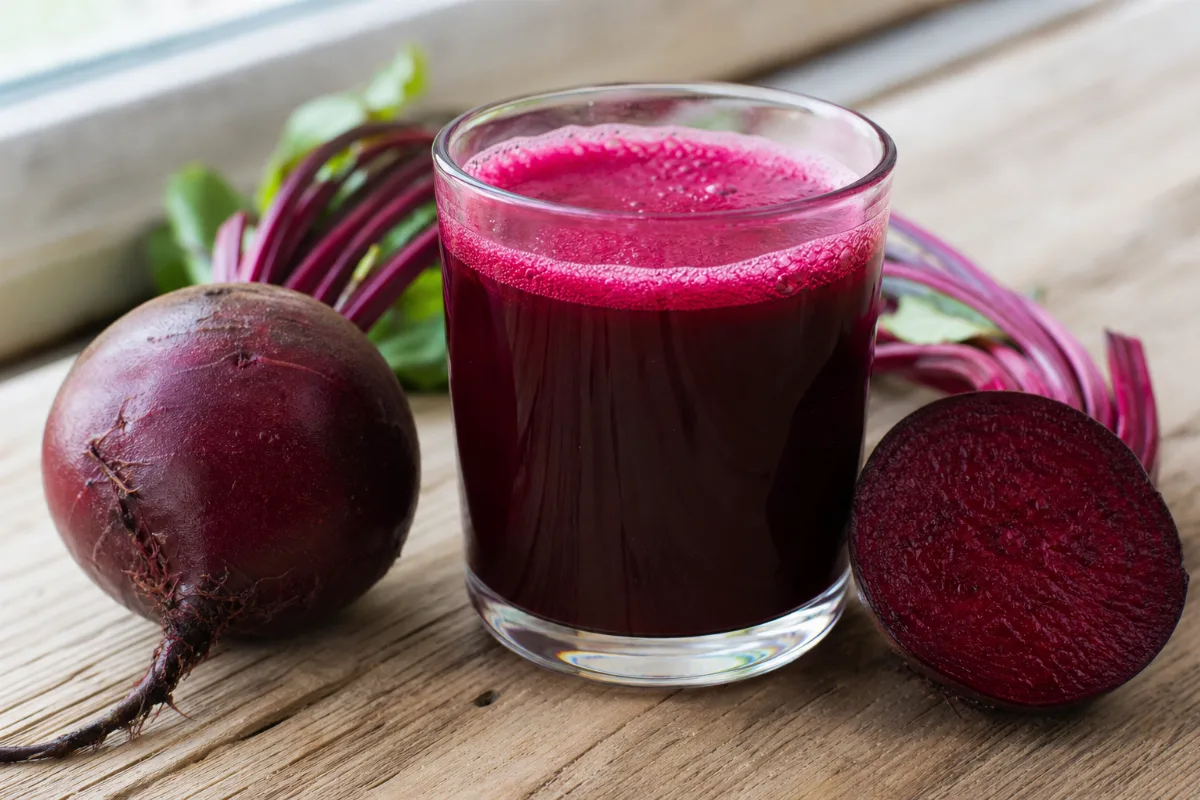
Beet juice is the pressed juice of beetroot (Beta vulgaris). It is sold fresh-pressed, bottled and pasteurised, or as concentrated shots, and bottled versions are often blended with apple or other juices.
No USDA nutrient entry for beet juice could be read, so we give no calorie, vitamin or mineral numbers. One food-composition study of juice from seven Austrian varieties found about 7.7% sugars (95% sucrose), 0.3 to 0.5 g of oxalic acid per litre and 0.8 to 1.3 g of betalain pigments per litre. For a 240 mL cup that would be roughly 18 g of sugars (our own sum from that average).
Why nitrate matters, and why bottles differ
The body can turn the nitrate in beets into nitric oxide, which relaxes blood vessels. This is the idea behind most beet juice trials. A 2017 review found a smaller blood pressure effect with nitrate-depleted juice, so something else in the juice may also matter.
Nitrate varied about 10-fold between beet varieties and from 0.01 to 2.4 g per litre across 16 commercial juices and 4 powders. So trial results do not apply equally to every bottle you can buy.
What the research shows
Blood pressure: a 2024 review of 11 trials (349 adults with high blood pressure) found systolic pressure 5.31 mmHg lower than placebo and rated certainty low. A 2022 review of 7 trials (218 adults) found 4.95 mmHg lower and rated certainty moderate. Diastolic pressure did not clearly change. No trial of heart attacks or strokes was read.
Exercise: a 2026 analysis of 38 studies (703 healthy adults) found a small gain in peak oxygen uptake, clearer in recreationally active adults and not clearly shown in highly trained athletes. A 2021 analysis of 17 studies found no significant gain in interval or sprint power.
Juice versus the whole beet and supplements
The results are for beet juice, mostly concentrated shots. They are not results for the whole vegetable, which keeps its fibre, or for powders, capsules and tablets. In a 2024 laboratory study of 37 beet supplements, five had significant cadmium contamination; juice was not tested.
At a glance
Traditional uses history, not proof
- Drunk as a food and, more recently, as a sports drink
- Long use as a food is not proof that it treats any condition
Studied for research
- Blood pressure, low certainty (2024) to moderate (2022): systolic about 5 mmHg lower in trials
- Peak oxygen uptake in exercise, moderate certainty: small gain, unclear in highly trained athletes
- Interval and sprint power, low certainty: no clear gain
- Nutrient content, moderate certainty: sugars, betalains, oxalic acid, variable nitrate
Main compounds
- Nitrate
- Betalains (red-purple pigments)
- Sugars (mostly sucrose)
- Oxalic acid
Common forms
- Fresh-pressed juice (not pasteurised)
- Bottled pasteurised juice, often blended with other juices
- Concentrated juice shots (the form used in most trials)
- Nitrate-depleted juice (used as a placebo in trials)
- Powders, capsules and tablets are different products and are not covered
Research links: 2024 review: beet juice and blood pressure in hypertension (11 trials) · 2026 review: beet juice and peak oxygen uptake (38 studies) · FDA: juice safety · Research Library · Genes & Biomarkers Library
What it is and its history
- Accepted scientific name
- Beta vulgaris L. (the plant whose root is juiced)
- Naming authority
- L. (name as given in the existing nutrient summary; not re-checked against GBIF for this page)
- Common names
- Beet juice (English); Beetroot juice (English); Red beet juice (English); Jugo de remolacha (Spanish); Jugo de betabel (Spanish (Mexico))
- Family or group
- Not verified from a source read. Beet juice is a processed food made by pressing the root.
- Classification
- Plantae > Beta > Beta vulgaris
- Native range
- Not verified from a source read.
- Habitat
- Not verified from a source read.
- What it looks like
- Roots: Not verified.; Stems: Not verified.; Leaves: Not verified.; Flowers: Not verified.
- Cultivation
- Not verified from a source read. The composition study used beets grown in Upper Austria.
- Harvest and processing
- Beet juice is the pressed juice of beetroot. The forms in the existing nutrient summary are fresh-pressed (not pasteurised), bottled pasteurised (often blended with apple or other juices), concentrated shots, nitrate-depleted juice used as a placebo in trials, and powders, capsules or tablets (different products).
- Look-alikes and adulterants
- Name: Beets (the whole vegetable); Note: The whole root has its own page, with fibre that juicing removes.; Name: Beet supplements (powder, capsule, tablet); Note: Different products; some contained cadmium in one study.; Name: Blended juices; Note: Bottled "beet" juices are often mixed with apple or other juices; check the label.
- Sustainability and conservation
- Not assessed.
Photographs
What is inside, and how it may work
What it contains and how those compounds act in cells and animals. Laboratory and animal mechanisms are not proven effects in people.
Main compounds
| Compound | Family | Where it is concentrated | Activity studied | Level of evidence |
|---|---|---|---|---|
| Nitrate (inorganic) | inorganic anion | Root (juice) 0.01 to 2.4 g per litre across 16 commercial juices and 4 powders; about 10-fold difference between varieties | The body can convert nitrate to nitric oxide. Pooled trials of nitrate-rich beet juice found a small fall in systolic blood pressure. 11 5 | Human data |
| Betalains (betacyanins and betaxanthins) | pigments | Root (juice) 0.8 to 1.3 g per litre; about 60% betacyanins and 40% betaxanthins | They give beets their red-purple colour and cause red urine in some people. A 2017 review found a smaller blood pressure effect against nitrate-depleted juice, which the authors read as a hint of nitrate-independent effects; no human trial of betalains alone was read. 11 9 1 | Lab |
| Sugars (mostly sucrose) | carbohydrate | Root (juice) About 7.7% average, 95% sucrose, in juice from 7 varieties | Free sugars; see the Safety tab. 11 | Lab |
| Oxalic acid | organic acid | Root (juice) 0.3 to 0.5 g per litre | Relevant to people advised to limit oxalate; see the Safety tab. 11 13 | Lab |
Mechanisms, receptors and pathways
| Target or pathway | Gene or receptor | What was found | Level |
|---|---|---|---|
| Nitrate to nitrite to nitric oxide | Not specified in the sources read | The 2026 narrative review describes an enterosalivary nitrate-nitrite-nitric oxide cycle that involves mouth bacteria. Nitric oxide relaxes blood vessels. Gut and mouth bacteria differ between people, so responses may differ. This is a proposed mechanism; the trial reviews did not test it. 6 | Human and lab |
| Beet pigment fate (beeturia) | Not specified | The pigment loses colour in stomach acid and with gut bacteria; red urine seems to depend on how much pigment survives to be absorbed in the colon. Oxalic acid helps keep the red colour. Findings are from a small human study and rat experiments. 9 4 | Human and animal |
Absorption, metabolism and elimination
- Absorption
- Betacyanin pigments were barely absorbed from rat intestine in one experiment; in humans, urine recovery of an oral dose of extract was 0.06 to 0.54% (betacyanin 1) over 8 hours.
- Distribution
- Not found.
- Metabolism
- Not found for beet juice.
- Elimination
- In rats, about 80% of an injected dose of pigment was recovered in urine.
- Bioavailability
- Not established for beet juice nitrate or pigments in the sources read.
Isolated compounds versus whole extracts
The blood pressure and exercise results are for beetroot juice, mostly concentrated shots in trials. They are not results for the whole vegetable, for ordinary bottled blends, or for powders and capsules. A 2017 review found a smaller blood pressure effect with nitrate-depleted beet juice than with regular juice, but it did not read that as no effect.
Nutritional composition
No USDA FoodData Central entry for beet juice could be read: the service refused our request (rate limit) on 2026-10-26, and the existing nutrient summary also had none. So no calorie, vitamin or mineral numbers are given. From the one composition study read (Wruss 2015, seven Austrian varieties): sugars about 7.7% (roughly 7.7 g in every 100 mL, 95% sucrose); oxalic acid 0.3 to 0.5 g per litre; total betalains 0.8 to 1.3 g per litre; nitrate varies a lot. For a 240 mL cup that would be roughly 18 g of sugars (our own arithmetic from the study average, not a label figure). Commercial juices may be blended or processed differently, so check the nutrition label.
2 moderate certainty2 low certainty
What was looked at
The 4 benefits and uses checked for Beet Juice, each with how strong the evidence is. Tap one to open it.
- Blood pressureLow certainty
- Endurance exercise (peak oxygen uptake)Moderate certainty
- High-intensity interval and sprint performanceLow certainty
- What is in the juice (nutrient content)Moderate certainty
Lab markers tracked in the studies
Systolic blood pressureDiastolic blood pressurePeak oxygen uptake (VO2max / VO2peak)Peak power output (interval or sprint exercise)Nitrate content of the juice
What is Beet Juice good for?
The main studied uses and how strong the human evidence is for each. Most trials used concentrated beet juice shots, which may differ from a glass of ordinary juice.
Benefits, one by one
Each card is a research question, not a promise. Tap a goal to filter. Open a card to see the studies, doses and limits.
Blood pressure
Low certaintyIn pooled trials of people with high blood pressure, beet juice lowered the top number (systolic) by about 5 mmHg compared with placebo. The bottom number (diastolic) did not clearly change. The two most recent reviews rate the certainty low and moderate.
4 studiesBeetroot juice, mostly concentrated juice shots in trials. Ordinary b…
Studies, doses and limits
What the trials found
Four pooled analyses of randomised trials were read. A 2024 review of 11 trials (349 adults with high blood pressure) found clinic systolic pressure 5.31 mmHg lower, with low certainty (GRADE) and no clear effect on diastolic or 24-hour pressure. A 2022 review of 7 trials (218 adults) found systolic 4.95 mmHg lower with moderate certainty. A 2017 review of 22 trials in adults generally found systolic 3.55 mmHg and diastolic 1.32 mmHg lower. A 2013 review of 16 small crossover trials (254 adults, nitrate and beet juice pooled) found systolic 4.4 mmHg lower.
Results
A small fall in systolic pressure in short trials. No trial of heart attacks or strokes was found in the sources read.
Effect sizes as reported
Systolic: -5.31 mmHg (2024), -4.95 mmHg (2022), -3.55 mmHg (2017), -4.4 mmHg (2013, nitrate and beet juice pooled). Diastolic: no significant change in 2024, 2022 and 2013; -1.32 mmHg in 2017.
Why this rating
The reviewers disagree: low (2024, GRADE) and moderate (2022, GRADE). Trials were short, up to 60 days in the 2022 review, and the results varied between trials. Blood pressure is a marker, not a heart or stroke outcome. We use the more cautious rating.
Form and dose studied
Beetroot juice, mostly concentrated juice shots in trials. Ordinary bottled or home-pressed juice may contain very different nitrate amounts.
Who was studied
Adults with high blood pressure (2024 and 2022 reviews); adults in general (2017); small crossover trials (2013).
Limits
Small, short trials; moderate to high heterogeneity; nitrate content differs a lot between products. Beet juice does not replace blood pressure medicine.
Why researchers looked
Beets are naturally high in nitrate. The body can turn nitrate into nitric oxide, a molecule that relaxes blood vessels.
Traditional use
Beet juice is drunk as a food and, more recently, as a sports drink. Long use as a food is not proof that it treats any condition.
Proposed mechanism Human and lab proposed
Nitrate from the juice is converted in the body to nitrite and then nitric oxide. A 2017 review found a smaller effect against nitrate-depleted beet juice, so something else in the juice may also play a part. This is a proposed mechanism, not proven here.
A proposed mechanism does not show that the effect happens in people.
If you take blood pressure medicine, ask your doctor or pharmacist; see the Safety tab.
Endurance exercise (peak oxygen uptake)
Moderate certaintyA 2026 pooled analysis of 38 studies (703 healthy adults) found beet juice gave a small gain in peak oxygen uptake compared with placebo. The gain was clearer in recreationally active adults than in highly trained athletes.
1 studiesBeetroot juice or beet-derived nitrate in placebo-controlled studies;…
Studies, doses and limits
What the trials found
The 2026 analysis pooled randomised and crossover placebo-controlled studies of healthy adults doing an incremental exercise test. The overall gain was small. In recreationally active people it was larger, and in highly trained athletes it was not clearly shown. The funnel plot hinted that small studies may have inflated the result.
Results
A small gain in a laboratory test of peak oxygen uptake. This is not the same as faster race times.
Effect sizes as reported
Standardised mean difference 0.24 overall (95% CI 0.11 to 0.37); 0.38 in recreationally active adults; 0.07 in highly trained athletes (95% CI -0.09 to 0.23); 0.19 after adjusting for possible small-study effects (95% CI 0.07 to 0.31).
Why this rating
The authors rated certainty moderate. The effect is small, shrinks after adjusting for possible publication bias, and is unclear in highly trained athletes.
Form and dose studied
Beetroot juice or beet-derived nitrate in placebo-controlled studies; the juice was usually a concentrated shot.
Who was studied
Healthy adults, from recreationally active to highly trained.
Limits
Small standardised effect, possible publication bias, varied designs. A VO2 test is not a performance outcome. See also the interval training result under Other uses, which found no clear gain.
Why researchers looked
Nitrate may help muscles use oxygen more efficiently during exercise.
Traditional use
Beet juice is drunk as a food and, more recently, as a sports drink. Long use as a food is not proof that it treats any condition.
Proposed mechanism Proposed
The proposed route is more nitric oxide, which may let muscles use oxygen with less effort. This is a proposal in the abstract, not shown by the analysis.
A proposed mechanism does not show that the effect happens in people.
See the Safety tab for beeturia, sugar and food safety.
High-intensity interval and sprint performance
Low certaintyA 2021 pooled analysis of 17 studies found no significant gain in power output during interval or sprint training with beetroot products. The authors said the studies were too different to be firm about it.
1 studiesBeetroot products, mostly juice, at varied amounts.
Studies, doses and limits
What the trials found
The review pooled 7 single-dose and 10 multi-day studies of beetroot products in interval or sprint training. Mean power output and peak power output both showed trivial, non-significant differences.
Results
No clear benefit for interval or sprint power. Evidence against a benefit in this use, with caution because the studies varied.
Effect sizes as reported
Mean power Hedges' g -0.05 (95% CI -0.32 to 0.21, p=0.69); peak power g 0.08 (95% CI -0.14 to 0.30, p=0.47).
Why this rating
A single 2021 review with varied products, timing and protocols. Certainty was not graded in the abstract. Newer trials may exist.
Form and dose studied
Beetroot products, mostly juice, at varied amounts.
Who was studied
Healthy adults doing interval or sprint training.
Limits
Differences in protocols, products and timing; the authors say they restrict a firm conclusion.
Why researchers looked
The same nitrate idea as for endurance: more nitric oxide might help muscles work harder in short, hard efforts.
Traditional use
Beet juice is drunk as a food and, more recently, as a sports drink. Long use as a food is not proof that it treats any condition.
Proposed mechanism Proposed
The proposal is the same as for endurance exercise. The analysis did not test a mechanism.
A proposed mechanism does not show that the effect happens in people.
None specific.
What is in the juice (nutrient content)
Moderate certaintyBeet juice is mostly water with about 7.7% sugars (95% of it sucrose). It carries red-purple betalain pigments and some oxalic acid, and its nitrate content varies about 10-fold between beet varieties.
1 studiesFresh-pressed juice from seven varieties; commercial juices and powde…
Studies, doses and limits
What the trials found
No trial. A food-composition study pressed juice from seven beetroot varieties grown in Upper Austria. It also tested 16 commercial juices and 4 powders for nitrate.
Results
The juice has sugars, betalains, oxalic acid and variable nitrate. The commercial products tested ranged from 0.01 to 2.4 g of nitrate per litre.
Effect sizes as reported
Total sugars about 7.7% (95% sucrose); oxalic acid 0.3 to 0.5 g per litre; total betalains 0.8 to 1.3 g per litre (about 60% betacyanins, 40% betaxanthins); nitrate 0.01 to 2.4 g per litre across commercial products.
Why this rating
Moderate for the composition of those seven varieties and sampled products; a bottle you buy may differ. No USDA entry for beet juice could be read, so no calorie, vitamin or mineral numbers are given.
Form and dose studied
Fresh-pressed juice from seven varieties; commercial juices and powders for nitrate only.
Limits
One small Austrian study. Not a trial. It says nothing about what the body takes up.
Why researchers looked
People ask what is in a glass of beet juice. Nitrate is the compound most trials focus on.
Traditional use
Beet juice is drunk as a food and, more recently, as a sports drink. Long use as a food is not proof that it treats any condition.
Proposed mechanism Food composition analysis
These are measured amounts in juice, from a laboratory food-composition study.
A proposed mechanism does not show that the effect happens in people.
Sugar and oxalic acid are discussed on the Safety tab.
Connections to the rest of health
How Beet Juice connects to the rest of our health knowledge graph. Every link says what kind of connection it is. A safety link (for example to the liver) is a warning, not a benefit. A study that merely mentions a topic never creates a benefit link.
Explore every connection: goals, body systems, organs, symptoms, genes
A. Wellness goals
| Connected to | Kind of connection | Evidence status | Context | Studies |
|---|---|---|---|---|
| Blood Pressure Support | Low certainty | Blood pressure: In pooled trials of people with high blood pressure, beet juice lowered the top number (systolic) by about 5 mmHg compared with placebo. The bottom number (diastolic) did not clearly change. The two most recent reviews rate the certainty low and moderate. | 5 2 1 8 | |
| Endurance Support | Moderate certainty | Endurance exercise (peak oxygen uptake): A 2026 pooled analysis of 38 studies (703 healthy adults) found beet juice gave a small gain in peak oxygen uptake compared with placebo. The gain was clearer in recreationally active adults than in highly trained athletes. | 7 | |
| Endurance Support | Low certainty | High-intensity interval and sprint performance: A 2021 pooled analysis of 17 studies found no significant gain in power output during interval or sprint training with beetroot products. The authors said the studies were too different to be firm about it. | 10 | |
| Preventive Wellness | Moderate certainty | What is in the juice (nutrient content): Beet juice is mostly water with about 7.7% sugars (95% of it sucrose). It carries red-purple betalain pigments and some oxalic acid, and its nitrate content varies about 10-fold between beet varieties. | 11 |
B. Body systems
| Connected to | Kind of connection | Evidence status | Context | Studies |
|---|---|---|---|---|
| Cardiovascular System | Biological association | Low certainty | Studied for: Blood pressure Studied for: Endurance exercise (peak oxygen uptake) | 5 2 1 8 7 11 |
| Musculoskeletal System | Biological association | Low certainty | Studied for: High-intensity interval and sprint performance | 10 |
E. Health conditions
| Connected to | Kind of connection | Evidence status | Context | Studies |
|---|---|---|---|---|
| Essential hypertension | Preliminary | Systolic pressure about 5 mmHg lower in pooled trials; not a replacement for medicine. Preparation or compound: Beetroot juice |
5 2 | |
| Kidney stones | Not enough evidence | Oxalic acid is present; no source read shows beet juice causes stones. Contains oxalic acid; no source read shows beet juice causes stones. Preparation or compound: Oxalic acid in beet juice |
13 11 | |
| Impaired kidney function | Narrative review | A 2026 review advises caution with nitrate-rich vegetables in impaired kidney function. Preparation or compound: Dietary nitrate |
6 |
I. Biomarkers
| Connected to | Kind of connection | Evidence status | Context | Studies |
|---|---|---|---|---|
| Systolic blood pressure | Biological association | Low certainty | Measured in trials: lowered. A lab change is not the same as a health benefit. | 5 2 |
| Diastolic blood pressure | Biological association | Low certainty | Measured in trials: no significant change. A lab change is not the same as a health benefit. | 2 1 |
| Peak oxygen uptake (VO2max / VO2peak) | Biological association | Moderate certainty | Measured in trials: raised. A lab change is not the same as a health benefit. | 7 |
| Peak power output (interval or sprint exercise) | Biological association | Low certainty | Measured in trials: no significant change. A lab change is not the same as a health benefit. | 10 |
| Nitrate content of the juice | Biological association | Moderate certainty | Measured in trials: not applicable. A lab change is not the same as a health benefit. | 11 |
K. Biological pathways
| Connected to | Kind of connection | Evidence status | Context | Studies |
|---|---|---|---|---|
| Nitric oxide pathway | Preliminary mechanism | Human and lab | Nitrate in beet juice is a precursor; the proposed route to lower blood pressure. | 6 5 |
| Betalains | Preliminary mechanism | Lab | Beet pigments; present in juice and the cause of beeturia. | 11 9 |
L. Active compounds
| Connected to | Kind of connection | Evidence status | Context | Studies |
|---|---|---|---|---|
| Nitrate (inorganic) | Biological association | Human | The body can convert nitrate to nitric oxide. Pooled trials of nitrate-rich beet juice found a small fall in systolic blood pressure. Preparation or compound: Root (juice) |
11 5 |
| Betalains (betacyanins and betaxanthins) | Biological association | Lab | They give beets their red-purple colour and cause red urine in some people. A 2017 review found a smaller blood pressure effect against nitrate-depleted juice, which the authors read as a hint of nitrate-independent effects; no human trial of betalains alone was read. Preparation or compound: Root (juice) |
11 9 1 |
| Sugars (mostly sucrose) | Biological association | Lab | Free sugars; see the Safety tab. Preparation or compound: Root (juice) |
11 |
| Oxalic acid | Biological association | Lab | Relevant to people advised to limit oxalate; see the Safety tab. Preparation or compound: Root (juice) |
11 13 |
Each connection is stored with the ingredient, the connected record, the kind of connection, the evidence status, the supporting studies, the preparation or compound involved, and a review date (last reviewed October 26, 2026).
Evidence at a glance: what changed in 2 lab markers
Tap a number to show only those markers. Counts are markers, not people.
The evidence
The research centre for Beet Juice. Every record here was checked against PubMed or the publisher's page; we never list a study we have not verified.
Evidence by outcome
Bars show how many studies we found for each outcome, not how well it works. People are added up across trials only (reviews are not added, to avoid double counting).
How we rate evidence
High certainty
Several well-run trials or reviews agree; further research is unlikely to change the picture much.
Moderate certainty
Good trials point the same way, but some doubt remains.
Low certainty
Small, short or inconsistent trials. The finding could change with better research.
Very low certainty
Very little or very weak human data. Treat as a possibility only.
Mixed findings
Trials or reviews disagree with each other.
Not enough evidence
Not enough human research to say either way.
Evidence against
Good research found no benefit, or found harm.
We take the reviewers' own risk-of-bias and GRADE statements where they exist, and otherwise judge from study size, design, consistency, directness and whether a product matches what is sold. Many publications do not make evidence high. Method note: We started from our existing beet juice summary, re-checked PubMed records and re-read their abstracts, and read the FDA, NIDDK and WHO pages. Only abstracts were read for studies. Items we could not verify are flagged in the research gaps.
Study library: every study we checked 14
| Study | Design | People | Product, dose, length | Result |
|---|---|---|---|---|
| Bahadoran 2017 The Nitrate-Independent Blood Pressure-Lowering Effect of Beetroot Juice: A Systematic Review and Meta-Analysis. Adv Nutr · PMID 29141968 · DOI |
Systematic review meta analysis |
650 intervention and 598 control 22 randomised trials (47 intervention groups, n=650; 43 control groups, n=598), adults in general |
Beetroot juice Beetroot juice Ranged from 70 to 500 mL a day across trials Under 14 days versus 14 days or more compared · vs Control groups, some with nitrate-depleted beet juice |
Both systolic and diastolic pressure were lower with beet juice than control. The fall was larger in longer trials and with larger amounts of juice. A smaller effect was seen against nitrate-depleted beet juice, which the authors read as a hint that something besides nitrate in the juice may also matter. Systolic -3.55 mmHg; diastolic -1.32 mmHg; against nitrate-depleted juice systolic -3.09 mmHg (Systolic 95% CI -4.55 to -2.54; diastolic -1.97 to -0.68) Methods, limits and fundingOutcomes: Resting systolic and diastolic blood pressure Limitations: Mixed populations. Certainty was not graded in the abstract. An erratum to this paper exists (Adv Nutr 2018). Funding and conflicts: No conflicts of interest declared. Read: abstract |
| Benjamim 2022 Nitrate Derived From Beetroot Juice Lowers Blood Pressure in Patients With Arterial Hypertension: A Systematic Review and Meta-Analysis. Front Nutr · PMID 35369064 · DOI |
Systematic review meta analysis |
218 participants 7 trials, 218 adults with high blood pressure |
Beetroot juice (nitrate-rich) Beetroot juice Trials gave 70 to 250 mL of juice a day 3 to 60 days · vs Control group (blinded) |
Systolic pressure fell compared with control; diastolic pressure did not change significantly. The reviewers rated both results moderate certainty (GRADE). Systolic -4.95 mmHg (GRADE moderate); diastolic -0.90 mmHg, not significant (GRADE moderate) (Systolic 95% CI -8.88 to -1.01; diastolic -3.16 to 1.36) Methods, limits and fundingOutcomes: Systolic and diastolic blood pressure Limitations: Few and short trials. Only trials whose juice could be blinded were included. Funding and conflicts: The authors declare no competing interests or commercial ties. Registration: PROSPERO 269339 Read: abstract |
| Brzezinska-Rojek 2024 Evaluation of the Safety and Potential Benefits of Beetroot-Based Dietary Supplements According to Their Elemental Composition. Biol Trace Elem Res · PMID 37804447 · DOI |
Laboratory analysis n/a |
37 beetroot-based dietary supplements (powders, capsules, tablets) | Beetroot dietary supplements (not juice) Beetroot powders, capsules and tablets · vs Permissible limits |
Five products were significantly contaminated with cadmium (4 to 134% of the provisional tolerable monthly intake), two with aluminium (11 to 12%) and three with barium. Lead was not found above the detection limit. The authors call for stricter control of the supplement market. Cadmium 4 to 134% of provisional tolerable monthly intake in 5 products (Not applicable) Methods, limits and fundingOutcomes: Metal and mineral content, including cadmium, aluminium, barium, lead Limitations: These are supplements, not juice. One country-specific product sample. Funding and conflicts: The authors have no relevant financial or non-financial interests to disclose. Read: abstract |
| Eastwood 1995 Beeturia and colonic oxalic acid. QJM · PMID 7493168 |
Laboratory and small human study human and animal |
Beeturic and non-beeturic adults; animal experiments | Beetroot pigment (betalaine) with and without oxalic acid Beetroot pigment |
Beeturia is red beet pigment in urine and faeces and occurs in about 14% of people. The pigment lost its colour with stomach acid, ferric ions and gut bacteria. The authors conclude beeturia comes from the pigment being absorbed in the colon, and that oxalic acid helps keep its red colour. About 14% of humans (background statement) (Not applicable) Methods, limits and fundingOutcomes: Pigment colour loss and beeturia Limitations: An older study of mechanism, with few details in the abstract. Funding and conflicts: Funding is not stated in the abstract. Read: abstract |
| Gronroos 2024 Effects of beetroot juice on blood pressure in hypertension according to European Society of Hypertension Guidelines: A systematic review and meta-analysis. Nutr Metab Cardiovasc Dis · PMID 39069465 · DOI |
Systematic review meta analysis |
349 patients 11 randomised trials, 349 adults with high blood pressure (clinic readings 140/90 mmHg or above) |
Beetroot juice (nitrate-rich) Beetroot juice Trial amounts not given in the abstract Not given in the abstract · vs Placebo, water or no intake |
Beet juice lowered clinic systolic pressure compared with placebo. There was no significant effect on clinic diastolic pressure or on 24-hour pressure. Heterogeneity was moderate to high. The reviewers rated certainty of evidence low (GRADE) and said results should be read with caution. Clinic systolic pressure MD -5.31 mmHg (I2 64%); GRADE low (95% CI -7.46 to -3.16) Methods, limits and fundingOutcomes: Clinic and 24-hour blood pressure Limitations: Short trials, moderate to high heterogeneity, low certainty. Blood pressure is a marker, not heart attacks or strokes. Funding and conflicts: The authors declare no competing interests or commercial ties. Read: abstract |
| Kurhaluk 2026 Dietary Nitrate-Rich Vegetables as Natural Modulators of Health: Mechanisms and Benefits in Ageing Populations. Int J Mol Sci · PMID 42074104 · DOI |
Narrative review human and lab |
Narrative review of nitrate-rich vegetables including beetroot | Nitrate-rich vegetables, beetroot highlighted Vegetables and beetroot |
The review says nitrate-rich vegetables may lower blood pressure and improve exercise efficiency, and that dietary nitrate is generally considered low-risk for healthy adults. It advises caution in susceptible groups such as infants and people with impaired kidney function. It also calls for long-term, well-controlled trials. No pooled numbers in the abstract (Not applicable) Methods, limits and fundingOutcomes: Mechanisms and health effects; safety comments Limitations: A narrative review, not a systematic one, so used here only for its caution about infants and impaired kidney function and for background on nitrate biology. Funding and conflicts: The authors declare no conflicts of interest. Read: abstract |
| Qin 2026 Effects of beetroot juice supplementation on maximal oxygen uptake during aerobic exercise: a systematic review and meta-analysis. Front Nutr · PMID 42523624 · DOI |
Systematic review meta analysis |
703 participants 38 randomised or crossover placebo-controlled studies, 703 healthy adults |
Beetroot juice or beet-derived nitrate Beetroot juice Trial amounts not given here (nitrate amounts stated in the paper) At least 3 consecutive days gave the most consistent effects · vs Placebo |
Beet juice gave a small gain in peak oxygen uptake compared with placebo. The gain was larger in recreationally active people and not clearly shown in highly trained athletes. Funnel plot asymmetry suggested small-study effects; after adjustment the gain was smaller but still statistically significant. The authors rated certainty moderate. Standardised mean difference 0.24 overall; 0.38 in recreationally active; 0.07 in highly trained; 0.19 after trim-and-fill adjustment (Overall 0.11 to 0.37; highly trained -0.09 to 0.23; adjusted 0.07 to 0.31) Methods, limits and fundingOutcomes: Maximal or peak oxygen uptake (VO2max or VO2peak) in an incremental exercise test Limitations: Small standardised effect, possible publication bias, varied trial designs. Peak oxygen uptake in a test is not the same as race performance. Funding and conflicts: The authors declare no competing interests or commercial ties. Registration: PROSPERO CRD420261414721 Read: abstract |
| Siervo 2013 Inorganic nitrate and beetroot juice supplementation reduces blood pressure in adults: a systematic review and meta-analysis. J Nutr · PMID 23596162 · DOI |
Systematic review meta analysis |
254 participants 16 crossover trials, 254 adults, 7 to 30 per trial |
Inorganic nitrate or beetroot juice (pooled together) Beetroot juice or nitrate salts Not given in the abstract 2 hours to 15 days · vs Placebo |
Nitrate and beet juice together lowered systolic pressure more clearly than diastolic. The authors said long-term trials and trials in people at higher cardiovascular risk were needed. Systolic -4.4 mmHg; diastolic -1.1 mmHg, not significant (Systolic 95% CI -5.9 to -2.8; diastolic -2.2 to 0.1) Methods, limits and fundingOutcomes: Systolic and diastolic blood pressure Limitations: Beet juice and nitrate salts are pooled, so it is not a beet-juice-only result. Very small trials, the longest 15 days. Funding and conflicts: Funding is not stated in the abstract. Read: abstract |
| Watts 1993 Beeturia and the biological fate of beetroot pigments. Pharmacogenetics · PMID 8148871 · DOI |
Cross sectional and animal human and rat |
100 healthy adult volunteers, plus rat experiments | Beetroot extract (red pigments, betacyanins) Beetroot extract Single oral test amount of extract 0 to 8 hours |
Beeturia (pink or red urine after beetroot) is said to occur in 10 to 14% of people and to be more common in iron deficiency and malabsorption. In 100 volunteers, 4 produced visibly red urine. The rat work suggested the pigment is unstable in stomach acid, so stomach acidity and emptying may decide who gets red urine. Visibly red urine in 4 of 100 volunteers (Not applicable) Methods, limits and fundingOutcomes: Pigment in urine Limitations: Used an extract, not juice. The 10 to 14% and iron-deficiency statements are background claims in the abstract, not results of this study. Rat findings may not carry over. Funding and conflicts: Funding is not stated in the abstract. Read: abstract |
| Wong 2021 The Effect of Beetroot Ingestion on High-Intensity Interval Training: A Systematic Review and Meta-Analysis. Nutrients · PMID 34835931 · DOI |
Systematic review meta analysis |
17 studies of beetroot products (7 single-dose, 10 over several days) in interval or sprint training | Beetroot products, mostly juice Beetroot (various products) Varied between studies Single dose or several days · vs Placebo |
No significant improvement in mean power or peak power. The authors said the studies differed too much in design, amounts and products for a firm conclusion. Mean power Hedges' g -0.05 (non-significant); peak power g 0.08 (non-significant) (Mean power -0.32 to 0.21; peak power -0.14 to 0.30) Methods, limits and fundingOutcomes: Mean and peak power output during high-intensity interval or sprint training Limitations: Studies differed in protocols, products and timing. 2021 review; newer trials may exist. Funding and conflicts: The authors declare no conflict of interest. Read: abstract |
| Wruss 2015 Compositional characteristics of commercial beetroot products and beetroot juice prepared from seven beetroot varieties grown in Upper Austria. J Food Compos Anal · Source · DOI |
Laboratory analysis n/a |
Juice pressed from 7 beetroot varieties grown in Upper Austria, plus 16 commercial juices and 4 powders tested for nitrate | Beet juice Beetroot juice |
Sugars averaged about 7.7%, 95% of it sucrose. Oxalic acid was 0.3 to 0.5 g per litre. Total betalains were 0.8 to 1.3 g per litre (about 60% betacyanins, 40% betaxanthins). Nitrate varied about 10-fold between varieties. Across 16 commercial juices and 4 powders nitrate ranged from 0.01 to 2.4 g per litre. Sugars about 7.7%; oxalic acid 0.3 to 0.5 g/L; betalains 0.8 to 1.3 g/L; nitrate 0.01 to 2.4 g/L in commercial products (Not applicable) Methods, limits and fundingOutcomes: Sugars, oxalic acid, betalains, phenolics, nitrate Limitations: Seven Austrian varieties and a small set of commercial products; a bottle you buy may differ. Abstract read through Europe PMC. Funding and conflicts: Funding is not stated in the abstract. Read: abstract (Europe PMC) |
| s-fda-juice US FDA: What You Need to Know About Juice Safety · Source |
Health agency n/a |
Methods, limits and fundingRead: full-text | ||
| s-niddk-stones NIDDK: Eating, Diet and Nutrition for Kidney Stones · Source |
Health agency n/a |
Methods, limits and fundingRead: full-text | ||
| s-who-healthy-diet WHO: Healthy diet (fact sheet) · Source |
Health agency n/a |
Methods, limits and fundingRead: full-text |
What we do not know yet
- No trial of heart attacks, strokes or death with beet juice was read.
- Trials were short, and mostly used concentrated juice shots, so ordinary drinking is less well studied.
- No USDA nutrient values for beet juice could be read, so calories, vitamins and minerals are not stated.
- Pregnancy, breastfeeding, children, allergy, and interactions beyond blood pressure medicine were not researched.
- Only the abstracts of the reviews were read, not the full papers or the trials inside them.
How new research is added
New studies are found by a saved PubMed search and placed in a review queue before the page changes.
Lab markers
What changed in blood or saliva tests during trials. A changed number is not the same as feeling or being healthier, and we give no "normal ranges".
Other 5
Systolic blood pressure
Lowered in trials
The top number in a blood pressure reading: the pressure in your arteries when the heart beats.
Low certaintyResults and what it means
Why it was measured
It is the usual marker in diet trials for blood pressure and later heart risk.
Statistical vs. clinical meaning
A small average fall in short trials; certainty rated low in 2024 and moderate in 2022.
Safety implication
Could add to the effect of blood pressure medicine in theory; no trial of that was read.
| Study | Result | People | Product |
|---|---|---|---|
| 5 | Clinic systolic pressure -5.31 mmHg (95% CI -7.46 to -3.16) with beet juice versus placebo | 349 adults with high blood pressure in 11 trials | Beetroot juice, daily, trial lengths not given in the abstract |
| 2 | Systolic -4.95 mmHg (95% CI -8.88 to -1.01) | 218 adults with high blood pressure in 7 trials | Beetroot juice, 70 to 250 mL a day, 3 to 60 days |
Diastolic blood pressure
No significant change in trials
The bottom number in a blood pressure reading: the pressure between heartbeats.
Low certaintyResults and what it means
Why it was measured
It is reported alongside systolic pressure in every blood pressure trial.
Statistical vs. clinical meaning
No clear change in people with high blood pressure; a small fall when adults in general were pooled.
Safety implication
None specific.
| Study | Result | People | Product |
|---|---|---|---|
| 2 | Diastolic -0.90 mmHg (95% CI -3.16 to 1.36), not significant | 218 adults with high blood pressure in 7 trials | Beetroot juice, 70 to 250 mL a day, 3 to 60 days |
| 1 | Diastolic -1.32 mmHg (95% CI -1.97 to -0.68) | 22 trials (47 intervention groups, n=650; 43 control groups, n=598), adults generally | Beetroot juice, 70 to 500 mL a day |
Peak oxygen uptake (VO2max / VO2peak)
Raised in trials
The most oxygen your body can use during hard exercise, measured in a lab test.
Moderate certaintyResults and what it means
Why it was measured
It is a common marker of aerobic fitness in exercise studies.
Statistical vs. clinical meaning
A small gain, not clearly present in highly trained athletes.
Safety implication
None specific.
| Study | Result | People | Product |
|---|---|---|---|
| 7 | Standardised mean difference 0.24 (95% CI 0.11 to 0.37) versus placebo; 0.07 (95% CI -0.09 to 0.23) in highly trained athletes | 703 healthy adults in 38 studies | Beetroot juice or beet-derived nitrate, at least 3 days gave the most consistent effects |
Peak power output (interval or sprint exercise)
No significant change in trials
The highest power a person produces during a short, hard effort, for example on a bike.
Low certaintyResults and what it means
Why it was measured
It shows whether a supplement helps short, hard efforts.
Statistical vs. clinical meaning
No clear benefit for interval or sprint power.
Safety implication
None specific.
| Study | Result | People | Product |
|---|---|---|---|
| 10 | Peak power Hedges' g 0.08 (95% CI -0.14 to 0.30), not significant; mean power g -0.05 (95% CI -0.32 to 0.21), not significant | 17 studies of interval or sprint training | Beetroot products, single dose (7 studies) or multi-day (10 studies) |
Nitrate content of the juice
Not applicable in trials
The amount of nitrate in a litre of juice. The body can turn nitrate into nitric oxide.
Moderate certaintyResults and what it means
Why it was measured
Trial results depend on how much nitrate the juice contains.
Statistical vs. clinical meaning
Brands differ widely, so trial results cannot be applied to every bottle.
Safety implication
See the Safety tab for the caution on infants and impaired kidney function.
| Study | Result | People | Product |
|---|---|---|---|
| 11 | Nitrate 0.01 to 2.4 g per litre across 16 commercial juices and 4 powders; about 10-fold difference between 7 beet varieties | Beet juice and powders (no people) | Not applicable (laboratory analysis) |
Safety
What studies and official sources say about side effects, medicines and who should check first. Each point shows what kind of evidence it comes from.
Main points to know 4
- Fresh-pressed juice that is not pasteurised can carry harmful bacteria. The US FDA says fresh-squeezed juice made from raw produce can carry harmful bacteria unless it is pasteurised or otherwise treated. Children, older adults, pregnant women and people with weakened immune systems risk serious illness from untreated juice. Beets grow in soil, so this applies to home-pressed and juice-bar beet juice. Packaged untreated juice must carry a warning label; juice sold by the glass does not need one. Authoritative guidance 12
- Beet supplements are not the same as juice. A 2024 laboratory study of 37 beetroot supplements (powders, capsules, tablets) found five with significant cadmium contamination, two with aluminium and three with barium. This was about supplements, not juice. Laboratory analysis 3
- Red urine and stools are common and usually harmless. Beeturia, pink or red urine after eating beets, is said to occur in about 10 to 14% of people. It is caused by beet pigment, not blood. If you are not sure the colour came from beets, or you have other symptoms, ask a doctor. Laboratory and small human study 9 4
- Blood pressure medicine. Beet juice lowers blood pressure a little in trials. The trials read did not report an interaction with blood pressure medicine, so none is established, but a pharmacist can check your list. Never stop a medicine on your own. Theoretical 5
Side effects 2
| Effect | How often | Severity and recovery | Evidence |
|---|---|---|---|
| Pink or red urine, and sometimes red stools (beeturia) The 1993 study used a beetroot extract, not juice. The abstract says beeturia is said to be more common in iron deficiency and malabsorption; it is not a reliable test for either. | Said to occur in 10 to 14% of people (1993 abstract) and about 14% (1995 abstract). In 100 volunteers given a test amount of beetroot extract, 4 produced visibly red urine. | mild, harmless in itself Passes when the pigment clears; the sources read do not give a time. | Laboratory and small human study 9 4 |
| Illness from bacteria in untreated juice (food poisoning) The FDA page covers juice in general, not beet juice specifically. | No beet-juice-specific figure was read. | can be serious in children, older adults, pregnant women and people with weakened immune systems Not described in the source read. | Authoritative guidance 12 |
Liver
No liver injury from drinking beet juice was found in the sources read. No liver-safety database (LiverTox) was searched.
How often. No frequency was found.
Monitoring. No agency monitoring advice was found.
This is a safety connection. It is not evidence that Beet Juice supports liver health.
Medicines and supplements 1
| With | Why it matters | Importance | Evidence | What to do |
|---|---|---|---|---|
| Blood pressure medicines prescription | Beet juice lowers blood pressure a little, so an added fall is plausible in theory. | The blood pressure reviews read measure the fall in pressure. They do not report medicine interactions, so no interaction is established. | Theoretical Not enough evidence 5 | If you take blood pressure medicine, tell your doctor or pharmacist before making beet juice a regular drink. Do not stop or change a medicine yourself. |
Who should check first 5
| Situation | Advice | Evidence |
|---|---|---|
| Pregnancy, breastfeeding, older adults, young children or weakened immune system, with untreated (unpasteurised) juice | The FDA lists these groups as at higher risk from untreated juice. Choose pasteurised or otherwise treated juice. Check the label, and ask at juice bars whether the juice is treated. | Authoritative guidance 12 |
| Impaired kidney function, and infants | A 2026 narrative review says dietary nitrate is generally low-risk for healthy adults but advises caution in infants and people with impaired kidney function. Ask your doctor about beet juice if you have kidney disease. Do not give beet juice to babies without asking a health professional. | Narrative review 6 |
| History of calcium oxalate kidney stones | Beet juice contains oxalic acid (0.3 to 0.5 g per litre in a food-composition study). The NIDDK page lists nuts, peanuts, rhubarb, spinach and wheat bran for people with calcium oxalate stones and says to ask a health professional about other oxalate sources. Beets are not named on that page. No source read shows that beet juice causes stones. Ask your doctor or dietitian. | Authoritative guidance 13 11 |
| Pregnancy and breastfeeding (the juice itself) | No source read gave advice on beet juice itself in pregnancy or breastfeeding, so none is stated. The FDA warning about untreated juice applies. Ask your midwife, doctor or dietitian. | Gap 12 |
| Diabetes or watching sugar | The juice is about 7.7% sugars, mostly sucrose, and juicing takes out the fibre. WHO says fruit juices contain significant free sugars that should be limited; its page names fruit juice, and it was not read as saying whether vegetable juice counts the same way. Check the label, because some bottled beet juices are blended with apple or other juices. | Authoritative guidance and food analysis 11 14 |
Overdose, product quality and regulators
Summary. No toxicity from beet juice as an ordinary drink was found in the sources read. The points above are the ones the sources raise.
Animal. Not reviewed.
High dose or long term signals. Trials lasted up to about two months. Long-term safety is not established in the sources read.
Overdose response. Not found.
Genotoxicity. Not researched.
Toxic or hazardous parts. Not researched.
Bacteria in untreated juice and metals in beet supplements are the contamination points found.
Bacteria in untreated juice. Untreated fresh juice can carry harmful bacteria from the produce. Pasteurised juice is treated to kill them. 12
Metals in beet supplements. In 37 beetroot supplements, 5 had significant cadmium, 2 aluminium and 3 barium; lead was not found above the limit. Juice was not tested. 3
| Body | Action | Date |
|---|---|---|
| US FDA (United States) | Juice safety: untreated juice can carry harmful bacteria; children, older adults, pregnant women and people with weakened immune systems risk serious illness. Untreated packaged juice must carry a warning label; juice sold by the glass is not required to. source | 2024-03-05 |
| NIDDK (US National Institutes of Health) (United States) | Kidney stone diet: people with calcium oxalate stones are advised to avoid certain oxalate-rich foods and to ask a health professional about others. Beets are not named. source | 2017-05 |
| WHO (International) | Healthy diet fact sheet: fruit juice contains significant free sugars that should be limited. The page names fruit juice, not vegetable juice. source | 2026-01-26 |
When to get medical help
- Vomiting, diarrhoea, fever or severe stomach pain after drinking untreated juice: call a doctor, and seek urgent care if severe, especially for a child, an older adult, a pregnant woman or someone with a weakened immune system
- Red urine with pain, fever, or if you are unsure it is from beets: see a doctor, because blood in urine needs checking
Stop using the product and contact a clinician or emergency service. In the US, Poison Control is 1-800-222-1222.
General information only, not medical advice. Ask a clinician or pharmacist before use, especially with medicines, in pregnancy or with a health condition. See the Natural Remedy Safety guide.
Frequently asked questions
What is beet juice?
Beet juice is the pressed juice of beetroot. It is sold fresh-pressed, bottled and pasteurised, as concentrated shots, and sometimes blended with apple or other juices.
Does beet juice lower blood pressure?
In pooled trials of adults with high blood pressure, systolic (top number) pressure was about 5 mmHg lower than with placebo. Certainty was rated low in a 2024 review and moderate in a 2022 review. Diastolic and 24-hour pressure did not clearly change. Blood pressure is a marker, not a heart attack or stroke result.
Can beet juice replace my blood pressure medicine?
Does beet juice improve sports performance?
Why does beet juice turn my urine pink or red?
Is fresh-pressed beet juice safe?
Untreated juice can carry harmful bacteria from the produce. The FDA says children, older adults, pregnant women and people with weakened immune systems risk serious illness from untreated juice. Pasteurised juice is the safer choice for these groups.
Does beet juice contain sugar?
Yes. Juice from seven Austrian varieties averaged about 7.7% sugars, 95% of it sucrose, and juicing removes the fibre. WHO says fruit juices contain free sugars that should be limited; its page names fruit juice, so we do not know if it counts vegetable juice the same way. Check labels, because some bottled beet juices are blended with apple juice.
Is beet juice a problem for kidney stones?
Is beet juice safe with kidney disease or for babies?
A 2026 review says dietary nitrate is generally low-risk for healthy adults but advises caution in infants and in people with impaired kidney function. Ask a health professional first.
Is beet juice safe in pregnancy or breastfeeding?
We found no source on beet juice itself in pregnancy or breastfeeding. The FDA warning about untreated juice applies to pregnant women. Choose pasteurised juice and ask your midwife or doctor.
Are beet powders and capsules the same as the juice?
No. They are different products. A 2024 laboratory study of 37 beetroot supplements found five with significant cadmium contamination. That study did not test juice.
Does every bottle of beet juice have the same nitrate?
No. Nitrate varied about 10-fold between beet varieties, and from 0.01 to 2.4 g per litre across 16 commercial juices and 4 powders. Trial results do not apply equally to every bottle.
Explore by health goal
Editorial transparency
- Written by
- AlternativeMed editorial team. Research compiled with AI assistance, then checked against the sources listed.
- Medical review
- None. This page has not been reviewed by a physician or pharmacist.
- First published
- 2026-10-26
- Last substantive update
- 2026-10-26
- How we research
- We started from our existing beet juice summary, re-checked PubMed records and re-read their abstracts, and read the FDA, NIDDK and WHO pages. Only abstracts were read for studies. Items we could not verify are flagged in the research gaps.
- How we rate evidence
- See "How we rate evidence" in the Evidence tab.
- Independence
- No product is promoted on this page. No affiliate links are shown. All pooled analyses read declared no competing interests, or did not state funding in the abstract.
Sources 14
Each source was opened and checked. Where we read only the abstract, it says so. The small numbers in the text point here.
- Bahadoran Z, Mirmiran P, Kabir A, Azizi F, et al.. The Nitrate-Independent Blood Pressure-Lowering Effect of Beetroot Juice: A Systematic Review and Meta-Analysis.. Adv Nutr. 2017. PMID 29141968. DOI 10.3945/an.117.016717. (abstract)
- Benjamim CJR, Porto AA, Valenti VE, Sobrinho ACDS, et al.. Nitrate Derived From Beetroot Juice Lowers Blood Pressure in Patients With Arterial Hypertension: A Systematic Review and Meta-Analysis.. Front Nutr. 2022. PMID 35369064. DOI 10.3389/fnut.2022.823039. (abstract)
- Brzezinska-Rojek J, Rutkowska M, Osko J, Konieczka P, et al.. Evaluation of the Safety and Potential Benefits of Beetroot-Based Dietary Supplements According to Their Elemental Composition.. Biol Trace Elem Res. 2024. PMID 37804447. DOI 10.1007/s12011-023-03902-x. (abstract)
- Eastwood MA, Nyhlin H. Beeturia and colonic oxalic acid.. QJM. 1995. PMID 7493168. (abstract)
- Gronroos R, Eggertsen R, Bernhardsson S, Praetorius Bjork M. Effects of beetroot juice on blood pressure in hypertension according to European Society of Hypertension Guidelines: A systematic review and meta-analysis.. Nutr Metab Cardiovasc Dis. 2024. PMID 39069465. DOI 10.1016/j.numecd.2024.06.009. (abstract)
- Kurhaluk N, Kolodziejska R, Buyun L, Kaminski P. Dietary Nitrate-Rich Vegetables as Natural Modulators of Health: Mechanisms and Benefits in Ageing Populations.. Int J Mol Sci. 2026. PMID 42074104. DOI 10.3390/ijms27083461. (abstract)
- Qin G, Kim S. Effects of beetroot juice supplementation on maximal oxygen uptake during aerobic exercise: a systematic review and meta-analysis.. Front Nutr. 2026. PMID 42523624. DOI 10.3389/fnut.2026.1858216. (abstract)
- Siervo M, Lara J, Ogbonmwan I, Mathers JC. Inorganic nitrate and beetroot juice supplementation reduces blood pressure in adults: a systematic review and meta-analysis.. J Nutr. 2013. PMID 23596162. DOI 10.3945/jn.112.170233. (abstract)
- Watts AR, Lennard MS, Mason SL, Tucker GT. Beeturia and the biological fate of beetroot pigments.. Pharmacogenetics. 1993. PMID 8148871. DOI 10.1097/00008571-199312000-00004. (abstract)
- Wong TH, Sim A, Burns SF. The Effect of Beetroot Ingestion on High-Intensity Interval Training: A Systematic Review and Meta-Analysis.. Nutrients. 2021. PMID 34835931. DOI 10.3390/nu13113674. (abstract)
- Wruss J, Waldenberger G, Huemer S, Uygun P, et al.. Compositional characteristics of commercial beetroot products and beetroot juice prepared from seven beetroot varieties grown in Upper Austria.. J Food Compos Anal. 2015. DOI 10.1016/j.jfca.2015.03.005. (abstract (Europe PMC))
- . US FDA: What You Need to Know About Juice Safety. . . (full-text)
- . NIDDK: Eating, Diet and Nutrition for Kidney Stones. . . (full-text)
- . WHO: Healthy diet (fact sheet). . . (full-text)


