Beverages · Drink
Apple Juice
Malus domestica (juice) · also called Apple juice, apple cider (unfiltered), jugo de manzana (Spanish)
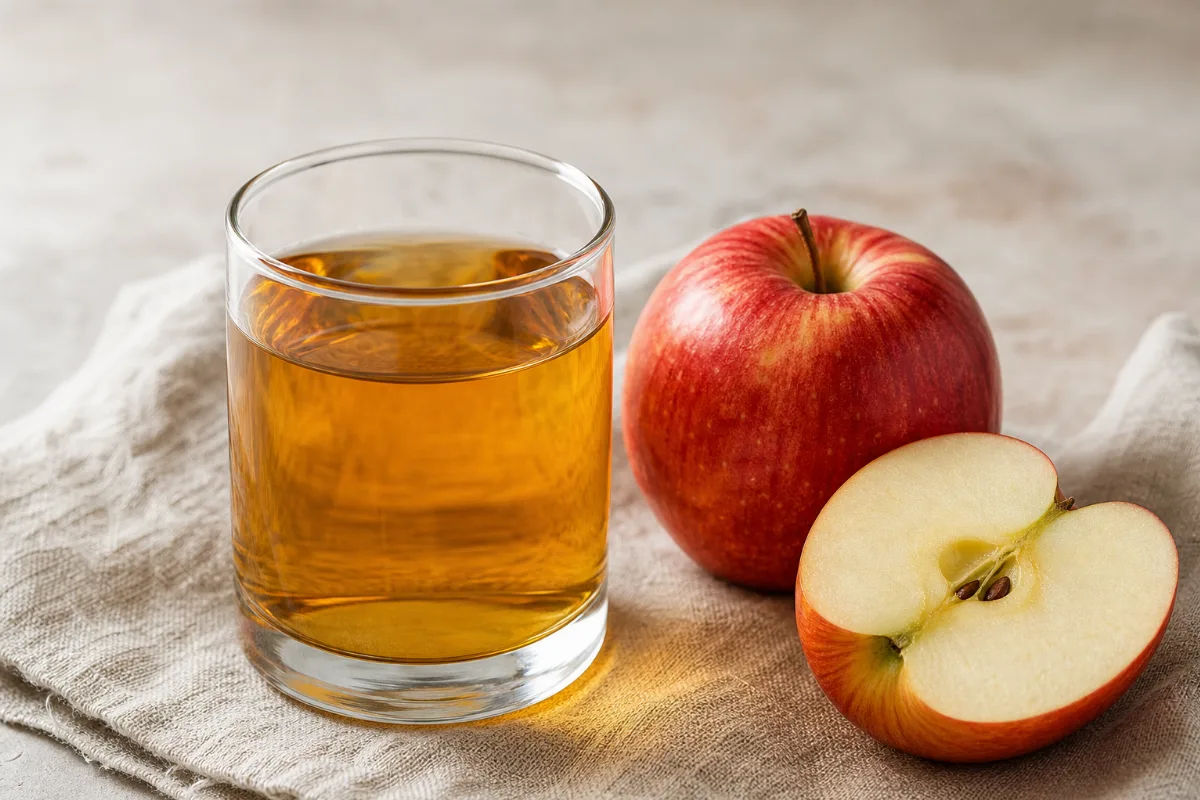
Apple juice is the pressed liquid of apples. One cup has about 114 calories and 24 g of sugars, and almost no fibre. Research on apple juice itself is small: one trial in young children with mild stomach flu, and small studies of heart-risk markers. Large studies link fruit juice with a slightly higher risk of type 2 diabetes. The main cautions are untreated cider, a few medicines, sugar and teeth.
General information, not medical advice. Last substantive update · Not medically reviewed. A named clinician has not signed off on this page. How this page is made
About Apple Juice
Apple juice is a sweet drink with most of the apple's fibre removed. Research on apple juice itself is small, and the main findings are about sugar, teeth and safety rather than health benefits.
What it is
Apple juice is the liquid pressed from apples (Malus domestica). Clear juice is filtered; cloudy juice keeps more apple solids; fresh-pressed cider may not be pasteurized; juice from concentrate is reconstituted with water. Juice drinks and cocktails often have added sugar and less juice.
One cup (248 g) of unsweetened bottled juice with added vitamin C has about 114 calories, 24 g of sugars, 0.5 g of fibre, 95 mg of vitamin C (added) and 250 mg of potassium. These figures come from our earlier USDA-based summary and were calculated per cup; the USDA record could not be re-opened when this page was written.
What the research shows
A randomised trial in 647 children aged 6 to 60 months with mild stomach flu found half-strength apple juice plus preferred fluids had fewer treatment failures than an electrolyte drink. This was one hospital and one setting.
Trials of apple products, pooled together, found small changes in cholesterol that were not clearly different from zero. A 20-trial review of apple juice reported better heart-risk markers, mostly oxidative stress, and one small trial of 20 adults found mixed results.
Studies of fruit juice in general link it with a small BMI rise in children and with higher type 2 diabetes risk. These are links, not proof, and are about fruit juice, not apple juice alone.
Arsenic, lead and mould toxin
FDA sets an action level of 10 parts per billion for inorganic arsenic in apple juice, and has a draft level of 10 parts per billion for lead, because apple juice is the juice young children drink most. These limits are for manufacturers.
WHO names apples and apple juice made from rotten fruit as a major source of patulin, a mould toxin that can cause nausea and vomiting. The Codex limit for apple juice is 50 micrograms per litre.
At a glance
Traditional uses history, not proof
- A common drink for children and adults
- Half-strength juice is sometimes used for children with stomach upset; one trial tested this (see Benefits)
Studied for research
- Mild stomach flu in young children (half-strength juice), low certainty
- Cholesterol and heart-risk markers, very low certainty
- Body weight (fruit juice in general), low certainty, a risk rather than a benefit
- Type 2 diabetes risk (fruit juice in general), low certainty, a risk rather than a benefit
- Uric acid and fullness in one sitting, low certainty
Main compounds
- Sugars (about 24 g per cup)
- Almost no fibre (0.5 g per cup)
- Vitamin C, which in the USDA item comes from an added vitamin
- Polyphenols, higher in cloudy juice
- Patulin, a mould toxin that can contaminate juice from rotten fruit
Common forms
- Clear, filtered juice (the form the USDA figures describe)
- Cloudy or unfiltered juice
- Fresh-pressed cider, which may be unpasteurized
- Juice from concentrate
- Juice drinks and cocktails (not 100% juice, often with added sugar)
Research links: FDA: What You Need to Know About Juice Safety · Dilute apple juice for children with mild stomach flu (JAMA, 2016) · Fruit juice in children, American Academy of Pediatrics (Pediatrics, 2017) · FDA: arsenic in apple juice, final guidance · NHS: 5 A Day, what counts · Research Library · Genes & Biomarkers Library
What it is and its history
- Accepted scientific name
- Malus domestica (juice)
- Naming authority
- (Suckow) Borkh. (accepted species per the sibling apples page; GBIF not re-queried today)
- Common names
- Apple juice (English); Apple cider (unfiltered, in US usage) (English); Jugo de manzana (Spanish)
- Family or group
- Rosaceae (rose family), the same family as pear, peach and cherry.
- Classification
- Plantae > Rosaceae > Malus > Malus domestica
- Native range
- Not verified from a source read.
- What it looks like
- Fruit: Juice is pressed from apple fruit; see the Apples page for the fruit.
- Cultivation
- Not verified.
- Harvest and processing
- Clear juice is filtered; cloudy or unfiltered juice keeps more apple solids; fresh-pressed cider may be unpasteurized; from-concentrate juice is reconstituted with water (existing nutrient summary; not re-sourced). Juice drinks or cocktails often have added sugar and less juice and are not the same as 100% juice.
- Look-alikes and adulterants
- Name: Juice drink or cocktail; Note: Often has added sugar and less juice; this page covers 100% apple juice.; Name: Whole apple; Note: Keeps its fibre; see the Apples page.
- Sustainability and conservation
- Not assessed.
Photographs
Traditional use and history history, not clinical proof
| Tradition or era | Documented use | Source |
|---|---|---|
| Everyday drink | No source read documents the history of apple juice. The nutrient summary notes that juicing removes most of the apple's fibre. | NOT verified (no history source read) |
Traditional use shows how it was used. It does not show that it works or is safe today.
What is inside, and how it may work
What it contains and how those compounds act in cells and animals. Laboratory and animal mechanisms are not proven effects in people.
Main compounds
| Compound | Family | Where it is concentrated | Activity studied | Level of evidence |
|---|---|---|---|---|
| Sugars | carbohydrate | Juice 9.62 g total sugars per 100 g; about 24 g per cup (USDA via existing summary) | Source of calories and free sugars. A trial found large servings of apple juice raised blood uric acid like a fructose drink did. 15 8 | Composition data and human trial |
| Added ascorbic acid (vitamin C) | vitamin | Added in processing 38.5 mg per 100 g (FDC 167771, an item with added vitamin C); about 95 mg per cup | The vitamin C in this USDA item comes from the added vitamin, not from the apples. Juice without added vitamin C has very little. 15 | Composition data |
| Polyphenols | plant compounds | Higher in cloudy juice (not verified) The two juices in one trial had 510 and 993 mg catechin equivalents per litre | Suggested to explain some marker changes; evidence is mostly from lab work and small trials. 6 7 | Small human trials, lab |
| Patulin | mycotoxin (contaminant, not a natural ingredient) | Made by moulds on rotting apples Codex maximum limit 50 micrograms per litre in apple juice (WHO) | Nausea and vomiting reported in humans; considered genotoxic, cancer risk not demonstrated. 16 | Authoritative guidance |
Mechanisms, receptors and pathways
| Target or pathway | Gene or receptor | What was found | Level |
|---|---|---|---|
| Antioxidant effects of apple polyphenols | Suggested route behind changes in oxidative-stress markers in juice trials; the human evidence is markers only. 7 6 | Human markers; mechanism lab based | |
| Drug absorption (transporters) | FDA explains for grapefruit juice that fruit juices can affect proteins that move some drugs into cells; for apple juice FDA only states the fexofenadine caution. 11 | Authoritative guidance |
Absorption, metabolism and elimination
- Absorption
- Not researched for apple juice itself.
- Distribution
- Not found.
- Metabolism
- Not found.
- Elimination
- Not found.
- Bioavailability
- Not established.
Isolated compounds versus whole extracts
Juice is not the same as the whole apple. Pressing removes most of the fibre; one trial found whole apple more filling than apple juice 30 minutes after eating, and cohort studies link fruit juice with higher, and apples with lower, diabetes risk. Cloudy juice keeps more apple solids than clear juice. The cholesterol trials pool whole apple, extract and juice.
Nutritional composition
Per 100 g of unsweetened, bottled apple juice with added vitamin C (USDA FoodData Central, FDC 167771, SR Legacy): 46 kcal, 9.62 g total sugars, 0.2 g fibre, 38.5 mg vitamin C (added), 101 mg potassium and 0.074 mg manganese. One cup (248 g) provides about 114 kcal, 24 g sugars, 0.5 g fibre, 95 mg vitamin C (added), 250 mg potassium and 0.18 mg manganese. A cup of juice has almost no fibre. WHO counts sugars in fruit juice as free sugars. Per-cup figures are calculated from the per-100 g values, which come from the existing nutrient summary; the USDA record could not be re-fetched on 2026-10-26, so they were not re-checked against USDA today. Values vary by brand, cloudiness and added vitamins.
4 low certainty1 very low certainty
What was looked at
The 5 benefits and uses checked for Apple Juice, each with how strong the evidence is. Tap one to open it.
- Mild stomach flu in young children (half-strength apple juice)Low certainty
- Cholesterol and heart-risk markers (trials of apple products and cloudy apple juice)Very low certainty
- Body weight (100% fruit juice in general)Low certainty
- Type 2 diabetes risk (fruit juice versus whole fruit)Low certainty
- Uric acid and fullness (one sitting)Low certainty
Lab markers tracked in the studies
Treatment failure in mild stomach flu (children)LDL cholesterolOxidative stress markersPlasma uric acidBody mass index and body weight
What is Apple Juice good for?
The studied uses and how strong the human evidence is for each. Evidence on apple juice alone is thin. Several rows below are risks that studies found, not benefits.
Benefits, one by one
Each card is a research question, not a promise. Tap a goal to filter. Open a card to see the studies, doses and limits.
Mild stomach flu in young children (half-strength apple juice)
Low certaintyIn one Toronto trial of 647 children aged 6 months to 5 years with mild stomach flu and little dehydration, half-strength apple juice plus the child's preferred fluids led to fewer treatment failures than a store-bought electrolyte drink. This was one hospital, one drink, in a defined setting. It is not advice for a sick child.
1 studiesHalf-strength apple juice with preferred fluids, as in the trial prot…
Studies, doses and limits
What the trials found
The trial was randomised and single-blind (Freedman et al., JAMA 2016) and covered minimally dehydrated children only.
Results
Treatment failure was less common with dilute apple juice (16.7% vs 25.0%) and fewer children needed intravenous fluids (2.5% vs 9.0%). Hospital stays and the frequency of diarrhoea and vomiting did not differ significantly.
Effect sizes as reported
Failure 16.7% vs 25.0% (difference -8.3%); IV fluids 2.5% vs 9.0%
Why this rating
One randomised trial in one centre, in a narrow group of mildly ill children; not repeated in the abstracts read. The comparison was against a particular electrolyte drink, not against water or nothing.
Form and dose studied
Half-strength apple juice with preferred fluids, as in the trial protocol. No amount advice is given here.
Who was studied
Children aged 6 to 60 months with mild stomach flu and minimal dehydration.
Limits
Single centre. Findings do not apply to adults, to severe dehydration, or to full-strength juice. Funding was not shown in the abstract read.
Why researchers looked
Young children often refuse electrolyte drinks, so a drink they will accept might keep them drinking.
Proposed mechanism Insufficient data
The trial did not test why. The authors do not explain a mechanism in the abstract read.
A proposed mechanism does not show that the effect happens in people.
A sick or dehydrated child needs a doctor's advice. Do not use juice as a replacement for medical care.
Cholesterol and heart-risk markers (trials of apple products and cloudy apple juice)
Very low certaintyTrials of apple products, including apple juice, found only small changes in cholesterol. A review of 20 human trials of apple juice reported better markers of heart risk, mainly oxidative stress. These are lab markers, not heart attacks or strokes.
3 studiesCloudy apple juice in the trials (two glasses a day for 4 weeks in th…
Studies, doses and limits
What the trials found
A 2022 meta-analysis pooled 18 trials of whole apple, extract and juice together (Kim et al.). A 2022 review looked at 20 trials of apple juice alone (Vallee Marcotte et al.). A 2014 crossover trial of 20 adults compared two cloudy juices (Soriano-Maldonado et al.).
Results
In the pooled apple products total and LDL cholesterol fell a few points, not significantly overall, and HDL dipped slightly. Juice-only trials mostly measured oxidative stress. In the 20-person trial, the vitamin C-rich cloudy juice raised antioxidant activity while the polyphenol-rich juice raised insulin and HOMA.
Effect sizes as reported
Pooled apple products: total cholesterol -2.69 mg/dL, LDL -2.80 mg/dL, HDL -1.04 mg/dL
Why this rating
The pooled trial mixes whole apple, extract and juice, so juice alone is not isolated. The juice review gives no pooled numbers in the abstract and the trial was tiny. Markers only; no outcome trials.
Form and dose studied
Cloudy apple juice in the trials (two glasses a day for 4 weeks in the 2014 trial). No amount advice is given here.
Who was studied
Mostly healthy adults, some with high cholesterol.
Limits
Short trials, small groups, mixed products, one trial showed a higher insulin marker with the polyphenol-rich juice.
Why researchers looked
Apple juice carries some of the polyphenols of the fruit but very little fibre, so researchers have asked whether it still helps heart-risk markers.
Proposed mechanism Preliminary mechanism
Apple polyphenols are suggested as the route. This idea comes mostly from lab and animal work and is unproven in people.
A proposed mechanism does not show that the effect happens in people.
Juice adds sugar and calories (see safety).
Body weight (100% fruit juice in general)
Low certaintyA 2024 pooled analysis of 42 studies found a very small BMI rise per daily serving of 100% fruit juice in children's cohort studies. Adult trials found no clear change in weight. These results cover fruit juice in general, not apple juice alone, and the evidence is not a benefit: the authors support guidance to limit juice.
1 studiesOne serving a day was the unit analysed, not advice.
Studies, doses and limits
What the trials found
Systematic review and meta-analysis (Nguyen et al., JAMA Pediatrics 2024): 17 cohorts of 45,851 children, 6 adult cohorts and 19 adult trials.
Results
Children's cohorts: a small higher BMI per extra daily serving. Adults: no significant change in trials, with a wide range.
Effect sizes as reported
Children +0.03 BMI per daily serving (0.01 to 0.05); adult trials -0.53 kg (-1.55 to 0.48)
Why this rating
Observational in children; wide range in the adult trials; covers all 100% fruit juices.
Form and dose studied
One serving a day was the unit analysed, not advice.
Who was studied
Children (cohorts) and adults (cohorts and trials).
Limits
No trials in children; not apple juice alone.
Why researchers looked
Juice adds calories without the fibre and fullness of whole fruit.
Proposed mechanism Preliminary mechanism
Extra calories are the suggested route (adult cohort studies that did not adjust for energy intake showed weight gain).
A proposed mechanism does not show that the effect happens in people.
Not a benefit; the authors support limiting juice.
Type 2 diabetes risk (fruit juice versus whole fruit)
Low certaintyIn three large US studies of health professionals, eating more apples and pears went with slightly lower diabetes risk, while drinking more fruit juice went with slightly higher risk. These are links in eating habits, not proof, and juice was one group, not apple juice alone.
1 studiesCohort units, not advice.
Studies, doses and limits
What the trials found
Three prospective cohorts, 12,198 new cases of type 2 diabetes over 3.46 million person-years (Muraki et al., BMJ 2013).
Results
Per 3 servings a week, fruit juice was linked to higher risk and apples and pears to lower risk.
Effect sizes as reported
Fruit juice HR 1.08 (1.05 to 1.11); apples and pears HR 0.93 (0.90 to 0.96) per 3 servings a week
Why this rating
Observational; self-reported diet; fruit juice grouped together and not apple juice alone.
Form and dose studied
Cohort units, not advice.
Who was studied
US health professionals.
Limits
People who drink more juice may differ in other ways. Not shown to cause diabetes.
Why researchers looked
Juice delivers sugar fast without the fibre of whole fruit.
Proposed mechanism Preliminary mechanism
Not tested in the cohort study; fibre and fast sugar are suggested routes.
A proposed mechanism does not show that the effect happens in people.
People with diabetes should ask their care team about juice.
Uric acid and fullness (one sitting)
Low certaintyIn a trial of 73 adults, uric acid in the blood rose in the half hour after large servings of apple juice or whole apple, about the same as after a fructose drink. People felt fuller 30 minutes after whole apple than after apple juice. Blood pressure was unchanged. Only a single sitting was studied.
1 studiesSingle servings in a lab visit.
Studies, doses and limits
What the trials found
Randomised crossover trial (White et al., Am J Clin Nutr 2018).
Results
Uric acid rose after fructose-containing drinks, including large apple juice; whole apple was more filling than juice at 30 minutes.
Effect sizes as reported
Large apple juice +17 umol/L uric acid at 30 min (9 to 24); fructose control +15 umol/L
Why this rating
Acute, one sitting, 73 adults; no long-term outcomes.
Form and dose studied
Single servings in a lab visit.
Who was studied
Adults.
Limits
Longer studies are needed, say the authors.
Why researchers looked
The fructose in fruit can raise uric acid, which is linked to gout.
Proposed mechanism Human evidence
The body responds to fructose whatever the source, say the authors.
A proposed mechanism does not show that the effect happens in people.
People with gout should ask their doctor about fructose and juice.
Connections to the rest of health
How Apple Juice connects to the rest of our health knowledge graph. Every link says what kind of connection it is. A safety link (for example to the liver) is a warning, not a benefit. A study that merely mentions a topic never creates a benefit link.
Explore every connection: goals, body systems, organs, symptoms, genes
A. Wellness goals
| Connected to | Kind of connection | Evidence status | Context | Studies |
|---|---|---|---|---|
| Digestive Support | Potential benefit | Low certainty | Mild stomach flu in young children (half-strength apple juice): In one Toronto trial of 647 children aged 6 months to 5 years with mild stomach flu and little dehydration, half-strength apple juice plus the child's preferred fluids led to fewer treatment failures than a store-bought electrolyte drink. This was one hospital, one drink, in a defined setting. It is not advice for a sick child. | 1 |
| Cholesterol Balance | Potential benefit | Very low certainty | Cholesterol and heart-risk markers (trials of apple products and cloudy apple juice): Trials of apple products, including apple juice, found only small changes in cholesterol. A review of 20 human trials of apple juice reported better markers of heart risk, mainly oxidative stress. These are lab markers, not heart attacks or strokes. | 3 7 6 |
| Heart Health | Potential benefit | Very low certainty | Cholesterol and heart-risk markers (trials of apple products and cloudy apple juice): Trials of apple products, including apple juice, found only small changes in cholesterol. A review of 20 human trials of apple juice reported better markers of heart risk, mainly oxidative stress. These are lab markers, not heart attacks or strokes. | 3 7 6 |
| Weight Management | Low certainty | Body weight (100% fruit juice in general): A 2024 pooled analysis of 42 studies found a very small BMI rise per daily serving of 100% fruit juice in children's cohort studies. Adult trials found no clear change in weight. These results cover fruit juice in general, not apple juice alone, and the evidence is not a benefit: the authors support guidance to limit juice. | 5 | |
| Blood Sugar Balance | Low certainty | Type 2 diabetes risk (fruit juice versus whole fruit): In three large US studies of health professionals, eating more apples and pears went with slightly lower diabetes risk, while drinking more fruit juice went with slightly higher risk. These are links in eating habits, not proof, and juice was one group, not apple juice alone. | 4 | |
| Metabolic Health | Low certainty | Uric acid and fullness (one sitting): In a trial of 73 adults, uric acid in the blood rose in the half hour after large servings of apple juice or whole apple, about the same as after a fructose drink. People felt fuller 30 minutes after whole apple than after apple juice. Blood pressure was unchanged. Only a single sitting was studied. | 8 |
B. Body systems
| Connected to | Kind of connection | Evidence status | Context | Studies |
|---|---|---|---|---|
| Digestive System | Biological association | Low certainty | Studied for: Mild stomach flu in young children (half-strength apple juice) | 1 |
| Cardiovascular System | Biological association | Very low certainty | Studied for: Cholesterol and heart-risk markers (trials of apple products and cloudy apple juice) | 3 7 6 |
| Metabolism Weight | Biological association | Low certainty | Studied for: Body weight (100% fruit juice in general) Studied for: Uric acid and fullness (one sitting) | 5 8 |
| Blood Sugar Support | Biological association | Low certainty | Studied for: Type 2 diabetes risk (fruit juice versus whole fruit) | 4 |
E. Health conditions
| Connected to | Kind of connection | Evidence status | Context | Studies |
|---|---|---|---|---|
| Tooth decay (dental caries) | Adverse effect or risk | Documented risk | AAP and NHS say juice sugars can raise tooth decay risk. Preparation or compound: Apple juice (free sugars) |
2 14 |
| Gastroenteritis (stomach flu) | Preliminary | One trial in young children with mild stomach flu; also untreated juice can cause gut infections. Preparation or compound: Half-strength apple juice |
1 12 |
I. Biomarkers
| Connected to | Kind of connection | Evidence status | Context | Studies |
|---|---|---|---|---|
| Treatment failure in mild stomach flu (children) | Biological association | Low certainty | Measured in trials: fewer failures with dilute apple juice. A lab change is not the same as a health benefit. | 1 |
| LDL cholesterol | Biological association | Very low certainty | Measured in trials: lowered slightly. A lab change is not the same as a health benefit. | 3 |
| Oxidative stress markers | Biological association | Very low certainty | Measured in trials: improved in the trials reviewed. A lab change is not the same as a health benefit. | 7 |
| Plasma uric acid | Biological association | Low certainty | Measured in trials: rose after large servings. A lab change is not the same as a health benefit. | 8 |
| Body mass index and body weight | Biological association | Low certainty | Measured in trials: slightly higher BMI in children's cohorts; no clear change in adult trials. A lab change is not the same as a health benefit. | 5 |
L. Active compounds
| Connected to | Kind of connection | Evidence status | Context | Studies |
|---|---|---|---|---|
| Sugars | Biological association | Composition data and human trial | Source of calories and free sugars. A trial found large servings of apple juice raised blood uric acid like a fructose drink did. Preparation or compound: Juice |
15 8 |
| Added ascorbic acid (vitamin C) | Biological association | Composition data | The vitamin C in this USDA item comes from the added vitamin, not from the apples. Juice without added vitamin C has very little. Preparation or compound: Added in processing |
15 |
| Polyphenols | Biological association | Small human trials, lab | Suggested to explain some marker changes; evidence is mostly from lab work and small trials. Preparation or compound: Higher in cloudy juice (not verified) |
6 7 |
| Patulin | Biological association | Authoritative guidance | Nausea and vomiting reported in humans; considered genotoxic, cancer risk not demonstrated. Preparation or compound: Made by moulds on rotting apples |
16 |
Each connection is stored with the ingredient, the connected record, the kind of connection, the evidence status, the supporting studies, the preparation or compound involved, and a review date (last reviewed October 26, 2026).
Evidence at a glance: what the research found for 5 outcomes
Each outcome below is one thing researchers measured. Certainty is how far the evidence can be trusted, not how well it works. The full studies are on the next tab.
The evidence
The research centre for Apple Juice. Every record here was checked against PubMed or the publisher's page; we never list a study we have not verified.
Evidence by outcome
Bars show how many studies we found for each outcome, not how well it works. People are added up across trials only (reviews are not added, to avoid double counting).
How we rate evidence
High certainty
Several well-run trials or reviews agree; further research is unlikely to change the picture much.
Moderate certainty
Good trials point the same way, but some doubt remains.
Low certainty
Small, short or inconsistent trials. The finding could change with better research.
Very low certainty
Very little or very weak human data. Treat as a possibility only.
Mixed findings
Trials or reviews disagree with each other.
Not enough evidence
Not enough human research to say either way.
Evidence against
Good research found no benefit, or found harm.
We take the reviewers' own risk-of-bias and GRADE statements where they exist, and otherwise judge from study size, design, consistency, directness and whether a product matches what is sold. Many publications do not make evidence high. Method note: We started from our existing apple juice summary, read PubMed abstracts and the FDA, WHO and NHS pages, and flagged anything we could not re-check. Only abstracts were read for studies.
Study library: every study we checked 16
| Study | Design | People | Product, dose, length | Result |
|---|---|---|---|---|
| Freedman 2016 Effect of Dilute Apple Juice and Preferred Fluids vs Electrolyte Maintenance Solution on Treatment Failure Among Children With Mild Gastroenteritis: A Randomized Clinical Trial. JAMA · PMID 27131100 · DOI |
Randomised single blind noninferiority trial |
647 Children aged 6 to 60 months with gastroenteritis and minimal dehydration, one tertiary pediatric emergency department in Toronto, Canada |
Half-strength apple juice plus preferred fluids juice pressed from apple fruit Fluids as desired (trial protocol; no amount advice here) Up to 7 days of follow-up · vs Apple-flavoured electrolyte maintenance solution |
Treatment failure was less common with dilute apple juice (16.7% vs 25.0%). Fewer children had intravenous rehydration (2.5% vs 9.0%). Hospitalisation and the frequency of diarrhoea and vomiting did not differ significantly. Treatment failure 16.7% vs 25.0%, difference -8.3%; IV rehydration 2.5% vs 9.0%, difference -6.5% (99% CI -11.6% to -1.8%) (97.5% CI for failure difference: minus infinity to -2.0%) Methods, limits and fundingOutcomes: Composite treatment failure within 7 days (IV rehydration, hospitalisation, unscheduled visit, protracted symptoms, crossover, 3% weight loss or significant dehydration) Limitations: One centre, single-blind, mild illness only, children who were minimally dehydrated. Not a trial of apple juice at full strength or in adults. Funding was not shown in the abstract read. Funding and conflicts: Not stated in the abstract read Read: abstract |
| Heyman 2017 Fruit Juice in Infants, Children, and Adolescents: Current Recommendations. Pediatrics · PMID 28562300 · DOI |
Professional guideline (American Academy of Pediatrics) |
Infants, children and adolescents | Fruit juice in general fruit juice in general |
The abstract says juice has some benefits but high sugar content adds calories and the risk of dental caries, and the lack of protein and fibre can predispose to inappropriate weight gain. None (guideline) (n/a) Methods, limits and fundingOutcomes: Juice sugar, calories, tooth decay, protein and fibre Limitations: Abstract only read; the recommendations section was not read. Covers fruit juice in general. Funding and conflicts: Professional society guideline Read: abstract |
| Kim 2022 Metabolic and Cardiovascular Benefits of Apple and Apple-Derived Products: A Systematic Review and Meta-Analysis of Randomized Controlled Trials. Front Nutr · PMID 35449537 · DOI |
Systematic review and meta analysis of randomised trials |
18 randomised trials of whole apple, apple extract and apple juice (pooled), at least one week of intake | Whole apple, apple extract and apple juice pooled together (juice is only part of the pool) whole fruit, extract and juice, pooled Varied by trial At least 1 week · vs Placebo or control in each trial |
Total and LDL cholesterol fell a little but not significantly overall; significant against placebo and in people with high starting levels. HDL fell slightly. The other markers were mostly unaffected. Total cholesterol -2.69 mg/dL; LDL -2.80 mg/dL; HDL -1.04 mg/dL (TC -5.43 to 0.04; LDL -5.78 to 0.17; HDL -1.79 to -0.29) Methods, limits and fundingOutcomes: Total, LDL and HDL cholesterol, triglycerides, glucose, insulin, C-reactive protein, blood pressure Limitations: Juice results are not separated from whole apple and extract in the abstract. Short trials; markers only. Funding and conflicts: Not stated in the abstract read Read: abstract |
| Muraki 2013 Fruit consumption and risk of type 2 diabetes: results from three prospective longitudinal cohort studies. BMJ · PMID 23990623 · DOI |
Three prospective cohort studies |
187382 US health professionals (66,105 + 85,104 women and 36,173 men), 12,198 developed type 2 diabetes over 3.46 million person-years |
Usual intake of individual whole fruits and of fruit juice (apples and pears grouped) whole fruits and fruit juice from usual diet Per 3 servings a week (analysis increment, not advice) Up to about 24 years of follow-up · vs Lower intake |
Whole fruits differed. Apples and pears were linked with slightly lower diabetes risk; fruit juice was linked with higher risk. Per 3 servings a week: apples and pears HR 0.93; fruit juice HR 1.08 (Apples and pears 0.90 to 0.96; fruit juice 1.05 to 1.11) Methods, limits and fundingOutcomes: New type 2 diabetes Limitations: Observational and self-reported diet. Fruit juice was grouped as one category, not apple juice alone. Funding and conflicts: Not stated in the abstract read Read: abstract |
| Nguyen 2024 Consumption of 100% Fruit Juice and Body Weight in Children and Adults: A Systematic Review and Meta-Analysis. JAMA Pediatr · PMID 38227336 · DOI |
Systematic review and meta analysis of cohort studies and randomised trials |
42 studies: 17 cohorts in children (45,851 children) and 6 cohorts plus 19 trials in adults (268,095 adults) | 100% fruit juice of any kind (not apple juice only) fruit juice in general (not apple juice alone) Per extra serving a day (cohorts); trial doses varied Cohorts at least 6 months; trials at least 2 weeks · vs Noncaloric controls in the trials |
In children's cohorts each extra daily serving went with a small higher BMI change. In adult cohorts, studies that did not adjust for energy intake showed weight gain, and those that did adjust did not. In adult trials there was no significant change in weight, but the range was wide. Children: +0.03 BMI per daily serving; adult trials: -0.53 kg (Children 0.01 to 0.05; adult trials -1.55 to 0.48 kg) Methods, limits and fundingOutcomes: Change in BMI (children) and body weight (adults) Limitations: Covers all 100% fruit juices, not apple juice alone. No trials in children. Cohort links do not prove cause. Funding and conflicts: Not stated in the abstract read (the record lists NIH and other non-industry research support) Read: abstract |
| Soriano-Maldonado 2014 Effects of regular consumption of vitamin C-rich or polyphenol-rich apple juice on cardiometabolic markers in healthy adults: a randomized crossover trial. Eur J Nutr · PMID 24531755 · DOI |
Randomised crossover trial |
20 Healthy adults aged 21 to 29 |
Two cloudy apple juices: vitamin C-rich (60 mg/L vitamin C, 510 mg catechin equivalent/L) and polyphenol-rich (22 mg/L vitamin C, 993 mg catechin equivalent/L) juice pressed from apple fruit Two glasses of 250 mL a day (trial design) 4 weeks per juice · vs The other juice (no no-juice control) |
The two juices differed on HOMA index, total cholesterol, ICAM-1 and VCAM-1. With the vitamin C-rich juice, plasma antioxidant activity rose and ICAM-1 and total cholesterol showed trends to fall. With the polyphenol-rich juice, plasma insulin and HOMA rose and total glutathione fell. Antioxidant activity (FRAP) P = 0.031 with the vitamin C-rich juice; insulin and HOMA increased with the polyphenol-rich juice (P < 0.05) (Not given in the abstract) Methods, limits and fundingOutcomes: Antioxidant status, glucose metabolism, lipids, inflammation markers Limitations: Only 20 young healthy adults, no water or no-juice comparison, markers only. The authors say mild favourable effects were seen with the vitamin C-rich juice; the polyphenol-rich juice raised insulin and HOMA. Funding and conflicts: Not stated in the abstract read Read: abstract |
| Vallee Marcotte 2022 Health Benefits of Apple Juice Consumption: A Review of Interventional Trials on Humans. Nutrients · PMID 35215471 · DOI |
Narrative review of interventional trials |
20 interventional studies in humans (from 67 retained) of apple juice | Apple juice, mostly cloudy juice juice pressed from apple fruit Varied by study Varied · vs Varied |
Cloudy apple juice was associated with several markers of cardiovascular health, most documentation being for oxidative stress. The authors conclude that juice consumed in moderation has positive effects on markers of cardiovascular risk. No pooled effect size in the abstract read (Not given) Methods, limits and fundingOutcomes: Markers of cardiovascular risk, oxidative stress, inflammation, lipids, diabetes Limitations: A narrative review with no pooled numbers in the abstract. Many of the included trials are small and short. Markers, not heart attacks or strokes. Funding and conflicts: Not stated in the abstract read Read: abstract |
| White 2018 The effects of apples and apple juice on acute plasma uric acid concentration: a randomized controlled trial. Am J Clin Nutr · PMID 29529161 · DOI |
Randomised crossover trial (acute) |
73 Adult participants given apple segments, apple juice, or glucose and fructose control drinks |
Apple juice (170 mL and 340 mL), whole apple (205 g and 410 g), fructose and glucose drinks juice pressed from apple fruit Single servings in the trial Blood tests at baseline, 30 and 60 minutes · vs Glucose and fructose control beverages |
Uric acid rose after all fructose-containing drinks and foods, including large apple juice, with no difference from the fructose control. Blood pressure at 70 minutes was unchanged. People felt more satiated 30 minutes after whole apple than after apple juice. Uric acid at 30 min with large juice +17 umol/L (95% CI 9 to 24), fructose control +15 umol/L (Large juice 9 to 24 umol/L) Methods, limits and fundingOutcomes: Plasma uric acid, blood pressure, satiety, glucose response Limitations: A single sitting, short, no long-term effects measured. The abstract says longer studies are needed. Funding and conflicts: Not stated in the abstract read Read: abstract |
| Yonemura 2018 Effects of Milk or Apple Juice Ingestion on the Pharmacokinetics of Elvitegravir and Cobicistat in Healthy Japanese Male Volunteers: A Randomized, Single-Dose, Three-Way Crossover Study. Clin Pharmacol Drug Dev · PMID 29364579 · DOI |
Randomised single dose three way crossover pharmacokinetic study |
Healthy Japanese male volunteers (number not shown in the abstract read) | Apple juice taken before a single dose of an elvitegravir/cobicistat/emtricitabine/tenofovir alafenamide tablet apple juice Single dose Single day · vs Nutritional protein-rich drink; milk |
Compared with a protein-rich drink, apple juice cut elvitegravir peak level by 67% and total exposure by 61%; milk cut them by 21% and 14%. Cobicistat did not differ. The authors concluded taking the tablet after apple juice appeared not appropriate. Cmax -67%, AUCinf -61% with apple juice (Not given in the abstract) Methods, limits and fundingOutcomes: Elvitegravir and cobicistat peak (Cmax) and total (AUC) blood levels Limitations: Small single-dose study in healthy men; abstract only read; not an outcome study in patients. Funding and conflicts: Not stated in the abstract read Read: abstract |
| s-fda-arsenic-apple-juice FDA: Action Level for Inorganic Arsenic in Apple Juice (final guidance, constituent update 1 June 2023) · Source |
Regulatory guidance n/a |
Methods, limits and fundingRead: full-text | ||
| s-fda-grapefruit-drugs FDA: Grapefruit Juice and Some Drugs Don't Mix · Source |
Official consumer guidance n/a |
Methods, limits and fundingRead: full-text | ||
| s-fda-juice-safety FDA: What You Need to Know About Juice Safety · Source |
Official consumer guidance n/a |
Methods, limits and fundingRead: full-text | ||
| s-fda-lead-juice-draft FDA: Draft guidance on action levels for lead in juice (constituent update 27 April 2022) · Source |
Regulatory draft guidance n/a |
Methods, limits and fundingRead: full-text | ||
| s-nhs-5-a-day NHS: 5 A Day: what counts? · Source |
Official health guidance n/a |
Methods, limits and fundingRead: full-text | ||
| s-usda-fdc-167771 USDA FoodData Central: Apple juice, canned or bottled, unsweetened, with added ascorbic acid (FDC 167771, SR Legacy) · Source |
Food composition database n/a |
Methods, limits and fundingRead: summary-only | ||
| s-who-mycotoxins WHO: Mycotoxins fact sheet · Source |
Official fact sheet n/a |
Methods, limits and fundingRead: full-text |
What we do not know yet
- No trial has tested apple juice alone for heart attacks, strokes or diabetes outcomes.
- The only stomach-flu trial is one hospital's trial in young children.
- Large studies of fruit juice group all juices together, not apple juice alone.
- Pregnancy, breastfeeding, apple allergy, gout and kidney advice were not researched beyond FDA's untreated-juice warning.
- The USDA record was not re-opened for this page; nutrition figures rest on our earlier summary and were calculated per cup.
- Whether FDA's lead guidance has been finalised was not checked.
How new research is added
New studies are found by a saved PubMed search and placed in a review queue before the page changes.
Lab markers
What changed in blood or saliva tests during trials. A changed number is not the same as feeling or being healthier, and we give no "normal ranges".
Metabolic 1
LDL cholesterol
Lowered slightly in trials
The so-called bad cholesterol carried in the blood.
Very low certaintyResults and what it means
Why it was measured
A common heart-risk marker.
Statistical vs. clinical meaning
A small change; juice alone is not isolated.
Safety implication
None specific.
| Study | Result | People | Product |
|---|---|---|---|
| 3 | -2.80 mg/dL overall (not significant; significant against placebo) | Adults in 18 trials | Whole apple, extract and juice pooled |
Other 4
Treatment failure in mild stomach flu (children)
Fewer failures with dilute apple juice in trials
A combined measure of needing IV fluids, hospital, extra doctor visits, long symptoms or weight loss.
Low certaintyResults and what it means
Why it was measured
The trial's main outcome.
Statistical vs. clinical meaning
A real difference in one trial; not repeated in the abstracts read.
Safety implication
None specific.
| Study | Result | People | Product |
|---|---|---|---|
| 1 | 16.7% vs 25.0% with the electrolyte drink | 647 children aged 6-60 months | Half-strength apple juice plus preferred fluids |
Oxidative stress markers
Improved in the trials reviewed in trials
Blood measures of how much stress oxidation puts on the body.
Very low certaintyResults and what it means
Why it was measured
The marker most often measured in apple juice trials.
Statistical vs. clinical meaning
Markers only; unclear what they mean for health.
Safety implication
None specific.
| Study | Result | People | Product |
|---|---|---|---|
| 7 | Cloudy apple juice was associated with better markers, mostly oxidative stress, in 20 trials (no pooled figures in the abstract) | Adults in 20 interventional studies | Mostly cloudy apple juice |
Plasma uric acid
Rose after large servings in trials
A waste product that can build up and form crystals in gout.
Low certaintyResults and what it means
Why it was measured
Fructose raises it.
Statistical vs. clinical meaning
A short rise; effect on health over time not known.
Safety implication
People with gout should ask a doctor.
| Study | Result | People | Product |
|---|---|---|---|
| 8 | +17 umol/L at 30 minutes after large apple juice (95% CI 9 to 24), similar to the fructose control | 73 adults | Apple juice or apple segments |
Body mass index and body weight
Slightly higher BMI in children's cohorts; no clear change in adult trials in trials
Weight relative to height.
Low certaintyResults and what it means
Why it was measured
Juice adds calories.
Statistical vs. clinical meaning
Small, not apple-specific.
Safety implication
Calories add up.
| Study | Result | People | Product |
|---|---|---|---|
| 5 | +0.03 BMI per daily serving in children's cohorts; adult trials -0.53 kg (-1.55 to 0.48) | Children and adults (42 studies) | 100% fruit juice of any kind |
Safety
What studies and official sources say about side effects, medicines and who should check first. Each point shows what kind of evidence it comes from.
Main points to know 4
- Fresh-pressed, unpasteurized juice and cider can carry harmful bacteria. FDA says juice or cider that has not been pasteurized or otherwise treated can carry bacteria from the fruit, and it has received reports of illness outbreaks traced to untreated juice. Children, older adults, pregnant women and people with weakened immune systems risk serious illness or even death from untreated juice. Untreated packaged juice must carry a warning label, but juice sold by the glass, for example at orchards or farmers' markets, need not. Authoritative guidance 12
- Some medicines work less well with apple juice. The FDA says the antihistamine fexofenadine (Allegra) may not work as well with orange or apple juice, and its label says not to take it with fruit juices. A small study in healthy volunteers found apple juice cut the peak and total blood levels of the HIV medicine elvitegravir (with cobicistat) by 67% and 61% compared with a protein drink. Check your own medicines with a pharmacist. Authoritative guidance (fexofenadine) and small human pharmacokinetic study (elvitegravir) 11 9
- Juice sugar, calories and teeth. The American Academy of Pediatrics says the high sugar in juice adds calories and raises the risk of tooth decay, and that juice lacks protein and fibre. The NHS says crushing fruit into juice releases sugars that can damage teeth, and advises limiting unsweetened juice and drinking it with meals. One cup of unsweetened juice has about 24 g of sugars and about 114 calories by USDA data. Authoritative guidance 2 14 15
- Traces of arsenic and lead. FDA set a non-binding action level of 10 parts per billion for inorganic arsenic in apple juice (final guidance, June 2023) and has a draft level of 10 parts per billion for lead in apple juice, because apple juice is the juice young children drink most. These limits are for manufacturers. Regulatory guidance 10 13
Side effects 4
| Effect | How often | Severity and recovery | Evidence |
|---|---|---|---|
| Foodborne illness from untreated juice or cider FDA gives no frequency in the page read. | Not established | mild to severe; can be serious in high-risk groups Varies | Authoritative guidance 12 |
| Tooth decay from frequent juice drinking Described by guidelines, not measured in a trial of apple juice. | Not established | mild to moderate Dental damage is not reversible once the tooth is lost | Authoritative guidance 2 14 |
| Nausea, stomach upset and vomiting from patulin (mould toxin) in juice made from mouldy fruit WHO says these effects have been reported in humans; no frequency given. | Not established | mild to moderate Not stated | Authoritative guidance 16 |
| Short rise in blood uric acid after large servings The same rise followed a fructose drink; people with gout should ask a doctor. | Not established | mild; clinical meaning unknown Measured only for 60 minutes | Human trial 8 |
Liver
No liver injury linked to apple juice was found in the sources read. LiverTox was not checked.
How often. No frequency found.
This is a safety connection. It is not evidence that Apple Juice supports liver health.
Medicines and supplements 3
| With | Why it matters | Importance | Evidence | What to do |
|---|---|---|---|---|
| Fexofenadine (Allegra, antihistamine) prescription and over-the-counter | FDA says fruit juices may reduce how much of the drug enters the blood. | The medicine may work less well. The FDA page says the label advises not to take it with fruit juices. | Authoritative guidance Moderate certainty 11 | Read the medicine label and ask a pharmacist. |
| Elvitegravir with cobicistat (HIV medicines, in a combination tablet) prescription | Not established in the abstract read. | In 'healthy Japanese male volunteers' (a three-way crossover study), apple juice cut peak levels of elvitegravir by 67% and total exposure by 61% compared with a protein drink. The authors concluded taking this tablet after apple juice appeared not to be appropriate. | Small human pharmacokinetic study Low certainty 9 | Ask the HIV care team or a pharmacist how to take the tablet. |
| Other prescription medicines prescription | No other apple juice interaction was found in the sources read. Grapefruit juice has well-known interactions; apple juice is not the same, and only the two above were found. | None found Not enough evidence | A pharmacist can check your own medicines. |
Who should check first 2
| Situation | Advice | Evidence |
|---|---|---|
| Pregnancy, older age, weakened immune system, or young children: unpasteurized juice or cider | FDA lists these groups as at higher risk of serious illness from untreated juice. Look for pasteurized or otherwise treated juice. | Authoritative guidance 12 |
| Taking fexofenadine or an elvitegravir-containing HIV tablet | Ask a pharmacist before taking the medicine with juice. | Authoritative guidance and small study 11 9 |
Overdose, product quality and regulators
Summary. Ordinary pasteurized apple juice is a common drink. The concerns in the sources read are contaminants (patulin, arsenic, lead), germs in untreated juice, and sugar.
Animal. Not reviewed (WHO notes liver, spleen, kidney and immune toxicity of patulin in animals).
Human doses studied. Trials gave juice for days to weeks with no safety problem reported in the abstracts read.
High dose or long term signals. Cohort studies link more fruit juice with higher type 2 diabetes risk and, in children, slightly higher BMI (see Benefits). These are links, not proof.
Overdose response. Not found.
Genotoxicity. WHO says patulin is considered genotoxic, but a cancer risk has not been demonstrated.
Apple juice can contain traces of arsenic, lead and patulin, and untreated juice can carry bacteria.
Inorganic arsenic. FDA final guidance sets an action level of 10 parts per billion in apple juice. FDA says more samples are testing under 3 and 5 ppb over time and that it expects to revisit the level. 10
Lead. FDA draft guidance proposes 10 parts per billion for lead in apple juice and 20 for other juices. We did not check whether it has been finalised. 13
Patulin (mould toxin). WHO names apples and apple juice made from affected fruit as the major human dietary source. The Codex maximum limit for patulin in apple juice is 50 micrograms per litre. 16
Bacteria in untreated juice. FDA says untreated juice and cider have been traced to outbreaks and advises looking for pasteurized or otherwise treated products. 12
| Body | Action | Date |
|---|---|---|
| FDA (US Food and Drug Administration) (United States) | Final guidance: action level of 10 ppb for inorganic arsenic in apple juice source | 2023-06-01 |
| FDA (United States) | Draft guidance: action level of 10 ppb for lead in apple juice (20 ppb other juices) source | 2022-04-27 |
| FDA (United States) | Consumer advice on untreated juice and cider, and the warning label for packaged untreated juice source | 2026-10-26 (page read) |
| WHO / Codex Alimentarius (International) | Maximum limit for patulin in apple juice of 50 micrograms per litre source | 2026-10-26 (page read) |
| NHS (UK) (United Kingdom) | Limit unsweetened juice and smoothies to a combined 150 mL a day; take with meals source | 2026-10-26 (page read) |
When to get medical help
- A baby or young child who is not drinking, is very sleepy, or is not passing urine
- Vomiting or diarrhoea that will not stop, or blood in the stool
- High fever with stomach illness, especially after untreated juice
- Signs of dehydration: very dry mouth, dizziness, sunken eyes
Stop using the product and contact a clinician or emergency service. In the US, Poison Control is 1-800-222-1222.
General information only, not medical advice. Ask a clinician or pharmacist before use, especially with medicines, in pregnancy or with a health condition. See the Natural Remedy Safety guide.
Frequently asked questions
Is apple juice healthy?
Is apple juice as good as eating an apple?
Does apple juice help with stomach flu?
One trial in young children with mild stomach flu found half-strength apple juice plus preferred fluids had fewer treatment failures than an electrolyte drink. It was one hospital. Ask a doctor about a sick child.
Does apple juice lower cholesterol?
Does apple juice cause weight gain or diabetes?
What is the difference between cloudy and clear apple juice?
Is unpasteurized apple cider safe?
FDA says untreated juice and cider have been linked to outbreaks. Children, older adults, pregnant women and people with weakened immune systems risk serious illness from untreated juice.
Does apple juice interact with medicines?
Is there arsenic or lead in apple juice?
What is patulin?
A mould toxin made on rotting apples. WHO says apple juice from affected fruit is a major source and that it can cause nausea and vomiting. The Codex limit in apple juice is 50 micrograms per litre.
Is apple juice bad for teeth?
Is apple juice safe in pregnancy?
FDA warns pregnant women about untreated juice and cider. We did not read an official statement on pasteurized apple juice in pregnancy, so ask your midwife or doctor.
Explore by health goal
Digestive SupportCholesterol BalanceHeart HealthWeight ManagementBlood Sugar BalanceMetabolic Health
Editorial transparency
- Written by
- AlternativeMed editorial team. Research compiled with AI assistance, then checked against the sources listed.
- Medical review
- None. This page has not been reviewed by a physician or pharmacist.
- First published
- 2026-10-26
- Last substantive update
- 2026-10-26
- How we research
- We started from our existing apple juice summary, read PubMed abstracts and the FDA, WHO and NHS pages, and flagged anything we could not re-check. Only abstracts were read for studies.
- How we rate evidence
- See "How we rate evidence" in the Evidence tab.
- Independence
- No product is promoted on this page. No affiliate links are shown.
Sources 16
Each source was opened and checked. Where we read only the abstract, it says so. The small numbers in the text point here.
- Freedman SB, Willan AR, Boutis K, et al.. Effect of Dilute Apple Juice and Preferred Fluids vs Electrolyte Maintenance Solution on Treatment Failure Among Children With Mild Gastroenteritis: A Randomized Clinical Trial.. JAMA. 2016. PMID 27131100. DOI 10.1001/jama.2016.5352. (abstract)
- Heyman MB, Abrams SA; AAP Section on Gastroenterology, Hepatology, and Nutrition. Fruit Juice in Infants, Children, and Adolescents: Current Recommendations.. Pediatrics. 2017. PMID 28562300. DOI 10.1542/peds.2017-0967. (abstract)
- Kim SJ, Anh NH, Jung CW, et al.. Metabolic and Cardiovascular Benefits of Apple and Apple-Derived Products: A Systematic Review and Meta-Analysis of Randomized Controlled Trials.. Front Nutr. 2022. PMID 35449537. DOI 10.3389/fnut.2022.766155. (abstract)
- Muraki I, Imamura F, Manson JE, et al.. Fruit consumption and risk of type 2 diabetes: results from three prospective longitudinal cohort studies.. BMJ. 2013. PMID 23990623. DOI 10.1136/bmj.f5001. (abstract)
- Nguyen M, Jarvis SE, Chiavaroli L, et al.. Consumption of 100% Fruit Juice and Body Weight in Children and Adults: A Systematic Review and Meta-Analysis.. JAMA Pediatr. 2024. PMID 38227336. DOI 10.1001/jamapediatrics.2023.6124. (abstract)
- Soriano-Maldonado A, Hidalgo M, Arteaga P, et al.. Effects of regular consumption of vitamin C-rich or polyphenol-rich apple juice on cardiometabolic markers in healthy adults: a randomized crossover trial.. Eur J Nutr. 2014. PMID 24531755. DOI 10.1007/s00394-014-0670-7. (abstract)
- Vallee Marcotte B, Verheyde M, Pomerleau S, et al.. Health Benefits of Apple Juice Consumption: A Review of Interventional Trials on Humans.. Nutrients. 2022. PMID 35215471. DOI 10.3390/nu14040821. (abstract)
- White SJ, Carran EL, Reynolds AN, et al.. The effects of apples and apple juice on acute plasma uric acid concentration: a randomized controlled trial.. Am J Clin Nutr. 2018. PMID 29529161. DOI 10.1093/ajcn/nqx059. (abstract)
- Yonemura T, Okada N, Sagane K, et al.. Effects of Milk or Apple Juice Ingestion on the Pharmacokinetics of Elvitegravir and Cobicistat in Healthy Japanese Male Volunteers: A Randomized, Single-Dose, Three-Way Crossover Study.. Clin Pharmacol Drug Dev. 2018. PMID 29364579. DOI 10.1002/cpdd.425. (abstract)
- . FDA: Action Level for Inorganic Arsenic in Apple Juice (final guidance, constituent update 1 June 2023). . . (full-text)
- . FDA: Grapefruit Juice and Some Drugs Don't Mix. . . (full-text)
- . FDA: What You Need to Know About Juice Safety. . . (full-text)
- . FDA: Draft guidance on action levels for lead in juice (constituent update 27 April 2022). . . (full-text)
- . NHS: 5 A Day: what counts?. . . (full-text)
- . USDA FoodData Central: Apple juice, canned or bottled, unsweetened, with added ascorbic acid (FDC 167771, SR Legacy). . . (summary-only)
- . WHO: Mycotoxins fact sheet. . . (full-text)


