Beverages · Drink
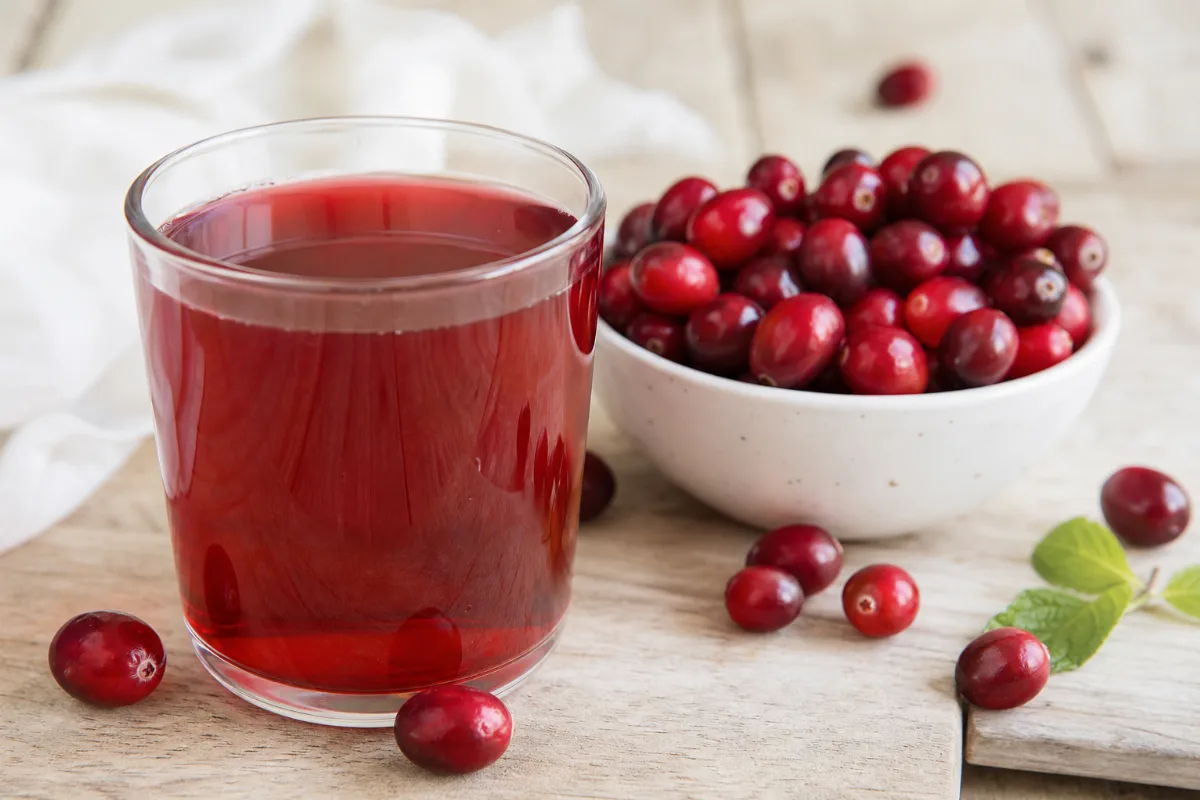
Cranberry Juice
Vaccinium macrocarpon (juice) · also called American cranberry juice, cranberry juice cocktail (a different product)
Cranberry juice is pressed from the American cranberry. People drink it mostly to try to prevent urinary tract infections (UTIs). Cochrane found cranberry products probably lower repeat UTIs in some groups, but trials of the juice itself disagree, and it does not treat a UTI. The main cautions are warfarin, kidney stones, sugar and untreated juice.
General information, not medical advice. Last substantive update · Not medically reviewed. A named clinician has not signed off on this page. How this page is made
About Cranberry Juice
Cranberry juice is a tart drink pressed from the American cranberry. The research is mostly about whether it can help prevent repeat urinary tract infections. It is a drink with a lot of sugar, not a treatment for an infection.
What it is
Cranberry juice is pressed from the fruit of the American cranberry, Vaccinium macrocarpon. It is tart, so many shelf products are cocktails or blends with other juices or added sugar. The USDA item on this page is unsweetened juice.
NCCIH says cranberry grows in wet habitats in the Northeastern and North Central parts of North America and has a history of use in food and medicine.
What is in a cup
USDA data for unsweetened cranberry juice, per 100 g: 46 kcal, 12.1 g sugars, 0.1 g fibre, 9.3 mg vitamin C, 1.2 mg vitamin E, 0.055 mg copper, 77 mg potassium and 2 mg sodium. USDA lists no caffeine and no alcohol.
One cup (253 g) has about 116 kcal, 30.6 g of sugars, 23.5 mg of vitamin C, 3.0 mg of vitamin E and 195 mg of potassium. Cocktails and juice drinks differ, so check the label.
Urinary infections: what the research shows
Cochrane (50 trials, 8,857 people) found cranberry products probably lower the risk of repeat UTIs in women with recurrent UTIs, in children and in people prone to UTI after a procedure. Results varied a lot, and juice and tablets were mixed together.
Trials of the juice alone disagree. One 24-week trial found fewer clinical UTIs; two others found no significant difference; a children's trial found fewer episodes but not fewer children with a recurrence. Cochrane found little or no benefit in older people in care, pregnancy and bladder emptying problems. It is not a treatment for a UTI.
Blood pressure, cholesterol, blood sugar and stomach
A 2026 pooled analysis of 12 trials found no significant fall in blood pressure. A 2024 pooled analysis of 16 trials found small changes in the total to HDL cholesterol ratio and an insulin resistance score, but not in LDL cholesterol, fasting glucose or HbA1c. A pooled analysis of four trials on H. pylori was not significant.
These analyses mix juice with other cranberry products.
At a glance
Traditional uses history, not proof
- Cranberry fruit has a history of use in food, dyes and medicine among Native Americans and later European settlers (NCCIH)
- Long use is not proof that it treats any condition
Studied for research
- Preventing repeat UTIs, moderate certainty for cranberry products pooled, mixed for juice alone
- Treating a UTI, not supported
- Blood pressure, low certainty (no significant change)
- Cholesterol and blood sugar, mixed
- H. pylori, insufficient evidence
- Kidney stone risk markers in urine, mixed
- Vitamin C, vitamin E and copper, high certainty for the nutrient content
Main compounds
- Proanthocyanidins (PACs)
- Sugars
- Vitamin C
- Vitamin E
- Copper and potassium
Common forms
- 100% unsweetened cranberry juice, as a drink (USDA values read)
- Cranberry juice cocktails, blends and juice drinks (values not read; often sweetened)
- Juice beverages used in trials (different strengths and placebos)
- Cranberry tablets and capsules are different products and are not covered
Research links: 2023 Cochrane review: cranberries for preventing UTIs (50 trials) · 2016 trial: cranberry juice beverage and clinical UTIs in women · NCCIH: cranberry, usefulness and safety · Research Library · Genes & Biomarkers Library
What it is and its history
- Accepted scientific name
- Vaccinium macrocarpon Aiton (American cranberry), juice
- Naming authority
- Species name and common names as given by NCCIH (page read 2026-10-26). Accepted-name check against GBIF was not run for this page.
- Synonyms
- Oxycoccus macrocarpos (given by NCCIH as a synonym)
- Common names
- Cranberry juice (English); American cranberry juice (English); Jugo de arandano rojo (Spanish)
- Family or group
- Cranberry juice is a processed drink pressed from the fruit of the American cranberry; it is not a plant.
- Classification
- Plantae > Ericaceae (heath family, per the earlier page; not re-checked) > Vaccinium > Vaccinium macrocarpon
- Native range
- NCCIH: cranberry is an evergreen shrub that grows in wet habitats in the Northeastern and North Central parts of North America.
- Habitat
- Wet habitats (NCCIH).
- What it looks like
- Roots: Not verified.; Stems: Evergreen shrub (NCCIH).; Leaves: Not verified.; Flowers: Not verified.; Fruit: The drink is pressed from the fruit. USDA gives household portions of 1 cup (253 g) and 1 fl oz (31.6 g) for unsweetened juice.
- Cultivation
- Not verified from a source read.
- Harvest and processing
- The USDA item is cranberry juice, unsweetened. Many shelf products are 'cocktails' or 'juice drinks' with other juices or added sugar; juice sold untreated must carry an FDA warning label. Pressing, pasteurising and concentrating were not read from a source beyond that.
- Look-alikes and adulterants
- Name: Cranberry juice cocktail and juice drinks; Note: Often blended or sweetened; the USDA values on this page are not for them.; Name: Cranberry tablets and capsules; Note: A different product; NCCIH says processing into tablets or capsules can lower PAC content. See the cranberry herb page.; Name: Vaccinium oxycoccos (small cranberry); Note: Listed by NCCIH as another cranberry species; the trials read used American cranberry juice or did not say.
- Sustainability and conservation
- Not assessed.
Photographs
What is inside, and how it may work
What it contains and how those compounds act in cells and animals. Laboratory and animal mechanisms are not proven effects in people.
Main compounds
| Compound | Family | Where it is concentrated | Activity studied | Level of evidence |
|---|---|---|---|---|
| Proanthocyanidins (PACs) | polyphenol | Fruit Not measured in store-bought juice in any source read. | Thought to stop certain E. coli sticking to the bladder wall (lab explanation). NCCIH says processing can lower PAC content in tablets and capsules. 12 15 | Lab |
| Sugars | carbohydrate | Juice USDA unsweetened juice per 100 g: sugars 12.1 g | Counted as free sugars by WHO. 19 20 | Human data |
| Vitamin C | vitamin | Juice USDA per 100 g: 9.3 mg | Nutrient; not shown to prevent illness by drinking this juice. 19 | Human data |
| Vitamin E (alpha-tocopherol) | vitamin | Juice USDA per 100 g: 1.2 mg | Nutrient. 19 | Human data |
| Copper and potassium | minerals | Juice USDA per 100 g: copper 0.055 mg, potassium 77 mg | Nutrients. 19 | Human data |
Mechanisms, receptors and pathways
| Target or pathway | Gene or receptor | What was found | Level |
|---|---|---|---|
| Bacterial adhesion in the bladder | P-fimbriae of E. coli on bladder lining cells | Cochrane and NCCIH state that PACs are thought to inhibit p-fimbriated E. coli from adhering to cells lining the bladder. In one juice trial, P-fimbriated E. coli were found in urine in 43.5% of the cranberry group and 80.0% of the placebo group, a difference that was not significant. 12 15 11 | Lab |
| Urine chemistry | Urinary oxalate, calcium, citrate, pH | Cranberry juice changed urine chemistry in two small trials in opposite directions on oxalate. The larger daily amount also lowered urine pH and uric acid. 7 3 | Human data |
Absorption, metabolism and elimination
- Absorption
- Not found for cranberry juice compounds in the sources read.
- Distribution
- Not found.
- Metabolism
- Not found.
- Elimination
- Not found.
- Bioavailability
- Not established in the sources read.
Isolated compounds versus whole extracts
Cochrane pooled juice, tablets and other products and says it is unclear whether juice and tablets differ. NCCIH says processing into tablets or capsules can reduce PACs. The juice trials above used drinks of different strengths and placebos. Blood pressure, cholesterol and blood sugar analyses also pool juice with dried forms. A result for one product does not carry over to another.
Nutritional composition
Nutrition from USDA FoodData Central (SR Legacy, April 2018 release; values read 2026-10-26 from a saved copy of the data in the project). Cranberry juice, unsweetened (FDC 168117), per 100 g: 46 kcal, 0.39 g protein, 0.13 g fat, 12.2 g carbohydrate, 12.1 g total sugars, 0.1 g fibre, 8 mg calcium, 0.25 mg iron, 6 mg magnesium, 77 mg potassium, 2 mg sodium, 9.3 mg vitamin C, 1.2 mg vitamin E, 5.1 micrograms vitamin K, 0.055 mg copper; no caffeine and no alcohol. One USDA household portion of 1 cup (253 g, the 100 g values multiplied by 2.53): about 116 kcal, 30.6 g sugars, 0.3 g fibre, 23.5 mg vitamin C, 3.0 mg vitamin E, 12.9 micrograms vitamin K, 195 mg potassium and 5 mg sodium. This is the unsweetened juice item. Cocktails, blends, concentrates and sweetened juice drinks have different values and were not read; check the label.
1 high certainty1 moderate certainty3 mixed findings2 low certainty1 not enough evidence1 evidence against
What was looked at
The 9 benefits and uses checked for Cranberry Juice, each with how strong the evidence is. Tap one to open it.
- Preventing repeat urinary tract infections (cranberry products, pooled)Moderate certainty
- Preventing repeat UTIs (cranberry juice trials on their own)Mixed findings
- Older people in care, pregnancy and bladder emptying problemsLow certainty
- Treating a UTI that has already startedEvidence against
- Vitamin C, vitamin E and copper in a glass (nutrient content)High certainty
- Blood pressureLow certainty
- Cholesterol and blood sugarMixed findings
- Helicobacter pylori stomach infectionNot enough evidence
- Kidney stone risk markers in urineMixed findings
Lab markers tracked in the studies
Clinical UTI episodesSystolic blood pressureTotal to HDL cholesterol ratioInsulin resistance score (HOMA-IR)
What is Cranberry Juice good for?
The studied uses and how strong the human evidence is for each. Several results are for cranberry products in general (juice, tablets and others together), not for juice on its own.
Benefits, one by one
Each card is a research question, not a promise. Tap a goal to filter. Open a card to see the studies, doses and limits.
Preventing repeat urinary tract infections (cranberry products, pooled)
Moderate certaintyCochrane pooled 50 trials of cranberry products (juice, tablets and others) and found they probably lower the risk of repeat UTIs in women with recurrent UTIs, in children and in people prone to UTI after a procedure. Juice and tablets were mixed together, so this is not a result for juice alone.
2 studiesJuice, tablets and other cranberry products pooled. Cochrane says it …
Studies, doses and limits
What the trials found
Fifty trials with 8,857 people. Twenty-six could be pooled for symptomatic, culture-verified UTIs. Moderate-certainty evidence of fewer UTIs overall, with large differences between trials.
Results
Overall risk ratio 0.70. Women with recurrent UTIs 0.74. Children 0.46. People prone to UTI after a procedure 0.47.
Effect sizes as reported
RR 0.70 (95% CI 0.58 to 0.84; 6,211 people); women 0.74 (0.55 to 0.99); children 0.46 (0.32 to 0.68); after a procedure 0.47 (0.37 to 0.61).
Why this rating
Cochrane rated the overall result moderate certainty; trial results varied (I2 69%). NCCIH calls the findings inconsistent.
Form and dose studied
Juice, tablets and other cranberry products pooled. Cochrane says it is unclear whether juice and tablets differ.
Who was studied
Women with recurrent UTIs, children, people prone to UTI after a procedure.
Limits
Mixed products and strengths. Not a result for juice alone. Not a treatment for an infection that has started.
Why researchers looked
Cranberry's proanthocyanidins (PACs) are thought to stop certain E. coli bacteria from sticking to the bladder wall.
Traditional use
NCCIH notes cranberry has a history of use in food and medicine among Native Americans and later European settlers. Long use is not proof.
Proposed mechanism Laboratory explanation
Proanthocyanidins (PACs) are thought to stop p-fimbriated E. coli from sticking to bladder lining cells. This is a lab-based explanation.
A proposed mechanism does not show that the effect happens in people.
See the Safety tab: warfarin, sugar and kidney stone questions.
Preventing repeat UTIs (cranberry juice trials on their own)
Mixed findingsFour trials tested the juice itself against a placebo drink. They do not agree. One 24-week trial found fewer clinical UTIs; two found no significant difference; a children's trial found fewer episodes but not fewer children with a recurrence.
4 studiesJuice or juice beverage versus a placebo drink. Tested amounts differ…
Studies, doses and limits
What the trials found
Maki 2016: 373 women, one 240 mL cranberry beverage a day for 24 weeks, fewer clinical UTIs (39 versus 67). Stapleton 2012: 176 women, not significant. Barbosa-Cesnik 2011: 319 college women, 27% cranberry juice, no reduction. Salo 2012: 255 children, fewer episodes (27 versus 47) but not fewer children with a recurrence.
Results
Clinical UTI rate ratio 0.61 in the 24-week trial. Hazard ratio 0.68 (not significant) and 20.0% versus 14.0% recurrence (not significant) in the other two women's trials. Children: 16% versus 22% with a recurrence (not significant).
Effect sizes as reported
Maki: IRR 0.61 (0.41 to 0.91). Stapleton: HR 0.68 (0.33 to 1.39). Barbosa-Cesnik: recurrence 20.0% cranberry versus 14.0% placebo. Salo: difference -6% (-16 to 4%) in children with a recurrence; episodes 0.16 per person-year lower (-0.31 to -0.01).
Why this rating
Four single-product trials that point in different directions; the juices differed (one was 27% cranberry) and so did the placebo drinks.
Form and dose studied
Juice or juice beverage versus a placebo drink. Tested amounts differed between trials; see the study records.
Who was studied
Women with a recent UTI; children treated for UTI.
Limits
Each result is for one product. Funding was not stated in the abstracts we read.
Why researchers looked
Juice is the form most people drink for urinary health.
Proposed mechanism Laboratory explanation
Same PAC explanation as above; one trial found fewer P-fimbriated E. coli in urine with juice, but the difference was not significant.
A proposed mechanism does not show that the effect happens in people.
Minor side effects were reported by 24.2% with cranberry and 12.5% with placebo in one trial (not significant).
Older people in care, pregnancy and bladder emptying problems
Low certaintyCochrane found little or no benefit from cranberry products in older people in care, pregnant women and adults whose bladder does not empty fully, and says the evidence does not support use in these groups.
2 studiesCranberry products, mixed forms.
Studies, doses and limits
What the trials found
Three trials each in older people in care (1,489 people), pregnant women (765) and adults with neuromuscular bladder dysfunction (464).
Results
Little or no benefit in low-certainty evidence.
Effect sizes as reported
Older people in care RR 0.93 (0.67 to 1.30); pregnancy RR 1.06 (0.75 to 1.50); bladder emptying problems RR 0.97 (0.78 to 1.19).
Why this rating
Cochrane graded these as low-certainty evidence. NCCIH calls results in older people in care and pregnancy inconsistent.
Form and dose studied
Cranberry products, mixed forms.
Who was studied
Older people in care, pregnant women, adults with incomplete bladder emptying.
Limits
Few trials, mixed products.
Why researchers looked
These groups are at higher risk for UTIs.
Proposed mechanism Not applicable
Not applicable.
A proposed mechanism does not show that the effect happens in people.
In pregnancy see the Safety tab.
Treating a UTI that has already started
Evidence againstCranberry is not a treatment for a UTI. NCCIH does not recommend it as a treatment in any population, and the NHS found no evidence that it eases symptoms or treats an infection already started.
2 studiesNot applicable.
Studies, doses and limits
What the trials found
No trial of juice as a treatment was read. The two agencies give a plain statement instead.
Results
No evidence of benefit as a treatment.
Why this rating
Official bodies advise against relying on it for treatment; no supporting evidence was found.
Who was studied
Anyone who thinks they have a UTI.
Limits
This is an agency position, not a pooled trial result.
Why researchers looked
People sometimes drink cranberry juice at the first sign of a UTI.
Proposed mechanism Not applicable
Not applicable.
A proposed mechanism does not show that the effect happens in people.
People who think they have a UTI should see a health care provider. NHS also says to avoid bladder-irritating drinks such as fruit juices during a UTI.
Vitamin C, vitamin E and copper in a glass (nutrient content)
High certaintyOne cup of unsweetened cranberry juice gives about 23.5 mg of vitamin C, 3.0 mg of vitamin E and 0.14 mg of copper, along with about 30.6 g of sugars and 116 kcal (USDA).
2 studiesUSDA item is unsweetened cranberry juice. Cocktails, blends and juice…
Studies, doses and limits
What the trials found
No trial was read showing the juice corrects a vitamin shortfall.
Results
A source of vitamin C, vitamin E and copper; also a source of sugar with almost no fibre.
Effect sizes as reported
USDA, unsweetened juice per 100 g: vitamin C 9.3 mg, vitamin E 1.2 mg, copper 0.055 mg, vitamin K 5.1 micrograms, potassium 77 mg, sugars 12.1 g, fibre 0.1 g, 46 kcal. One cup (253 g) is 2.53 times that.
Why this rating
High that the unsweetened juice contains these nutrients (USDA). Values vary with the cranberry variety and with how much of a product is real juice. Not tested as a treatment for any shortfall.
Form and dose studied
USDA item is unsweetened cranberry juice. Cocktails, blends and juice drinks differ and were not read.
Who was studied
General diet.
Limits
Nutrient facts, not trials. Many shelf products are cocktails with added sugar.
Why researchers looked
People look at juice as a source of vitamins; it is also a source of sugar.
Proposed mechanism Nutrient database
These are nutrient amounts in the drink from USDA tables.
A proposed mechanism does not show that the effect happens in people.
Sugar: see the Safety tab.
Blood pressure
Low certaintyA 2026 pooled analysis of 12 trials found no significant fall in blood pressure from cranberry, and the authors concluded it was not effective for managing blood pressure.
1 studiesJuice and other cranberry forms pooled.
Studies, doses and limits
What the trials found
Twelve randomised trials of cranberry in several forms.
Results
Systolic and diastolic pressure each fell by 1.31 mmHg on average, not statistically significant. A systolic fall was significant in a subgroup using juice (8 weeks or less, younger participants).
Effect sizes as reported
Systolic -1.31 mmHg (P 0.19); diastolic -1.31 mmHg (P 0.12).
Why this rating
Pooled result not significant; subgroup finding is exploratory; forms mixed.
Form and dose studied
Juice and other cranberry forms pooled.
Who was studied
Adults in 12 trials.
Limits
Not a juice-only analysis. Subgroups can mislead.
Why researchers looked
Cranberry polyphenols were thought to help blood vessels.
Proposed mechanism Not applicable
Not established in the abstract read.
A proposed mechanism does not show that the effect happens in people.
None specific.
Cholesterol and blood sugar
Mixed findingsA 2024 pooled analysis of 16 trials found small improvements in the total to HDL cholesterol ratio and an insulin resistance score, but no change in LDL cholesterol, total cholesterol, triglycerides, fasting glucose or HbA1c.
1 studiesJuice and dried forms (capsules, powder, tablets).
Studies, doses and limits
What the trials found
Sixteen randomised trials of cranberry in juice and dried forms.
Results
TC/HDL ratio and HOMA-IR improved; LDL, HDL, total cholesterol, triglycerides, fasting glucose, HbA1c and fasting insulin did not change overall. Fasting insulin fell only in a dried-forms subgroup.
Effect sizes as reported
TC/HDL-C MD -0.24 (-0.45 to -0.04); HOMA-IR MD -0.59 (-1.05 to -0.14).
Why this rating
Two small improvements among many markers that did not change; juice and dried forms are pooled.
Form and dose studied
Juice and dried forms (capsules, powder, tablets).
Who was studied
Adults, with and without health conditions.
Limits
Marker results, not heart or diabetes outcomes. Not a juice-only result. Unsweetened versus sweetened juice not separated in the abstract.
Why researchers looked
Cranberry polyphenols (anthocyanins and others) were thought to improve fat and sugar handling.
Proposed mechanism Not applicable
Not established in the abstract read.
A proposed mechanism does not show that the effect happens in people.
Juice carries sugar; see the Safety tab.
Helicobacter pylori stomach infection
Not enough evidenceA pooled analysis of four trials found cranberry may raise the chance of clearing H. pylori, but the result was not statistically significant.
1 studiesCranberry supplementation added to treatment; form not specified in t…
Studies, doses and limits
What the trials found
Four randomised trials, 1,935 people.
Results
Odds of clearing infection 1.27 times higher, not significant.
Effect sizes as reported
OR 1.27 (95% CI 0.63 to 2.58).
Why this rating
Four trials, a wide interval that includes no effect.
Form and dose studied
Cranberry supplementation added to treatment; form not specified in the abstract.
Who was studied
People with H. pylori.
Limits
May not be juice. Small number of trials.
Why researchers looked
Cranberry compounds were thought to stop H. pylori sticking to the stomach lining.
Traditional use
NCCIH notes traditional use for stomach disorders. Long use is not proof.
Proposed mechanism Not applicable
Not established in the abstract read.
A proposed mechanism does not show that the effect happens in people.
H. pylori needs medical treatment; cranberry is not a substitute.
Kidney stone risk markers in urine
Mixed findingsTwo small crossover trials of cranberry juice gave opposite results on urine markers linked to kidney stones. These are urine tests, not stones.
3 studiesJuice diluted with water in one trial; undiluted juice in the other.
Studies, doses and limits
What the trials found
Twenty men with no stone history (diluted juice, 2 weeks) and 24 people, half calcium oxalate stone formers (1 L a day, 1 week).
Results
Diluted juice lowered oxalate and phosphate, raised citrate and tended to lower calcium oxalate saturation. A larger daily amount raised urinary calcium and oxalate and increased calcium oxalate saturation by 18%, while lowering uric acid.
Effect sizes as reported
Calcium oxalate saturation +18% (1 L a day); urinary calcium 154 to 177 mg a day; oxalate 26.4 to 29.2 mg a day.
Why this rating
Two small trials that disagree; both measure urine markers rather than stones.
Form and dose studied
Juice diluted with water in one trial; undiluted juice in the other.
Who was studied
Healthy men; healthy people and calcium oxalate stone formers.
Limits
Short, small, no stone outcomes.
Why researchers looked
Juice changes urine chemistry, so researchers checked stone risk markers.
Proposed mechanism Human urine markers
Urine oxalate, calcium, citrate and acidity change calcium oxalate saturation.
A proposed mechanism does not show that the effect happens in people.
People with a stone history should ask a clinician. NIDDK says drinking enough liquid, mainly water, is the most important step; its page does not mention cranberry.
Connections to the rest of health
How Cranberry Juice connects to the rest of our health knowledge graph. Every link says what kind of connection it is. A safety link (for example to the liver) is a warning, not a benefit. A study that merely mentions a topic never creates a benefit link.
Explore every connection: goals, body systems, organs, symptoms, genes
A. Wellness goals
| Connected to | Kind of connection | Evidence status | Context | Studies |
|---|---|---|---|---|
| Womens Wellness | Moderate certainty | Preventing repeat urinary tract infections (cranberry products, pooled): Cochrane pooled 50 trials of cranberry products (juice, tablets and others) and found they probably lower the risk of repeat UTIs in women with recurrent UTIs, in children and in people prone to UTI after a procedure. Juice and tablets were mixed together, so this is not a result for juice alone. Preventing repeat UTIs (cranberry juice trials on their own): Four trials tested the juice itself against a placebo drink. They do not agree. One 24-week trial found fewer clinical UTIs; two found no significant difference; a children's trial found fewer episodes but not fewer children with a recurrence. | 12 15 6 11 2 10 | |
| Womens Wellness | Low certainty | Older people in care, pregnancy and bladder emptying problems: Cochrane found little or no benefit from cranberry products in older people in care, pregnant women and adults whose bladder does not empty fully, and says the evidence does not support use in these groups. Treating a UTI that has already started: Cranberry is not a treatment for a UTI. NCCIH does not recommend it as a treatment in any population, and the NHS found no evidence that it eases symptoms or treats an infection already started. | 12 15 17 | |
| Preventive Wellness | High certainty | Vitamin C, vitamin E and copper in a glass (nutrient content): One cup of unsweetened cranberry juice gives about 23.5 mg of vitamin C, 3.0 mg of vitamin E and 0.14 mg of copper, along with about 30.6 g of sugars and 116 kcal (USDA). | 19 20 | |
| Blood Pressure Support | Low certainty | Blood pressure: A 2026 pooled analysis of 12 trials found no significant fall in blood pressure from cranberry, and the authors concluded it was not effective for managing blood pressure. | 1 | |
| Heart Health | Low certainty | Blood pressure: A 2026 pooled analysis of 12 trials found no significant fall in blood pressure from cranberry, and the authors concluded it was not effective for managing blood pressure. | 1 | |
| Cholesterol Balance | Mixed findings | Cholesterol and blood sugar: A 2024 pooled analysis of 16 trials found small improvements in the total to HDL cholesterol ratio and an insulin resistance score, but no change in LDL cholesterol, total cholesterol, triglycerides, fasting glucose or HbA1c. | 5 | |
| Blood Sugar Balance | Mixed findings | Cholesterol and blood sugar: A 2024 pooled analysis of 16 trials found small improvements in the total to HDL cholesterol ratio and an insulin resistance score, but no change in LDL cholesterol, total cholesterol, triglycerides, fasting glucose or HbA1c. | 5 | |
| Digestive Support | Not enough evidence | Helicobacter pylori stomach infection: A pooled analysis of four trials found cranberry may raise the chance of clearing H. pylori, but the result was not statistically significant. | 9 | |
| Preventive Wellness | Mixed findings | Kidney stone risk markers in urine: Two small crossover trials of cranberry juice gave opposite results on urine markers linked to kidney stones. These are urine tests, not stones. | 7 3 18 |
B. Body systems
| Connected to | Kind of connection | Evidence status | Context | Studies |
|---|---|---|---|---|
| Urinary System | Biological association | Moderate certainty | Studied for: Preventing repeat urinary tract infections (cranberry products, pooled) Studied for: Preventing repeat UTIs (cranberry juice trials on their own) | 12 15 6 11 2 10 17 7 3 18 |
| Digestive System | Biological association | High certainty | Studied for: Vitamin C, vitamin E and copper in a glass (nutrient content) Studied for: Helicobacter pylori stomach infection | 19 20 9 |
| Cardiovascular System | Biological association | Low certainty | Studied for: Blood pressure | 1 |
| Metabolism Weight | Biological association | Mixed findings | Studied for: Cholesterol and blood sugar | 5 |
E. Health conditions
| Connected to | Kind of connection | Evidence status | Context | Studies |
|---|---|---|---|---|
| Kidney stones | Adverse effect or risk | Preliminary | Two small urine-marker trials disagree on stone risk. Preparation or compound: Cranberry juice |
3 7 |
| Recurrent urinary tract infection | Preliminary | Cochrane: probably lowers repeat UTIs in some groups; not a treatment. Preparation or compound: Cranberry products (juice trials mixed) |
12 15 |
I. Biomarkers
| Connected to | Kind of connection | Evidence status | Context | Studies |
|---|---|---|---|---|
| Clinical UTI episodes | Biological association | Mixed findings | Measured in trials: lowered in some trials. A lab change is not the same as a health benefit. | 6 11 2 10 |
| Systolic blood pressure | Biological association | Low certainty | Measured in trials: no significant change. A lab change is not the same as a health benefit. | 1 |
| Total to HDL cholesterol ratio | Biological association | Mixed findings | Measured in trials: lowered. A lab change is not the same as a health benefit. | 5 |
| Insulin resistance score (HOMA-IR) | Biological association | Mixed findings | Measured in trials: lowered. A lab change is not the same as a health benefit. | 5 |
K. Biological pathways
| Connected to | Kind of connection | Evidence status | Context | Studies |
|---|---|---|---|---|
| Escherichia coli (P-fimbriated) | Preliminary mechanism | Lab | The bacterium whose adhesion to the bladder wall PACs are thought to block. | 12 15 |
| Proanthocyanidins | Preliminary mechanism | Lab | Cranberry polyphenols thought to act on bacterial adhesion; not measured in store juice in any source read. | 15 |
L. Active compounds
| Connected to | Kind of connection | Evidence status | Context | Studies |
|---|---|---|---|---|
| Proanthocyanidins (PACs) | Biological association | Lab | Thought to stop certain E. coli sticking to the bladder wall (lab explanation). NCCIH says processing can lower PAC content in tablets and capsules. Preparation or compound: Fruit |
12 15 |
| Sugars | Biological association | Human | Counted as free sugars by WHO. Preparation or compound: Juice |
19 20 |
| Vitamin C | Biological association | Human | Nutrient; not shown to prevent illness by drinking this juice. Preparation or compound: Juice |
19 |
| Vitamin E (alpha-tocopherol) | Biological association | Human | Nutrient. Preparation or compound: Juice |
19 |
| Copper and potassium | Biological association | Human | Nutrients. Preparation or compound: Juice |
19 |
Each connection is stored with the ingredient, the connected record, the kind of connection, the evidence status, the supporting studies, the preparation or compound involved, and a review date (last reviewed October 26, 2026).
Evidence at a glance: what changed in 2 lab markers
Tap a number to show only those markers. Counts are markers, not people.
The evidence
The research centre for Cranberry Juice. Every record here was checked against PubMed or the publisher's page; we never list a study we have not verified.
Evidence by outcome
Bars show how many studies we found for each outcome, not how well it works. People are added up across trials only (reviews are not added, to avoid double counting).
How we rate evidence
High certainty
Several well-run trials or reviews agree; further research is unlikely to change the picture much.
Moderate certainty
Good trials point the same way, but some doubt remains.
Low certainty
Small, short or inconsistent trials. The finding could change with better research.
Very low certainty
Very little or very weak human data. Treat as a possibility only.
Mixed findings
Trials or reviews disagree with each other.
Not enough evidence
Not enough human research to say either way.
Evidence against
Good research found no benefit, or found harm.
We take the reviewers' own risk-of-bias and GRADE statements where they exist, and otherwise judge from study size, design, consistency, directness and whether a product matches what is sold. Many publications do not make evidence high. Method note: We started from our existing cranberry juice summary, re-checked nutrition against saved USDA FoodData Central data, read the health agency pages (NCCIH, NHS, FDA, WHO, AAP, NIDDK) and re-read the PubMed abstracts for the reviews and trials cited. Only abstracts were read for studies. Items we could not verify are flagged in the research gaps.
Study library: every study we checked 20
| Study | Design | People | Product, dose, length | Result |
|---|---|---|---|---|
| Bahreyni 2026 The Effect of Cranberry Consumption on Blood Pressure: A Systematic Review and Meta-Analysis of Randomized Controlled Trials. Clin Cardiol · PMID 42003421 · DOI |
Systematic review meta analysis |
12 randomised trials | Cranberry in several forms (juice and others) Fruit juice and other forms Varied Varied · vs Control |
The pooled falls of 1.31 mmHg systolic and 1.31 mmHg diastolic were not statistically significant. The systolic fall was significant in a subgroup of studies that gave cranberry as juice (8 weeks or less, younger participants). The authors concluded cranberry was not effective for managing blood pressure. Systolic -1.31 mmHg (P 0.19); diastolic -1.31 mmHg (P 0.12) (Not given in the abstract) Methods, limits and fundingOutcomes: Systolic and diastolic blood pressure Limitations: Subgroup findings are exploratory. Mixes juice and other forms. Registered on PROSPERO CRD420251028424. Funding and conflicts: Funding is not stated in the abstract. Registration: PROSPERO CRD420251028424 Read: abstract |
| Barbosa-Cesnik 2011 Cranberry juice fails to prevent recurrent urinary tract infection: results from a randomized placebo-controlled trial. Clin Infect Dis · PMID 21148516 · DOI |
RCT |
319 319 college women with an acute UTI |
27% cranberry juice Fruit juice 8 oz twice a day Up to 6 months, or until a second UTI · vs Placebo drink |
Recurrence was 16.9% overall and similar between groups. The cranberry group had a slightly higher recurrence rate (20.0% versus 14.0%). Symptoms did not differ between groups. Recurrence 20.0% cranberry versus 14.0% placebo (not significant) (Overall recurrence 12.8% to 21.0%) Methods, limits and fundingOutcomes: Second UTI (symptoms plus positive urine culture) Limitations: Healthy college women; the juice was 27% cranberry; the study was designed to detect a 2-fold difference. Funding and conflicts: Funding is not stated in the abstract (the record lists NIH research support). Read: abstract |
| Gettman 2005 Effect of cranberry juice consumption on urinary stone risk factors. J Urol · PMID 16006907 · DOI |
RCT crossover |
24 12 people without stones and 12 calcium oxalate stone formers |
Cranberry juice Fruit juice 1 L a day, versus 1 L deionised water 7 days per phase, controlled diet · vs Deionised water |
Juice raised urinary calcium (154 to 177 mg a day) and urinary oxalate (26.4 to 29.2 mg a day), which increased calcium oxalate saturation by 18%. It lowered urinary pH and uric acid. The authors concluded cranberry juice increases risk for calcium oxalate and uric acid stones and decreases risk for brushite stones. Calcium oxalate saturation +18%; urinary calcium P 0.0008; oxalate P 0.04 (Not given in the abstract) Methods, limits and fundingOutcomes: 24-hour urine stone risk factors and blood chemistry Limitations: Small, one week, urine markers rather than stones. Funding and conflicts: Funding is not stated in the abstract. Read: abstract |
| Hamann 2011 Warfarin-cranberry juice interaction. Ann Pharmacother · PMID 21364039 · DOI |
Case report |
1 One 46-year-old woman on warfarin |
Cranberry juice cocktail Fruit juice cocktail About 1,420 mL (1.5 quarts) a day for 2 days, then about 1,893 mL (2 quarts) a day for 3 to 4 days Two episodes |
INR rose from a usual 2.0 to 4.6, then to 6.5 on a second occasion, after very large daily amounts of cranberry juice cocktail. It fell back after stopping. The authors judged the link highly probable and found no other cause. INR 4.6 and 6.5 versus usual about 2.0 (Not applicable) Methods, limits and fundingOutcomes: INR (a blood clotting test) Limitations: A single case; amounts were very large; the product was a cocktail. Funding and conflicts: Funding is not stated in the abstract. Read: abstract |
| Li 2024 The Effects of Cranberry Consumption on Glycemic and Lipid Profiles in Humans: A Systematic Review and Meta-Analysis of Randomized Controlled Trials. Nutrients · PMID 38542695 · DOI |
Systematic review meta analysis |
16 randomised trials | Cranberry in juice and dried forms (capsules, powder, tablets) Fruit juice and dried forms Varied Varied · vs Control |
Cranberry lowered the total cholesterol to HDL cholesterol ratio and HOMA-IR. It did not change total cholesterol, HDL, LDL, triglycerides, fasting glucose, HbA1c or fasting insulin overall. Fasting insulin fell only in a subgroup using dried forms (3 studies, 165 people). TC/HDL-C MD -0.24; HOMA-IR MD -0.59; fasting insulin (dried forms) MD -2.16 (TC/HDL-C -0.45 to -0.04; HOMA-IR -1.05 to -0.14; insulin -4.24 to -0.07) Methods, limits and fundingOutcomes: Blood lipids, glucose, insulin, HbA1c, insulin resistance (HOMA-IR) Limitations: Juice and dried forms are pooled. The two findings are small and surrogate markers, not disease outcomes. Funding and conflicts: Funding is not stated in the abstract. Read: abstract |
| Maki 2016 Consumption of a cranberry juice beverage lowered the number of clinical urinary tract infection episodes in women with a recent history of urinary tract infection. Am J Clin Nutr · PMID 27251185 · DOI |
RCT |
373 373 women with a recent UTI (mean age 40.9 years) |
Cranberry juice beverage Fruit juice beverage One 240 mL serving a day 24 weeks · vs Placebo beverage |
Clinical UTIs fell: 39 episodes with cranberry beverage versus 67 with placebo. Clinical UTI with pyuria was also lower. Time to a UTI with a positive urine culture did not differ between groups. Clinical UTI incidence rate ratio 0.61; with pyuria 0.63; time to culture-positive UTI HR 0.97 (0.41 to 0.91; 0.40 to 0.97; 0.56 to 1.67) Methods, limits and fundingOutcomes: Clinical UTI episodes (primary); UTI with pyuria; UTI with positive culture Limitations: One trial of one beverage. The culture-confirmed outcome did not differ. A published erratum exists (PubMed 28765395); only the abstract was read and the corrections were not seen. Funding and conflicts: Funding is not stated in the abstract. Registered at clinicaltrials.gov NCT01776021. Registration: NCT01776021 Read: abstract |
| McHarg 2003 Influence of cranberry juice on the urinary risk factors for calcium oxalate kidney stone formation. BJU Int · PMID 14616463 · DOI |
RCT crossover |
20 20 South African male students with no history of kidney stones |
Cranberry juice diluted with water Fruit juice 500 mL juice diluted with 1,500 mL water, versus 2,000 mL water 2 weeks per phase, 2-week washout · vs Tap water |
During the juice phase oxalate and phosphate excretion fell and citrate rose. Calcium oxalate supersaturation fell, tending to be lower than with water alone. Urinary oxalate and phosphate down, citrate up; supersaturation down (numbers not in the abstract) (Not given in the abstract) Methods, limits and fundingOutcomes: 24-hour urine oxalate, phosphate, citrate and calcium oxalate supersaturation Limitations: Small trial in men with no stone history; urine markers, not stones. Diluted juice. Funding and conflicts: Funding is not stated in the abstract. Read: abstract |
| Mellen 2010 Effect of high-dose cranberry juice on the pharmacodynamics of warfarin in patients. Br J Clin Pharmacol · PMID 20642557 · DOI |
Interventional uncontrolled |
10 10 men on stable warfarin |
Cranberry juice Fruit juice 240 mL twice a day 7 days · vs Own baseline |
There was no statistical difference in mean prothrombin time between baseline and any day tested. No significant change (Not given in the abstract) Methods, limits and fundingOutcomes: Prothrombin time (a blood clotting test) Limitations: Ten men, one week, no control group; cannot rule out an effect in other people or with other amounts. Funding and conflicts: Funding is not stated in the abstract. Read: abstract |
| Nikbazm 2022 The effect of cranberry supplementation on Helicobacter pylori eradication in H. pylori positive subjects: a systematic review and meta-analysis of randomised controlled trials. Br J Nutr · PMID 34670631 · DOI |
Systematic review meta analysis |
1935 4 randomised trials, 5 effect sizes, 1,935 people with H. pylori |
Cranberry supplementation (forms mixed) Varied Varied · vs Control |
Cranberry raised the odds of clearing H. pylori, but the result was not statistically significant. Between-study differences were moderate. Overall OR 1.27 (0.63 to 2.58) Methods, limits and fundingOutcomes: H. pylori eradication Limitations: Only four trials. The abstract calls the effect 'supplementation', so it may not be juice. Funding and conflicts: Funding is not stated in the abstract. Read: abstract |
| Salo 2012 Cranberry juice for the prevention of recurrences of urinary tract infections in children: a randomized placebo-controlled trial. Clin Infect Dis · PMID 22100577 · DOI |
RCT |
255 263 children in Finland treated for UTI (255 analysed) |
Cranberry juice Fruit juice 6 months of juice, followed for 1 year · vs Placebo drink |
The juice did not significantly reduce the number of children with a recurrence (16% versus 22%). It did reduce the total number of UTI episodes (27 versus 47) and days on antimicrobials. Children with a recurrence: difference -6%; episode rate 0.16 per person-year lower; 6 fewer antimicrobial days per patient-year (Recurrence -16% to 4%; episodes -0.31 to -0.01; antimicrobial days -7 to -5) Methods, limits and fundingOutcomes: Children with at least one recurrent UTI; UTI episodes; days on antimicrobials Limitations: Mixed outcomes: the main per-child result was not significant. Funding and conflicts: Funding is not stated in the abstract. Read: abstract |
| Stapleton 2012 Recurrent urinary tract infection and urinary Escherichia coli in women ingesting cranberry juice daily: a randomized controlled trial. Mayo Clin Proc · PMID 22305026 · DOI |
RCT |
176 176 premenopausal women with a recent UTI |
Cranberry juice Fruit juice 4 oz or 8 oz a day (two cranberry groups) versus placebo juice 6 months · vs Placebo juice |
Cranberry juice did not significantly reduce UTI risk compared with placebo. UTI rate was 0.29 with cranberry and 0.37 with placebo. P-fimbriated E. coli in urine was found in 43.5% versus 80.0% (not significant). Minor side effects were reported by 24.2% with cranberry and 12.5% with placebo (not significant). UTI adjusted HR 0.68 (cranberry versus placebo) (0.33 to 1.39) Methods, limits and fundingOutcomes: Time to UTI (symptoms plus pyuria); bacteria in urine; adverse effects Limitations: Smaller than planned for a small effect; the authors call for larger trials. 120 of the 176 were assigned to cranberry juice. Funding and conflicts: Funding is not stated in the abstract. Supported by NIH per the record; no industry funding is shown in the abstract. Registration: NCT00128128 Read: abstract |
| Williams 2023 Cranberries for preventing urinary tract infections. Cochrane Database Syst Rev · PMID 37068952 · DOI |
Systematic review meta analysis |
50 randomised or quasi-randomised trials, 8,857 people (women with recurrent UTIs, children, people prone to UTI after a procedure, older people in care, pregnant women, adults with bladder emptying problems) | Cranberry products: juice, tablets and other forms together Fruit juice and other products Varied · vs Placebo, water, no specific treatment, antibiotics or probiotics |
Cranberry products reduced the risk of symptomatic, culture-verified UTIs overall (moderate certainty). They probably reduced it in women with recurrent UTIs, in children and in people prone to UTI after a procedure. In older people in care, pregnant women and adults with bladder emptying problems there may be little or no benefit (low certainty). It is unclear whether juice and tablets differ (very low certainty). Gut side effects probably did not differ from placebo. Overall RR 0.70 (26 studies, 6,211 people); women with recurrent UTIs RR 0.74; children RR 0.46; after a procedure RR 0.47; older people in care RR 0.93; pregnancy RR 1.06; bladder emptying problems RR 0.97; gut side effects RR 1.33 (Overall 0.58 to 0.84; women 0.55 to 0.99; children 0.32 to 0.68; procedure 0.37 to 0.61; older people 0.67 to 1.30; pregnancy 0.75 to 1.50; bladder 0.78 to 1.19; gut effects 1.00 to 1.77) Methods, limits and fundingOutcomes: Symptomatic, culture-verified UTIs; gut side effects Limitations: Mixes juice, tablets and other forms. Large differences between trials in the overall result (I2 69%). A November 2023 version of this review (PubMed 37947276) has the same numbers in its abstract. Funding and conflicts: Funding is not stated in the abstract. Cochrane review; not a single-product trial. Read: abstract |
| s-aap-juice American Academy of Pediatrics (2017): Fruit juice in infants, children and adolescents, news release · Source |
Professional guidance n/a |
Methods, limits and fundingRead: full-text | ||
| s-fda-juice US FDA: What You Need to Know About Juice Safety (content current as of 3 May 2024) · Source |
Regulator n/a |
Methods, limits and fundingRead: full-text | ||
| s-nccih-cranberry NCCIH: Cranberry: Usefulness and Safety (last updated November 2024) · Source |
Health agency n/a |
Methods, limits and fundingRead: full-text | ||
| s-nhs-5aday NHS: 5 A DAY, what counts · Source |
Health agency n/a |
Methods, limits and fundingRead: full-text | ||
| s-nhs-uti NHS: Urinary tract infections (UTIs) (page last reviewed 11 July 2025) · Source |
Health agency n/a |
Methods, limits and fundingRead: full-text | ||
| s-niddk-stones NIDDK: Eating, Diet, & Nutrition for Kidney Stones · Source |
Health agency n/a |
Methods, limits and fundingRead: full-text | ||
| s-usda-fdc-168117 USDA FoodData Central: Cranberry juice, unsweetened (FDC 168117, SR Legacy, April 2018) · Source |
Reference database n/a |
Methods, limits and fundingRead: full-text | ||
| s-who-sugars WHO (4 March 2015): WHO calls on countries to reduce sugars intake among adults and children · Source |
Regulator n/a |
Methods, limits and fundingRead: full-text |
What we do not know yet
- No pooled analysis was read that tests juice alone against placebo; Cochrane mixes juice and tablets and says it is unclear whether they differ.
- The juice trials differ in strength, sugar and placebo, and funding was not stated in the abstracts read.
- Blood pressure, cholesterol, blood sugar and H. pylori results mix juice with other cranberry forms.
- Kidney stone results are urine markers from two small trials, not stone outcomes.
- Diabetes, kidney disease (potassium), gout, oxalate advice, contamination, heavy metals and shelf life of opened juice were not researched. GBIF and PubChem checks were not done for this page.
How new research is added
New studies are found by a saved PubMed search and placed in a review queue before the page changes.
Lab markers
What changed in blood or saliva tests during trials. A changed number is not the same as feeling or being healthier, and we give no "normal ranges".
Other 4
Clinical UTI episodes
Lowered in some trials in trials
Urinary tract infections diagnosed by symptoms, sometimes with a urine test showing white cells (pyuria) or a positive culture.
Mixed findingsResults and what it means
Why it was measured
It is what people want to prevent; trials count how many episodes happen.
Statistical vs. clinical meaning
Results for the juice differ from trial to trial.
Safety implication
Fewer UTIs does not mean cranberry treats one.
| Study | Result | People | Product |
|---|---|---|---|
| 6 | Incidence rate ratio 0.61 (95% CI 0.41 to 0.91); 39 episodes versus 67 | 373 women with a recent UTI | One 240 mL cranberry beverage a day for 24 weeks |
| 11 | Adjusted HR 0.68 (95% CI 0.33 to 1.39), not significant | 176 premenopausal women with a recent UTI | Cranberry juice daily for 6 months |
| 2 | Recurrence 20.0% cranberry versus 14.0% placebo, not significant | 319 college women with an acute UTI | 27% cranberry juice twice a day |
| 10 | 27 versus 47 episodes; 16% versus 22% of children with a recurrence (not significant) | 255 children | Cranberry juice for 6 months |
Systolic blood pressure
No significant change in trials
The top number in a blood pressure reading.
Low certaintyTotal to HDL cholesterol ratio
Lowered in trials
Total cholesterol divided by HDL ('good') cholesterol; a lower ratio is usually better.
Mixed findingsResults and what it means
Why it was measured
A simple marker of cholesterol balance.
Statistical vs. clinical meaning
A small change in one ratio while LDL did not change.
Safety implication
None specific.
| Study | Result | People | Product |
|---|---|---|---|
| 5 | Mean difference -0.24 (95% CI -0.45 to -0.04); LDL, HDL and total cholesterol unchanged | 16 trials | Cranberry in juice and dried forms |
Insulin resistance score (HOMA-IR)
Lowered in trials
A calculated score from fasting glucose and insulin that estimates insulin resistance.
Mixed findingsResults and what it means
Why it was measured
Insulin resistance is linked to type 2 diabetes.
Statistical vs. clinical meaning
A small change in a calculated score while glucose and HbA1c did not change.
Safety implication
Juice carries sugar.
| Study | Result | People | Product |
|---|---|---|---|
| 5 | Mean difference -0.59 (95% CI -1.05 to -0.14); fasting glucose and HbA1c unchanged | 16 trials | Cranberry in juice and dried forms |
Safety
What studies and official sources say about side effects, medicines and who should check first. Each point shows what kind of evidence it comes from.
Main points to know 4
- Cranberry juice is not a treatment for a UTI. NCCIH does not recommend cranberry as a treatment for an existing UTI in any population. The NHS says there is no evidence cranberry products ease symptoms or treat an infection that has already started. Anyone who thinks they have a UTI should see a health care provider. Fever, back pain, blood in the urine, confusion or a UTI in pregnancy are reasons to get urgent help (NHS). Authoritative guidance 15 17
- Warfarin: official advice differs from the trial evidence. The NHS says to avoid cranberry products if you take warfarin. NCCIH calls the evidence on an interaction conflicting. A case report describes INR rising to 4.6 and 6.5 after about 1.4 to 1.9 litres a day of cranberry juice cocktail for several days. A small trial of 10 men on stable warfarin found no change in prothrombin time with 240 mL twice a day for a week. Ask the prescriber or pharmacist; never change a prescribed medicine on your own. Case report and small trial 17 15 4 8
- Sugar and teeth. USDA's unsweetened juice has about 30.6 g of sugars and 116 kcal in a cup, and many shelf products are sweetened. WHO counts sugars in fruit juices as free sugars. The NHS says cranberry products can contain a lot of sugar and that juice sugars can damage teeth. Authoritative guidance 19 20 17 16
- Kidney stones: small trials disagree. A one-week trial with 1 litre of juice a day raised urinary calcium and oxalate and increased calcium oxalate saturation by 18%. A different crossover trial with diluted juice lowered oxalate and raised citrate. If you have had kidney stones, ask your clinician. Human urine marker trials 3 7 18
Side effects 3
| Effect | How often | Severity and recovery | Evidence |
|---|---|---|---|
| Stomach upset and diarrhea with very large amounts, especially in young children Cochrane pooled juice, tablets and other products. | Not quantified by NCCIH. In the Cochrane review, gut side effects probably did not differ from placebo (RR 1.33, 95% CI 1.00 to 1.77). | mild Not described in the sources read. | Authoritative guidance 15 12 |
| Minor side effects in a juice trial The abstract does not say which effects. | 24.2% with cranberry juice versus 12.5% with placebo juice (not significant) in 176 women. | minor Not described. | RCT 11 |
| Weight gain and tooth decay from the sugars in juice General statements about fruit juice and free sugars. | Not quantified for cranberry juice. | depends on the product and the amount Not described. | Authoritative guidance 20 13 16 |
Liver
No liver injury from cranberry juice was found in the sources read. A liver-safety source (such as LiverTox) was not searched.
How often. No frequency was found.
Monitoring. No agency monitoring advice was found.
This is a safety connection. It is not evidence that Cranberry Juice supports liver health.
Medicines and supplements 2
| With | Why it matters | Importance | Evidence | What to do |
|---|---|---|---|---|
| Warfarin (blood thinner) prescription | Not established in the sources read. | The NHS says to avoid cranberry products on warfarin. NCCIH says the evidence is conflicting. One case report of two INR rises after very large amounts of juice cocktail; one small uncontrolled trial of 10 men found no change in prothrombin time at 240 mL twice a day. | Case report and small trial and guidance Low certainty 17 15 4 8 | Ask the prescriber or pharmacist before changing anything; do not stop or adjust warfarin yourself. |
| Other medicines prescription | Not found. | NCCIH advises talking with a health care provider about any medicine before using cranberry products, as some herbs and medicines interact. No other specific interaction with cranberry juice was found in the sources read. | Authoritative guidance Not enough evidence 15 | Tell your pharmacist what you take if you drink cranberry juice often. |
Who should check first 5
| Situation | Advice | Evidence |
|---|---|---|
| Taking warfarin | The NHS says to avoid cranberry products. Speak to the prescriber or pharmacist. | Authoritative guidance 17 15 |
| Symptoms of a urinary tract infection | See a health care provider. Do not use cranberry instead of a proven treatment. The NHS also advises avoiding bladder-irritating drinks such as fruit juices during a UTI. | Authoritative guidance 15 17 |
| History of kidney stones | Trials of juice and stone markers disagree. Ask your clinician which type of stone you had; NIDDK says water is the most important fluid. | Human urine marker trials 3 7 18 |
| Infants under 1 year | The AAP says fruit juice offers no nutritional benefit under age 1 and should not be in the diet. | Authoritative guidance 13 |
| Untreated (unpasteurised) juice in pregnancy, young children, older adults or weak immune systems | The FDA says these groups risk serious illness from untreated juice. Look for the warning label. | Authoritative guidance 14 |
Overdose, product quality and regulators
Summary. No toxicity from cranberry juice as an ordinary drink was found in the sources read. The safety points are the warfarin question, sugar, kidney stone markers and food safety of untreated juice.
Animal. Not reviewed.
High dose or long term signals. NCCIH says very large amounts can cause stomach upset and diarrhea, particularly in young children. The warfarin case report involved very large daily amounts of juice cocktail.
Overdose response. Not found.
Genotoxicity. Not researched.
Heavy metals, pesticides and added-sugar content of shelf products were not researched. The one contamination fact read is about germs in untreated juice.
Untreated juice. Most juice sold in the US is pasteurised, but some juice made on site is not. Untreated juice must be refrigerated and carry a warning label, except juice sold by the glass, which needs no label. Children, older adults, pregnant women and people with weakened immune systems risk serious illness from it. 14
| Body | Action | Date |
|---|---|---|
| US FDA (United States) | Juice safety: untreated juice must carry a warning label; no label is required for juice sold by the glass. source | 2024-05-03 |
| NCCIH (via FDA claim) (United States) | Since 2020 the FDA has allowed a label claim that evidence for cranberry juice beverages and recurrent UTIs in healthy women is 'limited and inconsistent'. This is described on the NCCIH page; the FDA decision itself was not opened. source | 2024-11 |
| NHS (United Kingdom) | Cranberry drinks and products may help prevent UTIs but no evidence they treat one; avoid cranberry products on warfarin; speak to a doctor before taking them in pregnancy. source | 2025-07-11 |
| WHO (International) | Free sugars, which include sugars in fruit juices, under 10% of daily energy, with under 5% giving extra benefit. source | 2015-03-04 |
| American Academy of Pediatrics (United States) | No fruit juice for children under 1 year; whole fruit preferred over juice for older children. source | 2017 |
When to get medical help
- Signs of a possible kidney infection or serious UTI (fever or shivering, pain in the lower tummy or under the ribs at the back, blood in the urine, symptoms getting worse quickly): get urgent medical help; the NHS lists these (also if you are pregnant, a man, diabetic, over 65, a child or have a weak immune system)
- Confusion, drowsiness or difficulty speaking with a suspected infection: call your local emergency number (999 in the UK, 911 in the US)
- Unusual bruising or bleeding, black stools or other bleeding if you take warfarin and have had a lot of cranberry juice: call your prescriber or urgent care
- Trouble breathing or swelling of the face, lips or throat after any food: call 911 or your local emergency number
Stop using the product and contact a clinician or emergency service. In the US, Poison Control is 1-800-222-1222.
General information only, not medical advice. Ask a clinician or pharmacist before use, especially with medicines, in pregnancy or with a health condition. See the Natural Remedy Safety guide.
Frequently asked questions
What is cranberry juice?
Can cranberry juice prevent urinary tract infections?
Can cranberry juice treat a UTI?
Does cranberry juice work for children?
Is cranberry juice safe with warfarin?
Does cranberry juice cause kidney stones?
How much sugar is in cranberry juice?
Does cranberry juice lower blood pressure or cholesterol?
Is cranberry juice good for the stomach or H. pylori?
Evidence is insufficient. A pooled analysis of four trials found a possible but not significant help with clearing H. pylori, and it may not be juice.
Is cranberry juice safe in pregnancy?
Is whole fruit better than juice?
Explore by health goal
Womens WellnessPreventive WellnessBlood Pressure SupportHeart HealthCholesterol BalanceBlood Sugar BalanceDigestive Support
Editorial transparency
- Written by
- AlternativeMed editorial team. Research compiled with AI assistance, then checked against the sources listed.
- Medical review
- None. This page has not been reviewed by a physician or pharmacist.
- First published
- 2026-10-26
- Last substantive update
- 2026-10-26
- How we research
- We started from our existing cranberry juice summary, re-checked nutrition against saved USDA FoodData Central data, read the health agency pages (NCCIH, NHS, FDA, WHO, AAP, NIDDK) and re-read the PubMed abstracts for the reviews and trials cited. Only abstracts were read for studies. Items we could not verify are flagged in the research gaps.
- How we rate evidence
- See "How we rate evidence" in the Evidence tab.
- Independence
- No product is promoted on this page. No affiliate links are shown. Who paid for the juice trials was not stated in the abstracts we read, so we make no statement about it.
Sources 20
Each source was opened and checked. Where we read only the abstract, it says so. The small numbers in the text point here.
- Bahreyni LZ, Amini MR, Sheikhi L, Taheri E, et al.. The Effect of Cranberry Consumption on Blood Pressure: A Systematic Review and Meta-Analysis of Randomized Controlled Trials.. Clin Cardiol. 2026. PMID 42003421. DOI 10.1002/clc.70254. (abstract)
- Barbosa-Cesnik C, Brown MB, Buxton M, Zhang L, et al.. Cranberry juice fails to prevent recurrent urinary tract infection: results from a randomized placebo-controlled trial.. Clin Infect Dis. 2011. PMID 21148516. DOI 10.1093/cid/ciq073. (abstract)
- Gettman MT, Ogan K, Brinkley LJ, Adams-Huet B, et al.. Effect of cranberry juice consumption on urinary stone risk factors.. J Urol. 2005. PMID 16006907. DOI 10.1097/01.ju.0000165168.68054.f8. (abstract)
- Hamann GL, Campbell JD, George CM. Warfarin-cranberry juice interaction.. Ann Pharmacother. 2011. PMID 21364039. DOI 10.1345/aph.1P451. (abstract)
- Li X, Chen W, Xia J, Pan D. The Effects of Cranberry Consumption on Glycemic and Lipid Profiles in Humans: A Systematic Review and Meta-Analysis of Randomized Controlled Trials.. Nutrients. 2024. PMID 38542695. DOI 10.3390/nu16060782. (abstract)
- Maki KC, Kaspar KL, Khoo C, Derrig LH, et al.. Consumption of a cranberry juice beverage lowered the number of clinical urinary tract infection episodes in women with a recent history of urinary tract infection.. Am J Clin Nutr. 2016. PMID 27251185. DOI 10.3945/ajcn.116.130542. (abstract)
- McHarg T, Rodgers A, Charlton K. Influence of cranberry juice on the urinary risk factors for calcium oxalate kidney stone formation.. BJU Int. 2003. PMID 14616463. DOI 10.1046/j.1464-410x.2003.04472.x. (abstract)
- Mellen CK, Ford M, Rindone JP. Effect of high-dose cranberry juice on the pharmacodynamics of warfarin in patients.. Br J Clin Pharmacol. 2010. PMID 20642557. DOI 10.1111/j.1365-2125.2010.03674.x. (abstract)
- Nikbazm R, Rahimi Z, Moradi Y, Alipour M. The effect of cranberry supplementation on Helicobacter pylori eradication in H. pylori positive subjects: a systematic review and meta-analysis of randomised controlled trials.. Br J Nutr. 2022. PMID 34670631. DOI 10.1017/S0007114521004256. (abstract)
- Salo J, Uhari M, Helminen M, Korppi M, et al.. Cranberry juice for the prevention of recurrences of urinary tract infections in children: a randomized placebo-controlled trial.. Clin Infect Dis. 2012. PMID 22100577. DOI 10.1093/cid/cir801. (abstract)
- Stapleton AE, Dziura J, Hooton TM, Cox ME, et al.. Recurrent urinary tract infection and urinary Escherichia coli in women ingesting cranberry juice daily: a randomized controlled trial.. Mayo Clin Proc. 2012. PMID 22305026. DOI 10.1016/j.mayocp.2011.10.006. (abstract)
- Williams G, Hahn D, Stephens JH, Craig JC. Cranberries for preventing urinary tract infections.. Cochrane Database Syst Rev. 2023. PMID 37068952. DOI 10.1002/14651858.CD001321.pub6. (abstract)
- . American Academy of Pediatrics (2017): Fruit juice in infants, children and adolescents, news release. . . (full-text)
- . US FDA: What You Need to Know About Juice Safety (content current as of 3 May 2024). . . (full-text)
- . NCCIH: Cranberry: Usefulness and Safety (last updated November 2024). . . (full-text)
- . NHS: 5 A DAY, what counts. . . (full-text)
- . NHS: Urinary tract infections (UTIs) (page last reviewed 11 July 2025). . . (full-text)
- . NIDDK: Eating, Diet, & Nutrition for Kidney Stones. . . (full-text)
- . USDA FoodData Central: Cranberry juice, unsweetened (FDC 168117, SR Legacy, April 2018). . . (full-text)
- . WHO (4 March 2015): WHO calls on countries to reduce sugars intake among adults and children. . . (full-text)


