Beverages · Drink
Prune Juice
Prunus domestica (juice of dried plums) · also called Prune juice, dried plum juice, jugo de ciruela pasa (Spanish)
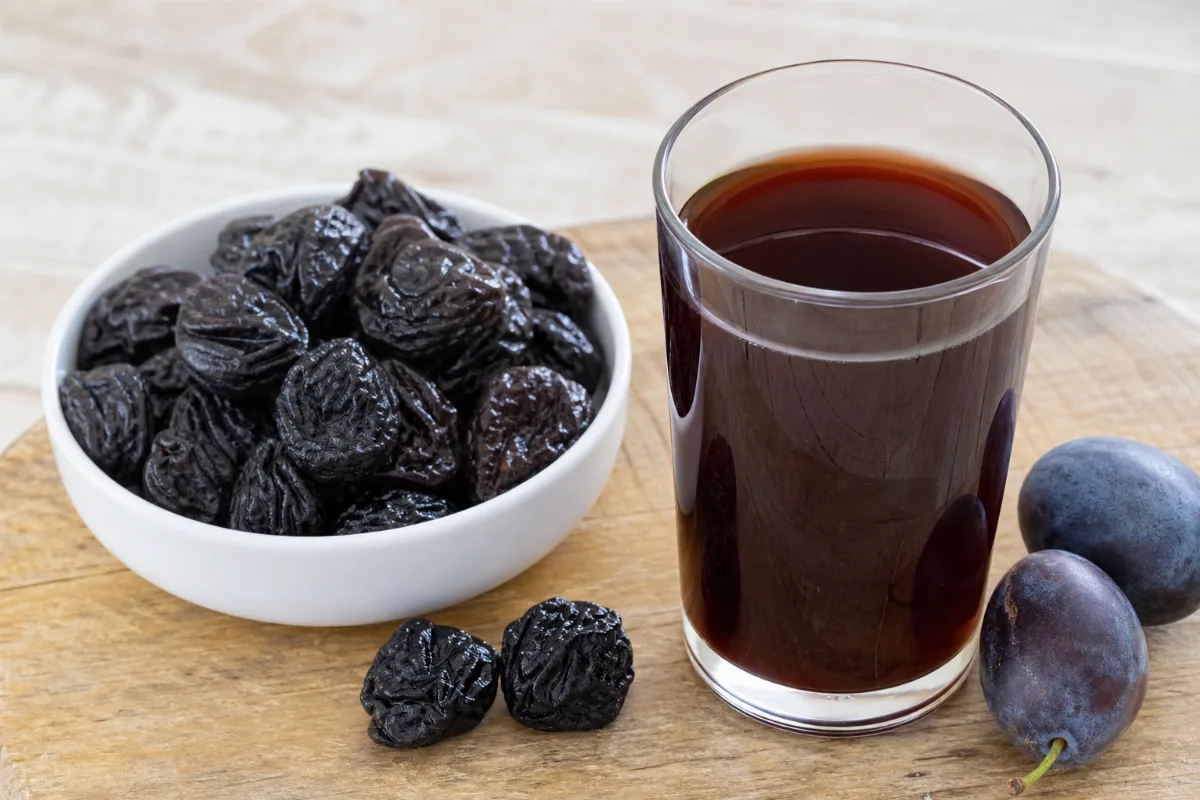
Prune juice is a sweet, dark drink made from prunes, which are dried plums. People most often drink it for constipation. One small trial found it gave fewer hard stools than a placebo drink, but it was partly funded by a company, and most prune research used whole prunes, not juice. The main cautions are its potassium for people with kidney disease, its sugar, and that juice is not advised for babies.
General information, not medical advice. Last substantive update · Not medically reviewed. A named clinician has not signed off on this page. How this page is made
About Prune Juice
Prune juice is a sweet, higher-potassium drink with one small trial behind its use for constipation. It is best seen as a food drink, not a proven remedy.
What it is
Prune juice is made from prunes, which are dried plums (Prunus domestica). It is a dark, sweet drink, usually sold canned or bottled.
One cup (256 g) of canned prune juice has about 182 calories, 42 g of sugars, 2.6 g of fibre and 707 mg of potassium (USDA). It also gives small to moderate amounts of iron, vitamin B6, vitamin C and copper. Juice has far less fibre than whole prunes, so they are different foods.
What the research shows
The one trial of the juice itself enrolled 84 Japanese adults with long-standing constipation. Those given 54 g of prune juice a day for 8 weeks had fewer hard stools and more normal stools than those given a look-alike placebo, and better constipation scores. No harm and no liver or kidney lab changes were reported. A company helped fund the trial.
Other prune research used the whole dried fruit. A small trial found dried plums beat psyllium for bowel movements a week, and a review called the evidence weak. A 2025 dietitian guideline built on 75 trials has two statements on prunes; its abstract does not say what they conclude.
A 1998 lab study found plant compounds in prune juice that slowed LDL oxidation in a test tube. We found no juice trial for children, heart, bone or blood sugar.
At a glance
Traditional uses history, not proof
- A popular home choice when stools are hard
- Drunk on its own or stirred into other drinks; no historical source was read for this page
Studied for research
- Chronic constipation, low certainty (one trial of the juice)
- Chronic constipation with whole prunes, low certainty
- Antioxidant effect in a test tube, lab only
- Children, heart, bone and blood sugar: nothing found for the juice
Main compounds
- Sorbitol, a sugar alcohol
- Sugars: about 42 g in one cup
- Potassium: about 707 mg in one cup
- Pectin and small amounts of fibre (2.6 g a cup)
- Chlorogenic acids and other plant phenolics
Common forms
- Canned or bottled prune juice (the form the USDA figures describe)
- Chilled, pasteurized juice
- Untreated or freshly pressed juice (needs care)
- Whole prunes (a different food, not juice)
Research links: Prune juice and constipation, randomised trial (Am J Gastroenterol, 2022) · NHS: Constipation · Prunes and constipation, systematic review (2014) · USDA FoodData Central: canned prune juice · Research Library · Genes & Biomarkers Library
What it is and its history
- Accepted scientific name
- Prune juice (juice of dried plums, Prunus domestica)
- Synonyms
- Dried plum juice
- Common names
- Prune juice (English); Jugo de ciruela pasa (Spanish)
- Family or group
- Rosaceae (rose family), which also includes plum, peach, cherry and apple.
- Classification
- Plantae > Rosaceae > Prunus > Prunus domestica
- Native range
- Not verified from a source read.
- Habitat
- Not verified.
- What it looks like
- Fruit: The juice is made from prunes (dried plums).
- Cultivation
- Not verified from a source read.
- Harvest and processing
- Made from prunes, commonly sold canned or bottled and pasteurized. The USDA record read is for canned prune juice. How the trial juice was made was not read in detail.
- Look-alikes and adulterants
- Name: Whole prunes (dried plums); Note: Most prune research used the whole dried fruit. Juice has much less fibre (1.0 g per 100 g in the USDA record), so it is a different food.
- Sustainability and conservation
- Not assessed.
Traditional use and history history, not clinical proof
| Tradition or era | Documented use | Source |
|---|---|---|
| Everyday home use | Prunes and prune juice are a popular home choice for constipation. No historical source was read for this page. | NOT verified (no source read) |
Traditional use shows how it was used. It does not show that it works or is safe today.
What is inside, and how it may work
What it contains and how those compounds act in cells and animals. Laboratory and animal mechanisms are not proven effects in people.
Main compounds
| Compound | Family | Where it is concentrated | Activity studied | Level of evidence |
|---|---|---|---|---|
| Sorbitol | sugar alcohol | Fruit Described as abundant in the trial juice; amount not read | The trial authors credit sorbitol, pectin and polyphenols together for the juice effect; each was not tested alone. 4 | Trial authors interpretation |
| Chlorogenic and neochlorogenic acid (phenolics) | hydroxycinnamic acids | Fruit About 441 mg of total phenolics per litre in commercial juice (1998 analysis) | Blocked LDL oxidation in a test tube. 7 | Lab only |
| Potassium | mineral | Fruit 276 mg per 100 g; about 707 mg a cup (USDA) | Essential mineral; a concern when kidneys cannot clear it. 13 | Composition data |
Mechanisms, receptors and pathways
| Target or pathway | Gene or receptor | What was found | Level |
|---|---|---|---|
| Stool softening by sorbitol, pectin and polyphenols | Proposed by the authors of the 2022 trial as the likely reason for the effect; not tested one by one. 4 | Authors interpretation |
Absorption, metabolism and elimination
- Absorption
- Not researched.
- Distribution
- Not found.
- Metabolism
- Not found.
- Elimination
- Not found.
- Bioavailability
- Not established.
Isolated compounds versus whole extracts
The one constipation trial used a prune juice product; the other constipation research used whole dried plums. Juice and whole prunes should not be treated as the same food. Sorbitol, pectin or polyphenol supplements were not part of any study read.
Nutritional composition
Per 100 g of canned prune juice (USDA FoodData Central, SR Legacy 167753): 71 kcal, 81.2 g water, 0.61 g protein, 0.03 g fat, 17.4 g carbohydrate of which 16.4 g are sugars, and 1.0 g fibre. One cup (256 g) provides about 182 kcal, 42 g of sugars, 2.6 g fibre, 1.6 g protein, 707 mg potassium, 3.0 mg iron, 0.56 mg vitamin B6, 10.5 mg vitamin C and 8.7 micrograms of vitamin K. It has no caffeine and no alcohol in the USDA record. Per-cup figures are calculated from the per-100 g values (multiplied by 2.56). Values vary with brand and how much pulp is left in.
2 low certainty3 not enough evidence
What was looked at
The 5 benefits and uses checked for Prune Juice, each with how strong the evidence is. Tap one to open it.
- Chronic constipation (prune juice)Low certainty
- Chronic constipation (whole prunes, for comparison)Low certainty
- Antioxidant activity (laboratory only)Not enough evidence
- Constipation in babies and childrenNot enough evidence
- Heart disease, bone loss, blood sugar, cancer and other claimsNot enough evidence
Lab markers tracked in the studies
Stool form (Bristol Stool Form Scale)Constipation symptom score (GSRS questionnaire)Complete spontaneous bowel movements a week (whole prunes)
What is Prune Juice good for?
The studied uses and how strong the human evidence is for each. Evidence for the juice itself is thin: one small trial. It is a drink with some research behind one use, not a proven treatment.
Benefits, one by one
Each card is a research question, not a promise. Tap a goal to filter. Open a card to see the studies, doses and limits.
Chronic constipation (prune juice)
Low certaintyIn one trial of 84 adults with long-standing constipation, drinking prune juice every day for 8 weeks led to fewer hard, lumpy stools and more normal stools than a look-alike placebo drink. Constipation symptom scores also improved. It is a single, small trial, and the company that makes the juice helped pay for it.
1 studiesPrune juice as a drink (54 g a day was the amount tested; this is not…
Studies, doses and limits
What the trials found
A 2022 double-blind, randomised, placebo-controlled trial in Japan gave 54 g a day of prune juice or a matched placebo drink for 8 weeks to 84 adults aged 20 to 75 with untreated chronic constipation (42 per group).
Results
Fewer hard and lumpy stools and more normal stools than placebo (significant from week 3). Loose and watery stools did not rise. Constipation and hard-stool scores were better than placebo at week 8. No adverse events and no liver or kidney lab changes.
Effect sizes as reported
Significant differences against placebo for stool form and two symptom scores. Exact sizes were in figures and tables that were not read.
Why this rating
One randomised trial, 84 people, one country, 8 weeks, partly funded by a company whose employees are authors. Results look consistent, but a single trial cannot settle the question.
Form and dose studied
Prune juice as a drink (54 g a day was the amount tested; this is not advice).
Who was studied
Adults 20-75 with chronic constipation in Japan.
Limits
Small and single. Bloating was not scored. The juice product contained sorbitol, which can loosen stools in some people. Not tested in children, older adults or pregnant women.
Why researchers looked
Prune juice is a traditional home choice when stools are hard, and it contains sorbitol, a sugar alcohol, plus pectin (a fibre) and plant compounds.
Traditional use
People have long reached for prunes and prune juice for constipation. No historical source was read for this page.
Proposed mechanism Preliminary mechanism
The trial authors credit sorbitol, pectin and polyphenols working together. They did not test each one separately, so this is their idea, not a shown mechanism.
A proposed mechanism does not show that the effect happens in people.
No adverse events were reported in the trial; see the Safety tab for sorbitol, potassium, sugar and child cautions.
Chronic constipation (whole prunes, for comparison)
Low certaintyMost prune research used the whole dried fruit, not the juice. In a small crossover trial, dried plums gave more complete bowel movements per week than psyllium, a fibre supplement. A review of four trials called the evidence promising but weak. Juice has far less fibre than whole prunes, so the results may not carry over.
3 studiesWhole dried plums (50 g twice a day in the 2011 trial; amounts studie…
Studies, doses and limits
What the trials found
A 2011 randomised crossover trial in 40 adults with chronic constipation (dried plums against psyllium), a 2014 systematic review of 4 trials, and a 2025 British dietitian guideline built on 75 trials that includes two statements on prunes.
Results
Dried plums beat psyllium for complete spontaneous bowel movements a week and stool consistency; straining and overall symptoms did not differ. The review found no difference in gut symptoms. The guideline abstract does not say what its prune statements conclude.
Effect sizes as reported
In the review: 3.5 against 2.8 complete spontaneous bowel movements a week (P = 0.006), prunes at 100 g a day against psyllium for 3 weeks.
Why this rating
Few small trials, some at unclear risk of bias. This is whole dried fruit, not juice, so it supports the juice finding only loosely.
Form and dose studied
Whole dried plums (50 g twice a day in the 2011 trial; amounts studied, not advice).
Who was studied
Adults with chronic constipation; 37 of 40 were women in the 2011 trial.
Limits
Not juice. The guideline abstract was the only part of the guideline read.
Why researchers looked
Whole prunes are high in fibre and sorbitol, and are a long-standing food for constipation.
Traditional use
Prunes are a traditional food for constipation; no historical source was read for this page.
Proposed mechanism Preliminary mechanism
Fibre, sorbitol and plant compounds are proposed routes. Not tested separately in the studies read.
A proposed mechanism does not show that the effect happens in people.
Dried plums were called safe and well tolerated in the 2011 trial.
Antioxidant activity (laboratory only)
Not enough evidenceA 1998 lab analysis found that commercial prune juice contains plant compounds (mostly chlorogenic acids) and that its extract slowed the oxidation of human LDL cholesterol in a test tube. This has not been shown to happen in people who drink the juice.
1 studiesExtract of commercial prune juice.
Studies, doses and limits
What the trials found
No human trial was read. This is a laboratory analysis of juice extracts.
Results
Prune juice extract blocked LDL oxidation by 3%, 62% and 97% at 5, 10 and 20 micromolar gallic acid equivalents.
Effect sizes as reported
Lab figures only.
Why this rating
Test-tube result. It does not show benefit in people.
Form and dose studied
Extract of commercial prune juice.
Limits
Not a human study, and a 1998 analysis of one product type.
Why researchers looked
Plant compounds that act as antioxidants in the lab are often studied as possible heart-health helpers.
Proposed mechanism Lab only
Test-tube antioxidant effect on LDL cholesterol (copper-driven oxidation).
A proposed mechanism does not show that the effect happens in people.
None specific.
Constipation in babies and children
Not enough evidenceWe did not find a trial of prune juice for constipation in children. The American Academy of Pediatrics notes that juice was once sometimes recommended for children with constipation, and cautions about its sugar. Ask a pediatrician before using it for a baby or child.
2 studiesNot applicable.
Studies, doses and limits
What the trials found
No trial of prune juice in children was read. The AAP report is policy advice about fruit juice in general.
Why this rating
No children's trial found in the sources read.
Who was studied
Children.
Limits
Search was brief.
Why researchers looked
Parents often try prune juice for children, so it is a common question.
Traditional use
Prune juice has been a family remedy for children; no historical source was read.
Proposed mechanism Preliminary mechanism
None specific.
A proposed mechanism does not show that the effect happens in people.
The AAP advises no juice in the first year of life.
Heart disease, bone loss, blood sugar, cancer and other claims
Not enough evidenceWe did not find a trial of prune juice for heart disease, bones, blood sugar or cancer. The bone and other prune trials we know of used whole prunes. These claims are not supported for the juice by anything read here.
0 studiesNot applicable.
Studies, doses and limits
Why this rating
No juice trial read.
Limits
The search for these uses was brief and not exhaustive.
Why researchers looked
Prunes as a whole fruit have been studied for several outcomes.
Proposed mechanism Preliminary mechanism
None established.
A proposed mechanism does not show that the effect happens in people.
None specific.
Connections to the rest of health
How Prune Juice connects to the rest of our health knowledge graph. Every link says what kind of connection it is. A safety link (for example to the liver) is a warning, not a benefit. A study that merely mentions a topic never creates a benefit link.
Explore every connection: goals, body systems, organs, symptoms, genes
A. Wellness goals
| Connected to | Kind of connection | Evidence status | Context | Studies |
|---|---|---|---|---|
| Digestive Support | Low certainty | Chronic constipation (prune juice): In one trial of 84 adults with long-standing constipation, drinking prune juice every day for 8 weeks led to fewer hard, lumpy stools and more normal stools than a look-alike placebo drink. Constipation symptom scores also improved. It is a single, small trial, and the company that makes the juice helped pay for it. | 4 | |
| Gut Health | Low certainty | Chronic constipation (prune juice): In one trial of 84 adults with long-standing constipation, drinking prune juice every day for 8 weeks led to fewer hard, lumpy stools and more normal stools than a look-alike placebo drink. Constipation symptom scores also improved. It is a single, small trial, and the company that makes the juice helped pay for it. | 4 | |
| Digestive Support | Low certainty | Chronic constipation (whole prunes, for comparison): Most prune research used the whole dried fruit, not the juice. In a small crossover trial, dried plums gave more complete bowel movements per week than psyllium, a fibre supplement. A review of four trials called the evidence promising but weak. Juice has far less fibre than whole prunes, so the results may not carry over. | 1 5 2 | |
| Gut Health | Low certainty | Chronic constipation (whole prunes, for comparison): Most prune research used the whole dried fruit, not the juice. In a small crossover trial, dried plums gave more complete bowel movements per week than psyllium, a fibre supplement. A review of four trials called the evidence promising but weak. Juice has far less fibre than whole prunes, so the results may not carry over. | 1 5 2 | |
| Heart Health | Not enough evidence | Antioxidant activity (laboratory only): A 1998 lab analysis found that commercial prune juice contains plant compounds (mostly chlorogenic acids) and that its extract slowed the oxidation of human LDL cholesterol in a test tube. This has not been shown to happen in people who drink the juice. | 7 | |
| Digestive Support | Not enough evidence | Constipation in babies and children: We did not find a trial of prune juice for constipation in children. The American Academy of Pediatrics notes that juice was once sometimes recommended for children with constipation, and cautions about its sugar. Ask a pediatrician before using it for a baby or child. | 3 6 | |
| Heart Health | Not enough evidence | Heart disease, bone loss, blood sugar, cancer and other claims: We did not find a trial of prune juice for heart disease, bones, blood sugar or cancer. The bone and other prune trials we know of used whole prunes. These claims are not supported for the juice by anything read here. |
B. Body systems
| Connected to | Kind of connection | Evidence status | Context | Studies |
|---|---|---|---|---|
| Digestive System | Biological association | Low certainty | Studied for: Chronic constipation (prune juice) Studied for: Chronic constipation (whole prunes, for comparison) | 4 1 5 2 3 6 |
| Cardiovascular System | Biological association | Not enough evidence | Studied for: Antioxidant activity (laboratory only) Studied for: Heart disease, bone loss, blood sugar, cancer and other claims | 7 |
E. Health conditions
| Connected to | Kind of connection | Evidence status | Context | Studies |
|---|---|---|---|---|
| Constipation | Potential benefit | One trial, partly company funded | One trial of adults with chronic constipation found fewer hard stools than placebo. Preparation or compound: Prune juice |
4 |
| High blood potassium (hyperkalemia) | Adverse effect or risk | Documented risk (guidance) | Higher-potassium juice for people with kidney disease or on potassium-raising medicines. Preparation or compound: Prune juice (about 707 mg potassium a cup) |
12 9 |
I. Biomarkers
| Connected to | Kind of connection | Evidence status | Context | Studies |
|---|---|---|---|---|
| Stool form (Bristol Stool Form Scale) | Biological association | Low certainty | Measured in trials: fewer hard stools, more normal stools. A lab change is not the same as a health benefit. | 4 |
| Constipation symptom score (GSRS questionnaire) | Biological association | Low certainty | Measured in trials: lowered. A lab change is not the same as a health benefit. | 4 |
| Complete spontaneous bowel movements a week (whole prunes) | Biological association | Low certainty | Measured in trials: raised. A lab change is not the same as a health benefit. | 5 1 |
L. Active compounds
| Connected to | Kind of connection | Evidence status | Context | Studies |
|---|---|---|---|---|
| Sorbitol | Biological association | Trial authors interpretation | The trial authors credit sorbitol, pectin and polyphenols together for the juice effect; each was not tested alone. Preparation or compound: Fruit |
4 |
| Chlorogenic and neochlorogenic acid (phenolics) | Biological association | Lab only | Blocked LDL oxidation in a test tube. Preparation or compound: Fruit |
7 |
| Potassium | Biological association | Composition data | Essential mineral; a concern when kidneys cannot clear it. Preparation or compound: Fruit |
13 |
Each connection is stored with the ingredient, the connected record, the kind of connection, the evidence status, the supporting studies, the preparation or compound involved, and a review date (last reviewed October 26, 2026).
Evidence at a glance: what changed in 2 lab markers
Tap a number to show only those markers. Counts are markers, not people.
The evidence
The research centre for Prune Juice. Every record here was checked against PubMed or the publisher's page; we never list a study we have not verified.
Evidence by outcome
Bars show how many studies we found for each outcome, not how well it works. People are added up across trials only (reviews are not added, to avoid double counting).
How we rate evidence
High certainty
Several well-run trials or reviews agree; further research is unlikely to change the picture much.
Moderate certainty
Good trials point the same way, but some doubt remains.
Low certainty
Small, short or inconsistent trials. The finding could change with better research.
Very low certainty
Very little or very weak human data. Treat as a possibility only.
Mixed findings
Trials or reviews disagree with each other.
Not enough evidence
Not enough human research to say either way.
Evidence against
Good research found no benefit, or found harm.
We take the reviewers' own risk-of-bias and GRADE statements where they exist, and otherwise judge from study size, design, consistency, directness and whether a product matches what is sold. Many publications do not make evidence high. Method note: We started from our existing prune juice page, re-read the USDA FoodData Central record, the full text of the 2022 trial, the abstracts of the other studies and the official pages cited. Items we could not verify are flagged in the research gaps. The amount of research on prune juice itself is small, so this page is short.
Study library: every study we checked 14
| Study | Design | People | Product, dose, length | Result |
|---|---|---|---|---|
| Attaluri 2011 Randomised clinical trial: dried plums (prunes) vs. psyllium for constipation. Aliment Pharmacol Ther · PMID 21323688 · DOI |
Randomised single blind crossover trial |
40 Adults with chronic constipation (mean age 38; 37 of 40 women) |
Dried plums (whole prunes, not juice) fruit 50 g twice a day 3 weeks per treatment, 1 week washout · vs Psyllium 11 g twice a day (same 6 g fibre a day) |
Complete spontaneous bowel movements a week and stool consistency improved more with dried plums than with psyllium (P below 0.05). Straining and overall symptoms did not differ. Both were rated equally palatable, safe and well tolerated. Significant for the main measure; numbers not in the abstract Methods, limits and fundingOutcomes: Complete spontaneous bowel movements per week, stool consistency, straining, global relief, tolerability Limitations: Small, single-blind, short, mostly women. Whole dried plums, not juice. Funding and conflicts: Not stated in the abstract read Read: abstract |
| Dimidi 2025 British Dietetic Association Guidelines for the Dietary Management of Chronic Constipation in Adults. J Hum Nutr Diet · PMID 41081513 · DOI |
Practice guideline built on four systematic reviews (75 randomised trials) |
Adults with chronic constipation | Dietary supplements, foods and drinks including prunes (two statements) |
The reviews covered 75 trials and produced 59 statements: 12 rest on very low-certainty evidence, 39 on low and 8 on moderate. For foods, two statements relate to prunes (three to kiwifruit, two to rye bread). The abstract does not say what the prune statements conclude or how certain they are. Prune juice is not named in the abstract. Guideline, not a trial Methods, limits and fundingOutcomes: Guideline statements graded with GRADE and a Delphi vote Limitations: Only the abstract was read, so the content of the prune statements is not known here. The abstract does not name prune juice. Funding and conflicts: Several authors are named; conflicts are in the paper, which was not read Read: abstract |
| Heyman 2017 Fruit Juice in Infants, Children, and Adolescents: Current Recommendations. Pediatrics · PMID 28562300 · DOI |
Clinical report (American Academy of Pediatrics) |
Infants, children and adolescents | Fruit juice (all kinds) |
Juice was once sometimes recommended for children with constipation. The report says juice has some benefits but also harms: its sugar adds calories and the risk of tooth decay, and the lack of protein and fibre can contribute to inappropriate weight gain. Guideline, not a trial Methods, limits and fundingOutcomes: Recommendations on fruit juice for children Limitations: Policy report about fruit juice in general, not prune juice specifically. Abstract read; the age limits were read on the AAP news page. Funding and conflicts: Professional body statement Read: abstract |
| Koyama 2022 Prune Juice Containing Sorbitol, Pectin, and Polyphenol Ameliorates Subjective Complaints and Hard Feces While Normalizing Stool in Chronic Constipation: A Randomized Placebo-Controlled Trial. Am J Gastroenterol · PMID 35971232 · DOI |
Randomised double blind placebo controlled trial |
84 Japanese adults aged 20-75 with untreated chronic constipation (Rome IV definition); 42 per group |
Prune juice juice 54 g of juice a day (the amount the trial tested, not advice) 8 weeks · vs Placebo drink matched for flavour, colour and taste |
Compared with the placebo group, the prune juice group had fewer hard and lumpy stools and more normal stools (the difference was significant from week 3). Loose and watery stools did not change. Constipation and hard-stool symptom scores were lower than with placebo at week 8. No adverse events and no liver or kidney lab changes were reported in either group. Significant differences in stool form and in two symptom scores (constipation, hard stools) at week 8; the abstract and full text read give no single summary number Methods, limits and fundingOutcomes: Stool form (Bristol Stool Form Scale), constipation symptom scores (GSRS questionnaire), adverse events, liver and kidney blood tests Limitations: One small trial in one country. The juice was a specific product with sorbitol, pectin and polyphenols and the trial did not test them one by one. Bloating was not scored. Exact effect sizes were in figures and tables not read. Funding and conflicts: Partly funded by MIKI Corporation; two authors are MIKI employees and two received a grant from it. The paper says the sponsor had no control over interpretation, writing or publication. Read: abstract and open-access full text (Europe PMC) |
| Lever 2014 Systematic review: the effect of prunes on gastrointestinal function. Aliment Pharmacol Ther · PMID 25109788 · DOI |
Systematic review of randomised trials |
Four trials: one in constipation and three in people without constipation | Prunes (dried plums, not juice) fruit Varied; 100 g a day in the constipation trial 3 weeks in the constipation trial · vs Psyllium or control |
In constipation, 3 weeks of prunes (100 g a day) beat psyllium (22 g a day) for stool frequency (3.5 against 2.8 complete spontaneous bowel movements a week, P = 0.006) and consistency (3.2 against 2.8 on the Bristol scale, P = 0.02). In people without constipation prunes softened stool in one trial and raised stool weight in another. No trial found a difference in gut symptoms between prunes and comparators. The authors called the evidence weak and in need of confirming. 3.5 vs 2.8 complete spontaneous bowel movements a week in constipation Methods, limits and fundingOutcomes: Stool frequency, consistency, weight, gut symptoms Limitations: Only four trials, too different to pool; two had unclear risk of bias. About prunes, not prune juice. Funding and conflicts: Not stated in the abstract read Read: abstract |
| s-aap-juice-news American Academy of Pediatrics (HealthyChildren.org): AAP Recommends No Fruit Juice for Children Under 1 Year · Source |
Professional body statement n/a |
Methods, limits and fundingRead: full-text | ||
| s-donovan-1998 Donovan JL, Meyer AS, Waterhouse AL. Phenolic composition and antioxidant activity of prunes and prune juice (Prunus domestica). J Agric Food Chem 1998 · Source |
Laboratory analysis (test tube) lab |
Methods, limits and fundingRead: abstract (Europe PMC) | ||
| s-fda-juice-safety FDA: What You Need to Know About Juice Safety · Source |
Regulator consumer advice n/a |
Methods, limits and fundingRead: full-text | ||
| s-medlineplus-potassium MedlinePlus: Potassium in diet · Source |
Official health information n/a |
Methods, limits and fundingRead: full-text | ||
| s-nhs-5-a-day NHS: 5 A DAY, what counts · Source |
Official health advice n/a |
Methods, limits and fundingRead: full-text | ||
| s-nhs-constipation NHS: Constipation · Source |
Official health advice n/a |
Methods, limits and fundingRead: full-text | ||
| s-nkf-potassium National Kidney Foundation: Potassium in Your CKD Diet · Source |
Patient guidance n/a |
Methods, limits and fundingRead: full-text | ||
| s-usda-fdc-167753 USDA FoodData Central: Prune juice, canned (FDC 167753, SR Legacy) · Source |
Food composition database n/a |
Methods, limits and fundingRead: full-text | ||
| s-who-sugars-2015 WHO: WHO calls on countries to reduce sugars intake among adults and children (4 March 2015) · Source |
International guideline n/a |
Methods, limits and fundingRead: full-text |
What we do not know yet
- Only one trial of prune juice itself was found, and it was partly company-funded.
- No trial compares prune juice with whole prunes.
- Pregnancy, breastfeeding, blood sugar, dental effects and contaminants in prune juice were not researched.
- No juice trial was found for children, heart, bone or cancer.
- Only the abstract of the 2025 guideline was read.
How new research is added
New studies are found by a saved PubMed search and placed in a review queue before the page changes.
Lab markers
What changed in blood or saliva tests during trials. A changed number is not the same as feeling or being healthier, and we give no "normal ranges".
Other 3
Stool form (Bristol Stool Form Scale)
Fewer hard stools, more normal stools in trials
A seven-point picture scale for how hard or loose stools are. Types 1 and 2 are hard and lumpy; 3 and 4 are normal; 5 to 7 are loose.
Low certaintyResults and what it means
Why it was measured
It shows whether constipation is easing without going too far.
Statistical vs. clinical meaning
A real change in a sensible measure, but from one small trial.
Safety implication
Loose stools did not increase in this trial.
| Study | Result | People | Product |
|---|---|---|---|
| 4 | Fewer hard and lumpy stools (types 1-2) and more normal stools (types 3-4) than placebo, significant from week 3; loose and watery stools (types 5-7) did not change | 84 adults with chronic constipation | Prune juice 54 g a day for 8 weeks |
Constipation symptom score (GSRS questionnaire)
Lowered in trials
A questionnaire in which people score their own gut symptoms, including constipation and hard stools.
Low certaintyResults and what it means
Why it was measured
It captures how people feel, not just what stools look like.
Statistical vs. clinical meaning
Self-reported, so open to expectation effects, though the trial was double-blind.
Safety implication
None specific.
| Study | Result | People | Product |
|---|---|---|---|
| 4 | Constipation and hard-stool scores were lower than placebo at week 8; diarrhoea, loose-stool and urgency scores did not change from baseline | 84 adults with chronic constipation | Prune juice 54 g a day for 8 weeks |
Complete spontaneous bowel movements a week (whole prunes)
Raised in trials
Bowel movements that happen without help and leave a feeling of complete emptying.
Low certaintyResults and what it means
Why it was measured
A standard way to count how often the bowel works well.
Statistical vs. clinical meaning
Whole-fruit result; do not assume juice does the same.
Safety implication
None specific.
| Study | Result | People | Product |
|---|---|---|---|
| 5 | 3.5 against 2.8 a week for prunes (100 g a day) against psyllium over 3 weeks | Adults with chronic constipation (one trial in the review) | Whole prunes, not juice |
Safety
What studies and official sources say about side effects, medicines and who should check first. Each point shows what kind of evidence it comes from.
Main points to know 4
- Potassium: prune juice is a higher-potassium drink for people with kidney disease. One cup has about 707 mg of potassium (USDA). The National Kidney Foundation lists prunes and prune juice among higher-potassium fruit choices for people with chronic kidney disease who are told to limit potassium. MedlinePlus says people with kidney problems, especially on dialysis, should not eat too many potassium-rich foods, and that ACE inhibitors, ARBs and potassium-sparing water pills can raise potassium. Ask a kidney clinician or dietitian. Authoritative guidance 13 12 9
- Sugar, calories and loose stools. One cup of canned prune juice has about 42 g of sugars and 182 kcal (USDA). Prune juice contains sorbitol, a sugar alcohol that the trial authors credit for part of its effect and that can loosen stools in some people. In the 2022 trial loose stools did not increase, but the trial was small. WHO counts sugars in fruit juice as free sugars and advises keeping free sugars under 10% of daily energy. Authoritative guidance 13 4 14
- Babies and children: juice is not advised in the first year. The American Academy of Pediatrics says fruit juice offers no nutritional benefit under age 1 and should not be in the diet, that unpasteurized juice should be strongly discouraged for children of all ages, and that juice is not appropriate for treating dehydration or diarrhoea. It gives daily limits for older children. Ask a pediatrician before using prune juice for a child with constipation. Authoritative guidance 6 3
- Untreated (unpasteurized) juice can carry germs. The FDA says children, older adults, pregnant women and people with weakened immune systems risk serious illness from untreated juice. Untreated packaged juice must carry a warning label, but juice sold by the glass need not. The USDA record used here is for canned juice. Regulator guidance 8
Side effects 2
| Effect | How often | Severity and recovery | Evidence |
|---|---|---|---|
| Gas or loose stools The 2022 juice trial reported no adverse events and no rise in loose stools, flatulence or diarrhoea scores. The 2014 review found no difference in gut symptoms between prunes and comparators. The trial authors note that prunes are said to cause diarrhoea and wind, and that bloating was not scored. We did not find a source measuring how often prune juice causes these. | Not established | mild, usually Not stated in the sources read. | Trial no signal 4 5 |
| Raised blood potassium in people with kidney disease or on potassium-raising medicines This is a food-composition and guidance point, not an adverse effect measured in a prune juice trial. | Not established | can be serious Depends on cause; clinician-managed. | Authoritative guidance 12 9 |
Liver
No liver or kidney lab changes were seen in the 2022 prune juice trial. LiverTox was not checked and no liver injury case from prune juice was found in the sources read. 4
How often. No frequency found.
This is a safety connection. It is not evidence that Prune Juice supports liver health.
Medicines and supplements 3
| With | Why it matters | Importance | Evidence | What to do |
|---|---|---|---|---|
| ACE inhibitors, ARBs and potassium-sparing diuretics (spironolactone, triamterene, amiloride) prescription | These medicines can raise blood potassium (MedlinePlus). Prune juice adds potassium (about 707 mg a cup, USDA). | MedlinePlus lists the medicines and the NKF lists prune juice as higher-potassium. No source read describes a measured prune juice interaction; the concern is the sum of the two facts. | Authoritative guidance Not enough evidence 9 12 13 | Ask a pharmacist or clinician, especially with kidney disease. |
| Warfarin and other vitamin K sensitive medicines prescription | Prune juice has a small amount of vitamin K (3.4 micrograms per 100 g, about 8.7 per cup, USDA). Vitamin K affects how warfarin works. | No source read links prune juice to a change in warfarin control. The figure is a food composition fact. | Nutrient database Not enough evidence 13 | People on warfarin are usually told to keep vitamin K intake steady; this was not re-checked in an official source for this page. Ask your clinician. |
| Medicines and laxatives in general prescription | No source read describes an interaction between prune juice and other laxatives or medicines beyond the potassium point above. | None found Not enough evidence | A pharmacist can check your own medicines. |
Who should check first 3
| Situation | Advice | Evidence |
|---|---|---|
| Kidney disease where you have been told to limit potassium | Ask your kidney clinician or dietitian before drinking prune juice. | Authoritative guidance 12 9 |
| Babies under 1 year | The AAP advises no fruit juice in the first year of life. | Authoritative guidance 6 |
| Diabetes or needing to watch sugar | One cup has about 42 g of sugars. No trial of prune juice and blood sugar was found; ask a clinician or dietitian. | Nutrient database 13 |
Overdose, product quality and regulators
Summary. Prune juice is an ordinary food drink. The safety points found were potassium load in kidney disease, sugar and sorbitol, and untreated juice.
Animal. Not reviewed.
Human doses studied. The 2022 trial gave 54 g a day for 8 weeks with no adverse events reported.
Overdose response. Not found.
Genotoxicity. Not reviewed.
The only contamination point read is germs in untreated juice. Heavy metals and pesticides in prune juice were not searched.
Untreated (unpasteurized) juice. The FDA says untreated juice can carry harmful bacteria and must be labelled when packaged; juice sold by the glass may not be. 8
| Body | Action | Date |
|---|---|---|
| FDA (US Food and Drug Administration) (United States) | Consumer advice: untreated juice needs a warning label; groups at higher risk from untreated juice source | 2026-10-26 (page read) |
| American Academy of Pediatrics (United States) | No fruit juice under age 1; limits for older children; unpasteurized juice strongly discouraged source | 2026-10-26 (page read) |
| WHO (International) | Keep free sugars (including those in fruit juice) below 10% of total energy intake source | 2026-10-26 (page read) |
| NHS (United Kingdom) | Juice and smoothies count once a day, up to a combined 150 ml; take at mealtimes for teeth source | 2026-10-26 (page read) |
| NHS (United Kingdom) | When to see a GP about constipation source | 2026-10-26 (page read) |
When to get medical help
- Swelling of the lips, face, tongue or throat, or trouble breathing, after drinking it (call your local emergency number)
- Muscle weakness, a very slow or irregular heartbeat or fainting in someone with kidney disease
- Blood in the stool, unexplained weight loss, tummy pain or a sudden change in bowel habit (see a doctor)
- Constipation that keeps coming back or is not improving
- Fever, vomiting or bloody diarrhoea after drinking untreated juice
Stop using the product and contact a clinician or emergency service. In the US, Poison Control is 1-800-222-1222.
General information only, not medical advice. Ask a clinician or pharmacist before use, especially with medicines, in pregnancy or with a health condition. See the Natural Remedy Safety guide.
Frequently asked questions
What is prune juice good for?
It is a sweet drink many people use for constipation. One small trial found it gave fewer hard stools than a placebo. Beyond that, we found no human trials of the juice.
Does prune juice help constipation?
Is prune juice as good as eating prunes?
Is prune juice high in potassium?
Is prune juice high in sugar?
Can prune juice cause loose stools or gas?
It contains sorbitol, which can loosen stools in some people. In the juice trial loose stools did not increase, but the trial was small.
Is prune juice safe for babies and children?
Can people with diabetes drink prune juice?
We found no trial of prune juice and blood sugar. One cup has about 42 g of sugars, so ask a clinician or dietitian.
Does prune juice interact with medicines?
Is it safe in pregnancy?
We did not read an official source on prune juice in pregnancy. The FDA warns pregnant women about untreated juice, so choose pasteurized juice and ask your midwife or doctor.
What is the difference between prune juice and prunes?
Does prune juice have antioxidants?
A 1998 lab analysis found plant compounds in it that slowed LDL oxidation in a test tube. That has not been shown to help people.
Explore by health goal
Editorial transparency
- Written by
- AlternativeMed editorial team. Research compiled with AI assistance, then checked against the sources listed.
- Medical review
- None. This page has not been reviewed by a physician or pharmacist.
- First published
- 2026-10-26
- Last substantive update
- 2026-10-26
- How we research
- We started from our existing prune juice page, re-read the USDA FoodData Central record, the full text of the 2022 trial, the abstracts of the other studies and the official pages cited. Items we could not verify are flagged in the research gaps. The amount of research on prune juice itself is small, so this page is short.
- How we rate evidence
- See "How we rate evidence" in the Evidence tab.
- Independence
- No product is promoted on this page. No affiliate links are shown.
Sources 14
Each source was opened and checked. Where we read only the abstract, it says so. The small numbers in the text point here.
- Attaluri A, Donahoe R, Valestin J, et al.. Randomised clinical trial: dried plums (prunes) vs. psyllium for constipation.. Aliment Pharmacol Ther. 2011. PMID 21323688. DOI 10.1111/j.1365-2036.2011.04594.x. (abstract)
- Dimidi E, van der Schoot A, Barrett K, et al.. British Dietetic Association Guidelines for the Dietary Management of Chronic Constipation in Adults.. J Hum Nutr Diet. 2025. PMID 41081513. DOI 10.1111/jhn.70133. (abstract)
- Heyman MB, Abrams SA; Section on Gastroenterology, Hepatology, and Nutrition. Fruit Juice in Infants, Children, and Adolescents: Current Recommendations.. Pediatrics. 2017. PMID 28562300. DOI 10.1542/peds.2017-0967. (abstract)
- Koyama T, Nagata N, Nishiura K, et al.. Prune Juice Containing Sorbitol, Pectin, and Polyphenol Ameliorates Subjective Complaints and Hard Feces While Normalizing Stool in Chronic Constipation: A Randomized Placebo-Controlled Trial.. Am J Gastroenterol. 2022. PMID 35971232. DOI 10.14309/ajg.0000000000001931. (abstract and open-access full text (Europe PMC))
- Lever E, Cole J, Scott SM, et al.. Systematic review: the effect of prunes on gastrointestinal function.. Aliment Pharmacol Ther. 2014. PMID 25109788. DOI 10.1111/apt.12913. (abstract)
- . American Academy of Pediatrics (HealthyChildren.org): AAP Recommends No Fruit Juice for Children Under 1 Year. . . (full-text)
- . Donovan JL, Meyer AS, Waterhouse AL. Phenolic composition and antioxidant activity of prunes and prune juice (Prunus domestica). J Agric Food Chem 1998. . . (abstract (Europe PMC))
- . FDA: What You Need to Know About Juice Safety. . . (full-text)
- . MedlinePlus: Potassium in diet. . . (full-text)
- . NHS: 5 A DAY, what counts. . . (full-text)
- . NHS: Constipation. . . (full-text)
- . National Kidney Foundation: Potassium in Your CKD Diet. . . (full-text)
- . USDA FoodData Central: Prune juice, canned (FDC 167753, SR Legacy). . . (full-text)
- . WHO: WHO calls on countries to reduce sugars intake among adults and children (4 March 2015). . . (full-text)


