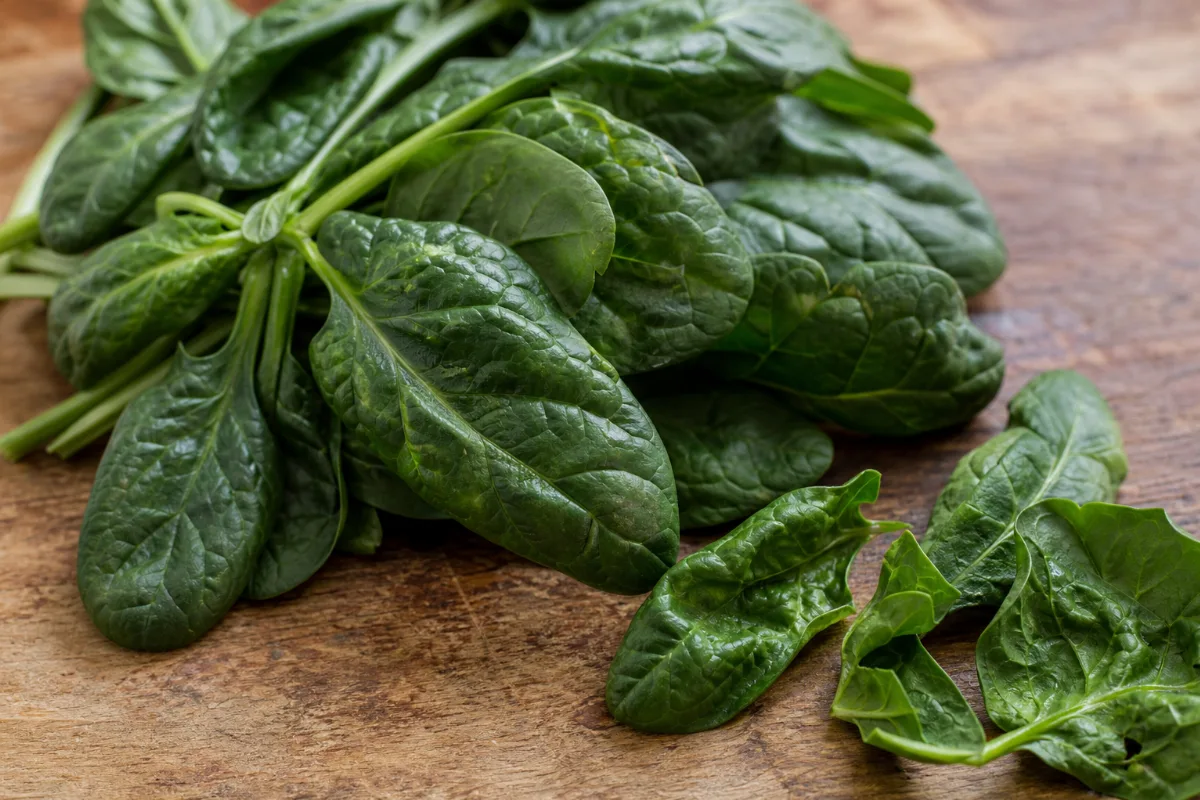
Vegetables · Vegetable
Spinach
Spinacia oleracea · also called Garden spinach, espinaca (Spanish)
Spinach is a leafy green vegetable eaten raw or cooked. It is very rich in vitamin K and a good source of folate and potassium. Eating more leafy greens is linked to less heart disease in observational studies, but trials have not shown a clear effect on blood pressure. The main cautions are warfarin (because of vitamin K), kidney stones (oxalate), kidney disease (potassium) and food poisoning from raw leaves.
General information, not medical advice. Last substantive update · Not medically reviewed. A named clinician has not signed off on this page. How this page is made
About Spinach
Spinach is a nutritious leafy vegetable, rich in vitamin K, folate and potassium. It is a healthy food, not a proven remedy: most health claims come from studies of leafy greens in general, or from capsules and extracts.
What it is
Spinach (Spinacia oleracea) is a leafy vegetable in the amaranth family. People eat the leaves raw, cooked, frozen or canned.
USDA data for raw spinach: 23 kcal per 100 g. One cup of raw leaves (30 g) has about 7 kcal, 0.7 g fibre, 0.9 g protein, 145 micrograms vitamin K, 58 micrograms folate (DFE), 8.4 mg vitamin C, 167 mg potassium, 30 mg calcium, 0.8 mg iron and 24 mg magnesium. Cooked spinach shrinks a lot, so the same weight holds many more leaves; cooked values were not read.
What the research shows
The firmest facts are about nutrients: vitamin K is needed for blood to clot and folate is a B vitamin, and spinach is a rich source of both. These are not trials of spinach.
Observational studies link more green leafy vegetables to less heart disease, but randomised trials of leafy greens did not show a clear change in blood pressure or vessel function. The authors call the trial evidence limited and inconclusive.
The big eye trial tested lutein capsules, not spinach, and found no significant benefit. The four spinach-specific trials we found used a concentrated extract.
Food versus capsules and extracts
The eye trial used lutein capsules and the performance trials used spinach extract. Results for a capsule or extract do not carry over to eating the leaves. In the eye trial, beta carotene capsules were also linked to more lung cancers in former smokers; that finding is about capsules, not spinach.
Amounts
This page gives no amounts to eat. Ask a doctor, pharmacist or dietitian what is right for you, especially if you take warfarin or have kidney problems.
At a glance
Traditional uses history, not proof
- Eaten as a leafy vegetable, raw in salads or cooked
- Long use as food is not proof that it treats any condition
Studied for research
- Vitamin K for normal blood clotting, high certainty for the nutrient, no spinach trial
- Folate from leafy greens, high certainty for the nutrient
- Heart disease risk (green leafy vegetables as a group), low certainty, observational
- Blood pressure and vessel function, insufficient evidence (trials of leafy greens)
- Eye health, insufficient evidence (lutein capsule trial, not spinach)
- Spinach extract and physical performance, very low certainty
Main compounds
- Vitamin K (phylloquinone)
- Folate
- Lutein and zeaxanthin
- Beta-carotene
- Oxalate
- Nitrate
- Potassium
Common forms
- Raw leaves and baby leaves as food
- Cooked, frozen or canned spinach as food
- Pre-washed bagged leaves
- Spinach powder or extract supplements (the performance trials used extracts, not the vegetable)
Research links: NHS: Warfarin · 2026 review: green leafy vegetables and cardiovascular disease · NIDDK: Eating, diet and nutrition for kidney stones · Research Library · Genes & Biomarkers Library
What it is and its history
- Accepted scientific name
- Spinacia oleracea
- Naming authority
- L. (GBIF accepted)
- Common names
- Spinach (English); Garden spinach (English); Espinaca (Spanish)
- Family or group
- Amaranthaceae (the amaranth family), as given by GBIF and by the existing nutrient summary.
- Classification
- Plantae > Tracheophyta > Magnoliopsida > Caryophyllales > Amaranthaceae > Spinacia > Spinacia oleracea
- Native range
- Not verified from a source read.
- Habitat
- Not verified from a source read.
- What it looks like
- Roots: Not verified.; Stems: Not verified.; Leaves: The leaves are the food. USDA gives a household portion of one cup of raw leaves as 30 g, one leaf as 10 g and a 10 oz package as 284 g.; Flowers: Not verified.; Fruit: Not verified.
- Cultivation
- Not verified from a source read.
- Harvest and processing
- Eaten raw, cooked, frozen or canned, or sold as a powder or extract (existing nutrient summary). Cooking effects on nutrients were not read from a source.
- Look-alikes and adulterants
- Name: Red spinach and other 'spinach' leaves; Note: Names such as red spinach are used for other leafy plants. The extract review read does not name the species of its red spinach, so its results are not assumed to apply to garden spinach.; Name: Swiss chard, kale and other leafy greens; Note: Different vegetables with their own pages. Green leafy vegetable studies pool several of them.
- Sustainability and conservation
- Not assessed.
Photographs
What is inside, and how it may work
What it contains and how those compounds act in cells and animals. Laboratory and animal mechanisms are not proven effects in people.
Main compounds
| Compound | Family | Where it is concentrated | Activity studied | Level of evidence |
|---|---|---|---|---|
| Vitamin K (phylloquinone) PubChem 5284607 | vitamin | Leaf USDA: 483 micrograms per 100 g raw | Needed for blood-clotting proteins (MedlinePlus). Affects warfarin. 16 19 17 | Human data |
| Folate (vitamin B9) PubChem 135398658 | vitamin | Leaf USDA: 194 micrograms DFE per 100 g raw | B vitamin; leafy greens are a natural source (MedlinePlus). 13 19 | Human data |
| Lutein (with zeaxanthin) PubChem 5281243 | carotenoid | Leaf USDA: 12,200 micrograms lutein plus zeaxanthin per 100 g raw | Carotenoid plant pigment. The AREDS2 trial of capsules found no significant benefit for advanced macular degeneration. 1 19 | Human data |
| Beta-carotene PubChem 5280489 | carotenoid | Leaf USDA: 5,630 micrograms per 100 g raw | Orange-yellow pigment that the body can turn into vitamin A (this role is general knowledge, not read in a source for this page). In AREDS2, beta carotene capsules were linked to more lung cancers in former smokers. 19 1 | Human data |
| Oxalate (oxalic acid) PubChem 971 | organic acid | Leaf Not given in the sources read | Spinach is a high-oxalate food (NIDDK). In healthy adults 2% to 12% of the oxalate in a spinach meal was absorbed and urine oxalate rose. 18 6 | Human data |
| Nitrate PubChem 943 | inorganic anion | Leaf Not given in the sources read | The spinach extract review describes the extract as rich in nitrate. Nitrate salts and beetroot juice lowered systolic blood pressure in small trials (not spinach). 9 8 | Human data |
Mechanisms, receptors and pathways
| Target or pathway | Gene or receptor | What was found | Level |
|---|---|---|---|
| Vitamin K and blood clotting | Clotting factors II, VII, IX and X (named by MedlinePlus) | Vitamin K is used by the liver to make clotting proteins; warfarin works against this, so the vitamin K in food affects the medicine. 16 17 | Human data |
| Dietary oxalate and urine oxalate | Not specified | After a spinach meal some oxalate is absorbed and urine oxalate rises; more water lowered the concentration spikes. 6 | Human data |
Absorption, metabolism and elimination
- Absorption
- Oxalate: 2% to 12% of the oxalate in a 10 oz spinach meal was absorbed in 21 healthy adults. Iron from vegetables is harder to absorb than iron from meat (MedlinePlus).
- Distribution
- Not found.
- Metabolism
- Not found.
- Elimination
- Urine oxalate peaked about 7 hours after the spinach meal in the study.
- Bioavailability
- Not established for most spinach nutrients in the sources read.
Isolated compounds versus whole extracts
The lutein trial used capsules and the performance trials used a concentrated extract, so neither tells us about eating spinach. Beetroot juice and nitrate salt results do not carry over to a leafy vegetable. Food, powder and extract are different products.
Nutritional composition
Nutrition from USDA FoodData Central (Spinach, raw, FDC 168462, SR Legacy, last updated 4/1/2019, read 2026-10-26). Per 100 g: 23 kcal, 2.86 g protein, 0.39 g fat, 3.63 g carbohydrate, 2.2 g fibre, about 91 g water, 99 mg calcium, 2.71 mg iron, 79 mg magnesium, 558 mg potassium, 79 mg sodium, 28.1 mg vitamin C, 194 micrograms folate (DFE), 469 micrograms vitamin A (RAE), 483 micrograms vitamin K, 0.897 mg manganese. One cup of raw leaves (30 g): about 6.9 kcal, 0.9 g protein, 0.7 g fibre, 30 mg calcium, 0.8 mg iron, 24 mg magnesium, 167 mg potassium, 8.4 mg vitamin C, 58 micrograms folate, 145 micrograms vitamin K, 3,660 micrograms lutein plus zeaxanthin. Figures vary with variety, ripeness and storage. Cooked spinach shrinks a lot, so the same weight holds many more leaves; cooked values were not read.
2 high certainty1 low certainty1 very low certainty3 not enough evidence
What was looked at
The 7 benefits and uses checked for Spinach, each with how strong the evidence is. Tap one to open it.
- Vitamin K for normal blood clottingHigh certainty
- Folate (vitamin B9) from leafy greensHigh certainty
- Heart disease risk (green leafy vegetables as a group)Low certainty
- Iron from spinachNot enough evidence
- Eye health (age-related macular degeneration)Not enough evidence
- Nitrate and blood pressureNot enough evidence
- Physical performance (spinach extract)Very low certainty
Lab markers tracked in the studies
Cardiovascular disease events and deathsBlood pressure and vascular functionProgression to advanced macular degenerationSystolic blood pressure after inorganic nitrate or beetroot juice
What is Spinach good for?
The main studied uses and how strong the human evidence is for each. Many results are for leafy greens as a group, for capsules, or for extracts, not for eating spinach.
Benefits, one by one
Each card is a research question, not a promise. Tap a goal to filter. Open a card to see the studies, doses and limits.
Vitamin K for normal blood clotting
High certaintyVitamin K is needed for blood to clot. Spinach is one of the richest food sources. USDA lists about 145 micrograms in one cup (30 g) of raw leaves. This is a nutrient fact, not a spinach trial. If you take warfarin, the same vitamin K matters for a different reason: see the Safety tab.
2 studiesRaw leaves as food. Values vary with variety, ripeness and storage.
Studies, doses and limits
What the trials found
MedlinePlus says vitamin K is needed to make clotting factors in the liver and lists green leafy vegetables such as kale, spinach, turnip greens, collards, Swiss chard, mustard greens, parsley and romaine as food sources. USDA lists 483 micrograms of vitamin K (phylloquinone) per 100 g of raw spinach, about 145 micrograms in one 30 g cup.
Results
The clotting role of vitamin K is well accepted, and spinach is a rich source. No trial of spinach for clotting was read.
Effect sizes as reported
USDA: 483 micrograms vitamin K per 100 g raw spinach; about 145 micrograms per cup (30 g).
Why this rating
High for the nutrient role and for spinach being a rich source (health-agency statement and USDA data). There is no spinach-specific trial, and a varied diet normally supplies vitamin K. MedlinePlus says deficiency is very rare.
Form and dose studied
Raw leaves as food. Values vary with variety, ripeness and storage.
Who was studied
Anyone eating a varied diet; MedlinePlus links deficiency to problems absorbing the vitamin and to long-term antibiotic treatment.
Limits
Nutrient fact, not a trial of spinach. This page does not show that extra vitamin K from any source adds benefit in someone who already has enough.
Why researchers looked
Spinach is often named as a vitamin K food, so people ask what it does for the body.
Traditional use
Spinach is eaten as a leafy vegetable, raw or cooked. Long use as food is not proof that it treats any condition.
Proposed mechanism Authoritative guidance
Vitamin K is used by the liver to make clotting proteins (clotting factors II, VII, IX and X). Without it, blood would not clot (MedlinePlus).
A proposed mechanism does not show that the effect happens in people.
People taking warfarin should keep vitamin K intake steady and ask their clinic; see the Safety tab.
Folate (vitamin B9) from leafy greens
High certaintyFolate is a B vitamin found naturally in green leafy vegetables, citrus fruit and beans. One cup of raw spinach (30 g) has about 58 micrograms of folate (DFE) by USDA data. Low folate can cause some types of anaemia. MedlinePlus says food alone can make it hard to get enough, so women planning pregnancy are advised to take folic acid.
2 studiesRaw leaves as food. MedlinePlus does not state how much folate is los…
Studies, doses and limits
What the trials found
MedlinePlus says folate occurs naturally in foods such as green leafy vegetables, citrus fruit and beans, that too little folate can lead to certain types of anaemia, and that because it may be hard to get enough through foods, women thinking about becoming pregnant should take folic acid supplements. USDA lists 194 micrograms of folate (DFE) per 100 g of raw spinach.
Results
Spinach is a recognised folate-containing food. No trial of spinach and folate status or anaemia was read.
Effect sizes as reported
USDA: 194 micrograms folate (DFE) per 100 g raw spinach; about 58 micrograms per cup (30 g).
Why this rating
High for the nutrient role and for leafy greens being a natural folate source (MedlinePlus and USDA). No spinach-specific trial was read, and folate in food is not the same as folic acid in a pill.
Form and dose studied
Raw leaves as food. MedlinePlus does not state how much folate is lost in cooking.
Who was studied
Everyone; women planning pregnancy are given special advice by MedlinePlus.
Limits
Nutrient information, not a trial of spinach. Cooking effects on folate were not read.
Why researchers looked
Spinach is a leafy green often named as a folate food, so people ask whether it supplies enough.
Traditional use
Spinach is eaten as a leafy vegetable, raw or cooked. Long use as food is not proof that it treats any condition.
Proposed mechanism Authoritative guidance
Folate is a water-soluble B vitamin the body uses to make cells. Folic acid is the man-made form used in supplements and fortified foods (MedlinePlus).
A proposed mechanism does not show that the effect happens in people.
Folic acid supplements have their own upper limit and can mask vitamin B12 shortage (MedlinePlus); ask a clinician.
Heart disease risk (green leafy vegetables as a group)
Low certaintyPeople who eat more green leafy vegetables have less heart disease in observational studies. A 2026 review found about 11% lower risk. This cannot prove the greens are the cause, and the studies were not about spinach alone.
2 studiesWhole green leafy vegetables eaten as food.
Studies, doses and limits
What the trials found
A 2026 systematic review pooled observational studies and found higher green leafy vegetable intake linked to lower cardiovascular disease (relative risk 0.89, 95% CI 0.82 to 0.97) and lower cardiovascular death (relative risk 0.79, 95% CI 0.62 to 0.97), with high heterogeneity (I2 80%). A 2017 meta-analysis of 95 prospective studies found, for fruit and vegetables combined, a relative risk of 0.92 for cardiovascular disease per 200 g a day (95% CI 0.90 to 0.95), and said inverse associations were seen for green leafy vegetables with cardiovascular disease and all-cause mortality.
Results
Observational studies link more leafy greens to less cardiovascular disease. Trials in the same review did not show clear changes in blood pressure or vessel function (see the next result).
Effect sizes as reported
Leafy greens: CVD RR 0.89 (0.82-0.97); CVD death RR 0.79 (0.62-0.97). Fruit and vegetables combined: CVD RR 0.92 per 200 g/day (0.90-0.95).
Why this rating
Low, because the evidence is observational: people who eat more greens differ from others in many ways, heterogeneity is high (I2 80%), and the studies are about green leafy vegetables as a group, not spinach alone.
Form and dose studied
Whole green leafy vegetables eaten as food.
Who was studied
Adults in prospective cohort studies.
Limits
Cannot show cause. Spinach was not analysed on its own in the abstracts read. Intake amounts and definitions of 'leafy' differ between studies.
Why researchers looked
Green leafy vegetables are rich in vitamins, minerals and plant pigments, and population studies ask whether eating them goes with healthier hearts.
Traditional use
Spinach is eaten as a leafy vegetable, raw or cooked. Long use as food is not proof that it treats any condition.
Proposed mechanism Unknown
Not established. Which nutrient or plant compound in leafy greens might matter, if any, is not shown by the studies read.
A proposed mechanism does not show that the effect happens in people.
None specific beyond the warfarin and kidney cautions on the Safety tab.
Iron from spinach
Not enough evidenceSpinach contains iron (2.71 mg per 100 g by USDA). But MedlinePlus lists vegetables among iron sources that are harder for the body to absorb than iron from meat, and says foods rich in vitamin C help absorption. No trial was found testing spinach for iron shortage or anaemia.
2 studiesRaw leaves as food.
Studies, doses and limits
What the trials found
MedlinePlus lists spinach among plant sources of iron, says iron from vegetables, fruits, grains and supplements is harder for the body to absorb, and says foods rich in vitamin C such as citrus, strawberries, tomatoes and potatoes also increase iron absorption. USDA lists 2.71 mg of iron per 100 g of raw spinach, about 0.81 mg in a 30 g cup.
Results
Spinach contains iron, but it is a plant source that is harder to absorb. No trial of spinach for iron deficiency or anaemia was read.
Effect sizes as reported
USDA: 2.71 mg iron per 100 g raw spinach; about 0.81 mg per cup (30 g).
Why this rating
There is no trial of spinach for iron status. The agency statement supports the nutrient facts only.
Form and dose studied
Raw leaves as food.
Who was studied
General adult diet.
Limits
A food containing a nutrient is not proof it treats a shortage of that nutrient. Possible iron-blocking compounds in spinach were not covered by the pages read.
Why researchers looked
Spinach has long been named as an iron food, so people ask if it helps with low iron.
Traditional use
Spinach is eaten as a leafy vegetable, raw or cooked. Long use as food is not proof that it treats any condition.
Proposed mechanism Authoritative guidance
Iron in plant foods is absorbed less well than iron in meat, fish and poultry; vitamin C foods increase absorption (MedlinePlus).
A proposed mechanism does not show that the effect happens in people.
Suspected low iron or anaemia needs a blood test and a clinician's advice, not a food swap.
Eye health (age-related macular degeneration)
Not enough evidenceSpinach is very rich in the yellow plant pigments lutein and zeaxanthin (about 12,200 micrograms per 100 g by USDA). The big AREDS2 trial gave lutein and zeaxanthin as capsules to people at risk of advanced macular degeneration. It did not significantly reduce progression compared with placebo. Spinach itself was not tested.
2 studiesLutein plus zeaxanthin capsules (not spinach).
Studies, doses and limits
What the trials found
AREDS2 randomised 4,203 people aged 50 to 85 at risk of advanced age-related macular degeneration to lutein 10 mg plus zeaxanthin 2 mg, omega-3 fats, both, or placebo, on top of the AREDS vitamin formula. After a median of 5 years, progression to advanced disease was 29% with lutein plus zeaxanthin and 31% with placebo, not a significant difference (HR 0.90, 98.7% CI 0.76 to 1.07, P=0.12).
Results
Lutein plus zeaxanthin capsules did not significantly reduce progression to advanced macular degeneration. The trial did not test spinach or any food.
Effect sizes as reported
HR 0.90 (98.7% CI 0.76-1.07), P=0.12; 29% vs 31% progression at 5 years.
Why this rating
Insufficient for spinach: the only trial read tested capsules, not food, and found no significant benefit. No trial of eating spinach for eye disease was read.
Form and dose studied
Lutein plus zeaxanthin capsules (not spinach).
Who was studied
People aged 50 to 85 already at risk of advanced AMD.
Limits
Capsules in people already at risk are not the same as eating spinach in people with healthy eyes.
Why researchers looked
Spinach is a rich lutein and zeaxanthin food, and observational data suggest these carotenoids might lower the risk of advanced macular degeneration (AREDS2 abstract), so people ask if eating it protects the eyes.
Traditional use
Spinach is eaten as a leafy vegetable, raw or cooked. Long use as food is not proof that it treats any condition.
Proposed mechanism Human data
Lutein and zeaxanthin are carotenoid plant pigments. Observational data suggested they might lower the risk of advanced macular degeneration; the AREDS2 trial tested that idea with capsules.
A proposed mechanism does not show that the effect happens in people.
Beta carotene capsules in the same trial were linked to more lung cancers, mostly in former smokers. That finding is about capsules, not spinach.
Nitrate and blood pressure
Not enough evidenceSpinach is a nitrate-containing leafy green. In small trials of nitrate salts and beetroot juice, systolic blood pressure fell by about 4 mm Hg. Those were not trials of spinach, and leafy-green trials showed no clear change (see the Heart section). So the result for spinach is unknown.
2 studiesBeetroot juice or nitrate salts (not spinach).
Studies, doses and limits
What the trials found
A 2013 meta-analysis of 16 small crossover trials (254 adults) found inorganic nitrate or beetroot juice lowered systolic blood pressure by 4.4 mm Hg (95% CI -5.9 to -2.8) and diastolic by 1.1 mm Hg (not significant). The 2026 leafy greens review found no significant effect on blood pressure in randomised trials of green leafy vegetables.
Results
Nitrate salts and beetroot juice lowered systolic pressure a little in short trials. Spinach was not tested in those trials, and leafy-green trials showed no significant change.
Effect sizes as reported
Systolic BP -4.4 mm Hg (nitrate salts or beetroot juice, not spinach).
Why this rating
Insufficient for spinach: the positive trials used different products, were short and small, and the leafy-green trials were null.
Form and dose studied
Beetroot juice or nitrate salts (not spinach).
Who was studied
Adults in short crossover trials.
Limits
Results for beetroot juice or nitrate salts do not carry over to a leafy vegetable.
Why researchers looked
Leafy greens and beetroot are nitrate-rich foods, so people ask whether the nitrate lowers blood pressure.
Traditional use
Spinach is eaten as a leafy vegetable, raw or cooked. Long use as food is not proof that it treats any condition.
Proposed mechanism Unknown
Not established for spinach. The abstracts read do not explain how nitrate might lower blood pressure or test it for spinach.
A proposed mechanism does not show that the effect happens in people.
Medicine for blood pressure should not be changed because of food or supplements without asking a clinician.
Physical performance (spinach extract)
Very low certaintyA 2025 review of four small trials of spinach extract (mostly red spinach, 94 people, 1 to 2 g) reported better results on most physical performance measures. These were extracts, not the vegetable, and the trials were small and short.
1 studiesExtract supplement.
Studies, doses and limits
What the trials found
A systematic review of four randomised trials (three red spinach, one green spinach; 94 people, mean age 29.4; follow-up 7 to 84 days) of spinach extract at 1 to 2 g found significant improvements in most physical performance measures, mixed results for body composition and no reported complications. The authors say more research is needed on dosing and populations.
Results
Spinach extract improved most performance measures in four small trials. This is not evidence about eating spinach.
Effect sizes as reported
Not given in the abstract.
Why this rating
Very low: four small, short trials of an extract, three of them of red spinach (species not stated in the abstract), pooled in a small review with no effect sizes in the abstract.
Form and dose studied
Extract supplement.
Who was studied
Adults, mean age 29.4.
Limits
Small, short, extract only. Species of red spinach not stated in the abstract.
Why researchers looked
Spinach extract is sold as a sports supplement, and the reviewers note it is rich in nitrate.
Traditional use
Spinach is eaten as a leafy vegetable, raw or cooked. Long use as food is not proof that it treats any condition.
Proposed mechanism Unknown
The reviewers note the extract is rich in nitrate. Whether nitrate explains any effect was not tested in the abstract.
A proposed mechanism does not show that the effect happens in people.
Extracts are concentrated products and are not covered by the food evidence on this page. Ask a doctor or pharmacist before using any.
Connections to the rest of health
How Spinach connects to the rest of our health knowledge graph. Every link says what kind of connection it is. A safety link (for example to the liver) is a warning, not a benefit. A study that merely mentions a topic never creates a benefit link.
Explore every connection: goals, body systems, organs, symptoms, genes
B. Body systems
| Connected to | Kind of connection | Evidence status | Context | Studies |
|---|---|---|---|---|
| Cardiovascular System | Biological association | High certainty | Studied for: Vitamin K for normal blood clotting Studied for: Heart disease risk (green leafy vegetables as a group) | 16 19 5 2 8 |
| Blood And Immune | Biological association | High certainty | Studied for: Vitamin K for normal blood clotting Studied for: Folate (vitamin B9) from leafy greens | 16 19 13 14 |
| Reproductive System | Biological association | High certainty | Studied for: Folate (vitamin B9) from leafy greens | 13 19 |
| Eyes And Vision | Biological association | Not enough evidence | Studied for: Eye health (age-related macular degeneration) | 1 19 |
| Musculoskeletal System | Biological association | Very low certainty | Studied for: Physical performance (spinach extract) | 9 |
C. Body parts and organs
| Connected to | Kind of connection | Evidence status | Context | Studies |
|---|---|---|---|---|
| Kidneys | Adverse effect or risk | Documented risk | High-oxalate food for people with calcium oxalate stones; potassium-rich for people with kidney disease. High in oxalate and potassium; cautions for kidney stones and kidney disease. Preparation or compound: Oxalate and potassium in spinach |
18 6 15 |
I. Biomarkers
| Connected to | Kind of connection | Evidence status | Context | Studies |
|---|---|---|---|---|
| Cardiovascular disease events and deaths | Biological association | Low certainty | Measured in trials: lowered. A lab change is not the same as a health benefit. | 5 2 |
| Blood pressure and vascular function | Biological association | Not enough evidence | Measured in trials: no-change. A lab change is not the same as a health benefit. | 5 |
| Progression to advanced macular degeneration | Biological association | Not enough evidence | Measured in trials: no-change. A lab change is not the same as a health benefit. | 1 |
| Systolic blood pressure after inorganic nitrate or beetroot juice | Biological association | Not enough evidence | Measured in trials: lowered. A lab change is not the same as a health benefit. | 8 |
K. Biological pathways
| Connected to | Kind of connection | Evidence status | Context | Studies |
|---|---|---|---|---|
| Vitamin K | Preliminary mechanism | Human | Spinach is a rich vitamin K food; vitamin K is needed for clotting and affects warfarin. | 16 17 |
| Folate | Preliminary mechanism | Human | Leafy greens are a natural folate source. | 13 |
| Potassium | Preliminary mechanism | Human | Spinach is potassium-rich; relevant for kidney disease and some blood pressure medicines. | 15 19 |
L. Active compounds
| Connected to | Kind of connection | Evidence status | Context | Studies |
|---|---|---|---|---|
| Vitamin K (phylloquinone) | Biological association | Human | Needed for blood-clotting proteins (MedlinePlus). Affects warfarin. Preparation or compound: Leaf |
16 19 17 |
| Folate (vitamin B9) | Biological association | Human | B vitamin; leafy greens are a natural source (MedlinePlus). Preparation or compound: Leaf |
13 19 |
| Lutein (with zeaxanthin) | Biological association | Human | Carotenoid plant pigment. The AREDS2 trial of capsules found no significant benefit for advanced macular degeneration. Preparation or compound: Leaf |
1 19 |
| Beta-carotene | Biological association | Human | Orange-yellow pigment that the body can turn into vitamin A (this role is general knowledge, not read in a source for this page). In AREDS2, beta carotene capsules were linked to more lung cancers in former smokers. Preparation or compound: Leaf |
19 1 |
| Oxalate (oxalic acid) | Biological association | Human | Spinach is a high-oxalate food (NIDDK). In healthy adults 2% to 12% of the oxalate in a spinach meal was absorbed and urine oxalate rose. Preparation or compound: Leaf |
18 6 |
| Nitrate | Biological association | Human | The spinach extract review describes the extract as rich in nitrate. Nitrate salts and beetroot juice lowered systolic blood pressure in small trials (not spinach). Preparation or compound: Leaf |
9 8 |
Each connection is stored with the ingredient, the connected record, the kind of connection, the evidence status, the supporting studies, the preparation or compound involved, and a review date (last reviewed October 26, 2026).
Evidence at a glance: what changed in 4 lab markers
Tap a number to show only those markers. Counts are markers, not people.
The evidence
The research centre for Spinach. Every record here was checked against PubMed or the publisher's page; we never list a study we have not verified.
Evidence by outcome
Bars show how many studies we found for each outcome, not how well it works. People are added up across trials only (reviews are not added, to avoid double counting).
How we rate evidence
High certainty
Several well-run trials or reviews agree; further research is unlikely to change the picture much.
Moderate certainty
Good trials point the same way, but some doubt remains.
Low certainty
Small, short or inconsistent trials. The finding could change with better research.
Very low certainty
Very little or very weak human data. Treat as a possibility only.
Mixed findings
Trials or reviews disagree with each other.
Not enough evidence
Not enough human research to say either way.
Evidence against
Good research found no benefit, or found harm.
We take the reviewers' own risk-of-bias and GRADE statements where they exist, and otherwise judge from study size, design, consistency, directness and whether a product matches what is sold. Many publications do not make evidence high. Method note: We started from our existing spinach summary, re-checked nutrition at USDA FoodData Central, read the health agency pages (NHS, MedlinePlus, NIDDK, FDA) and searched PubMed for reviews, trials and case reports. Only abstracts were read for studies, and three allergy reports had no abstract. Items we could not verify are flagged in the research gaps.
Study library: every study we checked 19
| Study | Design | People | Product, dose, length | Result |
|---|---|---|---|---|
| Age-Related Eye Disease Study 2 Research Group 2013 Lutein + zeaxanthin and omega-3 fatty acids for age-related macular degeneration: the Age-Related Eye Disease Study 2 (AREDS2) randomized clinical trial. JAMA · PMID 23644932 · DOI |
Controlled trial |
4203 4,203 people aged 50 to 85 at risk of advanced age-related macular degeneration (AMD) |
Lutein 10 mg plus zeaxanthin 2 mg capsules (and DHA plus EPA in other arms), on top of the AREDS formula Supplement capsules, not spinach Trial detail, not advice Median follow-up 5 years · vs Placebo |
Adding lutein plus zeaxanthin did not significantly reduce progression to advanced AMD compared with placebo. More lung cancers were noted in the beta carotene group than the no beta carotene group, mostly in former smokers. Progression to advanced AMD, lutein + zeaxanthin versus placebo: HR 0.90; lung cancer 2.0% (beta carotene) vs 0.9% (no beta carotene) (HR 0.90 (98.7% CI 0.76-1.07), P=0.12; lung cancer nominal P=0.04) Methods, limits and fundingOutcomes: Progression to advanced AMD (by eye); lung cancer was also counted Limitations: Supplement capsules in people already at risk, not food. The lung cancer difference was a nominal (not primary) finding. Funding and conflicts: Funding is not stated in the abstract; the abstract lists NIH-supported research (PubMed publication types: NIH extramural and intramural). Registration: NCT00345176 Read: abstract |
| Aune 2017 Fruit and vegetable intake and the risk of cardiovascular disease, total cancer and all-cause mortality-a systematic review and dose-response meta-analysis of prospective studies. Int J Epidemiol · PMID 28338764 · DOI |
Systematic review meta analysis |
Adults in 95 prospective studies (142 publications) | Fruit and vegetable intake as food Fruit and vegetables Per 200 g/day (analysis unit, not advice) Prospective follow-up · vs Lower intake |
For fruit and vegetables combined, each 200 g/day was linked to lower risk of coronary heart disease, stroke, cardiovascular disease, total cancer and death from any cause. The abstract says inverse associations were seen for green leafy vegetables, apples and pears, citrus, cruciferous vegetables and salads with cardiovascular disease and all-cause mortality. A summary figure for green leafy vegetables alone is not given in the abstract. Combined fruit and vegetables per 200 g/day: CVD RR 0.92; all-cause mortality RR 0.90 (CVD RR 0.92 (95% CI 0.90-0.95); all-cause mortality 0.90 (0.87-0.93)) Methods, limits and fundingOutcomes: Cardiovascular disease, total cancer, all-cause mortality Limitations: Prospective observational studies cannot show cause; people who eat more vegetables differ in other ways. The combined figures are not for spinach. Green leafy vegetable figure not in the abstract. Funding and conflicts: Not stated in the abstract. Read: abstract |
| Ferrer 2011 Food allergy to spinach in an infant. Allergol Immunopathol (Madr) · PMID 21269751 · DOI |
Case report |
Case report (letter): an infant | Spinach Leaf |
Only the title and publication type were read (the PubMed record has no abstract). The title reports a food allergy to spinach in an infant. Not available (Not available) Methods, limits and fundingOutcomes: Allergic reaction Limitations: No abstract to read. Case report: shows it can happen, not how often. Funding and conflicts: Not stated. Read: abstract |
| Foti 2012 Urticaria and angioedema to rubisco allergen in spinach and tomato. Ann Allergy Asthma Immunol · PMID 22192968 · DOI |
Case report |
Case report (letter); number of patients not available from the record | Spinach and tomato Leaf and fruit |
Only the title and publication type were read (the PubMed record has no abstract). The title reports hives (urticaria) and swelling (angioedema) linked to the rubisco protein in spinach and tomato. Not available (Not available) Methods, limits and fundingOutcomes: Allergic reaction Limitations: No abstract to read. Case report: shows it can happen, not how often. Funding and conflicts: Not stated. Read: abstract |
| Kaewpradup 2026 Dietary Green Leafy Vegetables and Cardiovascular Disease Risk: A Systematic Review and Meta-Analysis. Foods · PMID 42587937 · DOI |
Systematic review meta analysis |
Adults in observational studies and randomised trials of green leafy vegetables (not spinach alone) | Green leafy vegetables as food Leaves Not given in the abstract Varied · vs Lower intake (observational) or control (trials) |
Higher intake of green leafy vegetables was linked to lower CVD risk and CVD death in observational studies. Seven randomised trials showed no significant change in vascular function. No significant link with hypertension risk in observational studies, and no significant effect on systolic or diastolic blood pressure in trials. The authors call the trial evidence limited and inconclusive. CVD risk RR 0.89; CVD mortality RR 0.79; vascular function (7 RCTs) mean difference -0.37 (CVD RR 0.89 (95% CI 0.82-0.97), I2 80%; CVD death RR 0.79 (0.62-0.97), I2 80%; vascular function MD -0.37 (-1.90 to 1.16), I2 88%) Methods, limits and fundingOutcomes: Cardiovascular disease (CVD) risk, CVD death, vascular function, blood pressure Limitations: Observational links cannot show cause. High heterogeneity (I2 80-88%). Green leafy vegetables as a group, not spinach alone. Number of studies not given in the abstract. Funding and conflicts: Not stated in the abstract. Read: abstract |
| Lemack 2025 Spot Urine Oxalate Testing in a Controlled Trial of Forced Hydration and Spinach Consumption. Urology · PMID 40744229 · DOI |
Controlled trial |
21 21 healthy adults who do not form stones |
Spinach as a high-oxalate load (10 oz on each of two days) Spinach Trial detail, not advice 48 hours of urine collection · vs Same people with usual versus increased water intake on day 2 |
Urine oxalate excretion varied widely between people; 2% to 12% of the oxalate eaten was absorbed. Most people (91%) had at least one high-oxalate void, peaking about 7 hours after the spinach. Drinking more water lowered urine oxalate concentration spikes by up to 5-fold. 91% had one or more high-oxalate voids; water lowered spikes up to 5-fold (P=0.014) (P=0.014 for the water effect) Methods, limits and fundingOutcomes: Urine oxalate over 8 hours after the spinach load Limitations: Healthy non-stone formers only; small; does not tell a person with stones what to do. Funding and conflicts: Declaration of Competing Interest: none. Read: abstract |
| Schuller 2005 Occupational asthma due to allergy to spinach powder in a pasta factory. Allergy · PMID 15679732 · DOI |
Case report |
Case report (letter): a pasta factory worker | Spinach powder (inhaled at work) Leaf powder |
Only the title and publication type were read (the PubMed record has no abstract). The title reports occupational asthma from allergy to spinach powder in a pasta factory. Not available (Not available) Methods, limits and fundingOutcomes: Work-related asthma Limitations: No abstract to read. A work exposure to powder, not a reaction to eating spinach. Funding and conflicts: Not stated. Read: abstract |
| Siervo 2013 Inorganic nitrate and beetroot juice supplementation reduces blood pressure in adults: a systematic review and meta-analysis. J Nutr · PMID 23596162 · DOI |
Systematic review meta analysis |
254 254 adults across 16 small crossover trials (7 to 30 per study) |
Inorganic nitrate or beetroot juice supplementation Beetroot juice or nitrate salts, not spinach Trial detail, not advice 2 hours to 15 days · vs Placebo |
Inorganic nitrate and beetroot juice were linked to a greater fall in systolic than diastolic blood pressure. The authors say long-term trials are needed. Systolic BP -4.4 mm Hg; diastolic -1.1 mm Hg (not significant) (Systolic -4.4 (95% CI -5.9 to -2.8), P<0.001; diastolic -1.1 (-2.2 to 0.1), P=0.06) Methods, limits and fundingOutcomes: Systolic and diastolic blood pressure Limitations: Short crossover trials. Not spinach. Results for beetroot juice or nitrate salts do not carry over to a leafy vegetable. Funding and conflicts: Not stated in the abstract. Read: abstract |
| Wen 2025 Improved Effect of Spinach Extract on Physical Performance: A Systematic Review of Randomized Controlled Trials. Cureus · PMID 39991395 · DOI |
Systematic review |
94 94 adults in 4 randomised trials (mean age 29.4 years) |
Spinach extract supplement (three trials red spinach, one green spinach) Extract, not the food 1 to 2 g (trial detail, not advice) 7 to 84 days (mean 43.8) · vs Control |
The review reports significant improvements in most physical performance measures, mixed results for body composition and no complications. The authors say more research is needed on dosing and populations. Improved most performance measures; mixed body composition (Not given in the abstract) Methods, limits and fundingOutcomes: Physical performance, body composition, complications Limitations: Four small, short trials of an extract. Species of the red spinach is not stated in the abstract. Not evidence about eating spinach. Funding and conflicts: Authors declare no funding and no conflicts. Read: abstract |
| s-fda-outbreaks FDA: Investigations of Foodborne Illness Outbreaks · Source |
Health agency n/a |
Methods, limits and fundingRead: full-text | ||
| s-fda-produce FDA: Selecting and Serving Produce Safely · Source |
Health agency n/a |
Methods, limits and fundingRead: full-text | ||
| s-gbif-spinacia-oleracea GBIF Backbone: Spinacia oleracea L. (usageKey 3083647) · Source |
Reference database n/a |
Methods, limits and fundingRead: full-text | ||
| s-medlineplus-folate MedlinePlus: Folic acid in the diet · Source |
Health agency n/a |
Methods, limits and fundingRead: full-text | ||
| s-medlineplus-iron MedlinePlus: Iron in diet · Source |
Health agency n/a |
Methods, limits and fundingRead: full-text | ||
| s-medlineplus-potassium MedlinePlus: Potassium in diet · Source |
Health agency n/a |
Methods, limits and fundingRead: full-text | ||
| s-medlineplus-vitk MedlinePlus: Vitamin K · Source |
Health agency n/a |
Methods, limits and fundingRead: full-text | ||
| s-nhs-warfarin NHS: Warfarin · Source |
Health agency n/a |
Methods, limits and fundingRead: full-text | ||
| s-niddk-stones NIDDK: Eating, Diet, & Nutrition for Kidney Stones · Source |
Health agency n/a |
Methods, limits and fundingRead: full-text | ||
| s-usda-fdc-168462 USDA FoodData Central: Spinach, raw (FDC 168462) · Source |
Reference database n/a |
Methods, limits and fundingRead: full-text |
What we do not know yet
- No trial of eating spinach itself was found for heart disease, blood pressure, clotting, folate status, iron or eye health.
- Green leafy vegetable studies pool several vegetables, and a spinach-only result was not in the abstracts read.
- The only spinach-specific trials read tested an extract, mostly of red spinach, and were small and short.
- Allergy was found only in case reports with no abstracts; how common it is was not found.
- Nitrate for young infants, pesticide residues, heavy metals, goitrogens, histamine, FODMAPs and the effect of cooking were not researched.
How new research is added
New studies are found by a saved PubMed search and placed in a review queue before the page changes.
Lab markers
What changed in blood or saliva tests during trials. A changed number is not the same as feeling or being healthier, and we give no "normal ranges".
Other 4
Cardiovascular disease events and deaths
Lowered in trials
How many people in a study develop heart disease or stroke, or die of it.
Low certaintyResults and what it means
Why it was measured
These are the outcomes that matter most to health, so population studies count them.
Statistical vs. clinical meaning
An association in observational studies, not proof that greens prevent disease.
Safety implication
None specific.
| Study | Result | People | Product |
|---|---|---|---|
| 5 | Higher green leafy vegetable intake linked to lower CVD (RR 0.89, 95% CI 0.82-0.97) and CVD death (RR 0.79, 0.62-0.97) | Adults in observational studies | Green leafy vegetables as food (not spinach alone) |
Blood pressure and vascular function
No clear change in trials
Systolic and diastolic blood pressure, and how well blood vessels widen (vascular function).
Not enough evidenceResults and what it means
Why it was measured
Trials of leafy greens check blood pressure and vessel function.
Statistical vs. clinical meaning
The authors call the trial evidence limited and inconclusive (high heterogeneity, I2 88%). Trials were of leafy greens, not spinach alone.
Safety implication
None specific.
| Study | Result | People | Product |
|---|---|---|---|
| 5 | Seven randomised trials of green leafy vegetables: vascular function mean difference -0.37 (95% CI -1.90 to 1.16, p=0.64; units not stated in the abstract); no significant effect on systolic or diastolic blood pressure | Adults in randomised trials | Green leafy vegetables as food (not spinach alone) |
Progression to advanced macular degeneration
No clear change in trials
Whether early age-related macular degeneration (AMD) in an eye worsens to the advanced stage.
Not enough evidenceResults and what it means
Why it was measured
Advanced AMD is the stage that causes serious loss of central vision.
Statistical vs. clinical meaning
No significant difference with capsules. Not a test of spinach.
Safety implication
More lung cancers in the beta carotene group than the no beta carotene group (2.0% vs 0.9%), mostly in former smokers.
| Study | Result | People | Product |
|---|---|---|---|
| 1 | Lutein plus zeaxanthin versus placebo: HR 0.90 (98.7% CI 0.76-1.07), P=0.12; 5-year progression 29% vs 31% | 4,203 people aged 50 to 85 at risk | Lutein 10 mg plus zeaxanthin 2 mg capsules, median 5 years |
Systolic blood pressure after inorganic nitrate or beetroot juice
Lowered in trials
The top blood pressure number, measured after short courses of nitrate salts or beetroot juice.
Not enough evidenceResults and what it means
Why it was measured
Nitrate-rich foods such as leafy greens and beetroot are studied for blood pressure.
Statistical vs. clinical meaning
Short trials of other products. Not a result for spinach.
Safety implication
None specific.
| Study | Result | People | Product |
|---|---|---|---|
| 8 | Systolic BP -4.4 mm Hg (95% CI -5.9 to -2.8); diastolic -1.1 mm Hg (-2.2 to 0.1, P=0.06) | 254 adults in 16 small crossover trials | Inorganic nitrate or beetroot juice, 2 hours to 15 days (not spinach) |
Safety
What studies and official sources say about side effects, medicines and who should check first. Each point shows what kind of evidence it comes from.
Main points to know 5
- Warfarin: spinach is very rich in vitamin K, so keep intake steady and ask your clinic. The NHS says foods high in vitamin K, such as broccoli, spinach and other green leafy vegetables, can affect how warfarin works. You can still eat them, but talk to your warfarin clinic for advice. MedlinePlus says sudden changes in vitamin K intake can change how the medicine works and that it is important to keep vitamin K levels constant day to day. Do not change a prescribed medicine on your own. Authoritative guidance 17 16
- Kidney stones: spinach is high in oxalate. The US kidney institute (NIDDK) lists spinach among foods you may want to avoid if you have had calcium oxalate stones, to reduce oxalate in the urine. In a small 2025 study of 21 healthy adults who ate 10 oz of spinach, urine oxalate rose in most people, and drinking extra water lowered the spikes. Ask a clinician which type of stone you have. Authoritative guidance 18 6
- Kidney disease and some blood pressure medicines: spinach has a lot of potassium. USDA lists 558 mg of potassium per 100 g of raw spinach. MedlinePlus says people with kidney problems, particularly those on dialysis, should not eat too many potassium-rich foods. It also names ACE inhibitors, ARBs and potassium-sparing diuretics (spironolactone, triamterene, amiloride) among causes of high blood potassium. MedlinePlus does not name spinach on that page. Ask a clinician about potassium-rich foods. Authoritative guidance 15 19
- Food poisoning from leafy greens. The FDA outbreak list includes closed E. coli O157:H7 outbreaks with spinach as the suspected food, including a 2024 entry with 28 cases. Washing reduces germs but does not remove them all. Keep leafy greens cold and check recalls of bagged greens. Authoritative guidance 10 11
- Allergy is rare but has been reported. Case reports describe hives and swelling from spinach and tomato, a food allergy to spinach in an infant, and work-related asthma from spinach powder in a pasta factory. These show it can happen, not how often. Case report 4 3 7
Side effects 3
| Effect | How often | Severity and recovery | Evidence |
|---|---|---|---|
| Rise in urine oxalate after a large spinach meal Healthy people who do not form stones. 2% to 12% of the oxalate eaten was absorbed. The abstract does not describe symptoms. | 91% of 21 healthy adults had at least one high-oxalate void after 10 oz of spinach | not stated Not stated in the abstract | Controlled trial 6 |
| Allergic reactions: hives, swelling, infant food allergy, work-related asthma from spinach powder Only titles were read; the records have no abstract. No source read says how common spinach allergy is. | Not established | not stated Not stated | Case report 4 3 7 |
| More lung cancers in former smokers taking beta carotene capsules Capsules in the AREDS2 trial, not spinach. Spinach contains beta carotene as a food (USDA 5,630 micrograms per 100 g); the trial does not show that eating spinach does this. | 2.0% (23 people) versus 0.9% (11 people) without beta carotene | serious Not applicable | Controlled trial 1 |
Liver
No liver injury from eating spinach was found. A liver-safety source (such as LiverTox) was not searched for this food page.
How often. No frequency was found.
Monitoring. No agency monitoring advice was found.
This is a safety connection. It is not evidence that Spinach supports liver health.
Medicines and supplements 3
| With | Why it matters | Importance | Evidence | What to do |
|---|---|---|---|---|
| Warfarin (blood thinner) prescription | Vitamin K helps blood clot, and warfarin works by lowering vitamin K activity. Spinach is a rich vitamin K food (USDA: 483 micrograms per 100 g raw). | The NHS says you can still eat these foods but should ask your warfarin clinic; MedlinePlus says sudden changes in vitamin K intake can change the effect. | Authoritative guidance High certainty 17 16 19 | Ask your warfarin clinic. Do not change your medicine on your own. The NHS says do not take vitamin K supplements while taking warfarin. |
| Medicines that raise blood potassium (ACE inhibitors, ARBs, potassium-sparing diuretics) prescription | These medicines can raise potassium in the blood (MedlinePlus). Spinach is potassium-rich (USDA: 558 mg per 100 g raw). | MedlinePlus does not name spinach; the link is our reading of two separate facts. Normal food amounts have not been tested in a trial. | Authoritative guidance Low certainty 15 19 | If you take one of these medicines or have kidney disease, ask a clinician or pharmacist about potassium-rich foods. |
| Vitamin K supplements supplement | Same vitamin as in spinach, in concentrated form. | The NHS says not to take vitamin K supplements while on warfarin. | Authoritative guidance High certainty 17 | Ask a clinician or pharmacist first. |
Who should check first 6
| Situation | Advice | Evidence |
|---|---|---|
| Taking warfarin | Keep vitamin K intake steady and follow your warfarin clinic's advice. Do not stop or change medicine on your own. | Authoritative guidance 17 16 |
| History of calcium oxalate kidney stones | NIDDK lists spinach as a food you may want to avoid. Ask a clinician about your stone type and diet. | Authoritative guidance 18 |
| Kidney disease, especially on dialysis, or taking ACE inhibitors, ARBs or potassium-sparing diuretics | Ask a clinician about potassium-rich foods such as spinach. | Authoritative guidance 15 |
| Known allergy to spinach | Avoid it and ask an allergist. Call emergency services for trouble breathing or swelling of the face or throat. | Case report 4 3 7 |
| Pregnancy, young children, older age or weakened immunity (foodborne illness) | The FDA says these groups can be especially vulnerable to foodborne illness. Follow official food-safety advice for raw produce. | Authoritative guidance 11 |
| Planning a pregnancy (folate) | MedlinePlus says women thinking about becoming pregnant should take folic acid supplements, because folate can be hard to get from food alone. Ask a clinician. | Authoritative guidance 13 |
Overdose, product quality and regulators
Summary. No toxicity from spinach as ordinary food was found in the sources read. The cautions are specific to people with certain conditions or medicines.
Animal. Not reviewed.
Human doses studied. A trial gave 10 oz of spinach on two days to 21 healthy adults; the abstract reports urine oxalate changes, not harm. Extract trials (1 to 2 g, up to 84 days) reported no complications.
Overdose response. Not found.
Genotoxicity. Not researched.
Leafy greens eaten raw can carry germs; the FDA lists outbreaks linked to spinach. Pesticide residues, heavy metals and nitrate levels in spinach were not researched.
Food safety handling. The FDA says to wash all produce under running water, not to use soap, detergent or commercial produce wash, that washing reduces but does not eliminate bacteria, that pre-washed ready-to-eat packages can be used without more washing, and to keep cut or packaged produce at 40 F (4 C) or below. 11
Outbreaks. The FDA outbreak list includes closed E. coli O157:H7 outbreaks with spinach as the suspected food, including one with 28 cases (2024 entry). 10
| Body | Action | Date |
|---|---|---|
| NHS (UK) (United Kingdom) | Warfarin page: foods high in vitamin K such as spinach and other green leafy vegetables can affect how warfarin works; you can still eat them but ask your warfarin clinic; do not take vitamin K supplements source | 2026-02-24 |
| NIDDK (US National Institutes of Health) (United States) | Kidney stone diet page lists spinach among foods to consider avoiding if you have had calcium oxalate stones source | 2017-05-01 |
| MedlinePlus (US National Library of Medicine) (United States) | Vitamin K page: sudden changes in vitamin K intake can change warfarin's effect source | 2025-01-21 |
| MedlinePlus (US National Library of Medicine) (United States) | Potassium page: people with kidney problems should not eat too many potassium-rich foods; ACE inhibitors, ARBs and potassium-sparing diuretics are listed among causes of high potassium source | 2026-04-30 |
| FDA (US Food and Drug Administration) (United States) | Produce safety page: wash produce under running water, do not use soap or produce wash, refrigerate cut or packaged produce at 40 F or below; some groups are especially vulnerable to foodborne illness source | 2024-03-05 |
| FDA (US Food and Drug Administration) (United States) | Outbreak investigations list includes closed E. coli O157:H7 outbreaks with spinach as the suspected food (entries dated 2021 and 2024) source | 2024-08-28 |
When to get medical help
- Trouble breathing, swelling of the lips, face or throat, or widespread hives after eating spinach
- Signs of serious bleeding while taking warfarin, such as blood in urine or stool, unexplained bruising or nosebleeds (NHS)
- Severe pain in the side or back, fever or blood in the urine in someone with kidney stones
- Vomiting, diarrhoea, stomach pain or fever after eating raw leafy greens (FDA lists these as symptoms of foodborne illness)
Stop using the product and contact a clinician or emergency service. In the US, Poison Control is 1-800-222-1222.
General information only, not medical advice. Ask a clinician or pharmacist before use, especially with medicines, in pregnancy or with a health condition. See the Natural Remedy Safety guide.
Frequently asked questions
What is spinach good for?
Is spinach safe with warfarin?
Does spinach cause kidney stones?
Is spinach good for the heart?
Does spinach lower blood pressure?
Is spinach a good source of iron?
Is spinach good for the eyes?
Is spinach safe in pregnancy?
Should I worry about E. coli on spinach?
Can I be allergic to spinach?
Is spinach extract the same as eating spinach?
No. The small trials of better performance used a concentrated extract, mostly of red spinach. Their results do not tell us about eating the leaves.
Does cooking change spinach?
Cooked spinach shrinks a lot, so the same weight holds many more leaves. Effects of cooking on vitamins and oxalate were not read from a source, so we make no claim.
Explore by health goal
Editorial transparency
- Written by
- AlternativeMed editorial team. Research compiled with AI assistance, then checked against the sources listed.
- Medical review
- None. This page has not been reviewed by a physician or pharmacist.
- First published
- 2026-10-26
- Last substantive update
- 2026-10-26
- How we research
- We started from our existing spinach summary, re-checked nutrition at USDA FoodData Central, read the health agency pages (NHS, MedlinePlus, NIDDK, FDA) and searched PubMed for reviews, trials and case reports. Only abstracts were read for studies, and three allergy reports had no abstract. Items we could not verify are flagged in the research gaps.
- How we rate evidence
- See "How we rate evidence" in the Evidence tab.
- Independence
- No product is promoted on this page. No affiliate links are shown.
Sources 19
Each source was opened and checked. Where we read only the abstract, it says so. The small numbers in the text point here.
- Age-Related Eye Disease Study 2 Research Group. Lutein + zeaxanthin and omega-3 fatty acids for age-related macular degeneration: the Age-Related Eye Disease Study 2 (AREDS2) randomized clinical trial.. JAMA. 2013. PMID 23644932. DOI 10.1001/jama.2013.4997. (abstract)
- Aune D, Giovannucci E, Boffetta P, et al.. Fruit and vegetable intake and the risk of cardiovascular disease, total cancer and all-cause mortality-a systematic review and dose-response meta-analysis of prospective studies.. Int J Epidemiol. 2017. PMID 28338764. DOI 10.1093/ije/dyw319. (abstract)
- Ferrer M, Redon B, Bartolome B, et al.. Food allergy to spinach in an infant.. Allergol Immunopathol (Madr). 2011. PMID 21269751. DOI 10.1016/j.aller.2010.10.001. (abstract)
- Foti C, Damiani E, Zambonin CG, et al.. Urticaria and angioedema to rubisco allergen in spinach and tomato.. Ann Allergy Asthma Immunol. 2012. PMID 22192968. DOI 10.1016/j.anai.2011.09.011. (abstract)
- Kaewpradup T, Chusak C, Chantarasinlapin P, et al.. Dietary Green Leafy Vegetables and Cardiovascular Disease Risk: A Systematic Review and Meta-Analysis.. Foods. 2026. PMID 42587937. DOI 10.3390/foods15152678. (abstract)
- Lemack B, Donelan W, Joseph JP, et al.. Spot Urine Oxalate Testing in a Controlled Trial of Forced Hydration and Spinach Consumption.. Urology. 2025. PMID 40744229. DOI 10.1016/j.urology.2025.07.063. (abstract)
- Schuller A, Morisset M, Maadi F, et al.. Occupational asthma due to allergy to spinach powder in a pasta factory.. Allergy. 2005. PMID 15679732. DOI 10.1111/j.1398-9995.2004.00685.x. (abstract)
- Siervo M, Lara J, Ogbonmwan I, Mathers JC. Inorganic nitrate and beetroot juice supplementation reduces blood pressure in adults: a systematic review and meta-analysis.. J Nutr. 2013. PMID 23596162. DOI 10.3945/jn.112.170233. (abstract)
- Wen J, Syed B, Abed I, et al.. Improved Effect of Spinach Extract on Physical Performance: A Systematic Review of Randomized Controlled Trials.. Cureus. 2025. PMID 39991395. DOI 10.7759/cureus.77840. (abstract)
- . FDA: Investigations of Foodborne Illness Outbreaks. . . (full-text)
- . FDA: Selecting and Serving Produce Safely. . . (full-text)
- . GBIF Backbone: Spinacia oleracea L. (usageKey 3083647). . . (full-text)
- . MedlinePlus: Folic acid in the diet. . . (full-text)
- . MedlinePlus: Iron in diet. . . (full-text)
- . MedlinePlus: Potassium in diet. . . (full-text)
- . MedlinePlus: Vitamin K. . . (full-text)
- . NHS: Warfarin. . . (full-text)
- . NIDDK: Eating, Diet, & Nutrition for Kidney Stones. . . (full-text)
- . USDA FoodData Central: Spinach, raw (FDC 168462). . . (full-text)


