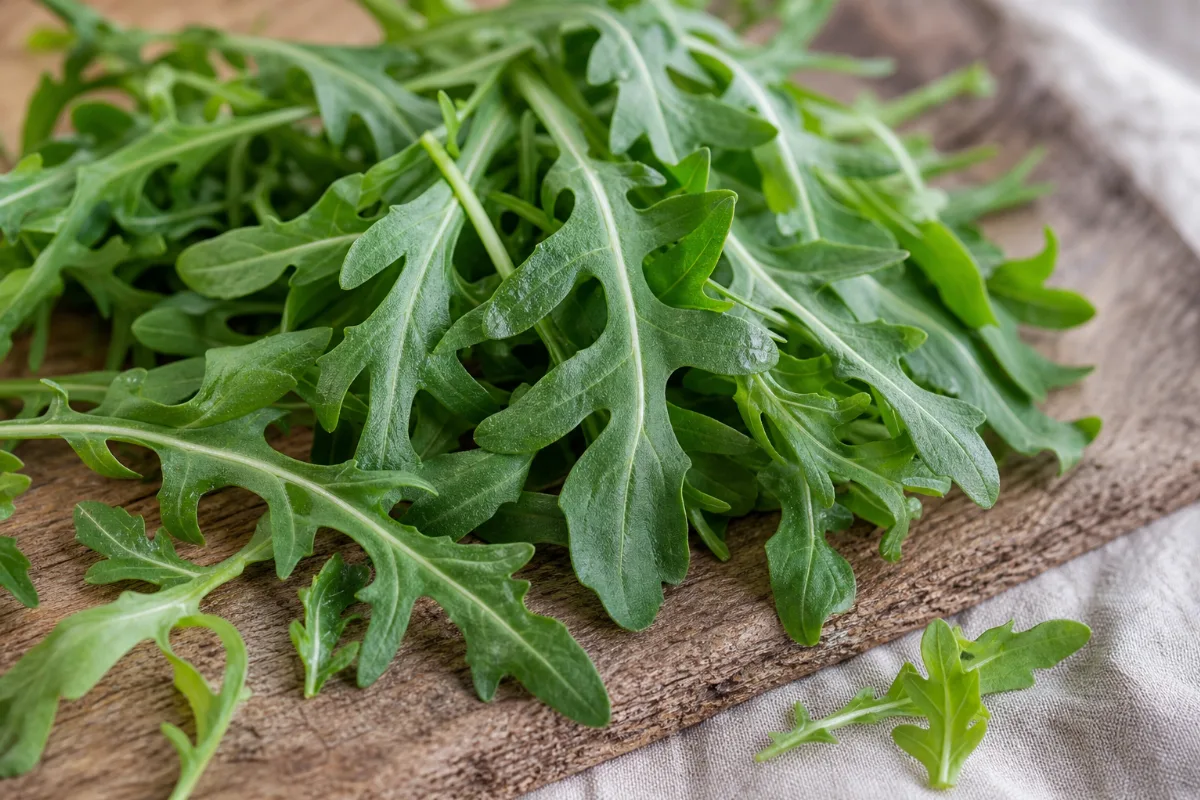
Vegetables · Vegetable
Arugula
Eruca vesicaria · also called Rocket, salad rocket, rucola, roqueta (Spanish)
Arugula, also called rocket, is a peppery leafy green in the cabbage family, eaten mostly raw in salads. It is a rich source of vitamin K, which the body needs for blood clotting. For blood pressure, heart disease and cancer the evidence is weak, mixed or from group studies and the lab, not arugula itself. The main cautions are vitamin K if you take warfarin, germs on raw leaves, and rare allergy.
General information, not medical advice. Last substantive update · Not medically reviewed. A named clinician has not signed off on this page. How this page is made
About Arugula
Arugula is a peppery, low-calorie salad green that is rich in vitamin K. It is a nutritious food, not a proven remedy: only one small trial has tested a rocket drink, and the rest of the health claims rest on group studies of leafy greens, nitrate or the lab.
What it is
Arugula (Eruca vesicaria, also written Eruca sativa) is the leaf of a plant in the cabbage family (Brassicaceae). People eat the leaves, usually raw, as baby or mature leaves.
USDA data for raw arugula (taken from our earlier summary; the record could not be re-opened today): 25 kcal, 1.6 g fibre, 108.6 micrograms vitamin K (about 90% of the Daily Value), 97 micrograms folate, 15 mg vitamin C, 119 micrograms vitamin A, 369 mg potassium and 160 mg calcium per 100 g. The USDA portion is 1/2 cup, 10 g, so a portion holds about a tenth of those amounts: about 2.5 kcal, 10.9 micrograms vitamin K and 1.5 mg vitamin C. A larger salad gives proportionally more.
What the research shows
The firmest fact is about the nutrient: the body needs vitamin K to make clotting factors, and leafy greens such as arugula are rich sources. Deficiency is very rare.
One small crossover trial gave 18 healthy young adults a rocket salad beverage with a set amount of nitrate. Their blood pressure fell for a few hours. It was one drink, not a salad. A meta-analysis of nitrate trials found a small fall in healthy people but not in people with high blood pressure.
Observational studies link more green leafy vegetables, and more cabbage-family vegetables, with lower heart and cancer risk. Trials of leafy greens did not show a clear gain, and these links do not prove cause. The retinal-cell and gut-cell studies used rocket extracts in a dish.
Food versus drinks and extracts
The blood pressure trial used a drink made from rocket. The nitrate review used juices and salts. The eye-cell and gut-cell studies used leaf extracts in a dish. Nothing read shows that a rocket capsule, powder or extract works in people.
Cutting or chewing the raw leaf starts the change from glucosinolates to isothiocyanates. Cooking stops the enzyme, though light steaming keeps some.
Amounts
This page gives no amounts to eat. Ask a doctor or pharmacist what is right for you, especially if you take warfarin or other medicine.
At a glance
Traditional uses history, not proof
- Eaten as a peppery salad leaf, usually raw
- Used wilted or lightly cooked in some dishes; long use is not proof of any health effect
Studied for research
- Vitamin K for blood clotting, high certainty for the nutrient, no arugula trial
- Blood pressure after a rocket-salad drink, low certainty (18 healthy adults, single drink)
- Blood pressure and nitrate in general, mixed
- Heart disease (green leafy vegetables as a group), mixed
- Cancer risk (cabbage-family vegetables as a group), very low certainty
- Eye cells and gut cells in the lab, insufficient evidence
Main compounds
- Vitamin K1 (phylloquinone)
- Inorganic nitrate
- Glucosinolates (glucoerucin, glucoraphanin) that form isothiocyanates (erucin, sulforaphane) when the leaf is cut
- Lutein and zeaxanthin
Common forms
- Raw leaves, baby or mature
- Bagged pre-washed leaves
- Lightly wilted or cooked leaves
- A rocket salad drink (used in one blood pressure trial)
- Freeze-dried leaf extract (used in a lab cell study; not a product for people)
Research links: MedlinePlus: Vitamin K · FDA: Selecting and Serving Produce Safely · Rocket salad beverage and blood pressure trial (2016) · Research Library · Genes & Biomarkers Library
What it is and its history
- Accepted scientific name
- Eruca vesicaria
- Naming authority
- (L.) Cav. (GBIF accepted; usageKey 5375920)
- Common names
- Arugula (English (US)); Rocket (English (UK)); Salad rocket (English); Rucola (Italian); Roqueta (Spanish)
- Family or group
- Brassicaceae (the cabbage or mustard family), which also includes broccoli, kale and radish.
- Classification
- Plantae > Tracheophyta > Magnoliopsida > Brassicales > Brassicaceae > Eruca > Eruca vesicaria
- Native range
- Not verified from a source read.
- Habitat
- Not verified from a source read.
- What it looks like
- Roots: Not verified.; Stems: Not verified.; Leaves: The leaves are the food. Plant-description details were not verified from a source read.; Flowers: Not verified.; Fruit: Not verified.
- Cultivation
- Not verified from a source read. A plant-science review (2026) describes greenhouse light, temperature and nitrogen as the main drivers of nitrate and antioxidant levels in rocket.
- Harvest and processing
- Eaten raw as baby or mature leaves, sold loose or in bags; sometimes wilted. Studies used a rocket salad beverage, freeze-dried or hot-air-dried leaf extracts, and fresh-cut leaves.
- Look-alikes and adulterants
- Name: Wild rocket (Diplotaxis tenuifolia); Note: A different rocket plant, listed alongside Eruca sativa in a 2006 PubMed paper title; it is not the same species. Evidence for one should not be assumed for the other.; Name: Watercress and mustard greens; Note: Other peppery cabbage-family greens; covered on their own pages.
- Sustainability and conservation
- Not assessed.
Photographs
Traditional use and history history, not clinical proof
| Tradition or era | Documented use | Source |
|---|---|---|
| Culinary use | Eaten as a peppery salad green (general knowledge; no historical source was read). | Not verified |
Traditional use shows how it was used. It does not show that it works or is safe today.
What is inside, and how it may work
What it contains and how those compounds act in cells and animals. Laboratory and animal mechanisms are not proven effects in people.
Main compounds
| Compound | Family | Where it is concentrated | Activity studied | Level of evidence |
|---|---|---|---|---|
| Phylloquinone (vitamin K1) PubChem 5284607 | vitamin | Leaf USDA (summary-only): 108.6 micrograms per 100 g raw arugula | Needed to make clotting factors (MedlinePlus). The reason for the warfarin caution. 17 16 18 | Human data |
| Nitrate (inorganic) PubChem 943 | inorganic anion | Leaf Not measured in any source read; depends on light and nitrogen in growing | Raised plasma nitrate and nitrite and lowered blood pressure for hours after a rocket salad beverage in 18 healthy adults. 17 3 2 | Human data |
| Glucoerucin and glucoraphanin (glucosinolates) PubChem 656539 | glucosinolates | Leaf Detected in fresh-cut rocket; amounts not read | Turn into erucin and sulforaphane when the leaf is cut or chewed. Effects shown in lab and animal work. 17 6 15 | Laboratory research |
| Erucin and sulforaphane (isothiocyanates) PubChem 78160 | isothiocyanates | Cut leaf Detected in rocket extracts; amounts not read | Cell results only for rocket extracts; not shown in people for arugula. 17 6 15 | Laboratory research |
| Lutein and zeaxanthin PubChem 5281243 | carotenoids | Leaf USDA (summary-only): 3,555 micrograms lutein plus zeaxanthin per 100 g | No study of arugula for eye health in people was found. 17 18 | None |
Mechanisms, receptors and pathways
| Target or pathway | Gene or receptor | What was found | Level |
|---|---|---|---|
| Vitamin K and clotting factors | Clotting factors II, VII, IX, X | The body needs vitamin K to make these clotting factors in the liver (MedlinePlus). 16 | Human data |
| Nitrate absorption | Not specified | Plasma nitrate and nitrite rose after a rocket salad beverage; blood pressure fell in the hours after. The abstract does not test the pathway. 3 | Human data |
| Glucosinolate to isothiocyanate conversion | Myrosinase | Cutting or chewing releases myrosinase, which converts glucosinolates to isothiocyanates. Cooking inactivates the enzyme, though light steaming under 5 minutes keeps some (Linus Pauling Institute). 15 6 | Laboratory research |
| NF-kB and VEGF signals in retinal cells | NF-kB, VEGF, TNF-alpha, IL-1 beta | A freeze-dried rocket extract lowered these signals in cultured ARPE-19 cells. Lab only. 1 | Laboratory research |
Absorption, metabolism and elimination
- Absorption
- Plasma nitrate and nitrite rose after a rocket salad beverage (18 healthy adults).
- Distribution
- Not found.
- Metabolism
- Not found for arugula. Glucosinolates are converted to isothiocyanates by myrosinase (Linus Pauling Institute).
- Elimination
- Not found.
- Bioavailability
- Not established for arugula nutrients.
Isolated compounds versus whole extracts
The blood pressure trial used a rocket salad beverage, not whole leaves. The nitrate meta-analysis used juices and salts. The retinal and gut-cell studies used extracts in a dish. Results for one form do not carry over to another, and nothing shows that a rocket capsule, powder or extract works.
Nutritional composition
Nutrition from USDA FoodData Central, raw arugula (SR Legacy FDC 169387), taken from our earlier nutrient summary because the FoodData Central API refused requests on 2026-10-26 (rate limit); the record was not re-opened. Per 100 g: 25 kcal, 1.6 g fibre, 108.6 micrograms vitamin K (about 90% of the Daily Value), 97 micrograms folate (DFE, 24%), 15 mg vitamin C (17%), 119 micrograms vitamin A (RAE, 13%), 369 mg potassium (8%), 160 mg calcium (12%), 47 mg magnesium (11%), 0.32 mg manganese (14%) and 3,555 micrograms lutein plus zeaxanthin. The USDA household portion is 1/2 cup raw, 10 g, so one portion holds about a tenth of those amounts (scaled by 0.1, rounded): about 2.5 kcal, 0.16 g fibre, 10.9 micrograms vitamin K, 9.7 micrograms folate, 1.5 mg vitamin C. A bigger salad holds proportionally more. Figures vary with variety, growing conditions and storage.
1 high certainty2 mixed findings1 low certainty1 very low certainty3 not enough evidence
What was looked at
The 8 benefits and uses checked for Arugula, each with how strong the evidence is. Tap one to open it.
- Vitamin K for normal blood clotting (nutrient role)High certainty
- Blood pressure after a rocket-salad drink (nitrate)Low certainty
- Blood pressure and dietary nitrate in generalMixed findings
- Heart disease risk (green leafy vegetables as a group)Mixed findings
- Cancer risk (cabbage-family vegetables as a group)Very low certainty
- Inflammation signals in eye cells (lab only)Not enough evidence
- Detox-enzyme genes in gut cells (lab only)Not enough evidence
- Eye health in people (lutein and zeaxanthin)Not enough evidence
Lab markers tracked in the studies
Systolic blood pressure (the top number)Plasma nitrate and nitriteVEGF in retinal cell cultures
What is Arugula good for?
The main studied uses and how strong the human evidence is for each. Most results are for nitrate or leafy greens as a group, not arugula itself.
Benefits, one by one
Each card is a research question, not a promise. Tap a goal to filter. Open a card to see the studies, doses and limits.
Vitamin K for normal blood clotting (nutrient role)
High certaintyVitamin K is needed for normal blood clotting. Leafy greens such as arugula are rich in it: our summary of USDA data lists about 109 micrograms in 100 g of raw leaves, around 90% of the Daily Value. Real deficiency is very rare. No trial tested arugula itself for this.
2 studiesRaw leaves as food.
Studies, doses and limits
What the trials found
MedlinePlus calls vitamin K the clotting vitamin and says the body needs it to make clotting factors II, VII, IX and X. It says deficiency is very rare and occurs when the vitamin cannot be absorbed from the gut, or after long treatment with antibiotics. It lists green leafy vegetables as food sources. USDA FoodData Central values for raw arugula were taken from our earlier summary (not re-opened today, see studies).
Results
The nutrient role is well established. No trial of arugula for clotting or for vitamin K status was found.
Effect sizes as reported
USDA (summary-only): 108.6 micrograms per 100 g raw arugula; 90% of the Daily Value per 100 g.
Why this rating
High for the general fact that vitamin K is needed for clotting (health-agency statement). No arugula-specific trial, and a varied diet already meets needs for most people.
Form and dose studied
Raw leaves as food.
Who was studied
General population; people with poor fat absorption or long antibiotic treatment are the ones named for deficiency.
Limits
Not a trial of arugula. Amounts vary with variety, ripeness and storage. USDA record not re-opened today.
Why researchers looked
Arugula is one of the richer leafy-green sources of vitamin K, so people ask what it does for the blood.
Traditional use
Arugula (rocket) has long been eaten as a peppery salad leaf, mostly raw; long use is not proof that it treats any condition.
Proposed mechanism Authoritative guidance
Vitamin K is needed to make clotting factors II, VII, IX and X in the liver (MedlinePlus). Arugula is a rich leafy-green source.
A proposed mechanism does not show that the effect happens in people.
High vitamin K matters for people on warfarin: see the Safety tab.
Blood pressure after a rocket-salad drink (nitrate)
Low certaintyIn one small crossover trial of 18 healthy young adults, a drink made from rocket salad raised blood nitrate and nitrite and lowered blood pressure for a few hours. It was a single drink, not a salad, and there is no long-term trial.
2 studiesRocket salad beverage with 800 mg nitrate, a single serving; trial de…
Studies, doses and limits
What the trials found
A semirandomised crossover trial (11 men and 7 women, mean age 28, healthy, normal blood pressure) gave four drinks, each with 800 mg nitrate: sodium nitrate, beetroot juice, a rocket salad beverage and a spinach beverage. After the rocket beverage systolic pressure fell from 122 to 116 mm Hg at 150 minutes (P=0.007), and diastolic pressure remained lower at 300 minutes (P=0.045). Plasma nitrate peaked at about 584 micromol/L, similar across drinks. Sodium nitrate did not change systolic pressure.
Results
A short-term fall in blood pressure after a nitrate-matched rocket drink in healthy young people.
Effect sizes as reported
Systolic 122 to 116 mm Hg at 150 min (P=0.007); diastolic lower at 300 min (P=0.045).
Why this rating
One small trial of single drinks in healthy young adults, with no long-term follow-up and no people with high blood pressure. A drink made from rocket is not the same as eating the leaves.
Form and dose studied
Rocket salad beverage with 800 mg nitrate, a single serving; trial detail, not advice.
Who was studied
Healthy adults with normal blood pressure, mean age 28.
Limits
n=18; single doses; semirandomised design; funding not stated in the abstract (registered NCT02271633). Rocket nitrate content differs with growing conditions (plant-science review).
Why researchers looked
Arugula is rich in nitrate, as are beetroot and spinach, and dietary nitrate is studied for blood pressure.
Traditional use
Arugula (rocket) has long been eaten as a peppery salad leaf, mostly raw; long use is not proof that it treats any condition.
Proposed mechanism Human physiology
Arugula holds inorganic nitrate. After a nitrate-rich drink, the blood levels of nitrate and nitrite rise (Jonvik 2016), and nitrate in general has been tested for blood pressure. How growing conditions change the nitrate level in rocket is described in a plant-science review.
A proposed mechanism does not show that the effect happens in people.
Do not stop or change prescribed blood pressure medicine because of a food. Ask your prescriber.
Blood pressure and dietary nitrate in general
Mixed findingsA review of 19 trials found dietary nitrate lowered the top blood pressure number by about 2.4 mmHg in healthy people, but not in people who already had high blood pressure. These trials did not test arugula; mostly nitrate juices or salts.
1 studiesInorganic nitrate from juices and salts across trials; not arugula.
Studies, doses and limits
What the trials found
A 2023 meta-analysis of 19 randomised-trial articles: in healthy people nitrate lowered systolic pressure by 2.42 mmHg (95% CI -4.28 to -0.57; P=0.01) but not diastolic (-0.58 mmHg) or mean arterial pressure. In people with high blood pressure there was no significant change in systolic (-0.82 mmHg, CI -2.53 to 0.90), diastolic or 24-hour pressure.
Results
A small fall in systolic pressure in healthy people; nothing clear in people with high blood pressure.
Effect sizes as reported
Healthy: systolic -2.42 mmHg (95% CI -4.28 to -0.57). Hypertension: systolic -0.82 mmHg (not significant).
Why this rating
The effect differs between healthy people and people with high blood pressure, is small, and comes from nitrate in general rather than arugula. The authors say more research is needed.
Form and dose studied
Inorganic nitrate from juices and salts across trials; not arugula.
Who was studied
Healthy adults; adults with high blood pressure.
Limits
Not arugula; searches ended December 2021; funding not stated in the abstract.
Why researchers looked
Because arugula contains nitrate, trials of nitrate in general are the nearest guide.
Traditional use
Arugula (rocket) has long been eaten as a peppery salad leaf, mostly raw; long use is not proof that it treats any condition.
Proposed mechanism Human physiology
Arugula holds inorganic nitrate. After a nitrate-rich drink, the blood levels of nitrate and nitrite rise (Jonvik 2016), and nitrate in general has been tested for blood pressure. How growing conditions change the nitrate level in rocket is described in a plant-science review.
A proposed mechanism does not show that the effect happens in people.
None specific. Do not change prescribed medicine on your own.
Heart disease risk (green leafy vegetables as a group)
Mixed findingsLarge observational studies link eating more green leafy vegetables with a lower chance of heart disease. But seven trials found no clear gain in blood vessel function or blood pressure. The findings are not specific to arugula.
1 studiesWhole green leafy vegetables as eaten.
Studies, doses and limits
What the trials found
A 2026 systematic review and meta-analysis: in observational studies higher intake of green leafy vegetables went with lower cardiovascular disease risk (RR 0.89; 95% CI 0.82 to 0.97; I2 80%) and lower cardiovascular death (RR 0.79; 0.62 to 0.97). No link with hypertension risk. Seven randomised trials showed no significant change in vascular function (MD -0.37; -1.90 to 1.16) and no significant effect on systolic or diastolic blood pressure.
Results
A link in observational data; no clear effect in trials.
Effect sizes as reported
CVD risk RR 0.89 (0.82 to 0.97); CVD death RR 0.79 (0.62 to 0.97); trials: no significant effect.
Why this rating
Observational links cannot show cause and heterogeneity was high (I2 80% to 88%). Trials were limited and found nothing significant. Group-level result, not arugula.
Form and dose studied
Whole green leafy vegetables as eaten.
Who was studied
Mostly general adult populations.
Limits
Not arugula-specific; diet and lifestyle differences between high and low eaters.
Why researchers looked
Arugula is a leafy green, and "eat more leafy greens" is common dietary advice for the heart.
Traditional use
Arugula (rocket) has long been eaten as a peppery salad leaf, mostly raw; long use is not proof that it treats any condition.
Proposed mechanism Preliminary mechanism
Not established. Researchers point to nitrate, vitamins, fibre and plant compounds, but the abstract does not test a mechanism.
A proposed mechanism does not show that the effect happens in people.
None specific. Leafy greens are vitamin K rich; see the Safety tab for warfarin.
Cancer risk (cabbage-family vegetables as a group)
Very low certaintyObservational studies link eating more cabbage-family vegetables with lower cancer risk overall, but the picture changes by cancer type, region and follow-up time. This does not prove vegetables prevent cancer, and arugula was not singled out.
2 studiesCruciferous vegetables as eaten.
Studies, doses and limits
What the trials found
A 2025 systematic review and dose-response meta-analysis of 226 case-control and cohort studies reported an odds ratio of 0.77 and a risk ratio of 0.96 for cancers with higher cruciferous vegetable intake. Links differed by cancer type, region, intake level and follow-up. In cohorts followed 2 to 15 years, low intake went with a higher cancer risk ratio. The Linus Pauling Institute says there is insufficient evidence that isothiocyanate exposure from vegetables lowers cancer risk.
Results
A mixed observational link at group level; nothing about arugula itself.
Effect sizes as reported
OR 0.77; RR 0.96 (as reported in the abstract).
Why this rating
Observational data only, varying by cancer type, with possible confounding by diet and lifestyle. Not specific to arugula, and the isothiocyanate mechanism is insufficiently proven in people.
Form and dose studied
Cruciferous vegetables as eaten.
Who was studied
Asian and American populations, various cancers.
Limits
Association only; the abstract says the link is complex.
Why researchers looked
Arugula belongs to the cabbage family (Brassicaceae), whose vegetables contain glucosinolates.
Traditional use
Arugula (rocket) has long been eaten as a peppery salad leaf, mostly raw; long use is not proof that it treats any condition.
Proposed mechanism Preliminary mechanism
When the leaf is cut or chewed, an enzyme (myrosinase) turns glucosinolates into isothiocyanates. Most evidence about what isothiocyanates do comes from lab and animal work (Linus Pauling Institute).
A proposed mechanism does not show that the effect happens in people.
Not a cancer treatment. People with cancer should follow their care team.
Inflammation signals in eye cells (lab only)
Not enough evidenceIn a lab dish, a freeze-dried rocket extract lowered inflammation and blood-vessel-growth signals in human retinal cells. This is a cell study only; no people and no eating of arugula were involved.
1 studiesFreeze-dried Eruca sativa extract in a cell dish. Not a food or suppl…
Studies, doses and limits
Results
Cell-culture result only.
Effect sizes as reported
VEGF expression -32%, secretion -34% (cells).
Why this rating
Lab study in one cell line with an extract; no animal or human data in the abstract.
Form and dose studied
Freeze-dried Eruca sativa extract in a cell dish. Not a food or supplement for people.
Limits
Cannot say anything about eating arugula or about eye disease.
Why researchers looked
Eye diseases such as age-related macular degeneration involve inflammation and VEGF in retinal cells, and researchers tested rocket extract.
Traditional use
Arugula (rocket) has long been eaten as a peppery salad leaf, mostly raw; long use is not proof that it treats any condition.
Proposed mechanism Laboratory research
In the cells, the extract lowered NF-kB phosphorylation, TNF-alpha, IL-1 beta and VEGF. A hot-air-dried extract acted differently, so how the leaf was dried mattered.
A proposed mechanism does not show that the effect happens in people.
No supplement or extract is recommended here.
Detox-enzyme genes in gut cells (lab only)
Not enough evidenceA food-preservation study measured plant compounds in cut rocket leaves and tested leaf extracts on human gut cells in the lab. Some enzyme genes went up. It tells us what is in the leaf, not what happens when people eat it.
2 studiesLeaf extracts in the lab.
Studies, doses and limits
Results
Compound levels shifted with the treatment; gene changes were selective and cell-based.
Why this rating
Laboratory study of a preservation method, in cells, with no human outcome.
Form and dose studied
Leaf extracts in the lab.
Limits
Not about eating rocket.
Why researchers looked
Glucosinolates and their isothiocyanates (erucin, sulforaphane) are the compounds people often credit for cabbage-family benefits.
Traditional use
Arugula (rocket) has long been eaten as a peppery salad leaf, mostly raw; long use is not proof that it treats any condition.
Proposed mechanism Laboratory research
Cut rocket leaves held glucoerucin and glucoraphanin, which turn into erucin and sulforaphane. In Caco-2 cells, extracts raised mRNA of some UDP-glucuronosyltransferases; glutathione S-transferases and Nrf2 did not change significantly.
A proposed mechanism does not show that the effect happens in people.
None.
Eye health in people (lutein and zeaxanthin)
Not enough evidenceUSDA data list lutein and zeaxanthin, plant pigments, in arugula. We found no study that tested eating arugula for eye health in people.
1 studiesRaw leaves as food.
Studies, doses and limits
Results
No arugula study.
Why this rating
No human study of arugula for eye outcomes was found.
Form and dose studied
Raw leaves as food.
Limits
Nothing to appraise.
Why researchers looked
Lutein and zeaxanthin are pigments found in the eye, and leafy greens are food sources.
Traditional use
Arugula (rocket) has long been eaten as a peppery salad leaf, mostly raw; long use is not proof that it treats any condition.
Proposed mechanism None
Not tested for arugula.
A proposed mechanism does not show that the effect happens in people.
None.
Connections to the rest of health
How Arugula connects to the rest of our health knowledge graph. Every link says what kind of connection it is. A safety link (for example to the liver) is a warning, not a benefit. A study that merely mentions a topic never creates a benefit link.
Explore every connection: goals, body systems, organs, symptoms, genes
B. Body systems
| Connected to | Kind of connection | Evidence status | Context | Studies |
|---|---|---|---|---|
| Cardiovascular System | Biological association | High certainty | Studied for: Vitamin K for normal blood clotting (nutrient role) Studied for: Blood pressure after a rocket-salad drink (nitrate) | 16 18 3 2 11 4 |
| Heart Circulation | Biological association | Low certainty | Studied for: Blood pressure after a rocket-salad drink (nitrate) Studied for: Heart disease risk (green leafy vegetables as a group) | 3 2 4 |
| Immune System | Biological association | Very low certainty | Studied for: Cancer risk (cabbage-family vegetables as a group) | 12 15 |
| Pain Inflammation | Biological association | Not enough evidence | Studied for: Inflammation signals in eye cells (lab only) | 1 |
| Digestive System | Biological association | Not enough evidence | Studied for: Detox-enzyme genes in gut cells (lab only) | 6 15 |
| Nervous System | Biological association | Not enough evidence | Studied for: Eye health in people (lutein and zeaxanthin) | 18 |
E. Health conditions
| Connected to | Kind of connection | Evidence status | Context | Studies |
|---|---|---|---|---|
| Food poisoning | Adverse effect or risk | Documented risk | Raw leafy greens can carry germs; washing lowers but does not remove them. Raw leafy greens can carry germs; wash and keep cold. Preparation or compound: Raw leafy greens |
13 7 |
I. Biomarkers
| Connected to | Kind of connection | Evidence status | Context | Studies |
|---|---|---|---|---|
| Systolic blood pressure (the top number) | Biological association | Mixed findings | Measured in trials: decrease. A lab change is not the same as a health benefit. | 3 11 4 |
| Plasma nitrate and nitrite | Biological association | Low certainty | Measured in trials: increase. A lab change is not the same as a health benefit. | 3 |
| VEGF in retinal cell cultures | Biological association | Not enough evidence | Measured in trials: decrease. A lab change is not the same as a health benefit. | 1 |
K. Biological pathways
| Connected to | Kind of connection | Evidence status | Context | Studies |
|---|---|---|---|---|
| Vitamin K | Preliminary mechanism | Human | Arugula is a rich leafy-green source; the vitamin is needed for clotting and matters on warfarin. | 16 18 |
| Dietary nitrate | Preliminary mechanism | Human | Arugula holds nitrate; a rocket drink lowered blood pressure for hours in healthy adults. | 3 11 |
L. Active compounds
| Connected to | Kind of connection | Evidence status | Context | Studies |
|---|---|---|---|---|
| Phylloquinone (vitamin K1) | Biological association | Human | Needed to make clotting factors (MedlinePlus). The reason for the warfarin caution. Preparation or compound: Leaf |
17 16 18 |
| Nitrate (inorganic) | Biological association | Human | Raised plasma nitrate and nitrite and lowered blood pressure for hours after a rocket salad beverage in 18 healthy adults. Preparation or compound: Leaf |
17 3 2 |
| Glucoerucin and glucoraphanin (glucosinolates) | Biological association | In vitro | Turn into erucin and sulforaphane when the leaf is cut or chewed. Effects shown in lab and animal work. Preparation or compound: Leaf |
17 6 15 |
| Erucin and sulforaphane (isothiocyanates) | Biological association | In vitro | Cell results only for rocket extracts; not shown in people for arugula. Preparation or compound: Cut leaf |
17 6 15 |
| Lutein and zeaxanthin | Biological association | None | No study of arugula for eye health in people was found. Preparation or compound: Leaf |
17 18 |
Each connection is stored with the ingredient, the connected record, the kind of connection, the evidence status, the supporting studies, the preparation or compound involved, and a review date (last reviewed October 26, 2026).
Evidence at a glance: what the research found for 8 outcomes
Each outcome below is one thing researchers measured. Certainty is how far the evidence can be trusted, not how well it works. The full studies are on the next tab.
The evidence
The research centre for Arugula. Every record here was checked against PubMed or the publisher's page; we never list a study we have not verified.
Evidence by outcome
Bars show how many studies we found for each outcome, not how well it works. People are added up across trials only (reviews are not added, to avoid double counting).
How we rate evidence
High certainty
Several well-run trials or reviews agree; further research is unlikely to change the picture much.
Moderate certainty
Good trials point the same way, but some doubt remains.
Low certainty
Small, short or inconsistent trials. The finding could change with better research.
Very low certainty
Very little or very weak human data. Treat as a possibility only.
Mixed findings
Trials or reviews disagree with each other.
Not enough evidence
Not enough human research to say either way.
Evidence against
Good research found no benefit, or found harm.
We take the reviewers' own risk-of-bias and GRADE statements where they exist, and otherwise judge from study size, design, consistency, directness and whether a product matches what is sold. Many publications do not make evidence high. Method note: We started from our existing arugula summary, checked the plant name at GBIF and compounds at PubChem, and searched PubMed for human trials, reviews, interaction and allergy reports. Only abstracts were read for studies, and three allergy reports were read by title only. Items we could not verify are flagged in the research gaps.
Study library: every study we checked 18
| Study | Design | People | Product, dose, length | Result |
|---|---|---|---|---|
| Cho 2026 Freeze-Dried Extracts of Eruca sativa Selectively Inhibit Nuclear Factor-kB and Vascular Endothelial Growth Factor Levels in Retinal Pigment Epithelial Cells. Prev Nutr Food Sci · PMID 42382025 · DOI |
Laboratory research human cells (in vitro) |
ARPE-19 human retinal pigment epithelial cell line | Freeze-dried Eruca sativa extract (and a hot-air-dried extract for comparison) 1 mg/mL in the cell dish (lab detail) · vs Untreated stressed cells |
Under thapsigargin stress, the freeze-dried extract at 1 mg/mL reduced VEGF expression by 32% and VEGF secretion by 34%. Under lipopolysaccharide it suppressed NF-kB phosphorylation, TNF-alpha and IL-1 beta in a dose-dependent way. The hot-air-dried extract behaved differently. No cell toxicity was seen over the range tested. VEGF expression -32%, secretion -34% (cells) Methods, limits and fundingOutcomes: VEGF expression and secretion, NF-kB phosphorylation, TNF-alpha, IL-1 beta Limitations: Cell line only; extract in a dish, not eating rocket; no people. Funding and conflicts: The authors declare no conflict of interest. Read: abstract |
| Fanourakis 2026 Greenhouse climate shapes nitrate levels, nutritional quality, and shelf life in leafy vegetables: species-specific responses. Front Plant Sci · PMID 42179523 · DOI |
Narrative review plants |
Review of greenhouse-grown lettuce, spinach and rocket | Rocket, lettuce and spinach leaves Leaves |
Growing conditions change the nitrate level of leafy vegetables. Low light or heat raise nitrate and lower antioxidants; rocket depends heavily on light quality and nitrogen balance to limit nitrate and keep antioxidant capacity. Methods, limits and fundingOutcomes: Nitrate, nutrients and shelf life as shaped by growing conditions Limitations: Plant-science review; no numbers for rocket nitrate were read; no people. Funding and conflicts: No commercial or financial relationships declared. Read: abstract |
| Jonvik 2016 Nitrate-Rich Vegetables Increase Plasma Nitrate and Nitrite Concentrations and Lower Blood Pressure in Healthy Adults. J Nutr · PMID 27075914 · DOI |
Controlled trial |
18 11 men and 7 women, healthy, normal blood pressure, mean age 28 |
Rocket salad beverage, compared with beetroot juice, spinach beverage and sodium nitrate (each with 800 mg nitrate) Rocket salad made into a beverage One drink containing 800 mg nitrate (trial detail, not advice) Single drinks, blood pressure followed for up to 300 minutes · vs Sodium nitrate, beetroot juice and spinach beverage; baseline |
Plasma nitrate and nitrite rose after all four drinks. After the rocket drink systolic pressure fell from 122 to 116 mm Hg at 150 minutes (P=0.007) and diastolic pressure stayed lower at 300 minutes (P=0.045). Sodium nitrate did not change systolic pressure. Systolic 122 to 116 mm Hg at 150 min after rocket beverage (P=0.007) (Not given in abstract (P values only)) Methods, limits and fundingOutcomes: Plasma nitrate and nitrite, resting blood pressure Limitations: Semirandomised crossover, 18 healthy young people, single drinks; a beverage made from rocket, not salad leaves eaten whole; no long-term outcome. Funding and conflicts: Registered NCT02271633. Funding not stated in the abstract. Registration: NCT02271633 Read: abstract |
| Kaewpradup 2026 Dietary Green Leafy Vegetables and Cardiovascular Disease Risk: A Systematic Review and Meta-Analysis. Foods · PMID 42587937 · DOI |
Meta-analysis |
Observational studies (cohorts) and seven randomised trials of vascular function | Green leafy vegetables as a group (arugula not singled out in the abstract) Leaves Varied · vs Lower intake / control |
Higher intake of green leafy vegetables was linked to lower cardiovascular disease risk (RR 0.89, 95% CI 0.82 to 0.97, I2 80%) and lower cardiovascular death (RR 0.79, 0.62 to 0.97). Seven trials found no significant improvement in vascular function (MD -0.37, -1.90 to 1.16) and no significant effect on blood pressure. No link with hypertension risk in observational studies. CVD risk RR 0.89 (observational); trials: no significant effect (95% CI 0.82 to 0.97) Methods, limits and fundingOutcomes: Cardiovascular disease risk and death, vascular function, blood pressure Limitations: Observational links do not prove cause; high heterogeneity (I2 80% to 88%); the authors call the trial evidence limited and inconclusive. Funding and conflicts: The authors declare no conflicts of interest. Read: abstract |
| Liccardi 1998 Intraoral and respiratory allergy to Eruca sativa (Cruciferae family) in a subject with sensitization to pollen allergens. J Allergy Clin Immunol · PMID 9564813 · DOI |
Case report |
1 One person sensitised to pollen (per the title) |
Only the title was read: it reports mouth (intraoral) and breathing-tract allergy to Eruca sativa in a person already sensitised to pollen. No other detail is known. Methods, limits and fundingOutcomes: Mouth and breathing-tract allergy Limitations: No abstract on PubMed; title only. Funding and conflicts: Not available. Read: title-only | |
| Lolli 2026 Plasma-Activated Water Dipping of Fresh-Cut Eruca sativa: An Extended Investigation of the Glucosinolate-Myrosinase System and Cellular Responses. Foods · PMID 42883669 · DOI |
Laboratory research human cells (in vitro) |
Fresh-cut rocket salad leaves and human Caco-2 gut cells in the lab | Extracts of rocket salad leaves dipped in plasma-activated water or plain water Leaf 20 minutes dipping · vs Leaves dipped in untreated water |
Leaves held the glucosinolates glucoerucin and glucoraphanin and the isothiocyanates erucin and sulforaphane. Extracts from treated leaves raised mRNA of some UDP-glucuronosyltransferase genes in Caco-2 cells; glutathione S-transferase and Nrf2 mRNA did not change significantly and inflammation genes changed only a little. Lab result only Methods, limits and fundingOutcomes: Glucosinolates, isothiocyanates, myrosinase activity, gene expression in cells Limitations: Cell culture; the study is about a food-preservation treatment, not about eating rocket; no people. Funding and conflicts: The authors declare no conflicts of interest. Read: abstract |
| Palacios 2025 Two Concurrent Outbreaks of Listeria monocytogenes Infections Linked to Packaged Salads, United States, 2014-2022. Emerg Infect Dis · PMID 41490655 · DOI |
Outbreak report |
Two genetically unrelated Listeria outbreaks traced to packaged salads from two firms | Packaged salads (leaf types not named in the abstract) Leaves 8 and 5 years |
The outbreaks caused 30 illnesses, 27 hospitalisations and 4 deaths over 8 years and led to recalls from two firms. Contamination can persist for long periods. 30 illnesses, 27 hospitalisations, 4 deaths Methods, limits and fundingOutcomes: Illnesses, hospitalisations, deaths, recalls Limitations: Outbreak report; arugula is not named in the abstract. Funding and conflicts: US public-health authors; no industry funding stated in the abstract. Read: abstract |
| Paulsen 2014 Contact sensitization to lettuce and rocket-salad with and without systemic elicitation of dermatitis after oral challenge. Contact Dermatitis · PMID 25155079 · DOI |
Case report |
Case report from a dermatology and allergy centre (details not read; no abstract) | Only the title was read: it reports skin (contact) sensitisation to lettuce and rocket salad, in some people with dermatitis after an oral challenge and in some without. No other detail is known. Methods, limits and fundingOutcomes: Skin contact allergy and dermatitis after eating Limitations: No abstract on PubMed; title only. Funding and conflicts: Not available. Read: title-only | |
| Ruiz Garcia 2014 Anaphylaxis due to Eruca sativa. J Investig Allergol Clin Immunol · PMID 25668902 |
Case report |
Case report (details not read; PubMed record has no abstract) | Only the title was read: it reports anaphylaxis (a severe allergic reaction) due to Eruca sativa. No other detail is known. Methods, limits and fundingOutcomes: Anaphylaxis Limitations: No abstract on PubMed; title only. Funding and conflicts: Not available. Read: title-only | |
| Violi 2016 Interaction Between Dietary Vitamin K Intake and Anticoagulation by Vitamin K Antagonists: Is It Really True?: A Systematic Review. Medicine (Baltimore) · PMID 26962786 · DOI |
Systematic review |
2 dietary trials and 9 observational studies in people taking vitamin K antagonist anticoagulants | Dietary vitamin K (food) with vitamin K antagonist medicines Varied · vs Lower or different vitamin K intake |
Evidence was conflicting. Some studies linked vitamin K intake to INR changes, while others suggested a minimum amount is needed to keep anticoagulation steady. An effect on clotting may be seen only at high intakes (above 150 micrograms a day in the studies). The review found no support for restricting vitamin K foods and suggested a stable diet without wide swings. Conflicting; effect seen mainly at high intakes Methods, limits and fundingOutcomes: INR (clotting test) and quality of anticoagulation Limitations: Mixed indications and INR targets; searches ended October 2015; not specific to arugula. Funding and conflicts: The authors report no conflicts of interest. Read: abstract |
| Zhang 2023 Regulatory effect of dietary nitrate on blood pressure: a meta-analysis of randomized controlled trials. Food Funct · PMID 36740972 · DOI |
Meta-analysis |
19 articles of randomised trials of inorganic nitrate, in healthy people and in people with high blood pressure | Dietary inorganic nitrate (not arugula specifically) Varied · vs Control |
In healthy people nitrate lowered systolic pressure by 2.42 mmHg (95% CI -4.28 to -0.57) but not diastolic or mean arterial pressure. In people with high blood pressure nitrate did not lower systolic (-0.82 mmHg, CI -2.53 to 0.90), diastolic or 24-hour pressure. Healthy: systolic -2.42 mmHg. Hypertension: no significant change. (95% CI -4.28 to -0.57 (healthy systolic)) Methods, limits and fundingOutcomes: Systolic, diastolic and mean arterial blood pressure; 24-hour ambulatory pressure Limitations: Nitrate in general (juice, salts), not arugula; searches ended December 2021; the authors say more research is needed. Funding and conflicts: Not stated in the abstract. Read: abstract |
| Zheng 2025 Unveiling the Effects of Cruciferous Vegetable Intake on Different Cancers: A Systematic Review and Dose-Response Meta-analysis. Nutr Rev · PMID 39348271 · DOI |
Meta-analysis |
226 case-control and cohort studies | Cruciferous vegetables as a group (arugula is a cruciferous vegetable but is not singled out) Vegetables Follow-up 2 to 15 years in cohorts · vs Lower intake |
The authors report an odds ratio of 0.77 and a risk ratio of 0.96 for cancers with higher cruciferous intake. Links differed by cancer type, region, intake level and follow-up time; in cohorts followed 2 to 15 years, low intake went with a higher cancer risk ratio. OR 0.77; RR 0.96 (pooled, as reported in the abstract) (Not given in abstract) Methods, limits and fundingOutcomes: Cancer risk by cancer type Limitations: Observational only; the abstract calls the link complex and varying; not specific to arugula; no cause shown. Funding and conflicts: Not stated in the abstract. Read: abstract |
| s-fda-produce FDA: Selecting and Serving Produce Safely · Source |
Regulator n/a |
Methods, limits and fundingRead: full-text | ||
| s-gbif-eruca GBIF Backbone: Eruca vesicaria (L.) Cav. (usageKey 5375920) and Eruca sativa Hill (usageKey 7474861) · Source |
Reference database n/a |
Methods, limits and fundingRead: full-text | ||
| s-lpi-isothiocyanates Linus Pauling Institute: Isothiocyanates · Source |
Reference review n/a |
Methods, limits and fundingRead: full-text | ||
| s-medlineplus-vitk MedlinePlus: Vitamin K · Source |
Health agency n/a |
Methods, limits and fundingRead: full-text | ||
| s-pubchem-arugula PubChem: compounds named on this page · Source |
Reference database n/a |
Methods, limits and fundingRead: full-text | ||
| s-usda-fdc-169387 USDA FoodData Central: Arugula, raw (SR Legacy 169387) · Source |
Reference database n/a |
Methods, limits and fundingRead: summary-only |
What we do not know yet
- No trial has tested eating arugula leaves for blood pressure, heart disease, cancer or eye health.
- The only rocket trial was small (18 healthy young adults) and followed blood pressure for hours.
- Cancer and heart findings are for cabbage-family or leafy vegetables as a group and are mostly observational.
- Allergy reports were read by title only, and no source read covered oxalate, thyroid, kidney stones, pregnancy or children for arugula.
- USDA values are summary-only: the FoodData Central record could not be re-opened.
How new research is added
New studies are found by a saved PubMed search and placed in a review queue before the page changes.
Lab markers
What changed in blood or saliva tests during trials. A changed number is not the same as feeling or being healthier, and we give no "normal ranges".
Other 3
Systolic blood pressure (the top number)
Decrease in trials
The pressure in the arteries when the heart beats, measured in mmHg.
Mixed findingsResults and what it means
Why it was measured
High blood pressure is a major risk factor for heart disease and stroke, so it is used as a stand-in for heart risk.
Statistical vs. clinical meaning
Small and short-term in healthy people; not shown in people with high blood pressure.
Safety implication
Do not change prescribed blood pressure medicine because of a food.
| Study | Result | People | Product |
|---|---|---|---|
| 3 | Fell from 122 to 116 mm Hg at 150 minutes after a rocket salad beverage (P=0.007) | 18 healthy adults | Rocket salad beverage with 800 mg nitrate, single drink |
| 11 | Dietary nitrate lowered it by 2.42 mmHg in healthy people; no significant change in people with hypertension | 19 randomised-trial articles | Inorganic nitrate (not arugula) |
| 4 | No significant effect in randomised trials of green leafy vegetables | Randomised trials in the review | Green leafy vegetables (group) |
Plasma nitrate and nitrite
Increase in trials
The amounts of nitrate and nitrite in blood plasma.
Low certaintyResults and what it means
Why it was measured
It shows that nitrate from the food or drink was absorbed.
Statistical vs. clinical meaning
Shows absorption of nitrate, not a health outcome.
Safety implication
None stated in the abstract.
| Study | Result | People | Product |
|---|---|---|---|
| 3 | Rose after all four drinks; peak plasma nitrate about 584 micromol/L after the rocket drink and peak nitrite 643 nmol/L | 18 healthy adults | Rocket salad beverage with 800 mg nitrate |
VEGF in retinal cell cultures
Decrease in trials
Vascular endothelial growth factor, a signal for new blood vessel growth, measured in cultured retinal cells.
Not enough evidenceResults and what it means
Why it was measured
Raised VEGF is part of some eye diseases, so researchers use it as a lab marker.
Statistical vs. clinical meaning
A lab signal only; it does not show an effect on eyes in people.
Safety implication
None.
| Study | Result | People | Product |
|---|---|---|---|
| 1 | VEGF expression fell 32% and secretion 34% with the freeze-dried extract at 1 mg/mL | ARPE-19 retinal cells (no people) | Freeze-dried Eruca sativa extract |
Safety
What studies and official sources say about side effects, medicines and who should check first. Each point shows what kind of evidence it comes from.
Main points to know 3
- Arugula is high in vitamin K and can matter on warfarin. Vitamin K can reduce the effect of warfarin. MedlinePlus says keep your vitamin K food intake the same from day to day, because sudden changes can change how the medicine works, and ask your health care provider whether to track intake. A 2016 systematic review found conflicting evidence and did not support cutting out vitamin K foods; it suggested a stable diet without wide swings. Authoritative guidance 16 10
- Raw leafy greens can carry germs. The FDA says harmful bacteria can contaminate fresh produce, that washing reduces but does not remove them, and that children, older adults, pregnant women and people with weak immune systems are more vulnerable. Two US Listeria outbreaks tied to packaged salads caused 30 illnesses, 27 hospitalisations and 4 deaths over 8 years. Arugula is not named in the abstract. Authoritative guidance 13 7
- Allergy to rocket has been reported. Case reports describe a severe allergic reaction (anaphylaxis), mouth and breathing-tract allergy in a person sensitised to pollen, and skin contact sensitisation to rocket salad. We read only the titles of these reports. How common this is was not found. Case report 9 5 8
Side effects 4
| Effect | How often | Severity and recovery | Evidence |
|---|---|---|---|
| Severe allergic reaction (anaphylaxis) to Eruca sativa, reported in a case report Only the title was read. | Not established | severe (reported case) Not stated; title only | Case report 9 |
| Mouth and breathing-tract allergy to Eruca sativa in a person sensitised to pollen One person per the title; no abstract. | Not established | Not stated Not stated | Case report 5 |
| Skin contact sensitisation to rocket salad, with dermatitis after eating in some people Title only. | Not established | Not stated Not stated | Case report 8 |
| Food poisoning (for example Listeria or E. coli) from contaminated raw leafy greens Arugula was not named in the sources read; it is eaten raw like other salad greens. | Not established | Can be severe in vulnerable people Most people recover; some develop severe illness (FDA) | Authoritative guidance 13 7 |
Liver
No liver injury from eating arugula was found in the sources read. LiverTox was not checked.
How often. No frequency was found.
Monitoring. No agency monitoring advice was found.
This is a safety connection. It is not evidence that Arugula supports liver health.
Medicines and supplements 3
| With | Why it matters | Importance | Evidence | What to do |
|---|---|---|---|---|
| Warfarin and other vitamin K antagonist blood thinners prescription | Vitamin K is the vitamin these medicines work against, and arugula is rich in it. | MedlinePlus advises keeping vitamin K intake steady day to day. A 2016 systematic review (2 dietary trials, 9 observational studies) found conflicting results, saw effects mainly at high intakes, and did not support restricting vitamin K foods. | Authoritative guidance Moderate certainty 16 10 | Tell your prescriber or pharmacist you eat arugula and other leafy greens, and ask whether to track your intake. Do not change your medicine yourself. |
| Blood pressure medicines prescription | Dietary nitrate lowered blood pressure slightly in healthy people in trials. | No source read reports an interaction between arugula and blood pressure medicine. The meta-analysis found no significant lowering in people with high blood pressure. | None found Not enough evidence 11 | Do not stop a prescribed blood pressure medicine because of a food. Ask your prescriber. |
| Newer (non-vitamin K) blood thinners prescription | Not covered by the sources read. | Not researched. | None found Not enough evidence | Ask a pharmacist about your own medicine. |
Who should check first 3
| Situation | Advice | Evidence |
|---|---|---|
| Known allergy to rocket or to cabbage-family plants | Avoid the food that triggers symptoms and ask an allergist. Call emergency services for trouble breathing or swelling of the face or throat. | Case report 9 5 8 |
| Taking warfarin or a similar vitamin K antagonist | Not a ban. Keep your intake steady and talk to your prescriber. | Authoritative guidance 16 10 |
| Pregnancy, older age, young children or a weak immune system | The FDA lists these groups as more vulnerable to foodborne illness. Wash loose leaves under running water, keep leaves cold and follow package directions. No arugula-specific pregnancy advice was found. | Authoritative guidance 13 |
Overdose, product quality and regulators
Summary. No toxicity from arugula as an ordinary food was found in the sources read. The concerns are allergy, germs on raw leaves and the vitamin K and warfarin question.
Animal. Not reviewed.
Human doses studied. One trial gave a rocket salad beverage with 800 mg nitrate as a single drink to healthy adults; the abstract does not describe side effects.
Overdose response. Not found.
Genotoxicity. Not researched.
Toxic or hazardous parts. No toxic part was identified in the sources read.
Raw leafy greens can carry bacteria. Pesticide residues, heavy metals and oxalate in arugula were not researched.
Food safety handling. The FDA says to wash produce under running water, not to use soap or produce wash, to dry it with a clean towel, to refrigerate at 40 F (4 C) or below, and to choose refrigerated bagged greens. Pre-washed ready-to-eat packages need no further washing. 13
Listeria in packaged salads. Two outbreaks linked to packaged salads from two firms caused 30 illnesses, 27 hospitalisations and 4 deaths over 8 years, and contamination can persist for long periods. 7
Nitrate level varies. A plant-science review says rocket nitrate depends on light quality and nitrogen balance in growing. 2
| Body | Action | Date |
|---|---|---|
| MedlinePlus (US National Library of Medicine) (United States) | Vitamin K encyclopedia entry: keep vitamin K food intake steady on warfarin and ask a provider source | 2025-01-21 |
| FDA (US Food and Drug Administration) (United States) | Produce safety guidance: wash, refrigerate, vulnerable groups source | 2024-03-05 |
When to get medical help
- Trouble breathing, swelling of the lips, face or throat, or widespread hives after eating arugula
- Vomiting, diarrhoea, fever or stomach pain after eating raw greens, especially in pregnancy, older age or with a weak immune system (the FDA says to contact a health care provider)
- Unusual bleeding or bruising in someone taking warfarin
Stop using the product and contact a clinician or emergency service. In the US, Poison Control is 1-800-222-1222.
General information only, not medical advice. Ask a clinician or pharmacist before use, especially with medicines, in pregnancy or with a health condition. See the Natural Remedy Safety guide.
Frequently asked questions
Is arugula good for you?
Can I eat arugula if I take warfarin?
Does arugula lower blood pressure?
Does the nitrate in arugula lower blood pressure?
Is arugula good for the heart?
Observational studies link green leafy vegetables with lower heart disease risk, but seven trials found no significant gain in vascular function or blood pressure. The studies were not about arugula alone.
Does arugula help prevent cancer?
What are glucosinolates in arugula?
Is arugula good for eye health?
Can raw arugula make you sick?
Should I wash bagged arugula?
The FDA says pre-washed, ready-to-eat packages need no further washing. Loose leaves should be washed under running water, with no soap or produce wash, and kept at 40 F (4 C) or below.
Can I be allergic to arugula?
Is arugula safe in pregnancy?
No arugula-specific advice was found. The FDA lists pregnant women as more vulnerable to foodborne illness from raw greens, so wash loose leaves and keep them cold. Ask your doctor.
Explore by health goal
Editorial transparency
- Written by
- AlternativeMed editorial team. Research compiled with AI assistance, then checked against the sources listed.
- Medical review
- None. This page has not been reviewed by a physician or pharmacist.
- First published
- 2026-10-26
- Last substantive update
- 2026-10-26
- How we research
- We started from our existing arugula summary, checked the plant name at GBIF and compounds at PubChem, and searched PubMed for human trials, reviews, interaction and allergy reports. Only abstracts were read for studies, and three allergy reports were read by title only. Items we could not verify are flagged in the research gaps.
- How we rate evidence
- See "How we rate evidence" in the Evidence tab.
- Independence
- No product is promoted on this page. No affiliate links are shown.
Sources 18
Each source was opened and checked. Where we read only the abstract, it says so. The small numbers in the text point here.
- Cho M, Lee J, Lee J, Doguer C, Hwang JH, Ha JH.. Freeze-Dried Extracts of Eruca sativa Selectively Inhibit Nuclear Factor-kB and Vascular Endothelial Growth Factor Levels in Retinal Pigment Epithelial Cells.. Prev Nutr Food Sci. 2026. PMID 42382025. DOI 10.3746/pnf.2026.004. (abstract)
- Fanourakis D, Korner O, Makraki T, Spyrou GP, Karavidas I, Tsaniklidis G, Woltering E, Ntatsi G.. Greenhouse climate shapes nitrate levels, nutritional quality, and shelf life in leafy vegetables: species-specific responses.. Front Plant Sci. 2026. PMID 42179523. DOI 10.3389/fpls.2026.1806482. (abstract)
- Jonvik KL, Nyakayiru J, Pinckaers PJ, Senden JM, van Loon LJ, Verdijk LB.. Nitrate-Rich Vegetables Increase Plasma Nitrate and Nitrite Concentrations and Lower Blood Pressure in Healthy Adults.. J Nutr. 2016. PMID 27075914. DOI 10.3945/jn.116.229807. (abstract)
- Kaewpradup T, Chusak C, Chantarasinlapin P, Shetty S, Nguyen V, Guan Z, Coorey R, Stephan BCM, Adisakwattana S, Siervo M.. Dietary Green Leafy Vegetables and Cardiovascular Disease Risk: A Systematic Review and Meta-Analysis.. Foods. 2026. PMID 42587937. DOI 10.3390/foods15152678. (abstract)
- Liccardi G, Salzillo A, Mistrello G, Roncarolo D, D'Amato M, D'Amato G.. Intraoral and respiratory allergy to Eruca sativa (Cruciferae family) in a subject with sensitization to pollen allergens.. J Allergy Clin Immunol. 1998. PMID 9564813. DOI 10.1016/S0091-6749(98)70407-5. (title-only)
- Lolli V, Mohammed S, Calani L, Tappi S, Rocculi P, Rinaldi M, Ramazzina I.. Plasma-Activated Water Dipping of Fresh-Cut Eruca sativa: An Extended Investigation of the Glucosinolate-Myrosinase System and Cellular Responses.. Foods. 2026. PMID 42883669. DOI 10.3390/foods15193565. (abstract)
- Palacios A, Vasser M, Madad A, et al.. Two Concurrent Outbreaks of Listeria monocytogenes Infections Linked to Packaged Salads, United States, 2014-2022.. Emerg Infect Dis. 2025. PMID 41490655. DOI 10.3201/eid3112.250989. (abstract)
- Paulsen E, Sommerlund M, Andersen F.. Contact sensitization to lettuce and rocket-salad with and without systemic elicitation of dermatitis after oral challenge.. Contact Dermatitis. 2014. PMID 25155079. DOI 10.1111/cod.12246. (title-only)
- Ruiz Garcia M, Carnes J, Cedena JR, Nieto MF.. Anaphylaxis due to Eruca sativa.. J Investig Allergol Clin Immunol. 2014. PMID 25668902. (title-only)
- Violi F, Lip GY, Pignatelli P, Pastori D.. Interaction Between Dietary Vitamin K Intake and Anticoagulation by Vitamin K Antagonists: Is It Really True?: A Systematic Review.. Medicine (Baltimore). 2016. PMID 26962786. DOI 10.1097/MD.0000000000002895. (abstract)
- Zhang Y, Zhang H, An W, Li D, Qin L.. Regulatory effect of dietary nitrate on blood pressure: a meta-analysis of randomized controlled trials.. Food Funct. 2023. PMID 36740972. DOI 10.1039/d2fo03140j. (abstract)
- Zheng S, Yan J, Wang J, Wang X, Kang YE, Koo BS, Shan Y, Liu L.. Unveiling the Effects of Cruciferous Vegetable Intake on Different Cancers: A Systematic Review and Dose-Response Meta-analysis.. Nutr Rev. 2025. PMID 39348271. DOI 10.1093/nutrit/nuae131. (abstract)
- . FDA: Selecting and Serving Produce Safely. . . (full-text)
- . GBIF Backbone: Eruca vesicaria (L.) Cav. (usageKey 5375920) and Eruca sativa Hill (usageKey 7474861). . . (full-text)
- . Linus Pauling Institute: Isothiocyanates. . . (full-text)
- . MedlinePlus: Vitamin K. . . (full-text)
- . PubChem: compounds named on this page. . . (full-text)
- . USDA FoodData Central: Arugula, raw (SR Legacy 169387). . . (summary-only)


