Vegetables · Vegetable
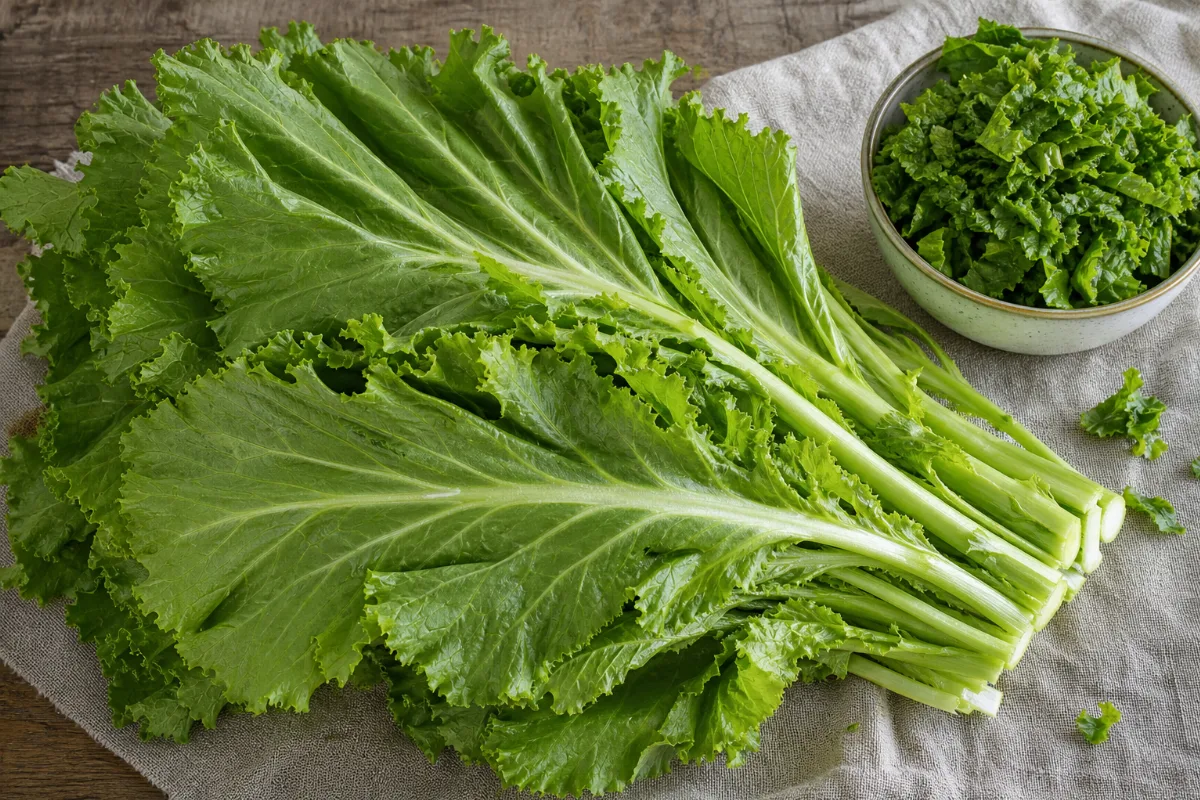
Mustard Greens
Brassica juncea · also called Leaf mustard, Indian mustard, mostaza (Spanish)
Mustard greens are a peppery leafy green from the cabbage and mustard family. They are rich in vitamin K and a source of vitamin C and vitamin A. Studies of leafy and cruciferous vegetables link them with less heart disease and some cancers, but those are population studies, not trials of mustard greens. The main cautions are warfarin (vitamin K) and, rarely, mustard allergy.
General information, not medical advice. Last substantive update · Not medically reviewed. A named clinician has not signed off on this page. How this page is made
About Mustard Greens
Mustard greens are a peppery, vitamin K-rich leafy green. They are a nutritious food, not a proven remedy: the health findings come from studies of leafy or cruciferous vegetables in general.
What it is
Mustard greens are the leaves of Brassica juncea, a plant in the cabbage and mustard family. They are eaten raw or cooked and taste sharp and peppery.
USDA data for raw mustard greens: 27 kcal per 100 g. One cup of chopped leaves (56 g) has about 15 kcal, 1.8 g fibre, 39 mg vitamin C, 144 micrograms vitamin K, 85 micrograms vitamin A (RAE), 64 mg calcium and 215 mg potassium. Cooked, frozen and canned values differ and were not read.
What the research shows
The firmest fact is nutrient content: mustard greens are a rich vitamin K food.
People who eat more green leafy vegetables have less heart disease in observational studies, but trials of vascular function and blood pressure showed no clear change. Observational studies also link cruciferous vegetables with fewer digestive tract cancers and less type 2 diabetes. These cannot show cause, and mustard greens were not studied alone.
Mustard greens contain glucosinolates. In one study of 45 people the body converted about 12% on average into active forms, with a wide range.
Food versus supplements
The findings on this page are for vegetables eaten as food. They do not apply to glucosinolate or isothiocyanate supplements, which this page does not cover.
Amounts
This page gives no amounts to eat. Ask a doctor, pharmacist or dietitian what is right for you, especially if you take warfarin or form kidney stones.
At a glance
Traditional uses history, not proof
- Eaten raw or cooked as a peppery leafy green
- Long use as food is not proof that they treat any condition
Studied for research
- Vitamin K food source, high certainty for the nutrient, no mustard greens trial
- Heart disease (leafy greens as a group), low certainty
- Digestive tract cancers (crucifers as a group), very low certainty
- Type 2 diabetes risk (crucifers as a group), low certainty
- Blood pressure, insufficient evidence
Main compounds
- Vitamin K
- Vitamin C
- Beta-carotene and lutein plus zeaxanthin
- Glucosinolates
Common forms
- Raw leaves
- Cooked leaves
- Frozen and canned leaves (NHS counts these as portions)
Research links: NHS: Warfarin · MedlinePlus: Vitamin K · Meta-analysis: green leafy vegetables and cardiovascular disease (2026) · Research Library · Genes & Biomarkers Library
What it is and its history
- Accepted scientific name
- Brassica juncea
- Naming authority
- The USDA record names the species Brassica juncea; no authority or accepted-name check was made
- Common names
- Mustard greens (English); Leaf mustard (English); Indian mustard (English); Mostaza (hojas) (Spanish)
- Family or group
- Brassicaceae, the cabbage and mustard family, which includes kale, broccoli, cabbage and collards.
- Classification
- Plantae > Brassicaceae (cabbage and mustard family) > Brassica > Brassica juncea
- Native range
- Not verified from a source read.
- Habitat
- Not verified from a source read.
- What it looks like
- Roots: Not verified.; Stems: Not verified.; Leaves: The leaves are the food. They have a sharp, peppery taste (existing site summary; not re-verified).; Flowers: Not verified.; Fruit: Not verified.
- Cultivation
- Not verified from a source read.
- Harvest and processing
- Eaten raw in salads or cooked; also sold frozen and canned (NHS says frozen and canned vegetables count as portions).
- Look-alikes and adulterants
- Name: Mustard seed and prepared mustard; Note: Made from mustard plant seed. Allergy evidence concerns mustard as an ingredient and may not describe the leaves.; Name: Kale, collard greens, turnip greens; Note: Other leafy members of the same family with their own vitamin K and glucosinolate content.
- Sustainability and conservation
- Not assessed.
Photographs
Traditional use and history history, not clinical proof
| Tradition or era | Documented use | Source |
|---|---|---|
| Culinary use | Eaten as a peppery leaf vegetable, raw or cooked (general knowledge; no historical source was read). | Not verified |
Traditional use shows how it was used. It does not show that it works or is safe today.
What is inside, and how it may work
What it contains and how those compounds act in cells and animals. Laboratory and animal mechanisms are not proven effects in people.
Main compounds
| Compound | Family | Where it is concentrated | Activity studied | Level of evidence |
|---|---|---|---|---|
| Vitamin K (phylloquinone) | vitamin | Leaf USDA: 258 micrograms per 100 g raw; about 144 micrograms per cup chopped (56 g) | Needed for blood clotting. Affects warfarin. 16 12 | Human data |
| Vitamin C (ascorbic acid) | vitamin | Leaf USDA: 70 mg per 100 g raw; about 39 mg per cup chopped | Essential nutrient. No mustard greens trial. 16 | Composition only |
| Carotenoids (beta-carotene, lutein plus zeaxanthin) | carotenoid | Leaf USDA per 100 g: 1,790 micrograms beta-carotene; 3,730 micrograms lutein plus zeaxanthin | Pigments; no mustard greens outcome study was found. 16 | Composition only |
| Glucosinolates (including sinigrin-type compounds) | sulfur compounds | Leaf About 79 mg total glucosinolates per half cup chopped (28 g) raw (Linus Pauling Institute) | Converted by the plant enzyme myrosinase (and by gut bacteria) into isothiocyanates, which give the pungent taste. Most health evidence is cell or animal work. 11 | Preliminary mechanism |
Mechanisms, receptors and pathways
| Target or pathway | Gene or receptor | What was found | Level |
|---|---|---|---|
| Glucosinolate to isothiocyanate conversion | Myrosinase (plant enzyme) | Chopping or chewing mixes the enzyme with glucosinolates and forms isothiocyanates. Cooking can stop the enzyme, after which gut bacteria must do the conversion; in 45 people the mean conversion was about 12% with a wide range (Linus Pauling Institute). 11 | Human data |
| Vitamin K and clotting | Not specified | Vitamin K from leafy greens affects blood clotting and can change the effect of warfarin (MedlinePlus, NHS). 12 14 | Human data |
Absorption, metabolism and elimination
- Absorption
- Not studied for mustard greens.
- Distribution
- Not found.
- Metabolism
- Glucosinolate conversion to isothiocyanates varied from 1.1% to 40.7% (mean about 12%) in 45 people given a mostly glucoraphanin source (Linus Pauling Institute).
- Elimination
- Not found.
- Bioavailability
- Not established for mustard greens.
Isolated compounds versus whole extracts
Heart and cancer findings are for green leafy or cruciferous vegetables eaten as food, not for mustard greens alone and not for glucosinolate or isothiocyanate supplements. Supplements are not covered on this page.
Nutritional composition
Nutrition from USDA FoodData Central (Mustard greens, raw, FDC 169256, record last updated 4/1/2019, read 2026-10-26). Per 100 g raw: 27 kcal, about 91 g water, 2.9 g protein, 0.4 g fat, 4.7 g carbohydrate, 3.2 g fibre, 115 mg calcium, 1.6 mg iron, 32 mg magnesium, 384 mg potassium, 20 mg sodium, 0.17 mg copper, 70 mg vitamin C, 258 micrograms vitamin K, 151 micrograms vitamin A (RAE), 2.0 mg vitamin E, 0.18 mg vitamin B6 and 12 micrograms folate (DFE). One cup of chopped raw leaves (56 g, the USDA household portion) has roughly 15 kcal, 1.8 g fibre, 64 mg calcium, 215 mg potassium, 39 mg vitamin C, 144 micrograms vitamin K and 85 micrograms vitamin A (RAE); per-cup figures are the per-100-g values scaled by 0.56 and rounded. The NHS counts 80 g of fresh, canned or frozen vegetables as one portion. Cooked, canned and frozen values differ from raw and were not read. Values vary with variety and growing conditions.
1 high certainty3 low certainty2 very low certainty2 not enough evidence
What is Mustard Greens good for?
The main studied uses and how strong the human evidence is for each. Most results are for leafy or cruciferous vegetables as a group, not mustard greens alone.
Benefits, one by one
Each card is a research question, not a promise. Tap a goal to filter. Open a card to see the studies, doses and limits.
Vitamin K from a leafy green (nutrient content)
High certaintyRaw mustard greens are one of the richer food sources of vitamin K. A cup of chopped leaves has about 144 micrograms. MedlinePlus names mustard greens among green leafy vegetable sources of this vitamin. This is a fact about what is in the leaf, not a trial of a health effect.
2 studiesRaw leaves (USDA). Cooking and canning change nutrient values, and a …
Studies, doses and limits
What the trials found
USDA lists 258 micrograms of vitamin K per 100 g of raw mustard greens, about 144 micrograms in one cup of chopped leaves (56 g). MedlinePlus lists mustard greens among the green leafy vegetables that supply vitamin K. No trial of mustard greens for a vitamin K outcome was read.
Results
Mustard greens are a rich vitamin K food. No outcome trial exists.
Effect sizes as reported
USDA: 258 micrograms per 100 g raw.
Why this rating
High only for the nutrient fact that the leaf is rich in vitamin K (food composition database and health-agency listing). There is no mustard greens trial of any health outcome.
Form and dose studied
Raw leaves (USDA). Cooking and canning change nutrient values, and a cooked comparison was not read.
Who was studied
Everyone eats vitamin K foods; the amount matters mainly for people taking warfarin (see the Safety tab).
Limits
Food-composition fact, not a health trial. Values vary with variety, growing conditions and storage.
Why researchers looked
People ask which foods supply vitamin K, which the body needs for blood clotting.
Traditional use
Mustard greens have long been eaten as a peppery cooked or raw leaf; long use is not proof that they treat any condition.
Proposed mechanism Authoritative guidance
Vitamin K is a nutrient the body uses in blood clotting. Leafy greens are a major food source (MedlinePlus).
A proposed mechanism does not show that the effect happens in people.
A rich vitamin K food matters for anyone taking warfarin. See the Safety tab.
Heart and circulation (green leafy vegetables as a group)
Low certaintyPeople who eat more green leafy vegetables tend to have less heart disease in population studies. Trials of leafy vegetables did not show better blood vessel function or lower blood pressure. The studies group all leafy greens together, so they say little about mustard greens alone.
1 studiesGreen leafy vegetables as eaten; no mustard greens-specific form.
Studies, doses and limits
What the trials found
A 2026 systematic review and meta-analysis pooled observational studies and randomised trials. Higher green leafy vegetable intake was linked to a lower risk of cardiovascular disease (RR 0.89, 95% CI 0.82 to 0.97) and lower cardiovascular death (RR 0.79, 0.62 to 0.97), with high heterogeneity (I2 80%). Seven randomised trials showed no significant improvement in vascular function (mean difference -0.37, -1.90 to 1.16).
Results
A link in observational studies; not confirmed by trials of vascular function.
Effect sizes as reported
CVD RR 0.89 (0.82 to 0.97); CVD death RR 0.79 (0.62 to 0.97); trials MD -0.37 (-1.90 to 1.16).
Why this rating
Observational findings with high heterogeneity, and trials that did not agree. Healthier people may also eat more greens. Mustard greens were not studied on their own.
Form and dose studied
Green leafy vegetables as eaten; no mustard greens-specific form.
Who was studied
Adults in observational studies and small trials.
Limits
Group of vegetables, not mustard greens alone; observational links cannot show cause; the trials were small and varied.
Why researchers looked
Leafy greens are rich in nutrients linked to heart health, so researchers compare people who eat more of them with those who eat less.
Traditional use
Mustard greens have long been eaten as a peppery cooked or raw leaf; long use is not proof that they treat any condition.
Proposed mechanism Preliminary mechanism
Mustard greens are a leafy green in the cabbage and mustard family. They hold vitamin K, vitamin C, carotenoids and sulfur compounds called glucosinolates. Which of these, if any, explains the links seen in population studies is not known.
A proposed mechanism does not show that the effect happens in people.
See the warfarin note on the Safety tab for people taking blood thinners.
Cancers of the digestive tract (cruciferous vegetables as a group)
Very low certaintyIn population studies, people who eat more cruciferous vegetables, the cabbage and mustard family, have fewer digestive tract cancers on average. These studies cannot show that the vegetables are the cause. Mustard greens are one member of the family and were not studied alone.
3 studiesCruciferous vegetables as eaten; cooked and raw were not separated in…
Studies, doses and limits
What the trials found
A 2024 meta-analysis of 81 articles (89 observational studies) found the highest cruciferous vegetable intake linked to lower risk of all digestive tract cancers combined (RR 0.81, 95% CI 0.76 to 0.87), with links for oesophageal, stomach, liver, pancreatic and colorectal cancer but not gallbladder cancer. A 2025 dose-response meta-analysis of 17 studies (7 cohort, 10 case-control; 97,595 people) linked higher intake with lower colon cancer risk (OR 0.80, 0.72 to 0.90) and cautioned about differences between studies.
Results
Lower cancer risk in people who eat more crucifers in observational studies.
Effect sizes as reported
All digestive cancers RR 0.81 (0.76 to 0.87); colon cancer OR 0.80 (0.72 to 0.90).
Why this rating
Observational only, with differences in study design and diet questionnaires, and possible confounding by healthier habits. Crucifers as a group; no mustard greens analysis.
Form and dose studied
Cruciferous vegetables as eaten; cooked and raw were not separated in the abstracts.
Who was studied
Adults in cohort and case-control studies.
Limits
Observational; self-reported diet; mustard greens not analysed. These are not trials of eating the vegetable to prevent cancer.
Why researchers looked
Cruciferous vegetables contain glucosinolates, which the body can turn into isothiocyanates that have shown anti-cancer effects in cell and animal studies.
Traditional use
Mustard greens have long been eaten as a peppery cooked or raw leaf; long use is not proof that they treat any condition.
Proposed mechanism Preliminary mechanism
Glucosinolates are broken down by an enzyme called myrosinase into isothiocyanates when the leaf is chopped or chewed. Most evidence that isothiocyanates fight cancer comes from cell and animal work (Linus Pauling Institute). Whether this explains the population links is unknown.
A proposed mechanism does not show that the effect happens in people.
None specific. Do not use food in place of cancer screening or treatment.
Risk of type 2 diabetes (cruciferous vegetables as a group)
Low certaintyIn four long follow-up studies, people who ate the most cruciferous vegetables were somewhat less likely to develop type 2 diabetes. The finding is observational and not about mustard greens specifically.
1 studiesCruciferous vegetables as eaten.
Studies, doses and limits
What the trials found
A 2016 meta-analysis of prospective cohorts (306,723 people; 16,544 new type 2 diabetes cases; follow-up 4.6 to 24 years) found the highest cruciferous vegetable intake linked to a lower risk of type 2 diabetes in four cohorts (SRR 0.84, 95% CI 0.73 to 0.96; I2 54.4%). Citrus fruit showed no link.
Results
A modest link in observational studies; no trial.
Effect sizes as reported
SRR 0.84 (0.73 to 0.96).
Why this rating
Four prospective cohorts with moderate heterogeneity; cause cannot be shown; crucifers as a group; searches ended in 2014.
Form and dose studied
Cruciferous vegetables as eaten.
Who was studied
Adults in prospective cohorts.
Limits
Few studies; observational; not mustard greens alone.
Why researchers looked
Researchers look at which kinds of vegetables are linked to diabetes risk.
Traditional use
Mustard greens have long been eaten as a peppery cooked or raw leaf; long use is not proof that they treat any condition.
Proposed mechanism Preliminary mechanism
Mustard greens are a leafy green in the cabbage and mustard family. They hold vitamin K, vitamin C, carotenoids and sulfur compounds called glucosinolates. Which of these, if any, explains the links seen in population studies is not known.
A proposed mechanism does not show that the effect happens in people.
People with diabetes should ask their care team before changing their diet.
Lung cancer risk (cruciferous vegetables as a group)
Very low certaintyPeople who ate the most cruciferous vegetables had lower lung cancer risk in observational studies. Clinical evidence is limited to two small trials with incomplete reports. Smoking is the main lung cancer risk, and diet does not cancel it.
1 studiesCruciferous vegetables as eaten.
Studies, doses and limits
What the trials found
A 2018 review reports a meta-analysis of 31 observational studies in which the highest versus lowest cruciferous vegetable intake had a summary OR/RR of 0.81 (95% CI 0.74 to 0.89) for lung cancer. The authors say clinical evidence is limited to two phase 2 trials with incomplete reporting.
Results
A link in observational studies; trials too limited to judge.
Effect sizes as reported
Summary OR/RR 0.81 (0.74 to 0.89).
Why this rating
Observational, self-reported diet, smoking can confuse results, crucifers as a group.
Form and dose studied
Cruciferous vegetables as eaten.
Who was studied
Adults in observational studies.
Limits
Not specific to mustard greens; cannot show cause.
Why researchers looked
Isothiocyanates from crucifers change how the body handles inhaled cancer-causing chemicals in lab work.
Traditional use
Mustard greens have long been eaten as a peppery cooked or raw leaf; long use is not proof that they treat any condition.
Proposed mechanism Preliminary mechanism
Isothiocyanates may change enzymes that handle carcinogens (cell and animal work, Linus Pauling Institute and the review). Not shown to prevent lung cancer in people.
A proposed mechanism does not show that the effect happens in people.
None specific. Not a substitute for stopping smoking or for screening.
Blood pressure (green leafy vegetables as a group)
Not enough evidenceTrials of leafy vegetables did not show a clear change in blood pressure, and population studies did not link them with the risk of high blood pressure.
1 studiesGreen leafy vegetables as a group.
Studies, doses and limits
What the trials found
The same 2026 meta-analysis found no significant effect on systolic or diastolic blood pressure in randomised trials, and no significant link between leafy vegetable intake and hypertension risk in observational studies.
Results
No clear effect on blood pressure.
Effect sizes as reported
Not significant (numbers not given in the abstract).
Why this rating
Small trials with varied designs and a group of vegetables; no mustard greens trial.
Form and dose studied
Green leafy vegetables as a group.
Who was studied
Adults.
Limits
Mustard greens not studied alone; abstract gives no blood pressure numbers.
Why researchers looked
Leafy greens give potassium and other nutrients linked to blood pressure.
Traditional use
Mustard greens have long been eaten as a peppery cooked or raw leaf; long use is not proof that they treat any condition.
Proposed mechanism Preliminary mechanism
Mustard greens are a leafy green in the cabbage and mustard family. They hold vitamin K, vitamin C, carotenoids and sulfur compounds called glucosinolates. Which of these, if any, explains the links seen in population studies is not known.
A proposed mechanism does not show that the effect happens in people.
None specific.
How the body uses mustard-family plant compounds (glucosinolates)
Low certaintyMustard greens carry about 79 mg of glucosinolates in half a cup. Whether these turn into active forms varies a lot between people. In one study of 45 healthy adults about 12% was converted, with a range of 1 to 41%. That study mostly used a broccoli-type compound.
1 studiesRaw versus cooked vegetables.
Studies, doses and limits
What the trials found
The Linus Pauling Institute lists mustard greens at 79 mg total glucosinolates per half cup chopped (28 g). It describes a feeding study in 45 healthy people (85% of the glucosinolate was glucoraphanin) with mean conversion of about 12% over 24 hours (range 1.1 to 40.7%).
Results
Highly variable conversion; no health outcome measured.
Effect sizes as reported
Mean about 12% (range 1.1 to 40.7%).
Why this rating
A measurement of how the body handles the compounds, not a health result; the study used mostly broccoli-type glucosinolate rather than mustard greens.
Form and dose studied
Raw versus cooked vegetables.
Who was studied
45 healthy adults.
Limits
Secondary source (the page summarises the study); not a health outcome.
Why researchers looked
Glucosinolates only help if the body converts them into isothiocyanates.
Traditional use
Mustard greens have long been eaten as a peppery cooked or raw leaf; long use is not proof that they treat any condition.
Proposed mechanism Preliminary mechanism
When cells are damaged by chopping or chewing, myrosinase converts glucosinolates into isothiocyanates. Cooking can switch the enzyme off, after which gut bacteria must do the conversion (Linus Pauling Institute).
A proposed mechanism does not show that the effect happens in people.
See thyroid note on the Safety tab.
Eye health (lutein in the leaves)
Not enough evidenceMustard greens contain a lot of lutein and zeaxanthin, plant pigments found in the eye. No source read links eating mustard greens with eye disease.
1 studiesRaw leaves (USDA).
Studies, doses and limits
What the trials found
USDA lists 3,730 micrograms of lutein plus zeaxanthin and 1,790 micrograms of beta-carotene per 100 g of raw mustard greens. No study of mustard greens and eye outcomes was found.
Results
Composition only; no health outcome.
Effect sizes as reported
USDA: 3,730 micrograms lutein plus zeaxanthin per 100 g.
Why this rating
No eye outcome study of mustard greens was read.
Form and dose studied
Raw leaves (USDA).
Who was studied
Not applicable.
Limits
Composition data only.
Why researchers looked
Lutein and zeaxanthin are studied for eye health, and leafy greens are food sources.
Traditional use
Mustard greens have long been eaten as a peppery cooked or raw leaf; long use is not proof that they treat any condition.
Proposed mechanism Preliminary mechanism
Lutein and zeaxanthin are carotenoid pigments. USDA lists 3,730 micrograms per 100 g of raw leaves. The step from food content to eye outcome was not tested for mustard greens.
A proposed mechanism does not show that the effect happens in people.
None specific.
Connections to the rest of health
How Mustard Greens connects to the rest of our health knowledge graph. Every link says what kind of connection it is. A safety link (for example to the liver) is a warning, not a benefit. A study that merely mentions a topic never creates a benefit link.
Explore every connection: goals, body systems, organs, symptoms, genes
A. Wellness goals
| Connected to | Kind of connection | Evidence status | Context | Studies |
|---|---|---|---|---|
| Heart Health | Biological association | Low certainty | Heart and circulation (green leafy vegetables as a group): People who eat more green leafy vegetables tend to have less heart disease in population studies. Trials of leafy vegetables did not show better blood vessel function or lower blood pressure. The studies group all leafy greens together, so they say little about mustard greens alone. | 2 |
| Blood Sugar Balance | Biological association | Low certainty | Risk of type 2 diabetes (cruciferous vegetables as a group): In four long follow-up studies, people who ate the most cruciferous vegetables were somewhat less likely to develop type 2 diabetes. The finding is observational and not about mustard greens specifically. | 1 |
| Blood Pressure Support | Not enough evidence | Blood pressure (green leafy vegetables as a group): Trials of leafy vegetables did not show a clear change in blood pressure, and population studies did not link them with the risk of high blood pressure. | 2 |
B. Body systems
| Connected to | Kind of connection | Evidence status | Context | Studies |
|---|---|---|---|---|
| Bones Joints Muscles | Biological association | High certainty | Studied for: Vitamin K from a leafy green (nutrient content) | 16 12 |
| Cardiovascular System | Biological association | High certainty | Studied for: Vitamin K from a leafy green (nutrient content) Studied for: Heart and circulation (green leafy vegetables as a group) | 16 12 2 |
| Heart Circulation | Biological association | Low certainty | Studied for: Heart and circulation (green leafy vegetables as a group) | 2 |
| Digestive System | Biological association | Very low certainty | Studied for: Cancers of the digestive tract (cruciferous vegetables as a group) Studied for: How the body uses mustard-family plant compounds (glucosinolates) | 7 5 11 |
| Blood Sugar Support | Biological association | Low certainty | Studied for: Risk of type 2 diabetes (cruciferous vegetables as a group) | 1 |
| Metabolism Weight | Biological association | Low certainty | Studied for: Risk of type 2 diabetes (cruciferous vegetables as a group) | 1 |
| Respiratory System | Biological association | Very low certainty | Studied for: Lung cancer risk (cruciferous vegetables as a group) | 8 |
| Eyes | Biological association | Not enough evidence | Studied for: Eye health (lutein in the leaves) | 16 |
C. Body parts and organs
E. Health conditions
| Connected to | Kind of connection | Evidence status | Context | Studies |
|---|---|---|---|---|
| Food allergy | Adverse effect or risk | Case report | Mustard allergy is documented, including anaphylaxis in one child. Mustard allergy is documented; whether leaves are the same was not covered. Preparation or compound: Mustard as an ingredient |
3 |
I. Biomarkers
| Connected to | Kind of connection | Evidence status | Context | Studies |
|---|---|---|---|---|
| Blood vessel function | Biological association | Low certainty | Measured in trials: no-change. A lab change is not the same as a health benefit. | 2 |
K. Biological pathways
L. Active compounds
| Connected to | Kind of connection | Evidence status | Context | Studies |
|---|---|---|---|---|
| Vitamin K (phylloquinone) | Biological association | Human | Needed for blood clotting. Affects warfarin. Preparation or compound: Leaf |
16 12 |
| Vitamin C (ascorbic acid) | Biological association | Composition only | Essential nutrient. No mustard greens trial. Preparation or compound: Leaf |
16 |
| Carotenoids (beta-carotene, lutein plus zeaxanthin) | Biological association | Composition only | Pigments; no mustard greens outcome study was found. Preparation or compound: Leaf |
16 |
| Glucosinolates (including sinigrin-type compounds) | Biological association | Preliminary mechanism | Converted by the plant enzyme myrosinase (and by gut bacteria) into isothiocyanates, which give the pungent taste. Most health evidence is cell or animal work. Preparation or compound: Leaf |
11 |
Each connection is stored with the ingredient, the connected record, the kind of connection, the evidence status, the supporting studies, the preparation or compound involved, and a review date (last reviewed October 26, 2026).
Evidence at a glance: what changed in 1 lab markers
Tap a number to show only those markers. Counts are markers, not people.
The evidence
The research centre for Mustard Greens. Every record here was checked against PubMed or the publisher's page; we never list a study we have not verified.
Evidence by outcome
Bars show how many studies we found for each outcome, not how well it works. People are added up across trials only (reviews are not added, to avoid double counting).
How we rate evidence
High certainty
Several well-run trials or reviews agree; further research is unlikely to change the picture much.
Moderate certainty
Good trials point the same way, but some doubt remains.
Low certainty
Small, short or inconsistent trials. The finding could change with better research.
Very low certainty
Very little or very weak human data. Treat as a possibility only.
Mixed findings
Trials or reviews disagree with each other.
Not enough evidence
Not enough human research to say either way.
Evidence against
Good research found no benefit, or found harm.
We take the reviewers' own risk-of-bias and GRADE statements where they exist, and otherwise judge from study size, design, consistency, directness and whether a product matches what is sold. Many publications do not make evidence high. Method note: We started from our existing mustard greens summary, re-checked nutrition at USDA FoodData Central, re-read the NHS, MedlinePlus, FDA, NIDDK and Linus Pauling Institute pages, and read PubMed abstracts. Only abstracts were read for studies. Items we could not verify are flagged in the research gaps.
Study library: every study we checked 16
| Study | Design | People | Product, dose, length | Result |
|---|---|---|---|---|
| Jia 2016 Consumption of citrus and cruciferous vegetables with incident type 2 diabetes mellitus based on a meta-analysis of prospective study. Prim Care Diabetes · PMID 26778708 · DOI |
Meta-analysis |
306723 Seven prospective cohorts (five articles); 306,723 people, 16,544 new type 2 diabetes cases; four cohorts for cruciferous vegetables |
Cruciferous vegetables as a group Vegetable Not comparable across studies 4.6 to 24 years of follow-up · vs Lowest intake group |
Highest cruciferous vegetable intake was linked to a lower chance of developing type 2 diabetes (SRR 0.84). Citrus fruit showed no link (SRR 1.02). SRR 0.84 (95% CI 0.73 to 0.96) Methods, limits and fundingOutcomes: New type 2 diabetes Limitations: Only four cohorts; moderate heterogeneity (I2 54.4%); observational, so it cannot show cause. Published 2016, searches to 2014. Funding and conflicts: Funding statement not shown in the abstract. Read: abstract |
| Kaewpradup 2026 Dietary Green Leafy Vegetables and Cardiovascular Disease Risk: A Systematic Review and Meta-Analysis. Foods · PMID 42587937 · DOI |
Meta-analysis |
Adults in observational studies and in 7 randomised trials of vascular function (total number not given in the abstract) | Green leafy vegetables as a group (not mustard greens alone) Leaf Not stated in the abstract Varied · vs No leafy vegetable intake or lower intake |
Observational: higher intake linked to lower CVD risk (RR 0.89) and CVD death (RR 0.79). Trials: no significant change in vascular function (mean difference -0.37) and no significant effect on systolic or diastolic blood pressure. No link with hypertension risk in observational studies. CVD RR 0.89; CVD death RR 0.79; vascular function MD -0.37 (CVD 0.82 to 0.97; CVD death 0.62 to 0.97; vascular function -1.90 to 1.16) Methods, limits and fundingOutcomes: Cardiovascular disease risk and death, vascular function, blood pressure Limitations: High heterogeneity (I2 80% for the observational results, 88% for the trials). Observational links cannot show cause. Leafy greens as a group; mustard greens were not analysed on their own. Funding and conflicts: Funding statement not shown in the abstract. Read: abstract |
| Katz 2026 Mustard-Induced Anaphylaxis in a 23-Month-Old Male: An Underrecognized Pediatric Food Allergen in the United States. Cureus · PMID 42732437 · DOI |
Case report |
1 23-month-old boy with egg allergy |
Mustard (an ingredient; plant part not stated) Not stated Isolated exposure Minutes · vs n/a |
Hives, lip swelling and cough within minutes of mustard, relieved by epinephrine. Skin-prick test to mustard gave a 15 mm wheal. The authors call mustard allergy uncommon but clinically significant, and note that mustard is not a major allergen that US law requires to be named on labels. Single case Methods, limits and fundingOutcomes: Allergic reaction and skin-prick test Limitations: One child. It concerns mustard as a condiment ingredient; the abstract does not say whether mustard leaves cause the same reaction. Funding and conflicts: Funding statement not shown in the abstract. Read: abstract |
| Kim 2025 Dissipation Behavior and Dietary Risk of Etofenprox in Kale (Brassica oleracea) and Red Mustard Greens (Brassica juncea). Foods · PMID 41464930 · DOI |
Field study n/a |
Field trials at three sites in Korea (greenhouse) | Red mustard greens (Brassica juncea) sprayed with the insecticide etofenprox Leaf Not applicable Residues followed over days · vs n/a |
The residue halved every 3.1 days in red mustard greens. At the 7-day pre-harvest interval the estimated intake was under 1% of the acceptable daily intake for the average consumer and under 4% for high-intake consumers. The authors conclude that following recommended spraying practice poses negligible risk. Half-life 3.1 days Methods, limits and fundingOutcomes: Pesticide residue and dietary risk Limitations: One pesticide, one country, red mustard greens in greenhouses. It does not describe residues on other products or from other sprays. Funding and conflicts: Funding statement not shown in the abstract. Read: abstract |
| Lai 2025 Cruciferous vegetables intake and risk of colon cancer: a dose-response meta-analysis. BMC Gastroenterol · PMID 40790161 · DOI |
Meta-analysis |
97595 17 studies (7 cohort, 10 case-control) with 97,595 participants |
Cruciferous vegetables as a group Vegetable Not comparable across studies Varied · vs Lowest intake group |
Higher cruciferous vegetable intake was linked to lower colon cancer risk, with risk falling progressively as intake rose. OR 0.80 (95% CI 0.72 to 0.90) Methods, limits and fundingOutcomes: Colon cancer Limitations: The authors urge caution: study designs and diet questionnaires differed, and other habits of vegetable eaters may explain part of the link. Case-control studies depend on recalled diet. Funding and conflicts: Funding statement not shown in the abstract. Read: abstract |
| Rangecroft 2021 Pickles and warfarin interaction: a case-based review. Clin Rheumatol · PMID 32778973 · DOI |
Case report |
1 36-year-old woman on warfarin with lupus and antiphospholipid syndrome |
Dill pickles (stopped), as an example of a vitamin K food Food Not stated Not stated · vs n/a |
Her INR rose to 9 on an unchanged warfarin dose after she stopped eating dill pickles. The authors write that keeping vitamin K intake consistent matters more than the amount, and that patients should be taught which foods contain vitamin K. Single case Methods, limits and fundingOutcomes: Blood clotting time (INR) Limitations: One patient and a pickle, not a mustard green. It illustrates the general vitamin K point only. Funding and conflicts: Funding statement not shown in the abstract. Read: abstract |
| Ren 2024 High intake of cruciferous vegetables reduces the risk of gastrointestinal cancers: results from observational studies. Crit Rev Food Sci Nutr · PMID 38051036 · DOI |
Meta-analysis |
81 articles covering 89 observational studies | Cruciferous vegetables as a group (broccoli and cabbage analysed separately) Vegetable Not comparable across studies Varied · vs Lowest intake group |
Highest intake was linked to lower risk of all digestive tract cancers combined; the link was seen for oesophageal, stomach, liver, pancreatic and colorectal cancer, but not gallbladder cancer. RR 0.81 for all digestive tract cancers; 7% lower risk per 50 g more a day below 75 g a day (95% CI 0.76 to 0.87 (all); 0.84 to 0.96 (per 50 g)) Methods, limits and fundingOutcomes: Cancers of the digestive tract Limitations: Observational only. The title says "reduces", but these studies cannot prove cause. Mustard greens were not analysed on their own. Funding and conflicts: Funding statement not shown in the abstract. Read: abstract |
| Zhang 2018 The Role of Cruciferous Vegetables and Isothiocyanates for Lung Cancer Prevention: Current Status, Challenges, and Future Research Directions. Mol Nutr Food Res · PMID 29663679 · DOI |
Meta-analysis |
Meta-analysis of 31 observational studies, plus a review of two small clinical trials | Cruciferous vegetables as a group Vegetable Not comparable across studies Varied · vs Lowest intake group |
Highest cruciferous vegetable intake was linked to lower lung cancer risk (summary OR/RR 0.81). The authors say clinical evidence is limited to two phase 2 trials with incomplete reporting. Summary OR/RR 0.81 (95% CI 0.74 to 0.89) Methods, limits and fundingOutcomes: Lung cancer risk Limitations: Observational studies of self-reported diet; smoking is the main lung cancer risk and can confuse results. Not specific to mustard greens. Funding and conflicts: Funding statement not shown in the abstract. Read: abstract |
| s-fda-produce FDA: Selecting and Serving Produce Safely · Source |
Regulator n/a |
Methods, limits and fundingRead: full-text | ||
| s-lpi-iodine Linus Pauling Institute: Iodine · Source |
University resource n/a |
Methods, limits and fundingRead: full-text | ||
| s-lpi-isothiocyanates Linus Pauling Institute: Isothiocyanates · Source |
University resource n/a |
Methods, limits and fundingRead: full-text | ||
| s-medlineplus-vitk MedlinePlus: Vitamin K · Source |
Health agency n/a |
Methods, limits and fundingRead: full-text | ||
| s-nhs-5aday NHS: 5 A DAY, what counts · Source |
Health agency n/a |
Methods, limits and fundingRead: full-text | ||
| s-nhs-warfarin NHS: Warfarin · Source |
Health agency n/a |
Methods, limits and fundingRead: full-text | ||
| s-niddk-stones NIDDK: Eating, Diet, and Nutrition for Kidney Stones · Source |
Health agency n/a |
Methods, limits and fundingRead: full-text | ||
| s-usda-fdc-169256 USDA FoodData Central: Mustard greens, raw (FDC 169256, NDB 11270) · Source |
Reference database n/a |
Methods, limits and fundingRead: full-text |
What we do not know yet
- No trial has tested mustard greens on their own for heart health, cancer, diabetes or any other outcome.
- Heart, cancer and diabetes findings come from studies of leafy or cruciferous vegetables as a group and are observational.
- The oxalate content of mustard greens was not found in a source read.
- Cooked, frozen and canned nutrition, heavy metals, pregnancy and breastfeeding were not researched.
- EU allergen rules, NCCIH, LiverTox and LactMed entries were not checked.
How new research is added
New studies are found by a saved PubMed search and placed in a review queue before the page changes.
Lab markers
What changed in blood or saliva tests during trials. A changed number is not the same as feeling or being healthier, and we give no "normal ranges".
Other 1
Blood vessel function
No clear change in trials
How well the blood vessels widen when blood flow increases, measured in trials of vegetable intake.
Low certaintyResults and what it means
Why it was measured
Poor blood vessel function is an early sign of heart and circulation disease.
Statistical vs. clinical meaning
A change in this measure is not the same as fewer heart attacks. The trials were varied (I2 88%).
Safety implication
None specific.
| Study | Result | People | Product |
|---|---|---|---|
| 2 | No significant change (mean difference -0.37; 95% CI -1.90 to 1.16) | Seven randomised trials of green leafy vegetable intake | Green leafy vegetables as a group |
Safety
What studies and official sources say about side effects, medicines and who should check first. Each point shows what kind of evidence it comes from.
Main points to know 4
- Rich in vitamin K: tell your warfarin clinic. Mustard greens are among the richer leafy sources of vitamin K (258 micrograms per 100 g raw, USDA). Vitamin K can change how the blood thinner warfarin works. The NHS says you can still eat leafy greens but should talk to your warfarin clinic, and MedlinePlus says sudden changes in vitamin K intake can change warfarin's effect and that intake should be kept steady day to day. A case report links an INR of 9 to a sudden change in a vitamin K food. Authoritative guidance 14 12 6 16
- Mustard allergy can be severe. A 2026 case report describes anaphylaxis in a 23-month-old child after mustard (as an ingredient). The authors call mustard allergy uncommon but clinically significant. Whether the leaves cause the same reaction was not covered. Trouble breathing or swelling of the face or throat needs emergency help. Case report 3
- Kidney stones: oxalate content is not stated in sources read. For people who have had calcium oxalate stones, NIDDK names spinach, rhubarb, nuts, peanuts and wheat bran to avoid. Mustard greens are not named and no oxalate figure for them was found in the sources read. Ask a dietitian if you form stones. Authoritative guidance 15
- Thyroid and iodine: only in large amounts or low iodine. The Linus Pauling Institute says cruciferous vegetables contain goitrogens, which interfere with iodine use, but most are not of clinical importance unless eaten in large amounts or when iodine intake is low. Mustard greens were not named. Authoritative guidance 10
Side effects 2
| Effect | How often | Severity and recovery | Evidence |
|---|---|---|---|
| Change in warfarin effect (clotting time) when vitamin K intake changes suddenly The case report concerned dill pickles, an example of a vitamin K food. | Not established | can be serious (bleeding or clotting) Not stated | Authoritative guidance 14 12 6 |
| Allergic reaction to mustard, including anaphylaxis in one reported child Evidence is for mustard as an ingredient; whether leaves are the same was not covered. | Not established | severe (one case) Resolved with epinephrine in the case | Case report 3 |
Liver
No liver injury from eating mustard greens was found in the sources read. LiverTox was not checked.
How often. No frequency was found.
Monitoring. No agency monitoring advice was found.
This is a safety connection. It is not evidence that Mustard Greens supports liver health.
Medicines and supplements 3
| With | Why it matters | Importance | Evidence | What to do |
|---|---|---|---|---|
| Warfarin (blood thinner) prescription | Mustard greens are a rich source of vitamin K, which affects blood clotting and can change how warfarin works. | The NHS and MedlinePlus both say vitamin K foods can affect warfarin and that big or sudden diet changes matter. A case report describes an INR of 9 after one vitamin K food was stopped. | Authoritative guidance High certainty 14 12 6 | You do not have to avoid leafy greens. Talk to your warfarin clinic and keep your intake steady. |
| Vitamin K supplements supplement | Vitamin K supplements raise vitamin K further. | The NHS says not to take vitamin K supplements while on warfarin. This is about supplements, not food. | Authoritative guidance High certainty 14 | Do not start vitamin K supplements on warfarin without your clinic's advice. |
| Thyroid medicines (levothyroxine) or iodine-poor diets prescription | Goitrogens in crucifers can interfere with iodine use. | Said to matter only with large amounts or low iodine (Linus Pauling Institute). No mustard greens study was read. | Authoritative guidance Low certainty 10 | If you have a thyroid condition, ask your clinician about your diet. |
Who should check first 3
| Situation | Advice | Evidence |
|---|---|---|
| Known mustard allergy | Avoid mustard foods that trigger symptoms and ask an allergist whether the leaves are safe for you. Call emergency services for trouble breathing or swelling. | Case report 3 |
| Taking warfarin | Keep intake steady and tell your warfarin clinic about changes in leafy greens. | Authoritative guidance 14 12 |
| History of calcium oxalate kidney stones | Ask a kidney or diet specialist about mustard greens; the oxalate content was not found in sources read. | Authoritative guidance 15 |
Overdose, product quality and regulators
Summary. No toxicity from mustard greens as ordinary food was found in the sources read. The concerns are warfarin, allergy and, for some people, thyroid and kidney stone questions.
Animal. Not reviewed.
Human doses studied. No mustard greens trial was found.
High dose or long term signals. None found.
Overdose response. Not found.
Genotoxicity. Not researched.
Toxic or hazardous parts. None identified in the sources read. Mustard seed oil and seed were not covered.
Wash leafy greens. One field study of red mustard greens found insecticide residue fell quickly and estimated intake was well below safe limits when spray practice was followed. Heavy metals, other pesticides and germs were not researched beyond FDA general advice.
Food safety handling. The FDA says to wash all produce under running water, not to use soap or produce wash, to choose refrigerated bagged greens, and to keep perishable produce cold at 40 F (4 C) or below. 9
Pesticide residue (one pesticide, Korea). In greenhouse trials of red mustard greens, etofenprox residue had a half-life of 3.1 days. At the 7-day pre-harvest interval, estimated intake was under 1% of the acceptable daily intake for the average consumer and under 4% for high-intake consumers. 4
| Body | Action | Date |
|---|---|---|
| NHS (UK) (United Kingdom) | Warfarin page: foods high in vitamin K such as green leafy vegetables can affect warfarin; you can still eat them but should talk to the warfarin clinic; no vitamin K supplements on warfarin source | 2026-02-24 |
| MedlinePlus (US National Library of Medicine) (United States) | Vitamin K page: mustard greens listed as a vitamin K food source; keep vitamin K intake steady on warfarin source | |
| FDA (US Food and Drug Administration) (United States) | Produce safety guidance: wash, refrigerate, cook thoroughly to kill bacteria source | 2024-03-05 |
When to get medical help
- Trouble breathing, swelling of the lips, face or throat, or widespread hives after eating mustard or mustard greens
- Unusual bleeding, large bruises, black or bloody stools or severe headache in someone taking warfarin
- Severe pain in the side or back, fever or blood in the urine in someone with kidney stones
Stop using the product and contact a clinician or emergency service. In the US, Poison Control is 1-800-222-1222.
General information only, not medical advice. Ask a clinician or pharmacist before use, especially with medicines, in pregnancy or with a health condition. See the Natural Remedy Safety guide.
Frequently asked questions
What are mustard greens good for?
Are mustard greens high in vitamin K?
Can I eat mustard greens if I take warfarin?
Do mustard greens help heart health?
People who eat more green leafy vegetables have less heart disease in observational studies (RR 0.89), but trials did not show better blood vessel function. Mustard greens were not studied alone.
Do mustard greens lower blood pressure?
Not shown. A 2026 meta-analysis found no significant effect of leafy vegetables on blood pressure in trials.
Do mustard greens prevent cancer?
Do mustard greens lower the risk of diabetes?
Four cohorts linked more cruciferous vegetables with a lower chance of type 2 diabetes (SRR 0.84). This is observational and not specific to mustard greens.
Are mustard greens bad for the thyroid?
Cruciferous vegetables contain goitrogens. The Linus Pauling Institute says these are not of clinical importance unless eaten in large amounts or with low iodine. Ask your clinician if you have a thyroid condition.
Are mustard greens high in oxalate?
We could not find an oxalate figure for them in the sources we read. NIDDK names spinach and rhubarb, not mustard greens, for people with calcium oxalate stones. Ask a dietitian if you form stones.
Can I be allergic to mustard greens?
Mustard allergy is documented, including anaphylaxis in a young child after mustard as an ingredient. Whether leaves cause the same reaction was not covered. Trouble breathing or swelling needs emergency help.
Is raw or cooked better?
No source read compared them for health outcomes. Cooking can stop the enzyme that makes isothiocyanates, so gut bacteria must convert the compounds, and conversion varied widely between people.
How should I wash mustard greens?
The FDA says to wash all produce under running water, without soap or produce wash, and to keep perishable greens cold. Cooking thoroughly kills harmful bacteria.
Explore by health goal
Editorial transparency
- Written by
- AlternativeMed editorial team. Research compiled with AI assistance, then checked against the sources listed.
- Medical review
- None. This page has not been reviewed by a physician or pharmacist.
- First published
- 2026-10-26
- Last substantive update
- 2026-10-26
- How we research
- We started from our existing mustard greens summary, re-checked nutrition at USDA FoodData Central, re-read the NHS, MedlinePlus, FDA, NIDDK and Linus Pauling Institute pages, and read PubMed abstracts. Only abstracts were read for studies. Items we could not verify are flagged in the research gaps.
- How we rate evidence
- See "How we rate evidence" in the Evidence tab.
- Independence
- No product is promoted on this page. No affiliate links are shown.
Sources 16
Each source was opened and checked. Where we read only the abstract, it says so. The small numbers in the text point here.
- Jia X, Zhong L, Song Y, Hu Y, Wang G, Sun S.. Consumption of citrus and cruciferous vegetables with incident type 2 diabetes mellitus based on a meta-analysis of prospective study.. Prim Care Diabetes. 2016. PMID 26778708. DOI 10.1016/j.pcd.2015.12.004. (abstract)
- Kaewpradup T, Chusak C, Chantarasinlapin P, Shetty S, Nguyen V, Guan Z.. Dietary Green Leafy Vegetables and Cardiovascular Disease Risk: A Systematic Review and Meta-Analysis.. Foods. 2026. PMID 42587937. DOI 10.3390/foods15152678. (abstract)
- Katz JA, Joshi SS, Joshi SN.. Mustard-Induced Anaphylaxis in a 23-Month-Old Male: An Underrecognized Pediatric Food Allergen in the United States.. Cureus. 2026. PMID 42732437. DOI 10.7759/cureus.114458. (abstract)
- Kim JH, Kwak HM, An GE, Oh JK, Chang HR.. Dissipation Behavior and Dietary Risk of Etofenprox in Kale (Brassica oleracea) and Red Mustard Greens (Brassica juncea).. Foods. 2025. PMID 41464930. DOI 10.3390/foods14244223. (abstract)
- Lai B, Li Z, Li J.. Cruciferous vegetables intake and risk of colon cancer: a dose-response meta-analysis.. BMC Gastroenterol. 2025. PMID 40790161. DOI 10.1186/s12876-025-04163-9. (abstract)
- Rangecroft A, Prabhu SS, Huang CC.. Pickles and warfarin interaction: a case-based review.. Clin Rheumatol. 2021. PMID 32778973. DOI 10.1007/s10067-020-05324-9. (abstract)
- Ren HG, Luu HN, Liu Y, Wang DW, Guo X.. High intake of cruciferous vegetables reduces the risk of gastrointestinal cancers: results from observational studies.. Crit Rev Food Sci Nutr. 2024. PMID 38051036. DOI 10.1080/10408398.2023.2271070. (abstract)
- Zhang Z, Bergan R, Shannon J, Slatore CG, Bobe G, Takata Y.. The Role of Cruciferous Vegetables and Isothiocyanates for Lung Cancer Prevention: Current Status, Challenges, and Future Research Directions.. Mol Nutr Food Res. 2018. PMID 29663679. DOI 10.1002/mnfr.201700936. (abstract)
- . FDA: Selecting and Serving Produce Safely. . . (full-text)
- . Linus Pauling Institute: Iodine. . . (full-text)
- . Linus Pauling Institute: Isothiocyanates. . . (full-text)
- . MedlinePlus: Vitamin K. . . (full-text)
- . NHS: 5 A DAY, what counts. . . (full-text)
- . NHS: Warfarin. . . (full-text)
- . NIDDK: Eating, Diet, and Nutrition for Kidney Stones. . . (full-text)
- . USDA FoodData Central: Mustard greens, raw (FDC 169256, NDB 11270). . . (full-text)