Spices · Spice
Mustard seed
Brassica juncea, Brassica nigra, Sinapis alba · also called Brown, black and white or yellow mustard; semilla de mostaza (Spanish)
Mustard seed comes from three plants in the cabbage family and is used whole, ground or as prepared mustard. The seed is mild until it is crushed and wetted, then it turns sharp. Human research on health uses is very small. The main caution is allergy: mustard is one of the more allergenic spices and reactions can be severe. Mustard plasters on the skin have also caused burns.
General information, not medical advice. Last substantive update · Not medically reviewed. A named clinician has not signed off on this page. How this page is made
About Mustard seed
Mustard seed is a flavour food, not a proven remedy. It is sharp when crushed and wetted, a teaspoon adds small amounts of minerals, and the most important health fact is that it is a strong allergen.
What it is
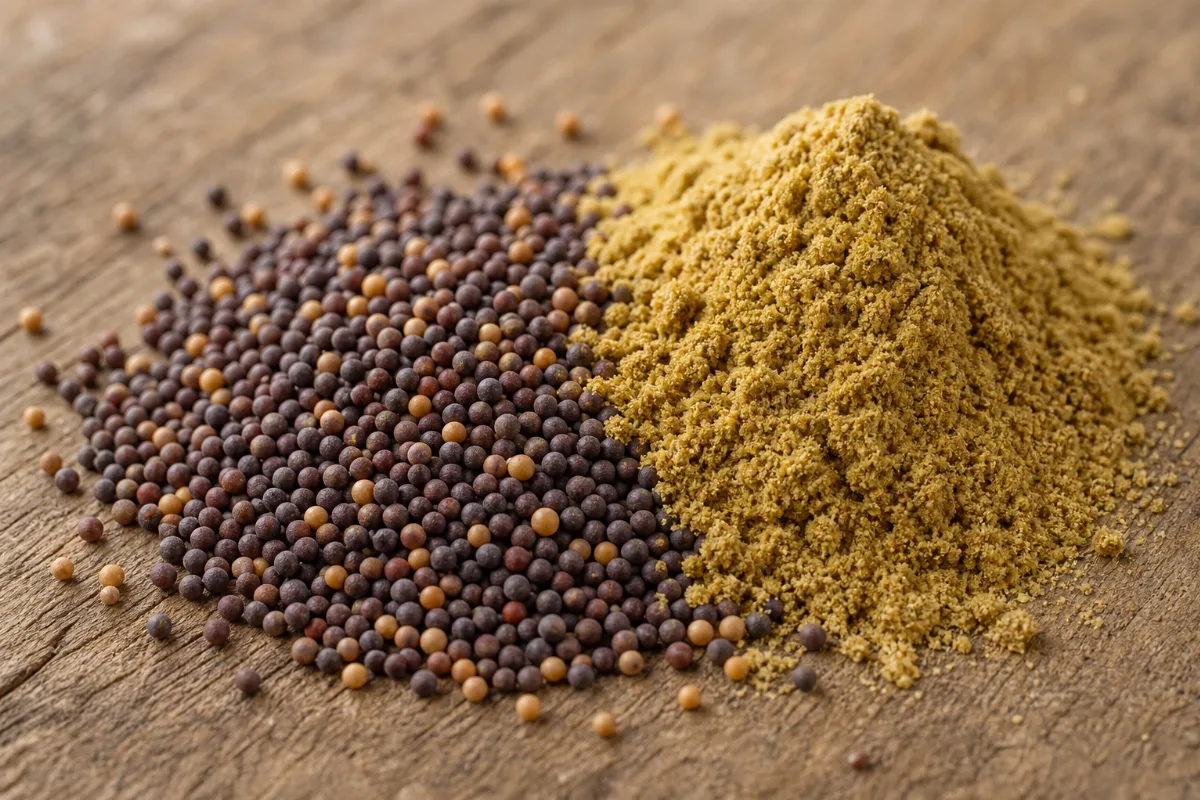
Mustard seed comes from three plants in the cabbage family (Brassicaceae): brown mustard (Brassica juncea), black mustard (Brassica nigra) and white or yellow mustard (Sinapis alba). The seeds are used whole, ground, or mixed with liquid as prepared mustard.
Whole dry seed has little bite. When it is crushed and wetted, a plant enzyme called myrosinase turns stored compounds (glucosinolates) into sharp-tasting isothiocyanates. A 2026 review says temperature, acidity and crushing all change how much forms.
Nutrition (USDA FoodData Central): ground mustard seed has 508 kcal per 100 g. One teaspoon (2.0 g) gives about 10 kcal, 0.5 g protein, 0.2 g fibre, 5 mg calcium, 7 mg magnesium, 15 mg potassium and 4 micrograms selenium. Prepared yellow mustard has 60 kcal and 1,100 mg sodium per 100 g, so a 5 g teaspoon has about 55 mg sodium. A spoonful is mostly flavour. Values are from 2019 data and real products vary.
What the research shows
The only human study of a mustard preparation we found had 14 adults who ate it for a few days. Blood cells showed less DNA damage in the lab, and cholesterol fell. These were early markers in a tiny, short study. It does not show that mustard prevents cancer or lowers cholesterol for good.
A white mustard toothpaste gave small gains in plaque and gum bleeding in a dental trial. That is a product, not the spice.
Other findings are from cells and animals. No trial of mustard seed as an everyday spice was found for blood pressure, blood sugar, digestion or any other outcome.
Food versus toothpaste, plasters and extracts
The toothpaste and extract results do not tell us about the spice in food, and plasters are a skin use with documented burns. The 14-person study used a mustard preparation, not capsules.
Amounts
This page gives no amounts to eat. Ask a doctor, pharmacist or allergist what is right for you, especially if you have food allergies.
At a glance
Traditional uses history, not proof
- Used whole, ground or as prepared mustard in cooking and condiments
- Mustard plasters on the skin were an old folk remedy for aches and chest congestion; burns have been reported
- Long use as food is not proof that it treats any condition
Studied for research
- Early DNA-damage markers in blood cells, very low certainty (one 14-person study)
- Blood cholesterol, very low certainty (same small study)
- Blood pressure, blood fats and blood sugar, insufficient evidence (cabbage-family foods in general)
- Gum health with a white mustard toothpaste, very low certainty (not a food)
- Anti-inflammatory and antimicrobial activity, lab and animal work only
- Mustard plasters on the skin, evidence against (burns)
Main compounds
- Sinigrin
- Sinalbin
- Allyl isothiocyanate
- Selenium
- Fibre
- Seed allergen proteins
Common forms
- Whole seeds, fried in oil or used in pickles
- Ground mustard seed
- Prepared mustard (seed mixed with water, vinegar or wine)
- Plasters or pastes on skin (not a food; burns reported)
- Toothpaste or extracts (the dental studies used these, not the spice)
Research links: NHS: Food allergy · 2026 review: allergic reactions to spices · Mustard-induced anaphylaxis in a toddler (2026 case report) · Research Library · Genes & Biomarkers Library
What it is and its history
- Accepted scientific name
- Brassica juncea, Brassica nigra and Sinapis alba (the three plants whose seeds are sold as mustard seed)
- Naming authority
- L. Czern. (B. juncea); L. W.D.J.Koch (B. nigra); L. (S. alba). All three are accepted names in GBIF.
- Common names
- Mustard seed (English); Brown mustard (B. juncea) (English); Black mustard (B. nigra) (English); White or yellow mustard (S. alba) (English); Semilla de mostaza (Spanish)
- Family or group
- Brassicaceae (the cabbage or mustard family), per GBIF.
- Classification
- Plantae > Tracheophyta > Magnoliopsida > Brassicales > Brassicaceae > Brassica / Sinapis > Brassica juncea; Brassica nigra; Sinapis alba
- Native range
- Not verified from a source read.
- Habitat
- Not verified from a source read.
- What it looks like
- Roots: Not verified.; Stems: Not verified.; Leaves: Not verified.; Flowers: Not verified.; Fruit: The seed is the part used as a spice. Size and colour were not verified from a source read.
- Cultivation
- Not verified from a source read.
- Harvest and processing
- Sold as whole seeds, ground powder and prepared mustard (seed mixed with liquid); the seed is also pressed for oil (earlier summary, not re-verified). How crushing and wetting create the pungent taste is described by the 2026 Brassica review in general terms (enzyme myrosinase, pH, temperature, crushing).
- Look-alikes and adulterants
- Name: Mustard greens and other cabbage-family foods; Note: Different parts and foods with their own pages. The glucosinolate review covers Brassica foods together.; Name: Horseradish and wasabi; Note: Also give a sharp bite through a similar enzyme reaction; separate foods with their own page.
- Sustainability and conservation
- Not assessed.
Photographs
What is inside, and how it may work
What it contains and how those compounds act in cells and animals. Laboratory and animal mechanisms are not proven effects in people.
Main compounds
| Compound | Family | Where it is concentrated | Activity studied | Level of evidence |
|---|---|---|---|---|
| Sinigrin (glucosinolate) PubChem 6911854 | glucosinolate | Seed Not given in the sources read | Named in the white mustard review as a main seed glucosinolate; forms allyl isothiocyanate when the seed is crushed and wet. 1 | Review |
| Sinalbin (glucosinolate) PubChem 76956748 | glucosinolate | Seed Not given in the sources read | Named in the white mustard review as a main seed glucosinolate of white mustard. 1 | Review |
| Allyl isothiocyanate PubChem 5971 | isothiocyanate | Seed (formed when crushed and wet) Not given in the sources read | The sharp-tasting product formed from sinigrin; isothiocyanates are active in the lab. The 14-person trial used a preparation with 25 mg total isothiocyanates in 20 g. 3 7 | Human data |
| Seed proteins Sin a 1 and Sin a 2 (white mustard allergens) | allergen proteins | Seed Not applicable | Named by the 2026 review as seed proteins linked to allergy risk. 1 5 | Review |
Mechanisms, receptors and pathways
| Target or pathway | Gene or receptor | What was found | Level |
|---|---|---|---|
| Glucosinolate to isothiocyanate conversion | Myrosinase (plant enzyme) | When seed is crushed and wetted, myrosinase turns glucosinolates into isothiocyanates. Temperature, pH, processing, the rest of the food, gut bacteria and individual differences change the yield. 7 | Review |
| Inflammation signals and microbes | TNF-alpha (named in the review) | Mustard-derived products suppressed TNF-alpha and inhibited many microbes in lab work. 1 | Lab and animal |
| Allergy (IgE-mediated) | IgE antibodies to seed proteins | Mustard allergy is diagnosed with skin prick tests and blood tests for specific IgE antibodies; the toddler case had a 15 mm wheal. 4 2 | Human data |
Absorption, metabolism and elimination
- Absorption
- Not found in the sources read.
- Distribution
- Not found.
- Metabolism
- The Brassica review says conversion in the gut and individual differences affect exposure to isothiocyanates.
- Elimination
- Not found.
- Bioavailability
- Not established for mustard seed in the sources read.
Isolated compounds versus whole extracts
The toothpaste trial used a white mustard product and the lab work used concentrated compounds, so neither tells us about sprinkling seed on food. The 14-person trial used a mustard preparation, not an extract. Seed, powder, prepared mustard, oil, plaster and toothpaste are different products.
Nutritional composition
Source: USDA FoodData Central, SR Legacy (last updated 2019), read 2026-10-26. Values per 100 g of ground mustard seed (FDC 170929): 508 kcal, 26.1 g protein, 36.2 g fat (1.99 g saturated), 28.1 g carbohydrate, 12.2 g fibre, 266 mg calcium, 9.21 mg iron, 370 mg magnesium, 738 mg potassium, 13 mg sodium, 208 micrograms selenium, 162 micrograms folate (DFE), 5.4 micrograms vitamin K. A teaspoon of ground seed weighs about 2.0 g, so it gives about 10 kcal, 0.5 g protein, 0.7 g fat, 0.2 g fibre, 5 mg calcium, 7 mg magnesium, 15 mg potassium and 4 micrograms selenium (calculated from the per-100 g values). A tablespoon (6.3 g) gives about 32 kcal and 13 micrograms selenium. Prepared yellow mustard (FDC 172234), per 100 g: 60 kcal, 3.7 g protein, 3.3 g fat, 5.8 g carbohydrate, 4.0 g fibre and 1,100 mg sodium. A teaspoon or packet (5.0 g) has about 3 kcal and about 55 mg sodium (calculated). So a spoonful is mostly flavour, with small amounts of minerals. Real products vary, and we did not compare these numbers with daily values.
3 very low certainty2 not enough evidence1 evidence against
What was looked at
The 6 benefits and uses checked for Mustard seed, each with how strong the evidence is. Tap one to open it.
- Early DNA-damage markers in blood cells (mustard preparation)Very low certainty
- Blood cholesterol (mustard preparation)Very low certainty
- Blood pressure, blood fats and blood sugar (cabbage-family foods in general)Not enough evidence
- Gum health (white mustard toothpaste or extract)Very low certainty
- Anti-inflammatory and antimicrobial activity (lab and animal work)Not enough evidence
- Mustard plasters on the skin for pain or chest congestionEvidence against
Lab markers tracked in the studies
DNA damage and micronuclei in blood cells (lab challenge)Blood cholesterolDental plaque index and gum bleedingIsothiocyanate formation from glucosinolates
What is Mustard seed good for?
The studied uses and how strong the human evidence is for each. Almost everything here comes from one tiny study, from products that are not the spice, or from the lab.
Benefits, one by one
Each card is a research question, not a promise. Tap a goal to filter. Open a card to see the studies, doses and limits.
Early DNA-damage markers in blood cells (mustard preparation)
Very low certaintyIn one tiny study, 14 people ate a mustard preparation for a few days and their blood cells showed less DNA damage when challenged in the lab. These are early markers, not cancer. Nobody can say from this that mustard lowers cancer risk.
1 studiesA mustard preparation (not an extract or capsule), used in the trial.…
Studies, doses and limits
What the trials found
A controlled study of 14 volunteers (10 women, 4 men) gave 20 g a day of a mustard preparation (25 mg total isothiocyanates) for 4 days. After it, blood cells had significantly less DNA damage and fewer micronuclei when challenged with hydrogen peroxide or a cancer-causing chemical in the lab (PubMed 22157087).
Results
Fewer DNA-damage and micronucleus signs in blood cells after a short mustard preparation. The abstract gives no numbers.
Effect sizes as reported
Not given in the abstract (described as significant).
Why this rating
Very low: 14 people, a few days, early lab markers, no disease outcome, product and mustard type not named in the abstract, and no control group is described. Nothing else was found to confirm it.
Form and dose studied
A mustard preparation (not an extract or capsule), used in the trial. Not advice.
Who was studied
Healthy adult volunteers (10 women, 4 men).
Limits
Tiny, short, uncontrolled as far as the abstract shows. Markers are not cancer. The abstract says both 3 and 4 days.
Why researchers looked
Mustard seed contains glucosinolates, which turn into isothiocyanates when the seed is crushed and wetted. Isothiocyanates are active in lab studies, so researchers tested a mustard preparation in people.
Traditional use
Mustard seed is used as a spice and condiment. Long use in food is not proof of any health effect.
Proposed mechanism Hypothesis
Isothiocyanates formed from glucosinolates are thought to affect protective enzymes (our earlier summary; the 2026 review describes how they form). This was not measured in the trial.
A proposed mechanism does not show that the effect happens in people.
Mustard is a strong allergen. Anyone with a mustard allergy must avoid it; see the Safety tab.
Blood cholesterol (mustard preparation)
Very low certaintyThe same 14-person study reported that cholesterol fell and liver tests did not change. It is one small result from a short study, so it is a hint, not a finding to rely on.
1 studiesA mustard preparation, as used in the trial. Not advice.
Studies, doses and limits
What the trials found
In the 14-person controlled study of 20 g a day of a mustard preparation for a few days, the abstract says clinical liver tests were unchanged but cholesterol levels were significantly reduced (PubMed 22157087).
Results
Cholesterol fell significantly; liver tests were unchanged. The abstract does not say which cholesterol measure or by how much.
Effect sizes as reported
Not given in the abstract.
Why this rating
Very low: one tiny, short study, no numbers in the abstract, no confirmation. Cholesterol changes over a few days do not show lasting effect.
Form and dose studied
A mustard preparation, as used in the trial. Not advice.
Who was studied
14 healthy adult volunteers.
Limits
One study. Size of change unknown. Not tested over weeks or months. Not a test of mustard seed as an everyday spice.
Why researchers looked
Cholesterol was measured alongside the DNA-damage markers in the same trial.
Traditional use
Mustard seed is eaten as a spice and condiment. Long use in food is not proof of any health effect.
Proposed mechanism Unknown
Not explained in the abstract.
A proposed mechanism does not show that the effect happens in people.
Allergy is the main concern; see the Safety tab.
Blood pressure, blood fats and blood sugar (cabbage-family foods in general)
Not enough evidenceReviews of cabbage-family foods report promising effects on blood pressure, blood fats and blood sugar, but studies are small and mixed and mustard seed is not singled out. There is no good evidence for mustard seed itself.
1 studiesCabbage-family foods and extracts in general; not mustard seed alone.
Studies, doses and limits
What the trials found
The 2026 Nutrients review of Brassica foods says similar glucosinolate content can give very different exposure to active compounds, so glucosinolate content alone is an unreliable guide (PubMed 42654204). The abstract gives no result for blood pressure, blood fats or blood sugar and does not single out mustard seed. An earlier 2025 PMC review cited in our summary was not re-opened.
Results
No mustard-seed-specific result. The review is about how Brassica foods work, not a trial.
Why this rating
Insufficient: the review covers cabbage-family foods as a group and gives no mustard-seed figure. A 2025 review in our earlier summary is marked summary-only.
Form and dose studied
Cabbage-family foods and extracts in general; not mustard seed alone.
Limits
Review abstract only. Mixed foods and extracts. Differences between people.
Why researchers looked
Mustard seed is a cabbage-family (Brassica) seed with glucosinolates, so it is often grouped with broccoli, cabbage and similar foods.
Traditional use
Mustard seed is a spice and condiment; the oil is a cooking oil in South Asia (our earlier summary). Long use is not proof of any health effect.
Proposed mechanism Review
A 2026 review says glucosinolates are inactive precursors. The plant enzyme myrosinase, pH, temperature, crushing, processing, the rest of the food and the gut all change how much active isothiocyanate you get, and people differ.
A proposed mechanism does not show that the effect happens in people.
The same review names goitrin, a thyroid-affecting breakdown product, as one to limit; no risk figure for mustard seed was found.
Gum health (white mustard toothpaste or extract)
Very low certaintyA review reports one 113-person trial in which a white-mustard toothpaste lowered plaque and gum bleeding scores slightly more than a placebo toothpaste over four weeks. This is toothpaste, not mustard as a food, and the review calls for better trials.
1 studiesWhite mustard toothpaste or sinigrin-rich extract. Not food.
Studies, doses and limits
What the trials found
A 2026 narrative review describes the largest double-blind dental trial to date (113 people): a white-mustard toothpaste lowered the plaque index by 2.43 versus 1.95 for placebo and bleeding on probing by 30.6% versus 26.8% within four weeks. A six-month follow-up with a sinigrin-rich extract confirmed these gains (PubMed 41752449).
Results
Small extra improvement over placebo in plaque and bleeding scores. The authors say it is a promising add-on and that comparison with standard mouthwash (chlorhexidine) is still needed.
Effect sizes as reported
Plaque index -2.43 vs -1.95; bleeding on probing -30.6% vs -26.8% (four weeks).
Why this rating
Very low for any food use. The result is for a toothpaste or extract, comes from a review abstract (the trial was not opened), and differences were small. Trial funding is not stated.
Form and dose studied
White mustard toothpaste or sinigrin-rich extract. Not food.
Who was studied
Adults in a dental trial (113 people).
Limits
Review abstract only. Products are not standardised. The review flags an unresolved allergy risk from seed proteins.
Why researchers looked
White mustard (Sinapis alba) seed compounds acted against mouth bacteria and inflammation signals in lab studies.
Traditional use
Not a food use. Mustard seed products have been tried in dental products.
Proposed mechanism Preliminary mechanism
Seed compounds (isothiocyanates, flavonoids, tocopherols) showed anti-inflammatory and antimicrobial activity in lab and animal studies, per the review.
A proposed mechanism does not show that the effect happens in people.
Mustard allergy: the review warns of allergy risk from seed proteins Sin a 1 and Sin a 2.
Anti-inflammatory and antimicrobial activity (lab and animal work)
Not enough evidenceIn cells and animals, mustard seed compounds calmed inflammation signals and held back some germs. This is lab work only. It does not show a benefit in people.
1 studiesConcentrated seed compounds in the lab; not food amounts.
Studies, doses and limits
What the trials found
No human trial of these effects from eating mustard seed was found. The 2026 review of white mustard describes them as lab and animal findings (PubMed 41752449).
Results
Lab and animal findings only.
Why this rating
Lab or animal only. Nothing here shows effect in people.
Form and dose studied
Concentrated seed compounds in the lab; not food amounts.
Who was studied
Cells and animals.
Limits
Cell and animal work at concentrations that may not be reached by eating the spice.
Why researchers looked
Isothiocyanates and other compounds in the seed are active in the lab.
Traditional use
Mustard plasters and seed were used in folk medicine for pain, congestion and more (as described in the burn case reports). Folk use is not proof.
Proposed mechanism Animal and lab only
Mustard-derived products suppressed pro-inflammatory signals such as TNF-alpha and inhibited many microbes at micromolar concentrations in lab studies (review abstract).
A proposed mechanism does not show that the effect happens in people.
None specific.
Mustard plasters on the skin for pain or chest congestion
Evidence againstMustard plasters are an old folk remedy, but no controlled trial was found. The reports we found describe second-degree burns. They are a warning, not a benefit.
2 studiesSkin plaster or paste. Not food.
Studies, doses and limits
What the trials found
Two case reports describe second-degree burns after a mustard plaster on the knee and on the chest and neck (PubMed 22666267, 28329477). No trial showing benefit was found.
Results
Burns reported; no benefit shown.
Why this rating
Against skin use: only harm is documented in the cases found. No benefit trial was found.
Form and dose studied
Skin plaster or paste. Not food.
Who was studied
Two adult women in case reports.
Limits
Case reports cannot say how often burns happen.
Why researchers looked
Folk use for rheumatism, arthritis, chest congestion and muscle aches.
Traditional use
Mustard plasters (mustard powder mixed with flour) are an old folk remedy.
Proposed mechanism Unknown
Not explained in the sources read.
A proposed mechanism does not show that the effect happens in people.
Burns and nerve damage can follow long application (case report authors).
Connections to the rest of health
How Mustard seed connects to the rest of our health knowledge graph. Every link says what kind of connection it is. A safety link (for example to the liver) is a warning, not a benefit. A study that merely mentions a topic never creates a benefit link.
Explore every connection: goals, body systems, organs, symptoms, genes
B. Body systems
| Connected to | Kind of connection | Evidence status | Context | Studies |
|---|---|---|---|---|
| Immune System | Biological association | Very low certainty | Studied for: Early DNA-damage markers in blood cells (mustard preparation) Studied for: Anti-inflammatory and antimicrobial activity (lab and animal work) | 3 1 |
| Cardiovascular System | Biological association | Very low certainty | Studied for: Blood cholesterol (mustard preparation) Studied for: Blood pressure, blood fats and blood sugar (cabbage-family foods in general) | 3 7 |
| Endocrine System | Biological association | Not enough evidence | Studied for: Blood pressure, blood fats and blood sugar (cabbage-family foods in general) | 7 |
| Digestive System | Biological association | Very low certainty | Studied for: Gum health (white mustard toothpaste or extract) | 1 |
| Integumentary System | Biological association | Evidence against | Studied for: Mustard plasters on the skin for pain or chest congestion | 8 6 |
C. Body parts and organs
E. Health conditions
| Connected to | Kind of connection | Evidence status | Context | Studies |
|---|---|---|---|---|
| Food allergy | Adverse effect or risk | Documented risk | Mustard is one of the more allergenic spices; reactions can be severe. Mustard is a strong food allergen; reactions can be severe. Preparation or compound: Mustard seed proteins (including in hidden form) |
4 5 2 |
I. Biomarkers
| Connected to | Kind of connection | Evidence status | Context | Studies |
|---|---|---|---|---|
| DNA damage and micronuclei in blood cells (lab challenge) | Biological association | Very low certainty | Measured in trials: lowered. A lab change is not the same as a health benefit. | 3 |
| Blood cholesterol | Biological association | Very low certainty | Measured in trials: lowered. A lab change is not the same as a health benefit. | 3 |
| Dental plaque index and gum bleeding | Biological association | Very low certainty | Measured in trials: lowered. A lab change is not the same as a health benefit. | 1 |
| Isothiocyanate formation from glucosinolates | Biological association | Low certainty | Measured in trials: unclear. A lab change is not the same as a health benefit. | 7 |
K. Biological pathways
| Connected to | Kind of connection | Evidence status | Context | Studies |
|---|---|---|---|---|
| Selenium | Preliminary mechanism | Human | Ground mustard seed has 208 micrograms of selenium per 100 g (USDA); about 4 micrograms per teaspoon. | 14 |
| Isothiocyanates | Preliminary mechanism | Review | Formed from glucosinolates when the seed is crushed and wet; yield varies with preparation and person. | 7 |
| Food allergy | Preliminary mechanism | Human | Mustard proteins are a strong food allergen. | 4 5 2 |
L. Active compounds
| Connected to | Kind of connection | Evidence status | Context | Studies |
|---|---|---|---|---|
| Sinigrin (glucosinolate) | Biological association | Review | Named in the white mustard review as a main seed glucosinolate; forms allyl isothiocyanate when the seed is crushed and wet. Preparation or compound: Seed |
1 |
| Sinalbin (glucosinolate) | Biological association | Review | Named in the white mustard review as a main seed glucosinolate of white mustard. Preparation or compound: Seed |
1 |
| Allyl isothiocyanate | Biological association | Human | The sharp-tasting product formed from sinigrin; isothiocyanates are active in the lab. The 14-person trial used a preparation with 25 mg total isothiocyanates in 20 g. Preparation or compound: Seed (formed when crushed and wet) |
3 7 |
| Seed proteins Sin a 1 and Sin a 2 (white mustard allergens) | Biological association | Review | Named by the 2026 review as seed proteins linked to allergy risk. Preparation or compound: Seed |
1 5 |
Each connection is stored with the ingredient, the connected record, the kind of connection, the evidence status, the supporting studies, the preparation or compound involved, and a review date (last reviewed October 26, 2026).
Evidence at a glance: what changed in 3 lab markers
Tap a number to show only those markers. Counts are markers, not people.
The evidence
The research centre for Mustard seed. Every record here was checked against PubMed or the publisher's page; we never list a study we have not verified.
Evidence by outcome
Bars show how many studies we found for each outcome, not how well it works. People are added up across trials only (reviews are not added, to avoid double counting).
How we rate evidence
High certainty
Several well-run trials or reviews agree; further research is unlikely to change the picture much.
Moderate certainty
Good trials point the same way, but some doubt remains.
Low certainty
Small, short or inconsistent trials. The finding could change with better research.
Very low certainty
Very little or very weak human data. Treat as a possibility only.
Mixed findings
Trials or reviews disagree with each other.
Not enough evidence
Not enough human research to say either way.
Evidence against
Good research found no benefit, or found harm.
We take the reviewers' own risk-of-bias and GRADE statements where they exist, and otherwise judge from study size, design, consistency, directness and whether a product matches what is sold. Many publications do not make evidence high. Method note: We started from our existing mustard seed summary, re-checked nutrition at USDA FoodData Central, read the NHS food allergy page and the PubMed abstracts. Only abstracts were read for studies. Items we could not verify, such as the Health Canada document, are flagged in the research gaps.
Study library: every study we checked 15
| Study | Design | People | Product, dose, length | Result |
|---|---|---|---|---|
| Brodzikowska 2026 Phytochemistry and Application of White Mustard (Sinapis alba) in Medicine and Dentistry-A Narrative Review. Molecules · PMID 41752449 · DOI |
Narrative review human, lab and animal |
113 Mostly lab and animal work; the largest clinical trial it describes had 113 people (dental) |
White mustard (Sinapis alba) seed products: toothpaste and a sinigrin-rich extract Seed Not given 4 weeks (toothpaste trial); 6 months (follow-up study) · vs Placebo toothpaste |
The review says mustard-derived products reduced inflammation signals such as TNF-alpha and inhibited many microbes in lab work. In the largest double-blind dental trial it describes (113 people), a white-mustard toothpaste lowered the plaque index by 2.43 versus 1.95 for placebo, and bleeding on probing by 30.6% versus 26.8% within four weeks. A six-month follow-up study of a sinigrin-rich extract confirmed these gains. The authors say translation is limited by varying extraction methods, no standard product and an unresolved allergy risk from seed proteins Sin a 1 and Sin a 2. Plaque index -2.43 vs -1.95; bleeding on probing -30.6% vs -26.8% (Not given in the abstract) Methods, limits and fundingOutcomes: Plaque index, bleeding on probing, mouth bacteria counts; lab anti-inflammatory and antimicrobial activity Limitations: Narrative review, and only its abstract was read; the trial itself was not opened. Differences between toothpaste and placebo were small. It is a toothpaste or extract, not mustard as food. Funding and conflicts: The review authors declare no conflicts of interest. Trial funding not stated. Read: abstract |
| Katz 2026 Mustard-Induced Anaphylaxis in a 23-Month-Old Male: An Underrecognized Pediatric Food Allergen in the United States. Cureus · PMID 42732437 · DOI |
Case report |
1 One 23-month-old boy with a history of egg allergy |
Mustard as a food exposure Condiment Single exposure |
Within minutes of a single mustard exposure the child developed widespread hives, lip swelling, a bluish colour around the mouth and cough. Symptoms eased quickly after an adrenaline (epinephrine) injection into the muscle. A skin prick test showed marked mustard sensitisation (15 mm wheal, 25 mm flare). The authors say mustard is often a hidden ingredient in condiments, sauces and processed foods and is not a required major allergen on US labels under FALCPA. One case Methods, limits and fundingOutcomes: Allergic reaction and skin prick test Limitations: A single case. It shows that severe reactions happen, not how often. Authors report no conflicts of interest. Funding and conflicts: No funding and no conflicts reported. Read: abstract |
| Lamy 2012 Antigenotoxic action of isothiocyanate-containing mustard as determined by two cancer biomarkers in a human intervention trial. European Journal of Cancer Prevention · PMID 22157087 · DOI |
Controlled trial |
14 14 volunteers (10 women, 4 men) |
A mustard preparation containing isothiocyanates (25 mg total isothiocyanates in 20 g) Mustard (preparation; species not stated in the abstract) Trial detail, not advice: 20 g a day 4 days (the abstract also says 3-day intervention) · vs Not clear from the abstract (blood taken before and after) |
After the mustard days, blood cells showed significantly less DNA damage and fewer micronuclei when challenged with hydrogen peroxide or a cancer-causing chemical in the lab dish. Liver tests did not change. Cholesterol fell significantly. The authors suggest even short-term intake of isothiocyanate-containing vegetables might be linked to lower cancer risk. Significant reduction in DNA damage and micronuclei; significant fall in cholesterol (sizes not given in the abstract) (Not given in the abstract) Methods, limits and fundingOutcomes: DNA damage (comet assay) and micronucleus formation in blood cells after a chemical challenge; liver tests; cholesterol Limitations: Only 14 people. Very short. Early lab markers, not cancer or heart disease. No control group is described in the abstract. The abstract says 4 days in one place and 3 days in another. Mustard type and product are not named. The authors are cautious in wording but the final sentence reaches further than the data. Funding and conflicts: Funding not stated in the abstract (listed as non-US-government research support). Read: abstract |
| Lisiecka 2026 Allergic reactions to spices: a review of sensitivities to pepper, cumin, oregano, anise, mustard and other spices. European Annals of Allergy and Clinical Immunology · PMID 40341008 · DOI |
Narrative review |
People with spice allergy (studies 2010 to 2023) | Spices as food, including mustard Spice |
The review says mustard is one of the most allergenic spices and its proteins can cause severe reactions even in small amounts. Diagnosis uses skin prick tests and blood tests for specific IgE antibodies. Cross-reactions among spices and other allergens make diagnosis harder. No numbers given in the abstract Methods, limits and fundingOutcomes: Spice allergy, severity, cross-reactivity, diagnosis Limitations: Narrative review, not a systematic one. Only the abstract was read, so how common mustard allergy is was not found. Funding and conflicts: Not stated in the abstract. Read: abstract |
| Sharma 2019 A Comprehensive Review on Mustard-Induced Allergy and Implications for Human Health. Clinical Reviews in Allergy & Immunology · PMID 29159565 · DOI |
Narrative review |
People with mustard allergy in published clinical studies | Mustard as food Seed and mustard products |
The review says mustard allergy has been reported for many years and is increasing gradually, especially where mustard is eaten more. It may be among the most important food allergies. Mustard can be a hidden allergen in foods, so allergic people need to recognise products that may contain it. The authors suggest mustard sensitivity should be tested in people with unexplained (idiopathic) anaphylaxis. No numbers given in the abstract Methods, limits and fundingOutcomes: Mustard allergy reports, allergens and cross-reactivity Limitations: Narrative review. Only the abstract was read. The abstract gives no figure for how common mustard allergy is. Funding and conflicts: Not stated in the abstract. Read: abstract |
| Tartar 2017 Second degree burn to mustard powder. Dermatology Online Journal · PMID 28329477 |
Case report |
1 One woman using a mustard plaster for chest congestion |
Mustard powder plaster on skin Seed (powder) |
A woman developed second-degree burns on the lower neck and chest after using a mustard plaster for chest congestion. She healed completely with silver sulfadiazine, emollients and a steroid ointment. One case Methods, limits and fundingOutcomes: Skin burn and recovery Limitations: A single case of skin use, not of eating mustard. Funding and conflicts: Not stated in the abstract. Read: abstract |
| Wondolowska-Grabowska 2026 From Glucosinolate Content to Isothiocyanate Yield: Rethinking Brassica Functionality. Nutrients · PMID 42654204 · DOI |
Narrative review human, plant and lab |
Brassica vegetables in general (cabbage family); mustard seed is not singled out in the abstract | Glucosinolates and the isothiocyanates they form Brassica foods |
The review says glucosinolates are inactive precursors. What the body gets depends on the plant enzyme myrosinase, pH, temperature, cutting or crushing, processing, the food mix, gut changes and differences between people. Similar glucosinolate content can give very different amounts of active compounds. It also names goitrin, a goitrogenic product, as something to limit in a food-optimisation approach. No numbers given in the abstract Methods, limits and fundingOutcomes: How glucosinolates turn into isothiocyanates and what affects it Limitations: Narrative review of Brassica foods as a group. Only the abstract was read. It does not give a risk figure for mustard seed. Funding and conflicts: The authors declare no conflicts of interest. Read: abstract |
| Yabanoglu 2012 Phytocontact Dermatitis due to Mustard Seed Mimicking Burn Injury: Report of a Case. Case Reports in Medicine · PMID 22666267 · DOI |
Case report |
1 One woman using a mustard-seed mixture on her knee for osteoarthritis pain |
Mustard-seed mixture applied to skin (plaster) Seed |
The authors describe a second-degree burn after a mixture containing mustard seed was put on the skin for knee pain. They say prolonged application can burn the skin and damage nerves, lesions appear within hours, and conservative treatment is their first choice. One case Methods, limits and fundingOutcomes: Skin burn Limitations: A single case of skin use, not of eating mustard. Funding and conflicts: Not stated in the abstract. Read: abstract |
| s-gbif-brassica-juncea GBIF Backbone: Brassica juncea (L.) Czern. (usageKey 3042751) · Source |
Reference database n/a |
Methods, limits and fundingRead: full-text | ||
| s-gbif-brassica-nigra GBIF Backbone: Brassica nigra (L.) W.D.J.Koch (usageKey 3042658) · Source |
Reference database n/a |
Methods, limits and fundingRead: full-text | ||
| s-gbif-sinapis-alba GBIF Backbone: Sinapis alba L. (usageKey 3047621) · Source |
Reference database n/a |
Methods, limits and fundingRead: full-text | ||
| s-healthcanada-mustard Health Canada: Mustard, a priority food allergen (2017) · Source |
Health agency n/a |
Methods, limits and fundingRead: summary-only | ||
| s-nhs-food-allergy NHS: Food allergy · Source |
Health agency n/a |
Methods, limits and fundingRead: full-text | ||
| s-usda-fdc-170929 USDA FoodData Central: Spices, mustard seed, ground (FDC 170929) · Source |
Reference database n/a |
Methods, limits and fundingRead: full-text | ||
| s-usda-fdc-172234 USDA FoodData Central: Mustard, prepared, yellow (FDC 172234) · Source |
Reference database n/a |
Methods, limits and fundingRead: full-text |
What we do not know yet
- No trial of mustard seed as an everyday spice was found for any health outcome.
- The only human study of a mustard preparation had 14 people and no numbers in its abstract.
- How common mustard allergy is was not found in the abstracts read.
- Pregnancy, breastfeeding, medicine interactions, contamination and mustard oil were not researched.
- Health Canada and EU allergen-labelling statements could not be re-checked and are not stated as fact here.
How new research is added
New studies are found by a saved PubMed search and placed in a review queue before the page changes.
Lab markers
What changed in blood or saliva tests during trials. A changed number is not the same as feeling or being healthier, and we give no "normal ranges".
Other 4
DNA damage and micronuclei in blood cells (lab challenge)
Lowered in trials
Lab tests (the comet assay and micronucleus test) that count how much DNA damage appears in blood cells when they are exposed to a damaging chemical.
Very low certaintyResults and what it means
Why it was measured
Researchers use them as early signs of how well cells resist DNA damage. They are not a measure of cancer.
Statistical vs. clinical meaning
An early marker in 14 people. It does not show that mustard prevents cancer.
Safety implication
None specific; allergy applies.
| Study | Result | People | Product |
|---|---|---|---|
| 3 | Significantly less DNA damage and micronucleus formation after a 3- to 4-day mustard preparation (numbers not in the abstract) | 14 adult volunteers | Mustard preparation with isothiocyanates, 20 g a day |
Blood cholesterol
Lowered in trials
The amount of cholesterol in the blood, measured by a blood test.
Very low certaintyResults and what it means
Why it was measured
High blood cholesterol is a risk factor for heart disease.
Statistical vs. clinical meaning
One small, short study. Not enough to rely on.
Safety implication
Liver tests did not change in this trial.
| Study | Result | People | Product |
|---|---|---|---|
| 3 | Cholesterol significantly reduced; liver tests unchanged (numbers not in the abstract) | 14 adult volunteers | Mustard preparation, 20 g a day for a few days |
Dental plaque index and gum bleeding
Lowered in trials
Dentist-measured scores of how much plaque is on the teeth and how often gums bleed when probed.
Very low certaintyResults and what it means
Why it was measured
They show gum inflammation and plaque build-up.
Statistical vs. clinical meaning
Small differences; toothpaste product; review abstract only.
Safety implication
Seed-protein allergy risk flagged by the review.
| Study | Result | People | Product |
|---|---|---|---|
| 1 | Plaque index -2.43 vs -1.95 for placebo; bleeding on probing -30.6% vs -26.8% over four weeks | 113 adults in a dental trial (as reported by the review) | White mustard toothpaste (not food) |
Isothiocyanate formation from glucosinolates
Unclear in trials
How much of the seed's stored glucosinolates actually turn into active isothiocyanates when the food is prepared and digested.
Low certaintyResults and what it means
Why it was measured
The review argues this yield, not glucosinolate content, decides what the body is exposed to.
Statistical vs. clinical meaning
Explains why the same food can act differently in different people; not a health outcome.
Safety implication
Goitrin, a thyroid-affecting product, is named as something to limit; no mustard-seed figure.
| Study | Result | People | Product |
|---|---|---|---|
| 7 | Yield depends on myrosinase activity, pH, temperature, crushing, processing, food mix, gut changes and the person (review conclusion; no numbers in the abstract) | Brassica foods in general | Not applicable |
Safety
What studies and official sources say about side effects, medicines and who should check first. Each point shows what kind of evidence it comes from.
Main points to know 5
- Allergy: mustard is a strong allergen and reactions can be severe. A 2026 spice-allergy review calls mustard one of the most allergenic spices and says its proteins can cause severe reactions even in small amounts. A 2019 review says mustard allergy has been reported for many years, may be increasing where mustard is eaten more, and that mustard can be a hidden allergen in foods. The NHS lists mustard among foods people can be allergic to. If you think you are allergic, see a doctor or allergist. Review 4 5 13
- Hidden mustard and a toddler case. A 2026 case report describes a 23-month-old who developed hives, lip swelling and cough within minutes of a single mustard exposure and needed an adrenaline injection. The authors say mustard is often hidden in condiments, sauces and processed foods and is not a required major allergen on US food labels. Case report 2
- Skin: mustard plasters have caused second-degree burns. Two case reports describe second-degree burns after mustard plasters were used for knee pain and chest congestion. One report says prolonged application can burn the skin and damage nerves, with lesions appearing within hours. Mustard on the skin is not a food use. Case report 8 6
- Cross-reaction with other cabbage-family seeds. Our earlier summary reports Health Canada saying mustard proteins resemble those in other cabbage-family seeds, so allergic people are advised to avoid those seeds, sprouted seeds and cold- or expeller-pressed canola oil. This was not re-opened for this page. The 2019 review also discusses cross-reactivity with other allergens. Authoritative guidance 12 5
- Thyroid: a general Brassica note, no mustard figure. A 2026 review of Brassica foods names goitrin, a breakdown product that can affect the thyroid, as something to limit. It gives no risk figure for mustard seed, and no source read says normal food amounts of mustard seed affect the thyroid. Review 7
Side effects 2
| Effect | How often | Severity and recovery | Evidence |
|---|---|---|---|
| Allergic reactions, from hives and swelling to anaphylaxis Reviews call mustard one of the more allergenic spices. No figure for how common it is was found in the abstracts read. | Not established | can be severe Emergency treatment needed for severe reactions (adrenaline in the toddler case) | Review 4 5 2 |
| Second-degree skin burns from mustard plasters Skin use, not eating. Lesions appear within hours, per the case report. | Not established | moderate to serious One case healed completely with treatment | Case report 8 6 |
Liver
No liver injury from mustard seed as food was found. In the one small trial, liver tests did not change. A liver-safety source (LiverTox) was not searched. 3
How often. No frequency found.
Monitoring. No agency monitoring advice was found.
This is a safety connection. It is not evidence that Mustard seed supports liver health.
Medicines and supplements 2
| With | Why it matters | Importance | Evidence | What to do |
|---|---|---|---|---|
| Prescription medicines prescription | No interaction between mustard seed in food and any medicine was found in the sources read. | Unknown. Absence of reports is not proof of safety. | None found Not enough evidence | Ask a pharmacist if you plan to use concentrated mustard extracts, not just cook with the spice. |
| Adrenaline (epinephrine) for allergic emergencies prescription | Adrenaline is the emergency treatment for severe allergic reactions (as in the toddler case and as the NHS describes). | Relevant only for people who have a mustard allergy and have been prescribed it. | Authoritative guidance High certainty 13 2 | If you have been prescribed an adrenaline auto-injector or nasal spray, use it at once in a serious reaction, then call emergency services (NHS). |
Who should check first 5
| Situation | Advice | Evidence |
|---|---|---|
| Known or suspected mustard allergy | Avoid mustard and products that may contain it, and ask an allergist. Our earlier summary reports Health Canada advising people with mustard allergy to avoid products labelled "may contain" mustard (not re-opened). | Review 4 5 12 |
| Allergy to other cabbage-family seeds or sprouted seeds | Ask an allergist whether mustard is safe for you, because the proteins resemble each other (earlier summary of Health Canada; not re-opened). | Authoritative guidance 12 |
| Young children with food allergies (for example egg allergy) | Mustard can hide in sauces and processed foods. Ask an allergist before introducing it if your child already has food allergies. The toddler case had a known egg allergy. | Case report 2 |
| Putting mustard powder or paste on the skin | Avoid mustard plasters. Burns have been reported. | Case report 8 6 |
| Thyroid disease | No source read gives advice about mustard seed in food. Ask your clinician if you have thyroid disease and eat large amounts of cabbage-family foods. | Review 7 |
Overdose, product quality and regulators
Summary. No toxicity from mustard seed as an ordinary spice was found in the sources read. The documented harms are allergy and skin burns from plasters.
Animal. Not reviewed.
Human doses studied. One trial gave 20 g a day of a mustard preparation for a few days to 14 people; the abstract reports no liver test change and does not describe harm.
Overdose response. Not found.
Genotoxicity. Not researched.
The sources read describe no contamination or adulteration problem for mustard seed. Heavy metals, aflatoxin and pesticide residues in spices were not researched for this page.
Hidden mustard in processed foods. Mustard is often a hidden ingredient in condiments, sauces and processed foods (toddler case report and 2019 review). This matters for allergic people reading labels. 2 5
| Body | Action | Date |
|---|---|---|
| NHS (UK) (United Kingdom) | Food allergy page: you can be allergic to any food, including mustard; call 999 for swelling of the lips, mouth, throat or tongue, fast or difficult breathing, a tight throat, or collapse; use an adrenaline auto-injector or nasal spray at once if prescribed source | 2026-08-20 |
| United States (FALCPA) (United States) | Mustard is not a required major allergen on US labels, per the 2026 toddler case report authors source | 2026-08-13 |
When to get medical help
- Swelling of the lips, mouth, throat, tongue or face, trouble breathing, a tight throat or trouble swallowing after eating mustard (NHS: call 999 or your local emergency number)
- Widespread hives, a blue or grey colour around the mouth, sudden confusion, drowsiness or fainting after eating mustard
- A child who becomes limp, floppy or unresponsive after a food (NHS)
- Blistering, severe pain or spreading redness on skin where mustard plaster or paste was placed
Stop using the product and contact a clinician or emergency service. In the US, Poison Control is 1-800-222-1222.
General information only, not medical advice. Ask a clinician or pharmacist before use, especially with medicines, in pregnancy or with a health condition. See the Natural Remedy Safety guide.
Frequently asked questions
Is mustard seed good for you?
Can you be allergic to mustard?
Where does hidden mustard turn up?
Can a child have a mustard allergy?
Yes. A 2026 case report describes anaphylaxis in a 23-month-old within minutes of mustard. The child also had an egg allergy. Ask an allergist if your child has food allergies.
What should I do if someone reacts to mustard?
The NHS says to call 999 (or your local emergency number) for swelling of the lips, mouth, throat or tongue, fast or difficult breathing, a tight throat or collapse. If an adrenaline auto-injector has been prescribed, use it at once, then call.
Does mustard lower cholesterol?
Not shown. One 14-person study of a mustard preparation reported lower cholesterol over a few days, but it was tiny, short and gave no numbers in its abstract.
Does mustard prevent cancer?
No. One small study found less DNA damage in blood cells challenged in the lab. That is an early marker, not cancer, and no larger study was found.
Why is mustard hot only when crushed and wet?
Whole dry seed has little bite. Crushing and wetting lets a plant enzyme turn stored compounds into sharp-tasting isothiocyanates. A 2026 review says temperature, acidity and crushing change how much forms.
Are mustard plasters safe?
Does mustard seed affect the thyroid?
A 2026 review of cabbage-family foods names goitrin as a thyroid-affecting breakdown product to limit, but gives no figure for mustard seed. Ask your clinician if you have thyroid disease.
Is mustard seed safe in pregnancy or with medicines?
The sources we read do not describe mustard seed in pregnancy, breastfeeding or with medicines. Ordinary cooking use is common; ask your doctor or pharmacist about concentrated products.
Does a white mustard toothpaste work?
A review describes a 113-person trial where it lowered plaque and gum bleeding scores slightly more than placebo over four weeks. It is a product, not the spice, and better trials are needed.
Explore by health goal
Editorial transparency
- Written by
- AlternativeMed editorial team. Research compiled with AI assistance, then checked against the sources listed.
- Medical review
- None. This page has not been reviewed by a physician or pharmacist.
- First published
- 2026-10-26
- Last substantive update
- 2026-10-26
- How we research
- We started from our existing mustard seed summary, re-checked nutrition at USDA FoodData Central, read the NHS food allergy page and the PubMed abstracts. Only abstracts were read for studies. Items we could not verify, such as the Health Canada document, are flagged in the research gaps.
- How we rate evidence
- See "How we rate evidence" in the Evidence tab.
- Independence
- No product is promoted on this page. No affiliate links are shown.
Sources 15
Each source was opened and checked. Where we read only the abstract, it says so. The small numbers in the text point here.
- Brodzikowska A, Gorski B, Michalowski K. Phytochemistry and Application of White Mustard (Sinapis alba) in Medicine and Dentistry-A Narrative Review.. Molecules. 2026. PMID 41752449. DOI 10.3390/molecules31040674. (abstract)
- Katz JA, Joshi SS, Joshi SN. Mustard-Induced Anaphylaxis in a 23-Month-Old Male: An Underrecognized Pediatric Food Allergen in the United States.. Cureus. 2026. PMID 42732437. DOI 10.7759/cureus.114458. (abstract)
- Lamy E, Garcia-Kaufer M, Prinzhorn J, et al.. Antigenotoxic action of isothiocyanate-containing mustard as determined by two cancer biomarkers in a human intervention trial.. European Journal of Cancer Prevention. 2012. PMID 22157087. DOI 10.1097/CEJ.0b013e32834ef140. (abstract)
- Lisiecka MF. Allergic reactions to spices: a review of sensitivities to pepper, cumin, oregano, anise, mustard and other spices.. European Annals of Allergy and Clinical Immunology. 2026. PMID 40341008. DOI 10.23822/EurAnnACI.1764-1489.400. (abstract)
- Sharma A, Verma AK, Gupta RK, et al.. A Comprehensive Review on Mustard-Induced Allergy and Implications for Human Health.. Clinical Reviews in Allergy & Immunology. 2019. PMID 29159565. DOI 10.1007/s12016-017-8651-2. (abstract)
- Tartar DM, Sharon VR. Second degree burn to mustard powder.. Dermatology Online Journal. 2017. PMID 28329477. (abstract)
- Wondolowska-Grabowska A, Szpunar-Krok E, Wegielewski M, et al.. From Glucosinolate Content to Isothiocyanate Yield: Rethinking Brassica Functionality.. Nutrients. 2026. PMID 42654204. DOI 10.3390/nu18162624. (abstract)
- Yabanoglu H, Akbulut S, Karakayali F. Phytocontact Dermatitis due to Mustard Seed Mimicking Burn Injury: Report of a Case.. Case Reports in Medicine. 2012. PMID 22666267. DOI 10.1155/2012/519215. (abstract)
- . GBIF Backbone: Brassica juncea (L.) Czern. (usageKey 3042751). . . (full-text)
- . GBIF Backbone: Brassica nigra (L.) W.D.J.Koch (usageKey 3042658). . . (full-text)
- . GBIF Backbone: Sinapis alba L. (usageKey 3047621). . . (full-text)
- . Health Canada: Mustard, a priority food allergen (2017). . . (summary-only)
- . NHS: Food allergy. . . (full-text)
- . USDA FoodData Central: Spices, mustard seed, ground (FDC 170929). . . (full-text)
- . USDA FoodData Central: Mustard, prepared, yellow (FDC 172234). . . (full-text)
Where to buy
Check the label first. Whatever you buy, look for these:
- Whole or ground: whole spices keep their flavor longer
- The origin and a packed-on or best-by date for freshness
- Organic or non-irradiated labeling if that matters to you
- A resealable, airtight container
Talk to a pharmacist or doctor before you start any supplement, especially if you take medicines. See the Safety tab for interactions.
Support our free guides: as an Amazon Associate we earn from qualifying purchases. Full disclosure.


