Beverages · Drink
Green & Vegetable Juices
Mixed vegetable juices · also called Green juice, vegetable juice, juiced greens, jugo verde (Spanish)
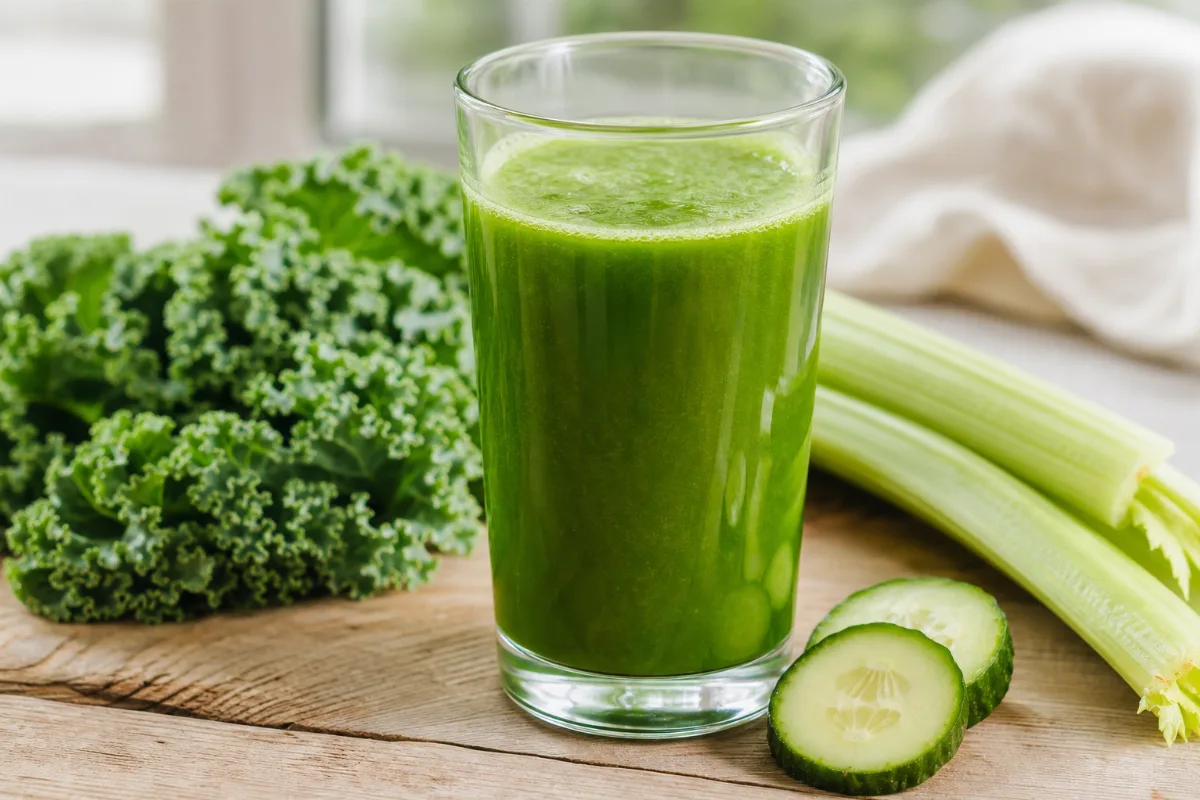
Green and vegetable juices are drinks pressed or blended from vegetables such as kale, spinach, celery and cucumber, or sold canned or bottled. There is no standard recipe, so nutrition varies. Small trials of canned vegetable juice found it helped people reach vegetable intake targets, but they were supported by the maker. Cleanse and detox claims have no good trials. The main cautions are oxalate and the kidneys, vitamin K and warfarin, potassium, salt and untreated juice.
General information, not medical advice. Last substantive update · Not medically reviewed. A named clinician has not signed off on this page. How this page is made
About Green & Vegetable Juices
Green and vegetable juice is a drink, not one food: the recipe decides what is in it. Trials of canned vegetable juice show it can add vegetable servings, but the larger ones were supported by the maker, and no study tested fresh green juice or compared it with whole vegetables.
What it is
Green and vegetable juices are drinks made from vegetables. Fresh juice is pressed at home or at a juice bar, often from kale, spinach, celery and cucumber. Canned or bottled mixed vegetable juice is sold in shops, and refrigerated cold-pressed juice is sold bottled.
USDA has no entry for home-made green juice, so this page shows the raw vegetables instead. Per 100 g, raw kale has 35 kcal and 4.1 g of fibre, spinach has 23 kcal and 2.2 g, celery 14 kcal and 1.6 g, and cucumber 15 kcal and 0.5 g (USDA). The trial's canned juice listed 50 calories, 8 g of sugars and 480 mg of sodium per 8 fl oz.
What the research shows
In a 12-week randomised trial of 90 adults, drinking a canned vegetable juice daily helped people reach recommended vegetable intake. In people who started with higher blood pressure, pressure fell. In a second trial of 81 adults with metabolic syndrome on a diet plan, those who also drank low-sodium juice lost more weight on average, though the three-group comparison was not significant.
A small 7-day pilot in 18 healthy adults tested a nitrate-rich green leafy juice against beetroot juice. Home diastolic pressure fell with the green juice, but the two juices did not differ significantly.
The two larger trials were supported by Campbell Soup Company, the juice's maker. No trial of fresh green juice, and no head-to-head study with whole vegetables, was found. A critical review found very little evidence for detox diets.
Juice versus whole vegetables and supplements
The trials used canned commercial juice or one nitrate-rich green juice. Powders, capsules and whole vegetables were not tested here. The NHS says crushing fruit and vegetables into juice releases sugars that can harm teeth, and counts juice as at most one portion of 5 A Day.
At a glance
Traditional uses history, not proof
- No traditional use was documented in the sources read; juice cleanses are a modern wellness habit
Studied for research
- Eating more vegetables (commercial vegetable juice), low certainty
- Blood pressure in some people, very low certainty
- Weight loss on a diet plan, very low certainty
- Cleanse and detox claims, insufficient evidence
- Juice compared with whole vegetables, insufficient evidence
Main compounds
- Vitamin K, very high in kale and spinach
- Potassium
- Oxalate, in leafy greens such as spinach
- Dietary nitrate, in leafy greens and beetroot
- Sodium in canned and bottled juices
Common forms
- Fresh juice made at home or at a juice bar
- Canned or bottled mixed vegetable juice (the form used in the trials)
- Cold-pressed bottled green juice sold refrigerated
- Green smoothies and juice cleanses
- Greens powders (not the same as juice and not covered here)
Research links: FDA: What you need to know about juice safety · MedlinePlus: Vitamin K (warfarin note) · Vegetable juice and vegetable intake, randomised trial (Nutrition Journal, 2010) · NIDDK: Diet for kidney stones · NHS: 5 A Day, what counts · Research Library · Genes & Biomarkers Library
What it is and its history
- Accepted scientific name
- Green and vegetable juices (mixed vegetable juices; a drink, not a single species)
- Common names
- Green juice (English); Vegetable juice (English); Juiced greens (English); Jugo verde (Spanish); Jugo de verduras (Spanish)
- Harvest and processing
- Four forms appear in the existing summary: fresh juice made at home or at a juice bar; canned or bottled mixed vegetable juice (used in the trials); cold-pressed bottled green juice sold refrigerated (check whether it is treated); and green smoothies or juice cleanses. Not re-sourced beyond the FDA juice pages and the trial papers.
- Look-alikes and adulterants
- Name: Green smoothie; Note: Blends the whole produce, so it keeps the pulp; see the Smoothies page.; Name: Greens powder or supplement; Note: Not the same as a drink made from fresh vegetables; not covered here.; Name: Whole vegetables; Note: Eaten whole, with their fibre.
Photographs
Traditional use and history history, not clinical proof
| Tradition or era | Documented use | Source |
|---|---|---|
| Modern wellness drink | No history source was read. The drink appears in the trials as a way to add vegetable servings, and in case reports as a juice cleanse. | NOT verified (no history source read) |
Traditional use shows how it was used. It does not show that it works or is safe today.
What is inside, and how it may work
What it contains and how those compounds act in cells and animals. Laboratory and animal mechanisms are not proven effects in people.
Main compounds
| Compound | Family | Where it is concentrated | Activity studied | Level of evidence |
|---|---|---|---|---|
| Vitamin K (phylloquinone) | vitamin | Leafy greens About 390 mcg per 100 g raw kale, 483 mcg raw spinach, 29 mcg celery, 16 mcg cucumber (USDA) | Needed for blood clotting; matters for people on warfarin. 14 15 16 13 9 | Composition data and authoritative guidance |
| Potassium | mineral | Leafy greens, celery About 558 mg per 100 g raw spinach, 348 mg kale, 260 mg celery, 147 mg cucumber (USDA) | A needed mineral; people with kidney disease may be told to limit it. 15 14 16 13 12 | Composition data and authoritative guidance |
| Oxalate | organic acid | Leafy greens such as spinach No measured amount in any source read. | Can form calcium oxalate crystals; linked to kidney stones and, in two case reports, kidney injury. 3 4 11 | Case reports and authoritative guidance |
| Nitrate | inorganic ion | Leafy greens, beetroot About 340 mg a day from 250 ml of the green leafy juice used in one pilot trial | The proposed reason for blood-pressure changes in the pilot trial; unproven for typical green juice. 1 | Pilot human trial |
| Sodium (in canned and bottled juices) | mineral | Added salt 480 mg per 8 fl oz in the juice used in the 12-week trial; 140 mg in the low-sodium version; 253 mg per 100 g canned tomato juice with salt added versus 10 mg without (USDA) | Added in processing; check the label. 5 6 17 18 | Composition data |
Mechanisms, receptors and pathways
| Target or pathway | Gene or receptor | What was found | Level |
|---|---|---|---|
| Dietary nitrate to nitric oxide | The authors of the 7-day pilot propose nitrate in leafy greens and beetroot as the reason blood pressure fell. The study did not test the mechanism. 1 | Human pilot, mechanism not tested | |
| Oxalate absorption and kidney crystals | The authors of one case report say juice cleanses increase oxalate absorption, causing high urine oxalate and crystal damage in people with risk factors. 3 | Case report interpretation |
Absorption, metabolism and elimination
- Absorption
- Not researched.
- Distribution
- Not found.
- Metabolism
- The case-report authors say vitamin C can be converted to oxalate (Raja et al.).
- Elimination
- Not found.
- Bioavailability
- Not established.
Isolated compounds versus whole extracts
The trials used canned commercial vegetable juice and a nitrate-rich green juice, not powders, supplements or whole vegetables. No source compared the same vegetables eaten whole and juiced.
Nutritional composition
There is no USDA entry for home-made green juice, because recipes vary. Instead, the table shows the raw vegetables often used, per 100 g (USDA FoodData Central, SR Legacy, read 2026-10-26): kale 35 kcal, 4.1 g fibre, 348 mg potassium, 390 mcg vitamin K, 93.4 mg vitamin C; spinach 23 kcal, 2.2 g fibre, 558 mg potassium, 483 mcg vitamin K; celery 14 kcal, 1.6 g fibre, 260 mg potassium, 29.3 mcg vitamin K, 80 mg sodium; cucumber with peel 15 kcal, 0.5 g fibre, 147 mg potassium, 16.4 mcg vitamin K. What ends up in a glass depends on the recipe and on how much pulp is strained out; no source we read measured home-made juice. For a typical commercial glass, the label of the juice used in the trial lists, per 8 fl oz: 50 calories, 480 mg sodium, 470 mg potassium, 2 g fibre and 8 g sugars (the low-sodium version 140 mg sodium and 820 mg potassium). Canned tomato juice (USDA, per 100 g): 17 kcal, 0.4 g fibre, 217 mg potassium, 253 mg sodium with salt added or 10 mg without.
1 low certainty2 very low certainty2 not enough evidence
What was looked at
The 5 benefits and uses checked for Green & Vegetable Juices, each with how strong the evidence is. Tap one to open it.
- Eating more vegetables (commercial vegetable juice)Low certainty
- Blood pressure (vegetable juice and green leafy juice)Very low certainty
- Body weight in metabolic syndrome (low-sodium vegetable juice plus a diet plan)Very low certainty
- Juice cleanses and 'detox' claimsNot enough evidence
- Green juice compared with eating the same vegetables wholeNot enough evidence
Lab markers tracked in the studies
Systolic blood pressureDiastolic blood pressureBody weight
What is Green & Vegetable Juices good for?
The studied uses and how strong the human evidence is for each. Most studies used canned commercial vegetable juice, not fresh green juice, and the larger trials were supported by the maker. Some rows are risks that studies found.
Benefits, one by one
Each card is a research question, not a promise. Tap a goal to filter. Open a card to see the studies, doses and limits.
Eating more vegetables (commercial vegetable juice)
Low certaintyIn a 12-week trial of 90 adults, those who drank a canned vegetable juice daily reached recommended vegetable intake. Those on diet advice alone did not. The juice was a salted, commercial product made by the company that supported the study.
2 studiesCanned or bottled commercial mixed vegetable juice. Not fresh green j…
Studies, doses and limits
What the trials found
Randomised trial, 12 weeks, 90 adults enrolled (30 per group: no juice, 8 fl oz or 16 fl oz of vegetable juice daily), 86 finished. All groups got DASH diet education.
Results
Without the juice, intake in every group was below the 2005 US Dietary Guidelines and DASH goals. The juice helped people reach the recommended intake.
Effect sizes as reported
Exact servings are in the paper's tables; the abstract states the finding in words only.
Why this rating
One randomised trial, small, supported by the juice's maker, using food diaries, which rely on memory. A second trial by the same group also found more vegetable servings with juice.
Form and dose studied
Canned or bottled commercial mixed vegetable juice. Not fresh green juice, powders or whole vegetables.
Who was studied
Healthy US adults; a second trial in adults with metabolic syndrome.
Limits
Industry-supported. Does not show juice is better than eating vegetables. Four people left the juice groups: two with a mild rash and one with mild heartburn that they linked to the juice.
Why researchers looked
Most people eat fewer vegetables than guidelines advise, and juice is an easy way to add some.
Traditional use
Fresh juicing is a modern wellness habit; no source read describes a traditional use.
Proposed mechanism None needed
The effect is simple: juice counts as vegetable servings in the diet records. No special mechanism is claimed.
A proposed mechanism does not show that the effect happens in people.
Commercial juice used here listed 480 mg of sodium per 8 fl oz (the low-sodium version 140 mg).
Blood pressure (vegetable juice and green leafy juice)
Very low certaintyTwo small studies saw blood pressure fall in some people who drank vegetable juice. One was a subgroup of a company-supported trial. The other was an 18-person pilot of a nitrate-rich green juice that was not clearly better than beetroot juice.
2 studiesCanned vegetable juice (12-week trial); a green leafy juice chosen fo…
Studies, doses and limits
What the trials found
In the 12-week juice trial, people who started in the pre-hypertensive range had lower blood pressure by week 12. In the 7-day crossover pilot (18 healthy adults), 250 ml of green leafy juice with about 340 mg of nitrate was compared with beetroot juice.
Results
Pre-hypertensive subgroup: systolic 128.1 to 123.4 mmHg and diastolic 82.6 to 79.0 mmHg at 12 weeks (within group). Pilot: home diastolic pressure fell with the green leafy juice (p = 0.03); beetroot juice lowered systolic pressure; the two juices did not differ significantly.
Effect sizes as reported
See results. Other heart-health measures in the 12-week trial did not change in general.
Why this rating
A subgroup change inside juice groups with no control comparison, plus a tiny 7-day pilot. The larger trial was industry-supported.
Form and dose studied
Canned vegetable juice (12-week trial); a green leafy juice chosen for its nitrate content (pilot).
Who was studied
Healthy adults; the benefit was seen in those starting with higher pressure.
Limits
Subgroup finding; pilot; healthy volunteers; no long-term outcomes such as heart attack or stroke.
Why researchers looked
Leafy greens and beetroot contain dietary nitrate, which the body can turn into nitric oxide, a compound that relaxes blood vessels.
Proposed mechanism Preliminary mechanism
Nitrate is the proposed route in the pilot trial. The 2010 trial was not designed around it.
A proposed mechanism does not show that the effect happens in people.
Canned juice can be salty. See the Safety tab.
Body weight in metabolic syndrome (low-sodium vegetable juice plus a diet plan)
Very low certaintyIn 81 adults on a calorie-limited DASH diet, those who also drank low-sodium vegetable juice lost more weight on average. The juice cannot be separated from the diet plan, and the three-group comparison was not significant.
1 studiesLow-sodium commercial vegetable juice.
Studies, doses and limits
What the trials found
12-week randomised trial; adults with metabolic syndrome; all limited to 1,600 (women) or 1,800 (men) kcal and taught the DASH diet; 0, 8 or 16 fl oz of low-sodium vegetable juice daily.
Results
Among completers the 12-week average change was -0.55 kg (no juice), -2.25 kg (8 fl oz) and -1.35 kg (16 fl oz). The three-group comparison was not significant; combining the two juice groups was significant.
Effect sizes as reported
As listed, with standard deviations of about 2.7 kg in every group.
Why this rating
One trial, supported by the juice's maker (some authors are employees with company stock). The 8 fl oz group did better than the 16 fl oz group, and the three-group test was not significant.
Form and dose studied
Low-sodium commercial vegetable juice.
Who was studied
Adults with metabolic syndrome in the US.
Limits
Cannot isolate the juice from the diet counselling and calorie limit. Fewer than 60% of the 16 fl oz group drank it on most days.
Why researchers looked
Eating more vegetables is linked with healthier weight, so the authors tested whether adding a juice helps people on a diet plan.
Proposed mechanism None established
Not established. The authors suggest juice helps people take in more vegetables.
A proposed mechanism does not show that the effect happens in people.
None specific.
Juice cleanses and 'detox' claims
Not enough evidenceA critical review found very little clinical evidence for detox diets and, to the authors' knowledge, no randomised trials of commercial detox diets in people. Case reports show kidney harm after juice cleanses in some people (see the Safety tab).
1 studiesDetox diets in general.
Studies, doses and limits
What the trials found
A 2015 critical review of detox diets in general (not a green juice study).
Results
A handful of small studies had flawed methods. No randomised trials of commercial detox diets in humans were found.
Why this rating
No good trials. The review was about detox diets in general.
Form and dose studied
Detox diets in general.
Limits
Not a green-juice review; abstract only.
Why researchers looked
Juice cleanses are marketed as ways to remove toxins and lose weight.
Traditional use
Modern marketing, not a traditional practice.
Proposed mechanism None shown
None shown. The review notes the body has its own systems for removing waste.
A proposed mechanism does not show that the effect happens in people.
See the oxalate and kidney warnings on the Safety tab.
Green juice compared with eating the same vegetables whole
Not enough evidenceWe found no study that compares the same vegetables eaten whole and juiced. The NHS counts vegetable juice as at most one portion of 5 A Day.
1 studiesNot applicable.
Studies, doses and limits
Results
Not studied in the sources read.
Why this rating
No comparison study read.
Limits
Whether juicing changes fibre or nutrient amounts was not measured in any source read.
Why researchers looked
People ask whether juice is a healthy substitute for vegetables.
Proposed mechanism Authoritative guidance
The NHS says crushing fruit and vegetables into juice releases sugars, which can harm teeth.
A proposed mechanism does not show that the effect happens in people.
None specific.
Connections to the rest of health
How Green & Vegetable Juices connects to the rest of our health knowledge graph. Every link says what kind of connection it is. A safety link (for example to the liver) is a warning, not a benefit. A study that merely mentions a topic never creates a benefit link.
Explore every connection: goals, body systems, organs, symptoms, genes
A. Wellness goals
| Connected to | Kind of connection | Evidence status | Context | Studies |
|---|---|---|---|---|
| Heart Health | Potential benefit | Low certainty | Eating more vegetables (commercial vegetable juice): In a 12-week trial of 90 adults, those who drank a canned vegetable juice daily reached recommended vegetable intake. Those on diet advice alone did not. The juice was a salted, commercial product made by the company that supported the study. Blood pressure (vegetable juice and green leafy juice): Two small studies saw blood pressure fall in some people who drank vegetable juice. One was a subgroup of a company-supported trial. The other was an 18-person pilot of a nitrate-rich green juice that was not clearly better than beetroot juice. | 5 6 1 |
| Weight Management | Potential benefit | Very low certainty | Body weight in metabolic syndrome (low-sodium vegetable juice plus a diet plan): In 81 adults on a calorie-limited DASH diet, those who also drank low-sodium vegetable juice lost more weight on average. The juice cannot be separated from the diet plan, and the three-group comparison was not significant. | 6 |
B. Body systems
| Connected to | Kind of connection | Evidence status | Context | Studies |
|---|---|---|---|---|
| Cardiovascular System | Biological association | Low certainty | Studied for: Eating more vegetables (commercial vegetable juice) Studied for: Blood pressure (vegetable juice and green leafy juice) | 5 6 1 |
| Metabolic System | Biological association | Very low certainty | Studied for: Body weight in metabolic syndrome (low-sodium vegetable juice plus a diet plan) | 6 |
| Liver And Detoxification | Biological association | Not enough evidence | Studied for: Juice cleanses and 'detox' claims | 2 |
| Digestive System | Biological association | Not enough evidence | Studied for: Green juice compared with eating the same vegetables whole | 10 |
E. Health conditions
| Connected to | Kind of connection | Evidence status | Context | Studies |
|---|---|---|---|---|
| Kidney stones (calcium oxalate) | Adverse effect or risk | Documented risk | NIDDK advises people prone to calcium oxalate stones to avoid spinach and ask about other oxalate sources. Preparation or compound: Oxalate-rich leafy greens (spinach) |
11 |
| Oxalate nephropathy | Adverse effect or risk | Case reports | Two single case reports of kidney injury after a week of juice. Preparation or compound: Green juice cleanse or juice diet |
3 4 |
I. Biomarkers
| Connected to | Kind of connection | Evidence status | Context | Studies |
|---|---|---|---|---|
| Systolic blood pressure | Biological association | Very low certainty | Measured in trials: lowered in a pre-hypertensive subgroup. A lab change is not the same as a health benefit. | 5 |
| Diastolic blood pressure | Biological association | Very low certainty | Measured in trials: lowered slightly. A lab change is not the same as a health benefit. | 5 1 |
| Body weight | Biological association | Very low certainty | Measured in trials: lower with juice plus diet plan (not significant across all three groups). A lab change is not the same as a health benefit. | 6 |
L. Active compounds
| Connected to | Kind of connection | Evidence status | Context | Studies |
|---|---|---|---|---|
| Vitamin K (phylloquinone) | Biological association | Composition data and authoritative guidance | Needed for blood clotting; matters for people on warfarin. Preparation or compound: Leafy greens |
14 15 16 13 9 |
| Potassium | Biological association | Composition data and authoritative guidance | A needed mineral; people with kidney disease may be told to limit it. Preparation or compound: Leafy greens, celery |
15 14 16 13 12 |
| Oxalate | Biological association | Case reports and authoritative guidance | Can form calcium oxalate crystals; linked to kidney stones and, in two case reports, kidney injury. Preparation or compound: Leafy greens such as spinach |
3 4 11 |
| Nitrate | Biological association | Pilot human trial | The proposed reason for blood-pressure changes in the pilot trial; unproven for typical green juice. Preparation or compound: Leafy greens, beetroot |
1 |
| Sodium (in canned and bottled juices) | Biological association | Composition data | Added in processing; check the label. Preparation or compound: Added salt |
5 6 17 18 |
Each connection is stored with the ingredient, the connected record, the kind of connection, the evidence status, the supporting studies, the preparation or compound involved, and a review date (last reviewed October 26, 2026).
Evidence at a glance: what the research found for 5 outcomes
Each outcome below is one thing researchers measured. Certainty is how far the evidence can be trusted, not how well it works. The full studies are on the next tab.
The evidence
The research centre for Green & Vegetable Juices. Every record here was checked against PubMed or the publisher's page; we never list a study we have not verified.
Evidence by outcome
Bars show how many studies we found for each outcome, not how well it works. People are added up across trials only (reviews are not added, to avoid double counting).
How we rate evidence
High certainty
Several well-run trials or reviews agree; further research is unlikely to change the picture much.
Moderate certainty
Good trials point the same way, but some doubt remains.
Low certainty
Small, short or inconsistent trials. The finding could change with better research.
Very low certainty
Very little or very weak human data. Treat as a possibility only.
Mixed findings
Trials or reviews disagree with each other.
Not enough evidence
Not enough human research to say either way.
Evidence against
Good research found no benefit, or found harm.
We take the reviewers' own risk-of-bias and GRADE statements where they exist, and otherwise judge from study size, design, consistency, directness and whether a product matches what is sold. Many publications do not make evidence high. Method note: We started from our existing summary of this drink, re-read the USDA FoodData Central records, PubMed abstracts and the open-access full text of the two vegetable-juice trials, and the FDA, NIDDK, MedlinePlus, National Kidney Foundation and NHS pages. Items we could not verify are flagged in the research gaps. This is a short page because little research exists on green juice itself.
Study library: every study we checked 18
| Study | Design | People | Product, dose, length | Result |
|---|---|---|---|---|
| Elsahoryi 2022 Effect of high nitrate vegetable juice supplementation on plasma nitrate and blood pressure in adults: a pilot randomized crossover intervention in healthy volunteers. J Nutr Sci · PMID 35720170 · DOI |
Pilot randomized crossover trial (7 days per juice) |
18 18 healthy adults |
Each person took 115 ml of beetroot juice or 250 ml of green leafy vegetable juice for 7 days, both with about 340 mg of nitrate a day. Beetroot juice lowered clinic and home systolic pressure. Home diastolic pressure fell with the green leafy juice (p = 0.03). The two juices were not statistically different from each other in the formal crossover analysis. Home diastolic blood pressure fell during the green leafy juice week (p = 0.03); no significant difference between the two juices. Methods, limits and fundingOutcomes: Plasma nitrate and nitrite, clinic and home blood pressure Limitations: Pilot study with 18 healthy people for 7 days. The green juice was a nitrate-rich product chosen for this trial, not a typical home recipe. Funding and conflicts: The authors declare no competing interests (statement read in the full text). Read: abstract and competing-interests statement (open access via Europe PMC) | |
| Klein 2015 Detox diets for toxin elimination and weight management: a critical review of the evidence. J Hum Nutr Diet · PMID 25522674 · DOI |
Critical review human and animal |
Published studies of commercial detox diets | The authors found very little clinical evidence for detox diets. A handful of small studies had flawed methods. To their knowledge no randomised controlled trials of commercial detox diets in humans had been done. Some foods have preliminary detox claims, mostly from animal work. Narrative review; no pooled numbers. Methods, limits and fundingOutcomes: Toxin elimination and weight management Limitations: Not a systematic review. About detox diets in general, not green juice specifically. Funding and conflicts: Not stated in the abstract read Read: abstract | |
| Makkapati 2018 "Green Smoothie Cleanse" Causing Acute Oxalate Nephropathy. Am J Kidney Dis · PMID 29203127 · DOI |
Case report |
1 One 65-year-old woman |
A 65-year-old woman developed acute kidney injury, found on biopsy to be oxalate nephropathy, linked in time to a juice cleanse made from oxalate-rich green leafy vegetables and fruits. Her risk factors were a gastric bypass long ago and recent long antibiotic treatment. Her kidney function was normal before the cleanse; it progressed to end-stage kidney disease. The authors warn that people with risk factors such as chronic kidney disease, gastric bypass or antibiotic use should be aware of this risk. One case; the authors describe a time link, not a proven cause. Methods, limits and fundingOutcomes: Acute kidney injury; kidney biopsy Limitations: A single case report cannot show how common this is or prove cause. Funding and conflicts: Not stated in the abstract read Read: abstract | |
| Raja 2023 Oxalate Nephropathy: A Case Report of Acute Kidney Injury Due to Juice Diet. Cureus · PMID 38283477 · DOI |
Case report |
1 One diabetic patient with normal kidney function |
A diabetic patient with normal kidney function was put on a juice diet for a week because of upper gastrointestinal bleeding. He developed biopsy-proven oxalate nephropathy that needed dialysis. He was lost to follow-up two weeks into dialysis. The authors say risk factors are likely to be age, diabetes, dehydration and chronic kidney disease. Their discussion centres on vitamin C (ascorbic acid) turning into oxalate. One case; the abstract does not list what was in the juice. Methods, limits and fundingOutcomes: Acute kidney injury; kidney biopsy Limitations: A single case report. The abstract does not describe the juice ingredients, so it does not show that leafy greens were the cause. Funding and conflicts: Not stated in the abstract read Read: abstract | |
| Shenoy 2010 The use of a commercial vegetable juice as a practical means to increase vegetable intake: a randomized controlled trial. Nutr J · PMID 20849620 · DOI |
Randomized controlled trial (parallel, 12 weeks) |
90 90 healthy adults enrolled; 86 finished (4 dropouts, all in the juice groups) |
Without the juice, vegetable intake was below the 2005 US Dietary Guidelines and DASH goals. Drinking the juice helped people reach the recommended intake. Most heart-health measures did not change. In people who started in the pre-hypertensive range, blood pressure fell: systolic 128.1 to 123.4 mmHg and diastolic 82.6 to 79.0 mmHg over 12 weeks (within-group, p < 0.05). Two people left with a mild rash and one with mild heartburn, which they linked to the juice. Pre-hypertensive subgroup, systolic 128.1 (SD 8.0) to 123.4 (SD 9.5) mmHg at 12 weeks; diastolic 82.6 (SD 5.6) to 79.0 (SD 4.5) mmHg. Within-group changes, not compared with the no-juice group. Methods, limits and fundingOutcomes: Daily vegetable servings; blood pressure and other heart-health measures Limitations: Small trial. Blood-pressure finding is a subgroup change within the juice groups. The juice was a canned, salted commercial product, not fresh green juice. Number of pre-hypertensive people not read. Funding and conflicts: Supported by resources from Campbell Soup Company (the maker of the juice tested); the paper's competing-interests statement says so. Registration: NCT01161706 Read: full-text (open access via Europe PMC) and abstract | |
| Shenoy 2010 Weight loss in individuals with metabolic syndrome given DASH diet counseling when provided a low sodium vegetable juice: a randomized controlled trial. Nutr J · PMID 20178625 · DOI |
Randomized controlled trial (parallel, 12 weeks) |
81 81 adults with metabolic syndrome (22 men, 59 women) |
Adults on a calorie-limited DASH plan who also drank low-sodium vegetable juice (8 or 16 fl oz a day) lost more weight on average than those given diet counselling only. Among people who finished, the 12-week average change was -0.55 kg with no juice, -2.25 kg with 8 fl oz and -1.35 kg with 16 fl oz. Differences between the three groups were not statistically significant; the difference was significant only when the two juice groups were combined. Completers, 12-week weight change: no juice -0.55 kg (SD 2.77); 8 fl oz -2.25 kg (SD 2.72); 16 fl oz -1.35 kg (SD 2.72). Three-group comparison not significant; juice versus no juice combined was significant (p < 0.05). Methods, limits and fundingOutcomes: Weight, vegetable intake and metabolic syndrome measures Limitations: The juice effect cannot be separated from the diet plan. Only 53% of the 16 fl oz group drank the juice on more than 85% of days. Low-sodium commercial juice, not fresh green juice. Funding and conflicts: Supported by resources from Campbell Soup Company. Two authors are employees who hold stock, and two are members of the company's Vegetable Plant Advisory Panel (competing-interests statement). Read: full-text (open access via Europe PMC) and abstract | |
| s-fda-juice-safety FDA: What You Need to Know About Juice Safety · Source |
Regulator guidance n/a |
Methods, limits and fundingRead: full-text | ||
| s-fda-moms-to-be FDA: Fruits, Veggies and Juices (Food Safety for Moms-to-Be) · Source |
Regulator guidance n/a |
Methods, limits and fundingRead: full-text | ||
| s-medlineplus-vitamin-k MedlinePlus: Vitamin K · Source |
Authoritative guidance n/a |
Methods, limits and fundingRead: full-text | ||
| s-nhs-5-a-day-what-counts NHS: 5 A Day: what counts? · Source |
Authoritative guidance n/a |
Methods, limits and fundingRead: full-text | ||
| s-niddk-kidney-stones-diet NIDDK: Eating, Diet, and Nutrition for Kidney Stones · Source |
Authoritative guidance n/a |
Methods, limits and fundingRead: full-text | ||
| s-nkf-potassium National Kidney Foundation: Potassium and Your CKD Diet · Source |
Authoritative guidance n/a |
Methods, limits and fundingRead: full-text | ||
| s-usda-fdc-168409 USDA FoodData Central: Cucumber, with peel, raw (SR Legacy) · Source |
Reference database n/a |
Methods, limits and fundingRead: full-text | ||
| s-usda-fdc-168421 USDA FoodData Central: Kale, raw (SR Legacy) · Source |
Reference database n/a |
Methods, limits and fundingRead: full-text | ||
| s-usda-fdc-168462 USDA FoodData Central: Spinach, raw (SR Legacy) · Source |
Reference database n/a |
Methods, limits and fundingRead: full-text | ||
| s-usda-fdc-169988 USDA FoodData Central: Celery, raw (SR Legacy) · Source |
Reference database n/a |
Methods, limits and fundingRead: full-text | ||
| s-usda-fdc-170458 USDA FoodData Central: Tomato juice, canned, with salt added (SR Legacy) · Source |
Reference database n/a |
Methods, limits and fundingRead: full-text | ||
| s-usda-fdc-170545 USDA FoodData Central: Tomato juice, canned, without salt added (SR Legacy) · Source |
Reference database n/a |
Methods, limits and fundingRead: full-text |
What we do not know yet
- No trial has tested fresh home-made green juice for vegetable intake, blood pressure, weight or any disease.
- No study compared the same vegetables eaten whole and juiced.
- Both larger trials used one canned commercial juice and were supported by its maker.
- Oxalate in fresh juice, fibre lost by juicing and plant-compound content were not measured in any source read.
- Allergy, medicine interactions other than warfarin, arsenic or lead in bottled juice, and how long fresh juice keeps were not researched.
How new research is added
New studies are found by a saved PubMed search and placed in a review queue before the page changes.
Lab markers
What changed in blood or saliva tests during trials. A changed number is not the same as feeling or being healthier, and we give no "normal ranges".
Metabolic 1
Body weight
Lower with juice plus diet plan (not significant across all three groups) in trials
Weight in kilograms.
Very low certaintyResults and what it means
Why it was measured
Weight loss is a goal in metabolic syndrome.
Statistical vs. clinical meaning
A small difference of unclear cause; the diet plan was the main intervention.
Safety implication
None specific.
| Study | Result | People | Product |
|---|---|---|---|
| 6 | 12-week change among completers: -0.55 kg (no juice), -2.25 kg (8 fl oz), -1.35 kg (16 fl oz) | 81 adults with metabolic syndrome | Low-sodium vegetable juice plus calorie-limited DASH plan |
Other 2
Systolic blood pressure
Lowered in a pre-hypertensive subgroup in trials
The higher number in a blood pressure reading, the pressure when the heart beats.
Very low certaintyResults and what it means
Why it was measured
A main heart-risk marker.
Statistical vs. clinical meaning
A small change in a subgroup; no one knows if it prevents heart disease.
Safety implication
Commercial juice carries sodium.
| Study | Result | People | Product |
|---|---|---|---|
| 5 | 128.1 to 123.4 mmHg over 12 weeks in people who started pre-hypertensive (within-group) | Pre-hypertensive subgroup of 86 adults | 8 or 16 fl oz commercial vegetable juice daily |
Diastolic blood pressure
Lowered slightly in trials
The lower number in a blood pressure reading, the pressure between beats.
Very low certaintyResults and what it means
Why it was measured
A main heart-risk marker.
Statistical vs. clinical meaning
Small changes in small studies.
Safety implication
None specific.
| Study | Result | People | Product |
|---|---|---|---|
| 5 | 82.6 to 79.0 mmHg over 12 weeks in the pre-hypertensive subgroup (within-group) | Pre-hypertensive subgroup | Commercial vegetable juice |
| 1 | Home diastolic pressure fell during the green leafy juice week (p = 0.03); no significant difference from beetroot juice | 18 healthy adults | 250 ml green leafy vegetable juice for 7 days |
Safety
What studies and official sources say about side effects, medicines and who should check first. Each point shows what kind of evidence it comes from.
Main points to know 4
- Oxalate and the kidneys: a rare but serious risk in some people. Two case reports describe sudden kidney injury from oxalate nephropathy after a week of juice cleanse or juice diet. One woman (65) drank a green smoothie and juice cleanse made from oxalate-rich leafy vegetables and fruit; she had a gastric bypass and recent long antibiotics, and her kidneys failed permanently. A diabetic man developed kidney injury needing dialysis after a week-long juice diet. These are two single cases, not proof of how often it happens. NIDDK says people who have had calcium oxalate stones may want to avoid spinach among other foods and should talk to a health care professional about other oxalate sources. Case report 3 4 11
- Leafy greens are rich in vitamin K, which matters for warfarin. MedlinePlus says people taking warfarin may need to eat less vitamin K, and more importantly to keep their intake the same every day, because sudden changes can change how the medicine works. Kale and spinach are on its list of vitamin K foods. USDA lists about 390 mcg of vitamin K per 100 g of raw kale and 483 mcg per 100 g of raw spinach. Juicing many leaves at once can make intake jump. Authoritative guidance 9 14 15
- Untreated juice can carry harmful bacteria. The FDA says juice made from fresh-squeezed or raw produce can carry bacteria unless the produce or juice has been pasteurised or otherwise treated. Children, older adults, pregnant women and people with weak immune systems can become seriously ill or die. Untreated packaged juice must carry a warning label, but juice sold by the glass, for example at juice bars, need not. Authoritative guidance 7 8
- Potassium and salt can be high. The National Kidney Foundation says people with high blood potassium may be advised to limit higher-potassium foods; its list of higher-potassium foods includes vegetable juices, tomato products and cooked spinach. A commercial vegetable juice in the trials listed 480 mg of sodium per 8 fl oz. Authoritative guidance 12 5
Side effects 3
| Effect | How often | Severity and recovery | Evidence |
|---|---|---|---|
| Acute oxalate nephropathy (kidney injury) after juice cleanses or juice diets Two single cases. No frequency is known. | Not established | severe; one case reached end-stage kidney disease and one needed dialysis Often incomplete, according to the authors of one report. | Case report 3 4 |
| Mild rash or heartburn linked by participants to the juice From the 12-week trial of a canned commercial juice. | 3 of 60 people in the juice groups withdrew (2 rash, 1 heartburn) | mild Not reported. | Rct adverse events 5 |
| Foodborne illness from untreated juice Symptoms can include vomiting, diarrhoea, abdominal pain, fever and body ache, usually within 1 to 3 days but sometimes 20 minutes to 6 weeks later. | Not established | varies; can be serious Most people recover quickly, but some develop chronic or life-threatening problems (FDA). | Authoritative guidance 7 |
Liver
No liver injury linked to green or vegetable juice was found in the sources read. LiverTox was not checked.
How often. No frequency found.
This is a safety connection. It is not evidence that Green & Vegetable Juices supports liver health.
Medicines and supplements 2
| With | Why it matters | Importance | Evidence | What to do |
|---|---|---|---|---|
| Warfarin (a blood thinner) prescription | Vitamin K helps blood clot, which works against warfarin. | MedlinePlus: keep vitamin K intake steady, because sudden changes can change the effect of the medicine. Kale and spinach are rich sources. | Authoritative guidance Moderate certainty 9 | Tell the clinician who manages your warfarin before starting a regular juice habit. |
| Other medicines prescription | No other medicine interaction with green or vegetable juice was found in the sources read. Nitrate-rich juice and blood-pressure or nitrate medicines were not looked up. | None found Not enough evidence | A pharmacist can check your own medicines. |
Who should check first 5
| Situation | Advice | Evidence |
|---|---|---|
| Past calcium oxalate kidney stones | NIDDK says you may want to avoid spinach, among other foods, and should ask a health care professional about other oxalate sources. | Authoritative guidance 11 |
| Kidney disease, gastric bypass or recent long antibiotic treatment, diabetes (risk factors named in the case reports) | The case-report authors say people with these risk factors should be aware of the oxalate risk. Ask a clinician or dietitian before a juice cleanse. | Case report 3 4 |
| Kidney disease with high blood potassium | The National Kidney Foundation says your provider may advise limiting higher-potassium foods; vegetable juices are on its higher list. | Authoritative guidance 12 |
| Taking warfarin | Keep vitamin K intake steady and tell your prescriber. | Authoritative guidance 9 |
| Pregnancy, older age, weak immune system, or giving juice to children | The FDA says choose pasteurised or otherwise treated juice; pregnant women should only drink treated juice. | Authoritative guidance 7 8 |
Overdose, product quality and regulators
Summary. Green and vegetable juice is a food. The documented harms are kidney injury from oxalate in two case reports, bacteria in untreated juice, and effects on warfarin.
Animal. Not reviewed.
Human doses studied. Trials used 8 or 16 fl oz of commercial vegetable juice daily for 12 weeks, and 250 ml of a green leafy juice for 7 days, with only mild side effects reported (a few withdrawals for rash or heartburn).
High dose or long term signals. Oxalate nephropathy after a week of juice cleanse or juice diet in two single cases (see above).
Overdose response. Not found.
Genotoxicity. Not reviewed.
Juice from raw produce can carry bacteria; the FDA gives steps to cut the risk.
Bacteria in untreated juice. FDA: untreated juice can carry harmful bacteria; most juice sold in the US is pasteurised; untreated packaged juice must carry a warning, but juice sold by the glass need not. 7
Washing produce before juicing. FDA: wash hands for at least 20 seconds, cut away damaged parts, wash produce under running water (no soap, detergent or produce wash), scrub firm produce such as cucumbers with a clean brush, even if you plan to peel it, then dry it. 7
Raw sprouts. FDA advice for pregnancy is to avoid raw sprouts of any kind. Check whether a juice blend contains sprouts. 8
| Body | Action | Date |
|---|---|---|
| FDA (US Food and Drug Administration) (United States) | Consumer advice on juice safety: warning label for untreated packaged juice, no label required for juice sold by the glass, and steps for making juice at home source | Content current as of 2024-03-05 (per the page) |
| FDA (United States) | Pregnancy advice: only drink pasteurised or otherwise treated juice; wash produce; avoid raw sprouts source | 2026-10-26 (page read) |
| NHS (UK) (United Kingdom) | Fruit juice, vegetable juice and smoothies count as at most one 5 A Day portion; keep to a combined 150 ml a day source | Page last reviewed 9 June 2026 |
| NIDDK (US) (United States) | People who have had calcium oxalate stones may want to avoid spinach and other high-oxalate foods source | Page read 2026-10-26 (no date found) |
When to get medical help
- Much less urine than usual, swelling, or sudden flank pain after a juice cleanse or juice diet
- Severe or bloody diarrhoea, vomiting, or fever after drinking untreated juice
- Unusual bruising or bleeding if you take warfarin
- Swelling of the lips, face or throat, or trouble breathing after any food
Stop using the product and contact a clinician or emergency service. In the US, Poison Control is 1-800-222-1222.
General information only, not medical advice. Ask a clinician or pharmacist before use, especially with medicines, in pregnancy or with a health condition. See the Natural Remedy Safety guide.
Frequently asked questions
Is green juice healthier than eating vegetables?
Does a juice cleanse detox the body?
A critical review found very little clinical evidence for detox diets and no randomised trials of commercial detox diets in people, to the authors' knowledge.
Can green juice lower blood pressure?
Does green or vegetable juice help weight loss?
One trial of 81 adults with metabolic syndrome on a calorie-limited diet found more average weight loss with low-sodium vegetable juice, but the three-group comparison was not significant and the diet plan was the main intervention. It was supported by the juice's maker.
Can green juice harm the kidneys?
Can I drink green juice if I take warfarin?
Is green juice high in potassium?
Is canned vegetable juice salty?
Is unpasteurised green juice safe?
Is green juice safe in pregnancy?
The FDA says pregnant women should only drink juice that is pasteurised or otherwise treated, wash produce under running water and avoid raw sprouts of any kind. We did not read a source on specific green-juice ingredients in pregnancy.
How should I wash vegetables before juicing?
The FDA advises washing hands for at least 20 seconds, cutting away damaged parts, washing produce under running water with no soap or produce wash, and scrubbing firm produce such as cucumbers with a clean brush, even if you will peel it.
Does green juice interact with other medicines?
Warfarin is the one interaction we found a source for. We did not find sources on other medicines, including blood-pressure or nitrate medicines. A pharmacist can check your own medicines.
Explore by health goal
Editorial transparency
- Written by
- AlternativeMed editorial team. Research compiled with AI assistance, then checked against the sources listed.
- Medical review
- None. This page has not been reviewed by a physician or pharmacist.
- First published
- 2026-10-26
- Last substantive update
- 2026-10-26
- How we research
- We started from our existing summary of this drink, re-read the USDA FoodData Central records, PubMed abstracts and the open-access full text of the two vegetable-juice trials, and the FDA, NIDDK, MedlinePlus, National Kidney Foundation and NHS pages. Items we could not verify are flagged in the research gaps. This is a short page because little research exists on green juice itself.
- How we rate evidence
- See "How we rate evidence" in the Evidence tab.
- Independence
- No product is promoted on this page. No affiliate links are shown.
Sources 18
Each source was opened and checked. Where we read only the abstract, it says so. The small numbers in the text point here.
- Elsahoryi NA, Cardwell C, Gilchrist S, Woodside JV. Effect of high nitrate vegetable juice supplementation on plasma nitrate and blood pressure in adults: a pilot randomized crossover intervention in healthy volunteers.. J Nutr Sci. 2022. PMID 35720170. DOI 10.1017/jns.2022.34. (abstract and competing-interests statement (open access via Europe PMC))
- Klein AV, Kiat H. Detox diets for toxin elimination and weight management: a critical review of the evidence.. J Hum Nutr Diet. 2015. PMID 25522674. DOI 10.1111/jhn.12286. (abstract)
- Makkapati S, D'Agati VD, Balsam L. "Green Smoothie Cleanse" Causing Acute Oxalate Nephropathy.. Am J Kidney Dis. 2018. PMID 29203127. DOI 10.1053/j.ajkd.2017.08.002. (abstract)
- Raja N, Radhakrishnan H, Masilamani S. Oxalate Nephropathy: A Case Report of Acute Kidney Injury Due to Juice Diet.. Cureus. 2023. PMID 38283477. DOI 10.7759/cureus.51226. (abstract)
- Shenoy SF, Kazaks AG, Holt RR, Chen HJ, et al.. The use of a commercial vegetable juice as a practical means to increase vegetable intake: a randomized controlled trial.. Nutr J. 2010. PMID 20849620. DOI 10.1186/1475-2891-9-38. (full-text (open access via Europe PMC) and abstract)
- Shenoy SF, Poston WS, Reeves RS, Kazaks AG, et al.. Weight loss in individuals with metabolic syndrome given DASH diet counseling when provided a low sodium vegetable juice: a randomized controlled trial.. Nutr J. 2010. PMID 20178625. DOI 10.1186/1475-2891-9-8. (full-text (open access via Europe PMC) and abstract)
- . FDA: What You Need to Know About Juice Safety. . . (full-text)
- . FDA: Fruits, Veggies and Juices (Food Safety for Moms-to-Be). . . (full-text)
- . MedlinePlus: Vitamin K. . . (full-text)
- . NHS: 5 A Day: what counts?. . . (full-text)
- . NIDDK: Eating, Diet, and Nutrition for Kidney Stones. . . (full-text)
- . National Kidney Foundation: Potassium and Your CKD Diet. . . (full-text)
- . USDA FoodData Central: Cucumber, with peel, raw (SR Legacy). . . (full-text)
- . USDA FoodData Central: Kale, raw (SR Legacy). . . (full-text)
- . USDA FoodData Central: Spinach, raw (SR Legacy). . . (full-text)
- . USDA FoodData Central: Celery, raw (SR Legacy). . . (full-text)
- . USDA FoodData Central: Tomato juice, canned, with salt added (SR Legacy). . . (full-text)
- . USDA FoodData Central: Tomato juice, canned, without salt added (SR Legacy). . . (full-text)


