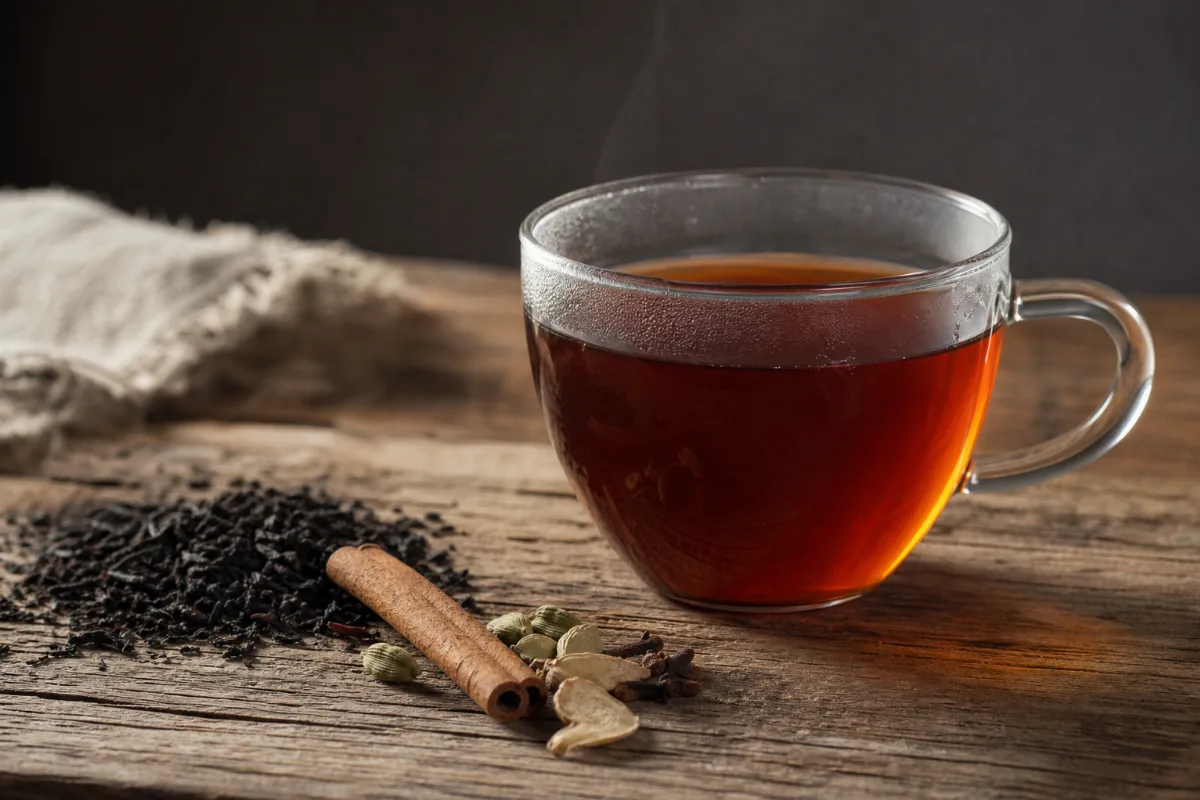
Herbal Teas & Extracts · Tea blend
Chai (Spiced Tea Blend)
Camellia sinensis (L.) Kuntze, with ginger, cardamom, cinnamon, clove and black pepper · also called Chai, masala chai, spiced tea, chai tea
Chai is black tea blended with warming spices such as ginger, cardamom, cinnamon, clove and black pepper, and often served with milk and sugar. People drink it for taste, warmth and comfort. We found no study of chai itself; the research is on black tea and on single spices, mostly as supplements. The main cautions: it contains caffeine, and cassia cinnamon contains coumarin, which can affect the liver in sensitive people.
General information, not medical advice. Last substantive update · Not medically reviewed. A named clinician has not signed off on this page. How this page is made
About Chai (Spiced Tea Blend)
Chai is black tea with spices. No study has tested chai itself, so its health effects are unproven. Check the cautions first: it has caffeine from the tea, cassia cinnamon contains coumarin, and cinnamon allergy has been reported in a chai drinker.
What chai is
Chai is a drink of black tea, from the leaf of Camellia sinensis (name checked in GBIF), blended with spices. Common spices are ginger, cardamom, cinnamon, clove and black pepper, and many people add milk and sugar.
Recipes differ a lot, and the amount of each spice is often not on the label. Some blends are sold as chai but use no tea leaf, so they have little or no caffeine.
Chai is the Hindi word for tea, and masala chai is a spiced tea from South Asia. We did not read a source on its history, so we say no more about it.
Chai is not the same as supplements
Searches found no trial or study of chai as a drink. The trials we cite tested black tea, or ginger, cinnamon or cardamom as capsules or powders.
A cup of chai has small, unmeasured amounts of each spice. So supplement results cannot be assumed for it.
This page gives no amounts, because no study shows an amount of chai that works. Ask a doctor or pharmacist what is right for you.
What the research looks at
Black tea trials show small average falls in LDL cholesterol and blood pressure, with low certainty.
Ginger capsules reduced pregnancy nausea in trials. Cinnamon supplements lowered blood sugar numbers in a 2025 pooling, and cardamom lowered inflammation markers in a small set of studies.
Clove and black pepper have no useful human trials as tea ingredients.
At a glance
Traditional uses history, not proof
- Chai is the Hindi word for tea, and masala chai is a spiced tea from South Asia.
- We did not read a source that gives the history of masala chai, so this page does not describe it further.
Studied for research
- Chai itself, insufficient
- LDL cholesterol (black tea), low
- Blood pressure (black tea), low
- Alertness and mood (tea caffeine and theanine), insufficient
- Pregnancy nausea (ginger capsules, not chai), moderate
- Blood sugar and cholesterol (cinnamon supplements), low
- Blood pressure and inflammation markers (cardamom), low
Main compounds
- Caffeine
- Piperine (pepper)
- Eugenol (clove)
- Cinnamaldehyde (cinnamon)
- Coumarin (cassia cinnamon)
Common forms
- Loose-leaf chai blend (black tea plus spices)
- Tea bags
- Chai made with milk and sugar
- Chai concentrates and latte mixes (contents vary by brand)
- Caffeine-free spiced blends that use no tea leaf
Research links: NHS: foods to avoid in pregnancy (caffeine) · NCCIH: Cinnamon · NCCIH: Ginger · Cassia cinnamon as a source of coumarin (abstract) · Caffeine content of brewed teas (abstract) · Cinnamon allergy in chai, case report (title) · Research Library · Genes & Biomarkers Library
What it is and its history
- Accepted scientific name
- Camellia sinensis (L.) Kuntze
- Naming authority
- (L.) Kuntze
- Common names
- Chai (Hindi/English); Masala chai (English); Spiced tea (English); Chai tea (English); Te chai (Spanish)
- Family or group
- Theaceae (tea plant); the spices come from other plant families
- Classification
- Plantae > Theaceae > Camellia > Camellia sinensis
- Native range
- Not read.
- Habitat
- Not read.
- What it looks like
- Part used: Tea leaf (black tea), plus spices: ginger root, cardamom pods, cinnamon bark, clove buds and black pepper.
- Cultivation
- Not read.
- Harvest and processing
- Black tea is fully oxidised tea leaf.
- Look-alikes and adulterants
- Name: Rooibos chai and herbal 'chai' blends; Note: Some blends use no tea leaf and so have little or no caffeine; read the label.; Name: Chai latte mixes and concentrates; Note: May contain sweeteners and other ingredients; contents differ by brand.
- Sustainability and conservation
- Not assessed.
Photographs
Traditional use and history history, not clinical proof
| Tradition or era | Documented use | Source |
|---|---|---|
| South Asian masala chai | Chai is the Hindi word for tea, and masala chai is a spiced tea from South Asia. We did not read a source that gives its history or recipe origins, so none is stated here. | No source read; background only |
Traditional use shows how it was used. It does not show that it works or is safe today.
What is inside, and how it may work
What it contains and how those compounds act in cells and animals. Laboratory and animal mechanisms are not proven effects in people.
Main compounds
| Compound | Family | Where it is concentrated | Activity studied | Level of evidence |
|---|---|---|---|---|
| Caffeine PubChem 2519 | methylxanthine | Tea leaf | A stimulant. The amount in a cup depends on the tea and steeping; chai was not measured. 4 31 | Human data |
| Piperine PubChem 638024 | alkaloid | Black pepper | The pungent pepper compound; isolated piperine changed drug levels in studies. 18 10 | Human and animal |
| Eugenol PubChem 3314 | phenylpropanoid | Clove | The main aroma compound of clove; concentrated clove oil has caused poisoning. 2 11 | Case report |
| Cinnamaldehyde PubChem 637511 | aldehyde | Cinnamon bark | The main cinnamon flavour compound. 12 | Not studied here |
| Coumarin PubChem 323 | benzopyrone | Cassia cinnamon | Present in substantial amounts in cassia barks; can harm the liver in sensitive people. 25 1 13 | Human data |
Mechanisms, receptors and pathways
| Target or pathway | Gene or receptor | What was found | Level |
|---|---|---|---|
| Drug-processing enzymes and transporters (via piperine) | Not named in the abstracts read | Piperine can inhibit or stimulate drug-handling enzymes and transporters, so it can change drug levels. 17 18 | Human and animal |
Absorption, metabolism and elimination
- Absorption
- Not studied for chai.
- Distribution
- Not read.
- Metabolism
- Not read.
- Elimination
- Not read.
- Bioavailability
- Not studied for chai.
Isolated compounds versus whole extracts
Most studies of the spices used powders, supplements or isolated compounds. A cup of chai contains small and unmeasured amounts of each spice with tea, and often milk and sugar. Supplement results cannot be carried over to the drink.
Nutritional composition
Chai is not a studied source of vitamins or minerals in the sources read. Milk and sugar, if added, change the nutrition.
1 moderate certainty4 low certainty2 not enough evidence
What was looked at
The 7 benefits and uses checked for Chai (Spiced Tea Blend), each with how strong the evidence is. Tap one to open it.
- Chai as a drink (any health effect)Not enough evidence
- LDL cholesterol, from drinking black tea (the base of chai)Low certainty
- Blood pressure, from drinking black tea (the base of chai)Low certainty
- Alertness, thinking and mood, from tea caffeineNot enough evidence
- Nausea and vomiting in early pregnancy, from ginger capsules and powders (not chai)Moderate certainty
- Blood sugar, cholesterol and blood pressure, from cinnamon supplements (not chai)Low certainty
- Blood pressure and inflammation markers, from cardamom (not chai)Low certainty
Lab markers tracked in the studies
LDL cholesterolSystolic blood pressure
What is Chai (Spiced Tea Blend) good for?
The uses people ask about and how strong the evidence is for each. Read the certainty label first: no result here comes from a trial of chai. They come from black tea or from single spices, mostly as supplements.
Benefits, one by one
Each card is a research question, not a promise. Tap a goal to filter. Open a card to see the studies, doses and limits.
Chai as a drink (any health effect)
Not enough evidenceWe found no trial or study of chai itself in people. The only paper about chai we found is one case report of an allergic reaction.
2 studiesNot shown on this page.
Studies, doses and limits
What the trials found
Searches on chai, masala chai and spiced tea found no trial, cohort or lab study of chai as a drink in people. The only relevant paper is a case report of lip inflammation from cinnamon allergy in a chai drinker.
Results
No health benefit of chai itself has been tested.
Why this rating
No studies of the blend. Results for single ingredients do not carry over to a cup of chai.
Form and dose studied
Not shown on this page.
Limits
The blend varies by brand, recipe and whether milk and sugar are added.
Why researchers looked
Chai is a popular spiced drink, so people ask whether it helps health.
Traditional use
Chai is the Hindi word for tea. Masala chai (spiced tea) is a South Asian tradition; this page does not trace its history because no source we read does.
Proposed mechanism Not established
Not established. Chai mixes black tea with several spices, and the proportions differ between blends and are often not on the label.
A proposed mechanism does not show that the effect happens in people.
See the Safety tab: caffeine, cinnamon type, allergy.
LDL cholesterol, from drinking black tea (the base of chai)
Low certaintyPooled trials of black tea found a small fall in LDL cholesterol. Chai was not tested.
2 studiesNot shown on this page.
Studies, doses and limits
What the trials found
A 2015 review of 10 trials (411 people) found LDL cholesterol 4.64 mg/dL lower (95% CI -8.99 to -0.30), with no clear change in total or HDL cholesterol, and more effect in people at higher heart risk. A Cochrane review of black tea trials found LDL 0.43 mmol/L lower (95% CI -0.56 to -0.31) over about six months, from only a few trials at risk of bias.
Results
Small fall in LDL, a blood marker, not a heart outcome.
Effect sizes as reported
Zhao 2015: LDL -4.64 mg/dL (-8.99, -0.30). Cochrane 2013, black tea: LDL MD -0.43 mmol/L (-0.56, -0.31).
Why this rating
Few small trials, the interval nearly reaches zero in one review, and black tea alone was tested, not tea with spices or milk.
Form and dose studied
Not shown on this page.
Who was studied
Adults, with and without higher heart risk.
Limits
Black tea only; Cochrane says no study reported heart events. Milk and sugar in chai were not tested.
Why researchers looked
Cholesterol is a common heart-risk measure, and black tea is an everyday drink.
Traditional use
Chai is the Hindi word for tea. Masala chai (spiced tea) is a South Asian tradition; this page does not trace its history because no source we read does.
Proposed mechanism Not established
Not established in the sources read.
A proposed mechanism does not show that the effect happens in people.
Caffeine; see Safety tab.
Blood pressure, from drinking black tea (the base of chai)
Low certaintySome pooled trials found small average falls in blood pressure with tea. Black tea looked weaker than green tea, and chai was not tested.
2 studiesNot shown on this page.
Studies, doses and limits
What the trials found
The Cochrane review found systolic pressure 1.85 mmHg lower with black tea (95% CI -3.21 to -0.48); diastolic did not change clearly (-1.27, CI -3.06 to 0.53). A 2020 review of 5 trials (408 people with raised pressure) of green or black tea found systolic 4.81 mmHg lower (-8.40 to -1.58), with the effect more marked for green than black tea.
Results
A few mmHg at most.
Effect sizes as reported
Cochrane 2013 (black tea): SBP MD -1.85 (-3.21, -0.48). Mahdavi-Roshan 2020 (green or black): SBP WMD -4.81 (-8.40, -1.58).
Why this rating
Few trials, green and black pooled in one review, short follow-up.
Form and dose studied
Not shown on this page.
Who was studied
Adults, including people with raised blood pressure.
Limits
Black tea alone. Caffeine can briefly raise blood pressure in some people.
Why researchers looked
High blood pressure is a major risk factor for heart disease and stroke.
Traditional use
Chai is the Hindi word for tea. Masala chai (spiced tea) is a South Asian tradition; this page does not trace its history because no source we read does.
Proposed mechanism Not established
Not established in the sources read.
A proposed mechanism does not show that the effect happens in people.
Do not use tea in place of blood pressure treatment.
Alertness, thinking and mood, from tea caffeine
Not enough evidenceA 2025 review of tea trials found small possible gains in attention and mood from theanine plus caffeine, with wide uncertainty. Chai was not tested.
1 studiesNot shown on this page.
Studies, doses and limits
What the trials found
A 2025 review of 50 randomised trials (15 in meta-analyses) found small-to-moderate differences in the first two hours for theanine plus caffeine versus placebo, for example attention switching accuracy SMD 0.33 (95% CI 0.13 to 0.54). Many intervals were wide and crossed zero. The authors ask for more trials using tea drinks.
Results
Small short-term differences; wide intervals.
Effect sizes as reported
Attention switching accuracy h2 SMD 0.33 (0.13, 0.54); overall mood h2 SMD 0.26 (-0.10, 0.63).
Why this rating
Mostly theanine and caffeine given alone, not brewed tea; uncertainty frequent; no chai trial.
Form and dose studied
Not shown on this page.
Who was studied
Healthy adults.
Limits
Not tea beverages in most trials.
Why researchers looked
People drink tea to feel awake and focused.
Traditional use
Chai is the Hindi word for tea. Masala chai (spiced tea) is a South Asian tradition; this page does not trace its history because no source we read does.
Proposed mechanism Human trials
Caffeine is a stimulant; tea also contains theanine. The review links the effects to those compounds, not to the whole drink.
A proposed mechanism does not show that the effect happens in people.
Caffeine can disturb sleep, especially near bedtime; see Safety tab.
Nausea and vomiting in early pregnancy, from ginger capsules and powders (not chai)
Moderate certaintyPooled trials of ginger found less nausea than placebo in pregnancy. They used capsules and powders, not chai, and the amount of ginger in chai is not known.
3 studiesNot shown on this page.
Studies, doses and limits
What the trials found
A 2014 review of 12 trials (1,278 pregnant women) found less nausea than placebo (MD 1.20, 95% CI 0.56 to 1.84) but no clear change in vomiting episodes (p = 0.06); the authors call the evidence low quality. A 2022 umbrella review of 24 reviews graded ginger for pregnancy nausea as a large effect with high GRADE certainty, mostly with capsules. NCCIH says most studies tested supplements rather than foods.
Results
Less nausea in trials of ginger supplements.
Effect sizes as reported
Viljoen 2014: nausea MD 1.20 (0.56, 1.84); vomiting MD 0.72 (-0.03, 1.46). Crichton 2022: large effect, GRADE high (authors' grading).
Why this rating
The umbrella review gives GRADE high, the 2014 review calls trials low quality; both used capsules, powders or extracts. Chai has caffeine, so pregnancy needs care (see Safety tab).
Form and dose studied
Not shown on this page.
Who was studied
Pregnant women with nausea; supplements.
Limits
Not tea. Ginger amount in chai unknown.
Why researchers looked
Many pregnant women look for options for nausea.
Traditional use
Chai is the Hindi word for tea. Masala chai (spiced tea) is a South Asian tradition; this page does not trace its history because no source we read does.
Proposed mechanism Not established
Not established in the sources read.
A proposed mechanism does not show that the effect happens in people.
Caffeine in chai counts toward the pregnancy limit; ask a midwife or doctor.
Blood sugar, cholesterol and blood pressure, from cinnamon supplements (not chai)
Low certaintyA 2025 pooling of 49 trials found better blood sugar, cholesterol and blood pressure numbers with cinnamon supplements. The type of cinnamon in chai is rarely stated.
2 studiesNot shown on this page.
Studies, doses and limits
What the trials found
A 2025 review of 49 randomised trials found lower fasting glucose (SMD -1.28; 95% CI -1.65 to -0.90), HbA1c (SMD -0.71; -1.02 to -0.40) and LDL (SMD -0.71; -1.02 to -0.40) than controls. The authors call it a possible add-on. NCCIH says results are hard to interpret because the species and part are often unclear, and higher quality research is needed.
Results
Lower blood-sugar and blood-fat numbers in supplement trials.
Effect sizes as reported
Fasting glucose SMD -1.28 (-1.65, -0.90); HbA1c SMD -0.71 (-1.02, -0.40).
Why this rating
Supplements, not tea; species unclear in many trials; the effect sizes are large and the abstract gives no certainty grade; NCCIH asks for better studies.
Form and dose studied
Not shown on this page.
Who was studied
Adults; many with diabetes or metabolic problems.
Limits
No trial of cinnamon in chai. Cassia cinnamon carries coumarin (see Safety tab).
Why researchers looked
Cinnamon is widely promoted for blood sugar.
Traditional use
Chai is the Hindi word for tea. Masala chai (spiced tea) is a South Asian tradition; this page does not trace its history because no source we read does.
Proposed mechanism Not established
Not established in the sources read.
A proposed mechanism does not show that the effect happens in people.
Cassia cinnamon contains coumarin; talk to your doctor if you take diabetes medicine.
Blood pressure and inflammation markers, from cardamom (not chai)
Low certaintyEight small studies of cardamom found lower inflammation markers and tiny falls in blood pressure on average.
1 studiesNot shown on this page.
Studies, doses and limits
What the trials found
A 2024 review of 8 studies found lower hs-CRP, IL-6 and TNF-alpha and small blood pressure falls (systolic -0.54 mmHg, 95% CI -0.88 to -0.19; diastolic -0.90, -1.07 to -0.73). The authors say the small number of studies calls for caution.
Results
Tiny average changes in blood pressure; lower inflammation markers.
Effect sizes as reported
Systolic WMD -0.54 mmHg (-0.88, -0.19).
Why this rating
Eight studies, forms of cardamom varied, unit labels in the abstract look inconsistent, no chai.
Form and dose studied
Not shown on this page.
Who was studied
Adults.
Limits
Not given as chai.
Why researchers looked
Cardamom is a common chai spice, and trials have looked at it as a powder or supplement.
Traditional use
Chai is the Hindi word for tea. Masala chai (spiced tea) is a South Asian tradition; this page does not trace its history because no source we read does.
Proposed mechanism Not established
Not established in the sources read.
A proposed mechanism does not show that the effect happens in people.
None specific.
Connections to the rest of health
How Chai (Spiced Tea Blend) connects to the rest of our health knowledge graph. Every link says what kind of connection it is. A safety link (for example to the liver) is a warning, not a benefit. A study that merely mentions a topic never creates a benefit link.
Explore every connection: goals, body systems, organs, symptoms, genes
A. Wellness goals
| Connected to | Kind of connection | Evidence status | Context | Studies |
|---|---|---|---|---|
| Cholesterol Balance | Low certainty | LDL cholesterol, from drinking black tea (the base of chai): Pooled trials of black tea found a small fall in LDL cholesterol. Chai was not tested. Blood sugar, cholesterol and blood pressure, from cinnamon supplements (not chai): A 2025 pooling of 49 trials found better blood sugar, cholesterol and blood pressure numbers with cinnamon supplements. The type of cinnamon in chai is rarely stated. | 26 6 20 23 | |
| Heart Health | Low certainty | LDL cholesterol, from drinking black tea (the base of chai): Pooled trials of black tea found a small fall in LDL cholesterol. Chai was not tested. Blood pressure, from drinking black tea (the base of chai): Some pooled trials found small average falls in blood pressure with tea. Black tea looked weaker than green tea, and chai was not tested. | 26 6 8 | |
| Blood Pressure Support | Low certainty | Blood pressure, from drinking black tea (the base of chai): Some pooled trials found small average falls in blood pressure with tea. Black tea looked weaker than green tea, and chai was not tested. Blood pressure and inflammation markers, from cardamom (not chai): Eight small studies of cardamom found lower inflammation markers and tiny falls in blood pressure on average. | 6 8 19 | |
| Mental Clarity | Not enough evidence | Alertness, thinking and mood, from tea caffeine: A 2025 review of tea trials found small possible gains in attention and mood from theanine plus caffeine, with wide uncertainty. Chai was not tested. | 16 | |
| Better Focus | Not enough evidence | Alertness, thinking and mood, from tea caffeine: A 2025 review of tea trials found small possible gains in attention and mood from theanine plus caffeine, with wide uncertainty. Chai was not tested. | 16 | |
| Nausea Relief | Moderate certainty | Nausea and vomiting in early pregnancy, from ginger capsules and powders (not chai): Pooled trials of ginger found less nausea than placebo in pregnancy. They used capsules and powders, not chai, and the amount of ginger in chai is not known. | 24 5 22 | |
| Pregnancy Support | Moderate certainty | Nausea and vomiting in early pregnancy, from ginger capsules and powders (not chai): Pooled trials of ginger found less nausea than placebo in pregnancy. They used capsules and powders, not chai, and the amount of ginger in chai is not known. | 24 5 22 | |
| Blood Sugar Balance | Low certainty | Blood sugar, cholesterol and blood pressure, from cinnamon supplements (not chai): A 2025 pooling of 49 trials found better blood sugar, cholesterol and blood pressure numbers with cinnamon supplements. The type of cinnamon in chai is rarely stated. | 20 23 | |
| Inflammation Balance | Low certainty | Blood pressure and inflammation markers, from cardamom (not chai): Eight small studies of cardamom found lower inflammation markers and tiny falls in blood pressure on average. | 19 |
B. Body systems
| Connected to | Kind of connection | Evidence status | Context | Studies |
|---|---|---|---|---|
| Heart and circulation | Adverse effect or risk | Low certainty | Caffeine can briefly raise heart rate and blood pressure in some people. Preparation or compound: Caffeine from the black tea base |
29 |
| Digestive System | Biological association | Not enough evidence | Studied for: Chai as a drink (any health effect) Studied for: Nausea and vomiting in early pregnancy, from ginger capsules and powders (not chai) | 21 3 24 5 22 |
| Cardiovascular System | Biological association | Low certainty | Studied for: LDL cholesterol, from drinking black tea (the base of chai) Studied for: Blood pressure, from drinking black tea (the base of chai) | 26 6 8 19 |
| Brain Focus | Biological association | Not enough evidence | Studied for: Alertness, thinking and mood, from tea caffeine | 16 |
| Blood Sugar Support | Biological association | Low certainty | Studied for: Blood sugar, cholesterol and blood pressure, from cinnamon supplements (not chai) | 20 23 |
D. Symptoms
| Connected to | Kind of connection | Evidence status | Context | Studies |
|---|---|---|---|---|
| Nausea in pregnancy | Moderate certainty | Less nausea in trials; chai not tested. Preparation or compound: Ginger capsules (not chai) |
24 5 |
I. Biomarkers
| Connected to | Kind of connection | Evidence status | Context | Studies |
|---|---|---|---|---|
| LDL cholesterol | Low certainty | Small fall in pooled trials; chai not tested. Preparation or compound: Black tea drink (not chai) |
26 6 | |
| LDL cholesterol | Biological association | Low certainty | Measured in trials: lowered in two reviews. A lab change is not the same as a health benefit. | 26 6 |
| Systolic blood pressure | Biological association | Low certainty | Measured in trials: lowered a little. A lab change is not the same as a health benefit. | 6 8 |
L. Active compounds
| Connected to | Kind of connection | Evidence status | Context | Studies |
|---|---|---|---|---|
| Caffeine | Biological association | Human | A stimulant. The amount in a cup depends on the tea and steeping; chai was not measured. Preparation or compound: Tea leaf |
4 31 |
| Piperine | Biological association | Human and animal | The pungent pepper compound; isolated piperine changed drug levels in studies. Preparation or compound: Black pepper |
18 10 |
| Eugenol | Biological association | Case report | The main aroma compound of clove; concentrated clove oil has caused poisoning. Preparation or compound: Clove |
2 11 |
| Cinnamaldehyde | Biological association | Not studied here | The main cinnamon flavour compound. Preparation or compound: Cinnamon bark |
12 |
| Coumarin | Biological association | Human | Present in substantial amounts in cassia barks; can harm the liver in sensitive people. Preparation or compound: Cassia cinnamon |
25 1 13 |
Each connection is stored with the ingredient, the connected record, the kind of connection, the evidence status, the supporting studies, the preparation or compound involved, and a review date (last reviewed October 25, 2026).
Evidence at a glance: what the research found for 7 outcomes
Each outcome below is one thing researchers measured. Certainty is how far the evidence can be trusted, not how well it works. The full studies are on the next tab.
The evidence
The research centre for Chai (Spiced Tea Blend). Every record here was checked against PubMed or the publisher's page; we never list a study we have not verified.
Evidence by outcome
Bars show how many studies we found for each outcome, not how well it works. People are added up across trials only (reviews are not added, to avoid double counting).
How we rate evidence
High certainty
Several well-run trials or reviews agree; further research is unlikely to change the picture much.
Moderate certainty
Good trials point the same way, but some doubt remains.
Low certainty
Small, short or inconsistent trials. The finding could change with better research.
Very low certainty
Very little or very weak human data. Treat as a possibility only.
Mixed findings
Trials or reviews disagree with each other.
Not enough evidence
Not enough human research to say either way.
Evidence against
Good research found no benefit, or found harm.
We take the reviewers' own risk-of-bias and GRADE statements where they exist, and otherwise judge from study size, design, consistency, directness and whether a product matches what is sold. Many publications do not make evidence high. Method note: We searched PubMed for chai studies, read the abstracts of the PubMed papers cited, checked the plant name in GBIF and compounds in PubChem, and read the NHS and NCCIH pages. Some regulator statements come from earlier research on related tea pages.
Study library: every study we checked 31
| Study | Design | People | Product, dose, length | Result |
|---|---|---|---|---|
| Abraham K et al 2010 Toxicology and risk assessment of coumarin: focus on human data. Mol Nutr Food Res · PMID 20024932 · DOI |
Review human and animal |
Review of coumarin toxicity, with a German telephone survey of over 1,000 people | Coumarin (from cassia cinnamon and as a medicine) |
Coumarin can harm the liver, and a subgroup of people is more sensitive than the animals studied. EFSA (2004) set a tolerable daily intake of 0.1 mg per kg body weight, and the human data confirmed that value. Heavy eaters of cassia cinnamon (for example at Christmas in Germany) may reach an intake near this limit. Methods, limits and fundingOutcomes: Liver and cancer effects of coumarin; tolerable daily intake Limitations: About coumarin and cassia spice generally; chai was not measured. Read: abstract |
| Case report authors (list not captured) 1992 Disseminated intravascular coagulation and hepatocellular necrosis due to clove oil. Blood Coagul Fibrinolysis · PMID 1450336 · DOI |
Case report |
1 A 2-year-old child |
Clove oil (swallowed) essential oil Not given Single ingestion |
A 2-year-old developed disseminated intravascular coagulation (a serious clotting disorder) and liver cell death after swallowing clove oil, and was treated with heparin, fresh frozen plasma and clotting factor concentrates. Methods, limits and fundingOutcomes: Blood clotting disorder and liver cell death Limitations: One child; this is the concentrated oil, not clove in tea. Read: abstract |
| Case report authors (list not captured) 2023 Cheilitis caused by allergic contact dermatitis to cinnamon in chai tea: A case report. Contact Dermatitis · PMID 36461791 · DOI |
Case report |
1 One patient (case report) |
Chai tea containing cinnamon spice (cinnamon) in a tea blend Not given in the record read Not given |
The title states the lip inflammation was caused by allergic contact dermatitis to cinnamon in chai tea. PubMed holds no abstract for this record, so only the title was read. One person; cannot give a rate Methods, limits and fundingOutcomes: Lip inflammation (cheilitis) from allergic contact dermatitis Limitations: Title only: no abstract on PubMed, so details are not verified. A single case shows it can happen, not how often. Read: title-only |
| Chin 2008 Caffeine content of brewed teas. Journal of analytical toxicology · PMID 19007524 · DOI |
Food analysis n/a |
20 assorted commercial tea products brewed under different conditions | Brewed teas (white, green, black, decaffeinated, herbal) leaf (drink) Lab measurement |
Caffeine in white, green and black teas ranged from 14 to 61 mg per 6 or 8 oz serving, with no clear trend by variety. Decaffeinated teas contained under 12 mg, and no caffeine was detected in the herbal teas. Steep time changed the caffeine level. Most brewed teas had less caffeine per serving than brewed coffee. Wide range between products (n/a) Methods, limits and fundingOutcomes: Caffeine in a serving Limitations: Only 20 products, one lab. Funding and conflicts: Not stated in the abstract Read: abstract |
| Crichton 2022 Orally consumed ginger and human health: an umbrella review. Am J Clin Nutr · PMID 35147170 · DOI |
Systematic review |
24 systematic reviews of oral ginger in humans | Oral ginger of any type unspecified Not shown on this page Up to 3 months · vs Various |
Strongest evidence: pregnancy nausea (large effect, GRADE high), osteoarthritis pain (small effect, GRADE high), glycemic control (GRADE very low to moderate). Dysmenorrhea, postoperative nausea, chemotherapy vomiting, blood pressure, weight: low to moderate. Lipids: very low. Effect sizes graded: large (pregnancy nausea); small (osteoarthritis pain); small (lipids) Methods, limits and fundingOutcomes: Any health outcome; AMSTAR-2 and GRADE graded Limitations: Substantial inconsistency and poor reporting of products across the source reviews. Ginger here means oral forms mostly capsules, not tea; GRADE grades are the authors' own. Read: abstract |
| Hartley 2013 Green and black tea for the primary prevention of cardiovascular disease. Cochrane Database of Systematic Reviews · PMID 23780706 · DOI |
Systematic review |
821 11 randomised trials of at least 3 months in healthy adults or adults at higher heart risk (4 of black tea, 7 of green tea) |
Green tea, black tea or tea extracts (analysed separately); amounts and forms differed leaf (drink) and extracts Differed between trials At least 3 months; blood-pressure and LDL results over about 6 months · vs No intervention, placebo or minimal intervention |
No trial reported heart or blood-vessel events. For black tea, LDL cholesterol fell by 0.43 mmol/L (95% CI -0.56 to -0.31) and systolic blood pressure by 1.85 mmHg (-3.21 to -0.48) over six months; diastolic pressure change was not significant (-1.27 mmHg, CI -3.06 to 0.53). Only a small number of trials fed each result and the trials were at risk of bias. The authors say the evidence is limited and results should be treated with caution. Small falls in LDL and systolic pressure for black tea (Black tea LDL MD -0.43 mmol/L (-0.56, -0.31); SBP MD -1.85 mmHg (-3.21, -0.48); DBP MD -1.27 (-3.06, 0.53)) Methods, limits and fundingOutcomes: Heart events, blood pressure, cholesterol Limitations: Few trials per analysis, risk of bias, forms and amounts of tea differed; no heart-event data. Funding and conflicts: Non-US government support listed in the PubMed record; no industry funding stated in the abstract Read: abstract |
| Hurrell 1999 Inhibition of non-haem iron absorption in man by polyphenolic-containing beverages. The British journal of nutrition · PMID 10999016 |
Controlled trial |
Adult volunteers eating a standard bread meal with radio-labelled iron | Black tea and other polyphenol drinks (herb teas, coffee, cocoa) leaf (drink) Servings with different polyphenol contents Single meals · vs Water control meal |
Black tea reduced iron absorption from the bread meal by 79 to 94%. All the polyphenol drinks were potent inhibitors, and adding milk to tea or coffee had little or no effect on this. Large drop in iron absorption from one meal (Not given in the abstract) Methods, limits and fundingOutcomes: Absorption of non-haem (plant-type) iron Limitations: Single test meals in a 1999 lab-style trial; says nothing about long-term iron status. Funding and conflicts: Not stated in the abstract Read: abstract |
| Mahdavi-Roshan 2020 The effects of regular consumption of green or black tea beverage on blood pressure in those with elevated blood pressure or hypertension: A systematic review and meta-analysis. Complementary therapies in medicine · PMID 32507441 · DOI |
Meta-analysis |
408 5 randomised trials (9 measurements) of regular green or black tea drinks in adults with raised blood pressure or high blood pressure |
Green or black tea (drink) leaf (drink) Differed Longer trials (3 months or more) showed larger falls · vs Control |
Regular tea lowered systolic pressure by 4.81 mmHg (95% CI -8.40 to -1.58) and diastolic by 1.98 mmHg (-3.77 to -0.20). Without the most varied trials the falls were about 3.53 and 0.99 mmHg. The effect of green tea was more pronounced than that of black tea. No trial reported side effects. Small average falls; green tea stronger than black (SBP WMD -4.81 (-8.40, -1.58); DBP WMD -1.98 (-3.77, -0.20)) Methods, limits and fundingOutcomes: Systolic and diastolic blood pressure Limitations: Only five trials; high variation between them; green and black tea pooled; two of five trials were not low risk of bias. Funding and conflicts: Not stated in the abstract Read: abstract |
| Mennen 2007 Consumption of black, green and herbal tea and iron status in French adults. European journal of clinical nutrition · PMID 17299492 · DOI |
Cross sectional |
2593 954 men and 1,639 women in France (SU.VI.MAX), healthy adults |
Black, green and herbal tea leaf (drink) Usual tea drinking by questionnaire Cross-sectional · vs Non-drinkers / lower drinkers |
Serum ferritin was not related to black, green or herbal tea drinking in men or women, and the risk of iron depletion was not related to tea drinking, strength, infusion time or time of day. The authors conclude apparently healthy adults are not at risk of iron depletion from tea. No link in healthy adults (Not given in the abstract) Methods, limits and fundingOutcomes: Blood ferritin (iron stores) and iron depletion Limitations: Cross-sectional; healthy French adults only; says nothing about people who already have low iron. Funding and conflicts: Not stated in the abstract Read: abstract |
| NCBI 2026 PubChem: Piperine (CID 638024) Web page / database · Source |
Database n/a |
n/a | n/a |
Formula C17H19NO3, checked 2026-10-25. Methods, limits and fundingOutcomes: n/a Limitations: Identity only. Read: api |
| NCBI 2026 PubChem: Eugenol (CID 3314) Web page / database · Source |
Database n/a |
n/a | n/a |
Formula C10H12O2, checked 2026-10-25. Methods, limits and fundingOutcomes: n/a Limitations: Identity only. Read: api |
| NCBI 2026 PubChem: Cinnamaldehyde (CID 637511) Web page / database · Source |
Database n/a |
n/a | n/a |
Formula C9H8O, checked 2026-10-25. Methods, limits and fundingOutcomes: n/a Limitations: Identity only. Read: api |
| NCBI 2026 PubChem: Coumarin (CID 323) Web page / database · Source |
Database n/a |
n/a | n/a |
Formula C9H6O2, checked 2026-10-25. Methods, limits and fundingOutcomes: n/a Limitations: Identity only. Read: api |
| NHS 2022 NHS (UK): Drinks and cups for babies and young children (page read 2026-10-25) Web page / database · Source |
Authoritative guidance n/a |
n/a | n/a |
Says tea and coffee are not suitable for babies or young children, and that added sugar can lead to tooth decay. Methods, limits and fundingOutcomes: n/a Limitations: Consumer guidance; the page's own review date had passed when read. Read: full-text |
| NHS 2026 NHS (UK): Foods to avoid in pregnancy (page read 2026-10-25) Web page / database · Source |
Authoritative guidance n/a |
n/a | n/a |
Says not to have more than 200 mg of caffeine a day in pregnancy, lists about 75 mg in a cup of tea, and links too much caffeine with a higher chance of miscarriage and stillbirth. Methods, limits and fundingOutcomes: n/a Limitations: Consumer guidance. Read: full-text |
| Payne 2025 Effects of Tea (Camellia sinensis) or its Bioactive Compounds l-Theanine or l-Theanine plus Caffeine on Cognition, Sleep, and Mood in Healthy Participants: A Systematic Review and Meta-Analysis of Randomized Controlled Trials. Nutrition reviews · PMID 40314930 · DOI |
Meta-analysis |
50 randomised trials in healthy people (15 eligible for at least one meta-analysis) of tea, L-theanine, or L-theanine plus caffeine | Tea (Camellia sinensis), L-theanine, or L-theanine plus caffeine leaf (drink) and isolated compounds Differed Mostly single doses · vs Placebo |
The clearest small-to-moderate differences were for theanine plus caffeine against placebo in the first two hours (for example attention switching accuracy SMD 0.33, 95% CI 0.13-0.54). Theanine alone improved choice reaction time at hour 1 (SMD -0.35). The reviewers say the intervals often leave the size and direction uncertain, and that more research using tea drinks is needed. Small effects for theanine with caffeine; tea drinks themselves not shown (e.g. attention switching SMD 0.33 (0.13, 0.54); choice reaction time with theanine SMD -0.35 (-0.61, -0.10)) Methods, limits and fundingOutcomes: Thinking, mood and sleep Limitations: Most trials tested isolated compounds, not tea; mostly short, single-dose tests in healthy people. Funding and conflicts: Not stated in the abstract Read: abstract |
| Review (authors not captured) 2018 Piperine-mediated drug interactions and formulation strategy for piperine: recent advances and future perspectives. Expert Opin Drug Metab Toxicol · PMID 29250980 · DOI |
Review human and animal |
Review of piperine effects on drug-handling enzymes and transporters | Piperine black pepper compound |
Piperine can change how co-administered drugs are handled in the body, with a helpful or harmful result depending on conditions. The authors say the clinical meaning of these interactions needs to be tested by varying the amount, frequency and duration. Methods, limits and fundingOutcomes: Drug interactions Limitations: Review of mechanisms and pharmacology; not about tea. Read: abstract |
| Review (authors not captured) 2021 Safety Aspects of the Use of Isolated Piperine Ingested as a Bolus. Foods · PMID 34574230 · DOI |
Review human and animal |
Human and animal studies of isolated piperine in single or short-term doses | Isolated piperine (concentrated, as in some supplements) black pepper compound Not shown here Short term |
Interactions with several drugs were seen in human and animal studies, in most cases raising drug availability in the body, which could increase drug effects or side effects. Animal studies with higher daily doses hinted at disturbed sperm production and harm to mothers and embryos. The authors advise considering the risks of isolated piperine in supplements. Methods, limits and fundingOutcomes: Interactions with drugs; reproductive effects in animals Limitations: This is about isolated, concentrated piperine, not the small amount of black pepper in a cup of chai. No chai-specific data. Read: abstract |
| Review (authors not captured) 2024 Effect of cardamom consumption on inflammation and blood pressure in adults: A systematic review and meta-analysis of randomized clinical trials. Food Sci Nutr · PMID 38268891 · DOI |
Meta-analysis |
8 clinical studies of cardamom in adults | Cardamom (powder or supplement; forms varied) seed/pod Not shown Differed · vs Placebo or control |
Cardamom lowered inflammation markers (hs-CRP, IL-6, TNF-alpha) and blood pressure on average; systolic fell by 0.54 mmHg (95% CI -0.88 to -0.19) and diastolic by 0.90 mmHg (-1.07 to -0.73). The authors say the small number of studies calls for caution. Methods, limits and fundingOutcomes: hs-CRP, IL-6, TNF-alpha, blood pressure Limitations: Eight studies; the abstract's unit labels for some markers look inconsistent (reported as printed); average blood pressure changes are tiny; cardamom was not given as chai. Read: abstract |
| Review (authors not captured) 2025 The effect of cinnamon supplementation on cardiovascular risk factors in adults: a GRADE assessed systematic review, dose-response and meta-analysis of randomized controlled trials. J Health Popul Nutr · PMID 40611215 · DOI |
Meta-analysis |
49 randomised trials of cinnamon supplements in adults | Cinnamon supplements (species and parts varied) bark (mostly) Differed between trials; not shown Differed · vs Placebo or control |
Pooled results favoured cinnamon for fasting glucose (SMD -1.28; 95% CI -1.65 to -0.90), HbA1c (SMD -0.71; -1.02 to -0.40), LDL (SMD -0.71; -1.02 to -0.40), systolic pressure (SMD -0.85; -1.54 to -0.16) and others, and raised HDL. The authors call it a possible add-on, not a stand-alone treatment. Methods, limits and fundingOutcomes: Waist, blood pressure, glucose, insulin, HbA1c, cholesterol, triglycerides, CRP Limitations: Supplements, not tea. Standardised effect sizes of this size are unusually large and may reflect trial differences; the abstract does not report heterogeneity or a certainty grade. NCCIH says species and part are often unclear in cinnamon studies. Read: abstract |
| Search note 2026 PubMed searches for trials of chai or masala chai (run 2026-10-25) Web page / database · Source |
Search note n/a |
n/a | n/a |
Searches on chai, masala chai and spiced tea found no trial, cohort or lab study of chai as a drink in people. The one relevant paper is a single case report of lip allergy to cinnamon in chai. Methods, limits and fundingOutcomes: n/a Limitations: Searching cannot prove nothing exists; papers indexed under other words could be missed. Read: search |
| US National Center for Complementary and Integrative Health 2024 NCCIH (NIH): Ginger (page read 2026-10-25) Web page / database · Source |
Authoritative guidance n/a |
n/a | n/a |
Ginger may help nausea and vomiting in pregnancy; most studies tested supplements rather than foods. Most motion sickness studies did not show help. Side effects include abdominal discomfort, heartburn, diarrhea, and mouth and throat irritation. Talk with your health care provider before using ginger if you take any medicine. Ginger supplements in pregnancy may be safe; little is known while breastfeeding. Methods, limits and fundingOutcomes: n/a Limitations: Consumer summary; no study details. Read: full-text |
| US National Center for Complementary and Integrative Health 2024 NCCIH (NIH): Cinnamon (page read 2026-10-25) Web page / database · Source |
Authoritative guidance n/a |
n/a | n/a |
Cinnamon is likely safe in amounts used in food. Studies for diabetes are hard to interpret because species and part are often unclear; higher quality research is needed. Coumarin in cassia cinnamon has been linked with the liver, and prolonged use could be an issue for sensitive people such as those with liver disease; Ceylon cinnamon has only a trace. Theoretical interactions with an anticancer medicine or nicotine. Larger amounts of Ceylon cinnamon in pregnancy are considered unsafe; little is known in larger amounts while breastfeeding. Skin products can cause contact dermatitis. Methods, limits and fundingOutcomes: n/a Limitations: Consumer summary; no study details. Read: full-text |
| Viljoen 2014 A systematic review and meta-analysis of the effect and safety of ginger in the treatment of pregnancy-associated nausea and vomiting. Nutr J · PMID 24642205 · DOI |
Meta-analysis |
1278 Pregnant women with nausea and vomiting, 12 RCTs |
oral ginger (preparations varied between trials) rhizome (unspecified) Not shown on this page Varied · vs Placebo or vitamin B6 |
Nausea improved versus placebo (mean difference 1.20, 95% CI 0.56 to 1.84); vomiting episodes did not significantly change (p = 0.06). No significant extra risk of spontaneous abortion (RR 3.14, 95% CI 0.65 to 15.11, a very imprecise estimate), heartburn or drowsiness. Nausea MD 1.20; vomiting MD 0.72 (not significant) (Nausea 95% CI 0.56-1.84; vomiting 95% CI -0.03 to 1.46; spontaneous abortion RR 3.14, 95% CI 0.65-15.11) Methods, limits and fundingOutcomes: Nausea symptoms, vomiting episodes, miscarriage, heartburn, drowsiness Limitations: Authors call the evidence low quality: few studies, variable outcome reporting. The wide interval on miscarriage means a risk cannot be ruled out. The trials used ginger capsules, powders or extracts, not tea. Registration: PROSPERO CRD42011001237 Read: abstract |
| Wang YH et al 2013 Cassia cinnamon as a source of coumarin in cinnamon-flavored food and food supplements in the United States. J Agric Food Chem · PMID 23627682 · DOI |
Lab analysis n/a |
Authenticated cinnamon bark plus store-bought cinnamon, cinnamon-flavoured foods and supplements in the US | Cinnamon bark and products bark |
True cinnamon (Cinnamomum verum) bark held only traces of coumarin; cassia barks (C. loureiroi, C. burmannii and C. cassia) held substantial amounts. Coumarin was found in all locally bought cinnamon, cinnamon-flavoured foods and supplements, which were probably Indonesian cassia (C. burmannii). Methods, limits and fundingOutcomes: Coumarin content by cinnamon species Limitations: Chemistry of US products; chai blends were not tested. Abstract gives no per-cup figure. Read: abstract |
| Zhao 2015 Black tea consumption and serum cholesterol concentration: Systematic review and meta-analysis of randomized controlled trials. Clinical nutrition (Edinburgh, Scotland) · PMID 24972454 · DOI |
Meta-analysis |
411 10 randomised trials of black tea drinking; adults, with and without higher heart risk |
Black tea drink leaf (drink) Differed between trials Differed · vs Placebo or control drink (per review) |
LDL cholesterol fell by 4.64 mg/dL (95% CI -8.99 to -0.30; P = 0.036). Total cholesterol (-2.04 mg/dL) and HDL (-1.15 mg/dL) did not change clearly. The LDL fall was larger in people at higher heart risk. Small fall in LDL; none in total or HDL (LDL -4.64 (-8.99, -0.30) mg/dL; total -2.04 (-6.43, 2.35); HDL -1.15 (-3.04, 0.75)) Methods, limits and fundingOutcomes: Total, LDL and HDL cholesterol Limitations: Small total sample; the abstract gives no certainty grade; the LDL interval almost reaches zero. Funding and conflicts: Non-US government support listed in the PubMed record; no industry funding stated in the abstract Read: abstract |
| n/a 2015 EFSA: Caffeine, EFSA explains risk assessment (factsheet, 2015) n/a · Source |
Authoritative guidance n/a |
n/a | n/a |
Said above. Methods, limits and fundingOutcomes: Says single doses of caffeine up to 200 mg from all sources do not raise safety concerns for healthy adults; single doses of 100 mg may affect sleep in some adults, particularly close to bedtime; intakes up to 400 mg a day do not raise concerns for healthy adults other than pregnant women; up to 200 mg a day does not raise concerns for the foetus. Notes tea was the main caffeine source in the UK and Ireland. Limitations: A factsheet summarising a scientific opinion; the full opinion was not opened. Text of the PDF read on 2026-10-25. Record taken from the black tea / ginger tea research files; not re-opened for this page. Read: summary-only |
| n/a 2016 IARC (WHO): Press release no. 244, IARC Monographs evaluate drinking coffee, mate, and very hot beverages (15 June 2016) n/a · Source |
Authoritative guidance n/a |
n/a | n/a |
Said above. Methods, limits and fundingOutcomes: Classed drinking very hot beverages (above about 65 C) as probably carcinogenic to humans (Group 2A) for cancer of the oesophagus, based on limited human evidence from places where tea or mate is traditionally drunk very hot. Says the temperature, not the drink, appears responsible. Limitations: A press release; the full journal summary was not opened. Text read on 2026-10-25. Record taken from the black tea / ginger tea research files; not re-opened for this page. Read: summary-only |
| n/a 2024 FDA: Spilling the Beans: How Much Caffeine Is Too Much? (content current as of 28 Aug 2024) n/a · Source |
Authoritative guidance n/a |
n/a | n/a |
Said above. Methods, limits and fundingOutcomes: Lists black tea at 71 mg caffeine and green tea at 37 mg in a 12 fl oz drink. Says about 400 mg a day is not generally linked with negative effects in most adults, with wide differences in sensitivity and some medicines raising sensitivity. Lists signs of too much caffeine. Advises people who are pregnant, trying to become pregnant or breastfeeding to ask their health care provider whether to limit caffeine. Quotes the Dietary Guidelines that caffeinated drinks should be avoided for children younger than 2. Says decaffeinated tea still has some caffeine. Limitations: A consumer update, not a trial. Page text read on 2026-10-25. Record taken from the black tea / ginger tea research files; not re-opened for this page. Read: summary-only |
| n/a 2026 GBIF Backbone Taxonomy: Camellia sinensis (L.) Kuntze (usage key 3189635) n/a · Source |
Database record n/a |
n/a | n/a |
Accepted species, family Theaceae, order Ericales. Methods, limits and fundingOutcomes: Accepted species Camellia sinensis (L.) Kuntze, family Theaceae, order Ericales. Limitations: Taxonomic database record via the GBIF API, checked 2026-10-25. Read: full-text |
| n/a 2026 PubChem: Caffeine (CID 2519) n/a · Source |
Database record n/a |
n/a | n/a |
Identity record only. Methods, limits and fundingOutcomes: Caffeine, formula C8H10N4O2. Limitations: Database record, checked 2026-10-25. Read: full-text |
What we do not know yet
- No study measures the amount of ginger, cinnamon, cardamom, clove or pepper in a cup of chai.
- Trials of single spices used powders or supplements; none used chai.
- Clove and black pepper have no useful human trials as tea ingredients; the research on them is lab, animal or about isolated compounds.
- No trial of chai or masala chai as a drink was found.
- No study compares chai with plain black tea, or measures what the spices add to a cup.
- No source on sugar in chai concentrates was found.
- EFSA, FDA and the EU clove assessment were not re-opened for this page.
How new research is added
New studies are found by a saved PubMed search and are placed in a review queue. A person reads each one before it is added.
Lab markers
What changed in blood or saliva tests during trials. A changed number is not the same as feeling or being healthier, and we give no "normal ranges".
Metabolic 1
LDL cholesterol
Lowered in two reviews in trials
The cholesterol carried in the blood that is linked with higher heart disease risk.
Low certaintyResults and what it means
Why it was measured
To see whether black tea changes blood fats.
Statistical vs. clinical meaning
Small; a lab number, not a heart outcome.
Safety implication
None from the numbers.
Other 1
Systolic blood pressure
Lowered a little in trials
The top blood pressure number.
Low certaintyResults and what it means
Why it was measured
To see whether tea drinking changes blood pressure.
Statistical vs. clinical meaning
A few mmHg at most.
Safety implication
Caffeine can briefly raise pressure in some people.
Safety
What studies and official sources say about side effects, medicines and who should check first. Each point shows what kind of evidence it comes from.
Main points to know 10
- Chai has caffeine from the black tea. Chai is made on a black tea base, so it contains caffeine. A lab study of 20 tea products found 14 to 61 mg per serving in white, green and black teas, with the steeping time changing the amount. Chai itself was not measured, so a cup of chai could differ. EFSA says about 400 mg a day from all sources is not a safety concern for healthy adults, and that a 100 mg dose close to bedtime may disturb sleep in some. The FDA says people differ a lot in sensitivity and some medicines raise it. Decaffeinated tea still has a little. Authoritative guidance 4 27 29
- Pregnancy and breastfeeding: caffeine counts, and spice amounts are unstudied. The NHS says not to have more than 200 mg of caffeine a day in pregnancy, lists about 75 mg in a cup of tea, and links too much caffeine with a higher chance of miscarriage and stillbirth. Because chai is a tea blend, it counts toward that total. EFSA gives 400 mg a day from all sources for breastfeeding women (summary only). NCCIH says larger amounts of Ceylon cinnamon in pregnancy are considered unsafe and little is known about larger spice amounts while breastfeeding. No study of chai in pregnancy was found. Ask your midwife or doctor. Authoritative guidance 15 27 23
- Cassia cinnamon contains coumarin, which can affect the liver. Most cinnamon sold in the US is cassia, not true Ceylon cinnamon. A lab study found true cinnamon bark had only traces of coumarin, while cassia barks had substantial amounts, and coumarin was in every cinnamon product bought. A review says coumarin can harm the liver, that some people are more sensitive than animals suggested, and that heavy users of cassia cinnamon may reach the tolerable daily intake EFSA set (0.1 mg per kg of body weight). NCCIH says prolonged use of cassia could be an issue for sensitive people such as those with liver disease. No coumarin figure for chai was found, and many blends list only 'cinnamon'. Other 25 1 23
- Allergy to the spices, including cinnamon. One case report describes lip inflammation caused by allergic contact dermatitis to cinnamon in chai tea. Only the title was available, so details are not verified, and one case shows it can happen, not how often. NCCIH notes cinnamon products can cause skin irritation or contact dermatitis in some people. Case report 3 23
- Black pepper: the evidence on drug interactions is about isolated piperine. Reviews found that isolated, concentrated piperine (the pepper compound, as in some supplements) changed the levels of several drugs, mostly raising them, and animal studies at higher amounts hinted at reproductive harm. These findings are about isolated piperine, not the small amount of pepper in a cup of chai, and the reviews state the clinical meaning is still to be tested. Whether the pepper in chai affects any medicine has not been studied. Ask your pharmacist if you take medicines with a narrow safety margin. Human and animal review 18 17
- Clove: oil poisoning in a child; tea not studied. A published case describes a 2-year-old with a serious clotting disorder and liver cell death after swallowing clove oil. That was concentrated oil, not clove in a tea. The EU herbal assessment (read for the clove tea record, summary only) says clove oil may raise bleeding risk with blood thinners in theory and that there are no data in pregnancy or breastfeeding. The cloves in chai are a small part of the blend and no human study of chai measured eugenol. Case report 2
- Tea can block iron absorption. In a trial using a bread meal, black tea cut absorption of non-haem iron by 79 to 94 percent, and adding milk made little difference. The NHS tells people with iron-deficiency anaemia to drink less tea. A French study of 2,593 healthy adults found no link between tea drinking and iron stores, so the worry is mainly for people with low iron. Controlled trial 7 9
- Sugar, milk and ready-made chai. Chai is often made with milk and sugar, and ready-made chai concentrates and latte mixes exist. We did not find a source that measured the sugar or calories in them, so we give no figure; check the label. The NHS says added sugar in drinks can lead to tooth decay in children. Whether milk alters any health effect of the tea was not tested in the studies read. Authoritative guidance 14
- Babies and young children. The NHS says tea and coffee are not suitable for babies or young children. The FDA quotes the Dietary Guidelines that caffeinated drinks should be avoided for children under 2. Authoritative guidance 14 29
- Very hot drinks. IARC (WHO) classed drinking very hot beverages (above about 65 C) as probably carcinogenic to the oesophagus, saying temperature rather than the drink appears responsible (summary only). Let chai cool a little. Authoritative guidance 28
Side effects 4
| Effect | How often | Severity and recovery | Evidence |
|---|---|---|---|
| Too much caffeine: jitteriness, fast heartbeat, poor sleep | Varies with sensitivity; no chai rate | mild to moderate Reversible | Authoritative guidance 29 27 |
| Allergic skin or lip reaction to cinnamon Details not verified: title only. | One case report; rate unknown | variable Usually reversible | Case report 3 23 |
| Stomach upset, heartburn or diarrhea from ginger | NCCIH lists these for ginger supplements; chai not measured | mild Reversible | Authoritative guidance 22 |
| Lower iron absorption from a meal | Seen in a trial with black tea | mild to moderate if iron is low Reversible | Controlled trial 7 |
Liver
No case of liver injury from chai was found. The liver question is about coumarin in cassia cinnamon: a review says some people are more sensitive than animal data suggested and that heavy cassia users may reach the EFSA tolerable daily intake (0.1 mg per kg of body weight); NCCIH says prolonged use could be an issue for sensitive people such as those with liver disease. Green tea extract liver reports (EFSA) concern concentrated catechin supplements, not black tea brews. 1 23
This is a safety connection. It is not evidence that Chai (Spiced Tea Blend) supports liver health.
Medicines and supplements 5
| With | Why it matters | Importance | Evidence | What to do |
|---|---|---|---|---|
| Caffeine-sensitive medicines and conditions prescription | Caffeine adds to stimulants and some medicines raise caffeine sensitivity (FDA). | Not tested for chai. | Authoritative guidance Low certainty 29 | Ask your doctor or pharmacist if you take medicines or have a heart rhythm problem. |
| Medicines handled by drug-processing enzymes (via piperine) prescription | Isolated piperine raised drug availability in several human and animal studies. | Only isolated piperine tested; pepper in tea not studied. | Human and animal review Very low certainty 18 17 | Tell your pharmacist you drink chai if you take medicines with a narrow safety margin. |
| Anticancer medicine or nicotine (cinnamon) prescription | NCCIH says theoretical reasons to suspect interaction. | Theoretical. | Authoritative guidance Not enough evidence 23 | Talk with your provider. |
| Any medicine (ginger) prescription | NCCIH advises checking with a provider before using ginger if you take any medicine. | General caution; no specific interaction stated for tea. | Authoritative guidance Not enough evidence 22 | Ask your doctor or pharmacist. |
| Blood thinners (clove) prescription | Clove oil slowed platelet clumping in lab tests; the EU assessor called an interaction theoretical for short dental use (clove tea record, summary only). | Not tested for chai. | Other Very low certainty | Tell your prescriber about herbal products, especially before surgery. |
Who should check first 5
| Situation | Advice | Evidence |
|---|---|---|
| Allergy to cinnamon or any spice or tea in the blend | Do not drink it. Check labels, since blends differ. | Case report 3 23 |
| Pregnancy or caffeine-limited advice | Count the caffeine and ask your midwife or doctor. | Authoritative guidance 15 |
| Liver disease | Ask your doctor, because cassia cinnamon contains coumarin. | Authoritative guidance 23 1 |
| Iron-deficiency anaemia | The NHS advises less tea; ask your doctor. | Controlled trial 7 |
| Babies and young children | Tea is not suitable for them, says the NHS. | Authoritative guidance 14 |
Overdose, product quality and regulators
Summary. Chai in drink amounts has a long history of everyday use; we found no poisoning reports from chai. The documented risks are caffeine, coumarin from cassia cinnamon and allergy. Concentrated clove oil and isolated piperine supplements are different products with their own risks.
Animal. Animal studies on high amounts of isolated piperine hinted at reproductive harm (review abstract).
Human doses studied. No amounts are given on this page.
High dose or long term signals. Heavy cassia cinnamon intake may reach the coumarin limit (review).
Overdose response. Too much caffeine can cause jitteriness and a fast heartbeat (FDA). If someone feels very unwell, call a doctor or poison centre.
Genotoxicity. Not covered in the sources read.
Toxic or hazardous parts. Clove oil, swallowed, caused serious harm in a young child (case report); not a tea issue.
We found no survey of contaminants in chai blends. Lab studies on tea itself report aluminium, lead, arsenic and cadmium in dry leaf with lower levels in the cup, in the black tea research record, but no chai products were tested.
Quality of spices. No source we read tested chai blends for lead, pesticides or adulteration.
| Body | Action | Date |
|---|---|---|
| NHS (UK) (United Kingdom) | Limit caffeine in pregnancy to 200 mg a day; tea and coffee not suitable for babies and young children. source | 2026-06-15 |
| US NIH, NCCIH (USA) | Cinnamon likely safe in food amounts; coumarin in cassia a possible issue for sensitive people; check with a provider about ginger and cinnamon if you take medicines. source | 2024 |
When to get medical help
- Swelling of the lips or face, hives or trouble breathing after drinking: call emergency services.
- Yellow skin or eyes, dark urine or severe itching: stop and see a doctor the same day.
- Racing heart, chest pain or severe shakiness after caffeine: seek medical help.
- Anyone who has swallowed clove or other essential oil: call a poison centre or emergency services at once.
Stop using the product and contact a clinician or emergency service. In the US, Poison Control is 1-800-222-1222.
General information only, not medical advice. Ask a clinician or pharmacist before use, especially with medicines, in pregnancy or with a health condition. See the Natural Remedy Safety guide.
Frequently asked questions
Is chai tea good for you?
Does chai have caffeine?
Is chai safe in pregnancy?
Can chai harm the liver?
What is the difference between cassia and Ceylon cinnamon in chai?
Can you be allergic to chai?
Yes. A case report describes lip inflammation from allergy to cinnamon in chai. We read only its title, so details are not verified. Stop and get help if you have swelling or trouble breathing.
Does the black pepper in chai affect medicines?
Does ginger in chai help nausea?
Does tea in chai block iron?
Can children drink chai?
Does chai with milk and sugar change anything?
Explore by health goal
Cholesterol BalanceHeart HealthBlood Pressure SupportMental ClarityBetter FocusNausea ReliefPregnancy SupportBlood Sugar BalanceInflammation Balance
Editorial transparency
- Written by
- AlternativeMed editorial team. Research compiled with AI assistance, then checked against PubMed records.
- Medical review
- None. This page has not been reviewed by a physician or pharmacist.
- First published
- 2026-10-25
- Last substantive update
- 2026-10-25
- How we research
- We searched PubMed for chai studies, read the abstracts of the PubMed papers cited, checked the plant name in GBIF and compounds in PubChem, and read the NHS and NCCIH pages. Some regulator statements come from earlier research on related tea pages.
- How we rate evidence
- See "How we rate evidence" in the Evidence tab.
- Independence
- No product is promoted on this page. No affiliate links are shown.
Sources 31
Each source was opened and checked. Where we read only the abstract, it says so. The small numbers in the text point here.
- Abraham K et al. Toxicology and risk assessment of coumarin: focus on human data.. Mol Nutr Food Res. 2010. PMID 20024932. DOI 10.1002/mnfr.200900281. (abstract)
- Case report authors (list not captured). Disseminated intravascular coagulation and hepatocellular necrosis due to clove oil.. Blood Coagul Fibrinolysis. 1992. PMID 1450336. DOI 10.1097/00001721-199210000-00025. (abstract)
- Case report authors (list not captured). Cheilitis caused by allergic contact dermatitis to cinnamon in chai tea: A case report.. Contact Dermatitis. 2023. PMID 36461791. DOI 10.1111/cod.14261. (title-only)
- Chin JM, Merves ML, Goldberger BA, et al. Caffeine content of brewed teas.. Journal of analytical toxicology. 2008. PMID 19007524. DOI 10.1093/jat/32.8.702. (abstract)
- Crichton M, Davidson AR, Innerarity C, et al.. Orally consumed ginger and human health: an umbrella review.. Am J Clin Nutr. 2022. PMID 35147170. DOI 10.1093/ajcn/nqac035. (abstract)
- Hartley L, Flowers N, Holmes J, et al. Green and black tea for the primary prevention of cardiovascular disease.. Cochrane Database of Systematic Reviews. 2013. PMID 23780706. DOI 10.1002/14651858.CD009934.pub2. (abstract)
- Hurrell RF, Reddy M, Cook JD. Inhibition of non-haem iron absorption in man by polyphenolic-containing beverages.. The British journal of nutrition. 1999. PMID 10999016. (abstract)
- Mahdavi-Roshan M, Salari A, Ghorbani Z, et al. The effects of regular consumption of green or black tea beverage on blood pressure in those with elevated blood pressure or hypertension: A systematic review and meta-analysis.. Complementary therapies in medicine. 2020. PMID 32507441. DOI 10.1016/j.ctim.2020.102430. (abstract)
- Mennen L, Hirvonen T, Arnault N, et al. Consumption of black, green and herbal tea and iron status in French adults.. European journal of clinical nutrition. 2007. PMID 17299492. DOI 10.1038/sj.ejcn.1602634. (abstract)
- NCBI. PubChem: Piperine (CID 638024). Web page / database. 2026. (api)
- NCBI. PubChem: Eugenol (CID 3314). Web page / database. 2026. (api)
- NCBI. PubChem: Cinnamaldehyde (CID 637511). Web page / database. 2026. (api)
- NCBI. PubChem: Coumarin (CID 323). Web page / database. 2026. (api)
- NHS. NHS (UK): Drinks and cups for babies and young children (page read 2026-10-25). Web page / database. 2022. (full-text)
- NHS. NHS (UK): Foods to avoid in pregnancy (page read 2026-10-25). Web page / database. 2026. (full-text)
- Payne ER, Aceves-Martins M, Dubost J, et al. Effects of Tea (Camellia sinensis) or its Bioactive Compounds l-Theanine or l-Theanine plus Caffeine on Cognition, Sleep, and Mood in Healthy Participants: A Systematic Review and Meta-Analysis of Randomized Controlled Trials.. Nutrition reviews. 2025. PMID 40314930. DOI 10.1093/nutrit/nuaf054. (abstract)
- Review (authors not captured). Piperine-mediated drug interactions and formulation strategy for piperine: recent advances and future perspectives.. Expert Opin Drug Metab Toxicol. 2018. PMID 29250980. DOI 10.1080/17425255.2018.1418854. (abstract)
- Review (authors not captured). Safety Aspects of the Use of Isolated Piperine Ingested as a Bolus.. Foods. 2021. PMID 34574230. DOI 10.3390/foods10092121. (abstract)
- Review (authors not captured). Effect of cardamom consumption on inflammation and blood pressure in adults: A systematic review and meta-analysis of randomized clinical trials.. Food Sci Nutr. 2024. PMID 38268891. DOI 10.1002/fsn3.3738. (abstract)
- Review (authors not captured). The effect of cinnamon supplementation on cardiovascular risk factors in adults: a GRADE assessed systematic review, dose-response and meta-analysis of randomized controlled trials.. J Health Popul Nutr. 2025. PMID 40611215. DOI 10.1186/s41043-025-00967-3. (abstract)
- Search note, not a paper. PubMed searches for trials of chai or masala chai (run 2026-10-25). Web page / database. 2026. (search)
- US National Center for Complementary and Integrative Health. NCCIH (NIH): Ginger (page read 2026-10-25). Web page / database. 2024. (full-text)
- US National Center for Complementary and Integrative Health. NCCIH (NIH): Cinnamon (page read 2026-10-25). Web page / database. 2024. (full-text)
- Viljoen E, Visser J, Koen N, et al.. A systematic review and meta-analysis of the effect and safety of ginger in the treatment of pregnancy-associated nausea and vomiting.. Nutr J. 2014. PMID 24642205. DOI 10.1186/1475-2891-13-20. (abstract)
- Wang YH et al. Cassia cinnamon as a source of coumarin in cinnamon-flavored food and food supplements in the United States.. J Agric Food Chem. 2013. PMID 23627682. DOI 10.1021/jf4005862. (abstract)
- Zhao Y, Asimi S, Wu K, et al. Black tea consumption and serum cholesterol concentration: Systematic review and meta-analysis of randomized controlled trials.. Clinical nutrition (Edinburgh, Scotland). 2015. PMID 24972454. DOI 10.1016/j.clnu.2014.06.003. (abstract)
- n/a. EFSA: Caffeine, EFSA explains risk assessment (factsheet, 2015). n/a. 2015. (summary-only)
- n/a. IARC (WHO): Press release no. 244, IARC Monographs evaluate drinking coffee, mate, and very hot beverages (15 June 2016). n/a. 2016. (summary-only)
- n/a. FDA: Spilling the Beans: How Much Caffeine Is Too Much? (content current as of 28 Aug 2024). n/a. 2024. (summary-only)
- n/a. GBIF Backbone Taxonomy: Camellia sinensis (L.) Kuntze (usage key 3189635). n/a. 2026. (full-text)
- n/a. PubChem: Caffeine (CID 2519). n/a. 2026. (full-text)
Where to buy
Check the label first. Whatever you buy, look for these:
- The herb is the first or only ingredient
- Organic or lab-tested if that matters to you
- Loose leaf or tea bags, and how long they have been stored
- If you take medicines or are pregnant, ask a pharmacist about the herb first
Talk to a pharmacist or doctor before you start any supplement, especially if you take medicines. See the Safety tab for interactions.
Support our free guides: as an Amazon Associate we earn from qualifying purchases. Full disclosure.


