Spices · Spice
Makrut (kaffir) lime leaf
Citrus hystrix · also called Kaffir lime leaf, Thai lime leaf, lima kaffir (Spanish)
Makrut lime leaf is a fragrant cooking leaf from a thorny citrus tree, used in Thai and other Southeast Asian curries and soups. It tastes floral and lemony. No study of people has tested the leaf, so health claims are not supported; the research is lab and rat studies of extracts. The main caution is for the fruit: juice or peel on the skin plus sunlight can cause blisters.
General information, not medical advice. Last substantive update · Not medically reviewed. A named clinician has not signed off on this page. How this page is made
About Makrut (kaffir) lime leaf
Makrut lime leaf is a flavoring, not a health food or remedy. It adds a floral, lemony note to curries and soups. Very little research exists and none in people.
What it is
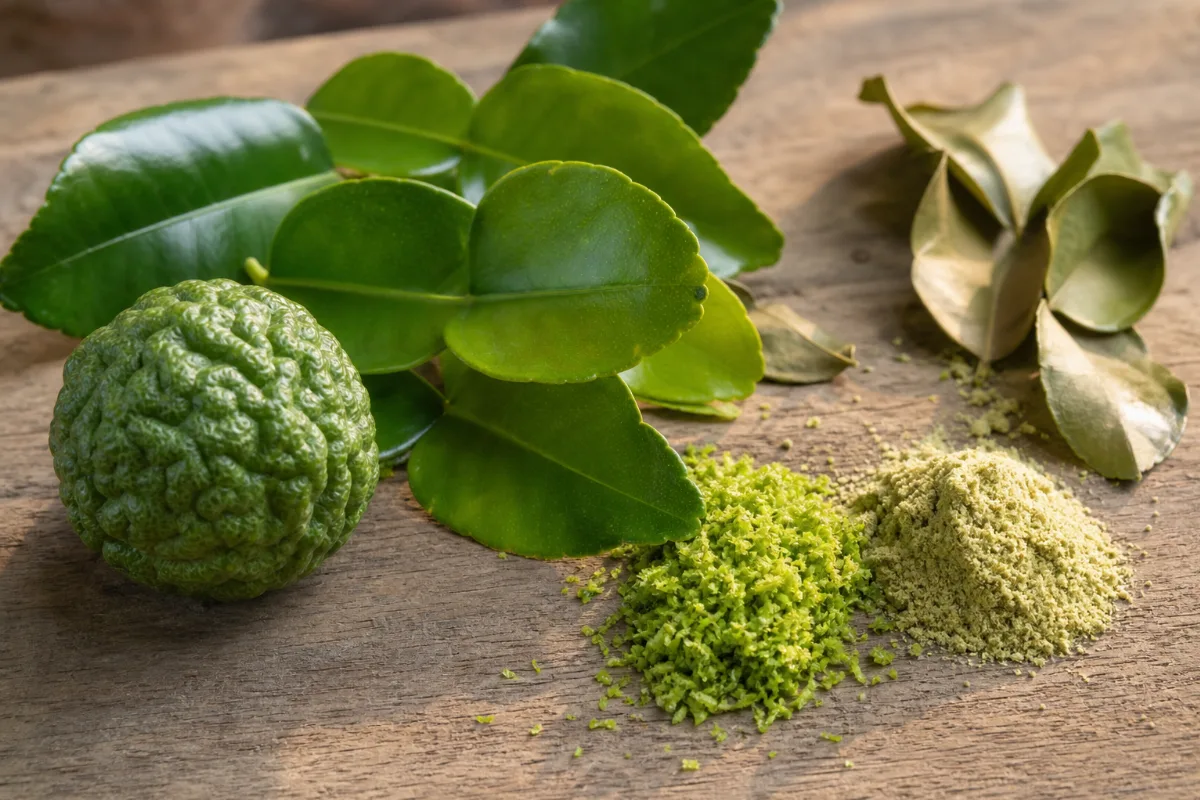
Makrut lime (Citrus hystrix) is a thorny shrub in the citrus family from tropical Southeast Asia. Its leaves look like two leaves joined end to end. The fruit is bumpy and green. It is also called kaffir lime and Thai lime.
The leaves give citrus flavor and aroma and are used a great deal in Thai green curries. They are sold fresh, frozen, freeze-dried or dried.
The main aroma compound in the leaf oil is citronellal, about 62 to 73 percent of the oil in the Malaysian samples a 2016 review covered. Oil makeup varies.
Nutrition
We found no USDA FoodData Central entry for makrut lime leaf, so we give no calories or nutrient numbers. Leaves are used in small amounts and usually removed before eating, so they add flavor, not food value.
What the research shows
We found no study of people eating or taking makrut lime leaf. The 2022 review says most work was at an early stage using crude extracts in the lab, and that clinical studies are lacking.
Extracts blocked enzymes linked to blood sugar, blood pressure and fat digestion in test tubes, and some lowered measures in rats. These results do not tell us what happens when people cook with the leaf.
Food versus extracts and oils
Every health result here is from a concentrated extract or oil in the lab or in animals. A leaf or two in a pot is very different and has not been studied.
At a glance
Traditional uses history, not proof
- Cooking leaf in Thai, Cambodian, Lao, Indonesian and Malaysian dishes
- Listed in a review as used traditionally for steam bathing after childbirth, headache and rheumatism, with no trials
- Long use as food is not proof that it treats any condition
Studied for research
- Blood sugar, insufficient evidence (lab and rat studies of extracts)
- Blood pressure, insufficient evidence (lab and rat studies of extracts)
- Cholesterol and body weight, insufficient evidence (lab and rat studies)
- Germ-fighting, insufficient evidence (essential oil in the lab)
Main compounds
- Citronellal
- Sabinene (peel oil)
- Furanocoumarins (peel and pulp)
Common forms
- Fresh, frozen or dried leaves in cooking
- Zest of the fruit in curry pastes
- Essential oil and extracts (the research used these, not the leaf in food)
Research links: 2022 review: Citrus hystrix and metabolic disorders · 2016 review: essential oils of Malaysian citrus · Research Library · Genes & Biomarkers Library
What it is and its history
- Accepted scientific name
- Citrus hystrix
- Naming authority
- DC.
- Common names
- Makrut lime (English); Kaffir lime (English); Thai lime (English); Lima kaffir (Spanish)
- Family or group
- Rutaceae (the citrus family), as given in the 2022 review.
- Classification
- Plantae > Rutaceae > Citrus > Citrus hystrix
- Native range
- Tropical Southeast Asia, southern China and northeastern India (2022 review).
- Habitat
- Not verified from a source read.
- What it looks like
- Roots: Not verified.; Stems: A flowering, shrubby plant 3 to 6 m high (2022 review); thorny (Wikipedia).; Leaves: Leaves look like two leaves joined end to end ('double-lobed'); each leaf is about 5 cm long (CooksInfo).; Flowers: Not verified.; Fruit: Green, warty, bumpy fruit (2022 review).
- Cultivation
- Wikipedia says it suits container gardens; not otherwise verified.
- Harvest and processing
- Sold fresh, frozen, freeze-dried or dried (CooksInfo). Dried leaves are sometimes sold as chopped 'granules'.
- Look-alikes and adulterants
- Name: Regular lime and lemon leaves; Note: Different plants. Cooks use lime or lemon zest as a stand-in, not their leaves.
- Sustainability and conservation
- Not assessed.
What is inside, and how it may work
What it contains and how those compounds act in cells and animals. Laboratory and animal mechanisms are not proven effects in people.
Main compounds
| Compound | Family | Where it is concentrated | Activity studied | Level of evidence |
|---|---|---|---|---|
| Citronellal | monoterpene aldehyde | Leaf oil 61.7 to 72.5 percent of the leaf essential oil in the Malaysian studies reviewed (2016 review). Varies between samples. | Main aroma compound of the leaf oil; lab antimicrobial activity reported for the oil, not for the compound alone. 1 | Laboratory research |
| Sabinene | monoterpene | Peel oil 36.4 to 48.5 percent of the peel oil (2016 review) | Main compound of peel oil. 1 | Laboratory research |
| Furanocoumarins | coumarin | Peel and pulp | Known to cause sunlight-triggered skin inflammation (Wikipedia). 5 2 | Human case |
Mechanisms, receptors and pathways
| Target or pathway | Gene or receptor | What was found | Level |
|---|---|---|---|
| ACE (angiotensin-converting enzyme) and starch-digesting enzymes | Not specified | Leaf extracts blocked these enzymes in test-tube assays. Not shown in people. 2 | Laboratory research |
Absorption, metabolism and elimination
- Absorption
- The 2022 review says there are no pharmacokinetic studies of the extract or its compounds.
- Distribution
- Not found.
- Metabolism
- Not found.
- Elimination
- Not found.
- Bioavailability
- Not established.
Isolated compounds versus whole extracts
Every health result on this page comes from concentrated extracts or oil in lab tests and animals. A leaf or two simmered in a pot is very different and has not been studied.
Nutritional composition
USDA FoodData Central: we found no entry for makrut lime leaf (the local copy of the SR Legacy spices and herbs data has none, and a search for 'lime leaf' did not return it), so we give no calories, vitamins or minerals and do not call the leaf a good source of anything. Leaves are used in small amounts and usually removed from the dish, so they add flavor, not food value.
4 not enough evidence
What was looked at
The 4 benefits and uses checked for Makrut (kaffir) lime leaf, each with how strong the evidence is. Tap one to open it.
What is Makrut (kaffir) lime leaf good for?
The studied uses and how strong the evidence is. Everything here is from lab tests or animals using extracts or oil, none from people, and none from cooking with the leaf.
Benefits, one by one
Each card is a research question, not a promise. Tap a goal to filter. Open a card to see the studies, doses and limits.
Blood sugar (lab and rat studies only)
Not enough evidenceExtracts of the leaf blocked sugar-digesting enzymes in lab tests, and a leaf extract lowered fasting blood glucose in rats with chemically induced diabetes. No study in people was found, so we cannot say anything about eating the leaf.
1 studiesLeaf extract in lab and rat studies. Not leaves eaten in food.
Studies, doses and limits
What the trials found
We found no human study of makrut lime leaf, as food or as an extract, for this use. The 2022 review says clinical studies are lacking.
Results
Lab and animal findings only. In rats with chemically induced diabetes, a leaf extract (ethanol) at 150 and 300 mg/kg body weight in drinking water for 8 weeks lowered fasting blood glucose (as listed in the 2022 review).
Effect sizes as reported
No human effect size exists. The numbers above are rat doses and do not apply to cooking.
Why this rating
Insufficient: only lab and rat studies of extracts, summarised in a review; nothing in people and nothing about food amounts.
Form and dose studied
Leaf extract in lab and rat studies. Not leaves eaten in food.
Who was studied
Rats and lab enzyme tests, not people.
Limits
Results are for concentrated extracts. The review says most studies were early and in vitro. Our source is a review, so we did not open each original study.
Why researchers looked
Researchers look at plants that block enzymes which break down starch, as a possible lead for future work on blood sugar.
Traditional use
Leaves are a cooking herb in Southeast Asia. Long use as food is not proof that it treats any condition.
Proposed mechanism In vitro or animal
In lab tests extracts block enzymes that digest starch (alpha-amylase and alpha-glucosidase). Not shown in people.
A proposed mechanism does not show that the effect happens in people.
No safety conclusion can be drawn from these studies.
Blood pressure (lab and rat studies only)
Not enough evidenceA water extract of the leaf blocked ACE, an enzyme involved in blood pressure, in a lab test, and a leaf extract mixed into rat food lowered the rats' blood pressure. There is no study in people.
1 studiesLeaf extract in lab and rat studies. Not leaves eaten in food.
Studies, doses and limits
What the trials found
We found no human study of makrut lime leaf, as food or as an extract, for this use. The 2022 review says clinical studies are lacking.
Results
Lab and animal findings only. An aqueous leaf extract blocked ACE by more than 90 percent in vitro, but the review notes the compounds were not identified and the extract was not compared with a positive control. In rats fed heated oil, adding 0.15 percent leaf extract to the diet for 16 weeks lowered systolic blood pressure compared with rats without it.
Effect sizes as reported
No human effect size exists.
Why this rating
Insufficient: lab and rat studies only, with weaknesses the review itself points out.
Form and dose studied
Leaf extract in lab and rat studies. Not leaves eaten in food.
Who was studied
Test-tube enzyme and rats, not people.
Limits
Rat model used heated frying oil, which is not the same as normal blood pressure. Our source is a review.
Why researchers looked
ACE is the target of a common class of blood pressure medicines, so ACE-blocking plant extracts get attention.
Traditional use
Leaves are a cooking herb in Southeast Asia. Long use as food is not proof that it treats any condition.
Proposed mechanism In vitro or animal
ACE (angiotensin-converting enzyme) blocking in a test tube; in rats the review also lists changes in oxidative markers. Not shown in people.
A proposed mechanism does not show that the effect happens in people.
Anyone on blood pressure medicine should not treat this as a reason to change it.
Cholesterol and body weight (lab and animal only)
Not enough evidenceRat studies listed in the 2022 review reported lower cholesterol, and one lab test found a fat-digesting enzyme (pancreatic lipase) was blocked by a leaf extract. Nothing has been tested in people.
1 studiesExtracts in lab and rat studies.
Studies, doses and limits
What the trials found
We found no human study of makrut lime leaf, as food or as an extract, for this use. The 2022 review says clinical studies are lacking.
Results
Lab and animal findings only. A leaf (ethanol) extract blocked pancreatic lipase by 58 percent in vitro in the review's table. The review's tables also list rat studies with lower total and LDL cholesterol; we did not open those original papers.
Effect sizes as reported
No human effect size exists.
Why this rating
Insufficient: lab and rat studies of extracts only.
Form and dose studied
Extracts in lab and rat studies.
Who was studied
Test tube and rats.
Limits
Summarised from a review, not the original studies.
Why researchers looked
Fat-digesting enzymes and blood fats are common targets in plant extract research.
Traditional use
Leaves are a cooking herb in Southeast Asia. Long use as food is not proof that it treats any condition.
Proposed mechanism In vitro or animal
Blocking of pancreatic lipase in a test tube. Not shown in people.
A proposed mechanism does not show that the effect happens in people.
No safety conclusion can be drawn.
Germ-fighting in the lab (essential oil)
Not enough evidenceThe leaf oil has been shown to have antimicrobial activity in lab experiments. That is a test-tube finding about concentrated oil, not about cooking with the leaf or about treating infections.
1 studiesEssential oil, lab only.
Studies, doses and limits
What the trials found
We found no human study.
Results
The 2016 review says the essential oil of C. hystrix has been experimentally shown to have antimicrobial and antifeedant activities. The abstract gives no figures.
Effect sizes as reported
No figures were read.
Why this rating
Insufficient: lab experiments with concentrated oil only; the details were not read.
Form and dose studied
Essential oil, lab only.
Who was studied
Lab experiments.
Limits
Only the abstract was read, so strength and test conditions are unknown.
Why researchers looked
Citrus oils are often tested against bacteria and fungi.
Traditional use
Leaves are a cooking herb in Southeast Asia. Long use as food is not proof that it treats any condition.
Proposed mechanism In vitro or animal
Not described in the abstract read.
A proposed mechanism does not show that the effect happens in people.
Concentrated citrus oils can irritate skin; do not apply to skin or swallow.
Connections to the rest of health
How Makrut (kaffir) lime leaf connects to the rest of our health knowledge graph. Every link says what kind of connection it is. A safety link (for example to the liver) is a warning, not a benefit. A study that merely mentions a topic never creates a benefit link.
Explore every connection: goals, body systems, organs, symptoms, genes
B. Body systems
| Connected to | Kind of connection | Evidence status | Context | Studies |
|---|---|---|---|---|
| Metabolic And Endocrine | Biological association | Not enough evidence | Studied for: Blood sugar (lab and rat studies only) Studied for: Cholesterol and body weight (lab and animal only) | 2 |
| Cardiovascular System | Biological association | Not enough evidence | Studied for: Blood pressure (lab and rat studies only) | 2 |
| Blood And Immune | Biological association | Not enough evidence | Studied for: Germ-fighting in the lab (essential oil) | 1 |
C. Body parts and organs
| Connected to | Kind of connection | Evidence status | Context | Studies |
|---|---|---|---|---|
| Skin | Adverse effect or risk | Documented risk | Juice on skin followed by sunlight can cause blisters; this is not about eating the leaf. Fruit juice or peel on skin followed by sunlight can cause blisters; not about eating the leaf. Preparation or compound: Fruit juice or peel on skin |
2 5 |
L. Active compounds
| Connected to | Kind of connection | Evidence status | Context | Studies |
|---|---|---|---|---|
| Citronellal | Biological association | In vitro | Main aroma compound of the leaf oil; lab antimicrobial activity reported for the oil, not for the compound alone. Preparation or compound: Leaf oil |
1 |
| Sabinene | Biological association | In vitro | Main compound of peel oil. Preparation or compound: Peel oil |
1 |
| Furanocoumarins | Biological association | Human case | Known to cause sunlight-triggered skin inflammation (Wikipedia). Preparation or compound: Peel and pulp |
5 2 |
Each connection is stored with the ingredient, the connected record, the kind of connection, the evidence status, the supporting studies, the preparation or compound involved, and a review date (last reviewed October 26, 2026).
Evidence at a glance: what the research found for 4 outcomes
Each outcome below is one thing researchers measured. Certainty is how far the evidence can be trusted, not how well it works. The full studies are on the next tab.
The evidence
The research centre for Makrut (kaffir) lime leaf. Every record here was checked against PubMed or the publisher's page; we never list a study we have not verified.
Evidence by outcome
Bars show how many studies we found for each outcome, not how well it works. People are added up across trials only (reviews are not added, to avoid double counting).
How we rate evidence
High certainty
Several well-run trials or reviews agree; further research is unlikely to change the picture much.
Moderate certainty
Good trials point the same way, but some doubt remains.
Low certainty
Small, short or inconsistent trials. The finding could change with better research.
Very low certainty
Very little or very weak human data. Treat as a possibility only.
Mixed findings
Trials or reviews disagree with each other.
Not enough evidence
Not enough human research to say either way.
Evidence against
Good research found no benefit, or found harm.
We take the reviewers' own risk-of-bias and GRADE statements where they exist, and otherwise judge from study size, design, consistency, directness and whether a product matches what is sold. Many publications do not make evidence high. Method note: We started from our existing makrut lime leaf page, re-read the 2022 review (full text) and the 2016 oil review (abstract) through PubMed and PubMed Central, and re-read two cooking and reference pages. Very little research exists, so this page is short on purpose.
Study library: every study we checked 5
| Study | Design | People | Product, dose, length | Result |
|---|---|---|---|---|
| p28930124 Md Othman SNA, et al. Essential Oils from the Malaysian Citrus (Rutaceae) Medicinal Plants. Medicines (Basel) 2016;3(2):13 · Source |
Narrative review Citrus hystrix leaf and peel essential oil |
Methods, limits and fundingRead: abstract | ||
| p35215280 Siti HN, Mohamed S, Kamisah Y. Potential Therapeutic Effects of Citrus hystrix DC and Its Bioactive Compounds on Metabolic Disorders. Pharmaceuticals (Basel) 2022;15(2):167 · Source |
Narrative review Citrus hystrix (leaf, rind, fruit extracts; lab and animal studies) |
Methods, limits and fundingRead: full-text | ||
| s-cooksinfo-makrut-lime-leaves CooksInfo: Makrut lime leaves · Source |
Cooking reference Citrus hystrix leaf |
Methods, limits and fundingRead: full-text | ||
| s-usda-sr-legacy-no-entry USDA FoodData Central, SR Legacy spices and herbs subset: no entry for makrut lime leaf · Source |
Reference database n/a |
Methods, limits and fundingRead: full-text | ||
| s-wikipedia-citrus-hystrix Wikipedia: Citrus hystrix · Source |
Reference article Citrus hystrix |
Methods, limits and fundingRead: full-text |
What we do not know yet
- No human study of makrut lime leaf was found for any use.
- Original rat and lab papers were not opened; descriptions come from a 2022 review.
- No USDA nutrition entry was found.
- Only the abstract of the 2016 oil review was read.
- No regulator statement, allergy report, children's or breastfeeding information, and no medicine interaction study was found.
- The furanocoumarin statement comes from Wikipedia.
How new research is added
New studies are found by a saved PubMed search and placed in a review queue before the page changes.
Lab markers
What changed in blood or saliva tests during trials. A changed number is not the same as feeling or being healthier, and we give no "normal ranges".
Safety
What studies and official sources say about side effects, medicines and who should check first. Each point shows what kind of evidence it comes from.
Main points to know 3
- Skin and sunlight: do not rub the fruit's juice or peel on skin that will meet the sun. The fruit's peel and pulp contain furanocoumarins, which are known to cause phytophotodermatitis, a skin inflammation triggered by sunlight (Wikipedia). A case report in the 2022 review describes a hiker who put the juice on his skin as an insect repellent and developed redness and blisters. The review notes no amount or duration was recorded and the sample is tiny. This is about skin contact with juice, not about eating the leaf. Case report 2 5
- Pregnancy: peel extract caused pregnancy loss in rats. In rats, peel extract (chloroform and ethanol) at 100 to 2,500 mg/kg twice daily caused dose-related loss of implantation and abortion, and the authors suggest avoiding peel extract in pregnancy. This was concentrated peel extract in animals, not leaves in food. No source we read describes leaves in cooking during pregnancy. Animal research 2
- Eating the leaf in food: no problem found, but little has been studied. The sources we read name no harm from eating the leaf in cooking. The 2022 review found only two toxicity studies of the plant, the rat study and the case report above. That is not proof of safety. Authoritative guidance 2
Side effects 1
| Effect | How often | Severity and recovery | Evidence |
|---|---|---|---|
| Redness and blisters on skin after applying the fruit juice (phytophotodermatitis) Juice on skin, not eating the leaf. No dose or duration was recorded and the review says this limits what can be concluded. | One case report | Described as blisters; no further detail Not stated | Case report 2 |
Liver
No liver injury from makrut lime leaf was found in the sources read. A liver-safety source (such as LiverTox) was not searched.
How often. No frequency was found.
Monitoring. No agency monitoring advice was found.
This is a safety connection. It is not evidence that Makrut (kaffir) lime leaf supports liver health.
Medicines and supplements 1
| With | Why it matters | Importance | Evidence | What to do |
|---|---|---|---|---|
| Prescription and other medicines prescription | Not described. | The sources we read name no medicine interaction for the leaf in food, and we found no interaction studies. Absence of evidence is not proof of no interaction. | None found Not enough evidence 2 | If you use concentrated extracts or oil, ask a pharmacist before combining them with medicines. |
Who should check first 3
| Situation | Advice | Evidence |
|---|---|---|
| Pregnancy and breastfeeding (concentrated peel extract or supplements) | Peel extract caused pregnancy loss in rats; skip concentrated peel extracts and ask your midwife or doctor. Leaf in cooking was not studied. Breastfeeding was not described in any source read. | Animal research 2 |
| Fruit juice or peel on skin before sun exposure | Avoid it. Wash it off and keep the skin out of the sun if it happens. | Case report 2 5 |
| Children | No source we read describes makrut lime leaf in children. Whole leaves are tough; remove them from food before serving. | Authoritative guidance 3 |
Overdose, product quality and regulators
Summary. Only two toxicity reports exist for the plant according to the 2022 review: a rat pregnancy study with peel extract and a skin case report. Nothing was found for leaf in food.
Animal. Peel extract in rats caused dose-related loss of implantation and abortion and, at 1,000 mg/kg of alcohol extract, lower fetal weight.
Human doses studied. No human dosing study was found.
Overdose response. Not found.
Genotoxicity. Not researched.
Toxic or hazardous parts. Peel and pulp contain furanocoumarins (skin reaction in sunlight, Wikipedia).
No source read describes contamination of this leaf. Pesticide residues, heavy metals and microbes were not researched.
When to get medical help
- Trouble breathing, swelling of the lips, face or throat, or widespread hives after eating it
- Painful blisters or a spreading rash on skin that touched the fruit's juice or peel and then met the sun
Stop using the product and contact a clinician or emergency service. In the US, Poison Control is 1-800-222-1222.
General information only, not medical advice. Ask a clinician or pharmacist before use, especially with medicines, in pregnancy or with a health condition. See the Natural Remedy Safety guide.
Frequently asked questions
What does makrut lime leaf taste like?
Is makrut lime leaf the same as kaffir lime leaf?
Yes. Kaffir lime, Thai lime and makrut lime are names for Citrus hystrix.
What is makrut lime leaf used for in cooking?
Is makrut lime leaf good for you?
Not shown. We found no study of people. The research is lab and rat studies of extracts, so we cannot say eating the leaf does anything for health.
Does it lower blood sugar or blood pressure?
Not shown. Extracts blocked related enzymes in the lab and lowered measures in rats. No human study was found.
Does it have nutrients?
We found no USDA entry for the leaf, so we give no nutrient numbers. It is used in small amounts for flavor.
Is it safe in pregnancy?
Leaves in cooking were not studied in the sources we read. In rats, concentrated peel extract caused pregnancy loss and the authors suggest avoiding it in pregnancy. Ask your midwife or doctor.
Can it interact with medicines?
No interactions were described in the sources we read, and no interaction studies were found. Ask a pharmacist if you take medicines and use concentrated products.
Can the fruit cause skin problems?
Can I use lime zest instead?
Lime or lemon zest is a common stand-in, but we did not verify this in a source we read, so treat it as a cooking tip, not a fact from research.
Can I buy it dried or frozen?
Yes. CooksInfo says the leaves are sold fresh, frozen or freeze-dried, and dried leaves are sometimes sold as chopped granules.
Explore by health goal
Editorial transparency
- Written by
- AlternativeMed editorial team. Research compiled with AI assistance, then checked against the sources listed.
- Medical review
- None. This page has not been reviewed by a physician or pharmacist.
- First published
- 2026-10-26
- Last substantive update
- 2026-10-26
- How we research
- We started from our existing makrut lime leaf page, re-read the 2022 review (full text) and the 2016 oil review (abstract) through PubMed and PubMed Central, and re-read two cooking and reference pages. Very little research exists, so this page is short on purpose.
- How we rate evidence
- See "How we rate evidence" in the Evidence tab.
- Independence
- No product is promoted on this page. No affiliate links are shown.
Sources 5
Each source was opened and checked. Where we read only the abstract, it says so. The small numbers in the text point here.
- . Md Othman SNA, et al. Essential Oils from the Malaysian Citrus (Rutaceae) Medicinal Plants. Medicines (Basel) 2016;3(2):13. . . (abstract)
- . Siti HN, Mohamed S, Kamisah Y. Potential Therapeutic Effects of Citrus hystrix DC and Its Bioactive Compounds on Metabolic Disorders. Pharmaceuticals (Basel) 2022;15(2):167. . . (full-text)
- . CooksInfo: Makrut lime leaves. . . (full-text)
- . USDA FoodData Central, SR Legacy spices and herbs subset: no entry for makrut lime leaf. . . (full-text)
- . Wikipedia: Citrus hystrix. . . (full-text)
Where to buy
Check the label first. Whatever you buy, look for these:
- Whole or ground: whole spices keep their flavor longer
- The origin and a packed-on or best-by date for freshness
- Organic or non-irradiated labeling if that matters to you
- A resealable, airtight container
Talk to a pharmacist or doctor before you start any supplement, especially if you take medicines. See the Safety tab for interactions.
Support our free guides: as an Amazon Associate we earn from qualifying purchases. Full disclosure.


