Galangal: Flavor, Cooking Use and Health Facts
Galangal is piney, peppery and citrusy and used fresh in Thai soups and curry pastes; human research is thin and limited to small trials of extracts.
Content last updated . This page has not been medically reviewed.
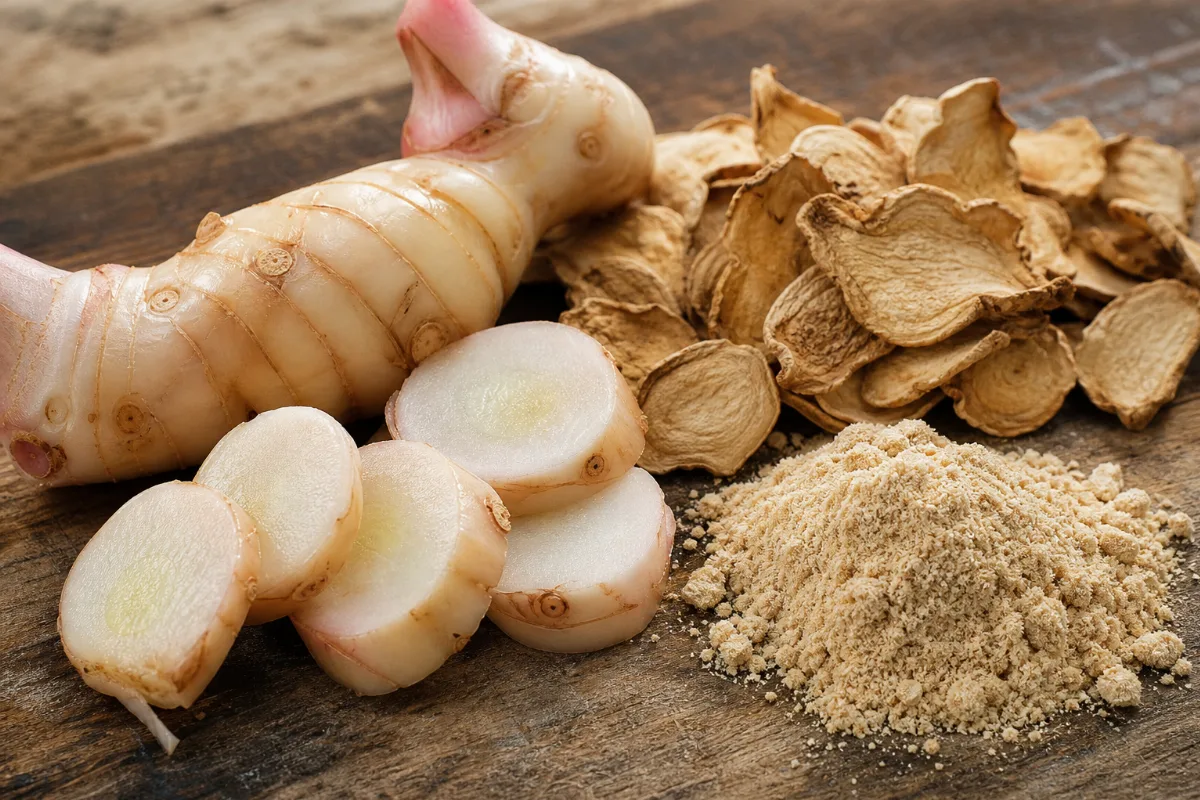
In the kitchen at a glance
Flavor:Hot / pungentCitrusy
Aroma: Pungent and piney, with notes of citrus and black pepper.
Used in: curries, soups and stews
Usual amount in food: One source swaps 1 tablespoon of minced fresh galangal for 1/2 teaspoon of powder; USDA has no entry for galangal.
What it is
Galangal is the underground stem (rhizome) of Alpinia galanga, a plant in the ginger family. [1] It is also called greater galangal, lengkuas or blue ginger. [1] It is native to South and Southeast Asia, and it is widely grown in Indonesia, the Philippines and Thailand. [1] The sources we read do not say how it differs from lesser galangal (Alpinia officinarum), so check the label if a recipe names one. White-skinned plants are used mainly as a spice, and red ones mainly as medicine. [1]Flavor and aroma
Galangal smells pungent and tastes of citrus, black pepper and pine. [1] Another cooking source describes it as piney, peppery and citrusy, with less juicy heat than ginger. [2] That piney note is what ginger lacks. [2] The root is hard and woody, too fibrous to grate the way you would grate ginger. [2] The sources we read do not say which compounds cause the taste, or how heat changes it.How it is used in cooking
Galangal is sold fresh, frozen, as dried slices and as powder. [2]- Thai cooking: a common ingredient in curries and in soups such as tom kha kai, used in chunks, in thin slices or pounded into curry paste. [1]
- Other dishes: tom yum, rendang and soto. [2]
- India and Pakistan: dried and ground for spice mixes such as nihari. [1]
- Philippines: the Mansaka people ferment it with honey into a wine called byais. [1]
If you cannot find fresh galangal, one cooking source says frozen is the best swap, used one for one. Powder is warmer and flatter, so use 1/2 teaspoon in place of 1 tablespoon minced fresh. For soup, 2 teaspoons of young ginger plus one torn makrut lime leaf can stand in. For curry paste or braises, try young ginger with a little lemongrass. [2] Ginger alone is hotter and lacks the pine note, so use about two-thirds as much. [2] The same source says dishes named for galangal, such as tom kha, are best made with frozen galangal. [2] The sources we read give no rule for when to add it or whether to toast it.
Normal food amounts
| Measure | Grams | Source |
|---|---|---|
| 1 teaspoon, powder | Not found | USDA SR Legacy has no entry for galangal [10] |
| 1 tablespoon, minced fresh | Not found | No weight in the sources we read |
| Typical recipe swap | 1 tbsp minced fresh = 1/2 tsp powder | One cooking source [2] |
USDA SR Legacy has no entry for this spice, so we give no nutrient numbers. [10] A slice or two in a pot is mostly flavor, and we make no claim that it supplies any vitamin or mineral.
Buying, storing and preparing
- Forms: fresh root, frozen root, dried slices and powder. [2]
- Shopping: the sources we read give no buying tips beyond choosing the form that suits the dish.
- Preparing: the root is woody, so cut it into thin slices or chunks rather than grating. [2]
- Storing and shelf life: the sources we read give no reliable shelf life. Freezing is a normal way to keep it. [2]
- Quality problems: the sources we read do not describe adulteration or contamination of galangal.
Health: what research says
Eating galangal in cooking is very different from taking a concentrated extract.Food amounts vs supplements
| In normal cooking | In supplements and extracts | |
|---|---|---|
| Typical amount | No gram weight found; one cooking source gives only swap ratios [2] | One trial used 500 mg of extract a day for 4 weeks [5]; another used a two-ingredient tablet for three months [8] |
| What studies mostly used | No study of galangal eaten as a seasoning was found | Branded extracts and tablets, in single small trials [4][5][8] |
| What we can say about benefit | Nothing; no study | Small single trials, some company-linked; none confirms a use [3][4] |
| Main safety limit | None described in the sources we read | Little human safety data; mixed animal results [6][7][9] |
What the evidence shows
| Use | What the sources found | Strength of evidence | Form and population |
|---|---|---|---|
| Mental alertness | In 59 adults who drink caffeine, a galangal extract gave a small gain in alertness score at 3 hours. [4] | Promising but limited | Branded extract; healthy adults |
| Sexual function in men taking SSRIs | In 60 men, scores rose from 11.2 to 17.4 on the extract, against 10.6 to 13.7 on placebo, by week 4. [5] | Promising but limited | 500 mg extract; adult men on SSRIs |
| Sperm movement | Motile sperm rose 62% with a pomegranate-and-galangal tablet, against 20% on placebo (70 men, 3 months). [8] | Insufficient evidence for galangal alone | Two-ingredient tablet; men with weak semen quality |
| Knee osteoarthritis pain | A 6-week trial of 247 people found a moderate benefit from an extract of ginger and galangal, with more mild stomach and gut side effects. [6] | Mixed; cannot separate galangal from ginger | Combination extract; adults with knee OA |
| Anti-inflammatory and anticancer effects | Reported in laboratory work and summarized in a 2022 review. [3] | Lab or animal only | Cells and animals |
| Kidney protection from an antibiotic | Rats given gentamicin had less kidney injury with galangal essential oil. [11] | Lab or animal only | Essential oil; rats |
For supplement forms, trials and interactions in depth, see the full herb guide: Galangal.
Official statements
We could not open a galangal page from NCCIH, Memorial Sloan Kettering or the EMA, so we quote no official statement. A rat study notes that one branded extract already has US GRAS status. That is a company claim in the abstract, not an FDA page we read. [7]Related pages
Health connections for Galangal
What research links to this spice, and how strong the evidence is. Most studies use concentrated extracts or doses far above what you eat; each card says which.
Mental alertness and attention
Preliminary or mixedOne randomized crossover study of 59 caffeine users found a small speed-of-response gain after a galangal extract, with or without caffeine.
Supplements: Possible small short-term effect; needs independent confirmation. Finding is for extracts or tablets, not food amounts.
Sexual function in men taking SSRI antidepressants
Preliminary or mixedA triple-blind trial of 60 men taking SSRIs found higher erectile-function scores at week 4 with a galangal extract than with placebo.
Supplements: Authors call it promising; not yet confirmed by other trials. Finding is for extracts or tablets, not food amounts.
Sperm movement (combination product)
Preliminary or mixedIn a 70-man trial, motile sperm numbers rose more with a pomegranate-and-galangal tablet than with placebo.
Supplements: Not shown for galangal on its own. Finding is for extracts or tablets, not food amounts.
Knee osteoarthritis pain (with ginger)
Preliminary or mixedA 6-week trial of a ginger-and-galangal extract found a moderate benefit over placebo, with more mild gut side effects.
Supplements: Not shown for galangal on its own. Finding is for extracts or tablets, not food amounts.
Traditional and kitchen use
Not enough evidenceGalangal is used as a kitchen spice and in folk medicine. This is traditional use, not proof of benefit.
Supplements: For food amounts: no study of galangal eaten as a seasoning was found. Traditional use is not proof of benefit.
Laboratory anti-inflammatory, antioxidant and anticancer effects
Lab or animal research onlyLaboratory work described in a review reports such activities. These are cell and animal findings only.
Supplements: No human benefit shown.
Kidney protection in rats given gentamicin
Lab or animal research onlyThe essential oil lowered kidney-injury markers in rats given the antibiotic gentamicin.
Supplements: No human benefit shown.
Activity against tuberculosis bacteria in the lab
Lab or animal research onlyExtracts modestly slowed growth of tuberculosis bacteria in test-tube work.
Supplements: No human benefit shown.
Documented risks and interactions (2)
- Gut side effects with a ginger-galangal extract. In the knee-pain trial, more people had gut-related adverse events with the extract than with placebo (59 vs 21), mostly mild.
- Liver enzymes and organ weights in an animal study. One animal study of galangal extracts reported higher liver enzymes and organ weights; a 90-day rat study of a standardized extract found no treatment-related harm.
Frequently asked questions
Is galangal the same as ginger?
No. Both are in the ginger family, but galangal is Alpinia galanga and has a piney, peppery, citrusy taste. [1][2] Ginger is juicier and hotter. [2]
Is galangal hot?
It has a peppery bite, but one cooking source says less juicy heat than ginger. [2]
How much is normal?
We found no gram weight for a household measure. One cooking source swaps 1 tablespoon of minced fresh galangal for 1/2 teaspoon of powder. [2]
Is it safe in pregnancy?
The sources we read do not say. Eating small amounts in food is normal in Southeast Asia, but ask your midwife or doctor about extracts. [3]
Can I take it with medicines?
The sources we read do not describe interactions. Ask a pharmacist, especially about extracts. [3]
More details: evidence, limits and cautions
The details behind this page: cautions, limits of the evidence and where sources disagree. Open any note to read it.
Safety note at a glance
Safety in more detail
- Medicines: the sources we read do not describe interactions. Ask a pharmacist, especially if you take blood thinners, diabetes medicine or SSRIs. [3]
- Pregnancy: the sources we read do not describe pregnancy use.
- Breastfeeding: the sources we read do not describe breastfeeding use.
- Children: the sources we read do not describe use in children.
- Allergy: the sources we read do not describe galangal allergy.
- Liver and kidney: an animal study of extracts reported higher liver enzymes, higher organ weights and slightly lower blood counts. [9] A 90-day rat study of a standardized extract found no treatment-related harm up to the highest dose. [7] Animal findings do not predict human harm directly. We found no human case reports.
- Surgery: the sources we read do not describe a surgery warning. Tell the surgical team about any supplement.
- Quality and contamination: not described in the sources we read.
- Amounts that cause trouble: in the one trial that reported them, the ginger-galangal extract caused more gut side effects than placebo (59 against 21 people), mostly mild. [6] No amount from cooking has been linked to harm in the sources we read.
References
- Wikipedia — Alpinia galanga (cites Hoogervorst 2013, Ravindran et al. 2004, Missouri Botanical Garden and Garcia 2019). https://en.wikipedia.org/wiki/Alpinia_galanga (accessed 2026-10-24)
- Know the Spices — Galangal substitutes: 5 best swaps for soup and curry. https://knowthespices.com/cooking/galangal-substitutes/ (accessed 2026-10-24)
- Journey of Alpinia galanga from kitchen spice to nutraceutical to folk medicine to nanomedicine. J Ethnopharmacol 2022; abstract read via Europe PMC. https://pubmed.ncbi.nlm.nih.gov/35227783/ (accessed 2026-10-24)
- Effect of Alpinia galanga on mental alertness and sustained attention with or without caffeine. J Am Coll Nutr 2017; abstract read via Europe PMC. https://pubmed.ncbi.nlm.nih.gov/28910196/ (accessed 2026-10-24)
- Alpinia galanga extract for SSRI-induced erectile dysfunction: a randomized triple-blind trial. Front Psychiatry 2023; abstract read via Europe PMC. https://pubmed.ncbi.nlm.nih.gov/37143784/ (accessed 2026-10-24)
- Effects of a ginger extract on knee pain in patients with osteoarthritis. Arthritis Rheum 2001; abstract read via Europe PMC. https://pubmed.ncbi.nlm.nih.gov/11710709/ (accessed 2026-10-24)
- Subchronic toxicological evaluation of EnXtra (standardised extract of Alpinia galanga rhizome) in rats. J Complement Integr Med 2022; abstract read via Europe PMC. https://pubmed.ncbi.nlm.nih.gov/35114741/ (accessed 2026-10-24)
- An extract of pomegranate fruit and galangal rhizome increases the numbers of motile sperm. PLoS One 2014; abstract read via Europe PMC. https://pubmed.ncbi.nlm.nih.gov/25275520/ (accessed 2026-10-24)
- Antimycobacterial activity and safety profile assessment of Alpinia galanga and Tinospora cordifolia. Evid Based Complement Alternat Med 2018; abstract read via Europe PMC. https://pubmed.ncbi.nlm.nih.gov/30069222/ (accessed 2026-10-24)
- USDA FoodData Central, SR Legacy (April 2018) — checked in the site's USDA data file (docs/research/spices/usda-spices.json); no galangal entry.
- Alpinia galanga essential oil mitigates gentamicin-induced renal injury. Kidney Dis 2025; abstract read via Europe PMC. https://pubmed.ncbi.nlm.nih.gov/41321790/ (accessed 2026-10-24)