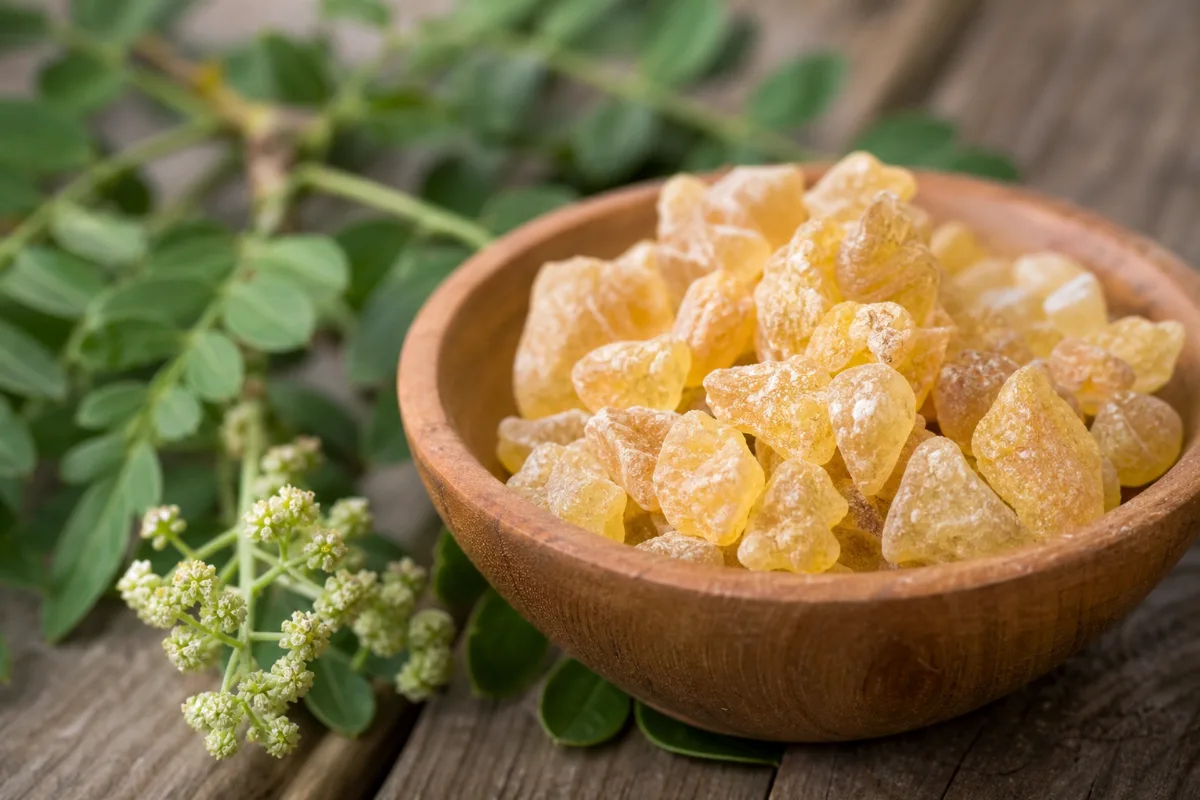
Herbs & Botanicals · Herbs · Tree resin sold as extracts, with low certainty for knee osteoarthritis and little else
Boswellia
Boswellia serrata Roxb. ex Colebr. · also called Boswellia, Indian frankincense, Indian olibanum, shallaki, salai guggul (Hindi), incienso indio (Spanish), arbre à encens (French)
Boswellia serrata is a tree of the incense family (Burseraceae). The part used is the dried gum resin, taken as extracts rich in boswellic acids, which are sold as capsules and creams. Its best-studied use is knee osteoarthritis, and the honest rating there is low: small trials of branded extracts (5-Loxin, Aflapin, Boswellin) report less pain, but the Cochrane review graded only two small trials of one extract as high quality, pooled reviews call the overall quality low or very low, and a 2024 analysis found no significant overall effect. Brain swelling after radiotherapy is also low, from one trial of 44 people. Most other uses (hand and back pain, asthma, ulcerative colitis, skin, gums, memory) are very low or insufficient, and for keeping Crohn's disease in remission the one large placebo trial, stopped early, found no benefit. Boswellia is not shown to treat or cure cancer. Mild stomach upset is the usual side effect; we found no reports of liver injury, but we could not read the LiverTox entry, and two single serious case reports exist (kidney injury; low blood sodium with a seizure). Some commercial extracts were padded with citric acid. There are no data for pregnancy, breastfeeding or children.
General information, not medical advice. Last substantive update · Not medically reviewed. A named clinician has not signed off on this page. How this page is made
About Boswellia
Boswellia serrata (Indian frankincense) is a tree whose dried gum resin is sold as extracts rich in boswellic acids. Its main studied use is knee osteoarthritis, and the certainty there is low: small trials of branded extracts such as 5-Loxin, Aflapin and Boswellin report less pain than placebo, but the Cochrane review graded only two small trials of one extract as high quality, pooled reviews call overall quality low or very low, and a 2024 analysis found no significant overall effect. Brain swelling after radiotherapy is low (one trial of 44 people). Most other uses are very low or insufficient, and keeping Crohn's disease in remission is rated against. It has not been shown to treat or cure cancer. Mild stomach upset is the usual side effect, with no liver-injury reports found (the LiverTox entry was not read) and two single serious case reports.
What it is
Boswellia serrata is a tree of the incense and myrrh family (Burseraceae), native to India according to the papers read. The resin that oozes from cuts in the bark dries into a gum resin, called Indian frankincense or salai guggul in Ayurveda. Supplements are dry extracts of this resin, often standardised to boswellic acids, which vary a lot between products: one test of 16 supplements found total acids from 0.4 to 35.7 percent.
Several other trees are also called frankincense. Boswellia sacra (also sold as B. carteri, from Arabia and Oman), B. papyrifera and B. frereana have different chemistry. Frankincense essential oil and incense are different products from standardised oral extracts. Some trials in this profile used other species, and we say so each time. The tree and its resin are not a food, so no nutrient table applies.
Traditional and current uses
In Ayurveda the gum resin (shallaki, salai guggul) is a traditional medicine, mainly for inflammation and stiff joints. Reviews say resins of Boswellia species have also been used in India, China and the Arabian world, and burned as incense. We could not check classical texts or dates. In Europe no herbal monograph for B. serrata was found; a review says the EU gave a B. serrata extract orphan-drug status in 2002 for brain swelling around tumours, and that the European Pharmacopoeia has a monograph for the resin.
Today people take extracts for joint pain, and less often for bowel, skin, breathing or brain complaints. Knee osteoarthritis is the use with the most trials.
What is in it and how it works
The best-known compounds are boswellic acids, especially KBA and AKBA. In test tubes they block 5-lipoxygenase, an enzyme that makes inflammatory leukotrienes, and other inflammation targets. But a review points out that blood levels after a plain oral extract are far below the test-tube levels, and boswellic acids did not block leukotrienes in human blood, so how the extract works in people is uncertain. Other resin compounds such as lupeolic acids are also active in the lab.
Absorption of plain extract is poor and is higher with a fatty meal. Micellar and lecithin forms raised blood levels a great deal in healthy volunteers and mice, but higher blood levels have not been shown to give better results in patients. Because products differ so much, one brand's trial does not stand for another.
What the research shows
Knee osteoarthritis: low. The Cochrane review (2014) graded two small trials of one enriched B. serrata extract (85 people) as high quality for less pain, but pooled reviews call overall quality low or very low and a 2024 analysis of 13 trials found no significant overall effect. Trials were mostly small, short and linked to the extract makers. Brain swelling after radiotherapy: low, from one trial of 44 people (60% versus 26% with a big drop in swelling on MRI) and uncontrolled series. Hand osteoarthritis: mixed. Combinations with turmeric: low, and the benefit cannot be credited to Boswellia alone.
Most other uses are very low or insufficient: low back pain, asthma, ulcerative colitis (two old trials against a drug, no placebo), psoriasis cream, gum inflammation, and memory (nearly all in mixtures). For keeping Crohn's disease in remission, the one large placebo trial of Boswelan, stopped early, found no benefit, so it is rated against. Boswellia has not been shown to treat or cure cancer.
120 122 21 6 12 64 16 51 19 43 101 102 116 49 69 45 84 54 89 24 55 20 44 18 118 1 114 117 28 9 41 39 65 40 83 33 35
At a glance
Traditional uses history, not proof
- Ayurveda (India): the gum resin (shallaki, salai guggul) is described as a traditional medicine for joint and inflammatory complaints. Specific classical texts and dates were not checked here.
- India, China and the Arabian world: reviews state that resins of Boswellia species have long been used in traditional medicine, and burned as incense. This describes the whole genus, not B. serrata alone.
- Modern use: extracts taken for joint pain and stiffness, and creams for skin.
Studied for research
- Knee osteoarthritis pain and function, and brain swelling after radiotherapy (one trial of 44 people), low
- Hand osteoarthritis, mixed; Boswellia with turmeric or other herbs, low
- Quick knee pain relief, cartilage, low back pain, asthma, ulcerative colitis, skin uses, gum inflammation, memory after head injury, very low
- Crohn's disease remission, against; rheumatoid arthritis, mood and sleep, blood sugar, hay fever, exercise soreness, insufficient
Main compounds
- Boswellic acids, mainly 11-keto-beta-boswellic acid (KBA) and acetyl-11-keto-beta-boswellic acid (AKBA): the markers used to standardise extracts; they act on inflammation enzymes in test tubes
- Beta-boswellic acid and alpha-boswellic acids, which reach higher blood levels than AKBA, and lupeolic acids, also active in the lab
- Incensole acetate is found in other species such as B. papyrifera and B. sacra, but was not detected in B. serrata
Common forms
- Standardised dry extracts of the gum resin in capsules (for example 5-Loxin, Aflapin, Boswellin, Boswelan)
- Extracts bound to lecithin or in micelles to raise absorption (for example Casperome)
- Blends with turmeric and other joint herbs
- Creams and oils (frankincense oil is often another species)
Research links: US National Center for Complementary and Integrative Health: Boswellia · Memorial Sloan Kettering: Boswellia · NIH LiverTox: Boswellia serrata (entry not opened by us) · Oral herbal therapies for osteoarthritis: Cochrane review (abstract) · Boswelan for Crohn's disease remission: placebo-controlled trial (abstract) · Research Library · Genes & Biomarkers Library
The plant and its history
- Accepted scientific name
- Boswellia serrata Roxb. ex Colebr.
- Naming authority
- Roxb. ex Colebr., published in Asiatic Researches 9: 379, t. 5 (1807) (GBIF)
- Synonyms
- Boswellia glabra Roxb.; Boswellia hirsuta Sm.; Boswellia serrata var. bivalvis Kuntze; Boswellia serrata var. glabra (Roxb.) A.W.Benn.; Boswellia thurifera Roxb. ex Fleming; Libanotus asiaticus Stackh.; Libanus thurifer Colebr.; Libanus thuriferus Colebr.
- Common names
- Indian frankincense (English); Indian olibanum (English); Boswellia (English); Shallaki (Hindi / Sanskrit-derived); Salai guggul (Hindi); Salai (Hindi); Kundur (Hindi); Luban (Hindi); Hastinashana (Sanskrit); Dhupali (Marathi); Kundu (Kannada); arbre a encens (French); kadzidlowiec indyjski (kadzidla indyjska) (Polish)
- Botanical family
- Burseraceae (the incense and myrrh family, order Sapindales; GBIF and NCBI agree).
- Classification
- Plantae > Tracheophyta > Magnoliopsida > Sapindales > Burseraceae > Boswellia > Boswellia serrata
- Native range
- Not verified from a primary source here. Papers read describe the tree and its gum resin as a traditional Indian (Ayurvedic) medicine (p21553931) and the Indian-frankincense name points the same way; distribution details were not retrieved.
- Habitat
- Not verified: no habitat source was retrieved.
- What the plant looks like
- Roots: Not described in the sources read.; Stems: A resin-bearing tree; the gum resin (oleogum resin) is the part used, collected as an exudate from cuts in the bark. The European Pharmacopoeia describes the air-dried gum-resin exudate of B. serrata (p21553931). Tree size and bark were not verified.; Leaves: Not described in the sources read.; Flowers: Not described in the sources read.; Fruit: Not described in the sources read.
- Cultivation
- Not verified. Supply is largely wild-tapped resin; one paper notes sustainability concerns for B. serrata harvest in India (s-johnson-2022-conservation-pmc, citing earlier work).
- Harvest and processing
- The drug is the dried gum resin exudate (European Pharmacopoeia, via p21553931). Supplements are dry extracts of the resin, often standardised to boswellic acids; products differ greatly, with total boswellic plus lupeolic acids from 0.4 to 35.7 percent across 16 supplements (p31581678). Steps for tapping and drying were not verified.
- Look-alikes and adulterants
- Name: Boswellia sacra Flueck. (including B. carteri / carterii; Arabian or Omani frankincense); Note: GBIF accepts B. sacra and lists B. carteri Birdw. as its synonym; some papers still treat carterii as a separate commercial type (p16364338). Resin is sold as frankincense or olibanum, but its acid profile and essential oil differ from B. serrata: it carries trace incensole where B. serrata had none detected (p29314317). Acid pattern lets labs tell species apart, and botanical identification of resins is uncertain (p31181656). Research on 'frankincense' may therefore not be about Indian B. serrata.; Name: Boswellia frereana Birdw. (Somali frankincense, 'maydi'); Note: A separate accepted species. Its resin inhibited human drug-metabolising enzymes in the lab about as strongly as B. serrata (p16364338).; Name: Boswellia papyrifera (Delile) Hochst. (Sudanese or Ethiopian frankincense); Note: A separate accepted species with by far the most incensole of three species tested (methanol extract 18.4 percent), which B. serrata lacked (p29314317). Incensole acetate research (anxiety-like and brain-protection effects in mice) belongs to this chemistry, not to B. serrata extracts.; Name: Boswellia ovalifoliolata N.P.Balakr. & A.N.Henry; Note: An accepted Indian species per GBIF; no use or chemistry data were read here, so it is listed only as a possible confusion with B. serrata.; Name: Other 'frankincense' sold as oil, incense or blends; Note: Essential oils from incense resin and combination supplements (for example with turmeric) are different products from standardised B. serrata extracts; evidence for one does not carry to the other.
- Sustainability and conservation
- Not fully verified. No IUCN assessment for B. serrata was retrieved. A 2022 paper (read in full) says many Boswellia species face probable or confirmed population declines from grazing, fire, land conversion and improper or excessive resin harvest, cites projections of population falls above 70 percent within 25 years for B. papyrifera, and notes sustainability concerns for B. sacra, B. frereana and B. serrata, without giving numbers for the last three (s-johnson-2022-conservation-pmc, p36501419). A search summary said B. sacra is commonly cited as Near Threatened from a 1998 assessment (s-cites-pc25-inf18, document not opened; NOT verified). Buyers wanting to avoid pressure on wild trees should ask suppliers about sourcing.
Traditional use and history history, not clinical proof
| Tradition or era | Documented use | Source |
|---|---|---|
| Ayurveda (India) | The gum resin of B. serrata (Shallaki, Salai guggul) is described as a traditional Ayurvedic medicine (review p21553931). Ayurvedic names are confirmed in GBIF's vernacular list, but specific classical texts, dates and preparations were not found and are not stated here. | p21553931 |
| India, China and the Arabian world | A systematic review states the resins of Boswellia species have been used for ages in traditional medicine in India, China and the Arabian world, independent of ritual use. Details by region were not given in the abstract. | p32027979 |
| Religious and cultural incense | Resin burned as incense in ceremonies since the beginning of written history (review); medicinal uses mainly for inflammation, with some use for wounds and as an antimicrobial. This describes the genus, not B. serrata alone. | p19814859 |
| Modern European regulation | A review states the European Medicines Agency classified a B. serrata extract as an orphan drug in 2002 for peritumoral brain oedema, and that the European Pharmacopoeia 6.0 has a monograph for Indian frankincense using KBA and AKBA as quality markers. No EMA/HMPC herbal monograph for B. serrata was found; one secondary reference says the HMPC has not worked on it, which is NOT verified against EMA's site. | p21553931 |
| 1990s to now: laboratory research | Work from the 1990s on AKBA and 5-lipoxygenase (p23194865, p9760176) was followed in the 2000s by studies of other targets such as mPGES-1 and cathepsin G, and by later formulation work to raise blood levels (p39033725). | p21553931 |
Traditional use shows how a plant was used. It does not show that a supplement works or is safe today.
What is inside, and how it may work
What the plant contains and how those compounds act in cells and animals. Laboratory and animal mechanisms are not proven effects in people.
Main compounds
| Compound | Family | Where it is concentrated | Activity studied | Level of evidence |
|---|---|---|---|---|
| 11-Keto-beta-boswellic acid (KBA) PubChem 9847548 | pentacyclic triterpene acid (ursane type, boswellic acid) | Gum resin Used with AKBA as the marker for Indian frankincense in the European Pharmacopoeia 6.0 (p21553931). No content figure verified here. | Inhibits 5-lipoxygenase in test systems; one of the acids with very low blood levels after oral extract. 1 88 92 106 | Laboratory research |
| Acetyl-11-keto-beta-boswellic acid (AKBA) PubChem 11168203 | pentacyclic triterpene acid (acetylated 11-keto ursane) | Gum resin Pharmacopoeia marker with KBA (p21553931). Product content varies widely; total boswellic plus lupeolic acids ranged 0.4-35.7 percent across 16 supplements (p31581678). | Non-redox, non-competitive 5-lipoxygenase inhibitor in isolated enzymes and cells; inhibits leukocyte elastase (IC50 about 15 microM) and IKK/NF-kB signalling in monocytes. Plasma levels after oral dosing are far below active test-tube levels. 93 92 91 107 1 106 | Laboratory research |
| Beta-boswellic acid PubChem 168928 | pentacyclic triterpene acid (ursane type) | Gum resin No content figure verified here. | Inhibits mPGES-1 (IC50 3-10 microM for boswellic acids) and cathepsin G; reduced rat pleurisy and mouse paw oedema in animals; plasma levels about 100-fold higher than AKBA/KBA in people (review). 104 110 1 106 | Animal research |
| Alpha-boswellic acid PubChem 637234 | pentacyclic triterpene acid (oleanane type) | Gum resin No content figure verified here. | Detectable in human plasma only after a high-fat meal in one trial; activity data here limited. 106 98 | Laboratory research |
| Acetyl-beta-boswellic acid PubChem 11386458 | pentacyclic triterpene acid (acetylated ursane) | Gum resin No content figure verified here. | Measured among six main boswellic acids in formulation studies; acetyl-beta-BA was the most cytotoxic of eight acids against one breast-cancer cell line in the lab (p31581678). 42 96 | Laboratory research |
| Acetyl-alpha-boswellic acid PubChem 15181201 | pentacyclic triterpene acid (acetylated oleanane) | Gum resin No content figure verified here. | With AKBA, lowered TNF-alpha and blocked IKK/NF-kB signalling in human monocytes in the lab. 107 106 | Laboratory research |
| 11-Keto-alpha-boswellic acid | pentacyclic triterpene acid (oleanane, 11-keto) | Gum resin of several species Natural occurrence shown for the first time in 2021 (p33445710). No PubChem CID retrieved by name lookup. | Cytotoxic to breast-cancer cell lines in the lab; weaker than the beta and acetylated forms. 98 | Laboratory research |
| Lupeolic acid and acetyl-lupeolic acids PubChem 90644330 | pentacyclic triterpene acids (lupane type) | Gum resin Measured with boswellic acids in eight-acid methods (p31181656). CID given is for lupeolic acid only; no CID found for the acetyl form. | Part of the active triterpene acid mixture in lab cytokine tests; micellar delivery raised their blood levels in a human trial. 97 96 99 58 | Laboratory research |
| Incensole acetate PubChem 53386731 | cembrane diterpene (acetate) | Resin of B. papyrifera and some B. sacra Highest in B. papyrifera (methanol extract 18.4 percent incensole); trace in B. sacra; not detected in B. serrata in one analysis (p29314317). Note this study measured incensole, the alcohol, not the acetate. | TRPV3 agonist with anxiolytic-like and antidepressive-like effects in mice; protected against brain ischemia in mice. Not a significant component of B. serrata, so not expected in Indian frankincense extracts. 78 80 3 79 | Animal research |
| Incensole PubChem 44583885 | cembrane diterpene (alcohol) | Resin of B. papyrifera See incensole acetate row. | Used as a marker to tell species apart. 3 | Laboratory research |
Mechanisms, receptors and pathways
| Target or pathway | Gene or receptor | What was found | Level |
|---|---|---|---|
| 5-lipoxygenase (leukotriene synthesis), AKBA and KBA | ALOX5 | AKBA binds a regulatory site on isolated 5-lipoxygenase (calcium-dependent) and blocks leukotriene synthesis in cells. Boswellic acids did not block leukotriene formation in human whole blood, and blood levels are far below test-tube active levels, so this route is doubtful in people (review p21553931). 93 92 1 | Laboratory research |
| Microsomal prostaglandin E synthase-1 (mPGES-1) | PTGES | Boswellic acids inhibited mPGES-1 at 3-10 microM, lowered LPS-driven PGE2 in human whole blood without touching COX products, and beta-BA at 1 mg/kg reduced rat pleurisy and mouse paw swelling. 104 | Animal research |
| Cathepsin G | CTSG | Boswellic acids inhibited human cathepsin G (IC50 about 600 nM). Oral frankincense extract lowered cathepsin G activity in blood drawn from volunteers (ex vivo) compared with placebo. 110 58 | Laboratory research |
| Human leukocyte elastase | ELANE | AKBA inhibited the enzyme with IC50 about 15 microM in a test tube. 91 | Laboratory research |
| IkappaB kinase and NF-kB signalling (acetyl-boswellic acids) | IKBKA / IKBKB / RELA | Acetyl-alpha-BA and AKBA bound and inhibited IKKalpha and IKKbeta, blocked IkappaBalpha breakdown and p65 phosphorylation, and lowered TNF-alpha in human monocytes. 107 | Laboratory research |
| Cytokine release from stimulated human blood cells | TNF, IL1B, IL6 | Frankincense supplements lowered TNF-alpha, IL-6 and IL-8 release in LPS-stimulated blood cells; the effect correlated with boswellic plus lupeolic acid content. In 20 volunteers both a native and a micellar extract lowered TNF-alpha in blood stimulated after dosing. 96 99 | Laboratory research |
| TRPV3 channel (incensole acetate) | TRPV3 | Incensole acetate activates TRPV3; anxiolytic-like and antidepressive-like behaviour in normal but not TRPV3-knockout mice. Relevant to B. papyrifera and B. sacra resins, not to B. serrata. 78 | Animal research |
| NF-kB inhibition and neuroprotection (incensole acetate) | RELA | Reduced infarct size, TNF-alpha, IL-1beta and NF-kB activation in mouse brain ischemia, partly via TRPV3. 80 | Animal research |
| Drug-metabolising enzymes (cytochrome P450) | CYP1A2, 2C8, 2C9, 2C19, 2D6, 3A4 | Resin extracts from four Boswellia species inhibited these enzymes in a test tube, non-selectively; boswellic acids are only part of this effect. Whether this matters for people taking medicines has not been shown in the papers read here. 29 | Laboratory research |
| Topoisomerases and other cell-signalling targets | TOP1 / TOP2A | Listed as targets of boswellic acids in a review; primary work not read here. 88 | Laboratory research |
Absorption, metabolism and elimination
- Absorption
- Oral absorption of boswellic acids is poor. A review reports very low plasma levels of AKBA and KBA, far below levels active in test tubes, and poor AKBA permeability (p21553931). Food matters: in a crossover trial in healthy men, a high-fat meal gave several-fold higher peak and total exposure of beta-BA, KBA and AKBA than fasting, and alpha-BA and acetyl-alpha-BA only appeared with the meal (p15643550). A second trial reports increased KBA bioavailability after a standardized meal (p22167571; title only read).
- Distribution
- Human tissue distribution was not found. In mice, a lecithin formulation raised brain KBA and AKBA 35-fold and eye levels up to 17-fold compared with plain extract (p23092618).
- Metabolism
- Not verified: no metabolism paper was read. A review notes beta-boswellic acid reaches plasma levels about 100-fold higher than AKBA or KBA (p21553931).
- Elimination
- Not verified. The food-effect trial followed plasma for up to 60 h, but half-life figures were not in the abstract (p15643550).
- Bioavailability
- Low for the plain extract and strongly formulation-dependent. In 20 healthy volunteers a micellar extract raised relative bioavailability of boswellic and lupeolic acids by 1,720-4,291 percent over a native extract, largest for AKBA (p39033725). A lecithin phytosome (Casperome) did the same in mice (p23092618). Whether higher blood levels mean better clinical results is a separate question that these papers do not answer.
Isolated compounds versus whole extracts
Boswellic acids are the best-studied part, but they are not the only active or relevant part. Besides boswellic acids, other triterpene acids from frankincense, including lupeolic acids, also inhibited 5-lipoxygenase and cathepsin G in cells, some more strongly (p29495286), and cytokine-lowering in the lab tracked with total boswellic plus lupeolic acid content (p31581678). The same extracts inhibit drug-metabolising enzymes mainly through something other than boswellic acids (p16364338). Single acids (for example AKBA) work in test tubes at levels far above those found in blood after an oral extract (p21553931), so results with pure AKBA cannot be assumed to apply to a whole-resin extract, and an extract rich in AKBA is not automatically better. Products also differ widely in acid content (0.4 to 35.7 percent) and in delivery (micellar or phytosome forms absorbed much better than plain extract: p39033725, p23092618), so one brand's trial does not stand for another. Incensole acetate is a feature of other species' resin (B. papyrifera, B. sacra), not of B. serrata.
Nutritional composition
A nutrient table is not meaningful for Boswellia. It is taken as a small amount of resin extract for its plant compounds, not as a food, and no vitamin or mineral content was looked up.
1 mixed findings4 low certainty13 very low certainty8 not enough evidence1 evidence against
What was looked at
The 27 benefits and uses checked for Boswellia, each with how strong the evidence is. Tap one to open it.
- Knee osteoarthritis: pain, stiffness and functionLow certainty
- How quickly knee pain relief startsVery low certainty
- Cartilage and joint structure in knee osteoarthritisVery low certainty
- Knee osteoarthritis compared with painkillersNot enough evidence
- Boswellia combined with turmeric or other joint herbsLow certainty
- Hand osteoarthritisMixed findings
- Frankincense oil applied to the kneeVery low certainty
- Low back painVery low certainty
- Rheumatoid arthritisNot enough evidence
- Experimental pain in healthy peopleNot enough evidence
- Brain swelling (edema) around tumours and after radiotherapyLow certainty
- Memory and thinking after brain injury or in older ageVery low certainty
- Mood, anxiety and sleepNot enough evidence
- Asthma and breathingVery low certainty
- Ulcerative colitis and chronic colitisVery low certainty
- Crohn's disease (keeping remission)Evidence against
- Collagenous colitis (watery diarrhoea)Not enough evidence
- Irritable bowel syndrome and bloatingVery low certainty
- Psoriasis and eczema (skin cream)Very low certainty
- Sun-damaged and ageing skinVery low certainty
- Skin reactions during breast radiotherapyVery low certainty
- Healing of burns (a different frankincense species)Very low certainty
- Brain swelling after radiotherapy (cancer-treatment side effect)Low certainty
- Exercise stress and muscle sorenessNot enough evidence
- Blood sugar and blood fatsNot enough evidence
- Gum inflammation (gingivitis)Very low certainty
- Chronic sinusitis and allergic rhinitis (hay fever)Not enough evidence
Lab markers tracked in the studies
High-sensitivity C-reactive protein (hs-CRP)Matrix metalloproteinase-3 (MMP-3)Tumor necrosis factor alpha (TNF-alpha)Interleukin-6 (IL-6)Cartilage breakdown markers (CTX-II, COMP, C2C and related)Erythrocyte sedimentation rate (ESR)Brain edema volume on MRIBrain-derived neurotrophic factor (BDNF)Lung function (FEV1, FVC, peak flow)Eosinophil countIFN-gamma (blood)IL-4 (blood)Brain swelling (edema) volume on MRIFasting blood sugarHbA1cTriglyceridesLDL cholesterolHDL cholesterolInsulin (blood)Malondialdehyde (MDA)hs-CRP, IL-6, TNF-alphaSkin elasticity and oil (sebum)
What is Boswellia good for?
The studied uses of Boswellia and how strong the human evidence is for each. "Low" means small, short or inconsistent studies, "very low" means a single small or unclear study, "mixed" means studies disagree, "insufficient" means there is not enough to judge, and "against" means the best trial found no benefit. Results belong to the extract, species and product tested (mostly Boswellia serrata gum-resin extracts such as 5-Loxin, Aflapin and Boswellin) and may not apply to other products or to frankincense oil.
Benefits, one by one
Each card is a research question, not a promise. Tap a goal to filter. Open a card to see the studies, doses and limits.
Knee osteoarthritis: pain, stiffness and function
Low certaintySmall trials of Boswellia serrata gum-resin extracts, most of them of the branded types 5-Loxin, Aflapin and Boswellin, found less knee pain and better movement than placebo after 30 to 180 days. Reviews that pooled the trials mostly agree, but the trials are small, often linked to the makers, and one review did not find a clear overall effect.
20 studiesTrial extracts include 5-Loxin (30% AKBA) 100 or 250 mg/day; Aflapin …
Studies, doses and limits
What the trials found
Pooled reviews: Yu 2020 (7 trials, 545 people) found lower pain (VAS weighted mean difference -8.33), WOMAC pain (-14.22), stiffness (-10.04) and better function (-10.75). Zhang 2025 (network meta-analysis, 39 trials, 4,599 people with knee OA across 7 supplements) ranked Boswellia first for pain and stiffness (WOMAC pain MD 10.58, VAS MD 17.26). Dubey 2024 (9 trials, 712 people) found Boswellia lowered every score. Bannuru 2018 (11 trials of curcumin or boswellia, 1,009 people) found both beat placebo but rated study quality low and said the evidence was not enough for clinical recommendations. The Cochrane review (Cameron 2014) judged high-quality evidence from two studies (85 people) that 100 mg/day of an enriched B. serrata extract for 90 days cut VAS pain by 17 points more than placebo (CI 8 to 26) and improved WOMAC function by 8 points (CI 2 to 14); adverse events were lower than with placebo in one study (RR 0.60). Liu 2018 listed B. serrata extract among 7 supplements with a large short-term pain effect but called the overall evidence quality very low. Against this, Dalmonte 2024 (13 trials) found NO significant overall effect (WOMAC p = 0.0865; VAS p = 0.3966) because the trials differed so much, and only subgroup analysis favoured Boswellia; Kessler 2015 (Ayurvedic treatments) found no significant Boswellia effect once bias was taken into account. Individual trials: 5-Loxin (30% AKBA) 100 or 250 mg/day for 90 days in 75 people improved pain and function (Sengupta 2008); Aflapin 100 mg/day for 30 days gave improvement by day 5 (Vishal 2011; Karlapudi 2023); Boswellin Super 150 or 300 mg twice daily for 90 days in 105 people lowered VAS pain by 45% and 62% (Majeed 2024); BOSMAX in 150 adults with no or mild OA lowered WOMAC by 24.55 points at day 90 (Jayaram 2025); OLNP-27 100 mg/day for 8 weeks in 60 people improved WOMAC and VAS (Nirvanashetty 2026). A very small 2003 crossover trial (30 people) also found less pain (Kimmatkar). One 2023 trial of Boswellia alone in people with persistent knee pain did not show a pain difference for Boswellia alone vs placebo in its abstract (Perez-Pinero).
Results
Positive in nearly every single-extract trial and in most pooled reviews; one 2024 review found no overall effect and an Ayurvedic review found none after bias adjustment.
Effect sizes as reported
VAS WMD -8.33 (CI -11.19 to -5.46), WOMAC pain WMD -14.22 (CI -22.34 to -6.09) Yu 2020; Cochrane VAS pain -17 points (CI 8 to 26), WOMAC function -8 points (CI 2 to 14); Zhang 2025 WOMAC pain MD 10.58 (CI 6.45 to 14.78); Dalmonte 2024 overall WOMAC p = 0.0865 (not significant).
Why this rating
The Cochrane review graded two small studies of one enriched extract as high quality, but pooled reviews (Bannuru 2018, Liu 2018) call the overall quality low or very low; most trials are small (30 to 150 people), short (30 to 180 days), many are by or linked to the extract makers, and the pooled effect disappeared in Dalmonte 2024.
Form and dose studied
Trial extracts include 5-Loxin (30% AKBA) 100 or 250 mg/day; Aflapin (20% AKBA plus non-volatile oil) 100 mg/day; Boswellin Super (30% AKBA) 150 or 300 mg twice daily; OLNP-27 100 mg/day; others did not state AKBA in the abstract. Treatment lasted 30 to 180 days. These are doses used in trials, not advice.
Who was studied
Adults, roughly 40 to 75 years old, with mild to moderate knee osteoarthritis. People with severe OA, older people, and long courses beyond 6 months are barely studied.
Limits
Small, short, brand-specific trials; several by people linked to the extract maker; many results are reported only as percent change within the treatment group; no head-to-head trials against approved painkillers (Bannuru 2018).
Why researchers looked
This is the main use that has been studied in people. Boswellia gum resin is traditionally used in India for stiff, painful joints.
Traditional use
In Ayurveda the gum resin (salai guggul) has been used for arthritis-type complaints and other inflammatory conditions.
Proposed mechanism Preliminary mechanism
Boswellic acids (AKBA and KBA) block the 5-lipoxygenase enzyme, which makes inflammatory leukotrienes, in test-tube work. A 2011 review points out that these acids reach very low blood levels and did not block leukotrienes in human blood, so the explanation is uncertain. Beta-boswellic acid, which reaches higher blood levels, may act on other inflammation enzymes (mPGES-1 and cathepsin G). None of this has been proven in people.
A proposed mechanism does not show that the effect happens in people.
Mostly mild stomach upset in trials; see the safety information for full detail.
120 122 21 6 12 64 16 51 19 43 101 102 116 49 69 45 84 54 89 24
How quickly knee pain relief starts
Very low certaintySeveral trials of Aflapin, 5-Loxin and Boswellin Super report pain relief within 5 to 7 days, much faster than most supplements. This comes from trials run by or linked to the extract makers and has not been confirmed by independent groups.
8 studiesAflapin 100 mg/day; 5-Loxin 250 mg/day; Boswellin Super 150 or 300 mg…
Studies, doses and limits
What the trials found
Significant pain improvement was recorded at day 5 with Aflapin 100 mg/day (Vishal 2011, 60 people; Karlapudi 2023, 70 people), at day 7 with 5-Loxin 250 mg/day (Sengupta 2008, 75 people), at day 5 with Boswellin Super 150 or 300 mg twice daily (Majeed 2024, 105 people), and by day 7 with OLNP-27 100 mg/day (Nirvanashetty 2026, 60 people). A subgroup analysis (Dubey 2024) found Aflapin trials showed larger drops than other extracts (VAS MD -16.09 vs -4.68; WOMAC pain -18.68 vs -7.07), but this is an indirect comparison across different trials. One small trial directly compared Aflapin and 5-Loxin (Sengupta 2010, 60 people) and reported Aflapin as better.
Results
Early improvement reported in each of these branded-extract trials; no independent replication found.
Effect sizes as reported
Aflapin vs other extracts, VAS MD -16.09 vs -4.68, WOMAC pain -18.68 vs -7.07 (Dubey 2024, indirect subgroup).
Why this rating
Findings come from small trials of a few branded extracts, mostly by linked researchers, with an indirect subgroup comparison and no independent confirmation.
Form and dose studied
Aflapin 100 mg/day; 5-Loxin 250 mg/day; Boswellin Super 150 or 300 mg twice daily; OLNP-27 100 mg/day.
Who was studied
Adults with knee osteoarthritis.
Limits
Not head-to-head except one small trial; patient-reported pain is open to expectation effects; brand-specific.
Why researchers looked
Fast onset would separate Boswellia from supplements like glucosamine that take weeks.
Proposed mechanism Animal research
Aflapin combines an AKBA-enriched extract with the non-volatile oil of the resin; in rats this raised blood AKBA by 51.78% compared with a 30% AKBA extract, which the developers say explains faster action. Animal and cell results only.
A proposed mechanism does not show that the effect happens in people.
No significant adverse events in these abstracts.
Cartilage and joint structure in knee osteoarthritis
Very low certaintyOne 180-day trial of Aflapin (SN13108F) reported more cartilage volume and thickness on MRI, and a 120-day Boswellin trial reported a wider joint gap and fewer bone spurs on x-ray. A 2003 trial saw no x-ray change. This is early and has not been repeated.
6 studiesSN13108F (Aflapin) 100 mg/day for 180 days; Boswellin (AKBA plus beta…
Studies, doses and limits
What the trials found
Kumar 2025 (80 adults, K-L grade II-III, SN13108F/Aflapin 100 mg/day for 180 days): MRI cartilage volume, thickness and joint space width were higher than placebo (p < 0.001) and blood and urine markers of cartilage breakdown fell. Majeed 2019 (48 people, Boswellin, 120 days): x-ray showed better joint gap and fewer osteophytes. Vaidya 2025 (62 people, Boswellia 300 mg with celery seed 250 mg, 90 days) found lower cartilage-breakdown markers and higher collagen-building markers, but this is a two-herb combination. Kimmatkar 2003 (30 people, 8-week crossover) found no x-ray change. The Cochrane review noted that radiographic joint changes were not measured in the Boswellia trials it included.
Results
Positive in two single-extract trials by linked authors and one combination trial; null in an older short trial.
Effect sizes as reported
Not reported as numbers in the abstracts (p < 0.001 vs placebo for MRI measures in Kumar 2025).
Why this rating
Only one MRI trial of one extract, small, with no independent replication; structural claims rest on abstracts only.
Form and dose studied
SN13108F (Aflapin) 100 mg/day for 180 days; Boswellin (AKBA plus beta-boswellic acid) for 120 days.
Who was studied
Adults with mild to moderate knee OA.
Limits
Single trials, abstracts only, sponsor-linked extracts; structural change over 6 months is short.
Why researchers looked
Symptom relief is useful, but protecting cartilage would change the course of the disease.
Proposed mechanism Laboratory research
In cell work, Aflapin lowered MMP-3 (an enzyme that breaks down cartilage) in stimulated human joint-lining cells and protected cartilage cells from inflammatory damage. This has not been shown to cause cartilage repair in people.
A proposed mechanism does not show that the effect happens in people.
Safety tests unchanged in these trials.
Knee osteoarthritis compared with painkillers
Not enough evidenceA few small trials compared Boswellia-containing products with ibuprofen, celecoxib or valdecoxib and found similar relief, but nearly all used mixed products and none used a plain Boswellia extract against an approved anti-inflammatory drug in a large trial.
6 studiesMixed products; not a Boswellia-only comparison.
Studies, doses and limits
What the trials found
Chopra 2013 (440 people, 24 weeks): an Ayurvedic formula containing Boswellia serrata, Tinospora, ginger and Emblica was equivalent to glucosamine and celecoxib on pain and function, but 26 people had a rise in the liver enzyme SGPT (7 on the Ayurvedic formulas were withdrawn and values returned to normal after stopping). Kizhakkedath 2013 (30 people): a turmeric-Boswellia formulation 500 mg twice daily scored better than celecoxib 100 mg twice daily. Karimifar 2017 (75 people, 4 weeks): Elaeagnus with or without Boswellia was comparable to ibuprofen. Kulkarni 2020: solid lipid Boswellia particles and standard Boswellia gum extract both improved pain and function, and the lipid particles needed less rescue pain medicine. The meta-analysis Del Grossi Moura 2017 found B. serrata beat placebo and valdecoxib in 2 trials but rated the overall evidence low. Bannuru 2018 noted that no trial compared boswellia with an approved NSAID.
Results
Equivalent or better than the drug in small mixed-product trials; no placebo-controlled test against a drug for plain Boswellia.
Effect sizes as reported
Not meaningfully pooled; equivalence margins in Chopra 2013 were VAS plus or minus 1.5 cm, WOMAC pain plus or minus 2.5, function plus or minus 8.5.
Why this rating
The drug-comparison trials are tiny, use combinations, or lack a placebo, and the reviewers state that no plain Boswellia vs approved NSAID trial exists.
Form and dose studied
Mixed products; not a Boswellia-only comparison.
Who was studied
Adults with knee OA.
Limits
Mixed products; no placebo arms in some; large dropout (28%) in the biggest trial.
Why researchers looked
Many people with knee OA cannot take anti-inflammatory painkillers (NSAIDs) because of stomach, kidney or heart risks.
Proposed mechanism Pharmacological theory
Boswellic acids are proposed to calm inflammation through different enzymes than NSAIDs, so they might cause fewer stomach side effects. This is a theory.
A proposed mechanism does not show that the effect happens in people.
The SGPT (liver enzyme) rise in Chopra 2013 is a signal worth knowing about for any multi-herb Ayurvedic formula containing Boswellia.
Boswellia combined with turmeric or other joint herbs
Low certaintyMany trials test Boswellia together with turmeric (curcumin) and other ingredients. These often report good results, but the benefit cannot be credited to Boswellia alone.
7 studiesExamples: Curamin (150 mg boswellic acid extract per capsule, three t…
Studies, doses and limits
What the trials found
Haroyan 2018 (201 adults aged 40 to 70, 12 weeks): Curamin (350 mg curcuminoids + 150 mg boswellic acid, three times a day) beat placebo on physical tests and WOMAC pain; curcumin alone beat placebo only on physical tests. Karlapudi 2018 (105 people, 90 days): a Terminalia, turmeric and Boswellia mix at 200 or 400 mg/day eased pain from day 14. Vaidya 2025 (62 people): Boswellia plus celery seed lowered inflammation and cartilage markers. Bender 2024 (88 people): Boswellia plus devil's claw with physical therapy improved function about twice as much at visit 2. The 2026 network meta-analysis (Inprasit, 20 trials, 1,633 people) found modified Boswellia formulations improved WOMAC pain, stiffness and function, while only modified turmeric reduced VAS pain; combined products need more study. Negative: Liu 2021 (RADIANT, 106 people with hand OA, Boswellia 250 mg plus pine bark, MSM and curcumin for 12 weeks) found no difference in hand pain (difference 5.34, CI -2.39 to 13.07).
Results
Mostly positive, but the effect cannot be assigned to Boswellia; one clear null trial.
Effect sizes as reported
RADIANT hand OA pain difference 5.34 (CI -2.39 to 13.07).
Why this rating
Different products and doses; combination effect cannot be split by ingredient; one null trial.
Form and dose studied
Examples: Curamin (150 mg boswellic acid extract per capsule, three times a day); LI73014F2 200 to 400 mg/day; CL20192 300 mg/day.
Who was studied
Adults with knee or hand OA.
Limits
Combinations; mostly manufacturer-linked; short.
Why researchers looked
Turmeric and Boswellia are both anti-inflammatory in lab work, and makers believe they work better together.
Proposed mechanism Pharmacological theory
Curcumin and boswellic acids act on different inflammation pathways in lab work, so combining them is thought to be additive; this is unproven in people.
A proposed mechanism does not show that the effect happens in people.
Well tolerated in the abstracts; liver enzyme rise seen in one multi-herb formula (Chopra 2013).
Hand osteoarthritis
Mixed findingsTwo trials of Boswellia-containing combinations in hand osteoarthritis disagree: one found a small pain benefit, the other none.
2 studiesCBTIL 2 tablets a day; RADIANT combination containing Boswellia extra…
Studies, doses and limits
What the trials found
Henrotin 2025 (162 people, 3 months): the patented turmeric plus B. serrata combination CBTIL (2 tablets a day) cut hand pain by 24.7 mm vs 16.2 mm on placebo (difference -8.5 mm, CI -16.4 to -0.6, p = 0.03); most other outcomes did not differ. Liu 2021 RADIANT (106 people, 12 weeks): Boswellia 250 mg/day with pine bark, MSM and curcumin showed no pain difference (5.34, CI -2.39 to 13.07).
Results
Mixed: one small benefit, one null.
Effect sizes as reported
CBTIL -8.5 mm (CI -16.4 to -0.6); RADIANT 5.34 (CI -2.39 to 13.07).
Why this rating
Two combination trials point in opposite directions and no plain Boswellia trial exists.
Form and dose studied
CBTIL 2 tablets a day; RADIANT combination containing Boswellia extract 250 mg/day.
Who was studied
Adults over 40 with symptomatic hand OA.
Limits
Both are combination products.
Why researchers looked
Hand OA has few treatments.
Proposed mechanism Pharmacological theory
Same proposed anti-inflammatory action as for knee OA; not tested specifically for hands.
A proposed mechanism does not show that the effect happens in people.
Adverse events were similar to placebo in both trials.
Frankincense oil applied to the knee
Very low certaintyOne small Iranian trial found that rubbing a frankincense oil on the knee for four weeks eased pain more than placebo oil. It is a single trial and registered after it ended.
1 studiesOily solution enriched in boswellic acids, three times daily to the k…
Studies, doses and limits
What the trials found
Mohsenzadeh 2023: 70 adults with knee OA used the oil three times a day for 4 weeks; scores in the frankincense group were lower than in the placebo group (p < 0.001), though both groups improved from baseline.
Results
Positive in one trial.
Effect sizes as reported
Not given in the abstract.
Why this rating
One small trial, registered retrospectively.
Form and dose studied
Oily solution enriched in boswellic acids, three times daily to the knee for 4 weeks.
Who was studied
Adults with knee OA.
Limits
Single trial; retrospective registration; large placebo response.
Why researchers looked
Boswellic acids are poorly absorbed by mouth, so skin application was tried.
Proposed mechanism Pharmacological theory
Local anti-inflammatory action is assumed; not shown.
A proposed mechanism does not show that the effect happens in people.
Skin reactions not reported in the abstract.
Low back pain
Very low certaintyThree small studies of Boswellia combinations found less back pain: two placebo-controlled trials of turmeric-Boswellia products, one of which lasted only 15 days, and an uncontrolled study. There are no trials of a plain Boswellia extract for back pain.
3 studiesCL20192 300 mg/day for 90 days; Rhuleave-K 500 mg for 15 days.
Studies, doses and limits
What the trials found
Majumdar 2025 (90 adults with chronic low back pain, CL20192 300 mg once daily, B. serrata plus Curcuma longa, 90 days): pain, unpleasantness and Oswestry disability scores fell more than with placebo (p < 0.001) with lower TNF-alpha, IL-6 and hs-CRP. Gupta 2025 (52 people with posture-related back soreness, Rhuleave-K 500 mg for 15 days): large improvement vs placebo, but the reported 98.5% pain drop is unusually large and the trial is very short. Giglio 2025 (103 people, uncontrolled, Acmella oleracea plus B. serrata for 8 weeks): pain (NRS) fell 28% and neuropathic pain scores about 37%; no control group.
Results
Positive in all three, but all are combinations and one is uncontrolled.
Effect sizes as reported
Not given as pooled numbers; Giglio 2025 NRS -28%, ODI -20.8%.
Why this rating
Three small combination studies, one uncontrolled, one only 15 days with an implausibly large effect.
Form and dose studied
CL20192 300 mg/day for 90 days; Rhuleave-K 500 mg for 15 days.
Who was studied
Adults with chronic or posture-related low back pain.
Limits
Combinations; short; uncontrolled study.
Why researchers looked
Chronic low back pain is common and long-term painkillers have risks.
Proposed mechanism Pharmacological theory
Assumed anti-inflammatory action; also a lowering of inflammation markers in the trial that measured them.
A proposed mechanism does not show that the effect happens in people.
Mild and transient effects in 8.7% in Giglio 2025; well tolerated in the others.
Rheumatoid arthritis
Not enough evidenceThe only human evidence is old and conflicting: a 1996 report claimed benefit of the German H15 extract, while a 1998 placebo-controlled pilot found no measurable effect. Boswellia is not an established treatment for rheumatoid arthritis.
4 studiesH15 (special resin extract) 3,600 mg/day for 12 weeks in the 1998 tri…
Studies, doses and limits
What the trials found
Etzel 1996 summarised work in more than 260 patients with RA and said H15 was effective on joint swelling, pain, ESR, stiffness and NSAID use; the PubMed abstract is cut off and gives no numbers. Sander 1998 (placebo-controlled pilot, H15 3,600 mg/day for 12 weeks added to usual treatment, 78 recruited, 37 analysed in detail) found no significant or clinically relevant change in Ritchie index, ESR, CRP, pain, or NSAID dose compared with placebo. Ernst 2008 counted RA among the conditions with trials of B. serrata but called the overall evidence encouraging rather than compelling.
Results
One unverifiable positive report and one clear null pilot.
Effect sizes as reported
Sander 1998 NSAID dose reduction 5.8% (H15) vs 3.1% (placebo), not significant.
Why this rating
One report with no verifiable data and one small null trial; nothing modern.
Form and dose studied
H15 (special resin extract) 3,600 mg/day for 12 weeks in the 1998 trial.
Who was studied
Adults with active rheumatoid arthritis already on usual treatment.
Limits
Old; very small; most participants not analysed; German-language.
Why researchers looked
Rheumatoid arthritis is an inflammatory joint disease and Boswellia is traditionally used for stiff joints.
Traditional use
Used in Ayurveda for joint inflammation.
Proposed mechanism Animal research
In a rat model of induced inflammation and in human joint-lining and cartilage cells, an AKBA-enriched Boswellia extract (Aflapin) reduced inflammation and MMP-3. Animal and cell work only.
A proposed mechanism does not show that the effect happens in people.
Do not replace prescribed rheumatoid arthritis drugs with Boswellia; discuss with a doctor.
Experimental pain in healthy people
Not enough evidenceA tiny 2026 crossover study found no effect of Boswellia on pain caused by capsaicin cream in healthy volunteers.
1 studies300 mg twice daily for 28 days.
Studies, doses and limits
What the trials found
Hammer 2026: 12 healthy volunteers took Boswellia serrata extract 300 mg twice daily or placebo for 28 days with a 4-week washout. Spontaneous pain did not differ (VAS 43 vs 47, d = 0.18, p = 0.539). The authors noted trends suggesting some effect on pain processing, but this was a pilot and the abstract does not give other results.
Results
No significant effect on the main outcome.
Effect sizes as reported
d = 0.18; p = 0.539.
Why this rating
12 people; exploratory pilot.
Form and dose studied
300 mg twice daily for 28 days.
Who was studied
Healthy volunteers.
Limits
Tiny; healthy people in an artificial pain model.
Why researchers looked
To learn whether Boswellia acts on pain nerves or only on joint inflammation.
Proposed mechanism Pharmacological theory
Any pain-pathway action is unknown; this trial was designed to look for one.
A proposed mechanism does not show that the effect happens in people.
Structured adverse event monitoring was done; results not in abstract.
Brain swelling (edema) around tumours and after radiotherapy
Low certaintyOne small placebo-controlled trial found that Boswellia serrata reduced brain swelling on MRI in people having brain radiotherapy, and a few small uncontrolled studies agree. This is early evidence and does not show that Boswellia treats brain tumours.
6 studies4,200 mg/day of B. serrata extract (Kirste); 4,500 mg/day of an AKBA …
Studies, doses and limits
What the trials found
Kirste 2011 (44 patients with brain tumours having radiotherapy; B. serrata 4,200 mg/day vs placebo): more than 75% reduction of edema on MRI in 60% of Boswellia patients vs 26% on placebo (p = .023); no effect on quality of life, cognition or dexamethasone dose; mild stomach upset in 6; no severe adverse events. Di Pierro 2019 (20 glioblastoma patients, Monoselect AKBA phytosome 4,500 mg/day for up to 34 weeks, uncontrolled): edema stable or reduced in a rising share; some needed less steroid; two had enough shrinkage to allow a better operation; mood and quality of life were stable. Janssen 2000 (19 children with brain tumours, H15 up to 126 mg/kg/day, median 9 months): no side effects; edema reduction documented on MRI in one child; no antitumour effect could be stated. Dejonckheere 2025 (systematic meta-narrative review, 6 records, 130 patients): roughly half benefited and about a third could taper or avoid dexamethasone, but the authors judge the evidence lacking and call for prospective trials.
Results
Positive in a small randomized pilot and in uncontrolled series; no large trial.
Effect sizes as reported
Edema reduction above 75%: 60% vs 26% (p = .023) Kirste 2011.
Why this rating
One randomized trial of 44 patients plus uncontrolled reports; reviewers say evidence is lacking and that optimal form, dose and timing are unknown.
Form and dose studied
4,200 mg/day of B. serrata extract (Kirste); 4,500 mg/day of an AKBA phytosome (Di Pierro); very large capsule counts per day.
Who was studied
Adults and children with brain tumours having radiotherapy; mostly small groups.
Limits
Edema shrinkage may partly reflect an antitumour effect; steroid doses did not differ in the randomized trial; uncontrolled studies cannot separate effect from natural course.
Why researchers looked
Brain swelling after radiation is usually treated with dexamethasone (a steroid) that has many side effects, so a steroid-sparing option is attractive. In 2002 the European Medicines Agency gave Boswellia serrata extract orphan-drug status for brain swelling around tumours.
Proposed mechanism Preliminary mechanism
Anti-inflammatory and possibly anti-swelling effects in lab work; a 2011 review notes boswellic acids reach very low blood levels, though they were detected in patients' blood in the Kirste trial.
A proposed mechanism does not show that the effect happens in people.
A 2024 laboratory study found alpha- and beta-boswellic acid promoted tumor properties in pediatric glioma cells, and advised against mixed commercial products for these tumours (cell work only). Anyone with a brain tumour should only use it under their cancer team.
Memory and thinking after brain injury or in older age
Very low certaintySmall trials, mostly from Iran, found memory or thinking-test gains after head injury or in older adults, but nearly all used mixtures with ginger, lemon balm or Terminalia, so Boswellia alone has not been shown to help.
8 studiesK-Vie extract 3 months; Memoral (Boswellia 360 mg + ginger 36 mg) 1 m…
Studies, doses and limits
What the trials found
Single-extract trials: Meshkat 2022 (80 people, K-Vie B. serrata extract for 3 months, injury 3 months to 3 years earlier) improved on RAVLT, DSST and TMT-B vs placebo (p < 0.05). Moein 2013 (38 patients with diffuse axonal injury, crossover) found no significant effect on overall disability but a signal for cognitive self-care. Sedighi 2014 (80 people with relapsing-remitting MS, B. papyrifera, a different species, 300 mg twice daily for 2 months): visuospatial memory improved but verbal memory and processing speed did not. Combination trials: Yousefi 2022 (100 people with mild head injury, Boswellia 360 mg plus ginger 36 mg for a month) improved several learning scores; Taghizadeh 2018 (70 older adults, Boswellia plus lemon balm for a month) improved memory scale scores; Salter 2025 (100 adults with memory complaints, B. serrata plus Terminalia chebula 300 mg/day for 120 days) improved recall, speed, sleep quality and blood BDNF; Panahishokouh 2023 (60 people with mild cognitive impairment or Alzheimer's, B. sacra in a five-herb mix for 3 months) improved MMSE and behaviour scores. Kirste 2011 found no cognitive effect during brain radiotherapy.
Results
Positive in most small trials, almost all with mixtures and many with unusual designs.
Effect sizes as reported
Not given in a comparable form in the abstracts (p-values only).
Why this rating
Small and short trials, mostly combination products, different Boswellia species, different outcomes, and no independent replication.
Form and dose studied
K-Vie extract 3 months; Memoral (Boswellia 360 mg + ginger 36 mg) 1 month; LN19184 300 mg/day for 120 days.
Who was studied
People after head injury, older adults, MS and cognitive impairment; not healthy young adults.
Limits
Mixtures; short; mostly from a few Iranian and Indian groups; sponsor employee in one author list.
Why researchers looked
Boswellia is anti-inflammatory and used in Ayurvedic and Iranian herbal medicine for memory.
Traditional use
Used in Ayurvedic and Iranian herbal traditions for memory.
Proposed mechanism Preliminary mechanism
Possible anti-inflammatory and brain-protective effects have been proposed from animal work; nothing confirmed in people. One 2025 trial also measured BDNF, a brain growth protein, in blood.
A proposed mechanism does not show that the effect happens in people.
No considerable adverse effects reported in these abstracts.
Mood, anxiety and sleep
Not enough evidenceBoswellia has not been tested on its own for depression, anxiety or sleep. A few trials of mixtures measured these as side outcomes with small effects.
6 studiesMixtures as in the studies above.
Studies, doses and limits
What the trials found
Kazemian 2017 (60 people with irritable bowel syndrome, mixture of Boswellia carterii, ginger and yarrow, 3 months): anxiety and depression scores fell in the herbal group and not in controls. Pérez-Piñero 2023 (120 adults with persistent knee pain, 8 weeks): Boswellia alone improved sleep latency. Salter 2025: the Boswellia plus Terminalia blend improved Athens Insomnia Scale sleep quality (p < 0.001). Di Pierro 2019 and Kirste 2011 found mood and quality of life stable in brain tumour patients. Hammer 2026 measured mood, anxiety and sleep in healthy volunteers but the abstract gives no results.
Results
Side outcomes only; mixed and not tested as a primary aim.
Effect sizes as reported
p-values only.
Why this rating
No trial was designed to test mood or sleep with Boswellia alone.
Form and dose studied
Mixtures as in the studies above.
Who was studied
IBS, knee pain, memory complaints and tumour patients.
Limits
Secondary outcomes; mixtures; abstracts only.
Why researchers looked
Chronic pain and inflammation can affect mood and sleep.
Proposed mechanism Pharmacological theory
No tested mechanism in people.
A proposed mechanism does not show that the effect happens in people.
Asthma and breathing
Very low certaintyThree small trials found that people with asthma who took Boswellia, alone or in a mix, had fewer symptoms or needed their inhaler less. The trials are small and short, and a 2010 review of herbs for asthma said no recommendation can be made from the evidence. It is not a replacement for asthma medicine.
4 studiesGum resin 300 mg three times daily (1998); Casperome 500 mg per day (…
Studies, doses and limits
What the trials found
A 1998 double-blind trial of 80 people (40 treated, 40 comparison) found 70% improved on a gum resin preparation versus 27% with lactose after 6 weeks, with better wheeze, breathlessness, lung function and lower eosinophil count and ESR; the abstract gives no p-values or lung-function numbers. A 2015 trial of 32 adults already on inhaled steroids plus bronchodilators found those given Casperome (a Boswellia extract bound to lecithin) used fewer inhalations per day than those given nothing extra over 4 weeks. A 2018 trial of 36 adults with mild to moderate asthma tested LI13109F, a Boswellia plus bael fruit mix, for 56 days: symptom scores improved versus placebo from day 14 (p = .0002), IFN-gamma rose and IL-4 fell. A 2010 systematic review of 26 herbal asthma trials noted a single Boswellia study showing potential to improve lung function, but concluded that symptom gains were not strongly backed by objective changes and that no recommendation can be made.
Results
Improvement in symptoms and, in one older trial, lung function; less inhaler use in one open comparison. None of the trials is large or long.
Effect sizes as reported
1998: 70% vs 27% improved; 2018 mix: symptom score p = .0002 vs placebo; 2015: fewer inhalations, size not stated in the abstract.
Why this rating
Three small trials of different products and a review, with design weaknesses (no placebo in one, a two-herb mix in another, missing statistics in the oldest) and a reviewer who found the overall herbal asthma evidence too weak to recommend. This rating is the compiler's.
Form and dose studied
Gum resin 300 mg three times daily (1998); Casperome 500 mg per day (2015); a Boswellia plus Aegle marmelos mix 200 mg per day (2018).
Who was studied
Adults and teenagers with mild to moderate bronchial asthma; the 2015 trial included people on regular inhaled treatment.
Limits
Small numbers; short; inhaler use is self-reported; one trial is linked to a product maker (Laila Nutraceuticals); no trial in children.
Why researchers looked
Leukotrienes are involved in asthma, and Boswellia blocks the enzyme that makes them in the lab, so asthma was one of the first conditions tested.
Traditional use
In Ayurveda the resin of Boswellia serrata is known as salai guggal and has long been used for inflammatory conditions (traditional use; as summarised in the reviews cited).
Proposed mechanism Preliminary mechanism
Boswellic acids, the active compounds in the resin, have been shown in lab studies to block 5-lipoxygenase, an enzyme that makes leukotrienes, chemicals that drive inflammation. This is lab and animal evidence and has not been shown to explain the results in people.
A proposed mechanism does not show that the effect happens in people.
Anyone with asthma should keep taking prescribed asthma medicines and talk to their doctor before adding Boswellia. Do not use it to replace a reliever or preventer inhaler.
Ulcerative colitis and chronic colitis
Very low certaintyTwo small, older trials from one centre in India found that Boswellia gum resin worked about as well as the drug sulfasalazine in people with colitis, with most going into remission. Neither used a placebo and both are small and old, and no newer trial has repeated them. It is not an established treatment, and active colitis needs a doctor.
4 studiesGum resin 350 mg three times daily (1997); 900 mg a day in three dose…
Studies, doses and limits
What the trials found
A 1997 trial in people with ulcerative colitis (grade II and III) compared 350 mg of gum resin three times daily with sulfasalazine for 6 weeks: all measures improved and 82% of the Boswellia group went into remission versus 75% on sulfasalazine. A 2001 trial of 30 people with chronic colitis found 14 of 20 on 900 mg a day of gum resin went into remission versus 4 of 10 on sulfasalazine. A 2013 systematic review of 21 herbal trials in inflammatory bowel disease said Boswellia gum resin was as effective as mesalazine in ulcerative colitis, but called the evidence limited and varied. A 2008 review of seven Boswellia trials found all positive and called the evidence encouraging but not compelling.
Results
Most people in both small trials improved, about as much as on the comparison drug.
Effect sizes as reported
Remission 82% vs 75% (1997); 14/20 vs 4/10 (2001). No pooled estimate.
Why this rating
Two small, old trials from the same group with no placebo, unclear blinding and no repeat by independent researchers. This rating is the compiler's.
Form and dose studied
Gum resin 350 mg three times daily (1997); 900 mg a day in three doses (2001), both for 6 weeks.
Who was studied
Adults with mild to moderate ulcerative colitis or chronic colitis in India.
Limits
Active-drug comparison only, no placebo; small; same research group; no recent confirmation; 6 weeks only.
Why researchers looked
Leukotrienes are raised in inflamed bowel, so a leukotriene-blocking resin was tried for colitis.
Traditional use
In Ayurveda the resin of Boswellia serrata is known as salai guggal and has long been used for inflammatory conditions (traditional use; as summarised in the reviews cited).
Proposed mechanism Preliminary mechanism
Boswellic acids, the active compounds in the resin, have been shown in lab studies to block 5-lipoxygenase, an enzyme that makes leukotrienes, chemicals that drive inflammation. This is lab and animal evidence and has not been shown to explain the results in people.
A proposed mechanism does not show that the effect happens in people.
Ulcerative colitis can become serious; blood in stool, fever or severe pain need prompt medical care. Do not stop prescribed colitis medicine without medical advice.
Crohn's disease (keeping remission)
Evidence againstThe one large well-run trial found Boswellia did not help people with Crohn's disease stay in remission for a year, though it was safe to take. A trial stopped early because the groups looked the same.
2 studiesBoswelan 2,400 mg per day for up to 52 weeks.
Studies, doses and limits
What the trials found
In a 2011 trial across 22 German centres, 108 people with Crohn's in remission were enrolled and 82 randomised to the Boswelan extract (2,400 mg a day) or placebo for up to 52 weeks. The trial was stopped early because the groups could not be told apart: 59.9% on Boswelan and 55.3% on placebo stayed in remission (P = 0.85), time to relapse was 171 vs 185 days (P = 0.69), and symptom scores and blood inflammation tests showed no benefit. Side effects were similar to placebo. The 2013 inflammatory-bowel review names other herbs, not Boswellia, among those with positive results in Crohn's disease.
Results
No benefit over placebo for keeping Crohn's in remission; good tolerability.
Effect sizes as reported
Remission kept 59.9% vs 55.3%, P = 0.85; time to relapse 171 vs 185 days, P = 0.69.
Why this rating
The only placebo-controlled trial found no difference. The trial ended early and only 66 people could be analysed, so a small effect cannot be fully excluded, but the result points against a useful effect. This rating is the compiler's.
Form and dose studied
Boswelan 2,400 mg per day for up to 52 weeks.
Who was studied
Adults with Crohn's disease in remission.
Limits
Stopped early; a different design from the older colitis trials; tested one extract only; did not test treating a flare.
Why researchers looked
Boswellia was proposed for inflammatory bowel disease, and a German extract (Boswelan) was tested for Crohn's.
Traditional use
In Ayurveda the resin of Boswellia serrata is known as salai guggal and has long been used for inflammatory conditions (traditional use; as summarised in the reviews cited).
Proposed mechanism Preliminary mechanism
Boswellic acids, the active compounds in the resin, have been shown in lab studies to block 5-lipoxygenase, an enzyme that makes leukotrienes, chemicals that drive inflammation. This is lab and animal evidence and has not been shown to explain the results in people.
A proposed mechanism does not show that the effect happens in people.
No safety differences from placebo in this trial. Crohn's disease needs medical care; do not replace prescribed treatment.
Collagenous colitis (watery diarrhoea)
Not enough evidenceOne small German trial found more people had normal stools on Boswellia than on placebo, but the result held only in one way of counting, the biopsies did not improve, and the Cochrane review calls the evidence too weak to be sure.
2 studiesExtract 400 mg three times daily for 6 weeks.
Studies, doses and limits
What the trials found
A 2007 double-blind multicentre trial randomised 31 people with proven collagenous colitis to a Boswellia extract 400 mg three times daily or placebo for 6 weeks. Among the 26 analysed as per protocol, 63.6% on the extract were in remission versus 26.7% on placebo (p = 0.04); counting everyone randomised, 43.8% vs 26.7% (p = 0.25). Biopsy findings and quality of life did not differ. Of seven placebo patients who then took the extract openly, five reached complete remission. The 2017 Cochrane review of 12 trials gave Boswellia a response of 44% vs 27% (RR 1.64, 95% CI 0.60 to 4.49, certainty low) and said it is uncertain about the benefits and harms of Boswellia; budesonide had the best evidence.
Results
A hint of benefit for stool frequency that was not confirmed in the stricter analysis; no benefit on biopsies.
Effect sizes as reported
Per protocol 63.6% vs 26.7%, p = 0.04; intention to treat 43.8% vs 26.7%, p = 0.25; Cochrane RR 1.64 (0.60 to 4.49).
Why this rating
One trial of 31 people whose result changes with the method of counting; the Cochrane reviewers rate the certainty low and are uncertain of benefit and harm. This rating is the compiler's.
Form and dose studied
Extract 400 mg three times daily for 6 weeks.
Who was studied
Adults with biopsy-proven collagenous colitis.
Limits
Very small; short; one product; no benefit on tissue findings.
Why researchers looked
Collagenous colitis causes long-lasting watery diarrhoea, and Boswellia was tried because of its use in other bowel inflammation.
Traditional use
In Ayurveda the resin of Boswellia serrata is known as salai guggal and has long been used for inflammatory conditions (traditional use; as summarised in the reviews cited).
Proposed mechanism Preliminary mechanism
Boswellic acids, the active compounds in the resin, have been shown in lab studies to block 5-lipoxygenase, an enzyme that makes leukotrienes, chemicals that drive inflammation. This is lab and animal evidence and has not been shown to explain the results in people.
A proposed mechanism does not show that the effect happens in people.
Five of the 31 left the trial early, one because of a side effect. Persistent diarrhoea needs medical assessment.
Irritable bowel syndrome and bloating
Very low certaintyTwo small trials in Italy suggest a Boswellia product may ease IBS symptoms, but one had no placebo and compared with other drugs, and the other combined Boswellia with turmeric and a diet. Not enough to say Boswellia itself helps.
2 studiesCasperome (dose not stated) for 4 weeks; Curcumin Boswellia Phytosome…
Studies, doses and limits
What the trials found
A 2017 trial of 71 people with mild IBS compared Casperome with two antispasm drugs for 4 weeks: pain, bowel changes, bloating and cramps improved in all groups; only the Casperome group had a significant fall in the number needing medical attention, and it had fewer side effects (mainly constipation). A 2022 randomised trial of 67 people with IBS and small-bowel bacterial imbalance compared Curcumin Boswellia Phytosome 500 mg twice daily plus a low-FODMAP diet with the diet alone for 30 days: bloating, belly pain and a urinary marker (indican) fell more with the supplement (p < 0.0001). Collagenous colitis and Crohn's disease are covered separately.
Results
Symptoms improved with the supplement, but in the first study they improved with the drugs too.
Effect sizes as reported
No effect sizes in the first abstract; second study p < 0.0001 for bloating vs diet alone.
Why this rating
Both studies are small, neither used a placebo, one mixes Boswellia with turmeric, and the second involves staff of the product maker. This rating is the compiler's.
Form and dose studied
Casperome (dose not stated) for 4 weeks; Curcumin Boswellia Phytosome 500 mg twice daily for 30 days.
Who was studied
Adults with mild IBS; adults with IBS and small-bowel imbalance.
Limits
No placebo; combined product in one trial; short; maker involvement in one.
Why researchers looked
IBS involves low-grade gut inflammation and bloating, and a lecithin-bound Boswellia extract was designed for better absorption.
Traditional use
In Ayurveda the resin of Boswellia serrata is known as salai guggal and has long been used for inflammatory conditions (traditional use; as summarised in the reviews cited).
Proposed mechanism Preliminary mechanism
The proposed idea is that boswellic acids calm gut inflammation; this is lab and animal evidence, not shown in IBS.
A proposed mechanism does not show that the effect happens in people.
Constipation was the main side effect noted in the drug groups in the first trial; the supplement group had fewer side effects. Blood in stool, weight loss or night symptoms need medical review.
Psoriasis and eczema (skin cream)
Very low certaintyOne small trial of a skin cream with Boswellia extract found less redness, scale and itch than a placebo cream in people with psoriasis or red eczema. Lab and mouse studies are encouraging but there is little human evidence, and Boswellia can cause skin allergy in some people.
3 studiesCream containing Bosexil (Boswellia extract with lecithin); strength …
Studies, doses and limits
What the trials found
A 2014 double-blind trial in Italy randomised people with psoriasis or red eczema to a Boswellia cream (Bosexil), a bilberry seed oil cream or a placebo cream. In psoriasis, scales improved in 70% of cases and redness in 50% with the Boswellia cream, with no worsening. In eczema the placebo gave no improvement in 90% of cases, while the Boswellia cream improved itch and redness in 60%. Group sizes and duration are not given in the abstract.
Results
Better scales, redness and itch than a placebo cream in a small trial.
Effect sizes as reported
Psoriasis: scales improved 70%, redness 50%; eczema: itch 60%, redness 60% (percent of cases).
Why this rating
One small trial by the product maker with no group sizes in the abstract; the rest is animal work. This rating is the compiler's.
Form and dose studied
Cream containing Bosexil (Boswellia extract with lecithin); strength and duration not stated.
Who was studied
Adults with psoriasis or erythematous eczema.
Limits
Small; one trial; maker-linked; results given as percent of cases; no long-term data.
Why researchers looked
Boswellia's anti-inflammatory action in the lab made it a candidate for inflamed skin conditions.
Traditional use
In Ayurveda the resin of Boswellia serrata is known as salai guggal and has long been used for inflammatory conditions (traditional use; as summarised in the reviews cited).
Proposed mechanism Preliminary mechanism
Anti-inflammatory action seen in lab studies; not directly shown in human skin.
A proposed mechanism does not show that the effect happens in people.
Case reports describe allergic skin reactions to Boswellia serrata extract in a cream and to frankincense oil. Test a small area first and stop if rash or itching appears.
Sun-damaged and ageing skin
Very low certaintyA tiny trial of 15 women found a cream with 0.5% boswellic acids smoothed rough skin and fine lines on the treated half of the face after 30 days. It is too small to judge, and wrinkles in the deeper sense were not shown to change.
3 studiesCream with 0.5% boswellic acids, once a day for 30 days.
Studies, doses and limits
What the trials found
A 2010 double-blind, split-face trial in 15 women compared a cream with 0.5% boswellic acids with the same cream without them, once daily for 30 days with a 2-month follow-up. The treated half had significantly better tactile roughness and fine lines; elasticity improved, oil (sebum) fell, and ultrasound suggested a reshaping of the dermal layer. No side effects were seen.
Results
Smoother skin and less fine lines on the treated side in 15 women.
Effect sizes as reported
Improvements reported; numbers not given in the abstract.
Why this rating
A single 15-person trial of one month with no numbers in the abstract. This rating is the compiler's.
Form and dose studied
Cream with 0.5% boswellic acids, once a day for 30 days.
Who was studied
Women with sun-damaged facial skin.
Limits
Very small; short; only women; no independent repeat.
Why researchers looked
Boswellic acids were tried in creams for photoaged skin because they reduce inflammation.
Traditional use
In Ayurveda the resin of Boswellia serrata is known as salai guggal and has long been used for inflammatory conditions (traditional use; as summarised in the reviews cited).
Proposed mechanism Preliminary mechanism
Anti-inflammatory action in skin cells; no direct test of how the cream changes skin structure besides ultrasound.
A proposed mechanism does not show that the effect happens in people.
Well tolerated in this trial, but allergic skin reactions to Boswellia have been reported.
Skin reactions during breast radiotherapy
Very low certaintyIn one trial a Boswellia cream reduced skin redness and the use of steroid creams in women having breast radiotherapy. The abstract gives no numbers and the makers ran the study, so it is promising rather than proven. It should only be used if the radiation team agrees.
4 studiesBoswellia cream (Bosexil), applied during radiotherapy; strength not …
Studies, doses and limits
What the trials found
A 2015 randomised placebo-controlled trial of Bosexil cream in women having radiotherapy after breast surgery found the cream reduced the grade of redness and skin symptoms and reduced steroid cream use, and was well tolerated. The abstract gives no patient numbers or statistics. A published comment on the trial exists; it was not read in full. A review of herbal products in radiation oncology (2026) says people should discuss any herbal product with their oncology team because of possible interactions.
Results
Less redness and less steroid cream use than with placebo cream, per the authors.
Effect sizes as reported
Numbers not given in the abstract.
Why this rating
One trial by the product maker; the abstract lacks sample size and statistics. This rating is the compiler's.
Form and dose studied
Boswellia cream (Bosexil), applied during radiotherapy; strength not stated in the abstract.
Who was studied
Women with breast cancer having radiotherapy.
Limits
One trial; maker involvement; no numbers in the abstract.
Why researchers looked
Radiotherapy often causes red, sore skin; an anti-inflammatory cream was tested to ease it.
Traditional use
In Ayurveda the resin of Boswellia serrata is known as salai guggal and has long been used for inflammatory conditions (traditional use; as summarised in the reviews cited).
Proposed mechanism Preliminary mechanism
Anti-inflammatory action; not tested directly in irradiated skin.
A proposed mechanism does not show that the effect happens in people.
Radiation skin care is directed by the radiotherapy team; ask before putting any product on irradiated skin. Allergic skin reactions to Boswellia have been reported.
Healing of burns (a different frankincense species)
Very low certaintyA trial of 54 people with second-degree burns found a frankincense (Boswellia carteri) ointment healed burns in about the same time as the standard silver sulfadiazine cream. It is a different species from the one in most supplements, and only 32 people finished.
1 studiesTopical ointment with 40% Boswellia carteri; applied until healed.
Studies, doses and limits
What the trials found
A 2023 double-blind trial in Shiraz, Iran randomised 54 people with second-degree burns to a sterilised ointment with 40% Boswellia carteri or 1% silver sulfadiazine cream. Of those, 32 finished. Mean healing time was 10.73 days with Boswellia and 10.94 days with the standard cream (P = 0.71), so no significant difference. The authors advise that contact dermatitis from Boswellia should be considered.
Results
Healing time about the same as the standard cream.
Effect sizes as reported
10.73 vs 10.94 days, P = 0.71.
Why this rating
One small trial, with a large dropout, that tested for similarity rather than benefit. This rating is the compiler's.
Form and dose studied
Topical ointment with 40% Boswellia carteri; applied until healed.
Who was studied
Adults aged 20-60 with second-degree burns.
Limits
Dropout (22 of 54 did not finish); another species; one hospital.
Why researchers looked
Frankincense resin was used in traditional wound care.
Traditional use
Frankincense resin has traditional use for wounds (traditional use; as noted by the trial authors).
Proposed mechanism Preliminary mechanism
Frankincense is thought to calm inflammation in wounds; this is not shown beyond the trial.
A proposed mechanism does not show that the effect happens in people.
The authors warn of contact allergy. Burns need proper medical care.
Brain swelling after radiotherapy (cancer-treatment side effect)
Low certaintyIn a small German trial, people having brain radiotherapy who took Boswellia had a bigger drop in brain swelling on scans than those given placebo, and a US case series of people with radiation damage after radiosurgery found about 60% had at least a 30% reduction in swelling. The studies measured swelling, not how long people lived, and Boswellia has not been shown to treat or cure cancer.
6 studiesAbout 4,200 mg a day during radiotherapy; 4,050 to 4,500 mg a day for…
Studies, doses and limits
What the trials found
In a 2011 randomised, double-blind pilot, 44 adults having radiotherapy for brain tumours took 4,200 mg a day of a Boswellia serrata extract or placebo. Scans showed swelling fell by more than 75% in 60% of the Boswellia group versus 26% of placebo (P = .023). No severe side effects (6 people had mild stomach upset). Steroid dose, quality of life and thinking tests did not differ. A 2025 series of 94 people with radiation necrosis after radiosurgery for brain metastases, who took about 4,050 to 4,500 mg a day for at least 2 months with no control group, reported an objective response of 59.6% (95% CI 48.9% to 69.6%), median duration of response 13.9 months, and mild to moderate stomach side effects in 14% and 2%. A 2023 report of three patients and a 2007 report of one patient are case reports only. A 2025 observational study in 72 glioblastoma patients reported longer survival in 60 patients who chose an add-on of polydatin, curcumin and Boswellia, but it was not randomised, the comparison group was 12 people, and the mix has three ingredients, so it does not show that Boswellia extends life.
Results
Smaller brain swelling on MRI; no change in steroid dose, quality of life or thinking in the randomised trial.
Effect sizes as reported
Swelling reduction >75%: 60% vs 26% (P = .023); case series response 59.6% (95% CI 48.9-69.6%).
Why this rating
One small randomised pilot plus an uncontrolled series; swelling on scans is a lab-type measure and the steroid dose did not fall. The case series has no comparison group. This rating is the compiler's.
Form and dose studied
About 4,200 mg a day during radiotherapy; 4,050 to 4,500 mg a day for at least 2 months in the series.
Who was studied
Adults with brain tumours having radiotherapy; adults with radiation necrosis after radiosurgery.
Limits
Small pilot; no survival or cure outcome; case series without controls; findings from a few centres; the trial authors say an anti-tumour effect may contribute but that is not shown.
Why researchers looked
Radiotherapy to the brain can cause swelling, usually treated with steroids that have side effects; Boswellia was tested as a possible steroid-sparing option.
Traditional use
In Ayurveda the resin of Boswellia serrata is known as salai guggal and has long been used for inflammatory conditions (traditional use; as summarised in the reviews cited).
Proposed mechanism Preliminary mechanism
Boswellic acids are thought to lower swelling by reducing leukotrienes and blocking VEGF, a signal that makes blood vessels leaky (authors' proposal, lab evidence).
A proposed mechanism does not show that the effect happens in people.
People having cancer treatment must tell their oncology team before taking Boswellia. High-dose use caused mild stomach side effects in some, and herbal products can interact with cancer drugs. Never use it instead of cancer treatment.
Exercise stress and muscle soreness
Not enough evidenceStudies of athletes give almost nothing on muscle soreness itself. A trial of master cyclists found a curcumin plus Boswellia product lowered a blood marker of damage from stress on the body, but it measured blood tests, not performance or soreness. Evidence for muscle soreness is not there.
2 studiesCurcumin plus Boswellia gum resin extract for 12 weeks (amounts not s…
Studies, doses and limits
What the trials found
A 2016 trial in 47 healthy male master cyclists compared a Mediterranean diet alone with the diet plus curcumin and Boswellia serrata gum resin for 12 weeks. Total AGE (a marker of sugar damage) and MDA (a marker of fat oxidation) changed differently between groups; other markers (including IL-6, TNF-alpha and hs-CRP) did not differ between groups. A 2025 14-day trial of a five-ingredient supplement in 25 amateur athletes reported lower joint pain and inflammatory markers; Boswellia cannot be credited because of the other ingredients, and joint pain is covered elsewhere.
Results
Changes in blood stress markers only; no performance or soreness outcome.
Effect sizes as reported
Only total AGE and MDA differed between groups.
Why this rating
Only combined products tested, one small trial each, and no muscle-soreness, strength or performance outcome. This rating is the compiler's.
Form and dose studied
Curcumin plus Boswellia gum resin extract for 12 weeks (amounts not stated in the abstract).
Who was studied
Healthy male master cyclists; amateur athletes.
Limits
No placebo in the cyclist trial; combined products; blood markers only.
Why researchers looked
Hard training raises inflammation and oxidative stress, so anti-inflammatory herbs are tested in athletes.
Traditional use
In Ayurveda the resin of Boswellia serrata is known as salai guggal and has long been used for inflammatory conditions (traditional use; as summarised in the reviews cited).
Proposed mechanism Preliminary mechanism
Antioxidant and anti-inflammatory action in lab studies; not shown to speed muscle recovery.
A proposed mechanism does not show that the effect happens in people.
No safety concern was reported in these short trials.
Blood sugar and blood fats
Not enough evidenceThe one placebo-controlled trial in people with type 2 diabetes found Boswellia did no better than placebo for blood sugar, HbA1c, cholesterol or triglycerides after 8 weeks. Positive effects come from animal and lab work, so no evidence supports using it for this.
3 studiesGum resin 250 mg twice daily (500 mg per day) for 8 weeks.
Studies, doses and limits
What the trials found
A 2018 double-blind trial in Iran gave 56 people with type 2 diabetes, who stayed on their usual medicines, 250 mg of Boswellia gum resin twice daily or placebo for 8 weeks. Fasting sugar, HbA1c and triglycerides fell from baseline in the Boswellia group, but differences from placebo were not significant: fasting sugar P = 0.09, HbA1c P = 0.20, total cholesterol P = 0.31, LDL P = 0.49, HDL P = 0.10, triglycerides P = 0.78, insulin P = 0.86 (from the conference abstract of the same trial). A 2020 review of Boswellia and metabolic syndrome concluded benefits mainly from animal and lab studies.
Results
No benefit over placebo on any measure.
Effect sizes as reported
Between-group P values 0.09 to 0.86.
Why this rating
One small, short trial with a null result; too little human data to say whether a different dose, product or duration might work. This rating is the compiler's.
Form and dose studied
Gum resin 250 mg twice daily (500 mg per day) for 8 weeks.
Who was studied
Adults with type 2 diabetes on usual medicines.
Limits
One trial; 56 people; 8 weeks; the review is mostly animal work.
Why researchers looked
Rodent studies showed Boswellia lowering blood sugar and fats, so a trial was run in people.
Traditional use
In Ayurveda the resin of Boswellia serrata is known as salai guggal and has long been used for inflammatory conditions (traditional use; as summarised in the reviews cited).
Proposed mechanism Animal research
A 2020 review reports that animal and lab studies show Boswellia lowering blood sugar and fats; these effects have not been confirmed in people (animal evidence).
A proposed mechanism does not show that the effect happens in people.
Anyone on diabetes medicines should check with their doctor, since Boswellia was tested only alongside usual treatment.
Gum inflammation (gingivitis)
Very low certaintyTwo small trials suggest frankincense or a herbal mouthwash containing it may help inflamed gums, but cleaning by a dentist did about as well, and the mouthwash had five herbs. Lab studies have tested it against gum-disease bacteria, which is not the same as helping in people.
2 studiesFrankincense extract 0.1 g or powder 0.2 g for 14 days; herbal mouthw…
Studies, doses and limits
What the trials found
A 2011 double-blind trial in 75 teenage girls with moderate gingivitis used frankincense extract 0.1 g or powder 0.2 g or placebo, with or without scaling and root planing, for 14 days. Gum measures fell in all groups; frankincense plus cleaning lowered inflammation more than no treatment (p < 0.001), but cleaning alone and frankincense alone were not significantly different (p = 0.169), and extract and powder did not differ. A 2022 cross-over trial of 50 people compared a five-herb mouthwash (myrtle, oak, pomegranate, purslane and Boswellia serrata) with 0.2% chlorhexidine for 14 days: both improved gum measures and did not differ.
Results
Gum inflammation improved, but the extra effect of frankincense over cleaning or other treatments is not shown.
Effect sizes as reported
Combined vs no treatment p < 0.001; frankincense vs cleaning alone p = 0.169.
Why this rating
Two small, short trials with design problems for this question (a five-herb mouthwash, no clear separation from cleaning). This rating is the compiler's.
Form and dose studied
Frankincense extract 0.1 g or powder 0.2 g for 14 days; herbal mouthwash twice daily for 14 days.
Who was studied
Teenage girls with gingivitis; adults with plaque-induced gingivitis.
Limits
Short; combined products; dental cleaning confounds; no long-term outcome.
Why researchers looked
Frankincense resin has long been chewed and used in the mouth in traditional medicine.
Traditional use
Frankincense resin has traditional use in oral care (traditional use; as mentioned in the trial background).
Proposed mechanism Laboratory research
Laboratory studies have tested Boswellia extracts against gum-disease bacteria such as Porphyromonas gingivalis (test-tube evidence; titles only read).
A proposed mechanism does not show that the effect happens in people.
No safety concern was reported. Bleeding gums that persist need a dentist.
Chronic sinusitis and allergic rhinitis (hay fever)
Not enough evidenceNo trial of Boswellia alone for hay fever was found. One small study of a four-ingredient supplement added to a steroid nose spray in chronic sinusitis found less nose redness and runny nose. That does not show Boswellia works for hay fever.
1 studiesOral supplement (blackcurrant, Boswellia serrata, bromelain, vitamin …
Studies, doses and limits
What the trials found
A 2023 Italian trial of 60 adults with chronic sinusitis compared a steroid nasal spray alone with the spray plus an oral supplement of blackcurrant, Boswellia serrata, bromelain and vitamin D (one dose a day for 30 days or two doses a day for 15 days). The supplement groups had better nose-lining findings (less redness and runny nose) than the spray-only group. Blood IgE, white cells and CRP were measured but the abstract reports improvement only in nasal findings. A search found no trial of Boswellia in allergic rhinitis.
Results
Better nose appearance with the add-on supplement; no allergic rhinitis data.
Effect sizes as reported
Statistically significant for nasal redness and runny nose; numbers not given in the abstract.
Why this rating
One preliminary study of a four-ingredient product; nothing for allergic rhinitis. This rating is the compiler's.
Form and dose studied
Oral supplement (blackcurrant, Boswellia serrata, bromelain, vitamin D) alongside a steroid nose spray.
Who was studied
Adults with chronic sinusitis.
Limits
Preliminary; four ingredients; no placebo; short.
Why researchers looked
Inflammation of the nose lining is a target for leukotriene-blocking herbs.
Traditional use
In Ayurveda the resin of Boswellia serrata is known as salai guggal and has long been used for inflammatory conditions (traditional use; as summarised in the reviews cited).
Proposed mechanism Preliminary mechanism
Boswellic acids, the active compounds in the resin, have been shown in lab studies to block 5-lipoxygenase, an enzyme that makes leukotrienes, chemicals that drive inflammation. This is lab and animal evidence and has not been shown to explain the results in people.
A proposed mechanism does not show that the effect happens in people.
Only tested alongside a steroid spray; chronic sinus symptoms or nosebleeds need a doctor.
Connections to the rest of health
How Boswellia connects to the rest of our health knowledge graph. Every link says what kind of connection it is. A safety link (for example to the liver) is a warning, not a benefit. A study that merely mentions a topic never creates a benefit link.
Explore every connection: goals, body systems, organs, symptoms, genes
A. Wellness goals
| Connected to | Kind of connection | Evidence status | Context | Studies |
|---|---|---|---|---|
| Joint Support | Demonstrated clinical effect | Low certainty | Knee osteoarthritis: pain, stiffness and function: Small trials of Boswellia serrata gum-resin extracts, most of them of the branded types 5-Loxin, Aflapin and Boswellin, found less knee pain and better movement than placebo after 30 to 180 days. Reviews that pooled the trials mostly agree, but the trials are small, often linked to the makers, and one review did not find a clear overall effect. | 120 122 21 6 12 64 16 51 19 43 101 102 116 49 69 45 84 54 89 24 |
| Inflammation Balance | Demonstrated clinical effect | Low certainty | Knee osteoarthritis: pain, stiffness and function: Small trials of Boswellia serrata gum-resin extracts, most of them of the branded types 5-Loxin, Aflapin and Boswellin, found less knee pain and better movement than placebo after 30 to 180 days. Reviews that pooled the trials mostly agree, but the trials are small, often linked to the makers, and one review did not find a clear overall effect. | 120 122 21 6 12 64 16 51 19 43 101 102 116 49 69 45 84 54 89 24 |
| Joint Support | Potential benefit | Very low certainty | How quickly knee pain relief starts: Several trials of Aflapin, 5-Loxin and Boswellin Super report pain relief within 5 to 7 days, much faster than most supplements. This comes from trials run by or linked to the extract makers and has not been confirmed by independent groups. Knee osteoarthritis compared with painkillers: A few small trials compared Boswellia-containing products with ibuprofen, celecoxib or valdecoxib and found similar relief, but nearly all used mixed products and none used a plain Boswellia extract against an approved anti-inflammatory drug in a large trial. | 116 49 101 69 84 21 102 103 14 56 47 60 19 6 38 48 115 8 43 65 39 77 70 36 32 |
| Joint Support | Preliminary mechanism | Very low certainty | Cartilage and joint structure in knee osteoarthritis: One 180-day trial of Aflapin (SN13108F) reported more cartilage volume and thickness on MRI, and a 120-day Boswellin trial reported a wider joint gap and fewer bone spurs on x-ray. A 2003 trial saw no x-ray change. This is early and has not been repeated. | 61 68 115 54 12 103 |
| Healthy Aging | Preliminary mechanism | Very low certainty | Cartilage and joint structure in knee osteoarthritis: One 180-day trial of Aflapin (SN13108F) reported more cartilage volume and thickness on MRI, and a 120-day Boswellin trial reported a wider joint gap and fewer bone spurs on x-ray. A 2003 trial saw no x-ray change. This is early and has not been repeated. | 61 68 115 54 12 103 |
| Inflammation Balance | Potential benefit | Low certainty | Boswellia combined with turmeric or other joint herbs: Many trials test Boswellia together with turmeric (curcumin) and other ingredients. These often report good results, but the benefit cannot be credited to Boswellia alone. Low back pain: Three small studies of Boswellia combinations found less back pain: two placebo-controlled trials of turmeric-Boswellia products, one of which lasted only 15 days, and an uncontrolled study. There are no trials of a plain Boswellia extract for back pain. | 38 48 115 8 43 65 14 70 36 32 55 20 44 18 118 1 34 26 121 15 33 35 83 24 111 10 2 114 117 28 9 41 52 109 17 |
| Joint Support | Traditional use | Not enough evidence | Rheumatoid arthritis: The only human evidence is old and conflicting: a 1996 report claimed benefit of the German H15 extract, while a 1998 placebo-controlled pilot found no measurable effect. Boswellia is not an established treatment for rheumatoid arthritis. | 25 95 24 103 |
| Inflammation Balance | Traditional use | Not enough evidence | Rheumatoid arthritis: The only human evidence is old and conflicting: a 1996 report claimed benefit of the German H15 extract, while a 1998 placebo-controlled pilot found no measurable effect. Boswellia is not an established treatment for rheumatoid arthritis. | 25 95 24 103 |
| Immune Support | Traditional use | Not enough evidence | Rheumatoid arthritis: The only human evidence is old and conflicting: a 1996 report claimed benefit of the German H15 extract, while a 1998 placebo-controlled pilot found no measurable effect. Boswellia is not an established treatment for rheumatoid arthritis. | 25 95 24 103 |
| Joint Support | Biological association | Not enough evidence | Experimental pain in healthy people: A tiny 2026 crossover study found no effect of Boswellia on pain caused by capsaicin cream in healthy volunteers. | 37 |
| Brain Health | Potential benefit | Low certainty | Brain swelling (edema) around tumours and after radiotherapy: One small placebo-controlled trial found that Boswellia serrata reduced brain swelling on MRI in people having brain radiotherapy, and a few small uncontrolled studies agree. This is early evidence and does not show that Boswellia treats brain tumours. Memory and thinking after brain injury or in older age: Small trials, mostly from Iran, found memory or thinking-test gains after head injury or in older adults, but nearly all used mixtures with ginger, lemon balm or Terminalia, so Boswellia alone has not been shown to help. | 55 20 44 18 118 1 74 76 100 119 108 94 85 |
| Memory Support | Potential benefit | Very low certainty | Memory and thinking after brain injury or in older age: Small trials, mostly from Iran, found memory or thinking-test gains after head injury or in older adults, but nearly all used mixtures with ginger, lemon balm or Terminalia, so Boswellia alone has not been shown to help. | 74 76 100 119 108 94 85 55 |
| Cognitive Performance | Potential benefit | Very low certainty | Memory and thinking after brain injury or in older age: Small trials, mostly from Iran, found memory or thinking-test gains after head injury or in older adults, but nearly all used mixtures with ginger, lemon balm or Terminalia, so Boswellia alone has not been shown to help. | 74 76 100 119 108 94 85 55 |
| Mood Balance | Potential benefit | Not enough evidence | Mood, anxiety and sleep: Boswellia has not been tested on its own for depression, anxiety or sleep. A few trials of mixtures measured these as side outcomes with small effects. | 50 89 94 20 55 37 |
| Better Sleep | Potential benefit | Not enough evidence | Mood, anxiety and sleep: Boswellia has not been tested on its own for depression, anxiety or sleep. A few trials of mixtures measured these as side outcomes with small effects. | 50 89 94 20 55 37 |
| Gut Health | Potential benefit | Very low certainty | Ulcerative colitis and chronic colitis: Two small, older trials from one centre in India found that Boswellia gum resin worked about as well as the drug sulfasalazine in people with colitis, with most going into remission. Neither used a placebo and both are small and old, and no newer trial has repeated them. It is not an established treatment, and active colitis needs a doctor. Collagenous colitis (watery diarrhoea): One small German trial found more people had normal stools on Boswellia than on placebo, but the result held only in one way of counting, the biopsies did not improve, and the Cochrane review calls the evidence too weak to be sure. | 33 35 83 24 66 46 7 31 |
| Digestive Support | Potential benefit | Very low certainty | Ulcerative colitis and chronic colitis: Two small, older trials from one centre in India found that Boswellia gum resin worked about as well as the drug sulfasalazine in people with colitis, with most going into remission. Neither used a placebo and both are small and old, and no newer trial has repeated them. It is not an established treatment, and active colitis needs a doctor. Collagenous colitis (watery diarrhoea): One small German trial found more people had normal stools on Boswellia than on placebo, but the result held only in one way of counting, the biopsies did not improve, and the Cochrane review calls the evidence too weak to be sure. | 33 35 83 24 66 46 7 31 |
| Gut Health | Biological association | Evidence against | Crohn's disease (keeping remission): The one large well-run trial found Boswellia did not help people with Crohn's disease stay in remission for a year, though it was safe to take. A trial stopped early because the groups looked the same. | 40 83 |
| Digestive Support | Biological association | Evidence against | Crohn's disease (keeping remission): The one large well-run trial found Boswellia did not help people with Crohn's disease stay in remission for a year, though it was safe to take. A trial stopped early because the groups looked the same. | 40 83 |
| Healthy Skin | Potential benefit | Very low certainty | Psoriasis and eczema (skin cream): One small trial of a skin cream with Boswellia extract found less redness, scale and itch than a placebo cream in people with psoriasis or red eczema. Lab and mouse studies are encouraging but there is little human evidence, and Boswellia can cause skin allergy in some people. Sun-damaged and ageing skin: A tiny trial of 15 women found a cream with 0.5% boswellic acids smoothed rough skin and fine lines on the treated half of the face after 30 days. It is too small to judge, and wrinkles in the deeper sense were not shown to change. | 111 10 2 86 112 41 5 |
| Healthy Aging | Potential benefit | Very low certainty | Sun-damaged and ageing skin: A tiny trial of 15 women found a cream with 0.5% boswellic acids smoothed rough skin and fine lines on the treated half of the face after 30 days. It is too small to judge, and wrinkles in the deeper sense were not shown to change. | 86 10 2 |
| Muscle Recovery | Potential benefit | Not enough evidence | Exercise stress and muscle soreness: Studies of athletes give almost nothing on muscle soreness itself. A trial of master cyclists found a curcumin plus Boswellia product lowered a blood marker of damage from stress on the body, but it measured blood tests, not performance or soreness. Evidence for muscle soreness is not there. | 13 75 |
| Blood Sugar Balance | Potential benefit | Not enough evidence | Blood sugar and blood fats: The one placebo-controlled trial in people with type 2 diabetes found Boswellia did no better than placebo for blood sugar, HbA1c, cholesterol or triglycerides after 8 weeks. Positive effects come from animal and lab work, so no evidence supports using it for this. | 72 71 67 |
| Metabolic Health | Potential benefit | Not enough evidence | Blood sugar and blood fats: The one placebo-controlled trial in people with type 2 diabetes found Boswellia did no better than placebo for blood sugar, HbA1c, cholesterol or triglycerides after 8 weeks. Positive effects come from animal and lab work, so no evidence supports using it for this. | 72 71 67 |
| Cholesterol Balance | Potential benefit | Not enough evidence | Blood sugar and blood fats: The one placebo-controlled trial in people with type 2 diabetes found Boswellia did no better than placebo for blood sugar, HbA1c, cholesterol or triglycerides after 8 weeks. Positive effects come from animal and lab work, so no evidence supports using it for this. | 72 71 67 |
| Immune Support | Potential benefit | Not enough evidence | Chronic sinusitis and allergic rhinitis (hay fever): No trial of Boswellia alone for hay fever was found. One small study of a four-ingredient supplement added to a steroid nose spray in chronic sinusitis found less nose redness and runny nose. That does not show Boswellia works for hay fever. | 17 |
B. Body systems
| Connected to | Kind of connection | Evidence status | Context | Studies |
|---|---|---|---|---|
| Immune system | Drug or supplement interaction | Not enough evidence | Immune-modulating activity in lab and animal studies; no human harm reports found; caution with immunosuppressants is theoretical. Preparation or compound: Boswellic acids |
87 22 |
| Respiratory system | Drug or supplement interaction | Not enough evidence | One small asthma trial looked at benefit; NCCIH advises asthma-medicine users to ask first. Preparation or compound: B. serrata gum resin |
34 57 81 |
| Water and sodium balance (hormone-related) | Adverse effect or risk | Not enough evidence | One case of SIADH with low sodium and seizure. Preparation or compound: B. serrata capsules at 1,000 mg/day |
27 |
| Reproductive system (pregnancy) | Contraindication | Not enough evidence | No human pregnancy data; precaution from NCCIH. Preparation or compound: Medicinal amounts of Boswellia |
81 |
| Bones and joints | Biological association | Low certainty | Main studied use: knee osteoarthritis pain and function, rated low. Preparation or compound: Boswellia serrata gum-resin extracts |
12 21 120 |
| Musculoskeletal System | Biological association | Low certainty | Studied for: Knee osteoarthritis: pain, stiffness and function Studied for: How quickly knee pain relief starts | 120 122 21 6 12 64 16 51 19 43 101 102 116 49 69 45 84 54 89 24 103 61 68 115 14 56 47 60 38 48 8 65 39 77 70 36 32 25 95 13 75 |
| Immune System | Biological association | Not enough evidence | Studied for: Rheumatoid arthritis Studied for: Ulcerative colitis and chronic colitis | 25 95 24 103 33 35 83 40 55 114 117 28 9 41 52 109 17 |
| Nervous System | Biological association | Not enough evidence | Studied for: Experimental pain in healthy people Studied for: Brain swelling (edema) around tumours and after radiotherapy | 37 55 20 44 18 118 1 74 76 100 119 108 94 85 114 117 28 9 41 |
| Stress Mood | Biological association | Not enough evidence | Studied for: Mood, anxiety and sleep | 50 89 94 20 55 37 |
| Sleep Recovery | Biological association | Not enough evidence | Studied for: Mood, anxiety and sleep | 50 89 94 20 55 37 |
| Respiratory System | Biological association | Very low certainty | Studied for: Asthma and breathing Studied for: Chronic sinusitis and allergic rhinitis (hay fever) | 34 26 121 15 17 |
| Digestive System | Biological association | Very low certainty | Studied for: Ulcerative colitis and chronic colitis Studied for: Crohn's disease (keeping remission) | 33 35 83 24 40 66 46 7 31 52 109 |
| Integumentary System | Biological association | Very low certainty | Studied for: Psoriasis and eczema (skin cream) Studied for: Sun-damaged and ageing skin | 111 10 2 86 112 41 5 |
| Metabolism Weight | Biological association | Not enough evidence | Studied for: Blood sugar and blood fats | 72 71 67 |
| Endocrine System | Biological association | Not enough evidence | Studied for: Blood sugar and blood fats | 72 71 67 |
C. Body parts and organs
| Connected to | Kind of connection | Evidence status | Context | Studies |
|---|---|---|---|---|
| Gut (digestive tract) | Adverse effect or risk | Low certainty | Mild nausea, diarrhoea, abdominal pain and stomach burn in trials, about as often as placebo in the best-itemised trial. Safety relationship, not a benefit. Preparation or compound: Boswellia serrata extracts in capsules |
101 54 123 |
| Kidneys | Adverse effect or risk | Not enough evidence | One reported acute kidney injury; trial kidney tests were normal in healthy people. Safety relationship, not a benefit. Preparation or compound: Boswellia serrata capsules, product unspecified |
63 53 |
| Liver | Biological association | Not enough evidence | No liver injury reports found; lab data show effects on liver enzyme genes. Safety relationship, not a benefit. Preparation or compound: B. serrata extracts; B. carteri resin extract in lab cells |
53 101 4 113 |
| Skin | Adverse effect or risk | Very low certainty | Allergic contact dermatitis in case reports after skin use. Preparation or compound: Frankincense oil and a cream containing B. serrata extract |
10 2 73 |
| Blood and platelets | Drug or supplement interaction | Not enough evidence | Possible reduced platelet clumping and added bleeding risk with blood thinners; lab-based, clinical significance undetermined. Preparation or compound: Boswellia extracts |
73 |
F. Functional actions
| Connected to | Kind of connection | Evidence status | Context | Studies |
|---|---|---|---|---|
| Immune modulation | Preliminary mechanism | Very low certainty | Basis for caution in autoimmune disease and transplants; not shown in human safety studies. Preparation or compound: Boswellic acids (lab) |
87 |
I. Biomarkers
| Connected to | Kind of connection | Evidence status | Context | Studies |
|---|---|---|---|---|
| High-sensitivity C-reactive protein (hs-CRP) | Biological association | Low certainty | Measured in trials: lowered. A lab change is not the same as a health benefit. | 49 61 68 69 45 84 115 70 95 |
| Matrix metalloproteinase-3 (MMP-3) | Biological association | Low certainty | Measured in trials: lowered. A lab change is not the same as a health benefit. | 101 49 61 115 103 |
| Tumor necrosis factor alpha (TNF-alpha) | Biological association | Low certainty | Measured in trials: mixed. A lab change is not the same as a health benefit. | 49 69 45 70 60 |
| Interleukin-6 (IL-6) | Biological association | Very low certainty | Measured in trials: mixed. A lab change is not the same as a health benefit. | 69 115 70 60 |
| Cartilage breakdown markers (CTX-II, COMP, C2C and related) | Biological association | Very low certainty | Measured in trials: lowered. A lab change is not the same as a health benefit. | 49 61 115 |
| Erythrocyte sedimentation rate (ESR) | Biological association | Very low certainty | Measured in trials: mixed. A lab change is not the same as a health benefit. | 115 95 |
| Brain edema volume on MRI | Biological association | Low certainty | Measured in trials: lowered. A lab change is not the same as a health benefit. | 55 20 18 |
| Brain-derived neurotrophic factor (BDNF) | Biological association | Very low certainty | Measured in trials: raised. A lab change is not the same as a health benefit. | 94 |
| Lung function (FEV1, FVC, peak flow) | Biological association | Very low certainty | Measured in trials: raised. A lab change is not the same as a health benefit. | 34 15 |
| Eosinophil count | Biological association | Very low certainty | Measured in trials: lowered. A lab change is not the same as a health benefit. | 34 |
| IFN-gamma (blood) | Biological association | Very low certainty | Measured in trials: raised. A lab change is not the same as a health benefit. | 121 |
| IL-4 (blood) | Biological association | Very low certainty | Measured in trials: lowered. A lab change is not the same as a health benefit. | 121 |
| Brain swelling (edema) volume on MRI | Biological association | Low certainty | Measured in trials: lowered. A lab change is not the same as a health benefit. | 55 114 |
| Fasting blood sugar | Biological association | Not enough evidence | Measured in trials: no-change. A lab change is not the same as a health benefit. | 72 71 |
| HbA1c | Biological association | Not enough evidence | Measured in trials: no-change. A lab change is not the same as a health benefit. | 71 72 |
| Triglycerides | Biological association | Not enough evidence | Measured in trials: no-change. A lab change is not the same as a health benefit. | 71 72 |
| LDL cholesterol | Biological association | Not enough evidence | Measured in trials: no-change. A lab change is not the same as a health benefit. | 71 |
| HDL cholesterol | Biological association | Not enough evidence | Measured in trials: no-change. A lab change is not the same as a health benefit. | 71 |
| Insulin (blood) | Biological association | Not enough evidence | Measured in trials: no-change. A lab change is not the same as a health benefit. | 71 |
| Malondialdehyde (MDA) | Biological association | Very low certainty | Measured in trials: lowered. A lab change is not the same as a health benefit. | 13 |
| hs-CRP, IL-6, TNF-alpha | Biological association | Very low certainty | Measured in trials: no-change. A lab change is not the same as a health benefit. | 13 |
| Skin elasticity and oil (sebum) | Biological association | Very low certainty | Measured in trials: raised. A lab change is not the same as a health benefit. | 86 |
J. Genes, receptors and enzymes
| Connected to | Kind of connection | Evidence status | Context | Studies |
|---|---|---|---|---|
| ALOX5 (5-lipoxygenase) | Preliminary mechanism | In vitro | AKBA binds a regulatory site and blocks leukotriene synthesis in isolated enzyme and cells; weak or absent in whole blood | 93 1 |
| PTGES (mPGES-1) | Preliminary mechanism | Animal | Boswellic acids block PGE2 formation at micromolar levels; beta-BA active in rat and mouse inflammation models | 104 |
| CTSG (cathepsin G) | Preliminary mechanism | In vitro | Direct inhibition (IC50 about 600 nM); oral extract lowered activity in volunteers' blood ex vivo | 110 |
| ELANE (leukocyte elastase) | Preliminary mechanism | In vitro | Inhibited by AKBA and beta-BA in a test tube | 91 |
| IKBKA / IKBKB (IKKalpha and IKKbeta) | Preliminary mechanism | In vitro | Acetyl-boswellic acids bind and inhibit both kinases in monocytes | 107 |
| TRPV3 (warmth-sensing channel) | Preliminary mechanism | Animal | Activated by incensole acetate (other species' resin), linked to anxiolytic-like effects in mice | 78 80 |
| CYP1A2, CYP2C8, CYP2C9, CYP2C19, CYP2D6, CYP3A4 | Preliminary mechanism | In vitro | Resin extracts inhibited these drug-metabolising enzymes in a test tube | 29 |
K. Biological pathways
| Connected to | Kind of connection | Evidence status | Context | Studies |
|---|---|---|---|---|
| NF-kB signalling | Preliminary mechanism | In vitro | Lowered by acetyl-boswellic acids in human monocytes and by incensole acetate in mouse brain | 107 80 |
| Leukotriene biosynthesis | Preliminary mechanism | In vitro | Blocked in cells by AKBA, not in human whole blood | 92 1 |
| Prostaglandin E2 synthesis | Preliminary mechanism | In vitro | Reduced via mPGES-1 without lowering COX products in human whole blood | 104 |
| Cytokine release (TNF-alpha, IL-6, IL-8, IL-1beta) | Preliminary mechanism | In vitro | Lowered in LPS-stimulated human blood cells by frankincense extracts | 96 99 |
L. Active compounds
| Connected to | Kind of connection | Evidence status | Context | Studies |
|---|---|---|---|---|
| 11-Keto-beta-boswellic acid (KBA) | Biological association | In vitro | Inhibits 5-lipoxygenase in test systems; one of the acids with very low blood levels after oral extract. Preparation or compound: Gum resin |
1 88 92 106 |
| Acetyl-11-keto-beta-boswellic acid (AKBA) | Biological association | In vitro | Non-redox, non-competitive 5-lipoxygenase inhibitor in isolated enzymes and cells; inhibits leukocyte elastase (IC50 about 15 microM) and IKK/NF-kB signalling in monocytes. Plasma levels after oral dosing are far below active test-tube levels. Preparation or compound: Gum resin |
93 92 91 107 1 106 |
| Beta-boswellic acid | Biological association | Animal | Inhibits mPGES-1 (IC50 3-10 microM for boswellic acids) and cathepsin G; reduced rat pleurisy and mouse paw oedema in animals; plasma levels about 100-fold higher than AKBA/KBA in people (review). Preparation or compound: Gum resin |
104 110 1 106 |
| Alpha-boswellic acid | Biological association | In vitro | Detectable in human plasma only after a high-fat meal in one trial; activity data here limited. Preparation or compound: Gum resin |
106 98 |
| Acetyl-beta-boswellic acid | Biological association | In vitro | Measured among six main boswellic acids in formulation studies; acetyl-beta-BA was the most cytotoxic of eight acids against one breast-cancer cell line in the lab (p31581678). Preparation or compound: Gum resin |
42 96 |
| Acetyl-alpha-boswellic acid | Biological association | In vitro | With AKBA, lowered TNF-alpha and blocked IKK/NF-kB signalling in human monocytes in the lab. Preparation or compound: Gum resin |
107 106 |
| 11-Keto-alpha-boswellic acid | Biological association | In vitro | Cytotoxic to breast-cancer cell lines in the lab; weaker than the beta and acetylated forms. Preparation or compound: Gum resin of several species |
98 |
| Lupeolic acid and acetyl-lupeolic acids | Biological association | In vitro | Part of the active triterpene acid mixture in lab cytokine tests; micellar delivery raised their blood levels in a human trial. Preparation or compound: Gum resin |
97 96 99 58 |
| Incensole acetate | Biological association | Animal | TRPV3 agonist with anxiolytic-like and antidepressive-like effects in mice; protected against brain ischemia in mice. Not a significant component of B. serrata, so not expected in Indian frankincense extracts. Preparation or compound: Resin of B. papyrifera and some B. sacra |
78 80 3 79 |
| Incensole | Biological association | In vitro | Used as a marker to tell species apart. Preparation or compound: Resin of B. papyrifera |
3 |
Each connection is stored with the ingredient, the connected record, the kind of connection, the evidence status, the supporting studies, the preparation or compound involved, and a review date (last reviewed October 25, 2026).
Evidence at a glance: what changed in 22 lab markers
Tap a number to show only those markers. Counts are markers, not people.
The evidence
The research centre for Boswellia. Every record here was checked against PubMed or the publisher's page; we never list a study we have not verified.
Evidence by outcome
Bars show how many studies we found for each outcome, not how well it works. People are added up across trials only (reviews are not added, to avoid double counting).
How we rate evidence
High certainty
Several well-run trials or reviews agree; further research is unlikely to change the picture much.
Moderate certainty
Good trials point the same way, but some doubt remains.
Low certainty
Small, short or inconsistent trials. The finding could change with better research.
Very low certainty
Very little or very weak human data. Treat as a possibility only.
Mixed findings
Trials or reviews disagree with each other.
Not enough evidence
Not enough human research to say either way.
Evidence against
Good research found no benefit, or found harm.
We take the reviewers' own risk-of-bias and GRADE statements where they exist, and otherwise judge from study size, design, consistency, directness and whether a product matches what is sold. Many publications do not make evidence high. Method note: We searched PubMed, read the US National Center for Complementary and Integrative Health and Memorial Sloan Kettering pages on Boswellia, and checked plant names in GBIF and the NCBI taxonomy and compounds in PubChem. Only abstracts were read for nearly all studies. Some sources were not verified: the NIH LiverTox entry (known only through a search summary), LactMed, the EMA, German Commission E and WHO positions, and the FDA's own pages. Certainty ratings are the compiler's own reading, except where the Cochrane reviewers' own grading is quoted. No study is cited that we could not verify.
Study library: every study we checked 127
| Study | Design | People | Product, dose, length | Result |
|---|---|---|---|---|
| Abdel-Tawab 2011 Boswellia serrata: an overall assessment of in vitro, preclinical, pharmacokinetic and clinical data. Clin Pharmacokinet · PMID 21553931 · DOI |
Systematic review |
Review of in-vitro, animal, pharmacokinetic and clinical data | Boswellia serrata gum resin extract and boswellic acids gum-resin |
Notes AKBA and KBA reach very low blood levels and failed to block leukotriene formation in human whole blood, so the long-assumed 5-lipoxygenase explanation is questionable; beta-boswellic acid (about 100-fold higher in plasma) may act on mPGES-1 and cathepsin G instead. Notes the EMA orphan-drug designation (2002) for peritumoral brain edema. Methods, limits and fundingOutcomes: Mechanism and pharmacokinetics Limitations: Narrative review (2011); mechanism section combines lab and animal work. Read: abstract |
| Acebo 2004 Allergic contact dermatitis from Boswellia serrata extract in a naturopathic cream. Contact Dermatitis · PMID 15373853 · DOI |
Case report |
Case report of a skin allergy to a cream with Boswellia serrata extract | Boswellia serrata extract in a cream unspecified |
Reports an allergic skin reaction to a cream containing Boswellia serrata extract (no abstract available; title only). One case report Methods, limits and fundingOutcomes: Skin allergy Limitations: Only the title was read; no abstract was available. Read: summary-only |
| Al-Shidhani 2018 Quantification of Incensole in Three Boswellia Species by NIR Spectroscopy Coupled with PLSR and Cross-Validation by HPLC. Phytochem Anal · PMID 29314317 · DOI |
Chemical analysis n/a |
Resins | B. papyrifera, B. sacra, B. serrata resin |
Methanol extract of B. papyrifera resin had the highest incensole (18.4 percent); only trace amounts in B. sacra; none detected in B. serrata. Methods, limits and fundingOutcomes: Incensole content Limitations: Extract percentages, not whole-resin content; few samples. Read: abstract |
| Alghamdi 2025 Boswellia carteri Birdw. Resin Extract Induces Phase-I Cytochrome P-450 Enzyme Gene Expressions in Human Hepatocarcinoma (Hep G2) Cells: In vitro and in silico Studies. Biologics · PMID 40352903 · DOI |
Laboratory research in-vitro |
Human liver cancer (Hep G2) cell line, plus computer modelling | Aqueous extract of Boswellia carteri resin gum resin Cell-culture concentrations Lab experiment |
Extract raised expression of liver enzyme genes (authors say CYP2B6 and CYP3A4 induction likely through the CAR receptor, needing confirmation). Authors advise caution with drugs processed by CYP enzymes and say living-body studies are needed. Methods, limits and fundingOutcomes: CYP1A2, CYP2B6, CYP3A4 gene expression Limitations: Cancer cell line, species is B. carteri not B. serrata, aqueous extract, gene expression not drug levels; no human data. Funding and conflicts: No conflicts declared Read: abstract |
| Badr 2023 Burn Wound Healing Effect of a Sterilized Traditional Formulation of Boswellia carteri vs. Silver Sulfadiazine Cream 1% in Patients Presenting Second-degree Burn Wounds: A Randomized, Double-blind Clinical Trial. Iran J Med Sci · PMID 36895452 · DOI |
Controlled trial |
54 People with second-degree burns, Shiraz, Iran (32 completed) |
Topical formulation containing 40% Boswellia carteri (a different frankincense species from B. serrata) resin topical formulation, dose not stated in the abstract until healed (about 11 days on average) · vs Silver sulfadiazine 1% cream |
Mean healing time was 10.73 days with Boswellia and 10.94 days with silver sulfadiazine (P = 0.71): no significant difference. The authors warn about the chance of contact dermatitis. Healing time 10.73 vs 10.94 days, P = 0.71 (Boswellia 9.23-12.23; silver sulfadiazine 9.03-12.85) Methods, limits and fundingOutcomes: Time to complete healing Limitations: Only 54 enrolled and 32 finished; tested as 'no worse than', not better; a different Boswellia species than the one in most supplements. Funding and conflicts: Conflict of interest: none declared. Read: abstract |
| Bannuru 2018 Efficacy of curcumin and Boswellia for knee osteoarthritis: Systematic review and meta-analysis. Semin Arthritis Rheum · PMID 29622343 · DOI |
Meta-analysis |
1009 Adults with knee osteoarthritis (11 RCTs of curcuminoid or boswellia) |
Curcuminoid or boswellia formulations vs placebo or NSAIDs gum-resin · vs Placebo or NSAIDs |
Both curcuminoid and boswellia formulations beat placebo for pain and function with no safety difference; no trial compared boswellia against an approved NSAID. Overall study quality was low; evidence not adequate for clinical recommendations. Methods, limits and fundingOutcomes: Pain, function, safety Limitations: Abstract only; Boswellia-only numbers not in the abstract; most trials under 100 people. Funding and conflicts: Competing interests: none. Read: abstract |
| Belcaro 2017 Supplementation with a lecithin-based delivery form of Boswellia serrata extract (Casperome) controls symptoms of mild irritable bowel syndrome. Eur Rev Med Pharmacol Sci · PMID 28537656 |
Other |
71 People with mild irritable bowel syndrome, Italy |
Casperome (Boswellia serrata extract with lecithin) unspecified 4 weeks · vs Two antispasm drugs (hyoscine butylbromide; papaverine with belladonna) |
Symptoms improved in all three groups. Only the Casperome group had a significant fall in the number needing medical attention, and it had fewer side effects (mainly constipation). No effect sizes in the abstract Methods, limits and fundingOutcomes: Pain, bowel habit changes, bloating, cramps; need for medical attention; side effects Limitations: Described as a preliminary study; no placebo; the abstract does not say how people were assigned; all groups improved, so the extract was not shown to beat the drugs. Casperome is a branded product; ties to its maker are not stated in the abstract. Read: abstract |
| Bender 2024 Investigating the Additive Effects of Loxacon(®) Food Supplement Capsules in Patients with Knee Osteoarthritis. A Multicenter, Randomized, Double-Blind, Controlled, Crossover, Follow-Up, Three-Arm Study. J Med Food · PMID 39446666 · DOI |
Controlled trial |
88 Adults with knee osteoarthritis (4 sites) |
Loxacon capsules (B. serrata extract + Harpagophytum extract, plus vitamins and minerals) with physical therapy gum-resin 5 weeks plus 60 days · vs Physical therapy alone; physical therapy + placebo |
Function improved about twice as much in physical therapy plus Loxacon at visit 2; those taking Loxacon had about three times the chance of a clinically important quality-of-life improvement. Combination of Boswellia and devil's claw. Methods, limits and fundingOutcomes: WOMAC, EQ-5D-5L, range of motion Limitations: Abstract only; combination; groups of 30; dose not in abstract. Read: abstract |
| Bonucci 2025 New Approach for Enhancing Survival in Glioblastoma Patients: A Longitudinal Pilot Study on Integrative Oncology. Cancers (Basel) · PMID 40723205 · DOI |
Other |
72 Newly diagnosed glioblastoma patients on standard chemoradiation, Italy |
Integrative therapy: polydatin plus curcumin plus Boswellia serrata, added to standard treatment unspecified · vs Patients who chose not to take it (n = 12) |
Patients who chose the add-on (n = 60) lived a median of 25.4 months versus 10.6 months for those who did not (n = 12). No severe side effects were attributed to it. Median survival 25.4 vs 10.6 months (observational) Methods, limits and fundingOutcomes: Overall survival Limitations: Not randomised and only 12 people in the comparison group; people chose their group, so healthier or better-resourced patients may have chosen the add-on. A three-ingredient mix, so Boswellia cannot be credited alone. Authors report patents. Funding and conflicts: Two authors are inventors on patent applications. Read: abstract |
| Buonomo 2021 Allergic contact dermatitis from Boswellia carterii (frankincense) oil. Contact Dermatitis · PMID 33963563 · DOI |
Case report |
Case report of a skin allergy to frankincense oil | Boswellia carterii essential oil unspecified |
Reports an allergic skin reaction to frankincense oil applied to the skin (no abstract available; title only). One case report Methods, limits and fundingOutcomes: Skin allergy Limitations: Only the title was read; no abstract was available. Read: summary-only |
| Büchele 2003 Analysis of 12 different pentacyclic triterpenic acids from frankincense in human plasma by high-performance liquid chromatography and photodiode array detection. J Chromatogr B · PMID 14522040 · DOI |
Method |
Human plasma | 12 triterpenic acids resin |
A sensitive method with about 66 percent extraction yield for 12 acids, suited to pharmacokinetic studies. Methods, limits and fundingOutcomes: Assay method Limitations: Method paper. Read: abstract |
| Cameron 2014 Oral herbal therapies for treating osteoarthritis. Cochrane Database Syst Rev · PMID 24848732 · DOI |
Meta-analysis |
5980 Adults with osteoarthritis (Cochrane review: 49 RCTs of oral herbs; 5 studies of B. serrata) |
Boswellia serrata extracts (enriched 100 mg for 90 days; others) gum-resin 100 mg/day enriched extract in the main analysis 90 days · vs Placebo (one study vs valdecoxib) |
High-quality evidence (2 studies, 85 people): enriched extract cut VAS pain by 17 points more than placebo and improved WOMAC function by 8 points. Moderate-quality evidence (1 study, 96 people): fewer adverse events with the extract (RR 0.60). No serious adverse events. Quality of life and joint x-ray changes were not measured. VAS pain -17 points (NNTB 2); WOMAC function -8 points (NNTB 4); adverse events RR 0.60 (pain 8 to 26; function 2 to 14; adverse events 0.39 to 0.92) Methods, limits and fundingOutcomes: Pain (VAS), WOMAC function, adverse events Limitations: Search ended Aug 2013; small trials; authors say the 95% CIs for pain did not exclude a clinically important change of 15 points but function benefit was uncertain at a 10-point threshold. Funding and conflicts: Authors: none known. Read: abstract |
| Chilelli 2016 Curcumin and Boswellia serrata Modulate the Glyco-Oxidative Status and Lipo-Oxidation in Master Athletes. Nutrients · PMID 27879642 · DOI |
Controlled trial |
47 Healthy male master cyclists, Italy |
Curcumin plus Boswellia serrata gum resin extract, with a Mediterranean diet gum resin 12 weeks · vs Mediterranean diet alone |
sRAGE, NEFA and MDA fell in both groups; only the supplement group had a significant fall in total AGE. Only the changes in total AGE and MDA differed significantly between groups. Between-group differences only for total AGE and MDA Methods, limits and fundingOutcomes: IL-6, TNF-alpha, hs-CRP, total AGE, sRAGE, MDA, fatty acids Limitations: Measures chemical stress markers in blood, not muscle soreness, performance or recovery. Two-ingredient product, no placebo. Funding and conflicts: Authors declare no conflict. Read: abstract |
| Chopra 2013 Ayurvedic medicine offers a good alternative to glucosamine and celecoxib in the treatment of symptomatic knee osteoarthritis: a randomized, double-blind, controlled equivalence drug trial. Rheumatology (Oxford) · PMID 23365148 · DOI |
Controlled trial |
440 Adults with symptomatic knee osteoarthritis |
Ayurvedic formulations (SGCG: Tinospora, ginger, Emblica, Boswellia serrata extracts; SGC without Boswellia) vs glucosamine vs celecoxib gum-resin formula doses not in abstract; glucosamine 2 g, celecoxib 200 mg daily 24 weeks · vs Glucosamine sulphate and celecoxib |
The Ayurvedic formulations were equivalent to glucosamine and celecoxib; 26 people had an asymptomatic rise in the liver enzyme SGPT (7 on the Ayurvedic formulations were withdrawn and values normalized after stopping); 28% withdrew overall. Boswellia is only one of four herbs. Methods, limits and fundingOutcomes: Weight-bearing pain VAS, WOMAC pain and function Limitations: Multi-herb formula, so the result is not specific to Boswellia; equivalence design with no placebo; high dropout. Read: abstract |
| Clark 2010 Herbal interventions for chronic asthma in adults and children: a systematic review and meta-analysis. Prim Care Respir J · PMID 20640388 · DOI |
Systematic review |
Adults and children with chronic asthma; 26 studies of 20 herbal preparations | Herbal preparations including Boswellia (one study) unspecified varied varied · vs Placebo |
Single studies of Boswellia and several other herbs showed potential to improve lung function. Symptom improvements were not strongly backed by objective changes. No pooled estimate for Boswellia (single study) Methods, limits and fundingOutcomes: Lung function, flare-ups, steroid use, symptoms Limitations: Most included trials were small, short and poorly designed; the authors say no recommendation for herbal treatment of asthma can be made. Funding and conflicts: Conflict of interest: none known. Read: abstract |
| Dalmonte 2024 Efficacy of Extracts of Oleogum Resin of Boswellia in the Treatment of Knee Osteoarthritis: A Systematic Review and Meta-Analysis. Phytother Res · PMID 39314013 · DOI |
Meta-analysis |
Adults with knee osteoarthritis (13 RCTs; 850 for WOMAC, 1185 for VAS) | Extracts of Boswellia oleogum resin gum-resin · vs Placebo, negative or positive control |
The overall pooled effect was NOT significant (WOMAC p = 0.0865; VAS p = 0.3966) because the trials differed so much; subgroup analysis and meta-regression did find lower WOMAC scores with Boswellia vs placebo. WOMAC p = 0.0865; VAS p = 0.3966 (overall, not significant) Methods, limits and fundingOutcomes: WOMAC, VAS Limitations: Abstract only; high heterogeneity; results depend on subgroup analysis. Funding and conflicts: Authors declared no conflicts of interest. Read: abstract |
| De Luca 2023 A Supplement with Ribes Nigrum, Boswellia Serrata, Bromelain and Vitamin D to Stop Local Inflammation in Chronic Sinusitis: A Case-Control Study. J Clin Med · PMID 37109265 · DOI |
Controlled trial |
60 Adults with chronic sinusitis, Italy |
Oral supplement of blackcurrant (Ribes nigrum), Boswellia serrata, bromelain and vitamin D, added to a steroid nose spray unspecified 1 dose a day for 30 days or 2 doses a day for 15 days 15 to 30 days · vs Steroid nose spray alone |
Nose redness and runny nose improved more with the supplement than with the spray alone. Statistically significant, numbers not given in the abstract Methods, limits and fundingOutcomes: Nose lining appearance (redness, runny nose); blood WBC, IgE, CRP Limitations: Described as a preliminary case-control study; 60 people in 3 groups; four-ingredient mix; no placebo. Funding and conflicts: Authors declare no conflict. Read: abstract |
| Dejonckheere 2025 Boswellia serrata for the Management of Radiation-Induced Cerebral Edema and Necrosis: A Systematic Meta-Narrative Review of Clinical Evidence. Adv Radiat Oncol · PMID 40092573 · DOI |
Systematic review |
130 Patients given boswellic acids during or after brain irradiation (6 records) |
Boswellic acid supplements (various) gum-resin |
Roughly half of patients benefited (on scans or symptoms) and about a third could taper or avoid dexamethasone; mostly mild stomach upset; evidence lacking and well-designed prospective trials are needed. Methods, limits and fundingOutcomes: Radiation-induced brain edema and radiation necrosis Limitations: Abstract only; small, mostly uncontrolled records; optimal dose, form and timing unknown; possible drug interactions uncertain. Funding and conflicts: Authors declared none. Read: abstract |
| Del Grossi Moura 2017 Oral herbal medicines marketed in Brazil for the treatment of osteoarthritis: A systematic review and meta-analysis. Phytother Res · PMID 28872719 · DOI |
Meta-analysis |
1741 Adults with osteoarthritis (16 studies; 9 in meta-analysis; B. serrata in 2) |
Herbal medicines marketed in Brazil incl. Boswellia serrata gum-resin · vs Placebo or valdecoxib |
B. serrata was more effective than both placebo and valdecoxib for pain and function in the 2 trials pooled; the authors judged the overall evidence insufficient because quality was low. Methods, limits and fundingOutcomes: Pain, function Limitations: Abstract only; only 2 Boswellia trials. Read: abstract |
| Di Pierro 2019 A novel lecithin-based delivery form of Boswellic acids as complementary treatment of radiochemotherapy-induced cerebral edema in patients with glioblastoma multiforme: a longitudinal pilot experience. J Neurosurg Sci · PMID 31096725 · DOI |
Cohort study |
20 Adults with newly diagnosed glioblastoma after surgery, radiation and temozolomide |
Monoselect AKBA (phytosome-based boswellic acid extract) gum-resin 4500 mg/day up to 34 weeks |
The share with reduced edema stayed steady and the share with reduced or stable edema rose; a good share used stable or lower steroids or were dexamethasone-free; two patients had edema shrink enough for easier surgery; quality of life and mood stayed stable. Methods, limits and fundingOutcomes: Brain edema on scans, steroid use, psychological status Limitations: Pilot, 20 patients, no control group. Read: abstract |
| Dubey 2024 Efficacy evaluation of standardized Boswellia serrata extract (Aflapin(Ⓡ)) in osteoarthritis: A systematic review and sub-group meta-analysis study. Explore (NY) · PMID 38365549 · DOI |
Meta-analysis |
712 Adults with osteoarthritis in 9 RCTs |
Boswellia serrata extracts; subgroup analysis of Aflapin vs other extracts gum-resin · vs Placebo/control |
Boswellia lowered all scores; in the subgroup analysis Aflapin showed larger drops than other extracts (VAS MD -16.09 vs -4.68; WOMAC pain -18.68 vs -7.07). Registered PROSPERO CRD42023411356. VAS MD -10.71; LFI -2.99; WOMAC pain -10.69; stiffness -5.49; function -10.69 (not given in abstract) Methods, limits and fundingOutcomes: VAS, Lequesne index, WOMAC pain/stiffness/function Limitations: Abstract only; subgroup comparison is indirect (not head to head); funding not stated in the abstract. Read: abstract |
| Efferth 2022 Anti-inflammatory and anti-cancer activities of frankincense: Targets, treatments and toxicities. Semin Cancer Biol · PMID 32027979 · DOI |
Systematic review |
Systematic review of frankincense (Boswellia) in inflammation and cancer | Frankincense and boswellic acids gum resin Varied Varied · vs Varied |
Authors conclude experimental toxicology and clinical trials 'revealed only mild adverse side effects'. Clinical trials showed efficacy for several conditions; glioma size was not reduced. Methods, limits and fundingOutcomes: Mechanisms, efficacy, toxicity Limitations: Abstract only; mixes lab and clinical work; no frequencies in the abstract. Funding and conflicts: Not stated in abstract Read: abstract |
| El Fortia 2006 Olibanum bezoar: complication of a traditional popular medicine. East Mediterr Health J · PMID 17333843 |
Case report |
1 Patient with an olibanum (frankincense) bezoar |
Olibanum taken as traditional remedy gum resin Not read Not read |
Title describes a bezoar (a solid lump in the stomach) as a complication of traditional use; MSK describes a 17-year-old with celiac disease after excessive frankincense intake needing surgical removal. The original abstract was not available. Methods, limits and fundingOutcomes: Gastrointestinal obstruction Limitations: Only the title read directly; details come from the MSK page. Funding and conflicts: Not stated Read: summary-only |
| Ernst 2008 Frankincense: systematic review. BMJ · PMID 19091760 · DOI |
Systematic review |
People in 7 RCTs of B. serrata extract (asthma, rheumatoid arthritis, Crohn's, osteoarthritis, collagenous colitis) | Boswellia serrata extract alone (combination products excluded) gum-resin · vs Placebo (5 trials) or active drug (2) |
All 7 trials reported the extract as clinically effective; 3 were of good methodological quality; no serious safety issues. Author calls the evidence encouraging but not compelling. Methods, limits and fundingOutcomes: Clinical effectiveness Limitations: Older review (searches to 2008); single reviewer; trials were small. Funding and conflicts: Author declared none. Read: abstract |
| Etzel 1996 Special extract of BOSWELLIA serrata (H 15) in the treatment of rheumatoid arthritis. Phytomedicine · PMID 23194870 · DOI |
Controlled trial |
Over 260 patients with rheumatoid arthritis (as stated in the abstract) | H15 (special B. serrata gum resin extract) gum-resin · vs Placebo standard therapy (as stated) |
The abstract (cut off in PubMed) says H15 is effective in rheumatoid arthritis and was compared with placebo standard therapy, but gives no numbers, no per-trial design and no results. The claim is not independently verifiable from the abstract. Methods, limits and fundingOutcomes: Joint swelling, pain, ESR, stiffness, NSAID use Limitations: Abstract is truncated; no numbers; 1996 paper reporting several approaches. Read: abstract |
| Ferrara 2015 Functional study on Boswellia phytosome as complementary intervention in asthmatic patients. Eur Rev Med Pharmacol Sci · PMID 26502867 |
Controlled trial |
32 Adults with asthma already using inhaled steroids plus long-acting bronchodilators (multicentre, Italy) |
Casperome (Boswellia serrata extract delivered with lecithin, a phytosome) unspecified 500 mg per day, added to usual treatment 4 weeks · vs No additional treatment (open comparison, no placebo) |
Those taking Casperome used fewer inhalations per day than those with no extra treatment. Only mild to moderate side effects were recorded. Fewer inhalations per day; size of the difference not given in the abstract Methods, limits and fundingOutcomes: Number of inhalations needed per day; adverse events Limitations: Only 32 people, 4 weeks, and the comparison group got nothing (no placebo), so expectation could play a part. Inhaler use is self-reported on a daily form. Lung function was not reported in the abstract. Casperome is a branded product; any ties to its maker are not stated in the abstract. Read: abstract |
| Finsterer 2024 Boswellia serrata intoxication manifesting with syndrome of inappropriate antidiuretic hormone secretion, hyponatremia, seizure, and rhabdomyolysis. Crit Care Sci · PMID 38922237 · DOI |
Case report |
1 38-year-old woman with clinically isolated syndrome (a first episode of possible multiple sclerosis) taking B. serrata for immune support |
Boswellia serrata capsules gum resin 200 mg/day long term, raised to 1000 mg/day 3 weeks at 1000 mg/day |
Generalised seizure and ICU admission with syndrome of inappropriate antidiuretic hormone secretion (SIADH; low blood sodium from excess water retention) and rhabdomyolysis (muscle breakdown). Resolved completely after treatment and stopping B. serrata. She had also just had a COVID-19 vaccine dose and raised the dose herself. Methods, limits and fundingOutcomes: Seizure, sodium, hormone tests Limitations: Single case; vaccination, underlying illness and the dose increase are confounders; abstract gives no product details. Author says 'potentially causes'. Funding and conflicts: None declared Read: abstract |
| Flavin 2007 A lipoxygenase inhibitor in breast cancer brain metastases. J Neurooncol · PMID 17001517 · DOI |
Case report |
1 One woman with breast cancer brain metastases that had not responded to standard treatment |
Boswellia serrata unspecified |
The author reports that the brain spots went away in this one patient. One patient Methods, limits and fundingOutcomes: Scan findings Limitations: A single case cannot show that Boswellia caused the change; other treatments and natural variation cannot be ruled out. Read: abstract |
| Frank 2006 Analysis of frankincense from various Boswellia species with inhibitory activity on human drug metabolising cytochrome P450 enzymes using liquid chromatography mass spectrometry after automated on-line extraction. J Chromatogr A · PMID 16364338 · DOI |
Laboratory research in-vitro |
Commercial resin extracts, human CYP enzymes | Extracts of B. carteri, B. frereana, B. sacra, B. serrata resin |
All four species inhibited CYP 1A2, 2C8, 2C9, 2C19, 2D6 and 3A4 about equally and non-selectively; boswellic acids were moderate to potent inhibitors but not the main inhibiting principle. Methods, limits and fundingOutcomes: CYP inhibition; boswellic acid fingerprints Limitations: Test-tube only; no clinical interaction data in this paper. Read: abstract |
| Gerhardt 2001 [Therapy of active Crohn disease with Boswellia serrata extract H 15]. Z Gastroenterol · PMID 11215357 · DOI |
Controlled trial |
102 102 adults with active Crohn's disease (83 in per-protocol analysis) |
B. serrata extract H15 versus mesalazine gum resin Not given in abstract Not given in abstract · vs mesalazine |
CDAI fell by 90 points on H15 and 53 on mesalazine; H15 was judged not inferior. Authors describe tolerability as proven but the abstract gives no adverse-event numbers. Methods, limits and fundingOutcomes: Crohn's Disease Activity Index, safety Limitations: German-language paper read as abstract only; no placebo; later maintenance trial did not show benefit. Funding and conflicts: Not stated in abstract Read: abstract |
| Giacosa 2022 Beneficial Effects on Abdominal Bloating with an Innovative Food-Grade Formulation of Curcuma longa and Boswellia serrata Extracts in Subjects with Irritable Bowel Syndrome and Small Bowel Dysbiosis. Nutrients · PMID 35276778 · DOI |
Controlled trial |
67 People with irritable bowel syndrome and signs of small-bowel bacterial imbalance (raised urinary indican), Italy |
Curcumin Boswellia Phytosome (turmeric plus Boswellia extract with lecithin) plus a low-FODMAP diet unspecified 500 mg twice a day 30 days · vs Low-FODMAP diet alone |
Bloating, pain and indican fell more in the supplement group than in the diet-only group (p < 0.0001), and overall rating was better (p < 0.0001). p < 0.0001 for bloating vs diet alone Methods, limits and fundingOutcomes: Bloating, belly pain, urinary indican, overall rating of benefit Limitations: No placebo: the control group got only the diet, so expectation may play a part. The product contains turmeric as well, so Boswellia cannot be credited alone. Authors include staff of Indena, the maker. Funding and conflicts: Authors include staff of Indena (product maker); the paper states no conflict. Read: abstract |
| Giglio 2025 Efficacy and Safety of Acmella oleracea and Boswellia serrata Extract as Add-On Therapy for Chronic Low Back Pain: An Observational, Real-World Cohort Study. Pharmaceuticals (Basel) · PMID 41471392 · DOI |
Cohort study |
103 Adults with chronic low back pain with neuropathic features |
Acmella oleracea + Boswellia serrata extract as add-on gum-resin 8 weeks |
Neuropathic pain scores fell 37% at week 8, NRS pain 28%, ODI 20.8%; NSAID and gabapentinoid use fell about 24% and 22%; mild effects in 8.7%. No control group. Methods, limits and fundingOutcomes: painDETECT, NPSI, NRS, ODI, SF-12, NSAID/gabapentinoid use Limitations: Observational, uncontrolled, combination of two plants. Funding and conflicts: One author employed by Cannabiscientia SA. Read: abstract |
| Gupta 1997 Effects of Boswellia serrata gum resin in patients with ulcerative colitis. Eur J Med Res · PMID 9049593 |
Controlled trial |
People with ulcerative colitis, grade II and III, Jammu, India | Boswellia serrata gum resin preparation (Sallai guggal) gum resin 350 mg three times daily 6 weeks · vs Sulfasalazine 1 g three times daily (a standard colitis medicine) |
All measures improved with Boswellia, about the same as with sulfasalazine. 82% of Boswellia-treated people went into remission, versus 75% on sulfasalazine. Remission 82% vs 75%; group sizes not given in the abstract Methods, limits and fundingOutcomes: Stool properties, rectal biopsy appearance, blood measures (haemoglobin, iron, calcium, protein, white cells, eosinophils) Limitations: Comparison was with an active drug, not a placebo, and the abstract does not give group sizes or say whether people were assigned at random or whether anyone was blinded. Old, small, from a single centre. Read: abstract |
| Gupta 1998 Effects of Boswellia serrata gum resin in patients with bronchial asthma: results of a double-blind, placebo-controlled, 6-week clinical study. Eur J Med Res · PMID 9810030 |
Controlled trial |
80 Adults and teenagers with bronchial asthma (treated group ages 18-75; control group ages 14-58), Jammu, India |
Boswellia serrata gum resin preparation (Salai guggal) gum resin 300 mg three times daily 6 weeks · vs Lactose 300 mg three times daily (40 patients) |
70% of treated patients improved versus 27% of the comparison group. Lung function measures rose and eosinophil count and ESR fell in the treated group. 70% vs 27% improved; individual lung-function numbers not given in the abstract Methods, limits and fundingOutcomes: Symptoms and signs (breathlessness, wheeze, number of attacks), lung function (FEV1, FVC, peak flow), eosinophil count, ESR Limitations: The abstract gives no p-values, no lung-function numbers, and no clear definition of improvement. The two groups differ in age range. Small and old (1998). Authors include researchers who study boswellic acids. Read: abstract |
| Gupta 2001 Effects of gum resin of Boswellia serrata in patients with chronic colitis. Planta Med · PMID 11488449 · DOI |
Controlled trial |
30 People aged 18-48 with chronic colitis (belly pain, bleeding, diarrhoea), Jammu, India |
Boswellia serrata gum resin preparation gum resin 900 mg per day in three doses 6 weeks · vs Sulfasalazine 3 g per day (10 patients) |
18 of 20 treated people improved on at least one measure, versus 6 of 10 on sulfasalazine. 14 of 20 went into remission with Boswellia versus 4 of 10 with sulfasalazine. Remission 14/20 (70%) vs 4/10 (40%) Methods, limits and fundingOutcomes: Stool properties, biopsy findings, blood measures, remission Limitations: Only 30 people, uneven groups (20 vs 10), single centre, active-drug comparison rather than placebo, and 'improvement in one or more parameters' is a loose measure. Read: abstract |
| Gupta 2025 The effect of turmeric-Boswellia formulation (Rhuleave-K) in posture-related low back soreness and discomfort: A randomized double blinded placebo controlled trial. J Back Musculoskelet Rehabil · PMID 39973246 · DOI |
Controlled trial |
52 Adults with posture-related low back soreness for 2-3 weeks or more |
Rhuleave-K (turmeric-Boswellia formulation) gum-resin 500 mg 15 days · vs Placebo |
Pain and disability fell significantly vs placebo; the reported 98.5% reduction in pain at day 15 is unusually large and should be read with caution. Methods, limits and fundingOutcomes: Pain intensity (NRS), categorical pain relief, Oswestry Disability Index Limitations: Abstract only; 15 days; combination; very large reported effect; short. Funding and conflicts: Authors declared no conflicts. Read: abstract |
| Hammer 2026 Effect of Boswellia serrata on Pain Intensity, Central and Peripheral Sensitization, and Pain Modulation in Healthy Volunteers-A Randomized, Double-Blind, Placebo-Controlled, Cross-Over Pilot Trial. Nutrients · PMID 42356227 · DOI |
Controlled trial |
12 Healthy volunteers (capsaicin pain model) |
Boswellia serrata extract gum-resin 300 mg twice daily 28 days (crossover) · vs Placebo |
No significant difference in spontaneous pain intensity (VAS 43 vs 47; p = 0.539). Exploratory pilot; mood, anxiety and sleep were measured but results are not in the abstract. d = 0.18; p = 0.539 Methods, limits and fundingOutcomes: Spontaneous pain intensity, allodynia, hyperalgesia, conditioned pain modulation, mood, anxiety, sleep Limitations: Abstract only; 12 people; pilot. Funding and conflicts: Authors declared no conflicts of interest. Read: abstract |
| Haroyan 2018 Efficacy and safety of curcumin and its combination with boswellic acid in osteoarthritis: a comparative, randomized, double-blind, placebo-controlled study. BMC Complement Altern Med · PMID 29316908 · DOI |
Controlled trial |
201 Adults aged 40-70 with osteoarthritis |
Curamin (curcuminoids 350 mg + boswellic acid extract 150 mg per capsule) and CuraMed alone gum-resin 1 capsule three times a day 12 weeks · vs Placebo |
The curcumin-boswellic acid combination beat placebo on physical tests and WOMAC pain; curcumin alone only on physical tests; combination had the larger effect. Registered NCT02390349. Combination product. Methods, limits and fundingOutcomes: Physical performance tests, WOMAC pain, stiffness, function Limitations: Abstract only; boswellic acid dose is one part of a combination; product donated by manufacturer. Funding and conflicts: Capsules donated by manufacturer Europharma USA; authors declared no competing interests. Read: abstract |
| Henrotin 2025 Effect of a combination of C. longa and B. serrata extracts on hand osteoarthritis. Results of a double-blind, randomized, placebo-controlled, multicenter trial. Osteoarthritis Cartilage · PMID 40554037 · DOI |
Controlled trial |
162 Adults with symptomatic hand osteoarthritis |
CBTIL (patented Curcuma longa + B. serrata extracts) gum-resin 2 tablets/day 3 months · vs Placebo |
Pain fell 24.7 mm vs 16.2 mm on placebo (difference -8.5 mm, p = 0.03); other outcomes mostly not different; adverse events similar. Registered NCT05570123. Pain difference -8.5 mm (-16.4 to -0.6) Methods, limits and fundingOutcomes: Hand pain VAS, painful/swollen joints, function, grip, analgesics Limitations: Abstract only; the benefit is small and combination-based. Funding and conflicts: Two authors received speaker fees from Tilman SA. Read: abstract |
| Holtmeier 2011 Randomized, placebo-controlled, double-blind trial of Boswellia serrata in maintaining remission of Crohn's disease: good safety profile but lack of efficacy. Inflamm Bowel Dis · PMID 20848527 · DOI |
Controlled trial |
82 Adults with Crohn's disease in remission, 22 German centres |
Boswelan (Boswellia serrata extract, PS0201Bo) unspecified 2,400 mg per day (3 times 2 capsules of 400 mg) 52 weeks planned · vs Placebo (40 randomised; 42 to Boswelan) |
59.9% of the Boswelan group and 55.3% of the placebo group stayed in remission (P = 0.85). Time to relapse was similar (171 vs 185 days). No benefit on symptom scores or inflammation tests. No safety differences from placebo. Remission kept: 59.9% vs 55.3%, P = 0.85 Methods, limits and fundingOutcomes: Share still in remission after 52 weeks; time to relapse; CDAI; IBDQ Limitations: Stopped early because the two groups could not be told apart; only 66 people could be analysed, so a modest benefit cannot be fully ruled out. Studied keeping remission, not treating active disease. Read: abstract |
| Hou 2026 Herbal Products and Dietary Supplements in Radiation Oncology: Evidence, Safety, and Practical Patient Counseling. Semin Radiat Oncol · PMID 42288367 · DOI |
Other |
Review for cancer patients and clinicians about herbal products used around radiotherapy | Five commonly used products including Boswellia unspecified varied varied |
The review describes uses and the evidence for Boswellia and four other products in oncology settings and stresses that herbal products can cause side effects and interact with cancer drugs, so patients should tell their care team. No effect sizes in the abstract Methods, limits and fundingOutcomes: Evidence, safety and counselling advice Limitations: Only the abstract was read; it is unclear what the full text concludes about Boswellia specifically. Funding and conflicts: One author reports grants from Tibetan medicine and health firms outside this work. Read: abstract |
| Hüsch 2013 Enhanced absorption of boswellic acids by a lecithin delivery form (Phytosome) of Boswellia extract. Fitoterapia · PMID 23092618 · DOI |
Animal pk animal |
Mice | Casperome (soy lecithin formulation of B. serrata extract) vs non-formulated extract resin weight-equivalent and equimolar oral doses single dose · vs unformulated extract |
Plasma AUC up to 7-fold higher for KBA and 3-fold for beta-BA; brain KBA and AKBA 35-fold higher, beta-BA 3-fold; up to 17-fold higher in the eye. First tissue-distribution data for boswellic acids. Methods, limits and fundingOutcomes: Plasma and tissue levels of six boswellic acids Limitations: Mouse study; not shown in people by this paper. Several authors are linked to the formulation's developer (not checked in detail). Read: abstract |
| Inprasit 2026 Evaluating the efficacy and safety of Curcuma longa, Boswellia serrata, and their mixed formulation in treating knee osteoarthritis: A systematic review and network meta-analysis. Complement Ther Med · PMID 41082950 · DOI |
Meta-analysis |
1633 Adults with knee osteoarthritis in 20 RCTs |
Curcuma longa, Boswellia serrata, or both (network meta-analysis) gum-resin · vs Placebo/other |
Modified (enhanced-delivery) Boswellia formulations improved WOMAC pain, stiffness and function vs comparison groups; only modified turmeric lowered VAS pain significantly; no difference in adverse events. Methods, limits and fundingOutcomes: VAS pain, WOMAC, adverse events Limitations: Abstract only; numbers for Boswellia not in the abstract. Funding and conflicts: Authors declared no competing interests. Read: abstract |
| Janssen 2000 Boswellic acids in the palliative therapy of children with progressive or relapsed brain tumors. Klin Padiatr · PMID 10994549 · DOI |
Case series |
19 Children and adolescents with progressive or relapsed brain tumours (palliative) |
H15 (B. serrata resin extract) gum-resin up to 126 mg/kg/day median 9 months |
No side effects seen; edema reduction documented by MRI in one child with peritumoral edema; some children felt better or had transient neurological improvement; authors say an antitumour effect cannot be stated. Methods, limits and fundingOutcomes: Safety, edema on MRI, symptoms Limitations: Uncontrolled palliative series (2000); overlap with earlier radiotherapy and chemotherapy possible. Read: abstract |
| Jayaram 2025 Clinical Benefits of Boswellia Serrata (BOSMAX®) in Early Knee Osteoarthritis: A Randomized, Placebo-Controlled, Double-Blind Study. J Med Food · PMID 41220252 · DOI |
Controlled trial |
150 Adults aged 40-75 with no or mild knee osteoarthritis |
BOSMAX (B. serrata extract) gum-resin 90 days · vs Placebo |
Total WOMAC fell by 6.28, 15.24 and 24.55 points at days 30, 60, 90 vs placebo; Lequesne -1.37, -2.93, -4.53; TNF-alpha -104.75 ng/L and hs-CRP -5.67 ng/mL at day 90; SF-36 unchanged; one mild unrelated adverse event. WOMAC total -24.55 at day 90 (between-group); Lequesne -4.53 Methods, limits and fundingOutcomes: WOMAC, VAS, Lequesne index, SF-36, TNF-alpha, hs-CRP Limitations: Abstract only; online ahead of print at time of reading; dose not in abstract. Read: abstract |
| Kafil 2017 Interventions for treating collagenous colitis. Cochrane Database Syst Rev · PMID 29127772 · DOI |
Systematic review |
476 People with collagenous colitis; 12 trials |
Boswellia serrata extract among seven therapies unspecified Boswellia: 400 mg three times a day for 8 weeks (per the review) varied · vs Placebo or other drugs |
For Boswellia, clinical response was 44% (7 of 16) versus 27% (4 of 15) on placebo; certainty low. Budesonide had the best evidence. The authors are uncertain about the benefits and harms of Boswellia. RR 1.64 for Boswellia vs placebo (1 study, 31 people) (0.60 to 4.49) Methods, limits and fundingOutcomes: Clinical response, biopsy response, quality of life, side effects Limitations: The Boswellia result rests on one small trial and the confidence interval includes no effect. Funding and conflicts: One author reports consulting and speaker fees from drug companies, outside this work. Read: abstract |
| Karimifar 2017 Evaluation of the effect of Elaeagnus angustifolia alone and combined with Boswellia thurifera compared with ibuprofen in patients with knee osteoarthritis: a randomized double-blind controlled clinical trial. Clin Rheumatol · PMID 28349271 · DOI |
Controlled trial |
75 Adults with knee osteoarthritis |
Elaeagnus angustifolia alone or with Boswellia (B. thurifera oleo-gum resin) vs ibuprofen gum-resin 4 weeks · vs Ibuprofen |
All three groups improved similarly (no difference between groups), so the Boswellia-containing capsule was comparable to ibuprofen in this small trial. Methods, limits and fundingOutcomes: VAS, Lequesne index, patient global assessment Limitations: Abstract only; B. thurifera (a Boswellia species name used in the paper) mixed with Elaeagnus; no placebo arm. Read: abstract |
| Karlapudi 2018 A Placebo-Controlled Double-Blind Study Demonstrates the Clinical Efficacy of a Novel Herbal Formulation for Relieving Joint Discomfort in Human Subjects with Osteoarthritis of Knee. J Med Food · PMID 29708818 · DOI |
Controlled trial |
105 Adults with knee osteoarthritis |
LI73014F2 (Terminalia chebula + Curcuma longa + B. serrata gum resin) gum-resin 200 or 400 mg/day 90 days · vs Placebo |
Significant pain relief and better function from day 14. Combination product, so credit cannot go to Boswellia alone. Methods, limits and fundingOutcomes: VAS, Lequesne, WOMAC Limitations: Abstract only; three-herb combination. Read: abstract |
| Karlapudi 2023 Efficacy and Safety of Aflapin®, a Novel Boswellia Serrata Extract, in the Treatment of Osteoarthritis of the Knee: A Short-Term 30-Day Randomized, Double-Blind, Placebo-Controlled Clinical Study. J Am Nutr Assoc · PMID 35512759 · DOI |
Controlled trial |
70 Adults with knee osteoarthritis (ACR criteria); 67 completed |
Aflapin (standardized to 20% AKBA) gum-resin 100 mg/day 30 days · vs Placebo |
Pain scores improved by day 5; by day 30 VAS fell 45% and total WOMAC 48% in the Aflapin group; MMP-3, TNF-alpha, hsCRP and C2C fell; no significant adverse effects. VAS -45%; LFI -40.9%; WOMAC pain -44.4%; stiffness -66.3%; function -44.4%; total WOMAC -48% (within-group changes) Methods, limits and fundingOutcomes: VAS, LFI, WOMAC, MMP-3, TNF-alpha, hsCRP, COMP, C2C Limitations: Abstract only; the percentages are changes in the Aflapin group (between-group figures not in the abstract); only 30 days. Read: abstract |
| Kazemian 2017 Evaluating the efficacy of mixture of Boswellia carterii, Zingiber officinale, and Achillea millefolium on severity of symptoms, anxiety, and depression in irritable bowel syndrome patients. J Res Med Sci · PMID 29259631 · DOI |
Controlled trial |
60 Adults with mild-to-moderate irritable bowel syndrome |
Mixture of Boswellia carterii, ginger and yarrow gum-resin 3 months · vs Control group |
Anxiety and depression scores fell in the herbal group but not in controls; a mixture, in IBS patients; belongs mostly to the bowel topic. Methods, limits and fundingOutcomes: IBS severity, Hospital Anxiety and Depression Scale Limitations: Abstract only; mixture; B. carterii species. Read: abstract |
| Kessler 2015 Ayurvedic interventions for osteoarthritis: a systematic review and meta-analysis. Rheumatol Int · PMID 25062981 · DOI |
Meta-analysis |
2952 Adults with osteoarthritis (19 randomized + 14 non-randomized trials of Ayurvedic treatments) |
Ayurvedic interventions incl. B. serrata alone and a Boswellia-containing formula gum-resin · vs Placebo or active drug |
For Boswellia serrata and a Boswellia-containing multicomponent formula, no evidence of significant effects was found once potential bias was taken into account; the compound Rumalaya and Shunti-Guduchi looked better. No severe adverse events. Methods, limits and fundingOutcomes: Pain, function, global improvement Limitations: Abstract only; Boswellia findings rest on single trials; Ayurvedic compounds are mostly not Boswellia. Read: abstract |
| Khosravi Samani 2011 The effect of Frankincense in the treatment of moderate plaque-induced gingivitis: a double blinded randomized clinical trial. Daru · PMID 22615671 |
Controlled trial |
75 High-school girls aged 15-18 with moderate gum inflammation, Iran |
Frankincense extract (0.1 g) or powder (0.2 g); abstract describes it as Boswellia serrata resin 0.1 g extract or 0.2 g powder 14 days · vs Placebo, with or without scaling and root planing (6 groups) |
Gum inflammation scores fell in all groups. Frankincense together with professional cleaning (scaling and root planing) lowered inflammation more than no treatment (p < 0.001). Extract and powder did not differ. Combined treatment vs no treatment p < 0.001 Methods, limits and fundingOutcomes: Gingival index; plaque; bleeding; pocket depth on days 0, 7 and 14 Limitations: Teenagers only, 14 days; the statistics in the abstract do not separate frankincense from the effect of cleaning alone, since the cleaning-only group did about as well as frankincense alone (p = 0.169). Read: abstract |
| Kim 2025 Safety assessment of turmeric-boswellia-sesame formulation in healthy adult volunteers: An open-label prospective study. Adv Clin Exp Med · PMID 39778015 · DOI |
Other human |
40 40 healthy adults, open label, no control group |
Turmeric-boswellia-sesame oil formulation (a blend, not boswellia alone) unspecified 2,000 mg/day 90 days |
No adverse effects or clinically significant changes in vital signs, blood counts, lipids, liver enzymes or kidney markers. All participants stayed in the normal quadrant of the eDISH liver plot; no abnormal R value or Hy's law findings. Methods, limits and fundingOutcomes: Adverse events, liver tests (R ratio, Hy's law, eDISH plot), kidney tests Limitations: Combination product, so boswellia's own contribution cannot be separated; no placebo; 40 people cannot exclude a rare reaction. Funding and conflicts: Not stated in abstract Read: abstract |
| Kimmatkar 2003 Efficacy and tolerability of Boswellia serrata extract in treatment of osteoarthritis of knee--a randomized double blind placebo controlled trial. Phytomedicine · PMID 12622457 · DOI |
Controlled trial |
30 Adults with knee osteoarthritis (crossover) |
Boswellia serrata extract (BSE) gum-resin 8 weeks per phase with washout · vs Placebo |
Knee pain, swelling and walking distance improved and flexion increased on the extract; x-ray showed no change; minor stomach side effects. Methods, limits and fundingOutcomes: Knee pain, flexion, walking distance, swelling, x-ray Limitations: Abstract only; very small; dose not given in the abstract; crossover. Read: abstract |
| Kirste 2011 Boswellia serrata acts on cerebral edema in patients irradiated for brain tumors: a prospective, randomized, placebo-controlled, double-blind pilot trial. Cancer · PMID 21287538 · DOI |
Controlled trial |
44 Patients with primary or secondary malignant brain tumours having radiotherapy |
Boswellia serrata (4200 mg/day; AKBA and KBA measured in blood) gum-resin 4200 mg/day During radiotherapy · vs Placebo |
Edema fell by more than 75% in 60% of Boswellia patients vs 26% on placebo (p = .023); no impact on quality of life or cognition; dexamethasone doses not different; mild stomach upset in 6; no severe adverse events. 60% vs 26% with edema reduction above 75%; p = .023 Methods, limits and fundingOutcomes: Brain edema volume on MRI (T2), toxicity, cognition, quality of life, dexamethasone dose Limitations: Pilot; 44 patients; the edema shrinkage may partly reflect an anti-tumour effect; steroid dose did not differ. Read: abstract |
| Kizhakkedath 2013 Clinical evaluation of a formulation containing Curcuma longa and Boswellia serrata extracts in the management of knee osteoarthritis. Mol Med Rep · PMID 24002213 · DOI |
Controlled trial |
30 Adults with knee osteoarthritis (28 completed) |
Curcuma longa plus B. serrata formulation (CB) vs celecoxib gum-resin 500 mg twice daily (combination) not given in abstract · vs Celecoxib 100 mg twice daily |
The turmeric-Boswellia formulation scored better than celecoxib on symptoms; well tolerated. Combination product; tiny trial. Methods, limits and fundingOutcomes: Symptom scores and clinical exam Limitations: Abstract only; 30 enrolled; combination; no placebo. Read: abstract |
| Kocyigit 2026 Pharmacokinetic and Pharmacodynamic Interactions Between Anti-Asthma Drugs and Medicinal Plants: A Comprehensive Review. Phytother Res · PMID 42702401 · DOI |
Systematic review |
Review of herb-drug interactions with anti-asthma medicines across eight botanicals including Boswellia serrata | Eight botanicals incl. B. serrata unspecified |
Reviews how these botanicals may affect CYP enzymes and transporters. The abstract makes no boswellia-specific statement; boswellia detail in the full text was not read. Methods, limits and fundingOutcomes: CYP, phase II enzyme and P-glycoprotein interactions Limitations: Abstract only. Funding and conflicts: Not stated in abstract Read: abstract |
| Koeberle 2018 Triterpene Acids from Frankincense and Semi-Synthetic Derivatives That Inhibit 5-Lipoxygenase and Cathepsin G. Molecules · PMID 29495286 · DOI |
Laboratory research in-vitro |
Human neutrophils, cell-free assays | 17 natural triterpene acids and 10 semi-synthetic derivatives resin |
Besides boswellic acids, several other tetra- and pentacyclic triterpene acids from frankincense inhibited 5-LO products and cathepsin G, some more strongly. Methods, limits and fundingOutcomes: 5-LO product synthesis, cathepsin G Limitations: Cell and enzyme work. Read: abstract |
| Kosolapov 2025 Development of CE-MS/MS method for unravelling nonsteroidal anti-inflammatory drugs as potential adulterants of Boswellia serrata extract. Talanta · PMID 40300475 · DOI |
Other lab in-vitro |
Laboratory analysis of commercial B. serrata dietary supplements | B. serrata extract supplements gum resin |
New method tested on supplements and found no evidence of NSAID adulteration in the products tested; it highlighted differences in boswellic acid profiles and undeclared citric and ascorbic acid. Methods, limits and fundingOutcomes: Detection of NSAID adulterants Limitations: Number of products tested is not given in the abstract; abstract only. Funding and conflicts: No competing interests declared Read: abstract |
| Kulkarni 2020 Double-blind trial of solid lipid Boswellia serrata particles (SLBSP) vs. standardized Boswellia serrata gum extract (BSE) for osteoarthritis of knee. Drug Metab Pers Ther · PMID 32549135 · DOI |
Controlled trial |
Adults with symptomatic knee osteoarthritis | Solid lipid Boswellia serrata particles (SLBSP) vs standardized B. serrata gum extract (BSE) gum-resin 2 months · vs Active comparator (BSE) with double-dummy placebo |
Both improved pain and function with no difference between them; SLBSP needed less rescue pain medicine; SLBSP lowered pro-inflammatory cytokines while BSE was followed by a several-fold rise. Methods, limits and fundingOutcomes: WOMAC, VAS, rescue analgesics, urine CTX-II, cytokines Limitations: Abstract only; no placebo-only arm; number of participants not in the abstract. Read: abstract |
| Kumar 2025 A Standardized Boswellia serrata Extract Improves Knee Joint Function and Cartilage Morphology in Human Volunteers with Mild to Moderate Osteoarthritis in a Randomized Placebo-Controlled Study. J Am Nutr Assoc · PMID 39700461 · DOI |
Controlled trial |
80 Adults with Kellgren-Lawrence grade II-III knee osteoarthritis |
SN13108F (Aflapin), a standardized B. serrata gum resin extract gum-resin 100 mg/day 180 days · vs Placebo |
Reduced pain and stiffness scores and improved walking; MRI showed higher cartilage volume, thickness and joint space width vs placebo (p < 0.001); blood and urine markers of inflammation and cartilage breakdown fell; safety labs unchanged. Methods, limits and fundingOutcomes: WOMAC, VAS, LFI, 6-minute walk, stair climb, MRI cartilage volume/thickness/joint space width, hsCRP, MMP-3, cartilage markers Limitations: Abstract only; 80 people; single study of MRI cartilage; p-values only. Read: abstract |
| Lalithakumari 2006 Safety and Toxicological Evaluation of a Novel, Standardized 3-O-Acetyl-11-keto-beta-Boswellic Acid (AKBA)-Enriched Boswellia serrata Extract (5-Loxin(R)). Toxicol Mech Methods · PMID 20021046 · DOI |
Animal research animal |
Sprague-Dawley rats, rabbits | 5-Loxin (B. serrata extract, 30% AKBA) gum resin Acute oral up to 5,000 mg/kg; 90-day dose-dependent study 90 days |
Acute oral LD50 above 5,000 mg/kg; dermal LD50 above 2,000 mg/kg; skin non-irritating; eye mildly irritating; no adverse findings in blood, chemistry, organs or hepatic DNA fragmentation across 90 days. Methods, limits and fundingOutcomes: Acute oral and dermal toxicity, irritation, 90-day toxicity Limitations: Single proprietary extract; animals; manufacturer research. Funding and conflicts: Laila Research Center Read: abstract |
| Li 2026 Acute Kidney Injury Associated With Boswellia serrata for Radiation Necrosis. Pract Radiat Oncol · PMID 42409315 · DOI |
Case report |
1 72-year-old woman taking Boswellia serrata capsules to manage radiation necrosis after cranial radiotherapy |
Boswellia serrata capsules (product not specified in abstract) gum resin Not given in abstract (authors say 'high doses') 8 days |
Acute kidney injury after 8 days of capsules; symptoms resolved after stopping and emergency treatment. Authors say acute kidney injury had not been reported with B. serrata before. Methods, limits and fundingOutcomes: Acute kidney injury after starting Limitations: Single case; dose, product and other medicines or cancer-treatment effects not given in the abstract; cause cannot be proven. Funding and conflicts: Not stated in abstract Read: abstract |
| Liu 2018 Dietary supplements for treating osteoarthritis: a systematic review and meta-analysis. Br J Sports Med · PMID 29018060 · DOI |
Meta-analysis |
Adults with hand, hip or knee osteoarthritis (69 RCTs, 20 supplements) | Oral supplements incl. Boswellia serrata extract gum-resin Short term (up to about 3 months in most trials) · vs Placebo |
Boswellia serrata extract was one of 7 supplements with a large short-term pain effect (effect size above 0.80); no supplement had a clinically important effect at medium or long term. Quality of evidence ranged from very low to high; overall very low. Methods, limits and fundingOutcomes: Pain, function, structure, safety Limitations: Abstract only; Boswellia-specific numbers not in the abstract; very low overall certainty stated by authors. Funding and conflicts: Authors declared no competing interests. Read: abstract |
| Liu 2021 Efficacy and safety of a supplement combination on hand pain among people with symptomatic hand osteoarthritis an internet-based, randomised clinical trial the RADIANT study. Osteoarthritis Cartilage · PMID 33617972 · DOI |
Controlled trial |
106 Adults over 40 with symptomatic hand osteoarthritis |
B. serrata extract 250 mg + pine bark 100 mg + methylsulfonylmethane 1500 mg + curcumin 168 mg per day gum-resin 250 mg Boswellia extract (as one part) 12 weeks · vs Placebo |
No significant difference in pain; adjusted difference in means 5.34 (CI -2.39 to 13.07). Authors say the findings do not support this combination for hand pain. Registered ACTRN12619000835145. adjusted difference 5.34 (-2.39 to 13.07) Methods, limits and fundingOutcomes: Hand pain VAS Limitations: Combination of four supplements; Internet-based. Read: abstract |
| Madisch 2007 Boswellia serrata extract for the treatment of collagenous colitis. A double-blind, randomized, placebo-controlled, multicenter trial. Int J Colorectal Dis · PMID 17764013 · DOI |
Controlled trial |
31 Adults with watery diarrhoea and biopsy-proven collagenous colitis, Germany |
Boswellia serrata extract (BSE) unspecified 400 mg three times daily 6 weeks · vs Placebo; non-responders could take open-label extract for 6 more weeks |
Remission in 63.6% on the extract versus 26.7% on placebo among the 26 people analysed as per protocol (p = 0.04). Counting everyone randomised (43.8% vs 26.7%), the difference was not significant (p = 0.25). No difference in biopsy findings or quality of life. Five of seven placebo patients who then took the extract in the open phase reached complete remission. Per protocol 63.6% vs 26.7% (p = 0.04); intention to treat 43.8% vs 26.7% (p = 0.25) (Per protocol: extract 30.8-89.1, placebo 7.7-55.1) Methods, limits and fundingOutcomes: Share with clinical remission (3 or fewer soft or solid stools a day); biopsy findings; quality of life Limitations: 31 people only; result depends on which analysis is used; biopsies did not improve. Read: abstract |
| Mahdian 2020 Effect of Boswellia species on the metabolic syndrome: A review. Iran J Basic Med Sci · PMID 33235693 · DOI |
Systematic review |
Narrative review of studies on obesity, blood sugar, blood pressure and blood fats | Boswellia species unspecified varied varied · vs varied |
The authors conclude Boswellia species show benefits for these problems, mostly based on laboratory and animal work. No pooled estimate Methods, limits and fundingOutcomes: Blood sugar, lipids, blood pressure, weight Limitations: A narrative review; only the abstract was read, so it cannot be confirmed how many human trials it included. It does not mention the null 2018 diabetes trial in the abstract. Funding and conflicts: Not stated Read: abstract |
| Majeed 2019 A pilot, randomized, double-blind, placebo-controlled trial to assess the safety and efficacy of a novel Boswellia serrata extract in the management of osteoarthritis of the knee. Phytother Res · PMID 30838706 · DOI |
Controlled trial |
48 Adults with knee osteoarthritis |
Boswellin (B. serrata extract with AKBA plus beta-boswellic acid) gum-resin 120 days · vs Placebo |
Pain and stiffness improved; x-ray showed improved joint gap and fewer osteophytes; hs-CRP fell; no serious adverse events. Methods, limits and fundingOutcomes: Pain, stiffness, physical function, x-ray, hs-CRP Limitations: Abstract only; pilot trial; dose not in abstract. Funding and conflicts: Authors affiliated with Sami Labs/Sabinsa, which hold Boswellin patents/trademarks. Read: abstract |
| Majeed 2024 A standardized Boswellia serrata extract shows improvements in knee osteoarthritis within five days-a double-blind, randomized, three-arm, parallel-group, multi-center, placebo-controlled trial. Front Pharmacol · PMID 39092235 · DOI |
Controlled trial |
105 Adults with newly diagnosed knee osteoarthritis (98 completed) |
Boswellin Super (B. serrata extract standardized to 30% AKBA) gum-resin 150 mg or 300 mg twice daily 90 days · vs Placebo |
Pain improved by day 5; at day 90 VAS pain fell 45.3% (150 mg) and 61.9% (300 mg), total WOMAC 68.5% and 73.6%; TNF-alpha, hs-CRP and IL-6 fell; no significant adverse events. Registered CTRI/2022/11/047397. VAS pain -45.3% / -61.9%; WOMAC total -68.5% / -73.6% (within-group changes) Methods, limits and fundingOutcomes: VAS, WOMAC, LFI, EQ-5D, 6-minute walk, TNF-alpha, hs-CRP, IL-6 Limitations: Abstract only; reported figures are within-group changes. Funding and conflicts: Four authors employed by Sami-Sabinsa Group, one by Sabinsa. Read: abstract |
| Majumdar 2025 Efficacy and safety evaluation of Boswellia serrata and Curcuma longa extract combination in the management of chronic lower back pain: A randomised, double-blind, placebo-controlled clinical study. Explore (NY) · PMID 39700654 · DOI |
Controlled trial |
90 Adults with chronic low back pain |
CL20192 (B. serrata + Curcuma longa extract combination) gum-resin 300 mg once daily 90 days · vs Placebo |
Pain, unpleasantness and disability scores fell more than with placebo (p < 0.001); inflammatory markers fell; all 90 completed; well tolerated. Combination product. Methods, limits and fundingOutcomes: Descriptor Differential Scale pain, unpleasantness, Oswestry Disability Index, SF-36, TNF-alpha, IL-6, hs-CRP, painkiller use Limitations: Abstract only; combination product; one trial. Read: abstract |
| Mehrzadi 2016 The Efficacy of Boswellia Serrata Gum Resin for Control of Lipid Profile and Blood Glucose in Diabetic Patients. Iran J Med Sci · PMID 27840532 |
Controlled trial |
56 Same trial as the 2018 paper (conference abstract) |
Boswellia serrata gum resin gum resin 250 mg twice a day 8 weeks · vs Placebo |
Fell from baseline (FBS P = 0.04, HbA1c P = 0.02, triglycerides P = 0.01) but between-group differences were not significant: FBS P = 0.09, HbA1c P = 0.20, total cholesterol P = 0.31, LDL P = 0.49, HDL P = 0.10, triglycerides P = 0.78, insulin P = 0.86. Between-group P values 0.09 to 0.86 Methods, limits and fundingOutcomes: Fasting sugar, HbA1c, insulin, cholesterol (total, LDL, HDL), triglycerides Limitations: Conference abstract of the same trial as p29774768; do not count as a second trial. Funding and conflicts: Not stated Read: abstract |
| Mehrzadi 2018 The Effects of Boswellia serrata Gum Resin on the Blood Glucose and Lipid Profile of Diabetic Patients: A Double-Blind Randomized Placebo-Controlled Clinical Trial. J Evid Based Integr Med · PMID 29774768 · DOI |
Controlled trial |
56 People with type 2 diabetes on their usual medicines, Iran |
Boswellia serrata gum resin gum resin 250 mg twice a day (500 mg per day) 8 weeks · vs Placebo |
Fasting sugar, HbA1c and triglycerides fell compared with each person's own start in the Boswellia group, but there was no significant difference between Boswellia and placebo on any measure. No significant difference vs placebo on any outcome Methods, limits and fundingOutcomes: Fasting blood sugar, HbA1c, insulin, cholesterol, triglycerides Limitations: Small, 8 weeks; the fall from baseline in the Boswellia group is not a fair comparison because the placebo group is the right yardstick. Funding and conflicts: Authors declare no conflict. Read: abstract |
| Memorial Sloan Kettering Cancer Center Integrative Medicine Boswellia (About Herbs) mskcc.org/cancer-care/integrative-medicine/herbs/boswellia · Source |
Authoritative guidance |
Boswellia unspecified |
Generally well tolerated; case reports of allergic contact dermatitis, a gastric bezoar after excessive frankincense, and mild constipation with a lecithin-based extract; extracts may inhibit platelet aggregation and may raise bleeding risk with blood thinners (clinical significance undetermined); in-vitro modulation of OATP1B3, MRP2 and P-glycoprotein with unknown relevance. Pregnancy, CYP and immunosuppressants not addressed in the text read. Methods, limits and fundingLimitations: Page text read through a web fetch tool; some sections (dosing) restricted. Read: full-text | |
| Meshkat 2022 Boswellia serrata extract shows cognitive benefits in a double-blind, randomized, placebo-controlled pilot clinical trial in individuals who suffered traumatic brain injury. Brain Inj · PMID 35385330 · DOI |
Controlled trial |
80 People who had a traumatic brain injury 3 months to 3 years earlier |
K-Vie (Boswellia serrata extract) gum-resin 3 months · vs Placebo |
Cognitive tests improved vs placebo (p < 0.05); authors call for a larger study. Methods, limits and fundingOutcomes: RAVLT, DSST, Trail-Making Test B Limitations: Abstract only; pilot; 46 treated vs 34 placebo. Read: abstract |
| Messina 2025 The Potential Benefits of a Novel Food Supplement Based on Cannabis Sativa, Boswellia, and Fish Oil for Pain and Inflammation in Physical Activity: Unraveling the Role of Orexin-A Modulation. Sports (Basel) · PMID 40711084 · DOI |
Controlled trial |
25 Amateur athletes aged 30-60 training at least 3 times a week, Italy |
Flector Softgel FS: a multi-ingredient supplement (Boswellia serrata extract, cannabis extract, fish oil, omega-3, undenatured collagen type II) unspecified one daily softgel (Boswellia amount not fully shown in the abstract) 14 days · vs Placebo |
Pain, several inflammatory markers, BMI, insulin and lipids improved versus placebo in the 15-person supplement group. No side effects. The authors call the findings promising and say larger studies are needed. Pain VAS p < 0.001 vs placebo Methods, limits and fundingOutcomes: Joint pain (VAS), inflammatory markers, insulin, lipids, orexin-A Limitations: 25 people, 14 days, five ingredients at once, so Boswellia cannot be credited. The study looked at joint pain, not muscle soreness. Funding and conflicts: Authors declare no conflict. Read: abstract |
| Moein 2013 The effect of Boswellia Serrata on neurorecovery following diffuse axonal injury. Brain Inj · PMID 24088189 · DOI |
Controlled trial |
38 Patients with diffuse axonal brain injury |
Boswellia serrata resin capsules gum-resin 6 weeks per phase (crossover) · vs Placebo |
No significant effect on overall outcome; improved 'cognitive ability to self-care' in one group; cognition items near significant; adverse events mild and similar. Methods, limits and fundingOutcomes: Disability Rating Scale Limitations: Abstract only; very small crossover. Read: abstract |
| Mohsenzadeh 2023 Evaluation of the effectiveness of topical oily solution containing frankincense extract in the treatment of knee osteoarthritis: a randomized, double-blind, placebo-controlled clinical trial. BMC Res Notes · PMID 36869332 · DOI |
Controlled trial |
70 Adults with knee osteoarthritis |
Topical oily solution with Boswellia (frankincense) extract enriched in boswellic acids gum-resin applied to the knee three times daily 4 weeks · vs Placebo oil |
Both groups improved from baseline; the frankincense group had significantly lower scores at the end (p < 0.001). Registered retrospectively (IRCT20150721023282N14). Methods, limits and fundingOutcomes: WOMAC, VAS pain, patient global assessment Limitations: Abstract only; retrospective registration; topical use is a different route. Funding and conflicts: Authors declared none. Read: abstract |
| Moussaieff 2008 Incensole acetate, an incense component, elicits psychoactivity by activating TRPV3 channels in the brain. FASEB J · PMID 18492727 · DOI |
Animal plus in vitro animal |
Mice (wild-type and TRPV3 knockout), HEK293 cells, keratinocytes | Incensole acetate resin not given in abstract not given in abstract · vs knockout mice |
Incensole acetate activated TRPV3 and caused anxiolytic-like and antidepressive-like behaviour in normal but not TRPV3-knockout mice. Methods, limits and fundingOutcomes: Behaviour, channel activation Limitations: Mouse and cell work; not tested in people. Read: abstract |
| Moussaieff 2009 Boswellia resin: from religious ceremonies to medical uses; a review of in-vitro, in-vivo and clinical trials. J Pharm Pharmacol · PMID 19814859 · DOI |
Narrative review n/a |
Review | Boswellia resin, boswellic acids, incensole acetate resin |
Resin used as incense in ritual since the beginning of written history; medicinal use mainly for inflammatory conditions; incensole acetate described as an NF-kB inhibitor and TRPV3 agonist. Methods, limits and fundingOutcomes: History and pharmacology Limitations: Narrative review by authors who discovered incensole acetate's effects. Read: abstract |
| Moussaieff 2012 Protective effects of incensole acetate on cerebral ischemic injury. Brain Res · PMID 22284622 · DOI |
Animal research animal |
Mice with induced brain ischemia | Incensole acetate resin dose-dependent (values not in abstract) acute · vs untreated |
Given after ischemia it reduced infarct volume and improved neurological scores, lowered TNF-alpha, IL-1beta, TGF-beta and NF-kB activation; benefit seen up to 6 h; partly through TRPV3. Methods, limits and fundingOutcomes: Infarct volume, cytokines, NF-kB Limitations: Mouse model only. Read: abstract |
| NCCIH (US National Center for Complementary and Integrative Health) 2025 Boswellia nccih.nih.gov (updated April 2025) · Source |
Authoritative guidance |
Boswellia unspecified |
Says boswellia is likely safe taken by mouth; extract up to 1,000 mg daily was used safely in several trials of up to 6 months; lists no specific side effects; food amounts likely safe in pregnancy and breastfeeding, little known about medicinal amounts; advises asking a provider before use if taking medicines or asthma medicine. Methods, limits and fundingLimitations: Agency page read in full; no side-effect frequencies given. Read: full-text | |
| Nastić 2026 Chemical Profiling and Authentication of Boswellia Species and Frankincense Products: Advances in Metabolomics and Quality Markers. Plants (Basel) · PMID 42884781 · DOI |
Narrative review in-vitro |
Review of authentication of Boswellia species and frankincense products | Boswellia resins gum resin |
Says trade has intensified concerns over species substitution, geographical mislabelling, adulteration and inconsistent quality; single markers and total-acid assays are insufficient to authenticate. Methods, limits and fundingOutcomes: Species substitution, mislabelling, adulteration Limitations: Review; abstract read; gives no prevalence. Funding and conflicts: No conflicts declared Read: abstract |
| Ng 2013 Systematic review: the efficacy of herbal therapy in inflammatory bowel disease. Aliment Pharmacol Ther · PMID 23981095 · DOI |
Systematic review |
1484 People with ulcerative colitis (14 trials) or Crohn's disease (7 trials); 21 randomised trials |
Many herbs; Boswellia serrata gum resin among them gum resin varied varied · vs Placebo or mesalazine |
Boswellia gum resin was as effective as mesalazine in ulcerative colitis in the trials reviewed. The authors call results encouraging but limited and varied. No pooled estimate for Boswellia Methods, limits and fundingOutcomes: Response and remission Limitations: The Boswellia trials are the small older ones; studies were limited and heterogeneous. Read: abstract |
| Nirvanashetty 2026 High potency and water dispersible Boswellia extract reduces pain and inflammation in subjects with osteoarthritis of the knee: A randomized, double-blind, placebo-controlled trial. Medicine (Baltimore) · PMID 42760675 · DOI |
Controlled trial |
60 Adults aged 40-75 with mild to moderate knee osteoarthritis |
OLNP-27, standardized water-dispersible B. serrata extract gum-resin 100 mg once daily 8 weeks · vs Placebo |
Significantly lower total WOMAC, pain, stiffness and VAS and better function than placebo; hs-CRP lower than placebo; effect on pain and stiffness seen by day 7. Methods, limits and fundingOutcomes: Total WOMAC, subscales, VAS, hs-CRP Limitations: Abstract only; small; AKBA percentage not in abstract. Funding and conflicts: Authors declared no conflicts of interest. Read: abstract |
| Panahishokouh 2022 Evaluation of the Effectiveness of an Herbal Formulation of Boswellia sacra Flueck. In Improving Cognitive and Behavioral Symptoms in Patients with Cognitive Impairment and Alzheimer's Disease. J Res Pharm Pract · PMID 37304222 · DOI |
Controlled trial |
60 Adults over 50 with mild cognitive impairment or mild-to-moderate Alzheimer's disease |
Herbal formulation containing Boswellia sacra, lemon balm, long pepper, cinnamon and Physalis gum-resin 3 months · vs Placebo |
Both scores improved significantly vs placebo (P ≤ 0.001). Five-herb formula with B. sacra. Methods, limits and fundingOutcomes: MMSE, Neuropsychiatric Inventory Limitations: Abstract only; B. sacra and a five-herb mix; small. Funding and conflicts: Authors declared none. Read: abstract |
| Pedretti 2010 Effects of topical boswellic acid on photo and age-damaged skin: clinical, biophysical, and echographic evaluations in a double-blind, randomized, split-face study. Planta Med · PMID 19918712 · DOI |
Controlled trial |
15 15 women with sun-damaged facial skin, Italy |
Cream with 0.5% boswellic acids resin once daily on one half of the face 30 days (plus 2-month follow-up) · vs Same cream without boswellic acids on the other half of the face |
Tactile roughness and fine lines improved on the treated side; elasticity improved, oil production fell, and ultrasound pointed to changes in the deeper skin layer. No side effects. Improvements reported; numbers not given in the abstract Methods, limits and fundingOutcomes: Dover photoaging scale, roughness, fine lines, elasticity, oil (sebum), ultrasound of the skin Limitations: Only 15 women, one month of use, no numbers in the abstract, no deeper wrinkles measured. Read: abstract |
| Peng 2025 From bench to bedside, boswellic acids in anti-inflammatory therapy - mechanistic insights, bioavailability challenges, and optimization approaches. Front Pharmacol · PMID 41341032 · DOI |
Narrative review |
Review of boswellic acids in inflammation, bioavailability and safety | Boswellic acids gum resin |
States that safety, toxicity and formulation limits are discussed. The safety content itself was not read. Methods, limits and fundingOutcomes: Mechanisms, bioavailability, safety Limitations: Abstract only. Funding and conflicts: No conflicts declared Read: abstract |
| Poeckel 2006 Boswellic acids: biological actions and molecular targets. Curr Med Chem · PMID 17168710 · DOI |
Narrative review n/a |
Review | Boswellic acids resin |
Names 5-lipoxygenase, leukocyte elastase, topoisomerases I and II and IkappaB kinases as targets; effects depend on cell type and acid structure. Methods, limits and fundingOutcomes: Targets Limitations: Narrative review. Read: abstract |
| Pérez-Piñero 2023 Efficacy of Boswellia serrata Extract and/or an Omega-3-Based Product for Improving Pain and Function in People Older Than 40 Years with Persistent Knee Pain: A Randomized Double-Blind Controlled Clinical Trial. Nutrients · PMID 37686880 · DOI |
Controlled trial |
120 Adults aged 40 or older with persistent knee pain (VAS above 3) |
B. serrata extract alone; omega-3 product (AvailOm); both; placebo gum-resin 8 weeks · vs Placebo |
Boswellia plus omega-3 improved WOMAC quality of life and some strength variables; the pain-intensity difference vs placebo was found for the omega-3 product, not for Boswellia alone; Boswellia improved sleep latency. Methods, limits and fundingOutcomes: VAS, WOMAC, muscle strength, sleep latency, Up-and-Go Limitations: Abstract only; about 30 per arm; Boswellia alone did not show a pain benefit in the abstract; two authors employed by Evonik. Funding and conflicts: Two authors are employees of Evonik Operations GmbH. Read: abstract |
| Püski 2024 Rapid Detection of Adulteration in Boswellia Extracts with Citric Acid by UPLC-HRMS and (1)H NMR. J Diet Suppl · PMID 38165273 · DOI |
Other lab in-vitro |
14 14 commercial B. serrata extracts used in food supplements |
B. serrata extract gum resin · vs USP reference extract |
Only two of 14 met the criteria for KBA and AKBA content. Ten extracts contained 6-11% citric acid, which is not a natural component, suggesting undeclared addition to pass the total-boswellic-acid titration test. 10 of 14 contained citric acid Methods, limits and fundingOutcomes: KBA/AKBA by HPLC, total boswellic acids by titration, citric acid by UPLC-HRMS and NMR Limitations: Small set of industry extracts, not retail bottles; no safety outcome measured. Funding and conflicts: Not stated in abstract Read: abstract |
| Safayhi 1997 Inhibition by boswellic acids of human leukocyte elastase. J Pharmacol Exp Ther · PMID 9103531 |
Laboratory research in-vitro |
Isolated enzyme | AKBA, beta-BA resin · vs other triterpenes |
AKBA reduced human leukocyte elastase with IC50 about 15 microM; beta-BA, amyrin and ursolic acid also inhibited. Methods, limits and fundingOutcomes: Elastase activity Limitations: Isolated enzyme. Read: abstract |
| Sailer 1996 Structure-activity relationships of the nonredox-type non-competitive leukotriene biosynthesis inhibitor acetyl-11-keto-β-boswellic acid. Phytomedicine · PMID 23194865 · DOI |
Laboratory research in-vitro |
Rat neutrophils | AKBA and analogues resin |
The carboxyl group plus the 11-keto group is essential; the 3-alpha acetoxy group raises affinity; small changes can abolish activity. Methods, limits and fundingOutcomes: 5-LO inhibition Limitations: Short conference-type note. Read: abstract |
| Sailer 1998 Characterization of an acetyl-11-keto-beta-boswellic acid and arachidonate-binding regulatory site of 5-lipoxygenase using photoaffinity labeling. Eur J Biochem · PMID 9760176 · DOI |
Laboratory research in-vitro |
Human 5-lipoxygenase protein | AKBA and a labelled analogue resin · vs competitive 5-LO inhibitors |
AKBA described as a non-redox, non-competitive 5-LO inhibitor that binds a site distinct from the substrate site, only in the presence of calcium. Methods, limits and fundingOutcomes: 5-LO binding Limitations: Isolated enzyme; later work questions relevance at blood levels. Read: abstract |
| Salter 2025 A standardized combination of Boswellia serrata and Terminalia chebula extracts to improve cognition in adults with subjective memory complaints: a randomized controlled proof-of-concept study. Front Nutr · PMID 41438191 · DOI |
Controlled trial |
100 Adults aged 40-65 with subjective memory complaints |
LN19184 (B. serrata gum resin + Terminalia chebula blend) gum-resin 300 mg once daily 120 days · vs Placebo |
Better scores on every RAVLT outcome, CANTAB visual learning and speed, sleep quality and BDNF than placebo; safety within normal limits. Methods, limits and fundingOutcomes: RAVLT, CANTAB, Athens Insomnia Scale, serum BDNF Limitations: Abstract only; combination; proof-of-concept; sponsor employee among authors. Funding and conflicts: One author employed by PLT Health Solutions. Read: abstract |
| Sander 1998 [Is H15 (resin extract of Boswellia serrata, "incense") a useful supplement to established drug therapy of chronic polyarthritis? Results of a double-blind pilot study]. Z Rheumatol · PMID 9566100 · DOI |
Controlled trial |
78 Outpatients with active rheumatoid arthritis (4 centres; 37 analysed from one centre) |
H15 (B. serrata resin extract), add-on to existing treatment gum-resin 9 tablets (3600 mg) per day 12 weeks · vs Placebo |
No measurable benefit: no significant or clinically relevant change from baseline or difference between groups in any measure; NSAID dose fell 5.8% on H15 and 3.1% on placebo. Only 37 of 78 people were analysed. NSAID reduction 5.8% vs 3.1% Methods, limits and fundingOutcomes: Ritchie index, ESR, CRP, VAS pain, NSAID dose Limitations: Small pilot, German-language paper; most of the 78 were not in the detailed analysis. Read: abstract |
| Schmiech 2019 Comparative Investigation of Frankincense Nutraceuticals: Correlation of Boswellic and Lupeolic Acid Contents with Cytokine Release Inhibition and Toxicity against Triple-Negative Breast Cancer Cells. Nutrients · PMID 31581678 · DOI |
Chemical analysis n/a |
16 16 frankincense supplements |
Frankincense nutraceuticals resin |
Total boswellic plus lupeolic acids ranged from 0.4 to 35.7 percent between products; content correlated with cytokine inhibition in stimulated cells. Methods, limits and fundingOutcomes: Acid content; cytokine release in LPS-stimulated blood cells Limitations: Lab-only; shows large product differences. Read: abstract |
| Schmiech 2019 Comparative Analysis of Pentacyclic Triterpenic Acid Compositions in Oleogum Resins of Different Boswellia Species and Their In Vitro Cytotoxicity against Treatment-Resistant Human Breast Cancer Cells. Molecules · PMID 31181656 · DOI |
Chemical analysis n/a |
41 41 oleogum resins from 9 Boswellia species |
B. sacra, dalzielii, papyrifera, serrata, carterii, neglecta, rivae, frereana, occulta resin |
Acid composition separated the species and their growing regions; botanical identification of resins is uncertain. Cell cytotoxicity (B. sacra strongest) is a lab result. Methods, limits and fundingOutcomes: Eight boswellic and lupeolic acids by HPLC-MS/MS Limitations: Cancer-cell part is test-tube only. Read: abstract |
| Schmiech 2021 11-Keto-alpha-Boswellic Acid, a Novel Triterpenoid from Boswellia spp. with Chemotaxonomic Potential and Antitumor Activity against Triple-Negative Breast Cancer Cells. Molecules · PMID 33445710 · DOI |
Chemical analysis n/a |
41 41 Boswellia oleogum resins from 9 species |
11-keto-alpha-boswellic acid resin |
Alpha-KBA shown to occur naturally for the first time; boswellic acids are alpha (oleanane) or beta (ursane) isomers, and KBA had been known only as the beta form. Methods, limits and fundingOutcomes: Natural occurrence Limitations: Antitumor part is cell and xenograft work. Read: abstract |
| Schmiech 2024 Single-dose comparative pharmacokinetic/pharmacodynamic study of a micellar formulation versus a native Boswellia serrata dry extract in healthy volunteers. Phytomedicine · PMID 39033725 · DOI |
Rct crossover |
20 Healthy volunteers |
Micellar Boswellia-Loges vs native Biotikon BS-85 resin 800 mg single dose single dose, plasma up to 48 h · vs crossover between the two products |
Micellar extract raised Cmax and AUC0-48 and shortened Tmax for all measured acids; relative bioavailability 1,720-4,291 percent, largest for AKBA. Both products lowered TNF-alpha in stimulated blood; the native product also lowered IL-1beta and IL-6; the products did not differ much in effect except IL-1beta, which fell more with the native one. Methods, limits and fundingOutcomes: Plasma boswellic and lupeolic acids; LPS-stimulated blood cytokines Limitations: Single dose, healthy people; ex-vivo blood test is not a clinical outcome. Registered DRKS00027369. Read: abstract |
| Sedighi 2014 Effect of Boswellia papyrifera on cognitive impairment in multiple sclerosis. Iran J Neurol · PMID 25422734 |
Controlled trial |
80 Patients with relapsing-remitting multiple sclerosis |
Boswellia papyrifera (a different Boswellia species) gum-resin 300 mg twice daily 2 months · vs Placebo |
Visuospatial memory improved (13 patients, p < 0.001) but verbal memory and processing speed did not. Methods, limits and fundingOutcomes: BICAMS cognitive tests Limitations: Different species than B. serrata; abstract only. Read: abstract |
| Sengupta 2008 A double blind, randomized, placebo controlled study of the efficacy and safety of 5-Loxin for treatment of osteoarthritis of the knee. Arthritis Res Ther · PMID 18667054 · DOI |
Controlled trial |
75 Adults with knee osteoarthritis |
5-Loxin (B. serrata extract enriched to 30% AKBA) gum-resin 100 mg/day or 250 mg/day 90 days · vs Placebo |
Both doses improved pain and function; 250 mg improved scores as early as day 7; MMP-3 in joint fluid fell; safety tests unchanged vs placebo. Registered ISRCTN05212803. Methods, limits and fundingOutcomes: VAS pain, Lequesne index, WOMAC, synovial-fluid MMP-3, safety labs Limitations: Abstract only; small (70 completed); percentages not in abstract. Read: abstract |
| Sengupta 2010 Comparative efficacy and tolerability of 5-Loxin and AflapinAgainst osteoarthritis of the knee: a double blind, randomized, placebo controlled clinical study. Int J Med Sci · PMID 21060724 · DOI |
Controlled trial |
60 Adults with knee osteoarthritis |
5-Loxin (30% AKBA) and Aflapin gum-resin 100 mg/day each 90 days · vs Placebo |
Both extracts improved pain and function; Aflapin acted from day 7 and was reported to be better than 5-Loxin; in-vitro data on MMP-3 and ICAM-1 inhibition by Aflapin. Registered ISRCTN80793440. Methods, limits and fundingOutcomes: VAS, Lequesne index, WOMAC, safety Limitations: Abstract only; 57 completed; 20 per group; the comparison of the two extracts is small. Funding and conflicts: Authors declared no conflict of interest. Read: abstract |
| Sengupta 2011 Cellular and molecular mechanisms of anti-inflammatory effect of Aflapin: a novel Boswellia serrata extract. Mol Cell Biochem · PMID 21479939 · DOI |
Laboratory research animal |
Rats and human cell cultures (chondrocytes, synovial cells) | Aflapin (AKBA-enriched B. serrata extract with non-volatile oil) vs BE-30 (5-Loxin) gum-resin · vs BE-30 (5-Loxin) |
AKBA availability in rats was 51.78% higher with Aflapin than with 30% AKBA extract; Aflapin did somewhat better in a rat inflammation model and in protecting human cartilage cells and lowering MMP-3 in stimulated synovial cells (IC50 44.7 vs 52.5 ng/mL). Methods, limits and fundingOutcomes: AKBA blood availability, inflammation, MMP-3, cartilage cell survival Limitations: Animal and cell work from the product developers; not proof of benefit in people. Read: abstract |
| Siemoneit 2011 Inhibition of microsomal prostaglandin E2 synthase-1 as a molecular basis for the anti-inflammatory actions of boswellic acids from frankincense. Br J Pharmacol · PMID 20840544 · DOI |
In vitro plus animal in-vitro |
Human cells and enzyme; rat pleurisy; mouse paw oedema | Boswellic acids (beta-BA in animals) resin beta-BA 1 mg/kg (ip or oral, rat; ip, mouse) acute · vs vehicle |
Boswellic acids inhibited mPGES-1 (IC50 3-10 microM); beta-BA lowered LPS-induced PGE2 in human whole blood without affecting COX products; beta-BA reduced rat pleurisy and mouse paw oedema. Methods, limits and fundingOutcomes: mPGES-1 activity, PGE2 Limitations: Lab and animal evidence; the micromolar IC50 is above plasma levels seen in people (see pharmacokinetics). Read: abstract |
| Skarke 2012 Increased bioavailability of 11-keto-β-boswellic acid following single oral dose frankincense extract administration after a standardized meal in healthy male volunteers: modeling and simulation considerations for evaluating drug exposures. J Clin Pharmacol · PMID 22167571 · DOI |
Pharmacokinetic trial |
Healthy male volunteers | Frankincense extract resin single oral dose single dose · vs fasted vs standardized meal (from title) |
PubMed carries no abstract; only the title was read. The title states KBA bioavailability rose after a standardized meal. Methods, limits and fundingOutcomes: KBA exposure Limitations: No abstract read, so no numbers are given. Read: summary-only |
| Sterk 2004 Effect of food intake on the bioavailability of boswellic acids from a herbal preparation in healthy volunteers. Planta Med · PMID 15643550 · DOI |
Controlled trial |
Healthy male volunteers (number not given in the abstract) | Dry extract BSE-018 of B. serrata gum resin resin 3 capsules = 786 mg dry extract, single dose single dose, plasma followed up to 60 h · vs fasted vs high-fat meal (two-way crossover) |
A high-fat meal gave several-fold higher AUC and peak levels of beta-BA, KBA and AKBA than fasting. Alpha-BA and acetyl-alpha-BA were detectable only after the high-fat meal. Methods, limits and fundingOutcomes: Plasma boswellic acid levels Limitations: Small crossover study, one product, males only; abstract gives no figures. Read: abstract |
| Syrovets 2005 Acetyl-boswellic acids inhibit lipopolysaccharide-mediated TNF-alpha induction in monocytes by direct interaction with IkappaB kinases. J Immunol · PMID 15611276 · DOI |
Laboratory research in-vitro |
Human monocytes, recombinant enzymes | Acetyl-alpha-BA and AKBA resin |
Both acetyl acids lowered TNF-alpha, blocked IkappaBalpha degradation and p65 phosphorylation, and bound to and inhibited IKKalpha and IKKbeta. Methods, limits and fundingOutcomes: NF-kB signalling, TNF-alpha Limitations: Cell and enzyme work only. Read: abstract |
| Taghizadeh 2018 The effect of tablet containing Boswellia serrata and Melisa officinalis extract on older adults' memory: A randomized controlled trial. Arch Gerontol Geriatr · PMID 29306113 · DOI |
Controlled trial |
70 Older adults (53 completed) |
Tablet with Boswellia serrata and Melissa officinalis extracts gum-resin 1 month · vs Placebo |
Total and subscale memory scores improved after the tablets (p < 0.0001). Combination with lemon balm. Methods, limits and fundingOutcomes: Wechsler Memory Scale-Revised Limitations: Abstract only; combination; short; dose not given. Read: abstract |
| Talebi Ardakani 2022 Effect of an herbal mouthwash on periodontal indices in patients with plaque-induced gingivitis: A cross-over clinical trial. J Adv Periodontol Implant Dent · PMID 36714089 · DOI |
Controlled trial |
50 People with plaque-induced gum inflammation, Tehran |
Mouthwash of five herbal extracts (myrtle, oak, pomegranate, purslane and Boswellia serrata) unspecified used twice daily 14 days · vs 0.2% chlorhexidine mouthwash |
Both mouthwashes improved gum measures and did not differ from each other. No significant difference between herbal and chlorhexidine Methods, limits and fundingOutcomes: Pocket depth, gum index, bleeding on probing, plaque Limitations: Five-herb mix, so Boswellia cannot be credited alone; no placebo or no-treatment arm; short. Read: abstract |
| Tausch 2009 Identification of human cathepsin G as a functional target of boswellic acids from the anti-inflammatory remedy frankincense. J Immunol · PMID 19648270 · DOI |
In vitro plus ex vivo in-vitro |
Human neutrophils, cell-free enzyme; ex-vivo blood after oral extract | Boswellic acids; defined frankincense extracts resin · vs placebo (ex-vivo part) |
Boswellic acids inhibited cathepsin G with IC50 about 600 nM, competitively and reversibly; related proteases much less sensitive; oral frankincense extract reduced cathepsin G activity in human blood ex vivo versus placebo. Methods, limits and fundingOutcomes: Cathepsin G activity Limitations: Mostly test-tube; ex-vivo part does not show a clinical effect. Read: abstract |
| Togni 2014 A cosmeceutical formulation based on boswellic acids for the treatment of erythematous eczema and psoriasis. Clin Cosmet Investig Dermatol · PMID 25419153 · DOI |
Controlled trial |
People with psoriasis or red (erythematous) eczema, Italy | Bosexil cream (Boswellia serrata resin extract with lecithin) resin applied to skin (strength not given in the abstract) · vs Placebo cream; a third group used bilberry seed oil cream |
In psoriasis, Bosexil improved scales in 70% of cases and redness in 50% with no worsening. In eczema, itch and redness improved in 60% of cases; placebo gave no improvement in 90% of eczema cases. Improved scales 70%, redness 50% (psoriasis); itch 60%, redness 60% (eczema) Methods, limits and fundingOutcomes: Scales, redness, itch; PASI and EASI scores Limitations: Group sizes and duration not given in the abstract; results given as percent of cases improved rather than score differences; authors from the product maker. Funding and conflicts: Authors include Indena staff (maker of the cream). Read: abstract |
| Togni 2015 Clinical evaluation of safety and efficacy of Boswellia-based cream for prevention of adjuvant radiotherapy skin damage in mammary carcinoma: a randomized placebo controlled trial. Eur Rev Med Pharmacol Sci · PMID 25967706 |
Controlled trial |
Women with breast cancer having radiotherapy after surgery, Italy | Bosexil cream (boswellic acids in a lecithin formulation) resin applied to the skin in the irradiated area (strength not given in the abstract) during radiotherapy · vs Placebo cream |
The cream reduced the grade of redness and skin symptoms and cut the use of steroid creams, and was well tolerated. Numbers not given in the abstract Methods, limits and fundingOutcomes: Redness (visual and computer colour analysis); RTOG toxicity scale; steroid cream use Limitations: Number of patients and statistics not given in the abstract. The authors are from the product maker. A published comment on this trial also raised questions (it was not read in full). Funding and conflicts: Authors include Indena staff (maker of the cream). Read: abstract |
| US National Institute of Diabetes and Digestive and Kidney Diseases (LiverTox) 2020 LiverTox: Boswellia serrata NCBI Bookshelf NBK563692 · Source |
Authoritative guidance |
Boswellia unspecified |
Per a web-search summary of the entry: extracts have not been linked to serum aminotransferase elevations during therapy or to clinically apparent acute liver injury; likelihood score E (unlikely cause). Entry last updated November 2020. Methods, limits and fundingLimitations: The Bookshelf page itself could not be opened (browser check); wording comes from a search summary and is NOT verified directly. Read: summary-only | |
| Upadhyay 2025 Boswellia Serrata for Cerebral Radiation Necrosis After Radiosurgery for Brain Metastases. Int J Radiat Oncol Biol Phys · PMID 39993542 · DOI |
Case series |
94 People with radiation necrosis (tissue damage and swelling) after radiosurgery for brain metastases, USA |
Boswellia serrata supplement unspecified target 4,050-4,500 mg per day at least 2 months |
Objective response in 59.6%: complete response 12%, partial response 48%, stable 28%, worse 12%. Median length of response 13.9 months. About 14% had mild and 2% moderate stomach side effects. Objective response rate 59.6% (48.9%-69.6%) Methods, limits and fundingOutcomes: Share with at least 30% less swelling on MRI Limitations: No placebo or comparison group, so improvement may be partly the natural course of the condition or other treatments. Doctors' own series from one centre. Read: abstract |
| Vaidya 2025 Efficacy and Safety of Boswellia serrata and Apium graveolens L. Extract Against Knee Osteoarthritis and Cartilage Degeneration: A Randomized, Double-blind, Multicenter, Placebo-Controlled Clinical Trial. Pharm Res · PMID 39875757 · DOI |
Controlled trial |
62 Adults with knee osteoarthritis |
Standardized B. serrata gum resin 300 mg plus celery seed extract 250 mg (combination) gum-resin 300 mg + 250 mg 90 days · vs Placebo |
Less pain, stiffness and swelling; inflammatory (IL-7, IL-1, IL-6, hs-CRP, TNF-alpha, ESR) and cartilage-breakdown markers (CTX-II, COMP, MMP-3) lower than baseline and placebo; collagen-building markers higher. This is a Boswellia-celery combination, so the effect cannot be credited to Boswellia alone. Methods, limits and fundingOutcomes: WOMAC, VAS, 6-minute walk, KOOS, x-ray, blood and urine markers Limitations: Abstract only; combination product; 62 people. Funding and conflicts: Funded by Phytoveda Pvt. Ltd., which markets the product; several authors are employees. Read: abstract |
| Vishal 2011 A double blind, randomized, placebo controlled clinical study evaluates the early efficacy of aflapin in subjects with osteoarthritis of knee. Int J Med Sci · PMID 22022214 · DOI |
Controlled trial |
60 Adults with knee osteoarthritis |
Aflapin (B. serrata gum resin extract) gum-resin 100 mg/day 30 days · vs Placebo |
Aflapin lowered pain and improved function significantly, noticeable by day 5. Registered ISRCTN69643551. Methods, limits and fundingOutcomes: VAS, Lequesne index, WOMAC, safety Limitations: Abstract only; 30 days only; small. Funding and conflicts: Authors declared no conflict of interest. Read: abstract |
| Warnick 2023 Treatment of adverse radiation effects with Boswellia serrata after failure of pentoxifylline and vitamin E: illustrative cases. J Neurosurg Case Lessons · PMID 36718863 · DOI |
Case report |
3 Three patients with symptomatic radiation damage after radiosurgery for meningioma or metastasis |
5-Loxin (Boswellia serrata extract) unspecified |
All three improved after 5-Loxin was added, steroids were stopped, and no side effects were seen. The author is cautious: more experience is needed. Three cases Methods, limits and fundingOutcomes: Symptoms and MRI changes Limitations: Three patients, no comparison group, chosen by the author. Funding and conflicts: No conflict reported. Read: abstract |
| Wiese 2024 Boswellic acid formulations are not suitable for treatment of pediatric high-grade glioma due to tumor promoting potential. J Tradit Complement Med · PMID 38223806 · DOI |
Laboratory research in-vitro |
Pediatric high-grade glioma cell lines (laboratory study) | alpha-boswellic acid, beta-boswellic acid, AKBA gum-resin · vs Untreated cells |
Alpha- and beta-boswellic acid promoted some tumor properties in the cells; AKBA reduced viability but did not change apoptosis or in-ovo growth. Authors advise against mixed commercial boswellic acid products for these tumors. Methods, limits and fundingOutcomes: Cell viability, stemness, apoptosis, in-ovo tumor growth Limitations: Laboratory cells only; not a patient study. Funding and conflicts: Authors declared none. Read: abstract |
| Yousefi 2022 Effect of a Boswellia and Ginger Mixture on the Memory Dysfunction of the Mild Traumatic Brain Injury Patients: A Randomized, Double-Blind Controlled Trial. Bull Emerg Trauma · PMID 36568722 · DOI |
Controlled trial |
100 Adults with memory problems after mild traumatic brain injury |
Memoral (Boswellia 360 mg + ginger 36 mg mixture) gum-resin 360 mg Boswellia + 36 mg ginger 1 month (follow-up at 1 and 3 months) · vs Placebo |
Total learning, interference, forgetting rate and net positive score were better than placebo at 1 and 3 months; word span did not differ. Combination with ginger. Methods, limits and fundingOutcomes: Auditory-visual learning test (AVLT) Limitations: Abstract only; combination product; short. Read: abstract |
| Yu 2020 Effectiveness of Boswellia and Boswellia extract for osteoarthritis patients: a systematic review and meta-analysis. BMC Complement Med Ther · PMID 32680575 · DOI |
Meta-analysis |
545 Adults with osteoarthritis in 7 RCTs |
Boswellia serrata or extract (various) gum-resin · vs Placebo or conventional drug |
Pooled lower pain, stiffness and better function than controls; authors suggest at least 4 weeks of use. VAS WMD -8.33; WOMAC pain WMD -14.22; stiffness -10.04; function -10.75; Lequesne -2.27 (VAS -11.19 to -5.46; WOMAC pain -22.34 to -6.09; stiffness -15.86 to -4.22; function -15.06 to -6.43; Lequesne -3.08 to -1.45) Methods, limits and fundingOutcomes: VAS pain, WOMAC pain/stiffness/function, Lequesne index Limitations: Abstract only; extracts and comparators mixed (placebo and drug); risk of bias and heterogeneity not given in the abstract. Read: abstract |
| Yugandhar 2018 A novel herbal composition containing extracts of Boswellia serrata gum resin and Aegle marmelos fruit alleviates symptoms of asthma in a placebo controlled double-blind clinical study. Phytother Res · PMID 29210124 · DOI |
Controlled trial |
36 Adults with mild to moderate asthma, India |
LI13109F (AlvioLife): Boswellia serrata gum resin extract combined with Aegle marmelos (bael) fruit extract gum resin + fruit 200 mg per day of the combination 56 days · vs Placebo 200 mg per day (18 per group) |
Asthma symptom scores (p = .0002) and emotional function (p = .0305) improved versus placebo from day 14. IFN-gamma rose (p = .0014) and IL-4 fell (p = .0497) versus placebo. No serious side effects. Symptom score p = .0002 vs placebo Methods, limits and fundingOutcomes: Asthma symptom score, emotional function, blood IFN-gamma and IL-4 Limitations: Only 18 people per group. The product is a two-herb mix, so the effect cannot be credited to Boswellia alone. A lab author works for the product maker (Laila Nutraceuticals). Funding and conflicts: One author is from Laila Nutraceuticals, which makes the product. Registration: CTRI/2016/10/007393 Read: abstract |
| Zhang 2025 Comparative Effectiveness of Nutritional Supplements in the Treatment of Knee Osteoarthritis: A Network Meta-Analysis. Nutrients · PMID 40806131 · DOI |
Meta-analysis |
4599 Adults with knee osteoarthritis (39 RCTs, 42 studies; 7 supplements) |
Boswellia (various extracts) vs placebo gum-resin · vs Placebo |
Boswellia improved all four outcomes vs placebo and ranked highest for pain and stiffness; no supplement raised adverse events. Authors say larger trials with standardized doses are needed. WOMAC pain MD 10.58; stiffness MD 9.47; function MD 14.00; VAS pain MD 17.26 (scales as in the paper) (pain 6.45 to 14.78; stiffness 6.39 to 12.74; function 7.74 to 20.21; VAS 8.06 to 26.52) Methods, limits and fundingOutcomes: WOMAC pain/stiffness/function, VAS pain, adverse events Limitations: Abstract only; network meta-analysis relies on small trials; number of Boswellia trials not in the abstract. Funding and conflicts: Authors declared no conflicts of interest. Read: abstract |
| Zhou 2021 Safety Evaluation of Natural Drugs in Chronic Skeletal Disorders: A Literature Review of Clinical Trials in the Past 20 years. Front Pharmacol · PMID 35095508 · DOI |
Systematic review |
Review of 17 randomised trials of natural drugs in chronic bone and joint disorders (osteoporosis, osteoarthritis, rheumatoid arthritis, gout) | Various, including B. serrata extract unspecified Varied Varied · vs Varied |
Summarises that, for B. serrata extract, upper abdominal pain and unstable movements were the main side effects seen in osteoarthritis trials. Methods, limits and fundingOutcomes: Adverse reactions Limitations: Review of reviews of mixed products; the abstract lumps Hedera helix, Boswellia and green-lipped mussel together; original trials not identified in the abstract. Funding and conflicts: No conflicts declared Read: abstract |
| e-lactancia (APILAM 2022 Boswellia (breastfeeding compatibility) e-lactancia.org · Source |
Authoritative guidance |
Boswellia unspecified |
Rates Boswellia as compatible with breastfeeding while noting no published data on passage into milk. Update date 9 Nov 2022. Methods, limits and fundingLimitations: Secondary database, not a regulator; no milk-transfer data. Read: summary-only | |
| s-gbif-boswellia-serrata GBIF Backbone: Boswellia serrata Roxb. ex Colebr. (usageKey 5421354) · Source |
Reference database n/a |
Methods, limits and fundingRead: full-text | ||
| s-ncbi-taxonomy-613112 NCBI Taxonomy: Boswellia serrata (taxid 613112) · Source |
Reference database n/a |
Methods, limits and fundingRead: full-text | ||
| Şen 2022 Complementary medicines used in ulcerative colitis and unintended interactions with cytochrome P450-dependent drug-metabolizing enzymes. Turk J Med Sci · PMID 36422483 · DOI |
Systematic review |
Review of complementary medicines used in ulcerative colitis | Curcumin, cannabinoids, wheatgrass, Boswellia, wormwood, aloe vera unspecified |
Review discusses possible unintended interactions of these medicines with CYP enzymes and notes the lack of long-term controlled studies. The abstract gives no boswellia-specific findings. Methods, limits and fundingOutcomes: Potential interactions with CYP450 drug-metabolising enzymes Limitations: Narrative review; abstract only; boswellia detail not read. Funding and conflicts: No conflict declared Read: abstract |
What we do not know yet
- What the evidence supports: knee osteoarthritis pain and function are low; brain swelling after radiotherapy is low; hand osteoarthritis is mixed; combinations with turmeric are low; quick pain relief, cartilage, low back pain, asthma, ulcerative colitis, skin uses, gum inflammation and memory are very low; rheumatoid arthritis, mood and sleep, blood sugar, hay fever, exercise soreness and collagenous colitis are insufficient; Crohn's disease remission is against.
- What is uncertain: most knee trials are small, short and linked to the extract makers, results are tied to specific branded extracts, and the pooled effect disappeared in a 2024 analysis. Brain swelling rests on one trial of 44 people plus uncontrolled series. Blood levels of boswellic acids are far below test-tube levels, so how the extract works in people is unclear.
- What has never been tested: plain Boswellia against approved painkillers in a large trial; independent long-term safety trials; any measure of how often side effects happen; Boswellia with blood thinners, NSAIDs, immunosuppressants or asthma medicine in people; pregnancy, breastfeeding and children; heavy metals and pesticides in supplements.
- What we could not verify: the NIH LiverTox entry (we rely on a search summary; no liver-injury case reports were found in PubMed), LactMed, the EMA, German Commission E and WHO positions (secondary sources or nothing found), and the FDA's own pages. Details of the skin-allergy and stomach-lump case reports were read by title only. Native range, habitat and conservation status of the tree were not verified.
- Almost all studies were read as abstracts only, so some numbers (for example group sizes and statistics) are missing for older trials. Several extract trials, cream trials and mechanism papers came from groups linked to the products. Species matter: trials of B. papyrifera, B. sacra and B. carteri are flagged and should not be applied to B. serrata.
How new research is added
New studies are found by a saved PubMed search and are placed in a review queue. A person reads each one before it changes any evidence rating or safety wording. New publications never change ratings automatically.
Lab markers
What changed in blood or saliva tests during trials. A changed number is not the same as feeling or being healthier, and we give no "normal ranges".
Metabolic 6
Fasting blood sugar
No clear change in trials
Blood sugar level after an overnight fast.
Not enough evidenceResults and what it means
Why it was measured
Main day-to-day marker of diabetes control.
Statistical vs. clinical meaning
Not different from placebo; one small trial.
Safety implication
Tested alongside usual diabetes medicines.
| Study | Result | People | Product |
|---|---|---|---|
| 72 | Fell from baseline in the Boswellia group (P = 0.04) but not different from placebo (P = 0.09) | Type 2 diabetes (n=56) | 250 mg twice daily, 8 weeks |
HbA1c
No clear change in trials
A blood test showing average blood sugar over about three months.
Not enough evidenceResults and what it means
Why it was measured
Longer-term measure of diabetes control.
Statistical vs. clinical meaning
8 weeks is short for an HbA1c change.
Safety implication
None.
| Study | Result | People | Product |
|---|---|---|---|
| 71 | Fell from baseline (P = 0.02) but not different from placebo (P = 0.20) | Type 2 diabetes (n=56) | 250 mg twice daily, 8 weeks |
Triglycerides
No clear change in trials
A type of fat in the blood.
Not enough evidenceResults and what it means
LDL cholesterol
No clear change in trials
So-called bad cholesterol carried in the blood.
Not enough evidenceHDL cholesterol
No clear change in trials
So-called good cholesterol.
Not enough evidenceInsulin (blood)
No clear change in trials
The hormone that moves sugar from blood into cells.
Not enough evidenceInflammatory 5
High-sensitivity C-reactive protein (hs-CRP)
Lowered in trials
A blood protein made by the liver that rises with inflammation.
Low certaintyResults and what it means
Why it was measured
Used as a general sign of inflammation in joint trials.
Statistical vs. clinical meaning
Falls in hs-CRP are consistent across newer knee OA trials, but most abstracts give no numbers, many are sponsor-linked, and a change in a blood marker is not the same as feeling better. It did not change in the older RA pilot.
Safety implication
None identified.
| Study | Result | People | Product |
|---|---|---|---|
| 49 | hsCRP reduced (value not in abstract) | 70 adults with knee OA | Aflapin 100 mg/day for 30 days |
| 61 | hsCRP reduced vs baseline and placebo (p < 0.001) | 80 adults with knee OA | SN13108F (Aflapin) 100 mg/day for 180 days |
| 68 | Serum hs-CRP significantly reduced vs placebo | 48 adults with knee OA | Boswellin (AKBA plus beta-boswellic acid) for 120 days |
| 69 | hs-CRP decreased in both dose groups (value not in abstract) | 105 adults with knee OA | Boswellin Super (30% AKBA) 150 or 300 mg twice daily for 90 days |
| 45 | hs-CRP -5.67 ng/mL at day 90 (p < .05) | 150 adults with no or mild knee OA | BOSMAX for 90 days |
| 84 | hs-CRP lower than placebo | 60 adults with knee OA | OLNP-27 100 mg/day for 8 weeks |
| 115 | hs-CRP lower than baseline and placebo | 62 adults with knee OA | Boswellia 300 mg plus celery seed 250 mg for 90 days |
| 70 | hs-CRP reduced vs placebo | 90 adults with chronic low back pain | CL20192 (Boswellia plus turmeric) 300 mg/day for 90 days |
| 95 | No significant change in CRP or ESR vs placebo | 37 analysed adults with rheumatoid arthritis | H15 3,600 mg/day for 12 weeks |
Tumor necrosis factor alpha (TNF-alpha)
Mixed results in trials
A signalling protein released by immune cells that drives inflammation in joints.
Low certaintyResults and what it means
Why it was measured
A marker of inflammatory activity in arthritis trials.
Statistical vs. clinical meaning
Reductions are reported in several trials, but one trial saw cytokines rise on the standard extract, so the effect is not consistent.
Safety implication
None identified.
| Study | Result | People | Product |
|---|---|---|---|
| 49 | TNF-alpha reduced (value not in abstract) | 70 adults with knee OA | Aflapin 100 mg/day for 30 days |
| 69 | TNF-alpha decreased in both dose groups | 105 adults with knee OA | Boswellin Super 150 or 300 mg twice daily for 90 days |
| 45 | TNF-alpha -104.75 ng/L at day 90 (p < .05) | 150 adults with no or mild knee OA | BOSMAX for 90 days |
| 70 | TNF-alpha reduced vs placebo | 90 adults with chronic low back pain | CL20192 300 mg/day for 90 days |
| 60 | Pro-inflammatory cytokines (including TNF-alpha, IL-6) markedly lowered with solid lipid particles, but several-fold HIGHER in the standard extract arm (p < 0.05) | Adults with knee OA | Solid lipid Boswellia particles vs standardized extract for 2 months |
Interleukin-6 (IL-6)
Mixed results in trials
An inflammatory signalling protein in the blood.
Very low certaintyResults and what it means
Why it was measured
A marker of inflammatory activity.
Statistical vs. clinical meaning
Small trials, three of them with combinations; direction not consistent across all.
Safety implication
None identified.
| Study | Result | People | Product |
|---|---|---|---|
| 69 | IL-6 decreased in the Boswellin groups | 105 adults with knee OA | Boswellin Super 150 or 300 mg twice daily for 90 days |
| 115 | IL-6 decreased vs baseline and placebo | 62 adults with knee OA | Boswellia plus celery seed for 90 days |
| 70 | IL-6 reduced vs placebo | 90 adults with chronic low back pain | CL20192 300 mg/day for 90 days |
| 60 | Lowered with solid lipid particles; raised with standard extract | Adults with knee OA | Solid lipid Boswellia particles vs standardized extract |
Erythrocyte sedimentation rate (ESR)
Mixed results in trials
A simple blood test of general inflammation (how fast red cells settle).
Very low certaintyResults and what it means
Why it was measured
A general inflammation marker used in arthritis trials.
Statistical vs. clinical meaning
One positive combination trial and one null RA pilot.
Safety implication
None identified.
hs-CRP, IL-6, TNF-alpha
No clear change in trials
Blood markers of general inflammation.
Very low certaintyResults and what it means
Why it was measured
Used to see whether training-related inflammation is lowered.
Statistical vs. clinical meaning
The abstract does not give the values; no between-group difference is reported.
Safety implication
None.
| Study | Result | People | Product |
|---|---|---|---|
| 13 | Measured; the abstract names only total AGE and MDA as differing between groups | Healthy male master cyclists (n=47) | Curcumin plus Boswellia vs diet alone, 12 weeks |
Other 11
Matrix metalloproteinase-3 (MMP-3)
Lowered in trials
An enzyme that breaks down cartilage; high levels are linked to joint damage in osteoarthritis and rheumatoid arthritis.
Low certaintyResults and what it means
Why it was measured
Used as a lab sign of cartilage breakdown and joint inflammation.
Statistical vs. clinical meaning
Consistent with the cartilage-protection idea, but in the trials it came from 5-Loxin and Aflapin research groups, abstracts give mostly p-values, and no study showed MMP-3 change predicts less joint damage.
Safety implication
None identified.
| Study | Result | People | Product |
|---|---|---|---|
| 101 | Synovial fluid MMP-3 significantly reduced | 75 adults with knee OA | 5-Loxin (30% AKBA) 100 or 250 mg/day for 90 days |
| 49 | Circulating MMP-3 reduced (value not in abstract) | 70 adults with knee OA | Aflapin 100 mg/day for 30 days |
| 61 | MMP-3 reduced vs baseline and placebo (p < 0.001) | 80 adults with knee OA | SN13108F (Aflapin) 100 mg/day for 180 days |
| 115 | Serum MMP-3 decreased vs baseline and placebo | 62 adults with knee OA | Boswellia 300 mg plus celery seed 250 mg for 90 days |
Cartilage breakdown markers (CTX-II, COMP, C2C and related)
Lowered in trials
Fragments of cartilage proteins found in blood or urine; higher levels suggest cartilage is breaking down faster.
Very low certaintyResults and what it means
Why it was measured
Used as lab signs of cartilage turnover in osteoarthritis.
Statistical vs. clinical meaning
Markers moved in the cartilage-friendly direction in three trials, but these are lab surrogates and the one MRI trial is small and unreplicated.
Safety implication
None identified.
| Study | Result | People | Product |
|---|---|---|---|
| 49 | C2C reduced (COMP also measured; result for COMP not stated in abstract) | 70 adults with knee OA | Aflapin 100 mg/day for 30 days |
| 61 | Serum type II collagen degradation peptide, Fibulin-3 and urinary CTX-II reduced vs baseline and placebo (p < 0.001) | 80 adults with knee OA | SN13108F (Aflapin) 100 mg/day for 180 days |
| 115 | CTX-II, COMP lower; collagen-building markers PIIANP and PIICP higher vs placebo | 62 adults with knee OA | Boswellia 300 mg plus celery seed 250 mg for 90 days |
Brain edema volume on MRI
Lowered in trials
The amount of fluid swelling around a brain tumour or irradiated area, measured on a T2 MRI scan.
Low certaintyResults and what it means
Why it was measured
Swelling causes headache and neurological symptoms and is usually treated with steroids.
Statistical vs. clinical meaning
A scan change that can matter to symptoms, but the randomized trial found no difference in dexamethasone dose, quality of life or cognition.
Safety implication
Used only alongside cancer care; potential drug interactions are uncertain (Dejonckheere 2025).
| Study | Result | People | Product |
|---|---|---|---|
| 55 | Edema reduction above 75% in 60% on Boswellia vs 26% on placebo (p = .023) | 44 patients with brain tumours having radiotherapy | B. serrata 4,200 mg/day |
| 20 | Share of patients with reduced or stable edema rose over time; no control group | 20 patients with glioblastoma | Monoselect AKBA 4,500 mg/day for up to 34 weeks |
Brain-derived neurotrophic factor (BDNF)
Raised in trials
A protein that supports the growth and survival of nerve cells; measured in blood it is only a rough sign.
Very low certaintyResults and what it means
Why it was measured
Proposed as a marker of brain health.
Statistical vs. clinical meaning
One trial of a mixed product; blood BDNF is a weak stand-in for brain function.
Safety implication
None identified.
| Study | Result | People | Product |
|---|---|---|---|
| 94 | Serum BDNF higher than placebo (p < 0.001) | 100 adults aged 40-65 with memory complaints | LN19184 (B. serrata plus Terminalia chebula) 300 mg/day for 120 days |
Lung function (FEV1, FVC, peak flow)
Raised in trials
How much air a person can blow out, and how fast, measured with a breathing test.
Very low certaintyResults and what it means
Why it was measured
Shows whether airways are working better in asthma.
Statistical vs. clinical meaning
The numbers are not in the abstract. The 2010 review said improvements in symptoms were not strongly backed by objective changes.
Safety implication
None reported in the abstract.
| Study | Result | People | Product |
|---|---|---|---|
| 34 | Increases in FEV1, FVC and peak flow reported in the treated group; values not given in the abstract | Adults and teenagers with bronchial asthma (n=80) | Gum resin 300 mg three times daily, 6 weeks, vs lactose |
Eosinophil count
Lowered in trials
A white blood cell type that is often raised in allergic conditions and asthma.
Very low certaintyResults and what it means
Why it was measured
A marker of allergic inflammation.
Statistical vs. clinical meaning
The abstract gives no values or statistics.
Safety implication
None reported.
| Study | Result | People | Product |
|---|---|---|---|
| 34 | Decrease in eosinophil count reported (value not given) | Adults and teenagers with bronchial asthma | Gum resin 300 mg three times daily, 6 weeks |
IFN-gamma (blood)
Raised in trials
A signalling protein of the immune system; low levels are linked to allergic-type immune responses.
Very low certaintyResults and what it means
Why it was measured
Used to see whether the immune balance moved away from an allergic pattern.
Statistical vs. clinical meaning
Statistically different in a very small trial of a two-herb mix; not shown to equal clinical benefit.
Safety implication
No abnormal lab findings reported.
| Study | Result | People | Product |
|---|---|---|---|
| 121 | Higher than placebo (p = .0014) | Adults with mild to moderate asthma (n=36) | Boswellia plus bael fruit mix 200 mg/day, 56 days |
IL-4 (blood)
Lowered in trials
A signalling protein that drives allergic-type immune responses.
Very low certaintyResults and what it means
Why it was measured
Used to see whether allergic signalling is reduced.
Statistical vs. clinical meaning
Borderline p-value in a trial with 18 per group.
Safety implication
None reported.
| Study | Result | People | Product |
|---|---|---|---|
| 121 | Lower than placebo (p = .0497) | Adults with mild to moderate asthma (n=36) | Boswellia plus bael fruit mix 200 mg/day, 56 days |
Brain swelling (edema) volume on MRI
Lowered in trials
The size of fluid swelling around a brain tumour or treated area on an MRI scan.
Low certaintyResults and what it means
Why it was measured
Swelling causes headache and other symptoms and is often treated with steroids.
Statistical vs. clinical meaning
A scan finding; in the randomised trial steroid dose, quality of life and thinking did not differ. Not a measure of survival or cure.
Safety implication
Mild to moderate stomach side effects in a minority.
| Study | Result | People | Product |
|---|---|---|---|
| 55 | Reduction of more than 75% in 60% of patients on Boswellia vs 26% on placebo (P = .023) | Adults with brain tumours having radiotherapy (n=44) | 4,200 mg/day extract during radiotherapy vs placebo |
| 114 | At least 30% lower swelling in 59.6% (95% CI 48.9-69.6%) | People with radiation necrosis after radiosurgery (n=94) | About 4,050-4,500 mg/day for 2 months or more; no control group |
Malondialdehyde (MDA)
Lowered in trials
A blood marker of fat damaged by oxidation.
Very low certaintyResults and what it means
Why it was measured
Shows oxidative stress, which rises with hard training.
Statistical vs. clinical meaning
A lab marker; no link to performance or recovery shown; combined product.
Safety implication
None.
| Study | Result | People | Product |
|---|---|---|---|
| 13 | Fell in both groups; the change differed significantly between the curcumin plus Boswellia group and the diet-only group | Healthy male master cyclists (n=47) | Curcumin plus Boswellia gum resin with diet vs diet alone, 12 weeks |
Skin elasticity and oil (sebum)
Raised in trials
Instrument measures of how stretchy the skin is and how much oil it makes.
Very low certaintyResults and what it means
Why it was measured
Used to see if a cream changes skin quality.
Statistical vs. clinical meaning
Tiny trial; values not in the abstract.
Safety implication
No side effects in the trial.
| Study | Result | People | Product |
|---|---|---|---|
| 86 | Elasticity improved and sebum decreased on the treated side (values not given) | 15 women with photoaged facial skin | 0.5% boswellic acid cream daily, 30 days, split-face |
Safety
What studies and official sources say about side effects, medicines and who should check first. Each point shows what kind of evidence it comes from.
Main points to know 8
- In trials, side effects were mostly mild stomach and gut complaints. In the best-itemised trial (75 adults with knee osteoarthritis, 90 days), diarrhoea, nausea, vomiting, abdominal pain, stomach burn, itching and general weakness were each reported by a few people, and about as often on placebo as on Boswellia extract. Another small crossover trial reported 'minor gastrointestinal' reactions without listing them. NCCIH says Boswellia taken by mouth is likely safe and that up to 1,000 mg a day of extract was used in several trials lasting up to 6 months. Most trials were small, short and run by makers of the extract, so rare problems would not show up. Controlled trial 101 54 123 43 68 84 120 81
- We found no reports of liver injury, but the evidence is thin. Our PubMed searches found no case report or case series of liver injury from Boswellia. A web summary of NIH's LiverTox says extracts have not been linked to liver enzyme rises or to clinically apparent liver injury and rates it 'unlikely' (we could not open that page ourselves). A 90-day study of 40 healthy adults taking a turmeric-boswellia-sesame blend found no liver or kidney test changes. Absence of reports is not proof of safety: no study has been big enough to count a rare reaction, and products sold as Boswellia are sometimes blends. Authoritative guidance 53 101 113
- Two recent single case reports describe serious problems at higher amounts. A 2026 report describes acute kidney injury in a 72-year-old woman after 8 days of Boswellia capsules taken for brain radiation damage; it resolved after stopping. A 2024 report describes a seizure with low blood sodium (SIADH), muscle breakdown and intensive care in a 38-year-old woman after about 3 weeks at 1,000 mg a day, shortly after a vaccine dose. Each is a single case with other possible causes, so neither proves Boswellia was the cause and neither tells us how often this happens. Case report 63 27
- Pregnancy and breastfeeding: not enough information, so avoid medicinal amounts. NCCIH says amounts found in food are likely safe in pregnancy and breastfeeding but little is known about medicinal amounts. A breastfeeding database (e-lactancia) rates it compatible while noting there are no published data on passage into milk. We found no human pregnancy-outcome studies. Some traditional sources say frankincense stimulates the uterus; we found no evidence for or against it. Without data, the careful choice is to avoid medicinal doses and ask your doctor or midwife. Authoritative guidance 81 124
- It might add to the effect of blood thinners. Memorial Sloan Kettering says Boswellia extracts may reduce platelet clumping and may raise bleeding risk with blood thinners such as warfarin, but says the clinical significance is undetermined. We found no bleeding reports or trials pairing the two. Pharmacological theory 73 41
- Some people react to Boswellia on the skin. Case reports describe allergic contact dermatitis from frankincense oil and from a cream containing Boswellia serrata extract. MSK lists allergic skin reactions as a possible side effect. Case report 10 2 73
- Quality is uneven: some extracts were padded with citric acid. A Hungarian lab test of 14 commercial Boswellia serrata extracts found that only two met the expected content of the key boswellic acids, and 10 contained 6 to 11 percent citric acid that is not a natural part of the resin, apparently added to pass a total-acid test. A separate method found no painkiller (NSAID) adulteration in the supplements it tested. Look for products that state the species, the plant part and the amount of boswellic acids, and that are tested by a third party. Laboratory research 90 59 82
- Talk to your doctor first if you have asthma, an autoimmune condition, an organ transplant or take regular medicines. NCCIH advises people on asthma medicine to check with their provider before starting a supplement. Boswellic acids affect immune and inflammation pathways in laboratory studies, which is why caution is often advised for autoimmune disease and transplant medicines, but we found no human report of harm and no agency text that names them. Lab data also suggest Boswellia extracts could change how the liver handles some drugs, but the human relevance is unknown. Pharmacological theory 81 4 57 87
Side effects 14
| Effect | How often | Severity and recovery | Evidence |
|---|---|---|---|
| Diarrhoea In the 90-day 5-Loxin trial diarrhoea was reported by 3 of 23 on placebo, 2 of 24 on 100 mg and 2 of 23 on 250 mg: no excess over placebo. Counts are tiny. | Not established | mild Reversible | Controlled trial 101 |
| Nausea 1 of 23 on placebo, 3 of 24 on 100 mg and 2 of 23 on 250 mg in the same trial; too few to say whether it is more common with Boswellia. | Not established | mild Reversible | Controlled trial 101 73 |
| Vomiting 1 person in each of the three groups. | Not established | mild Reversible | Controlled trial 101 |
| Abdominal pain 4 on placebo, 2 on 100 mg and 2 on 250 mg. A review of joint-disorder trials names upper abdominal pain as a main side effect of Boswellia serrata extract. | Not established | mild Reversible | Controlled trial 101 123 |
| Stomach burn or acid reflux Stomach burn was reported by 4 on placebo, 0 on 100 mg and 3 on 250 mg. Acid reflux was not separately itemised in any abstract we read. | Not established | mild Reversible | Controlled trial 101 |
| Minor gastrointestinal reactions (unspecified) A crossover trial in 30 people said the extract was well tolerated 'except for minor gastrointestinal' reactions; the abstract lists none and gives no numbers. | Not established | mild Not stated | Controlled trial 54 |
| Constipation One person on 250 mg in the 5-Loxin trial; MSK also lists mild constipation in people with irritable bowel syndrome taking a lecithin-based extract (original trial not read). | Not established | mild Reversible | Case report 101 73 |
| Itching or allergy Itching in 2 on placebo, 1 on 100 mg and 4 on 250 mg; an unspecified 'allergy' in 3, 0 and 1. No skin rash severity data. | Not established | mild Reversible | Controlled trial 101 |
| Allergic contact dermatitis (skin rash after skin use) Case reports from frankincense oil and from a cream with Boswellia serrata extract. Only titles could be read. Not seen with capsules in the trials we read. | Not established | mild to moderate Not stated | Case report 10 2 73 |
| General weakness, headache, mild fever Reported at similar rates in all groups in the 5-Loxin trial; not clearly linked to the extract. | Not established | mild Reversible | Controlled trial 101 |
| Acute kidney injury One 72-year-old woman after 8 days of capsules taken for radiation necrosis; authors suggest it may happen at high doses. Single case; not seen in trial safety labs. | Not established | serious Resolved after stopping and emergency treatment (one case) | Case report 63 |
| Low blood sodium with seizure (SIADH) and muscle breakdown One 38-year-old woman on 1,000 mg a day for 3 weeks, after a vaccine dose and a self-raised dose. Cause not established. | Not established | serious Resolved completely after treatment and stopping (one case) | Case report 27 |
| Gastric bezoar (lump of resin in the stomach) from excessive frankincense MSK describes a 17-year-old with celiac disease after excessive frankincense intake; the original abstract was not available to us. | Not established | serious Needed surgery in the reported case | Case report 73 23 |
| No change in blood chemistry or blood counts in trials Several 30 to 90 day trials report liver, kidney and blood tests unchanged versus placebo (one used a turmeric-boswellia blend). These are reassuring for short-term use but small. | Not established | none seen Not applicable | Controlled trial 101 102 116 49 53 |
Liver
We found no published case report or case series of liver injury attributed to Boswellia in PubMed (searches combining Boswellia or frankincense with hepatotoxicity, liver injury, hepatitis and drug-induced liver injury returned only animal, lab and general-review papers). A web-search summary of NIH's LiverTox entry says Boswellia serrata extracts have not been linked to liver enzyme rises during therapy or to clinically apparent acute liver injury, with a likelihood score of E ('unlikely'); we could not open the page itself, so this is not verified directly. Human trial data are reassuring but limited: in 90-day trials of 5-Loxin and Aflapin, serum chemistry was described as almost unchanged versus placebo, and in a 40-person open-label study of a turmeric-boswellia-sesame blend taken at 2,000 mg a day for 90 days, liver enzyme patterns (R ratio, Hy's law, eDISH plot) stayed normal. Rat studies of 5-Loxin up to 90 days found no liver changes. Lab work suggests Boswellia carteri extract can raise the activity of some liver enzyme genes in a liver cancer cell line, which is a theoretical drug-interaction matter rather than evidence of liver injury. The honest summary: no signal of liver harm in the literature we searched, but supplements are sold as blends, the largest trials had under 110 people, and none was designed to detect a rare idiosyncratic reaction. 101 102 116 53 62 4 113
How often. No liver-injury cases were found, so no rate can be given. Do not say liver injury is impossible: the trials are too small to rule out a rare reaction, and blended products (for example with turmeric, which has been linked to liver injury in registries) cannot be attributed to Boswellia alone.
Monitoring. No guideline was found recommending routine liver tests for Boswellia users. Anyone with existing liver disease or unexplained abnormal liver tests should check with their clinician before using it, and tell their clinician about all supplements if liver tests are ever abnormal.
This is a safety connection. It is not evidence that Boswellia supports liver health.
Medicines and supplements 9
| With | Why it matters | Importance | Evidence | What to do |
|---|---|---|---|---|
| Blood thinners (warfarin, apixaban, rivaroxaban) and antiplatelets (aspirin, clopidogrel) prescription | MSK states extracts may reduce platelet aggregation and may increase bleeding risk with anticoagulants. No human bleeding studies were found. | Clinical significance undetermined. | Pharmacological theory Not enough evidence 73 | Tell the prescriber you take Boswellia. Report easy bruising, nosebleeds, black stools or blood in urine. |
| Painkillers of the NSAID type (ibuprofen, naproxen, diclofenac, celecoxib) otc | Boswellia is studied as an alternative to NSAIDs and is thought to act partly through leukotriene (5-lipoxygenase) pathways, not the same enzymes. No study of taking the two together was found, and no agency text addresses it. | Unknown. Adding two anti-inflammatory products could in theory add gut irritation or bleeding risk (inference, not shown). | Pharmacological theory Not enough evidence 16 87 | Do not stop prescribed NSAIDs or anticoagulants in favour of Boswellia. Ask a pharmacist before combining. |
| Drugs broken down by liver enzymes (CYP2B6, CYP3A4, CYP1A2) and moved by transporters (P-glycoprotein, OATP1B3, MRP2) prescription | In liver cancer cells a Boswellia carteri extract raised CYP2B6 and CYP3A4 gene expression, probably via the CAR receptor (lab only). MSK reports in-vitro modulation of OATP1B3, MRP2 and P-glycoprotein by boswellic acids. Reviews list Boswellia among herbs that may affect CYP enzymes. No human drug-level study was found. | Unknown; the species tested was often B. carteri, not B. serrata, and cell results often do not carry over to people. | Laboratory research Very low certainty 4 73 127 57 | Ask a pharmacist, especially if you take narrow-margin medicines such as transplant drugs, cancer drugs, warfarin or epilepsy medicines. |
| Asthma medicines (inhaled steroids, beta-agonists, montelukast, theophylline) prescription | A 2026 review examines Boswellia serrata among eight botanicals for effects on CYP enzymes and P-glycoprotein relevant to asthma drugs; the abstract gives no boswellia-specific result. One small old trial tested Boswellia for asthma symptom relief (not safety). NCCIH advises people on asthma medicine to ask their provider first. | Unknown; no documented interaction. | Pharmacological theory Not enough evidence 57 34 81 | Do not replace asthma controller medicine with Boswellia. Tell your doctor you use it. |
| Immunosuppressants (tacrolimus, ciclosporin, mycophenolate, steroids for transplant or autoimmune disease) and immune-modulating biologics prescription | Boswellic acids change immune signals (cytokines, immune cells) in lab and animal studies; human data are limited to disease trials. MSK page text read gives no specific warning. Whether this could weaken or add to immunosuppressant effects is unstudied (a reference title on the MSK page mentions transplant rejection but we could not read it). | Theoretical; no case or trial found. | Pharmacological theory Not enough evidence 87 22 73 | Do not use with a transplant or immunosuppressant unless your specialist agrees. |
| Anti-inflammatory bowel drugs (mesalazine, sulfasalazine) prescription | Boswellia extract H15 was compared with mesalazine, and a gum resin preparation with sulfasalazine, as an alternative. They were not combined in the trials we read. | No documented interaction; the Crohn's maintenance trial found no benefit over placebo. | Controlled trial Low certainty 30 33 40 | Do not swap prescribed IBD medicine for Boswellia without your gastroenterologist. |
| Medicines that lower sodium or affect water balance (diuretics, SSRIs, carbamazepine) prescription | One reported case of SIADH and low sodium with seizure on Boswellia at 1,000 mg a day. Whether this could add to sodium-lowering drugs is not known. | Speculative, based on one case. | Case report Not enough evidence 27 | If you take such medicines and start Boswellia, report headache, confusion, nausea or muscle weakness promptly. |
| Turmeric, curcumin and other joint supplements in blends otc | Boswellia is often sold with turmeric and sesame oil. Turmeric appears in drug-induced liver injury registries according to a 2026 review. A 40-person blend study found no liver signal. | Attribution of any problem to a single ingredient is hard. | Systematic review Not enough evidence 53 57 | Check labels; avoid stacking several joint or anti-inflammatory supplements without advice. |
| Alcohol otc | No data found on Boswellia and alcohol. | Not studied. | Pharmacological theory Not enough evidence | No specific advice beyond moderation; avoid mixing with other liver-stressing products. |
Who should check first 13
| Situation | Advice | Evidence |
|---|---|---|
| Pregnancy | Avoid medicinal amounts. Food amounts are likely safe per NCCIH, but little is known about higher amounts. A traditional idea that frankincense stimulates the uterus has no human evidence we could find either way, and we found no pregnancy-outcome studies. | Authoritative guidance 81 |
| Breastfeeding | Little is known about medicinal amounts (NCCIH). A Spanish database rates it compatible but says no data exist on transfer into milk. A lactation specialist or pharmacist should decide; LactMed has no entry that we could find. | Authoritative guidance 81 124 |
| Children and teenagers | No trials in children were found. A teenager with celiac disease developed a stomach resin lump after excessive frankincense intake. Do not give medicinal amounts without a paediatrician. | Case report 23 73 |
| Taking blood thinners, or a bleeding disorder | Ask your prescriber first. The concern (reduced platelet clumping) rests on lab data per MSK; clinical significance is undetermined. | Pharmacological theory 73 |
| Planned surgery or dental procedures | Tell the surgeon and anaesthetist you use Boswellia. We found no surgery-specific guidance, but the possible effect on platelets and unknown drug interactions make this a sensible precaution; common practice for supplements is to ask when to stop beforehand. | Pharmacological theory 73 |
| Asthma | One small trial tested Boswellia as a possible asthma aid; it is not proof of safety or benefit. Keep your prescribed medicines and check with your provider first, as NCCIH advises. | Authoritative guidance 81 34 57 |
| Autoimmune disease | Discuss with the specialist. Boswellic acids act on immune pathways in the lab; no human harm report was found. The 2024 seizure case involved a woman with a first episode of possible multiple sclerosis, but a link to her immune condition is not shown. | Pharmacological theory 87 27 |
| Organ transplant or immunosuppressant treatment | Do not start without the transplant team's approval; interaction data are absent. | Pharmacological theory 87 73 |
| Existing kidney disease | Ask your kidney doctor first. One case of acute kidney injury has been reported; trial kidney tests were normal in healthy people. | Case report 63 53 |
| Existing liver disease or unexplained abnormal liver tests | Check with your clinician first. There is no known signal of harm, but no one has studied people with liver disease taking Boswellia. | Authoritative guidance 113 |
| Low sodium, epilepsy or seizures | Be cautious and ask your doctor; one case of seizure with low sodium occurred on 1,000 mg a day. | Case report 27 |
| Allergy to frankincense, myrrh or other resins; sensitive skin | Avoid skin products containing Boswellia. Allergic contact dermatitis has been reported. | Case report 10 2 |
| Older adults on several medicines | No age-specific safety data were found. More medicines means more room for interactions, and the interaction evidence above is incomplete. | Authoritative guidance 81 |
Overdose, product quality and regulators
Summary. Animal tests of one standardised extract found very low acute toxicity. In people, doses used in trials were modest and well tolerated, but serious single case reports exist at higher intakes, and human overdose limits have not been established.
Animal. 5-Loxin (B. serrata extract, 30% AKBA): oral LD50 above 5,000 mg/kg in rats; dermal LD50 above 2,000 mg/kg; skin non-irritating and eye mildly irritating in rabbits; a dose-dependent 90-day rat study found no adverse changes in blood, chemistry or tissues and no liver DNA fragmentation. A 2022 review says experimental toxicology showed only mild adverse effects.
Human doses studied. Trials of extracts: 100 mg and 250 mg a day for 90 days (5-Loxin); 100 mg a day for 30 to 90 days (Aflapin); 100 mg a day for 8 weeks (OLNP-27); 2,400 mg a day of Boswelan for up to 52 weeks in Crohn's disease; 350 mg three times daily for 6 weeks of gum resin in colitis; a turmeric-boswellia-sesame blend at 2,000 mg a day for 90 days. NCCIH says up to 1,000 mg a day of extract was used safely in several trials of up to 6 months.
High dose or long term signals. Two case reports at higher intakes: acute kidney injury after 8 days of capsules (dose not stated), and SIADH with seizure after 3 weeks at 1,000 mg a day. Both single cases. The Crohn's trial gave 2,400 mg a day for a year and found no safety disadvantage versus placebo, so high dose alone does not explain the cases.
Overdose response. No overdose data found. After a large amount or any child ingestion, call a local poison centre (US 1-800-222-1222). Eating large amounts of raw resin has caused a stomach lump needing surgery in a reported case.
Genotoxicity. Not assessed in the sources we read beyond the absence of liver DNA fragmentation in the rat study.
Quality is the weak spot. Frankincense trade is wide and product identity and content vary. We found no study of heavy metals or pesticides in Boswellia supplements and no documented harm from contamination.
Species substitution and mislabelling. A 2026 review says expanding trade has raised concerns about species substitution, geographical mislabelling, adulteration and inconsistent quality, and that chemical overlap among species and variation by origin and processing make authentication difficult. Single markers and simple total-acid tests are not enough. It gives no prevalence. 82
Boswellia serrata versus B. carterii (B. sacra) and others. Most arthritis and gut trials used B. serrata extracts rich in AKBA. Frankincense essential oil and resin sold as B. carterii or B. sacra is a different species. A study of B. carteri found enzyme-gene effects in cells, and studies on one species should not be applied to another. 4 82
Undeclared citric acid in extracts. In a Hungarian analysis, 10 of 14 commercial B. serrata extracts contained 6 to 11 percent citric acid, apparently added to meet total-boswellic-acid titration specifications; only 2 of 14 met the KBA and AKBA criteria. The samples were industrial extracts, not retail bottles, and no health outcome was measured. 90
Painkiller (NSAID) adulteration. A new method tested for 13 NSAIDs in B. serrata supplements and found no adulteration in the products tested; it found undeclared citric and ascorbic acid. The number of products was not in the abstract. 59
Heavy metals and pesticides. No survey of heavy metals or pesticide residues in Boswellia supplements was found.
Blends. Many products combine Boswellia with turmeric, collagen, MSM or other ingredients; trial results for a blend cannot be assigned to Boswellia alone. 53 43
| Body | Action | Date |
|---|---|---|
| NCCIH (US National Center for Complementary and Integrative Health) (United States) | Says Boswellia is likely safe by mouth, extract up to 1,000 mg daily used safely in several trials up to 6 months; food amounts likely safe in pregnancy and breastfeeding, little known about medicinal amounts; no specific side effects listed; check with a provider if on medicines or asthma medicine. source | Updated April 2025 |
| US Food and Drug Administration (FDA) (United States) | Boswellia supplements are sold as dietary supplements; FDA does not approve them before sale, and makers are responsible for safety and labelling (as stated on the NCCIH page). No FDA approval as a drug for any use was found. source | Not stated |
| Memorial Sloan Kettering About Herbs (United States) | Generally well tolerated; lists allergic skin reactions; says extracts may raise bleeding risk with blood thinners and notes in-vitro transporter effects. Not a regulator. source | Not stated |
When to get medical help
- Passing very little urine, swelling, or a sudden rise in tiredness and nausea after starting Boswellia (possible kidney problem): stop and get medical care the same day.
- Seizure, severe confusion, severe headache, or new muscle weakness or very dark urine (possible low sodium or muscle breakdown): emergency care now.
- Bleeding that will not stop, black or bloody stools, vomiting blood, or large unexplained bruises, especially if you take blood thinners: stop Boswellia and seek care urgently.
- Swollen lips, face or tongue, wheeze or trouble breathing after a dose: call emergency services.
- Yellow skin or eyes, dark urine or pale stools: stop and see a doctor promptly (no Boswellia liver injury reports were found, but any liver warning sign needs checking).
- Severe stomach pain, repeated vomiting or a hard lump in the belly after swallowing raw resin or large amounts of frankincense: seek care urgently.
- A spreading itchy rash or blisters after skin use: stop using the product and see a clinician.
Stop the supplement and contact a clinician or emergency service. In the US, Poison Control is 1-800-222-1222.
General information only, not medical advice. Ask a clinician or pharmacist before use, especially with medicines, in pregnancy or with a health condition. See the Natural Remedy Safety guide.
Frequently asked questions
Does boswellia help knee osteoarthritis?
Possibly a little, but the certainty is low. Small trials of Boswellia serrata extracts (5-Loxin, Aflapin, Boswellin and others) found less knee pain than placebo, and some pooled reviews agree. The Cochrane review graded two small trials of one enriched extract (85 people) as high quality, but pooled reviews call the overall quality low or very low, and a 2024 analysis of 13 trials found no significant overall effect. Most trials were small, short and linked to the extract makers. Results from one brand may not apply to another. Talk to your doctor before using it with other arthritis treatment.
Does boswellia work as well as ibuprofen or other painkillers?
We cannot say. A few small trials compared Boswellia-containing products with ibuprofen, celecoxib or valdecoxib and found similar relief, but nearly all used mixtures, some had no placebo group, and the reviewers say no large trial has compared a plain Boswellia extract with an approved anti-inflammatory drug. Do not stop a prescribed painkiller in favour of Boswellia without your doctor.
Does boswellia reduce brain swelling after radiotherapy?
Maybe, but the certainty is low. One placebo-controlled trial of Boswellia serrata extract in 44 people having brain radiotherapy found a big drop in swelling on MRI in 60% of the Boswellia group versus 26% on placebo; steroid dose and quality of life did not differ. Other reports are uncontrolled, and a 2024 lab study raised a concern in children's glioma cells. Anyone with a brain tumour should use it only if their cancer team agrees.
Does boswellia treat or prevent cancer?
No. Boswellia has not been shown to treat, cure or prevent any cancer. The brain swelling studies measured swelling on scans, not survival, and an observational study of a three-ingredient mix could not show that Boswellia extends life. A lab study even raised a concern about children's brain tumour cells. Never use it instead of cancer treatment, and tell your oncology team if you take it.
Does boswellia help Crohn's disease or ulcerative colitis?
For keeping Crohn's disease in remission, no: the one large placebo-controlled trial of Boswelan (a Boswellia serrata extract) was stopped early with no benefit over placebo, so it is rated against. For ulcerative colitis, two old, small trials from one centre in India found Boswellia gum resin about as good as sulfasalazine, but neither used a placebo and nobody has repeated them, so the certainty is very low. Do not replace prescribed bowel medicine.
Is boswellia helpful for asthma?
The certainty is very low. Three small trials, one of them of a Boswellia and bael fruit mix, found fewer symptoms or less inhaler use, but they were small and short, one had no placebo and the oldest gave no statistics. A 2010 review said no recommendation can be made. Keep taking your prescribed asthma medicine and check with your doctor first, as the US National Center for Complementary and Integrative Health advises.
What are the side effects of boswellia?
Mostly mild stomach and gut complaints. In the best-itemised trial (75 adults, 90 days of 5-Loxin), diarrhoea, nausea, vomiting, stomach pain, stomach burn and itching were each reported by a few people, about as often on placebo. Creams and oil can cause allergic skin rashes. Two single serious case reports exist, with kidney injury and with low blood sodium and a seizure; neither proves Boswellia was the cause. Trials were small and short, so rare problems would not show.
Can boswellia harm the liver or kidneys?
We found no case reports of liver injury from Boswellia, and short trials showed unchanged liver and kidney tests, but this is thin evidence: no study was big enough to catch a rare reaction, and many products are blends. We could not open the NIH LiverTox page and rely on a search summary that rates it as unlikely to cause liver injury. One case of acute kidney injury was reported after 8 days of capsules in a 72-year-old woman. If you have liver or kidney disease, ask your doctor first.
Does boswellia interact with blood thinners or other medicines?
Interactions are rated very low or insufficient, and come from theory or lab work, not from people. Memorial Sloan Kettering says extracts may reduce platelet clumping and may add to blood thinners, but significance is undetermined and no bleeding reports were found. Lab data suggest effects on liver enzymes that handle some drugs, but often with a different species. Nothing has been tested with immunosuppressants, asthma drugs or NSAIDs. Tell your doctor and pharmacist if you take regular medicines, and ask about stopping before surgery.
Is boswellia safe in pregnancy, breastfeeding or for children?
There are no data. The US National Center for Complementary and Integrative Health says food amounts are likely safe in pregnancy and breastfeeding but little is known about medicinal amounts. A Spanish breastfeeding database rates it compatible but notes no data on passage into milk. No trials in children were found, and a teenager with celiac disease had a stomach lump of resin after eating excessive frankincense. The careful choice is to avoid medicinal amounts and ask a doctor or midwife.
Are boswellia supplements all the same quality?
No. A Hungarian lab test of 14 commercial Boswellia serrata extracts found that only 2 met the expected content of the key boswellic acids and 10 contained 6 to 11 percent citric acid, apparently added to pass a total-acid test. These were industrial extracts, not shop bottles. A review warns of species mix-ups, and one method found no hidden painkillers in the supplements it tested. We found no survey of heavy metals. Look for labels naming the species, the plant part and independent testing.
Is boswellia the same as frankincense oil?
No. Boswellia serrata (Indian frankincense) is the tree behind most supplement extracts. Frankincense oil and incense are often another species such as Boswellia sacra (also sold as B. carteri) or B. papyrifera, with different chemistry. Studies of one species or product should not be applied to another. Only one small trial looked at frankincense oil rubbed on the knee, and one at a B. carteri burn ointment.
Explore by health goal
Inflammation BalanceJoint SupportGut HealthDigestive SupportHealthy SkinHealthy AgingImmune SupportBrain HealthMemory SupportCognitive PerformanceMood BalanceBetter SleepMuscle RecoveryBlood Sugar BalanceMetabolic HealthCholesterol Balance
Editorial transparency
- Written by
- AlternativeMed editorial team. Research compiled with AI assistance, then checked against PubMed records.
- Medical review
- None. This page has not been reviewed by a physician or pharmacist.
- First published
- 2026-10-25
- Last substantive update
- 2026-10-25
- How we research
- We searched PubMed, read the US National Center for Complementary and Integrative Health and Memorial Sloan Kettering pages on Boswellia, and checked plant names in GBIF and the NCBI taxonomy and compounds in PubChem. Only abstracts were read for nearly all studies. Some sources were not verified: the NIH LiverTox entry (known only through a search summary), LactMed, the EMA, German Commission E and WHO positions, and the FDA's own pages. Certainty ratings are the compiler's own reading, except where the Cochrane reviewers' own grading is quoted. No study is cited that we could not verify.
- How we rate evidence
- See "How we rate evidence" in the Evidence tab.
- Independence
- No product is promoted on this page. No affiliate links are shown. If one is added later it will be labelled and kept apart from the evidence.
Sources 127
Each source was opened and checked. Where we read only the abstract, it says so. The small numbers in the text point here.
- Abdel-Tawab M, Werz O, Schubert-Zsilavecz M. Boswellia serrata: an overall assessment of in vitro, preclinical, pharmacokinetic and clinical data.. Clin Pharmacokinet. 2011. PMID 21553931. DOI 10.2165/11586800-000000000-00000. (abstract)
- Acebo E, Raton JA, Sautua S, et al.. Allergic contact dermatitis from Boswellia serrata extract in a naturopathic cream.. Contact Dermatitis. 2004. PMID 15373853. DOI 10.1111/j.0105-1873.2004.0396d.x. (summary-only)
- Al-Shidhani S, Rehman NU, Mabood F et al.. Quantification of Incensole in Three Boswellia Species by NIR Spectroscopy Coupled with PLSR and Cross-Validation by HPLC.. Phytochem Anal. 2018. PMID 29314317. DOI 10.1002/pca.2743. (abstract)
- Alghamdi SS, Albahlal HN, Alajmi RS, et al.. Boswellia carteri Birdw. Resin Extract Induces Phase-I Cytochrome P-450 Enzyme Gene Expressions in Human Hepatocarcinoma (Hep G2) Cells: In vitro and in silico Studies.. Biologics. 2025. PMID 40352903. DOI 10.2147/BTT.S491278. (abstract)
- Badr P, Afsharypuor S, Tohidinik HR, et al.. Burn Wound Healing Effect of a Sterilized Traditional Formulation of Boswellia carteri vs. Silver Sulfadiazine Cream 1% in Patients Presenting Second-degree Burn Wounds: A Randomized, Double-blind Clinical Trial.. Iran J Med Sci. 2023. PMID 36895452. DOI 10.30476/IJMS.2022.91853.2307. (abstract)
- Bannuru RR, Osani MC, Al-Eid F, et al.. Efficacy of curcumin and Boswellia for knee osteoarthritis: Systematic review and meta-analysis.. Semin Arthritis Rheum. 2018. PMID 29622343. DOI 10.1016/j.semarthrit.2018.03.001. (abstract)
- Belcaro G, Gizzi G, Pellegrini L, et al.. Supplementation with a lecithin-based delivery form of Boswellia serrata extract (Casperome) controls symptoms of mild irritable bowel syndrome.. Eur Rev Med Pharmacol Sci. 2017. PMID 28537656. (abstract)
- Bender T, Somogyi P, Gógl Á, et al.. Investigating the Additive Effects of Loxacon(®) Food Supplement Capsules in Patients with Knee Osteoarthritis. A Multicenter, Randomized, Double-Blind, Controlled, Crossover, Follow-Up, Three-Arm Study.. J Med Food. 2024. PMID 39446666. DOI 10.1089/jmf.2024.0133. (abstract)
- Bonucci M, Fuggetta MP, Anelli L, et al.. New Approach for Enhancing Survival in Glioblastoma Patients: A Longitudinal Pilot Study on Integrative Oncology.. Cancers (Basel). 2025. PMID 40723205. DOI 10.3390/cancers17142321. (abstract)
- Buonomo M, Hylwa S. Allergic contact dermatitis from Boswellia carterii (frankincense) oil.. Contact Dermatitis. 2021. PMID 33963563. DOI 10.1111/cod.13881. (summary-only)
- Büchele B, Simmet T. Analysis of 12 different pentacyclic triterpenic acids from frankincense in human plasma by high-performance liquid chromatography and photodiode array detection.. J Chromatogr B. 2003. PMID 14522040. DOI 10.1016/s1570-0232(03)00555-5. (abstract)
- Cameron M, Chrubasik S. Oral herbal therapies for treating osteoarthritis.. Cochrane Database Syst Rev. 2014. PMID 24848732. DOI 10.1002/14651858.CD002947.pub2. (abstract)
- Chilelli NC, Ragazzi E, Valentini R, et al.. Curcumin and Boswellia serrata Modulate the Glyco-Oxidative Status and Lipo-Oxidation in Master Athletes.. Nutrients. 2016. PMID 27879642. DOI 10.3390/nu8110745. (abstract)
- Chopra A, Saluja M, Tillu G, et al.. Ayurvedic medicine offers a good alternative to glucosamine and celecoxib in the treatment of symptomatic knee osteoarthritis: a randomized, double-blind, controlled equivalence drug trial.. Rheumatology (Oxford). 2013. PMID 23365148. DOI 10.1093/rheumatology/kes414. (abstract)
- Clark CE, Arnold E, Lasserson TJ, et al.. Herbal interventions for chronic asthma in adults and children: a systematic review and meta-analysis.. Prim Care Respir J. 2010. PMID 20640388. DOI 10.4104/pcrj.2010.00041. (abstract)
- Dalmonte T, Andreani G, Rudelli C, et al.. Efficacy of Extracts of Oleogum Resin of Boswellia in the Treatment of Knee Osteoarthritis: A Systematic Review and Meta-Analysis.. Phytother Res. 2024. PMID 39314013. DOI 10.1002/ptr.8336. (abstract)
- De Luca P, D'Ascanio L, Cingolani C, et al.. A Supplement with Ribes Nigrum, Boswellia Serrata, Bromelain and Vitamin D to Stop Local Inflammation in Chronic Sinusitis: A Case-Control Study.. J Clin Med. 2023. PMID 37109265. DOI 10.3390/jcm12082929. (abstract)
- Dejonckheere CS, Scafa D, Käsmann L, et al.. Boswellia serrata for the Management of Radiation-Induced Cerebral Edema and Necrosis: A Systematic Meta-Narrative Review of Clinical Evidence.. Adv Radiat Oncol. 2025. PMID 40092573. DOI 10.1016/j.adro.2025.101732. (abstract)
- Del Grossi Moura M, Lopes LC, Biavatti MW, et al.. Oral herbal medicines marketed in Brazil for the treatment of osteoarthritis: A systematic review and meta-analysis.. Phytother Res. 2017. PMID 28872719. DOI 10.1002/ptr.5910. (abstract)
- Di Pierro F, Simonetti G, Petruzzi A, et al.. A novel lecithin-based delivery form of Boswellic acids as complementary treatment of radiochemotherapy-induced cerebral edema in patients with glioblastoma multiforme: a longitudinal pilot experience.. J Neurosurg Sci. 2019. PMID 31096725. DOI 10.23736/S0390-5616.19.04662-9. (abstract)
- Dubey V, Kheni D, Sureja V. Efficacy evaluation of standardized Boswellia serrata extract (Aflapin(Ⓡ)) in osteoarthritis: A systematic review and sub-group meta-analysis study.. Explore (NY). 2024. PMID 38365549. DOI 10.1016/j.explore.2024.02.001. (abstract)
- Efferth T, Oesch F. Anti-inflammatory and anti-cancer activities of frankincense: Targets, treatments and toxicities.. Semin Cancer Biol. 2022. PMID 32027979. DOI 10.1016/j.semcancer.2020.01.015. (abstract)
- El Fortia M, Badi H, Elalem Kh, et al.. Olibanum bezoar: complication of a traditional popular medicine.. East Mediterr Health J. 2006. PMID 17333843. (summary-only)
- Ernst E. Frankincense: systematic review.. BMJ. 2008. PMID 19091760. DOI 10.1136/bmj.a2813. (abstract)
- Etzel R. Special extract of BOSWELLIA serrata (H 15) in the treatment of rheumatoid arthritis.. Phytomedicine. 1996. PMID 23194870. DOI 10.1016/S0944-7113(96)80019-5. (abstract)
- Ferrara T, De Vincentiis G, Di Pierro F. Functional study on Boswellia phytosome as complementary intervention in asthmatic patients.. Eur Rev Med Pharmacol Sci. 2015. PMID 26502867. (abstract)
- Finsterer J. Boswellia serrata intoxication manifesting with syndrome of inappropriate antidiuretic hormone secretion, hyponatremia, seizure, and rhabdomyolysis.. Crit Care Sci. 2024. PMID 38922237. DOI 10.62675/2965-2774.20240049-en. (abstract)
- Flavin DF. A lipoxygenase inhibitor in breast cancer brain metastases.. J Neurooncol. 2007. PMID 17001517. DOI 10.1007/s11060-006-9248-4. (abstract)
- Frank A, Unger M. Analysis of frankincense from various Boswellia species with inhibitory activity on human drug metabolising cytochrome P450 enzymes using liquid chromatography mass spectrometry after automated on-line extraction.. J Chromatogr A. 2006. PMID 16364338. DOI 10.1016/j.chroma.2005.11.116. (abstract)
- Gerhardt H, Seifert F, Buvari P, et al.. [Therapy of active Crohn disease with Boswellia serrata extract H 15].. Z Gastroenterol. 2001. PMID 11215357. DOI 10.1055/s-2001-10708. (abstract)
- Giacosa A, Riva A, Petrangolini G, et al.. Beneficial Effects on Abdominal Bloating with an Innovative Food-Grade Formulation of Curcuma longa and Boswellia serrata Extracts in Subjects with Irritable Bowel Syndrome and Small Bowel Dysbiosis.. Nutrients. 2022. PMID 35276778. DOI 10.3390/nu14030416. (abstract)
- Giglio M, Mattia C, Sansone P, et al.. Efficacy and Safety of Acmella oleracea and Boswellia serrata Extract as Add-On Therapy for Chronic Low Back Pain: An Observational, Real-World Cohort Study.. Pharmaceuticals (Basel). 2025. PMID 41471392. DOI 10.3390/ph18121903. (abstract)
- Gupta I, Parihar A, Malhotra P, et al.. Effects of Boswellia serrata gum resin in patients with ulcerative colitis.. Eur J Med Res. 1997. PMID 9049593. (abstract)
- Gupta I, Gupta V, Parihar A, et al.. Effects of Boswellia serrata gum resin in patients with bronchial asthma: results of a double-blind, placebo-controlled, 6-week clinical study.. Eur J Med Res. 1998. PMID 9810030. (abstract)
- Gupta I, Parihar A, Malhotra P, et al.. Effects of gum resin of Boswellia serrata in patients with chronic colitis.. Planta Med. 2001. PMID 11488449. DOI 10.1055/s-2001-15802. (abstract)
- Gupta A, Agarwal A. The effect of turmeric-Boswellia formulation (Rhuleave-K) in posture-related low back soreness and discomfort: A randomized double blinded placebo controlled trial.. J Back Musculoskelet Rehabil. 2025. PMID 39973246. DOI 10.1177/10538127241296343. (abstract)
- Hammer S, Reiser M, Bader M, et al.. Effect of Boswellia serrata on Pain Intensity, Central and Peripheral Sensitization, and Pain Modulation in Healthy Volunteers-A Randomized, Double-Blind, Placebo-Controlled, Cross-Over Pilot Trial.. Nutrients. 2026. PMID 42356227. DOI 10.3390/nu18121839. (abstract)
- Haroyan A, Mukuchyan V, Mkrtchyan N, et al.. Efficacy and safety of curcumin and its combination with boswellic acid in osteoarthritis: a comparative, randomized, double-blind, placebo-controlled study.. BMC Complement Altern Med. 2018. PMID 29316908. DOI 10.1186/s12906-017-2062-z. (abstract)
- Henrotin Y, de Schrijver F, De Vlam K, et al.. Effect of a combination of C. longa and B. serrata extracts on hand osteoarthritis. Results of a double-blind, randomized, placebo-controlled, multicenter trial.. Osteoarthritis Cartilage. 2025. PMID 40554037. DOI 10.1016/j.joca.2025.06.005. (abstract)
- Holtmeier W, Zeuzem S, Preiss J, et al.. Randomized, placebo-controlled, double-blind trial of Boswellia serrata in maintaining remission of Crohn's disease: good safety profile but lack of efficacy.. Inflamm Bowel Dis. 2011. PMID 20848527. DOI 10.1002/ibd.21345. (abstract)
- Hou YN, Gubili J, Mao JJ. Herbal Products and Dietary Supplements in Radiation Oncology: Evidence, Safety, and Practical Patient Counseling.. Semin Radiat Oncol. 2026. PMID 42288367. DOI 10.1016/j.semradonc.2026.151035. (abstract)
- Hüsch J, Bohnet J, Fricker G et al.. Enhanced absorption of boswellic acids by a lecithin delivery form (Phytosome) of Boswellia extract.. Fitoterapia. 2013. PMID 23092618. DOI 10.1016/j.fitote.2012.10.002. (abstract)
- Inprasit C, Bunyamahote S, Boonpattharatthiti K, et al.. Evaluating the efficacy and safety of Curcuma longa, Boswellia serrata, and their mixed formulation in treating knee osteoarthritis: A systematic review and network meta-analysis.. Complement Ther Med. 2026. PMID 41082950. DOI 10.1016/j.ctim.2025.103256. (abstract)
- Janssen G, Bode U, Breu H, et al.. Boswellic acids in the palliative therapy of children with progressive or relapsed brain tumors.. Klin Padiatr. 2000. PMID 10994549. DOI 10.1055/s-2000-9676. (abstract)
- Jayaram M, Kim J, Baek KS, et al.. Clinical Benefits of Boswellia Serrata (BOSMAX®) in Early Knee Osteoarthritis: A Randomized, Placebo-Controlled, Double-Blind Study.. J Med Food. 2025. PMID 41220252. DOI 10.1177/1096620X251392467. (abstract)
- Kafil TS, Nguyen TM, Patton PH, et al.. Interventions for treating collagenous colitis.. Cochrane Database Syst Rev. 2017. PMID 29127772. DOI 10.1002/14651858.CD003575.pub6. (abstract)
- Karimifar M, Soltani R, Hajhashemi V, et al.. Evaluation of the effect of Elaeagnus angustifolia alone and combined with Boswellia thurifera compared with ibuprofen in patients with knee osteoarthritis: a randomized double-blind controlled clinical trial.. Clin Rheumatol. 2017. PMID 28349271. DOI 10.1007/s10067-017-3603-z. (abstract)
- Karlapudi V, Prasad Mungara AVV, Sengupta K, et al.. A Placebo-Controlled Double-Blind Study Demonstrates the Clinical Efficacy of a Novel Herbal Formulation for Relieving Joint Discomfort in Human Subjects with Osteoarthritis of Knee.. J Med Food. 2018. PMID 29708818. DOI 10.1089/jmf.2017.0065. (abstract)
- Karlapudi V, Sunkara KB, Konda PR, et al.. Efficacy and Safety of Aflapin®, a Novel Boswellia Serrata Extract, in the Treatment of Osteoarthritis of the Knee: A Short-Term 30-Day Randomized, Double-Blind, Placebo-Controlled Clinical Study.. J Am Nutr Assoc. 2023. PMID 35512759. DOI 10.1080/07315724.2021.2014370. (abstract)
- Kazemian A, Toghiani A, Shafiei K, et al.. Evaluating the efficacy of mixture of Boswellia carterii, Zingiber officinale, and Achillea millefolium on severity of symptoms, anxiety, and depression in irritable bowel syndrome patients.. J Res Med Sci. 2017. PMID 29259631. DOI 10.4103/jrms.JRMS_905_16. (abstract)
- Kessler CS, Pinders L, Michalsen A, et al.. Ayurvedic interventions for osteoarthritis: a systematic review and meta-analysis.. Rheumatol Int. 2015. PMID 25062981. DOI 10.1007/s00296-014-3095-y. (abstract)
- Khosravi Samani M, Mahmoodian H, Moghadamnia A, et al.. The effect of Frankincense in the treatment of moderate plaque-induced gingivitis: a double blinded randomized clinical trial.. Daru. 2011. PMID 22615671. (abstract)
- Kim SK, Jayachandran V, Vo TS, et al.. Safety assessment of turmeric-boswellia-sesame formulation in healthy adult volunteers: An open-label prospective study.. Adv Clin Exp Med. 2025. PMID 39778015. DOI 10.17219/acem/193023. (abstract)
- Kimmatkar N, Thawani V, Hingorani L, et al.. Efficacy and tolerability of Boswellia serrata extract in treatment of osteoarthritis of knee--a randomized double blind placebo controlled trial.. Phytomedicine. 2003. PMID 12622457. DOI 10.1078/094471103321648593. (abstract)
- Kirste S, Treier M, Wehrle SJ, et al.. Boswellia serrata acts on cerebral edema in patients irradiated for brain tumors: a prospective, randomized, placebo-controlled, double-blind pilot trial.. Cancer. 2011. PMID 21287538. DOI 10.1002/cncr.25945. (abstract)
- Kizhakkedath R. Clinical evaluation of a formulation containing Curcuma longa and Boswellia serrata extracts in the management of knee osteoarthritis.. Mol Med Rep. 2013. PMID 24002213. DOI 10.3892/mmr.2013.1661. (abstract)
- Kocyigit E, Bülbül A, Kocaadam-Bozkurt B, et al.. Pharmacokinetic and Pharmacodynamic Interactions Between Anti-Asthma Drugs and Medicinal Plants: A Comprehensive Review.. Phytother Res. 2026. PMID 42702401. DOI 10.1002/ptr.70436. (abstract)
- Koeberle A, Henkel A, Verhoff M et al.. Triterpene Acids from Frankincense and Semi-Synthetic Derivatives That Inhibit 5-Lipoxygenase and Cathepsin G.. Molecules. 2018. PMID 29495286. DOI 10.3390/molecules23020506. (abstract)
- Kosolapov D, Bařinka F, Gazárková T, et al.. Development of CE-MS/MS method for unravelling nonsteroidal anti-inflammatory drugs as potential adulterants of Boswellia serrata extract.. Talanta. 2025. PMID 40300475. DOI 10.1016/j.talanta.2025.128112. (abstract)
- Kulkarni PD, Damle ND, Singh S, et al.. Double-blind trial of solid lipid Boswellia serrata particles (SLBSP) vs. standardized Boswellia serrata gum extract (BSE) for osteoarthritis of knee.. Drug Metab Pers Ther. 2020. PMID 32549135. DOI 10.1515/dmpt-2020-0104. (abstract)
- Kumar B, Ghaytidak AB, Pandey AK, et al.. A Standardized Boswellia serrata Extract Improves Knee Joint Function and Cartilage Morphology in Human Volunteers with Mild to Moderate Osteoarthritis in a Randomized Placebo-Controlled Study.. J Am Nutr Assoc. 2025. PMID 39700461. DOI 10.1080/27697061.2024.2438894. (abstract)
- Lalithakumari K, Krishnaraju AV, Sengupta K, et al.. Safety and Toxicological Evaluation of a Novel, Standardized 3-O-Acetyl-11-keto-beta-Boswellic Acid (AKBA)-Enriched Boswellia serrata Extract (5-Loxin(R)).. Toxicol Mech Methods. 2006. PMID 20021046. DOI 10.1080/15376520600620232. (abstract)
- Li M, Daftarian M, Chahal M, et al.. Acute Kidney Injury Associated With Boswellia serrata for Radiation Necrosis.. Pract Radiat Oncol. 2026. PMID 42409315. DOI 10.1016/j.prro.2026.06.002. (abstract)
- Liu X, Machado GC, Eyles JP, et al.. Dietary supplements for treating osteoarthritis: a systematic review and meta-analysis.. Br J Sports Med. 2018. PMID 29018060. DOI 10.1136/bjsports-2016-097333. (abstract)
- Liu X, Robbins S, Eyles J, et al.. Efficacy and safety of a supplement combination on hand pain among people with symptomatic hand osteoarthritis an internet-based, randomised clinical trial the RADIANT study.. Osteoarthritis Cartilage. 2021. PMID 33617972. DOI 10.1016/j.joca.2021.01.011. (abstract)
- Madisch A, Miehlke S, Eichele O, et al.. Boswellia serrata extract for the treatment of collagenous colitis. A double-blind, randomized, placebo-controlled, multicenter trial.. Int J Colorectal Dis. 2007. PMID 17764013. DOI 10.1007/s00384-007-0364-1. (abstract)
- Mahdian D, Abbaszadeh-Goudarzi K, Raoofi A, et al.. Effect of Boswellia species on the metabolic syndrome: A review.. Iran J Basic Med Sci. 2020. PMID 33235693. DOI 10.22038/ijbms.2020.42115.9957. (abstract)
- Majeed M, Majeed S, Narayanan NK, et al.. A pilot, randomized, double-blind, placebo-controlled trial to assess the safety and efficacy of a novel Boswellia serrata extract in the management of osteoarthritis of the knee.. Phytother Res. 2019. PMID 30838706. DOI 10.1002/ptr.6338. (abstract)
- Majeed A, Majeed S, Satish G, et al.. A standardized Boswellia serrata extract shows improvements in knee osteoarthritis within five days-a double-blind, randomized, three-arm, parallel-group, multi-center, placebo-controlled trial.. Front Pharmacol. 2024. PMID 39092235. DOI 10.3389/fphar.2024.1428440. (abstract)
- Majumdar A, Prasad MAVV, Gandavarapu SR, et al.. Efficacy and safety evaluation of Boswellia serrata and Curcuma longa extract combination in the management of chronic lower back pain: A randomised, double-blind, placebo-controlled clinical study.. Explore (NY). 2025. PMID 39700654. DOI 10.1016/j.explore.2024.103099. (abstract)
- Mehrzadi S, Tavakolifar B, Huseini HF, et al.. The Efficacy of Boswellia Serrata Gum Resin for Control of Lipid Profile and Blood Glucose in Diabetic Patients.. Iran J Med Sci. 2016. PMID 27840532. (abstract)
- Mehrzadi S, Tavakolifar B, Huseini HF, et al.. The Effects of Boswellia serrata Gum Resin on the Blood Glucose and Lipid Profile of Diabetic Patients: A Double-Blind Randomized Placebo-Controlled Clinical Trial.. J Evid Based Integr Med. 2018. PMID 29774768. DOI 10.1177/2515690X18772728. (abstract)
- Memorial Sloan Kettering Cancer Center Integrative Medicine. Boswellia (About Herbs). mskcc.org/cancer-care/integrative-medicine/herbs/boswellia. . (full-text)
- Meshkat S, Mahmoodi Baram S, Rajaei S, et al.. Boswellia serrata extract shows cognitive benefits in a double-blind, randomized, placebo-controlled pilot clinical trial in individuals who suffered traumatic brain injury.. Brain Inj. 2022. PMID 35385330. DOI 10.1080/02699052.2022.2059816. (abstract)
- Messina A, Monda A, Vassallo V, et al.. The Potential Benefits of a Novel Food Supplement Based on Cannabis Sativa, Boswellia, and Fish Oil for Pain and Inflammation in Physical Activity: Unraveling the Role of Orexin-A Modulation.. Sports (Basel). 2025. PMID 40711084. DOI 10.3390/sports13070199. (abstract)
- Moein P, Abbasi Fard S, Asnaashari A, et al.. The effect of Boswellia Serrata on neurorecovery following diffuse axonal injury.. Brain Inj. 2013. PMID 24088189. DOI 10.3109/02699052.2013.825009. (abstract)
- Mohsenzadeh A, Karimifar M, Soltani R, et al.. Evaluation of the effectiveness of topical oily solution containing frankincense extract in the treatment of knee osteoarthritis: a randomized, double-blind, placebo-controlled clinical trial.. BMC Res Notes. 2023. PMID 36869332. DOI 10.1186/s13104-023-06291-5. (abstract)
- Moussaieff A, Rimmerman N, Bregman T et al.. Incensole acetate, an incense component, elicits psychoactivity by activating TRPV3 channels in the brain.. FASEB J. 2008. PMID 18492727. DOI 10.1096/fj.07-101865. (abstract)
- Moussaieff A, Mechoulam R. Boswellia resin: from religious ceremonies to medical uses; a review of in-vitro, in-vivo and clinical trials.. J Pharm Pharmacol. 2009. PMID 19814859. DOI 10.1211/jpp/61.10.0003. (abstract)
- Moussaieff A, Yu J, Zhu H et al.. Protective effects of incensole acetate on cerebral ischemic injury.. Brain Res. 2012. PMID 22284622. DOI 10.1016/j.brainres.2012.01.001. (abstract)
- NCCIH (US National Center for Complementary and Integrative Health). Boswellia. nccih.nih.gov (updated April 2025). 2025. (full-text)
- Nastić N, Pastor K. Chemical Profiling and Authentication of Boswellia Species and Frankincense Products: Advances in Metabolomics and Quality Markers.. Plants (Basel). 2026. PMID 42884781. DOI 10.3390/plants15192916. (abstract)
- Ng SC, Lam YT, Tsoi KK, et al.. Systematic review: the efficacy of herbal therapy in inflammatory bowel disease.. Aliment Pharmacol Ther. 2013. PMID 23981095. DOI 10.1111/apt.12464. (abstract)
- Nirvanashetty S, Panda SK. High potency and water dispersible Boswellia extract reduces pain and inflammation in subjects with osteoarthritis of the knee: A randomized, double-blind, placebo-controlled trial.. Medicine (Baltimore). 2026. PMID 42760675. DOI 10.1097/MD.0000000000050686. (abstract)
- Panahishokouh M, Noroozian M, Mohammadian F, et al.. Evaluation of the Effectiveness of an Herbal Formulation of Boswellia sacra Flueck. In Improving Cognitive and Behavioral Symptoms in Patients with Cognitive Impairment and Alzheimer's Disease.. J Res Pharm Pract. 2022. PMID 37304222. DOI 10.4103/jrpp.jrpp_73_22. (abstract)
- Pedretti A, Capezzera R, Zane C, et al.. Effects of topical boswellic acid on photo and age-damaged skin: clinical, biophysical, and echographic evaluations in a double-blind, randomized, split-face study.. Planta Med. 2010. PMID 19918712. DOI 10.1055/s-0029-1240581. (abstract)
- Peng C, Yang Y, Wang Y, et al.. From bench to bedside, boswellic acids in anti-inflammatory therapy - mechanistic insights, bioavailability challenges, and optimization approaches.. Front Pharmacol. 2025. PMID 41341032. DOI 10.3389/fphar.2025.1692443. (abstract)
- Poeckel D, Werz O. Boswellic acids: biological actions and molecular targets.. Curr Med Chem. 2006. PMID 17168710. DOI 10.2174/092986706779010333. (abstract)
- Pérez-Piñero S, Muñoz-Carrillo JC, Victoria-Montesinos D, et al.. Efficacy of Boswellia serrata Extract and/or an Omega-3-Based Product for Improving Pain and Function in People Older Than 40 Years with Persistent Knee Pain: A Randomized Double-Blind Controlled Clinical Trial.. Nutrients. 2023. PMID 37686880. DOI 10.3390/nu15173848. (abstract)
- Püski P, Körmöczi T, Berkecz R, et al.. Rapid Detection of Adulteration in Boswellia Extracts with Citric Acid by UPLC-HRMS and (1)H NMR.. J Diet Suppl. 2024. PMID 38165273. DOI 10.1080/19390211.2023.2299886. (abstract)
- Safayhi H, Rall B, Sailer ER et al.. Inhibition by boswellic acids of human leukocyte elastase.. J Pharmacol Exp Ther. 1997. PMID 9103531. (abstract)
- Sailer ER, Hoernlein RF, Ammon HP et al.. Structure-activity relationships of the nonredox-type non-competitive leukotriene biosynthesis inhibitor acetyl-11-keto-β-boswellic acid.. Phytomedicine. 1996. PMID 23194865. DOI 10.1016/S0944-7113(96)80014-6. (abstract)
- Sailer ER, Schweizer S, Boden SE et al.. Characterization of an acetyl-11-keto-beta-boswellic acid and arachidonate-binding regulatory site of 5-lipoxygenase using photoaffinity labeling.. Eur J Biochem. 1998. PMID 9760176. DOI 10.1046/j.1432-1327.1998.2560364.x. (abstract)
- Salter D, Gupta SVB, Sairam B, et al.. A standardized combination of Boswellia serrata and Terminalia chebula extracts to improve cognition in adults with subjective memory complaints: a randomized controlled proof-of-concept study.. Front Nutr. 2025. PMID 41438191. DOI 10.3389/fnut.2025.1695341. (abstract)
- Sander O, Herborn G, Rau R. [Is H15 (resin extract of Boswellia serrata, "incense") a useful supplement to established drug therapy of chronic polyarthritis? Results of a double-blind pilot study].. Z Rheumatol. 1998. PMID 9566100. DOI 10.1007/s003930050051. (abstract)
- Schmiech M, Lang SJ, Ulrich J et al.. Comparative Investigation of Frankincense Nutraceuticals: Correlation of Boswellic and Lupeolic Acid Contents with Cytokine Release Inhibition and Toxicity against Triple-Negative Breast Cancer Cells.. Nutrients. 2019. PMID 31581678. DOI 10.3390/nu11102341. (abstract)
- Schmiech M, Lang SJ, Werner K et al.. Comparative Analysis of Pentacyclic Triterpenic Acid Compositions in Oleogum Resins of Different Boswellia Species and Their In Vitro Cytotoxicity against Treatment-Resistant Human Breast Cancer Cells.. Molecules. 2019. PMID 31181656. DOI 10.3390/molecules24112153. (abstract)
- Schmiech M, Ulrich J, Lang SJ et al.. 11-Keto-alpha-Boswellic Acid, a Novel Triterpenoid from Boswellia spp. with Chemotaxonomic Potential and Antitumor Activity against Triple-Negative Breast Cancer Cells.. Molecules. 2021. PMID 33445710. DOI 10.3390/molecules26020366. (abstract)
- Schmiech M, Abdel-Kahaar E, Ulrich J et al.. Single-dose comparative pharmacokinetic/pharmacodynamic study of a micellar formulation versus a native Boswellia serrata dry extract in healthy volunteers.. Phytomedicine. 2024. PMID 39033725. DOI 10.1016/j.phymed.2024.155863. (abstract)
- Sedighi B, Pardakhty A, Kamali H, et al.. Effect of Boswellia papyrifera on cognitive impairment in multiple sclerosis.. Iran J Neurol. 2014. PMID 25422734. (abstract)
- Sengupta K, Alluri KV, Satish AR, et al.. A double blind, randomized, placebo controlled study of the efficacy and safety of 5-Loxin for treatment of osteoarthritis of the knee.. Arthritis Res Ther. 2008. PMID 18667054. DOI 10.1186/ar2461. (abstract)
- Sengupta K, Krishnaraju AV, Vishal AA, et al.. Comparative efficacy and tolerability of 5-Loxin and AflapinAgainst osteoarthritis of the knee: a double blind, randomized, placebo controlled clinical study.. Int J Med Sci. 2010. PMID 21060724. DOI 10.7150/ijms.7.366. (abstract)
- Sengupta K, Kolla JN, Krishnaraju AV, et al.. Cellular and molecular mechanisms of anti-inflammatory effect of Aflapin: a novel Boswellia serrata extract.. Mol Cell Biochem. 2011. PMID 21479939. DOI 10.1007/s11010-011-0818-1. (abstract)
- Siemoneit U, Koeberle A, Rossi A et al.. Inhibition of microsomal prostaglandin E2 synthase-1 as a molecular basis for the anti-inflammatory actions of boswellic acids from frankincense.. Br J Pharmacol. 2011. PMID 20840544. DOI 10.1111/j.1476-5381.2010.01020.x. (abstract)
- Skarke C, Kuczka K, Tausch L et al.. Increased bioavailability of 11-keto-β-boswellic acid following single oral dose frankincense extract administration after a standardized meal in healthy male volunteers: modeling and simulation considerations for evaluating drug exposures.. J Clin Pharmacol. 2012. PMID 22167571. DOI 10.1177/0091270011422811. (summary-only)
- Sterk V, Büchele B, Simmet T. Effect of food intake on the bioavailability of boswellic acids from a herbal preparation in healthy volunteers.. Planta Med. 2004. PMID 15643550. DOI 10.1055/s-2004-835844. (abstract)
- Syrovets T, Büchele B, Krauss C et al.. Acetyl-boswellic acids inhibit lipopolysaccharide-mediated TNF-alpha induction in monocytes by direct interaction with IkappaB kinases.. J Immunol. 2005. PMID 15611276. DOI 10.4049/jimmunol.174.1.498. (abstract)
- Taghizadeh M, Maghaminejad F, Aghajani M, et al.. The effect of tablet containing Boswellia serrata and Melisa officinalis extract on older adults' memory: A randomized controlled trial.. Arch Gerontol Geriatr. 2018. PMID 29306113. DOI 10.1016/j.archger.2017.12.008. (abstract)
- Talebi Ardakani M, Farahi A, Mojab F, et al.. Effect of an herbal mouthwash on periodontal indices in patients with plaque-induced gingivitis: A cross-over clinical trial.. J Adv Periodontol Implant Dent. 2022. PMID 36714089. DOI 10.34172/japid.2022.017. (abstract)
- Tausch L, Henkel A, Siemoneit U et al.. Identification of human cathepsin G as a functional target of boswellic acids from the anti-inflammatory remedy frankincense.. J Immunol. 2009. PMID 19648270. DOI 10.4049/jimmunol.0803574. (abstract)
- Togni S, Maramaldi G, Di Pierro F, et al.. A cosmeceutical formulation based on boswellic acids for the treatment of erythematous eczema and psoriasis.. Clin Cosmet Investig Dermatol. 2014. PMID 25419153. DOI 10.2147/CCID.S69240. (abstract)
- Togni S, Maramaldi G, Bonetta A, et al.. Clinical evaluation of safety and efficacy of Boswellia-based cream for prevention of adjuvant radiotherapy skin damage in mammary carcinoma: a randomized placebo controlled trial.. Eur Rev Med Pharmacol Sci. 2015. PMID 25967706. (abstract)
- US National Institute of Diabetes and Digestive and Kidney Diseases (LiverTox). LiverTox: Boswellia serrata. NCBI Bookshelf NBK563692. 2020. (summary-only)
- Upadhyay R, Elguindy ANM, Salts L, et al.. Boswellia Serrata for Cerebral Radiation Necrosis After Radiosurgery for Brain Metastases.. Int J Radiat Oncol Biol Phys. 2025. PMID 39993542. DOI 10.1016/j.ijrobp.2025.02.016. (abstract)
- Vaidya N, Agarwal R, Dipankar DG, et al.. Efficacy and Safety of Boswellia serrata and Apium graveolens L. Extract Against Knee Osteoarthritis and Cartilage Degeneration: A Randomized, Double-blind, Multicenter, Placebo-Controlled Clinical Trial.. Pharm Res. 2025. PMID 39875757. DOI 10.1007/s11095-025-03818-2. (abstract)
- Vishal AA, Mishra A, Raychaudhuri SP. A double blind, randomized, placebo controlled clinical study evaluates the early efficacy of aflapin in subjects with osteoarthritis of knee.. Int J Med Sci. 2011. PMID 22022214. DOI 10.7150/ijms.8.615. (abstract)
- Warnick RE. Treatment of adverse radiation effects with Boswellia serrata after failure of pentoxifylline and vitamin E: illustrative cases.. J Neurosurg Case Lessons. 2023. PMID 36718863. DOI 10.3171/CASE22488. (abstract)
- Wiese M, Pohlmeier B, Kubiak K, et al.. Boswellic acid formulations are not suitable for treatment of pediatric high-grade glioma due to tumor promoting potential.. J Tradit Complement Med. 2024. PMID 38223806. DOI 10.1016/j.jtcme.2023.07.007. (abstract)
- Yousefi O, Ghazi-Mirsaiid S, Azami P, et al.. Effect of a Boswellia and Ginger Mixture on the Memory Dysfunction of the Mild Traumatic Brain Injury Patients: A Randomized, Double-Blind Controlled Trial.. Bull Emerg Trauma. 2022. PMID 36568722. DOI 10.30476/BEAT.2022.97106.1400. (abstract)
- Yu G, Xiang W, Zhang T, et al.. Effectiveness of Boswellia and Boswellia extract for osteoarthritis patients: a systematic review and meta-analysis.. BMC Complement Med Ther. 2020. PMID 32680575. DOI 10.1186/s12906-020-02985-6. (abstract)
- Yugandhar P, Rao KM, Sengupta K. A novel herbal composition containing extracts of Boswellia serrata gum resin and Aegle marmelos fruit alleviates symptoms of asthma in a placebo controlled double-blind clinical study.. Phytother Res. 2018. PMID 29210124. DOI 10.1002/ptr.5963. (abstract)
- Zhang Y, Gui Y, Adams R, et al.. Comparative Effectiveness of Nutritional Supplements in the Treatment of Knee Osteoarthritis: A Network Meta-Analysis.. Nutrients. 2025. PMID 40806131. DOI 10.3390/nu17152547. (abstract)
- Zhou D, Zhang H, Xue X, et al.. Safety Evaluation of Natural Drugs in Chronic Skeletal Disorders: A Literature Review of Clinical Trials in the Past 20 years.. Front Pharmacol. 2021. PMID 35095508. DOI 10.3389/fphar.2021.801287. (abstract)
- e-lactancia (APILAM, Spain). Boswellia (breastfeeding compatibility). e-lactancia.org. 2022. (summary-only)
- . GBIF Backbone: Boswellia serrata Roxb. ex Colebr. (usageKey 5421354). . . (full-text)
- . NCBI Taxonomy: Boswellia serrata (taxid 613112). . . (full-text)
- Şen A. Complementary medicines used in ulcerative colitis and unintended interactions with cytochrome P450-dependent drug-metabolizing enzymes.. Turk J Med Sci. 2022. PMID 36422483. DOI 10.55730/1300-0144.5482. (abstract)
Where to buy
Check the label first. Whatever you buy, look for these:
- The plant part and the extract type or ratio on the label
- A standardized amount of the active compounds, where relevant
- A third-party testing mark (USP, NSF or ConsumerLab)
- Interactions: ask a pharmacist if you take medicines, are pregnant or have a medical condition
Talk to a pharmacist or doctor before you start any supplement, especially if you take medicines. See the Safety tab for interactions.
Support our free guides: as an Amazon Associate we earn from qualifying purchases. Full disclosure.


