Fruits · Fruit
Cantaloupe
Cucumis melo · also called Muskmelon, rockmelon, melon (Spanish: melon)
Cantaloupe is the sweet, orange-fleshed fruit of a gourd-family plant. It is a good source of vitamin C and also gives potassium and beta-carotene. No trial shows that eating it prevents or treats a disease, and the cold trials used vitamin C tablets. The main caution is food poisoning: whole cantaloupes have caused Listeria and Salmonella outbreaks, so scrub the rind and keep cut melon cold.
General information, not medical advice. Last substantive update · Not medically reviewed. A named clinician has not signed off on this page. How this page is made
About Cantaloupe
Cantaloupe is a sweet, juicy fruit that is a good source of vitamin C and also gives potassium and beta-carotene. It is a nutritious food, not a proven remedy. Food safety is the main practical point: wash and scrub the rind, and keep cut melon cold.
What it is
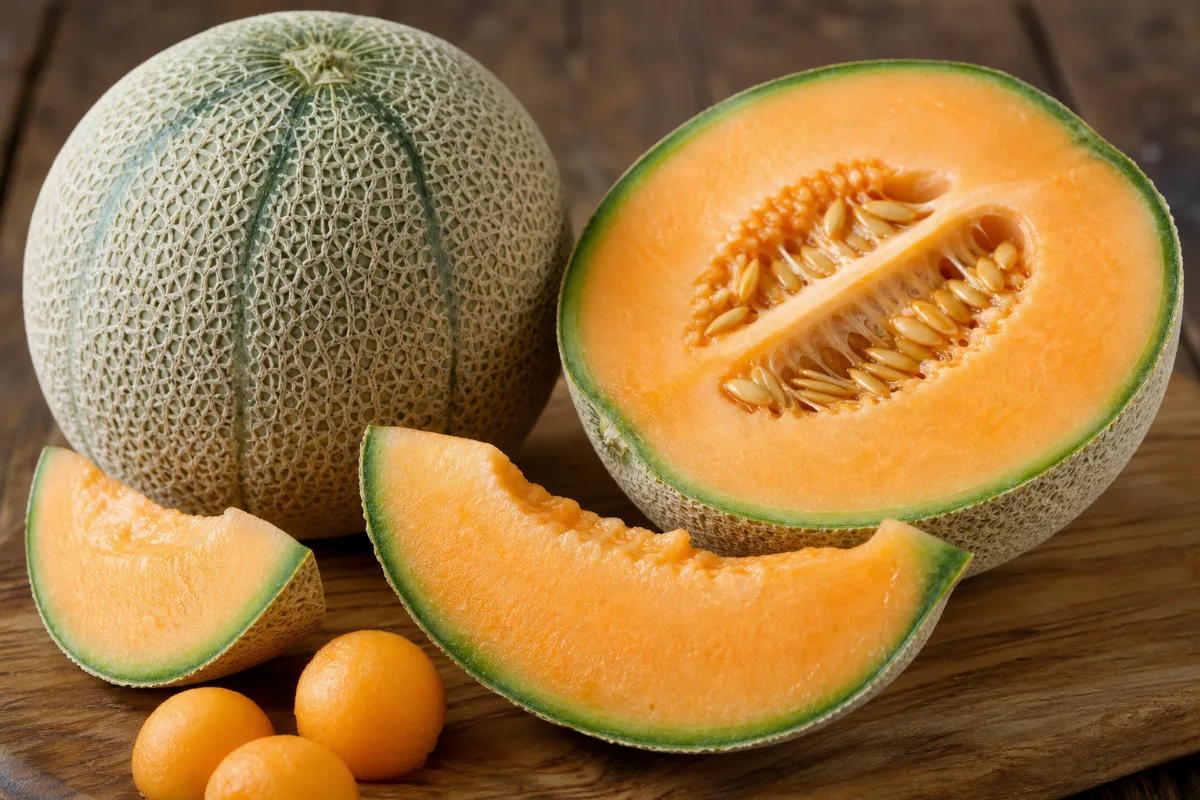
Cantaloupe is the fruit of Cucumis melo, a plant in the gourd family. People eat the soft orange flesh; the netted rind and the seeds are not eaten.
USDA data for raw cantaloupe: 34 kcal per 100 g. One cup of cubes (160 g) has about 54 kcal, 1.4 g fibre, 12.6 g natural sugars, 58.7 mg vitamin C, 427 mg potassium, 270 mcg vitamin A (RAE) and 3,232 mcg beta-carotene. About 90 percent of the fruit is water. Values vary with variety and ripeness, and vitamin C falls with cooking and long storage.
What the research shows
The firmest fact is about vitamin C: too little causes scurvy, and vitamin C foods prevent it. That is a nutrient fact, not a cantaloupe trial.
The large Cochrane review of colds tested vitamin C tablets, not fruit, and found no fewer colds in the general public. Big reviews of fruit and vegetables as a group link them with less heart disease and earlier death, but they are observational and cantaloupe is not singled out.
Two reviews of follow-up studies found cantaloupe linked with a higher chance of high blood pressure and type 2 diabetes, based on few studies, with no sizes in the abstracts. That is a signal to watch, not proof of harm. Cancer findings for melon are from lab extracts only.
Capsules and tablets versus the fruit
The cold trials used vitamin C tablets of at least 0.2 g a day. One cup of cantaloupe cubes has about 59 mg. The stress trials used branded capsules of a melon juice concentrate. The cancer studies used lab extracts. Results for one form do not carry over to another.
Amounts
This page gives no amounts to eat or drink. Ask a doctor or pharmacist what is right for you, especially if you take medicine, have kidney disease or manage diabetes.
At a glance
Traditional uses history, not proof
- Eaten fresh as a sweet, juicy fruit
- Long use as food is not proof that it treats any condition
Studied for research
- Preventing scurvy through vitamin C, high certainty for the nutrient, no cantaloupe trial
- Common cold, catching one, against (vitamin C tablets, general public)
- Heart disease and early death, low certainty (fruit and vegetables as a group)
- Blood pressure and type 2 diabetes, very low certainty, with a cantaloupe higher-risk signal in observational reviews
- Cancer cells, insufficient evidence (lab and animal extracts only)
Main compounds
- Vitamin C (ascorbic acid)
- Beta-carotene (orange colour)
- Potassium
- Melon SOD enzyme (in branded concentrate capsules, not the fruit)
Common forms
- Raw fruit as cubes, balls or wedges
- Frozen cubes and juice (no study compared them with fresh)
- Melon juice concentrate capsules (used in two stress trials; not the same as the fruit)
- Vitamin C tablets (used in cold trials; not the same as the fruit)
Research links: CDC: 2011 Listeria outbreak linked to whole cantaloupes (archived) · FDA: Selecting and serving produce safely · Cochrane review: vitamin C and the common cold (2013) · Research Library · Genes & Biomarkers Library
What it is and its history
- Accepted scientific name
- Cucumis melo
- Naming authority
- L. (GBIF accepted; usageKey 2874570)
- Common names
- Cantaloupe (English); Muskmelon (English); Rockmelon (English); Melon (Spanish)
- Family or group
- Cucurbitaceae (the gourd family), which also includes cucumbers, pumpkins and squashes.
- Classification
- Plantae > Tracheophyta > Magnoliopsida > Cucurbitales > Cucurbitaceae > Cucumis > Cucumis melo
- Native range
- Not verified from a source read.
- Habitat
- Not verified from a source read.
- What it looks like
- Roots: Not verified.; Stems: Not verified.; Leaves: Not verified.; Flowers: Not verified.; Fruit: The orange, sweet flesh is eaten; the netted rind and seeds are not (existing page; not re-verified). USDA gives one large wedge (one eighth of a large melon) as 102 g.
- Cultivation
- Not verified from a source read.
- Harvest and processing
- Eaten raw as cubes, balls or wedges. Frozen cubes and juice exist; no source comparing them with fresh fruit was read. The supplement trials used a melon juice concentrate in capsules.
- Look-alikes and adulterants
- Name: Honeydew and other melons; Note: Other forms of Cucumis melo; not checked here.; Name: Watermelon (Citrullus lanatus); Note: A different species in the same family. Allergy studies link melon and watermelon reactions, so people often avoid both.; Name: Bitter melon (Momordica charantia); Note: A different plant with a similar name, covered on its own page.
- Sustainability and conservation
- Not assessed.
Photographs
Traditional use and history history, not clinical proof
| Tradition or era | Documented use | Source |
|---|---|---|
| Food use | Cantaloupe is eaten fresh as a sweet fruit (general knowledge; no historical source was read). The scoping review abstract says melon peel and seeds have shown medicinal potential in laboratory work; that is not a history of use. | Not verified |
Traditional use shows how it was used. It does not show that it works or is safe today.
What is inside, and how it may work
What it contains and how those compounds act in cells and animals. Laboratory and animal mechanisms are not proven effects in people.
Main compounds
| Compound | Family | Where it is concentrated | Activity studied | Level of evidence |
|---|---|---|---|---|
| Ascorbic acid (vitamin C) PubChem 54670067 | vitamin | Flesh USDA: 36.7 mg per 100 g raw cantaloupe (about 58.7 mg in 1 cup of cubes) | Essential nutrient. MedlinePlus says it is needed for collagen, wound healing and iron absorption. Prevents scurvy. 18 20 17 | Human data |
| Beta-carotene PubChem 5280489 | carotenoid | Flesh (orange colour) USDA: 2,020 mcg per 100 g (about 3,232 mcg in 1 cup of cubes) | Gives the orange colour. Amount is measured; no trial linking cantaloupe carotenoids to a health result was read. 19 20 | Content only |
| Potassium | mineral | Flesh USDA: 267 mg per 100 g (about 427 mg in 1 cup of cubes) | Mineral for nerves, muscles and heartbeat (MedlinePlus). Matters for people whose kidneys cannot clear extra potassium. 16 20 | Human data |
| Superoxide dismutase (SOD) enzyme in melon concentrates | enzyme | Juice concentrate in capsules 140 IU or 140 U per 10 mg capsule in two branded-capsule trials | The authors say the enzyme supports antioxidant defence. Trials reported lower stress and fatigue scores; the capsules are not the fruit. 10 3 | Human supplement |
Mechanisms, receptors and pathways
| Target or pathway | Gene or receptor | What was found | Level |
|---|---|---|---|
| Vitamin C, collagen and iron handling | Not specified | Vitamin C is needed for collagen and wound healing and helps the body absorb iron (MedlinePlus). Too little causes scurvy. 17 | Human data |
| Melon allergy: profilin cross-reaction | Profilin (plant pan-allergen) | In ragweed-allergic people, melon oral allergy syndrome is most likely cross-sensitisation to profilin; 43 of 46 melon reactors tested positive to a profilin-enriched extract. 1 | Human data |
| Melon peel contact hives | Lipid transfer protein in melon peel | An 8 to 9 kDa lipid transfer protein in melon peel was identified as a major allergen in 14 patients with hives on contact; 5 of 5 challenged with it reacted. 5 | Human data |
| Cancer cell activity of melon extracts | Not specified | Extracts lowered the growth of several cancer cell types in dishes and animals. No human mechanism has been shown. 11 | In vitro and animal |
| SOD and perceived stress | Not specified | The trial authors propose the enzyme supports antioxidant defence and so affects stress and fatigue. This is their interpretation, not tested directly in the abstracts. 10 3 | Authors interpretation |
Absorption, metabolism and elimination
- Absorption
- Not studied for cantaloupe.
- Distribution
- Not found.
- Metabolism
- Not found.
- Elimination
- Not found.
- Bioavailability
- Not established for cantaloupe. MedlinePlus says cooking, long storage and light lower vitamin C in foods.
Isolated compounds versus whole extracts
The cold trials used vitamin C tablets of at least 0.2 g a day, far above one cup of cantaloupe cubes (about 59 mg). The stress trials used capsules of a melon juice concentrate. The cancer findings are from lab extracts. The fruit-and-vegetable studies are of food eaten in general. Results for one form do not carry over to another.
Nutritional composition
Nutrition from USDA FoodData Central, raw cantaloupe (FDC 169092). Per 100 g: 34 kcal, 0.9 g fibre, 7.86 g total sugars, 36.7 mg vitamin C, 267 mg potassium, 169 mcg vitamin A (RAE), 2,020 mcg beta-carotene, 21 mcg folate (DFE), 12 mg magnesium, 2.5 mcg vitamin K, about 90 g water. One cup of cubes (160 g): about 54 kcal, 1.4 g fibre, 12.6 g sugars, 58.7 mg vitamin C (about 65% of the FDA Daily Value), 427 mg potassium (9%), 270 mcg vitamin A RAE (30%), 3,232 mcg beta-carotene, 33.6 mcg folate (8%), 19 mg magnesium, 4 mcg vitamin K. Other USDA portions: 1 cup of balls (177 g), 1 cup diced (156 g), 1 large wedge (102 g, one eighth of a large melon). Figures vary with variety, ripeness and storage, and vitamin C falls with cooking, long storage and light (MedlinePlus). Cantaloupe is mainly a vitamin C, vitamin A and potassium fruit. The fibre is modest, and the juice has less fibre than the whole fruit.
1 high certainty1 mixed findings3 low certainty2 very low certainty3 not enough evidence1 evidence against
What was looked at
The 11 benefits and uses checked for Cantaloupe, each with how strong the evidence is. Tap one to open it.
- Preventing scurvy (severe vitamin C shortage)High certainty
- Catching a common cold (vitamin C tablets)Evidence against
- How long a cold lasts (vitamin C tablets)Mixed findings
- Heart disease and early death (fruit and vegetables as a group)Low certainty
- High blood pressure (fruit and vegetables; cantaloupe signal)Very low certainty
- Type 2 diabetes (fruit and vegetables; cantaloupe signal)Very low certainty
- Cancer risk (fruit and vegetables as a group)Low certainty
- Melon extracts and cancer cells (lab and animal only)Not enough evidence
- Stress and tiredness (melon SOD capsules, not the fruit)Low certainty
- Beta-carotene and vitamin A contentNot enough evidence
- Water content and hydrationNot enough evidence
Lab markers tracked in the studies
Perceived stress score (PSS-14)
What is Cantaloupe good for?
The main studied uses and how strong the human evidence is for each. Many results come from vitamin C tablets, from fruit and vegetables as a group, or from lab extracts rather than from cantaloupe itself.
Benefits, one by one
Each card is a research question, not a promise. Tap a goal to filter. Open a card to see the studies, doses and limits.
Preventing scurvy (severe vitamin C shortage)
High certaintyVitamin C is needed to make collagen and heal wounds, and the body does not make or store it. Cantaloupe is listed by MedlinePlus first among fruits with the highest vitamin C. Raw cantaloupe has 36.7 mg per 100 g (USDA). Scurvy is rare and mainly affects older, malnourished adults. No trial has tested cantaloupe itself for scurvy.
2 studiesRaw fruit. Cooking and long storage lower vitamin C (MedlinePlus).
Studies, doses and limits
What the trials found
MedlinePlus says vitamin C is needed for collagen, wound healing and iron absorption, that all fruits and vegetables contain some, that cantaloupe is first on its list of fruits with the highest content, and that scurvy mainly affects older, malnourished adults. USDA FoodData Central lists 36.7 mg of vitamin C per 100 g of raw cantaloupe. No trial of cantaloupe itself was found.
Results
Cantaloupe is a good vitamin C food. That is a nutrient fact, not a cantaloupe trial.
Effect sizes as reported
USDA: 36.7 mg per 100 g; about 58.7 mg in 1 cup of cubes (160 g).
Why this rating
The need for vitamin C and the cause of scurvy are well established. The rating is for the nutrient role, not for any trial of cantaloupe.
Form and dose studied
Raw fruit. Cooking and long storage lower vitamin C (MedlinePlus).
Who was studied
General population; scurvy risk is mainly in older, malnourished adults.
Limits
No cantaloupe trial. Vitamin C content varies with variety, ripeness and storage.
Why researchers looked
Cantaloupe is best known as a vitamin C fruit, so people ask whether it protects against vitamin C shortage.
Traditional use
Cantaloupe is eaten fresh as a sweet fruit; long use as food is not proof that it treats any condition.
Proposed mechanism Established nutrient role
Vitamin C is needed to make collagen and to help the body absorb iron. Too little over a long time causes scurvy.
A proposed mechanism does not show that the effect happens in people.
No concern from the vitamin C in the food itself. Large supplement doses are a different matter and are not recommended in pregnancy (MedlinePlus).
Catching a common cold (vitamin C tablets)
Evidence againstNo trial tested cantaloupe for colds. A Cochrane review of vitamin C tablets (not fruit) found they did not lower the number of colds in the general public. MedlinePlus says the same for vitamin C supplements and vitamin C-rich foods.
2 studiesVitamin C tablets (at least 0.2 g a day in the included trials). One …
Studies, doses and limits
What the trials found
The 2013 Cochrane review pooled 29 trial comparisons (11,306 people). In 10,708 people in general community trials the pooled risk ratio for catching a cold was 0.97 (0.94 to 1.00). In 598 marathon runners, skiers and soldiers it was 0.48 (0.35 to 0.64). All trials used vitamin C tablets of at least 0.2 g a day.
Results
No lower chance of colds in the general public. A lower chance in people under short, severe physical stress. Tablets, not cantaloupe.
Effect sizes as reported
General community RR 0.97 (0.94 to 1.00); extreme exercise or cold RR 0.48 (0.35 to 0.64).
Why this rating
A Cochrane meta-analysis of placebo-controlled trials found no meaningful effect in the general public. It tested tablets, so it says nothing direct about cantaloupe.
Form and dose studied
Vitamin C tablets (at least 0.2 g a day in the included trials). One cup of cantaloupe cubes has about 59 mg (USDA).
Who was studied
General community; marathon runners, skiers and soldiers on subarctic exercises.
Limits
Supplements only; published 2013; trials under 0.2 g a day were excluded.
Why researchers looked
Cantaloupe is a vitamin C fruit, and vitamin C has long been used as a household cold remedy.
Traditional use
Cantaloupe is eaten fresh as a sweet fruit; long use as food is not proof that it treats any condition.
Proposed mechanism Preliminary mechanism
Vitamin C is an antioxidant and takes part in immune cell function. Whether this changes colds in people is what the trials tested.
A proposed mechanism does not show that the effect happens in people.
No cantaloupe-specific concern for this use.
How long a cold lasts (vitamin C tablets)
Mixed findingsRegular daily vitamin C tablets shortened colds by about 8% in adults and 14% in children in the Cochrane review. Vitamin C started after symptoms began showed no consistent effect. These were tablets, not cantaloupe.
1 studiesVitamin C tablets, not fruit.
Studies, doses and limits
What the trials found
The Cochrane review found, across 31 comparisons (9,745 cold episodes), that regular vitamin C shortened colds by 8% (3% to 12%) in adults and 14% (7% to 21%) in children. In 7 comparisons of vitamin C started at the onset of a cold (3,249 episodes) there was no consistent effect on duration or severity.
Results
Small shortening with daily tablets taken before the cold; no consistent effect when started after symptoms.
Effect sizes as reported
Duration -8% (3 to 12) adults; -14% (7 to 21) children.
Why this rating
Consistent small effect with regular tablets, but no consistent effect when taken as treatment, and no cantaloupe trial.
Form and dose studied
Vitamin C tablets, not fruit.
Who was studied
Adults and children in the included trials.
Limits
Supplements only; published 2013.
Why researchers looked
People who eat vitamin C foods often hope a cold will pass faster.
Traditional use
Cantaloupe is eaten fresh as a sweet fruit; long use as food is not proof that it treats any condition.
Proposed mechanism Unknown
Not established; the review does not explain why regular vitamin C might shorten colds.
A proposed mechanism does not show that the effect happens in people.
No cantaloupe-specific concern for this use.
Heart disease and early death (fruit and vegetables as a group)
Low certaintyIn a large review of follow-up studies, people who ate more fruit and vegetables combined had lower rates of heart disease, stroke and early death. These studies are about fruit and vegetables as a group. Cantaloupe is not named among the foods singled out.
1 studiesWhole fruit and vegetables eaten as food.
Studies, doses and limits
What the trials found
The 2017 meta-analysis of 95 prospective studies reported, per 200 g a day of fruit and vegetables combined, risk ratios of 0.92 for coronary heart disease, 0.84 for stroke, 0.92 for cardiovascular disease and 0.90 for all-cause death. Foods named for inverse links included apples and pears, citrus fruits, green leafy vegetables, cruciferous vegetables and salads. Cantaloupe is not named in the abstract.
Results
Lower risk with more fruit and vegetables overall. Nothing specific to cantaloupe.
Effect sizes as reported
Per 200 g a day: coronary heart disease RR 0.92 (0.90 to 0.94); stroke 0.84 (0.76 to 0.92); cardiovascular disease 0.92 (0.90 to 0.95); all-cause death 0.90 (0.87 to 0.93).
Why this rating
Observational cohorts, so other healthy habits may explain part of the link. High heterogeneity for stroke and death. Not specific to cantaloupe.
Form and dose studied
Whole fruit and vegetables eaten as food.
Who was studied
Adults in 95 prospective studies.
Limits
Association, not proof of cause. Fruit and vegetables combined.
Why researchers looked
Cantaloupe is one fruit in the pattern of fruit and vegetable eating that large cohort studies have followed.
Traditional use
Cantaloupe is eaten fresh as a sweet fruit; long use as food is not proof that it treats any condition.
Proposed mechanism Preliminary mechanism
Not established. Fibre, potassium, vitamin C and many plant compounds have been suggested, but observational studies cannot say which, if any, matter.
A proposed mechanism does not show that the effect happens in people.
None specific. Cantaloupe food safety and potassium points are on the Safety tab.
High blood pressure (fruit and vegetables; cantaloupe signal)
Very low certaintyA review of 18 follow-up studies found that eating more fruit overall went with a lower chance of developing high blood pressure. For cantaloupe in particular, 2 to 5 studies found a higher chance. This cannot show that cantaloupe raises blood pressure, and the review calls the results for single foods mixed.
1 studiesWhole fruit eaten as food.
Studies, doses and limits
What the trials found
The 2023 meta-analysis of 18 prospective studies (451,291 people) found per 200 g a day a risk ratio for new high blood pressure of 0.97 for fruit and vegetables, 0.93 for fruits and 1.00 for vegetables. Inverse associations were seen for apples or pears, blueberries, raisins or grapes, avocado, broccoli, carrots and lettuce. Positive associations were seen for cantaloupe, Brussels sprouts, cruciferous vegetables and potatoes, based on 2 to 5 studies. No size is given for cantaloupe in the abstract.
Results
Fruit overall: lower risk. Cantaloupe: a higher-risk association from few studies, size not given in the abstract.
Effect sizes as reported
Fruits RR 0.93 (0.89 to 0.98) per 200 g a day. Cantaloupe: positive association, number not in abstract.
Why this rating
Observational data, only 2 to 5 studies for cantaloupe, no effect size read, and the authors call subtype results mixed.
Form and dose studied
Whole fruit eaten as food.
Who was studied
Adults in 18 prospective studies.
Limits
Association, not cause. Diet, weight, salt and other habits may explain the cantaloupe result. Size not available from the abstract.
Why researchers looked
Fruit and potassium-rich foods are often linked with blood pressure, so reviewers split fruit into single foods.
Traditional use
Cantaloupe is eaten fresh as a sweet fruit; long use as food is not proof that it treats any condition.
Proposed mechanism Unknown
Not established for cantaloupe. The authors do not offer a reason for the cantaloupe result.
A proposed mechanism does not show that the effect happens in people.
People who manage blood pressure with medicine should keep taking it and ask their clinician about diet.
Type 2 diabetes (fruit and vegetables; cantaloupe signal)
Very low certaintyA review of 23 follow-up studies found a weak link between eating more fruit and a lower chance of type 2 diabetes. For cantaloupe, the reviewers found a higher-risk association from few studies. This is not proof that cantaloupe causes diabetes.
2 studiesWhole fruit eaten as food; fruit juice analysed separately.
Studies, doses and limits
What the trials found
The 2021 meta-analysis of 23 cohort studies found, for high versus low intake, a risk ratio for type 2 diabetes of 0.93 for fruit and vegetables combined and 0.93 for fruits. Inverse associations were seen for apples, apples and pears, blueberries, grapefruit and grapes and raisins. Positive associations were seen for cantaloupe, fruit drinks, fruit juice, Brussels sprouts, cauliflower and potatoes, mostly from few studies. The authors call the overall link weak and say firm conclusions need more studies.
Results
Fruit overall: weakly lower risk. Cantaloupe: higher-risk association, size not given in the abstract.
Effect sizes as reported
Fruits RR 0.93 (0.90 to 0.97) high vs low. Cantaloupe: positive association, number not in abstract.
Why this rating
Observational, few studies for cantaloupe, no effect size read, and the authors say further studies are needed.
Form and dose studied
Whole fruit eaten as food; fruit juice analysed separately.
Who was studied
Adults in 23 cohort studies.
Limits
Association, not cause; the cantaloupe result may reflect what else people eat with it or other habits.
Why researchers looked
Fruit contains natural sugar, so reviewers looked at which fruits go with lower or higher diabetes risk.
Traditional use
Cantaloupe is eaten fresh as a sweet fruit; long use as food is not proof that it treats any condition.
Proposed mechanism Unknown
Not established for cantaloupe.
A proposed mechanism does not show that the effect happens in people.
One cup of cubes has about 12.6 g of natural sugars (USDA). People managing diabetes can ask their care team about fruit.
Cancer risk (fruit and vegetables as a group)
Low certaintyIn the same large review, more fruit and vegetables went with a very small lower chance of cancer overall. Nothing in it is specific to cantaloupe.
1 studiesWhole fruit and vegetables eaten as food.
Studies, doses and limits
What the trials found
The 2017 meta-analysis found, per 200 g a day of fruit and vegetables combined, a summary risk ratio for total cancer of 0.97 (0.95 to 0.99, 12 studies). Reductions were seen up to about 600 g a day. Cantaloupe is not named in the abstract.
Results
A very small association for fruit and vegetables combined; none specific to cantaloupe.
Effect sizes as reported
Total cancer RR 0.97 (0.95 to 0.99) per 200 g a day.
Why this rating
Observational; tiny effect; produce as a group.
Form and dose studied
Whole fruit and vegetables eaten as food.
Who was studied
Adults in prospective studies.
Limits
Association, not cause. Not specific to cantaloupe.
Why researchers looked
Cantaloupe contains vitamin C and carotenoids, which people link with cancer prevention.
Traditional use
Cantaloupe is eaten fresh as a sweet fruit; long use as food is not proof that it treats any condition.
Proposed mechanism Unknown
Not established.
A proposed mechanism does not show that the effect happens in people.
None specific.
Melon extracts and cancer cells (lab and animal only)
Not enough evidenceA 2024 scoping review of 14 lab and animal papers found melon extracts acted against several kinds of cancer cells in dishes and animals. No human trial was included. This does not show that eating cantaloupe prevents or treats cancer.
1 studiesLaboratory extracts of melon fruit, peel or seed.
Studies, doses and limits
Results
Lab and animal signal only; the authors call for more investigation.
Why this rating
Lab and animal research only; extracts are not the fruit as eaten; no human outcome.
Form and dose studied
Laboratory extracts of melon fruit, peel or seed.
Who was studied
Cell lines and animals.
Limits
Not human data. The review summarises extracts, not food.
Why researchers looked
Researchers test fruit extracts on cancer cells to look for leads.
Traditional use
Cantaloupe is eaten fresh as a sweet fruit; long use as food is not proof that it treats any condition.
Proposed mechanism In vitro and animal
Extract activity measured as IC50 values in cultured cells and animal models. The review does not identify one compound responsible.
A proposed mechanism does not show that the effect happens in people.
Do not use this as a reason to replace medical care.
Stress and tiredness (melon SOD capsules, not the fruit)
Low certaintyTwo small trials of branded melon concentrate capsules rich in an enzyme called SOD reported lower stress and tiredness scores than placebo in healthy adults. The capsules are not cantaloupe, the abstracts give no numbers, and funding is not stated.
2 studiesCapsules of melon juice concentrate with 140 IU or 140 U SOD per caps…
Studies, doses and limits
What the trials found
A 2009 pilot trial in 70 healthy volunteers aged 30 to 55 (4 weeks, placebo-controlled) and a 2014 trial in 61 healthy people (12 weeks, 32 active and 29 placebo) both reported significant improvement in stress, fatigue and quality-of-life scores compared with placebo. The 2009 abstract notes no adverse effect. Neither abstract gives numbers.
Results
Reported improvement on self-rated scales; no figures read.
Effect sizes as reported
Not given in the abstracts.
Why this rating
Two small trials of a branded capsule, self-rated scales, no numbers read, funding not stated, and the product is not the food.
Form and dose studied
Capsules of melon juice concentrate with 140 IU or 140 U SOD per capsule. Not the same as eating cantaloupe.
Who was studied
Healthy adults who felt stress and fatigue.
Limits
Small, short, possibly industry-linked (not checked), self-reported outcomes.
Why researchers looked
The concentrate is sold as an antioxidant enzyme source, so its makers tested it for stress and fatigue.
Traditional use
Cantaloupe is eaten fresh as a sweet fruit; long use as food is not proof that it treats any condition.
Proposed mechanism Authors interpretation
The authors propose that the SOD enzyme supports the body's antioxidant defence. This is their interpretation and was not tested directly in these abstracts.
A proposed mechanism does not show that the effect happens in people.
No adverse effect noted in the 2009 abstract. Ask a pharmacist before using supplements.
Beta-carotene and vitamin A content
Not enough evidenceThe orange flesh comes from beta-carotene. USDA lists 2,020 micrograms of beta-carotene and 169 micrograms of vitamin A (RAE) per 100 g. No human trial linking cantaloupe carotenoids to a health result was found.
2 studiesRaw fruit.
Studies, doses and limits
What the trials found
Content is measured, not tested in people: USDA lists beta-carotene and vitamin A (RAE) per 100 g and per cup. We did not find a trial of cantaloupe carotenoids and a health outcome.
Results
Nutrient content only.
Effect sizes as reported
USDA per 100 g: beta-carotene 2,020 mcg; vitamin A 169 mcg RAE.
Why this rating
Content figure only; no human outcome study read.
Form and dose studied
Raw fruit.
Limits
No outcome study.
Why researchers looked
Carotenoids are measured in orange fruit because the body can turn some into vitamin A.
Traditional use
Cantaloupe is eaten fresh as a sweet fruit; long use as food is not proof that it treats any condition.
Proposed mechanism General knowledge
Beta-carotene can be converted to vitamin A in the body (general nutrition knowledge; not checked against a source this round).
A proposed mechanism does not show that the effect happens in people.
None specific from the food.
Water content and hydration
Not enough evidenceUSDA lists cantaloupe as about 90 percent water. No trial linking eating it to hydration was found.
1 studiesRaw fruit.
Studies, doses and limits
Results
Content figure only.
Effect sizes as reported
About 90 g water per 100 g (USDA).
Why this rating
No trial.
Form and dose studied
Raw fruit.
Limits
No study.
Why researchers looked
Juicy fruit is often described as hydrating.
Traditional use
Cantaloupe is eaten fresh as a sweet fruit; long use as food is not proof that it treats any condition.
Proposed mechanism Content only
Water content is a measurement; no hydration mechanism was studied.
A proposed mechanism does not show that the effect happens in people.
None specific.
Connections to the rest of health
How Cantaloupe connects to the rest of our health knowledge graph. Every link says what kind of connection it is. A safety link (for example to the liver) is a warning, not a benefit. A study that merely mentions a topic never creates a benefit link.
Explore every connection: goals, body systems, organs, symptoms, genes
B. Body systems
| Connected to | Kind of connection | Evidence status | Context | Studies |
|---|---|---|---|---|
| Immune System | Biological association | High certainty | Studied for: Preventing scurvy (severe vitamin C shortage) Studied for: Catching a common cold (vitamin C tablets) | 17 20 7 2 11 19 |
| Integumentary System | Biological association | High certainty | Studied for: Preventing scurvy (severe vitamin C shortage) | 17 20 |
| Respiratory System | Biological association | Evidence against | Studied for: Catching a common cold (vitamin C tablets) Studied for: How long a cold lasts (vitamin C tablets) | 7 17 |
| Cardiovascular System | Biological association | Low certainty | Studied for: Heart disease and early death (fruit and vegetables as a group) Studied for: High blood pressure (fruit and vegetables; cantaloupe signal) | 2 8 |
| Endocrine System | Biological association | Very low certainty | Studied for: Type 2 diabetes (fruit and vegetables; cantaloupe signal) | 6 20 |
| Metabolic | Biological association | Very low certainty | Studied for: Type 2 diabetes (fruit and vegetables; cantaloupe signal) | 6 20 |
| Nervous System | Biological association | Low certainty | Studied for: Stress and tiredness (melon SOD capsules, not the fruit) | 10 3 |
| Visual System | Biological association | Not enough evidence | Studied for: Beta-carotene and vitamin A content | 20 19 |
| Urinary System | Biological association | Not enough evidence | Studied for: Water content and hydration | 20 |
C. Body parts and organs
| Connected to | Kind of connection | Evidence status | Context | Studies |
|---|---|---|---|---|
| Gut | Adverse effect or risk | Documented risk | Listeria and Salmonella outbreaks have been traced to whole cantaloupes. Preparation or compound: Contaminated rind or cut fruit |
13 9 4 |
| Kidneys | Adverse effect or risk | Documented risk | In chronic kidney disease the kidneys may not clear extra potassium (MedlinePlus). Kidneys may not clear extra potassium in chronic kidney disease (MedlinePlus). Preparation or compound: Potassium in the fruit |
16 20 |
E. Health conditions
| Connected to | Kind of connection | Evidence status | Context | Studies |
|---|---|---|---|---|
| Food allergy | Adverse effect or risk | Documented risk | Confirmed reactions in 19 of 53 adults reporting them; oral allergy syndrome and rare severe reactions. Preparation or compound: Melon flesh and peel |
12 1 5 |
| Scurvy | Biological association | Deficiency link | Cantaloupe is a vitamin C food; scurvy comes from too little vitamin C. Preparation or compound: Raw cantaloupe as a vitamin C food |
17 20 |
| Listeriosis | Adverse effect or risk | Documented risk | Whole cantaloupes caused the 2011 US outbreak (147 illnesses, 33 deaths from listeriosis). Preparation or compound: Contaminated whole cantaloupe |
13 |
| Salmonella infections | Adverse effect or risk | Documented risk | Cantaloupe was strongly linked to a 2023 outbreak in the UK and Portugal. Preparation or compound: Contaminated cantaloupe |
9 4 |
I. Biomarkers
| Connected to | Kind of connection | Evidence status | Context | Studies |
|---|---|---|---|---|
| Perceived stress score (PSS-14) | Biological association | Low certainty | Measured in trials: decrease. A lab change is not the same as a health benefit. | 10 3 |
K. Biological pathways
| Connected to | Kind of connection | Evidence status | Context | Studies |
|---|---|---|---|---|
| Vitamin C | Preliminary mechanism | Human | Cantaloupe is a vitamin C food; scurvy results from too little vitamin C. | 17 20 |
| Beta-carotene | Preliminary mechanism | Content only | The orange colour comes from beta-carotene; content is measured. | 19 20 |
| Potassium | Preliminary mechanism | Human | A potassium-containing fruit; matters in chronic kidney disease. | 16 20 |
| Profilin | Preliminary mechanism | Human | Plant pan-allergen linked to melon reactions in pollen-allergic people. | 1 |
L. Active compounds
| Connected to | Kind of connection | Evidence status | Context | Studies |
|---|---|---|---|---|
| Ascorbic acid (vitamin C) | Biological association | Human | Essential nutrient. MedlinePlus says it is needed for collagen, wound healing and iron absorption. Prevents scurvy. Preparation or compound: Flesh |
18 20 17 |
| Beta-carotene | Biological association | Content only | Gives the orange colour. Amount is measured; no trial linking cantaloupe carotenoids to a health result was read. Preparation or compound: Flesh (orange colour) |
19 20 |
| Potassium | Biological association | Human | Mineral for nerves, muscles and heartbeat (MedlinePlus). Matters for people whose kidneys cannot clear extra potassium. Preparation or compound: Flesh |
16 20 |
| Superoxide dismutase (SOD) enzyme in melon concentrates | Biological association | Human supplement | The authors say the enzyme supports antioxidant defence. Trials reported lower stress and fatigue scores; the capsules are not the fruit. Preparation or compound: Juice concentrate in capsules |
10 3 |
Each connection is stored with the ingredient, the connected record, the kind of connection, the evidence status, the supporting studies, the preparation or compound involved, and a review date (last reviewed October 25, 2026).
Evidence at a glance: what the research found for 11 outcomes
Each outcome below is one thing researchers measured. Certainty is how far the evidence can be trusted, not how well it works. The full studies are on the next tab.
The evidence
The research centre for Cantaloupe. Every record here was checked against PubMed or the publisher's page; we never list a study we have not verified.
Evidence by outcome
Bars show how many studies we found for each outcome, not how well it works. People are added up across trials only (reviews are not added, to avoid double counting).
How we rate evidence
High certainty
Several well-run trials or reviews agree; further research is unlikely to change the picture much.
Moderate certainty
Good trials point the same way, but some doubt remains.
Low certainty
Small, short or inconsistent trials. The finding could change with better research.
Very low certainty
Very little or very weak human data. Treat as a possibility only.
Mixed findings
Trials or reviews disagree with each other.
Not enough evidence
Not enough human research to say either way.
Evidence against
Good research found no benefit, or found harm.
We take the reviewers' own risk-of-bias and GRADE statements where they exist, and otherwise judge from study size, design, consistency, directness and whether a product matches what is sold. Many publications do not make evidence high. Method note: We started from our existing cantaloupe summary, checked nutrition against the USDA FoodData Central record for raw cantaloupe, and searched PubMed for human trials, reviews, outbreak reports and allergy studies. Only abstracts were read for studies. Items we could not verify are flagged in the research gaps.
Study library: every study we checked 20
| Study | Design | People | Product, dose, length | Result |
|---|---|---|---|---|
| Asero 2011 The nature of melon allergy in ragweed-allergic subjects: A study of 1000 patients. Allergy Asthma Proc · PMID 21262100 · DOI |
Cross sectional lab |
1000 1000 people allergic to ragweed pollen, interviewed about melon or watermelon reactions |
Melon (fresh melon skin-prick test) and profilin-enriched pollen extract Fruit · vs Groups by number of seasonal allergen sources |
Melon or watermelon oral allergy syndrome was reported by 4 of 646 (1%) of those reacting to 3 or fewer seasonal allergen sources and 81 of 354 (23%) of those reacting to more than 3. Of 46 melon reactors, 43 (93%) tested positive to a profilin-enriched extract. The authors conclude melon allergy in ragweed-allergic people is most likely cross-sensitisation to the plant protein profilin. 4/646 (1%) vs 81/354 (23%) reported melon or watermelon oral allergy syndrome (n/a) Methods, limits and fundingOutcomes: Melon or watermelon oral allergy syndrome and profilin sensitisation Limitations: Self-reported history in a group chosen for ragweed allergy; not the general public. Funding and conflicts: Not stated in the abstract. Read: abstract |
| Aune 2017 Fruit and vegetable intake and the risk of cardiovascular disease, total cancer and all-cause mortality-a systematic review and dose-response meta-analysis of prospective studies. Int J Epidemiol · PMID 28338764 · DOI |
Meta-analysis |
95 prospective studies (142 publications) of fruit and vegetable intake | Fruit and vegetables eaten as food (not cantaloupe alone) Per 200 g a day in the analysis; not advice Follow-up of cohorts · vs Lower intake |
Per 200 g a day of fruit and vegetables combined, summary risk ratios were 0.92 for coronary heart disease, 0.84 for stroke, 0.92 for cardiovascular disease, 0.97 for total cancer and 0.90 for all-cause death. Inverse links were named for apples and pears, citrus fruits, green leafy vegetables, cruciferous vegetables and salads. Cantaloupe is not named in the abstract. RR 0.92 coronary heart disease; 0.84 stroke; 0.92 cardiovascular disease; 0.97 total cancer; 0.90 all-cause death (per 200 g a day) (CHD 0.90-0.94; stroke 0.76-0.92; CVD 0.90-0.95; cancer 0.95-0.99; all-cause 0.87-0.93) Methods, limits and fundingOutcomes: Coronary heart disease, stroke, cardiovascular disease, total cancer, all-cause death Limitations: Observational cohorts, so food choices and other habits may explain part of the links. Fruit and vegetables combined; heterogeneity high for stroke (I2 73%) and all-cause death (I2 83%). Not specific to cantaloupe. Funding and conflicts: Conflict statement in the record: none. Read: abstract |
| Carillon 2014 Dietary supplementation with a superoxide dismutase-melon concentrate reduces stress, physical and mental fatigue in healthy people: a randomised, double-blind, placebo-controlled trial. Nutrients · PMID 24949549 · DOI |
RCT |
61 61 healthy people (32 active, 29 placebo) |
SOD-melon concentrate capsule, not the fruit Melon concentrate One capsule a day (10 mg concentrate, 140 U SOD); trial detail, not advice 12 weeks · vs Starch placebo |
The authors report that the concentrate lowered perceived stress and fatigue and improved quality of life compared with placebo. The abstract gives no numbers. Reported as significant; no numbers in abstract (n/a) Methods, limits and fundingOutcomes: Perceived stress (PSS-14), quality of life (SF-36), fatigue (Prevost scale), Stroop tests Limitations: Small trial of a branded capsule, not the fruit. The abstract gives no figures and does not state the funder. Funding and conflicts: Funding not stated in the abstract; proprietary concentrate, possible link to its maker not checked. Registration: NCT01767922 Read: abstract |
| Cataldo 2025 An Investigation of an Outbreak of Salmonella Newport Infections Linked to Melons from Southwest Indiana-United States, 2023. Foodborne Pathog Dis · PMID 40452569 · DOI |
Outbreak investigation |
11 ill people, 5 hospitalised, in six US states (2023 outbreak) | Cantaloupes and watermelons grown in Southwest Indiana Fruit 2023 |
Traceback did not find a single point of convergence for cantaloupe or watermelon, but lab matches of farm, land and distributor samples to the outbreak strains supported ongoing contamination of melons grown in that area. The authors call this the fourth Salmonella outbreak since 2012 linked to cantaloupes or watermelons from Southwest Indiana. 11 ill, 5 hospitalised; fourth outbreak since 2012 in that region (n/a) Methods, limits and fundingOutcomes: Source of an outbreak of Salmonella Newport infections Limitations: A single regional outbreak; it does not describe all cantaloupe. Funding and conflicts: Not stated in the abstract. Read: abstract |
| Gandolfo-Cano 2014 Molecular characterization of contact urticaria in patients with melon allergy. Br J Dermatol · PMID 24640940 · DOI |
Lab and challenge |
14 14 patients with hives after touching melon peel |
Melon-peel extract and purified melon-peel lipid transfer protein Peel Contact challenge; not advice · vs Inhibition studies |
Sera from all 14 patients bound an 8 to 9 kDa protein identified as a lipid transfer protein in melon peel. In 5 patients, contact with the purified protein caused itchy redness and hives at the contact site. 14/14 sera bound the protein; 5/5 challenged reacted (n/a) Methods, limits and fundingOutcomes: IgE binding and skin reaction to melon peel Limitations: Small group of people already known to have melon allergy. Funding and conflicts: Conflict statement in the record: none. Read: abstract |
| Halvorsen 2021 Fruit and vegetable consumption and the risk of type 2 diabetes: a systematic review and dose-response meta-analysis of prospective studies. BMJ Nutr Prev Health · PMID 35028521 · DOI |
Meta-analysis |
23 cohort studies of fruit and vegetable intake and type 2 diabetes | Fruit and vegetables eaten as food High versus low intake and per 200 g a day; not advice Follow-up of cohorts · vs Lower intake |
High versus low intake: RR 0.93 for fruit and vegetables combined and 0.93 for fruits. Inverse associations were seen for apples, apples and pears, blueberries, grapefruit and grapes and raisins. Positive associations were seen for cantaloupe, fruit drinks, fruit juice, Brussels sprouts, cauliflower and potatoes, mostly from few studies. The authors call the overall link weak. RR 0.93 fruit and vegetables (high vs low); 0.93 fruits. Cantaloupe: positive association, number not given in abstract (0.89-0.98; 0.90-0.97) Methods, limits and fundingOutcomes: New type 2 diabetes Limitations: Observational. The cantaloupe result rests on few studies, gives no size in the abstract and does not show cause. Funding and conflicts: Not stated in the abstract. Read: abstract |
| Hemila 2013 Vitamin C for preventing and treating the common cold. Cochrane Database Syst Rev · PMID 23440782 · DOI |
Meta-analysis |
11306 29 trial comparisons for incidence (10,708 people in general community trials; 598 marathon runners, skiers and soldiers); 31 comparisons for duration |
Vitamin C tablets (not cantaloupe) At least 0.2 g a day; trial detail, not advice Varied · vs Placebo |
General community: pooled RR 0.97 (0.94 to 1.00) for catching a cold. Five trials in marathon runners, skiers and soldiers: RR 0.48 (0.35 to 0.64). Regular vitamin C shortened colds by 8% in adults and 14% in children. Vitamin C started after symptoms began showed no consistent effect. RR 0.97 general community; RR 0.48 under extreme exercise or cold; duration -8% adults, -14% children (95% CI 0.94 to 1.00; 0.35 to 0.64) Methods, limits and fundingOutcomes: Cold incidence, duration, severity Limitations: Vitamin C tablets, not fruit; trials under 0.2 g a day were excluded; published 2013. Funding and conflicts: Not stated in the abstract. Read: abstract |
| Madsen 2023 Fruit and vegetable consumption and the risk of hypertension: a systematic review and meta-analysis of prospective studies. Eur J Nutr · PMID 37106252 · DOI |
Meta-analysis |
451291 18 prospective studies (451,291 participants, 145,492 cases) |
Fruit and vegetables eaten as food Per 200 g a day in the analysis; not advice Follow-up of cohorts · vs Lower intake |
Per 200 g a day the summary RR was 0.97 for fruit and vegetables, 0.93 for fruits and 1.00 for vegetables. Inverse associations were seen for apples or pears, blueberries, raisins or grapes, avocado, broccoli, carrots and lettuce. Positive associations (higher risk) were seen for cantaloupe, Brussels sprouts, cruciferous vegetables and potatoes, based on 2 to 5 studies. The authors say subtype results were mixed and need further study. RR 0.97 fruit and vegetables; 0.93 fruits; 1.00 vegetables (per 200 g a day). Cantaloupe: positive association, number not given in abstract (0.95-0.99; 0.89-0.98; 0.98-1.02) Methods, limits and fundingOutcomes: New high blood pressure (hypertension) Limitations: Observational. The cantaloupe finding rests on few studies and cannot show that cantaloupe raises blood pressure; the abstract gives no size for it. Funding and conflicts: Not stated in the abstract. Read: abstract |
| McGeoch 2024 Salmonella Saintpaul outbreak associated with cantaloupe consumption, the United Kingdom and Portugal, September to November 2023. Epidemiol Infect · PMID 38705587 · DOI |
Outbreak case control |
98 outbreak cases (93 UK, 5 Portugal); case-control study with 25 UK cases and 100 controls | Cantaloupe eaten Fruit September to November 2023 · vs 100 controls |
Of 98 genetically matched cases, 46% were under age 10. Among the 25 UK cases studied, 13 reported blood in stool and 5 were hospitalised. Eating cantaloupe was strongly linked to illness (adjusted odds ratio 14.22; 95% CI 2.83 to 71.43; p 0.001). The authors note an increase in large Salmonella outbreaks linked to melon. aOR 14.22 for cantaloupe (2.83 to 71.43) Methods, limits and fundingOutcomes: Link between illness and foods eaten Limitations: Small case-control study with wide uncertainty; shows association in one outbreak, not how common illness is. Funding and conflicts: Not stated in the abstract. Read: abstract |
| Milesi 2009 Effect of an oral supplementation with a proprietary melon juice concentrate (Extramel) on stress and fatigue in healthy people: a pilot, double-blind, placebo-controlled clinical trial. Nutr J · PMID 19754931 · DOI |
RCT |
70 70 healthy volunteers aged 30 to 55 who felt daily stress and fatigue |
Proprietary melon juice concentrate capsule (rich in the enzyme SOD), not the fruit Melon juice concentrate One capsule a day (10 mg concentrate, 140 IU SOD); trial detail, not advice 4 weeks · vs Placebo capsule |
No adverse effect was noted. The authors report significant improvement on signs of stress and fatigue and on perceived stress and quality of life compared with placebo. The abstract gives no numbers. Reported as significant improvement; no numbers in abstract (n/a) Methods, limits and fundingOutcomes: Stress and fatigue scales (FARD, PSS-14, SF-12, Epworth) Limitations: Pilot trial of a branded capsule, not the fruit. The abstract does not state who paid for the study. Numbers were not shown in the abstract. Self-rated scales. Funding and conflicts: Funding not stated in the abstract; the product is proprietary, so a link to its maker is possible and was not checked. Read: abstract |
| Raja Soh 2024 A Scoping Review on Cucumis melo and Its Anti-Cancer Properties. Malays J Med Sci · PMID 39247112 · DOI |
Scoping review in-vitro and animal |
14 articles (published 2000 to 2023) on melon or cantaloupe extracts and cancer | Cucumis melo (cantaloupe or melon) extracts Fruit extracts (peel and seed also discussed) Lab concentrations (IC50 values) |
Melon extracts showed anti-cancer action in lab dishes and animal studies across eight cancer types (cervical, colon, prostate, leukaemia, multiple myeloma, breast, hepatoma, ovarian). Some IC50 values were low, especially for colon and prostate cells. The authors call for more investigation. No human outcome. Low IC50 values in some cell lines. Methods, limits and fundingOutcomes: Anti-cancer activity in cells and animals Limitations: Lab and animal work only. Extracts in a dish are not the same as eating the fruit. No human trial of cantaloupe and cancer was included. Funding and conflicts: Conflict of interest: none stated. Read: abstract |
| Rodriguez 2000 Randomized, double-blind, crossover challenge study in 53 subjects reporting adverse reactions to melon (Cucumis melo). J Allergy Clin Immunol · PMID 11080722 · DOI |
Randomized crossover challenge |
53 53 adults who reported reactions to melon |
Melon (Cucumis melo) food challenge Fruit Challenge test; not advice Single challenges · vs Placebo (double-blind) |
Real reactions were confirmed in 19 of 53 people (36%). The most common symptom was oral allergy syndrome (14 people). Two people had life-threatening reactions with breathing problems and low blood pressure. 88% of those with onset data had seasonal rhinitis or asthma first. Isolated melon allergy was rare; most had other allergies. Common linked foods were avocado, banana, kiwi, watermelon and peach. 19/53 (36%) confirmed; 2 life-threatening (n/a) Methods, limits and fundingOutcomes: Confirmed allergic reaction to melon Limitations: Adults who already reported reactions, so it does not give how common melon allergy is in the general public. Published 2000. The study says Cucumis melo; cantaloupe is a type of it. Funding and conflicts: Not stated in the abstract. Read: abstract |
| s-cdc-listeria-2011 CDC: 2011 Outbreak of Listeria Infections Linked to Whole Cantaloupes from Jensen Farms, Colorado · Source |
Regulator n/a |
Methods, limits and fundingRead: full-text | ||
| s-fda-produce FDA: Selecting and Serving Produce Safely · Source |
Regulator n/a |
Methods, limits and fundingRead: full-text | ||
| s-gbif-cucumis-melo GBIF Backbone: Cucumis melo L. (usageKey 2874570) · Source |
Reference database n/a |
Methods, limits and fundingRead: full-text | ||
| s-medlineplus-potassium MedlinePlus: Potassium · Source |
Health agency n/a |
Methods, limits and fundingRead: full-text | ||
| s-medlineplus-vitc MedlinePlus: Vitamin C · Source |
Health agency n/a |
Methods, limits and fundingRead: full-text | ||
| s-pubchem-ascorbic-acid PubChem: L-Ascorbic acid (CID 54670067) · Source |
Reference database n/a |
Methods, limits and fundingRead: full-text | ||
| s-pubchem-beta-carotene PubChem: beta-carotene (CID 5280489) · Source |
Reference database n/a |
Methods, limits and fundingRead: full-text | ||
| s-usda-fdc-169092 USDA FoodData Central: Melons, cantaloupe, raw (FDC 169092) · Source |
Reference database n/a |
Methods, limits and fundingRead: summary-only |
What we do not know yet
- No trial has tested cantaloupe for scurvy, colds or any illness outcome.
- The cantaloupe higher-risk signals for blood pressure and diabetes come from abstracts of observational reviews, with no sizes read.
- No study of cantaloupe carotenoids or water content and a health outcome was found.
- How common melon allergy is in the general public, and breastfeeding, choking and residue questions, were not researched.
- The Canadian 2023 Malichita and Rudy outbreak notice could not be loaded, so its figures are not used.
How new research is added
New studies are found by a saved PubMed search and placed in a review queue before the page changes.
Lab markers
What changed in blood or saliva tests during trials. A changed number is not the same as feeling or being healthier, and we give no "normal ranges".
Other 1
Perceived stress score (PSS-14)
Decrease in trials
A 14-question self-rated scale of how stressful a person finds their life.
Low certaintyResults and what it means
Why it was measured
It was used to judge whether melon SOD capsules changed how stressed people felt.
Statistical vs. clinical meaning
A self-rated score is not a measure of disease and the capsules are not the fruit.
Safety implication
None specific.
| Study | Result | People | Product |
|---|---|---|---|
| 10 | Reported significant improvement in perceived stress compared with placebo; no numbers in the abstract | 70 healthy volunteers | Branded melon juice concentrate capsule, 4 weeks |
| 3 | Reported significantly lower perceived stress compared with placebo; no numbers in the abstract | 61 healthy people | SOD-melon concentrate capsule, 12 weeks |
Safety
What studies and official sources say about side effects, medicines and who should check first. Each point shows what kind of evidence it comes from.
Main points to know 5
- Whole cantaloupes have caused large food-poisoning outbreaks. The rind touches soil and can carry germs that reach the flesh when the melon is cut. In 2011 whole cantaloupes from one US farm caused 147 Listeria illnesses in 28 states and 33 deaths from listeriosis (CDC). In 2023 a Salmonella outbreak in the UK and Portugal (98 genetically matched cases, 46% in children under 10) was strongly linked to cantaloupe in a case-control study (adjusted odds ratio 14.22; 95% CI 2.83 to 71.43). A 2023 Salmonella Newport outbreak (11 ill, 5 hospitalised, six US states) was the fourth since 2012 linked to melons from Southwest Indiana. The FDA says to wash produce under running water, scrub melons with a clean brush, use no soap, dry it, keep cut melon at 40 F (4 C) or colder, and throw away melon that looks rotten. Outbreak investigation 13 9 4 14
- Listeria is most dangerous for older adults, pregnant women and people with weak immunity. In the 2011 outbreak most ill people were over 60 (median age 78). Seven illnesses were related to pregnancy (three in newborns and four in pregnant women) and one miscarriage was reported. CDC advised older adults, people with weakened immune systems and pregnant women not to eat the affected cantaloupes. Follow recall notices for the brand you buy. Outbreak investigation 13
- Potassium: ask a clinician if you have kidney disease or take medicines that raise potassium. MedlinePlus says people with chronic kidney disease may not be able to remove extra potassium and may need a special lower-potassium diet, and that some medicines can raise potassium. It does not name cantaloupe. USDA lists 267 mg of potassium per 100 g of raw cantaloupe, about 427 mg in 1 cup of cubes. Authoritative guidance 16 20
- Melon allergy is real and can be severe. In a double-blind food challenge study, reactions to melon were confirmed in 19 of 53 adults who reported them (36%). The most common symptom was an itchy mouth (oral allergy syndrome); two people had life-threatening reactions with breathing problems and low blood pressure. Most people with melon allergy also had hay fever, asthma or other food allergies (avocado, banana, kiwi, watermelon, peach). In ragweed-allergic people melon reactions are linked to cross-reaction with a plant protein called profilin. Touching melon peel caused hives in 14 patients with melon allergy, linked to a peel protein. Clinical study 12 1 5
- Observational reviews link cantaloupe with higher blood pressure and diabetes risk. Two large reviews of follow-up studies found positive (higher-risk) associations for cantaloupe with new high blood pressure and with type 2 diabetes, each based on a few studies, with no size given in the abstracts. This is not proof of harm and does not explain a reason. Observational 8 6
Side effects 5
| Effect | How often | Severity and recovery | Evidence |
|---|---|---|---|
| Food poisoning (Listeria, Salmonella) from contaminated rind or cut fruit Outbreak counts only; how often cantaloupe makes people ill overall was not found. | Not established | mild to life-threatening Not stated in the sources read | Outbreak investigation 13 9 4 |
| Allergic reaction: itchy or swollen mouth, hives, rarely breathing problems and low blood pressure Group already reporting melon reactions; general-population rate not found. | 19 of 53 reporting adults had a confirmed reaction in one challenge study | mild to life-threatening Not stated | Clinical study 12 1 |
| Hives on skin that touches melon peel 14 patients with melon allergy. | Not established | mild Not stated | Clinical study 5 |
| Higher blood potassium in people whose kidneys cannot clear it MedlinePlus does not name cantaloupe; the link is the USDA potassium figure. | Not established | varies Not stated | Authoritative guidance 16 20 |
| No adverse effect noted in a 4-week trial of a melon juice concentrate capsule A capsule, not the fruit; one pilot trial. | Not established | not applicable Not applicable | Controlled trial 10 |
Liver
No liver injury from eating cantaloupe was found in the sources read. LiverTox was not checked for melon.
How often. No frequency was found.
Monitoring. No agency monitoring advice was found.
This is a safety connection. It is not evidence that Cantaloupe supports liver health.
Medicines and supplements 3
| With | Why it matters | Importance | Evidence | What to do |
|---|---|---|---|---|
| Medicines that raise blood potassium, and kidney disease diets prescription | MedlinePlus says that in chronic kidney disease the kidneys may not remove extra potassium and that some medicines can raise potassium. It does not say which medicines or which foods. | Cantaloupe has 427 mg of potassium per cup of cubes (USDA). Whether this matters depends on your kidneys and medicines. | Authoritative guidance Low certainty 16 20 | Ask a pharmacist or kidney dietitian if you take blood pressure or heart medicines, or have kidney disease. |
| Warfarin and other vitamin K-sensitive medicines prescription | No source read links cantaloupe with warfarin. USDA lists only a small amount of vitamin K in cantaloupe (about 4 micrograms per cup of cubes). | Not established. The absence of a warning in the sources read is not proof of safety. | No source found Not enough evidence 20 | Tell your pharmacist what foods you eat regularly if you take warfarin. |
| Other medicines or herbs prescription | No cantaloupe-specific medicine interaction was found in the sources read. Grapefruit-type warnings were not checked for melon. | Not established. | No source found Not enough evidence | Ask a pharmacist if you take regular medicines. |
Who should check first 6
| Situation | Advice | Evidence |
|---|---|---|
| Known allergy to melon, watermelon, or ragweed or grass pollen allergy with itchy mouth after melon | Avoid the food that triggers symptoms and ask an allergist. For trouble breathing or swelling of the face or throat, call emergency services. | Clinical study 12 1 |
| Pregnancy | The main concern is Listeria from the rind or cut fruit, not the fruit itself. CDC advised pregnant women not to eat the cantaloupes in the 2011 outbreak. Wash and scrub the rind, keep cut melon cold, and follow recalls. Ask your doctor or midwife about food safety. Large vitamin C supplement doses are not recommended in pregnancy (MedlinePlus); that does not apply to the fruit. | Outbreak investigation 13 14 17 |
| Breastfeeding | No source read warns about cantaloupe while breastfeeding. LactMed was not checked. | No source found |
| Young children, older adults and people with weak immunity | These groups were most affected in the outbreaks read (46% of the UK and Portugal cases were under 10; most 2011 Listeria cases were over 60). Follow the handling steps above. Choking risk for young children was not researched. | Outbreak investigation 9 13 |
| Chronic kidney disease | Ask a clinician or kidney dietitian whether potassium-rich fruit suits you. | Authoritative guidance 16 |
| Diabetes or watching sugar | One cup of cubes has about 12.6 g of natural sugars (USDA). Ask your care team about fruit and your plan. | Nutrient data 20 |
Overdose, product quality and regulators
Summary. No toxicity from cantaloupe as ordinary food was found in the sources read. The concerns are contamination, allergy and potassium for people who need to limit it.
Animal. Not reviewed.
Human doses studied. A 4-week trial of a melon juice concentrate capsule noted no adverse effect; the abstract of the 12-week trial does not report on safety.
Overdose response. Not found.
Genotoxicity. Not researched.
Toxic or hazardous parts. The rind and seeds are not eaten. No toxic plant part was identified in the sources read.
The rind can carry germs from soil and handling. Pesticide residues and heavy metals in cantaloupe were not researched.
Listeria outbreak 2011 (US). Whole cantaloupe from one farm: 147 illnesses, 28 states, 33 deaths from listeriosis; source traced to the packing facility and fields. 13
Salmonella outbreaks 2023. UK and Portugal: 98 cases linked to cantaloupe (case-control aOR 14.22). US: a Salmonella Newport outbreak tied to melons from Southwest Indiana, the fourth there since 2012. 9 4
Handling. The FDA says to wash all produce under running water and scrub firm produce such as melons with a clean brush, to avoid soap or produce wash, to dry produce, to keep cut produce at 40 F (4 C) or below, to buy pre-cut melon only if refrigerated or on ice, and to throw away rotten produce. 14
| Body | Action | Date |
|---|---|---|
| CDC (US Centers for Disease Control and Prevention) (United States) | 2011 Listeria outbreak notice: high-risk groups (older adults, weak immunity, pregnancy) advised not to eat the affected Jensen Farms cantaloupes source | 2012-08-27 |
| FDA (US Food and Drug Administration) (United States) | Produce safety guidance: wash, scrub melons, refrigerate cut and pre-cut produce, discard rotten produce source | |
| MedlinePlus / NIH (United States) | Potassium page: kidneys may not clear extra potassium in chronic kidney disease; some medicines can raise potassium source |
When to get medical help
- Trouble breathing, swelling of the lips, face or throat, or faintness after eating cantaloupe or melon (two people in the challenge study had breathing problems and low blood pressure)
- Blood in the stool, fever or severe stomach illness after eating cantaloupe (blood in stool was reported in the UK Salmonella cases), especially in pregnancy, young children, older age or weak immunity
- Any illness after eating a melon named in a recall notice: contact a doctor and mention the melon
Stop using the product and contact a clinician or emergency service. In the US, Poison Control is 1-800-222-1222.
General information only, not medical advice. Ask a clinician or pharmacist before use, especially with medicines, in pregnancy or with a health condition. See the Natural Remedy Safety guide.
Frequently asked questions
What is cantaloupe good for?
Does cantaloupe prevent colds?
Is cantaloupe good for the heart?
Large reviews link fruit and vegetables as a group with less heart disease. They are observational and do not single out cantaloupe, so no heart benefit is shown for cantaloupe itself.
Does cantaloupe raise or lower blood pressure?
Not shown. Fruit overall was linked with a lower chance of high blood pressure, but a few studies linked cantaloupe with a higher chance. This cannot show cause.
Is cantaloupe bad for people with diabetes?
Does cantaloupe fight cancer?
Can cantaloupe cause food poisoning?
Is cantaloupe safe in pregnancy?
Can I be allergic to cantaloupe?
Is cantaloupe okay with kidney disease?
Does cantaloupe interact with medicines?
No cantaloupe-specific interaction was found in the sources read, which is not proof of safety. Potassium matters with kidney disease and some medicines. Ask a pharmacist.
Explore by health goal
Editorial transparency
- Written by
- AlternativeMed editorial team. Research compiled with AI assistance, then checked against the sources listed.
- Medical review
- None. This page has not been reviewed by a physician or pharmacist.
- First published
- 2026-10-25
- Last substantive update
- 2026-10-25
- How we research
- We started from our existing cantaloupe summary, checked nutrition against the USDA FoodData Central record for raw cantaloupe, and searched PubMed for human trials, reviews, outbreak reports and allergy studies. Only abstracts were read for studies. Items we could not verify are flagged in the research gaps.
- How we rate evidence
- See "How we rate evidence" in the Evidence tab.
- Independence
- No product is promoted on this page. No affiliate links are shown.
Sources 20
Each source was opened and checked. Where we read only the abstract, it says so. The small numbers in the text point here.
- Asero R, Mistrello G, Amato S.. The nature of melon allergy in ragweed-allergic subjects: A study of 1000 patients.. Allergy Asthma Proc. 2011. PMID 21262100. DOI 10.2500/aap.2011.32.3416. (abstract)
- Aune D, Giovannucci E, Boffetta P, Fadnes LT, Keum N, Norat T, et al.. Fruit and vegetable intake and the risk of cardiovascular disease, total cancer and all-cause mortality-a systematic review and dose-response meta-analysis of prospective studies.. Int J Epidemiol. 2017. PMID 28338764. DOI 10.1093/ije/dyw319. (abstract)
- Carillon J, Notin C, Schmitt K, Simoneau G, Lacan D.. Dietary supplementation with a superoxide dismutase-melon concentrate reduces stress, physical and mental fatigue in healthy people: a randomised, double-blind, placebo-controlled trial.. Nutrients. 2014. PMID 24949549. DOI 10.3390/nu6062348. (abstract)
- Cataldo N, Schwensohn C, Kirchner M, Jenkins E, et al.. An Investigation of an Outbreak of Salmonella Newport Infections Linked to Melons from Southwest Indiana-United States, 2023.. Foodborne Pathog Dis. 2025. PMID 40452569. DOI 10.1089/fpd.2024.0171. (abstract)
- Gandolfo-Cano M, Bartra J, Gonzalez-Mancebo E, Feo-Brito F, Gomez E, Bartolome B, et al.. Molecular characterization of contact urticaria in patients with melon allergy.. Br J Dermatol. 2014. PMID 24640940. DOI 10.1111/bjd.12701. (abstract)
- Halvorsen RE, Elvestad M, Molin M, Aune D.. Fruit and vegetable consumption and the risk of type 2 diabetes: a systematic review and dose-response meta-analysis of prospective studies.. BMJ Nutr Prev Health. 2021. PMID 35028521. DOI 10.1136/bmjnph-2020-000218. (abstract)
- Hemila H, Chalker E.. Vitamin C for preventing and treating the common cold.. Cochrane Database Syst Rev. 2013. PMID 23440782. DOI 10.1002/14651858.CD000980.pub4. (abstract)
- Madsen H, Sen A, Aune D.. Fruit and vegetable consumption and the risk of hypertension: a systematic review and meta-analysis of prospective studies.. Eur J Nutr. 2023. PMID 37106252. DOI 10.1007/s00394-023-03145-5. (abstract)
- McGeoch LJ, Hoban A, Sawyer C, Rabie H, et al.. Salmonella Saintpaul outbreak associated with cantaloupe consumption, the United Kingdom and Portugal, September to November 2023.. Epidemiol Infect. 2024. PMID 38705587. DOI 10.1017/S0950268824000670. (abstract)
- Milesi MA, Lacan D, Brosse H, Desor D, Notin C.. Effect of an oral supplementation with a proprietary melon juice concentrate (Extramel) on stress and fatigue in healthy people: a pilot, double-blind, placebo-controlled clinical trial.. Nutr J. 2009. PMID 19754931. DOI 10.1186/1475-2891-8-40. (abstract)
- Raja Soh RSS, Hapidin H, Kasiram MZ.. A Scoping Review on Cucumis melo and Its Anti-Cancer Properties.. Malays J Med Sci. 2024. PMID 39247112. DOI 10.21315/mjms2024.31.4.5. (abstract)
- Rodriguez J, Crespo JF, Burks W, Rivas-Plata C, Fernandez-Anaya S, Vives R, Daroca P.. Randomized, double-blind, crossover challenge study in 53 subjects reporting adverse reactions to melon (Cucumis melo).. J Allergy Clin Immunol. 2000. PMID 11080722. DOI 10.1067/mai.2000.110467. (abstract)
- . CDC: 2011 Outbreak of Listeria Infections Linked to Whole Cantaloupes from Jensen Farms, Colorado. . . (full-text)
- . FDA: Selecting and Serving Produce Safely. . . (full-text)
- . GBIF Backbone: Cucumis melo L. (usageKey 2874570). . . (full-text)
- . MedlinePlus: Potassium. . . (full-text)
- . MedlinePlus: Vitamin C. . . (full-text)
- . PubChem: L-Ascorbic acid (CID 54670067). . . (full-text)
- . PubChem: beta-carotene (CID 5280489). . . (full-text)
- . USDA FoodData Central: Melons, cantaloupe, raw (FDC 169092). . . (summary-only)


