Fruits · Fruit
Apricots
Prunus armeniaca · also called Apricot, albaricoque (Spanish)
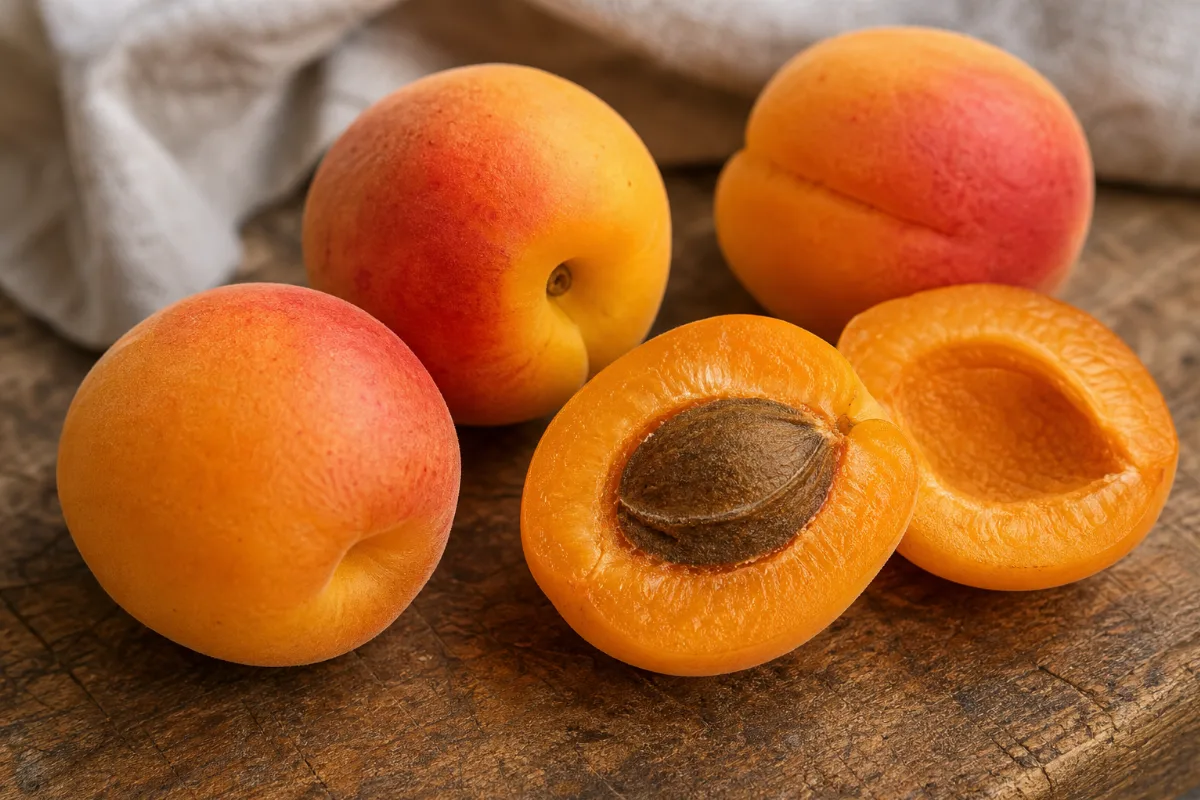
The apricot is a small orange stone fruit eaten fresh, dried or canned. The flesh gives vitamin A (from carotenoids), some vitamin C, fibre and potassium. No trial has tested apricots on a health outcome, and the evidence for fruit in general is only observational. The key caution: raw apricot kernels and 'vitamin B17' (laetrile) release cyanide and have caused poisonings.
General information, not medical advice. Last substantive update · Not medically reviewed. A named clinician has not signed off on this page. How this page is made
About Apricots
The apricot is a nutritious fruit, not a proven remedy. The fruit itself has no safety signal in the sources read. The kernel inside the stone is the danger.
What it is
The apricot (Prunus armeniaca) is the fruit of a small tree in the rose family, the same family as peaches, plums and cherries. People eat the soft orange flesh fresh, dried or canned.
USDA data for raw apricot: 48 kcal per 100 g. One apricot (35 g) has about 17 kcal, 0.7 g fibre, 3.2 g sugars, 3.5 mg vitamin C, 34 micrograms vitamin A (RAE) and 91 mg potassium. Dried apricots (sulfured) are far more concentrated: 241 kcal, 53.4 g sugars, 7.3 g fibre and 1160 mg potassium per 100 g, with only 1 mg vitamin C. USDA lists no sulphite level.
What the research shows
No trial has tested apricots on vitamin status, digestion, eyes or heart health. The firmest facts are nutrient amounts, which USDA measured.
A 2017 meta-analysis of 95 prospective studies linked more fruit and vegetables overall with lower heart disease and early death. It names apples, pears and citrus; apricots are not named in the abstract. Observational studies cannot prove cause.
One small trial found blood sugar after bread with sugar-free apricot jam was similar to bread alone. Two tiny studies of bitter apricot seeds found lower LDL but higher triglycerides and hormone changes.
For cancer, Cochrane found no controlled trials of laetrile or amygdalin, and NCI says there is little anticancer effect. Lab studies of amygdalin do not show benefit in people.
Fruit, dried fruit, jam and kernels are different things
Results for one form do not carry over to another. The jam trial used a sugar-free product. The seed studies used bitter kernels. Laetrile and amygdalin are purified kernel compounds. Dried apricots hold far more sugar and potassium per 100 g than fresh fruit.
Amounts
This page gives no amounts to eat. Ask a doctor or pharmacist what is right for you, especially if you take medicine, have asthma, allergies or kidney disease.
At a glance
Traditional uses history, not proof
- Eaten as a fresh, dried or canned fruit and made into jam
- Dried apricots are a common snack; long use as food is not proof of a health benefit
Studied for research
- Vitamin A and vitamin C source, content measured, no apricot trial
- Heart disease and early death (fruit and vegetables as a group), low certainty
- Blood sugar after a meal with apricot jam, very low certainty
- Cholesterol with bitter apricot seeds (not the fruit), very low certainty and a cyanide hazard
- Cancer claims for kernels, amygdalin and laetrile, evidence against
Main compounds
- Beta-carotene and other carotenoids (orange pigments)
- Vitamin C
- Fibre and potassium
- Amygdalin, in the kernel not the flesh (releases cyanide)
- Sugars, much more concentrated in dried apricots
Common forms
- Fresh fruit
- Dried apricots (often preserved with sulphites)
- Canned apricots, nectar and juice (not read in full)
- Sugar-free apricot jam (used in a blood sugar trial)
- Bitter apricot seeds and kernel extracts (a cyanide hazard; not the fruit)
Research links: EFSA: cyanogenic glycosides in foods (2019) · NCI: Laetrile/Amygdalin · Cochrane review: laetrile for cancer (2015) · Research Library · Genes & Biomarkers Library
What it is and its history
- Accepted scientific name
- Prunus armeniaca
- Naming authority
- L. (GBIF accepted)
- Common names
- Apricot (English); Albaricoque (Spanish)
- Family or group
- Rosaceae (the rose family), which also includes peaches, plums, cherries and apples. GBIF lists this family; the other members are named in the allergy studies read.
- Classification
- Plantae > Tracheophyta > Magnoliopsida > Rosales > Rosaceae > Prunus > Prunus armeniaca
- Native range
- Not verified from a source read.
- Habitat
- Not verified from a source read.
- What it looks like
- Roots: Not verified.; Stems: Not verified.; Leaves: Not verified.; Flowers: Not verified.; Fruit: The fruit is the food: orange flesh around a stone (pit). USDA's portion for raw apricot is one fruit of 35 g. The seed inside the stone is the kernel, which contains amygdalin.
- Cultivation
- Not verified from a source read.
- Harvest and processing
- Eaten fresh, canned, dried or as jam, juice or nectar. USDA lists a dried sulfured record and several canned and nectar records; only raw and dried were read in full.
- Look-alikes and adulterants
- Name: Apricot kernel oil and apricot kernel (herb); Note: The kernel is a different part of the plant with a cyanide hazard when raw. It has its own pages; this page is about the fruit flesh.; Name: Peach, plum, nectarine, cherry (other stone fruits); Note: Close relatives. Allergy studies show shared proteins with peach in particular.; Name: Japanese apricot (Prunus mume); Note: A different species with its own research, not covered here.
- Sustainability and conservation
- Not assessed.
Photographs
Traditional use and history history, not clinical proof
| Tradition or era | Documented use | Source |
|---|---|---|
| Amygdalin and laetrile promoted for cancer | The Cochrane review says laetrile and amygdalin, a compound from apricot and other Prunus kernels, are promoted under various names for treating cancer without evidence of efficacy. NCI says laetrile is also called 'vitamin B-17', though it is not recognised as a vitamin. | p25918920 |
| Culinary use | The fruit is eaten fresh, dried, canned or as jam (general knowledge; no historical source was read). | Not verified |
Traditional use shows how it was used. It does not show that it works or is safe today.
What is inside, and how it may work
What it contains and how those compounds act in cells and animals. Laboratory and animal mechanisms are not proven effects in people.
Main compounds
| Compound | Family | Where it is concentrated | Activity studied | Level of evidence |
|---|---|---|---|---|
| Beta-carotene PubChem 5280489 | carotenoid | Fruit flesh USDA: 1090 micrograms per 100 g raw apricot | An orange plant pigment the body can turn into vitamin A. Antioxidant in lab tests; no apricot trial on a health outcome was found. 20 | Human data |
| Vitamin A (as RAE) | vitamin | Fruit flesh USDA: 96 micrograms RAE per 100 g raw; 180 per 100 g dried (sulfured) | Vitamin A activity expressed by USDA from the carotenoids in the fruit. 20 21 | Human data |
| Other carotenoids (alpha-carotene, beta-cryptoxanthin, lutein plus zeaxanthin) | carotenoid | Fruit flesh USDA per 100 g raw: alpha-carotene 19, beta-cryptoxanthin 104, lutein plus zeaxanthin 89 micrograms | Content only; no apricot trial on a health outcome was found. 20 | Lab |
| Vitamin C (ascorbic acid) | vitamin | Fruit flesh USDA: 10 mg per 100 g raw; 1 mg per 100 g dried (sulfured) | A nutrient; apricots are a modest source. 20 21 | Human data |
| Amygdalin PubChem 656516 | cyanogenic glycoside | Kernel (seed inside the stone), not the flesh Not stated in the sources read | Releases hydrogen cyanide in the body. Source of the kernel poisoning cases. Lab studies report effects on cancer cells; trials in people are lacking. 18 15 11 | Human data |
Mechanisms, receptors and pathways
| Target or pathway | Gene or receptor | What was found | Level |
|---|---|---|---|
| Cyanide release from amygdalin | Not specified | NCI says amygdalin makes hydrogen cyanide, which is changed into cyanide in the body. This is the cause of the kernel poisoning cases. 18 13 | Human data |
| Cell death signals in cancer cells (Bax, caspase-3, Bcl-2) | Bax, caspase-3, Bcl-2 | A 2018 review describes amygdalin raising pro-apoptotic Bax and caspase-3, lowering Bcl-2 and slowing the cell cycle in cancer cells. Lab and animal findings only; trials are still needed according to the authors. 11 | Lab |
| Shared allergen proteins in stone fruits | Lipid transfer protein (Pru ar 3), ENEA (Pru ar 5) | Apricot's main allergen is a lipid transfer protein 94% similar to peach's. Another protein, ENEA, is shared with peach and cross-reacts with a latex allergen. 10 9 3 2 | Human data |
Absorption, metabolism and elimination
- Absorption
- Not studied for apricot flesh.
- Distribution
- Not found.
- Metabolism
- Not found.
- Elimination
- Not found.
- Bioavailability
- Not established for apricot carotenoids in the sources read.
Isolated compounds versus whole extracts
Each preparation is a different thing. The fruit flesh gives vitamins, fibre and potassium. Dried apricots hold much more sugar, fibre and potassium per 100 g and may contain sulphite. Sugar-free jam in the glucose trial had almost no carbohydrate. Kernels, kernel extracts and purified amygdalin or laetrile carry the cyanide hazard and are not the fruit. Fruit-and-vegetable pattern studies do not isolate apricots.
Nutritional composition
Nutrition from USDA FoodData Central (SR Legacy, published 4/1/2019, read 2026-10-25). Raw apricot, per 100 g: 48 kcal, 11.1 g carbohydrate, 9.24 g total sugars (5.87 g sucrose, 2.37 g glucose, 0.94 g fructose), 2.0 g fibre, 1.4 g protein, 0.39 g fat, 86.4 g water, 10 mg vitamin C, 96 micrograms vitamin A (RAE), 1090 micrograms beta-carotene, 259 mg potassium, 13 mg calcium, 0.39 mg iron, 0.078 mg copper, 0.89 mg vitamin E, 3.3 micrograms vitamin K, 9 micrograms folate (DFE) and 1 mg sodium. One apricot (35 g): about 17 kcal, 0.7 g fibre, 3.2 g sugars, 3.5 mg vitamin C, 34 micrograms vitamin A (RAE) and 91 mg potassium. One cup sliced (165 g): about 79 kcal, 3.3 g fibre, 15.2 g sugars, 16.5 mg vitamin C, 158 micrograms vitamin A (RAE) and 427 mg potassium. Dried apricot (sulfured, uncooked), per 100 g: 241 kcal, 62.6 g carbohydrate, 53.4 g sugars, 7.3 g fibre, 3.39 g protein, 1160 mg potassium, 2.66 mg iron, 180 micrograms vitamin A (RAE), 1 mg vitamin C and 30.9 g water; one cup of halves (130 g) is about 313 kcal and 69 g sugars. USDA lists no sulphite level. Figures vary with variety and ripeness. Serving values are our arithmetic from the USDA numbers.
1 low certainty2 very low certainty3 not enough evidence1 evidence against
What was looked at
The 7 benefits and uses checked for Apricots, each with how strong the evidence is. Tap one to open it.
- Vitamin A and vitamin C content (a nutrient source)Not enough evidence
- Heart disease, cancer and early death (fruit and vegetables as a group)Low certainty
- Blood sugar after a breakfast with apricot jamVery low certainty
- Cholesterol and heart markers (bitter apricot seeds, not the fruit)Very low certainty
- Digestion and bowel regularityNot enough evidence
- Eye health and antioxidant effects of the orange pigmentsNot enough evidence
- Cancer (apricot kernels, amygdalin, laetrile or 'vitamin B17')Evidence against
Lab markers tracked in the studies
Blood glucose after a meal (glycaemic response)LDL cholesterolTriglycerides
What is Apricots good for?
The main studied uses and how strong the human evidence is for each. Several results come from kernels, seeds or jam, not from eating the fruit.
Benefits, one by one
Each card is a research question, not a promise. Tap a goal to filter. Open a card to see the studies, doses and limits.
Vitamin A and vitamin C content (a nutrient source)
Not enough evidenceRaw apricots contain beta-carotene, which the body can turn into vitamin A, and some vitamin C. USDA measured the amounts. No trial has tested apricots on vitamin status or any health outcome.
2 studiesRaw fruit and dried fruit as food. Canned and juice forms were not re…
Studies, doses and limits
What the trials found
USDA lists, per 100 g of raw apricot: vitamin A 96 micrograms RAE, beta-carotene 1090 micrograms, alpha-carotene 19, beta-cryptoxanthin 104, lutein plus zeaxanthin 89 micrograms, and vitamin C 10 mg. One apricot (35 g) is about 34 micrograms RAE and 3.5 mg vitamin C. Dried apricots carry far less vitamin C (1 mg per 100 g) but more vitamin A per 100 g (180 micrograms RAE) because the water is gone.
Results
The nutrient amounts are measured. No study of apricots on blood vitamin levels, eyesight, immunity or deficiency was found.
Effect sizes as reported
USDA per 100 g raw: 96 micrograms RAE vitamin A, 10 mg vitamin C. Dried (sulfured): 180 micrograms RAE, 1 mg vitamin C.
Why this rating
The nutrient content is measured, but no trial tested apricots on a health outcome, so the benefit itself cannot be rated higher.
Form and dose studied
Raw fruit and dried fruit as food. Canned and juice forms were not read.
Who was studied
People of any age eating the fruit as food; deficiency was not studied with apricots.
Limits
Content figures only; amounts vary with variety, ripeness and storage. This is not a trial of apricots.
Why researchers looked
Apricots are an orange fruit, so people ask whether they are a good source of vitamin A.
Traditional use
Apricots are an old culinary fruit; long use as food is not proof that they treat any condition.
Proposed mechanism Established nutrition
Beta-carotene and other orange carotenoids are plant pigments that the body can convert in part to vitamin A. The vitamin A figure USDA lists is already expressed as vitamin A activity (RAE).
A proposed mechanism does not show that the effect happens in people.
None specific from the fruit flesh. Do not confuse the fruit with the kernel, which is a cyanide hazard (see the Safety tab).
Heart disease, cancer and early death (fruit and vegetables as a group)
Low certaintyLarge studies that follow people over time link eating more fruit and vegetables with a lower chance of heart disease and early death. Apricots were not singled out, and these studies cannot prove cause.
1 studiesFruit and vegetables eaten as food, in general.
Studies, doses and limits
What the trials found
A 2017 meta-analysis of 95 prospective studies found, for fruit and vegetables combined and per 200 g a day, an 8% lower risk of coronary heart disease (RR 0.92), a 16% lower risk of stroke (0.84), 8% lower cardiovascular disease (0.92), 3% lower total cancer (0.97) and 10% lower all-cause death (0.90). The abstract names apples and pears, citrus, green leafy and cruciferous vegetables and salads. It does not name apricots.
Results
A general fruit-and-vegetable pattern is linked to lower risk. Apricots specifically were not measured in the abstract.
Effect sizes as reported
Per 200 g a day of fruit and vegetables: RR 0.92 heart disease, 0.84 stroke, 0.90 all-cause death.
Why this rating
Observational studies of whole populations; they show association, not cause, and apricots were not analysed alone. Heterogeneity was high for stroke and death.
Form and dose studied
Fruit and vegetables eaten as food, in general.
Who was studied
Adults in many countries, followed prospectively.
Limits
Cannot show that apricots cause any benefit. People who eat more fruit often differ in other ways.
Why researchers looked
Apricots are a fruit, so people ask whether they share the benefits seen for fruit in general.
Traditional use
Apricots are an old culinary fruit; long use as food is not proof that they treat any condition.
Proposed mechanism Observational
Many possible reasons are suggested (fibre, potassium, plant pigments), but the studies behind this entry only count foods eaten and outcomes later; they do not test a mechanism.
A proposed mechanism does not show that the effect happens in people.
None specific.
Blood sugar after a breakfast with apricot jam
Very low certaintyOne tiny trial gave 12 healthy young adults white bread with sugar-free apricot jam. Blood sugar was similar to bread alone. This tested a jam product, not the fruit.
1 studiesSugar-free apricot jam eaten with white bread (a product, not the fru…
Studies, doses and limits
What the trials found
In a crossover trial of 12 healthy adults, sugar-free apricot jam with white bread and white bread alone were both classed as medium glycaemic index and low-to-medium glycaemic load. Hunger was lower after the jam with bread (P<0.05).
Results
Jam with bread behaved like bread alone. Fresh and dried apricots were not tested in this trial.
Effect sizes as reported
Both meals: medium glycaemic index (the abstract gives no figure).
Why this rating
One tiny single-meal trial in healthy young people, a sugar-free jam product, and no data on whole apricots.
Form and dose studied
Sugar-free apricot jam eaten with white bread (a product, not the fruit).
Who was studied
Twelve healthy adults, mean age 25.
Limits
Not the fruit; one meal; healthy people only; funding not shown in the abstract.
Why researchers looked
People ask whether apricots, which contain natural sugars, raise blood sugar sharply.
Traditional use
Apricots are an old culinary fruit; long use as food is not proof that they treat any condition.
Proposed mechanism Human measurement
The jam in the trial had only traces of available carbohydrate, so it added almost no sugar load. The trial could not show how fresh or dried apricot affects blood sugar.
A proposed mechanism does not show that the effect happens in people.
People with diabetes should ask their care team about fruit and dried fruit.
Cholesterol and heart markers (bitter apricot seeds, not the fruit)
Very low certaintyTwo small before-and-after studies from one research group gave volunteers bitter apricot seeds and measured blood fats. LDL fell, but triglycerides and some hormones rose. Seeds contain cyanide-releasing amygdalin, so this is not advice to eat them.
5 studiesBitter apricot seeds (kernels) in divided daily portions; amounts are…
Studies, doses and limits
What the trials found
In 12 healthy adults over 12 weeks, LDL cholesterol fell from 2.93 to 2.31 mmol/L (P<0.001) and total cholesterol from 4.86 to 4.44 (P<0.05), but triglycerides rose from 0.84 to 1.17 mmol/L. In 18 women over 42 days, LDL fell, while total cholesterol and triglycerides rose at 21 days and several hormones (FSH, testosterone, androstenedione) rose by day 42. Neither abstract reports a cyanide measurement.
Results
Mixed changes in blood fats and hormones in tiny uncontrolled studies. Neither studied the fruit flesh.
Effect sizes as reported
LDL -0.62 mmol/L (12 adults, 12 weeks); triglycerides +0.33 mmol/L.
Why this rating
Two small, uncontrolled studies from the same group, using bitter seeds, with mixed results and no safety measure in the abstracts.
Form and dose studied
Bitter apricot seeds (kernels) in divided daily portions; amounts are not repeated here because kernels are a cyanide hazard.
Who was studied
Healthy adults in Slovakia (12 and 18 people).
Limits
No control group; very small; same research group; hormone effects of unknown meaning; not the fruit.
Why researchers looked
Apricot seeds are sold as a health food, so researchers measured blood fats in volunteers.
Traditional use
Apricots are an old culinary fruit; long use as food is not proof that they treat any condition.
Proposed mechanism Unknown
Not tested in these abstracts. The seeds contain amygdalin and oils; how any effect would arise is unknown.
A proposed mechanism does not show that the effect happens in people.
Raw apricot kernels can cause cyanide poisoning (EFSA, NCI, case reports). Please read the Safety tab before anything else.
Digestion and bowel regularity
Not enough evidenceApricots contain fibre, but no trial testing apricots for constipation or gut health was found.
2 studiesRaw and dried fruit as food.
Studies, doses and limits
What the trials found
USDA lists 2.0 g of fibre per 100 g of raw apricot (about 0.7 g in one apricot) and 7.3 g per 100 g of dried apricot. No human trial of apricots on bowel movements was found.
Results
No apricot-specific result.
Effect sizes as reported
Fibre per 100 g: 2.0 g raw, 7.3 g dried (USDA).
Why this rating
Fibre content is measured, but no study tested apricots for digestion.
Form and dose studied
Raw and dried fruit as food.
Who was studied
Not studied.
Limits
No study found.
Why researchers looked
Fruit fibre is often linked with regular bowels, so people ask about apricots.
Traditional use
Apricots are an old culinary fruit; long use as food is not proof that they treat any condition.
Proposed mechanism Established physiology
Fibre adds bulk to stool. This is a general nutrition idea; it was not tested for apricots in a source read.
A proposed mechanism does not show that the effect happens in people.
Dried apricots hold much more sugar and potassium per 100 g than fresh (USDA).
Eye health and antioxidant effects of the orange pigments
Not enough evidenceApricots contain carotenoids, including lutein and zeaxanthin, but no human trial of apricots on eye health was found.
1 studiesRaw fruit as food.
Studies, doses and limits
What the trials found
USDA lists per 100 g of raw apricot: beta-carotene 1090 micrograms, alpha-carotene 19, beta-cryptoxanthin 104, lutein plus zeaxanthin 89 micrograms. No study of apricots on eye disease or vision was found.
Results
Content only; no health result.
Effect sizes as reported
Lutein plus zeaxanthin 89 micrograms per 100 g raw (USDA).
Why this rating
No human trial of apricots on any eye outcome was found.
Form and dose studied
Raw fruit as food.
Who was studied
Not studied.
Limits
No study found.
Why researchers looked
Carotenoids are often discussed for eyes, and apricots are orange, so people ask.
Traditional use
Apricots are an old culinary fruit; long use as food is not proof that they treat any condition.
Proposed mechanism Lab
Carotenoids behave as antioxidants in laboratory tests. Whether eating apricots changes eye health was not tested.
A proposed mechanism does not show that the effect happens in people.
None specific.
Cancer (apricot kernels, amygdalin, laetrile or 'vitamin B17')
Evidence againstApricot kernels contain amygdalin, which is sold as laetrile or 'vitamin B17' for cancer. A Cochrane review found no controlled trials, and the cyanide poisoning risk is serious. Evidence is against it.
5 studiesAmygdalin, laetrile, apricot kernels and kernel extracts (not the fru…
Studies, doses and limits
What the trials found
The 2015 Cochrane review searched eight databases and found no randomised or quasi-randomised trial of laetrile or amygdalin in cancer. The authors found the risk-benefit balance unambiguously negative because of cyanide poisoning, especially by mouth. NCI says laetrile has shown little anticancer effect in clinical studies, is not approved by the FDA, and is not recognised as a vitamin. A 2018 review describes cell findings and says trials are still needed.
Results
No benefit shown in people. Serious cyanide risk, especially by mouth.
Effect sizes as reported
No eligible trials (Cochrane 2015).
Why this rating
Cochrane and NCI find no good evidence of benefit and document a serious poisoning risk. Cell findings do not change that.
Form and dose studied
Amygdalin, laetrile, apricot kernels and kernel extracts (not the fruit flesh).
Who was studied
People with cancer who use these products as alternative treatment.
Limits
No controlled trials exist; case reports show harm.
Why researchers looked
Amygdalin has been promoted for decades as a cancer remedy.
Traditional use
Apricots are an old culinary fruit; long use as food is not proof that they treat any condition.
Proposed mechanism Lab
In the lab, amygdalin has been reported to trigger cell death in cancer cells. In the body it releases hydrogen cyanide, which is toxic. Cell results do not show benefit in people.
A proposed mechanism does not show that the effect happens in people.
Cyanide poisoning has been reported in an adult and in a 4-year-old child (case reports). Do not replace cancer treatment with these products.
Connections to the rest of health
How Apricots connects to the rest of our health knowledge graph. Every link says what kind of connection it is. A safety link (for example to the liver) is a warning, not a benefit. A study that merely mentions a topic never creates a benefit link.
Explore every connection: goals, body systems, organs, symptoms, genes
B. Body systems
| Connected to | Kind of connection | Evidence status | Context | Studies |
|---|---|---|---|---|
| Nutrition | Biological association | Not enough evidence | Studied for: Vitamin A and vitamin C content (a nutrient source) | 20 21 |
| Immune System | Biological association | Not enough evidence | Studied for: Vitamin A and vitamin C content (a nutrient source) Studied for: Heart disease, cancer and early death (fruit and vegetables as a group) | 20 21 1 |
| Cardiovascular System | Biological association | Low certainty | Studied for: Heart disease, cancer and early death (fruit and vegetables as a group) Studied for: Cholesterol and heart markers (bitter apricot seeds, not the fruit) | 1 5 6 13 12 4 |
| Blood Sugar Support | Biological association | Very low certainty | Studied for: Blood sugar after a breakfast with apricot jam | 8 |
| Endocrine System | Biological association | Very low certainty | Studied for: Cholesterol and heart markers (bitter apricot seeds, not the fruit) | 5 6 13 12 4 |
| Digestive System | Biological association | Not enough evidence | Studied for: Digestion and bowel regularity | 20 21 |
| Integumentary System | Biological association | Not enough evidence | Studied for: Eye health and antioxidant effects of the orange pigments | 20 |
| Cellular | Biological association | Evidence against | Studied for: Cancer (apricot kernels, amygdalin, laetrile or 'vitamin B17') | 7 18 11 13 12 |
E. Health conditions
| Connected to | Kind of connection | Evidence status | Context | Studies |
|---|---|---|---|---|
| Food allergy | Adverse effect or risk | Documented risk | Apricot allergy is documented and cross-reacts with peach and with a latex allergen. Preparation or compound: Apricot fruit proteins (LTP, Pru ar 5) |
10 9 3 |
| Cyanide poisoning | Adverse effect or risk | Documented risk | Kernels release cyanide; case reports in an adult and a child. Raw apricot kernels and amygdalin release cyanide; case reports exist in an adult and a child. Preparation or compound: Raw apricot kernels and amygdalin |
13 12 4 15 |
| Asthma | Adverse effect or risk | Documented risk | Two of three sulphite-sensitive people with asthma reacted to dried apricots in a small challenge study. Preparation or compound: Sulphite-preserved dried apricots |
14 |
I. Biomarkers
| Connected to | Kind of connection | Evidence status | Context | Studies |
|---|---|---|---|---|
| Blood glucose after a meal (glycaemic response) | Biological association | Very low certainty | Measured in trials: unclear. A lab change is not the same as a health benefit. | 8 |
| LDL cholesterol | Biological association | Very low certainty | Measured in trials: decrease. A lab change is not the same as a health benefit. | 5 6 |
| Triglycerides | Biological association | Very low certainty | Measured in trials: increase. A lab change is not the same as a health benefit. | 5 6 |
K. Biological pathways
| Connected to | Kind of connection | Evidence status | Context | Studies |
|---|---|---|---|---|
| Vitamin A | Preliminary mechanism | Human | Apricots supply vitamin A activity from carotenoids; no apricot trial on vitamin A status was found. | 20 |
| Vitamin C | Preliminary mechanism | Human | A modest source in raw apricot, little in dried. | 20 21 |
| Potassium | Preliminary mechanism | Human | 259 mg per 100 g raw and 1160 mg per 100 g dried (USDA). | 20 21 |
L. Active compounds
| Connected to | Kind of connection | Evidence status | Context | Studies |
|---|---|---|---|---|
| Beta-carotene | Biological association | Human | An orange plant pigment the body can turn into vitamin A. Antioxidant in lab tests; no apricot trial on a health outcome was found. Preparation or compound: Fruit flesh |
20 |
| Vitamin A (as RAE) | Biological association | Human | Vitamin A activity expressed by USDA from the carotenoids in the fruit. Preparation or compound: Fruit flesh |
20 21 |
| Other carotenoids (alpha-carotene, beta-cryptoxanthin, lutein plus zeaxanthin) | Biological association | Lab | Content only; no apricot trial on a health outcome was found. Preparation or compound: Fruit flesh |
20 |
| Vitamin C (ascorbic acid) | Biological association | Human | A nutrient; apricots are a modest source. Preparation or compound: Fruit flesh |
20 21 |
| Amygdalin | Biological association | Human | Releases hydrogen cyanide in the body. Source of the kernel poisoning cases. Lab studies report effects on cancer cells; trials in people are lacking. Preparation or compound: Kernel (seed inside the stone), not the flesh |
18 15 11 |
Each connection is stored with the ingredient, the connected record, the kind of connection, the evidence status, the supporting studies, the preparation or compound involved, and a review date (last reviewed October 25, 2026).
Evidence at a glance: what the research found for 7 outcomes
Each outcome below is one thing researchers measured. Certainty is how far the evidence can be trusted, not how well it works. The full studies are on the next tab.
The evidence
The research centre for Apricots. Every record here was checked against PubMed or the publisher's page; we never list a study we have not verified.
Evidence by outcome
Bars show how many studies we found for each outcome, not how well it works. People are added up across trials only (reviews are not added, to avoid double counting).
How we rate evidence
High certainty
Several well-run trials or reviews agree; further research is unlikely to change the picture much.
Moderate certainty
Good trials point the same way, but some doubt remains.
Low certainty
Small, short or inconsistent trials. The finding could change with better research.
Very low certainty
Very little or very weak human data. Treat as a possibility only.
Mixed findings
Trials or reviews disagree with each other.
Not enough evidence
Not enough human research to say either way.
Evidence against
Good research found no benefit, or found harm.
We take the reviewers' own risk-of-bias and GRADE statements where they exist, and otherwise judge from study size, design, consistency, directness and whether a product matches what is sold. Many publications do not make evidence high. Method note: We started from our existing apricot summary, re-checked nutrition in the USDA FoodData Central data file, read the EFSA, NCI, FDA and NHS pages, and searched PubMed for trials, reviews, case reports and allergy studies. Only abstracts were read for studies. Items we could not verify are flagged in the research gaps.
Study library: every study we checked 21
| Study | Design | People | Product, dose, length | Result |
|---|---|---|---|---|
| Aune 2017 Fruit and vegetable intake and the risk of cardiovascular disease, total cancer and all-cause mortality-a systematic review and dose-response meta-analysis of prospective studies. Int J Epidemiol · PMID 28338764 · DOI |
Meta-analysis |
95 prospective studies (142 publications) of fruit and vegetable intake | Fruit and vegetables eaten as food, in general Fruit and vegetables (not apricots specifically) Prospective follow-up, varied · vs Lower versus higher intake |
For fruit and vegetables combined, per 200 g a day: coronary heart disease RR 0.92, stroke 0.84, cardiovascular disease 0.92, total cancer 0.97, all-cause mortality 0.90. Inverse associations were named for apples and pears, citrus fruits, green leafy vegetables, cruciferous vegetables and salads. Apricots are not named in the abstract. RR 0.92 (heart disease), 0.84 (stroke), 0.92 (cardiovascular), 0.97 (cancer), 0.90 (all-cause death) per 200 g a day (95% CI 0.90-0.94; 0.76-0.92; 0.90-0.95; 0.95-0.99; 0.87-0.93) Methods, limits and fundingOutcomes: Heart disease, stroke, cardiovascular disease, total cancer, all-cause death Limitations: Observational: cannot prove cause. Heterogeneity was high for stroke (I2 73%) and all-cause mortality (I2 83%). Fruit and vegetables are combined; apricots were not analysed on their own. Funding and conflicts: Not shown in the abstract. Read: abstract |
| Borges 2008 Lipid transfer proteins from Rosaceae fruits share consensus epitopes responsible for their IgE-binding cross-reactivity. Biochem Biophys Res Commun · PMID 18036340 · DOI |
Laboratory in silico/lab |
Computer and laboratory modelling of lipid transfer protein allergens from apple, peach, apricot and plum | Protein models Fruit protein |
Four IgE-binding regions were mapped, two of them shared across the Rosaceae group, which probably explains cross-reactivity between fruits. The authors add that the cross-reactivity has varying clinical relevance and is not necessarily accompanied by allergy to the matching fruit. Not applicable (Not applicable) Methods, limits and fundingOutcomes: IgE-binding regions Limitations: Modelling study, not a clinical result. Funding and conflicts: Not shown in the abstract. Read: abstract |
| Giangrieco 2019 ENEA, a peach and apricot IgE-binding protein cross-reacting with the latex major allergen Hev b 5. Mol Immunol · PMID 31254775 · DOI |
Laboratory and clinical |
3305 31 patients with peach allergy or latex IgE, and 3305 people tested for suspected allergy |
Recombinant apricot protein ENEA and natural peach protein Fruit protein |
A peach and apricot protein, now named Pru ar 5, is recognised by IgE from allergic patients and partly blocks IgE binding to the latex allergen Hev b 5. In 31 selected patients 28 were co-sensitised to ENEA and Hev b 5 by one test; among 3305 people tested for suspected allergy 17 were sensitised to ENEA and 10 of them to Hev b 5. The authors say the amount varies a lot between fruit batches, which may explain occasional reactions. 28 of 31 selected patients; 17 of 3305 random (Not applicable) Methods, limits and fundingOutcomes: IgE binding Limitations: Mostly laboratory work; being IgE-positive does not always mean having symptoms. Funding and conflicts: Not shown in the abstract. Read: abstract |
| Konstantatos 2017 An unusual presentation of chronic cyanide toxicity from self-prescribed apricot kernel extract. BMJ Case Rep · PMID 28893740 · DOI |
Case report |
1 One 67-year-old man |
Self-prescribed apricot kernel extract taken daily for 5 years Kernel extract 5 years |
During routine anaesthesia his pulse oximeter showed low oxygen. After surgery he said he had taken apricot kernel extract daily for 5 years. Blood analysis confirmed cyanide toxicity; the authors think free cyanide disturbed the oximeter reading. Readings returned to normal after he stopped it. Not applicable (Not applicable) Methods, limits and fundingOutcomes: Low oxygen reading under anaesthesia, blood cyanide Limitations: A single case; the abstract does not give the amount taken. Funding and conflicts: Competing interests: none declared. Read: abstract |
| Kopcekova 2018 Influence of long-term consumption of bitter apricot seeds on risk factors for cardiovascular diseases. J Environ Sci Health B · PMID 29336667 · DOI |
Clinical trial |
12 12 healthy adult volunteers (5 women, 7 men), Slovakia |
Bitter apricot seeds (kernels), eaten in divided daily portions Seed (kernel), not the fruit flesh Per-kilogram dose given in the paper; not repeated here because kernels are a cyanide hazard 12 weeks |
Total cholesterol fell from 4.86 to 4.44 mmol/L (P<0.05) and LDL from 2.93 to 2.31 mmol/L (P<0.001). HDL did not change significantly. Triglycerides rose from 0.84 to 1.17 mmol/L. hs-CRP fell from 1.92 to 1.23 mg/L, not significant. The abstract reports no cyanide measurement. LDL -0.62 mmol/L; triglycerides +0.33 mmol/L (P<0.001 for LDL) Methods, limits and fundingOutcomes: Cholesterol, triglycerides, hs-CRP, creatine kinase Limitations: Twelve people, no control group, bitter kernels (a recognised cyanide hazard), the same research group as the 2021 women's study. Not a test of eating the fruit. Funding and conflicts: Funding is not shown in the abstract. Read: abstract |
| Kopcekova 2021 Consumption of bitter apricot seeds affects lipid and endocrine profile in women. J Environ Sci Health B · PMID 33645417 · DOI |
Clinical trial |
18 18 women of reproductive age (mean 41.6 years), Slovakia |
Bitter apricot seeds (kernels), eaten in divided daily portions Seed (kernel), not the fruit flesh Per-kilogram dose given in the paper; not repeated here because kernels are a cyanide hazard 42 days |
LDL fell significantly after 42 days. Total cholesterol and triglycerides rose after 21 days. FSH, testosterone and androstenedione rose by day 42; prolactin and testosterone rose and oestradiol fell at day 21. The abstract concludes that daily seed intake may affect plasma lipids and hormones. LDL lower at 42 days; hormone changes (P<0.05) Methods, limits and fundingOutcomes: Lipids and reproductive hormones Limitations: Eighteen women, no control group, bitter kernels, hormone changes of unknown meaning. The abstract is not fully clear about total cholesterol. Not a test of eating the fruit. Funding and conflicts: Funding is not shown in the abstract. Read: abstract |
| Milazzo 2015 Laetrile treatment for cancer. Cochrane Database Syst Rev · PMID 25918920 · DOI |
Systematic review |
0 Randomised and quasi-randomised trials of laetrile or amygdalin in cancer; none qualified |
Laetrile (semi-synthetic) and amygdalin Kernel compound (not the fruit) Searches to 2015 |
More than 200 references were found, but no study met the inclusion criteria. The authors say claims of benefit are not supported by sound clinical data, that there is a considerable risk of serious cyanide poisoning, especially by mouth, and that the risk-benefit balance is unambiguously negative. No eligible trials (Not applicable) Methods, limits and fundingOutcomes: Anticancer effect and adverse effects Limitations: Review found no controlled trials at all, so it cannot rate effect size. Funding and conflicts: The authors report no financial interest in the subject. Read: abstract |
| Papakonstantinou 2022 Short-term effects of sugar-free apricot jam, cocoa powder and dried cranberry cereal bar on glycaemic responses in healthy adults: a randomised clinical trial. J Nutr Sci · PMID 36304830 · DOI |
Controlled trial |
12 12 healthy adults, mean age 25, BMI 22 |
Sugar-free apricot jam eaten with white bread (jam had only traces of available carbohydrate) Apricot jam product, not the fresh fruit Meals matched on 25 g of available carbohydrate (trial detail, not advice) Single meals in random order, blood glucose for 120 minutes · vs 25 g glucose reference and white bread alone |
Jam with white bread and white bread alone were both classed medium glycaemic index and low-to-medium glycaemic load. Hunger was lower after jam with bread (P<0.05). Both meals medium glycaemic index (Not shown in the abstract) Methods, limits and fundingOutcomes: Glycaemic index and load, hunger and fullness ratings Limitations: Twelve young healthy people, one meal each, a sugar-free jam product (not fresh apricots). The jam added almost no carbohydrate, so this does not test the fruit's sugar. Funding and conflicts: Funding is not shown in the abstract. Read: abstract |
| Pastorello 1994 Allergenic cross-reactivity among peach, apricot, plum, and cherry in patients with oral allergy syndrome: an in vivo and in vitro study. J Allergy Clin Immunol · PMID 7930303 · DOI |
Laboratory and clinical |
23 23 patients with oral allergy syndrome to peach |
Fresh peach, apricot, plum and cherry (skin tests, food challenges, immunoblotting) Fruit |
A 13-kd protein was the only major allergen common to all stone fruits tested. Immunoblot inhibition showed wide cross-reactivity within the group, and grass and birch pollen only partly blocked peach binding. The authors conclude that clinical cross-reactivity is mainly due to this shared protein. Wide cross-reactivity within the group (Not applicable) Methods, limits and fundingOutcomes: Cross-reactivity Limitations: Selected patients who were already allergic to peach; 1994 methods. Funding and conflicts: Not shown in the abstract. Read: abstract |
| Pastorello 2000 Evidence for a lipid transfer protein as the major allergen of apricot. J Allergy Clin Immunol · PMID 10669861 · DOI |
Laboratory and clinical |
30 30 people with oral allergy syndrome to apricot confirmed by an open food challenge (2 with systemic reactions) |
Apricot extract (fresh fruit allergen testing) Fruit · vs Peach lipid transfer protein used to block binding |
Serum from all 30 patients recognised a 9-kd protein, which belongs to the lipid transfer protein (LTP) family and is 94% similar to the LTP of peach. Binding to apricot extract was completely blocked by purified peach LTP. The authors conclude that the major apricot allergen is an LTP, highly cross-reactive with peach. All 30 recognised the 9-kd LTP (Not applicable) Methods, limits and fundingOutcomes: IgE reactivity to apricot proteins Limitations: Allergic patients only, so it says nothing about how common apricot allergy is. Funding and conflicts: Not shown in the abstract. Read: abstract |
| Saleem 2018 Amygdalin from Apricot Kernels Induces Apoptosis and Causes Cell Cycle Arrest in Cancer Cells: An Updated Review. Anticancer Agents Med Chem · PMID 29308747 · DOI |
Narrative review cell/animal |
Cell and animal findings, plus a few human reports, on amygdalin | Amygdalin (purified compound) Kernel compound (not the fruit) |
The review describes amygdalin raising pro-apoptotic Bax and caspase-3, lowering Bcl-2 and slowing the cell cycle in cancer cells. The authors say well-planned clinical trials are still needed to prove effectiveness in living patients. The review also argues that the cyanide danger is a mistaken belief; that view conflicts with the Cochrane review, NCI and the case reports on this page. Not applicable (Not applicable) Methods, limits and fundingOutcomes: Cell death and cell cycle markers in cancer cells Limitations: Narrative review of lab findings. It does not show benefit in people. Funding and conflicts: Not shown in the abstract. Read: abstract |
| Sauer 2015 Severe cyanide poisoning from an alternative medicine treatment with amygdalin and apricot kernels in a 4-year-old child. Wien Med Wochenschr · PMID 25605411 · DOI |
Case report |
1 One 4-year-old boy with metastatic ependymoma |
Oral and intravenous amygdalin ('vitamin B 17') plus oral apricot kernel Kernel and purified amygdalin |
He arrived agitated, unresponsive (Glasgow Coma Scale 3) with severe lactic acidosis and a markedly raised serum cyanide level. After sodium thiosulfate he improved quickly and recovered fully without further intensive care. Not applicable (Not applicable) Methods, limits and fundingOutcomes: Cyanide poisoning Limitations: A single case in a child already seriously ill; several products were used together. Funding and conflicts: Not shown in the abstract. Read: abstract |
| Suchard 1998 Acute cyanide toxicity caused by apricot kernel ingestion. Ann Emerg Med · PMID 9832674 · DOI |
Case report |
1 One 41-year-old woman |
Apricot kernels bought at a health food store Kernel Single ingestion |
She became weak and short of breath within 20 minutes, was comatose and had a low body temperature on arrival, and responded promptly to cyanide antidote treatment. She later needed a continuous thiosulfate infusion for persistent acidosis. The authors call it the first reported US case of cyanide toxicity from apricot kernels since 1979. Not applicable (Not applicable) Methods, limits and fundingOutcomes: Cyanide poisoning Limitations: A single case; the amount eaten is not stated in the abstract. Funding and conflicts: Not shown in the abstract. Read: abstract |
| Taylor 1988 Sensitivity to sulfited foods among sulfite-sensitive subjects with asthma. J Allergy Clin Immunol · PMID 3379229 · DOI |
Controlled trial |
8 Eight people with asthma already diagnosed as sulfite sensitive |
Sulfited foods including dried apricots, lettuce, shrimp, white grape juice, mashed potatoes and mushrooms Dried apricots with added sulphite Challenges · vs Double-blind challenges |
Four of eight did not react to any sulfited food. Two of the three people tested with dried apricots reacted with a fall in lung function. The authors conclude that sulfite-sensitive people with asthma will not necessarily react; it depends on the food, the residual sulfite and the person. 2 of 3 reacted to dried apricots (Not applicable) Methods, limits and fundingOutcomes: Lung function after eating Limitations: Very small and old (1988). Sulphite levels in today's dried apricots may differ. Funding and conflicts: Not shown in the abstract. Read: abstract |
| s-efsa-2019-cng EFSA CONTAM Panel: Evaluation of the health risks related to the presence of cyanogenic glycosides in foods other than raw apricot kernels · Source |
Regulator n/a |
Methods, limits and fundingRead: full-text | ||
| s-fda-produce FDA: Selecting and Serving Produce Safely · Source |
Regulator n/a |
Methods, limits and fundingRead: full-text | ||
| s-gbif-prunus-armeniaca GBIF species match: Prunus armeniaca · Source |
Reference database n/a |
Methods, limits and fundingRead: full-text | ||
| s-nci-laetrile NCI: Laetrile/Amygdalin (PDQ patient version) · Source |
Health agency n/a |
Methods, limits and fundingRead: full-text | ||
| s-nhs-5aday NHS: 5 A Day, what counts? · Source |
Health agency n/a |
Methods, limits and fundingRead: full-text | ||
| s-usda-fdc-171697 USDA FoodData Central: Apricots, raw (SR Legacy, FDC 171697) · Source |
Reference database n/a |
Methods, limits and fundingRead: full-text | ||
| s-usda-fdc-173941 USDA FoodData Central: Apricots, dried, sulfured, uncooked (SR Legacy, FDC 173941) · Source |
Reference database n/a |
Methods, limits and fundingRead: full-text |
What we do not know yet
- No trial has tested fresh or dried apricots on vitamin status, digestion, eye health, blood sugar or heart markers.
- The fruit-and-vegetable meta-analysis does not report apricots alone.
- The seed studies had no control groups and report no cyanide measurements in the abstracts.
- No source read says how common apricot allergy is or how much sulphite today's dried apricots contain.
- Pregnancy, breastfeeding, choking risk, pesticide residues and heavy metals were not covered by a source read.
How new research is added
New studies are found by a saved PubMed search and placed in a review queue before the page changes.
Lab markers
What changed in blood or saliva tests during trials. A changed number is not the same as feeling or being healthier, and we give no "normal ranges".
Metabolic 2
LDL cholesterol
Decrease in trials
The 'bad' cholesterol carried in the blood; high levels are linked to heart disease risk.
Very low certaintyResults and what it means
Why it was measured
It is a standard heart-risk marker.
Statistical vs. clinical meaning
Small uncontrolled studies of bitter seeds, not the fruit. A blood marker is not the same as fewer heart attacks.
Safety implication
Raw kernels can cause cyanide poisoning.
Triglycerides
Increase in trials
A type of fat in the blood. High levels are linked to heart risk.
Very low certaintyResults and what it means
Why it was measured
It is a standard blood-fat marker, measured alongside cholesterol.
Statistical vs. clinical meaning
Went the unhelpful way in both small studies, which shows the overall blood-fat picture was mixed.
Safety implication
Raw kernels can cause cyanide poisoning.
Other 1
Blood glucose after a meal (glycaemic response)
Unclear in trials
How high and how long blood sugar rises after eating. It is summarised as a glycaemic index (how fast) and glycaemic load (how much).
Very low certaintyResults and what it means
Why it was measured
It shows how a food affects blood sugar in the two hours after eating.
Statistical vs. clinical meaning
A single small meal test of a sugar-free jam. It does not say how fresh or dried apricots affect blood sugar.
Safety implication
People with diabetes should ask their care team; dried apricots hold far more sugar per 100 g than fresh (USDA).
| Study | Result | People | Product |
|---|---|---|---|
| 8 | Sugar-free apricot jam with white bread and white bread alone were both medium glycaemic index and low-to-medium glycaemic load | 12 healthy adults | Meals with 25 g of available carbohydrate, one meal each |
Safety
What studies and official sources say about side effects, medicines and who should check first. Each point shows what kind of evidence it comes from.
Main points to know 5
- Do not eat raw apricot kernels or kernel extracts. The kernel is the seed inside the stone. It contains amygdalin, which releases cyanide in the body. Case reports describe an adult who became weak and short of breath within 20 minutes and arrived in a coma, a 4-year-old who needed antidote treatment, and a man with confirmed cyanide toxicity after 5 years of daily kernel extract. EFSA's acute safety limit for cyanide is 20 micrograms per kg of body weight, whatever the food. The fruit flesh is a different thing and is not the concern here. Case report 13 12 4 15
- 'Vitamin B17' and laetrile are not vitamins and not proven cancer treatments. NCI says laetrile is another name for amygdalin, that it makes hydrogen cyanide in the body, that it is not recognised as a vitamin, that it has shown little anticancer effect in clinical studies and that the FDA has not approved it. NCI lists side effects including nausea, vomiting, headache, dizziness, liver damage, very low blood pressure, coma and death. The 2015 Cochrane review found no controlled trials, warned of serious cyanide poisoning especially by mouth, and judged the risk-benefit balance unambiguously negative. Systematic review 18 7
- Apricot allergy exists and can cross-react with peach and latex. In 30 people with confirmed apricot allergy (oral allergy syndrome, 2 with whole-body reactions), all recognised a protein that is 94% similar to peach's. A later study found a peach and apricot protein (Pru ar 5) that cross-reacts with the latex allergen Hev b 5. Cross-reaction in blood tests does not always mean symptoms. Trouble breathing or swelling of the face or throat needs emergency help. Observational 10 9 3 2
- Sulphite-preserved dried apricots can trigger asthma in sulphite-sensitive people. In a small 1988 challenge study, 2 of 3 sulphite-sensitive people with asthma reacted to dried apricots with a fall in lung function. USDA lists its dried apricot record as sulfured. The label should say if sulphites are used. Not everyone with sulphite sensitivity reacts. Clinical trial 14 21
- Dried apricots are concentrated in sugar and potassium. Per 100 g, USDA lists 53.4 g of sugars and 1160 mg of potassium for dried apricots, compared with 9.24 g and 259 mg for raw. People told to limit potassium (for example with kidney disease or certain medicines) should ask their clinician. The NHS says dried fruit is best eaten at mealtimes rather than as a snack between meals, to reduce tooth decay risk. Authoritative guidance 20 21 19
Side effects 4
| Effect | How often | Severity and recovery | Evidence |
|---|---|---|---|
| Cyanide poisoning from raw kernels or kernel extract: weakness, shortness of breath, confusion, low body temperature, coma Applies to kernels and extracts, not to the fruit flesh. | Not established | severe, life-threatening Recovered with antidote treatment (sodium thiosulfate) in the cases read | Case report 13 12 4 |
| Oral allergy syndrome: itching or swelling of the mouth after eating raw apricot 30 confirmed patients in one study, 2 with systemic reactions; the sources read do not say how common it is. | Not established | mild to moderate; whole-body reactions possible Not stated in the abstract | Observational 10 9 |
| Reduced lung function after sulphite-treated dried apricots in sulphite-sensitive people with asthma 2 of 3 people tested reacted; the study had only 8 sulphite-sensitive volunteers. | Not established | moderate Not stated in the abstract | Clinical trial 14 |
| Changes in blood fats and hormones after eating bitter apricot seeds Triglycerides and several hormones rose in tiny uncontrolled studies; the abstracts report no cyanide measurement. | Not established | unknown Not stated | Clinical trial 5 6 |
Liver
No liver injury from eating apricot flesh was found in the sources read. LiverTox was not checked. NCI lists liver damage among the side effects of laetrile (amygdalin). 18
How often. No frequency was found.
Monitoring. No agency monitoring advice was found.
This is a safety connection. It is not evidence that Apricots supports liver health.
Medicines and supplements 3
| With | Why it matters | Importance | Evidence | What to do |
|---|---|---|---|---|
| High-dose vitamin C and raw almonds or crushed fruit pits, while taking laetrile supplement | NCI says laetrile side effects get worse with raw almonds or crushed fruit pits and with high doses of vitamin C. | This concerns laetrile and kernel products, not the fruit flesh. | Authoritative guidance Low certainty 18 | Do not use laetrile or amygdalin products. Anyone who has should tell their doctor. |
| Potassium-restricting medicines or potassium limits in kidney disease prescription | Apricots contain potassium, much more in dried apricots (USDA). | No source read quantifies a risk from apricots. This is a general caution based on the potassium content. | Expert opinion Not enough evidence 20 21 | People told to limit potassium should ask a clinician or pharmacist about dried apricots. |
| Medicines in general prescription | No source read describes a medicine interaction with apricot flesh. | Not finding one is not proof that none exists. | None found Not enough evidence | A pharmacist can check your medicines. |
Who should check first 5
| Situation | Advice | Evidence |
|---|---|---|
| Anyone: raw apricot kernels, kernel extracts, amygdalin, laetrile or 'vitamin B17' products | Avoid them. Call poison control or emergency services if someone has eaten kernels and feels unwell. | Case report 13 12 4 18 |
| Known allergy to apricot, peach or other stone fruit, or a latex allergy with fruit reactions | Ask an allergist before eating raw apricot. Cross-reaction is documented but not certain. | Observational 10 3 |
| Sulphite-sensitive asthma | Check dried apricot labels for sulphites and ask a clinician. | Clinical trial 14 |
| Pregnancy and breastfeeding | No source read singles out apricot flesh in either. Kernel and laetrile products should be avoided by everyone. LactMed was not checked. Ask your doctor. | None found |
| Children | A 4-year-old developed severe cyanide poisoning after oral apricot kernel and amygdalin (case report). Keep kernels away from children. Choking risk from stones or whole fruit was not researched. | Case report 12 |
Overdose, product quality and regulators
Summary. The fruit flesh shows no toxicity signal in the sources read. The kernel is the hazard because amygdalin releases cyanide. EFSA applies one acute reference dose for cyanide (20 micrograms per kg body weight) to any food.
Animal. Not reviewed.
Human doses studied. The case reports describe poisoning. The seed trials gave bitter seeds in divided daily portions for 6 to 12 weeks; their abstracts report no cyanide measurement and the amounts are not repeated here.
High dose or long term signals. A man who took kernel extract daily for 5 years had confirmed blood cyanide toxicity (case report).
Overdose response. The cases read recovered with cyanide antidote treatment, including sodium thiosulfate. Treatment is urgent and medical.
Genotoxicity. Not researched.
Toxic or hazardous parts. Kernel (seed inside the stone): amygdalin. For scale, EFSA's 2019 text gives bitter almonds as a similar example: 0.1 to 1.4 g could reach the reference dose, which it says is less than half a small kernel for a toddler.
Washing produce reduces dirt and germs. Pesticide residues, heavy metals and sulphite levels in apricots were not researched.
Food safety handling. The FDA says to wash all produce under running water, not to use soap or produce wash, and to keep cut or perishable produce at 40 F (4 C) or below. 16
Cyanide limits in processed stone-fruit foods. EFSA notes EU legal limits for canned stone fruits (5 mg total cyanide per kg), stone-fruit spirits and marzipan. It calculated that eating 35 to 400 g of canned stone fruit at exactly the limit would reach the reference dose, and says its estimate is more likely to overestimate than underestimate the risk. 15
| Body | Action | Date |
|---|---|---|
| EFSA (European Food Safety Authority) (European Union) | Cyanide acute reference dose of 20 micrograms per kg body weight, set in 2016 for raw apricot kernels, applies to any dietary source. Mean acute exposures did not exceed it in any age group; the 95th percentile did in some surveys of children and adolescents (up to about 2.5-fold). EFSA judged an actual adverse effect unlikely. source | 2019-04-11 |
| NCI (US National Cancer Institute) (United States) | Laetrile/amygdalin: little anticancer effect in clinical studies; makes cyanide in the body; not FDA-approved; not a recognised vitamin source | 2022-06-02 |
| FDA (US Food and Drug Administration) (United States) | Produce safety guidance: wash under running water, no soap or produce wash, refrigerate cut produce source | 2024-03-05 |
| NHS (UK) (United Kingdom) | Dried fruit best eaten at mealtimes, not as a between-meal snack, to reduce tooth decay risk source |
When to get medical help
- Weakness, headache, dizziness, confusion, fast breathing or collapse after eating apricot kernels or kernel extract (possible cyanide poisoning): call emergency services or poison control at once
- Trouble breathing, swelling of the lips, face or throat, or widespread hives after eating apricot
- Wheezing or chest tightness after eating dried apricots in someone with sulphite-sensitive asthma
- Confusion, deep drowsiness or very low blood pressure in anyone taking laetrile or 'vitamin B17'
Stop using the product and contact a clinician or emergency service. In the US, Poison Control is 1-800-222-1222.
General information only, not medical advice. Ask a clinician or pharmacist before use, especially with medicines, in pregnancy or with a health condition. See the Natural Remedy Safety guide.
Frequently asked questions
What are apricots good for?
Are apricots a good source of vitamin A?
Raw apricot has 96 micrograms vitamin A (RAE) per 100 g, from carotenoids such as beta-carotene (USDA). No trial tested apricots on vitamin A status.
Is it safe to eat the kernels inside apricot stones?
Is 'vitamin B17' or laetrile a cancer treatment?
Can I be allergic to apricots?
Are dried apricots a problem for asthma?
Are dried apricots as healthy as fresh?
Do apricots lower cholesterol or help the heart?
Do apricots raise blood sugar?
Are apricots good for digestion?
They contain fibre, but no trial of apricots for constipation or gut health was found.
Are apricots good for the eyes?
They contain carotenoids, including lutein and zeaxanthin. No human trial of apricots on eye health was found.
Can apricots interact with medicines, or are they safe in pregnancy?
No source read describes a medicine interaction or singles out apricot flesh in pregnancy. That is not proof of safety. Dried apricots are high in potassium, so ask a pharmacist if you must limit it.
Explore by health goal
Editorial transparency
- Written by
- AlternativeMed editorial team. Research compiled with AI assistance, then checked against the sources listed.
- Medical review
- None. This page has not been reviewed by a physician or pharmacist.
- First published
- 2026-10-25
- Last substantive update
- 2026-10-25
- How we research
- We started from our existing apricot summary, re-checked nutrition in the USDA FoodData Central data file, read the EFSA, NCI, FDA and NHS pages, and searched PubMed for trials, reviews, case reports and allergy studies. Only abstracts were read for studies. Items we could not verify are flagged in the research gaps.
- How we rate evidence
- See "How we rate evidence" in the Evidence tab.
- Independence
- No product is promoted on this page. No affiliate links are shown.
Sources 21
Each source was opened and checked. Where we read only the abstract, it says so. The small numbers in the text point here.
- Aune D, Giovannucci E, Boffetta P, et al.. Fruit and vegetable intake and the risk of cardiovascular disease, total cancer and all-cause mortality-a systematic review and dose-response meta-analysis of prospective studies.. Int J Epidemiol. 2017. PMID 28338764. DOI 10.1093/ije/dyw319. (abstract)
- Borges JP, Barre A, Culerrier R, et al.. Lipid transfer proteins from Rosaceae fruits share consensus epitopes responsible for their IgE-binding cross-reactivity.. Biochem Biophys Res Commun. 2008. PMID 18036340. DOI 10.1016/j.bbrc.2007.11.046. (abstract)
- Giangrieco I, Ricciardi T, Alessandri C, et al.. ENEA, a peach and apricot IgE-binding protein cross-reacting with the latex major allergen Hev b 5.. Mol Immunol. 2019. PMID 31254775. DOI 10.1016/j.molimm.2019.05.007. (abstract)
- Konstantatos A, Shiv Kumar M, Burrell A, Smith J. An unusual presentation of chronic cyanide toxicity from self-prescribed apricot kernel extract.. BMJ Case Rep. 2017. PMID 28893740. DOI 10.1136/bcr-2017-220814. (abstract)
- Kopcekova J, Kolesarova A, Kovacik A, et al.. Influence of long-term consumption of bitter apricot seeds on risk factors for cardiovascular diseases.. J Environ Sci Health B. 2018. PMID 29336667. DOI 10.1080/03601234.2017.1421841. (abstract)
- Kopcekova J, Kovacikova E, Kovacik A, et al.. Consumption of bitter apricot seeds affects lipid and endocrine profile in women.. J Environ Sci Health B. 2021. PMID 33645417. DOI 10.1080/03601234.2021.1890513. (abstract)
- Milazzo S, Horneber M. Laetrile treatment for cancer.. Cochrane Database Syst Rev. 2015. PMID 25918920. DOI 10.1002/14651858.CD005476.pub4. (abstract)
- Papakonstantinou E, Magriplis E, Katsaros G, et al.. Short-term effects of sugar-free apricot jam, cocoa powder and dried cranberry cereal bar on glycaemic responses in healthy adults: a randomised clinical trial.. J Nutr Sci. 2022. PMID 36304830. DOI 10.1017/jns.2022.74. (abstract)
- Pastorello EA, Ortolani C, Farioli L, et al.. Allergenic cross-reactivity among peach, apricot, plum, and cherry in patients with oral allergy syndrome: an in vivo and in vitro study.. J Allergy Clin Immunol. 1994. PMID 7930303. DOI 10.1016/0091-6749(94)90177-5. (abstract)
- Pastorello EA, D'Ambrosio FP, Pravettoni V, et al.. Evidence for a lipid transfer protein as the major allergen of apricot.. J Allergy Clin Immunol. 2000. PMID 10669861. DOI 10.1016/s0091-6749(00)90090-3. (abstract)
- Saleem M, Asif J, Asif M, Saleem U. Amygdalin from Apricot Kernels Induces Apoptosis and Causes Cell Cycle Arrest in Cancer Cells: An Updated Review.. Anticancer Agents Med Chem. 2018. PMID 29308747. DOI 10.2174/1871520618666180105161136. (abstract)
- Sauer H, Wollny C, Oster I, et al.. Severe cyanide poisoning from an alternative medicine treatment with amygdalin and apricot kernels in a 4-year-old child.. Wien Med Wochenschr. 2015. PMID 25605411. DOI 10.1007/s10354-014-0340-7. (abstract)
- Suchard JR, Wallace KL, Gerkin RD. Acute cyanide toxicity caused by apricot kernel ingestion.. Ann Emerg Med. 1998. PMID 9832674. DOI 10.1016/s0196-0644(98)70077-0. (abstract)
- Taylor SL, Bush RK, Selner JC, et al.. Sensitivity to sulfited foods among sulfite-sensitive subjects with asthma.. J Allergy Clin Immunol. 1988. PMID 3379229. DOI 10.1016/0091-6749(88)90885-8. (abstract)
- . EFSA CONTAM Panel: Evaluation of the health risks related to the presence of cyanogenic glycosides in foods other than raw apricot kernels. . . (full-text)
- . FDA: Selecting and Serving Produce Safely. . . (full-text)
- . GBIF species match: Prunus armeniaca. . . (full-text)
- . NCI: Laetrile/Amygdalin (PDQ patient version). . . (full-text)
- . NHS: 5 A Day, what counts?. . . (full-text)
- . USDA FoodData Central: Apricots, raw (SR Legacy, FDC 171697). . . (full-text)
- . USDA FoodData Central: Apricots, dried, sulfured, uncooked (SR Legacy, FDC 173941). . . (full-text)
Where to buy
Check the label first. Whatever you buy, look for these:
- Unsweetened with no added sugar, if you want the fruit alone
- Sulfur dioxide (sulfites) listed on the label: some people react
- A best-by date and a resealable bag
- Dried fruit is high in sugar and calories, so watch portions
Talk to a pharmacist or doctor before you start any supplement, especially if you take medicines. See the Safety tab for interactions.
Support our free guides: as an Amazon Associate we earn from qualifying purchases. Full disclosure.


