Spices · Spice
Grains of paradise
Aframomum melegueta · also called Melegueta pepper, Guinea grains, alligator pepper
Grains of paradise are the small seeds of a West African plant in the ginger family. They taste peppery and warm, with a hint of citrus, and are used as a spice. A few small studies tested seed extracts in capsules for body fat and anxiety, but nobody has studied the spice as eaten in food. Avoid medicinal use in pregnancy and breastfeeding, and ask a pharmacist before taking any extract.
General information, not medical advice. Last substantive update · Not medically reviewed. A named clinician has not signed off on this page. How this page is made
About Grains of paradise
Grains of paradise is a peppery, slightly citrusy spice from West Africa. Almost all the health research is on seed extracts in capsules, not on the spice in food. The main cautions are about extracts, pregnancy and breastfeeding, and name mix-ups with other spices.
What it is
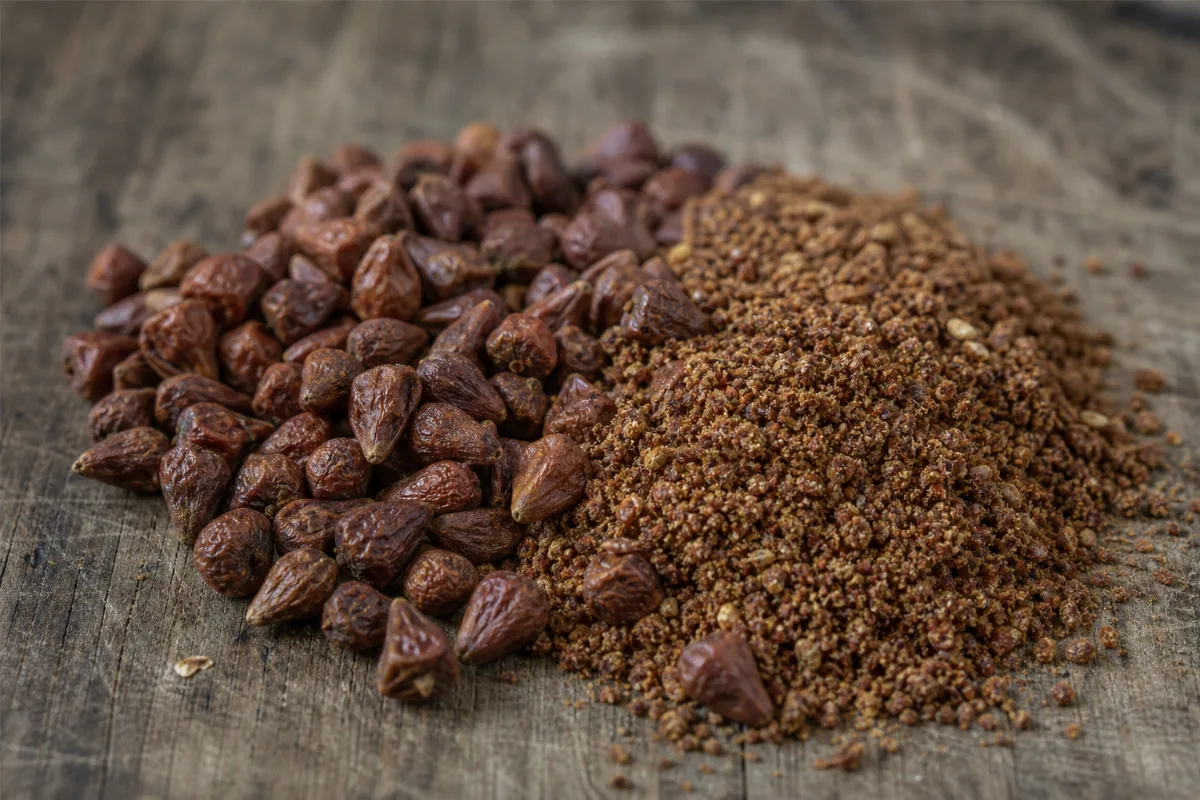
Grains of paradise (Aframomum melegueta) is a plant in the ginger family, closely related to cardamom. It grows in swampy places along the West African coast. The pods hold many small reddish-brown seeds, and the seeds are the spice.
The taste is pungent and peppery, with hints of citrus. The heat comes mainly from aromatic ketones such as 6-paradol. The oils that give cardamom most of its aroma are present only in traces.
It is common in the cooking of West and North Africa. In the 14th and 15th centuries it became a popular stand-in for black pepper in Europe. Its name is shared with other spices, so check the Latin name.
What the research shows
Three small human trials tested seed extracts in capsules. Two looked at body fat and energy use and one at anxiety and sleep ratings. None tested the spice as eaten.
Two of the three trials involve extract makers. Their abstracts give limited numbers, so the results are low or very low certainty. No larger or independent trial was found.
Animal studies add a little: lower blood glucose in rats given a strong extract, and less weight gain in mice given pure 6-paradol. These are not evidence for people.
Food versus capsules and extracts
A pinch of ground spice in a dish is very different from a capsule of concentrated extract. The trials used extracts in capsules. Results from them should not be assumed for the spice in cooking.
Nutrition
No nutrition figures are given here. A previous check of the USDA food database found no entry for this spice, and that check could not be repeated today. Used in pinches, a spice adds little to the diet.
At a glance
Traditional uses history, not proof
- Used as a peppery seasoning in West and North African cooking
- Used in Europe in the 14th and 15th centuries as a substitute for black pepper
- Long use as food is not proof that it treats any condition
Studied for research
- Belly fat and energy use, low certainty (two small extract trials)
- Anxiety, mood and sleep ratings, very low certainty (one pilot of an extract)
- Blood sugar in rats, insufficient evidence (animal)
- Weight gain in mice (6-paradol), insufficient evidence (animal)
- Eating the spice in food, insufficient evidence (no study)
Main compounds
- 6-Paradol
- 6-Gingerol and 6-shogaol
- Essential oils (traces)
Common forms
- Whole seeds, crushed or ground, as a spice
- Ground spice as seasoning
- Seed extracts in capsules (the trials used extracts, not the spice)
Research links: PubMed: 2014 extract trial for belly fat and energy use · PubMed: 28-day rat toxicity study · eCFR: 21 CFR 182.10 spices list · Research Library · Genes & Biomarkers Library
What it is and its history
- Accepted scientific name
- Aframomum melegueta
- Naming authority
- K.Schum. (GBIF accepted)
- Synonyms
- Name: Amomum melegueta; Note: Older name; the US food regulation (21 CFR 182.10) lists it as Amomum melegueta Rosc.
- Common names
- Grains of paradise (English); Melegueta pepper (English); Guinea grains (English); Alligator pepper (English); Malagueta (Portuguese)
- Family or group
- Zingiberaceae, the ginger family. Closely related to cardamom (Wikipedia).
- Classification
- Plantae > Tracheophyta > Liliopsida > Zingiberales > Zingiberaceae > Aframomum > Aframomum melegueta
- Native range
- West Africa (Wikipedia). It is also a cash crop in southern Ethiopia.
- Habitat
- Swampy habitats along the West African coast (Wikipedia).
- What it looks like
- Roots: Not verified.; Stems: Herbaceous perennial plant (Wikipedia).; Leaves: Narrow leaves (Wikipedia).; Flowers: Trumpet-shaped, purple flowers (Wikipedia).; Fruit: Pods about 5 to 7 cm long holding many small reddish-brown seeds, the part used as spice (Wikipedia).
- Cultivation
- Not verified beyond being a cash crop in parts of Ethiopia.
- Harvest and processing
- Seeds are used whole or ground as a spice (Wikipedia).
- Look-alikes and adulterants
- Name: Grains of Selim (Xylopia aethiopica); Note: A different spice. Wikipedia says terms such as African pepper and Guinea pepper are ambiguous and can apply to it.; Name: Capsicum (chilli) 'grains of paradise' and malagueta chilli; Note: RxList warns the name is also used for capsicum. Wikipedia says the name malagueta was later applied to a chilli after chillies reached Europe.
- Sustainability and conservation
- Not assessed.
Photographs
Traditional use and history history, not clinical proof
| Tradition or era | Documented use | Source |
|---|---|---|
| Wikipedia (secondary) | ||
| Wikipedia (secondary) | ||
| Wikipedia (secondary); the Britannica quote was not checked against Britannica |
Traditional use shows how it was used. It does not show that it works or is safe today.
What is inside, and how it may work
What it contains and how those compounds act in cells and animals. Laboratory and animal mechanisms are not proven effects in people.
Main compounds
| Compound | Family | Where it is concentrated | Activity studied | Level of evidence |
|---|---|---|---|---|
| 6-Paradol | aromatic ketone (vanilloid) | Seed Not given in the sources read | Main cause of the peppery taste (Wikipedia). In mice, 6-paradol reduced weight gain on a high-fat diet. 9 3 | Animal research |
| 6-Gingerol and 6-shogaol | vanilloid | Seed Together with 6-paradol made up 10% total vanilloids in one branded extract | Named as the main vanilloids in the extract used in the 2025 anxiety pilot. 5 | Human data |
| Essential oils | volatile oils | Seed Traces only | The oils that give cardamom most of its aroma are present only in traces here (Wikipedia). 9 | Human data |
Mechanisms, receptors and pathways
| Target or pathway | Gene or receptor | What was found | Level |
|---|---|---|---|
| Brown fat heat production | Brown adipose tissue | The 2014 authors say an earlier single dose of an alcohol extract raised energy use by activating brown fat. Not shown for food. 2 | Human data |
| Brain-signalling targets (lab tests) | TRPV1, hCB2R, 5HT1AR, FAAH | In vitro, a branded extract activated TRPV1, modulated hCB2R and 5HT1AR and inhibited FAAH. Not shown in people. 5 | Laboratory research |
| Fat-making genes | Lipid-metabolism genes in liver and fat tissue | In mice, 6-paradol lowered activity of genes for making and moving fat, without the AMPK switch. 3 | Animal research |
Absorption, metabolism and elimination
- Absorption
- Not found.
- Distribution
- Not found.
- Metabolism
- Not found.
- Elimination
- Not found.
- Bioavailability
- Not found.
Isolated compounds versus whole extracts
All health results here come from concentrated extracts (30 mg to 500 mg a day in capsules) or pure 6-paradol in mice. A pinch of ground spice in a dish is a very different exposure and has not been studied.
Nutritional composition
No nutrition figures are given. A previous check of USDA FoodData Central (SR Legacy) found no entry for grains of paradise, and this check could not be repeated because the USDA test key was rate-limited on 2026-10-26. Spices are used in pinches, so they add little to the diet. We do not call grains of paradise a good source of any nutrient.
1 low certainty1 very low certainty3 not enough evidence
What was looked at
The 5 benefits and uses checked for Grains of paradise, each with how strong the evidence is. Tap one to open it.
- Belly fat and energy use (seed extract)Low certainty
- Anxiety, mood and sleep ratings (seed extract)Very low certainty
- Eating the spice in normal cookingNot enough evidence
- Blood sugar (rat study of a strong extract)Not enough evidence
- Weight gain in mice (6-paradol)Not enough evidence
Lab markers tracked in the studies
Belly (visceral) fat areaWhole-body energy useAnxiety, mood and sleep questionnaire scoresBlood glucose (rats)Body weight gain and fat (mice)
What is Grains of paradise good for?
The main studied uses and how strong the human evidence is for each. Every result below is for a seed extract or a lab animal, not for the spice as eaten in food.
Benefits, one by one
Each card is a research question, not a promise. Tap a goal to filter. Open a card to see the studies, doses and limits.
Belly fat and energy use (seed extract)
Low certaintyTwo small trials gave people a seed extract in capsules, not the spice as food. A 2014 trial in 19 young women found a small drop in belly fat and a rise in energy use compared with placebo over 4 weeks. A 2022 trial in 70 overweight adults reported more energy use and weight loss over 12 weeks. Neither trial tested the spice you cook with.
2 studiesSeed extracts in capsules (30 mg a day in 2014; 250 mg twice a day of…
Studies, doses and limits
What the trials found
2014 (Japan): 19 non-obese women aged 20 to 22 took a grains of paradise alcohol extract (30 mg a day) or placebo for 4 weeks each, in a single-blind randomised crossover design. Visceral (belly) fat area fell slightly with the extract and rose slightly with placebo, a significant difference (p<0.05). Whole-body energy use rose with the extract but not with placebo (p<0.05). Fat under the skin and total fat did not change. 2022 (India): 70 overweight adults aged 20 to 50 (BMI 25 to 30) took 250 mg of a branded seed extract or placebo twice a day for 12 weeks. The authors report higher energy use (p<0.01), a change in the visceral-to-subcutaneous fat ratio (p<0.01), and more weight loss and lower BMI than placebo (p<0.01), with blood and chemistry tests in the normal range. The abstract's wording on visceral fat area ('increased') conflicts with the paper's title ('reduces'), so we do not state a direction for that one measure.
Results
Both small trials favoured the extract on energy use and fat measures. The effects were for extracts, in short trials, and have not been repeated by independent groups that we found.
Effect sizes as reported
2014: visceral fat area difference p<0.05 and energy use p<0.05 versus placebo (no effect sizes in the abstract). 2022: p<0.01 for energy use, BMI and weight versus placebo; no numbers for the size of the change in the abstract.
Why this rating
Low: two small, short trials of extracts. The 2014 trial was single-blind with 19 young, non-obese women. In the 2022 trial, authors work for the company that makes the extract. No trial tested the spice as eaten, and no larger or independent trial was found.
Form and dose studied
Seed extracts in capsules (30 mg a day in 2014; 250 mg twice a day of a branded extract in 2022). Not the spice as food.
Who was studied
Young non-obese women (2014); overweight adults aged 20 to 50 (2022).
Limits
Extracts are not the spice. Short trials. Company-linked authors in 2022. The 2022 abstract is unclear on one fat measure.
Why researchers looked
The seeds contain pungent compounds such as 6-paradol. Earlier work suggested they may switch on heat-making fat tissue, so researchers tested extracts for body fat.
Traditional use
Grains of paradise are used as a spice, whole or ground, in West African and other cooking. Long use as food is not proof that it treats any condition.
Proposed mechanism Human data
The 2014 authors say an earlier single dose of an alcohol extract raised energy use by activating brown fat, a tissue that makes heat. This is the authors' idea, not shown for the spice in food.
A proposed mechanism does not show that the effect happens in people.
Neither abstract reports serious problems. See the Safety tab for a rat study of a strong extract and for pregnancy.
Anxiety, mood and sleep ratings (seed extract)
Very low certaintyOne very small 2025 pilot gave a seed extract to adults with moderate anxiety scores. The authors report lower anxiety and tension, better mood and better sleep ratings after 48 hours. The company that sells the extract ran the work. This is too early to rely on, and it did not test the spice in food.
1 studiesA branded hydro-alcoholic seed extract in capsule form (50 to 150 mg …
Studies, doses and limits
What the trials found
2025 pilot (randomised, double-blind): healthy adults with moderate anxiety levels took 50, 100 or 150 mg a day of a hydro-alcoholic seed extract (10% total vanilloids, mainly 6-gingerol, 6-shogaol and 6-paradol) for two days. Questionnaires were filled in before and 48 hours after the first dose. The authors report significantly lower anxiety and stress-related tension, better overall mood and better sleep quality at 50 to 150 mg, with no side effects reported. The abstract gives no group sizes or numbers.
Results
The authors report improvements in anxiety, mood and sleep ratings. The abstract does not say how many people took part, how the placebo group changed, or give effect sizes.
Effect sizes as reported
Not given in the abstract.
Why this rating
Very low: a pilot with a 48-hour follow-up, no numbers in the abstract, and a conflict of interest (authors are employees of the company that sells the extract, and the company paid for the trial). Self-rated questionnaires. Not the spice as food.
Form and dose studied
A branded hydro-alcoholic seed extract in capsule form (50 to 150 mg a day for two days). Not the spice as food.
Who was studied
Adults with moderate anxiety levels who were otherwise healthy.
Limits
Extract, two days, company-run, no numbers read. Not a trial of people with an anxiety disorder.
Why researchers looked
Lab tests suggested the extract acts on several brain-signalling targets. The authors wanted a first test in people.
Traditional use
Grains of paradise are used as a spice, whole or ground, in West African and other cooking. Long use as food is not proof that it treats any condition.
Proposed mechanism Laboratory research
In lab (in vitro) tests the extract activated a pain-and-heat receptor (TRPV1), acted on a cannabinoid receptor (hCB2R) and a serotonin receptor (5HT1AR), and blocked the enzyme FAAH. The authors suggest FAAH blocking may matter most. This is lab work, not shown in people.
A proposed mechanism does not show that the effect happens in people.
No side effects reported in the abstract. Anyone with anxiety that affects daily life should talk to a doctor.
Eating the spice in normal cooking
Not enough evidenceNo study we found tested grains of paradise as eaten in food, for any health outcome. In the kitchen it is mostly a flavour: peppery, warm and a little citrusy.
1 studiesWhole seeds or ground spice as seasoning.
Studies, doses and limits
What the trials found
No human study of the whole spice eaten as food was found in PubMed.
Results
Nothing to report for health outcomes.
Why this rating
No human study of the spice as food.
Form and dose studied
Whole seeds or ground spice as seasoning.
Limits
Extract results above cannot be carried over to a pinch of spice.
Why researchers looked
Not studied as a food. Traditional use is mainly as a seasoning.
Traditional use
Cooking use in West and North Africa and, in the 14th and 15th centuries, as a stand-in for black pepper in Europe (Wikipedia).
Proposed mechanism Authoritative guidance
The heat comes mainly from aromatic ketones such as 6-paradol (Wikipedia).
A proposed mechanism does not show that the effect happens in people.
See the Safety tab.
Blood sugar (rat study of a strong extract)
Not enough evidenceIn a 28-day rat study, a strong alcohol extract lowered blood glucose in male rats. The same study found higher liver weight. It has not been tested for blood sugar in people, and it says nothing about food amounts.
1 studiesEthanol extract of the seeds (rats; 450 and 1500 mg/kg).
Studies, doses and limits
What the trials found
No human study of blood sugar was found.
Results
At 450 and 1500 mg/kg of an ethanol extract, male rats had significantly lower blood glucose. The authors say the extract may be useful for diabetes but that liver toxicity should be considered.
Effect sizes as reported
Not given in the abstract.
Why this rating
Rats only, one strong extract, 28 days. Nothing in people.
Form and dose studied
Ethanol extract of the seeds (rats; 450 and 1500 mg/kg).
Who was studied
Male and female Sprague-Dawley rats.
Limits
Animal study of a concentrated extract, not food.
Why researchers looked
The seeds contain gingerol-type compounds that may help with heart disease, diabetes and inflammation, according to the authors.
Traditional use
Used in West Africa for stomach ache, snakebite and diarrhoea, and said to have anti-inflammatory properties (study background).
Proposed mechanism Animal research
Not explained in the abstract.
A proposed mechanism does not show that the effect happens in people.
Liver weight and alkaline phosphatase rose in the same study; see the Safety tab. People with diabetes should not use an extract in place of treatment.
Weight gain in mice (6-paradol)
Not enough evidenceIn mice fed a high-fat diet, pure 6-paradol (the main hot compound in the seeds) reduced weight gain and fat over 2 weeks. Related compounds from ginger did not. This is mouse work on a single compound, not the spice.
1 studiesSynthesised 6-paradol given by mouth to mice for 2 weeks.
Studies, doses and limits
What the trials found
Not tested in people.
Results
In high-fat-fed male mice, 6-paradol over 2 weeks decreased body weight gain and visceral and subcutaneous fat. 6-gingerol and 6-shogaol had no effect.
Effect sizes as reported
Not given in the abstract.
Why this rating
Mouse study of a synthesised pure compound at doses that cannot be compared with food.
Form and dose studied
Synthesised 6-paradol given by mouth to mice for 2 weeks.
Who was studied
6-week-old male mice on a high-fat diet.
Limits
Mouse study, short, pure compound, not whole seeds.
Why researchers looked
6-paradol is a major pungent compound in the seeds, and researchers wanted to know how the seeds might affect obesity.
Traditional use
Grains of paradise are used as a spice, whole or ground, in West African and other cooking. Long use as food is not proof that it treats any condition.
Proposed mechanism Animal research
The authors found 6-paradol changed the activity of genes involved in making and moving fat in liver and fat tissue, without the AMPK switch that 6-gingerol uses.
A proposed mechanism does not show that the effect happens in people.
None reported in the abstract.
Connections to the rest of health
How Grains of paradise connects to the rest of our health knowledge graph. Every link says what kind of connection it is. A safety link (for example to the liver) is a warning, not a benefit. A study that merely mentions a topic never creates a benefit link.
Explore every connection: goals, body systems, organs, symptoms, genes
B. Body systems
| Connected to | Kind of connection | Evidence status | Context | Studies |
|---|---|---|---|---|
| Metabolism Weight | Biological association | Low certainty | Studied for: Belly fat and energy use (seed extract) Studied for: Blood sugar (rat study of a strong extract) | 2 4 1 3 |
| Nervous System | Biological association | Very low certainty | Studied for: Anxiety, mood and sleep ratings (seed extract) | 5 |
| Digestive System | Biological association | Not enough evidence | Studied for: Eating the spice in normal cooking | 9 |
I. Biomarkers
| Connected to | Kind of connection | Evidence status | Context | Studies |
|---|---|---|---|---|
| Belly (visceral) fat area | Biological association | Low certainty | Measured in trials: mixed. A lab change is not the same as a health benefit. | 2 4 |
| Whole-body energy use | Biological association | Low certainty | Measured in trials: raised. A lab change is not the same as a health benefit. | 2 4 |
| Anxiety, mood and sleep questionnaire scores | Biological association | Very low certainty | Measured in trials: lowered. A lab change is not the same as a health benefit. | 5 |
| Blood glucose (rats) | Biological association | Not enough evidence | Measured in trials: lowered. A lab change is not the same as a health benefit. | 1 |
| Body weight gain and fat (mice) | Biological association | Not enough evidence | Measured in trials: lowered. A lab change is not the same as a health benefit. | 3 |
J. Genes, receptors and enzymes
L. Active compounds
| Connected to | Kind of connection | Evidence status | Context | Studies |
|---|---|---|---|---|
| 6-Paradol | Biological association | Animal | Main cause of the peppery taste (Wikipedia). In mice, 6-paradol reduced weight gain on a high-fat diet. Preparation or compound: Seed |
9 3 |
| 6-Gingerol and 6-shogaol | Biological association | Human | Named as the main vanilloids in the extract used in the 2025 anxiety pilot. Preparation or compound: Seed |
5 |
| Essential oils | Biological association | Human | The oils that give cardamom most of its aroma are present only in traces here (Wikipedia). Preparation or compound: Seed |
9 |
Each connection is stored with the ingredient, the connected record, the kind of connection, the evidence status, the supporting studies, the preparation or compound involved, and a review date (last reviewed October 26, 2026).
The evidence
The research centre for Grains of paradise. Every record here was checked against PubMed or the publisher's page; we never list a study we have not verified.
Evidence by outcome
Bars show how many studies we found for each outcome, not how well it works. People are added up across trials only (reviews are not added, to avoid double counting).
How we rate evidence
High certainty
Several well-run trials or reviews agree; further research is unlikely to change the picture much.
Moderate certainty
Good trials point the same way, but some doubt remains.
Low certainty
Small, short or inconsistent trials. The finding could change with better research.
Very low certainty
Very little or very weak human data. Treat as a possibility only.
Mixed findings
Trials or reviews disagree with each other.
Not enough evidence
Not enough human research to say either way.
Evidence against
Good research found no benefit, or found harm.
We take the reviewers' own risk-of-bias and GRADE statements where they exist, and otherwise judge from study size, design, consistency, directness and whether a product matches what is sold. Many publications do not make evidence high. Method note: We started from our existing summary, re-read each PubMed abstract, read the US spice regulation, a consumer drug-information page and Wikipedia, and checked the species name at GBIF. Only abstracts were read for studies. Little research exists, so this page is short on purpose.
Study library: every study we checked 9
| Study | Design | People | Product, dose, length | Result |
|---|---|---|---|---|
| p19883745 Toxicological evaluation of grains of paradise (Aframomum melegueta) [Roscoe] K. Schum. · Source |
Animal research rat |
Methods, limits and fundingRead: abstract | ||
| p24759256 Daily ingestion of grains of paradise (Aframomum melegueta) extract increases whole-body energy expenditure and decreases visceral fat in humans. · Source |
Controlled trial |
Methods, limits and fundingRead: abstract | ||
| p33793045 6-Paradol Acts as a Potential Anti-obesity Vanilloid from Grains of Paradise. · Source |
Animal research mouse |
Methods, limits and fundingRead: abstract | ||
| p36329722 Aframomum melegueta Seed Extract with Standardized Content of 6-Paradol Reduces Visceral Fat and Enhances Energy Expenditure in Overweight Adults - A Randomized Double-Blind, Placebo-Controlled Clinical Study. · Source |
Controlled trial |
Methods, limits and fundingRead: abstract | ||
| p40006090 Aframomum melegueta Seed Extract's Effects on Anxiety, Stress, Mood, and Sleep: A Randomized, Double-Blind, Pilot Clinical Trial. · Source |
Controlled trial |
Methods, limits and fundingRead: abstract | ||
| s-ecfr-182-10 eCFR: 21 CFR 182.10 Spices and other natural seasonings and flavorings · Source |
Regulation n/a |
Methods, limits and fundingRead: full-text | ||
| s-gbif-aframomum-melegueta GBIF Backbone: Aframomum melegueta K.Schum. (usageKey 2758930) · Source |
Reference database n/a |
Methods, limits and fundingRead: full-text | ||
| s-rxlist-gop RxList: Grains of Paradise · Source |
Consumer reference n/a |
Methods, limits and fundingRead: full-text | ||
| s-wikipedia-gop Wikipedia: Grains of paradise · Source |
Encyclopedia n/a |
Methods, limits and fundingRead: full-text |
What we do not know yet
- No human study of the spice as eaten in food.
- No independent or large trial of the extract for body fat; the 2022 trial is company-linked.
- The 2025 anxiety pilot abstract gives no group sizes or numbers.
- No interaction or pregnancy study in people.
- Nutrition figures, contamination and allergy were not researched.
How new research is added
New studies are found by a saved PubMed search and placed in a review queue before the page changes.
Lab markers
What changed in blood or saliva tests during trials. A changed number is not the same as feeling or being healthier, and we give no "normal ranges".
Metabolic 1
Blood glucose (rats)
Lowered in trials
The amount of sugar in the blood.
Not enough evidenceResults and what it means
Why it was measured
High blood glucose is the main marker in diabetes.
Statistical vs. clinical meaning
Animal finding only.
Safety implication
Liver weight and alkaline phosphatase rose at the same doses.
| Study | Result | People | Product |
|---|---|---|---|
| 1 | Significantly lower in male rats at 450 and 1500 mg/kg of ethanol extract. | Sprague-Dawley rats, 28 days | Ethanol seed extract (not food) |
Other 4
Belly (visceral) fat area
Mixed results in trials
The area of fat deep in the belly around the organs, measured by scans.
Low certaintyResults and what it means
Why it was measured
Belly fat is linked to metabolic problems, so it is used as a marker in weight studies.
Statistical vs. clinical meaning
A small change in a scan measure in short extract trials. Not shown for food amounts.
Safety implication
None reported in the abstracts.
| Study | Result | People | Product |
|---|---|---|---|
| 2 | Fell slightly with 30 mg a day of extract versus a slight rise with placebo (p<0.05). | 19 non-obese women, 4 weeks | Alcohol extract of seeds (not food) |
| 4 | Reported as significant (p<0.001), but the abstract's wording on direction conflicts with the title. | 70 overweight adults, 12 weeks | Branded seed extract, 250 mg twice a day |
Whole-body energy use
Raised in trials
How many calories the body burns at rest, measured by breath tests (indirect calorimetry).
Low certaintyResults and what it means
Why it was measured
The extract is said to raise heat production, so energy use was the main measure.
Statistical vs. clinical meaning
Both small trials point the same way; neither is independent of doubt about the company link in 2022.
Safety implication
None reported.
Anxiety, mood and sleep questionnaire scores
Lowered in trials
Self-filled questionnaires that rate anxiety, tension, mood and sleep.
Very low certaintyResults and what it means
Why it was measured
These are the usual ways to rate how anxious or rested someone feels.
Statistical vs. clinical meaning
A very short pilot run by the maker. Not enough to rely on.
Safety implication
No side effects reported in the abstract.
| Study | Result | People | Product |
|---|---|---|---|
| 5 | Authors report lower anxiety and stress-related tension, better mood and sleep at 48 hours (numbers not in the abstract). | Adults with moderate anxiety levels | Branded seed extract, 50 to 150 mg a day for two days |
Body weight gain and fat (mice)
Lowered in trials
How much weight and fat mice gained on a high-fat diet.
Not enough evidenceResults and what it means
Why it was measured
Used to screen compounds for effects on obesity.
Statistical vs. clinical meaning
Mouse finding only.
Safety implication
None reported.
| Study | Result | People | Product |
|---|---|---|---|
| 3 | 6-paradol decreased weight gain and visceral and subcutaneous fat over 2 weeks; 6-gingerol and 6-shogaol did not. | Male mice on a high-fat diet | Synthesised 6-paradol |
Safety
What studies and official sources say about side effects, medicines and who should check first. Each point shows what kind of evidence it comes from.
Main points to know 5
- Spice in food is not the same as a strong extract. Every health result on this page comes from seed extracts in capsules or lab animals, not from the spice you cook with. We found no safety limit for food amounts and no report of harm from eating it as a seasoning, but we also found almost no research on the whole spice. Ask a doctor or pharmacist before using a supplement or extract. Authoritative guidance 8 1
- Pregnancy and breastfeeding: avoid medicinal use. A consumer drug-information site (RxList) says not enough is known about grains of paradise in pregnancy and breastfeeding and advises avoiding it. That page is about its use as medicine. We found no source on normal cooking amounts. Ask your midwife or doctor. Authoritative guidance 8
- Liver: a strong extract raised liver weight in rats. In a 28-day study of an ethanol extract in rats (450 and 1500 mg/kg), liver weight and a liver enzyme (alkaline phosphatase) rose with dose, with no signs of fatty liver or scarring. The authors said liver toxicity should be considered. A 12-week human trial of a branded extract reported normal blood and chemistry tests, but we read only its abstract. People with liver disease should ask a doctor before using extracts. Animal research 1 4
- Stomach, bowel and urinary irritation. RxList says grains of paradise might be safe for most adults but can irritate the stomach, intestine and urinary system. This is a short consumer summary with no dose range and no cited study for this point. Authoritative guidance 8
- Do not mix it up with capsicum. RxList warns that the name 'grains of paradise' is also used for capsicum (chilli). Wikipedia notes 'alligator pepper', 'African pepper' and 'Guinea pepper' can mean other spices such as grains of Selim. Check the Latin name Aframomum melegueta on the label. Authoritative guidance 8 9
Side effects 3
| Effect | How often | Severity and recovery | Evidence |
|---|---|---|---|
| Higher liver weight and alkaline phosphatase in rats given a strong extract 28-day study; no steatosis or cirrhosis seen. An extract at very high doses, not food. | Dose-related at 450 and 1500 mg/kg in male and female rats | not stated Not stated in the abstract | Animal research 1 |
| Stomach, intestine and urinary irritation Listed by RxList with no frequency or source for this specific claim. | Not established | not stated Not stated | Authoritative guidance 8 |
| No side effects reported in two small human extract trials Abstracts only. Both trials were run by or with the extract makers and were short. | 2022 trial: no adverse effects observed; 2025 pilot: no side effects reported | not stated Not applicable | Controlled trial 4 5 |
Liver
No case of liver injury in people from grains of paradise was found. A 28-day rat study of a strong ethanol extract raised liver weight and alkaline phosphatase in a dose-related way. The authors called for liver toxicity to be considered. The 2022 human trial abstract says biochemical and blood tests stayed in the normal range over 12 weeks. A liver-safety database (LiverTox) was not searched for this spice. 1 4
How often. No frequency in people was found.
Monitoring. No agency monitoring advice was found.
This is a safety connection. It is not evidence that Grains of paradise supports liver health.
Medicines and supplements 3
| With | Why it matters | Importance | Evidence | What to do |
|---|---|---|---|---|
| Prescription medicines (general) prescription | No human interaction study was found. RxList does not list any medicine interactions for grains of paradise. | Authoritative guidance Not enough evidence 8 | If you use an extract and take regular medicines, ask a pharmacist. | |
| Liver-affecting medicines theoretical | Not established. Only inferred from the rat liver finding with a strong extract. | Unknown. This is our caution, not a finding from a source. | Theoretical Not enough evidence 1 | People on medicines that affect the liver should ask a pharmacist before taking an extract. |
| Blood-sugar medicines theoretical | A strong extract lowered blood glucose in male rats. | Never shown in people. | Animal research Not enough evidence 1 | People using diabetes medicines should ask a pharmacist before taking an extract. |
Who should check first 3
| Situation | Advice | Evidence |
|---|---|---|
| Pregnancy or breastfeeding (medicinal use) | RxList advises avoiding it. Ask a midwife or doctor. | Authoritative guidance 8 |
| Liver disease (extract) | Ask a doctor before using an extract. This is a precaution drawn from rat data. | Animal research 1 |
| Sensitive stomach or urinary irritation | RxList says it might irritate the digestive and urinary system. | Authoritative guidance 8 |
Overdose, product quality and regulators
Summary. No harm from the spice as ordinary food was found, but there is almost no safety research on it. A strong extract raised liver weight in rats.
Animal. 28-day rat study of an ethanolic extract: dose-related rise in liver weight and alkaline phosphatase at 450 and 1500 mg/kg, no steatosis or cirrhosis, and lower blood glucose in males (Ilic 2010).
Human doses studied. Extracts of 30 mg a day for 4 weeks (2014), 250 mg twice a day for 12 weeks (2022) and 50 to 150 mg a day for two days (2025). Food amounts were never studied.
High dose or long term signals. Liver signals in rats only.
Overdose response. Not found.
Genotoxicity. Not researched.
No source we read describes contamination or adulteration of this spice.
Mix-ups with other 'pepper' spices. Common names are shared with capsicum and grains of Selim, so check the Latin name. 8 9
Aflatoxin, heavy metals, pesticides. Not researched for this spice in the sources read.
| Body | Action | Date |
|---|---|---|
| FDA (US) (United States) | 21 CFR 182.10 lists 'Grains of paradise' (Amomum melegueta Rosc.) among spices and natural seasonings that are generally recognized as safe for their intended use. source | 2026-10-01 |
| RxList (consumer drug-information site) (United States) | Might be safe for most adults; can irritate the stomach, intestine and urinary system; not enough known in pregnancy and breastfeeding, so avoid. Not a regulator. source | unknown |
When to get medical help
- Trouble breathing, swelling of the lips, face or throat, or a widespread rash after eating it: get emergency help.
- Severe or lasting stomach pain, vomiting or blood in the stool or urine after using an extract: stop and see a doctor.
- Yellow skin or eyes, dark urine or severe tiredness while using an extract (general liver warning signs, not specific to this spice): see a doctor.
Stop using the product and contact a clinician or emergency service. In the US, Poison Control is 1-800-222-1222.
General information only, not medical advice. Ask a clinician or pharmacist before use, especially with medicines, in pregnancy or with a health condition. See the Natural Remedy Safety guide.
Frequently asked questions
What are grains of paradise?
What do grains of paradise taste like?
Pungent and peppery, with hints of citrus. The heat comes mainly from compounds such as 6-paradol.
Is it the same as black pepper?
No. It is a different plant, in the ginger family. It was used as a substitute for black pepper in Europe in the 14th and 15th centuries.
Is it the same as alligator pepper or grains of Selim?
The names overlap. Wikipedia says alligator pepper is sometimes confused with grains of paradise, and that African pepper and Guinea pepper can mean other spices such as grains of Selim. Check the Latin name Aframomum melegueta.
Does it burn fat?
Does it help anxiety or sleep?
One pilot of a branded extract reported better anxiety and sleep ratings after 48 hours, but the abstract has no numbers and the maker ran the trial. This is too early to rely on.
Does it lower blood sugar?
A strong extract lowered blood glucose in rats. It has not been tested in people.
Is it safe in pregnancy or breastfeeding?
RxList says not enough is known about medicinal use and advises avoiding it. We found no source on cooking amounts. Ask your midwife or doctor.
Can it harm the liver?
Does it interact with medicines?
No interaction study in people was found, and RxList lists none. If you take regular medicines and want to use an extract, ask a pharmacist.
Is it approved as a food ingredient?
In the United States, 21 CFR 182.10 lists grains of paradise (under the older name Amomum melegueta) among spices that are generally recognized as safe for their intended use.
Explore by health goal
Editorial transparency
- Written by
- AlternativeMed editorial team. Research compiled with AI assistance, then checked against the sources listed.
- Medical review
- None. This page has not been reviewed by a physician or pharmacist.
- First published
- 2026-10-26
- Last substantive update
- 2026-10-26
- How we research
- We started from our existing summary, re-read each PubMed abstract, read the US spice regulation, a consumer drug-information page and Wikipedia, and checked the species name at GBIF. Only abstracts were read for studies. Little research exists, so this page is short on purpose.
- How we rate evidence
- See "How we rate evidence" in the Evidence tab.
- Independence
- No product is promoted on this page. No affiliate links are shown.
Sources 9
Each source was opened and checked. Where we read only the abstract, it says so. The small numbers in the text point here.
- . Toxicological evaluation of grains of paradise (Aframomum melegueta) [Roscoe] K. Schum.. . . (abstract)
- . Daily ingestion of grains of paradise (Aframomum melegueta) extract increases whole-body energy expenditure and decreases visceral fat in humans.. . . (abstract)
- . 6-Paradol Acts as a Potential Anti-obesity Vanilloid from Grains of Paradise.. . . (abstract)
- . Aframomum melegueta Seed Extract with Standardized Content of 6-Paradol Reduces Visceral Fat and Enhances Energy Expenditure in Overweight Adults - A Randomized Double-Blind, Placebo-Controlled Clinical Study.. . . (abstract)
- . Aframomum melegueta Seed Extract's Effects on Anxiety, Stress, Mood, and Sleep: A Randomized, Double-Blind, Pilot Clinical Trial.. . . (abstract)
- . eCFR: 21 CFR 182.10 Spices and other natural seasonings and flavorings. . . (full-text)
- . GBIF Backbone: Aframomum melegueta K.Schum. (usageKey 2758930). . . (full-text)
- . RxList: Grains of Paradise. . . (full-text)
- . Wikipedia: Grains of paradise. . . (full-text)
Where to buy
Check the label first. Whatever you buy, look for these:
- Whole or ground: whole spices keep their flavor longer
- The origin and a packed-on or best-by date for freshness
- Organic or non-irradiated labeling if that matters to you
- A resealable, airtight container
Talk to a pharmacist or doctor before you start any supplement, especially if you take medicines. See the Safety tab for interactions.
Support our free guides: as an Amazon Associate we earn from qualifying purchases. Full disclosure.


