Spices · Spice
Grains of Selim
Xylopia aethiopica · also called Selim pepper, Senegal pepper, Ethiopian pepper, Moor pepper
Grains of Selim are the dried pods of a West African tree, used in soups, sauces and coffee for a resinous, peppery, slightly bitter taste. No human study has tested the spice or an extract. Strong extracts were tested only in cells, rats and mice, and one rat study found lower platelet counts. Ask a pharmacist before using an extract, especially if you take antidepressants.
General information, not medical advice. Last substantive update · Not medically reviewed. A named clinician has not signed off on this page. How this page is made
About Grains of Selim
Grains of Selim is a smoky, resinous, slightly bitter spice from West Africa. There are no human studies. The few safety signals are from strong extracts in rats and mice, so they are cautions and not proof of harm in cooking.
What it is
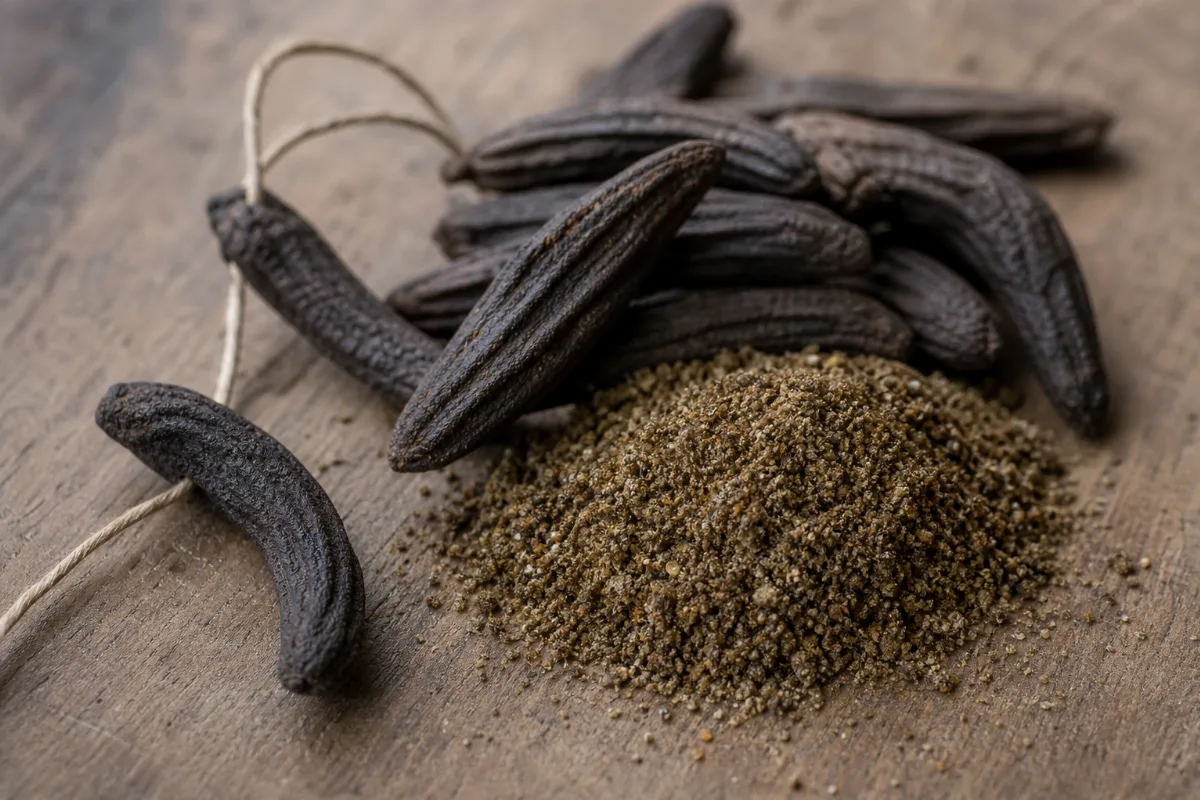
Grains of Selim are the dried fruits of Xylopia aethiopica, a shrubby West African tree in the custard-apple family. The fruits are dark brown, twisted pods 2.5 to 5 cm long, each holding 5 to 8 kidney-shaped seeds.
The hull of the pod carries the aroma. The seed inside is bitter and not aromatic. Katzer compares the taste to cubeb pepper and nutmeg together, aromatic, quite pungent and slightly bitter. The pods are often smoked while drying, which adds a smoky edge.
Cooks crush the dried pods lightly, often tie them in a bundle, simmer them in soups and stews, and take them out before serving. In Senegal the spice flavours cafe Touba coffee. In northern Cameroon and Nigeria it goes into tea with dried ginger and cloves. The names African pepper and Guinea pepper are vague and can mean other spices, so check the Latin name.
What the research shows
We found no human trial, case report or food study. Everything comes from cells, rats and mice, and most of it uses strong ethanol extracts or the single compound xylopic acid.
A review of xylopic acid reports pain-relieving, anti-inflammatory and anxiety-easing effects in animals. Ethanol extracts slowed cancer cell growth in dishes and cut tumours in rats given a cancer-causing chemical. These are lab leads only and are not evidence that eating the spice helps anyone.
Food versus extracts
A simmered pod in a pot of soup is very different from a concentrated ethanol extract or a purified compound. The animal and cell work used the extracts. Do not assume its results, good or bad, for the spice in cooking.
Nutrition
No nutrition figures are given. An earlier check found no USDA FoodData Central entry for this spice, and a re-check on 2026-10-26 could not be completed because the USDA key was rate-limited. A spice used in small amounts is mostly flavour.
At a glance
Traditional uses history, not proof
- Simmered in West African soups and stews, then removed
- Added to coffee in Senegal (cafe Touba) and to tea in northern Cameroon and Nigeria
- Used as a rub for fish when smoked and ground
- Long use as food is not proof that it treats any condition
Studied for research
- Pain and inflammation, insufficient evidence (animal and lab work on one compound)
- Anxiety-like behaviour, insufficient evidence (mice, one compound)
- Cancer cell growth, insufficient evidence (cells and rats, strong extracts)
- Antidepressant-like effect, insufficient evidence (mice)
- Eating the spice in food, insufficient evidence (no study)
Main compounds
- Essential oil (beta-pinene, 1,8-cineol, terpineol)
- Xylopic acid
- Kaurane diterpenes
Common forms
- Dried pods, lightly crushed, simmered and removed
- Smoked pods or paste
- Ground powder
- Ethanol extracts (used in studies, not the spice as eaten)
Research links: PubMed: 90-day rat toxicity study · PubMed: antidepressant interaction study in mice · PubMed: 2012 cancer cell study · Research Library · Genes & Biomarkers Library
What it is and its history
- Accepted scientific name
- Xylopia aethiopica
- Naming authority
- (Dunal) A.Rich. (GBIF accepted)
- Common names
- Grains of Selim (English); Selim pepper (English); Senegal pepper (English); Ethiopian pepper (English); Moor pepper (English); Negro pepper (English); Kani pepper (English); Hwentia (Akan (Ghana))
- Family or group
- Annonaceae, the custard-apple family (Katzer).
- Classification
- Plantae > Tracheophyta > Magnoliopsida > Magnoliales > Annonaceae > Xylopia > Xylopia aethiopica
- Native range
- Tropical Africa, from Ethiopia to Ghana (Katzer).
- Habitat
- Not verified.
- What it looks like
- Roots: Not verified.; Stems: Wikipedia calls it a shrubby tree.; Leaves: Not verified.; Flowers: Not verified.; Fruit: Dark brown, twisted bean-like pods 2.5 to 5 cm long and 4 to 6 mm thick, each holding 5 to 8 kidney-shaped seeds about 5 mm long. The hull is aromatic, the seed is not (Katzer).
- Cultivation
- Not verified.
- Harvest and processing
- The pods are often smoked while drying, which gives a smoky edge (Katzer). In Senegal the green fruit is smoked until sticky (Wikipedia).
- Look-alikes and adulterants
- Name: Xylopia striata; Note: A related species with larger pods, also used in Senegal (Wikipedia).; Name: Grains of paradise (Aframomum melegueta); Note: A different spice in the ginger family that is sometimes also called Guinea pepper (Wikipedia).
- Sustainability and conservation
- Not assessed.
Photographs
Traditional use and history history, not clinical proof
| Tradition or era | Documented use | Source |
|---|---|---|
| Katzer's Spice Pages (single-author reference); the sentence was cut off in our copy |
Traditional use shows how it was used. It does not show that it works or is safe today.
What is inside, and how it may work
What it contains and how those compounds act in cells and animals. Laboratory and animal mechanisms are not proven effects in people.
Main compounds
| Compound | Family | Where it is concentrated | Activity studied | Level of evidence |
|---|---|---|---|---|
| Essential oil (2 to 4.5% of the fruit) | terpenes | Fruit 2 to 4.5% (Katzer) | Includes beta-pinene, 1,8-cineol, alpha-terpineol, terpinen-4-ol, paradol and bisabolene. These are resinous, camphor-like aroma compounds. 6 | Human data |
| Xylopic acid | kaurane diterpene | Fruit Not given in the sources read | Pain-relieving, anti-inflammatory and anxiety-easing effects in animals and a central nervous system depressant effect; harmful reproductive effects in mice (review abstract). 7 | Animal research |
| ent-15-oxokaur-16-en-19-oic acid | kaurane diterpene | Fruit (ethanol extract fraction) Not given | Named as the main cytotoxic and DNA-damaging compound of the ethanol extract in cancer cell lines. 1 | Laboratory research |
Mechanisms, receptors and pathways
| Target or pathway | Gene or receptor | What was found | Level |
|---|---|---|---|
| Cancer cell death | Caspase-3 | In breast cancer cells and rats, an ethanol extract acted through a caspase-3 cell-death pathway with antioxidant and anti-inflammatory changes. Not shown in people. 3 | Animal research |
| DNA damage and cell cycle arrest | Not stated | The active HPLC fraction induced DNA damage, G1 cell-cycle arrest and cell death in cancer cell lines. 1 | Laboratory research |
| Serotonin signalling (proposed) | Not stated | The authors suggest the synergy with antidepressants may be due to raised serotonin signalling by varying routes. Not shown in people. 2 | Animal research |
Absorption, metabolism and elimination
- Absorption
- Not found in people. In mice, venlafaxine and fluoxetine lowered the blood level of xylopic acid, possibly by affecting gastric emptying.
- Distribution
- Not found.
- Metabolism
- Not found.
- Elimination
- Not found.
- Bioavailability
- Not found.
Isolated compounds versus whole extracts
All health research found used strong ethanol extracts or the isolated compound xylopic acid, in cells, rats and mice. Cooks use the whole pod in small amounts, often simmered and removed. Extract results should not be assumed for food.
Nutritional composition
No nutrition figures are given. The old page said USDA FoodData Central has no entry for grains of Selim. A re-check on 2026-10-26 could not be completed because the USDA test key was rate-limited. Spices are used in pinches, so they add little to the diet, and we do not call this spice a good source of any nutrient.
5 not enough evidence
What was looked at
The 5 benefits and uses checked for Grains of Selim, each with how strong the evidence is. Tap one to open it.
- Pain and inflammation (xylopic acid, animals and lab)Not enough evidence
- Anxiety-like behaviour (xylopic acid, mice)Not enough evidence
- Cancer cell growth (lab and rats, ethanol extract)Not enough evidence
- Antidepressant-like effect (mice)Not enough evidence
- Eating the spice in cookingNot enough evidence
What is Grains of Selim good for?
The main studied uses and how strong the evidence is for each. Every result below is from cells or animals using a strong extract or one compound, not from people and not from the spice as eaten.
Benefits, one by one
Each card is a research question, not a promise. Tap a goal to filter. Open a card to see the studies, doses and limits.
Pain and inflammation (xylopic acid, animals and lab)
Not enough evidenceA 2020 review of xylopic acid, one compound found in the fruit, says it showed pain-relieving, anti-inflammatory and anti-allergy effects in lab and animal work. No study in people was found, and none tested the spice as eaten.
1 studiesIsolated xylopic acid (not the spice).
Studies, doses and limits
What the trials found
No human study was found.
Results
The review abstract calls the effects promising in lab and animal work. It does not give numbers.
Effect sizes as reported
Not given in the abstract.
Why this rating
Insufficient: a review abstract of an isolated compound in animals and cells. No human study, and nothing on the spice in food.
Form and dose studied
Isolated xylopic acid (not the spice).
Who was studied
Animals and cell tests (the abstract does not say which species).
Limits
Abstract only. The review is about one compound, not the whole fruit. We did not read the animal studies it cites.
Why researchers looked
Xylopic acid is a main compound of the fruit, so researchers tested the isolated compound in animals.
Traditional use
Grains of Selim are used as a spice in West African soups, sauces, porridges and drinks. Long use as food is not proof that it treats any condition.
Proposed mechanism Not stated
Not explained in the abstract.
A proposed mechanism does not show that the effect happens in people.
The same review says harmful effects of xylopic acid on the reproductive system of mice are well documented. See the Safety tab.
Anxiety-like behaviour (xylopic acid, mice)
Not enough evidenceThe same 2020 review says xylopic acid eased anxiety-like behaviour in mice and acts as a central nervous system depressant. This is mouse work on one compound. It says nothing about anxiety in people or about the spice in food.
1 studiesIsolated xylopic acid (not the spice).
Studies, doses and limits
What the trials found
No human study was found.
Results
The review abstract says xylopic acid was able to ease anxiety-like symptoms in mice. No numbers are given.
Effect sizes as reported
Not given in the abstract.
Why this rating
Insufficient: mice only, an isolated compound, abstract read only.
Form and dose studied
Isolated xylopic acid (not the spice).
Who was studied
Mice.
Limits
Abstract only. Mouse behaviour tests are a weak guide to human anxiety.
Why researchers looked
Xylopic acid affects the nervous system in animals, so researchers looked at anxiety-like behaviour in mice.
Traditional use
Grains of Selim are used as a spice in West African soups, sauces, porridges and drinks. Long use as food is not proof that it treats any condition.
Proposed mechanism Not stated
The review calls xylopic acid a central nervous system depressant. Details are not in the abstract.
A proposed mechanism does not show that the effect happens in people.
A nervous system depressant effect in animals is one reason to ask a pharmacist before combining a strong extract with sedatives or antidepressants (our caution; see the Safety tab).
Cancer cell growth (lab and rats, ethanol extract)
Not enough evidenceStrong ethanol extracts of the fruit slowed the growth of cancer cells in dishes. In one rat study, an extract also lowered tumour numbers in rats given a cancer-causing chemical. None of this has been tested in people, and none of it uses the spice as eaten.
2 studies70% or other ethanol extracts of the dried fruit (not the spice as ea…
Studies, doses and limits
What the trials found
No human study was found.
Results
2012: a 70% ethanol extract slowed growth of several cancer cell lines (estimated IC50 12 ug/ml in colon cancer cells and 7.5 ug/ml in one leukemia line, above 25 ug/ml in another). 2025: an ethanol extract reduced growth of two breast cancer cell lines and, at 75, 150 and 300 mg/kg for 20 weeks, reduced tumour incidence, burden and volume in rats given DMBA, similar to tamoxifen.
Effect sizes as reported
Cell-line IC50 values and p<0.05 in the 2025 abstract; no human effect sizes exist.
Why this rating
Insufficient: cells and rats only, concentrated ethanol extracts. Dish results rarely carry over to people.
Form and dose studied
70% or other ethanol extracts of the dried fruit (not the spice as eaten).
Who was studied
Human cancer cell lines; female rats given DMBA.
Limits
Abstracts only. Ethanol extracts are far stronger than food. The 2012 paper also reports that the active compound damaged DNA in cells, which is a reason for caution rather than a benefit.
Why researchers looked
The fruit is used in traditional medicine in West Africa, so researchers screened extracts against cancer cells.
Traditional use
Grains of Selim are used as a spice in West African soups, sauces, porridges and drinks. Long use as food is not proof that it treats any condition.
Proposed mechanism Laboratory research
A 2012 paper isolated one compound (ent-15-oxokaur-16-en-19-oic acid) that damaged DNA, stopped cell division and triggered cell death in lab cells. A 2025 paper reports a caspase-3 cell-death pathway and antioxidant and anti-inflammatory changes.
A proposed mechanism does not show that the effect happens in people.
The 2012 abstract describes DNA damage in cells from the active fraction. The significance for people eating the spice is unknown.
Antidepressant-like effect (mice)
Not enough evidenceIn mice, a 70% ethanol extract and xylopic acid showed antidepressant-like activity in a tail suspension test. No human study was found. The same work found interactions with three antidepressants, described on the Safety tab.
1 studies70% ethanol extract of dried fruit and isolated xylopic acid (mice).
Studies, doses and limits
What the trials found
No human study was found.
Results
Both the extract and xylopic acid showed significant antidepressant-like activity in mice. Combined with imipramine, fluoxetine or venlafaxine, the effect was synergistic (interaction indices below 1).
Effect sizes as reported
Interaction indices 0.298 to 0.601 across six combinations (below 1 means synergy).
Why this rating
Insufficient: one mouse study with an extract and an isolated compound. Mouse tests like this do not show an effect in depressed people.
Form and dose studied
70% ethanol extract of dried fruit and isolated xylopic acid (mice).
Who was studied
Mice.
Limits
Abstract only. Not a treatment signal. The main message of the paper is a possible interaction with medicines.
Why researchers looked
Researchers tested the extract in mice alone and with three common antidepressants to look for interactions.
Traditional use
Grains of Selim are used as a spice in West African soups, sauces, porridges and drinks. Long use as food is not proof that it treats any condition.
Proposed mechanism In vivo
The authors suggest the effect may come from raised serotonin signalling by several routes. This is their idea, not shown in people.
A proposed mechanism does not show that the effect happens in people.
Possible interaction with antidepressants. See the Safety tab.
Eating the spice in cooking
Not enough evidenceNo study of the spice as eaten in food was found, in people or animals. In the kitchen it is a flavouring.
1 studiesThe spice in cooking.
Studies, doses and limits
What the trials found
No human study was found.
Results
No study found.
Why this rating
Insufficient: no study.
Form and dose studied
The spice in cooking.
Limits
No evidence either way.
Why researchers looked
Nobody has tested a pinch of the spice in a dish for a health outcome.
Traditional use
Grains of Selim are used as a spice in West African soups, sauces, porridges and drinks. Long use as food is not proof that it treats any condition.
Proposed mechanism Not stated
None.
A proposed mechanism does not show that the effect happens in people.
See the Safety tab.
Connections to the rest of health
How Grains of Selim connects to the rest of our health knowledge graph. Every link says what kind of connection it is. A safety link (for example to the liver) is a warning, not a benefit. A study that merely mentions a topic never creates a benefit link.
Explore every connection: goals, body systems, organs, symptoms, genes
B. Body systems
| Connected to | Kind of connection | Evidence status | Context | Studies |
|---|---|---|---|---|
| Immune Inflammation | Biological association | Not enough evidence | Studied for: Pain and inflammation (xylopic acid, animals and lab) | 7 |
| Nervous System | Biological association | Not enough evidence | Studied for: Anxiety-like behaviour (xylopic acid, mice) Studied for: Antidepressant-like effect (mice) | 7 2 |
| Cancer Oncology | Biological association | Not enough evidence | Studied for: Cancer cell growth (lab and rats, ethanol extract) | 1 3 |
| Digestive | Biological association | Not enough evidence | Studied for: Eating the spice in cooking | 8 |
J. Genes, receptors and enzymes
| Connected to | Kind of connection | Evidence status | Context | Studies |
|---|---|---|---|---|
| Caspase-3 | Preliminary mechanism | Animal | Linked to cell death in breast cancer cells treated with an ethanol extract; lab and rat work only. | 3 |
L. Active compounds
| Connected to | Kind of connection | Evidence status | Context | Studies |
|---|---|---|---|---|
| Essential oil (2 to 4.5% of the fruit) | Biological association | Human | Includes beta-pinene, 1,8-cineol, alpha-terpineol, terpinen-4-ol, paradol and bisabolene. These are resinous, camphor-like aroma compounds. Preparation or compound: Fruit |
6 |
| Xylopic acid | Biological association | Animal | Pain-relieving, anti-inflammatory and anxiety-easing effects in animals and a central nervous system depressant effect; harmful reproductive effects in mice (review abstract). Preparation or compound: Fruit |
7 |
| ent-15-oxokaur-16-en-19-oic acid | Biological association | In vitro | Named as the main cytotoxic and DNA-damaging compound of the ethanol extract in cancer cell lines. Preparation or compound: Fruit (ethanol extract fraction) |
1 |
Each connection is stored with the ingredient, the connected record, the kind of connection, the evidence status, the supporting studies, the preparation or compound involved, and a review date (last reviewed October 26, 2026).
Evidence at a glance: what the research found for 5 outcomes
Each outcome below is one thing researchers measured. Certainty is how far the evidence can be trusted, not how well it works. The full studies are on the next tab.
The evidence
The research centre for Grains of Selim. Every record here was checked against PubMed or the publisher's page; we never list a study we have not verified.
Evidence by outcome
Bars show how many studies we found for each outcome, not how well it works. People are added up across trials only (reviews are not added, to avoid double counting).
How we rate evidence
High certainty
Several well-run trials or reviews agree; further research is unlikely to change the picture much.
Moderate certainty
Good trials point the same way, but some doubt remains.
Low certainty
Small, short or inconsistent trials. The finding could change with better research.
Very low certainty
Very little or very weak human data. Treat as a possibility only.
Mixed findings
Trials or reviews disagree with each other.
Not enough evidence
Not enough human research to say either way.
Evidence against
Good research found no benefit, or found harm.
We take the reviewers' own risk-of-bias and GRADE statements where they exist, and otherwise judge from study size, design, consistency, directness and whether a product matches what is sold. Many publications do not make evidence high. Method note: We started from the earlier page, re-read each PubMed abstract, read Wikipedia and Katzer's spice pages, and checked the species name at GBIF. Only abstracts were read for studies. Little research exists, so this page is short on purpose.
Study library: every study we checked 8
| Study | Design | People | Product, dose, length | Result |
|---|---|---|---|---|
| p22409878 Characterization of the antiproliferative activity of Xylopia aethiopica. · Source |
Laboratory research cell lines |
Methods, limits and fundingRead: abstract | ||
| p38826835 Investigation of Herb-Drug Interactions between Xylopia aethiopica, Its Principal Constituent Xylopic Acid, and Antidepressants. · Source |
Animal research mouse |
Methods, limits and fundingRead: abstract | ||
| p39400944 Anticancer Potential of Ethanolic Extract of Xylopia aethiopica (Dunal) A. Rich (Annonaceae) Dried Fruits on Breast Adenocarcinoma: In Vitro and In Vivo Evidences. · Source |
Animal research rat and cell lines |
Methods, limits and fundingRead: abstract | ||
| p42179896 Acute (14-Day) and Subchronic (90-Day) Toxicity Evaluation of the Dried Fruit Spice Xylopia aethiopica (Dunal) A. Rich. (Annonaceae) in Male and Female Wistar Rats. · Source |
Animal research rat |
Methods, limits and fundingRead: abstract | ||
| s-gbif-xylopia GBIF Backbone: Xylopia aethiopica (Dunal) A.Rich. (usageKey 3157151) · Source |
Reference database n/a |
Methods, limits and fundingRead: full-text | ||
| s-katzer-xylopia Gernot Katzer's Spice Pages: Negro pepper (Xylopia aethiopica) · Source |
Spice reference n/a |
Methods, limits and fundingRead: full-text | ||
| s-oge-xylopic Oge EN et al. A review of pharmacological effects of xylopic acid. Int J Basic Clin Pharmacol 2020. · Source |
Narrative review mixed (animal and lab) |
Methods, limits and fundingRead: abstract | ||
| s-wikipedia-gos Wikipedia: Grains of Selim · Source |
Encyclopedia n/a |
Methods, limits and fundingRead: full-text |
What we do not know yet
- No human study of the spice, in food or as an extract.
- No study of pregnancy, breastfeeding, children or allergy.
- All safety signals are from strong extracts in rats and mice.
- No official safety statement was found.
- Nutrition figures, contamination and shelf life were not researched.
How new research is added
New studies are found by a saved PubMed search and placed in a review queue before the page changes.
Lab markers
What changed in blood or saliva tests during trials. A changed number is not the same as feeling or being healthier, and we give no "normal ranges".
Safety
What studies and official sources say about side effects, medicines and who should check first. Each point shows what kind of evidence it comes from.
Main points to know 6
- No human safety study exists. We found no human study of grains of Selim, as food or as an extract, and no official safety statement. The rat and mouse results below used strong ethanol extracts, not the spice in a pot of soup. They are cautions, not proof of harm at food amounts. Animal research 4 2
- Lower platelet counts in a 90-day rat study. In a 90-day study, rats given an ethanol extract of the dried fruit at 75, 150 and 300 mg/kg a day had lower platelet counts (p<=0.001 in females, p<=0.01 in males). The authors say long-term use of the extract might cause low platelets and anaemia, particularly at higher doses, and ask for caution with long-term use. Their abstract does not give red-cell results, so the anaemia point is their conclusion only. Platelets help blood clot. Rat doses cannot be turned into a human amount. Animal research 4
- Possible interaction with antidepressants (mice). In mice, the fruit extract and xylopic acid acted together with imipramine, fluoxetine and venlafaxine, and lowered the blood level of imipramine. No human data exist. If you take an antidepressant and use this spice heavily or as an extract, ask a pharmacist. Animal research 2
- Reproductive effects of xylopic acid in mice. A 2020 review abstract says harmful effects of xylopic acid on the reproductive system of mice are well documented. In the 90-day rat study, the reproductive organs looked normal under the microscope. Whether either finding matters for people eating the spice is unknown. Ask your midwife or doctor about pregnancy. Animal research 7 4
- DNA damage in cells from one compound. A 2012 lab paper found that the active fraction of an ethanol extract caused DNA damage and cell death in cancer cells. This was in a dish with a purified fraction. We do not know what it means for food amounts. Laboratory research 1
- Do not mix it up with other 'pepper' spices. Wikipedia says African pepper and Guinea pepper are ambiguous names that can also mean other spices such as grains of paradise. The pods of a related species, Xylopia striata, are larger and are also sold. Check the Latin name Xylopia aethiopica on the label. Authoritative guidance 8
Side effects 2
| Effect | How often | Severity and recovery | Evidence |
|---|---|---|---|
| Lower platelet counts in rats given a strong ethanol extract for 90 days Extract, not food. Bilirubin was slightly lower in males at 300 mg/kg; other blood chemistry and organ tissue were unchanged. | Both sexes at 75, 150 and 300 mg/kg a day | not stated Not stated in the abstract | Animal research 4 |
| Lower blood level of imipramine when given with the extract (mice) Mice, extract or xylopic acid, not food. | Significant (P<0.0001) in the mice tested | not stated Not stated | Animal research 2 |
Liver
No case of liver injury in people was found. In the 90-day rat study of an ethanol extract, liver enzymes (ALT, AST), creatinine and liver tissue showed no significant change; bilirubin dipped slightly in males at the top dose. A liver-safety database (LiverTox) was not searched for this spice. 4
How often. No frequency in people was found.
Monitoring. No agency monitoring advice was found.
This is a safety connection. It is not evidence that Grains of Selim supports liver health.
Medicines and supplements 3
| With | Why it matters | Importance | Evidence | What to do |
|---|---|---|---|---|
| Antidepressants (imipramine, fluoxetine, venlafaxine) prescription | Mouse work suggests added effect through serotonin signalling and, for imipramine, less absorption into the blood. | Unknown in people. Mouse study of an extract and an isolated compound. | Animal research Not enough evidence 2 | If you take an antidepressant and use more than normal cooking amounts, ask a pharmacist. |
| Blood-thinning medicines and medicines that affect clotting theoretical | Inferred only from lower platelet counts in rats given a strong extract. Not studied in people. | Unknown. This is our caution, not a finding from a source. | Theoretical Not enough evidence 4 | If you take blood thinners, ask a pharmacist before using an extract. |
| Other prescription medicines prescription | No human interaction study was found. The review abstract asks for studies of food-drug interactions because the fruit is eaten so widely. | Authoritative guidance Not enough evidence 7 | If you take regular medicines and want to use an extract, ask a pharmacist. |
Who should check first 3
| Situation | Advice | Evidence |
|---|---|---|
| Pregnancy and breastfeeding (extracts or heavy use) | No source we read gives guidance. Mouse data on xylopic acid raise a question. Ask a midwife or doctor. | Animal research 7 |
| Bleeding disorders, low platelets or planned surgery (extracts) | A precaution from rat platelet data; tell your doctor and surgical team about any extract. This is our reasoning, not a source claim. | Theoretical 4 |
| Taking antidepressants (extracts or heavy use) | Ask a pharmacist. Based on mouse data. | Animal research 2 |
Overdose, product quality and regulators
Summary. No human toxicity data. A single 2000 mg/kg dose of an ethanol extract caused no deaths in young female rats (LD50 above 2000 mg/kg). Over 90 days at 75 to 300 mg/kg, platelet counts fell.
Animal. Acute: LD50 above 2000 mg/kg in young female rats. Subchronic 90 days at 75, 150 and 300 mg/kg: no change in body weight or organ weights; platelets fell in both sexes; no tissue changes in the organs examined.
Human doses studied. No human dose has been studied. Food amounts were never measured in a study.
High dose or long term signals. Lower platelets with long, high-dose extract in rats.
Overdose response. Not found.
Genotoxicity. One purified fraction caused DNA damage in cancer cells in a dish (2012 paper). Not tested in animals or people in that paper.
Toxic or hazardous parts. Not found.
No source we read describes contamination or adulteration of this spice.
Name mix-ups. Names such as African pepper and Guinea pepper are shared with other spices, and larger pods from a related species (Xylopia striata) are also sold. 8
Aflatoxin, heavy metals, pesticides. Not researched for this spice in the sources read.
| Body | Action | Date |
|---|
When to get medical help
- Trouble breathing, swelling of the lips, face or throat, or a widespread rash after eating it: get emergency help.
- Unusual bruising, nosebleeds, bleeding gums or blood in the urine or stool while using an extract: see a doctor (a general warning sign, not shown for this spice in people).
- Severe tiredness, pale skin or shortness of breath while using an extract: see a doctor.
Stop using the product and contact a clinician or emergency service. In the US, Poison Control is 1-800-222-1222.
General information only, not medical advice. Ask a clinician or pharmacist before use, especially with medicines, in pregnancy or with a health condition. See the Natural Remedy Safety guide.
Frequently asked questions
What are grains of Selim?
What do grains of Selim taste like?
How is it used in cooking?
The dried pods are lightly crushed, simmered in soups or stews and removed before serving. It also flavours cafe Touba coffee in Senegal and tea in northern Cameroon and Nigeria.
Is it a true pepper or the same as grains of paradise?
It is not related to black pepper. Wikipedia says the names African pepper and Guinea pepper are ambiguous and can also mean grains of paradise, a different spice in the ginger family. Check the Latin name Xylopia aethiopica.
Is it the same as Senegal pepper?
Senegal pepper is another name for it. Wikipedia adds that the larger smoked pods sold in Senegal often come from a related species, Xylopia striata.
Does it have health benefits?
Does it fight cancer?
Is it safe in pregnancy or breastfeeding?
We found no guidance. A review abstract says xylopic acid harmed the reproductive system of mice, and it is unknown whether that matters for food amounts. Ask your midwife or doctor.
Does it interact with medicines?
In mice, the extract and xylopic acid acted together with imipramine, fluoxetine and venlafaxine and lowered the blood level of imipramine. No human data exist. If you take antidepressants, ask a pharmacist.
Can it affect platelets or bleeding?
In a 90-day rat study of an ethanol extract, platelet counts fell, and the authors urge caution with long-term use. This was an extract in rats. Tell your doctor about any extract before surgery or if you take blood thinners.
Can it harm the liver or kidneys?
In the same rat study, liver enzymes, creatinine and organ tissue showed no significant change, and bilirubin dipped slightly in males at the top dose. No human data exist.
Explore by health goal
Editorial transparency
- Written by
- AlternativeMed editorial team. Research compiled with AI assistance, then checked against the sources listed.
- Medical review
- None. This page has not been reviewed by a physician or pharmacist.
- First published
- 2026-10-26
- Last substantive update
- 2026-10-26
- How we research
- We started from the earlier page, re-read each PubMed abstract, read Wikipedia and Katzer's spice pages, and checked the species name at GBIF. Only abstracts were read for studies. Little research exists, so this page is short on purpose.
- How we rate evidence
- See "How we rate evidence" in the Evidence tab.
- Independence
- No product is promoted on this page. No affiliate links are shown.
Sources 8
Each source was opened and checked. Where we read only the abstract, it says so. The small numbers in the text point here.
- . Characterization of the antiproliferative activity of Xylopia aethiopica.. . . (abstract)
- . Investigation of Herb-Drug Interactions between Xylopia aethiopica, Its Principal Constituent Xylopic Acid, and Antidepressants.. . . (abstract)
- . Anticancer Potential of Ethanolic Extract of Xylopia aethiopica (Dunal) A. Rich (Annonaceae) Dried Fruits on Breast Adenocarcinoma: In Vitro and In Vivo Evidences.. . . (abstract)
- . Acute (14-Day) and Subchronic (90-Day) Toxicity Evaluation of the Dried Fruit Spice Xylopia aethiopica (Dunal) A. Rich. (Annonaceae) in Male and Female Wistar Rats.. . . (abstract)
- . GBIF Backbone: Xylopia aethiopica (Dunal) A.Rich. (usageKey 3157151). . . (full-text)
- . Gernot Katzer's Spice Pages: Negro pepper (Xylopia aethiopica). . . (full-text)
- . Oge EN et al. A review of pharmacological effects of xylopic acid. Int J Basic Clin Pharmacol 2020.. . . (abstract)
- . Wikipedia: Grains of Selim. . . (full-text)
Where to buy
Check the label first. Whatever you buy, look for these:
- Whole or ground: whole spices keep their flavor longer
- The origin and a packed-on or best-by date for freshness
- Organic or non-irradiated labeling if that matters to you
- A resealable, airtight container
Talk to a pharmacist or doctor before you start any supplement, especially if you take medicines. See the Safety tab for interactions.
Support our free guides: as an Amazon Associate we earn from qualifying purchases. Full disclosure.


