Spices · Spice
White pepper
Piper nigrum · also called White peppercorn, Muntok pepper, pimienta blanca (Spanish)
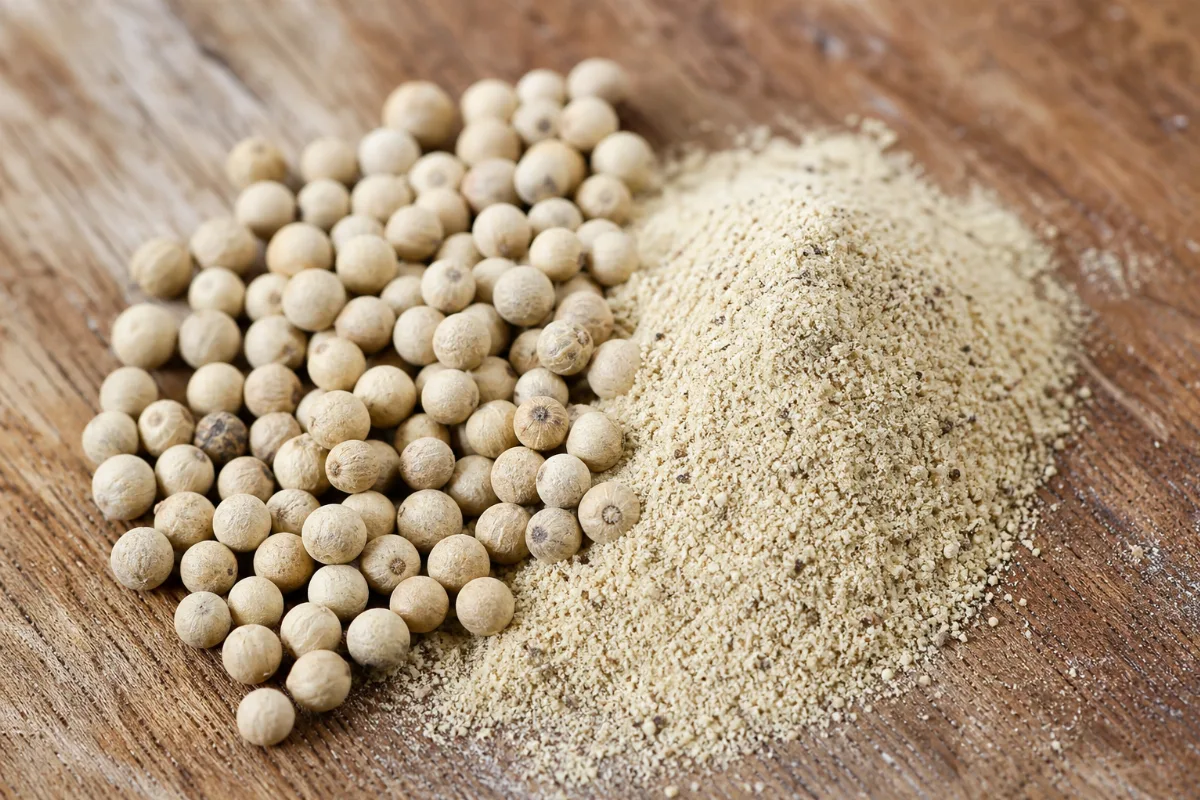
White pepper is the ripe seed of the pepper vine with its outer skin removed. It tastes hot and earthy and is used where black specks would show. Almost no research exists on white pepper itself. The main caution is for supplements: pure piperine, the hot compound, can change how some medicines work.
General information, not medical advice. Last substantive update · Not medically reviewed. A named clinician has not signed off on this page. How this page is made
About White pepper
White pepper is a seasoning, not a proven remedy. Little research exists on it, and the documented safety concern is about concentrated piperine in supplements, not the spice in food.
What it is
White pepper is the seed of Piper nigrum, the climbing vine that also gives black pepper. The spice is the fruit, called a peppercorn. The vine is native to South Asia, and Vietnam, Brazil, Indonesia and India lead production.
White pepper is made from fully ripe red berries that are soaked in water for about a week until the flesh softens. The rest is rubbed off and the bare seed is dried. Black pepper is made from unripe fruit with the outer layer left on. (Source: Wikipedia, a secondary source.)
The heat comes mainly from piperine. The outer layer holds aroma compounds that give black pepper its citrus and woody notes, and white pepper mostly lacks them, so it smells duller and earthier.
USDA data for ground white pepper per 100 g: 296 kcal, 26.2 g fibre, 265 mg calcium, 14.3 mg iron, 4.3 mg manganese. A teaspoon is 2.4 g (about 7 kcal, 0.6 g fibre, 0.3 mg iron), so a pinch adds little.
What the research shows
We found one randomised trial of white pepper as a medicine: stir-fried white pepper against a clay medicine in 174 young children with diarrhoea in China. It did better in acute and persistent diarrhoea. The abstract gives no numbers or safety results, and the comparator was not a placebo, so the result is very uncertain.
We found no study of white pepper used as a cooking spice for any health outcome.
A systematic review of black pepper reported many benefits in test tubes and animals but counted only one clinical trial among 82 studies.
Food versus supplements
Pepper on food, stir-fried white pepper as a traditional medicine, and piperine capsules are three different things. The safety reviews are about the third. The trial is about the second. The first has hardly been studied.
Amounts
This page gives no amounts to eat. Ask a doctor, pharmacist or dietitian what is right for you, especially if you take prescription medicines.
At a glance
Traditional uses history, not proof
- Used as a cooking spice, especially in pale sauces, soups and Chinese, Thai and Portuguese dishes
- Stir-fried white pepper is a traditional medicine for children's diarrhoea in China
- Long use as food or tradition is not proof that it treats any condition
Studied for research
- Children's diarrhoea (stir-fried white pepper, traditional preparation), very low certainty, one trial
- Changing medicine levels (isolated piperine), low certainty, a risk rather than a benefit
- General health claims for black pepper, insufficient evidence (lab and animal studies)
Main compounds
- Piperine
- Limonene
- Pinene
- Beta-caryophyllene
Common forms
- Whole white peppercorns
- Ground white pepper
- Stir-fried white pepper as a traditional medicine (trial)
- Piperine capsules and pepper extracts (not the spice)
Research links: BfR review: isolated piperine safety · Trial: stir-fried white pepper and children's diarrhoea · Systematic review of black pepper · Research Library · Genes & Biomarkers Library
What it is and its history
- Accepted scientific name
- Piper nigrum
- Naming authority
- L.
- Common names
- White pepper (English); White peppercorn (English); Muntok pepper (English); Pimienta blanca (Spanish)
- Family or group
- Piperaceae (pepper family), from general knowledge, not a source read for this page.
- Classification
- Plantae > Piperaceae > Piper > Piper nigrum
- Native range
- South Asia (Wikipedia, secondary source); Vietnam, Brazil, Indonesia and India lead production.
- Habitat
- Not verified from a source read.
- What it looks like
- Roots: Not verified.; Stems: A climbing vine (Wikipedia).; Leaves: Not verified.; Flowers: Not verified.; Fruit: The spice is the fruit, called a peppercorn (Wikipedia). White pepper is the seed with the outer layer removed.
- Cultivation
- Not verified from a source read.
- Harvest and processing
- White pepper is made from fully ripe red berries. They soak in water for about a week until the flesh softens, the rest is rubbed off, and the bare seed is dried. Black pepper is made from unripe fruit with the outer layer left on (Wikipedia, secondary source).
- Look-alikes and adulterants
- Name: Black pepper; Note: Same plant, different processing: the outer layer is left on, so it carries more aroma compounds.; Name: Pink peppercorn and Sichuan pepper; Note: Not true pepper: they come from different plants and have their own pages.
- Sustainability and conservation
- Not assessed.
Photographs
What is inside, and how it may work
What it contains and how those compounds act in cells and animals. Laboratory and animal mechanisms are not proven effects in people.
Main compounds
| Compound | Family | Where it is concentrated | Activity studied | Level of evidence |
|---|---|---|---|---|
| Piperine | alkaloid (amide) | Fruit layer and seed One secondary source puts black pepper at 4.6 to 9.7% piperine, white pepper slightly higher (Wikipedia) | Gives the heat. As an isolated compound it can change how drug-handling enzymes and transporters work (reviews). 5 3 7 | Human data |
| Limonene, pinene and beta-caryophyllene | volatile aroma compounds | Outer layer (mostly removed in white pepper) Not given | Aroma: citrus, pine and wood notes in black pepper that white pepper mostly lacks (Wikipedia). 7 | Not applicable |
Mechanisms, receptors and pathways
| Target or pathway | Gene or receptor | What was found | Level |
|---|---|---|---|
| Drug-metabolising enzymes and transporters | Not named in the abstracts | Piperine can inhibit or stimulate these proteins depending on conditions, so it can change the levels of co-given drugs. Shown for isolated piperine, not pepper on food. 5 3 | Human and animal |
Absorption, metabolism and elimination
- Absorption
- Not found for white pepper.
- Distribution
- Not found.
- Metabolism
- Piperine can modulate metabolising enzymes (review).
- Elimination
- Not found.
- Bioavailability
- Not established for white pepper.
Isolated compounds versus whole extracts
Almost all research is on black pepper or on isolated piperine, not white pepper on food. Food seasoning, a traditional medicine preparation such as stir-fried white pepper, and concentrated piperine supplements are three different things.
Nutritional composition
Nutrition from USDA FoodData Central (Spices, pepper, white, FDC 170933, SR Legacy, last updated 4/1/2019, read 2026-10-26). Per 100 g: 296 kcal, 10.4 g protein, 2.12 g fat, 68.6 g carbohydrate, 26.2 g fibre, 11.4 g water, 265 mg calcium, 14.3 mg iron, 90 mg magnesium, 176 mg phosphorus, 73 mg potassium, 5 mg sodium, 1.13 mg zinc, 4.3 mg manganese, 21 mg vitamin C. USDA household portions: one teaspoon of ground white pepper is 2.4 g and one tablespoon is 7.1 g. Scaled to one teaspoon (our arithmetic): about 7 kcal, 0.6 g fibre, 6 mg calcium, 0.3 mg iron, 0.1 mg manganese and 0.5 mg vitamin C. A teaspoon is a large amount for a single dish, so real intakes are usually smaller. Real products vary.
1 low certainty1 very low certainty2 not enough evidence
What was looked at
The 4 benefits and uses checked for White pepper, each with how strong the evidence is. Tap one to open it.
- Diarrhoea in infants and young children (stir-fried white pepper, a traditional preparation)Very low certainty
- Raising the blood levels of other medicines (isolated piperine)Low certainty
- Other health claims for pepper (mostly black pepper, in the lab and in animals)Not enough evidence
- Nutrients in a pinch of white pepperNot enough evidence
Lab markers tracked in the studies
Frequency of diarrhoea and cure rate in childrenBlood levels of co-given medicines
What is White pepper good for?
The studied uses and how strong the human evidence is. There is very little, and most of it is not about white pepper as a food.
Benefits, one by one
Each card is a research question, not a promise. Tap a goal to filter. Open a card to see the studies, doses and limits.
Diarrhoea in infants and young children (stir-fried white pepper, a traditional preparation)
Very low certaintyOne 2013 trial in a Chinese hospital gave 174 infants and young children with diarrhoea either stir-fried white pepper or a clay medicine. In acute and persistent diarrhoea the pepper group did better. This is a traditional medicine preparation given to sick children, not the pepper on your food, and it is one small trial with an active comparator. This page does not suggest anyone give it to a child.
1 studiesStir-fried ground white pepper as a medicine in the trial; amount not…
Studies, doses and limits
What the trials found
Randomised trial of 174 patients under about 2.5 years old: stir-fried white pepper (88) versus montmorillonite powder (86). Success was similar in chronic diarrhoea (52 patients). The cure rate was higher with white pepper in acute diarrhoea (62 patients) and persistent diarrhoea (60 patients), and diarrhoea frequency fell more.
Results
Better than the clay medicine in acute and persistent diarrhoea; no difference in chronic diarrhoea. Cure rates, doses and safety results are not in the abstract.
Effect sizes as reported
Not given in the abstract.
Why this rating
Very low: a single hospital trial reported in an abstract only, with an active comparator and no placebo, no stated blinding, no numbers and no safety results, in a traditional preparation that is not a normal food amount. No second trial was found.
Form and dose studied
Stir-fried ground white pepper as a medicine in the trial; amount not stated in the abstract. This page gives no amounts.
Who was studied
Infants and children under about 2.5 years with diarrhoea in China.
Limits
Comparator was another medicine, not a placebo. The full text was not read. One trial only.
Why researchers looked
Stir-fried white pepper is used in Chinese traditional medicine for diarrhoea in children, so researchers compared it with a standard clay medicine.
Traditional use
White pepper is a cooking spice. Long use as food or in traditional medicine is not proof that it treats any condition.
Proposed mechanism Not stated
The abstract gives no mechanism.
A proposed mechanism does not show that the effect happens in people.
Diarrhoea in babies and young children can lead to dehydration. Seek medical advice rather than treating it with a spice.
Raising the blood levels of other medicines (isolated piperine)
Low certaintyPiperine is the compound that makes pepper hot. Reviews say that, as a pure extract taken in one dose, it can change how the body handles some medicines, usually raising their levels. That is a measurement, not a health benefit, and it can be a risk. It was not shown for pepper used as seasoning.
2 studiesIsolated piperine or pepper extract in supplements; no official amoun…
Studies, doses and limits
What the trials found
The BfR review of human and animal bolus studies found interactions with several drugs, in most cases raising drug availability, and warns this may cause increased or unintended drug effects. The Lee review says the effect can be helpful or harmful and depends on dose, dosing frequency and duration.
Results
Raised drug levels in most bolus studies of isolated piperine. Neither review reports a study of white pepper used as a spice.
Effect sizes as reported
Not given in the abstracts.
Why this rating
Low for people: the human work is mostly small studies of pure piperine that measure drug levels, not health outcomes, and both sources are narrative reviews read as abstracts. The finding does not apply to food amounts.
Form and dose studied
Isolated piperine or pepper extract in supplements; no official amount found.
Who was studied
People taking medicines who also take piperine supplements.
Limits
Narrative reviews, abstracts only. A higher drug level is not a benefit.
Why researchers looked
Piperine is sold in supplements as a 'bioavailability enhancer', so researchers studied how it changes drug handling.
Traditional use
Pepper is a cooking spice; this effect belongs to concentrated piperine.
Proposed mechanism Review
Piperine can inhibit or stimulate metabolising enzymes and drug transporters, depending on the treatment conditions (Lee 2018 review).
A proposed mechanism does not show that the effect happens in people.
If you take prescription medicines, ask a pharmacist before using piperine or pepper-extract supplements. See the Safety tab.
Other health claims for pepper (mostly black pepper, in the lab and in animals)
Not enough evidenceA systematic review of black pepper research reported antioxidant, antidiabetic, cholesterol-lowering and other effects, but almost all in test tubes or animals: 60 in vitro studies, 21 animal studies and only one clinical trial. None of this is about white pepper on food.
1 studiesBlack pepper powder, pills, pastes and isolated compounds in differen…
Studies, doses and limits
What the trials found
One clinical trial in the whole review; the abstract does not name it.
Results
Lab and animal findings only. No human outcome is established.
Why this rating
Insufficient: the evidence is in vitro and animal, on black pepper and its compounds, and the review reports only one clinical trial.
Form and dose studied
Black pepper powder, pills, pastes and isolated compounds in different studies.
Limits
Review of an abstract only; mostly lab and animal work; not white pepper.
Why researchers looked
Black and white pepper come from the same plant, so researchers study its compounds, mainly piperine.
Traditional use
The review found India had the most traditional reports, mostly for menstrual and ear-nose-throat problems, using powder, pills or paste. Tradition is not proof.
Proposed mechanism Laboratory research
The review lists antioxidant, enzyme and cell-signalling effects in laboratory work. These are not shown in people.
A proposed mechanism does not show that the effect happens in people.
None specific beyond the Safety tab.
Nutrients in a pinch of white pepper
Not enough evidenceWhite pepper is a seasoning, so the amount used adds very little. One teaspoon of ground white pepper (2.4 g) has about 7 kcal, 0.6 g of fibre and 0.3 mg of iron by USDA data. It is not a meaningful source of any nutrient at normal amounts.
1 studiesGround white pepper as a seasoning.
Studies, doses and limits
What the trials found
USDA gives per 100 g: 296 kcal, 26.2 g fibre, 265 mg calcium, 14.3 mg iron and 4.3 mg manganese. Scaled to 2.4 g (one teaspoon, our arithmetic) these are small.
Results
A nutrient fact only. We did not compare against daily values, so we do not call white pepper a good source of anything.
Effect sizes as reported
Per teaspoon (2.4 g), calculated: about 7 kcal, 0.63 g fibre, 6 mg calcium, 0.34 mg iron, 0.10 mg manganese.
Why this rating
There is no health outcome here, only composition data. USDA SR Legacy values are from 2019 and real products vary.
Form and dose studied
Ground white pepper as a seasoning.
Who was studied
Anyone eating it.
Limits
Composition data, not a trial.
Why researchers looked
People ask whether a spice adds nutrients.
Traditional use
Used for flavour.
Proposed mechanism Reference data
Not applicable. These are food composition figures.
A proposed mechanism does not show that the effect happens in people.
None specific.
Connections to the rest of health
How White pepper connects to the rest of our health knowledge graph. Every link says what kind of connection it is. A safety link (for example to the liver) is a warning, not a benefit. A study that merely mentions a topic never creates a benefit link.
Explore every connection: goals, body systems, organs, symptoms, genes
B. Body systems
| Connected to | Kind of connection | Evidence status | Context | Studies |
|---|---|---|---|---|
| Digestive System | Biological association | Very low certainty | Studied for: Diarrhoea in infants and young children (stir-fried white pepper, a traditional preparation) Studied for: Raising the blood levels of other medicines (isolated piperine) | 2 5 3 6 |
| Liver And Detox | Biological association | Low certainty | Studied for: Raising the blood levels of other medicines (isolated piperine) | 5 3 |
| Metabolic System | Biological association | Not enough evidence | Studied for: Other health claims for pepper (mostly black pepper, in the lab and in animals) | 4 |
I. Biomarkers
| Connected to | Kind of connection | Evidence status | Context | Studies |
|---|---|---|---|---|
| Frequency of diarrhoea and cure rate in children | Biological association | Very low certainty | Measured in trials: lowered. A lab change is not the same as a health benefit. | 2 |
| Blood levels of co-given medicines | Biological association | Low certainty | Measured in trials: raised. A lab change is not the same as a health benefit. | 5 3 |
K. Biological pathways
L. Active compounds
| Connected to | Kind of connection | Evidence status | Context | Studies |
|---|---|---|---|---|
| Piperine | Drug or supplement interaction | Documented risk | Can change levels of some medicines. Isolated piperine can change levels of some medicines. Preparation or compound: Isolated piperine in supplements |
5 3 |
| Piperine | Biological association | Human | Gives the heat. As an isolated compound it can change how drug-handling enzymes and transporters work (reviews). Preparation or compound: Fruit layer and seed |
5 3 7 |
| Limonene, pinene and beta-caryophyllene | Biological association | Not applicable | Aroma: citrus, pine and wood notes in black pepper that white pepper mostly lacks (Wikipedia). Preparation or compound: Outer layer (mostly removed in white pepper) |
7 |
Each connection is stored with the ingredient, the connected record, the kind of connection, the evidence status, the supporting studies, the preparation or compound involved, and a review date (last reviewed October 26, 2026).
Evidence at a glance: what changed in 2 lab markers
Tap a number to show only those markers. Counts are markers, not people.
The evidence
The research centre for White pepper. Every record here was checked against PubMed or the publisher's page; we never list a study we have not verified.
Evidence by outcome
Bars show how many studies we found for each outcome, not how well it works. People are added up across trials only (reviews are not added, to avoid double counting).
How we rate evidence
High certainty
Several well-run trials or reviews agree; further research is unlikely to change the picture much.
Moderate certainty
Good trials point the same way, but some doubt remains.
Low certainty
Small, short or inconsistent trials. The finding could change with better research.
Very low certainty
Very little or very weak human data. Treat as a possibility only.
Mixed findings
Trials or reviews disagree with each other.
Not enough evidence
Not enough human research to say either way.
Evidence against
Good research found no benefit, or found harm.
We take the reviewers' own risk-of-bias and GRADE statements where they exist, and otherwise judge from study size, design, consistency, directness and whether a product matches what is sold. Many publications do not make evidence high. Method note: We started from our existing white pepper summary, re-checked nutrition at USDA FoodData Central and searched PubMed. Only abstracts were read for studies. Items we could not verify are flagged in the research gaps.
Study library: every study we checked 7
| Study | Design | People | Product, dose, length | Result |
|---|---|---|---|---|
| Gimenez 2011 Severe pepper allergy in a young child. WMJ · PMID 21748999 |
Case report |
1 A 17-month-old boy with mild eczema |
Venison and roast beef in a marinade with several spices including black and cayenne pepper Ground spice in a marinade Food in a marinade Single events |
The boy developed hives, red eyes, facial swelling and severe cough straight after eating venison in a marinade containing black and cayenne pepper, and a milder reaction after roast beef in the same marinade. Venison without marinade caused no reaction. Skin tests to cayenne and black pepper extracts were positive. Blood IgE tests were undetectable to black pepper, chili pepper and white pepper, and 0.11 kU/L to cayenne pepper. The authors say pepper allergy in children is rare and that rates are unknown. Not applicable (Not applicable) Methods, limits and fundingOutcomes: Allergic reaction Limitations: One child. The reaction was to black and cayenne pepper in a spice mix; the blood test for white pepper was undetectable, so this case does not show allergy to white pepper. Funding and conflicts: Not stated in the abstract. Read: abstract |
| Jin 2013 Stir-fried white pepper can treat diarrhea in infants and children efficiently: a randomized controlled trial. Am J Chin Med · PMID 23895150 · DOI |
Controlled trial |
174 Infants and children under about 2.5 years with diarrhoea (acute, persistent or chronic) at a hospital in Shandong, China |
Stir-fried white pepper (a traditional preparation, not the plain spice on food) Ground peppercorn (seed) Not given in the abstract Not given in the abstract · vs Montmorillonite powder (a clay medicine), not a placebo |
Participants were randomly given stir-fried white pepper (88) or montmorillonite powder (86). Success was similar in the 52 chronic diarrhoea patients. In acute (62) and persistent (60) diarrhoea the cure rate was higher with stir-fried white pepper, and diarrhoea frequency fell more. The abstract says it assessed safety but reports no safety results. Higher cure rate than clay powder in acute and persistent diarrhoea (numbers not in the abstract) (Not given in the abstract) Methods, limits and fundingOutcomes: Cure rate and frequency of diarrhoea Limitations: Single hospital; comparator was an active clay medicine, not a placebo; the abstract does not say whether anyone was blinded, gives no cure rates, doses or safety data, and the full text was not read. A traditional medicine preparation in sick young children, not a cooking amount. Funding and conflicts: Not stated in the abstract. Read: abstract |
| Lee 2018 Piperine-mediated drug interactions and formulation strategy for piperine: recent advances and future perspectives. Expert Opin Drug Metab Toxicol · PMID 29250980 · DOI |
Narrative review human, animal and laboratory |
Laboratory, animal and some human studies of piperine and co-given drugs | Isolated piperine Fruit compound Varied Varied |
The review says piperine can modulate metabolising enzymes and drug transporters. It can influence the pharmacokinetics of co-given drugs, which may be therapeutically beneficial or harmful, because piperine can inhibit or stimulate these proteins depending on the treatment conditions. The authors say the clinical importance should be assessed by varying dose, dosing frequency and treatment duration. Qualitative; no pooled numbers in the abstract (Not applicable) Methods, limits and fundingOutcomes: Effects on drug-handling enzymes and transporters Limitations: Narrative review. Mostly isolated piperine in lab and animal work; the abstract gives no numbers and no study of pepper on food. Funding and conflicts: Not stated in the abstract. Read: abstract |
| Takooree 2019 A systematic review on black pepper (Piper nigrum L.): from folk uses to pharmacological applications. Crit Rev Food Sci Nutr · PMID 30740986 · DOI |
Systematic review human, animal and laboratory |
Published studies of black pepper (Piper nigrum) and its compounds | Black pepper (Piper nigrum) and bioactive compounds such as piperine Seeds and fruits Varied Varied |
The review reports that India had the most traditional reports, mostly for menstrual and ear-nose-throat disorders in people, with seeds and fruits used as powder, pills or tablets and paste. It reports antimicrobial, antioxidant, anticancer (cell lines), antidiabetic and cholesterol-lowering results in vitro or in animals. Most pharmacological studies were in vitro (60), 21 were in vivo and only 1 was a clinical trial. 60 in vitro, 21 in vivo, 1 clinical trial (Not applicable) Methods, limits and fundingOutcomes: Traditional uses and pharmacological properties Limitations: The reviewed work is about black pepper and its compounds, not white pepper. Almost all of it is lab or animal work. The abstract does not name which clinical trial was meant. Funding and conflicts: Not stated in the abstract. Read: abstract |
| Ziegenhagen 2021 Safety Aspects of the Use of Isolated Piperine Ingested as a Bolus. Foods · PMID 34574230 · DOI |
Narrative review human and animal |
Human and animal studies of isolated piperine as a single dose | Isolated piperine (from Piper nigrum) Fruit compound Single or short-term bolus doses (amounts not given in the abstract) Short term |
The German Federal Institute for Risk Assessment (BfR) reviewed isolated piperine used as a single ingredient in supplements. In human and animal bolus studies it interacted with several drugs, in most cases raising drug availability, which may carry the risk of unintended or increased drug effects. Animal studies with higher daily doses than the human interaction studies indicated disturbed sperm formation and effects on maternal reproduction and the embryo. Human studies rarely reported adverse effects but looked mainly at drug interactions. The authors say it appears advisable to consider the health risks of isolated piperine in bolus form, for example in some supplements. Qualitative; no pooled numbers in the abstract (Not applicable) Methods, limits and fundingOutcomes: Interactions with drugs, reproductive and other safety signals Limitations: Review of isolated piperine, not of pepper as seasoning. Human studies were not designed for safety. The abstract gives no numbers. Funding and conflicts: No conflict of interest declared by the authors. Read: abstract |
| s-usda-fdc-170933 USDA FoodData Central: Spices, pepper, white (FDC 170933) · Source |
Reference database n/a |
Methods, limits and fundingRead: full-text | ||
| s-wiki-black-pepper Wikipedia: Black pepper (covers white pepper production, flavour and use) · Source |
Secondary source n/a |
Methods, limits and fundingRead: full-text |
What we do not know yet
- No study of white pepper as a cooking spice for any health outcome was found.
- The only white pepper trial was read as an abstract; its numbers, doses and safety results are unknown.
- Most pepper research is on black pepper or isolated piperine, mostly in the lab or in animals.
- Pregnancy, breastfeeding, liver, kidney, contamination and quality of white pepper were not found in the sources read.
- History of white pepper was not researched.
How new research is added
New studies are found by a saved PubMed search and placed in a review queue before the page changes.
Lab markers
What changed in blood or saliva tests during trials. A changed number is not the same as feeling or being healthier, and we give no "normal ranges".
Other 2
Frequency of diarrhoea and cure rate in children
Lowered in trials
How often a child has loose stools, and whether the illness is judged cured.
Very low certaintyResults and what it means
Why it was measured
These are the outcomes the trial used to compare treatments.
Statistical vs. clinical meaning
A single small trial against another medicine. It does not show that white pepper in food helps digestion.
Safety implication
Dehydration risk in young children with diarrhoea; the abstract gives no safety results.
| Study | Result | People | Product |
|---|---|---|---|
| 2 | Diarrhoea frequency fell more, and the cure rate was higher, with stir-fried white pepper than with montmorillonite powder in acute and persistent diarrhoea; similar in chronic diarrhoea (numbers not in the abstract) | 174 infants and children under about 2.5 years in China | Stir-fried white pepper (traditional preparation) versus montmorillonite powder |
Blood levels of co-given medicines
Raised in trials
How much of a medicine is in the blood after a dose.
Low certaintyResults and what it means
Why it was measured
Piperine studies measure how it changes the absorption and clearance of other drugs.
Statistical vs. clinical meaning
A change in drug levels is not a benefit and can raise the risk of side effects.
Safety implication
Relevant to anyone on prescription medicines who takes piperine supplements.
| Study | Result | People | Product |
|---|---|---|---|
| 5 | Interactions with several drugs, in most cases increasing drug bioavailability (BfR review of human and animal bolus studies) | People and animals given a single dose of isolated piperine | Isolated piperine, not pepper seasoning |
Safety
What studies and official sources say about side effects, medicines and who should check first. Each point shows what kind of evidence it comes from.
Main points to know 4
- Cooking amounts are different from piperine supplements. No safety problem from white pepper as a seasoning was found in the sources read. The safety concerns found are about isolated piperine taken as a single dose in supplements, which can change how the body handles some medicines. If you take prescription medicines, ask a pharmacist before using piperine or pepper-extract supplements. Narrative review 5 3
- Pregnancy and fertility: animal signals for high-dose isolated piperine. In animal studies, daily piperine doses higher than in the human interaction studies pointed to disturbed sperm formation and effects on the mother's reproduction and the embryo. This is for isolated piperine, not pepper on food, and it has not been tested in people. No source read gives pregnancy advice for pepper as seasoning. Animal research 5
- Allergy to pepper is rare but has been reported. A case report describes a 17-month-old with hives, facial swelling and cough after a marinade containing black and cayenne pepper, with positive skin tests to black and cayenne pepper. Blood tests for white pepper were undetectable in that child. The authors call pepper allergy in children rare. Case report 1
- Do not treat a child's diarrhoea with a spice. The trial of stir-fried white pepper in young children gave no safety results in its abstract. Diarrhoea in babies and young children can cause dehydration, so ask a doctor or pharmacist. Controlled trial 2
Side effects 2
| Effect | How often | Severity and recovery | Evidence |
|---|---|---|---|
| Raised levels or stronger effects of some medicines (isolated piperine) Reviews of isolated piperine; most bolus studies saw increased drug availability. Not shown for pepper used in cooking. | Not established | not stated Not stated | Narrative review 5 3 |
| Allergic reaction: hives, swelling, cough One child, reacting to a marinade with black and cayenne pepper. Specific IgE to white pepper was undetectable. How common pepper allergy is was not found. | Not established | not stated Not stated | Case report 1 |
Liver
No liver injury from white pepper as a spice was found in the sources read. A liver-safety source such as LiverTox was not searched for this food page.
How often. No frequency was found.
Monitoring. No agency monitoring advice was found.
This is a safety connection. It is not evidence that White pepper supports liver health.
Medicines and supplements 2
| With | Why it matters | Importance | Evidence | What to do |
|---|---|---|---|---|
| Prescription medicines in general (with isolated piperine or pepper extract supplements) supplement | Piperine can inhibit or stimulate drug-metabolising enzymes and transporters, depending on conditions (Lee 2018). In most bolus studies it increased drug availability (BfR 2021). | Reviews say the effect can be helpful or harmful depending on the drug and dose. No specific drug is named in the abstracts read. | Narrative review Low certainty 5 3 | Ask a pharmacist before using piperine or pepper-extract supplements with any prescription medicine. |
| Prescription medicines (with pepper used in cooking) prescription | No source read tested or reported an interaction at cooking amounts. | No evidence found Not enough evidence 5 | No special action is advised by the sources read. Ask a pharmacist if you are unsure. |
Who should check first 5
| Situation | Advice | Evidence |
|---|---|---|
| Taking prescription medicines and considering piperine or pepper-extract supplements | Ask a pharmacist or doctor first; piperine can change drug levels. | Narrative review 5 3 |
| Known allergy to pepper | Avoid it and ask an allergist. Call emergency services for trouble breathing or swelling of the face or throat. | Case report 1 |
| Pregnancy or trying to conceive | The animal findings concern isolated piperine at high doses. Pepper as seasoning has not been reviewed in the sources read. Avoid piperine supplements unless a clinician agrees. | Animal research 5 |
| Babies and young children with diarrhoea | Do not use a spice as treatment. Seek medical advice because of the risk of dehydration. | Controlled trial 2 |
| Breastfeeding | No source read gives advice for pepper. Ask a clinician about supplements. | No evidence found |
Overdose, product quality and regulators
Summary. No toxicity from white pepper as a spice was found in the sources read. No upper limit for pepper in food was found.
Animal. High daily doses of isolated piperine in animals pointed to disturbed sperm formation and maternal and embryo effects (BfR review).
Human doses studied. Human piperine studies are mostly single doses of the isolated compound; amounts are not given in the abstracts. The BfR review says they paid little attention to safety beyond drug interactions.
High dose or long term signals. Not established in people.
Overdose response. Not found.
Genotoxicity. Not researched.
The sources read do not describe contamination, adulteration, heavy metals or germs in white pepper. White pepper is soaked in water for about a week during production, but no source read links this to a safety problem.
Production. White pepper is made from ripe berries soaked in water until the flesh softens and rubbed off, then dried (Wikipedia, secondary source). No safety finding is attached to this in the source. 7
| Body | Action | Date |
|---|---|---|
| BfR (German Federal Institute for Risk Assessment) (Germany) | Review concludes it appears advisable to consider potential health risks of isolated piperine taken as a bolus, for example in some food supplements source | 2021-09-08 |
When to get medical help
- Trouble breathing, swelling of the lips, face or throat, or widespread hives after eating pepper
- Signs of dehydration in a baby or young child with diarrhoea: very few wet nappies, dry mouth, unusual sleepiness
- Unexpected side effects of a prescription medicine after starting a piperine supplement
Stop using the product and contact a clinician or emergency service. In the US, Poison Control is 1-800-222-1222.
General information only, not medical advice. Ask a clinician or pharmacist before use, especially with medicines, in pregnancy or with a health condition. See the Natural Remedy Safety guide.
Frequently asked questions
What is white pepper?
White pepper is the seed of the Piper nigrum vine with the outer layer removed. It is the same plant as black pepper; the difference is in how it is processed. It is hot and earthy, with less citrus and pine aroma than black pepper.
How is white pepper different from black pepper?
White pepper comes from fully ripe berries that are soaked until the flesh softens and is rubbed off. Black pepper comes from unripe fruit with the outer layer left on. The outer layer holds aroma compounds that give black pepper its citrus and woody notes, so white pepper smells duller and earthier.
Is white pepper good for you?
It is a seasoning, so it adds very little: one teaspoon (2.4 g) has about 7 kcal and 0.6 g of fibre by USDA data. We found no study of white pepper as a cooking spice for any health outcome.
Does white pepper help with diarrhoea?
One 2013 trial in China gave stir-fried white pepper, a traditional preparation, to 174 infants and young children and found a better cure rate than a clay medicine in acute and persistent diarrhoea. It is a single trial with an active comparator, and the abstract has no safety results. Do not treat a child's diarrhoea with a spice; ask a doctor.
Does white pepper help you lose weight or fight disease?
Not shown. A systematic review of black pepper found 60 test-tube studies, 21 animal studies and only one clinical trial. Findings in the lab do not show that pepper on food helps in people.
Can pepper change how my medicines work?
Is white pepper safe in pregnancy?
No source we read gives advice for pepper as seasoning. Animal studies of high-dose isolated piperine pointed to effects on sperm formation and on the mother and embryo, but that is not pepper on food and was not tested in people. Ask your doctor about supplements.
Can you be allergic to white pepper?
Pepper allergy looks rare. One case report describes a 17-month-old who reacted to a marinade with black and cayenne pepper; his blood test for white pepper was undetectable. For trouble breathing or swelling of the face or throat, call emergency services.
Is white pepper the same as piperine?
Why do some cooks prefer white pepper?
It leaves no dark specks in pale sauces, soups and mashed potatoes, and its flavour is hot and earthy rather than citrusy. These are cooking facts from a secondary source, not health claims.
Does white pepper contain nutrients?
A little: by USDA data, 100 g has 26.2 g fibre, 14.3 mg iron and 4.3 mg manganese, but a teaspoon weighs only 2.4 g, so the amount per use is small. We do not call it a good source of anything.
Is there a safe limit for white pepper?
We found no upper limit for pepper in food and no report of harm from normal cooking use. That is not proof of no risk; the sources read simply do not cover it.
Explore by health goal
Editorial transparency
- Written by
- AlternativeMed editorial team. Research compiled with AI assistance, then checked against the sources listed.
- Medical review
- None. This page has not been reviewed by a physician or pharmacist.
- First published
- 2026-10-26
- Last substantive update
- 2026-10-26
- How we research
- We started from our existing white pepper summary, re-checked nutrition at USDA FoodData Central and searched PubMed. Only abstracts were read for studies. Items we could not verify are flagged in the research gaps.
- How we rate evidence
- See "How we rate evidence" in the Evidence tab.
- Independence
- No product is promoted on this page. No affiliate links are shown.
Sources 7
Each source was opened and checked. Where we read only the abstract, it says so. The small numbers in the text point here.
- Gimenez L, Zacharisen M. Severe pepper allergy in a young child.. WMJ. 2011. PMID 21748999. (abstract)
- Jin CQ, Jia YX, Dong HX, et al.. Stir-fried white pepper can treat diarrhea in infants and children efficiently: a randomized controlled trial.. Am J Chin Med. 2013. PMID 23895150. DOI 10.1142/S0192415X13500511. (abstract)
- Lee SH, Kim HY, Back SY, Han HK. Piperine-mediated drug interactions and formulation strategy for piperine: recent advances and future perspectives.. Expert Opin Drug Metab Toxicol. 2018. PMID 29250980. DOI 10.1080/17425255.2018.1418854. (abstract)
- Takooree H, Aumeeruddy MZ, Rengasamy KRR, et al.. A systematic review on black pepper (Piper nigrum L.): from folk uses to pharmacological applications.. Crit Rev Food Sci Nutr. 2019. PMID 30740986. DOI 10.1080/10408398.2019.1565489. (abstract)
- Ziegenhagen R, Heimberg K, Lampen A, Hirsch-Ernst KI. Safety Aspects of the Use of Isolated Piperine Ingested as a Bolus.. Foods. 2021. PMID 34574230. DOI 10.3390/foods10092121. (abstract)
- . USDA FoodData Central: Spices, pepper, white (FDC 170933). . . (full-text)
- . Wikipedia: Black pepper (covers white pepper production, flavour and use). . . (full-text)
Where to buy
Check the label first. Whatever you buy, look for these:
- Whole or ground: whole spices keep their flavor longer
- The origin and a packed-on or best-by date for freshness
- Organic or non-irradiated labeling if that matters to you
- A resealable, airtight container
Talk to a pharmacist or doctor before you start any supplement, especially if you take medicines. See the Safety tab for interactions.
Support our free guides: as an Amazon Associate we earn from qualifying purchases. Full disclosure.


