Spices · Spice
Cubeb pepper (tailed pepper)
Piper cubeba · also called Tailed pepper, Java pepper, cubebs
Cubeb pepper is the dried unripe berry of a vine in the pepper family. It tastes pungent, woody and a little bitter, and is used in North African and Indonesian cooking. Almost nothing is known about its effects in people. Lab tests suggest concentrated extracts could affect how the liver handles some medicines, so ask a pharmacist before taking an extract.
General information, not medical advice. Last substantive update · Not medically reviewed. A named clinician has not signed off on this page. How this page is made
About Cubeb pepper (tailed pepper)
Cubeb pepper is a rare, warm and slightly bitter spice. It is a flavouring, not a proven remedy: research is thin, mostly lab work, and one lab study hints at medicine interactions with concentrated extracts.
What it is
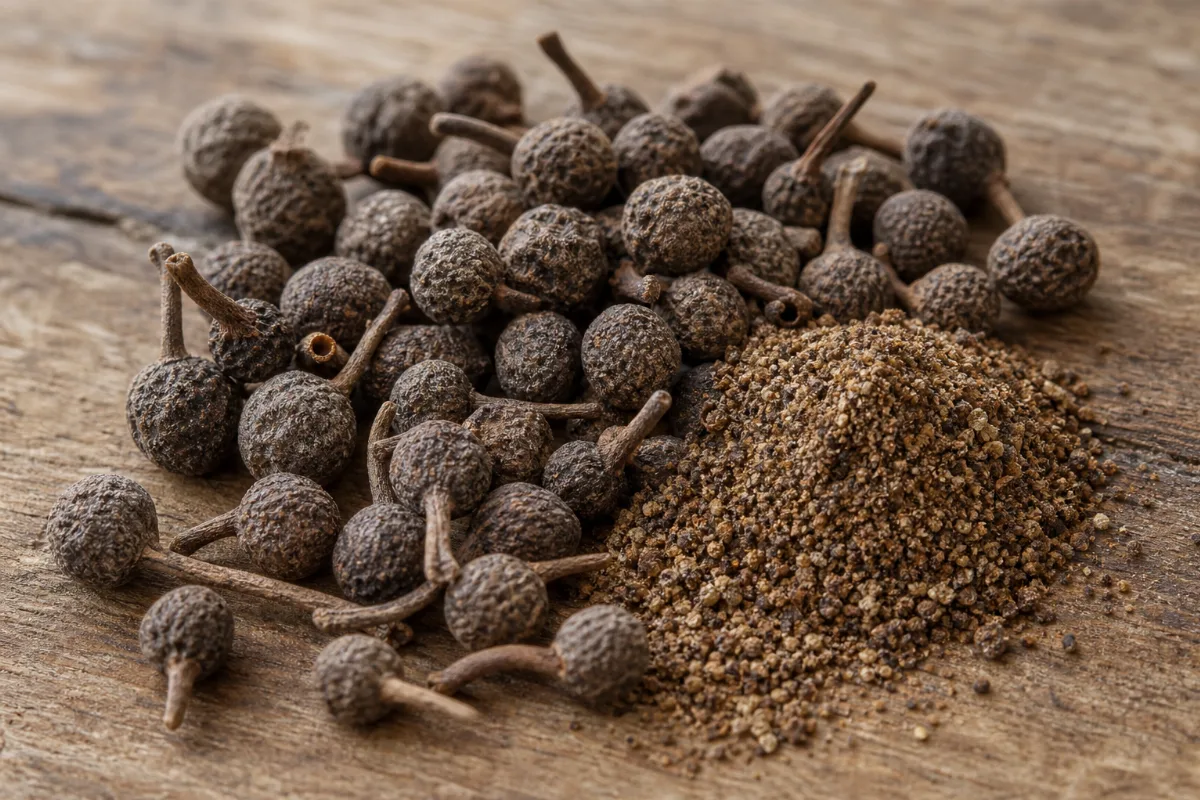
Cubeb pepper is the dried, unripe fruit of Piper cubeba, a climbing vine in the pepper family. Most of it is grown today on Java and other Indonesian islands (Katzer), and Wikipedia names Java and Sumatra. That is why it is also called Java pepper. The berries look like black pepper but keep a small stalk, the tail in 'tailed pepper'.
Do not confuse it with false cubeb or Ashanti pepper (Piper guineense) from Africa, which has smaller, smoother, reddish berries.
Flavor and cooking
Cubeb tastes pungent and bitter, with a dry, woody, warm and camphor-like smell. Some writers compare it to allspice, a view Katzer does not share. It is sold whole and is crushed or ground before use.
In Morocco it appears in savoury dishes, pastries and sometimes in ras el hanout. In Indonesia it seasons curries called gulai. It also flavours gin. In Europe it was a valued spice in the Middle Ages and a popular substitute for black pepper in the 16th and 17th centuries.
The sources read give no rules on when to add it, so we give none. Because it is strong and bitter, many cooks start with very little and taste.
What the research shows
There is almost no human research. The 2022 review describes cell and animal studies and one report of a single patient. It does not describe a clinical trial.
The firmest finding is a safety hint: in a 2005 test-tube study, five compounds from cubeb blocked a liver enzyme called CYP3A4 about as strongly as the drug ketoconazole. People were not tested.
Nutrition
No nutrient numbers are given because none were found. Cubeb is used in small pinches, so it adds almost nothing to the diet.
At a glance
Traditional uses history, not proof
- Spice in Moroccan dishes and in the mix ras el hanout
- Seasoning in Indonesian curries
- Flavouring in drinks such as gin
- Traditional remedy for stomach, breathing and throat complaints (not proven)
Studied for research
- Kidney disease, insufficient evidence (one case report)
- Antioxidant and anti-inflammatory effects, very low certainty (lab and animal)
- Blood-sugar enzymes, very low certainty (test tube only)
- Antibacterial and antifungal activity, very low certainty (lab only)
- Cancer cell lines, very low certainty (lab only)
Main compounds
- Essential oil (mostly sabinene)
- Cubebin and related lignans
- Piperine (sources disagree on its role)
Common forms
- Whole dried berries, crushed or ground before use
- Essential oil used by industry for flavour
- Extracts used in laboratory studies
Research links: 2022 review of cubeb · 2005 CYP3A4 lab study · Katzer's Spice Pages: cubeb · Research Library · Genes & Biomarkers Library
What it is and its history
- Accepted scientific name
- Piper cubeba
- Naming authority
- L.fil. (GBIF accepted)
- Common names
- Cubeb pepper (English); Tailed pepper (English); Java pepper (English); Poivre a queue (French); Cubeba (Spanish)
- Family or group
- Piperaceae (the pepper family), as given by GBIF, Katzer and the review.
- Classification
- Plantae > Tracheophyta > Magnoliopsida > Piperales > Piperaceae > Piper > Piper cubeba
- Native range
- The 2022 review says it is native to Java and Borneo; Wikipedia says it is mostly grown in Java and Sumatra, and Katzer says Java and other Indonesian islands. The sources differ slightly.
- Habitat
- Not verified from a source read.
- What it looks like
- Roots: Not verified.; Stems: The review describes a woody climbing perennial 5 to 15 m high with ashy-grey climbing branches.; Leaves: The review describes ovate leaves up to 15 cm long and 6 cm wide.; Flowers: Not verified.; Fruit: Katzer: stalked berries a little larger than peppercorns, with a furrowed surface; most are hollow. The stalk is the 'tail'.
- Cultivation
- Not verified from a source read.
- Harvest and processing
- The unripe berries are dried and sold whole; they are crushed or ground before use (Katzer).
- Look-alikes and adulterants
- Name: False cubeb or Ashanti pepper (Piper guineense); Note: A different plant from Central and West Africa with smaller, smoother, reddish berries and a curved stalk (Katzer).; Name: Black pepper (Piper nigrum); Note: A relative with similar-looking berries but no tail and a different taste.
- Sustainability and conservation
- Not assessed.
Photographs
Traditional use and history history, not clinical proof
| Tradition or era | Documented use | Source |
|---|---|---|
Traditional use shows how it was used. It does not show that it works or is safe today.
What is inside, and how it may work
What it contains and how those compounds act in cells and animals. Laboratory and animal mechanisms are not proven effects in people.
Main compounds
| Compound | Family | Where it is concentrated | Activity studied | Level of evidence |
|---|---|---|---|---|
| Sabinene and other terpenes (essential oil) | terpene | Fruit Katzer: up to 10% essential oil, about half of it sabinene | Gives the aroma. Lab anti-inflammatory activity is claimed in the review (rat study). 4 1 | Animal research |
| Cubebin and related lignans (hinokinin, clusin, yatein) | lignan | Fruit Katzer: cubebin about 2% | Katzer says these cause the burn. Some lignans with a methylenedioxyphenyl group blocked CYP3A4 in a lab test. 4 2 1 | Laboratory research |
| Piperine | alkaloid amide | Fruit Not given in the sources read | The review lists piperine among the most abundant compounds; Katzer says amides play no significant role in the heat. Sources disagree. 4 1 | Unknown |
Mechanisms, receptors and pathways
| Target or pathway | Gene or receptor | What was found | Level |
|---|---|---|---|
| CYP3A4 (liver drug-processing enzyme) | CYP3A4 | Five compounds with a methylenedioxyphenyl group blocked it very strongly and selectively in a test tube. 2 | Laboratory research |
Absorption, metabolism and elimination
- Absorption
- Not found.
- Distribution
- Not found.
- Metabolism
- Not found.
- Elimination
- Not found.
- Bioavailability
- Not found.
Isolated compounds versus whole extracts
Nearly all research used extracts, oil or isolated compounds in dishes or animals. None tested the whole spice in cooking amounts.
Nutritional composition
No nutrient numbers are given. No USDA FoodData Central entry for cubeb was found by a search earlier (we could not re-run it today because the data service was rate-limited), and no other source read gives them. Cubeb is used in small pinches, so it adds almost nothing to the diet. We give no grams-per-teaspoon figures.
4 very low certainty2 not enough evidence
What was looked at
The 6 benefits and uses checked for Cubeb pepper (tailed pepper), each with how strong the evidence is. Tap one to open it.
- Kidney disease (one case report)Not enough evidence
- Antioxidant and anti-inflammatory activity (lab and animal)Very low certainty
- Blocking blood-sugar-related enzymes (lab only)Very low certainty
- Antibacterial and antifungal activity (lab only)Very low certainty
- Cancer cell lines (lab only)Very low certainty
- Traditional uses: digestion, breathing, throat and sedationNot enough evidence
Lab markers tracked in the studies
Kidney function blood tests (creatinine, urea, eGFR)
What is Cubeb pepper (tailed pepper) good for?
Little human research exists, so this list is short. Every result below is from a single report, a test tube or animals, or from tradition.
Benefits, one by one
Each card is a research question, not a promise. Tap a goal to filter. Open a card to see the studies, doses and limits.
Kidney disease (one case report)
Not enough evidenceThe only human report in the 2022 review is a single 47-year-old man with kidney disease linked to high blood pressure. After 6 weeks of cubeb capsules, his symptoms and kidney blood tests were reported to improve. One patient cannot show that cubeb works.
1 studiesCapsules of cubeb fruit powder (not the spice in cooking). Amount not…
Studies, doses and limits
What the trials found
The review describes one 47-year-old man with kidney disease linked to high blood pressure whose creatinine would not return to normal on usual medicine. He was given cubeb capsules for 6 weeks. Symptoms (poor appetite, tiredness) and blood urea, creatinine and urine tests were reported to improve, with no side effects. The review says eGFR rose.
Results
Reported improvement in one patient. No comparison group, no blinding, and the patient also stayed on usual care as described.
Effect sizes as reported
No numbers beyond the single patient's reported improvement were read.
Why this rating
Insufficient. One uncontrolled case report, read second-hand through a review. It cannot separate the spice from usual care, chance or natural change.
Form and dose studied
Capsules of cubeb fruit powder (not the spice in cooking). Amount not repeated here.
Who was studied
One adult with kidney disease.
Limits
Single patient, reported second-hand. We did not read the original report.
Why researchers looked
A review of cubeb looked for a kidney-protecting effect and found this report.
Traditional use
Cubeb is a spice used in small pinches. Long use as a spice or traditional medicine is not proof that it treats any condition.
Proposed mechanism Preliminary mechanism
Not established. Rat studies in the same review (an extract against kidney stones) are cited as supporting, but they are animal work.
A proposed mechanism does not show that the effect happens in people.
People with kidney disease should not treat this as advice. Ask a kidney doctor before any supplement; see the Safety tab on medicine interactions.
Antioxidant and anti-inflammatory activity (lab and animal)
Very low certaintyIn test tubes, cubeb extracts and oil neutralised free radicals. In rats, the oil reduced swelling. None of this was tested in people eating cubeb.
1 studiesExtracts and essential oil in lab and rat studies, at doses far above…
Studies, doses and limits
What the trials found
No human studies of these effects were found in the review.
Results
Lab assays gave antioxidant activity for several extracts and the essential oil. In rats with a swelling test, the essential oil reduced paw swelling and lung inflammation markers.
Why this rating
Very low as a statement about people: lab and animal only, with concentrated extracts and oil, not food.
Form and dose studied
Extracts and essential oil in lab and rat studies, at doses far above what a recipe provides.
Limits
Cell, test-tube and rat work; not shown to help any condition in people.
Why researchers looked
Cubeb is rich in aromatic oil and lignans, so researchers test them in lab models of inflammation and oxidation.
Traditional use
Cubeb is a spice used in small pinches. Long use as a spice or traditional medicine is not proof that it treats any condition.
Proposed mechanism In vitro and animal
The review credits compounds in the oil (sabinene, terpinene, terpineol, thujene) and lignans such as cubebin. These are lab and animal findings.
A proposed mechanism does not show that the effect happens in people.
Concentrated essential oil is not a food. Ask a pharmacist before using any cubeb extract.
Blocking blood-sugar-related enzymes (lab only)
Very low certaintyIn test tubes, cubeb extracts slowed two enzymes that break down starch. This is not a test of blood sugar in people and is not a diabetes treatment.
1 studiesMethanol and water extracts of cubeb in the lab.
Studies, doses and limits
What the trials found
No human or animal blood-sugar trial of cubeb was described in the review. A rat result in the same section was for a different species (long pepper).
Results
Both extracts significantly blocked the two enzymes in vitro at the concentration tested.
Why this rating
Very low: test-tube enzyme tests only.
Form and dose studied
Methanol and water extracts of cubeb in the lab.
Limits
Enzyme tests do not show an effect on blood sugar.
Why researchers looked
Researchers screen plants for effects on digestive enzymes linked to blood sugar.
Traditional use
Cubeb is a spice used in small pinches. Long use as a spice or traditional medicine is not proof that it treats any condition.
Proposed mechanism Laboratory research
Methanol and water extracts blocked the enzymes alpha-amylase and alpha-glucosidase in the test tube.
A proposed mechanism does not show that the effect happens in people.
People with diabetes should not use this as a reason to take cubeb in place of medicine.
Antibacterial and antifungal activity (lab only)
Very low certaintyCubeb oil and extracts stopped some bacteria and yeasts growing in dishes in the lab. This does not show that cubeb treats any infection.
1 studiesOil and solvent extracts in the lab.
Studies, doses and limits
What the trials found
No human infection trial was described.
Results
Zones where growth was stopped appeared around discs soaked in oil or extracts for many bacteria, and extracts inhibited Candida albicans in dish tests.
Why this rating
Very low: lab dishes only.
Form and dose studied
Oil and solvent extracts in the lab.
Limits
Results depend on the solvent and method; the dish is not the body.
Why researchers looked
Spices and their oils are often tested against germs because some are used to preserve food.
Traditional use
Cubeb is a spice used in small pinches. Long use as a spice or traditional medicine is not proof that it treats any condition.
Proposed mechanism Laboratory research
Lab results with steam-distilled oil and several solvent extracts; the review also cites an oral gel made with the oil tested against Candida in the lab.
A proposed mechanism does not show that the effect happens in people.
Do not use cubeb oil on the skin or in the mouth as a germ treatment without asking a clinician or pharmacist.
Cancer cell lines (lab only)
Very low certaintySome cubeb extracts and compounds killed cancer cells in dishes. This is early lab work and says nothing about cancer in people. Cubeb does not treat or prevent cancer.
1 studiesFruit extracts and isolated compounds in dishes.
Studies, doses and limits
What the trials found
No human cancer study was described.
Results
Lab studies reported cell death in some cancer cell lines and less in normal ones.
Why this rating
Very low: cell lines only.
Form and dose studied
Fruit extracts and isolated compounds in dishes.
Limits
Cell lines are not tumours in people. Many plant extracts kill cells in dishes.
Why researchers looked
Piper plants are screened for cell-killing compounds. Morocco lists cubeb among plants traditionally used for cancer.
Traditional use
Cubeb is a spice used in small pinches. Long use as a spice or traditional medicine is not proof that it treats any condition.
Proposed mechanism Laboratory research
Extracts triggered programmed cell death in several cancer cell lines (breast, colon, bile duct) with less effect on normal cell lines.
A proposed mechanism does not show that the effect happens in people.
People with cancer should not use cubeb as a treatment. Tell the cancer team about any supplement.
Traditional uses: digestion, breathing, throat and sedation
Not enough evidenceThe review says cubeb has been used for stomach complaints, abdominal pain, asthma and as a calming agent. Cubeb cigarettes were sold in Victorian times for throat and chest complaints. Traditional use is not evidence that it works.
2 studiesPowder, decoction and oil, traditionally; cigarettes in the 19th cent…
Studies, doses and limits
What the trials found
No trial was found for any of these uses.
Results
Traditional use only.
Why this rating
Insufficient: tradition, no trials.
Form and dose studied
Powder, decoction and oil, traditionally; cigarettes in the 19th century.
Who was studied
Not studied.
Limits
Tradition is not proof; smoking products carry their own risks.
Why researchers looked
People ask what the spice was used for in the past.
Traditional use
Cubeb is a spice used in small pinches. Long use as a spice or traditional medicine is not proof that it treats any condition.
Proposed mechanism Traditional use
Not established.
A proposed mechanism does not show that the effect happens in people.
Do not smoke cubeb products as a remedy.
Connections to the rest of health
How Cubeb pepper (tailed pepper) connects to the rest of our health knowledge graph. Every link says what kind of connection it is. A safety link (for example to the liver) is a warning, not a benefit. A study that merely mentions a topic never creates a benefit link.
Explore every connection: goals, body systems, organs, symptoms, genes
B. Body systems
| Connected to | Kind of connection | Evidence status | Context | Studies |
|---|---|---|---|---|
| Urinary System | Biological association | Not enough evidence | Studied for: Kidney disease (one case report) | 1 |
| Whole Body | Biological association | Very low certainty | Studied for: Antioxidant and anti-inflammatory activity (lab and animal) | 1 |
| Metabolism Weight | Biological association | Very low certainty | Studied for: Blocking blood-sugar-related enzymes (lab only) | 1 |
| Immune System | Biological association | Very low certainty | Studied for: Antibacterial and antifungal activity (lab only) | 1 |
| Cellular | Biological association | Very low certainty | Studied for: Cancer cell lines (lab only) | 1 |
| Respiratory System | Biological association | Not enough evidence | Studied for: Traditional uses: digestion, breathing, throat and sedation | 1 5 |
| Digestive System | Biological association | Not enough evidence | Studied for: Traditional uses: digestion, breathing, throat and sedation | 1 5 |
I. Biomarkers
| Connected to | Kind of connection | Evidence status | Context | Studies |
|---|---|---|---|---|
| Kidney function blood tests (creatinine, urea, eGFR) | Biological association | Not enough evidence | Measured in trials: improved in one reported patient. A lab change is not the same as a health benefit. | 1 |
J. Genes, receptors and enzymes
| Connected to | Kind of connection | Evidence status | Context | Studies |
|---|---|---|---|---|
| CYP3A4 | Preliminary mechanism | In vitro | Blocked by some cubeb compounds in the lab. | 2 |
L. Active compounds
| Connected to | Kind of connection | Evidence status | Context | Studies |
|---|---|---|---|---|
| Sabinene and other terpenes (essential oil) | Biological association | Animal | Gives the aroma. Lab anti-inflammatory activity is claimed in the review (rat study). Preparation or compound: Fruit |
4 1 |
| Cubebin and related lignans (hinokinin, clusin, yatein) | Biological association | In vitro | Katzer says these cause the burn. Some lignans with a methylenedioxyphenyl group blocked CYP3A4 in a lab test. Preparation or compound: Fruit |
4 2 1 |
| Piperine | Biological association | Unknown | The review lists piperine among the most abundant compounds; Katzer says amides play no significant role in the heat. Sources disagree. Preparation or compound: Fruit |
4 1 |
Each connection is stored with the ingredient, the connected record, the kind of connection, the evidence status, the supporting studies, the preparation or compound involved, and a review date (last reviewed October 26, 2026).
Evidence at a glance: what the research found for 6 outcomes
Each outcome below is one thing researchers measured. Certainty is how far the evidence can be trusted, not how well it works. The full studies are on the next tab.
The evidence
The research centre for Cubeb pepper (tailed pepper). Every record here was checked against PubMed or the publisher's page; we never list a study we have not verified.
Evidence by outcome
Bars show how many studies we found for each outcome, not how well it works. People are added up across trials only (reviews are not added, to avoid double counting).
How we rate evidence
High certainty
Several well-run trials or reviews agree; further research is unlikely to change the picture much.
Moderate certainty
Good trials point the same way, but some doubt remains.
Low certainty
Small, short or inconsistent trials. The finding could change with better research.
Very low certainty
Very little or very weak human data. Treat as a possibility only.
Mixed findings
Trials or reviews disagree with each other.
Not enough evidence
Not enough human research to say either way.
Evidence against
Good research found no benefit, or found harm.
We take the reviewers' own risk-of-bias and GRADE statements where they exist, and otherwise judge from study size, design, consistency, directness and whether a product matches what is sold. Many publications do not make evidence high. Method note: We started from our existing cubeb summary, re-read the 2022 review in full and the 2005 abstract in PubMed, and re-read GBIF, Katzer's Spice Pages and Wikipedia. Nothing we could not read is stated as fact.
Study library: every study we checked 5
| Study | Design | People | Product, dose, length | Result |
|---|---|---|---|---|
| Drissi 2022 Cubeb (Piper cubeba L.f.): A comprehensive review of its botany, phytochemistry, traditional uses, and pharmacological properties. Frontiers in Nutrition · PMID 36483927 · DOI |
Narrative review human, animal and in-vitro (as reviewed) |
Not applicable: a review of botany, chemistry, traditional use, and cell, animal and a few human reports | Piper cubeba fruit extracts, essential oil and isolated compounds Dried fruit (berries), mostly Not advice Varies · vs Varies |
The review lists many lab and animal findings. Its only human report is a single patient with kidney disease. It says conducting clinical studies seems worthwhile, so no systematic clinical research is described. Not applicable Methods, limits and fundingOutcomes: Traditional uses, composition, toxicity, and lab and animal activity (antioxidant, anti-inflammatory, blood-sugar enzymes, antibacterial, antifungal, cancer cell lines, kidney) Limitations: Narrative review, not a systematic one. Mostly cell and animal work with extracts and oils. We read the abstract in PubMed and the full text on PubMed Central. Funding and conflicts: Authors declare no commercial or financial conflicts. Publication fee paid by the authors' university (full text). Read: full-text |
| Usia 2005 Potent CYP3A4 inhibitory constituents of Piper cubeba. Journal of Natural Products · PMID 15679319 · DOI |
Laboratory research in-vitro |
Not applicable: test-tube enzyme assays | Ethyl acetate part of a water extract of Piper cubeba, and 20 compounds isolated from it Cubeb (fruit not stated in the abstract) · vs Ketoconazole (a drug known to block CYP3A4) |
The extract part strongly blocked CYP3A4. Five of the isolated compounds, each with one methylenedioxyphenyl group, blocked CYP3A4 very strongly and selectively, at about the same strength as ketoconazole. IC50 0.44 to 1.0 micromolar for the five compounds, against 0.72 micromolar for ketoconazole Methods, limits and fundingOutcomes: Blocking of the liver enzymes CYP3A4 and CYP2D6 in a lab test Limitations: Test-tube assay with an extract fraction and isolated compounds. It does not show any effect in people or at food amounts. Funding and conflicts: Not stated in the abstract. Read: abstract |
| s-gbif-piper-cubeba GBIF Backbone: Piper cubeba L.fil. (usageKey 7606629) · Source |
Reference database n/a |
Methods, limits and fundingRead: full-text | ||
| s-katzer-cubeb-pepper Gernot Katzer's Spice Pages: Cubeb pepper (Piper cubeba) · Source |
Secondary reference n/a |
Methods, limits and fundingRead: full-text | ||
| s-wikipedia-piper-cubeba Wikipedia: Piper cubeba (cites Britannica 1911, Katzer, Long 2002 and others) · Source |
Secondary reference n/a |
Methods, limits and fundingRead: full-text |
What we do not know yet
- No clinical trial of cubeb was found.
- The kidney report is a single patient, read only through a review.
- Pregnancy, breastfeeding, children and allergy are not described.
- Nutrient data and contamination data were not found.
- Whether the lab enzyme-blocking happens in people was never tested.
How new research is added
New studies are found by a saved PubMed search and placed in a review queue before the page changes.
Lab markers
What changed in blood or saliva tests during trials. A changed number is not the same as feeling or being healthier, and we give no "normal ranges".
Other 1
Kidney function blood tests (creatinine, urea, eGFR)
Improved in one reported patient in trials
Blood tests doctors use to see how well the kidneys filter waste.
Not enough evidenceResults and what it means
Why it was measured
The one reported patient was followed with these tests.
Statistical vs. clinical meaning
One uncontrolled report; no conclusion can be drawn.
Safety implication
People with kidney disease should ask a kidney doctor before any supplement.
| Study | Result | People | Product |
|---|---|---|---|
| 1 | One patient reported with lower creatinine and urea and a higher eGFR after 6 weeks of cubeb capsules, according to the review | One man, 47, kidney disease linked to high blood pressure | Cubeb fruit capsules (not culinary use) |
Safety
What studies and official sources say about side effects, medicines and who should check first. Each point shows what kind of evidence it comes from.
Main points to know 3
- Medicines: lab tests show cubeb compounds strongly block a liver enzyme that processes many drugs. In a 2005 test-tube study, five compounds from cubeb blocked the liver enzyme CYP3A4 about as strongly as the drug ketoconazole. This has not been shown in people, and no one tested a pinch of the spice. If you take medicine and want to use a cubeb extract or oil, ask a pharmacist first. Laboratory research 2
- Almost no human safety research. No human safety trial of cubeb was found. In rats, no deaths or toxic signs were reported at the highest doses tested in the studies the 2022 review lists. That does not tell us what is safe for a person. Animal research 1
- Spice in food vs extract or oil. Everything above concerns concentrated extracts and compounds. In ordinary cooking, cubeb is used in small pinches and the sources read describe no problem. None found 1 4
Side effects 2
| Effect | How often | Severity and recovery | Evidence |
|---|---|---|---|
| Irritation of mucous membranes (from cubebin) Wikipedia states cubebin irritates mucous membranes and attributes this to a 1911 encyclopedia. We could not verify it in a modern source. | Not established | not stated Not stated | Secondary reference 5 |
| No adverse effects reported in the one kidney case report One patient: too little to show safety. | Not established | none reported Not applicable | Case report 1 |
Liver
No liver injury from cubeb was found. A liver-safety source (such as LiverTox) was not searched. Lab assays show enzyme blocking, which is different from injury. 2
How often. No frequency was found.
Monitoring. No monitoring advice was found.
This is a safety connection. It is not evidence that Cubeb pepper (tailed pepper) supports liver health.
Medicines and supplements 2
| With | Why it matters | Importance | Evidence | What to do |
|---|---|---|---|---|
| Medicines processed by the liver enzyme CYP3A4 (many common prescription drugs) prescription | Lab assays: compounds from cubeb blocked CYP3A4 as strongly as ketoconazole (IC50 0.44 to 1.0 micromolar against 0.72 micromolar). | Not shown in people or at food amounts. If it happened with a concentrated extract, drug levels could rise. | Laboratory research Very low certainty 2 | If you take prescription medicine, ask a pharmacist before using cubeb extracts or oil. A pinch in food was not tested. |
| Warfarin, blood pressure drugs, diabetes drugs and other specific medicines prescription | No interaction was found for these. | Unknown. | None found Not enough evidence 1 | Ask a pharmacist if you take any regular medicine and plan to use more than a food pinch. |
Who should check first 2
| Situation | Advice | Evidence |
|---|---|---|
| Taking prescription medicine and planning to use a cubeb extract, oil or supplement | Ask a pharmacist first (enzyme finding above). | Laboratory research 2 |
| Pregnancy, breastfeeding, young children, allergy, kidney or liver disease | The sources read say nothing about these. No amount can be called proven safe. A pinch in food is the only use the sources describe; ask a midwife, doctor or pharmacist about anything more. | None found 1 |
Overdose, product quality and regulators
Summary. In rats, no deaths or behaviour changes were reported at the highest doses tested of a methanol fruit extract and of the essential oil, per the 2022 review. No toxicity data in people were found.
Animal. Rat studies reviewed in the 2022 review: no mortality or toxic signs at the top doses tested; a lignan from the fruit caused no weight change over a week.
Human doses studied. One case report of capsules for 6 weeks with no adverse effects noted. No trial.
Overdose response. Not found.
Genotoxicity. Not researched.
Mix-ups and adulteration are described. We found no source on lead, mould toxins or pesticide in cubeb.
Look-alikes and adulteration. False cubeb or Ashanti pepper (Piper guineense) is a different plant with smaller, smoother, reddish berries. Wikipedia says cubeb has been adulterated with other Piper species, and that cubeb oil is sometimes used to adulterate patchouli oil. 4 5
Contaminants. No data found on heavy metals, aflatoxin or pesticide residues in cubeb.
| Body | Action | Date |
|---|
When to get medical help
- Trouble breathing, swelling of the lips, face or throat, or widespread hives after eating or handling cubeb
- Unusual side effects after starting a cubeb extract or oil while on regular medicine: stop it and call a pharmacist or doctor
Stop using the product and contact a clinician or emergency service. In the US, Poison Control is 1-800-222-1222.
General information only, not medical advice. Ask a clinician or pharmacist before use, especially with medicines, in pregnancy or with a health condition. See the Natural Remedy Safety guide.
Frequently asked questions
Is cubeb pepper the same as black pepper?
What does cubeb pepper taste like?
Pungent and bitter, with a dry, woody, warm and slightly camphor-like aroma. Some compare it to allspice, though Katzer disagrees.
Where is cubeb pepper used in cooking?
Where does it come from?
Does cubeb help with any disease?
Not that research has shown. The evidence is lab and animal work plus one patient report.
Can cubeb pepper interact with medicines?
A lab study found compounds from cubeb strongly blocked a liver enzyme that processes many medicines. It has not been shown in people or at food amounts. Ask a pharmacist if you plan to use an extract or oil.
Is cubeb pepper safe in pregnancy?
The sources we read do not describe pregnancy. Ask a midwife or doctor about anything beyond a small pinch in food.
Is cubeb safe for children?
The sources we read do not describe children. Ask a doctor.
Did cubeb cigarettes really exist?
Yes. In the 19th century cubeb cigarettes were sold for throat and chest complaints. That is history, not proof of benefit, and we do not recommend smoking them.
What is the difference between cubeb and false cubeb?
False cubeb or Ashanti pepper is a different plant from Africa with smaller, smoother, reddish berries and a curved stalk.
Why is cubeb hard to find?
Is cubeb pepper a supplement?
Extracts and oil exist, but nearly all studies used them in dishes or animals. A culinary pinch and a concentrated extract are very different things. Ask a pharmacist or doctor before taking an extract.
Explore by health goal
Editorial transparency
- Written by
- AlternativeMed editorial team. Research compiled with AI assistance, then checked against the sources listed.
- Medical review
- None. This page has not been reviewed by a physician or pharmacist.
- First published
- 2026-10-26
- Last substantive update
- 2026-10-26
- How we research
- We started from our existing cubeb summary, re-read the 2022 review in full and the 2005 abstract in PubMed, and re-read GBIF, Katzer's Spice Pages and Wikipedia. Nothing we could not read is stated as fact.
- How we rate evidence
- See "How we rate evidence" in the Evidence tab.
- Independence
- No product is promoted on this page. No affiliate links are shown.
Sources 5
Each source was opened and checked. Where we read only the abstract, it says so. The small numbers in the text point here.
- Drissi B, Mahdi I, Yassir M, Ben Bakrim W, Bouissane L, Sobeh M. Cubeb (Piper cubeba L.f.): A comprehensive review of its botany, phytochemistry, traditional uses, and pharmacological properties.. Frontiers in Nutrition. 2022. PMID 36483927. DOI 10.3389/fnut.2022.1048520. (full-text)
- Usia T, Watabe T, Kadota S, Tezuka Y. Potent CYP3A4 inhibitory constituents of Piper cubeba.. Journal of Natural Products. 2005. PMID 15679319. DOI 10.1021/np0401765. (abstract)
- . GBIF Backbone: Piper cubeba L.fil. (usageKey 7606629). . . (full-text)
- . Gernot Katzer's Spice Pages: Cubeb pepper (Piper cubeba). . . (full-text)
- . Wikipedia: Piper cubeba (cites Britannica 1911, Katzer, Long 2002 and others). . . (full-text)
Where to buy
Check the label first. Whatever you buy, look for these:
- Whole or ground: whole spices keep their flavor longer
- The origin and a packed-on or best-by date for freshness
- Organic or non-irradiated labeling if that matters to you
- A resealable, airtight container
Talk to a pharmacist or doctor before you start any supplement, especially if you take medicines. See the Safety tab for interactions.
Support our free guides: as an Amazon Associate we earn from qualifying purchases. Full disclosure.


