Spices · Spice blend
Ras el hanout
Blend of many spices (no single species) · also called Rass el hanout, head of the shop
Ras el hanout is a North African spice blend with a dozen or more spices, used rubbed on meat or stirred into couscous and rice. There is no single recipe. We found no study of the blend itself on any health outcome, so what is known comes from single spices inside it. The main practical caution is allergens, such as sesame, mustard or celery, so read the label.
General information, not medical advice. Last substantive update · Not medically reviewed. A named clinician has not signed off on this page. How this page is made
About Ras el hanout
Ras el hanout is a warm, fragrant North African seasoning blend with no fixed recipe. It is rarely studied as a blend, so this page is short and says plainly what is not known. The practical points are to read the label for allergens and to buy from a source you trust.
What it is
Ras el hanout is a spice mix found in varying forms in Tunisia, Algeria and Morocco. The Arabic name means 'head of the shop' and suggests the best spices the seller has to offer.
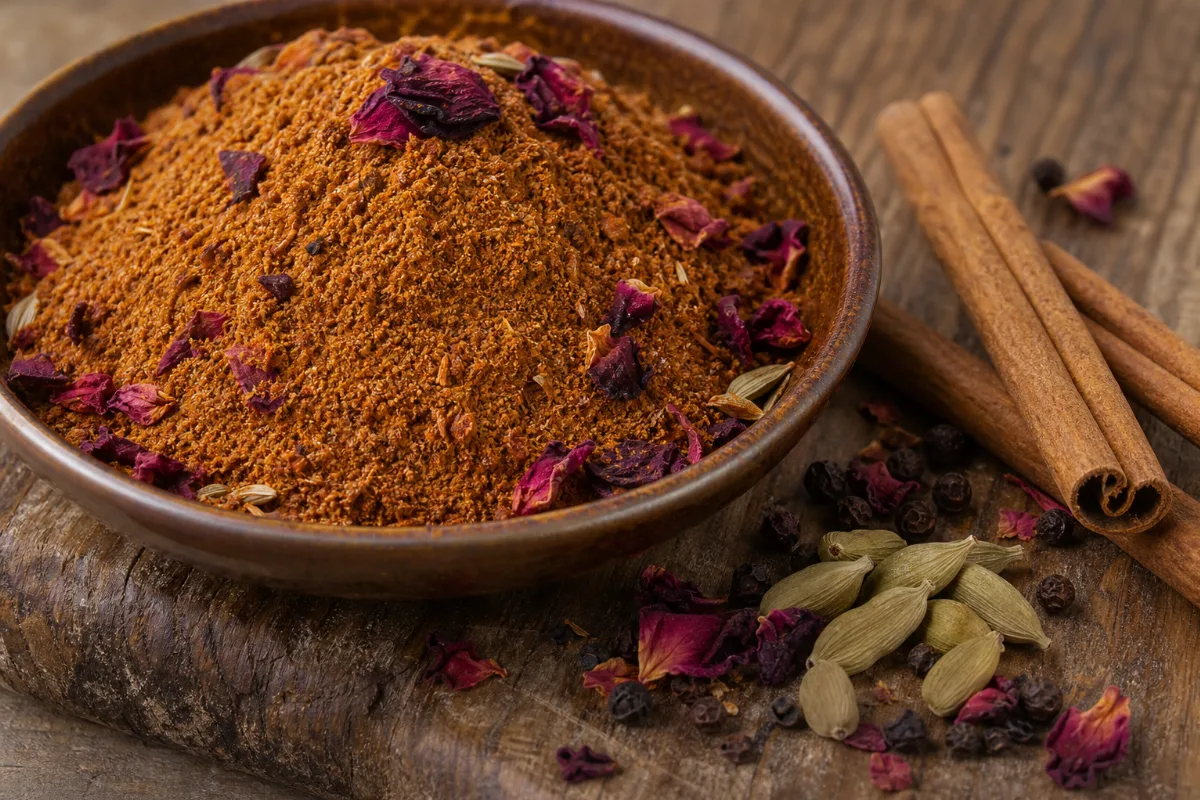
No definitive recipe exists. Each shop, company or family may have its own, usually with over a dozen spices in different proportions. Common ingredients include cardamom, cumin, clove, cinnamon, nutmeg, mace, allspice, dry ginger, chili peppers, coriander seed, peppercorn, paprika, fenugreek and turmeric.
In the kitchen
It is used in many savory dishes, sometimes rubbed on meat or fish, or stirred into couscous or rice. Ingredients may be toasted before grinding or pounded in a mortar.
Garlic, saffron, nuts and dry herbs are generally added to dishes separately, but some commercial blends, particularly in Europe and North America, may contain them. Some preparations include salt or sugar, though that is generally not the accepted practice.
Nutrition
We give no nutrient table. An earlier check of USDA FoodData Central found no entry for ras el hanout, and our repeat search was blocked by the database's request limit, so we did not re-verify it. Recipes differ, so one table would not fit every blend. Read the label for added salt or sugar.
What the research shows
No human study of the blend was found. The one paper we found tested a ras el hanout and olive oil, onion, garlic and lemon marinade on rabbit meat in storage, where it slowed spoilage and growth of Campylobacter jejuni. That is food science, not health.
For two common ingredients, NCCIH says it does not know enough to say turmeric or curcumin helps any health purpose, and that research does not clearly support cinnamon for any condition. Both pages are mostly about supplements.
At a glance
Traditional uses history, not proof
- Used in Morocco, Tunisia and Algeria on meat and fish and in couscous and rice
- The name is understood to mean 'head of the shop', the best mix the spice seller can offer
Studied for research
- The blend eaten as a seasoning: no human study found
- Turmeric and cinnamon inside the blend: unclear evidence, mostly from supplements, insufficient certainty
- A meat storage test with the blend as a marinade, very low certainty and not a health outcome
Main compounds
- No compound list exists for the blend because the recipe varies
- Often includes cumin, coriander, cinnamon, ginger, turmeric, paprika, cardamom and cloves
Common forms
- Dry ground blend, the usual form
- Whole spices toasted and ground or pounded at home
- Used as a rub or marinade with oil
- No supplement form of the blend was found
Research links: NCCIH: Turmeric · NCCIH: Cinnamon · FDA: Sesame is the ninth major food allergen · Lead in spices, North Carolina (MMWR 2018) · Research Library · Genes & Biomarkers Library
What it is and its history
- Accepted scientific name
- Ras el hanout (a spice blend, not a single plant)
- Synonyms
- Rass el hanout
- Common names
- Ras el hanout (Arabic transliteration); Rass el hanout (alternate spelling); Head of the shop (English translation of the Arabic name)
- Native range
- A spice mix found in Tunisia, Algeria and Morocco (Wikipedia).
- Harvest and processing
- Ingredients may be toasted before grinding or pounded in a mortar and mixed (Wikipedia).
- Look-alikes and adulterants
- Name: Other spice blends such as garam masala or curry powder; Note: Different recipes from other regions, though some ingredients overlap.
Photographs
Traditional use and history history, not clinical proof
| Tradition or era | Documented use | Source |
|---|---|---|
Traditional use shows how it was used. It does not show that it works or is safe today.
What is inside, and how it may work
What it contains and how those compounds act in cells and animals. Laboratory and animal mechanisms are not proven effects in people.
Absorption, metabolism and elimination
- Absorption
- Not found for the blend.
- Distribution
- Not found.
- Metabolism
- Not found.
- Elimination
- Not found.
- Bioavailability
- Not established.
Isolated compounds versus whole extracts
Research on turmeric and cinnamon that NCCIH describes is mostly on supplements or concentrated products, not on seasoning blends. No supplement form of ras el hanout was found.
Nutritional composition
No nutrient table is given. An earlier check of USDA FoodData Central (SR Legacy) found no entry for ras el hanout; our attempt to repeat that search on 2026-10-26 was blocked by the database's request limit, so it was not re-verified. The recipe changes by maker, so one table would not fit every blend. Some blends may contain added salt or sugar, so read the label.
1 very low certainty2 not enough evidence
What was looked at
The 3 benefits and uses checked for Ras el hanout, each with how strong the evidence is. Tap one to open it.
What is Ras el hanout good for?
The main studied uses and how strong the human evidence is for each. There is no human research on the blend, so this list is short.
Benefits, one by one
Each card is a research question, not a promise. Tap a goal to filter. Open a card to see the studies, doses and limits.
Ras el hanout eaten as a seasoning (health effects of the blend)
Not enough evidenceWe found no study of ras el hanout, as a blend, on any health outcome in people. It is a flavoring. Anything said about health belongs to single spices inside it, and even for those the best official summaries say the evidence is unclear.
2 studiesDry ground or whole-spice blends used in cooking. No supplement form …
Studies, doses and limits
What the trials found
A PubMed search for the blend's name found one paper (a meat storage test, see the other uses). No human trial was found.
Results
No human study of the blend was found.
Why this rating
There is no human research on the blend, and the recipe is different from maker to maker, so no result could be pooled.
Form and dose studied
Dry ground or whole-spice blends used in cooking. No supplement form of the blend was found.
Who was studied
Not studied.
Limits
Absence of studies is not proof of no effect and not proof of safety. See the Safety tab for allergens and contamination.
Why researchers looked
The blend is a mix of many spices, so people ask whether it does anything beyond flavor.
Traditional use
Used in Morocco, Tunisia and Algeria for savory dishes, rubbed on meat or fish or stirred into couscous or rice. Long use as food is not proof of a health effect.
Proposed mechanism Unknown
Not established for the blend. Composition changes from one maker to the next.
A proposed mechanism does not show that the effect happens in people.
The main practical points are allergens on the label and possible lead in some ground spices. See the Safety tab.
Single spices that are often inside the blend (turmeric, cinnamon)
Not enough evidenceTurmeric and cinnamon are often in the mix. The US government health center NCCIH says it does not know enough to say turmeric or curcumin helps any condition, and that research does not clearly support cinnamon for any condition. That research is mostly on supplements, not on a pinch in a blend.
2 studiesStudies are of supplements or extracts, not of a blend.
Studies, doses and limits
What the trials found
NCCIH describes studies of turmeric or curcumin products (for example for knee osteoarthritis, fatty liver and cholesterol) and says the initial evidence is positive for some measures but that higher-quality evidence is needed. For cinnamon it says it is unclear whether supplements help diabetes or weight loss.
Results
Neither page supports a health claim for the spice at the amounts found in a seasoning blend.
Why this rating
Results are for supplements or concentrated products, the species and part of cinnamon are often unclear, and the blend has not been studied.
Form and dose studied
Studies are of supplements or extracts, not of a blend.
Who was studied
Mostly adults with specific conditions, in studies summarized by NCCIH.
Limits
We read the NCCIH summaries only, not the underlying trials. Other spices in the blend (cumin, ginger, paprika, cardamom, cloves, nutmeg, black pepper, fenugreek) were not re-read here; each has its own page.
Why researchers looked
People hope the health claims for single spices carry over to a blend.
Traditional use
Both spices have long traditional medicine uses (NCCIH); this is not proof from trials.
Proposed mechanism Unknown
Not discussed by NCCIH in these pages in a way that applies to a blend.
A proposed mechanism does not show that the effect happens in people.
Highly absorbable curcumin products have been linked to liver harm, and some cassia cinnamon products are high in coumarin. Those are not a pinch of a blend. See the Safety tab.
Spoilage and Campylobacter in rabbit meat marinated with the blend (a food-science test, not a health outcome)
Very low certaintyOne laboratory study marinated whole rabbit carcasses with an Algerian-type ras el hanout and olive oil, onion, garlic and lemon, and stored them. The marinated meat spoiled more slowly and had less growth of the germ Campylobacter jejuni. It is about meat storage, not about what the blend does in people.
1 studiesA spice mixture plus a marinade, used on meat. Not a supplement.
Studies, doses and limits
Results
Marinating with the blend delayed growth of the main spoilage microbes, fat oxidation, protein breakdown and colour change from day 5 to day 20 of display at 7 degrees C, and inhibited Campylobacter jejuni. A taste panel rated the marinated meat most positively.
Effect sizes as reported
No numbers were read in the abstract.
Why this rating
One laboratory study on one kind of meat with one recipe, only the abstract read, and the marinade held other ingredients as well. It does not show anything about health.
Form and dose studied
A spice mixture plus a marinade, used on meat. Not a supplement.
Who was studied
Rabbit meat.
Limits
The effect of the spice mixture alone was not separated from olive oil, onion, garlic and lemon. Not a reason to leave meat unrefrigerated or to skip cooking it thoroughly.
Why researchers looked
Food scientists test spice blends as natural ways to keep meat fresh.
Traditional use
Spices have long been used in marinades; this does not prove they make food safe.
Proposed mechanism Laboratory research
Not established. The authors tested meat quality and microbes, not how the spices work.
A proposed mechanism does not show that the effect happens in people.
Cook meat properly and keep it cold whatever the seasoning. A marinade does not replace food-safety steps.
Connections to the rest of health
How Ras el hanout connects to the rest of our health knowledge graph. Every link says what kind of connection it is. A safety link (for example to the liver) is a warning, not a benefit. A study that merely mentions a topic never creates a benefit link.
Explore every connection: goals, body systems, organs, symptoms, genes
B. Body systems
| Connected to | Kind of connection | Evidence status | Context | Studies |
|---|---|---|---|---|
| Digestive System | Biological association | Not enough evidence | Studied for: Ras el hanout eaten as a seasoning (health effects of the blend) | 8 2 |
E. Health conditions
| Connected to | Kind of connection | Evidence status | Context | Studies |
|---|---|---|---|---|
| Food allergy | Documented risk | Recipes vary, so the label matters. Recipes vary, so a blend may contain sesame, mustard or celery. Preparation or compound: Blend with sesame, mustard or celery |
3 5 | |
| Lead poisoning | Documented risk | Found in some ground spices in one investigation; the blend was not tested separately. Preparation or compound: Some ground spices |
1 |
Each connection is stored with the ingredient, the connected record, the kind of connection, the evidence status, the supporting studies, the preparation or compound involved, and a review date (last reviewed October 26, 2026).
Evidence at a glance: what the research found for 3 outcomes
Each outcome below is one thing researchers measured. Certainty is how far the evidence can be trusted, not how well it works. The full studies are on the next tab.
The evidence
The research centre for Ras el hanout. Every record here was checked against PubMed or the publisher's page; we never list a study we have not verified.
Evidence by outcome
Bars show how many studies we found for each outcome, not how well it works. People are added up across trials only (reviews are not added, to avoid double counting).
How we rate evidence
High certainty
Several well-run trials or reviews agree; further research is unlikely to change the picture much.
Moderate certainty
Good trials point the same way, but some doubt remains.
Low certainty
Small, short or inconsistent trials. The finding could change with better research.
Very low certainty
Very little or very weak human data. Treat as a possibility only.
Mixed findings
Trials or reviews disagree with each other.
Not enough evidence
Not enough human research to say either way.
Evidence against
Good research found no benefit, or found harm.
We take the reviewers' own risk-of-bias and GRADE statements where they exist, and otherwise judge from study size, design, consistency, directness and whether a product matches what is sold. Many publications do not make evidence high. Method note: We started from our existing summary of the blend, re-read the Wikipedia article, the NCCIH turmeric and cinnamon pages, the FDA and EU allergen pages and the FDA spice update, and read the PubMed record for the one blend paper and for the lead report. Little research exists for the blend, so the page is short. Items we could not verify are flagged in the research gaps.
Study library: every study we checked 8
| Study | Design | People | Product, dose, length | Result |
|---|---|---|---|---|
| Angelon-Gaetz 2018 Lead in Spices, Herbal Remedies, and Ceremonial Powders Sampled from Home Investigations for Children with Elevated Blood Lead Levels - North Carolina, 2011-2018. MMWR Morb Mortal Wkly Rep · PMID 30462630 · DOI |
Retrospective case series of home investigations human homes (product testing) |
386 386 samples of spices, herbal remedies and ceremonial powders from 59 homes of 61 children with elevated blood lead in North Carolina |
Not an intervention: lead testing of products found in homes 2011 to 2018 |
More than one fourth (28.8%) of the spices, herbal remedies and ceremonial powders sampled contained 1 mg/kg lead or more. In the full text, turmeric averaged 66 mg/kg (range 0.1 to 740), and the country of purchase was known for only 48 percent of samples. Ras el hanout does not appear in the results table. The authors suggest a national maximum limit for lead in spices. 28.8% of 386 samples at 1 mg/kg or more Methods, limits and fundingOutcomes: Lead in the products (mg/kg) Limitations: Homes of children who already had high blood lead, so it does not show how common lead is in shop spices. Origin mostly unknown. Not about ras el hanout. Funding and conflicts: No conflicts disclosed. Read: abstract plus full-text results (PMC6289082) |
| Djenane 2023 Use of Algerian Type Ras El-Hanout Spices Mixture with Marination to Increase the Sensorial Quality, Shelf Life, and Safety of Whole Rabbit Carcasses under Low-O2 Modified Atmosphere Packaging. Foods · PMID 37569200 · DOI |
Laboratory food science study (meat storage test) rabbit meat (food science) |
Whole rabbit carcasses (meat), not people | An Algerian-type ras el hanout spice mixture with a marinade of extra virgin olive oil, onion, garlic and lemon juice Spice mixture Not given as advice 0 to 20 days of retail display at 7 degrees C · vs Unmarinated rabbit carcasses; aerobic versus low-oxygen packaging |
Marinating with the ras el hanout blend kept meat water-holding and pH in a good range, delayed spoilage microbes, fat oxidation and colour change from day 5 to day 20, and inhibited Campylobacter jejuni. Taste-panel scores for the marinated meat were the most positive. The authors say the combination may suit retail use. No effect sizes were read in the abstract. Methods, limits and fundingOutcomes: Meat pH, water holding, tenderness, fat oxidation, spoilage microbes, colour, taste panel scores and Campylobacter jejuni growth Limitations: About meat storage, not human health. The marinade also had oil, onion, garlic and lemon, so the spice mixture alone was not isolated. Only the abstract was read. Funding and conflicts: Authors declare no conflict of interest and say the funders had no role. Read: abstract |
| s-fda-sesame FDA: The FASTER Act, Sesame Is the Ninth Major Food Allergen · Source |
Regulator page n/a |
Methods, limits and fundingRead: full-text | ||
| s-fda-spice-risk-2018 FDA: FDA Updates Spice Risk Profile, Adds Information About Lower Salmonella Prevalence in Retail Products (15 February 2018) · Source |
Regulator update n/a |
Methods, limits and fundingRead: full-text | ||
| s-fsai-allergens FSAI (Ireland): List of 14 allergens that must be declared in the EU · Source |
Regulator page n/a |
Methods, limits and fundingRead: full-text | ||
| s-nccih-cinnamon NCCIH: Cinnamon, Usefulness and Safety · Source |
Government health information page n/a |
Methods, limits and fundingRead: full-text | ||
| s-nccih-turmeric NCCIH: Turmeric, Usefulness and Safety · Source |
Government health information page n/a |
Methods, limits and fundingRead: full-text | ||
| s-wiki-ras-el-hanout Wikipedia: Ras el hanout (article text read 2026-10-26) · Source |
Encyclopedia n/a |
Methods, limits and fundingRead: full-text |
What we do not know yet
- No human study of ras el hanout as a blend on any health outcome was found.
- Nutrition for the blend was not verified.
- No safety information for pregnancy, breastfeeding or children for the blend.
- Lead and Salmonella data do not cover the blend separately.
- The single-spice evidence was read only as NCCIH summaries.
How new research is added
New studies are found by a saved PubMed search and placed in a review queue before the page changes.
Lab markers
What changed in blood or saliva tests during trials. A changed number is not the same as feeling or being healthier, and we give no "normal ranges".
Safety
What studies and official sources say about side effects, medicines and who should check first. Each point shows what kind of evidence it comes from.
Main points to know 2
- Read the label if you avoid sesame, mustard, celery or other allergens. The recipe differs from maker to maker, so a bought blend may contain sesame, mustard or celery, and some commercial blends add garlic, nuts or other extras. In the EU, celery, mustard and sesame must be declared. In the US, sesame must be labelled on packaged foods since 1 January 2023, and FDA warns some recipes now include small amounts of sesame. If you are allergic and the label is unclear, ask the maker. Authoritative guidance 3 5 8
- Lead can be present in some ground spices; blends were not tested separately. A North Carolina investigation of homes of children with high blood lead found 28.8% of 386 spice, herbal and ceremonial samples had 1 mg/kg lead or more. Ras el hanout is not in the results table. It was a study of homes already linked to lead cases, so it does not show how common lead is in shop spices. Buying from a trusted source is sensible, especially for children and pregnancy. Case series 1
Side effects 2
| Effect | How often | Severity and recovery | Evidence |
|---|---|---|---|
| Allergic reaction in someone allergic to an ingredient in the blend (for example sesame, mustard, celery) The sources describe labelling rules, not how often blends cause reactions. | Not found for the blend. It depends on the recipe. | varies; food allergy can be serious Not assessed in the sources read. | Authoritative guidance 3 5 |
| No other adverse effect of the blend in food amounts was found in the sources read Absence of reports is not proof of safety. Single spices inside have their own pages. | Not applicable. | unknown Not applicable. | Unknown 8 |
Liver
No liver injury linked to the blend was found. NCCIH says liver damage has been reported with highly bioavailable curcumin supplements, and that some cassia cinnamon products are high in coumarin, which has been linked to liver effects in sensitive people. Those are supplements or heavy cassia use, not a seasoning blend. 7 6
Monitoring. NCCIH advises stopping curcumin products and talking to a health provider if signs such as fatigue, nausea, poor appetite, dark urine or jaundice appear.
This is a safety connection. It is not evidence that Ras el hanout supports liver health.
Medicines and supplements 3
| With | Why it matters | Importance | Evidence | What to do |
|---|---|---|---|---|
| Medicines in general (the blend as food) prescription | Unknown. No interaction study of the blend was found. | Unknown Not enough evidence 7 | If you take regular medicines, a pharmacist can check anything that is unusual for you, such as supplements of the spices inside. | |
| An anticancer medicine or nicotine (cinnamon, one possible ingredient) prescription | NCCIH says, based on research partly funded by it, there are theoretical reasons to suspect that some components of cinnamon may interact with an anticancer medicine or nicotine. | Theoretical, and about cinnamon, not the blend. | Theoretical Very low certainty 6 | Ask a pharmacist or doctor if you take cancer treatment and use cinnamon products regularly. |
| Medicines (turmeric or curcumin supplements, one possible ingredient) prescription | NCCIH says some herbs and medicines interact in harmful ways and to talk to a health care provider before using any herbal product. | General warning on supplements, not about the spice in a blend. | Authoritative guidance Not enough evidence 7 | Tell your provider about any turmeric or curcumin supplement. |
Who should check first 1
Overdose, product quality and regulators
Summary. No toxicity of the blend in cooking amounts was found in the sources read. Hot-chili blends can irritate the mouth and stomach, but no source read states this for the blend.
Animal. Not found.
Human doses studied. No safe or unsafe amount for the blend is stated in the sources read.
High dose or long term signals. Not found for the blend.
Overdose response. Not found.
Genotoxicity. Not found.
Toxic or hazardous parts. Not named in the sources read.
Two contamination points came from the sources read: lead in some ground spices, and Salmonella in dried spices. Neither source tested ras el hanout separately.
Lead in spices. 28.8% of 386 spice, herbal remedy and ceremonial powder samples from homes of children with raised blood lead had 1 mg/kg lead or more. Turmeric averaged 66 mg/kg (range 0.1 to 740). Origin was largely unknown. Ras el hanout is not in the table. 1
Salmonella in dried spices. FDA found Salmonella in nine of 11 types of retail dried spices at significantly lower rates than in imported shipments, and says this fits industry treatment after import. Dehydrated garlic and basil were exceptions. Blends were not among the 11 types named in the update. 4
Old Moroccan formulas. Wikipedia says some older Moroccan formulas included supposed aphrodisiacs, among them cantharides (a dangerous beetle), but these seem irrelevant to flavoring. We found no source about modern blends and did not test any product. 8
| Body | Action | Date |
|---|---|---|
| FDA (US) (United States) | Sesame is the ninth major food allergen; labelling on packaged foods and dietary supplements required from 1 January 2023. Some recipes now include small amounts of sesame. source | 2023-01-01 |
| FSAI summary of EU rules (European Union / Ireland) | Celery, mustard and sesame seeds, among 14 allergens, must be declared. source | |
| FDA (US) (United States) | Spice risk profile update on Salmonella in retail versus imported dried spices. source | 2018-02-15 |
| CDC (MMWR) (United States) | Authors suggest a national maximum limit for lead in spices and herbal remedies. source | 2018-11-23 |
| NCCIH (US) (United States) | Turmeric and cinnamon pages: not enough evidence of benefit for any condition; supplements have specific cautions (liver, pregnancy, coumarin). source |
When to get medical help
- Trouble breathing, swelling of the lips or throat, widespread hives, repeated vomiting or fainting soon after eating: call emergency services. These can be signs of a serious allergic reaction.
- Liver warning signs if you also take curcumin supplements: unusual tiredness, nausea, poor appetite, dark urine or yellow skin or eyes. Stop the supplement and call your health provider.
Stop using the product and contact a clinician or emergency service. In the US, Poison Control is 1-800-222-1222.
General information only, not medical advice. Ask a clinician or pharmacist before use, especially with medicines, in pregnancy or with a health condition. See the Natural Remedy Safety guide.
Frequently asked questions
What is ras el hanout?
A dry spice blend found in Tunisia, Algeria and Morocco. The name means 'head of the shop'.
What is in it?
There is no fixed recipe. Common ingredients include cumin, coriander seed, cinnamon, ginger, turmeric, paprika, chili, cardamom, cloves, nutmeg, mace, allspice, pepper and fenugreek.
What does it taste like?
Warm and complex, with sweet spices beside earthy ones. The sources we read do not describe the taste in detail, and the heat depends on the recipe.
How is it used in cooking?
Often rubbed on meat or fish, or stirred into couscous or rice.
Is there research on its health effects?
Does it contain allergens?
Can it contain lead?
Lead was found in some ground spices in a North Carolina investigation of homes with lead-exposed children. Ras el hanout was not listed, and the study cannot show how common lead is in shop spices.
Is it safe in pregnancy?
Can I use it with my medicines?
No interaction was found for the blend in the sources read. If you take medicines and also use turmeric or curcumin supplements, ask a pharmacist.
Does it contain salt or sugar?
Some preparations do, though that is generally not the accepted practice. Bought blends may differ, so read the label.
Does it make meat safer?
One lab study found the blend, in a marinade with oil, onion, garlic and lemon, slowed spoilage and Campylobacter growth in stored rabbit meat. It does not replace cooking meat properly and keeping it cold.
Explore by health goal
Editorial transparency
- Written by
- AlternativeMed editorial team. Research compiled with AI assistance, then checked against the sources listed.
- Medical review
- None. This page has not been reviewed by a physician or pharmacist.
- First published
- 2026-10-26
- Last substantive update
- 2026-10-26
- How we research
- We started from our existing summary of the blend, re-read the Wikipedia article, the NCCIH turmeric and cinnamon pages, the FDA and EU allergen pages and the FDA spice update, and read the PubMed record for the one blend paper and for the lead report. Little research exists for the blend, so the page is short. Items we could not verify are flagged in the research gaps.
- How we rate evidence
- See "How we rate evidence" in the Evidence tab.
- Independence
- No product is promoted on this page. No affiliate links are shown.
Sources 8
Each source was opened and checked. Where we read only the abstract, it says so. The small numbers in the text point here.
- Angelon-Gaetz KA, Klaus C, Chaudhry EA, Bean DK.. Lead in Spices, Herbal Remedies, and Ceremonial Powders Sampled from Home Investigations for Children with Elevated Blood Lead Levels - North Carolina, 2011-2018.. MMWR Morb Mortal Wkly Rep. 2018. PMID 30462630. DOI 10.15585/mmwr.mm6746a2. (abstract plus full-text results (PMC6289082))
- Djenane D, Ben Miri Y, Arino A.. Use of Algerian Type Ras El-Hanout Spices Mixture with Marination to Increase the Sensorial Quality, Shelf Life, and Safety of Whole Rabbit Carcasses under Low-O2 Modified Atmosphere Packaging.. Foods. 2023. PMID 37569200. DOI 10.3390/foods12152931. (abstract)
- . FDA: The FASTER Act, Sesame Is the Ninth Major Food Allergen. . . (full-text)
- . FDA: FDA Updates Spice Risk Profile, Adds Information About Lower Salmonella Prevalence in Retail Products (15 February 2018). . . (full-text)
- . FSAI (Ireland): List of 14 allergens that must be declared in the EU. . . (full-text)
- . NCCIH: Cinnamon, Usefulness and Safety. . . (full-text)
- . NCCIH: Turmeric, Usefulness and Safety. . . (full-text)
- . Wikipedia: Ras el hanout (article text read 2026-10-26). . . (full-text)
Where to buy
Check the label first. Whatever you buy, look for these:
- Whole or ground: whole spices keep their flavor longer
- The origin and a packed-on or best-by date for freshness
- Organic or non-irradiated labeling if that matters to you
- A resealable, airtight container
Talk to a pharmacist or doctor before you start any supplement, especially if you take medicines. See the Safety tab for interactions.
Support our free guides: as an Amazon Associate we earn from qualifying purchases. Full disclosure.


