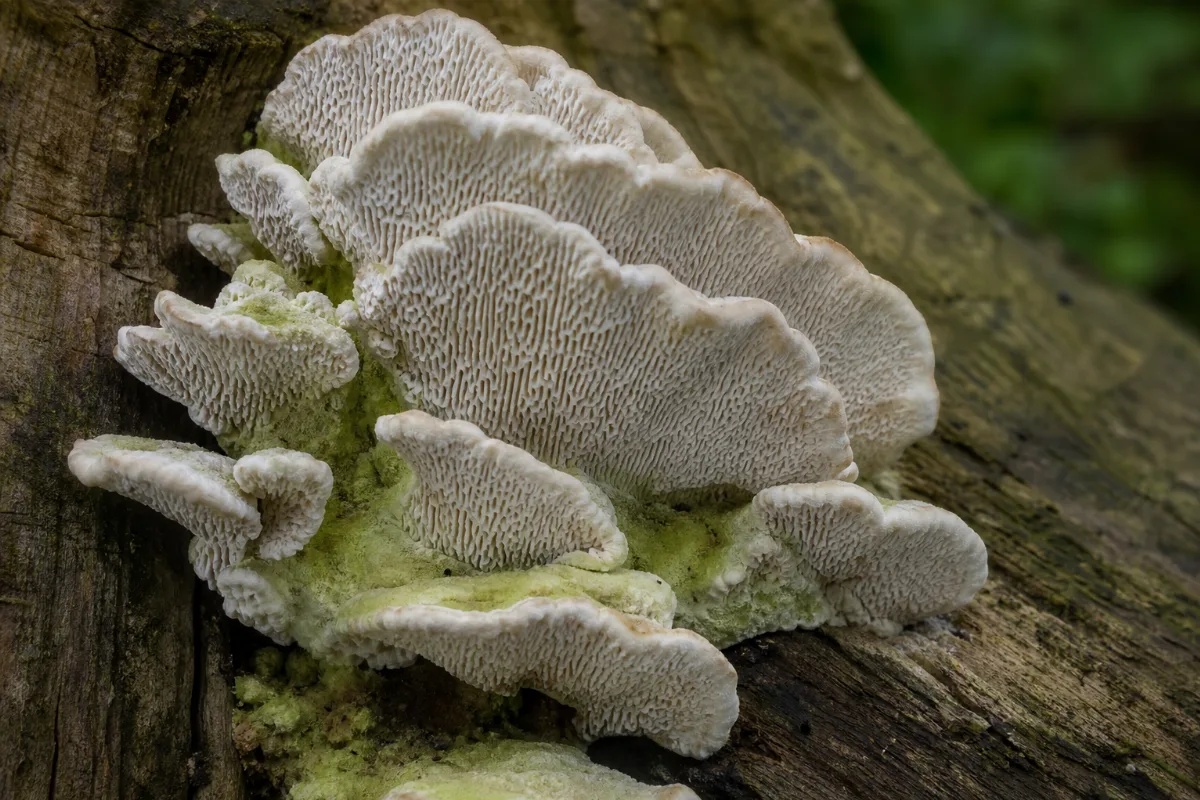
Mushrooms · Wild polypore
Lumpy bracket
Trametes gibbosa (older name Lenzites gibbosa) · also called Unequal bracket
Lumpy bracket is a tough bracket fungus that rots dead hardwood, such as beech. It is a relative of turkey tail, but it is not a food and we found no supplement made from it. The research is thin: lab and animal studies, none in people. Do not use a wild fungus unless an expert has identified it.
General information, not medical advice. Last substantive update · Not medically reviewed. A named clinician has not signed off on this page. How this page is made
About Lumpy bracket
Lumpy bracket (Trametes gibbosa) is a tough, lumpy bracket fungus that rots dead hardwood. It is a relative of turkey tail, but the turkey tail research does not apply to it. Everything known about its effects comes from cell dishes, test tubes and two small animal studies. We found no human study, no safety data and no product. Do not use a wild fungus without an expert.
What it is, and the naming
Lumpy bracket is a Eurasian wood-decay fungus found on beech and other hardwoods. It has a lumpy, zoned cap, tough white flesh and a white pore surface. It has been introduced to North America and is spreading there.
GBIF lists Trametes gibbosa as the accepted name. Lenzites gibbosa, used in some papers, is an older name. A 2025 review also calls it unequal bracket.
In North America it was long mistaken for another species, 'Trametes elegans'. A result on one species cannot be assumed for another, so check the Latin name on anything you read.
What the research shows
Nothing has been tested in people. A 2023 cell study found that a sugar-rich fraction switched on the TLR4 immune receptor. A 2016 screen found an ethanol extract increased phagocytosis in isolated human white cells.
A 2024 paper reported that a hot-water extract was comparable to silymarin on liver markers in rats with chemical liver injury. A 2013 mouse study found a sugar made in liquid culture lowered blood sugar in diabetic mice.
Other papers report weak germ-slowing, weak cancer-cell toxicity, an enzyme result and an antiviral screen. These results show interesting chemistry. They cannot show a health effect, because test-tube and animal results often fail in people.
How strong is the evidence?
Every result is rated very-low or insufficient. The studies are abstract-only reads of lab or animal work, mostly from single groups, and several use different preparations: a sugar fraction, solvent extracts, mycelium extracts and a liquid-culture sugar. The antiviral abstract gives no numbers. A 2025 review lists many activities, but cites older papers and gives no human evidence.
Forms and products
We found no consumer product made from lumpy bracket, so we cannot say what one would contain. The lab work used solvent extracts, a purified sugar fraction and a liquid-culture sugar, which are not tea, powder or capsules. For medicinal mushrooms in general, NCI says supplement ingredients may vary considerably from lot to lot. Fruiting body and mycelium extracts behaved differently in one comparison.
At a glance
Traditional uses history, not proof
- A 2025 review calls it a mushroom used in Asian medicine, but gives no source for that claim, so we treat it as not verified.
Studied for research
- Immune-cell signalling, not enough evidence (cell dishes only)
- Antioxidant tests, not enough evidence (test tube only)
- Liver protection, very low evidence (one rat study)
- Blood sugar, very low evidence (one mouse study of a lab-made extract)
- Germs, flu viruses and cancer cells in dishes, not enough evidence
- Any use in people, not enough evidence (nothing found)
Main compounds
- A sugar-rich polysaccharide fraction (mostly glucose)
- Extracts that contain tannins, flavonoids and triterpenoids (screening groups, not measured)
Common forms
- Solvent and hot-water extracts (laboratory only)
- A sugar made in liquid culture (laboratory only)
- No consumer product was found
Research links: Liver protection in rats (abstract) · Immune-receptor activation in cells (abstract) · Blood sugar in diabetic mice (abstract) · Three Trametes species compared in the lab (abstract) · MushroomExpert: Trametes gibbosa · NCI: Medicinal mushrooms (PDQ) · Research Library · Genes & Biomarkers Library
What it is and its history
- Accepted scientific name
- Trametes gibbosa
- Naming authority
- (Pers.) Fr. (GBIF)
- Synonyms
- Lenzites gibbosus (Pers.) Hemmi (GBIF lists this as a synonym; papers write Lenzites gibbosa)
- Common names
- Lumpy bracket (English); Unequal bracket (English)
- Family or group
- Polyporaceae (a fungus family; bracket fungi), not a plant
- Classification
- Fungi > Basidiomycota > Agaricomycetes > Polyporales > Polyporaceae > Trametes > Trametes gibbosa
- Native range
- MushroomExpert says Eurasian; introduced to North America, where it is spreading quickly.
- Habitat
- Deadwood of beech and other hardwoods (MushroomExpert).
- What it looks like
- Fruiting body: Lumpy, zoned-tomentose cap; tough white flesh; white pore surface usually of slot-like pores with thick walls; spores 4 to 5 micrometres long (MushroomExpert).
- Cultivation
- Grown in liquid and on wood in lab studies (liquid-culture polysaccharide; wood-decay research). No cultivation as a food or supplement was found.
- Harvest and processing
- Not found in the sources read.
- Look-alikes and adulterants
- Name: Trametes species 01 (North America); Note: MushroomExpert says the cap of T. gibbosa is usually thicker and more tomentose with more slot-like pores, but features are not stable and spores may need measuring.; Name: Turkey tail (Trametes versicolor); Note: A relative; its research does not apply to lumpy bracket.
- Sustainability and conservation
- Not checked. MushroomExpert describes it as spreading in North America.
Traditional use and history history, not clinical proof
| Tradition or era | Documented use | Source |
|---|---|---|
| Asian medicine (claimed) | A 2025 review calls it a mushroom used in Asian medicine, citing three papers. We traced no primary traditional source. NOT verified. | p41157106 |
Traditional use shows how it was used. It does not show that it works or is safe today.
What is inside, and how it may work
What it contains and how those compounds act in cells and animals. Laboratory and animal mechanisms are not proven effects in people.
Main compounds
| Compound | Family | Where it is concentrated | Activity studied | Level of evidence |
|---|---|---|---|---|
| Hot-water polysaccharide fraction (mostly glucose) | polysaccharide | Fruiting body Total sugar about 90% of the fraction (abstract of the 2023 paper) | Activated a TLR4 reporter in cells. Total sugar is not a beta-glucan figure. 2 | Laboratory research |
| Extracellular polysaccharide (EPS) from liquid culture | polysaccharide | Culture broth | Fr-I fraction weight-average molar mass 3.872 x 10^5 g/mol (abstract); lowered blood sugar in diabetic mice. 7 | Animal research |
| Tannins, flavonoids, triterpenoids, anthraquinones, alkaloids (screening groups) | mixed groups | Methanol extract (mushroom part not stated) | Reported by a mycochemical screen; not isolated or measured. 1 | Laboratory research |
Mechanisms, receptors and pathways
| Target or pathway | Gene or receptor | What was found | Level |
|---|---|---|---|
| TLR4 signalling | TLR4, IL-8 | A polysaccharide fraction activated the TLR4 reporter and raised IL-8 in cells; cells without TLR4 did not respond. 2 | Laboratory research |
| Phagocytosis by white cells | Not given | An ethanol extract raised phagocytosis in isolated human granulocytes. 3 | Laboratory research |
| Tyrosinase | Tyrosinase | Mycelium extract inhibited the enzyme more than kojic acid in a test tube. 5 | Laboratory research |
Absorption, metabolism and elimination
- Absorption
- Not studied.
- Distribution
- Not studied.
- Metabolism
- Not studied.
- Elimination
- Not studied.
- Bioavailability
- Not established.
Isolated compounds versus whole extracts
Every result is for a lab preparation: a purified sugar fraction, a solvent extract, a mycelium extract or a liquid-culture sugar. No result is for a whole mushroom, tea, powder or capsule.
Nutritional composition
Not a food mushroom as far as the sources read show. We found no USDA entry and no nutrient table, so no nutrient figures are given.
2 very low certainty6 not enough evidence
What was looked at
The 8 benefits and uses checked for Lumpy bracket, each with how strong the evidence is. Tap one to open it.
- Immune-cell signalling (cell tests only)Not enough evidence
- Antioxidant tests (test tube only)Not enough evidence
- Liver protection in rats (animal study)Very low certainty
- Blood sugar and fats in diabetic mice (animal study)Very low certainty
- Germs and fungi in the lab (test tube only)Not enough evidence
- Cancer cells in dishes (cell tests only)Not enough evidence
- Enzyme tests linked to skin pigment and memory (test tube only)Not enough evidence
- Flu viruses in the lab (test tube only)Not enough evidence
Lab markers tracked in the studies
TLR4 receptor activation in reporter cellsPhagocytosis by isolated human white cellsDPPH radical scavengingLiver blood markers and tissue (rat)Blood sugar in diabetic miceGrowth inhibition of test germsTyrosinase enzyme activity
What is Lumpy bracket good for?
The uses people ask about and how strong the evidence is for each. All of it is from dishes, test tubes or animals, and none is shown in people. Read this together with the Safety tab.
Benefits, one by one
Each card is a research question, not a promise. Tap a goal to filter. Open a card to see the studies, doses and limits.
Immune-cell signalling (cell tests only)
Not enough evidenceIn cell dishes, a sugar-rich fraction from lumpy bracket switched on an immune receptor (TLR4) and raised an immune signal protein (IL-8). An ethanol extract also made isolated human white cells swallow more particles. These are test results, not effects in people.
2 studiesFraction made by hot-water extraction, ethanol precipitation and dial…
Studies, doses and limits
Results
2023 (Iran): a polysaccharide fraction of about 90% sugar, mostly glucose, activated a TLR4 reporter in a dose-dependent way and raised IL-8; cells without TLR4 did not respond. 2016 (Central Europe): of 27 polypore ethanol extracts, T. gibbosa was one of five that significantly increased phagocytosis by isolated human granulocytes (181% for T. gibbosa).
Effect sizes as reported
Cell-dish activity only; no effect size in people
Why this rating
Two cell-based papers (abstracts read). Cell results rarely carry over to people.
Form and dose studied
Fraction made by hot-water extraction, ethanol precipitation and dialysis; ethanol extract. These are lab preparations, not a tea, powder or capsule, and no product was found.
Who was studied
Engineered human reporter cells; isolated human neutrophils
Limits
Abstracts only; no figures for dose responses; the 90% figure is a total sugar count, not a beta-glucan count; no animal or human data.
Why researchers looked
Many Trametes mushrooms are said to affect immune cells, and researchers tested whether this species does the same in a dish.
Traditional use
No traditional use is documented in a primary source we read. A 2025 review says it is used in Asian medicine but gives no source for that claim.
Proposed mechanism Laboratory research
The polysaccharide fraction activated the TLR4 receptor pathway in reporter cells. TLR4 is a receptor on immune cells.
A proposed mechanism does not show that the effect happens in people.
No human safety data were found. See the Safety tab. Do not use a wild fungus unless an expert has identified it.
Antioxidant tests (test tube only)
Not enough evidenceHot-water and methanol extracts of lumpy bracket neutralised test chemicals in the lab, with the hot-water extract doing better than methanol. Another study found fruiting-body extracts did better than mycelium extracts but less well than vitamin C. A chemical test does not show a benefit in the body.
2 studiesLab extracts only.
Studies, doses and limits
Results
2024 (Iran): DPPH test, hot-water extract IC50 414.33 micrograms per mL vs 936.92 for methanol extract. 2018 (Serbia): fruiting-body extracts of Trametes species were better ABTS scavengers and iron reducers than mycelium extracts, but less effective than ascorbic acid.
Effect sizes as reported
Test-tube activity only; the hot-water extract was stronger than the methanol extract
Why this rating
Test-tube chemistry in two abstract-only papers.
Form and dose studied
Lab extracts only.
Who was studied
Chemical assays (no cells, animals or people)
Limits
Abstracts only; different assays in each paper; no human data.
Why researchers looked
Antioxidant chemistry is a quick first screen for a new mushroom extract.
Traditional use
No traditional use is documented in a primary source we read. A 2025 review says it is used in Asian medicine but gives no source for that claim.
Proposed mechanism Laboratory research
Radical-scavenging chemistry in test tubes, possibly from phenolics and sugars. Not shown to act in the body.
A proposed mechanism does not show that the effect happens in people.
No human safety data were found. See the Safety tab. Do not use a wild fungus unless an expert has identified it.
Liver protection in rats (animal study)
Very low certaintyIn one short experiment, rats given a chemical that injures the liver were also given a hot-water extract of lumpy bracket. The authors say liver markers and tissue results were comparable to the reference drug silymarin. Rat injury models do not show a benefit in people.
1 studiesHot-water extract of the mushroom given to rats. No product for peopl…
Studies, doses and limits
Results
2024 (Iran): in rats injured with carbon tetrachloride for 7 days, the two higher of three extract doses were reported comparable to silymarin on liver blood markers, and better on tissue examination. The abstract gives no marker values or rat numbers.
Effect sizes as reported
Reported as comparable to silymarin in a rat injury model; no figures in the abstract
Why this rating
One animal study, abstract read, chemical-injury model, no marker values, no human data.
Form and dose studied
Hot-water extract of the mushroom given to rats. No product for people was found.
Who was studied
Rats
Limits
Single abstract-only study; number of rats and funding not stated; the study cannot show liver safety or benefit in people.
Why researchers looked
Iranian researchers looked for a liver-protecting extract after a test-tube antioxidant screen.
Traditional use
No traditional use is documented in a primary source we read. A 2025 review says it is used in Asian medicine but gives no source for that claim.
Proposed mechanism Hypothesis
Not shown. The authors link it to the extract's antioxidant activity but did not prove how it works.
A proposed mechanism does not show that the effect happens in people.
Nothing here says lumpy bracket is safe for the liver. See the Safety tab.
Blood sugar and fats in diabetic mice (animal study)
Very low certaintyA sugar-rich substance made by growing the fungus in liquid culture lowered blood sugar and fats in diabetic mice. It was not the mushroom itself, and nobody has tested it in people.
1 studiesA polysaccharide made in a fermentation tank, not a mushroom, tea or …
Studies, doses and limits
Results
2013 (China): the extracellular polysaccharide (EPS) from liquid culture decreased plasma glucose by 17.4%, total cholesterol by 14.0% and triacylglycerol by 12.6% in streptozotocin diabetic mice.
Effect sizes as reported
17.4% lower glucose in diabetic mice (single study)
Why this rating
One mouse study of a lab-fermented extract; abstract read; no human data.
Form and dose studied
A polysaccharide made in a fermentation tank, not a mushroom, tea or capsule.
Who was studied
Mice made diabetic with streptozotocin
Limits
Abstract only; number of mice and comparison group not stated; source is culture broth, not the wild fruiting body.
Why researchers looked
Researchers who isolated a new strain tested the sugars it released into its growth liquid.
Traditional use
No traditional use is documented in a primary source we read. A 2025 review says it is used in Asian medicine but gives no source for that claim.
Proposed mechanism Hypothesis
Not studied beyond the effect measurement.
A proposed mechanism does not show that the effect happens in people.
Nothing is known about safety in people. Anyone who takes diabetes medicine should ask a doctor before using any mushroom product.
Germs and fungi in the lab (test tube only)
Not enough evidenceA methanol extract of lumpy bracket slowed the growth of test germs in dishes. A Serbian study found low activity against Candida and Aspergillus compared with an antifungal drug. This does not show it treats any infection.
2 studiesMethanol and other solvent extracts, not food or tea.
Studies, doses and limits
Results
2017 (Ghana): methanol extract gave growth-inhibition zones of 10.00 to 21.50 mm and minimum inhibitory concentrations of 4.0 to 20 mg/mL; time-kill tests showed bacteriostatic action. 2018 (Serbia): low antifungal activity compared with ketoconazole.
Effect sizes as reported
Test-tube slowing of growth; weak against fungi compared with a drug
Why this rating
Two test-tube papers, abstracts read.
Form and dose studied
Methanol and other solvent extracts, not food or tea.
Who was studied
Test microbes in agar and broth
Limits
Abstracts only; no animal or human data; solvent extracts are not what anyone would swallow.
Why researchers looked
Wood-rotting fungi make chemicals to fight other microbes, so researchers screen them for antimicrobial activity.
Traditional use
No traditional use is documented in a primary source we read. A 2025 review says it is used in Asian medicine but gives no source for that claim.
Proposed mechanism Laboratory research
Not shown. The papers report extracts that contained tannins, flavonoids and triterpenoids.
A proposed mechanism does not show that the effect happens in people.
No human safety data were found. See the Safety tab. Do not use a wild fungus unless an expert has identified it.
Cancer cells in dishes (cell tests only)
Not enough evidenceExtracts of lumpy bracket had weak to moderate toxic effects on human cancer cell lines in dishes. This does not show it treats cancer, and anyone in cancer care should talk to their oncology team first.
2 studiesSolvent extracts of mycelium or fruiting body.
Studies, doses and limits
Results
2006 (China): the methanol extract of T. gibbosa showed weak cytotoxicity compared with quercetin on HeLa and SMMC-7721 cells. 2018 (Serbia): mycelium extracts of Trametes species were more cytotoxic than fruiting-body extracts, and cervix cells were the most sensitive.
Effect sizes as reported
Weak cell toxicity; no effect in an animal or a person
Why this rating
Two abstract-only cell studies.
Form and dose studied
Solvent extracts of mycelium or fruiting body.
Who was studied
Human cancer cell lines (HeLa, SMMC-7721, lung, colon)
Limits
Cell lines in a dish; results do not match what happens in a body; the second paper pools three Trametes species in its abstract.
Why researchers looked
Many polypores are screened for cell-killing chemistry.
Traditional use
No traditional use is documented in a primary source we read. A 2025 review says it is used in Asian medicine but gives no source for that claim.
Proposed mechanism Laboratory research
Not shown. One paper links the activity to triterpenes, sugars and polyphenols working together.
A proposed mechanism does not show that the effect happens in people.
Cell toxicity in a dish is not a safety finding and not a cancer treatment. Anyone in cancer care should tell their oncology team about any fungus product.
Enzyme tests linked to skin pigment and memory (test tube only)
Not enough evidenceIn enzyme tests, a mycelium extract of lumpy bracket blocked tyrosinase (an enzyme in skin pigment) better than the reference compound kojic acid. The same study tested a memory-related enzyme and found a different Trametes species worked best.
1 studiesMycelium extract in an enzyme assay.
Studies, doses and limits
Results
2018 (Serbia): T. gibbosa mycelium extract inhibited tyrosinase by 40.9% more than kojic acid. T. versicolor mycelium extract was the best inhibitor of acetylcholinesterase, about two times weaker than galantamine.
Effect sizes as reported
Stronger than kojic acid in one enzyme assay
Why this rating
One enzyme-assay paper, abstract read.
Form and dose studied
Mycelium extract in an enzyme assay.
Who was studied
Enzymes in a test tube
Limits
One abstract; no skin, brain, animal or human data; the memory-enzyme result was not for T. gibbosa.
Why researchers looked
Researchers screen fungi for enzyme blockers used in skin lightening and memory-drug research.
Traditional use
No traditional use is documented in a primary source we read. A 2025 review says it is used in Asian medicine but gives no source for that claim.
Proposed mechanism Laboratory research
Enzyme blocking in a test tube.
A proposed mechanism does not show that the effect happens in people.
No human safety data were found. See the Safety tab. Do not use a wild fungus unless an expert has identified it.
Flu viruses in the lab (test tube only)
Not enough evidenceA water extract of lumpy bracket mycelium was among those that the authors called promising against flu viruses in the lab. The abstract gives no figures. It does not show it prevents or treats flu.
1 studiesAqueous extract of mycelium.
Studies, doses and limits
Results
2012 (Russia): T. gibbosa was one of seven named strains the authors call the most perspective for producing antiviral medicines. No numbers are in the abstract.
Effect sizes as reported
Antiviral activity in a dish; no figures read
Why this rating
One abstract with no numbers.
Form and dose studied
Aqueous extract of mycelium.
Who was studied
Influenza A virus in the lab
Limits
Abstract only; no figures; no animal or human data.
Why researchers looked
Researchers screened Altai Mountain fungi for activity against bird and human influenza A.
Traditional use
No traditional use is documented in a primary source we read. A 2025 review says it is used in Asian medicine but gives no source for that claim.
Proposed mechanism Laboratory research
Not studied.
A proposed mechanism does not show that the effect happens in people.
No human safety data were found. See the Safety tab. Do not use a wild fungus unless an expert has identified it.
Connections to the rest of health
How Lumpy bracket connects to the rest of our health knowledge graph. Every link says what kind of connection it is. A safety link (for example to the liver) is a warning, not a benefit. A study that merely mentions a topic never creates a benefit link.
Explore every connection: goals, body systems, organs, symptoms, genes
A. Wellness goals
| Connected to | Kind of connection | Evidence status | Context | Studies |
|---|---|---|---|---|
| Immune Health | Preliminary mechanism | Not enough evidence | Immune-cell signalling (cell tests only): In cell dishes, a sugar-rich fraction from lumpy bracket switched on an immune receptor (TLR4) and raised an immune signal protein (IL-8). An ethanol extract also made isolated human white cells swallow more particles. These are test results, not effects in people. Germs and fungi in the lab (test tube only): A methanol extract of lumpy bracket slowed the growth of test germs in dishes. A Serbian study found low activity against Candida and Aspergillus compared with an antifungal drug. This does not show it treats any infection. | 2 3 1 5 14 |
| Healthy Aging | Preliminary mechanism | Not enough evidence | Antioxidant tests (test tube only): Hot-water and methanol extracts of lumpy bracket neutralised test chemicals in the lab, with the hot-water extract doing better than methanol. Another study found fruiting-body extracts did better than mycelium extracts but less well than vitamin C. A chemical test does not show a benefit in the body. | 13 5 |
| Liver Health | Potential benefit | Very low certainty | Liver protection in rats (animal study): In one short experiment, rats given a chemical that injures the liver were also given a hot-water extract of lumpy bracket. The authors say liver markers and tissue results were comparable to the reference drug silymarin. Rat injury models do not show a benefit in people. | 13 |
| Blood Sugar Balance | Preliminary mechanism | Very low certainty | Blood sugar and fats in diabetic mice (animal study): A sugar-rich substance made by growing the fungus in liquid culture lowered blood sugar and fats in diabetic mice. It was not the mushroom itself, and nobody has tested it in people. | 7 |
| Cancer Support | Preliminary mechanism | Not enough evidence | Cancer cells in dishes (cell tests only): Extracts of lumpy bracket had weak to moderate toxic effects on human cancer cell lines in dishes. This does not show it treats cancer, and anyone in cancer care should talk to their oncology team first. | 12 5 |
| Skin Health | Preliminary mechanism | Not enough evidence | Enzyme tests linked to skin pigment and memory (test tube only): In enzyme tests, a mycelium extract of lumpy bracket blocked tyrosinase (an enzyme in skin pigment) better than the reference compound kojic acid. The same study tested a memory-related enzyme and found a different Trametes species worked best. | 5 |
B. Body systems
| Connected to | Kind of connection | Evidence status | Context | Studies |
|---|---|---|---|---|
| Immune System | Biological association | Not enough evidence | Studied for: Immune-cell signalling (cell tests only) Studied for: Germs and fungi in the lab (test tube only) | 2 3 1 5 12 14 |
| Whole Body | Biological association | Not enough evidence | Studied for: Antioxidant tests (test tube only) | 13 5 |
| Liver | Biological association | Very low certainty | Studied for: Liver protection in rats (animal study) | 13 |
| Endocrine System | Biological association | Very low certainty | Studied for: Blood sugar and fats in diabetic mice (animal study) | 7 |
| Skin | Biological association | Not enough evidence | Studied for: Enzyme tests linked to skin pigment and memory (test tube only) | 5 |
E. Health conditions
| Connected to | Kind of connection | Evidence status | Context | Studies |
|---|---|---|---|---|
| Pregnancy and breastfeeding | Contraindication | Not enough evidence | No safety data found. Preparation or compound: All lumpy bracket products |
8 |
I. Biomarkers
| Connected to | Kind of connection | Evidence status | Context | Studies |
|---|---|---|---|---|
| TLR4 receptor activation in reporter cells | Biological association | Not enough evidence | Measured in trials: increased. A lab change is not the same as a health benefit. | 2 |
| Phagocytosis by isolated human white cells | Biological association | Not enough evidence | Measured in trials: increased. A lab change is not the same as a health benefit. | 3 |
| DPPH radical scavenging | Biological association | Not enough evidence | Measured in trials: stronger with hot-water extract. A lab change is not the same as a health benefit. | 13 |
| Liver blood markers and tissue (rat) | Biological association | Very low certainty | Measured in trials: improved in rats. A lab change is not the same as a health benefit. | 13 |
| Blood sugar in diabetic mice | Biological association | Very low certainty | Measured in trials: decreased. A lab change is not the same as a health benefit. | 7 |
| Growth inhibition of test germs | Biological association | Not enough evidence | Measured in trials: growth slowed. A lab change is not the same as a health benefit. | 1 |
| Tyrosinase enzyme activity | Biological association | Not enough evidence | Measured in trials: decreased activity. A lab change is not the same as a health benefit. | 5 |
J. Genes, receptors and enzymes
| Connected to | Kind of connection | Evidence status | Context | Studies |
|---|---|---|---|---|
| Toll-like receptor 4 (TLR4) | Preliminary mechanism | In vitro | Activated by a polysaccharide fraction in reporter cells. | 2 |
L. Active compounds
| Connected to | Kind of connection | Evidence status | Context | Studies |
|---|---|---|---|---|
| Hot-water polysaccharide fraction (mostly glucose) | Biological association | In vitro | Activated a TLR4 reporter in cells. Total sugar is not a beta-glucan figure. Preparation or compound: Fruiting body |
2 |
| Extracellular polysaccharide (EPS) from liquid culture | Biological association | Animal | Fr-I fraction weight-average molar mass 3.872 x 10^5 g/mol (abstract); lowered blood sugar in diabetic mice. Preparation or compound: Culture broth |
7 |
| Tannins, flavonoids, triterpenoids, anthraquinones, alkaloids (screening groups) | Biological association | In vitro | Reported by a mycochemical screen; not isolated or measured. Preparation or compound: Methanol extract (mushroom part not stated) |
1 |
Each connection is stored with the ingredient, the connected record, the kind of connection, the evidence status, the supporting studies, the preparation or compound involved, and a review date (last reviewed October 25, 2026).
Evidence at a glance: what the research found for 8 outcomes
Each outcome below is one thing researchers measured. Certainty is how far the evidence can be trusted, not how well it works. The full studies are on the next tab.
The evidence
The research centre for Lumpy bracket. Every record here was checked against PubMed or the publisher's page; we never list a study we have not verified.
Evidence by outcome
Bars show how many studies we found for each outcome, not how well it works. People are added up across trials only (reviews are not added, to avoid double counting).
How we rate evidence
High certainty
Several well-run trials or reviews agree; further research is unlikely to change the picture much.
Moderate certainty
Good trials point the same way, but some doubt remains.
Low certainty
Small, short or inconsistent trials. The finding could change with better research.
Very low certainty
Very little or very weak human data. Treat as a possibility only.
Mixed findings
Trials or reviews disagree with each other.
Not enough evidence
Not enough human research to say either way.
Evidence against
Good research found no benefit, or found harm.
We take the reviewers' own risk-of-bias and GRADE statements where they exist, and otherwise judge from study size, design, consistency, directness and whether a product matches what is sold. Many publications do not make evidence high. Method note: We read PubMed records and abstracts for 10 papers (one rat study, one mouse study, six cell or test-tube studies, one radionuclide measurement, one review), checked the names in GBIF, read the MushroomExpert and National Cancer Institute pages, and searched NCBI Books for LiverTox and LactMed entries (none found). Abstracts give few numbers. Certainty ratings are the compiler's own reading.
Study library: every study we checked 14
| Study | Design | People | Product, dose, length | Result |
|---|---|---|---|---|
| Appiah 2017 Antimicrobial Activities and Time-Kill Kinetics of Extracts of Selected Ghanaian Mushrooms. Evid Based Complement Alternat Med · PMID 29234399 · DOI |
Laboratory research in-vitro |
Test bacteria and fungi in agar and broth | Methanol extract of T. gibbosa (tested alongside T. elegans, Schizophyllum commune and Volvariella volvacea) mushroom (part not stated in the abstract) Not shown here |
T. gibbosa methanol extract gave mean growth-inhibition zones of 10.00 to 21.50 mm and minimum inhibitory concentrations of 4.0 to 20 mg/mL across test organisms. Time-kill tests showed bacteriostatic action (it slowed growth rather than killing). Slowed growth of test germs in a dish Methods, limits and fundingOutcomes: Zone of growth inhibition; minimum inhibitory concentration; time-kill kinetics Limitations: Test-tube work on a methanol extract; abstract read; the test organisms are not listed in the abstract text we read. Funding and conflicts: Not stated in the abstract Read: abstract |
| Bakhshi Jouybari 2023 Immunomodulatory Activity of Polysaccharide from Trametes gibbosa (Pers.) Fr (Basidiomycota, Fungi) Mediated by TLR4 Signaling Pathway. Adv Biomed Res · PMID 37434932 · DOI |
Laboratory research in-vitro |
HEK-Blue hTLR4 reporter cells (engineered human kidney-derived cells) and TLR4-lacking control cells | Polysaccharide fraction (TGP) of T. gibbosa, purified by ethanol precipitation and dialysis fruiting body (as described in the paper) Not shown here · vs Cells without TLR4 |
Total sugar about 90%, mostly glucose. The fraction activated the TLR4 signalling reporter in a dose-dependent way and raised IL-8. Control cells lacking TLR4 did not respond to it. The authors suggest TLR4 signalling is a target of its immune activity. Cell-culture signalling response only Methods, limits and fundingOutcomes: TLR4 activation (secreted alkaline phosphatase reporter); IL-8 release; sugar content Limitations: Engineered cells in a dish; a sugar total is not a beta-glucan measure; no animal or human data; abstract read. Funding and conflicts: Not stated in the abstract Read: abstract |
| Doskocil 2016 In vitro immunomodulatory activity, cytotoxicity and chemistry of some central European polypores. Pharm Biol · PMID 26984176 · DOI |
Laboratory research in-vitro |
Isolated human neutrophils; Caco-2 and HT-29 colon cell lines | Ethanol extracts of 27 polypore species including T. gibbosa fruiting bodies (as described in the paper) Not shown here · vs Untreated cells |
T. gibbosa was one of five species whose extracts significantly increased phagocytosis in granulocytes (by 181% for T. gibbosa, per the abstract). The authors judged two other species (Neolentinus lepideus and Polyporus squamosus) the most promising. Some extracts were cytotoxic; the abstract names Pycnoporus cinnabarinus as cytotoxic to both cell lines. Increased phagocytosis by isolated white cells in a test Methods, limits and fundingOutcomes: Phagocytosis by neutrophils (chemiluminescence); cytotoxicity; phenol and beta-glucan content Limitations: Cell test only; abstract read; 27 species screened; the authors' food-safety remark is about two other edible species, not T. gibbosa. Funding and conflicts: Not stated in the abstract Read: abstract |
| GBIF Secretariat 2026 GBIF Backbone Taxonomy: Trametes gibbosa (Pers.) Fr. (key 9208081) GBIF API · Source |
Database record n/a |
n/a | n/a Not shown here |
GBIF match API on 2026-10-25: Trametes gibbosa (Pers.) Fr. is ACCEPTED (key 9208081), family Polyporaceae, order Polyporales, class Agaricomycetes, phylum Basidiomycota. A fuzzy match for Lenzites gibbosa returned Lenzites gibbosus (Pers.) Hemmi (key 5247614) as a SYNONYM pointing to key 9208081. n/a Methods, limits and fundingOutcomes: Accepted name and synonym Limitations: Index Fungorum was not checked. Funding and conflicts: Not applicable Read: API record, checked 2026-10-25 |
| Knežević 2018 Antioxidative, antifungal, cytotoxic and antineurodegenerative activity of selected Trametes species from Serbia. PLoS One · PMID 30169542 · DOI |
Laboratory research in-vitro |
Test fungi (Candida, Aspergillus), human cancer cell lines (cervix, lung, colon) and enzyme assays | Extracts of T. versicolor, T. hirsuta and T. gibbosa mycelium and basidiocarps (fruiting bodies) Not shown here · vs Ketoconazole, ascorbic acid, galantamine, kojic acid and cytostatic drugs as reference compounds |
Extracts showed low antifungal activity compared with ketoconazole. Fruiting-body extracts scavenged the ABTS radical and reduced iron better than mycelium extracts, but less well than ascorbic acid. Mycelium extracts were more cytotoxic to three cancer cell lines. T. gibbosa mycelium extract inhibited tyrosinase activity better than kojic acid (by 40.9%). Mixed lab activities; low antifungal activity Methods, limits and fundingOutcomes: Antifungal, antioxidant (ABTS, FRAP), cytotoxic, acetylcholinesterase and tyrosinase activity Limitations: Several species pooled in the abstract; abstract read; results are for extracts in a dish, not for any food or supplement. Funding and conflicts: Not stated in the abstract Read: abstract |
| Kuo 2023 Trametes gibbosa (MushroomExpert.Com), by Michael Kuo, 30 March 2023 MushroomExpert.Com · Source |
Reference page n/a |
n/a | n/a Not shown here |
Page text read on 2026-10-25. It describes a Eurasian polypore on beech and other hardwood deadwood, introduced to North America and spreading quickly, with a lumpy, zoned-tomentose cap, tough white flesh and a white pore surface usually of slot-like pores. In North America it was long mistaken for 'Trametes elegans'; a similar species, Trametes species 01, can be hard to separate and spores may have to be measured. n/a Methods, limits and fundingOutcomes: Identity, habitat, look-alikes Limitations: A hobby identification reference, not a peer-reviewed paper; the part we read gives no edibility statement. Funding and conflicts: Not applicable Read: page text |
| Ma 2013 Production, fractionation, characterization of extracellular polysaccharide from a newly isolated Trametes gibbosa and its hypoglycemic activity. Carbohydr Polym · PMID 23768587 · DOI |
Animal study animal |
Streptozotocin-induced diabetic mice (number not given in the abstract) | Extracellular polysaccharide (EPS) made by T. gibbosa grown in liquid culture culture broth of a newly isolated strain (not fruiting body) Not shown here |
In the diabetic mice the EPS decreased plasma glucose, total cholesterol and triacylglycerol by 17.4%, 14.0% and 12.6%. The authors say the EPS has potential to prevent high blood sugar in diabetic patients. Lower blood sugar and fats in diabetic mice Methods, limits and fundingOutcomes: Plasma glucose, total cholesterol, triacylglycerol Limitations: Mouse study of a lab-fermented extract, not a mushroom; abstract read; no human data. Funding and conflicts: Not stated in the abstract Read: abstract |
| NCBI Bookshelf 2026 NCBI Books search for LiverTox and LactMed entries (Trametes gibbosa, Lenzites gibbosa, lumpy bracket) NCBI Bookshelf · Source |
Database search n/a |
n/a | n/a Not shown here |
A search of NCBI Books on 2026-10-25 for Trametes gibbosa and for Lenzites gibbosa returned no result. A search for lumpy bracket returned one unrelated record about antibiotic-associated diarrhoea in care homes. No LiverTox or LactMed entry for this fungus was found. No entry found Methods, limits and fundingOutcomes: As described Limitations: A search for a name is not a full review. MSK, EMA and NCCIH pages were not checked. Funding and conflicts: Not applicable Read: search result |
| National Cancer Institute 2024 NCI PDQ: Medicinal Mushrooms (health professional version) National Cancer Institute · Source |
Authoritative guidance n/a |
n/a | n/a Not shown here |
Page text read on 2026-10-25 (updated 6 November 2024). It says supplement ingredients may vary considerably from lot to lot with no guarantee that label ingredients are present, and that the FDA has not approved medicinal mushrooms as a treatment for cancer or any other medical condition. Its turkey tail section concerns Trametes versicolor, not lumpy bracket. General regulatory caution; nothing specific to lumpy bracket Methods, limits and fundingOutcomes: As described Limitations: Not about lumpy bracket; applies by analogy only. Funding and conflicts: Government source Read: page text |
| Pigoń-Zając 2025 Modern Pro-Health Applications of Medicinal Mushrooms: Insights into the Polyporaceae Family, with a Focus on Cerrena unicolor. Molecules · PMID 41157106 · DOI |
Narrative review n/a |
n/a (review) | n/a Not shown here |
Free full text (PMC12566297) read for passages naming T. gibbosa. It calls T. gibbosa, 'unequal bracket', a mushroom used in Asian medicine and says it has shown anticancer, immunomodulatory, antiviral, anti-inflammatory, antioxidant, antibacterial and neuroprotective properties, attributed to polysaccharides, steroids and phenolics, citing three earlier papers. It gives no primary traditional source. n/a Methods, limits and fundingOutcomes: Mentions of T. gibbosa Limitations: A review with a different focus (Cerrena unicolor); one sentence on T. gibbosa; its claims were not traced to their sources; PubMed esummary checked, full text passages read. Funding and conflicts: Not stated Read: full text (passages naming T. gibbosa) |
| Rakić 2014 Radionuclides in some edible and medicinal macrofungal species from Tara Mountain, Serbia. Environ Sci Pollut Res Int · PMID 24801292 · DOI |
Environmental measurement n/a |
Fruiting bodies of six wood-growing and three mycorrhizal fungus species and their substrates, Serbia, 2011 and 2012 | T. gibbosa was one of nine species measured fruiting body Not shown here |
Across all species the ranges were 29 to 3,020 Bq/kg (K-40), 21.9 to 735 Bq/kg (Cs-137), 3 to 39 Bq/kg (Ra-226) and 2.0 to 18 Bq/kg (Ra-228) dry weight. The authors say the highest levels were in species with fleshy fruiting bodies, and that tough versus fleshy type mattered. The abstract does not give a value for T. gibbosa alone. No value for T. gibbosa alone in the abstract Methods, limits and fundingOutcomes: Activity of potassium-40, caesium-137, radium-226 and radium-228 Limitations: Abstract read; ranges cover all nine species; one mountain in Serbia; says nothing about human effects. Funding and conflicts: Not stated in the abstract Read: abstract |
| Ren 2006 Evaluation of cytotoxic activities of some medicinal polypore fungi from China. Fitoterapia · PMID 16797143 · DOI |
Laboratory research in-vitro |
Human cervix (HeLa) and liver cancer (SMMC-7721) cell lines | Petrol ether, ethyl acetate and methanol extracts of eight polypore fungi; methanol extract of T. gibbosa named among those with weak activity fungus (part not stated in the abstract) Not shown here · vs Quercetin |
The abstract says the methanol extracts of several fungi, including T. gibbosa, showed weak cytotoxic activity compared with quercetin. Methanol extracts of Phellinus conchatus and Pycnoporus sanguineus were more active. Weak cytotoxicity of the methanol extract in cancer cell lines Methods, limits and fundingOutcomes: Cytotoxicity (MTT assay) Limitations: Cancer cell lines in a dish only; abstract read; results for the other extracts are not split out by species in the abstract. Funding and conflicts: Not stated in the abstract Read: abstract |
| Sarkar 2024 Evaluation of the Hepatoprotective Effect of the Lumpy Bracket Medicinal Mushroom Trametes gibbosa (Agaricomycetes) on CCl4-Induced Liver Injury in Rats. Int J Med Mushrooms · PMID 38884264 · DOI |
Animal study animal |
Rats given carbon tetrachloride for 7 days to injure the liver (number of rats not given in the abstract) | Hot-water (aqueous) extract of T. gibbosa; also a methanol extract in the test-tube antioxidant test mushroom (part not stated in the abstract) Not shown here 7 days · vs Silymarin as positive control; untreated injured rats |
Hot-water extract scavenged the DPPH test radical better than methanol extract (IC50 414.33 vs 936.92 micrograms per mL). In rats, the two higher of three extract doses were reported as comparable to silymarin on liver markers and, on tissue examination, even better. The authors say T. gibbosa could be a candidate for liver protection after further studies. Protective effect in an injury model in rats; no human data Methods, limits and fundingOutcomes: Radical scavenging (DPPH); liver blood markers and liver tissue under the microscope Limitations: Animal model only; abstract read, not full text; rat numbers and marker values not in the abstract; chemical-injury models do not show benefit in people. Funding and conflicts: Not stated in the abstract Read: abstract |
| Teplyakova 2012 Antiviral activity of polyporoid mushrooms (higher Basidiomycetes) from Altai Mountains (Russia). Int J Med Mushrooms · PMID 22339706 · DOI |
Laboratory research in-vitro |
Influenza A viruses (H5N1 bird strain and H3N2 human strain) in the lab | Aqueous extracts from mycelium of 11 fungus species including T. gibbosa mycelium Not shown here |
The abstract names T. gibbosa among seven strains it calls most perspective for producing antiviral medicines. No figures are given in the abstract. Antiviral activity of a mycelium extract in the lab (no figures read) Methods, limits and fundingOutcomes: Antiviral activity against influenza A Limitations: Abstract only, no numbers; lab study with virus in a dish; mycelium extract, not a food or supplement. Funding and conflicts: Not stated in the abstract Read: abstract |
What we do not know yet
- No human trial and no human safety study of lumpy bracket were found.
- The liver and blood-sugar findings are single animal studies read as abstracts only.
- The papers use different preparations and often do not state the part of the mushroom used.
- No edibility statement, poisoning report, heavy-metal or mould-toxin test for the species was found.
- LiverTox and LactMed entries were not found; EMA, NCCIH and MSK pages were not checked.
How new research is added
New studies are found by a saved PubMed search and placed in a review queue. A person reads each one before it changes any evidence rating or safety wording. New publications never change ratings automatically.
Lab markers
What changed in blood or saliva tests during trials. A changed number is not the same as feeling or being healthier, and we give no "normal ranges".
Other 7
TLR4 receptor activation in reporter cells
Increased in trials
A lab reading of whether a receptor on immune cells is switched on by the sample.
Not enough evidenceResults and what it means
Why it was measured
A first screen for immune-signalling chemistry.
Statistical vs. clinical meaning
Cell result only.
Safety implication
Not a measure of safety or of any immune benefit.
| Study | Result | People | Product |
|---|---|---|---|
| 2 | The polysaccharide fraction activated TLR4 signalling in a dose-dependent way and increased IL-8; control cells without TLR4 did not respond. | HEK-Blue hTLR4 reporter cells | Polysaccharide fraction of T. gibbosa |
Phagocytosis by isolated human white cells
Increased in trials
How readily white cells swallow particles in a lab test.
Not enough evidenceResults and what it means
Why it was measured
A screen for immune-stimulating extracts.
Statistical vs. clinical meaning
Cell result only.
Safety implication
Not a measure of immune health in people.
| Study | Result | People | Product |
|---|---|---|---|
| 3 | Ethanol extract of T. gibbosa significantly increased phagocytosis in granulocytes by 181%; four other species were also active. | Human neutrophils isolated in the lab | Ethanol extract of T. gibbosa |
DPPH radical scavenging
Stronger with hot-water extract in trials
A chemical test of how well an extract neutralises a test radical. Lower IC50 means stronger activity.
Not enough evidenceResults and what it means
Why it was measured
A quick antioxidant screen.
Statistical vs. clinical meaning
Test-tube chemistry only.
Safety implication
Not a measure of any effect in the body.
| Study | Result | People | Product |
|---|---|---|---|
| 13 | Hot-water extract IC50 414.33 micrograms per mL; methanol extract 936.92 micrograms per mL. | Test-tube assay | Extracts of T. gibbosa |
Liver blood markers and tissue (rat)
Improved in rats in trials
Enzymes such as AST and ALT, bilirubin and tissue appearance after liver injury in rats.
Very low certaintyResults and what it means
Why it was measured
To see whether an extract limits chemical liver injury in rats.
Statistical vs. clinical meaning
Animal result, abstract only.
Safety implication
Does not show liver benefit or safety in people.
| Study | Result | People | Product |
|---|---|---|---|
| 13 | Two higher extract doses were reported comparable to silymarin on liver markers and better on tissue appearance; no values in the abstract. | Rats with carbon tetrachloride injury | Hot-water extract of T. gibbosa |
Blood sugar in diabetic mice
Decreased in trials
Glucose in mouse blood plasma after a streptozotocin injury to the pancreas.
Very low certaintyResults and what it means
Why it was measured
To check for a sugar-lowering effect of the extract.
Statistical vs. clinical meaning
Animal result from one abstract.
Safety implication
Does not show a blood-sugar effect in people.
| Study | Result | People | Product |
|---|---|---|---|
| 7 | Plasma glucose fell by 17.4%, total cholesterol by 14.0% and triacylglycerol by 12.6%. | Streptozotocin-induced diabetic mice | EPS made by T. gibbosa in liquid culture |
Growth inhibition of test germs
Growth slowed in trials
Width of the clear zone around an extract on a dish and the lowest extract strength that stops growth.
Not enough evidenceResults and what it means
Why it was measured
A screen for antimicrobial chemistry.
Statistical vs. clinical meaning
Test-tube result only.
Safety implication
Not a measure of treating any infection.
| Study | Result | People | Product |
|---|---|---|---|
| 1 | Zones of 10.00 to 21.50 mm; minimum inhibitory concentrations 4.0 to 20 mg/mL; bacteriostatic action. | Test microbes | Methanol extract of T. gibbosa |
Tyrosinase enzyme activity
Decreased activity in trials
How much an extract slows the enzyme that makes skin pigment, in a test tube.
Not enough evidenceResults and what it means
Safety
What studies and official sources say about side effects, medicines and who should check first. Each point shows what kind of evidence it comes from.
Main points to know 4
- No human safety data were found. We found no clinical trial, case report or poison-centre report for lumpy bracket, and no entry in LiverTox or LactMed. That means the risks are unknown, not that there are none. Nothing here is a safety all-clear. None 8
- Wild fungus: identify with an expert, do not guess. Lumpy bracket is a tough wild bracket fungus. MushroomExpert says a similar species (Trametes species 01) can be hard to separate and spores may need measuring, and that the North American fungus was long mistaken for 'Trametes elegans'. Do not eat, brew or apply a wild fungus unless a trained local expert has identified it. Identification caution 6
- Not a food and no supplement was found. The page we read gives no edibility statement, and we found no food use and no supplement made from lumpy bracket. The lab work used solvent extracts and a liquid-culture sugar, not tea, powder or capsules. None 6 13
- Do not borrow turkey tail evidence. The cancer-care research on turkey tail is on Trametes versicolor extracts. It does not apply to lumpy bracket. Anyone in cancer treatment should tell their oncology team about any fungus product. Authoritative guidance 9
Side effects 2
| Effect | How often | Severity and recovery | Evidence |
|---|---|---|---|
| No adverse effects have been reported, but none have been looked for in people Absence of reports in the sources we read is not proof of safety. | Unknown | unknown Not applicable | None |
| Allergic reaction or breathing trouble from handling or inhaling fungal dust Not studied for this fungus. This is general caution about fungi, not from a lumpy bracket source. | Unknown | unknown Not applicable | General caution |
Liver
We found no case report or trial linking lumpy bracket to liver injury, and no LiverTox entry. One rat study reported liver-protective results in a chemical-injury model; that does not show liver safety or benefit in people. 8 13
How often. No liver reports found; this is not proof of liver safety.
Monitoring. No agency monitoring advice exists in the sources we read. People with liver disease should ask a doctor before using any medicinal fungus.
This is a safety connection. It is not evidence that Lumpy bracket supports liver health.
Medicines and supplements 4
| With | Why it matters | Importance | Evidence | What to do |
|---|---|---|---|---|
| Diabetes medicines prescription | Theoretical only: a lab-fermented extract lowered blood sugar in diabetic mice. | Unknown. No interaction study or case report was found. | Theoretical Not enough evidence 7 | Ask your prescriber or pharmacist before using any medicinal fungus. |
| Immune-suppressing medicines or cancer treatment prescription | Theoretical only: extracts activated immune-cell signalling in cell dishes. | Unknown. No interaction study or case report was found. | Theoretical Not enough evidence 2 3 | Tell your oncology team, transplant team or pharmacist about any fungus product. |
| Blood thinners, herbal products and other supplements supplement | Unknown. | None Not enough evidence | Tell your pharmacist about every product you use. | |
| Food and alcohol food | Unknown. Lumpy bracket is not a food. | None Not enough evidence | Not applicable. |
Who should check first 4
| Situation | Advice | Evidence |
|---|---|---|
| Pregnancy and breastfeeding | No safety data were found, so it is not known whether it is safe. Ask a doctor. Our NCBI Books search found no LactMed entry. | None 8 |
| Children and babies | No safety data were found. Ask a doctor before giving any medicinal fungus to a child. | None |
| Mushroom or mould allergy, asthma | Allergy to this fungus has not been studied. Take extra care and ask a doctor. This is general caution, not from a lumpy bracket source. | General caution |
| Diabetes, liver disease, or before surgery | Nothing is known. Ask your doctor before using any medicinal fungus. | None |
Overdose, product quality and regulators
Summary. No toxicity study in people was found. The rat liver study did not report harm in its abstract, but it was not a safety study.
Animal. The 2024 rat abstract reports protective results and does not describe side effects.
Human doses studied. No human study. This page gives no amounts and none are advised.
Overdose response. No description was found. If someone becomes unwell after eating any wild fungus, seek medical help or call poison control and keep a sample if you can.
Toxic parts. Not described in the sources read.
We found no heavy-metal, pesticide or mould-toxin test for lumpy bracket. One Serbian study measured radioactive elements in nine wild fungi including it, but its abstract gives no value for lumpy bracket alone.
Radioactive elements in wild fungi. The 2014 abstract gives ranges across all nine species and says the highest levels were in species with fleshy fruiting bodies. T. gibbosa is a tough species and the abstract gives no figure for it. This is not a finding that it is safe. 11
Supplement quality in general. NCI says supplement ingredients may vary considerably from lot to lot and there is no guarantee that label ingredients are present. No lumpy bracket supplement was found. 9
| Body | Action | Date |
|---|---|---|
| US National Cancer Institute (PDQ) (United States) | States that the FDA has not approved medicinal mushrooms as a treatment for cancer or any other medical condition, and that supplement ingredients may vary considerably from lot to lot. The page has no lumpy bracket section. source | 2024-11-06 |
| LiverTox / LactMed (US NIH) (United States) | No entry found for Trametes gibbosa or Lenzites gibbosa by NCBI Books search. source | 2026-10-25 |
When to get medical help
- Itching, hives, swelling of the lips, tongue or face, wheeze or trouble breathing after eating, handling or inhaling a fungus: get emergency help now (general advice, not from a lumpy bracket source).
- Repeated vomiting, severe stomach pain, diarrhoea, confusion or yellow skin or eyes after eating any wild fungus: get medical help now and call your local poison control number (in the US, 1-800-222-1222). Keep a sample of the fungus if you can.
If someone may be poisoned or in a crisis, contact a clinician or emergency service straight away. In the US, Poison Control is 1-800-222-1222.
General information only, not medical advice. Ask a clinician or pharmacist before use, especially with medicines, in pregnancy or with a health condition. See the Natural Remedy Safety guide.
Frequently asked questions
What is lumpy bracket?
Is lumpy bracket the same as turkey tail?
Does lumpy bracket have proven health benefits?
Is lumpy bracket edible?
The identification page we read gives no edibility statement, and we found no food use. Do not eat a wild fungus because a page says it is safe. Only a trained local expert can identify it.
Is there a lumpy bracket supplement?
Does it protect the liver?
Only in one rat study of a chemical-injury model, where an extract was reported as comparable to the drug silymarin. No study in people was found.
Can it lower blood sugar?
A sugar made from the fungus in liquid culture lowered blood sugar in diabetic mice. It was not tested in people. Anyone with diabetes should ask a doctor before using any mushroom product.
Does it fight cancer or infections?
Is it safe in pregnancy or for children?
Not known. We found no safety data, so ask a doctor.
Does it interact with medicines?
How can I tell it from look-alikes?
This page cannot help you identify a fungus. A mushroom reference says a similar species can be hard to separate and spores may need measuring. Ask a trained local expert.
What should I do if someone is unwell after eating a wild fungus?
Get medical help now and call your local poison control number. Keep a sample of the fungus if you can. See the poisoning page linked below.
Explore by health goal
Immune HealthHealthy AgingLiver HealthBlood Sugar BalanceCancer SupportSkin Health
Editorial transparency
- Written by
- AlternativeMed editorial team. Research compiled with AI assistance, then checked against PubMed records.
- Medical review
- None. This page has not been reviewed by a physician or pharmacist.
- First published
- 2026-10-25
- Last substantive update
- 2026-10-25
- How we research
- We read PubMed records and abstracts for 10 papers (one rat study, one mouse study, six cell or test-tube studies, one radionuclide measurement, one review), checked the names in GBIF, read the MushroomExpert and National Cancer Institute pages, and searched NCBI Books for LiverTox and LactMed entries (none found). Abstracts give few numbers. Certainty ratings are the compiler's own reading.
- How we rate evidence
- See "How we rate evidence" in the Evidence tab.
- Independence
- No product is promoted on this page. No affiliate links are shown. This page is information, not a recommendation to use lumpy bracket.
Sources 14
Each source was opened and checked. Where we read only the abstract, it says so. The small numbers in the text point here.
- Appiah T, Boakye YD, Agyare C. Antimicrobial Activities and Time-Kill Kinetics of Extracts of Selected Ghanaian Mushrooms.. Evid Based Complement Alternat Med. 2017. PMID 29234399. DOI 10.1155/2017/4534350. (abstract)
- Bakhshi Jouybari H, Valadan R, Mirzaee F, et al. Immunomodulatory Activity of Polysaccharide from Trametes gibbosa (Pers.) Fr (Basidiomycota, Fungi) Mediated by TLR4 Signaling Pathway.. Adv Biomed Res. 2023. PMID 37434932. DOI 10.4103/abr.abr_50_22. (abstract)
- Doskocil I, et al (9 authors). In vitro immunomodulatory activity, cytotoxicity and chemistry of some central European polypores.. Pharm Biol. 2016. PMID 26984176. DOI 10.3109/13880209.2016.1156708. (abstract)
- GBIF Secretariat. GBIF Backbone Taxonomy: Trametes gibbosa (Pers.) Fr. (key 9208081). GBIF API. 2026. (API record, checked 2026-10-25)
- Knežević A, et al (7 authors). Antioxidative, antifungal, cytotoxic and antineurodegenerative activity of selected Trametes species from Serbia.. PLoS One. 2018. PMID 30169542. DOI 10.1371/journal.pone.0203064. (abstract)
- Kuo M. Trametes gibbosa (MushroomExpert.Com), by Michael Kuo, 30 March 2023. MushroomExpert.Com. 2023. (page text)
- Ma Y, Mao D, Geng L, et al. Production, fractionation, characterization of extracellular polysaccharide from a newly isolated Trametes gibbosa and its hypoglycemic activity.. Carbohydr Polym. 2013. PMID 23768587. DOI 10.1016/j.carbpol.2013.04.019. (abstract)
- NCBI Bookshelf. NCBI Books search for LiverTox and LactMed entries (Trametes gibbosa, Lenzites gibbosa, lumpy bracket). NCBI Bookshelf. 2026. (search result)
- National Cancer Institute. NCI PDQ: Medicinal Mushrooms (health professional version). National Cancer Institute. 2024. (page text)
- Pigoń-Zając D, et al (4 authors). Modern Pro-Health Applications of Medicinal Mushrooms: Insights into the Polyporaceae Family, with a Focus on Cerrena unicolor.. Molecules. 2025. PMID 41157106. DOI 10.3390/molecules30204089. (full text (passages naming T. gibbosa))
- Rakić M, et al (7 authors). Radionuclides in some edible and medicinal macrofungal species from Tara Mountain, Serbia.. Environ Sci Pollut Res Int. 2014. PMID 24801292. DOI 10.1007/s11356-014-2967-8. (abstract)
- Ren G, et al (5 authors). Evaluation of cytotoxic activities of some medicinal polypore fungi from China.. Fitoterapia. 2006. PMID 16797143. DOI 10.1016/j.fitote.2006.05.004. (abstract)
- Sarkar A, Sabzevari O, Ebrahimi SES, et al. Evaluation of the Hepatoprotective Effect of the Lumpy Bracket Medicinal Mushroom Trametes gibbosa (Agaricomycetes) on CCl4-Induced Liver Injury in Rats.. Int J Med Mushrooms. 2024. PMID 38884264. DOI 10.1615/IntJMedMushrooms.2024053967. (abstract)
- Teplyakova TV, et al (6 authors). Antiviral activity of polyporoid mushrooms (higher Basidiomycetes) from Altai Mountains (Russia).. Int J Med Mushrooms. 2012. PMID 22339706. DOI 10.1615/intjmedmushr.v14.i1.40. (abstract)


