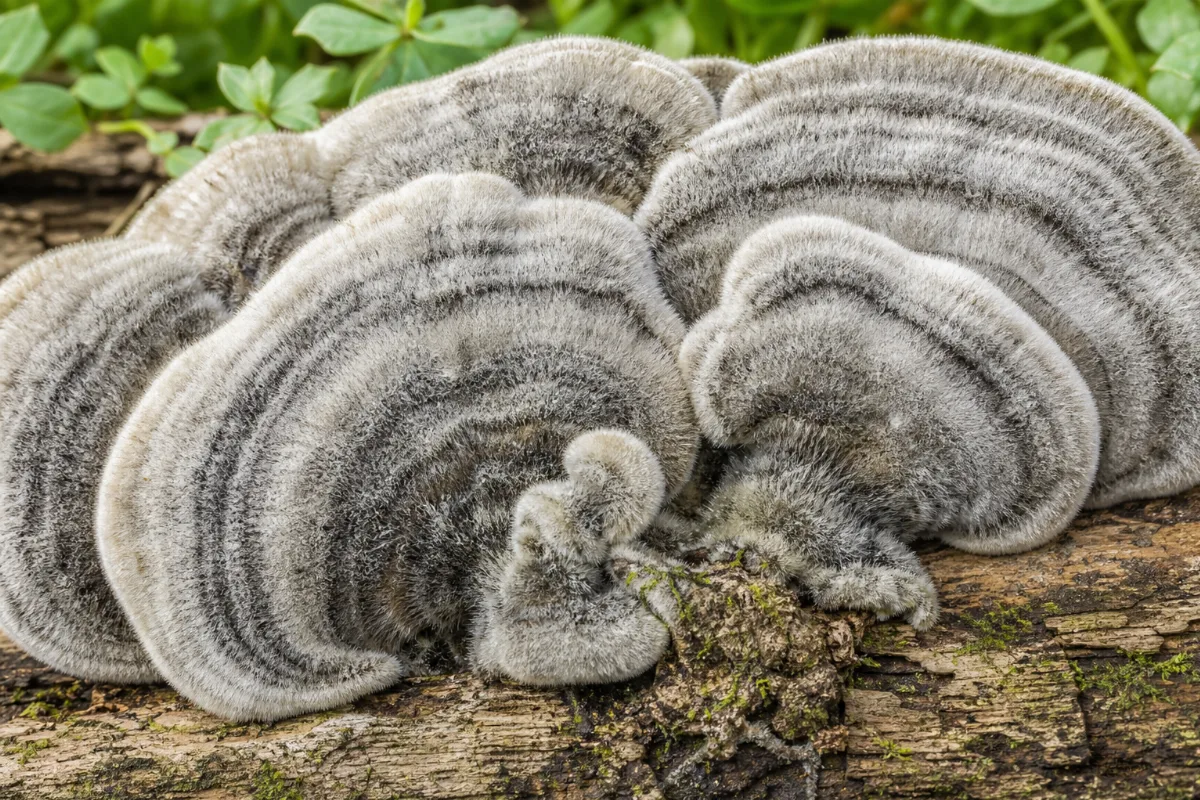
Mushrooms · Medicinal wild polypore
Hairy Bracket
Trametes hirsuta (old name Coriolus hirsutus) · also called Hairy turkey tail (informal); not the same as downy bracket (Trametes pubescens)
Hairy bracket (Trametes hirsuta) is a thin, leathery mushroom that grows in overlapping shelves on dead hardwood, mostly beech. A field guide calls it too tough to eat. Research on it is limited to test-tube work on extracts: they held back some germs and cancer cells and showed antioxidant chemistry in dishes. We found no human trial and no safety study in people. Ask a doctor or pharmacist before any product, and never eat a wild mushroom unless an expert has identified it.
General information, not medical advice. Last substantive update · Not medically reviewed. A named clinician has not signed off on this page. How this page is made
About Hairy Bracket
Hairy bracket (Trametes hirsuta) is a thin, leathery shelf mushroom that rots dead hardwood. It is not a food, and we found no supplement made from it. Everything known about its health effects comes from test-tube work on extracts and culture products. We found no human trial and no safety study in people, so any benefit is unproven and its safety is unknown.
What it is
Hairy bracket is a fungus in the family Polyporaceae, not a plant. GBIF accepts the name Trametes hirsuta (Wulfen) Lloyd. Old names include Polyporus hirsutus and Coriolus hirsutus. A field guide describes brackets 4 to 10 cm across, white or cream with silvery hairs when young, later zoned and ridged, which cause white rot on hardwoods, most often dead beech.
It is a separate species from turkey tail (Trametes versicolor), which is the mushroom behind the purified PSK extract used in cancer care in Japan. See our turkey tail guide for that. It is also separate from downy bracket (Trametes pubescens), which is easily confused with a young hairy bracket.
Traditional and current uses
We found no source on a traditional medicinal use of hairy bracket. A 2016 paper says downy bracket has been used in Asian folk medicine for cancer and gut ailments, which is not proof of benefit and is not about hairy bracket.
Today it is studied in the lab, and it is better known in industry as a source of the laccase enzyme and in clean-up of dyes and pollutants. A field guide calls it too leathery to be considered edible.
What the research shows
Everything is lab work. In 2026, fruiting-body extracts made with ethanol or water held back several bacteria and moulds in dishes, and the ethanol extract held back about 80% of two cancer cell lines at 50 ug/mL. A purified sugar chain released into culture liquid was cytotoxic to several cancer lines but not to prostate cells, and another strain's sugar chain raised immune-cell activity in dishes. Three studies found antioxidant activity in tubes.
Studies of the related downy bracket add test-tube blocking of starch and cholinesterase enzymes, lower inflammation signals in cells and rats with induced paw swelling, and one animal study of a culture product. None of it has been tested in a person, and a result in a dish rarely carries over to the body.
Fruiting body, mycelium and culture liquid are different
The studies used fruiting-body extracts, mycelium extracts from one Brazilian strain, and sugar chains from culture liquid. These are different materials with different contents. Results from one cannot be applied to another, and none matches a mushroom product.
Legal and regulatory status
The only regulator document we read is EFSA's 2024 opinions on a food enzyme made by a Trametes hirsuta strain, which found no safety concern under the intended conditions of use. We did not find or read any statement on the mushroom itself from EMA, FDA, NCCIH, LiverTox or LactMed, so none is stated here. Rules differ by country and change.
At a glance
Traditional uses history, not proof
- We found no source on a traditional medicinal use of hairy bracket itself.
- A 2016 paper says the similar species Trametes pubescens (downy bracket) has been used in Asian folk medicine for cancer and gut ailments. That is not proof that it works.
Studied for research
- Bacteria and moulds in test dishes, insufficient (lab only)
- Antioxidant chemistry, insufficient
- Cancer cells in dishes, insufficient (no animal or human data)
- Immune cells in dishes, insufficient
- Blood-sugar enzymes, brain enzymes and inflammation in a similar species, insufficient
Main compounds
- A beta-glucan sugar chain released into culture liquid
- Phenolic compounds and flavonoids
- Fatty acids, esters and sterols
Common forms
- Wild bracket (not eaten; a field guide calls it too leathery to be edible)
- Solvent extracts of the fruiting body, made in the lab
- Mycelium and culture-liquid products in research
- An industrial laccase enzyme made by a cultured strain (not the mushroom)
Research links: 2026 lab study of extracts (abstract) · Cancer cell study of a culture beta-glucan (abstract) · Immune cells and a culture glucan (abstract) · EFSA opinion on a food enzyme made by the fungus (abstract) · GBIF name record · Research Library · Genes & Biomarkers Library
What it is and its history
- Accepted scientific name
- Trametes hirsuta
- Naming authority
- (Wulfen) Lloyd (GBIF)
- Synonyms
- Polyporus hirsutus (Wulfen) Fr.; Coriolus hirsutus (Wulfen) Quel.; Boletus hirsutus Wulfen; Polystictus hirsutus (Wulfen) Cooke; Daedalea polyzona
- Common names
- Hairy bracket (English); Hairy turkey tail (informal; not confirmed in a source we read) (English); Downy bracket (this is the similar species Trametes pubescens, not hairy bracket) (English)
- Family or group
- Polyporaceae (a fungus family, not a plant)
- Classification
- Fungi > Basidiomycota > Agaricomycetes > Polyporales > Polyporaceae > Trametes > Trametes hirsuta
- Native range
- First Nature: fairly common and widespread in Britain and Ireland, plentiful in northern and central mainland Europe, and frequent in many parts of the world including China and North America.
- Habitat
- On many kinds of hardwood, most commonly dead beech. It is a saprophyte that causes white rot (First Nature).
- What it looks like
- Fruiting body: First Nature: semicircular brackets, usually 4-10 cm across, white or cream and covered in silvery hairs at first, later ochre or brownish toward the edge with narrow ridged colour zones. Pores are white, then cream and ochre, about 3 to 4 per mm. Spore print white. Young brackets smell faintly of aniseed and taste bitter. Annual, appearing in late summer and autumn but can last through winter.
- Cultivation
- No cultivation source for the mushroom body was read. Mycelium and culture liquid are grown in tanks for research and enzyme production.
- Harvest and processing
- Not checked in the sources read.
- Look-alikes and adulterants
- Name: Downy bracket (Trametes pubescens); Note: First Nature says young hairy bracket is easily confused with downy bracket, which is paler and finely downy rather than coarsely hairy; mature hairy bracket shows ridged colour zones.; Name: Turkey tail (Trametes versicolor); Note: A close relative in the same genus with its own, better-studied research. GBIF lists it as a separate accepted species. Our turkey tail guide covers it.
- Sustainability and conservation
- Not checked in the sources read.
Traditional use and history history, not clinical proof
| Tradition or era | Documented use | Source |
|---|---|---|
| Europe, 1789 | First described scientifically by the Austrian mycologist Franz Xavier von Wulfen as Polyporus hirsutus; moved to Trametes by C. G. Lloyd in 1924 (as First Nature states). | s-first-nature |
| Asian folk medicine (for the similar species T. pubescens) | A 2016 paper says Trametes pubescens has been used in folk medicine in Asian countries for cancer and gut ailments. We did not find a source on traditional use of hairy bracket itself. Treat this as NOT verified beyond the paper's statement. | p27196881 |
Traditional use shows how it was used. It does not show that it works or is safe today.
What is inside, and how it may work
What it contains and how those compounds act in cells and animals. Laboratory and animal mechanisms are not proven effects in people.
Main compounds
| Compound | Family | Where it is concentrated | Activity studied | Level of evidence |
|---|---|---|---|---|
| Extracellular beta-D-(1,3)-glucan | polysaccharide | Culture liquid | Cytotoxic to some cancer cell lines in dishes; another strain's glucan raised immune-cell activity in dishes. 11 10 | Laboratory research |
| Phenolic compounds (chlorogenic, ferulic, caffeic and gallic acids; flavonoids; tannins) | phenolics | Mycelium (Brazilian strain) and fruiting body extracts | Antioxidant in chemistry tests. 2 1 8 | Laboratory research |
| Fatty acids, esters and sterols (linoleic acid methyl ester, n-hexadecanoic acid) | lipids | Fruiting body extracts | Suggested by the authors as a possible contributor to the lab activity; not tested alone. 1 | Laboratory research |
Mechanisms, receptors and pathways
| Target or pathway | Gene or receptor | What was found | Level |
|---|---|---|---|
| Immune-cell activation (IL-2, IFN-gamma, TNF-alpha, NK killing, macrophage engulfing) | IL2, IFNG, TNF | A culture glucan raised these in dishes. 10 | Laboratory research |
| Nitric oxide and iNOS in stimulated macrophages (T. pubescens) | NOS2 | Lowered by T. pubescens extracts in mouse cells. 5 | Laboratory research |
| Antioxidant enzymes (superoxide dismutase, glutathione) in animals (T. pubescens culture product) | SOD | Raised in dim-light-stressed animals. 6 | Animal research |
Absorption, metabolism and elimination
- Absorption
- Not studied.
- Distribution
- Not studied.
- Metabolism
- Not studied.
- Elimination
- Not studied.
- Bioavailability
- Not established for the mushroom or its extracts.
Isolated compounds versus whole extracts
The studies used very different materials: solvent extracts of fruiting body, mycelium extracts from a Brazilian strain, a purified culture-liquid glucan, and an industrial enzyme. Their results cannot be combined, and none is the whole mushroom eaten as food.
Nutritional composition
We found no nutrient table or food-composition entry for hairy bracket. A field guide calls it too leathery to be considered edible, so it is not a food.
8 not enough evidence
What was looked at
The 8 benefits and uses checked for Hairy Bracket, each with how strong the evidence is. Tap one to open it.
- Bacteria and moulds in test dishesNot enough evidence
- Antioxidant chemistryNot enough evidence
- Cancer cells in test dishesNot enough evidence
- Immune cells in test dishesNot enough evidence
- Blood-sugar enzymes in a test tube (similar species)Not enough evidence
- Brain-related enzymes and nerve-type cells (similar species)Not enough evidence
- Inflammation in cells and rat paw swelling (similar species)Not enough evidence
- Oxidative stress in stressed animals (similar species, culture product)Not enough evidence
Lab markers tracked in the studies
Minimum inhibitory concentration (MIC) and inhibition zonesCancer cell growth in cultureAntioxidant test scores (DPPH, ORAC, ABTS)Immune cell activity and cytokines (NK killing, phagocytosis, IL-2, IFN-gamma, TNF-alpha)Starch-digesting enzyme inhibition (alpha-amylase, alpha-glucosidase)Cholinesterase inhibition (acetylcholinesterase, butyrylcholinesterase)Nitric oxide and iNOS in stimulated immune cellsInduced paw swelling in ratsBlood markers of fat oxidation and antioxidant defence (lipid peroxidation products, SOD, reduced glutathione)
What is Hairy Bracket good for?
The uses people ask about and how strong the human evidence is for each. For every one, there is no human evidence. Read this together with the Safety tab.
Benefits, one by one
Each card is a research question, not a promise. Tap a goal to filter. Open a card to see the studies, doses and limits.
Bacteria and moulds in test dishes
Not enough evidenceExtracts of hairy bracket stopped the growth of several bacteria and moulds in test dishes. This is not a medicine and was never tried on an infection in a person or animal.
1 studiesWater, ethanol, acetone, ethyl acetate and chloroform extracts of the…
Studies, doses and limits
What the trials found
No human study of this was found. Our PubMed searches found no clinical trial and no case report in people.
Results
In a 2026 laboratory study, ethanol and water extracts of the fruiting body were the most active. Inhibition zones reached 31.3 mm and the lowest minimum inhibitory concentration was 15.6 ug/mL (against Streptococcus agalactiae and Enterococcus raffinosus, and the moulds Aspergillus niger, Botrytis cinerea and Alternaria alternata).
Effect sizes as reported
Test-tube figures only; no human or animal figures
Why this rating
Only test-tube work on one batch of mushroom. Nothing was tested on an infection in an animal or person.
Form and dose studied
Water, ethanol, acetone, ethyl acetate and chloroform extracts of the fruiting body, in the lab only. No study used a product comparable to anything sold.
Who was studied
Bacteria and moulds in dishes
Limits
Killing germs in a dish does not mean the same extract is safe or works in the body. The abstract does not name a collection or voucher, and the authors do not compare the extracts with normal cells.
Why researchers looked
Wood-rotting fungi make many chemicals, and researchers screen them for anything that holds back germs.
Traditional use
We found no source that describes a traditional medicinal use of hairy bracket itself. A 2016 paper says the similar species Trametes pubescens has been used in Asian folk medicine for cancer and stomach and gut problems. Traditional use is not proof that it works.
Proposed mechanism Laboratory research
Not worked out. The 2026 study found fatty acids, sterols and phenol-type compounds in the active extracts, which may play a part. This is laboratory chemistry.
A proposed mechanism does not show that the effect happens in people.
Hairy bracket is not an antibiotic. Do not use it for an infection. Nothing is known about safety in people. Ask a doctor or pharmacist before using any hairy bracket product, and see the Safety tab.
Antioxidant chemistry
Not enough evidenceIn chemistry tests, extracts of hairy bracket mopped up reactive molecules. That is a property of the extract in a tube. It has not been shown to help anyone's body.
3 studiesEthanol and water extracts of fruiting body; water extract of myceliu…
Studies, doses and limits
What the trials found
No human study of this was found. Our PubMed searches found no clinical trial and no case report in people.
Results
Three laboratory studies agree on the direction. In the 2026 study the ethanol extract gave the strongest antioxidant result at 50 ug/mL. In a French study of six polypores (28 extracts), the ethanol extract of Trametes hirsuta was one of four with significant antioxidant activity and gave among the highest ORAC values. In a Brazilian study, the water extract of the mycelium (a different material) gave the best result in the ABTS test.
Effect sizes as reported
Test-tube scores only; no body markers
Why this rating
Three consistent laboratory studies, but each is a chemistry test on a different material (fruiting body in two, mycelium in one).
Form and dose studied
Ethanol and water extracts of fruiting body; water extract of mycelium from one Brazilian strain.
Who was studied
Test-tube chemistry
Limits
An antioxidant score in a tube does not show a benefit in the body. Collections, strains and extraction methods differ, so results do not combine.
Why researchers looked
Antioxidant tests are cheap and many mushroom papers include them.
Traditional use
We found no source that describes a traditional medicinal use of hairy bracket itself. A 2016 paper says the similar species Trametes pubescens has been used in Asian folk medicine for cancer and stomach and gut problems. Traditional use is not proof that it works.
Proposed mechanism Laboratory research
Phenol-type compounds in the extracts can donate electrons to reactive molecules in a test tube. Whether that happens in the body is unknown.
A proposed mechanism does not show that the effect happens in people.
Antioxidant test scores are not a health claim. Nothing is known about safety in people. Ask a doctor or pharmacist before using any hairy bracket product, and see the Safety tab.
Cancer cells in test dishes
Not enough evidenceExtracts and a purified sugar-chain (beta-glucan) from hairy bracket held back the growth of some cancer cell lines in dishes. Nobody has tested it in an animal with cancer or in a person. It is not a cancer treatment.
2 studiesCulture-liquid polysaccharide (2025) and fruiting-body ethanol extrac…
Studies, doses and limits
What the trials found
No human study of this was found. Our PubMed searches found no clinical trial and no case report in people.
Results
A 2025 study of a purified polysaccharide from the fungus's culture liquid found it more cytotoxic to HT-29 colon cells than the crude version, then MOLT-4 leukaemia, HepG2 liver and HEp-2 cells, but it did not work against PC-3 prostate cells. The 2026 ethanol extract of the fruiting body held back about 80% of SK-HEP-1 liver and PC-3 prostate cancer cells at 50 ug/mL. The two PC-3 results disagree, probably because the materials are different (culture polysaccharide versus a fruiting-body extract); neither study explains it.
Effect sizes as reported
Percent growth held back in dishes; no body figures
Why this rating
Two dish studies on different materials that partly disagree. No animal or human work.
Form and dose studied
Culture-liquid polysaccharide (2025) and fruiting-body ethanol extract (2026).
Who was studied
Human cancer cell lines in dishes
Limits
Many substances kill cells in a dish and fail in the body. Neither paper shows safety for normal cells in the abstract.
Why researchers looked
Cancer cell-line screening is the most common first test for any mushroom extract.
Traditional use
We found no source that describes a traditional medicinal use of hairy bracket itself. A 2016 paper says the similar species Trametes pubescens has been used in Asian folk medicine for cancer and stomach and gut problems. Traditional use is not proof that it works.
Proposed mechanism Laboratory research
Not worked out. A beta-glucan is a long sugar chain; the paper describes a beta-D-(1,3)-glucan from the growth liquid.
A proposed mechanism does not show that the effect happens in people.
Hairy bracket is not a cancer treatment and must not replace treatment. Tell your cancer team about any mushroom product. Nothing is known about safety in people. Ask a doctor or pharmacist before using any hairy bracket product, and see the Safety tab.
Immune cells in test dishes
Not enough evidenceA sugar-chain made by one strain of hairy bracket made immune cells more active in dishes. It has not been tested in animals or people, so we cannot say it changes your immunity.
1 studiesPolysaccharide from the culture liquid, not the mushroom body.
Studies, doses and limits
What the trials found
No human study of this was found. Our PubMed searches found no clinical trial and no case report in people.
Results
A 2014 study of the extracellular polysaccharide of strain VKESR found a good stimulation index for spleen cells, stronger natural killer cell killing of tumour cells, dose-dependent macrophage phagocytosis, strong IL-2 and IFN-gamma and moderate TNF-alpha stimulation.
Effect sizes as reported
Lab effects on immune cell activity; no figures in the abstract
Why this rating
One 2014 dish study of one strain. Not repeated that we found.
Form and dose studied
Polysaccharide from the culture liquid, not the mushroom body.
Who was studied
Immune cells in culture
Limits
Dish effects on immune cells often do not carry over to eating something. The polysaccharide came from culture liquid.
Why researchers looked
Beta-glucans from many fungi are studied for their effect on immune cells.
Traditional use
We found no source that describes a traditional medicinal use of hairy bracket itself. A 2016 paper says the similar species Trametes pubescens has been used in Asian folk medicine for cancer and stomach and gut problems. Traditional use is not proof that it works.
Proposed mechanism Laboratory research
The paper reports more spleen-cell growth, more natural killer cell killing and more engulfing by macrophages in culture, with higher IL-2 and IFN-gamma. These are lab findings.
A proposed mechanism does not show that the effect happens in people.
A stimulated immune cell in a dish is not a benefit. People with autoimmune conditions or on immune-suppressing medicines should ask a doctor first. Nothing is known about safety in people. Ask a doctor or pharmacist before using any hairy bracket product, and see the Safety tab.
Blood-sugar enzymes in a test tube (similar species)
Not enough evidenceAn extract of a close relative (Trametes pubescens, downy bracket) weakly blocked two enzymes that digest starch in a test tube. This was not tested on blood sugar in animals or people.
1 studiesMethanol and hot-water extracts of T. pubescens fruiting bodies.
Studies, doses and limits
What the trials found
No human study of this was found, for hairy bracket or its relative.
Results
Methanol and hot-water extracts of Trametes pubescens fruiting bodies inhibited alpha-amylase and alpha-glucosidase moderately at 2.0 mg/mL, less strongly than the drug acarbose.
Effect sizes as reported
Moderate enzyme inhibition, below the drug acarbose
Why this rating
Test-tube work on a related species, not on hairy bracket.
Form and dose studied
Methanol and hot-water extracts of T. pubescens fruiting bodies.
Who was studied
Enzymes in a tube
Limits
The species is T. pubescens, not T. hirsuta. No animal or human blood-sugar data. High concentrations were used.
Why researchers looked
Blocking starch-digesting enzymes is how some diabetes drugs work, so researchers screen mushrooms for it.
Traditional use
We found no source that describes a traditional medicinal use of hairy bracket itself. A 2016 paper says the similar species Trametes pubescens has been used in Asian folk medicine for cancer and stomach and gut problems. Traditional use is not proof that it works.
Proposed mechanism Laboratory research
Enzyme inhibition in a tube: the extract slowed alpha-amylase and alpha-glucosidase.
A proposed mechanism does not show that the effect happens in people.
Do not use it to manage diabetes. Ask a pharmacist if you take diabetes medicine. Nothing is known about safety in people. Ask a doctor or pharmacist before using any hairy bracket product, and see the Safety tab.
Brain-related enzymes and nerve-type cells (similar species)
Not enough evidenceThe same relative's extracts blocked brain enzymes in a test tube and protected nerve-type rat cells from a toxic chemical. This is early lab screening, not a memory benefit.
1 studiesMethanol and hot-water extracts of T. pubescens fruiting bodies.
Studies, doses and limits
What the trials found
No human study of this was found, for hairy bracket or its relative.
Results
Trametes pubescens extracts inhibited acetylcholinesterase and butyrylcholinesterase moderately, comparable to galanthamine, a drug used in early Alzheimer's disease. The methanol extract protected PC-12 nerve-type rat cells from glutamate injury at 2-40 ug/mL.
Effect sizes as reported
Comparable to galanthamine in a tube; cell protection at 2-40 ug/mL
Why this rating
One 2016 study of a related species.
Form and dose studied
Methanol and hot-water extracts of T. pubescens fruiting bodies.
Who was studied
Enzymes in a tube; rat nerve-type cells
Limits
Species is T. pubescens, not hairy bracket. Tube and cell work only. It says nothing about memory or brain health in people.
Why researchers looked
The enzymes involved are the target of some Alzheimer's drugs, so extracts are screened against them.
Traditional use
We found no source that describes a traditional medicinal use of hairy bracket itself. A 2016 paper says the similar species Trametes pubescens has been used in Asian folk medicine for cancer and stomach and gut problems. Traditional use is not proof that it works.
Proposed mechanism Laboratory research
Enzyme inhibition (acetylcholinesterase and butyrylcholinesterase) in a tube and cell protection in a dish.
A proposed mechanism does not show that the effect happens in people.
Do not use it for memory problems or dementia. Nothing is known about safety in people. Ask a doctor or pharmacist before using any hairy bracket product, and see the Safety tab.
Inflammation in cells and rat paw swelling (similar species)
Not enough evidenceExtracts of the related species lowered inflammation signals in immune-type cells and eased induced paw swelling in rats. It has not been tested for any inflammatory condition in people.
1 studiesMethanol and hot-water extracts of T. pubescens fruiting bodies.
Studies, doses and limits
What the trials found
No human study of this was found, for hairy bracket or its relative.
Results
In the 2016 study both T. pubescens extracts reduced nitric oxide production and iNOS expression in lipopolysaccharide-stimulated RAW 264.7 mouse macrophage cells and significantly suppressed carrageenan-induced paw swelling in rats.
Effect sizes as reported
Significant reduction in rat paw swelling; no figures in the abstract
Why this rating
A single study of a related species, with a brief induced-swelling rat test.
Form and dose studied
Methanol and hot-water extracts of T. pubescens fruiting bodies.
Who was studied
Mouse cells in dishes; rats
Limits
Related species, one study, a short artificial swelling model. Says nothing about arthritis or any real inflammatory disease.
Why researchers looked
Inflammation tests are standard for mushroom extracts.
Traditional use
We found no source that describes a traditional medicinal use of hairy bracket itself. A 2016 paper says the similar species Trametes pubescens has been used in Asian folk medicine for cancer and stomach and gut problems. Traditional use is not proof that it works.
Proposed mechanism Animal research
The extracts reduced nitric oxide and iNOS in stimulated mouse macrophage cells. These are animal and cell findings.
A proposed mechanism does not show that the effect happens in people.
Do not use it for pain or inflammatory disease. Nothing is known about safety in people. Ask a doctor or pharmacist before using any hairy bracket product, and see the Safety tab.
Oxidative stress in stressed animals (similar species, culture product)
Not enough evidenceA product made from liquid cultures of the related Trametes pubescens lowered markers of fat damage in animals kept in dim light. Nobody has tested it in people.
1 studiesTrametin, a product made from liquid cultures of T. pubescens. Not th…
Studies, doses and limits
What the trials found
No human study of this was found, for hairy bracket or its relative.
Results
The preparation, named Trametin, prevented oxidative stress in animals kept in dimmed light. It lowered primary and end products of lipid peroxidation and raised total antioxidant activity, superoxide dismutase and reduced glutathione.
Effect sizes as reported
Improved blood markers in the animals; no figures in the abstract
Why this rating
One animal study of a culture product from a related species. Species, group sizes and doses are not in the abstract.
Form and dose studied
Trametin, a product made from liquid cultures of T. pubescens. Not the mushroom body.
Who was studied
Experimental animals (species not stated in the abstract)
Limits
The product is a culture preparation of a related species. It is not comparable with a mushroom or a supplement.
Why researchers looked
A Russian group tested a culture-liquid product from this fungus in animals under stress.
Traditional use
We found no source that describes a traditional medicinal use of hairy bracket itself. A 2016 paper says the similar species Trametes pubescens has been used in Asian folk medicine for cancer and stomach and gut problems. Traditional use is not proof that it works.
Proposed mechanism Animal research
Raised antioxidant enzymes (superoxide dismutase) and reduced glutathione in the blood of the animals. This is an animal finding.
A proposed mechanism does not show that the effect happens in people.
Not a treatment for anything. Nothing is known about safety in people. Ask a doctor or pharmacist before using any hairy bracket product, and see the Safety tab.
Connections to the rest of health
How Hairy Bracket connects to the rest of our health knowledge graph. Every link says what kind of connection it is. A safety link (for example to the liver) is a warning, not a benefit. A study that merely mentions a topic never creates a benefit link.
Explore every connection: goals, body systems, organs, symptoms, genes
B. Body systems
| Connected to | Kind of connection | Evidence status | Context | Studies |
|---|---|---|---|---|
| Immune system | Drug or supplement interaction | Not enough evidence | Raised immune-cell activity and IL-2 and IFN-gamma in dishes. Raised immune-cell activity in dishes. Preparation or compound: Culture-liquid glucan (cell studies) |
10 |
| Immune System | Biological association | Not enough evidence | Studied for: Bacteria and moulds in test dishes Studied for: Cancer cells in test dishes | 1 11 10 |
| Whole Body Balance | Biological association | Not enough evidence | Studied for: Antioxidant chemistry | 1 8 2 |
| Pain Inflammation | Biological association | Not enough evidence | Studied for: Inflammation in cells and rat paw swelling (similar species) | 5 |
I. Biomarkers
| Connected to | Kind of connection | Evidence status | Context | Studies |
|---|---|---|---|---|
| Minimum inhibitory concentration (MIC) and inhibition zones | Biological association | Not enough evidence | Measured in trials: lowered (germ growth). A lab change is not the same as a health benefit. | 1 |
| Cancer cell growth in culture | Biological association | Not enough evidence | Measured in trials: lowered (cell growth). A lab change is not the same as a health benefit. | 1 11 |
| Antioxidant test scores (DPPH, ORAC, ABTS) | Biological association | Not enough evidence | Measured in trials: raised (scavenging). A lab change is not the same as a health benefit. | 8 2 |
| Immune cell activity and cytokines (NK killing, phagocytosis, IL-2, IFN-gamma, TNF-alpha) | Biological association | Not enough evidence | Measured in trials: raised. A lab change is not the same as a health benefit. | 10 |
| Starch-digesting enzyme inhibition (alpha-amylase, alpha-glucosidase) | Biological association | Not enough evidence | Measured in trials: lowered (enzyme activity). A lab change is not the same as a health benefit. | 5 |
| Cholinesterase inhibition (acetylcholinesterase, butyrylcholinesterase) | Biological association | Not enough evidence | Measured in trials: lowered (enzyme activity). A lab change is not the same as a health benefit. | 5 |
| Nitric oxide and iNOS in stimulated immune cells | Biological association | Not enough evidence | Measured in trials: lowered. A lab change is not the same as a health benefit. | 5 |
| Induced paw swelling in rats | Biological association | Not enough evidence | Measured in trials: lowered. A lab change is not the same as a health benefit. | 5 |
| Blood markers of fat oxidation and antioxidant defence (lipid peroxidation products, SOD, reduced glutathione) | Biological association | Not enough evidence | Measured in trials: improved. A lab change is not the same as a health benefit. | 6 |
K. Biological pathways
| Connected to | Kind of connection | Evidence status | Context | Studies |
|---|---|---|---|---|
| Cytokine signalling (IL-2, IFN-gamma, TNF-alpha) | Preliminary mechanism | In vitro | Raised by a culture glucan in immune cells in dishes. | 10 |
L. Active compounds
| Connected to | Kind of connection | Evidence status | Context | Studies |
|---|---|---|---|---|
| Extracellular beta-D-(1,3)-glucan | Biological association | In vitro | Cytotoxic to some cancer cell lines in dishes; another strain's glucan raised immune-cell activity in dishes. Preparation or compound: Culture liquid |
11 10 |
| Phenolic compounds (chlorogenic, ferulic, caffeic and gallic acids; flavonoids; tannins) | Biological association | In vitro | Antioxidant in chemistry tests. Preparation or compound: Mycelium (Brazilian strain) and fruiting body extracts |
2 1 8 |
| Fatty acids, esters and sterols (linoleic acid methyl ester, n-hexadecanoic acid) | Biological association | In vitro | Suggested by the authors as a possible contributor to the lab activity; not tested alone. Preparation or compound: Fruiting body extracts |
1 |
Each connection is stored with the ingredient, the connected record, the kind of connection, the evidence status, the supporting studies, the preparation or compound involved, and a review date (last reviewed October 25, 2026).
Evidence at a glance: what changed in 3 lab markers
Tap a number to show only those markers. Counts are markers, not people.
The evidence
The research centre for Hairy Bracket. Every record here was checked against PubMed or the publisher's page; we never list a study we have not verified.
Evidence by outcome
Bars show how many studies we found for each outcome, not how well it works. People are added up across trials only (reviews are not added, to avoid double counting).
How we rate evidence
High certainty
Several well-run trials or reviews agree; further research is unlikely to change the picture much.
Moderate certainty
Good trials point the same way, but some doubt remains.
Low certainty
Small, short or inconsistent trials. The finding could change with better research.
Very low certainty
Very little or very weak human data. Treat as a possibility only.
Mixed findings
Trials or reviews disagree with each other.
Not enough evidence
Not enough human research to say either way.
Evidence against
Good research found no benefit, or found harm.
We take the reviewers' own risk-of-bias and GRADE statements where they exist, and otherwise judge from study size, design, consistency, directness and whether a product matches what is sold. Many publications do not make evidence high. Method note: We searched PubMed for Trametes hirsuta, Coriolus hirsutus and Trametes pubescens (311 records, almost all about enzymes and pollution clean-up), screened the titles of the health and safety ones for human studies and found none, and read the PubMed records and abstracts of 11 papers (nine lab or animal studies, two regulator opinions on a food enzyme). We checked the names in GBIF and read one field guide. Only abstracts were read. EMA, FDA, NCCIH, LiverTox and LactMed were not read. Certainty ratings are the compiler's own reading.
Study library: every study we checked 14
| Study | Design | People | Product, dose, length | Result |
|---|---|---|---|---|
| Ahmed 2026 Solvent alternation of the antimicrobial, antioxidant, anticancer activities and chemical profiles of Trametes hirsuta (Wulfen) Lloyd. BMC microbiology · PMID 42387370 · DOI |
Laboratory research fungus extract in vitro |
Test-tube germs and cancer cell lines (including SK-HEP-1 and PC-3); one batch of mushroom | Trametes hirsuta extracts made with water, ethanol, acetone, ethyl acetate or chloroform Fruiting body (extracts) |
Ethanol and water extracts were the most active against bacteria, with inhibition zones up to 31.3 mm and minimum inhibitory concentrations as low as 15.6 ug/mL (Streptococcus agalactiae, Enterococcus raffinosus). They also stopped the moulds Aspergillus niger, Botrytis cinerea and Alternaria alternata at 15.6 ug/mL at best. At 50 ug/mL the ethanol extract showed the strongest antioxidant result and held back about 80% of SK-HEP-1 and PC-3 cancer cells. GC-MS found fatty acids, esters, sterols and phenol-type compounds (linoleic acid methyl ester and n-hexadecanoic acid noted). Methods, limits and fundingOutcomes: Germ-growth tests (inhibition zones, minimum inhibitory concentration), antioxidant tests, cancer-cell growth, GC-MS and chemical screening of the extracts. Limitations: Test-tube work only. The abstract does not name the collection or strain voucher, and the extracts were not compared with normal cells here. Not tested in animals or people. Funding and conflicts: Funding not stated in the abstract Read: abstract |
| Aranha 2022 Biochemical characterization and biological properties of mycelium extracts from Lepista sordida GMA-05 and Trametes hirsuta GMA-01: new mushroom strains isolated in Brazil. Brazilian journal of microbiology · PMID 35076897 · DOI |
Laboratory research mycelium extract in vitro |
Mycelium extracts tested in chemistry assays and in two cell types (J774-A1 macrophages and Vero cells) | Water and other extracts of mycelium (fungus threads grown in a tank) of one Brazilian Trametes hirsuta strain, GMA-01, and of Lepista sordida Mycelium (not the fruiting body) |
The aqueous T. hirsuta extract gave the most notable antioxidant results, especially in the ABTS test. Phenolic acids found included chlorogenic, ferulic, caffeic and gallic acids. In Vero cells the L. sordida extract was 12.6-fold less toxic than the T. hirsuta one, and the authors judged both to have low cell toxicity. Methods, limits and fundingOutcomes: Antioxidant tests, phenolic compounds (UPLC-MS), cell toxicity. Limitations: Mycelium from one strain, tested in dishes only. The authors suggest use as a functional food or additive, but no food or human test was done. Funding and conflicts: Funding not stated in the abstract Read: abstract |
| EFSA CEP Panel (Lambre 2024 Safety evaluation of the food enzyme laccase from the non-genetically modified Trametes hirsuta strain AE-OR. EFSA journal · PMID 38764476 · DOI |
Regulatory opinion food enzyme |
Food-enzyme safety dossier (genotoxicity tests, 90-day rat study, allergen search) | Laccase food enzyme made by culturing Trametes hirsuta strain AE-OR (an industrial enzyme, not the mushroom) Culture-made enzyme |
Genotoxicity tests did not raise a safety concern. The 90-day rat study gave a no-observed-adverse-effect level of 862 mg total organic solids per kg body weight per day, the highest dose tested. Estimated European intake was up to 0.026 mg per kg per day, a margin of at least 33,154. No allergen match was found, but allergic reactions cannot be excluded, though the likelihood is low. The panel concluded no safety concern under the intended conditions of use. Methods, limits and fundingOutcomes: Genotoxicity, systemic toxicity in a 90-day rat study, similarity to known allergens, dietary exposure. Limitations: About an enzyme made in a factory by the fungus, not the mushroom, and not a supplement. It says nothing about eating the mushroom. Funding and conflicts: Regulator's own assessment of an applicant's data (applicant: Amano Enzyme Inc.) Read: abstract |
| EFSA CEP Panel (Lambre 2024 Safety evaluation of an extension of use of the food enzyme laccase from the non-genetically modified Trametes hirsuta strain AE-OR. EFSA journal · PMID 38993590 · DOI |
Regulatory opinion food enzyme |
Update of the food-enzyme safety dossier for three more uses | Laccase food enzyme made by culturing Trametes hirsuta strain AE-OR (not the mushroom) Culture-made enzyme |
Use was extended from six to nine food-making processes. Estimated European intake rose to up to 0.030 mg total organic solids per kg body weight per day, a margin of exposure of at least 28,733. The panel again concluded no safety concern under the revised intended conditions of use. Methods, limits and fundingOutcomes: Updated dietary exposure and margin of exposure. Limitations: About an industrial enzyme, not the mushroom. Funding and conflicts: Regulator's own assessment of an applicant's data (applicant: Amano Enzyme Inc.) Read: abstract |
| Im 2016 In Vitro Antioxidant, Anti-Diabetes, Anti-Dementia, and Inflammation Inhibitory Effect of Trametes pubescens Fruiting Body Extracts. Molecules (Basel, Switzerland) · PMID 27196881 · DOI |
Laboratory research fungus extract in vitro and rat |
Test-tube enzyme and chemistry assays, rat nerve-type cells (PC-12), mouse macrophage cells (RAW 264.7) and rats with induced paw swelling | Trametes pubescens (a similar species, not T. hirsuta) methanol and hot-water extracts Fruiting body (extracts) 2.0 mg/mL in the main test-tube assays (as stated) |
Radical-scavenging by the extracts at 2.0 mg/mL was comparable to the reference antioxidant BHT. Alpha-amylase and alpha-glucosidase inhibition was lower than the drug acarbose but moderate at 2.0 mg/mL; cholinesterase inhibition was moderate and comparable to galanthamine. The methanol extract protected PC-12 cells from glutamate injury at 2-40 ug/mL. Both extracts reduced nitric oxide and iNOS in stimulated macrophages and significantly suppressed carrageenan-induced paw swelling in rats. Methods, limits and fundingOutcomes: Antioxidant tests, blood-sugar enzymes (alpha-amylase, alpha-glucosidase), brain enzymes (acetylcholinesterase, butyrylcholinesterase), nerve cell protection, nitric oxide and iNOS in immune cells, carrageenan-induced rat paw swelling. Limitations: This is T. pubescens, a similar species, not T. hirsuta. Mostly test-tube and cell work with one rat swelling test. No human data. Funding and conflicts: Funding not stated in the abstract Read: abstract |
| Kolesnikova 2017 Effect of Preparation Based on Trametes Pubescens Xylotroph Fungi on Lipid Peroxidation in the Blood of Experimental Animals under Conditions of Dark Stress. Bulletin of experimental biology and medicine · PMID 28429215 · DOI |
Animal research animals |
Experimental animals kept in dimmed light (a "dark stress" model) | Trametin, a product made from liquid cultures of Trametes pubescens (a similar species, not T. hirsuta) Culture product (not the fruiting body) |
The abstract reports that Trametin prevented oxidative stress in the dimmed-light animals, raised lipid unsaturation, lowered primary and end products of lipid peroxidation, and raised total antioxidant activity, superoxide dismutase and reduced glutathione. Methods, limits and fundingOutcomes: Blood markers of fat oxidation and antioxidant defence. Limitations: Animal study of a culture product from a similar species. No numbers in the abstract. The animal species and sample size are not given in the abstract. Funding and conflicts: Funding not stated in the abstract Read: abstract |
| Liu 2022 A fungus (Trametes pubescens) resists cadmium toxicity by rewiring nitrogen metabolism and enhancing energy metabolism. Frontiers in microbiology · PMID 36504813 · DOI |
Laboratory research fungus and rice |
A cadmium-resistant Trametes pubescens fungus; rice seedlings in pots | Living Trametes pubescens fungus (a similar species, not T. hirsuta) Whole living fungus (environmental study) |
Rice seedlings grown with the fungus grew better and took up less cadmium in their tissues. The fungus coped with cadmium by changing its nitrogen and energy metabolism. Methods, limits and fundingOutcomes: Rice seedling growth and cadmium in rice tissue; fungus gene and metabolite changes under cadmium. Limitations: An environmental study of a related species. No mushroom body was tested for metals, and it is not about human health. Funding and conflicts: Funding not stated in the abstract Read: abstract |
| Maaloul 2023 Antioxidant Potential of Several Polypores Mushrooms from the South of France. International journal of medicinal mushrooms · PMID 37831508 · DOI |
Laboratory research fungus extract in vitro |
Extracts of six polypore species collected in southern France (28 extracts in all) | Trametes hirsuta and five other polypores, extracted in turn with cyclohexane, dichloromethane, ethanol and water Dried fruiting body (extracts) |
Of 28 extracts, four had significant antioxidant activity: ethanol extracts of Inonotus cuticularis, Trametes hirsuta and Ganoderma lucidum (wild and cultivated). The ethanol extracts of I. cuticularis and T. hirsuta gave the highest ORAC values. Methods, limits and fundingOutcomes: Total phenol (Folin-Ciocalteu), DPPH and ORAC antioxidant tests. Limitations: Chemistry tests in tubes. Antioxidant scores do not show a benefit in the body. Numbers were not in the abstract. Funding and conflicts: Funding not stated in the abstract Read: abstract |
| Malik 2020 Lead tolerant endophyte Trametes hirsuta improved the growth and lead accumulation in the vegetative parts of Triticum aestivum L. Heliyon · PMID 32671237 · DOI |
Laboratory research fungus and wheat |
A Trametes hirsuta strain isolated from a plant root in lead-polluted soil; wheat seedlings | Living Trametes hirsuta fungus (strain from a Chenopodium album root) Whole living fungus (environmental study) |
The fungus tolerated lead at 1500 mg per L in dishes. Wheat seedlings inoculated with it grew 24% more and had 18% more chlorophyll at 1000 mg per kg lead, and held 50% more lead in the shoots at 1500 mg per kg than uninoculated plants. Methods, limits and fundingOutcomes: Fungus tolerance to lead, wheat growth and lead uptake. Limitations: An environmental clean-up study. It was not about the mushroom as food or medicine and no mushroom body was tested for metals. Shows only that this fungus can tolerate and move lead. Funding and conflicts: Funding not stated in the abstract Read: abstract |
| R 2014 Immunopotentiating properties of extracellular polysaccharide from Trametes hirsuta strain VKESR. Carbohydrate polymers · PMID 24721082 · DOI |
Laboratory research immune cells in vitro |
Immune cells in culture (spleen cells, macrophages, natural killer cells) | Extracellular polysaccharide (glucan) from Trametes hirsuta strain VKESR Culture liquid (not the fruiting body) |
The glucan gave a good stimulation index in spleen-cell growth, enhanced natural killer cell killing of tumour cells in the dish, and increased macrophage phagocytosis in a dose-dependent way. It raised IL-2 and IFN-gamma strongly and TNF-alpha moderately. Methods, limits and fundingOutcomes: Lymphocyte growth, engulfing ability of macrophages (phagocytosis), natural killer cell killing of tumour cells, cytokine levels. Limitations: Dish study of one strain's culture polysaccharide. Says nothing about eating the mushroom. Numbers were not in the abstract. Funding and conflicts: Funding not stated in the abstract Read: abstract |
| Ramalingam 2025 Anti-proliferative potential of extracellular beta-glucans isolated from Trametes hirsuta in carcinoma and leukemic cell lines. International journal of biological macromolecules · PMID 39909278 · DOI |
Laboratory research fungus polysaccharide in vitro |
Four carcinoma cell lines (HepG2, HEp-2, HT-29, PC3) and one leukaemia cell line (MOLT-4) | Water-soluble extracellular polysaccharide (a beta-1,3-glucan) released by the fungus into its growth liquid; crude and purified fractions Culture liquid (not the fruiting body) |
The purified polysaccharide was a beta-D-(1,3)-glucan. It was significantly more cytotoxic to HT-29 colon cells, then MOLT-4, HepG2 and HEp-2, than the crude material. It did not work against PC-3 prostate cells. Methods, limits and fundingOutcomes: Growth of cancer cells exposed to crude and purified polysaccharide; chemical identification of the polysaccharide. Limitations: Cells in dishes, polysaccharide made in culture, not from the mushroom body. No normal-cell comparison is reported in the abstract. Funding and conflicts: Funding not stated in the abstract Read: abstract |
| n/a 2026 Our PubMed searches for hairy bracket (run 2026-10-25): titles screened for human studies and safety reports n/a · Source |
Database record n/a |
n/a | n/a |
A search for Trametes hirsuta, Coriolus hirsutus or Trametes pubescens in title or abstract returned 311 records. Almost all are about the fungus's enzymes, clean-up of dyes and pollutants, or growing it. We screened the titles of 40 records that also mention extract, antimicrobial, antioxidant, cancer-cell, polysaccharide or similar words, 10 that mention patients, trials or humans, 21 that mention allergy, toxicity, poisoning or safety, and 3 that mention pregnancy, children, case reports or adverse events. None of the titles was a clinical trial, a case report or a safety study of the mushroom in people. The only safety documents were two EFSA opinions on a food enzyme made with the fungus. Abstracts were read for the 11 records cited on this page. Methods, limits and fundingOutcomes: A search for Trametes hirsuta, Coriolus hirsutus or Trametes pubescens in title or abstract returned 311 records. Almost all are about the fungus's enzymes, clean-up of dyes and pollutants, or growing it. We screened the titles of 40 records that also mention extract, antimicrobial, antioxidant, cancer-cell, polysaccharide or similar words, 10 that mention patients, trials or humans, 21 that mention allergy, toxicity, poisoning or safety, and 3 that mention pregnancy, children, case reports or adverse events. None of the titles was a clinical trial, a case report or a safety study of the mushroom in people. The only safety documents were two EFSA opinions on a food enzyme made with the fungus. Abstracts were read for the 11 records cited on this page. Limitations: A title screen can miss papers. Only English-language PubMed was searched; Chinese, Russian and other-language journals and other databases were not. Funding and conflicts: Independent public or database record Read: full text |
| n/a 2026 First Nature (volunteer-run UK wildlife guide): Trametes hirsuta (Wulfen) Lloyd - Hairy Bracket, read 2026-10-25 n/a · Source |
Field guide n/a |
n/a | n/a |
Describes the bracket (4-10 cm, silvery-haired, zoned and ridged when mature), white rot on hardwoods most often dead beech, annual bracket in late summer and autumn, faint aniseed smell and bitter taste when young. Says that young hairy bracket is easily confused with downy bracket (Trametes pubescens). Says it is not generally reported as poisonous but is too leathery to be considered edible. Gives the 1789 first description by Wulfen and the 1924 move to Trametes by Lloyd, and lists synonyms. Methods, limits and fundingOutcomes: Describes the bracket (4-10 cm, silvery-haired, zoned and ridged when mature), white rot on hardwoods most often dead beech, annual bracket in late summer and autumn, faint aniseed smell and bitter taste when young. Says that young hairy bracket is easily confused with downy bracket (Trametes pubescens). Says it is not generally reported as poisonous but is too leathery to be considered edible. Gives the 1789 first description by Wulfen and the 1924 move to Trametes by Lloyd, and lists synonyms. Limitations: A hobbyist guide, not a medical or regulatory source. The edibility statement rests on this one guide. Funding and conflicts: Independent public or database record Read: full text |
| n/a 2026 GBIF Backbone Taxonomy: Trametes hirsuta (Wulfen) Lloyd (usage key 8032257), and Trametes pubescens (Schumach.) Pilat (usage key 7621208), checked by API 2026-10-25 n/a · Source |
Database record n/a |
n/a | n/a |
Both names are ACCEPTED in GBIF, family Polyporaceae, order Polyporales. Trametes versicolor (turkey tail) is also an accepted, separate species (key 2548311). Methods, limits and fundingOutcomes: Both names are ACCEPTED in GBIF, family Polyporaceae, order Polyporales. Trametes versicolor (turkey tail) is also an accepted, separate species (key 2548311). Limitations: Naming record only; says nothing about use or safety. Funding and conflicts: Independent public or database record Read: full text |
What we do not know yet
- No human trial, case report or safety study of hairy bracket was found.
- No animal study and no toxicity test of the mushroom itself; the animal data here are from a related species.
- Metals, allergy and look-alike questions for the mushroom body are not covered by any source read.
- Fruiting body, mycelium and culture liquid are not compared, and the studies rarely give the collection or strain details.
- No regulator statement on the mushroom was read.
How new research is added
New studies are found by a saved PubMed search and placed in a review queue. A person reads each one before it changes any evidence rating or safety wording. New publications never change ratings automatically.
Lab markers
What changed in blood or saliva tests during trials. A changed number is not the same as feeling or being healthier, and we give no "normal ranges".
Other 9
Minimum inhibitory concentration (MIC) and inhibition zones
Lowered (germ growth) in trials
The MIC is the lowest concentration of an extract that stops visible germ growth in a dish. An inhibition zone is the clear ring around a spot of extract on a germ-covered plate.
Not enough evidenceResults and what it means
Why it was measured
Used in the lab to rank how strongly an extract holds back a germ.
Statistical vs. clinical meaning
A dish result only. It is not an antibiotic measure for people.
Safety implication
A low MIC in a dish does not mean the extract is safe to swallow or treats infection.
| Study | Result | People | Product |
|---|---|---|---|
| 1 | Ethanol and water extracts had MICs as low as 15.6 ug/mL and inhibition zones up to 31.3 mm. | Bacteria and moulds in dishes | Fruiting-body extracts |
Cancer cell growth in culture
Lowered (cell growth) in trials
The share of cultured cancer cells that stop growing or die after exposure to a substance.
Not enough evidenceResults and what it means
Why it was measured
The first screening test for anything claimed to act on cancer.
Statistical vs. clinical meaning
Dish results with a conflict on PC-3.
Safety implication
Not a treatment signal. Substances that kill cancer cells in a dish often also harm normal cells.
| Study | Result | People | Product |
|---|---|---|---|
| 1 | Ethanol extract at 50 ug/mL held back almost 80% of SK-HEP-1 and PC-3 cells. | Cancer cell lines in dishes | Fruiting-body ethanol extract |
| 11 | Purified polysaccharide was more cytotoxic than crude to HT-29, then MOLT-4, HepG2 and HEp-2 cells; it did not work against PC-3. | Cancer cell lines in dishes | Culture-liquid beta-glucan |
Antioxidant test scores (DPPH, ORAC, ABTS)
Raised (scavenging) in trials
Chemistry tests that measure how well an extract neutralises a reactive test molecule.
Not enough evidenceResults and what it means
Why it was measured
Cheap screens for antioxidant chemistry.
Statistical vs. clinical meaning
Test-tube chemistry only.
Safety implication
Does not show any effect in the body.
| Study | Result | People | Product |
|---|---|---|---|
| 8 | The ethanol extract of Trametes hirsuta had among the highest ORAC values of 28 polypore extracts. | Extracts in a tube | Fruiting-body ethanol extract |
| 2 | The aqueous mycelium extract gave the most notable antioxidant results, especially in the ABTS test. | Extracts in a tube | Mycelium water extract |
Immune cell activity and cytokines (NK killing, phagocytosis, IL-2, IFN-gamma, TNF-alpha)
Raised in trials
Cytokines are signal proteins released by immune cells. NK cells and macrophages are white blood cells that attack abnormal cells and engulf debris.
Not enough evidenceResults and what it means
Why it was measured
Used to see whether a substance stimulates immune cells.
Statistical vs. clinical meaning
Dish result for one strain.
Safety implication
A higher cytokine level is not the same as better protection from illness.
| Study | Result | People | Product |
|---|---|---|---|
| 10 | IL-2 and IFN-gamma were stimulated strongly and TNF-alpha moderately; natural killer cell killing and macrophage engulfing rose. | Immune cells in culture | Culture-liquid polysaccharide |
Starch-digesting enzyme inhibition (alpha-amylase, alpha-glucosidase)
Lowered (enzyme activity) in trials
Enzymes in the gut that break starch into sugars. Drugs such as acarbose block them to slow sugar absorption.
Not enough evidenceResults and what it means
Why it was measured
Used to screen extracts for a possible blood-sugar effect.
Statistical vs. clinical meaning
Test-tube only, related species.
Safety implication
Not a sign that blood sugar falls in people.
| Study | Result | People | Product |
|---|---|---|---|
| 5 | Moderate inhibition at 2.0 mg/mL, lower than acarbose. | Enzymes in a tube | T. pubescens fruiting-body extracts (related species) |
Cholinesterase inhibition (acetylcholinesterase, butyrylcholinesterase)
Lowered (enzyme activity) in trials
Enzymes that break down a nerve messenger called acetylcholine. Some Alzheimer's drugs block them.
Not enough evidenceResults and what it means
Why it was measured
Used to screen extracts for a possible brain-related effect.
Statistical vs. clinical meaning
Test-tube only, related species.
Safety implication
Not a sign of any effect on memory.
| Study | Result | People | Product |
|---|---|---|---|
| 5 | Moderate inhibition, comparable to galanthamine. | Enzymes in a tube | T. pubescens fruiting-body extracts (related species) |
Nitric oxide and iNOS in stimulated immune cells
Lowered in trials
Nitric oxide is an inflammation signal made by the enzyme iNOS in activated immune cells.
Not enough evidenceResults and what it means
Why it was measured
A standard cell test for anti-inflammatory activity.
Statistical vs. clinical meaning
Cell result, related species.
Safety implication
Not an anti-inflammatory effect shown in people.
| Study | Result | People | Product |
|---|---|---|---|
| 5 | Both extracts reduced nitric oxide production and iNOS expression. | Mouse macrophage cells (RAW 264.7) | T. pubescens fruiting-body extracts (related species) |
Induced paw swelling in rats
Lowered in trials
The size of a rat's paw after an irritant (carrageenan) is injected. A standard early test for anti-inflammatory activity.
Not enough evidenceResults and what it means
Why it was measured
Used as a rough animal test of inflammation.
Statistical vs. clinical meaning
One short rat test, related species.
Safety implication
Not a model of any human inflammatory disease.
| Study | Result | People | Product |
|---|---|---|---|
| 5 | The extracts significantly suppressed carrageenan-induced swelling. | Rats | T. pubescens fruiting-body extracts (related species) |
Blood markers of fat oxidation and antioxidant defence (lipid peroxidation products, SOD, reduced glutathione)
Improved in trials
Products of fat oxidation rise with oxidative stress; superoxide dismutase and glutathione are the body's own antioxidant defences.
Not enough evidenceResults and what it means
Why it was measured
Used to see whether a substance changes oxidative stress in animals.
Statistical vs. clinical meaning
One animal study, related species, culture product.
Safety implication
Not shown in people.
| Study | Result | People | Product |
|---|---|---|---|
| 6 | Lipid peroxidation products fell; total antioxidant activity, SOD and reduced glutathione rose. | Animals kept in dim light | Trametin (T. pubescens culture product) |
Safety
What studies and official sources say about side effects, medicines and who should check first. Each point shows what kind of evidence it comes from.
Main points to know 4
- Nothing is known about safety in people. We found no clinical trial, case report or safety study of hairy bracket in people, and no toxicity test of the whole mushroom in animals. That means nobody knows what it does in people. It does not show that it is safe. Absence of evidence 12
- It is not a food, and wild mushrooms need an expert. One field guide says hairy bracket is not generally reported as poisonous but is too leathery to be considered edible. Young hairy bracket is easily confused with downy bracket (Trametes pubescens). Never eat or use a wild mushroom unless an expert has identified it in person. Photos and apps are not reliable. Field guide 13
- Not a cancer or infection treatment. The lab results on cancer cells and germs are dish work. Do not use hairy bracket in place of cancer care or antibiotics, and tell your care team about any mushroom product. Laboratory research 1 11
- A safety opinion exists only for a food enzyme made by the fungus. The European food safety agency (EFSA) found no safety concern for a laccase enzyme made by a Trametes hirsuta culture and used as a processing aid in food. That enzyme is a factory product and not the mushroom, so it does not show that the mushroom is safe. Regulatory opinion 3 4
Side effects 3
| Effect | How often | Severity and recovery | Evidence |
|---|---|---|---|
| No adverse effects in people have been reported No human use was studied, so this is not a finding of safety. | Not established | unknown Not applicable | Absence of evidence 12 |
| Possible allergy to the food enzyme (not the mushroom) EFSA said a risk of allergic reaction from dietary exposure to the laccase cannot be excluded, but the likelihood is low. No allergen match was found. This is about the enzyme only. | Not established | unknown Unknown | Regulatory opinion 3 |
| Cell toxicity of a mycelium extract in a lab cell line In Vero cells the T. hirsuta mycelium extract was 12.6 times more toxic than a second mushroom's extract; the authors still called both low in toxicity. A cell-line result does not predict effects in people. | Not established | unknown Not applicable | Laboratory research 2 |
Liver
We found no case report or trial linking hairy bracket to liver injury, and no liver safety study. This is an absence of evidence, not proof of safety. 12
How often. No reports found; this is not proof of liver safety.
Monitoring. No agency monitoring advice was read. People with liver disease should ask a doctor first.
This is a safety connection. It is not evidence that Hairy Bracket supports liver health.
Medicines and supplements 5
| With | Why it matters | Importance | Evidence | What to do |
|---|---|---|---|---|
| Immune-suppressing medicines (including after a transplant) and autoimmune conditions prescription | A glucan from one strain raised spleen-cell growth, natural killer cell killing, macrophage engulfing and IL-2 and IFN-gamma in dishes. | A theoretical concern from dish work on a culture polysaccharide. Nothing is known in people. | Laboratory research Not enough evidence 10 | If you take medicines that suppress or modify the immune system, ask your prescriber or pharmacist before using hairy bracket. |
| Diabetes medicines prescription | Extracts of the related species T. pubescens moderately blocked starch-digesting enzymes in a tube. | Test-tube result on a related species. Nothing is known in people; a blood-sugar effect, if real, might add to medicines. | Laboratory research Not enough evidence 5 | Do not use it to treat diabetes. Ask a pharmacist before combining it with diabetes medicine. |
| Dementia medicines that block cholinesterase (such as galanthamine) prescription | Extracts of the related species T. pubescens inhibited cholinesterase enzymes in a tube, comparable to galanthamine. | Test-tube result on a related species. No test in animals or people. | Laboratory research Not enough evidence 5 | Ask a pharmacist before combining a mushroom product with dementia medicine. |
| Cancer treatments (chemotherapy, radiotherapy, immunotherapy) prescription | Not studied. Dish results on cancer cells and immune cells give no information about how it behaves with cancer treatment. | Unknown. | Absence of evidence Not enough evidence 12 | Tell your cancer team about any mushroom product before you start. Turkey tail has a separate and better-studied history; its evidence does not carry over to hairy bracket. |
| Blood thinners and antiplatelet medicines prescription | Not studied. | Unknown. | Absence of evidence Not enough evidence 12 | No interaction data. Ask a pharmacist if you take blood thinners. |
Who should check first 5
| Situation | Advice | Evidence |
|---|---|---|
| Pregnancy and breastfeeding | No data. Avoid unless a doctor advises otherwise. | Absence of evidence 12 |
| Children | No data. Do not give to children. | Absence of evidence 12 |
| Immune-suppressing medicines, transplant or autoimmune condition | Ask a doctor first. | Laboratory research 10 |
| Allergy to mushrooms or moulds, or asthma | No allergy reports for hairy bracket itself were found, which does not mean it cannot cause one. Ask a doctor if you react to other fungi. | Absence of evidence 12 |
| Liver or kidney disease | Ask a doctor first. Nothing is known for this mushroom. | Absence of evidence 12 |
Overdose, product quality and regulators
Summary. No toxicity study of the mushroom itself was found.
Animal. For the food enzyme made by the fungus (not the mushroom), a 90-day rat study found no adverse effect at the highest dose tested, 862 mg total organic solids per kg body weight per day, and genotoxicity tests did not raise a concern (EFSA 2024).
Human doses studied. No human use was studied.
High dose or long term signals. Not studied for the mushroom.
Overdose response. No overdose description was found.
Genotoxicity. Not tested for the mushroom. Tests on the food enzyme did not raise a concern.
Toxic or hazardous parts. Fungus. A field guide says it is not generally reported as poisonous, but it is too leathery to be considered edible.
No quality standard that we could verify applies to hairy bracket products, and we found none on sale. Species mix-ups, the form (fruiting body, mycelium, culture liquid) and metals in wood-growing fungi are all open questions.
Species mix-ups. Young hairy bracket is easily confused with downy bracket (T. pubescens). Turkey tail (T. versicolor) is a separate accepted species with its own, better-known research. A label saying 'Trametes' or 'turkey tail' does not tell you which one is inside. 13 14
Fruiting body, mycelium and culture liquid are different materials. The 2026 extracts came from fruiting body, one Brazilian study used mycelium, and the cancer and immune studies used the sugar-chain released into the growth liquid. Results from one cannot be applied to another. 1 2 11 10
Metals. A hairy bracket strain isolated from lead-polluted soil tolerated lead and helped wheat take up more lead; a downy bracket strain resisted cadmium and cut cadmium uptake in rice. These are clean-up studies of living fungi in soil. Nobody measured metals in a mushroom body that anyone might use as a product, so the question is open. 9 7
| Body | Action | Date |
|---|---|---|
| EFSA (European Food Safety Authority) (EU) | Food-enzyme opinion: laccase made by the non-genetically modified Trametes hirsuta strain AE-OR is not a safety concern under the intended conditions of use in six, then nine, food-making processes. This concerns the enzyme, not the mushroom. source | 2024 |
When to get medical help
- Swelling of the face or throat, wheeze or trouble breathing after taking any mushroom product: call emergency services.
- Vomiting, severe diarrhoea or stomach pain after eating a wild mushroom: get medical help or call a poison centre and keep a sample.
- Yellow skin or eyes, dark urine or pale stools after taking a mushroom product: stop it and get medical help.
- A fever, cough or other sign of infection that is not improving: see a doctor. Do not rely on a mushroom extract.
If someone may be poisoned or in a crisis, contact a clinician or emergency service straight away. In the US, Poison Control is 1-800-222-1222.
General information only, not medical advice. Ask a clinician or pharmacist before use, especially with medicines, in pregnancy or with a health condition. See the Natural Remedy Safety guide.
Frequently asked questions
What is hairy bracket?
Is hairy bracket the same as turkey tail?
No. Turkey tail is Trametes versicolor, a separate accepted species in the same genus. Its cancer-care history belongs to a purified extract called PSK, and that does not carry over to hairy bracket. Some people call hairy bracket 'hairy turkey tail', which can cause confusion.
How is it different from downy bracket?
Does it help with cancer?
No human or animal study exists. In dishes, extracts and a culture beta-glucan held back some cancer cell lines, but they did not work on prostate cells in one study and held back prostate cells in another. It is not a cancer treatment, and you should tell your cancer team about any mushroom product.
Is hairy bracket safe?
Can I eat it?
A field guide says it is not generally reported as poisonous but is too leathery to be considered edible. We cannot advise wild picking. Young hairy bracket is easily confused with downy bracket, and photos and apps are not reliable. Never eat a wild mushroom unless an expert has identified it in person.
Is it an antibiotic?
No. Extracts held back several bacteria and moulds in dishes. That is not the same as treating an infection. It has not been tested on an infection in animals or people. See a doctor for signs of infection.
Is it a strong antioxidant?
Does it boost the immune system?
A sugar chain from one strain made immune cells more active in dishes. Nobody has tested whether eating it does anything to immunity. If you take immune-suppressing medicines or have an autoimmune condition, ask a doctor first.
Does it interact with medicines?
Is it safe in pregnancy, breastfeeding or for children?
No data were found for any of these groups, so avoid it unless a doctor advises otherwise.
What is the laccase enzyme made from this fungus?
Explore by health goal
Editorial transparency
- Written by
- AlternativeMed editorial team. Research compiled with AI assistance, then checked against PubMed records.
- Medical review
- None. This page has not been reviewed by a physician or pharmacist.
- First published
- 2026-10-25
- Last substantive update
- 2026-10-25
- How we research
- We searched PubMed for Trametes hirsuta, Coriolus hirsutus and Trametes pubescens (311 records, almost all about enzymes and pollution clean-up), screened the titles of the health and safety ones for human studies and found none, and read the PubMed records and abstracts of 11 papers (nine lab or animal studies, two regulator opinions on a food enzyme). We checked the names in GBIF and read one field guide. Only abstracts were read. EMA, FDA, NCCIH, LiverTox and LactMed were not read. Certainty ratings are the compiler's own reading.
- How we rate evidence
- See "How we rate evidence" in the Evidence tab.
- Independence
- No product is promoted on this page. No affiliate links are shown. This page is information, not a recommendation to use hairy bracket.
Sources 14
Each source was opened and checked. Where we read only the abstract, it says so. The small numbers in the text point here.
- Ahmed YM, Abdelaziz AM, El-Sheikh HH, Younis AM. Solvent alternation of the antimicrobial, antioxidant, anticancer activities and chemical profiles of Trametes hirsuta (Wulfen) Lloyd.. BMC microbiology. 2026. PMID 42387370. DOI 10.1186/s12866-026-05044-1. (abstract)
- Aranha GM, Contato AG, Salgado JCDS, et al. Biochemical characterization and biological properties of mycelium extracts from Lepista sordida GMA-05 and Trametes hirsuta GMA-01: new mushroom strains isolated in Brazil.. Brazilian journal of microbiology. 2022. PMID 35076897. DOI 10.1007/s42770-021-00670-5. (abstract)
- EFSA CEP Panel (Lambre C, Barat Baviera JM, Bolognesi C, et al). Safety evaluation of the food enzyme laccase from the non-genetically modified Trametes hirsuta strain AE-OR.. EFSA journal. 2024. PMID 38764476. DOI 10.2903/j.efsa.2024.8778. (abstract)
- EFSA CEP Panel (Lambre C, Barat Baviera JM, Bolognesi C, et al). Safety evaluation of an extension of use of the food enzyme laccase from the non-genetically modified Trametes hirsuta strain AE-OR.. EFSA journal. 2024. PMID 38993590. DOI 10.2903/j.efsa.2024.8869. (abstract)
- Im KH, Nguyen TK, Choi J, Lee TS. In Vitro Antioxidant, Anti-Diabetes, Anti-Dementia, and Inflammation Inhibitory Effect of Trametes pubescens Fruiting Body Extracts.. Molecules (Basel, Switzerland). 2016. PMID 27196881. DOI 10.3390/molecules21050639. (abstract)
- Kolesnikova LI, Kolesnikov SI, Romanova ED, et al. Effect of Preparation Based on Trametes Pubescens Xylotroph Fungi on Lipid Peroxidation in the Blood of Experimental Animals under Conditions of Dark Stress.. Bulletin of experimental biology and medicine. 2017. PMID 28429215. DOI 10.1007/s10517-017-3707-0. (abstract)
- Liu J, Fu P, Wang L, et al. A fungus (Trametes pubescens) resists cadmium toxicity by rewiring nitrogen metabolism and enhancing energy metabolism.. Frontiers in microbiology. 2022. PMID 36504813. DOI 10.3389/fmicb.2022.1040579. (abstract)
- Maaloul A, Portillo-Lemus L, Vitou M, et al. Antioxidant Potential of Several Polypores Mushrooms from the South of France.. International journal of medicinal mushrooms. 2023. PMID 37831508. DOI 10.1615/IntJMedMushrooms.2023050126. (abstract)
- Malik A, Butt TA, Naqvi STA, et al. Lead tolerant endophyte Trametes hirsuta improved the growth and lead accumulation in the vegetative parts of Triticum aestivum L.. Heliyon. 2020. PMID 32671237. DOI 10.1016/j.heliyon.2020.e04188. (abstract)
- R S, M K P, S J, et al. Immunopotentiating properties of extracellular polysaccharide from Trametes hirsuta strain VKESR.. Carbohydrate polymers. 2014. PMID 24721082. DOI 10.1016/j.carbpol.2014.02.003. (abstract)
- Ramalingam S, Ramalingam E, Azeez S, et al. Anti-proliferative potential of extracellular beta-glucans isolated from Trametes hirsuta in carcinoma and leukemic cell lines.. International journal of biological macromolecules. 2025. PMID 39909278. DOI 10.1016/j.ijbiomac.2025.140644. (abstract)
- n/a. Our PubMed searches for hairy bracket (run 2026-10-25): titles screened for human studies and safety reports. n/a. 2026. (full text)
- n/a. First Nature (volunteer-run UK wildlife guide): Trametes hirsuta (Wulfen) Lloyd - Hairy Bracket, read 2026-10-25. n/a. 2026. (full text)
- n/a. GBIF Backbone Taxonomy: Trametes hirsuta (Wulfen) Lloyd (usage key 8032257), and Trametes pubescens (Schumach.) Pilat (usage key 7621208), checked by API 2026-10-25. n/a. 2026. (full text)


