Seaweed & Algae · Seaweed
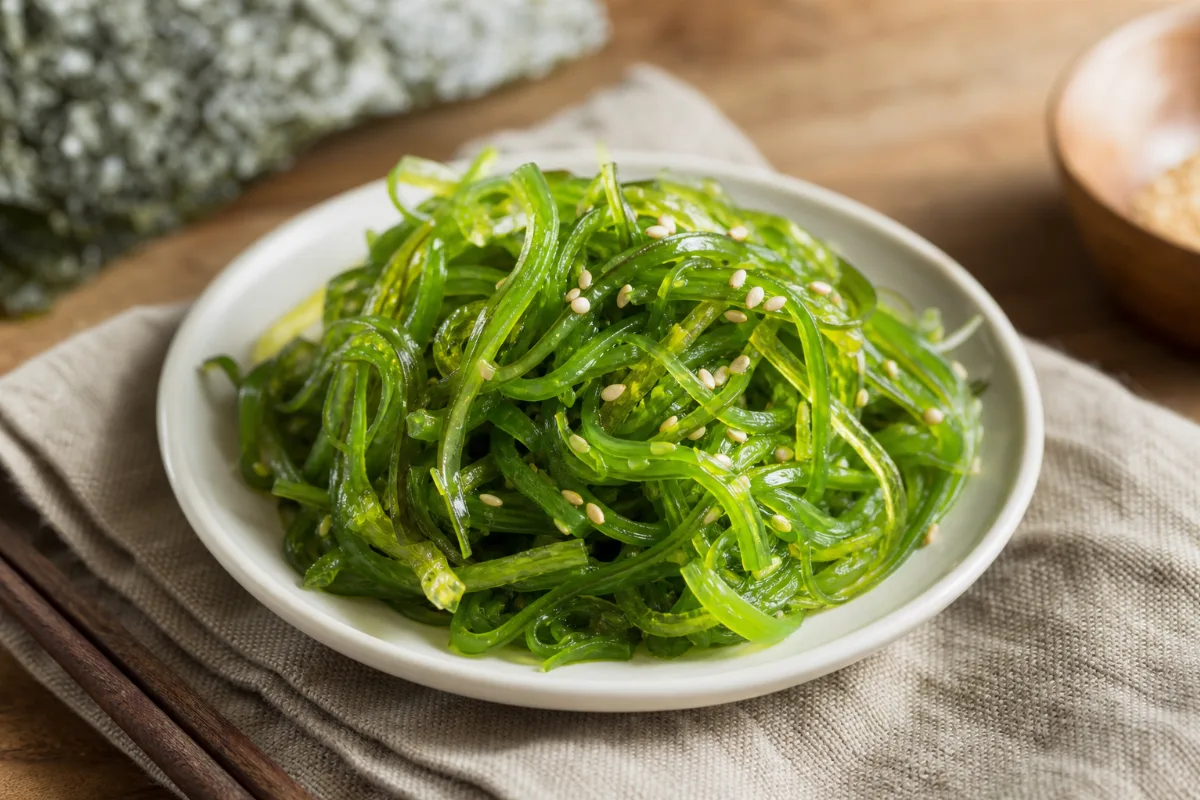
Seaweed Salad (Chuka Wakame)
Undaria pinnatifida (wakame), usually · also called Chuka wakame, goma wakame, sesame seaweed salad
Seaweed salad is a ready-to-eat side dish of seasoned seaweed, usually wakame, in a sweet, salty, sesame-flavored dressing. We found no trial of the salad itself as a health food. The things that are measured are its iodine, which varies a lot between seaweed foods, its salt and sugar in premade versions, and germs in a ready-to-eat product. Ask a clinician if you have thyroid disease or are pregnant.
General information, not medical advice. Last substantive update · Not medically reviewed. A named clinician has not signed off on this page. How this page is made
About Seaweed Salad (Chuka Wakame)
Seaweed salad, often called chuka wakame, is a ready-to-eat dish of seasoned seaweed, sold fresh or frozen and served in many sushi restaurants. It is a prepared food, not a remedy. This page looks at the dish, not at plain wakame: the first things to know are that its iodine is unpredictable and that, like any cold ready-to-eat food, it can carry germs.
What it is
The Canadian Food Inspection Agency describes seaweed salad as generally made with wakame and a dressing based on sesame seed oil, soy sauce and vinegar. Wakame (Undaria pinnatifida) is a brown seaweed, an alga rather than a plant. A consumer article says restaurant salads are often premade by a manufacturer and sometimes include agar, another seaweed, and that wakame is not naturally bright green.
There is no USDA entry we could use. For 100 g of premade salad, the same article gives 70 calories, 1 g protein, 11 g carbohydrate, 5 g fibre, 6 g sugar, 2.5 g fat and 820 mg sodium. Recipes, brands and restaurants differ, so these are one example, not a standard.
Iodine comes first
Wakame holds iodine, and the amount in seaweed foods is hard to guess. A Norwegian lab survey of 96 products found seaweed-containing foods held 30 to 25,300 microg of iodine per portion, and 54 of the 96 products would pass the upper level in one portion. A UK survey found only 10 percent of seaweed products stated iodine on the label. We did not find an iodine measurement for seaweed salad itself.
The American Thyroid Association says more than 1,100 microg of iodine a day is not recommended and may cause thyroid dysfunction. In a small Greenland study, a meal with seaweed salad briefly raised TSH in healthy people, with no adverse events.
What the research shows
We found no trial of seaweed salad for any health condition. The research is about what the food contains and how safe it is. Two very small meal studies measured iodine. One small trial of plain dried wakame with rice found lower blood sugar after the meal, and a review of brown seaweeds points the same way but found no high-quality trial. That is about the ingredient, not the dressed salad.
Salad versus plain wakame versus supplements
The iodine studies used seaweed salad as part of a sushi meal. The blood sugar trial used plain dried wakame. Homemade salads were not studied. Kelp tablets and iodine supplements are different products and can carry far more iodine. ATA advises against iodine and kelp supplements with more than 500 microg of iodine a day.
At a glance
Traditional uses history, not proof
- Eaten as a cold side dish, often at sushi restaurants
- Long use as a side dish is not proof that it treats any condition
Studied for research
- Iodine from a seaweed salad meal, low certainty (two very small meal studies)
- Blood sugar after a meal, very low certainty (studied with plain wakame, not the salad)
- Food safety and Listeria findings, moderate certainty for what was found (one large government survey)
Main compounds
- Iodine
- Sodium (salt) from the dressing
- Added sugar and food colours in many premade versions
- Sesame oil, soy sauce and vinegar (the usual dressing)
Common forms
- Premade fresh or frozen seaweed salad sold in shops and used by restaurants (the product in the Canadian survey)
- Seaweed salad served as part of a sushi meal (the product in the iodine studies)
- Plain dried wakame (used in the blood sugar trial)
- Homemade versions vary and were not studied. Kelp tablets and iodine supplements are different products and are not covered.
Research links: Canadian survey of seaweed salad, 2021 to 2024 · Iodine from sushi and wakame salad: crossover trial · Iodine in kelp and seaweed products (Norway) · American Thyroid Association statement on excess iodine · Research Library · Genes & Biomarkers Library
What it is and its history
- Accepted scientific name
- Undaria pinnatifida (Harv.) Suringar is the main ingredient (wakame). Seaweed salad itself is a prepared dish, not a species.
- Naming authority
- GBIF accepted name for wakame (key 5422556), exact match, 2026-10-26.
- Common names
- Seaweed salad (English); Chuka wakame (Japanese (romanised), as in the page title); Goma wakame (Japanese (romanised); name from an earlier summary, not re-read); Ensalada de algas (Spanish)
- Family or group
- Alariaceae (kelp order Laminariales), for wakame, per GBIF. The salad is a food made from seaweed, which is an alga, not a plant part.
- Classification
- Chromista (per GBIF, for wakame) > Ochrophyta (brown algae) > Phaeophyceae > Laminariales > Alariaceae > Undaria > Undaria pinnatifida
- Native range
- Not verified from a source read.
- Habitat
- Not verified from a source read.
- Cultivation
- Not verified from a source read.
- Harvest and processing
- The Canadian report describes seaweed salad as generally made with wakame and a dressing of sesame seed oil, soy sauce and vinegar. A consumer article says restaurant versions are often premade by a manufacturer, that agar (another seaweed) is sometimes added, and that wakame is not naturally bright green. Sold fresh or frozen; the Canadian survey sampled both. How the wakame is salted, cut and dyed was not read from a source.
- Look-alikes and adulterants
- Name: Plain wakame; Note: The seaweed on its own, such as dried wakame in miso soup, has its own page; the salad adds dressing, salt, sugar and sometimes colours.; Name: Homemade seaweed salad; Note: A consumer article says homemade versions let you choose the ingredients; no study compared them.; Name: Mixed seaweed salads; Note: May include other seaweeds with different iodine; kombu is far higher in iodine than nori.
Photographs
Traditional use and history history, not clinical proof
| Tradition or era | Documented use | Source |
|---|---|---|
| Canadian Food Inspection Agency survey report (citing a book chapter by Delaney and colleagues, 2016, not read) | ||
| Healthline consumer article (2022) | ||
| Not found in any source read |
Traditional use shows how it was used. It does not show that it works or is safe today.
What is inside, and how it may work
What it contains and how those compounds act in cells and animals. Laboratory and animal mechanisms are not proven effects in people.
Main compounds
| Compound | Family | Where it is concentrated | Activity studied | Level of evidence |
|---|---|---|---|---|
| Iodine | mineral (halogen) | Wakame (whole seaweed) 30 to 25,300 microg per portion across 39 seaweed-containing foods (Norway, 2021); 231 microg in the sushi and wakame salad meal used in one trial. Not measured for salad alone in any source read. | Needed for thyroid hormones. Too much may disturb the thyroid. 1 2 9 | Human data |
| Sodium (salt) | mineral | Added in the dressing 820 mg per 100 g of premade salad (consumer article) | Too much salt raises blood pressure risk, per the NHS. 13 15 | Consumer article |
| Sugar and food colours | additives | Added in the dressing About 6 g of sugar per 100 g; colours such as yellow #5 and blue #1 often present (consumer article) | The article says little data suggest they are inherently harmful. 13 | Consumer article |
Mechanisms, receptors and pathways
| Target or pathway | Gene or receptor | What was found | Level |
|---|---|---|---|
| Thyroid hormone production | Not specified in the sources read | Iodine is needed to make thyroid hormones; high intake may cause thyroid dysfunction according to ATA. In a small study a seaweed salad meal briefly raised TSH. 9 5 | Human data |
Absorption, metabolism and elimination
- Absorption
- In 20 healthy young women, estimated absorption of iodine in the first 24 hours was 75 percent from a sushi and wakame salad meal and 97 percent from a potassium iodide supplement.
- Distribution
- Not found.
- Metabolism
- Not found.
- Elimination
- In a small Greenland study, urinary iodine peaked at 6 hours and was back to pre-meal values by day 2.
- Bioavailability
- About 75 percent over 24 hours for the meal tested.
Isolated compounds versus whole extracts
The iodine studies used seaweed salad as part of a sushi meal. The blood sugar studies used plain dried wakame or brown seaweeds in general. Kelp tablets and iodine supplements are different products with far more iodine and are not covered here.
Nutritional composition
No USDA FoodData Central entry was reached for this dish (the USDA search service refused the request on 2026-10-26, and the older page said none exists in USDA SR Legacy), so no USDA values are used. These figures come from a consumer health article (Healthline, 2022), which cites its own database source that was not opened: for 100 g of premade seaweed salad, 70 calories, 1 g protein, 11 g carbohydrate, 5 g fibre, 6 g sugar, 2.5 g fat and sodium 36 percent of the reference daily intake (820 mg). It says the fibre may come from agar added to some salads. There is no official serving size, and this page gives no how-much-to-eat advice. Recipes, brands and restaurants differ; this is one example, not a standard.
1 low certainty1 very low certainty
What was looked at
The 2 benefits and uses checked for Seaweed Salad (Chuka Wakame), each with how strong the evidence is. Tap one to open it.
- Iodine from the salad (nutrient source, and the main risk)Low certainty
- Blood sugar after a meal (wakame, the main ingredient)Very low certainty
Lab markers tracked in the studies
Urinary iodineBlood glucose after a meal
What is Seaweed Salad (Chuka Wakame) good for?
The main studied points and how strong the human evidence is for each. No study tested seaweed salad as a treatment; most of what we know is measurement and food-safety testing.
Benefits, one by one
Each card is a research question, not a promise. Tap a goal to filter. Open a card to see the studies, doses and limits.
Iodine from the salad (nutrient source, and the main risk)
Low certaintySeaweed salad is made from wakame, a seaweed that holds iodine. In two small meal studies, urinary iodine rose after a meal with seaweed salad, and about three-quarters of the iodine in a sushi and wakame salad meal was estimated to be absorbed. But product tests show iodine in seaweed foods varies enormously, and the label rarely says how much is in the pack.
4 studiesWakame salad as part of a sushi meal (Aakre 2023); fresh Greenlandic …
Studies, doses and limits
What the trials found
Aakre 2023 (randomised crossover, 20 healthy young women, Norway): a meal of sushi with nori plus a wakame salad (231 microg iodine) was compared with a potassium iodide supplement (225 microg). Estimated absorption in the first 24 hours was 75 percent from the seaweed meal and 97 percent from the supplement. Noahsen 2020 (randomised meal study, 9 people with normal thyroids, Greenland): urinary iodine rose 385 percent with a fresh Greenlandic seaweed salad, 59 percent with no salad and 43 percent with a Japanese salad bought in a store, and was back to normal by day 2. TSH rose briefly and was normal again by day 3; free T4 did not change. No adverse reactions. Aakre 2021 (96 Norwegian products): seaweed-containing foods held 30 to 25,300 microg iodine per portion, and 54 of 96 products would pass the upper level in one portion; labelling was inadequate or inaccurate for several products. Bouga 2015 (224 UK products): only 10 percent stated iodine on the label.
Results
Eating seaweed salad does deliver iodine, and the body takes up most of it. But the amount in a given pack or restaurant portion is unpredictable, so it cannot be treated as a reliable iodine source. This is a measurement of what is in the food, not a proven health benefit.
Effect sizes as reported
Estimated 24-hour iodine absorption 75 percent (sushi plus wakame salad) versus 97 percent (supplement). Urinary iodine +43 percent after a store-bought Japanese salad versus +59 percent after sushi without salad.
Why this rating
Low: two very small meal studies in healthy people, one of them only 9 people split into three groups; seaweed foods vary hugely; no study measured long-term iodine status or thyroid outcomes from eating seaweed salad.
Form and dose studied
Wakame salad as part of a sushi meal (Aakre 2023); fresh Greenlandic seaweed salad and a store-bought Japanese seaweed salad (Noahsen 2020).
Who was studied
Healthy young women (Norway); 9 people with normal thyroid function (Greenland). Not tested in people with thyroid disease, in pregnancy, or in children.
Limits
The Norwegian meal combined sushi and salad, so the salad alone was not separated; the 2023 paper has an erratum (correction) whose content was not read. The Greenland groups were tiny and the abstract does not say what seaweed was in the store-bought salad. Neither study looked at repeated eating.
Why researchers looked
Wakame is rich in iodine, a mineral the thyroid needs. Researchers asked whether a seaweed salad meal is a useful iodine source and whether one meal disturbs the thyroid.
Traditional use
Seaweed salad (chuka wakame) is a ready-made side dish served in sushi restaurants and sold in shops. Long use as a side dish is not proof that it treats any condition.
Proposed mechanism Human measurement
Iodine in food is absorbed and passes out in urine, so urine iodine shows how much a meal delivered. Iodine is needed to make thyroid hormones.
A proposed mechanism does not show that the effect happens in people.
Too much iodine can harm the thyroid. See the Safety tab before treating the salad as an iodine source.
Blood sugar after a meal (wakame, the main ingredient)
Very low certaintyNo study tested seaweed salad for blood sugar. In one small trial, 26 adults had lower blood glucose and insulin 30 minutes after rice with 4 g of dried wakame than after rice alone. A review of brown seaweeds in general points the same way, but found no high-quality trial.
2 studiesPlain dried wakame eaten with rice (trial); brown seaweeds and extrac…
Studies, doses and limits
What the trials found
Yoshinaga 2019 (randomised crossover, 26 adults, Japan): 200 g rice alone versus 200 g rice with 4 g dried wakame. Glucose and insulin were significantly lower at 30 minutes with wakame, and the incremental areas under the curves were lower. Vaughan 2022 (meta-analysis of 18 randomised trials of brown seaweeds and extracts): pooled fasting glucose lower by 4.6 and after-meal glucose lower by 7.1; the authors say results varied, no high-quality trial was found, and species-specific and dose-response research is needed.
Results
A single-meal effect of plain dried wakame on blood sugar was seen in one small trial. This does not show that a seasoned, sweetened salad does the same, or that it helps long-term blood sugar. Premade salads can also contain added sugar (see Safety).
Effect sizes as reported
Meta-analysis: fasting glucose mean difference -4.6 (95% CI -7.88 to -1.33); after-meal -7.1 (95% CI -7.4 to -6.9).
Why this rating
Very low for the salad: no study of the salad itself. The wakame trial is one small single-meal study and the review mixes several brown seaweeds and extracts, with no high-quality trial.
Form and dose studied
Plain dried wakame eaten with rice (trial); brown seaweeds and extracts in the review.
Who was studied
26 adults in Japan; healthy, at-risk and type 2 diabetes in the review.
Limits
Not tested with seasoned salad; effects beyond one meal not shown; the review mixes seaweeds and extracts.
Why researchers looked
Wakame is the usual base of seaweed salad. Researchers asked whether adding brown seaweed to a starchy meal flattens the blood sugar rise.
Traditional use
Seaweed salad (chuka wakame) is a ready-made side dish served in sushi restaurants and sold in shops. Long use as a side dish is not proof that it treats any condition.
Proposed mechanism Hypothesis
Not shown in the abstracts read. The authors only suggest wakame may blunt blood sugar rises after a meal.
A proposed mechanism does not show that the effect happens in people.
Wakame is high in iodine, and premade salad can be high in salt and sugar. See the Safety tab. This page does not say anyone should eat it for blood sugar.
Connections to the rest of health
How Seaweed Salad (Chuka Wakame) connects to the rest of our health knowledge graph. Every link says what kind of connection it is. A safety link (for example to the liver) is a warning, not a benefit. A study that merely mentions a topic never creates a benefit link.
Explore every connection: goals, body systems, organs, symptoms, genes
A. Wellness goals
| Connected to | Kind of connection | Evidence status | Context | Studies |
|---|---|---|---|---|
| Thyroid Support | Low certainty | Iodine from the salad (nutrient source, and the main risk): Seaweed salad is made from wakame, a seaweed that holds iodine. In two small meal studies, urinary iodine rose after a meal with seaweed salad, and about three-quarters of the iodine in a sushi and wakame salad meal was estimated to be absorbed. But product tests show iodine in seaweed foods varies enormously, and the label rarely says how much is in the pack. | 2 5 1 3 | |
| Blood Sugar Balance | Very low certainty | Blood sugar after a meal (wakame, the main ingredient): No study tested seaweed salad for blood sugar. In one small trial, 26 adults had lower blood glucose and insulin 30 minutes after rice with 4 g of dried wakame than after rice alone. A review of brown seaweeds in general points the same way, but found no high-quality trial. | 8 7 |
B. Body systems
C. Body parts and organs
| Connected to | Kind of connection | Evidence status | Context | Studies |
|---|---|---|---|---|
| Thyroid | Adverse effect or risk | Documented risk | Seaweed foods in a Norwegian survey held 30 to 25,300 microg of iodine per portion; ATA says more than 1,100 microg a day may cause thyroid dysfunction. Seaweed foods held 30 to 25,300 microg of iodine per portion in one survey; ATA says more than 1,100 microg a day may cause thyroid dysfunction. Preparation or compound: Iodine in seaweed foods |
1 9 |
G. Root causes and contributing factors
| Connected to | Kind of connection | Evidence status | Context | Studies |
|---|---|---|---|---|
| Foodborne illness | Adverse effect or risk | Documented risk | Listeria in 1.9 percent of Canadian retail samples, all frozen; one large school outbreak in Japan involved seaweed salad. Listeria in 1.9 percent of 858 Canadian retail seaweed salads, all frozen; one large school outbreak in Japan involved seaweed salad. Preparation or compound: Ready-to-eat seaweed salad |
11 4 |
I. Biomarkers
| Connected to | Kind of connection | Evidence status | Context | Studies |
|---|---|---|---|---|
| Urinary iodine | Biological association | Low certainty | Measured in trials: raised. A lab change is not the same as a health benefit. | 2 5 1 |
| Blood glucose after a meal | Biological association | Very low certainty | Measured in trials: lowered. A lab change is not the same as a health benefit. | 8 7 |
K. Biological pathways
L. Active compounds
| Connected to | Kind of connection | Evidence status | Context | Studies |
|---|---|---|---|---|
| Iodine | Biological association | Human | Needed for thyroid hormones. Too much may disturb the thyroid. Preparation or compound: Wakame (whole seaweed) |
1 2 9 |
| Sodium (salt) | Biological association | Consumer article | Too much salt raises blood pressure risk, per the NHS. Preparation or compound: Added in the dressing |
13 15 |
| Sugar and food colours | Biological association | Consumer article | The article says little data suggest they are inherently harmful. Preparation or compound: Added in the dressing |
13 |
Each connection is stored with the ingredient, the connected record, the kind of connection, the evidence status, the supporting studies, the preparation or compound involved, and a review date (last reviewed October 26, 2026).
Evidence at a glance: what changed in 2 lab markers
Tap a number to show only those markers. Counts are markers, not people.
The evidence
The research centre for Seaweed Salad (Chuka Wakame). Every record here was checked against PubMed or the publisher's page; we never list a study we have not verified.
Evidence by outcome
Bars show how many studies we found for each outcome, not how well it works. People are added up across trials only (reviews are not added, to avoid double counting).
How we rate evidence
High certainty
Several well-run trials or reviews agree; further research is unlikely to change the picture much.
Moderate certainty
Good trials point the same way, but some doubt remains.
Low certainty
Small, short or inconsistent trials. The finding could change with better research.
Very low certainty
Very little or very weak human data. Treat as a possibility only.
Mixed findings
Trials or reviews disagree with each other.
Not enough evidence
Not enough human research to say either way.
Evidence against
Good research found no benefit, or found harm.
We take the reviewers' own risk-of-bias and GRADE statements where they exist, and otherwise judge from study size, design, consistency, directness and whether a product matches what is sold. Many publications do not make evidence high. Method note: We started from our earlier seaweed salad summary, re-read the Canadian government survey, the consumer article, and the ATA, NHS and LactMed pages, checked wakame in GBIF, and read the PubMed abstracts for each study cited. Items we could not verify are flagged in the research gaps.
Study library: every study we checked 15
| Study | Design | People | Product, dose, length | Result |
|---|---|---|---|---|
| Aakre 2021 Commercially available kelp and seaweed products - valuable iodine source or risk of excess intake? Food Nutr Res · PMID 33889064 · DOI |
Product survey (laboratory analysis) Mixed seaweeds |
96 96 seaweed products on the Norwegian market: 43 whole seaweeds, 39 seaweed-containing foods, 14 supplements |
Seaweed products measured for iodine (ICP-MS) Whole seaweeds, seaweed foods and supplements |
Iodine in one portion of seaweed-containing foods ranged from 30 to 25,300 microg. For 54 of the 96 products, one portion or dose would be over the tolerable upper intake level. Labelling of species and iodine was inadequate or inaccurate for several products. The authors called seaweed products unreliable iodine sources that may carry a risk of excess iodine. 54 of 96 products over the upper level in one portion (Not stated in the abstract) Methods, limits and fundingOutcomes: Iodine per portion and per gram Limitations: Norwegian market products; seaweed salad was not reported separately in the abstract. Not a trial. Funding and conflicts: No competing interests declared. Read: abstract |
| Aakre 2023 Bioavailability of iodine from a meal consisting of sushi and a wakame seaweed salad-A randomized crossover trial. Food Sci Nutr · PMID 38107121 · DOI |
Randomised crossover trial Undaria pinnatifida and Porphyra spp. |
20 20 healthy young women, Norway |
A meal of sushi with nori and a wakame seaweed salad (231 microg iodine) versus a potassium iodide supplement (225 microg iodine) Wakame (Undaria pinnatifida) salad and nori (Porphyra) in sushi One meal Urine collected for 48 hours · vs Potassium iodide supplement |
Urinary iodine rose after both the seaweed meal and the supplement, but the median was higher after the supplement. Estimated uptake in the first 24 hours was 75 percent from the sushi and wakame meal and 97 percent from the supplement. The authors say sushi and wakame could be iodine sources, but iodine in seaweed varies by place and processing and must be stable and predictable first. 75 percent versus 97 percent estimated uptake over 24 hours (Not stated in the abstract) Methods, limits and fundingOutcomes: Urinary iodine over 48 hours; estimated iodine uptake in the first 24 hours Limitations: Small, healthy young women only, single meal. The meal was sushi plus wakame salad, so the salad alone was not separated. An erratum (correction) was published in 2025; its content was not read. Funding and conflicts: No competing interests declared. Read: abstract |
| Bouga 2015 Emergence of Seaweed and Seaweed-Containing Foods in the UK: Focus on Labeling, Iodine Content, Toxicity and Nutrition. Foods · PMID 28231201 · DOI |
Product survey Mixed seaweeds |
224 224 seaweed-containing products on the UK market |
Retail products checked for labelling and iodine Seaweed foods |
Only 22 of 224 products (10 percent) stated iodine on the label and 40 more (18 percent) gave enough information to estimate it. For those, the median was 110 microg/g and 585 microg per estimated serving. Twenty-six products could give more than the European adult upper level of 600 microg a day. The authors note risks from high iodine and from build-up of arsenic and heavy metals in some seaweeds. Median 585 microg iodine per estimated serving (IQR 105 to 2,520) (Not stated in the abstract) Methods, limits and fundingOutcomes: Labelling of iodine; estimated iodine per serving Limitations: Calculations per serving relied on assumptions. Seaweed salad is not singled out in the abstract. Funding and conflicts: No competing interests declared. Read: abstract |
| Kashima 2021 An outbreak of food poisoning due to Escherichia coli serotype O7:H4 carrying astA for enteroaggregative E. coli heat-stable enterotoxin1 (EAST1). Epidemiol Infect · PMID 34726137 · DOI |
Outbreak investigation Not applicable |
3000 About 3000 elementary and junior high school students, Saitama, Japan, June 2020 |
School lunch containing a seaweed salad Seaweed salad and a red seaweed ingredient (Gigartina tenella) |
A school lunch was the only food all patients had eaten. E. coli O7:H4 carrying the astA gene was found in patients and in a seaweed salad and in red seaweed used as a raw material. The isolates were all of the same origin and resistant to ampicillin and cefotaxime. The authors say this is the first report of a large outbreak from this E. coli type. About 3000 people affected (Not stated in the abstract) Methods, limits and fundingOutcomes: Source of a food poisoning outbreak Limitations: An outbreak report, not a measure of how often it happens. The salad was a school-lunch dish and the abstract does not describe its recipe. Funding and conflicts: No conflicts declared. Read: abstract |
| Noahsen 2020 Intake of seaweed as part of a single sushi meal, iodine excretion and thyroid function in euthyroid subjects: a randomized dinner study. J Endocrinol Invest · PMID 31571150 · DOI |
Small randomised meal study Not specified |
9 9 people with normal thyroid function, Greenland |
Halibut maki roll with (A) fresh Greenlandic seaweed salad, (B) no seaweed salad, or (C) a Japanese seaweed salad bought at a local store Seaweed salad (kinds not named in the abstract) One meal Spot urine and blood daily for a week · vs Maki roll without seaweed salad |
Urinary iodine rose by 385 percent (group A), 59 percent (B) and 43 percent (C), peaked at 6 hours and was back to pre-meal values by day 2. Serum TSH rose 150 percent on day 2 and was back to pre-meal values by day 3. Free T4 stayed level. No adverse reactions were reported. The authors concluded a single sushi meal with seaweed salad did not cause adverse events. Urinary iodine +385 percent (fresh salad), +59 percent (no salad), +43 percent (store-bought salad) (Not stated in the abstract) Methods, limits and fundingOutcomes: Urinary iodine, TSH and free T4 Limitations: Only 9 people split into three groups (about 3 each); a one-meal study; healthy thyroids only. The abstract does not say which group had the TSH rise, or what species was in the store-bought salad. Funding and conflicts: Not stated in the abstract. Read: abstract |
| Raymond 2025 Evaluation of Porcine Gastric Mucin-Based Method for Extraction of Noroviruses from Seaweed Salad. Viruses · PMID 41012672 · DOI |
Laboratory method study Not applicable |
Wakame seaweed salad of various brands, spiked in the lab | A lab method to recover norovirus from seaweed salad Wakame seaweed salad · vs Other extraction methods |
The authors state that several norovirus outbreaks have been linked to contaminated ready-to-eat seaweed products and that standard test methods work poorly on seaweed. Their improved method recovered about 17 to 19 percent of norovirus added to wakame salad. This paper is about a testing method, not about how common norovirus is in salad. Recovery about 17 to 19 percent (Not stated in the abstract) Methods, limits and fundingOutcomes: Recovery of norovirus from the salad Limitations: A method paper; it does not measure real contamination of salads on sale. Funding and conflicts: No conflicts declared. Read: abstract |
| Vaughan 2022 Effect of brown seaweed on plasma glucose in healthy, at-risk, and type 2 diabetic individuals: systematic review and meta-analysis. Nutr Rev · PMID 34549293 · DOI |
Systematic review and meta analysis of randomised trials Brown seaweeds (mixed) |
18 18 randomised trials in healthy people, people at risk of diabetes and people with type 2 diabetes |
Brown seaweeds and their extracts Brown seaweeds (several kinds) and extracts Varied Varied · vs Control |
Results varied between studies. Pooled, fasting glucose was lower by 4.6 (95% CI -7.88 to -1.33) and after-meal glucose was lower by 7.1 (95% CI -7.4 to -6.9). The authors say brown seaweed shows potential, but no high-quality trial was found and species-specific and dose-response research is needed. Fasting glucose mean difference -4.6; after-meal -7.1 (Not stated in the abstract) Methods, limits and fundingOutcomes: Fasting and after-meal plasma glucose Limitations: Mixed seaweeds and extracts, not seaweed salad. No high-quality trial among those included. Funding and conflicts: Not stated in the abstract. Read: abstract |
| Yoshinaga 2019 Effects of Undaria pinnatifida (Wakame) on Postprandial Glycemia and Insulin Levels in Humans: a Randomized Crossover Trial. Plant Foods Hum Nutr · PMID 31418121 · DOI |
Randomised crossover trial (single meal) Undaria pinnatifida |
26 26 adults, Japan |
Rice with dried wakame Dried wakame (Undaria pinnatifida) 4 g dried wakame with 200 g rice One meal; blood sampled for 2 hours · vs 200 g rice alone |
Blood glucose and insulin were lower 30 minutes after rice with wakame than after rice alone, and the incremental areas under the curves for glucose and insulin were lower with wakame. The authors suggest wakame may help blunt blood sugar rises after a meal. Lower glucose and insulin at 30 minutes; lower incremental areas (Not stated in the abstract) Methods, limits and fundingOutcomes: Blood glucose and insulin after the meal Limitations: Single meal, healthy adults, plain dried wakame with rice, not a seasoned salad. Effects on long-term blood sugar not tested. Funding and conflicts: Not stated in the abstract. Read: abstract |
| s-ata-2013 American Thyroid Association: statement on the potential risks of excess iodine ingestion and exposure (5 June 2013) · Source |
Health agency n/a |
Methods, limits and fundingRead: full-text | ||
| s-cdc-listeria CDC: Listeria prevention · Source |
Health agency n/a |
Methods, limits and fundingRead: not-read | ||
| s-cfia-2024 Canadian Food Inspection Agency: Bacterial pathogens and indicators in seaweed salad, April 1, 2021 to March 31, 2024 (targeted survey, final report) · Source |
Government survey Wakame salad (retail) |
Methods, limits and fundingRead: full-text | ||
| s-gbif-undaria GBIF Backbone: Undaria pinnatifida (Harv.) Suringar (usageKey 5422556) · Source |
Reference database Undaria pinnatifida |
Methods, limits and fundingRead: full-text | ||
| s-healthline-2022 Healthline: What Is Seaweed Salad? (medically reviewed, 2 September 2022) · Source |
Consumer article Premade seaweed salad / wakame |
Methods, limits and fundingRead: full-text | ||
| s-lactmed-seaweed Drugs and Lactation Database (LactMed): Seaweed (PMID 30000910; record dated 2024 Oct 15) · Source |
Drug and lactation database record Seaweed (kelp; Undaria pinnatifida mentioned) |
Methods, limits and fundingRead: full-text | ||
| s-nhs-salt NHS: Salt in your diet (page last reviewed 17 April 2023) · Source |
Health agency n/a |
Methods, limits and fundingRead: full-text |
What we do not know yet
- No trial of seaweed salad for any health condition was found; the blood sugar studies used plain wakame or brown seaweeds.
- No iodine measurement of seaweed salad as sold was found, and the label rarely states it.
- Nutrition figures come from one consumer article, not USDA, because no USDA entry was reached.
- The CDC Listeria page could not be opened, so its higher-risk groups are not confirmed here; no official statement on seaweed salad in pregnancy was found.
- Allergy to the dressing, metals in the salad, choking risk for children, and interactions with medicines were not researched or found.
How new research is added
New studies are found by a saved PubMed search and placed in a review queue before the page changes.
Lab markers
What changed in blood or saliva tests during trials. A changed number is not the same as feeling or being healthier, and we give no "normal ranges".
Other 2
Urinary iodine
Raised in trials
The amount of iodine in urine. It shows how much iodine recently came in from food.
Low certaintyResults and what it means
Why it was measured
Iodine is needed for the thyroid, and both too little and too much can cause problems.
Statistical vs. clinical meaning
Shows the salad delivers iodine; says nothing about benefit or harm from repeated eating.
Safety implication
Product tests found some seaweed foods carry far more iodine than the upper level in one portion.
| Study | Result | People | Product |
|---|---|---|---|
| 2 | Urinary iodine rose after the seaweed meal and after the supplement; the supplement gave a higher median | 20 healthy young women, Norway | Sushi with nori plus wakame salad (231 microg iodine) versus potassium iodide (225 microg) |
| 5 | Rose 385 percent (fresh seaweed salad), 59 percent (no salad) and 43 percent (store-bought Japanese salad); back to pre-meal values by day 2 | 9 people with normal thyroid function, Greenland | One sushi meal with or without seaweed salad |
Blood glucose after a meal
Lowered in trials
How high blood sugar rises in the hours after eating.
Very low certaintyResults and what it means
Why it was measured
Large spikes after meals are linked to risk of type 2 diabetes and heart disease.
Statistical vs. clinical meaning
A short-term change after one meal with plain wakame; not tested with the salad.
Safety implication
Iodine and, in premade salads, added sugar and salt.
| Study | Result | People | Product |
|---|---|---|---|
| 8 | Lower glucose and insulin at 30 minutes and lower incremental areas under the curve with wakame | 26 adults, Japan | 200 g rice with 4 g dried wakame versus rice alone |
| 7 | After-meal glucose lower by 7.1 across trials of brown seaweeds | 18 trials, mixed groups | Brown seaweeds and extracts |
Safety
What studies and official sources say about side effects, medicines and who should check first. Each point shows what kind of evidence it comes from.
Main points to know 3
- Iodine: the amount in a salad is unknown. Seaweed salad is made mostly from wakame, which holds iodine. A Norwegian lab survey of 96 seaweed products found seaweed-containing foods carried 30 to 25,300 microg of iodine per portion, and in 54 of the 96 products one portion would pass the upper level. A UK survey found only 10 percent of seaweed products stated iodine on the label. We found no measured iodine for seaweed salad as sold. The American Thyroid Association says more than 1,100 microg of iodine a day is not recommended and may cause thyroid dysfunction. Laboratory measurement and authoritative guidance 1 3 9
- It is a ready-to-eat food, so germs matter. A Canadian government survey of 858 retail seaweed salads found Listeria monocytogenes in 16 samples (1.9 percent), all frozen, at low levels (below 5 per gram) and from only 5 lots. No illnesses were linked, and the agency called seaweed salad sold in Canada generally safe. Elsewhere, an outbreak of E. coli food poisoning among about 3000 school students in Japan was traced to a lunch that included seaweed salad and a red seaweed ingredient, and a 2025 paper states that several norovirus outbreaks have been linked to ready-to-eat seaweed products. Government survey and outbreak report 11 4 6
- Salt, sugar and additives in premade salads. A consumer health article lists premade seaweed salad at 820 mg of sodium and 6 g of sugar per 100 g, and says the sodium comes mostly from added salt. Premade versions often have added sugar or high fructose corn syrup, colours such as yellow #5 and blue #1, and hydrolyzed vegetable protein, which contains wheat. The article says there is little data that these ingredients are inherently harmful. The NHS says too much salt can cause high blood pressure. Consumer article and health agency 13 15
Side effects 3
| Effect | How often | Severity and recovery | Evidence |
|---|---|---|---|
| Too much iodine can disturb the thyroid ATA: more than 1,100 microg a day may cause thyroid dysfunction. In a small Greenland study, one sushi meal with seaweed salad raised urinary iodine and briefly raised TSH (normal again by day 3) in people with healthy thyroids, with no adverse events. | Not found for seaweed salad. | can be serious over time Not found for seaweed salad. | Authoritative guidance 9 5 |
| Food poisoning (Listeria, E. coli, norovirus) from a contaminated ready-to-eat salad The 2020 Japan school outbreak affected about 3000 students; seaweed salad and a red seaweed raw material carried the E. coli. | Listeria in 16 of 858 Canadian retail samples (1.9 percent), all frozen, from 5 lots. | varies; outbreaks have been large Not applicable | Government survey and outbreak report 11 4 6 |
| Extra salt, sugar and colours from the dressing Colours and flavour enhancers are listed on the ingredient label. | Common in premade versions, per a consumer article. | depends on how much is eaten Not applicable | Consumer article 13 15 |
Liver
No liver injury from seaweed salad was found in the sources read. A liver-safety source such as LiverTox was not searched.
How often. No frequency was found.
Monitoring. No agency monitoring advice was found.
This is a safety connection. It is not evidence that Seaweed Salad (Chuka Wakame) supports liver health.
Medicines and supplements 2
| With | Why it matters | Importance | Evidence | What to do |
|---|---|---|---|---|
| Thyroid medicines (levothyroxine, antithyroid drugs) and thyroid disease prescription | Iodine acts on the thyroid itself. | No source on seaweed salad with thyroid medicine was read. Given the iodine facts above, this is a question for a clinician. | None found Not enough evidence 9 | If you have thyroid disease or take thyroid medicine, ask your clinician before eating seaweed salad regularly. |
| Warfarin (a blood thinner) prescription | Not found. | No source on seaweed salad with warfarin was read. | None found Not enough evidence | If you take warfarin or any regular medicine, ask your pharmacist or doctor about changes in your diet. |
Who should check first 5
| Situation | Advice | Evidence |
|---|---|---|
| Thyroid disease, or taking thyroid medicine | Ask your clinician before eating seaweed salad regularly. This page does not tell anyone to eat or avoid it for a thyroid problem. | Expert guidance 9 |
| Pregnancy | The American Thyroid Association lists higher recommended iodine intakes in pregnancy (220 to 250 microg a day), while the 1,100 microg adult upper limit still applies. Listeria is a concern for pregnant people with ready-to-eat foods, but the official page that lists the higher-risk groups could not be opened for this page, so that statement is not verified here. Ask your midwife or doctor about cold ready-made salads. | Authoritative guidance partly unverified 9 10 |
| Breastfeeding | LactMed says some sources recommend against using seaweed during breastfeeding because of its high iodine and possible heavy metals, and that no data exist on seaweed components in breast milk apart from iodine being actively transported into milk. ATA lists 250 to 290 microg a day as the recommended intake while breastfeeding. Ask your midwife or doctor. | Drug and lactation database 14 9 |
| Babies, toddlers and young children | Children have lower salt limits than adults. The NHS lists no more than 2 g of salt a day for ages 1 to 3, 3 g for 4 to 6, 5 g for 7 to 10, and less than 1 g under 1 year; babies cannot process much salt. Children also have lower iodine upper limits than adults, but no source on seaweed salad for children was read. Choking risk was not researched. Ask your child's doctor. | Health agency 15 |
| Older adults and people with weak immunity | Ready-to-eat salads are not cooked before eating. The Canadian survey and outbreak reports show germs can be present. If your immune system is weak, ask your clinician about cold prepared salads. No official statement on seaweed salad for these groups was read. | Inference from survey 11 |
Overdose, product quality and regulators
Summary. For seaweed salad as food, the points are iodine, germs in a ready-to-eat product, and added salt, sugar and colours. No other toxicity was found in the sources read.
Animal. Not reviewed.
High dose or long term signals. ATA says more than 1,100 microg of iodine a day may cause thyroid dysfunction.
Overdose response. Not found.
Genotoxicity. Not researched.
Two kinds of contamination are documented for the salad: germs, and (for seaweed in general) minerals and metals taken up from sea water.
Canadian retail survey (2021 to 2024). 858 fresh and frozen samples from 11 cities were tested. 98.1 percent were satisfactory. Salmonella, E. coli O157 and elevated generic E. coli were not found. Listeria monocytogenes was found in 16 samples, all frozen, from 5 lots, at below 5 per gram. Frozen products had shelf lives of up to 2 years, and some lots were sampled several times. 11
Japan school lunch outbreak (2020). E. coli O7:H4 carrying the astA gene was found in patients and in a seaweed salad and a red seaweed raw ingredient; about 3000 students were affected. The authors call it the first report of a large outbreak of this type. 4
Norovirus. A 2025 paper by Canadian government labs says several norovirus outbreaks have been linked to ready-to-eat seaweed products and that standard test methods work poorly on seaweed; they tested a better lab method on wakame salad. It does not report how often salads carry norovirus. 6
Heavy metals. The UK survey notes that some seaweeds accumulate arsenic and heavy metals. No measurement of metals in seaweed salad was found in the sources read. 3
Labels. Only 10 percent of UK seaweed products stated iodine, and Norwegian labelling was inadequate or inaccurate for several products. Salad labels were not examined separately. 3 1
| Body | Action | Date |
|---|---|---|
| American Thyroid Association (United States) | More than 1,100 microg of iodine a day (Tolerable Upper Limit) is not recommended and may cause thyroid dysfunction; advises against iodine and kelp supplements with more than 500 microg a day. source | 2013-06-05 |
| Canadian Food Inspection Agency (Canada) | After testing 858 retail seaweed salads (2021 to 2024), said seaweed salad sold in Canada is generally safe, found Listeria monocytogenes in 1.9 percent (all frozen, 5 lots), took follow-up action with no illnesses reported, and recommends good hygiene for producers, retailers and consumers. source | 2024 |
| NHS (United Kingdom) | Adults should have no more than 6 g of salt a day; lower limits for children by age; too much salt can cause high blood pressure. source | 2023-04-17 |
| LactMed (US National Library of Medicine) (United States) | Some sources recommend against seaweed during breastfeeding because of its high iodine content and possible heavy metals; no data on seaweed components in breast milk other than iodine transport. source | 2024-10-15 |
When to get medical help
Stop using the product and contact a clinician or emergency service. In the US, Poison Control is 1-800-222-1222.
General information only, not medical advice. Ask a clinician or pharmacist before use, especially with medicines, in pregnancy or with a health condition. See the Natural Remedy Safety guide.
Frequently asked questions
What is seaweed salad?
A ready-to-eat dish of seasoned seaweed, usually wakame, in a dressing that is generally based on sesame oil, soy sauce and vinegar, per the Canadian Food Inspection Agency. It is sold fresh or frozen and served in many sushi restaurants.
What is chuka wakame?
Is seaweed salad high in iodine?
Does the body absorb the iodine from seaweed salad?
In a small crossover trial of 20 women, about 75 percent of the iodine in a sushi and wakame salad meal was estimated to be absorbed in the first 24 hours, versus 97 percent from a supplement.
Is seaweed salad bad for the thyroid?
Can seaweed salad give you food poisoning?
Is seaweed salad safe in pregnancy?
Is it safe while breastfeeding?
LactMed says some sources recommend against seaweed during breastfeeding because of its high iodine and possible heavy metals. Ask your midwife or doctor.
How much salt and sugar is in premade seaweed salad?
One consumer article lists about 820 mg of sodium and 6 g of sugar per 100 g, mostly from the dressing. Packs and restaurants vary, so read the label or ask.
Why is it so bright green?
A consumer article says wakame is not naturally bright green, and that premade salads often contain colours such as yellow #5 and blue #1. It says there is little data these are inherently harmful. Colours are listed on the label.
Does seaweed salad help with blood sugar or weight?
Explore by health goal
Editorial transparency
- Written by
- AlternativeMed editorial team. Research compiled with AI assistance, then checked against the sources listed.
- Medical review
- None. This page has not been reviewed by a physician or pharmacist.
- First published
- 2026-10-26
- Last substantive update
- 2026-10-26
- How we research
- We started from our earlier seaweed salad summary, re-read the Canadian government survey, the consumer article, and the ATA, NHS and LactMed pages, checked wakame in GBIF, and read the PubMed abstracts for each study cited. Items we could not verify are flagged in the research gaps.
- How we rate evidence
- See "How we rate evidence" in the Evidence tab.
- Independence
- No product is promoted on this page. No affiliate links are shown. Funding is not stated in the abstracts of several studies used.
Sources 15
Each source was opened and checked. Where we read only the abstract, it says so. The small numbers in the text point here.
- Aakre I, Solli DD, Markhus MW, et al.. Commercially available kelp and seaweed products - valuable iodine source or risk of excess intake?. Food Nutr Res. 2021. PMID 33889064. DOI 10.29219/fnr.v65.7584. (abstract)
- Aakre I, Tveit IB, Myrmel LS, et al.. Bioavailability of iodine from a meal consisting of sushi and a wakame seaweed salad-A randomized crossover trial.. Food Sci Nutr. 2023. PMID 38107121. DOI 10.1002/fsn3.3689. (abstract)
- Bouga M, Combet E. Emergence of Seaweed and Seaweed-Containing Foods in the UK: Focus on Labeling, Iodine Content, Toxicity and Nutrition.. Foods. 2015. PMID 28231201. DOI 10.3390/foods4020240. (abstract)
- Kashima K, Sato M, Osaka Y, et al.. An outbreak of food poisoning due to Escherichia coli serotype O7:H4 carrying astA for enteroaggregative E. coli heat-stable enterotoxin1 (EAST1).. Epidemiol Infect. 2021. PMID 34726137. DOI 10.1017/S0950268821002338. (abstract)
- Noahsen P, Kleist I, Larsen HM, Andersen S. Intake of seaweed as part of a single sushi meal, iodine excretion and thyroid function in euthyroid subjects: a randomized dinner study.. J Endocrinol Invest. 2020. PMID 31571150. DOI 10.1007/s40618-019-01122-6. (abstract)
- Raymond P, Paul S, Blain R, Nasheri N. Evaluation of Porcine Gastric Mucin-Based Method for Extraction of Noroviruses from Seaweed Salad.. Viruses. 2025. PMID 41012672. DOI 10.3390/v17091245. (abstract)
- Vaughan K, Ranawana V, Cooper D, Aceves-Martins M. Effect of brown seaweed on plasma glucose in healthy, at-risk, and type 2 diabetic individuals: systematic review and meta-analysis.. Nutr Rev. 2022. PMID 34549293. DOI 10.1093/nutrit/nuab069. (abstract)
- Yoshinaga K, Mitamura R. Effects of Undaria pinnatifida (Wakame) on Postprandial Glycemia and Insulin Levels in Humans: a Randomized Crossover Trial.. Plant Foods Hum Nutr. 2019. PMID 31418121. DOI 10.1007/s11130-019-00763-5. (abstract)
- . American Thyroid Association: statement on the potential risks of excess iodine ingestion and exposure (5 June 2013). . . (full-text)
- . CDC: Listeria prevention. . . (not-read)
- . Canadian Food Inspection Agency: Bacterial pathogens and indicators in seaweed salad, April 1, 2021 to March 31, 2024 (targeted survey, final report). . . (full-text)
- . GBIF Backbone: Undaria pinnatifida (Harv.) Suringar (usageKey 5422556). . . (full-text)
- . Healthline: What Is Seaweed Salad? (medically reviewed, 2 September 2022). . . (full-text)
- . Drugs and Lactation Database (LactMed): Seaweed (PMID 30000910; record dated 2024 Oct 15). . . (full-text)
- . NHS: Salt in your diet (page last reviewed 17 April 2023). . . (full-text)
Where to buy
Check the label first. Whatever you buy, look for these:
- The iodine amount: seaweed can be very high in iodine, which matters for thyroid conditions
- Heavy metal testing information from the maker
- Origin and harvest area
- Organic or tested labeling
Talk to a pharmacist or doctor before you start any supplement, especially if you take medicines. See the Safety tab for interactions.
Support our free guides: as an Amazon Associate we earn from qualifying purchases. Full disclosure.


