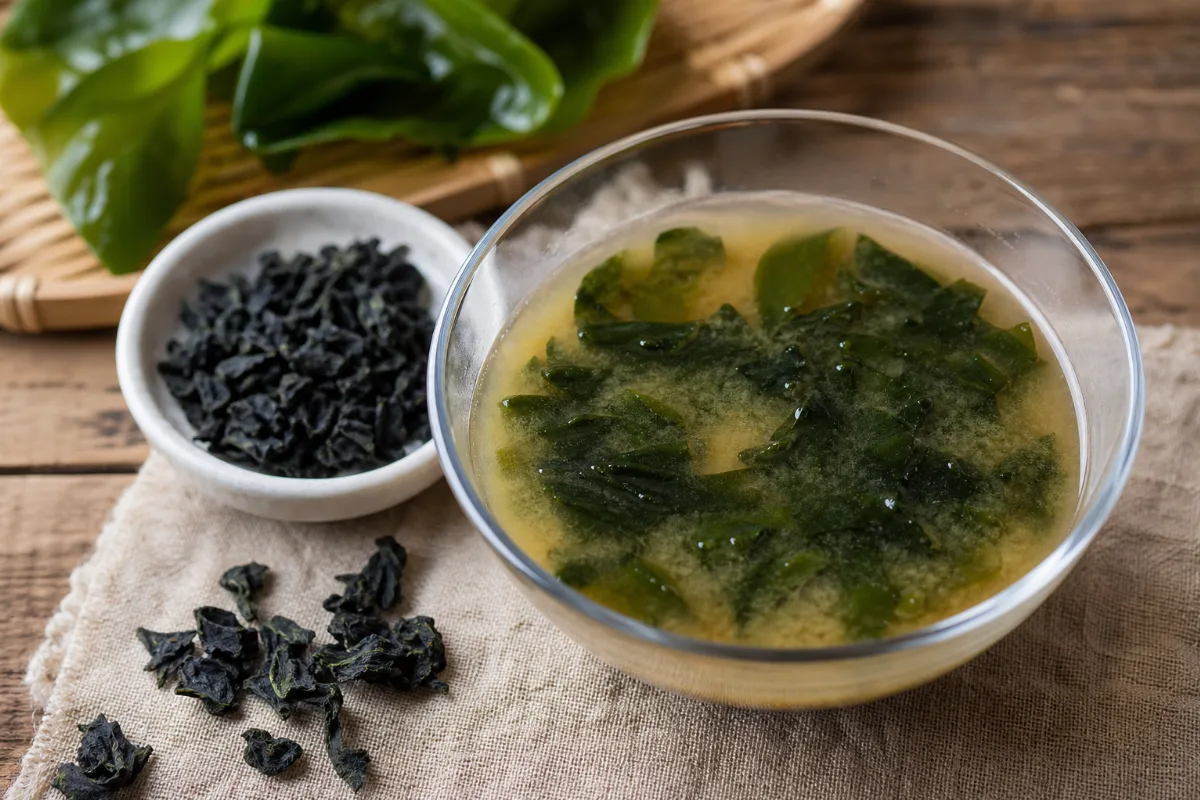
Seaweed & Algae · Seaweed
Wakame
Undaria pinnatifida · also called Miyeok (Korean), Asian kelp, Japanese kelp, alga wakame (Spanish)
Wakame is a brown seaweed, best known as the soft green pieces in miso soup. Small trials found lower blood sugar after a meal with wakame, but most of the evidence is weak or mixed, and no trial shows it treats a disease. It has far less iodine than kombu, but still a lot, and amounts vary. If you have thyroid disease or are pregnant or breastfeeding, ask your doctor before eating it often.
General information, not medical advice. Last substantive update · Not medically reviewed. A named clinician has not signed off on this page. How this page is made
About Wakame
Wakame is a brown seaweed eaten for taste and minerals. Research on it is small and mixed, so it is best seen as a food with real iodine and salt content rather than a proven remedy.
What it is
Wakame (Undaria pinnatifida) is a brown seaweed in the kelp group. It is sold dried, salted or fresh and is best known in miso soup.
USDA lists raw wakame at 45 kcal, 3 g of protein and 0.5 g of fibre per 100 g, with 872 mg of sodium. A typical USDA portion of 2 tablespoons (10 g) of raw wakame gives about 4.5 kcal. USDA has no iodine value for it, and its B12 figure of 0 does not tell us whether wakame has B12.
These values are for raw wakame, which is mostly water. Dried wakame holds far more per gram, so do not mix the two.
What the research shows
Two small crossover trials found lower blood sugar and insulin after a meal that included wakame. Reviews of brown seaweeds in general agree in direction, but they mix species, extracts and doses, and the authors say no high-quality trial was found.
A trial of wakame alone found no change in cholesterol or blood pressure in healthy adults. A snack with wakame and carob lowered cholesterol in people with obesity, but the carob could be responsible. One tiny trial found lower blood pressure in one group.
Claims about cancer, immunity, weight loss or "detox" rest mostly on lab or animal work or on seaweed in general. A 2019 review says more human trials are needed.
Whole wakame versus extracts and other seaweeds
Most pooled reviews mix whole seaweeds with refined products and extracts, so they do not show what eating wakame does. Kombu holds far more iodine than wakame, and other brown seaweeds such as hijiki have their own cautions. Extracts such as fucoidan and fucoxanthin are different products and are not covered here.
At a glance
Traditional uses history, not proof
- A staple of Japanese and Korean cooking, best known in miso soup (not verified from a source read)
- Called a traditional aid for milk supply in some Asian cultures; no clinical trial supports this
Studied for research
- Blood sugar and insulin after a meal, low certainty
- Blood cholesterol, mixed results
- Blood pressure, very low certainty
- Weight, waist size and appetite, very low certainty
- Iodine intake, low certainty (a measure of intake, not a health result)
Main compounds
- Iodine (30 to 185 micrograms per gram of dried wakame, per one review)
- Sodium (872 mg per 100 g raw)
- Folate, magnesium, calcium and manganese
- Arsenic, mostly the less toxic arsenosugar kind
Common forms
- Dried wakame, rehydrated for soups and salads
- Salted wakame, rinsed before use
- Fresh or raw wakame (the form the USDA values describe)
- Seasoned wakame salad (see its own page)
- Wakame supplements and extracts (not the same as the food)
Research links: American Thyroid Association: excess iodine statement · LactMed: Seaweed · Wakame and after-meal blood sugar, crossover trial (2019) · Iodine, seaweed and the thyroid (European Thyroid Journal, 2021) · USDA FoodData Central: raw wakame · Research Library · Genes & Biomarkers Library
What it is and its history
- Accepted scientific name
- Undaria pinnatifida
- Naming authority
- (Harv.) Suringar (GBIF accepted, usageKey 5422556)
- Common names
- Wakame (English); Miyeok (miyeuk) (Korean); Asian kelp (English); Japanese kelp (English); Apron-ribbon vegetable (English); Alga wakame (Spanish)
- Family or group
- Alariaceae, a family of brown seaweeds (kelps) in the order Laminariales.
- Classification
- Chromista > Ochrophyta > Phaeophyceae (brown algae) > Laminariales > Alariaceae > Undaria > Undaria pinnatifida
- Native range
- Not verified from a source read. The 2017 ecology review describes a global non-native range.
- Habitat
- Marine (seaweed). Not described further in the sources read.
- What it looks like
- Roots: Not verified.; Stems: Not verified.; Leaves: Not verified.
- Cultivation
- Not verified from a source read.
- Harvest and processing
- Sold as dried, salted or fresh seaweed (not verified from a source read).
- Look-alikes and adulterants
- Name: Kombu (Laminaria and related kelps); Note: A different brown seaweed with far more iodine per gram (2,500 to 10,000 micrograms per gram versus 30 to 185 for wakame, per one review).; Name: Hijiki and arame; Note: Other brown seaweeds used in Japanese cooking with their own safety notes; see their own pages.
- Sustainability and conservation
- Not assessed. Wakame is widely reported as a non-native species outside its native range.
Photographs
Traditional use and history history, not clinical proof
| Tradition or era | Documented use | Source |
|---|---|---|
| Japanese and Korean cooking | Wakame is a staple of Japanese and Korean cooking, best known in miso soup. Korean sources call it miyeok. | NOT verified: no source read documents the history or the miso soup use. A 2021 review says seaweed use in Asian cooking is long established. |
| Traditional use for milk supply | LactMed calls brown seaweed (Undaria pinnatifida) a purported galactogogue in some Asian cultures, with no scientifically valid clinical trials. | s-lactmed-seaweed (read 2026-10-26) |
| Spread as a non-native species | A 2017 review says wakame has a global non-native range and was first recorded as introduced in 1971. It says its effects are limited in most places and management has had minimal success. | p29075477 (abstract read 2026-10-26) |
Traditional use shows how it was used. It does not show that it works or is safe today.
What is inside, and how it may work
What it contains and how those compounds act in cells and animals. Laboratory and animal mechanisms are not proven effects in people.
Main compounds
| Compound | Family | Where it is concentrated | Activity studied | Level of evidence |
|---|---|---|---|---|
| Iodine | mineral | Whole seaweed 30 to 185 micrograms per gram dry weight (range in a 2021 review table) | Needed for thyroid hormones; too much can disturb the thyroid. 8 13 | Composition and guidance |
| Arsenic (mostly arsenosugars) | metalloid | Whole seaweed Not found for wakame | Total arsenic in urine rose after wakame; most seaweed arsenic is arsenosugars, much less toxic than inorganic arsenic. 2 8 | Small human study and review |
| Sodium | mineral | Whole seaweed 872 mg per 100 g raw | Provides salt in the diet. 16 | Composition data |
| Folate, magnesium, calcium, manganese | vitamin and minerals | Whole seaweed Folate 196 mcg DFE, magnesium 107 mg, calcium 150 mg, manganese 1.4 mg per 100 g raw | Provides small amounts of these nutrients per typical portion. 16 | Composition data |
Mechanisms, receptors and pathways
| Target or pathway | Gene or receptor | What was found | Level |
|---|---|---|---|
| Effects on digestion, insulin and appetite | The trials found lower glucose, insulin and C-peptide after wakame meals. A pooled review mentions polyphenols and fucoidan as possible active compounds in brown seaweeds, but the sources read did not test them in wakame. GLP-1 rose after Laminaria, not Undaria, in one trial. 12 6 | Human marker findings; mechanism unproven |
Absorption, metabolism and elimination
- Absorption
- Not researched.
- Distribution
- Not found.
- Metabolism
- Not found.
- Elimination
- Urinary iodine and total arsenic rose after wakame in 11 volunteers.
- Bioavailability
- Review says iodine bioavailability and cooking losses must be considered, but gives no figure for wakame.
Isolated compounds versus whole extracts
The pooled reviews of seaweed and glucose or body weight mix whole seaweeds, refined products and extracts, so they do not show what eating wakame does. Supplements and extracts (for example fucoidan or fucoxanthin products) are different products and are not covered here.
Nutritional composition
Per 100 g of raw wakame (USDA FoodData Central, SR Legacy record 170496): 45 kcal, 80 g water, 3.03 g protein, 0.64 g fat, 9.14 g carbohydrate of which 0.65 g are sugars, and 0.5 g fibre. It has 872 mg sodium, 150 mg calcium, 107 mg magnesium, 2.18 mg iron, 1.4 mg manganese, 196 mcg folate and 5.3 mcg vitamin K. USDA lists no iodine value and lists vitamin B12 as 0, which does not tell us whether wakame contains B12. The household portion is 2 tablespoons (10 g), about 4.5 kcal. These values are for raw wakame, which is mostly water; dried wakame holds far more per gram.
1 mixed findings2 low certainty3 very low certainty2 not enough evidence
What was looked at
The 8 benefits and uses checked for Wakame, each with how strong the evidence is. Tap one to open it.
- Blood sugar and insulin after a mealLow certainty
- Blood cholesterolMixed findings
- Blood pressureVery low certainty
- Weight, waist size and body fatVery low certainty
- Appetite and feeling fullVery low certainty
- Iodine intakeLow certainty
- Breast milk supplyNot enough evidence
- Cancer, heart disease prevention, "detox" and other claimsNot enough evidence
Lab markers tracked in the studies
Blood glucose after a mealInsulin after a mealLDL cholesterolTotal cholesterolSystolic blood pressureBMI and body fatUrinary iodine
What is Wakame good for?
The main studied uses and how strong the human evidence is for each. Most results come from small, short trials or from reviews that mix several seaweeds, not from long studies of wakame as a normal food.
Benefits, one by one
Each card is a research question, not a promise. Tap a goal to filter. Open a card to see the studies, doses and limits.
Blood sugar and insulin after a meal
Low certaintyIn two small one-meal trials, adding wakame to a starchy meal gave lower blood sugar and insulin afterwards than the same meal without it. Pooled reviews of brown seaweeds also point that way, but they mix many species and forms, and no long-term wakame trial was found.
4 studiesDried wakame about 4 g to 5 g in one test meal, in the trials. The re…
Studies, doses and limits
What the trials found
A 2019 crossover trial (26 adults) found lower glucose and insulin 30 minutes after rice with about 4 g of dried wakame than after rice alone. A 2021 crossover trial (20 healthy adults) found lower glucose, insulin and C-peptide after 5 g of Undaria with a starch meal once body weight was taken into account. A 2022 review of 18 trials of brown seaweed and extracts and a 2023 meta-analysis of 23 studies found better after-meal glucose; the 2023 analysis also found better HbA1c and HOMA-IR but no change in fasting glucose or insulin.
Results
Lower after-meal glucose and insulin in single-meal trials. Pooled reviews agree in direction but mix brown seaweeds and extracts.
Effect sizes as reported
2022 review: after-meal glucose mean difference -7.1 (95% CI -7.4 to -6.9) and fasting -4.6 (-7.88 to -1.33), brown seaweed and extracts pooled. Wakame trials gave no numbers in their abstracts.
Why this rating
Two small single-meal trials in healthy adults, plus pooled reviews that mix species, forms and doses and include no high-quality trial, per the 2022 authors. One trial has an author at a company; funding is not stated.
Form and dose studied
Dried wakame about 4 g to 5 g in one test meal, in the trials. The reviews pool seaweeds and extracts.
Who was studied
Healthy adults in the wakame trials; healthy, at-risk and type 2 diabetes in the reviews.
Limits
Single meals, not long-term; healthy volunteers; effect in the 2021 trial depended on body weight; reviews do not isolate wakame.
Why researchers looked
Brown seaweeds contain fibre-like gels and plant compounds, and researchers asked whether eating them slows how fast starch raises blood sugar.
Traditional use
Wakame is a long-standing part of Japanese and Korean cooking. That is food tradition, not evidence of this effect.
Proposed mechanism Preliminary mechanism
Proposed routes include seaweed fibre and polyphenols slowing digestion. The sources read did not test these routes for wakame, so this is unproven.
A proposed mechanism does not show that the effect happens in people.
See the Safety tab: wakame brings iodine and sodium with it.
Blood cholesterol
Mixed findingsResults are mixed. A trial of wakame alone in healthy people with normal cholesterol found no change over 17 days. A trial of a snack that mixed wakame and carob found lower LDL and total cholesterol over 8 weeks in people with obesity, but the effect cannot be put down to wakame. A pooled review of seaweed trials found small falls, mostly with brown seaweed that was refined or extracted.
3 studiesWhole dried wakame (null trial); wakame plus carob snack; mixed seawe…
Studies, doses and limits
What the trials found
A 2020 crossover trial (35 healthy adults, 4.8 g a day for 17 days) found no change in cholesterol absorption markers, serum lipids, glucose or blood pressure. A 2020 trial in people with obesity and metabolic syndrome found LDL cholesterol fell 8.9 mg/dL with a wakame and carob snack against 0.9 mg/dL with a control snack over 8 weeks. A 2025 meta-analysis of 11 trials found total cholesterol down 7.72 mg/dL and LDL down 7.33 mg/dL with seaweed products, but those pooled whole, refined and extracted seaweeds.
Results
Null in healthy people eating wakame; lower in a combination snack in obesity; small pooled fall for seaweed products overall.
Effect sizes as reported
Snack trial: LDL -8.9 vs -0.9 mg/dL, total cholesterol -10.4 vs -1.4 mg/dL. Pooled review: total -7.72 mg/dL (95% CI -12.49 to -2.95), LDL -7.33 mg/dL (-11.64 to -3.02).
Why this rating
One null trial of wakame alone, one small trial of a combination food, and a pooled review that does not isolate wakame. The authors of the 2020 absorption trial found no effect.
Form and dose studied
Whole dried wakame (null trial); wakame plus carob snack; mixed seaweed products (review).
Who was studied
Healthy adults; adults with obesity and metabolic syndrome.
Limits
The snack trial included carob and randomised 40 people although the abstract gives groups of 16; the review mixes forms.
Why researchers looked
Animal work had suggested that seaweed could lower cholesterol, so researchers tested it in people.
Proposed mechanism Human tested not supported
One idea is less cholesterol absorbed in the gut. The 2020 trial tested this directly with wakame and found no change in absorption markers.
A proposed mechanism does not show that the effect happens in people.
No safety problem was reported in the abstracts read.
Blood pressure
Very low certaintyOne very small trial found a fall in top blood pressure with 6 g a day of dried wakame for a month, mostly in people whose pressure was high-normal. A second trial in healthy adults found no change in blood pressure.
2 studiesDried wakame 4 g to 6 g a day, in trial designs.
Studies, doses and limits
What the trials found
A 2009 double-blind trial in Ecuador (27 adults with at least one feature of metabolic syndrome) found systolic pressure fell 10.5 mmHg (95% CI 4.1 to 16.8) after one month at 6 g a day, in one group. A 2020 crossover trial (35 healthy adults, 4.8 g a day for 17 days) found blood pressure did not change.
Results
A fall in one tiny trial; no change in healthy adults.
Effect sizes as reported
Systolic blood pressure -10.5 mmHg (95% CI 4.1 to 16.8) in the 6 g a day group of the 2009 trial.
Why this rating
One very small trial with a changing design and no other change in measures, and one null trial in healthy adults.
Form and dose studied
Dried wakame 4 g to 6 g a day, in trial designs.
Who was studied
Adults with a feature of metabolic syndrome; healthy adults.
Limits
Tiny sample; the effect appeared in one group only; abstract does not state funding.
Why researchers looked
Wakame is eaten daily in Japan, where researchers wondered whether it helps explain low rates of metabolic syndrome.
Proposed mechanism Unknown
Not established.
A proposed mechanism does not show that the effect happens in people.
See the Safety tab for sodium and iodine.
Weight, waist size and body fat
Very low certaintyEating wakame did not clearly change weight. A snack trial with wakame found no difference in body measures, and the one wakame trial that measured waist found falls in women that also happened on placebo. A pooled review found small falls in BMI and body fat with seaweed products, but mostly with refined or extracted brown seaweed.
3 studiesWhole wakame in two trials; refined or extracted brown seaweed drives…
Studies, doses and limits
What the trials found
In the 2020 snack trial, body measures did not differ between wakame-carob and control snacks. In the 2009 trial, waist size fell in women, including 2.4 cm during the placebo month in one group. A 2025 meta-analysis of 11 trials found BMI (standardised mean difference -0.40) and fat mass (-1.48) favoured seaweed when refined or extracted brown seaweed was given for at least 8 weeks.
Results
No clear effect of wakame itself; small pooled changes for seaweed products.
Effect sizes as reported
Pooled review: BMI SMD -0.40 (95% CI -0.65 to -0.16); fat mass SMD -1.48 (-2.66 to -0.30). Wakame trials: no clear difference.
Why this rating
The wakame trials found no clear effect, and the pooled result comes from refined or extracted seaweed.
Form and dose studied
Whole wakame in two trials; refined or extracted brown seaweed drives the pooled result.
Who was studied
Adults with obesity or metabolic syndrome.
Limits
Small trials; products differ; the review is not about wakame alone.
Why researchers looked
Seaweed is low in calories and fibre-rich, so researchers asked whether it helps with weight.
Proposed mechanism Preliminary mechanism
Proposed routes include slower fat absorption and fullness; these were not tested for wakame in the sources read.
A proposed mechanism does not show that the effect happens in people.
None specific.
Appetite and feeling full
Very low certaintyIn a one-meal trial, appetite scores were lower after meals with Undaria or Laminaria seaweed, but later food intake did not differ. In the snack trial, fullness rose after the test meal in both groups.
2 studies5 g seaweed in one meal (trial design).
Studies, doses and limits
What the trials found
A 2021 crossover trial in 20 healthy adults found lower appetite scores after seaweed meals, and no difference in food eaten at a buffet three hours later. The 2020 snack trial found satiety rose after a test meal in both the wakame-carob and the control groups.
Results
Lower appetite scores in one trial; no change in later eating.
Effect sizes as reported
No numbers in the abstracts.
Why this rating
Small single-meal trial with self-rated scores and no change in actual intake.
Form and dose studied
5 g seaweed in one meal (trial design).
Who was studied
Healthy adults; adults with obesity.
Limits
Self-rated; short-term.
Why researchers looked
Seaweed fibre could make meals more filling.
Proposed mechanism Unknown
Not established for wakame.
A proposed mechanism does not show that the effect happens in people.
None specific.
Iodine intake
Low certaintyWakame is a source of iodine, much less than kombu but variable. In a feeding study, urinary iodine rose after eating seaweed, most after kombu. This shows seaweed raises iodine intake. It does not show better thyroid health, and too much iodine can harm the thyroid.
2 studiesWhole seaweed as food.
Studies, doses and limits
What the trials found
An 11-person feeding study found urinary iodine and total arsenic rose after nori, kombu and wakame, with the largest iodine effect after kombu. A review lists wakame at 30 to 185 micrograms of iodine per gram of dry weight, and says 2 to 6 g of dried wakame would reach 150 micrograms. Product surveys found iodine varied hugely and was often not labelled.
Results
More iodine intake after seaweed; no health outcome measured.
Effect sizes as reported
Wakame iodine 30 to 185 micrograms per gram dry weight (review table); total urinary iodine rose after seaweed (no figures in the abstract).
Why this rating
The rise in urinary iodine is a measured fact in a small study; benefit for health is not shown.
Form and dose studied
Whole seaweed as food.
Who was studied
11 volunteers in the feeding study.
Limits
A rise in iodine is only good if you were short of it; the sources read do not measure thyroid health after eating wakame.
Why researchers looked
Seaweed is a natural source of iodine, a mineral the thyroid needs.
Proposed mechanism Established physiology
Seaweed delivers iodine that the thyroid uses to make hormones.
A proposed mechanism does not show that the effect happens in people.
Too much iodine is the main safety point; see the Safety tab.
Breast milk supply
Not enough evidenceWakame is traditionally used in some Asian cultures to help milk supply. The LactMed record says no scientifically valid clinical trials support this. It also says some sources recommend against seaweed while breastfeeding because of iodine and metals.
1 studiesWhole seaweed as food.
Studies, doses and limits
What the trials found
No trial was found. LactMed (record dated 2024) says no scientifically valid clinical trials support this use.
Results
No evidence of benefit.
Why this rating
No clinical trial; tradition only.
Form and dose studied
Whole seaweed as food.
Limits
No human data.
Why researchers looked
Traditional use in some Asian cultures after childbirth.
Traditional use
Called a purported galactogogue in some Asian cultures by LactMed (2024).
Proposed mechanism Unknown
Not established.
A proposed mechanism does not show that the effect happens in people.
LactMed says iodine is actively transported into breast milk; see the Safety tab.
Cancer, heart disease prevention, "detox" and other claims
Not enough evidenceMany web claims about wakame rest on lab or animal work, or on seaweed in general. In the sources read, no human trial showed wakame treats or prevents a disease. One review reports that in Korean women, eating wakame was not significantly linked with breast cancer risk.
2 studiesWhole seaweed, extracts and foods mixed.
Studies, doses and limits
What the trials found
A 2019 narrative review says more evidence from human intervention studies is needed to evaluate seaweed benefits, and that mechanistic evidence is needed to support health claims. A 2021 review notes Korean women who ate miyeok (wakame) showed no significant link with breast cancer risk.
Results
No human evidence of disease prevention or treatment.
Effect sizes as reported
No numbers.
Why this rating
Reviews call for more human trials; the breast cancer result is a second-hand report in a review.
Form and dose studied
Whole seaweed, extracts and foods mixed.
Limits
Reviews mix seaweeds, extracts and foods.
Why researchers looked
Wakame holds plant compounds that show activity in cells and animals.
Proposed mechanism Preliminary mechanism
Mostly lab and animal work, not tested in people for wakame.
A proposed mechanism does not show that the effect happens in people.
None specific.
Connections to the rest of health
How Wakame connects to the rest of our health knowledge graph. Every link says what kind of connection it is. A safety link (for example to the liver) is a warning, not a benefit. A study that merely mentions a topic never creates a benefit link.
Explore every connection: goals, body systems, organs, symptoms, genes
A. Wellness goals
| Connected to | Kind of connection | Evidence status | Context | Studies |
|---|---|---|---|---|
| Blood Sugar Balance | Potential benefit | Low certainty | Blood sugar and insulin after a meal: In two small one-meal trials, adding wakame to a starchy meal gave lower blood sugar and insulin afterwards than the same meal without it. Pooled reviews of brown seaweeds also point that way, but they mix many species and forms, and no long-term wakame trial was found. | 11 12 10 6 |
| Cholesterol Balance | Potential benefit | Mixed findings | Blood cholesterol: Results are mixed. A trial of wakame alone in healthy people with normal cholesterol found no change over 17 days. A trial of a snack that mixed wakame and carob found lower LDL and total cholesterol over 8 weeks in people with obesity, but the effect cannot be put down to wakame. A pooled review of seaweed trials found small falls, mostly with brown seaweed that was refined or extracted. | 17 5 7 |
| Heart Health | Potential benefit | Mixed findings | Blood cholesterol: Results are mixed. A trial of wakame alone in healthy people with normal cholesterol found no change over 17 days. A trial of a snack that mixed wakame and carob found lower LDL and total cholesterol over 8 weeks in people with obesity, but the effect cannot be put down to wakame. A pooled review of seaweed trials found small falls, mostly with brown seaweed that was refined or extracted. Blood pressure: One very small trial found a fall in top blood pressure with 6 g a day of dried wakame for a month, mostly in people whose pressure was high-normal. A second trial in healthy adults found no change in blood pressure. | 17 5 7 9 |
| Blood Pressure Support | Potential benefit | Very low certainty | Blood pressure: One very small trial found a fall in top blood pressure with 6 g a day of dried wakame for a month, mostly in people whose pressure was high-normal. A second trial in healthy adults found no change in blood pressure. | 9 17 |
| Weight Management | Potential benefit | Very low certainty | Weight, waist size and body fat: Eating wakame did not clearly change weight. A snack trial with wakame found no difference in body measures, and the one wakame trial that measured waist found falls in women that also happened on placebo. A pooled review found small falls in BMI and body fat with seaweed products, but mostly with refined or extracted brown seaweed. Appetite and feeling full: In a one-meal trial, appetite scores were lower after meals with Undaria or Laminaria seaweed, but later food intake did not differ. In the snack trial, fullness rose after the test meal in both groups. | 5 9 7 12 |
| Metabolic Health | Potential benefit | Low certainty | Iodine intake: Wakame is a source of iodine, much less than kombu but variable. In a feeding study, urinary iodine rose after eating seaweed, most after kombu. This shows seaweed raises iodine intake. It does not show better thyroid health, and too much iodine can harm the thyroid. | 2 8 |
| Womens Wellness | Potential benefit | Not enough evidence | Breast milk supply: Wakame is traditionally used in some Asian cultures to help milk supply. The LactMed record says no scientifically valid clinical trials support this. It also says some sources recommend against seaweed while breastfeeding because of iodine and metals. | 15 |
| Preventive Wellness | Not enough evidence | Cancer, heart disease prevention, "detox" and other claims: Many web claims about wakame rest on lab or animal work, or on seaweed in general. In the sources read, no human trial showed wakame treats or prevents a disease. One review reports that in Korean women, eating wakame was not significantly linked with breast cancer risk. | 4 8 |
B. Body systems
| Connected to | Kind of connection | Evidence status | Context | Studies |
|---|---|---|---|---|
| Endocrine System | Biological association | Low certainty | Studied for: Blood sugar and insulin after a meal Studied for: Iodine intake | 11 12 10 6 2 8 |
| Cardiovascular System | Biological association | Mixed findings | Studied for: Blood cholesterol Studied for: Blood pressure | 17 5 7 9 |
| Metabolism Weight | Biological association | Very low certainty | Studied for: Weight, waist size and body fat Studied for: Appetite and feeling full | 5 9 7 12 |
| Reproductive System | Biological association | Not enough evidence | Studied for: Breast milk supply | 15 |
| Immune System | Biological association | Not enough evidence | Studied for: Cancer, heart disease prevention, "detox" and other claims | 4 8 |
E. Health conditions
| Connected to | Kind of connection | Evidence status | Context | Studies |
|---|---|---|---|---|
| Thyroid disease | Adverse effect or risk | Documented risk | Excess iodine can disturb the thyroid, and people with thyroid disease are more susceptible, per the American Thyroid Association. Preparation or compound: Iodine in wakame |
13 8 |
I. Biomarkers
| Connected to | Kind of connection | Evidence status | Context | Studies |
|---|---|---|---|---|
| Blood glucose after a meal | Biological association | Low certainty | Measured in trials: lowered in single-meal trials. A lab change is not the same as a health benefit. | 11 12 10 6 |
| Insulin after a meal | Biological association | Low certainty | Measured in trials: lowered in single-meal trials. A lab change is not the same as a health benefit. | 11 12 |
| LDL cholesterol | Biological association | Mixed findings | Measured in trials: no change in wakame alone; lower in a combination snack and in a pooled review. A lab change is not the same as a health benefit. | 17 5 7 |
| Total cholesterol | Biological association | Mixed findings | Measured in trials: no change in wakame alone; lower in a combination snack and in a pooled review. A lab change is not the same as a health benefit. | 17 5 7 |
| Systolic blood pressure | Biological association | Very low certainty | Measured in trials: lower in one tiny trial; no change in healthy adults. A lab change is not the same as a health benefit. | 9 17 |
| BMI and body fat | Biological association | Very low certainty | Measured in trials: slightly lower for refined or extracted brown seaweed, not shown for wakame. A lab change is not the same as a health benefit. | 7 5 |
| Urinary iodine | Biological association | Low certainty | Measured in trials: higher after seaweed. A lab change is not the same as a health benefit. | 2 |
L. Active compounds
| Connected to | Kind of connection | Evidence status | Context | Studies |
|---|---|---|---|---|
| Iodine | Biological association | Composition and guidance | Needed for thyroid hormones; too much can disturb the thyroid. Preparation or compound: Whole seaweed |
8 13 |
| Arsenic (mostly arsenosugars) | Biological association | Small human study and review | Total arsenic in urine rose after wakame; most seaweed arsenic is arsenosugars, much less toxic than inorganic arsenic. Preparation or compound: Whole seaweed |
2 8 |
| Sodium | Biological association | Composition data | Provides salt in the diet. Preparation or compound: Whole seaweed |
16 |
| Folate, magnesium, calcium, manganese | Biological association | Composition data | Provides small amounts of these nutrients per typical portion. Preparation or compound: Whole seaweed |
16 |
Each connection is stored with the ingredient, the connected record, the kind of connection, the evidence status, the supporting studies, the preparation or compound involved, and a review date (last reviewed October 26, 2026).
Evidence at a glance: what the research found for 8 outcomes
Each outcome below is one thing researchers measured. Certainty is how far the evidence can be trusted, not how well it works. The full studies are on the next tab.
The evidence
The research centre for Wakame. Every record here was checked against PubMed or the publisher's page; we never list a study we have not verified.
Evidence by outcome
Bars show how many studies we found for each outcome, not how well it works. People are added up across trials only (reviews are not added, to avoid double counting).
How we rate evidence
High certainty
Several well-run trials or reviews agree; further research is unlikely to change the picture much.
Moderate certainty
Good trials point the same way, but some doubt remains.
Low certainty
Small, short or inconsistent trials. The finding could change with better research.
Very low certainty
Very little or very weak human data. Treat as a possibility only.
Mixed findings
Trials or reviews disagree with each other.
Not enough evidence
Not enough human research to say either way.
Evidence against
Good research found no benefit, or found harm.
We take the reviewers' own risk-of-bias and GRADE statements where they exist, and otherwise judge from study size, design, consistency, directness and whether a product matches what is sold. Many publications do not make evidence high. Method note: We started from our existing wakame summary, re-read the USDA FoodData Central record and the full text of one thyroid review, and read PubMed abstracts and the ATA and LactMed texts. For most studies only the abstract was read. Items we could not verify are flagged in the research gaps.
Study library: every study we checked 17
| Study | Design | People | Product, dose, length | Result |
|---|---|---|---|---|
| Aakre 2021 Commercially available kelp and seaweed products - valuable iodine source or risk of excess intake? Food Nutr Res · PMID 33889064 · DOI |
Product survey (laboratory analysis) |
96 96 macroalgae products on the Norwegian market (43 whole-food, 39 seaweed-containing foods, 14 supplements) |
Whole seaweeds, foods containing seaweed and supplements products as sold One portion or daily dose as labelled |
Iodine in one portion of whole-food seaweed products ranged from 128 to 62,400 micrograms. For 54 products, one portion or dose would exceed the tolerable upper intake level for iodine. Labelling of species and iodine was inadequate or inaccurate for several products. 54 of 96 products over the upper level in one portion or dose Methods, limits and fundingOutcomes: Iodine content per portion or dose and labelling Limitations: Norwegian market in the survey year; wakame is not separated in the abstract. Funding and conflicts: Authors declare no competing interest. Read: abstract |
| Barandiaran 2024 Exposure to iodine, essential and non-essential trace element through seaweed consumption in humans. Sci Rep · PMID 38871780 · DOI |
Feeding study (before and after) |
11 11 volunteers |
Nori, kombu and wakame fed in turn whole seaweeds Single feeding episodes · vs Urine before eating |
Urinary iodine and total arsenic rose after seaweed. The largest iodine weight was after kombu, and the largest total arsenic weight was after wakame. Higher urinary iodine and total arsenic after seaweed; no health outcome measured Methods, limits and fundingOutcomes: Urinary iodine, arsenic, cobalt, copper, cadmium, molybdenum, selenium and zinc Limitations: Eleven people, urine measures only, total (not inorganic) arsenic. Does not show harm or benefit. Funding and conflicts: Authors declare no competing interests. Read: abstract |
| Bouga 2015 Emergence of Seaweed and Seaweed-Containing Foods in the UK: Focus on Labeling, Iodine Content, Toxicity and Nutrition. Foods · PMID 28231201 · DOI |
Product survey |
224 224 seaweed-containing products on the UK market |
Seaweed whole foods and seaweed-containing foods products as sold Estimated per serving |
Only 22 products (10%) stated their iodine content and another 40 (18%) gave enough information to estimate it. For these, the median iodine content was 110 micrograms per gram. 26 products could lead to an intake above the European adult upper level of 600 micrograms a day. 10% of products stated iodine content; 26 could exceed 600 micrograms per day Methods, limits and fundingOutcomes: Labelling and iodine content Limitations: UK market in 2015. Serving-size calculations rest on assumptions, as the authors say. Funding and conflicts: Authors declare no conflict of interest. Read: abstract |
| Cherry 2019 Risks and benefits of consuming edible seaweeds. Nutr Rev · PMID 30840077 · DOI |
Narrative review |
Review of the composition, human health evidence and adverse effects of edible seaweeds | Whole seaweeds, extracted bioactives and seaweed foods (mixed) whole seaweed, extracts and foods |
The review says more evidence from human intervention studies is needed to evaluate the benefits of seaweeds, and that mechanistic evidence is needed to support health claims. It also covers excess iodine and arsenic as possible adverse effects. No pooled numbers Methods, limits and fundingOutcomes: Nutritional composition, health benefits in humans, adverse effects (iodine, arsenic) Limitations: Narrative review mixing whole seaweed, extracts and foods. One author is affiliated with VOYA Products Limited, a seaweed products company: possible industry link. Funding and conflicts: Possible industry link (one author at VOYA Products Ltd). Conflict statement not shown in the abstract. Read: abstract |
| Izaola 2020 Effects of a snack enriched with carob and Undaria pinnatifida (wakame) on metabolic parameters in a double blind, randomized clinical trial in obese patients. Nutr Hosp · PMID 32379474 · DOI |
Double blind randomised trial |
40 40 patients with obesity and metabolic syndrome were randomised (the results text mentions 16 per group) |
A snack enriched with wakame and carob (a combination food, not wakame alone) dried wakame in a snack 8 weeks · vs A control snack |
LDL cholesterol fell 8.9 mg/dL with the enriched snack against 0.9 mg/dL with the control (p = 0.03), total cholesterol fell 10.4 against 1.4 mg/dL (p = 0.02), and resistin fell 1.0 against 0.1 (p = 0.03). Weight measures, other heart markers and food intake did not differ. Satiety rose in both groups. LDL -8.9 vs -0.9 mg/dL; total cholesterol -10.4 vs -1.4 mg/dL Methods, limits and fundingOutcomes: LDL and total cholesterol, resistin, weight measures, satiety Limitations: Small trial, a snack containing both wakame and carob, so the effect cannot be put down to wakame. The abstract gives group sizes of 16 although 40 were randomised. Funding and conflicts: Funding not stated in the abstract. Registration: NCT03420989 Read: abstract |
| Kim 2023 Brown Seaweed Consumption as a Promising Strategy for Blood Glucose Management: A Comprehensive Meta-Analysis. Nutrients · PMID 38068845 · DOI |
Meta-analysis |
23 studies of seaweed and blood glucose | Brown seaweeds, including Undaria pinnatifida, Laminaria digitata, Ascophyllum nodosum and Fucus vesiculosus whole seaweed and supplements Varied; the authors compared high and low dose groups Varied · vs Control |
After-meal blood glucose, HbA1c and HOMA-IR were significantly better with seaweed than control. Fasting glucose and insulin were not significantly different. Significant improvement in after-meal glucose, HbA1c and HOMA-IR; no significant fasting glucose or insulin effect (the abstract gives no numbers) Methods, limits and fundingOutcomes: After-meal glucose, HbA1c, HOMA-IR, fasting glucose, insulin Limitations: Pooled several brown seaweeds, including supplements, so it is not about wakame alone. The abstract does not rate study quality. Funding and conflicts: Authors declare no conflict of interest. Read: abstract |
| Lagowska 2025 Effects of dietary seaweed on obesity-related metabolic status: a systematic review and meta-analysis of randomized controlled trials. Nutr Rev · PMID 38749056 · DOI |
Systematic review and meta analysis of randomised trials |
11 interventional studies in adults with overweight or obesity | Edible seaweed, refined or extracted brown seaweed and seaweed-derived products (species mixed; wakame not separated in the abstract) whole seaweed, extracts and refined products Varied; effects seen with at least 8 weeks 8 weeks or more for the significant results · vs Control |
Significant effects favouring seaweed for BMI and percentage fat mass (seen with refined or extracted brown seaweed) and for total and LDL cholesterol. No significant effect on glucose metabolism. BMI SMD -0.40; fat mass SMD -1.48; total cholesterol -7.72 mg/dL; LDL cholesterol -7.33 mg/dL (BMI -0.65 to -0.16; fat mass -2.66 to -0.30; total cholesterol -12.49 to -2.95; LDL -11.64 to -3.02) Methods, limits and fundingOutcomes: BMI, fat mass, total and LDL cholesterol, glucose metabolism Limitations: Only 11 studies, mixing whole, refined and extracted seaweeds, so it does not show what eating wakame does. Some authors are Japan-based researchers; funding is not stated in the abstract. Funding and conflicts: Not stated in the abstract. Read: abstract |
| Smyth 2021 Iodine, Seaweed, and the Thyroid. Eur Thyroid J · PMID 33981614 · DOI |
Narrative review |
Review of iodine, seaweed and thyroid health | Edible seaweeds including Undaria pinnatifida (wakame) whole seaweed |
Table 1 lists wakame (Undaria pinnatifida) at 30 to 185 micrograms of iodine per gram of dry weight, 2.0 to 6.0 g of dried seaweed to reach 150 micrograms, against 2,500 to 10,000 micrograms per gram for kombu-type brown seaweeds. The review says caution is needed with brown seaweeds, and that most seaweed arsenic is arsenosugars, which are much less toxic than inorganic arsenic. It reports that in Korean women eating miyeok (wakame) was not significantly associated with breast cancer risk. Wakame iodine 30-185 micrograms per gram dry weight (range from other publications) Methods, limits and fundingOutcomes: Iodine content of seaweeds, thyroid effects, arsenic, breast cancer link Limitations: Narrative review. The table puts wakame under "green algae", but wakame is a brown seaweed (GBIF). Table values come from other publications and different places. Read: abstract and full text on PubMed Central. Funding and conflicts: Author declares no conflicts of interest. Read: full-text |
| Teas 2009 Could dietary seaweed reverse the metabolic syndrome? Asia Pac J Clin Nutr · PMID 19713172 |
Double blind placebo controlled randomised trial |
27 27 adults in Quito, Ecuador, with at least one feature of the metabolic syndrome |
Dried wakame (Undaria pinnatifida) whole seaweed, dried 4 g a day, then 6 g a day for one group Two months (one month per step) · vs Placebo for one month in one group |
In the group that took 6 g a day, systolic blood pressure fell 10.5 mmHg after a month, mainly in people with high-normal starting pressure. Waist size fell in women (including a 2.4 cm fall during the placebo month in the other group). No other changes were seen. Systolic blood pressure -10.5 mmHg at 6 g a day (4.1 to 16.8 mmHg) Methods, limits and fundingOutcomes: Blood pressure, weight, waist, inflammation markers and lipids Limitations: Very small trial with a changing design; women lost waist size even on placebo. Funding not stated in the abstract. Funding and conflicts: Not stated in the abstract. Read: abstract |
| Vaughan 2022 Effect of brown seaweed on plasma glucose in healthy, at-risk, and type 2 diabetic individuals: systematic review and meta-analysis. Nutr Rev · PMID 34549293 · DOI |
Systematic review and meta analysis of randomised trials |
18 randomised trials in healthy, at-risk and type 2 diabetes adults | Brown seaweed and brown seaweed extracts (several species; wakame not separated in the abstract) whole seaweed and extracts Varied Varied · vs Control |
Fasting glucose mean difference -4.6 (95% CI -7.88 to -1.33) and after-meal glucose mean difference -7.1 (95% CI -7.4 to -6.9), both favouring brown seaweed. Results varied between populations. The authors say no high-quality trial was found and more species-specific research is needed. Fasting: -4.6; after-meal: -7.1 (units not given in the abstract) (Fasting -7.88 to -1.33; after-meal -7.4 to -6.9) Methods, limits and fundingOutcomes: Fasting and after-meal plasma glucose Limitations: Brown seaweeds and extracts pooled, so it does not show what wakame alone does. No high-quality trial, per the authors. Funding and conflicts: No competing interests are stated in the abstract (not checked in full text). Read: abstract |
| Yoshinaga 2019 Effects of Undaria pinnatifida (Wakame) on Postprandial Glycemia and Insulin Levels in Humans: a Randomized Crossover Trial. Plant Foods Hum Nutr · PMID 31418121 · DOI |
Randomised crossover trial (single meal) |
26 26 adults |
Dried wakame (Undaria pinnatifida) eaten with rice whole seaweed, dried About 4 g of dried wakame with 200 g of rice (one meal) One test meal per visit (blood sampled over 2 hours) · vs 200 g of rice alone |
Blood glucose and insulin were lower 30 minutes after rice with wakame than after rice alone, and the incremental areas under the curves for glucose and insulin were lower with wakame. Lower glucose and insulin at 30 minutes and lower areas under the curve (the abstract gives no numbers) Methods, limits and fundingOutcomes: Blood glucose and insulin over 2 hours after the meal Limitations: Single meal, not a long-term trial. Healthy status of volunteers is not stated in the abstract. Short-term blood sugar only. Funding and conflicts: Funding not stated in the abstract. One author is listed at a company (Riken Vitamin Co., Ltd.); treat as possible industry link. Registration: UMIN000031050 Read: abstract |
| Zaharudin 2021 Effects of brown seaweeds on postprandial glucose, insulin and appetite in humans - A randomized, 3-way, blinded, cross-over meal study. Clin Nutr · PMID 32917417 · DOI |
Randomised, blinded 3 way crossover meal study |
20 20 healthy adults |
Laminaria digitata or Undaria pinnatifida (wakame) with a starch meal whole seaweed 5 g of seaweed with 30 g of starch (one meal) One test meal per visit · vs Energy-matched meal with pea protein |
Glucose, insulin and C-peptide responses were lower after both seaweed meals after correcting for body weight. People weighing 63 kg or less had a lower glucose response between 40 and 90 minutes. GLP-1 was higher after Laminaria only. Appetite scores were lower after the seaweeds, and food eaten at a later buffet three hours on did not differ. Lower responses after correction for body weight (the abstract gives no figures) Methods, limits and fundingOutcomes: Blood glucose, insulin, C-peptide, GLP-1, appetite scores and later food intake Limitations: Single meal in healthy, mostly normal-weight adults. The result depended on body weight. The abstract gives two different trial registry numbers. Funding and conflicts: Authors declare no conflicts of interest. Read: abstract |
| s-ata-iodine American Thyroid Association: ATA Statement on the Potential Risks of Excess Iodine Ingestion and Exposure · Source |
Professional society statement |
Methods, limits and fundingRead: full-text | ||
| s-gbif-undaria-pinnatifida GBIF Backbone: Undaria pinnatifida (Harv.) Suringar (usageKey 5422556) · Source |
Reference database n/a |
Methods, limits and fundingRead: full-text | ||
| s-lactmed-seaweed Drugs and Lactation Database (LactMed): Seaweed (PMID 30000910; record dated 2024 Oct 15) · Source |
Drug and lactation database record |
Methods, limits and fundingRead: abstract | ||
| s-usda-fdc-170496 USDA FoodData Central: Seaweed, wakame, raw (FDC 170496, SR Legacy) · Source |
Reference database n/a |
Methods, limits and fundingRead: full-text | ||
| van den Driessche 2020 Effects of spirulina and wakame consumption on intestinal cholesterol absorption and serum lipid concentrations in non-hypercholesterolemic adult men and women. Eur J Nutr · PMID 31388739 · DOI |
Randomised crossover trial |
35 35 healthy men and women without high cholesterol |
Wakame (Undaria pinnatifida) compared with spirulina and placebo whole seaweed 4.8 g a day 17 days, with 14-day washouts · vs Placebo |
Compared with placebo, wakame did not change the cholesterol absorption or synthesis markers. Serum lipid and glucose concentrations and blood pressure were also not changed. No significant differences Methods, limits and fundingOutcomes: Markers of cholesterol absorption and synthesis, serum lipids, glucose and blood pressure Limitations: Healthy people with normal cholesterol, 17 days only. It tested absorption markers, so it cannot say what happens in people with high cholesterol. Funding and conflicts: Authors declare no conflict of interest. Read: abstract |
What we do not know yet
- No long-term trial of wakame as a normal food was found for blood sugar, cholesterol or blood pressure.
- Pooled reviews do not separate wakame from other brown seaweeds, extracts and supplements.
- No inorganic arsenic figure and no iodine loss from soaking or boiling were found for wakame.
- Seaweed allergy, choking risk and liver safety were not researched.
- The history of wakame in cooking and its farming were not found in a source read.
- Fucoxanthin, fucoidan and other compounds were not measured in wakame as eaten in the sources read.
How new research is added
New studies are found by a saved PubMed search and placed in a review queue before the page changes.
Lab markers
What changed in blood or saliva tests during trials. A changed number is not the same as feeling or being healthier, and we give no "normal ranges".
Metabolic 2
LDL cholesterol
No change in wakame alone; lower in a combination snack and in a pooled review in trials
The so-called bad cholesterol carried in the blood.
Mixed findingsResults and what it means
Why it was measured
A common heart-risk marker.
Statistical vs. clinical meaning
A small change; no one knows whether it changes heart outcomes.
Safety implication
None specific.
| Study | Result | People | Product |
|---|---|---|---|
| 17 | No change versus placebo | 35 healthy adults | 4.8 g wakame a day for 17 days |
| 5 | -8.9 mg/dL against -0.9 mg/dL with control snack (p = 0.03) | Adults with obesity and metabolic syndrome | Wakame and carob snack for 8 weeks |
| 7 | -7.33 mg/dL (95% CI -11.64 to -3.02) | Adults in 11 trials | Seaweed products pooled |
Total cholesterol
No change in wakame alone; lower in a combination snack and in a pooled review in trials
All the cholesterol carried in the blood.
Mixed findingsResults and what it means
Why it was measured
A basic blood-fat marker.
Statistical vs. clinical meaning
A small change; unproven for heart outcomes.
Safety implication
None specific.
| Study | Result | People | Product |
|---|---|---|---|
| 17 | No change versus placebo | 35 healthy adults | 4.8 g wakame a day for 17 days |
| 5 | -10.4 mg/dL against -1.4 mg/dL with control snack (p = 0.02) | Adults with obesity and metabolic syndrome | Wakame and carob snack for 8 weeks |
| 7 | -7.72 mg/dL (95% CI -12.49 to -2.95) | Adults in 11 trials | Seaweed products pooled |
Other 5
Blood glucose after a meal
Lowered in single-meal trials in trials
The sugar level in the blood in the hours after eating.
Low certaintyResults and what it means
Why it was measured
A common marker of how quickly a meal raises blood sugar.
Statistical vs. clinical meaning
A small short-term change in a marker; not shown to prevent or treat diabetes.
Safety implication
None specific here; see Safety for iodine.
| Study | Result | People | Product |
|---|---|---|---|
| 11 | Lower at 30 minutes and lower area under the curve with rice plus wakame than with rice alone | Adults in a crossover trial | About 4 g dried wakame with 200 g rice |
| 12 | Lower response after Undaria and Laminaria than control after correcting for body weight | Healthy adults in a crossover trial | 5 g Undaria with 30 g starch |
| 10 | After-meal glucose mean difference -7.1 (95% CI -7.4 to -6.9) favouring brown seaweed | Adults in 18 trials | Brown seaweed and extracts pooled |
Insulin after a meal
Lowered in single-meal trials in trials
The hormone released after eating to move sugar out of the blood.
Low certaintyResults and what it means
Why it was measured
Shows how hard the body works to handle a meal.
Statistical vs. clinical meaning
A small short-term change; no long-term meaning shown.
Safety implication
None specific.
Systolic blood pressure
Lower in one tiny trial; no change in healthy adults in trials
The top number of a blood pressure reading.
Very low certaintyResults and what it means
Why it was measured
A common heart-risk marker.
Statistical vs. clinical meaning
Too small to rely on.
Safety implication
None specific.
BMI and body fat
Slightly lower for refined or extracted brown seaweed, not shown for wakame in trials
Body-mass index and the percentage of body weight that is fat.
Very low certaintyResults and what it means
Why it was measured
Common measures of weight status.
Statistical vs. clinical meaning
Not shown for eating wakame.
Safety implication
None specific.
Urinary iodine
Higher after seaweed in trials
The amount of iodine passed in urine, used to track recent intake.
Low certaintyResults and what it means
Why it was measured
The usual way to check iodine intake.
Statistical vs. clinical meaning
Shows intake went up; not a health outcome.
Safety implication
Too much iodine can harm the thyroid; see Safety.
| Study | Result | People | Product |
|---|---|---|---|
| 2 | Urinary iodine rose after seaweed, most after kombu | 11 volunteers | Nori, kombu and wakame fed in turn |
Safety
What studies and official sources say about side effects, medicines and who should check first. Each point shows what kind of evidence it comes from.
Main points to know 3
- Iodine is the main safety point. Wakame has much less iodine than kombu, but it still has a lot and the amount varies. A review lists 30 to 185 micrograms per gram of dried wakame. Surveys of seaweed products found iodine was often not on the label, and in a Norwegian survey one portion of 54 of 96 products would exceed the tolerable upper level. The American Thyroid Association says infants, older adults, pregnant or breastfeeding women and people with thyroid disease are more likely to be harmed by too much iodine. Ask your doctor if any of these apply to you. Authoritative guidance 8 1 3 13
- Seaweed takes up arsenic. In a small feeding study, total urinary arsenic rose after eating seaweed, with the largest effect for wakame. The study did not measure a health effect or inorganic arsenic. A review says most arsenic in seaweed is arsenosugars, which are much less toxic than inorganic arsenic. Small human study and review 2 8
- Pregnancy and breastfeeding: ask first. LactMed says iodine is actively transported into breast milk, heavy metals are excreted into milk, and some sources recommend against seaweed while breastfeeding. The ATA sets upper iodine limits for pregnancy and breastfeeding of 500 to 1,100 micrograms a day depending on the body. Authoritative guidance 15 13
Side effects 3
| Effect | How often | Severity and recovery | Evidence |
|---|---|---|---|
| Thyroid problems from too much iodine (overactive or underactive thyroid) The ATA says excess iodine may cause thyroid dysfunction, and the 2021 review warns that even small amounts of brown seaweeds can have antithyroid actions. No frequency for wakame was found. | Not established | varies; can be serious in susceptible people Not stated in the sources read. | Authoritative guidance 13 8 |
| Raised urinary arsenic after eating seaweed 11 volunteers; total arsenic, not inorganic arsenic. | Not established | not rated; no health outcome measured Not stated. | Small human study 2 |
| High salt content in salted or seasoned forms USDA lists 872 mg of sodium per 100 g of raw wakame. Salted and ready-made forms were not analysed in the sources read. | Not established | depends on the person Not applicable. | Composition data 16 |
Liver
No liver injury linked to eating wakame was found in the sources read. LiverTox was not searched.
How often. No frequency found.
This is a safety connection. It is not evidence that Wakame supports liver health.
Medicines and supplements 3
| With | Why it matters | Importance | Evidence | What to do |
|---|---|---|---|---|
| Thyroid medicines and thyroid disease prescription | Iodine affects thyroid hormone production. | The ATA says people with existing thyroid disease are susceptible to harm from excess iodine. No source read tested wakame with thyroid medicines. | Authoritative guidance Low certainty 13 8 | Ask your doctor or pharmacist before eating seaweed regularly if you have thyroid disease or take thyroid medicine. |
| Blood thinners (warfarin) and vitamin K prescription | Vitamin K can work against warfarin. | USDA lists 5.3 micrograms of vitamin K per 100 g of raw wakame, a small amount. No source read tested wakame with warfarin. | None found Not enough evidence 16 | A pharmacist can check your own medicines. |
| Medicines for blood sugar or blood pressure prescription | Small falls in blood sugar and pressure were seen in a few trials. | No interaction report was found. The trials were small and short. | None found Not enough evidence 11 9 | A pharmacist can check your own medicines. |
Who should check first 2
| Situation | Advice | Evidence |
|---|---|---|
| Thyroid disease, or a history of thyroid problems | Ask your doctor before eating seaweed regularly. The ATA says people with existing thyroid disease are susceptible to excess iodine. | Authoritative guidance 13 |
| Pregnancy, breastfeeding, and feeding babies and young children | Ask your doctor or midwife. The 2021 review reports a recommendation to limit brown seaweed to one serving a week for pregnant women and children, without naming the body; LactMed says some sources advise against seaweed while breastfeeding. | Authoritative guidance and review 13 15 8 |
Overdose, product quality and regulators
Summary. No toxicity from wakame eaten as ordinary food was found in the sources read apart from the iodine and arsenic points above.
Animal. Not reviewed.
Human doses studied. Trials gave 4 g to 6 g of dried wakame a day for up to two months. The abstracts report no safety problem, but they were not designed to test safety.
High dose or long term signals. A review says regular intake of iodine-rich seaweeds (kelps) can expose people to excess iodine. Wakame is much lower in iodine than kelps, but amounts vary.
Overdose response. Not found.
Genotoxicity. Not reviewed.
Seaweed can hold arsenic and other metals, and product labels often leave out the species and iodine content.
Labelling and iodine variation. In a 2021 survey of 96 products, labelling of species and iodine was inadequate or inaccurate for several. In a 2015 UK survey of 224 products, only 10% stated iodine content. 1 3
Arsenic. Total urinary arsenic rose after wakame in 11 volunteers. The 2021 review says most seaweed arsenic is arsenosugars, much less toxic than inorganic arsenic, and that Laminaria digitata had the highest inorganic arsenic among the brown seaweeds it discussed. No inorganic arsenic figure for wakame was found. 2 8
| Body | Action | Date |
|---|---|---|
| American Thyroid Association (United States) | Says more than 1,100 micrograms of iodine a day is not recommended, lists upper limits of 500 to 1,100 micrograms a day for pregnancy and lactation, and advises against iodine and kelp supplements above 500 micrograms a day. source | Not shown in the text read |
| LactMed (US National Library of Medicine) (United States) | Seaweed record: no valid clinical trials support wakame as a milk-supply aid; iodine and heavy metals pass into breast milk; some sources recommend against seaweed while breastfeeding. source | 2024-10-15 |
When to get medical help
- Swelling of the lips, face, tongue or throat after eating
- Trouble breathing, wheezing or a tight throat
- Feeling faint or collapsing after eating
- A new swelling at the front of the neck, a racing heartbeat or unusual tiredness after regularly eating large amounts of seaweed: tell a doctor
Stop using the product and contact a clinician or emergency service. In the US, Poison Control is 1-800-222-1222.
General information only, not medical advice. Ask a clinician or pharmacist before use, especially with medicines, in pregnancy or with a health condition. See the Natural Remedy Safety guide.
Frequently asked questions
What is wakame good for?
What is in wakame nutritionally?
USDA lists raw wakame at 45 kcal, 3.03 g of protein, 0.5 g of fibre, 150 mg of calcium, 107 mg of magnesium and 196 mcg of folate per 100 g. A 10 g portion is about 4.5 kcal. USDA has no iodine value.
How much iodine is in wakame?
Is wakame safe if I have a thyroid condition?
Can I eat wakame in pregnancy or while breastfeeding?
Does wakame contain arsenic?
Does wakame lower blood sugar?
Does wakame lower cholesterol?
Does wakame lower blood pressure or help with weight loss?
Does wakame help milk supply?
It is a traditional belief in some Asian cultures. LactMed says no scientifically valid clinical trials support it.
Is wakame high in salt?
USDA lists 872 mg of sodium per 100 g of raw wakame, about 87 mg in a 10 g portion. Salted wakame and ready-made soups were not analysed in the sources read.
Does wakame interact with medicines?
We found no report of wakame interacting with medicines. Thyroid medicines are the main one to ask about, because of its iodine. A pharmacist can check your own medicines.
Explore by health goal
Heart HealthWeight ManagementBlood Sugar BalanceCholesterol BalanceBlood Pressure SupportMetabolic HealthWomens WellnessPreventive Wellness
Editorial transparency
- Written by
- AlternativeMed editorial team. Research compiled with AI assistance, then checked against the sources listed.
- Medical review
- None. This page has not been reviewed by a physician or pharmacist.
- First published
- 2026-10-26
- Last substantive update
- 2026-10-26
- How we research
- We started from our existing wakame summary, re-read the USDA FoodData Central record and the full text of one thyroid review, and read PubMed abstracts and the ATA and LactMed texts. For most studies only the abstract was read. Items we could not verify are flagged in the research gaps.
- How we rate evidence
- See "How we rate evidence" in the Evidence tab.
- Independence
- No product is promoted on this page. No affiliate links are shown.
Sources 17
Each source was opened and checked. Where we read only the abstract, it says so. The small numbers in the text point here.
- Aakre I, Solli DD, Markhus MW, et al.. Commercially available kelp and seaweed products - valuable iodine source or risk of excess intake?. Food Nutr Res. 2021. PMID 33889064. DOI 10.29219/fnr.v65.7584. (abstract)
- Barandiaran LN, Taylor VF, Karagas MR. Exposure to iodine, essential and non-essential trace element through seaweed consumption in humans.. Sci Rep. 2024. PMID 38871780. DOI 10.1038/s41598-024-64556-w. (abstract)
- Bouga M, Combet E. Emergence of Seaweed and Seaweed-Containing Foods in the UK: Focus on Labeling, Iodine Content, Toxicity and Nutrition.. Foods. 2015. PMID 28231201. DOI 10.3390/foods4020240. (abstract)
- Cherry P, O'Hara C, Magee PJ, McSorley EM, Allsopp PJ. Risks and benefits of consuming edible seaweeds.. Nutr Rev. 2019. PMID 30840077. DOI 10.1093/nutrit/nuy066. (abstract)
- Izaola O, Primo D, Rico Bargues D, et al.. Effects of a snack enriched with carob and Undaria pinnatifida (wakame) on metabolic parameters in a double blind, randomized clinical trial in obese patients.. Nutr Hosp. 2020. PMID 32379474. DOI 10.20960/nh.02906. (abstract)
- Kim YR, Park MJ, Park SY, Kim JY. Brown Seaweed Consumption as a Promising Strategy for Blood Glucose Management: A Comprehensive Meta-Analysis.. Nutrients. 2023. PMID 38068845. DOI 10.3390/nu15234987. (abstract)
- Lagowska K, Jurgonski A, Mori M, et al.. Effects of dietary seaweed on obesity-related metabolic status: a systematic review and meta-analysis of randomized controlled trials.. Nutr Rev. 2025. PMID 38749056. DOI 10.1093/nutrit/nuae042. (abstract)
- Smyth PPA. Iodine, Seaweed, and the Thyroid.. Eur Thyroid J. 2021. PMID 33981614. DOI 10.1159/000512971. (full-text)
- Teas J, Baldeon ME, Chiriboga DE, et al.. Could dietary seaweed reverse the metabolic syndrome?. Asia Pac J Clin Nutr. 2009. PMID 19713172. (abstract)
- Vaughan K, Ranawana V, Cooper D, Aceves-Martins M. Effect of brown seaweed on plasma glucose in healthy, at-risk, and type 2 diabetic individuals: systematic review and meta-analysis.. Nutr Rev. 2022. PMID 34549293. DOI 10.1093/nutrit/nuab069. (abstract)
- Yoshinaga K, Mitamura R. Effects of Undaria pinnatifida (Wakame) on Postprandial Glycemia and Insulin Levels in Humans: a Randomized Crossover Trial.. Plant Foods Hum Nutr. 2019. PMID 31418121. DOI 10.1007/s11130-019-00763-5. (abstract)
- Zaharudin N, Tullin M, Pekmez CT, et al.. Effects of brown seaweeds on postprandial glucose, insulin and appetite in humans - A randomized, 3-way, blinded, cross-over meal study.. Clin Nutr. 2021. PMID 32917417. DOI 10.1016/j.clnu.2020.08.027. (abstract)
- . American Thyroid Association: ATA Statement on the Potential Risks of Excess Iodine Ingestion and Exposure. . . (full-text)
- . GBIF Backbone: Undaria pinnatifida (Harv.) Suringar (usageKey 5422556). . . (full-text)
- . Drugs and Lactation Database (LactMed): Seaweed (PMID 30000910; record dated 2024 Oct 15). . . (abstract)
- . USDA FoodData Central: Seaweed, wakame, raw (FDC 170496, SR Legacy). . . (full-text)
- van den Driessche JJ, Plat J, Konings MCJM, Mensink RP. Effects of spirulina and wakame consumption on intestinal cholesterol absorption and serum lipid concentrations in non-hypercholesterolemic adult men and women.. Eur J Nutr. 2020. PMID 31388739. DOI 10.1007/s00394-019-02073-7. (abstract)
Where to buy
Check the label first. Whatever you buy, look for these:
- The iodine amount: seaweed can be very high in iodine, which matters for thyroid conditions
- Heavy metal testing information from the maker
- Origin and harvest area
- Organic or tested labeling
Talk to a pharmacist or doctor before you start any supplement, especially if you take medicines. See the Safety tab for interactions.
Support our free guides: as an Amazon Associate we earn from qualifying purchases. Full disclosure.


