Seaweed & Algae · Seaweed
Arame
Eisenia bicyclis (also written Ecklonia bicyclis) · also called Arame, Ecklonia bicyclis
Arame is a mild brown seaweed from the coasts of Japan, sold dried as thin dark strands and eaten after soaking and cooking. One lab study of a single sample found it rich in magnesium and carrying iodine, far less than kombu but still a lot per gram. No human study of eating arame was found; the sleep, gut, weight and skin findings come from extracts tested in animals and cells. Arame is not hijiki: UK and Hong Kong food agencies single out hijiki, not arame, for inorganic arsenic. The main cautions are iodine and the thyroid.
General information, not medical advice. Last substantive update · Not medically reviewed. A named clinician has not signed off on this page. How this page is made
About Arame
Arame is a mild-tasting brown seaweed eaten as a sea vegetable. It is a mineral-rich food with some iodine, and it is not hijiki. Almost nothing is known about its effects on health in people, so it is best seen as a food and not as a remedy.
What it is
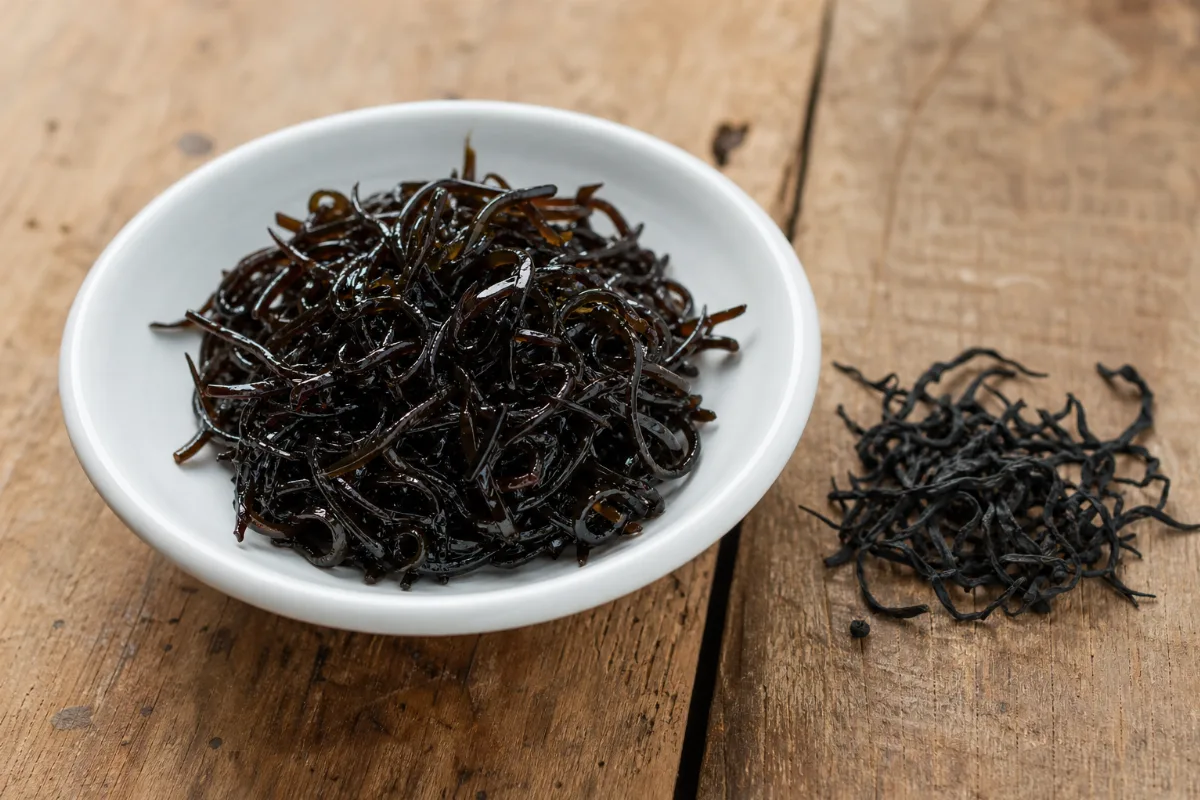
Arame is a brown seaweed, Eisenia bicyclis (also written Ecklonia bicyclis), from the coasts of Japan. It is a seaweed, not a plant. It is sold dried as thin dark strands, then soaked and cooked.
USDA FoodData Central has no entry for arame. The numbers here come from one laboratory study of a single dried sample. Per 100 g of that dried sample: magnesium about 1,750 mg, potassium about 2,001 mg, sodium about 1,084 mg, calcium about 695 mg, iron about 25.5 mg, manganese about 3.3 mg and selenium about 70 microg. A dry 100 g is far more than anyone eats, so see the nutrition table for a small dry portion. One sample is not an average.
Iodine and arsenic come first
The sample held about 79 mg of iodine per kg dry weight. That is far below kombu (about 3,126 in the same study) but still large per gram, and other samples can differ a lot. The American Thyroid Association says more than 1,100 microg of iodine a day is not recommended and may cause thyroid dysfunction.
Arame is not hijiki. In a UK survey, inorganic arsenic was found only in hijiki. The UK Food Standards Agency advised avoiding hijiki and named arame as an alternative, and Hong Kong's Centre for Food Safety says seaweed other than hijiki is safe to eat with respect to arsenic. The arame sample still had total arsenic of 7.0 mg per kg; most seaweed arsenic is organic, but the inorganic part was not measured.
What the research shows
No human study of eating arame was found. The measured facts are about composition and contaminants. In 49 regular seaweed eaters in Norway, thyroid TSH fell after six weeks without seaweed, but the seaweeds were not named.
Reports of benefit for sleep, colitis, weight, skin and lifespan come from extracts tested in mice, cells and fruit flies. Several have authors at a company. These are not tests of the food as eaten and do not show an effect in people.
At a glance
Traditional uses history, not proof
- Eaten in Japanese cooking as a sea vegetable after soaking and simmering
- Long use as food is not proof that it treats any condition
Studied for research
- Minerals such as magnesium, iron and manganese, low certainty (one sample)
- Iodine content, low certainty for the arame figure (one sample), which is also its main caution
- Thyroid tests in regular seaweed eaters, low certainty (arame not named)
- Sleep, colitis, weight, skin and lifespan, insufficient (extracts in animals and cells only)
- Any human health benefit, no human trial found
Main compounds
- Iodine (about 79 mg per kg dry weight in one sample)
- Magnesium, potassium, sodium and calcium
- Phlorotannins such as dieckol (in lab extracts)
- Arsenic, mostly organic in seaweed (inorganic not measured in the sample)
Common forms
- Dried arame strands, the form the study measured
- Soaked and cooked arame (not measured)
- Arame extracts used in lab studies (not the same as the food)
Research links: American Thyroid Association: excess iodine statement · Hong Kong Centre for Food Safety: hijiki and arsenic · Commercial edible seaweeds, mineral content (Foods, 2026) · Habitual seaweed eaters and thyroid (Eur J Nutr, 2026) · NHS: iodine · Research Library · Genes & Biomarkers Library
What it is and its history
- Accepted scientific name
- Eisenia bicyclis (Kjellman) Setchell
- Naming authority
- Listed as accepted in GBIF; Ecklonia bicyclis is also listed in GBIF and is used as a second name
- Synonyms
- Ecklonia bicyclis
- Common names
- Arame (English / Japanese); Arame (Spanish)
- Family or group
- A brown seaweed (kelp order Laminariales). It is a seaweed, not a plant.
- Classification
- Chromista > Ochrophyta > Phaeophyceae > Laminariales > Lessoniaceae (most GBIF datasets) or Alariaceae (some) > Eisenia > Eisenia bicyclis
- Native range
- The existing arame summary says the coasts of Japan; not verified from a source read.
- Habitat
- Not verified from a source read.
- What it looks like
- Roots: Not verified.; Stems: Not verified.; Leaves: Not verified.
- Cultivation
- Not verified from a source read.
- Harvest and processing
- Sold dried as thin dark strands, then soaked and cooked (existing summary; not re-sourced).
- Look-alikes and adulterants
- Name: Hijiki (Sargassum fusiforme); Note: A different dark, shredded seaweed with high inorganic arsenic; agencies advise avoiding it. Hong Kong's Centre for Food Safety describes it as physically distinct from arame.; Name: Kombu and wakame; Note: Other brown seaweeds with their own pages; they differ in iodine and minerals. In one study kombu iodine was about 40 times that of the arame sample.; Name: Arame extracts and supplements; Note: Lab extracts of Eisenia bicyclis are a different product from the cooked food.
- Sustainability and conservation
- Not assessed.
Photographs
Traditional use and history history, not clinical proof
| Tradition or era | Documented use | Source |
|---|---|---|
| Japanese cooking | Eaten as a sea vegetable after soaking and cooking. The existing summary says it comes from the coasts of Japan; no historical source was read. | NOT verified (no source read) |
Traditional use shows how it was used. It does not show that it works or is safe today.
What is inside, and how it may work
What it contains and how those compounds act in cells and animals. Laboratory and animal mechanisms are not proven effects in people.
Main compounds
| Compound | Family | Where it is concentrated | Activity studied | Level of evidence |
|---|---|---|---|---|
| Iodine | mineral (halogen) | Whole seaweed 79.2 mg/kg dry weight in one sample (Nava 2026) | Needed for thyroid hormones. Too much may disturb the thyroid. 7 13 | Composition data |
| Phlorotannins (eckol, dieckol and related) | polyphenols | Whole seaweed (extract) | Found in ethanol extracts of E. bicyclis; reported effects are from cells and animals only. 11 6 | Lab and animal |
| Arsenic (mostly organic forms in seaweed) | metalloid | Whole seaweed Total 7.03 mg/kg dry weight in one arame sample; inorganic not measured | Contaminant taken up from sea water; see Safety. 7 4 | Composition data |
Mechanisms, receptors and pathways
| Target or pathway | Gene or receptor | What was found | Level |
|---|---|---|---|
| Anti-inflammatory, AMPK, Tor-FoxO and GABA/serotonin signalling reported for arame extracts | Reported in cells, mice and flies for extracts. Not shown for eating arame in people. 11 12 9 6 | Lab and animal | |
| Iodine and thyroid function | High iodine intake from seaweed raised TSH in regular eaters (seaweed type not named). 1 | Human, observational |
Absorption, metabolism and elimination
- Absorption
- Not researched for arame.
- Distribution
- Not found.
- Metabolism
- Not found.
- Elimination
- Not found.
- Bioavailability
- Not established for arame.
Isolated compounds versus whole extracts
The lab studies of sleep, colitis, weight, skin and lifespan used ethanol or water extracts of Eisenia bicyclis, not cooked arame. A review of edible seaweeds says human trials are needed before health claims. Several extract studies have authors at a cosmetics and ingredients company.
Nutritional composition
No USDA FoodData Central entry exists for arame, so these figures come from one laboratory analysis of a single purchased sample of dried arame from Japan (Nava et al., Foods 2026), ground to powder. Per 100 g of dried arame (our arithmetic from the paper's per-kg figures): magnesium about 1,750 mg, potassium about 2,001 mg, sodium about 1,084 mg, calcium about 695 mg, phosphorus about 191 mg, iron about 25.5 mg, manganese about 3.3 mg, zinc about 1.9 mg, copper about 0.50 mg, selenium about 70 microg and iodine about 7.9 mg (7,900 microg). A typical dry portion is not established by any source read; for comparison, the paper's own risk estimate assumed a 5 g serving once a week for Europeans, and 5 g of dry arame would hold about 87 mg magnesium, 100 mg potassium, 54 mg sodium, 35 mg calcium, 1.3 mg iron and about 396 microg iodine on the same sample. Soaking and cooking change these numbers and were not measured. Values vary with harvest place, season and processing. Calories, protein, fibre and fat were not given in the abstract or tables read; the paper lists fatty acids but not in a form we can convert to a portion.
3 low certainty6 not enough evidence
What was looked at
The 9 benefits and uses checked for Arame, each with how strong the evidence is. Tap one to open it.
- Minerals in dried arame (nutrient content)Low certainty
- Iodine supply (nutrient content)Low certainty
- Thyroid tests (TSH) in people who eat seaweed regularly (arame not named)Low certainty
- Sleep (arame extract, fruit flies and mice)Not enough evidence
- Colitis (arame extract, mice)Not enough evidence
- Body weight and fat (arame extract, cells and mice)Not enough evidence
- Skin aging from sunlight (arame extract, cells and mice)Not enough evidence
- Lifespan (arame extract, fruit flies)Not enough evidence
- Blood sugar, cholesterol, blood pressure, cancer and other claimsNot enough evidence
Lab markers tracked in the studies
TSH (thyroid-stimulating hormone)Urinary iodine
What is Arame good for?
The main studied uses and how strong the evidence is for each. For arame there is no human trial, so most rows describe what is in the food or what extracts did in animals. None of this shows that eating arame treats or prevents a disease.
Benefits, one by one
Each card is a research question, not a promise. Tap a goal to filter. Open a card to see the studies, doses and limits.
Minerals in dried arame (nutrient content)
Low certaintyIn the one dried arame sample analysed in a 2026 Italian study, magnesium, potassium, sodium and calcium were the largest minerals, with iron, manganese and some selenium. This describes what is in the food. It does not show that eating arame prevents any disease.
2 studiesDried arame as sold. Cooked, soaked and simmered arame was not measur…
Studies, doses and limits
What the trials found
No human study. A laboratory analysis of one purchased sample of dried arame (Eisenia bicyclis, from Japan) found, per kg dry weight, magnesium 17,496 mg, potassium 20,005 mg, sodium 10,838 mg, calcium 6,950 mg, iron 255 mg, manganese 33.1 mg and selenium 0.70 mg. The study found arame had the highest magnesium of the six seaweeds tested.
Results
Arame is a mineral-rich seaweed by weight when dry. The figures describe a dried powder, which is far more concentrated than a cooked portion.
Effect sizes as reported
Per 100 g dry weight (our arithmetic from the per-kg figures): magnesium about 1,750 mg, potassium about 2,001 mg, sodium about 1,084 mg, calcium about 695 mg, iron about 25.5 mg.
Why this rating
The values come from one sample of one product. Minerals vary with harvest place, season and processing. Low confidence in any single figure, even though the general picture (a mineral-rich brown seaweed) is expected.
Form and dose studied
Dried arame as sold. Cooked, soaked and simmered arame was not measured.
Limits
One sample. Dried powder only. Mineral absorption from arame was not tested.
Why researchers looked
Seaweeds are eaten as sea vegetables partly for their minerals, and researchers measure them for both nutrients and contaminants.
Traditional use
Arame is a brown seaweed from the coasts of Japan, sold dried as thin dark strands, and soaked and cooked as a sea vegetable. Long use as food is not proof that it treats any condition.
Proposed mechanism Laboratory measurement
These are measured amounts in the food.
A proposed mechanism does not show that the effect happens in people.
The same sample also carried iodine and arsenic; see the next card and the Safety tab.
Iodine supply (nutrient content)
Low certaintyArame contains iodine, a mineral the thyroid needs. In one sample it held about 79 mg per kg dry weight, much less than kombu in the same study (about 3,126 mg per kg) but far more than a typical daily need per gram. Too much iodine can disturb the thyroid, so this is both a nutrient and a caution.
3 studiesDried arame as sold. The iodine left after soaking and cooking was no…
Studies, doses and limits
What the trials found
No trial of arame. One laboratory analysis found iodine 79.2 mg/kg dry weight in a dried arame sample. A separate 2004 survey of 12 seaweeds found iodine from 16 microg/g in nori to over 8165 microg/g in one processed kelp product, and noted that iodine is water-soluble in cooking and may be lost in humid storage. Arame is not named in that abstract.
Results
By simple arithmetic on the one sample, 1 g of dried arame carries about 79 microg of iodine and 5 g about 396 microg. The American Thyroid Association says more than 1,100 microg a day is not recommended and may cause thyroid dysfunction. Other arame products may differ a lot, and cooking may remove some iodine.
Effect sizes as reported
Arame 79.2 mg/kg dry weight; kombu 3,125.6 mg/kg and nori about 37 mg/kg in the same study.
Why this rating
Low for the arame number, because it rests on one sample. It is more certain that brown seaweeds in general can be rich in iodine and that amounts vary widely between products.
Form and dose studied
Dried arame as sold. The iodine left after soaking and cooking was not measured for arame.
Limits
One sample; dry weight; no cooked-food data; no human absorption data for arame.
Why researchers looked
Brown seaweeds take up iodine from sea water, and iodine intake that is too high or too low affects the thyroid.
Traditional use
Seaweed is a regular part of East Asian diets.
Proposed mechanism Laboratory measurement
Iodine is needed to make thyroid hormones. These are measured amounts of iodine in the food.
A proposed mechanism does not show that the effect happens in people.
Ask a clinician about seaweed if you have thyroid disease, take thyroid medicine, are pregnant or breastfeeding, or feed young children.
Thyroid tests (TSH) in people who eat seaweed regularly (arame not named)
Low certaintyIn 49 regular seaweed eaters in Norway, estimated iodine intake was above the upper limit. After six weeks without seaweed it fell a lot, and TSH (a thyroid test) fell too. The study did not say which seaweeds people ate, so it says nothing about arame specifically. It is a caution, not a benefit.
1 studiesHabitual seaweed in the diet, species not named.
Studies, doses and limits
What the trials found
A 2026 non-randomised pre-post study of 49 habitual seaweed consumers in Norway measured urinary iodine, thyroid hormones and TSH before and after six weeks without seaweed.
Results
Median urinary iodine fell from 270 to 87 microg/L and estimated iodine intake from 658 to 189 microg a day. Median TSH fell significantly, most in people with the highest intakes.
Effect sizes as reported
Estimated iodine intake 658 (p25-p75 330 to 1516) to 189 (142 to 264) microg/day.
Why this rating
Small study, no comparison group, convenience sample, and the abstract does not say which seaweeds were eaten.
Form and dose studied
Habitual seaweed in the diet, species not named.
Who was studied
Adults in Norway who ate seaweed regularly.
Limits
Cannot be applied to arame specifically. A fall in TSH after stopping shows seaweed was affecting the test, not that anyone was ill.
Why researchers looked
Seaweed can supply very large amounts of iodine, so researchers checked thyroid function in people who eat it often.
Traditional use
Not specific to arame.
Proposed mechanism Observational
Excess iodine can change thyroid function. The study measured, but did not test, a mechanism.
A proposed mechanism does not show that the effect happens in people.
See the Safety tab for thyroid cautions.
Sleep (arame extract, fruit flies and mice)
Not enough evidenceIn flies and mice made sleepless with caffeine, an arame extract restored sleep time and shifted brain chemicals. This has not been tested in people.
1 studiesExtract (not the food).
Studies, doses and limits
Results
In caffeine-treated flies the extract normalised sleep; in mice it restored pentobarbital sleep time but not sleep onset.
Effect sizes as reported
No effect size in the abstract.
Why this rating
Animal study of an extract only. Not evidence that eating arame helps sleep.
Form and dose studied
Extract (not the food).
Who was studied
Fruit flies and mice.
Limits
Caffeine-induced sleep loss in animals is not human insomnia. Two authors work at a cosmetics and ingredients company (COSMAX BIO).
Why researchers looked
Researchers looked for sleep-friendly natural compounds; arame is rich in phlorotannins.
Proposed mechanism Animal research
The authors suggest effects on antioxidant defence and on GABA and serotonin signalling in animals. This is a lab idea, not shown in people.
A proposed mechanism does not show that the effect happens in people.
No safety data in people.
Colitis (arame extract, mice)
Not enough evidenceA 70% ethanol extract of arame eased induced colitis in mice and shifted gut bacteria. There is no human study.
1 studiesExtract.
Studies, doses and limits
Results
Less intestinal shortening and lower inflammatory signals in mice.
Effect sizes as reported
No effect size in the abstract.
Why this rating
Cells and mice only; ethanol extract, not food.
Form and dose studied
Extract.
Who was studied
Cells and mice.
Limits
Chemically induced colitis in mice is not ulcerative colitis in people.
Why researchers looked
Phenolic compounds in arame are anti-inflammatory in lab tests.
Proposed mechanism Animal research
The authors report effects on the mTOR pathway and gut bacteria in cells and mice.
A proposed mechanism does not show that the effect happens in people.
People with bowel disease should not use seaweed extracts in place of treatment.
Body weight and fat (arame extract, cells and mice)
Not enough evidenceA standardised 30% ethanol extract of arame lowered body weight and fat in mice fed a high-fat diet and slowed fat-cell formation in a dish. No human trial exists.
1 studiesStandardised extract.
Studies, doses and limits
Results
Lower body and fat weight and smaller fat cells in mice.
Effect sizes as reported
No effect size in the abstract.
Why this rating
Cells and mice only; industry-linked authors; extract, not food.
Form and dose studied
Standardised extract.
Who was studied
Cells and mice.
Limits
Co-authors are from COSMAXBIO, a company. Mouse weight results often do not carry over to people.
Why researchers looked
Brown seaweed compounds are studied for effects on fat cells.
Proposed mechanism Animal research
The authors report effects through the AMPK signalling pathway in cells and mice.
A proposed mechanism does not show that the effect happens in people.
None specific.
Skin aging from sunlight (arame extract, cells and mice)
Not enough evidenceAn arame extract protected human skin cells and hairless mice from UVB-induced damage such as wrinkles. It has not been tested on people.
1 studies30% ethanol extract.
Studies, doses and limits
Results
Fewer wrinkles and less dryness in UVB-exposed mice.
Effect sizes as reported
No effect size in the abstract.
Why this rating
Cells and mice only; industry-linked authors; extract, not food.
Form and dose studied
30% ethanol extract.
Who was studied
Human skin cells in a dish; hairless mice.
Limits
Co-authors are from COSMAXBIO. No human skin tests.
Why researchers looked
Seaweed polyphenols are studied as antioxidants for skin.
Proposed mechanism Animal research
The authors report effects on MMP-1, collagen and Nrf2 signals in cells and mice.
A proposed mechanism does not show that the effect happens in people.
None specific.
Lifespan (arame extract, fruit flies)
Not enough evidenceA water extract of arame lengthened the life of female fruit flies by up to 40%. It did not help males, and it says nothing about human lifespan.
1 studiesWater extract.
Studies, doses and limits
Results
Longer lifespan in female flies only.
Effect sizes as reported
Up to 40% longer lifespan in female flies.
Why this rating
Fruit flies only; extract, not food.
Form and dose studied
Water extract.
Who was studied
Fruit flies.
Limits
The paper's call to encourage arame as a supplement goes beyond a fly study.
Why researchers looked
Food extracts are screened in flies for effects on ageing pathways.
Proposed mechanism Animal research
The authors say the effect depends on the Tor and FoxO signalling pathways in flies.
A proposed mechanism does not show that the effect happens in people.
None specific.
Blood sugar, cholesterol, blood pressure, cancer and other claims
Not enough evidenceWe found no human trial of eating arame for any health outcome. A review of edible seaweeds says more human studies are needed before health claims can be supported.
1 studiesNot applicable.
Studies, doses and limits
What the trials found
A 2019 narrative review of edible seaweeds concluded that more human intervention studies and mechanistic evidence are needed. A PubMed search for arame, Eisenia bicyclis and Ecklonia bicyclis with human or trial terms found no human study of the food.
Results
No evidence of benefit found.
Why this rating
No human studies of arame were found.
Limits
Absence of studies is not proof of no effect, or of harm.
Why researchers looked
Seaweed is often marketed for many benefits.
Proposed mechanism Unknown
Not established.
A proposed mechanism does not show that the effect happens in people.
None specific.
Connections to the rest of health
How Arame connects to the rest of our health knowledge graph. Every link says what kind of connection it is. A safety link (for example to the liver) is a warning, not a benefit. A study that merely mentions a topic never creates a benefit link.
Explore every connection: goals, body systems, organs, symptoms, genes
A. Wellness goals
| Connected to | Kind of connection | Evidence status | Context | Studies |
|---|---|---|---|---|
| Preventive Wellness | Low certainty | Minerals in dried arame (nutrient content): In the one dried arame sample analysed in a 2026 Italian study, magnesium, potassium, sodium and calcium were the largest minerals, with iron, manganese and some selenium. This describes what is in the food. It does not show that eating arame prevents any disease. | 7 19 | |
| Thyroid Support | Low certainty | Iodine supply (nutrient content): Arame contains iodine, a mineral the thyroid needs. In one sample it held about 79 mg per kg dry weight, much less than kombu in the same study (about 3,126 mg per kg) but far more than a typical daily need per gram. Too much iodine can disturb the thyroid, so this is both a nutrient and a caution. | 7 10 13 | |
| Thyroid Support | Low certainty | Thyroid tests (TSH) in people who eat seaweed regularly (arame not named): In 49 regular seaweed eaters in Norway, estimated iodine intake was above the upper limit. After six weeks without seaweed it fell a lot, and TSH (a thyroid test) fell too. The study did not say which seaweeds people ate, so it says nothing about arame specifically. It is a caution, not a benefit. | 1 | |
| Better Sleep | Not enough evidence | Sleep (arame extract, fruit flies and mice): In flies and mice made sleepless with caffeine, an arame extract restored sleep time and shifted brain chemicals. This has not been tested in people. | 6 | |
| Gut Digestive Health | Not enough evidence | Colitis (arame extract, mice): A 70% ethanol extract of arame eased induced colitis in mice and shifted gut bacteria. There is no human study. | 11 | |
| Weight Management | Not enough evidence | Body weight and fat (arame extract, cells and mice): A standardised 30% ethanol extract of arame lowered body weight and fat in mice fed a high-fat diet and slowed fat-cell formation in a dish. No human trial exists. | 12 | |
| Skin Health | Not enough evidence | Skin aging from sunlight (arame extract, cells and mice): An arame extract protected human skin cells and hairless mice from UVB-induced damage such as wrinkles. It has not been tested on people. | 3 | |
| Healthy Aging | Not enough evidence | Lifespan (arame extract, fruit flies): A water extract of arame lengthened the life of female fruit flies by up to 40%. It did not help males, and it says nothing about human lifespan. | 9 | |
| Preventive Wellness | Not enough evidence | Blood sugar, cholesterol, blood pressure, cancer and other claims: We found no human trial of eating arame for any health outcome. A review of edible seaweeds says more human studies are needed before health claims can be supported. | 2 |
B. Body systems
| Connected to | Kind of connection | Evidence status | Context | Studies |
|---|---|---|---|---|
| Musculoskeletal System | Biological association | Low certainty | Studied for: Minerals in dried arame (nutrient content) | 7 19 |
| Endocrine System | Biological association | Low certainty | Studied for: Iodine supply (nutrient content) Studied for: Thyroid tests (TSH) in people who eat seaweed regularly (arame not named) | 7 10 13 1 |
| Nervous System | Biological association | Not enough evidence | Studied for: Sleep (arame extract, fruit flies and mice) | 6 |
| Digestive System | Biological association | Not enough evidence | Studied for: Colitis (arame extract, mice) | 11 |
| Metabolic System | Biological association | Not enough evidence | Studied for: Body weight and fat (arame extract, cells and mice) Studied for: Lifespan (arame extract, fruit flies) | 12 9 |
| Integumentary System | Biological association | Not enough evidence | Studied for: Skin aging from sunlight (arame extract, cells and mice) | 3 |
| Cardiovascular System | Biological association | Not enough evidence | Studied for: Blood sugar, cholesterol, blood pressure, cancer and other claims | 2 |
C. Body parts and organs
| Connected to | Kind of connection | Evidence status | Context | Studies |
|---|---|---|---|---|
| Thyroid | Adverse effect or risk | Documented risk | Seaweed iodine can push intake above the 1,100 microg adult upper limit and raise TSH in regular eaters; arame measured about 79 mg/kg dry weight in one sample. Seaweed iodine can push intake above the 1,100 microg adult upper limit; arame held about 79 mg per kg dry weight in one sample. Preparation or compound: Iodine in arame |
13 1 7 |
G. Root causes and contributing factors
| Connected to | Kind of connection | Evidence status | Context | Studies |
|---|---|---|---|---|
| Heavy metal exposure | Adverse effect or risk | Documented risk | One arame sample had total arsenic above a seaweed-institute guide; inorganic arsenic was not measured. Preparation or compound: Seaweed as food |
7 8 |
I. Biomarkers
| Connected to | Kind of connection | Evidence status | Context | Studies |
|---|---|---|---|---|
| TSH (thyroid-stimulating hormone) | Biological association | Low certainty | Measured in trials: lowered after stopping seaweed. A lab change is not the same as a health benefit. | 1 |
| Urinary iodine | Biological association | Low certainty | Measured in trials: lowered after stopping seaweed. A lab change is not the same as a health benefit. | 1 |
K. Biological pathways
L. Active compounds
| Connected to | Kind of connection | Evidence status | Context | Studies |
|---|---|---|---|---|
| Iodine | Biological association | Composition data | Needed for thyroid hormones. Too much may disturb the thyroid. Preparation or compound: Whole seaweed |
7 13 |
| Phlorotannins (eckol, dieckol and related) | Biological association | Lab and animal | Found in ethanol extracts of E. bicyclis; reported effects are from cells and animals only. Preparation or compound: Whole seaweed (extract) |
11 6 |
| Arsenic (mostly organic forms in seaweed) | Biological association | Composition data | Contaminant taken up from sea water; see Safety. Preparation or compound: Whole seaweed |
7 4 |
Each connection is stored with the ingredient, the connected record, the kind of connection, the evidence status, the supporting studies, the preparation or compound involved, and a review date (last reviewed October 26, 2026).
Evidence at a glance: what the research found for 9 outcomes
Each outcome below is one thing researchers measured. Certainty is how far the evidence can be trusted, not how well it works. The full studies are on the next tab.
The evidence
The research centre for Arame. Every record here was checked against PubMed or the publisher's page; we never list a study we have not verified.
Evidence by outcome
Bars show how many studies we found for each outcome, not how well it works. People are added up across trials only (reviews are not added, to avoid double counting).
How we rate evidence
High certainty
Several well-run trials or reviews agree; further research is unlikely to change the picture much.
Moderate certainty
Good trials point the same way, but some doubt remains.
Low certainty
Small, short or inconsistent trials. The finding could change with better research.
Very low certainty
Very little or very weak human data. Treat as a possibility only.
Mixed findings
Trials or reviews disagree with each other.
Not enough evidence
Not enough human research to say either way.
Evidence against
Good research found no benefit, or found harm.
We take the reviewers' own risk-of-bias and GRADE statements where they exist, and otherwise judge from study size, design, consistency, directness and whether a product matches what is sold. Many publications do not make evidence high. Method note: We started from our existing arame summary, searched PubMed for human and extract studies, and re-read PubMed abstracts, the open-access tables of the 2026 mineral study, and the American Thyroid Association, NHS, Hong Kong Centre for Food Safety, Food Safety News and MedlinePlus pages. Items we could not verify are flagged in the research gaps.
Study library: every study we checked 19
| Study | Design | People | Product, dose, length | Result |
|---|---|---|---|---|
| Aakre I et al. 2026 Impact of habitual seaweed consumption on iodine nutrition and thyroid function: a non-randomized pre-post clinical study Eur J Nutr · PMID 41543576 · DOI |
Non randomised pre post Mixed seaweeds |
49 49 habitual seaweed consumers recruited from the two largest cities in Norway |
Habitual seaweed, then six weeks without seaweed Seaweeds eaten in everyday diet (species not named in the abstract) |
Median urinary iodine fell from 270 to 87 microg/L and estimated iodine intake from 658 to 189 microg/day after six weeks without seaweed. Intake before stopping was above the Tolerable Upper Intake Level. Median TSH fell significantly after stopping seaweed, most in people with the highest intakes. Estimated iodine intake 658 to 189 microg/day; TSH lower after stopping (Not applicable) Methods, limits and fundingOutcomes: Urinary iodine, estimated iodine intake, TSH, fT3, fT4, TPO antibodies Limitations: No control group; convenience sample; species not named in the abstract, so arame is not singled out. Funding and conflicts: Authors declare no conflict of interest. Read: abstract |
| Cherry P et al. 2019 Risks and benefits of consuming edible seaweeds Nutr Rev · PMID 30840077 · DOI |
Narrative review Edible seaweeds in general |
Review of human evidence on whole seaweeds, extracts and seaweed foods | Edible seaweeds Whole seaweed, extracts, foods |
The authors summarise composition, weigh human evidence and the risks of excess iodine and arsenic, and conclude that more human intervention studies and mechanistic evidence are needed before health claims can be supported. Not applicable (Not applicable) Methods, limits and fundingOutcomes: Health benefits and adverse effects Limitations: Narrative review, abstract read only. Funding and conflicts: One author works for a seaweed products company (VOYA Products Limited), per the author affiliations. Read: abstract |
| Choi SI et al. 2021 Eisenia bicyclis Extract Repairs UVB-Induced Skin Photoaging In Vitro and In Vivo: Photoprotective Effects Mar Drugs · PMID 34940692 · DOI |
Animal and cell Eisenia bicyclis extract |
Human skin cells in a dish and hairless mice exposed to UVB light | 30% ethanol extract of E. bicyclis (taken by mouth in mice) Extract of the seaweed (not the food as eaten) |
In skin cells and UVB-exposed mice the extract reduced signs of photoaging such as wrinkles and dryness. Animal or lab result; no human effect size (Not applicable) Methods, limits and fundingOutcomes: Wrinkles, skin thickness, collagen signals Limitations: Cells and mice only; not tested on people's skin. Co-authors are from COSMAXBIO. Funding and conflicts: No conflict declared in the abstract, but co-authors work at COSMAXBIO (industry link). Read: abstract |
| EFSA Panel on Contaminants in the Food Chain (CONTAM) 2024 Risk assessment of complex organoarsenic species in food EFSA J · PMID 39655151 · DOI |
Regulatory risk assessment Not species-specific |
General population exposure estimates | Organic arsenic compounds in marine foods (arsenobetaine, arsenosugars, arsenolipids) Marine foods incl. seaweed |
For arsenobetaine, EFSA concluded current dietary exposure does not raise a health concern. For one arsenosugar (glycerol arsenosugar), the highest adult exposure estimate (consumers of nori/laver) gave a margin of exposure above 1000, not raising a concern. No conclusions could be drawn for other arsenosugars, and no risk assessment could be done for arsenolipids because of missing data. Margin of exposure above 1000 for glycerol arsenosugar (Not applicable) Methods, limits and fundingOutcomes: Hazard and exposure Limitations: Covers organic arsenic in general; arame is not named in the abstract. Funding and conflicts: Official EFSA opinion. Read: abstract |
| European Food Safety Authority (EFSA) 2023 Dietary exposure to heavy metals and iodine intake via consumption of seaweeds and halophytes in the European population EFSA J · PMID 36742462 · DOI |
Exposure assessment Seaweeds in general |
468 468 subjects in 19 European countries with 697 eating occasions of seaweeds, halophytes and related products |
Seaweed consumption exposure assessment Seaweeds |
Seaweeds are an important source of total arsenic, mainly the organic kind. For consumers of seaweed, exposure estimates for cadmium were within the range of earlier whole-diet estimates, while inorganic arsenic and lead were 10% to 30% of earlier whole-diet exposures. Mean iodine intakes above 20 microg per kg body weight per day were found among consumers of kombu and laver. Arame is not named in the abstract. Kombu and laver consumers above 20 microg/kg body weight/day iodine (Not applicable) Methods, limits and fundingOutcomes: Exposure to cadmium, lead, arsenic, mercury and iodine Limitations: Arame not named in the abstract; few eating occasions per seaweed. Funding and conflicts: Official EFSA report. Read: abstract |
| Ha YJ et al. 2025 Effects of Eisenia bicyclis Extract on Sleep Promotion in a Caffeine-Induced Insomnia Models J Microbiol Biotechnol · PMID 41162163 · DOI |
Animal research Eisenia bicyclis extract |
Fruit flies and mice given caffeine to disturb sleep | E. bicyclis extract Extract of the seaweed (not the food as eaten) |
In caffeine-disturbed flies and mice, the extract restored sleep time and changed brain chemicals (GABA, serotonin). Sleep onset (latency) in mice was not affected. Animal or lab result; no human effect size (Not applicable) Methods, limits and fundingOutcomes: Sleep time, brain chemistry Limitations: Flies and mice only; caffeine-induced sleep loss is not human insomnia. Two authors are from COSMAX BIO, a company. Funding and conflicts: Authors declare no financial conflicts; two authors are at COSMAX BIO (industry link). Read: abstract |
| Nava V et al. 2026 Commercial Edible Seaweeds: Characterization by Mineral Content and Fatty Acid Composition Foods · PMID 42794005 · DOI |
Laboratory analysis Eisenia bicyclis (arame), plus five other seaweeds |
6 One purchased sample each of six dried seaweeds, one of them arame (Eisenia bicyclis, from Japan), ground to powder |
Dried seaweed powder analysed for minerals, toxic elements and fatty acids Whole dried seaweed |
For the single arame sample (per kg dry weight): magnesium 17,496 mg, potassium 20,005 mg, sodium 10,838 mg, calcium 6,950 mg, phosphorus 1,909 mg, iron 255 mg, manganese 33.1 mg, zinc 19.1 mg, copper 5.04 mg, selenium 0.70 mg, iodine 79.2 mg. Toxic elements: cadmium 0.25, lead 0.82, total arsenic 7.03, mercury 0.02 mg/kg. Kombu iodine in the same study was 3,125.6 mg/kg. The abstract says nearly all samples exceeded the CEVA guide limits for cadmium (0.5 mg/kg) and total arsenic (3 mg/kg); in the full text, arame cadmium was below 0.5 and total arsenic above 3. Inorganic arsenic was not measured. Arame iodine 79.2 mg/kg dry weight (one sample); total arsenic 7.03 mg/kg (Not applicable) Methods, limits and fundingOutcomes: Minerals, toxic elements, iodine and fatty acids Limitations: One purchased sample per seaweed, dried products only, so nothing is known about fresh or cooked arame. The CEVA limits are a French seaweed-institute guide, not a law. Origin and harvest season affect results. Funding and conflicts: No conflict of interest declared; no external funding mentioned in the part read. Read: abstract |
| Rose M et al. 2007 Arsenic in seaweed--forms, concentration and dietary exposure Food Chem Toxicol · PMID 17336439 · DOI |
Laboratory analysis Five seaweed varieties |
31 31 dried retail samples of five varieties of seaweed bought in London and online (UK) |
Seaweed measured for total and inorganic arsenic before and after preparation Whole dried seaweed |
Arsenic was found in all samples; total arsenic ranged from 18 to 124 mg/kg. Inorganic arsenic was found only in the nine hijiki samples (67 to 96 mg/kg). The other varieties had less than 0.3 mg/kg inorganic arsenic (the detection limit). The UK Food Standards Agency advised consumers to avoid hijiki. The abstract does not name the other four varieties. Hijiki 67-96 mg/kg inorganic arsenic; other varieties below 0.3 mg/kg (Not applicable) Methods, limits and fundingOutcomes: Total and inorganic arsenic Limitations: The abstract does not name the other varieties; the FSA news coverage below says arame was among them. Samples from 2000s UK shops. Funding and conflicts: Government laboratory (Defra Central Science Laboratory); funding not stated in the abstract. Read: abstract |
| Tahanzadeh N et al. 2022 An aqueous extract of the brown alga Eisenia bicyclis extends lifespan in a sex-specific manner by interfering with the Tor-FoxO axis Aging (Albany NY) · PMID 35980274 · DOI |
Animal research Eisenia bicyclis extract |
Fruit flies (Drosophila melanogaster) | Aqueous (water) extract of E. bicyclis Extract of the seaweed (not the food as eaten) |
Small amounts of extract extended lifespan of female flies by up to 40%; males were not helped. The authors say the finding should prompt studies in other organisms. Animal or lab result; no human effect size (Not applicable) Methods, limits and fundingOutcomes: Lifespan Limitations: Fruit flies only. The abstract also suggests encouraging arame as a health-promoting food supplement, which goes beyond what a fly study can show. Funding and conflicts: Authors declare no conflicts of interest. Read: abstract |
| Teas J et al. 2004 Variability of iodine content in common commercially available edible seaweeds Thyroid · PMID 15588380 · DOI |
Laboratory analysis 12 seaweed species |
12 species of commercial seaweed from the US market and from harvesters in Canada, Tasmania and Namibia | Seaweeds measured for iodine Whole seaweed |
Iodine ranged from 16 microg/g in nori to over 8165 microg/g in one processed kelp product. Iodine is water-soluble in cooking and may be lost in humid storage, so the amount in a prepared food is hard to estimate. The authors say some Asian seaweed dishes may exceed the tolerable upper intake level of 1100 microg a day. The abstract does not name arame. 16 to over 8165 microg/g across 12 species (Not applicable) Methods, limits and fundingOutcomes: Iodine content Limitations: Arame is not named in the abstract. Few samples per species. Funding and conflicts: Not stated in the abstract. Read: abstract |
| Wang Q et al. 2025 Eisenia bicyclis Extract Ameliorates Colitis in In Vitro and In Vivo Models Through Modulation of mTOR Axis and Gut Microbiota Composition Foods · PMID 40077417 · DOI |
Animal and cell Eisenia bicyclis extract |
Cells and a mouse model of colitis (DSS-induced) | 70% ethanol extract of E. bicyclis Extract of the seaweed (not the food as eaten) |
The extract improved colitis signs in mice, lowered inflammatory cytokines, and shifted gut bacteria. The extract contained phenolic compounds such as eckol and dieckol. Animal or lab result; no human effect size (Not applicable) Methods, limits and fundingOutcomes: Colitis signs, inflammatory signals, gut bacteria Limitations: Mice and cells only; an ethanol extract, not eaten arame; no human data. Funding and conflicts: No conflict of interest declared. Read: abstract |
| Yoon YS et al. 2024 Anti-obesity effects of a standardized ethanol extract of Eisenia bicyclis by regulating the AMPK signaling pathway in 3T3-L1 cells and HFD-induced mice Food Funct · PMID 38771619 · DOI |
Animal and cell Eisenia bicyclis extract |
Fat cells (3T3-L1) and mice fed a high-fat diet | 30% ethanol extract of E. bicyclis Extract of the seaweed (not the food as eaten) |
In cells and high-fat-diet mice the extract lowered body weight and fat and changed fat-making signals; the authors suggest it could be a potential agent to prevent obesity. Animal or lab result; no human effect size (Not applicable) Methods, limits and fundingOutcomes: Body weight, fat, blood fats, signalling proteins Limitations: Cells and mice only; a standardised extract, not food. Co-authors are from COSMAXBIO, a company. Funding and conflicts: Industry-linked: co-authors at COSMAXBIO. Read: abstract |
| s-ata-2013 American Thyroid Association: statement on the potential risks of excess iodine ingestion and exposure (5 June 2013) · Source |
Regulator statement n/a |
Methods, limits and fundingRead: full-text | ||
| s-cfs-hk-hijiki Centre for Food Safety, Hong Kong: Hijiki and Arsenic (Risk Assessment Section, Feb 2011) · Source |
Regulator statement n/a |
Methods, limits and fundingRead: full-text | ||
| s-fsa-2010-fsn Food Safety News: Food Standards Agency issues seaweed warning (5 Aug 2010) · Source |
News report of regulator n/a |
Methods, limits and fundingRead: full-text | ||
| s-gbif-eisenia-bicyclis GBIF: Eisenia bicyclis (Kjellm.) Setchell, 1905 (key 176928964) · Source |
Reference database n/a |
Methods, limits and fundingRead: full-text | ||
| s-medlineplus-food-allergy MedlinePlus: Food Allergy · Source |
Regulator statement n/a |
Methods, limits and fundingRead: full-text | ||
| s-nhs-iodine NHS: Vitamins and minerals: Iodine · Source |
Regulator statement n/a |
Methods, limits and fundingRead: full-text | ||
| s-usda-none USDA FoodData Central: no entry for arame · Source |
Reference database n/a |
Methods, limits and fundingRead: saved-copy |
What we do not know yet
- No human study of eating arame was found.
- Composition rests on one purchased sample; USDA has no entry for arame.
- Inorganic arsenic in the arame sample was not measured, and the UK arame finding comes through news coverage of the FSA.
- No arame-specific advice for pregnancy, breastfeeding, children, thyroid medicines or warfarin was found.
- Iodine and arsenic after soaking and cooking arame were not measured.
How new research is added
New studies are found by a saved PubMed search and placed in a review queue before the page changes.
Lab markers
What changed in blood or saliva tests during trials. A changed number is not the same as feeling or being healthier, and we give no "normal ranges".
Hormonal 1
TSH (thyroid-stimulating hormone)
Lowered after stopping seaweed in trials
A pituitary hormone measured in blood to check how the thyroid is working.
Low certaintyResults and what it means
Why it was measured
A rising TSH can be an early sign that iodine is affecting the thyroid.
Statistical vs. clinical meaning
Shows seaweed was affecting a thyroid test in regular eaters; it does not show harm in any one person.
Safety implication
People with thyroid disease should ask a clinician before eating seaweed often.
| Study | Result | People | Product |
|---|---|---|---|
| 1 | Median TSH fell significantly after six weeks without seaweed, most in those with the highest iodine intake | 49 habitual seaweed consumers in Norway | Stopping seaweed for six weeks (seaweed type not named) |
Other 1
Urinary iodine
Lowered after stopping seaweed in trials
The amount of iodine in urine, the usual measure of recent iodine intake.
Low certaintyResults and what it means
Why it was measured
It shows whether a diet gives too little, enough or too much iodine.
Statistical vs. clinical meaning
A measure of exposure, not of health.
Safety implication
High values in regular seaweed eaters are the reason for the iodine caution on this page.
| Study | Result | People | Product |
|---|---|---|---|
| 1 | Median fell from 270 to 87 microg/L after six weeks without seaweed | 49 habitual seaweed consumers in Norway | Stopping seaweed for six weeks (seaweed type not named) |
Safety
What studies and official sources say about side effects, medicines and who should check first. Each point shows what kind of evidence it comes from.
Main points to know 4
- Arame is not hijiki. Hijiki is a different seaweed that contains high inorganic arsenic, and the UK Food Standards Agency and Hong Kong's Centre for Food Safety advise avoiding it. In the UK survey, arame had no inorganic arsenic above the detection limit. Hong Kong says seaweed other than hijiki is safe to eat with respect to arsenic. Check that a pack says arame (or Eisenia bicyclis) and not hijiki. Regulator statement and laboratory analysis 8 15 14
- Iodine can be high and varies. One dried arame sample held about 79 mg of iodine per kg dry weight. That is far below kombu in the same study but still a lot per gram: by simple arithmetic, 5 g of that dried sample holds about 396 microg, and the American Thyroid Association says more than 1,100 microg a day is not recommended and may cause thyroid dysfunction. Other products can differ a lot and cooking may remove some iodine. In 49 regular seaweed eaters in Norway, estimated iodine intake was above the upper limit and thyroid TSH fell after six weeks without seaweed. Laboratory measurement and authoritative guidance 7 13 1 10
- Total arsenic is not small, but most seaweed arsenic is organic. The arame sample had total arsenic of 7.03 mg/kg dry weight. Inorganic arsenic, the more toxic form, was not measured. EFSA says seaweeds are important sources of total arsenic that is mainly organic, and in 2024 judged two common organic forms (arsenobetaine and glycerol arsenosugar) unlikely to raise a health concern at current exposures. Laboratory analysis and regulatory assessment 7 5 4
- A serious allergic reaction is an emergency. Seaweed allergy was not researched for arame. For swelling of the throat, severe trouble breathing, fainting or shock after eating any food, call emergency services (911 in the US) at once. Authoritative guidance 17
Side effects 3
| Effect | How often | Severity and recovery | Evidence |
|---|---|---|---|
| Too much iodine can disturb the thyroid No arame-specific cases were found. NHS says high doses of iodine for long periods could change how the thyroid works. | Not established | can be serious over time The Norwegian study found TSH fell after seaweed was stopped for six weeks. | Authoritative guidance 13 18 1 |
| Higher TSH in regular seaweed eaters (arame not named) Small study without a control group. | Not established | not serious in the study read TSH fell after stopping seaweed | Observational 1 |
| Arsenic or cadmium from contaminated product Measured levels only; no illness from arame was found in the sources read. | Not established | not stated Not stated | Laboratory analysis 7 8 |
Liver
No liver injury from eating arame was found in the sources read. A liver-safety database such as LiverTox was not searched.
How often. No frequency found.
Monitoring. No agency monitoring advice was found.
This is a safety connection. It is not evidence that Arame supports liver health.
Medicines and supplements 3
| With | Why it matters | Importance | Evidence | What to do |
|---|---|---|---|---|
| Thyroid medicines (levothyroxine, antithyroid drugs) and thyroid disease prescription | Iodine affects thyroid hormone production. | No source on arame with thyroid medicines was read. NHS and ATA warn about high iodine and the thyroid generally. | Authoritative guidance Not enough evidence 13 18 | Ask your clinician before eating seaweed often. |
| Warfarin and other blood thinners prescription | Some seaweeds contain vitamin K. | No source on arame vitamin K or warfarin was read. | None found Not enough evidence | A pharmacist can check your own medicines. |
| Kelp tablets, iodine pills and iodine-containing supplements supplement | Adds to total iodine intake. | ATA advises against iodine and kelp supplements above 500 microg a day. | Authoritative guidance Moderate certainty 13 | Count all iodine sources; ask a clinician. |
Who should check first 4
| Situation | Advice | Evidence |
|---|---|---|
| Thyroid disease, or taking thyroid medicine | Ask a clinician before eating seaweed often. | Authoritative guidance 13 18 |
| Pregnancy or breastfeeding | No arame-specific source was read. ATA gives US iodine intakes for pregnancy (220-250 microg a day) and breastfeeding (250-290), and sets 1,100 microg as the upper limit. Ask your clinician before eating seaweed often. | Authoritative guidance 13 |
| Young children | No arame-specific source or children's upper limits were read. Ask a clinician or pharmacist. | None found |
| Known seaweed allergy | Avoid. Seek emergency help for severe symptoms. | Authoritative guidance 17 |
Overdose, product quality and regulators
Summary. The safety points for arame as food are iodine and arsenic. No other toxicity from ordinary arame was found in the sources read.
Animal. Not reviewed.
High dose or long term signals. NHS says high doses of iodine for long periods could change how the thyroid works. ATA says more than 1,100 microg a day may cause thyroid dysfunction.
Overdose response. Not found.
Genotoxicity. Not researched.
Arame, like other seaweeds, takes up minerals and metals from sea water.
Cadmium, lead, mercury, arsenic in one arame sample. Per kg dry weight: cadmium 0.25, lead 0.82, total arsenic 7.03, mercury 0.02 mg. Against the CEVA guide limits in the paper (cadmium 0.5, lead 5, mercury 0.1), arame was under the limits for those three. Total arsenic was above the 3 mg/kg limit quoted in the abstract, and inorganic arsenic was not measured. The CEVA limits are a French seaweed-institute guide, not a law, and the paper notes there are no harmonised EU limits for seaweed foods. 7
Inorganic arsenic: arame versus hijiki. In a UK survey of 31 dried samples, inorganic arsenic was found only in hijiki (67 to 96 mg/kg); the other varieties were below 0.3 mg/kg. News coverage of the UK Food Standards Agency says arame was tested and none was found, and the agency named arame, kombu, nori and wakame as alternatives. Hong Kong's Centre for Food Safety says seaweed other than hijiki is safe to eat with respect to its arsenic content. 8 15 14
European exposure to seaweed metals. For people who eat seaweed, EFSA found cadmium exposure within earlier whole-diet estimates, and inorganic arsenic and lead at 10% to 30% of earlier whole-diet exposures. Arame is not named in the abstract. 5
| Body | Action | Date |
|---|---|---|
| UK Food Standards Agency (as reported by Food Safety News) (United Kingdom) | Advised consumers to avoid hijiki because of inorganic arsenic and to choose arame, kombu, nori or wakame instead. source | 2010-08-05 |
| Centre for Food Safety, Hong Kong (Hong Kong) | Advises avoiding hijiki; says there is no need to stop eating other seaweed varieties. source | 2011-02 |
| American Thyroid Association (United States) | More than 1,100 mcg of iodine a day is not recommended and may cause thyroid dysfunction; advises against iodine and kelp supplements above 500 mcg a day. source | 2013-06-05 |
| NHS (United Kingdom) | High doses of iodine for long periods could change how the thyroid works; 0.5 mg or less a day of iodine supplements is unlikely to cause harm. source | 2020-08-03 |
| EFSA (European Union) | 2024 risk assessment: current dietary exposure to arsenobetaine and glycerol arsenosugar does not raise a health concern; no conclusion for other arsenosugars or arsenolipids. source | 2024-12-09 |
When to get medical help
Stop using the product and contact a clinician or emergency service. In the US, Poison Control is 1-800-222-1222.
General information only, not medical advice. Ask a clinician or pharmacist before use, especially with medicines, in pregnancy or with a health condition. See the Natural Remedy Safety guide.
Frequently asked questions
What is arame?
A mild brown seaweed from Japan, sold dried as thin dark strands and eaten after soaking and cooking. It is a sea vegetable, not a plant.
Is arame the same as hijiki?
Is arame safe from arsenic?
Is arame high in iodine?
Can seaweed affect the thyroid?
What nutrients does arame contain?
Does arame help with weight loss or sleep?
Does arame help the gut or colitis?
No human study exists. An extract eased induced colitis in mice.
Does arame lengthen life or protect the skin?
Is arame the same as kombu or wakame?
No. All are brown seaweeds but they differ in iodine and minerals. In one study kombu iodine was about 40 times that of the arame sample.
Is arame safe in pregnancy or for children?
We did not find arame-specific advice. Because of its iodine, ask a clinician before eating seaweed often.
What if I have a reaction after eating arame?
For swelling of the throat, severe trouble breathing, fainting or shock, call 911 or your local emergency number.
Explore by health goal
Preventive WellnessThyroid SupportBetter SleepGut Digestive HealthWeight ManagementSkin HealthHealthy Aging
Editorial transparency
- Written by
- AlternativeMed editorial team. Research compiled with AI assistance, then checked against the sources listed.
- Medical review
- None. This page has not been reviewed by a physician or pharmacist.
- First published
- 2026-10-26
- Last substantive update
- 2026-10-26
- How we research
- We started from our existing arame summary, searched PubMed for human and extract studies, and re-read PubMed abstracts, the open-access tables of the 2026 mineral study, and the American Thyroid Association, NHS, Hong Kong Centre for Food Safety, Food Safety News and MedlinePlus pages. Items we could not verify are flagged in the research gaps.
- How we rate evidence
- See "How we rate evidence" in the Evidence tab.
- Independence
- No product is promoted on this page. No affiliate links are shown. Several extract studies have authors at a company, which is flagged where used.
Sources 19
Each source was opened and checked. Where we read only the abstract, it says so. The small numbers in the text point here.
- Aakre I et al.. Impact of habitual seaweed consumption on iodine nutrition and thyroid function: a non-randomized pre-post clinical study. Eur J Nutr. 2026. PMID 41543576. DOI 10.1007/s00394-025-03813-8. (abstract)
- Cherry P et al.. Risks and benefits of consuming edible seaweeds. Nutr Rev. 2019. PMID 30840077. DOI 10.1093/nutrit/nuy066. (abstract)
- Choi SI et al.. Eisenia bicyclis Extract Repairs UVB-Induced Skin Photoaging In Vitro and In Vivo: Photoprotective Effects. Mar Drugs. 2021. PMID 34940692. DOI 10.3390/md19120693. (abstract)
- EFSA Panel on Contaminants in the Food Chain (CONTAM). Risk assessment of complex organoarsenic species in food. EFSA J. 2024. PMID 39655151. DOI 10.2903/j.efsa.2024.9112. (abstract)
- European Food Safety Authority (EFSA). Dietary exposure to heavy metals and iodine intake via consumption of seaweeds and halophytes in the European population. EFSA J. 2023. PMID 36742462. DOI 10.2903/j.efsa.2023.7798. (abstract)
- Ha YJ et al.. Effects of Eisenia bicyclis Extract on Sleep Promotion in a Caffeine-Induced Insomnia Models. J Microbiol Biotechnol. 2025. PMID 41162163. DOI 10.4014/jmb.2509.09008. (abstract)
- Nava V et al.. Commercial Edible Seaweeds: Characterization by Mineral Content and Fatty Acid Composition. Foods. 2026. PMID 42794005. DOI 10.3390/foods15183219. (abstract)
- Rose M et al.. Arsenic in seaweed--forms, concentration and dietary exposure. Food Chem Toxicol. 2007. PMID 17336439. DOI 10.1016/j.fct.2007.01.007. (abstract)
- Tahanzadeh N et al.. An aqueous extract of the brown alga Eisenia bicyclis extends lifespan in a sex-specific manner by interfering with the Tor-FoxO axis. Aging (Albany NY). 2022. PMID 35980274. DOI 10.18632/aging.204218. (abstract)
- Teas J et al.. Variability of iodine content in common commercially available edible seaweeds. Thyroid. 2004. PMID 15588380. DOI 10.1089/thy.2004.14.836. (abstract)
- Wang Q et al.. Eisenia bicyclis Extract Ameliorates Colitis in In Vitro and In Vivo Models Through Modulation of mTOR Axis and Gut Microbiota Composition. Foods. 2025. PMID 40077417. DOI 10.3390/foods14050714. (abstract)
- Yoon YS et al.. Anti-obesity effects of a standardized ethanol extract of Eisenia bicyclis by regulating the AMPK signaling pathway in 3T3-L1 cells and HFD-induced mice. Food Funct. 2024. PMID 38771619. DOI 10.1039/d4fo00759j. (abstract)
- . American Thyroid Association: statement on the potential risks of excess iodine ingestion and exposure (5 June 2013). . . (full-text)
- . Centre for Food Safety, Hong Kong: Hijiki and Arsenic (Risk Assessment Section, Feb 2011). . . (full-text)
- . Food Safety News: Food Standards Agency issues seaweed warning (5 Aug 2010). . . (full-text)
- . GBIF: Eisenia bicyclis (Kjellm.) Setchell, 1905 (key 176928964). . . (full-text)
- . MedlinePlus: Food Allergy. . . (full-text)
- . NHS: Vitamins and minerals: Iodine. . . (full-text)
- . USDA FoodData Central: no entry for arame. . . (saved-copy)
Where to buy
Check the label first. Whatever you buy, look for these:
- The iodine amount: seaweed can be very high in iodine, which matters for thyroid conditions
- Heavy metal testing information from the maker
- Origin and harvest area
- Organic or tested labeling
Talk to a pharmacist or doctor before you start any supplement, especially if you take medicines. See the Safety tab for interactions.
Support our free guides: as an Amazon Associate we earn from qualifying purchases. Full disclosure.


