Wellness Goals · Blood condition
Anemia and Iron Deficiency: Tiredness and Testing
Anemia and iron deficiency (blood conditions) · also called Anemia, anaemia, iron deficiency, iron deficiency anemia, low iron, low hemoglobin, anemia ferropénica, deficiencia de hierro
Anemia means having fewer healthy red blood cells than normal, so the body gets less oxygen-rich blood, and iron deficiency anemia is the most common type. Tiredness is only one possible sign and has many causes, so testing (a blood count and ferritin) comes before iron pills. Iron pills help when tests show low iron; the evidence for iron when you are not anemic is limited to small gains in self-rated tiredness in women with low ferritin. See a doctor if tiredness lasts a few weeks, or for black stools, chest pain or fainting.
General information, not medical advice. Last substantive update · Not medically reviewed. A named clinician has not signed off on this page. How this page is made
About Anemia and Iron Deficiency: Tiredness and Testing
Anemia means the blood has fewer healthy red blood cells than normal, and iron deficiency anemia is the most common type. Tiredness is only one possible sign, so a blood test comes before iron pills. Iron helps when tests show it is low, but iron for tiredness when you are not anemic has only limited evidence, and too much iron can harm. See a doctor if tiredness lasts a few weeks or other warning signs appear.
What anemia and iron deficiency are
NHLBI says anemia develops when your blood produces a lower-than-normal amount of healthy red blood cells, so your body does not get enough oxygen-rich blood. The lack of oxygen can make you feel tired or weak. Iron deficiency anemia, caused by too little iron, is the most common type; other types include vitamin B12-deficiency and hemolytic anemia.
A 2021 Lancet review adds that iron deficiency can cause problems before anemia appears. This page is educational. Only a clinician can tell whether you have anemia, and why.
Why tiredness alone cannot tell you
The NHS lists tiredness and lack of energy, shortness of breath, noticeable heartbeats, paler skin and headaches as symptoms of iron deficiency anemia. NHLBI and MedlinePlus say mild anemia may cause no symptoms at all, and that symptoms usually develop slowly.
Many other conditions cause the same feelings. The NHS lists sleep apnea, diabetes, an overactive thyroid and ME/CFS among them, so a blood test, not symptoms alone, shows whether anemia is present.
Why the cause matters
NHLBI says anemia may come from diet, medicines or another medical condition, and may be a sign of something more serious such as bleeding in the stomach, kidney disease, cancer or an autoimmune disease. NHS names heavy periods and pregnancy as very common causes of iron deficiency anemia, and bleeding in the stomach and bowel as another.
MedlinePlus lists poor absorption (for example from celiac disease, Crohn disease or stomach surgery) and not eating enough iron-containing foods as other reasons. A British guideline says about a third of men and postmenopausal women with iron deficiency anemia have an underlying abnormality, most often in the gut, so finding the cause matters as much as replacing iron.
How anemia and iron deficiency are tested
The usual first test is a full or complete blood count, which shows whether the number of red blood cells and the hemoglobin are normal. NHLBI says a clinician may also check blood iron and ferritin. A Cochrane review found a ferritin cutoff of 30 micrograms per liter was reasonably sensitive and very specific for iron deficiency in people seeking medical care, though ferritin also rises with inflammation.
A 2026 American Society of Hematology guideline sets ferritin thresholds for different groups so that iron deficiency can be diagnosed whether or not anemia is present. Testing comes before iron pills because tiredness has many causes, and because iron is generally not given to people who are not iron deficient.
What established care looks like
When a blood test shows low red blood cells, NHS says iron tablets are recommended, usually for about 6 months, with repeat blood tests to check levels return to normal. NHLBI describes other options in general terms, such as iron given through a vein, medicines for anemia caused by kidney disease and, for serious anemia, blood transfusion. A clinician chooses among them.
Common side effects of iron tablets include constipation or diarrhea, stomach pain, heartburn, nausea and darker stools. Untreated iron deficiency anemia can raise the risk of infection and heart or lung complications, and carries risks in pregnancy (NHS). Talk to a clinician before starting or stopping any treatment.
Food and iron
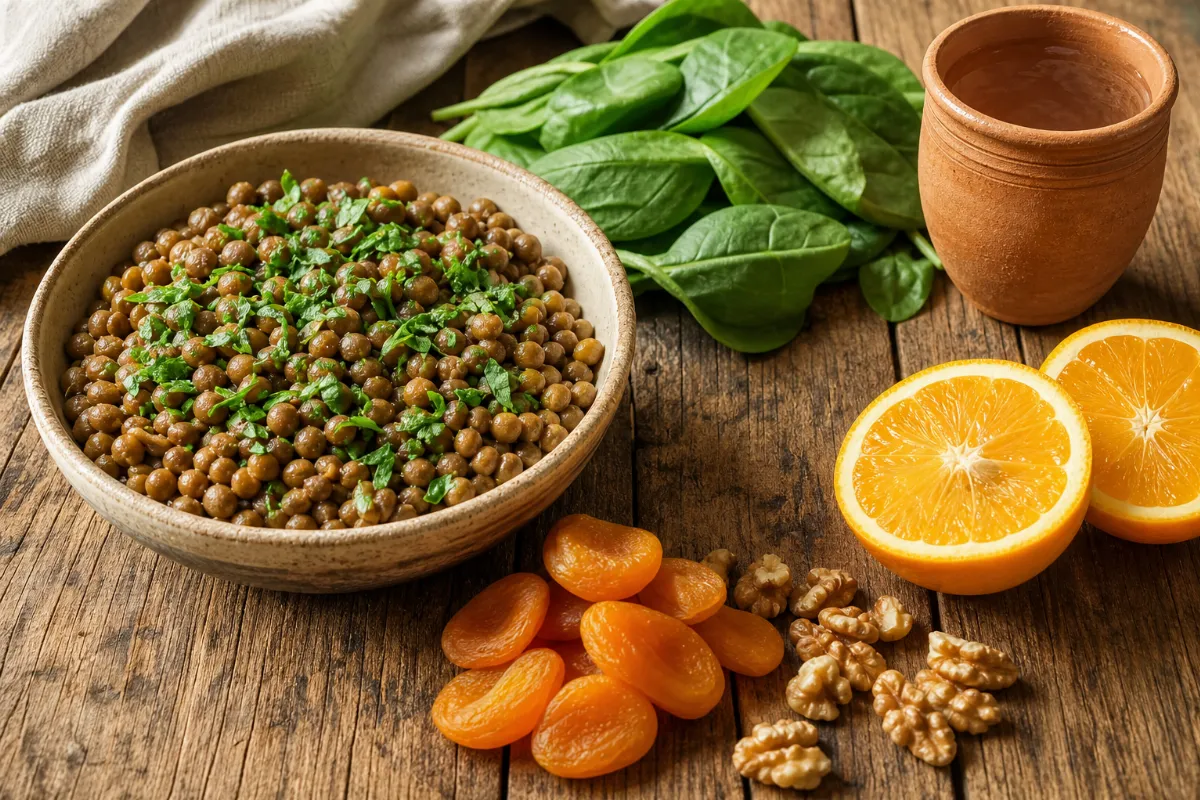
Good iron sources include red meat, beans, nuts, dried fruit and fortified breakfast cereals; dark-green leafy vegetables also appear on NHS lists. MedlinePlus says iron from plants and supplements is harder to absorb and that vitamin C-rich foods help absorption. NHS says most people can get the iron they need from a varied, balanced diet.
In a meal study, black tea, coffee, cocoa and herbal teas such as peppermint and chamomile all lowered iron absorption. NHS lists tea, coffee, dairy and high-phytate foods among things to have less of when iron is low.
What natural and lifestyle approaches have and have not shown
Iron when you are not anemic: in women with unexplained tiredness and low ferritin, trials found a little less self-rated tiredness with iron than with placebo, but no better measured fitness. Vitamin C added to iron raised hemoglobin only slightly, and two small trials found alternate-day iron was absorbed better and caused fewer gut side effects. A review of iron cooking pots was mixed.
No randomised trial of a herbal or 'blood-building' product for anemia was read. Natural does not automatically mean safe: ask a clinician or pharmacist before changing your care.
At a glance
Traditional uses history, not proof
Studied for research
- Iron pills for tested iron deficiency or anemia, high certainty for raising hemoglobin
- Iron during pregnancy, moderate certainty
- Iron for tiredness when not anemic, low certainty
- Iron-rich foods and meal combinations, low certainty
- Vitamin C with iron, low certainty (tiny gain)
- Tea and coffee timing, low certainty
- Alternate-day iron, low certainty
- Fortified foods and counselling, low certainty
- Lactoferrin, low certainty
- Iron cookware, mixed
Main compounds
- Iron
- Ferritin
- Vitamin C
- Lactoferrin
- Polyphenols (tea and coffee)
Common forms
- Iron tablets prescribed after a blood test
- Iron-rich foods
- Fortified cereals and foods
- Vitamin C-rich foods and juice
- Cast iron cookware
Research links: 2021 Lancet seminar: iron deficiency · 2016 Cochrane review: daily iron for menstruating women · 2018 review: iron for fatigue when not anemic · 2003 trial: iron for unexplained fatigue in non-anemic women · 2026 ASH guideline: diagnosing iron deficiency · NHS: Iron deficiency anaemia · NHLBI: What is anemia? · Research Library · Genes & Biomarkers Library
What it is and its history
- Accepted scientific name
- Anemia and iron deficiency (blood conditions)
- Common names
- Anemia (English); Anaemia (English (UK spelling)); Iron deficiency (English); Iron deficiency anemia (English); Anemia ferropénica (Spanish); Deficiencia de hierro (Spanish)
- Family or group
- Blood condition. Iron deficiency can exist without anemia (Lancet review); anemia has several types, including iron-deficiency, vitamin B12-deficiency, hemolytic and aplastic.
- Look-alikes and adulterants
- Name: Vitamin B12 or folate deficiency anemia; Note: Lack of a vitamin rather than iron; the blood test checks for it too (NHS).; Name: Haemochromatosis; Note: The opposite problem, iron build-up. Fatigue is a symptom of both.; Name: Sleep apnea, diabetes, overactive thyroid, ME/CFS; Note: NHS lists these as other causes of long-term tiredness.
Traditional use and history history, not clinical proof
| Tradition or era | Documented use | Source |
|---|---|---|
| Modern guidance | Current guidance from the American Society of Hematology (2026) and the British Society of Gastroenterology (2021) is the history read for this page. Nothing older was read. | p42747316 |
Traditional use shows how it was used. It does not show that it works or is safe today.
What is inside, and how it may work
What it contains and how those compounds act in cells and animals. Laboratory and animal mechanisms are not proven effects in people.
Main compounds
| Compound | Family | Where it is concentrated | Activity studied | Level of evidence |
|---|---|---|---|---|
| Iron | mineral | Needed to make hemoglobin; found in red meat, beans, nuts, dried fruit and fortified cereals (NHS). | Carries oxygen as part of hemoglobin. 26 20 | Human data |
| Ferritin | storage protein | A blood test of iron stores. | Low ferritin points to iron deficiency; it rises with inflammation. 5 | Human data |
| Hepcidin | hormone | The main regulator of iron in the body. | Rises after iron doses and limits further absorption. 11 16 | Human data |
| Vitamin C | vitamin | In oranges, grapefruit, kiwi, strawberries, broccoli and tomatoes (MedlinePlus). | Helps absorb iron from food. 3 20 | Human data |
| Polyphenols | plant compounds | In black tea, coffee, cocoa and herbal teas. | Bind iron and lower its absorption from a meal. 8 | Human data |
Mechanisms, receptors and pathways
| Target or pathway | Gene or receptor | What was found | Level |
|---|---|---|---|
| Why iron deficiency causes tiredness | Without iron the body cannot make enough hemoglobin to carry oxygen effectively (MedlinePlus). Trials of iron for tiredness measured fatigue scores, not this step. 20 7 | Not established | |
| Hepcidin and iron absorption | A Lancet review says hepcidin upregulation by oral iron limits absorption of high-dose oral iron and of iron during inflammation. A trial in iron-depleted women found daily split dosing raised hepcidin and lowered absorption. 11 16 | Human data |
Isolated compounds versus whole extracts
Iron pills deliver a measured amount of iron in one form; food also brings enhancers and inhibitors (vitamin C, meat tissue, phytate, polyphenols), so food and pills behave differently. A person's own iron status often matters more than the meal.
1 high certainty1 moderate certainty1 mixed findings7 low certainty
What was looked at
The 10 benefits and uses checked for Anemia and Iron Deficiency: Tiredness and Testing, each with how strong the evidence is. Tap one to open it.
- Iron pills when blood tests show iron deficiency or anemiaHigh certainty
- Iron for tiredness when you are not anemicLow certainty
- Iron during pregnancyModerate certainty
- Eating iron-rich foods and meal combinationsLow certainty
- Vitamin C taken with ironLow certainty
- Tea, coffee and herbal tea around iron-rich mealsLow certainty
- Taking iron on alternate days instead of every dayLow certainty
- Food-based programs: fortified foods and diet counsellingLow certainty
- Cooking in cast iron potsMixed findings
- Lactoferrin (a milk protein) instead of iron tabletsLow certainty
Lab markers tracked in the studies
HemoglobinSerum ferritinSelf-rated tirednessFractional iron absorptionGut side effects of iron
What is Anemia and Iron Deficiency: Tiredness and Testing good for?
These are the main natural, food and supplement approaches studied for anemia and iron deficiency and how strong the human evidence is for each. They describe what trials found, not advice to try anything. Established medical care is described in the About tab.
Benefits, one by one
Each card is a research question, not a promise. Tap a goal to filter. Open a card to see the studies, doses and limits.
Iron pills when blood tests show iron deficiency or anemia
High certaintyWhen tests show low iron, trials in women found iron pills raise hemoglobin and iron stores and lower the chance of anemia. This is what clinicians use. Pills commonly upset the gut. A test comes first, because the same pills can cause harm if iron is not low.
5 studiesTrials used daily oral iron, with or without folic acid or vitamin C,…
Studies, doses and limits
What the trials found
A Cochrane review of 67 trials (8,506 menstruating women) found women given daily iron were less likely to be anemic (RR 0.39; moderate-quality evidence) and iron deficient (RR 0.62; moderate), and had higher hemoglobin (51 studies, 6,861 women; high-quality evidence). Iron improved exercise performance and appeared to reduce symptomatic fatigue. A 2021 Lancet review calls oral iron first-line in most cases and says its absorption is limited by the body hormone hepcidin. NHS, NHLBI and MedlinePlus describe iron tablets as the usual treatment for iron deficiency anemia, taken for months with follow-up blood tests.
Results
Anemia RR 0.39; iron deficiency RR 0.62; hemoglobin higher by a mean difference of 5.30. Gut effects: loose stools RR 2.13, constipation RR 2.07.
Effect sizes as reported
Anemia 95% CI 0.25 to 0.60; iron deficiency 0.50 to 0.76; hemoglobin 4.14 to 6.45; loose stools 1.10 to 4.11; constipation 1.35 to 3.17.
Why this rating
The Cochrane review graded the hemoglobin result as high-quality evidence. The anemia and iron-deficiency results were moderate, and only 10 of 67 trials were at low risk of bias.
Form and dose studied
Trials used daily oral iron, with or without folic acid or vitamin C, at many amounts. Amounts are given only as what each study used. They are not advice. NHS says iron tablets are usually taken for about 6 months and repeat blood tests are done.
Who was studied
Menstruating women, aged about 12 to 50. Many trials were in lower-income settings.
Limits
Not all trials said how they were run. Results for men, older adults and people with other conditions were not read here. Cognitive results were conflicting.
Why researchers looked
Iron is needed to make hemoglobin, so researchers tested whether replacing it fixes low blood counts and symptoms.
Proposed mechanism Hypothesis
Proposed: iron replaces what the body lacks for making red blood cells. The trials measured blood counts, not this step.
A proposed mechanism does not show that the effect happens in people.
Gut upset is common (constipation, loose stools, stomach pain, darker stools). Keep iron out of reach of children: an overdose in a young child can be fatal (NHS). Iron should be taken for tested iron deficiency, not by guesswork.
Iron for tiredness when you are not anemic
Low certaintyIn women with unexplained tiredness who were not anemic but had low or borderline iron stores (ferritin), iron tablets reduced self-rated tiredness a little more than placebo. They did not improve measured physical fitness. Benefit seemed limited to people with low ferritin, which is why a blood test comes first.
4 studiesBoth trials used ferrous sulfate providing 80 mg of elemental iron a …
Studies, doses and limits
What the trials found
A Swiss trial of 144 women (2003) found fatigue fell 29 percent with iron and 13 percent with placebo over 4 weeks; only women with ferritin at or below 50 micrograms per liter improved. A French trial of 198 women with ferritin below 50 (2012) found the fatigue score fell 47.7 percent with iron and 28.8 percent with placebo over 12 weeks, with no effect on quality of life, depression or anxiety. A 2018 review of 18 trials found less self-reported fatigue (4 trials, 714 people) but no change in objective physical capacity (9 trials, 235 people).
Results
Swiss trial: difference 0.95 points on a 10-point fatigue scale. French trial: difference 18.9 percentage points in fatigue score. Review: self-reported fatigue SMD -0.38; maximal oxygen consumption SMD 0.11 (no clear change).
Effect sizes as reported
Swiss 95% CI 0.32 to 1.62; French -34.5 to -3.2; review fatigue -0.52 to -0.23; oxygen consumption -0.15 to 0.37.
Why this rating
Benefits were in self-rated tiredness, not in objective measures. Only 4 trials in the review measured fatigue the same way, and placebo groups also improved by 13 to 29 percent.
Form and dose studied
Both trials used ferrous sulfate providing 80 mg of elemental iron a day, for 4 or 12 weeks. That is what the studies used. It is not advice.
Who was studied
Women aged 18 to 55 with unexplained fatigue, not anemic, mostly with low ferritin, in primary care in Switzerland and France.
Limits
Women only. Short trials. In the French trial participants knew what they took. Ferritin rises with inflammation, so interpreting it needs a clinician.
Why researchers looked
Many people feel tired with normal blood counts, so researchers asked whether low iron stores alone could be the reason.
Proposed mechanism Hypothesis
Proposed: low iron stores may affect energy in tissues before anemia appears. Not tested directly in these trials.
A proposed mechanism does not show that the effect happens in people.
Side effects of iron were not detailed in the abstracts. Iron is not advised for people who are not iron deficient (NHLBI), and people with haemochromatosis are usually told to avoid it (NHS).
Iron during pregnancy
Moderate certaintyPregnancy raises the need for iron. A large review found daily iron during pregnancy may lower the chance of anemia and probably lowers iron-deficiency anemia at term. Babies were also a little less likely to have low birthweight. A pregnancy clinician decides what is right for each person.
3 studiesDaily oral iron alone or with folic acid. Amounts differed between tr…
Studies, doses and limits
What the trials found
A 2024 Cochrane review of 57 trials (48,971 women) found iron may reduce maternal anemia (RR 0.30; low-certainty evidence) and iron deficiency at term (RR 0.51; low) and probably reduces iron-deficiency anemia at term (RR 0.41; moderate). Babies were probably less likely to have low birthweight (RR 0.84; moderate). Preterm birth probably did not differ. The evidence on adverse effects was very uncertain. NHS names pregnancy as a very common cause of iron deficiency anemia, and NHLBI says untreated anemia in pregnancy raises risks for mother and baby.
Results
Anemia RR 0.30; iron deficiency at term RR 0.51; iron-deficiency anemia at term RR 0.41; low birthweight RR 0.84.
Effect sizes as reported
Anemia 0.20 to 0.47; iron deficiency 0.38 to 0.68; iron-deficiency anemia 0.26 to 0.63; low birthweight 0.72 to 0.99.
Why this rating
The Cochrane authors rated the iron-deficiency anemia and low birthweight results as moderate certainty and the anemia and iron deficiency results as low certainty.
Form and dose studied
Daily oral iron alone or with folic acid. Amounts differed between trials and are not advice. Ask a pregnancy clinician about iron.
Who was studied
Pregnant women in many countries; 19 trials were in places with some malaria risk.
Limits
Trials differed widely. No trial reported clinical malaria. Adverse effects and severe anemia were very uncertain.
Why researchers looked
Pregnancy is a common time for iron deficiency, so many trials tested iron during it.
Proposed mechanism Hypothesis
Proposed: iron supports the greater blood volume and the baby's needs. Trials measured outcomes, not this.
A proposed mechanism does not show that the effect happens in people.
Stomach upset is the commonest complaint with iron (NHS). Ask your midwife or doctor before taking iron in pregnancy.
Eating iron-rich foods and meal combinations
Low certaintyFoods such as red meat, beans, nuts, dried fruit and fortified cereals contribute iron, and plant iron is harder to absorb. Studies of whole diets found meals with an absorption enhancer let people absorb more iron. Whether diet changes alone fix anemia was not shown in the trials read here.
5 studiesFood, not pills: for example meals with vitamin C-rich foods or meat …
Studies, doses and limits
What the trials found
A 2013 review of 19 studies found absorption from diets was higher with an enhancer (SMD 0.53) and higher than from low-bioavailability diets (SMD 0.96); single inhibitors did not clearly reduce absorption in whole diets. Absorption ranged from 0.7 to 22.9 percent between studies and depended on iron status, with diet mattering most when ferritin was low. A 2010 review estimates bioavailability of 14 to 18 percent for mixed diets and 5 to 12 percent for vegetarian diets in people with no iron stores, and notes the person's own iron status mattered more than diet composition. NHS, NHLBI and MedlinePlus list red meat, beans, nuts, dried fruit, fortified cereals, dark-green leafy vegetables and vitamin C-rich foods.
Results
Enhancer SMD 0.53; low-bioavailability comparison SMD 0.96; predicted absorption 2.1 to 23.0 percent at ferritin 6 to 80 micrograms per liter.
Effect sizes as reported
Enhancer 95% CI 0.21 to 0.85; low-bioavailability 0.51 to 1.41.
Why this rating
The evidence is on iron absorbed, a stand-in measure. No trial in these reviews tested whether changing meals alone fixes anemia.
Form and dose studied
Food, not pills: for example meals with vitamin C-rich foods or meat tissue. Food sources differ from supplements. NHS says most people can get the iron they need from a varied, balanced diet.
Who was studied
Mostly healthy adults in United States, European and Mexican studies.
Limits
Absorption was measured, not anemia. Results may not apply to other countries or ages. NHS also lists tea, coffee, dairy and high-phytate foods as things that make absorption harder in large amounts.
Why researchers looked
Diet is where iron comes from, so researchers measured how much iron people absorb from different meals and diets.
Proposed mechanism Lab/human absorption studies
Proposed: vitamin C and meat tissue can raise absorption of plant iron, while phytate (in grains and beans) and polyphenols can lower it. Shown for absorption in single-meal studies, not for anemia outcomes.
A proposed mechanism does not show that the effect happens in people.
NHS advises limiting red and processed meat because of a probable link with bowel cancer. Liver is a rich iron source that NHS says to avoid during pregnancy.
Vitamin C taken with iron
Low certaintyVitamin C helps the body absorb plant iron from a meal. When researchers added vitamin C to iron pills in people with anemia, hemoglobin rose only a tiny amount more, which the authors called not clinically meaningful.
3 studiesVitamin C from supplements or from food or juice taken with iron pill…
Studies, doses and limits
What the trials found
A 2024 review of 10 randomised trials and 1 cohort study (1,930 people with iron deficiency anemia) found iron plus vitamin C raised hemoglobin by 0.14 g/dL and ferritin by 3.23 micrograms per liter more than iron alone. The authors said this was small and likely not clinically important and did not support routine vitamin C with oral iron. NHS suggests orange juice after a tablet may help absorption.
Results
Hemoglobin mean difference 0.14 g/dL (10 studies); ferritin 3.23 micrograms per liter (9 studies).
Effect sizes as reported
Hemoglobin 95% CI 0.08 to 0.20; ferritin 1.63 to 4.84.
Why this rating
The reviewers called the gain small and probably not meaningful, and the studies pooled different products and amounts.
Form and dose studied
Vitamin C from supplements or from food or juice taken with iron pills; amounts varied and are not advice.
Who was studied
People with iron deficiency anemia in 11 studies.
Limits
One included study was not randomised. Funding was not stated in the abstract.
Why researchers looked
Vitamin C is thought to help iron absorption, so researchers tested whether adding it improves treatment.
Proposed mechanism Hypothesis
Proposed: vitamin C keeps iron in a form the gut absorbs more easily. Shown for food in absorption studies.
A proposed mechanism does not show that the effect happens in people.
Haemochromatosis: NHS says people with it are usually told to avoid iron or vitamin C supplements.
Tea, coffee and herbal tea around iron-rich meals
Low certaintyBlack tea, coffee, cocoa and even herbal teas such as peppermint and chamomile cut how much iron the body absorbs from a meal in a lab-style study. NHS lists tea and coffee among drinks to have less of when your iron is low.
2 studiesDrinks with a bread meal in the study; no recommendations about amoun…
Studies, doses and limits
What the trials found
A study in adult volunteers measured iron absorption from a bread meal eaten with different drinks. Drinks with 20 to 50 mg polyphenols per serving cut absorption 50 to 70 percent, and 100 to 400 mg cut it 60 to 90 percent. Black tea cut it 79 to 94 percent, peppermint tea 84 percent, cocoa 71 percent, vervain 59 percent, lime flower 52 percent and chamomile 47 percent. Milk added to tea or coffee changed little. NHS lists tea, coffee and dairy among foods that make absorption harder in large amounts.
Results
Absorption reduced by 47 to 94 percent depending on the drink.
Effect sizes as reported
Not given in the abstract.
Why this rating
The test was single meals in healthy volunteers, not people with anemia, so the effect on iron status over time was not tested.
Form and dose studied
Drinks with a bread meal in the study; no recommendations about amounts or timing are made here.
Who was studied
Healthy adult volunteers (number not in the abstract).
Limits
Single test meals. Real-life effects on anemia or ferritin were not measured.
Why researchers looked
Tea and coffee contain polyphenols that bind iron, so researchers measured absorption with a meal.
Proposed mechanism Human absorption study
Shown in healthy adults: polyphenols bind iron so less is absorbed from that meal.
A proposed mechanism does not show that the effect happens in people.
This is a food-and-drink note, not a safety warning. Do not stop prescribed iron or change medicines because of it without asking your clinician.
Taking iron on alternate days instead of every day
Low certaintyTwo small Swiss trials in young women with low iron stores found that taking the same iron on alternate days was absorbed better than on consecutive days, and caused fewer gut side effects at the same total. Ferritin ended up similar in the larger trial.
3 studies100 mg iron capsules daily or on alternate days in the 2023 trial, an…
Studies, doses and limits
What the trials found
In a 2017 study of 40 iron-depleted women (study 1), alternate-day iron was absorbed at 21.8 percent versus 16.3 percent for consecutive days; splitting a daily amount in two did not help (20 women, study 2). In a 2023 randomised, placebo-controlled trial of 150 women with ferritin of 30 micrograms per liter or less, ferritin was similar (43.8 versus 44.8) at equal total iron, but gut side effects were less likely with alternate days (ratio 1.56 for consecutive days) and iron deficiency at 6 months was 11.4 percent versus 3.0 percent.
Results
Fractional absorption 21.8 versus 16.3 percent (P=0.0013); gut side effect ratio 1.56; iron deficiency at 6 months 11.4 versus 3.0 percent (P=0.049).
Effect sizes as reported
Side effects 95% CI 1.38 to 1.77.
Why this rating
Two small trials in young Swiss women with low stores, not diagnosed anemia. The 2017 authors say findings need confirming in iron-deficient anemic patients.
Form and dose studied
100 mg iron capsules daily or on alternate days in the 2023 trial, and 60 mg or 120 mg doses in the 2017 studies. These are the study amounts and not advice.
Who was studied
Young women in Switzerland with low iron stores.
Limits
Small, one country, women only. The 2017 study was open-label.
Why researchers looked
Iron taken daily raises a hormone called hepcidin that can block later absorption, so researchers tested spacing.
Proposed mechanism Human absorption study
Shown: higher hepcidin after consecutive-day dosing was linked to lower fractional absorption in one trial.
A proposed mechanism does not show that the effect happens in people.
Gut side effects (constipation, stomach pain, nausea) are the common issue. A clinician should set the schedule.
Food-based programs: fortified foods and diet counselling
Low certaintyReviews found fortified foods, iron-rich foods and diet counselling can raise hemoglobin in some groups, but the trials are few and often at risk of bias. Few reviews tested food-only plans in adults.
2 studiesFortified cereals, milk and powders; counselling programs. Details di…
Studies, doses and limits
What the trials found
A 2021 Cochrane overview of 75 reviews found iron fortification of foods raised hemoglobin and reduced anemia in infants, and daily iron supplements helped many groups; only a limited number of reviews tested ways to improve dietary diversity and quality. A 2022 review of 7 trials in pregnant women found fortified products, iron-rich foods or counselling were all reported effective, but most trials were at medium risk of bias and some at high risk.
Results
Not pooled across reviews.
Effect sizes as reported
Not given.
Why this rating
The 2022 review has only 7 trials with bias concerns; the 2021 overview found few reviews on food-based plans.
Form and dose studied
Fortified cereals, milk and powders; counselling programs. Details differed and are not advice.
Who was studied
Infants, children and pregnant women, mostly in programs around the world.
Limits
Food-only trials in adults with iron deficiency anemia were not read.
Why researchers looked
Where iron pills are hard to use, programs tested adding iron to foods or teaching people to eat more of it.
Proposed mechanism Hypothesis
Proposed: adding iron to the food supply raises intake across a group.
A proposed mechanism does not show that the effect happens in people.
Fortified foods can add iron on top of what a person already takes; ask a clinician if you already take iron pills.
Cooking in cast iron pots
Mixed findingsA few trials in lower-income countries tried iron cooking pots. One review found some benefit in people who were anemic, and a later trial in Benin found no benefit over iron tablets. Results depended on how consistently pots were used.
2 studiesCast iron or blue steel pots; the amount of iron added depends on the…
Studies, doses and limits
What the trials found
A 2003 review of 3 trials found some evidence that food cooked in iron pots raised hemoglobin in anemic or iron-deficient people, with effects affected by compliance, age, malaria and hookworm. A 2008 randomised trial in Benin (339 people) found no difference in hemoglobin after 6 months, and ferritin was higher in the group taking iron supplements; the authors found no evidence that iron pots work against iron-deficiency anemia.
Results
Review: some effect in anemic people. Benin trial: no hemoglobin difference at 6 months.
Effect sizes as reported
Not given in the abstracts.
Why this rating
The review leaned slightly positive, the later randomised trial did not, and both are about lower-income settings.
Form and dose studied
Cast iron or blue steel pots; the amount of iron added depends on the food and time.
Who was studied
Children, girls and women in developing-country settings.
Limits
Only a few trials; compliance varied; results may not apply to other settings.
Why researchers looked
Iron leaches from cast iron into food, so researchers tested whether cooking in iron pots raises hemoglobin.
Proposed mechanism Hypothesis
Proposed: iron leaching from the pot adds absorbable iron. A later trial questioned whether it is absorbed.
A proposed mechanism does not show that the effect happens in people.
No specific harm was reported in the abstracts. People with haemochromatosis should ask a clinician about extra iron sources.
Lactoferrin (a milk protein) instead of iron tablets
Low certaintyIn four small trials of pregnant women with iron-deficiency anemia, lactoferrin raised hemoglobin about as well as iron tablets, with fewer gut side effects. The set of trials is small, and a clinician should guide anemia treatment.
2 studiesDaily oral bovine lactoferrin compared with daily ferrous iron; amoun…
Studies, doses and limits
What the trials found
A 2018 meta-analysis of 4 randomised trials (600 pregnant women) found hemoglobin after 4 weeks was slightly higher with bovine lactoferrin than with iron sulfate (MD 0.77). In mild anemia there was no significant difference; in moderate anemia (one trial, 228 women) lactoferrin was better. Gut side effects were significantly lower with lactoferrin. The 2021 Cochrane overview also reports oral bovine lactoferrin beat ferrous iron for hemoglobin and gut effects in one review of pregnant women.
Results
Hemoglobin MD 0.77 at 4 weeks (P=0.04); fewer gut side effects.
Effect sizes as reported
Hemoglobin 95% CI 0.04 to 1.55.
Why this rating
Only 4 trials and 600 people, and the gain was small; results may differ outside pregnancy.
Form and dose studied
Daily oral bovine lactoferrin compared with daily ferrous iron; amounts differ and are not advice.
Who was studied
Pregnant women with iron-deficiency anemia.
Limits
The authors' conclusion that lactoferrin should be the first choice goes further than four trials can show.
Why researchers looked
Iron pills upset many stomachs, so researchers tested a milk protein that binds iron.
Proposed mechanism Hypothesis
Proposed: lactoferrin carries iron and may be gentler on the gut. Not shown in these trials.
A proposed mechanism does not show that the effect happens in people.
Lactoferrin is a milk protein, so people with milk allergy should ask a clinician. Not studied here in children or men.
Connections to the rest of health
How Anemia and Iron Deficiency: Tiredness and Testing connects to the rest of our health knowledge graph. Every link says what kind of connection it is. A safety link (for example to the liver) is a warning, not a benefit. A study that merely mentions a topic never creates a benefit link.
Explore every connection: goals, body systems, organs, symptoms, genes
A. Wellness goals
| Connected to | Kind of connection | Evidence status | Context | Studies |
|---|---|---|---|---|
| Reduce Fatigue | High certainty | Iron pills when blood tests show iron deficiency or anemia: When tests show low iron, trials in women found iron pills raise hemoglobin and iron stores and lower the chance of anemia. This is what clinicians use. Pills commonly upset the gut. A test comes first, because the same pills can cause harm if iron is not low. Iron for tiredness when you are not anemic: In women with unexplained tiredness who were not anemic but had low or borderline iron stores (ferritin), iron tablets reduced self-rated tiredness a little more than placebo. They did not improve measured physical fitness. Benefit seemed limited to people with low ferritin, which is why a blood test comes first. | 10 11 25 21 20 18 17 7 27 4 14 3 24 16 28 19 6 13 1 | |
| Reduce Fatigue | Low certainty | Eating iron-rich foods and meal combinations: Foods such as red meat, beans, nuts, dried fruit and fortified cereals contribute iron, and plant iron is harder to absorb. Studies of whole diets found meals with an absorption enhancer let people absorb more iron. Whether diet changes alone fix anemia was not shown in the trials read here. | 2 9 26 25 21 | |
| Reduce Fatigue | Low certainty | Tea, coffee and herbal tea around iron-rich meals: Black tea, coffee, cocoa and even herbal teas such as peppermint and chamomile cut how much iron the body absorbs from a meal in a lab-style study. NHS lists tea and coffee among drinks to have less of when your iron is low. | 8 25 |
B. Body systems
E. Health conditions
| Connected to | Kind of connection | Evidence status | Context | Studies |
|---|---|---|---|---|
| Haemochromatosis | Health agency guidance | People with this inherited iron build-up are usually advised to avoid iron or vitamin C supplements. Preparation or compound: Iron and vitamin C supplements |
24 | |
| Fatigue: when to get help | Health agency guidance | Other causes of tiredness that a clinician checks for. Preparation or compound: Evaluation |
27 |
I. Biomarkers
| Connected to | Kind of connection | Evidence status | Context | Studies |
|---|---|---|---|---|
| Hemoglobin | Biological association | High certainty | Measured in trials: Higher is better when it starts low. A lab change is not the same as a health benefit. | 10 7 |
| Serum ferritin | Biological association | Low certainty | Measured in trials: Higher after treatment shows stores refilling. A lab change is not the same as a health benefit. | 17 5 |
| Self-rated tiredness | Biological association | Low certainty | Measured in trials: Lower is better. A lab change is not the same as a health benefit. | 18 17 7 |
| Fractional iron absorption | Biological association | Low certainty | Measured in trials: Higher means more iron absorbed. A lab change is not the same as a health benefit. | 16 8 |
| Gut side effects of iron | Biological association | Low certainty | Measured in trials: Fewer is better. A lab change is not the same as a health benefit. | 28 1 |
L. Active compounds
| Connected to | Kind of connection | Evidence status | Context | Studies |
|---|---|---|---|---|
| Iron | Biological association | Human | Carries oxygen as part of hemoglobin. | 26 20 |
| Ferritin | Biological association | Human | Low ferritin points to iron deficiency; it rises with inflammation. | 5 |
| Hepcidin | Biological association | Human | Rises after iron doses and limits further absorption. | 11 16 |
| Vitamin C | Biological association | Human | Helps absorb iron from food. | 3 20 |
| Polyphenols | Biological association | Human | Bind iron and lower its absorption from a meal. | 8 |
Each connection is stored with the ingredient, the connected record, the kind of connection, the evidence status, the supporting studies, the preparation or compound involved, and a review date (last reviewed October 31, 2026).
Evidence at a glance: what the research found for 10 outcomes
Each outcome below is one thing researchers measured. Certainty is how far the evidence can be trusted, not how well it works. The full studies are on the next tab.
The evidence
The research centre for Anemia and Iron Deficiency: Tiredness and Testing. Every record here was checked against PubMed or the publisher's page; we never list a study we have not verified.
Evidence by outcome
Bars show how many studies we found for each outcome, not how well it works. People are added up across trials only (reviews are not added, to avoid double counting).
How we rate evidence
High certainty
Several well-run trials or reviews agree; further research is unlikely to change the picture much.
Moderate certainty
Good trials point the same way, but some doubt remains.
Low certainty
Small, short or inconsistent trials. The finding could change with better research.
Very low certainty
Very little or very weak human data. Treat as a possibility only.
Mixed findings
Trials or reviews disagree with each other.
Not enough evidence
Not enough human research to say either way.
Evidence against
Good research found no benefit, or found harm.
We take the reviewers' own risk-of-bias and GRADE statements where they exist, and otherwise judge from study size, design, consistency, directness and whether a product matches what is sold. Many publications do not make evidence high. Method note: We searched PubMed, re-read the abstract of every review and trial cited, and read the NHS, NHLBI and MedlinePlus pages directly. Full texts were not read. Certainty ratings are the compiler's own reading, except where a review gives its own grade (stated in the text). Funding is not stated in most abstracts, and this is noted where relevant.
Study library: every study we checked 28
| Study | Design | People | Product, dose, length | Result |
|---|---|---|---|---|
| Abu Hashim 2018 Lactoferrin or ferrous salts for iron deficiency anemia in pregnancy: A meta-analysis of randomized trials Eur J Obstet Gynecol Reprod Biol · PMID 29059584 · DOI |
Systematic review meta analysis |
600 Pregnant women with iron-deficiency anemia; 4 randomised trials |
Daily oral bovine lactoferrin (a milk protein) About 4 weeks (primary outcome) · vs Daily oral ferrous iron |
Hemoglobin rose slightly more with lactoferrin (0.77); in mild anemia there was no significant difference, and in moderate anemia (one trial) lactoferrin did better. Gut side effects were significantly lower with lactoferrin. Hemoglobin mean difference 0.77 (P=0.04) (95% CI 0.04 to 1.55) Methods, limits and fundingOutcomes: Change in hemoglobin at 4 weeks; ferritin; gut side effects Limitations: Four small trials; the authors' conclusion that lactoferrin should be the agent of choice goes beyond what four trials can show. Funding and conflicts: No funding statement in the abstract. Read: abstract |
| Collings 2013 The absorption of iron from whole diets: a systematic review Am J Clin Nutr · PMID 23719560 · DOI |
Systematic review meta analysis |
19 studies from the United States, Europe and Mexico measuring iron absorption from whole diets; a regression used 58 US individuals | Whole diets with or without enhancers and inhibitors of iron absorption Varied · vs Low-bioavailability diets or diets without an enhancer |
Absorption was higher with an enhancer (SMD 0.53) and higher than with low-bioavailability diets (SMD 0.96); single inhibitors did not clearly reduce it. Absorption varied from 0.7 to 22.9 percent between studies and depended on iron status, with diet mattering more at low ferritin. Enhancer SMD 0.53; low-bioavailability comparison SMD 0.96; predicted absorption 2.1 to 23.0 percent at ferritin 6 to 80 micrograms per liter (Enhancer 0.21 to 0.85; low-bioavailability 0.51 to 1.41) Methods, limits and fundingOutcomes: Percent non-heme iron absorbed Limitations: Absorption was measured, not anemia outcomes; findings may not apply to developing countries or other age groups. Funding and conflicts: No funding statement in the abstract. Read: abstract |
| Deng 2024 Efficacy of vitamin C with Fe supplementation in patients with iron deficiency anemia: a systematic review and meta-analysis Blood Vessel Thromb Hemost · PMID 40765927 · DOI |
Systematic review meta analysis |
1930 People with iron deficiency anemia; 10 randomised trials (1,782) and 1 cohort study (148) |
Oral iron with vitamin C compared with oral iron alone Varied · vs Iron alone |
Adding vitamin C raised hemoglobin by 0.14 g/dL and ferritin by 3.23 micrograms per liter. The authors called this small and likely clinically insignificant and did not support routine vitamin C with oral iron. Hemoglobin MD 0.14 g/dL (10 studies); ferritin MD 3.23 micrograms per liter (9 studies) (Hemoglobin 0.08 to 0.20; ferritin 1.63 to 4.84) Methods, limits and fundingOutcomes: Change in hemoglobin; ferritin; adverse events Limitations: Pools different iron products and vitamin C amounts; one included study was not randomised. Funding and conflicts: No funding statement in the abstract. Read: abstract |
| Finkelstein 2024 Daily oral iron supplementation during pregnancy Cochrane Database Syst Rev · PMID 39145520 · DOI |
Systematic review meta analysis |
48971 Pregnant women; 57 trials, 48,971 women; 19 trials in malaria-endemic settings |
Daily oral iron alone, or with folic acid or other vitamins and minerals Varied · vs Placebo or no iron |
Iron may reduce maternal anemia (RR 0.30, low certainty) and iron deficiency at term (RR 0.51, low certainty) and probably reduces iron-deficiency anemia at term (RR 0.41, moderate certainty). Babies were probably less likely to be low birthweight (RR 0.84, moderate). Evidence on adverse effects is very uncertain. Anemia RR 0.30; iron deficiency at term RR 0.51; iron-deficiency anemia at term RR 0.41; low birthweight RR 0.84 (Anemia 0.20 to 0.47; iron deficiency 0.38 to 0.68; iron-deficiency anemia 0.26 to 0.63; low birthweight 0.72 to 0.99) Methods, limits and fundingOutcomes: Maternal anemia, iron deficiency, iron-deficiency anemia at term; infant birthweight and other outcomes; adverse effects Limitations: Wide differences between trials; adverse-effect and severe-anemia data very uncertain; no trials reported clinical malaria. Funding and conflicts: Review supported by the World Health Organization (agency listed in the record). Read: abstract |
| Garcia-Casal 2021 Serum or plasma ferritin concentration as an index of iron deficiency and overload Cochrane Database Syst Rev · PMID 34028001 · DOI |
Systematic review diagnostic |
108 studies; 72 studies (6,059 people) on iron deficiency, 36 studies (1,927 people) on iron overload | Ferritin blood test compared with bone marrow or liver iron Not a trial · vs Not given |
At a threshold of 30 micrograms per liter there was low-certainty evidence that ferritin is reasonably sensitive (79 percent) and very specific (98 percent) for iron deficiency in people seeking medical care. Evidence for iron overload was very low certainty, and it is unclear how well ferritin screens people with no symptoms. Sensitivity 79 percent, specificity 98 percent at 30 micrograms per liter (9 studies, 512 people) (Sensitivity 58 to 91 percent; specificity 91 to 100 percent) Methods, limits and fundingOutcomes: Sensitivity and specificity of ferritin Limitations: Thresholds varied from 12 to 200 micrograms per liter across studies; ferritin rises with inflammation. Funding and conflicts: Review supported by the World Health Organization (agency listed in the record). Read: abstract |
| Geerligs 2003 Food prepared in iron cooking pots as an intervention for reducing iron deficiency anaemia in developing countries: a systematic review J Hum Nutr Diet · PMID 12859709 · DOI |
Systematic review |
Participants aged 4 months or older in 3 eligible randomised trials in developing countries | Food cooked in cast iron pots Varied · vs Food cooked in non-iron pots |
There was some evidence that eating food from iron pots raised hemoglobin in anemic or iron-deficient people. The effect seemed to depend on how consistently pots were used, age, malaria and hookworm. Not pooled in the abstract (Not given) Methods, limits and fundingOutcomes: Hemoglobin; compliance with pot use Limitations: Only 3 trials; searches ended in 2002; compliance varied. Funding and conflicts: No funding statement in the abstract. Read: abstract |
| Houston 2018 Efficacy of iron supplementation on fatigue and physical capacity in non-anaemic iron-deficient adults: a systematic review of randomised controlled trials BMJ Open · PMID 29626044 · DOI |
Systematic review meta analysis |
1170 Adults aged 18 or older who were iron deficient but not anemic; 18 trials plus 2 companion papers (searched to October 2016) |
Oral, intramuscular or intravenous iron, any amount or duration Varied · vs Placebo or active therapy |
Iron was linked to less self-reported fatigue (4 trials, 714 people) but not to better objective physical capacity such as maximal oxygen consumption (9 trials, 235 people). Hemoglobin and ferritin rose. Fatigue SMD -0.38; maximal oxygen consumption SMD 0.11; hemoglobin MD 4.01 g/L; ferritin MD 9.23 (units as printed in the abstract) (Fatigue 95% CI -0.52 to -0.23; oxygen consumption -0.15 to 0.37; hemoglobin 1.22 to 6.81; ferritin 6.48 to 11.97) Methods, limits and fundingOutcomes: Self-reported fatigue; objective physical capacity; hemoglobin; ferritin Limitations: Only 4 trials measured fatigue the same way; fatigue is self-reported; includes more than one iron route. Funding and conflicts: No funding statement in the abstract. Registration: PROSPERO CRD42014007085 Read: abstract |
| Hurrell 1999 Inhibition of non-haem iron absorption in man by polyphenolic-containing beverages Br J Nutr · PMID 10999016 |
Controlled human absorption study |
Adult volunteers (number not given in the abstract) eating a bread meal with different drinks, measured by radio-iron in red cells | Black tea, coffee, cocoa and herb teas (chamomile, vervain, lime flower, pennyroyal, peppermint) with a bread meal Single meals · vs Water |
All the drinks cut iron absorption in a dose-dependent way: 50 to 70 percent with 20 to 50 mg polyphenols per serving and 60 to 90 percent with 100 to 400 mg. Black tea cut it 79 to 94 percent, peppermint tea 84 percent, cocoa 71 percent, camomile 47 percent. Adding milk changed little. Absorption reductions: black tea 79-94 percent; peppermint 84 percent; cocoa 71 percent; chamomile 47 percent (Not given in the abstract) Methods, limits and fundingOutcomes: Iron absorption from the bread meal Limitations: Single test meals in healthy adults; it did not test anemia or long-term iron status. Funding and conflicts: No funding statement in the abstract. Read: abstract |
| Hurrell 2010 Iron bioavailability and dietary reference values Am J Clin Nutr · PMID 20200263 · DOI |
Narrative review |
Review of iron absorption from mixed and vegetarian diets | Not an intervention study: phytate, polyphenols, calcium, ascorbic acid and muscle tissue as dietary factors Not given · vs Not given |
Estimated iron bioavailability is 14 to 18 percent for mixed diets and 5 to 12 percent for vegetarian diets in people with no iron stores. Single-meal studies repeatedly show effects of phytate, polyphenols, calcium, ascorbic acid and muscle tissue; in multi-meal studies with a varied diet the effect of single components was more modest. The person's own iron status generally had a greater effect than diet composition. Bioavailability 14-18 percent (mixed diet), 5-12 percent (vegetarian) in people with no iron stores (Not given in the abstract) Methods, limits and fundingOutcomes: Estimated bioavailability; effect of dietary factors on absorption Limitations: Narrative review; the abstract does not describe how studies were chosen. Funding and conflicts: No funding statement in the abstract. Read: abstract |
| Low 2016 Daily iron supplementation for improving anaemia, iron status and health in menstruating women Cochrane Database Syst Rev · PMID 27087396 · DOI |
Systematic review meta analysis |
8506 Menstruating women (or women aged 12 to 50); 67 trials, 8,506 women; only 10 trials at low overall risk of bias |
Daily oral iron (at least 5 days a week), with or without folic acid or vitamin C Varied · vs Control or placebo |
Women taking iron were less likely to be anemic (RR 0.39) and iron deficient (RR 0.62) and had higher hemoglobin. Exercise performance improved and symptomatic fatigue appeared to fall. Loose stools, constipation and other gut symptoms were more common with iron. Anemia RR 0.39; hemoglobin mean difference 5.30 (51 studies, 6,861 women); iron deficiency RR 0.62; loose stools RR 2.13; constipation RR 2.07 (Anemia 0.25 to 0.60; hemoglobin 4.14 to 6.45; iron deficiency 0.50 to 0.76; loose stools 1.10 to 4.11; constipation 1.35 to 3.17) Methods, limits and fundingOutcomes: Anemia, hemoglobin, iron deficiency, side effects, exercise performance, fatigue Limitations: Many trials gave too little detail to judge quality; cognitive results were conflicting; only one study reported iron-deficiency anemia specifically. Funding and conflicts: Cochrane review; no funding conflict stated in the abstract. Read: abstract |
| Pasricha 2021 Iron deficiency Lancet · PMID 33285139 · DOI |
Narrative review |
Seminar review of iron deficiency worldwide | Overview of causes, diagnosis and treatment Not a trial · vs Not given |
Iron deficiency is among the leading contributors to the global burden of disease and affects children and premenopausal women most. Problems can occur without anemia. Oral iron is first-line in most cases, and its absorption is limited by hepcidin. An underlying cause should be sought; coeliac disease screening should be considered, and endoscopy is warranted in men and postmenopausal women with iron-deficiency anemia. Not a trial (Not given) Methods, limits and fundingOutcomes: Causes, diagnosis, treatment Limitations: Narrative seminar; no pooled data in the abstract. Funding and conflicts: No funding statement in the abstract. Read: abstract |
| Powers 2026 American Society of Hematology 2026 guidelines for diagnosis of iron deficiency Blood Adv · PMID 42747316 · DOI |
Clinical practice guideline |
People of all ages worldwide being evaluated for iron deficiency | Serum ferritin thresholds and other diagnostic criteria Not a trial · vs Not given |
The panel made 5 recommendations, including serum ferritin thresholds for specific populations, with the aim of diagnosing iron deficiency whether or not anemia is present, and guidance for people with inflammation. The abstract does not list the thresholds. Five recommendations; thresholds not in the abstract (Not given) Methods, limits and fundingOutcomes: Diagnosis of iron deficiency, with or without anemia Limitations: Only the abstract was read, so the threshold numbers are not given on this page. Funding and conflicts: The panel was balanced to limit conflicts of interest (abstract); the University of Kansas Health System supported the process. Read: abstract |
| Sharieff 2008 Is cooking food in iron pots an appropriate solution for the control of anaemia in developing countries? A randomised clinical trial in Benin Public Health Nutr · PMID 17935647 · DOI |
Randomised controlled trial |
339 161 households in Benin: children 6 to 24 months, girls 11 to 15 years and women 15 to 44 years; about half were anemic at the start |
Cast iron pots or blue steel pots for cooking 6 months · vs Oral iron (Sprinkles for children, iron tablets for girls and women) |
Hemoglobin did not differ between groups at 6 months, and ferritin was higher in the control group on iron supplements. The authors found no evidence that iron cooking pots are effective against iron-deficiency anemia. Ferritin difference between groups P<0.0001 (Not given in the abstract) Methods, limits and fundingOutcomes: Hemoglobin, serum ferritin, C-reactive protein Limitations: Households not individuals were randomised; the control group received supplements, not nothing. Funding and conflicts: No funding statement in the abstract. Read: abstract |
| Skolmowska 2022 Effectiveness of Dietary Interventions in Prevention and Treatment of Iron-Deficiency Anemia in Pregnant Women: A Systematic Review of Randomized Controlled Trials Nutrients · PMID 35893877 · DOI |
Systematic review |
Pregnant women (anemic or mixed groups); 7 randomised trials | Fortified products, regular iron-rich foods or dietary counselling Weeks to six months or longer · vs Placebo, supplementation or control |
All the dietary approaches were reported as effective at improving hemoglobin, but most trials were at medium risk of bias and some at high risk, so more rigorous trials are needed. Not pooled (Not given) Methods, limits and fundingOutcomes: Hemoglobin Limitations: Only 7 trials, mixed designs, bias concerns. Funding and conflicts: No funding statement in the abstract. Registration: PROSPERO CRD42021261235 Read: abstract |
| Snook 2021 British Society of Gastroenterology guidelines for the management of iron deficiency anaemia in adults Gut · PMID 34497146 · DOI |
Clinical practice guideline |
Adults with iron deficiency anemia | Blood testing, iron replacement and investigation for the cause Not a trial · vs Not given |
Iron deficiency anemia can generally be diagnosed by blood tests. About a third of men and postmenopausal women with it have an underlying abnormality, most often in the gut. Good management combines iron replacement with investigation to find the cause. Unexplained iron deficiency anemia in at-risk people is an accepted reason for fast-track referral in the UK because gut cancers can present this way, often without specific symptoms. About one third of men and postmenopausal women with a gut abnormality (Not given) Methods, limits and fundingOutcomes: Diagnosis and cause-finding in iron deficiency anemia Limitations: UK guideline from a gastroenterology society; the abstract is a summary. Funding and conflicts: No funding statement in the abstract. Read: abstract |
| Stoffel 2017 Iron absorption from oral iron supplements given on consecutive versus alternate days and as single morning doses versus twice-daily split dosing in iron-depleted women: two open-label, randomised controlled trials Lancet Haematol · PMID 29032957 · DOI |
Randomised controlled trial |
60 Iron-depleted women aged 18 to 40 (ferritin 25 micrograms per liter or less) in Switzerland: 40 in study 1, 20 in study 2 |
Labelled ferrous sulfate (60 mg iron on consecutive or alternate days; 120 mg once or split into two 60 mg doses) as used in the studies 14 to 28 days (study 1); 3 days (study 2) · vs Other schedule (within-person comparison) |
Iron taken on alternate days was absorbed better than on consecutive days (about 21.8 versus 16.3 percent). Splitting the daily amount into two did not raise absorption and raised hepcidin. No serious adverse events. Fractional absorption 21.8 versus 16.3 percent (P=0.0013) (Geometric means with SD ranges only in the abstract) Methods, limits and fundingOutcomes: Iron absorption and serum hepcidin Limitations: Open-label, small, women with low stores but not necessarily anemic; authors say findings need confirming in iron-deficient anemic patients. Funding and conflicts: Swiss National Science Foundation. Registration: NCT02175888 and NCT02177851 Read: abstract |
| Vaucher 2012 Effect of iron supplementation on fatigue in nonanemic menstruating women with low ferritin: a randomized controlled trial CMAJ · PMID 22777991 · DOI |
Randomised controlled trial |
198 Women aged 18 to 53 with fatigue, hemoglobin above 12.0 g/dL and ferritin below 50 micrograms per liter, from 44 primary care practices in France |
Oral ferrous sulfate, 80 mg a day of elemental iron (the amount used in the study, not advice) 12 weeks · vs Placebo |
The fatigue score fell 47.7 percent with iron and 28.8 percent with placebo. There was no significant effect on quality of life, depression or anxiety. Hemoglobin rose 0.32 g/dL and ferritin 11.4 micrograms per liter more than placebo. Difference -18.9 percent in fatigue score (P=0.02) (95% CI -34.5 to -3.2) Methods, limits and fundingOutcomes: Fatigue score (Current and Past Psychological Scale); quality of life, depression, anxiety; hemoglobin, ferritin Limitations: Closed-label, observer-blinded design (people knew which they took); women only. Funding and conflicts: No funding statement in the abstract. Read: abstract |
| Verdon 2003 Iron supplementation for unexplained fatigue in non-anaemic women: double blind randomised placebo controlled trial BMJ · PMID 12763985 · DOI |
Randomised controlled trial |
144 Women aged 18 to 55 with unexplained fatigue and no anemia, in western Switzerland (primary care); 136 (94 percent) finished |
Oral ferrous sulphate, 80 mg a day of elemental iron (the amount used in the study, not advice) 4 weeks · vs Placebo |
Fatigue fell by 1.82 of 6.37 points (29 percent) with iron and by 0.85 of 6.46 points (13 percent) with placebo (difference 0.95 points). Only women with ferritin at or below 50 micrograms per liter improved. Difference 0.95 points (P=0.004) (95% CI 0.32 to 1.62) Methods, limits and fundingOutcomes: Fatigue on a 10-point visual analogue scale Limitations: Four weeks only; women only; the benefit was limited to those with low or borderline ferritin. Funding and conflicts: No funding statement in the abstract. Read: abstract |
| da Silva Lopes 2021 Nutrition-specific interventions for preventing and controlling anaemia throughout the life cycle: an overview of systematic reviews Cochrane Database Syst Rev · PMID 34564844 · DOI |
Overview of reviews |
75 systematic reviews across the life cycle (infants to pregnant women); 33 gave GRADE ratings | Iron pills or drops, fortified foods, micronutrient powders and dietary diversity or counselling Varied · vs No treatment, placebo or other |
Daily iron supplements may raise hemoglobin and reduce anemia and iron-deficiency anemia in several groups. Iron fortification of foods in infants and iron pots with children may help in places with low malaria risk. Only a limited number of reviews tested ways to improve dietary diversity and quality. Not pooled across reviews (Not given) Methods, limits and fundingOutcomes: Hemoglobin, anemia, iron-deficiency anemia, iron deficiency, adverse effects Limitations: An overview of reviews; ratings varied from high to very low; few reviews on dietary diversity. Funding and conflicts: Review supported by the World Health Organization (agency listed in the record). Read: abstract |
| s-medlineplus MedlinePlus Medical Encyclopedia: Iron deficiency anemia (review date 1 April 2025) · Source |
Health agency n/a |
Methods, limits and fundingRead: full-text | ||
| s-nhlbi-ida NHLBI, NIH: Iron-deficiency anemia (last updated 24 March 2022) · Source |
Health agency n/a |
Methods, limits and fundingRead: full-text | ||
| s-nhlbi-tx NHLBI, NIH: Anemia - Treatment and management (last updated 24 March 2022) · Source |
Health agency n/a |
Methods, limits and fundingRead: full-text | ||
| s-nhlbi-what NHLBI, NIH: Anemia - What is anemia? (last updated 24 March 2022) · Source |
Health agency n/a |
Methods, limits and fundingRead: full-text | ||
| s-nhs-haem NHS: Haemochromatosis (overview page) · Source |
Health agency n/a |
Methods, limits and fundingRead: full-text | ||
| s-nhs-ida NHS: Iron deficiency anaemia (page last reviewed 26 January 2024) · Source |
Health agency n/a |
Methods, limits and fundingRead: full-text | ||
| s-nhs-iron NHS: Vitamins and minerals - Iron (page last reviewed 3 August 2020) · Source |
Health agency n/a |
Methods, limits and fundingRead: full-text | ||
| s-nhs-tired NHS: Tiredness and fatigue (page last reviewed 2 June 2023) · Source |
Health agency n/a |
Methods, limits and fundingRead: full-text | ||
| von Siebenthal 2023 Alternate day versus consecutive day oral iron supplementation in iron-depleted women: a randomized double-blind placebo-controlled study EClinicalMedicine · PMID 38021373 · DOI |
Randomised controlled trial |
150 Young Swiss women with ferritin 30 micrograms per liter or less, 75 per group |
100 mg iron capsules daily for 90 days then placebo, or the same capsule on alternate days for 180 days (equal total amount; as used in the trial) 180 days · vs Alternate-day versus consecutive-day schedule with placebo capsules |
At equal total iron, ferritin was the same (43.8 versus 44.8 micrograms per liter). Gut side effects on iron days were more likely with consecutive-day dosing (ratio 1.56). Iron deficiency at 6 months was 11.4 percent versus 3.0 percent, favoring alternate days. Side effects LPR 1.56 (P<0.0001); iron deficiency at 6 months 11.4 versus 3.0 percent (P=0.049) (Side effects 95% CI 1.38 to 1.77) Methods, limits and fundingOutcomes: Serum ferritin; gastrointestinal side effects; iron deficiency; hepcidin Limitations: Young Swiss women with low stores, not diagnosed anemia; one country. Funding and conflicts: Swiss National Science Foundation. Registration: NCT05105438 Read: abstract |
What we do not know yet
- No randomised trial of any herb, seaweed or 'blood-building' product for anemia was read.
- Food-only plans for diagnosed iron deficiency anemia in adults were not read.
- Iron-for-tiredness trials were short and mostly in women; results for men and older adults were not read.
- The detailed ferritin thresholds in the 2026 guideline were not read (abstract only).
- The NIH Office of Dietary Supplements iron page was blocked, so its official upper limit is not quoted.
- Full texts were not read.
How new research is added
New studies are found by a saved PubMed search and placed in a review queue before the page changes.
Lab markers
What changed in blood or saliva tests during trials. A changed number is not the same as feeling or being healthier, and we give no "normal ranges".
Organ function 1
Hemoglobin
Higher is better when it starts low in trials
The iron-rich protein in red blood cells that carries oxygen, measured in a blood test.
High certaintyResults and what it means
Why it was measured
It is the main number used to say whether someone is anemic.
Statistical vs. clinical meaning
A large and reliable rise in the Cochrane review, but only part of how someone feels.
Other 4
Serum ferritin
Higher after treatment shows stores refilling in trials
A blood test of the protein that stores iron; low ferritin points to low iron stores.
Low certaintyResults and what it means
Why it was measured
It shows iron stores before anemia appears and guides who might benefit from iron.
Statistical vs. clinical meaning
Ferritin is a useful marker but rises with inflammation, and thresholds vary between guidelines.
| Study | Result | People | Product |
|---|---|---|---|
| 17 | Ferritin rose 11.4 micrograms per liter more than placebo at 12 weeks. | 198 women with ferritin below 50 | Oral iron |
| 5 | At a cutoff of 30 micrograms per liter ferritin had 79 percent sensitivity and 98 percent specificity for iron deficiency in people seeking care. | 9 studies, 512 adults | Diagnostic test review |
Self-rated tiredness
Lower is better in trials
A score from a questionnaire or a 0 to 10 scale on which people rate how tired they feel.
Low certaintyResults and what it means
Why it was measured
Tiredness is the main complaint that sends people to the doctor.
Statistical vs. clinical meaning
Subjective and affected by placebo; objective fitness did not improve in the review.
Fractional iron absorption
Higher means more iron absorbed in trials
The share of an iron dose that the gut absorbs, measured with labelled iron.
Low certaintyResults and what it means
Why it was measured
It shows how well different schedules, foods and drinks let iron in.
Statistical vs. clinical meaning
A stand-in measure from small studies, not an anemia outcome.
Gut side effects of iron
Fewer is better in trials
Constipation, loose stools, stomach pain and nausea reported by people taking iron.
Low certaintyResults and what it means
Why it was measured
They are the main reason people stop iron, so schedules and alternatives were compared.
Statistical vs. clinical meaning
Based on small trials in specific groups.
| Study | Result | People | Product |
|---|---|---|---|
| 28 | Consecutive-day dosing had 1.56 times the chance of gut side effects on iron days compared with alternate days. | 150 young women | Iron on consecutive or alternate days |
| 1 | Significantly fewer gut side effects with lactoferrin than with iron sulfate. | 600 pregnant women in 4 trials | Bovine lactoferrin versus ferrous iron |
Safety
What studies and official sources say about side effects, medicines and who should check first. Each point shows what kind of evidence it comes from.
Main points to know 5
- Test first: tiredness alone cannot show low iron. Tiredness has many causes, including poor sleep, sleep apnea, diabetes, an overactive thyroid and long-term fatigue conditions. A blood test is how anemia and iron deficiency are checked. NHLBI says iron supplements are generally not given to people who do not have iron-deficiency anemia, because too much iron can damage organs. Health agency guidance 27 22 25
- Anemia can be a sign of something else. NHLBI says anemia may be a sign of a more serious condition, such as bleeding in the stomach, kidney disease, cancer or an autoimmune disease. A British gastroenterology guideline says about a third of men and postmenopausal women with iron deficiency anemia have an underlying abnormality, most often in the gut. Treating the numbers alone can miss the cause. Health agency guidance and guideline 23 15
- Too much iron can harm. Haemochromatosis is an inherited condition in which iron slowly builds up and can damage the liver, joints, pancreas and heart. The NHS says people with it are usually advised to avoid iron or vitamin C supplements, and fatigue is one of its symptoms. NHS also lists stomach upset from high iron doses. Health agency guidance 24 26
- Keep iron pills away from children. NHS says an overdose of iron in a young child can be fatal, so keep iron supplement tablets out of reach. Health agency guidance 25 26
- This page does not replace care. Iron pills, vitamin C, lactoferrin and food changes are things to discuss with a clinician after testing. They are not a way to test or treat yourself. Editorial 22 25
Side effects 4
| Effect | How often | Severity and recovery | Evidence |
|---|---|---|---|
| Constipation, loose stools, stomach pain, heartburn, nausea The Cochrane review found more gut symptoms with iron. NHS says to keep taking the tablets, and that taking them with or after food may reduce side effects. | Constipation RR 2.07 and loose stools RR 2.13 in a review of women | Mild to moderate Not stated | Systematic review of randomised trials and health agency guidance 10 25 26 |
| Darker stools NHS lists darker than usual poo as an iron side effect. Black, tar-like stools can also be a sign of bleeding (MedlinePlus), so mention them to a clinician. | Listed by NHS; no rate given | Not graded Not stated | Health agency guidance 25 |
| Iron overdose in a young child NHS: very high doses of iron can be fatal, particularly in children. | Rare | Can be fatal Not stated | Health agency guidance 25 26 |
| Iron build-up in people with haemochromatosis People with this inherited condition are usually told to avoid iron or vitamin C supplements. | Depends on the condition | Can damage liver, joints, pancreas and heart Not stated | Health agency guidance 24 |
Medicines and supplements 6
| With | Why it matters | Importance | Evidence | What to do |
|---|---|---|---|---|
| Tea, coffee, cocoa and herbal teas (peppermint, chamomile and others) with meals food and drink | Polyphenols bind iron in the gut | Cut absorption of iron from a test meal by about 47 to 94 percent depending on the drink | Human absorption study Low certainty 8 25 | Not studied for anemia outcomes. NHS lists tea and coffee among drinks to have less of; ask a clinician or dietitian about timing. |
| Milk, dairy and foods high in phytic acid (wholegrain cereals) food | Can make it harder to absorb iron from other foods and tablets | NHS says large amounts make absorption harder | Health agency guidance Not enough evidence 25 | Ask a clinician or dietitian before changing the diet of someone with anemia. |
| Vitamin C (food or supplement) supplement | Helps absorption of iron | Added only 0.14 g/dL hemoglobin in a review of people with anemia | Systematic review of randomised trials Low certainty 3 24 | People with haemochromatosis are usually told to avoid vitamin C supplements (NHS). |
| Aspirin, ibuprofen and other anti-inflammatory pain medicines prescription and over-the-counter | They can cause stomach bleeding, a common cause of iron loss | NHS and MedlinePlus list regular use as a cause of iron deficiency anemia | Health agency guidance Not enough evidence 25 20 | If you take them often and feel tired or pale, tell a clinician. Do not stop prescribed medicines on your own. |
| Antacids (and the antibiotic tetracycline) taken in large amounts over-the-counter and prescription | Can reduce the iron the body absorbs | MedlinePlus lists them as reasons the body may not absorb enough iron | Health agency guidance Not enough evidence 20 | Ask a pharmacist about timing if you take both. |
| Other supplements or medicines taken together with iron general | Not studied in the sources read | Unknown | Absence of evidence Not enough evidence 26 | No interaction study was read for iron with other supplements. Ask a pharmacist before combining. |
Who should check first 5
| Situation | Advice | Evidence |
|---|---|---|
| Haemochromatosis (inherited iron build-up) | NHS says people with it are usually advised to avoid iron or vitamin C supplements. | Health agency guidance 24 |
| No test showing low iron | NHLBI says iron supplements are generally not given to people who do not have iron-deficiency anemia, because too much iron can damage organs. Ask a clinician for a blood test first. | Health agency guidance 22 |
| Pregnancy and breastfeeding | NHS names pregnancy as a very common cause of iron deficiency anemia and says untreated anemia raises the risk of complications before and after birth. MedlinePlus says pregnant and breastfeeding women need extra iron. NHS lists liver as an iron-rich food but says to avoid it in pregnancy. Ask a midwife or doctor about iron. | Health agency guidance 25 20 26 4 |
| Children | NHLBI says young children can develop iron-deficiency anemia if their diet lacks iron, usually between 9 months and 1 year. NHS warns that iron overdose in a young child can be fatal. Ask a paediatric clinician before giving any iron product. | Health agency guidance 21 25 |
| Kidney disease, bowel disease or other long-term conditions | NHLBI lists kidney disease and long-lasting inflammatory conditions as causes of iron-deficiency anemia that need their own care. See a clinician rather than self-treating. | Health agency guidance 21 |
Overdose, product quality and regulators
| Body | Action | Date |
|---|---|---|
| NHS (UK) (United Kingdom) | Says iron tablets are recommended when a blood test shows low red blood cells, usually for about 6 months, with repeat blood tests; lists side effects; warns keep tablets away from children; says heavy periods and pregnancy are very common causes. source | 2024-01 |
| NHS (UK) (United Kingdom) | Vitamins and minerals: Iron. Lists food sources, says high doses can cause constipation, nausea, vomiting and stomach pain, and warns very high doses can be fatal, particularly in children. source | 2020-08 |
| National Heart, Lung, and Blood Institute (NHLBI, US NIH) (United States) | Says anemia may be a sign of a more serious condition and that iron supplements are generally not given to people without iron-deficiency anemia. source | 2022-03 |
When to get medical help
- Black, tar-like stools or blood in the stool, or heavy and lasting period bleeding: see a clinician soon, because bleeding is a common cause of iron loss.
- Chest pain, feeling faint or being very short of breath: seek urgent care or call your local emergency number.
- Tiredness that has lasted a few weeks without a clear reason, or comes with weight loss or mood changes: see a doctor for a blood test.
- A child who may have swallowed iron tablets: call your local poison control centre or emergency services straight away.
Stop using the product and contact a clinician or emergency service. In the US, Poison Control is 1-800-222-1222.
General information only, not medical advice. Ask a clinician or pharmacist before use, especially with medicines, in pregnancy or with a health condition. See the Natural Remedy Safety guide.
Frequently asked questions
What are anemia and iron deficiency anemia?
Does being tired mean I have low iron?
How are anemia and iron deficiency tested?
What causes iron deficiency anemia?
Can I take iron for energy without a test?
Does iron help tiredness when I am not anemic?
How long does iron treatment take?
When prescribed for iron deficiency anemia, NHS says tablets are usually taken for about 6 months, with repeat blood tests to check levels return to normal.
Do vegetarians need to worry about iron?
Do tea, coffee and herbal tea affect iron?
Does vitamin C help iron work?
Do herbal or 'blood-building' products fix anemia?
No randomised trial of such a product for anemia was read for this page. A lab study also found many herbal teas lower iron absorption. Ask a clinician before relying on one.
Explore by health goal
Editorial transparency
- Written by
- AlternativeMed editorial team. Research compiled with AI assistance, then checked against PubMed records.
- Medical review
- None. This page has not been reviewed by a physician or pharmacist.
- First published
- 2026-10-31
- Last substantive update
- 2026-10-31
- How we research
- We searched PubMed, re-read the abstract of every review and trial cited, and read the NHS, NHLBI and MedlinePlus pages directly. Full texts were not read. Certainty ratings are the compiler's own reading, except where a review gives its own grade (stated in the text). Funding is not stated in most abstracts, and this is noted where relevant.
- How we rate evidence
- See "How we rate evidence" in the Evidence tab.
- Independence
- No product is promoted on this page. No affiliate links are shown.
Sources 28
Each source was opened and checked. Where we read only the abstract, it says so. The small numbers in the text point here.
- Abu Hashim H, Foda O, Ghayaty E. Lactoferrin or ferrous salts for iron deficiency anemia in pregnancy: A meta-analysis of randomized trials. Eur J Obstet Gynecol Reprod Biol. 2018. PMID 29059584. DOI 10.1016/j.ejogrb.2017.10.003. (abstract)
- Collings R, Harvey LJ, Hooper L et al.. The absorption of iron from whole diets: a systematic review. Am J Clin Nutr. 2013. PMID 23719560. DOI 10.3945/ajcn.112.050609. (abstract)
- Deng J, Ramelli L, Li PY et al.. Efficacy of vitamin C with Fe supplementation in patients with iron deficiency anemia: a systematic review and meta-analysis. Blood Vessel Thromb Hemost. 2024. PMID 40765927. DOI 10.1016/j.bvth.2024.100023. (abstract)
- Finkelstein JL, Cuthbert A, Weeks J et al.. Daily oral iron supplementation during pregnancy. Cochrane Database Syst Rev. 2024. PMID 39145520. DOI 10.1002/14651858.CD004736.pub6. (abstract)
- Garcia-Casal MN, Pasricha SR, Martinez RX et al.. Serum or plasma ferritin concentration as an index of iron deficiency and overload. Cochrane Database Syst Rev. 2021. PMID 34028001. DOI 10.1002/14651858.CD011817.pub2. (abstract)
- Geerligs PD, Brabin BJ, Omari AA. Food prepared in iron cooking pots as an intervention for reducing iron deficiency anaemia in developing countries: a systematic review. J Hum Nutr Diet. 2003. PMID 12859709. DOI 10.1046/j.1365-277x.2003.00447.x. (abstract)
- Houston BL, Hurrie D, Graham J et al.. Efficacy of iron supplementation on fatigue and physical capacity in non-anaemic iron-deficient adults: a systematic review of randomised controlled trials. BMJ Open. 2018. PMID 29626044. DOI 10.1136/bmjopen-2017-019240. (abstract)
- Hurrell RF, Reddy M, Cook JD. Inhibition of non-haem iron absorption in man by polyphenolic-containing beverages. Br J Nutr. 1999. PMID 10999016. (abstract)
- Hurrell R, Egli I. Iron bioavailability and dietary reference values. Am J Clin Nutr. 2010. PMID 20200263. DOI 10.3945/ajcn.2010.28674F. (abstract)
- Low MS, Speedy J, Styles CE et al.. Daily iron supplementation for improving anaemia, iron status and health in menstruating women. Cochrane Database Syst Rev. 2016. PMID 27087396. DOI 10.1002/14651858.CD009747.pub2. (abstract)
- Pasricha SR, Tye-Din J, Muckenthaler MU et al.. Iron deficiency. Lancet. 2021. PMID 33285139. DOI 10.1016/S0140-6736(20)32594-0. (abstract)
- Powers JM, Lim MY, Achebe MO et al.. American Society of Hematology 2026 guidelines for diagnosis of iron deficiency. Blood Adv. 2026. PMID 42747316. DOI 10.1182/bloodadvances.2025015950. (abstract)
- Sharieff W, Dofonsou J, Zlotkin S. Is cooking food in iron pots an appropriate solution for the control of anaemia in developing countries? A randomised clinical trial in Benin. Public Health Nutr. 2008. PMID 17935647. DOI 10.1017/S1368980007001139. (abstract)
- Skolmowska D, Głąbska D, Kołota A et al.. Effectiveness of Dietary Interventions in Prevention and Treatment of Iron-Deficiency Anemia in Pregnant Women: A Systematic Review of Randomized Controlled Trials. Nutrients. 2022. PMID 35893877. DOI 10.3390/nu14153023. (abstract)
- Snook J, Bhala N, Beales ILP et al.. British Society of Gastroenterology guidelines for the management of iron deficiency anaemia in adults. Gut. 2021. PMID 34497146. DOI 10.1136/gutjnl-2021-325210. (abstract)
- Stoffel NU, Cercamondi CI, Brittenham G et al.. Iron absorption from oral iron supplements given on consecutive versus alternate days and as single morning doses versus twice-daily split dosing in iron-depleted women: two open-label, randomised controlled trials. Lancet Haematol. 2017. PMID 29032957. DOI 10.1016/S2352-3026(17)30182-5. (abstract)
- Vaucher P, Druais PL, Waldvogel S et al.. Effect of iron supplementation on fatigue in nonanemic menstruating women with low ferritin: a randomized controlled trial. CMAJ. 2012. PMID 22777991. DOI 10.1503/cmaj.110950. (abstract)
- Verdon F, Burnand B, Stubi CL et al.. Iron supplementation for unexplained fatigue in non-anaemic women: double blind randomised placebo controlled trial. BMJ. 2003. PMID 12763985. DOI 10.1136/bmj.326.7399.1124. (abstract)
- da Silva Lopes K, Yamaji N, Rahman MO et al.. Nutrition-specific interventions for preventing and controlling anaemia throughout the life cycle: an overview of systematic reviews. Cochrane Database Syst Rev. 2021. PMID 34564844. DOI 10.1002/14651858.CD013092.pub2. (abstract)
- . MedlinePlus Medical Encyclopedia: Iron deficiency anemia (review date 1 April 2025). . . (full-text)
- . NHLBI, NIH: Iron-deficiency anemia (last updated 24 March 2022). . . (full-text)
- . NHLBI, NIH: Anemia - Treatment and management (last updated 24 March 2022). . . (full-text)
- . NHLBI, NIH: Anemia - What is anemia? (last updated 24 March 2022). . . (full-text)
- . NHS: Haemochromatosis (overview page). . . (full-text)
- . NHS: Iron deficiency anaemia (page last reviewed 26 January 2024). . . (full-text)
- . NHS: Vitamins and minerals - Iron (page last reviewed 3 August 2020). . . (full-text)
- . NHS: Tiredness and fatigue (page last reviewed 2 June 2023). . . (full-text)
- von Siebenthal HK, Gessler S, Vallelian F et al.. Alternate day versus consecutive day oral iron supplementation in iron-depleted women: a randomized double-blind placebo-controlled study. EClinicalMedicine. 2023. PMID 38021373. DOI 10.1016/j.eclinm.2023.102286. (abstract)


