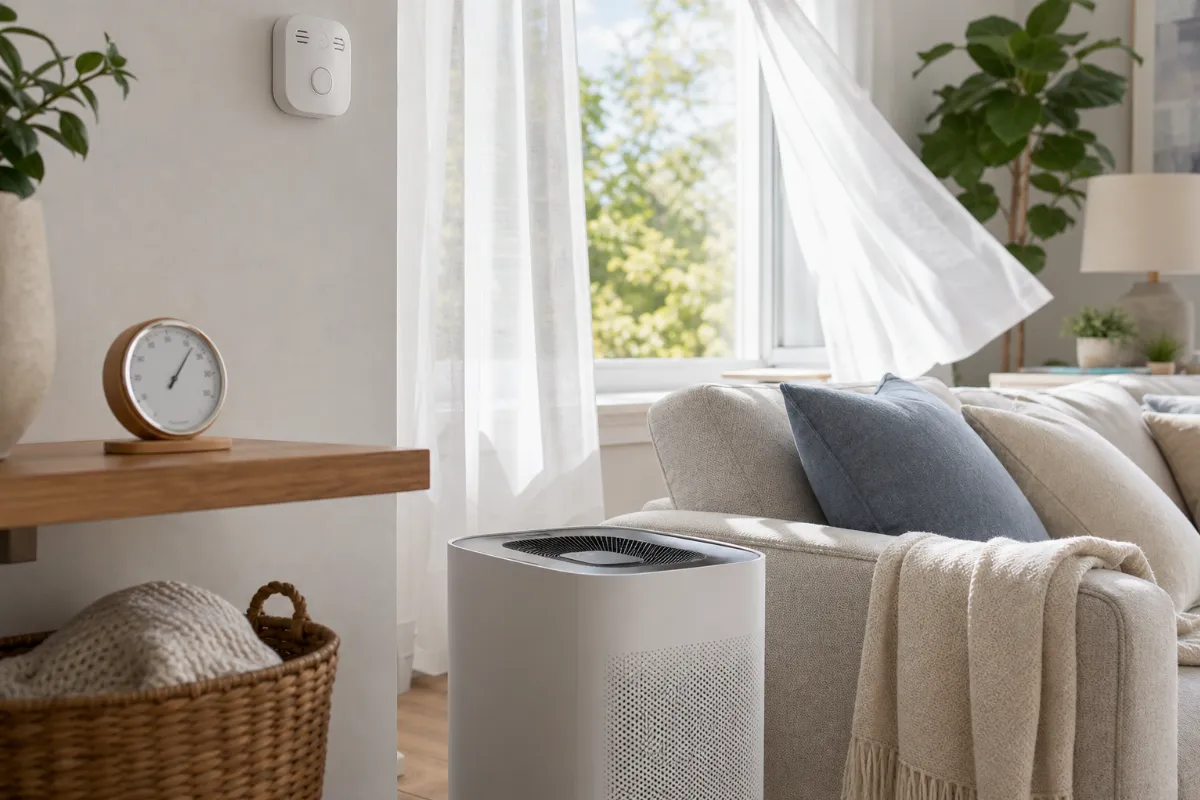
Breathe Easier
Improve Indoor Air Quality
The air inside your home can carry smoke, cooking fumes, dust, mold spores and gases from fuel-burning appliances, and cleaning it starts with removing the source and letting fresh air in. This page covers the home environment itself; breathing habits, nasal symptoms, allergy season and quitting smoking have their own goals.
General information, not medical advice. Last updated November 1, 2026. Written by the AlternativeMed editorial team. Not medically reviewed.
Start here
- Deal with the source first: fix leaks and dry wet areas within 24 to 48 hours, use an exhaust fan vented outdoors when you cook, and keep smoking and vaping outside.
- Bring in fresh air: open windows when the outdoor air is good, and run kitchen and bathroom fans during cooking and showers.
- Install a carbon monoxide alarm outside each sleeping area if you have any fuel-burning appliance, attached garage or fireplace, and test your home for radon.
Be careful with
- Do not use an ozone generator sold as an air cleaner. The EPA says ozone is a lung irritant that can worsen asthma and has little ability to remove indoor pollutants at safe levels.
- Never use a generator, charcoal grill, camp stove or gas oven for heat indoors, and never run a car in an attached garage. These can cause fatal carbon monoxide poisoning.
- An air cleaner is a supplement, not a fix. It does not remove the cause of mold or gas leaks, and most do not remove gases.
- Do not mix chlorine bleach with ammonia-containing cleaners, and do not stop or change prescribed asthma or allergy medicines because you bought an air cleaner.
Get help when
- Headache, dizziness, nausea, confusion, chest pain or weakness that eases when you leave the house, or a carbon monoxide alarm sounding: go outside and get urgent medical advice. In the UK the NHS names 999 for difficulty breathing, sudden confusion, loss of consciousness, weakness or chest pain.
- Severe breathlessness, blue lips, chest pain, wheeze that does not settle with your prescribed reliever, or a child struggling to breathe: seek emergency care.
- Cough, wheeze, stuffy nose or eye irritation that is worse at home and better away from it, or that comes with visible mold or a musty smell: see a doctor and fix the moisture source.
- A radon test at or above the action level the EPA names, or a gas smell, a flame that burns yellow or soot around an appliance: arrange professional help.
About Improve Indoor Air Quality
What this goal means
This goal is about the air in the places where you spend most of your time. The EPA lists common indoor sources: fuel-burning appliances and tobacco products, building materials and furnishings, cleaning and personal-care products, heating, cooling and humidifying equipment, excess moisture, and outdoor sources such as radon and outdoor air pollution.
The EPA describes three broad strategies: control the source, bring in outdoor air, and, as a supplement, clean the air. Removing or reducing a source is usually the most effective of the three.
1,2What it can feel like
The EPA says immediate effects can include irritated eyes, nose and throat, headaches, dizziness and tiredness, and that asthma symptoms may appear or worsen. These can look like a cold or another viral illness, so it helps to note when and where symptoms happen, for example worse at home and better elsewhere.
Many problems have no obvious sign. Carbon monoxide and radon cannot be seen or smelled, and the NHS says you cannot tell if carbon monoxide is around you.
1,3,4Contributing factors
Common contributors are damp and mold, cooking (especially with gas and without a vented fan), unvented or faulty combustion appliances, tobacco smoke, scented and chemical products, and too little fresh air. Outdoor smoke, such as from wildfires, can also enter a home.
The EPA notes that high temperature and humidity can increase some pollutant levels, and that too little ventilation lets emissions build up.
1,5,6,7Relevant conditions
Indoor air problems matter most for people with asthma, allergies, lung disease, heart disease and for young children and older adults. A review of the evidence found that indoor dampness or mold is consistently linked with asthma development and flare-ups, wheeze, cough, respiratory infections and allergic rhinitis, and strongly suggests a causal role in asthma flare-ups in children.
A meta-analysis of 41 studies found that gas cooking was linked with a higher chance of childhood asthma (odds ratio 1.32), and indoor nitrogen dioxide with current wheeze. These are associations in population studies, not proof that one stove causes one child's asthma.
1,8,9Realistic expectations
Cleaner indoor air is a sensible, low-risk step, but it is not a cure. The EPA states there is considerable uncertainty about which levels or lengths of exposure cause specific health problems, and trials of home air cleaners for asthma have given mixed results.
Treat the changes here as a way to lower avoidable exposures, alongside any treatment your doctor has prescribed.
1,10,11Who this applies to
Anyone can use these steps. Extra care is sensible for people with asthma, COPD, allergies or heart disease, babies and children, older adults, pregnant people, and anyone who has recently had water damage, a new renovation or a heating-season change.
The EPA says people can also become sensitized to some biological or chemical pollutants after repeated or high-level exposure.
1Related conditions and symptoms
A manageable starting plan
An educational starting point, not a personal prescription. Adjust it to your own situation and any advice from your clinician.
Your first actions
- Install or check carbon monoxide alarms near sleeping areas, and arrange yearly servicing of fuel-burning appliances.
- Order a radon test if you have not had one.
- Fix any leaks, damp patches or mold sources, and dry water damage within 24 to 48 hours.
- Use a vented fan when you cook and open windows briefly each day when outdoor air is good.
Optional additions
- Add a portable air cleaner sized for the room where you spend the most time, if smoke or particles are an issue.
- Check the filter in your HVAC system and consider a higher-rated one if your system can take it.
- Cut back on aerosols, strong air fresheners and indoor burning of candles or incense.
What to track
- Where and when your symptoms happen (at home or away, in which room, after cooking or cleaning).
- Indoor humidity, using a simple hygrometer.
- Dates you test alarms and replace filters.
When to reassess
Give changes a few weeks, and recheck whenever there is new water damage, a renovation or a change to your heating. If symptoms persist or follow you outside the home, speak to a doctor.
When to seek professional support
- See a doctor for ongoing cough, wheeze, breathlessness or eye and nose irritation, especially if you have asthma or lung disease.
- Contact a qualified engineer or your gas supplier if you suspect a gas leak or a faulty appliance.
- Ask a pharmacist or doctor before using any product that claims to treat breathing symptoms.
What helps
Ordered by how well the research supports each step. Evidence strength is shown on every card; precautions sit next to the advice.
Start here
Control the source: fix leaks and dry water damage quickly
High certaintyAddresses: Lowers the chance of mold and dampness-related symptoms
Why it may help: The EPA says the key to mold control is moisture control. Dry water-damaged areas and items within 24 to 48 hours and fix leaking plumbing or other water sources. A large review found dampness or mold consistently linked with asthma flare-ups, wheeze, cough and allergic rhinitis.
How to apply it: Repair leaks, dry wet carpets and furnishings promptly, and wash mold from hard surfaces with detergent and water, then dry fully. Cleaning alone usually lets mold return if the moisture remains. For about 10 square feet or less most people can clean it themselves; for larger areas, sewage or suspected HVAC contamination call a professional.
Who it may suit: Anyone with damp patches, a musty smell or past water damage, especially people with asthma or mold allergy.
Precautions: Moldy absorbent materials such as ceiling tiles and carpet may need replacing. Wear a well-fitting N-95 respirator, gloves and goggles without vent holes for cleanup. People with asthma should avoid contact with mold, so ask someone else to do the cleaning. Never mix chlorine bleach with ammonia-containing cleaners.
12,13,8Keep indoor humidity moderate
Moderate certaintyAddresses: Makes the home less welcoming to mold
Why it may help: The EPA's mold guide advises keeping indoor relative humidity below 60 percent, ideally between 30 and 50 percent, and treating condensation on windows, walls or pipes as a sign that humidity is too high.
How to apply it: Use a simple hygrometer to check humidity, run bathroom and kitchen fans, and dry any condensation quickly.
Who it may suit: Homes with condensation, damp rooms or musty smells.
Precautions: A dry home is not a substitute for repairing leaks. Very dry air can irritate some people, so aim for a middle range rather than as low as possible.
13Ventilate: let fresh outdoor air in
Moderate certaintyAddresses: Dilutes pollutants and carries them out
Why it may help: The EPA says bringing in outdoor air dilutes indoor pollutants, through open windows and doors, fans, and kitchen and bathroom exhaust fans, and that you should ventilate more during short-term activities such as cooking.
How to apply it: Open windows for a short time each day when outdoor air is good, use exhaust fans when cooking and bathing, and keep vents unblocked.
Who it may suit: Most homes, particularly those that are tightly sealed.
Precautions: The EPA cautions against ventilating when there are nearby outdoor sources such as smoke, and heating or cooling costs can rise. On high-pollen days see the allergy-season goal.
1,2Use a range hood or exhaust fan vented outdoors when you cook
Moderate certaintyAddresses: Lowers cooking fumes, including nitrogen dioxide from gas stoves
Why it may help: The EPA names unvented combustion such as gas stoves as a main indoor source of nitrogen dioxide and advises an exhaust fan vented outdoors over gas stoves. A meta-analysis linked gas cooking with a higher chance of childhood asthma and indoor nitrogen dioxide with wheeze.
How to apply it: Turn the fan on before you start cooking and leave it on a few minutes after. Use the back burners if your hood captures them better, and open a window as well if you can.
Who it may suit: Everyone who cooks, and especially households with gas stoves, children with asthma or wheeze, or small kitchens.
Precautions: A fan that only recirculates air does not vent fumes outdoors. Association studies cannot show that removing a stove would prevent asthma in a particular child.
5,2,9Install carbon monoxide alarms and service fuel-burning appliances
High certaintyAddresses: Prevents poisoning from a gas you cannot see or smell
Why it may help: The CDC advises battery-operated or battery-backup carbon monoxide detectors near every sleeping area, yearly servicing of furnaces, water heaters and other fuel-burning appliances, and replacing detectors per the manufacturer's instructions or every 5 years. The NHS advises an alarm in each room with an appliance that burns gas, oil, coal or wood.
How to apply it: Place alarms as the instructions say, test them when the clocks change, and book yearly servicing by a qualified technician. Have chimneys checked or cleaned yearly.
Who it may suit: Every home with a fuel-burning appliance, fireplace, attached garage or portable generator.
Precautions: Carbon monoxide can kill people who are asleep before they notice symptoms. An alarm is a backup to, not a replacement for, safe appliances.
14,3,15Test your home for radon
High certaintyAddresses: Finds a hidden cause of lung cancer risk
Why it may help: The EPA says radon causes about 21,000 lung cancer deaths a year in the US, is the leading cause among non-smokers, and urges people to test. It advises fixing the home at 4 pCi/L (150 Bq/m3) and above, and considering a fix between 2 and 4 pCi/L.
How to apply it: Use a test kit or a qualified tester and follow the instructions. If the result is at or above the action level, a qualified radon professional can reduce it. Air cleaners do not reduce radon entering a home.
Who it may suit: Everyone, because radon can occur in any home. Smokers face a much higher combined risk.
Precautions: The EPA's page does not describe mitigation methods in detail; ask a qualified professional. If you smoke, the EPA advises stopping, and the quit-smoking goal has support information.
4,2Additional options
Use a portable HEPA air cleaner as a supplement
Low certaintyAddresses: May lower particles such as smoke and dust in the room where it runs
Why it may help: The EPA says portable air cleaners and HVAC filters can reduce indoor particles but supplement, not replace, source control and ventilation, and studies with portable HEPA units show small health benefits, with some allergy and asthma symptom improvements. In a randomized trial of 75 children with poorly controlled asthma, the main asthma-control score did not differ significantly, though some secondary results favored HEPA units. A larger blinded school trial of 236 students found no significant reduction in asthma symptom-days.
How to apply it: Choose a unit sized for the room using its clean air delivery rate, place it where you spend most time with airflow clear, run it consistently, and replace filters on schedule. Pick one that does not make ozone.
Who it may suit: People with smoke exposure, pets or particle-triggered symptoms who have already dealt with sources.
Precautions: Most table-top models remove particles poorly and air cleaners generally do not remove gases. Dirty filters perform badly. Do not treat an air cleaner as asthma treatment.
16,2,10,11Use a better furnace or HVAC filter
Low certaintyAddresses: Filters air through the whole home when the system runs
Why it may help: The EPA suggests a filter rated MERV 13 or higher if your system can take it, a snug fit, and replacement about every 60 to 90 days, sooner if heavily soiled. It notes a whole-home system only filters while it runs, often less than a quarter of the heating and cooling season.
How to apply it: Ask an HVAC technician whether your system can handle a higher-rated filter, and consider setting the fan to run continuously in smoky periods.
Who it may suit: Homes with forced-air heating or cooling.
Precautions: A tight-fitting high-rated filter that restricts airflow can strain some systems, so check compatibility first.
16,7Set up a clean room during smoke events
Moderate certaintyAddresses: Gives you a place with lower indoor smoke exposure
Why it may help: For wildfire smoke the EPA advises keeping windows and doors closed, choosing one room, running an ozone-free portable air cleaner there, and using the highest practical filter on your HVAC. A systematic review found portable HEPA cleaners reduced fine particles by 54 to 92 percent in studies, and standard-filter mechanical ventilation by less.
How to apply it: Close the room, run the cleaner on a high setting, and avoid adding indoor smoke or particles. Air out the home when outdoor air briefly improves.
Who it may suit: Households during wildfire or other outdoor smoke events, especially with asthma, heart or lung disease, or young children.
Precautions: Particle reduction is not the same as proven health benefit. People with lung or heart disease should follow their care plan and seek help if symptoms worsen.
7,17Choose and use household products with care
Moderate certaintyAddresses: Lowers volatile chemical exposure
Why it may help: The EPA lists cleansers, disinfectants, paints, air fresheners and craft products as sources of volatile organic compounds that can irritate the eyes, nose and throat and cause headaches and nausea. It advises increasing ventilation when using them, following directions, storing safely and buying limited quantities.
How to apply it: Use products as directed, ventilate while and after using them, close containers tightly, and dispose of old chemicals through a household waste collection.
Who it may suit: Anyone, especially people with asthma and those who clean often.
Precautions: Never mix cleaning products. Keep chemicals away from children and pets.
6Keep humidifiers clean and not too humid
Moderate certaintyAddresses: Avoids growth of germs and mold from the device
Why it may help: The EPA advises not humidifying above 50 percent relative humidity, cleaning portable humidifiers every third day, emptying and drying them daily, and using low-mineral water such as distilled water. It advises stopping a humidifier and seeing a doctor if respiratory symptoms seem linked to its use.
How to apply it: Check the instructions, rinse well after any cleaning product so chemicals are not released, and stop using it if condensation forms on windows.
Who it may suit: People who use humidifiers, especially with asthma or allergies.
Precautions: Dust mites and mold can grow in excess moisture and trigger allergic reactions.
18Still being studied
Houseplants for cleaner air
Evidence againstAddresses: Not shown to clean indoor air in real homes
Why it may help: Potted plants can remove volatile compounds in small sealed chambers, but a review of 196 results from 12 chamber studies concluded you would need roughly 10 to 1,000 plants per square meter of floor to match ordinary air exchange. The EPA says there is no evidence that a reasonable number of houseplants meaningfully reduces indoor pollutants.
How to apply it: Enjoy plants for how they look and feel, not as an air cleaner.
Who it may suit: People who like plants.
Precautions: Overly damp soil can encourage microorganisms that affect allergic people, so avoid overwatering.
19,2Food & nutrition
Cooking and your indoor air
Food and drink are not a way to clean indoor air, and we did not find a reliable human study linking a particular food to better home air. What matters in the kitchen is the cooking itself.
The EPA lists cooking among short-term activities that can raise pollutant levels, and advises ventilating while you cook. For gas stoves it advises an exhaust fan vented to the outdoors.
2,5Remedies & supplements
Traditional use, laboratory findings and human trials are kept apart. "Natural" does not mean safe.
We did not find a remedy or supplement with reliable human evidence for this goal in the sources we read. Be cautious of any product that promises a result, and read the "What to avoid" tab for claims that do not hold up.
Therapies & care
Indoor air problems tied to health symptoms deserve a professional look when they persist. A doctor can assess breathing symptoms, asthma and allergies, and a qualified technician can check appliances, ventilation and radon. We do not give medicine advice here, and prescribed inhalers and other medicines should never be stopped or replaced because of changes to your home.
Professional home checks
Moderate certaintyHome safety and environmental assessment A qualified gas or heating engineer can service appliances, flues and chimneys, a radon professional can test and reduce radon, and an experienced contractor can deal with large mold areas, sewage-contaminated water or suspected HVAC contamination.
Who it may suit: Anyone with fuel-burning appliances, an alarm that has sounded, high radon, large water damage or persistent symptoms at home.
Precautions: Check credentials. Do not run a system you suspect is contaminated with mold.
14,3,4,13Medical review of breathing symptoms
Moderate certaintyEstablished professional care A clinician can work out whether cough, wheeze or congestion is linked to asthma, allergy or infection, and can adjust prescribed care. Noting when and where symptoms occur helps.
Who it may suit: Anyone with ongoing breathing symptoms, asthma or allergies, or symptoms that improve away from home.
Precautions: Do not stop prescribed medicines on your own.
1What to avoid
Habits, products and claims that can get in the way. Never stop a prescribed medicine without talking to the professional who prescribed it.
Risks that apply to most people
Ozone generators and "ozone-producing" air cleaners
High certaintyWhy: The EPA says ozone is a toxic gas that can damage the lungs and worsen asthma, and that at levels within health standards ozone has little potential to remove indoor contaminants. It does not remove particles, allergens, carbon monoxide or formaldehyde, and can create irritating byproducts. No federal agency has approved these devices for occupied spaces.
Who it applies to: Anyone, especially people with asthma and children.
Try instead: Use source control, ventilation and a particle filter that does not make ozone. The EPA says electrostatic precipitators, ionizers and plasma units may also make ozone, and lists low-ozone testing programs.
20,16Using combustion appliances indoors for heating or cooking without proper venting
High certaintyWhy: Unvented gas heaters, charcoal, generators and camp stoves can produce carbon monoxide and nitrogen dioxide. The CDC says never heat your house with a gas oven, never use a generator inside the home or garage even with doors open, never burn charcoal indoors and never run a car in an attached garage.
Who it applies to: Everyone, especially during cold weather and power cuts.
Try instead: Use properly installed, vented, serviced appliances and keep generators more than 20 feet from windows, doors and vents.
14,15,5Smoking or vaping indoors
Moderate certaintyWhy: The EPA lists tobacco products and secondhand smoke among indoor pollutants and advises avoiding indoor smoking and vaping during smoke events. We did not find a figure for vaping aerosol in the sources we read, so no precise risk is stated here.
Who it applies to: Anyone who shares indoor space with a smoker, especially children and people with asthma.
Try instead: Keep homes and cars smoke-free and use support to quit.
1,7Personal triggers to check
Persistent dampness, condensation and visible mold
High certaintyWhy: Dampness or mold is consistently associated with asthma flare-ups, wheeze, cough and respiratory infections, and the EPA says mold can irritate even people who are not allergic.
Who it applies to: People with asthma, allergies, babies and older adults.
Try instead: Find and fix the water source, dry affected items, and keep humidity moderate.
8,12,13Cooking fumes, especially gas cooking in poorly ventilated kitchens
Moderate certaintyWhy: Gas stoves are an indoor source of nitrogen dioxide, which the EPA says can irritate and increases bronchial reactivity in some people with asthma. Cooking also creates short-term spikes in pollutants.
Who it applies to: Children, people with asthma and households with small, closed kitchens.
Try instead: Use a vented hood or fan, and open a window while cooking.
5,2,9Burning candles, incense and wood or gas heaters during smoke events
Low certaintyWhy: The EPA lists burning candles or incense, frying or broiling, and using gas or wood stoves among activities that add indoor particles during smoke events. We did not find an agency source we read that measures their effect on health at other times.
Who it applies to: People with asthma, heart or lung disease during smoky days.
Try instead: Limit them when air is already poor, and ventilate when you do use them.
7Strong scents, aerosols and air fresheners
Low certaintyWhy: The EPA lists air fresheners and aerosol products among sources of volatile organic compounds that can irritate the airways and cause headaches.
Who it applies to: People with asthma, fragrance sensitivity and those who clean in small spaces.
Try instead: Choose fragrance-free products where you can and ventilate when you use any.
6,7Products that need caution
Ionizers, plasma, UV and "photocatalytic" air purifiers
Moderate certaintyWhy: The EPA says plasma, photocatalytic oxidation and UV have not been shown to remove gases effectively in residential units, and some ionizing devices can produce ozone. The EPA does not certify or endorse specific brands.
Who it applies to: Shoppers comparing devices.
Try instead: Prefer a particle filter with a clean air delivery rate that suits the room, and check low-ozone lists.
16Table-top air cleaners with low airflow
Moderate certaintyWhy: The EPA says most table-top models remove particles poorly, and air cleaners generally do not remove gases or reduce radon.
Who it applies to: Anyone relying on a small unit in a large room.
Try instead: Size the unit by clean air delivery rate for the room and keep filters fresh.
2,16Using a humidifier without cleaning it
Moderate certaintyWhy: The EPA says to clean portable humidifiers every third day and use low-mineral water, and that high humidity may encourage growth of biological organisms.
Who it applies to: Households with asthma or allergy.
Try instead: Clean on schedule, use distilled water and keep humidity at or below 50 percent.
18Unsupported claims
"Houseplants purify your air"
High certaintyWhy: Chamber studies do not translate to homes: a review concluded 10 to 1,000 plants per square meter would be needed to match normal air exchange.
Who it applies to: Social media and décor sites.
Try instead: Use ventilation and source control for air quality.
19,2"Ozone cleans and kills mold in occupied rooms"
High certaintyWhy: The EPA says levels needed to kill biological contaminants would be 5 to 10 times above health standards, and ozone does not remove embedded contaminants.
Who it applies to: Sellers of ozone machines.
Try instead: Fix moisture and remove mold physically.
20"An air purifier will cure asthma or allergies"
Moderate certaintyWhy: Trials have given small or inconsistent results. One blinded trial in schools found no significant reduction in asthma symptom-days, and a home trial's main outcome was not significant.
Who it applies to: Product advertising.
Try instead: Use air cleaning as a supplement and keep taking and following your prescribed plan.
11,10,16Common mistakes
Testing for mold instead of fixing moisture
Moderate certaintyWhy: The EPA says testing is usually unnecessary when mold is visible, and that no federal limits exist for mold or spores. A review found current evidence does not support measuring specific microbiologic factors to guide actions.
Who it applies to: Anyone who finds mold.
Try instead: Find and fix the source of moisture and clean up the mold.
13,8Relying on a carbon monoxide alarm with old batteries or past its life
High certaintyWhy: The CDC advises checking batteries when the clocks change and replacing detectors per instructions or every 5 years.
Who it applies to: Every home with fuel-burning appliances.
Try instead: Put a reminder in your calendar and test regularly.
14Skipping the radon test because the home seems fine
High certaintyWhy: Radon has no smell or sign. The EPA says average indoor levels are 1.3 pCi/L and urges testing.
Who it applies to: Every home.
Try instead: Test once, and again after major changes such as renovations.
4Evidence & safety
What the research shows
Agency guidance is consistent that the best steps are removing sources, controlling moisture, ventilating and, as a supplement, filtering. Evidence is strongest for the hazards of dampness and mold, carbon monoxide and radon. Evidence that air cleaners improve health outcomes at home is limited and mixed, and houseplants and ozone generators are not supported.
Limits of the evidence
- Many findings come from observational studies, which show associations rather than proof of cause.
- The EPA states there is considerable uncertainty about which concentrations or exposure periods cause specific health problems.
- The air cleaner trials we read were small or had mixed results, and one was unblinded with self-reported outcomes.
- We read agency pages for the US and the NHS for carbon monoxide. Rules, units and emergency numbers differ by country.
Precautions and interactions
- Do not mix chlorine bleach with ammonia-containing cleaners.
- Wear suitable protection when cleaning mold, and ask someone else to do it if you have asthma.
- Ozone-producing devices can harm the lungs and are not approved for occupied spaces.
Life-stage considerations
- Children and babies: gas cooking and indoor nitrogen dioxide are linked with childhood asthma and wheeze, and the EPA notes low-level nitrogen dioxide exposure may raise the risk of respiratory infections in young children.
- Older adults and people with heart or lung disease: smoke days and poorly serviced appliances matter more, so follow your care plan.
- Pregnancy and breastfeeding: we did not find a source we read with specific advice beyond the general steps here. Ask a clinician about any concerns.
Warning signs
- Carbon monoxide symptoms such as headache, dizziness, nausea, confusion or chest pain that ease away from the building.
- Severe breathlessness, blue lips or struggling to speak.
- Symptoms that return only at home or follow a leak, new renovation or new appliance.
- A gas smell, a persistent alarm or visible soot.
Claim checks
Houseplants clean the air in your home
Evidence againstA review of chamber studies concluded plants would be needed in the thousands to match normal air exchange, and the EPA finds no evidence that a reasonable number meaningfully reduce pollutants.
19,2Ozone generators make air safe and fresh
Evidence againstThe EPA says ozone can harm the lungs and has little ability to remove indoor contaminants at safe levels, and no federal agency has approved the devices for occupied spaces.
20An air purifier prevents asthma flare-ups
Low certaintyA small randomized trial showed mixed results, and a larger blinded school trial found no significant reduction in symptom-days. Air cleaners may help some people but are not proven treatment.
10,11,16Mold must be tested before you act
Moderate certaintyThe EPA says testing is usually unnecessary when mold is visible, and a review does not support measuring microbiologic factors to guide action.
13,8Gas stoves are linked with childhood asthma
Moderate certaintyA meta-analysis of 41 studies found gas cooking was associated with higher odds of childhood asthma (odds ratio 1.32). This shows association, and vented hoods are the EPA's advised response.
9,5You can tell if carbon monoxide is present
High certaintyNo: the NHS says it is colourless and odourless, so alarms matter.
3,14Questions people ask
What is the single best way to improve indoor air quality?
The EPA says removing or reducing pollution sources is usually the most effective strategy, followed by ventilation and, as a supplement, air cleaning.
Do air purifiers work?
Portable HEPA units can reduce particles in a room, and the EPA says studies show small health benefits, including some asthma and allergy improvements. Trials we read were mixed, and air cleaners generally do not remove gases or radon. Choose one that does not make ozone.
How humid should my home be?
The EPA's mold guide says below 60 percent and ideally between 30 and 50 percent. For humidifiers it advises not going above 50 percent.
How do I deal with mold at home?
Fix the moisture source, dry affected items within 24 to 48 hours and wash hard surfaces with detergent and water. About 10 square feet or less can usually be cleaned by the household; larger areas or sewage damage need a professional.
Do I need to test for mold?
Testing is usually unnecessary when mold is visible, according to the EPA, and no federal limits exist for mold spores.
Are gas stoves bad for indoor air?
The EPA lists gas stoves as a main source of indoor nitrogen dioxide and advises a fan vented outdoors. A meta-analysis found gas cooking linked with childhood asthma. Using a vented hood is a practical step.
Where should I put carbon monoxide alarms?
The CDC says near every sleeping area, and the NHS says in each room with a gas, oil, coal or wood appliance. Check batteries when the clocks change and replace per instructions or every 5 years.
What should I do if my carbon monoxide alarm sounds?
The NHS advises stopping any appliance you think is producing it if safe, going outside and getting medical advice, and not going back in until you have advice. The UK number it names for serious symptoms is 999.
What is a safe radon level?
The EPA advises fixing a home at 4 pCi/L (150 Bq/m3) and above and considering it between 2 and 4 pCi/L. Smokers face a much higher combined risk.
Do houseplants help?
Not in a meaningful way for air quality. Enjoy them for other reasons, and avoid overwatering.
Is a humidifier good for my breathing?
It can help with dry air but needs cleaning every third day, low-mineral water and humidity at or below 50 percent. Stop using it and see a doctor if symptoms seem linked to it.
What about candles and incense?
The EPA lists them among activities that add indoor particles during smoke events. We did not find a source we read that quantifies other situations, so burn less and ventilate.
References
- US EPA. Introduction to Indoor Air Quality. Read 2026-11-01. source
- US EPA. Improving Indoor Air Quality. Read 2026-11-01. source
- NHS. Carbon monoxide poisoning. Read 2026-11-01. source
- US EPA. Health Risk of Radon. Read 2026-11-01. source
- US EPA. Nitrogen Dioxide's Impact on Indoor Air Quality. Read 2026-11-01. source
- US EPA. Volatile Organic Compounds' Impact on Indoor Air Quality. Read 2026-11-01. source
- US EPA. Wildfires and Indoor Air Quality (IAQ). Read 2026-11-01. source
- Mendell MJ, et al. Respiratory and allergic health effects of dampness, mold, and dampness-related agents: a review of the epidemiologic evidence. Environ Health Perspect. 2011;119(6):748-56. source
- Lin W, Brunekreef B, Gehring U. Meta-analysis of the effects of indoor nitrogen dioxide and gas cooking on asthma and wheeze in children. Int J Epidemiol. 2013;42(6):1724-37. source
- Drieling RL, et al. Randomized trial of a portable HEPA air cleaner intervention to reduce asthma morbidity among Latino children in an agricultural community. Environ Health. 2022;21(1):1. source
- Phipatanakul W, et al. Effect of School Integrated Pest Management or Classroom Air Filter Purifiers on Asthma Symptoms in Students With Active Asthma: A Randomized Clinical Trial. JAMA. 2021;326(9):839-850. source
- US EPA. Mold and Health. Read 2026-11-01. source
- US EPA. A Brief Guide to Mold, Moisture and Your Home. Read 2026-11-01. source
- CDC. Carbon Monoxide Poisoning Basics. Read 2026-11-01. source
- US EPA. Carbon Monoxide's Impact on Indoor Air Quality. Read 2026-11-01. source
- US EPA. Guide to Air Cleaners in the Home. Read 2026-11-01. source
- Goodman N, et al. Interventions for reducing exposure to air pollution from landscape fires in a changing environment: A systematic review. Sci Total Environ. 2025. source
- US EPA. Use and Care of Home Humidifiers. Read 2026-11-01. source
- Cummings BE, Waring MS. Potted plants do not improve indoor air quality: a review and analysis of reported VOC removal efficiencies. J Expo Sci Environ Epidemiol. 2020;30(2):253-261. source
- US EPA. Ozone Generators that are Sold as Air Cleaners. Read 2026-11-01. source
Related on AlternativeMed
Related goals
Reduce Exposure to Respiratory Irritants → Improve Comfort During Allergy Season → Manage Nasal Congestion → Protect Your Lung Health → Build Comfortable Breathing Habits → Get Support to Stop Smoking or Vaping →