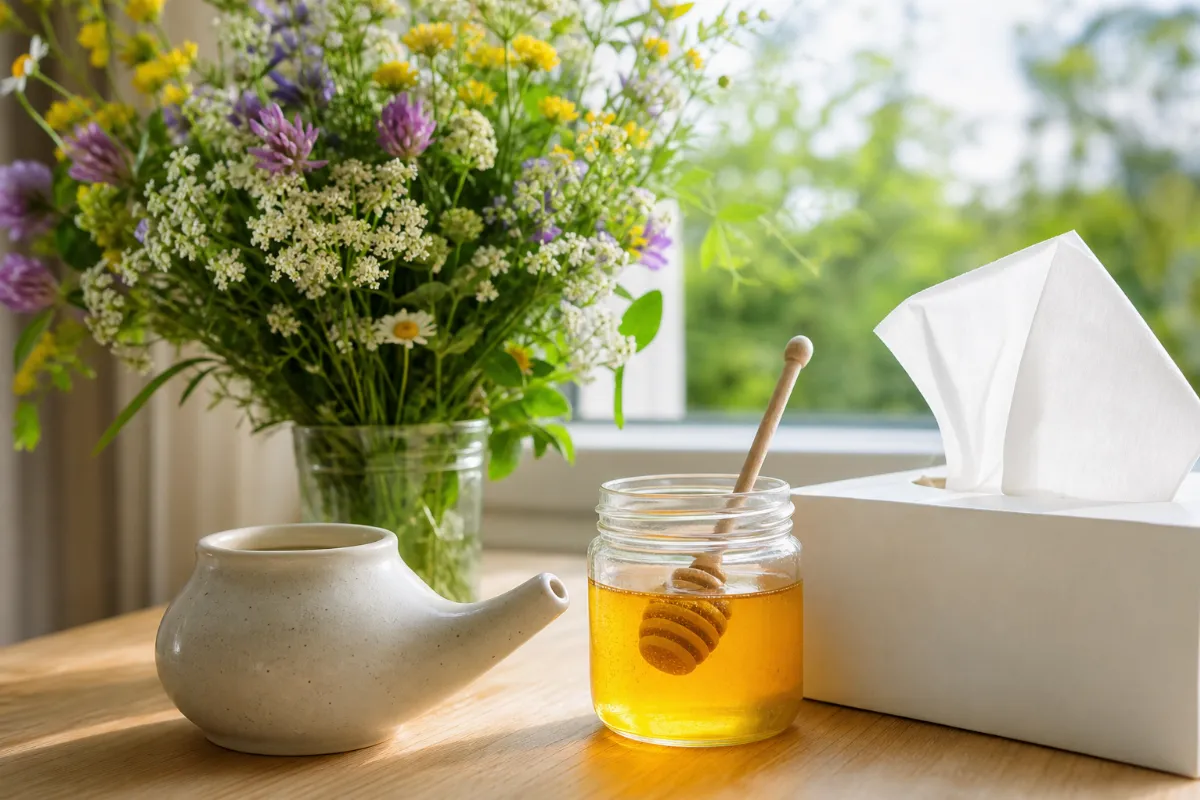
Wellness Goals · Immune comparison
Allergies vs Colds
Allergic rhinitis (hay fever) compared with the common cold · also called Allergies vs colds, hay fever vs cold, seasonal allergy, pollen allergy, rinitis alergica, resfriado
Allergies (such as hay fever) and colds can both cause a runny or blocked nose and sneezing, but the cause differs: an allergy is an immune reaction to a trigger such as pollen, while a cold is a viral infection. Colds usually clear in 1 to 2 weeks; hay fever can last weeks or months. Itchy eyes point towards allergy, fever and aches towards infection. A clinician can help tell them apart, and severe allergic reactions are emergencies.
General information, not medical advice. Last substantive update · Not medically reviewed. A named clinician has not signed off on this page. How this page is made
About Allergies vs Colds
Allergies such as hay fever and colds can look alike, but an allergy is an immune reaction to a trigger and a cold is a viral infection. Colds usually pass in 1 to 2 weeks; hay fever can last weeks or months. A pharmacist or clinician can discuss treatment, and natural options have low-certainty evidence. Severe allergic reactions are emergencies.
Allergies vs colds: two different things with overlapping symptoms
Both a cold and an allergy such as hay fever can cause a runny or blocked nose, sneezing and a cough. MedlinePlus describes an allergy as a reaction by your immune system to something that does not bother most other people; the NHS says hay fever is an allergic reaction to pollen. A cold, in contrast, is an infection by a virus.
This page is educational: it cannot tell you which one you have. The colds, flu and respiratory infections page covers the infection side in detail.
Typical features: cause, timing and symptoms compared
Cause: a cold is caused by a virus; hay fever by pollen reaching the nose, eyes and throat; other allergies by triggers such as dust mites, mould, pet dander, food and insect stings (MedlinePlus).
Symptoms: the NHS lists cold symptoms as a blocked or runny nose, sneezing, sore throat, hoarse voice, cough and feeling tired and unwell, and some people get a fever and aching muscles. Hay fever symptoms listed by the NHS are sneezing, coughing, a runny or blocked nose, itchy red or watery eyes, and an itchy throat, mouth, nose or ears. MedlinePlus adds postnasal drip and dark circles under the eyes. Itchy eyes and ears point more to allergy; fever and aching muscles are listed with colds.
Contagion: colds spread from person to person, and germs can live on hands and surfaces for up to 24 hours (NHS). An allergy is an immune reaction and does not spread.
Timing and how long symptoms last
The NHS says a cold builds gradually over 2 to 3 days and you should begin to feel better in about 1 to 2 weeks. Hay fever can last weeks or months and is usually worst from late March to September in the UK, especially in warm, humid, windy weather when pollen counts are high.
A pattern that returns at the same time each year, or follows exposure to pets, dust or pollen, points towards allergy. A high temperature and aches point towards infection. These are clues, not a diagnosis.
How a clinician tells the difference
MedlinePlus says hay fever is diagnosed from a physical exam and symptoms, with skin or blood tests sometimes used. A 2015 specialist guideline recommends diagnosing allergic rhinitis from a history and exam consistent with an allergic cause plus one or more of nasal congestion, runny nose, itchy nose or sneezing, and allergy testing when the diagnosis is uncertain or treatment does not work.
A 2021 expert consensus found upper-airway symptoms are rated differently in allergic rhinitis, the common cold and COVID-19, but only a test or a clinician can say for sure.
Treatment overview for allergies and for colds
Colds: the NHS advises rest, plenty of fluids and pharmacist advice; antibiotics do not help colds. See the colds, flu and respiratory infections page.
Hay fever: the NHS says there is no cure, but a pharmacist can discuss antihistamines and steroid nasal sprays, and a GP may refer for immunotherapy, where gradually increasing amounts of pollen are given by injection or tablet to build tolerance. A 2015 guideline gives strong recommendations for nasal steroid sprays and for second-generation oral antihistamines when sneezing and itching dominate. Some antihistamines make you very sleepy; non-drowsy ones exist. Treatments are named only in general terms here; a clinician or pharmacist should advise.
A 2018 European guideline says allergen immunotherapy is the only treatment that targets the underlying cause, and recommends at least 3 years of therapy for long-term benefit.
What natural and lifestyle approaches have and have not shown
For allergic rhinitis, salt-water nose rinses have low-certainty evidence of easing symptoms, acupuncture showed small and fading gains, and probiotics, honey, spirulina, black seed and herbal medicines have low-certainty or mixed evidence. Pollen-avoidance steps are NHS guidance without a trial read. See the Health Benefits and Evidence tabs.
For colds, see the colds page; this page does not test remedies for colds.
When to see a clinician
The NHS says see a GP if hay fever gets worse or does not improve with pharmacy medicines. For a cold, see a GP for a high temperature for more than 3 days, symptoms getting worse, shortness of breath or chest pain, no improvement after 10 days, or a cough lasting more than 3 weeks.
An allergic reaction can be severe: throat or tongue swelling, trouble breathing, wheezing, fainting or confusion needs emergency help. Use your local emergency number. See the Safety tab.
At a glance
Traditional uses history, not proof
Studied for research
- Salt-water nose rinses, low certainty
- Acupuncture, low certainty
- Dust-mite control and HEPA purifiers, low certainty
- Pollen-avoidance steps, insufficient (agency guidance)
- Probiotics, low certainty
- Honey, low certainty
- Butterbur, low certainty
- Spirulina and black seed, low certainty
- Vitamin D, mixed
- Herbal medicines as a group, low certainty
Main compounds
- Honey
- Probiotics
- Butterbur extract
- Spirulina
- Nigella sativa (black seed)
- Vitamin D
Common forms
- Saline nose rinses and sprays
- Acupuncture sessions
- HEPA air purifiers
- Probiotic capsules
- Honey and birch pollen honey
- Butterbur extract tablets
Research links: NHS: Hay fever · NHS: Common cold · NHS: Anaphylaxis · MedlinePlus: Hay fever · Cochrane 2018: Saline irrigation for allergic rhinitis · Guideline 2015: Allergic rhinitis · Research Library · Genes & Biomarkers Library
What it is and its history
- Accepted scientific name
- Allergic rhinitis (hay fever) compared with the common cold
- Common names
- Hay fever, seasonal allergy (English); Pollen allergy (English); Common cold (English); Rinitis alergica, fiebre del heno, resfriado (Spanish)
- Family or group
- Immune and respiratory conditions. A cold is an infection by a virus; allergic rhinitis is an immune reaction to a trigger such as pollen.
- Look-alikes and adulterants
- Name: Common cold; Note: Builds over 2 to 3 days, can include fever and aching muscles (NHS); see the colds page.; Name: Flu; Note: Comes on within hours and can leave you too unwell for normal activities (NHS).; Name: COVID-19; Note: Can look like a cold or allergy; a 2021 consensus rated symptom intensity differently across the three, but only a test can tell.; Name: Sinusitis, asthma, eczema; Note: A 2015 guideline lists these among conditions that go with allergic rhinitis and should be checked.
What is inside, and how it may work
What it contains and how those compounds act in cells and animals. Laboratory and animal mechanisms are not proven effects in people.
Main compounds
| Compound | Family | Where it is concentrated | Activity studied | Level of evidence |
|---|---|---|---|---|
| Honey | food | Tested as an add-on for hay fever symptoms. 1 17 | Human data | |
| Probiotics | live microorganisms | Studied for symptoms and immune balance in allergic rhinitis. 12 | Human data | |
| Butterbur (Petasites hybridus) extract | plant extract | Compared with an antihistamine in one trial. 18 | Human data | |
| Spirulina | alga | Compared with placebo in one trial. 3 | Human data | |
| Nigella sativa (black seed) | seed oil | Meta-analysed in allergic rhinitis trials. 7 | Human data | |
| Vitamin D | vitamin | Meta-analysed in allergic rhinitis trials. 11 | Human data |
Mechanisms, receptors and pathways
| Target or pathway | Gene or receptor | What was found | Level |
|---|---|---|---|
| What an allergy is | MedlinePlus: an immune-system reaction to something that does not bother most other people; common triggers include pollen, dust mites, mould spores, pet dander, food, insect stings and medicines. 21 | Agency summary | |
| Why colds are different | NHS: colds are infections that spread through coughs and sneezes, germs surviving on hands and surfaces for up to 24 hours, so a cold is contagious while an allergy is not. 25 21 | Agency summary | |
| Th1/Th2 balance with probiotics | A 2022 meta-analysis reported a higher Th1/Th2 ratio with probiotics but no change in IgE levels. 12 | Human biomarker |
Isolated compounds versus whole extracts
The studies read tested whole foods (honey), live bacteria, one butterbur extract, algae and seed products, and mixed herbal medicines. Pooled herbal results cannot be applied to one herb.
1 mixed findings11 low certainty1 not enough evidence
What was looked at
The 13 benefits and uses checked for Allergies vs Colds, each with how strong the evidence is. Tap one to open it.
- Salt-water nose rinses (saline irrigation)Low certainty
- AcupunctureLow certainty
- Reducing house dust mites in the bedroomLow certainty
- HEPA air purifiers at homeLow certainty
- Avoiding pollen: showering, closed windows, other stepsNot enough evidence
- ProbioticsLow certainty
- Honey (including birch pollen honey)Low certainty
- Butterbur (Petasites hybridus) extractLow certainty
- Spirulina (blue-green alga)Low certainty
- Black seed (Nigella sativa)Low certainty
- Vitamin DMixed findings
- Herbal medicines as a groupLow certainty
- Health supplements overallLow certainty
Lab markers tracked in the studies
Nasal symptom and quality-of-life scoresAntihistamine or rescue medicine use
What is Allergies vs Colds good for?
The natural, lifestyle and complementary approaches studied for allergic rhinitis (hay fever), the condition most often confused with a cold, and how strong the human evidence is for each. These describe what studies found, not advice to try anything. Established medical care is described in the About tab.
Benefits, one by one
Each card is a research question, not a promise. Tap a goal to filter. Open a card to see the studies, doses and limits.
Salt-water nose rinses (saline irrigation)
Low certaintyA Cochrane review of 14 small trials found saline irrigation may ease patient-reported allergic rhinitis symptoms compared with no saline, but the evidence is low quality.
2 studiesIsotonic or hypertonic salt solutions, various volumes and devices, a…
Studies, doses and limits
What the trials found
Cochrane review 2018 (14 randomised trials, 747 people, children and adults) and a 2012 meta-analysis of 10 trials.
Results
Symptom severity improved versus no saline at up to 4 weeks and at 4 weeks to 3 months; the 2012 meta-analysis reported 27.66% better nasal symptoms and 62.1% less medicine use. Whether it adds to nasal steroids or antihistamines was uncertain.
Effect sizes as reported
SMD -1.32 (up to 4 weeks) and -1.44 (4 weeks to 3 months)
Why this rating
Cochrane graded the evidence low or very low: small studies, mixed scoring tools, no follow-up beyond 3 months.
Form and dose studied
Isotonic or hypertonic salt solutions, various volumes and devices, as reported in trials. No amounts are advised here.
Who was studied
Adults and children with allergic rhinitis.
Limits
Different scoring systems; no head-to-head test of solution strength in the Cochrane review.
Why researchers looked
Rinsing the nose is a cheap, low-risk step many people try for hay fever and perennial allergy.
Proposed mechanism Hypothesis
Proposed: washing allergen and mucus from the nasal lining. Not tested directly in the reviews read.
A proposed mechanism does not show that the effect happens in people.
No adverse effects were reported with saline in the studies that mentioned them. Use clean, safe water for any rinse; see the Safety tab.
Acupuncture
Low certaintyA large German trial found 8 weeks of acupuncture slightly improved hay fever quality of life and antihistamine use versus sham and versus medicine alone, though the authors say the gain may be small in practice.
3 studies12 sessions over 8 weeks by trained physicians in the trial.
Studies, doses and limits
What the trials found
Randomised trial of 422 adults with seasonal allergic rhinitis (2013) and a 2015 meta-analysis of 13 trials (2,365 people); a 2015 specialist guideline lists acupuncture as an option.
Results
In the trial, quality of life and rescue-medicine scores improved at 8 weeks versus sham and versus medicine alone, no differences at week 16, small benefits again in the second year. The meta-analysis found lower symptom, medication and IgE measures with no serious reactions linked to acupuncture.
Effect sizes as reported
RQLQ 0.5 point better than sham (97.5% CI 0.2 to 0.8); nasal symptom score WMD -4.42
Why this rating
Low: a good-sized sham-controlled trial, but small gains of doubtful clinical importance, benefits fading by week 16, and a meta-analysis from 2013.
Form and dose studied
12 sessions over 8 weeks by trained physicians in the trial.
Who was studied
Adults with seasonal allergic rhinitis and birch or grass pollen sensitisation.
Limits
Not powered for rare harms; the meta-analysis mixed sham and non-sham controls.
Why researchers looked
Acupuncture is widely used for hay fever and is listed as an option in a United States specialist guideline.
Proposed mechanism Hypothesis
Unknown. Proposed immune and nervous-system effects; not shown in the studies read.
A proposed mechanism does not show that the effect happens in people.
Needles can cause bruising or soreness; no serious reactions were linked to acupuncture in the review. See the Safety tab.
Reducing house dust mites in the bedroom
Low certaintyReviews of small trials found mite-killing sprays looked most promising, while mattress and pillow covers used on their own are unlikely to help.
2 studiesImpermeable bedding covers, mite-killing sprays, HEPA filters, as tes…
Studies, doses and limits
What the trials found
Cochrane review 2012: 9 trials, 501 people with mite-sensitive allergic rhinitis.
Results
Seven of nine trials reduced mite load; impermeable covers alone are unlikely to give benefit; the authors could not give definitive recommendations because trials were small and of poor quality.
Effect sizes as reported
Not given in the abstract
Why this rating
Low: small, poor-quality trials and the review is from 2012.
Form and dose studied
Impermeable bedding covers, mite-killing sprays, HEPA filters, as tested in trials. No amounts are advised.
Who was studied
Adults and children with perennial mite allergic rhinitis.
Limits
Poor methods; mixed interventions.
Why researchers looked
For year-round allergy, house dust mites are a common trigger and people try to cut exposure at home.
Proposed mechanism Hypothesis
Proposed: less mite allergen in the breathing zone means less immune reaction. Mite load fell in 7 of 9 trials.
A proposed mechanism does not show that the effect happens in people.
Chemical sprays should be used as the label directs; the abstract did not describe harms.
HEPA air purifiers at home
Low certaintyA six-week double-blind trial found HEPA purifiers lowered medication scores in people with mite allergy and cut indoor fine particles, but symptom and quality-of-life scores did not change.
2 studiesTwo HEPA purifiers (living room and bedroom) run for 6 weeks.
Studies, doses and limits
What the trials found
Randomised double-blind placebo-controlled trial (2020) in homes of adults with mite allergic rhinitis.
Results
Medication scores improved with active purifiers versus mock-up purifiers; symptom scores, visual analogue scale and quality of life did not differ; PM2.5 fell by up to 51.8% in bedrooms.
Effect sizes as reported
Medication score improved; symptoms not different
Why this rating
Low: one six-week trial with mixed results.
Form and dose studied
Two HEPA purifiers (living room and bedroom) run for 6 weeks.
Who was studied
Adults with house dust mite allergic rhinitis.
Limits
Short trial; symptoms did not improve.
Why researchers looked
Air purifiers are sold to people with indoor allergies.
Proposed mechanism Indirect evidence
Proposed: filtering particles from indoor air. Particle levels fell, supporting this step but not symptom relief.
A proposed mechanism does not show that the effect happens in people.
No harms described in the abstract.
Avoiding pollen: showering, closed windows, other steps
Not enough evidenceThe NHS lists several ways to reduce pollen exposure, but I read no trial testing them, so the certainty is insufficient.
2 studies
Studies, doses and limits
What the trials found
Health-agency guidance (NHS hay fever page, reviewed March 2024). No trial or review read.
Results
The NHS suggests petroleum jelly inside the nostrils, wraparound sunglasses, showering and changing clothes after being outdoors, keeping windows closed, damp dusting, pollen filters in car vents, avoiding grass and drying laundry outdoors. A 2015 specialist guideline says clinicians may advise avoiding known allergens.
Effect sizes as reported
Not available
Why this rating
No trial of these steps was read; this is agency guidance.
Who was studied
People with pollen allergy.
Limits
No trial evidence read.
Why researchers looked
Hay fever is triggered by pollen, so lowering contact is the first step.
Proposed mechanism Hypothesis
Reduces contact with the trigger. Not tested in a trial that I read.
A proposed mechanism does not show that the effect happens in people.
No harms described; avoid smoke, which the NHS lists among things to avoid.
Probiotics
Low certaintyA 2022 meta-analysis of 28 studies found probiotics eased allergic rhinitis symptoms and improved quality of life, but results varied widely between studies.
1 studiesMany strains and products; no amounts are advised.
Studies, doses and limits
What the trials found
Meta-analysis 2022: 28 studies of people with allergic rhinitis.
Results
Symptoms improved (SMD -0.29), quality of life improved (SMD -0.64) and Th1/Th2 ratio rose; total and allergen-specific IgE did not change.
Effect sizes as reported
Symptoms SMD -0.29 (CI -0.44 to -0.13); RQLQ SMD -0.64 (CI -0.79 to -0.49)
Why this rating
Low: pooled benefits but high heterogeneity (I2 89% and 97%) and many different strains.
Form and dose studied
Many strains and products; no amounts are advised.
Who was studied
Adults and children with allergic rhinitis.
Limits
High heterogeneity; the authors advise caution when recommending probiotics.
Why researchers looked
Gut bacteria influence immune balance, so probiotics are tried for allergy.
Proposed mechanism Hypothesis
Proposed: shifting the immune response away from the allergic (Th2) type; the review reported a higher Th1/Th2 ratio.
A proposed mechanism does not show that the effect happens in people.
Safety outcomes were reported but the abstract gives no numbers; see the Safety tab.
Honey (including birch pollen honey)
Low certaintyTwo small trials suggest honey may help hay fever symptoms alongside usual medicine, but the doses were large, groups were small and one trial was a pilot.
3 studies1 g per kg body weight daily for 4 weeks in the Malaysian trial; dail…
Studies, doses and limits
What the trials found
A 40-person randomised placebo-controlled trial in Malaysia (2013) and a 61-person randomised pilot of birch pollen honey in Finland (2011).
Results
Malaysian trial: at 8 weeks only the honey group kept improving; benefit lasted a month after stopping. Finnish pilot: birch pollen honey gave 60% lower total symptom score and 50% less antihistamine use than usual medicine only; versus regular honey the difference was not significant.
Effect sizes as reported
Birch pollen honey 60% lower symptom score vs usual medicine only
Why this rating
Low: two small trials, one pilot, honey given on top of medicine, and no consistent advantage over regular honey.
Form and dose studied
1 g per kg body weight daily for 4 weeks in the Malaysian trial; daily honey increasing from November in Finland, as reported. No amounts are advised here.
Who was studied
Adults with allergic rhinitis or birch pollen allergy.
Limits
Small numbers; usual-medication comparison in the Finnish trial was not placebo; very large honey amount.
Why researchers looked
Some people eat local honey hoping to build tolerance to pollen.
Proposed mechanism Hypothesis
Proposed: tiny amounts of pollen or honey components calm the allergic response. Not shown in these trials.
A proposed mechanism does not show that the effect happens in people.
Honey is not for babies under 12 months (NHS); it is a sugar-containing food. See the Safety tab.
Butterbur (Petasites hybridus) extract
Low certaintyOne 125-person trial found a butterbur extract worked about as well as an antihistamine for hay fever over two weeks, but there was no placebo group and safety of butterbur products is a concern.
3 studiesSpecific extract ZE 339, one tablet four times daily for 2 weeks. No …
Studies, doses and limits
What the trials found
Randomised double-blind trial (BMJ 2002), 125 people with seasonal allergic rhinitis in Switzerland and Germany.
Results
SF-36 and global improvement were similar between butterbur and the antihistamine; two thirds of antihistamine side effects were sleepiness or tiredness.
Effect sizes as reported
Median global improvement score 3 in both groups
Why this rating
Low: one two-week trial against an active medicine with no placebo.
Form and dose studied
Specific extract ZE 339, one tablet four times daily for 2 weeks. No amounts are advised here.
Who was studied
Adults with seasonal allergic rhinitis.
Limits
No placebo; single extract; the 2015 US guideline gave no recommendation on herbal therapy.
Why researchers looked
Butterbur is a traditional plant studied as an alternative to antihistamines.
Proposed mechanism Hypothesis
Proposed: plant compounds with anti-allergy action. Not tested in the abstract.
A proposed mechanism does not show that the effect happens in people.
A rat study found two oily butterbur products raised liver enzyme gene activity and enlarged the liver; this is not a human finding but is a reason for caution. See the Safety tab.
Spirulina (blue-green alga)
Low certaintyOne double-blind trial reported that spirulina improved nasal discharge, sneezing, congestion and itching versus placebo, but the abstract gives no group sizes and it is a single early study.
2 studiesDose and duration not given in the abstract.
Studies, doses and limits
What the trials found
Double-blind placebo-controlled trial (2008); also listed as promising in a 2020 supplements review.
Results
Spirulina improved symptoms and physical findings compared with placebo (P < 0.001).
Effect sizes as reported
P < 0.001
Why this rating
Low: one early trial with missing details, though a later review also lists it as promising.
Form and dose studied
Dose and duration not given in the abstract.
Who was studied
People with allergic rhinitis.
Limits
No group size, dose or duration in the abstract; mechanism unknown.
Why researchers looked
Spirulina is sold as an immune-modulating supplement.
Proposed mechanism Unknown
Not clarified; the authors call for studies to explain how it might work.
A proposed mechanism does not show that the effect happens in people.
The abstract gave no safety data. See the Safety tab.
Black seed (Nigella sativa)
Low certaintyA 2024 meta-analysis of 8 trials reported better treatment response and lower nasal symptoms with Nigella sativa, but the authors warn that few, lower-quality trials make this unstable.
1 studiesOil or seed supplements, as used in trials. No amounts are advised.
Studies, doses and limits
What the trials found
Meta-analysis 2024 of 8 randomised trials.
Results
Total effective rate OR 4.24 (CI 2.57 to 7.27); nasal symptoms mean difference -2.60 in three studies; adverse effects transient and similar to control.
Effect sizes as reported
OR 4.24; MD -2.60
Why this rating
Low: few trials of lower quality, as the authors state.
Form and dose studied
Oil or seed supplements, as used in trials. No amounts are advised.
Who was studied
People with allergic rhinitis.
Limits
Few and low-quality trials.
Why researchers looked
Black seed is a traditional remedy tested for hay fever.
Proposed mechanism Hypothesis
Proposed: anti-inflammatory and anti-allergic compounds. Not shown in the abstract.
A proposed mechanism does not show that the effect happens in people.
Adverse effects were transient and not different from control (OR 1.01). See the Safety tab.
Vitamin D
Mixed findingsA 2025 meta-analysis of 5 trials found no clear overall effect on hay fever symptoms, though a subgroup not using steroids improved.
1 studiesVitamin D supplements as in trials. No amounts are advised.
Studies, doses and limits
What the trials found
Meta-analysis 2025 of 5 randomised trials.
Results
Overall SMD -2.69 (not significant, I2 98%); without concomitant corticosteroids SMD -0.56 (CI -0.90 to -0.23); response also differed by sex.
Effect sizes as reported
Overall SMD -2.69 (CI -6.20 to 0.82)
Why this rating
Mixed: overall result not significant and heterogeneity very high; subgroup finding is exploratory.
Form and dose studied
Vitamin D supplements as in trials. No amounts are advised.
Who was studied
People with allergic rhinitis.
Limits
Only 5 trials; I2 98 to 99%.
Why researchers looked
Vitamin D influences immune cells, and low levels have been linked to allergy.
Proposed mechanism Hypothesis
Proposed: immune regulation. Not tested in the abstract.
A proposed mechanism does not show that the effect happens in people.
Check amounts with a clinician; see the Safety tab.
Herbal medicines as a group
Low certaintyA 2021 review of 32 studies found herbal medicines beat placebo for hay fever symptoms for up to 12 weeks, with no benefit beyond that, and side effects similar to placebo.
1 studiesMixed herbal products and formulas. No amounts are advised.
Studies, doses and limits
What the trials found
Systematic review and meta-analysis 2021 (32 studies, 2,697 patients, mean age 34.6).
Results
Up to 4 weeks: total nasal symptom SMD -0.68 and RQLQ SMD -0.53; 4 to 12 weeks: symptoms SMD -0.22; over 12 weeks no benefit over placebo; no difference from standard treatment.
Effect sizes as reported
Up to 4 weeks: SMD -0.68 (CI -0.98 to -0.38)
Why this rating
Low: pooled across very different herbs and products; the abstract does not give risk of bias.
Form and dose studied
Mixed herbal products and formulas. No amounts are advised.
Who was studied
Adults and some children with allergic rhinitis.
Limits
Pooled results mix many herbs, so the finding cannot be applied to one herb.
Why researchers looked
Many herbal products, including traditional Chinese formulas, are used for allergy.
Proposed mechanism Preclinical
The review described anti-allergic, anti-inflammatory, anti-leukotriene and anti-histaminic effects in laboratory data; not established in people.
A proposed mechanism does not show that the effect happens in people.
Adverse effects comparable to placebo in the review; see the Safety tab.
Health supplements overall
Low certaintyA 2020 mixed-methods review of 48 trials found promising but limited evidence for several supplements, and urged shared decisions with a clinician.
1 studiesMany supplements; no amounts advised.
Studies, doses and limits
What the trials found
Systematic review 2020 of 48 randomised trials and 10 observational studies.
Results
Promising evidence for apple polyphenols, tomato extract, spirulina, chlorophyll c2, honey, conjugated linoleic acid, MSM, isoquercitrin, vitamins C, D and E, and probiotics.
Effect sizes as reported
Not given in abstract
Why this rating
Low: the authors say good-quality evidence is scarce.
Form and dose studied
Many supplements; no amounts advised.
Who was studied
People with allergic rhinitis.
Limits
Abstract gives no effect sizes; mixed products.
Why researchers looked
People often self-treat allergy with supplements thought to be safe.
Proposed mechanism Hypothesis
Varies by supplement; not established.
A proposed mechanism does not show that the effect happens in people.
Natural does not mean risk-free; see the Safety tab.
Connections to the rest of health
How Allergies vs Colds connects to the rest of our health knowledge graph. Every link says what kind of connection it is. A safety link (for example to the liver) is a warning, not a benefit. A study that merely mentions a topic never creates a benefit link.
Explore every connection: goals, body systems, organs, symptoms, genes
A. Wellness goals
| Connected to | Kind of connection | Evidence status | Context | Studies |
|---|---|---|---|---|
| Immune Support | Low certainty | Salt-water nose rinses (saline irrigation): A Cochrane review of 14 small trials found saline irrigation may ease patient-reported allergic rhinitis symptoms compared with no saline, but the evidence is low quality. Acupuncture: A large German trial found 8 weeks of acupuncture slightly improved hay fever quality of life and antihistamine use versus sham and versus medicine alone, though the authors say the gain may be small in practice. | 8 9 2 4 19 12 1 17 25 7 11 10 | |
| Immune Support | Low certainty | Reducing house dust mites in the bedroom: Reviews of small trials found mite-killing sprays looked most promising, while mattress and pillow covers used on their own are unlikely to help. Health supplements overall: A 2020 mixed-methods review of 48 trials found promising but limited evidence for several supplements, and urged shared decisions with a clinician. | 13 19 15 | |
| Immune Support | Low certainty | HEPA air purifiers at home: A six-week double-blind trial found HEPA purifiers lowered medication scores in people with mite allergy and cut indoor fine particles, but symptom and quality-of-life scores did not change. Butterbur (Petasites hybridus) extract: One 125-person trial found a butterbur extract worked about as well as an antihistamine for hay fever over two weeks, but there was no placebo group and safety of butterbur products is a concern. | 14 19 18 6 3 15 | |
| Immune Support | Not enough evidence | Avoiding pollen: showering, closed windows, other steps: The NHS lists several ways to reduce pollen exposure, but I read no trial testing them, so the certainty is insufficient. | 26 19 |
B. Body systems
I. Biomarkers
| Connected to | Kind of connection | Evidence status | Context | Studies |
|---|---|---|---|---|
| Nasal symptom and quality-of-life scores | Biological association | Low certainty | Measured in trials: improved with saline rinses and acupuncture in some trials; HEPA purifiers did not change symptoms. A lab change is not the same as a health benefit. | 8 2 |
| Antihistamine or rescue medicine use | Biological association | Low certainty | Measured in trials: lower with acupuncture, birch pollen honey and HEPA purifiers in single trials. A lab change is not the same as a health benefit. | 17 |
L. Active compounds
| Connected to | Kind of connection | Evidence status | Context | Studies |
|---|---|---|---|---|
| Honey | Biological association | Human | Tested as an add-on for hay fever symptoms. | 1 17 |
| Probiotics | Biological association | Human | Studied for symptoms and immune balance in allergic rhinitis. | 12 |
| Butterbur (Petasites hybridus) extract | Biological association | Human | Compared with an antihistamine in one trial. | 18 |
| Spirulina | Biological association | Human | Compared with placebo in one trial. | 3 |
| Nigella sativa (black seed) | Biological association | Human | Meta-analysed in allergic rhinitis trials. | 7 |
| Vitamin D | Biological association | Human | Meta-analysed in allergic rhinitis trials. | 11 |
Each connection is stored with the ingredient, the connected record, the kind of connection, the evidence status, the supporting studies, the preparation or compound involved, and a review date (last reviewed October 31, 2026).
Evidence at a glance: what the research found for 13 outcomes
Each outcome below is one thing researchers measured. Certainty is how far the evidence can be trusted, not how well it works. The full studies are on the next tab.
The evidence
The research centre for Allergies vs Colds. Every record here was checked against PubMed or the publisher's page; we never list a study we have not verified.
Evidence by outcome
Bars show how many studies we found for each outcome, not how well it works. People are added up across trials only (reviews are not added, to avoid double counting).
How we rate evidence
High certainty
Several well-run trials or reviews agree; further research is unlikely to change the picture much.
Moderate certainty
Good trials point the same way, but some doubt remains.
Low certainty
Small, short or inconsistent trials. The finding could change with better research.
Very low certainty
Very little or very weak human data. Treat as a possibility only.
Mixed findings
Trials or reviews disagree with each other.
Not enough evidence
Not enough human research to say either way.
Evidence against
Good research found no benefit, or found harm.
We take the reviewers' own risk-of-bias and GRADE statements where they exist, and otherwise judge from study size, design, consistency, directness and whether a product matches what is sold. Many publications do not make evidence high. Method note: We searched PubMed, read the abstract of every review and trial cited, and read the NHS, MedlinePlus and NCCIH pages through a tool that summarises pages. Full texts were not read. Certainty ratings are the compiler's own reading, except where a review gives its own grade (stated in the text). Funding is not stated in most abstracts, and this is noted where relevant.
Study library: every study we checked 26
| Study | Design | People | Product, dose, length | Result |
|---|---|---|---|---|
| Asha'ari 2013 Ingestion of honey improves the symptoms of allergic rhinitis: evidence from a randomized placebo-controlled trial in the East coast of Peninsular Malaysia. Ann Saudi Med · PMID 24188941 · DOI |
Randomized controlled trial |
40 40 adults with allergic rhinitis at 2 hospital clinics in Malaysia |
Honey 1 g per kg body weight daily for 4 weeks, as reported, on top of daily antihistamine tablets · vs Honey-flavoured corn syrup plus the same antihistamine |
Both groups improved by week 4; at week 8 only the honey group kept improving, and only the honey group improved significantly on individual symptoms. Improvement persisted a month after stopping. Not given in abstract (Not given in abstract) Methods, limits and fundingOutcomes: Total and individual allergic rhinitis symptom scores at 4 and 8 weeks Limitations: Only 40 people; honey given on top of medicine; a very large daily honey amount; no funding statement in the record read. Funding and conflicts: No funding or conflict statement in the record read. Read: abstract |
| Brinkhaus 2013 Acupuncture in patients with seasonal allergic rhinitis: a randomized trial. Ann Intern Med · PMID 23420231 · DOI |
Randomized controlled trial |
422 422 adults with seasonal allergic rhinitis and IgE sensitisation to birch and grass pollen; 46 physicians in 6 hospital clinics and 32 private clinics |
Acupuncture (12 treatments over 8 weeks) plus rescue antihistamine · vs Sham acupuncture plus rescue antihistamine, or rescue antihistamine alone |
After 8 weeks acupuncture gave better quality of life and lower antihistamine use than sham and than rescue medicine alone. Differences were gone at week 16 and small again in the second year. The authors say improvements may not be clinically significant. RQLQ difference vs sham 0.5 point, vs rescue medicine alone 0.7 point; rescue medication score 1.1 and 1.5 points (97.5% CI 0.2 to 0.8; 0.4 to 1.0; 0.4 to 1.9; 0.8 to 2.2) Methods, limits and fundingOutcomes: Rhinitis Quality of Life Questionnaire (RQLQ) and rescue medication score Limitations: Not powered for rare adverse events; low baseline scores; benefits may be small in practice. Funding and conflicts: No funding or conflict statement in the record read. Read: abstract |
| Cingi 2008 The effects of spirulina on allergic rhinitis. Eur Arch Otorhinolaryngol · PMID 18343939 · DOI |
Randomized controlled trial |
People with allergic rhinitis (number not stated in the abstract) | Spirulina (blue-green alga) supplement · vs Placebo |
Spirulina improved symptoms and physical findings compared with placebo (P < 0.001). The authors call for studies to clarify the mechanism. P < 0.001 for symptom improvement (Not given in abstract) Methods, limits and fundingOutcomes: Nasal discharge, sneezing, congestion, itching and physical findings Limitations: Abstract does not give group sizes, dose or duration; a single early trial. Funding and conflicts: No funding or conflict statement in the record read. Read: abstract |
| Feng 2015 Acupuncture for the treatment of allergic rhinitis: a systematic review and meta-analysis. Am J Rhinol Allergy · PMID 25590322 · DOI |
Systematic review meta analysis |
2365 13 randomised trials (2,365 participants) of acupuncture for allergic rhinitis, searched to July 2013 |
Acupuncture · vs Control groups (sham or other) |
Acupuncture lowered nasal symptom scores, medication scores and serum IgE versus control, and quality-of-life measures pointed the same way. No fatal events or serious systemic reactions needing hospital care were related to acupuncture. Nasal symptom score WMD -4.42 (-8.42 to -0.43) Methods, limits and fundingOutcomes: Nasal symptom scores, medication scores, serum IgE, quality of life, safety Limitations: Included trials differed in design and controls; search ended 2013; the abstract gives no risk-of-bias rating. Funding and conflicts: No funding or conflict statement in the record read. Read: abstract |
| Hagemann 2021 Differentiation of COVID-19 signs and symptoms from allergic rhinitis and common cold: An ARIA-EAACI-GA2 LEN consensus. Allergy · PMID 33730365 · DOI |
Consensus statement n/a |
87 87 analysed questionnaires from 192 invited allergy specialists (ARIA members) in a modified Delphi process |
Expert rating of upper-airway symptoms · vs Comparison across COVID-19, common cold and allergic rhinitis |
Experts rated upper-airway symptom intensity differently across the three conditions (p < .001), showing that symptom patterns can help tell them apart; the authors planned an electronic algorithm. Not given in abstract (Not given in abstract) Methods, limits and fundingOutcomes: Symptom intensity by disease Limitations: Expert opinion, not patient data; the abstract does not list the individual symptom ratings. Funding and conflicts: No funding or conflict statement in the record read. Read: abstract |
| Hashida 2023 Application to Butterbur Products of a Suggested Daily Intake-Based Safety Evaluation of Individual Herbal Supplements with Cytochrome P450 Expression as a Major Index. J Nutr Sci Vitaminol (Tokyo) · PMID 37394426 · DOI |
Animal study rat |
Rats given three butterbur (Petasites hybridus) products without pyrrolizidine alkaloids for 8 days | Three commercial butterbur products at 100 times a suggested human daily intake per body weight · vs Untreated rats |
Two oily products markedly raised liver CYP2B expression (more than 10-fold) and moderately CYP3A1, with liver enlargement and kidney protein build-up; one powdery product showed no significant liver or kidney effect. Products differed in chemical make-up. CYP2B mRNA more than 10-fold higher with two oily products (Not given in abstract) Methods, limits and fundingOutcomes: Liver and kidney effects, liver enzyme (cytochrome P450) gene expression Limitations: Rat study with a high multiple of human intake; not a human safety finding. Funding and conflicts: No funding or conflict statement in the record read. Read: abstract |
| He 2024 Meta-analysis of randomized controlled trials assessing the efficacy of nigella sativa supplementation for allergic rhinitis treatment. Front Pharmacol · PMID 39372205 · DOI |
Systematic review meta analysis |
8 randomised trials of Nigella sativa (black seed) in allergic rhinitis, searched to October 2023 | Nigella sativa supplementation · vs Control groups |
Nigella raised the total effective rate (OR 4.24) and lowered nasal symptoms (mean difference -2.60, three studies); adverse effects were transient and no different from control. The authors warn that few studies and lower-quality design may make the results unstable. OR 4.24; MD -2.60; adverse effects OR 1.01 (2.57 to 7.27; -2.82 to -2.38; 0.59 to 1.73) Methods, limits and fundingOutcomes: Total effective rate, nasal symptoms, adverse effects Limitations: Few trials of lower quality; large confidence in the abstract may not hold in better studies. Funding and conflicts: No funding or conflict statement in the record read. Read: abstract |
| Head 2018 Saline irrigation for allergic rhinitis. Cochrane Database Syst Rev · PMID 29932206 · DOI |
Systematic review |
747 14 randomised trials: 7 in children (499) and 7 in adults (248) with allergic rhinitis; follow-up up to 3 months |
Nasal saline irrigation (isotonic or hypertonic, various volumes and delivery) · vs No saline, or saline added to nasal steroid or antihistamine treatment |
Saline irrigation may improve patient-reported severity compared with no saline at up to 4 weeks and at 4 weeks to 3 months (both low-quality evidence, large standardised effects). Whether saline adds anything on top of nasal steroids or antihistamines was uncertain (very low quality). No adverse effects were reported with saline in the studies that mentioned them. SMD -1.32 up to 4 weeks; SMD -1.44 at 4 weeks to 3 months (-1.84 to -0.81; -2.39 to -0.48) Methods, limits and fundingOutcomes: Patient-reported disease severity, nosebleed, local irritation, quality of life Limitations: Small studies with differing, poorly validated scoring systems; search ended November 2017; no data beyond 3 months; overall quality low or very low. Funding and conflicts: No funding or conflict statement in the record read. Read: abstract |
| Hermelingmeier 2012 Nasal irrigation as an adjunctive treatment in allergic rhinitis: a systematic review and meta-analysis. Am J Rhinol Allergy · PMID 23168142 · DOI |
Systematic review meta analysis |
10 randomised controlled trials (more than 400 participants) in adults and children with allergic rhinitis; irrigation up to 7 weeks | Saline nasal irrigation · vs Control (usual care or no irrigation) |
Regular irrigation for up to 7 weeks was reported to improve all four outcomes: nasal symptoms by 27.66%, medicine use down 62.1%, mucociliary clearance 31.19% faster, quality of life 27.88% better. The authors judged it well tolerated. 27.66% symptom improvement; 62.1% less medicine use (Not given in abstract) Methods, limits and fundingOutcomes: Symptom score, medicine use, mucociliary clearance time, quality of life Limitations: Small trials; search covered 1994 to 2010; percentages are pooled estimates without intervals in the abstract. Funding and conflicts: No funding or conflict statement in the record read. Read: abstract |
| Hoang 2021 Herbal Medicines for Allergic Rhinitis: a Systematic Review and Meta-analysis. Curr Allergy Asthma Rep · PMID 33768322 · DOI |
Systematic review meta analysis |
2697 32 studies (2,697 patients, mean age 34.6 years) of herbal medicines for allergic rhinitis |
Herbal medicines of many kinds · vs Placebo or standard treatment |
Herbal medicine beat placebo for symptoms and quality of life at up to 4 weeks and at 4 to 12 weeks; beyond 12 weeks it showed no benefit over placebo. No difference from standard treatment. Adverse effects were comparable to placebo. Up to 4 weeks: symptoms SMD -0.68, RQLQ SMD -0.53; 4 to 12 weeks: symptoms SMD -0.22 (-0.98 to -0.38; -0.81 to -0.25; -0.4 to -0.05) Methods, limits and fundingOutcomes: Total nasal symptom score and RQLQ Limitations: Mixed herbs and products; the abstract does not list which herbs worked or the risk of bias. Funding and conflicts: No funding or conflict statement in the record read. Read: abstract |
| Kawada 2025 Vitamin D Supplementation and Allergic Rhinitis: A Systematic Review and Meta-Analysis. Medicina (Kaunas) · PMID 40005471 · DOI |
Systematic review meta analysis |
5 randomised trials of vitamin D in people with allergic rhinitis | Vitamin D supplementation · vs Placebo |
Overall the symptom difference was not statistically significant, with very high heterogeneity. Without concomitant corticosteroids vitamin D lowered symptoms (SMD -0.56), while with corticosteroids the effect was not significant. Overall SMD -2.69 (not significant); without steroids SMD -0.56 (-6.20 to 0.82; -0.90 to -0.23) Methods, limits and fundingOutcomes: Allergic rhinitis symptom scores Limitations: Only 5 trials; I2 98%; results depend on sex and co-medication, so subgroup findings are exploratory. Funding and conflicts: No funding or conflict statement in the record read. Read: abstract |
| Luo 2022 The Efficacy and Safety of Probiotics for Allergic Rhinitis: A Systematic Review and Meta-Analysis. Front Immunol · PMID 35663980 · DOI |
Systematic review meta analysis |
28 studies of people with allergic rhinitis (searched to June 2021) | Probiotic supplements (many strains) · vs Placebo |
Probiotics relieved symptoms and improved quality of life compared with control; overall and allergen-specific IgE did not change. Heterogeneity was high and the authors advise caution. Symptoms SMD -0.29; RQLQ SMD -0.64 (-0.44 to -0.13; -0.79 to -0.49) Methods, limits and fundingOutcomes: Symptom scores, RQLQ quality of life, Th1/Th2 ratio, IgE Limitations: High heterogeneity (I2 89% and 97%); many strains and designs. Registered PROSPERO CRD42021242645. Funding and conflicts: No funding or conflict statement in the record read. Read: abstract |
| Nurmatov 2012 House dust mite avoidance measures for perennial allergic rhinitis: an updated Cochrane systematic review. Allergy · PMID 22103686 · DOI |
Systematic review |
501 9 randomised trials (501 participants) with house dust mite allergic rhinitis |
Bedroom dust-mite control: impermeable bedding covers, mite-killing sprays, HEPA filters · vs Placebo or other avoidance measures |
Most interventions reduced mite load. Mite-killing sprays looked the most promising but with methodological limits; impermeable bedding covers on their own are unlikely to help. The authors could not offer definitive recommendations. Not given in abstract (Not given in abstract) Methods, limits and fundingOutcomes: Mite load, rhinitis symptoms Limitations: Small trials of poor methodological quality. Funding and conflicts: No funding or conflict statement in the record read. Read: abstract |
| Park 2020 Effects of Air Purifiers on Patients with Allergic Rhinitis: a Multicenter, Randomized, Double-Blind, and Placebo-Controlled Study. Yonsei Med J · PMID 32734732 · DOI |
Randomized controlled trial |
Adults with house dust mite allergic rhinitis in their homes; two purifiers (living room and bedroom) for 6 weeks | HEPA air purifiers · vs Mock-up (placebo) purifiers |
Medication scores improved with active purifiers, but symptom, visual analogue and quality-of-life scores did not differ. Indoor fine-particle levels fell, by up to 51.8% for bedroom PM2.5. Medication score improved; symptoms not different (Not given in abstract) Methods, limits and fundingOutcomes: Symptom and medication scores, quality of life, indoor PM2.5 and PM10 Limitations: Six weeks only; symptom measures did not improve; number of participants not given in the abstract. Funding and conflicts: No funding or conflict statement in the record read. Read: abstract |
| Pellow 2020 Health supplements for allergic rhinitis: A mixed-methods systematic review. Complement Ther Med · PMID 32507438 · DOI |
Systematic review |
48 randomised trials and 10 observational studies of supplements in allergic rhinitis | Single and combined health supplements · vs Placebo or other |
Promising evidence for apple polyphenols, tomato extract, spirulina, chlorophyll c2, honey, conjugated linoleic acid, MSM, isoquercitrin, vitamins C, D and E, and probiotics, plus some combination formulas. The authors say good-quality evidence is scarce and decisions should be shared between clinician and patient. Not given in abstract (Not given in abstract) Methods, limits and fundingOutcomes: Efficacy and safety Limitations: Authors describe the evidence as limited; the abstract gives no effect sizes. Funding and conflicts: No funding or conflict statement in the record read. Read: abstract |
| Roberts 2018 EAACI Guidelines on Allergen Immunotherapy: Allergic rhinoconjunctivitis. Allergy · PMID 28940458 · DOI |
Clinical guideline n/a |
People with allergic rhinoconjunctivitis (nose and eyes) | Allergen immunotherapy (injection or under the tongue) |
Broad evidence of efficacy; injection and under-the-tongue routes are recommended for seasonal and perennial allergic rhinitis for short-term benefit; the strongest long-term benefit is for grass immunotherapy; at least 3 years of therapy is suggested; gaps remain on long-term benefit and use in children. Methods, limits and fundingOutcomes: Clinical efficacy of allergen immunotherapy Limitations: Product-specific evaluation is advised; gaps in long-term and paediatric evidence. Funding and conflicts: No funding or conflict statement in the record read. Read: abstract |
| Saarinen 2011 Birch pollen honey for birch pollen allergy--a randomized controlled pilot study. Int Arch Allergy Immunol · PMID 21196761 · DOI |
Randomized controlled pilot |
61 44 patients with birch pollen allergy in two honey groups and 17 on usual medication only; 50 completed |
Birch pollen honey (honey with added birch pollen) or regular honey daily before the pollen season, as reported · vs Usual allergy medication only |
The birch pollen honey group reported 60% lower total symptom score, twice as many symptom-free days and 50% less antihistamine use than the usual-medication group. Birch pollen honey versus regular honey was not significantly different. The authors call the results preliminary. 60% lower total symptom score vs control (Not given in abstract) Methods, limits and fundingOutcomes: Daily symptoms and medicine use during birch pollen season Limitations: Pilot study; not blinded to usual-medication group; small numbers. Funding and conflicts: No funding or conflict statement in the record read. Read: abstract |
| Schapowal A et al. 2002 Randomised controlled trial of butterbur and cetirizine for treating seasonal allergic rhinitis. BMJ · PMID 11799030 · DOI |
Randomized controlled trial |
125 125 people with seasonal allergic rhinitis in Switzerland and Germany |
Butterbur (Petasites hybridus) carbon dioxide extract ZE 339, one tablet four times daily for 2 weeks, as reported · vs Cetirizine (an antihistamine) once daily |
Butterbur and the antihistamine were similarly effective and both well tolerated; sleepiness and tiredness accounted for two thirds of the antihistamine group's adverse events. Similar scores (median global improvement 3 in both) (Not given in abstract) Methods, limits and fundingOutcomes: SF-36 questionnaire and clinical global improvement Limitations: No placebo group; two weeks only; one specific extract that cannot be assumed for other butterbur products. Funding and conflicts: No funding or conflict statement in the record read. Read: abstract |
| Seidman 2015 Clinical practice guideline: Allergic rhinitis. Otolaryngol Head Neck Surg · PMID 25644617 · DOI |
Clinical guideline |
Clinicians managing allergic rhinitis in patients aged 2 years and over | Guideline action statements |
Diagnosis is clinical, from history and examination with one or more of nasal congestion, runny nose, itchy nose or sneezing; allergy testing when the diagnosis is uncertain or treatment does not work; strong recommendations for nasal steroid sprays and for second-generation oral antihistamines for sneezing and itching; immunotherapy to be offered when response to medicines is inadequate; environmental controls and acupuncture listed as options; no recommendation on herbal therapy. n/a (n/a) Methods, limits and fundingOutcomes: Diagnosis and management recommendations Limitations: A United States specialist guideline from 2015; the authors state it is not a standard of care; newer guidance exists. Funding and conflicts: No funding or conflict statement in the record read. Read: abstract |
| Wilson 2005 Sublingual immunotherapy for allergic rhinitis: systematic review and meta-analysis. Allergy · PMID 15575924 · DOI |
Systematic review meta analysis |
979 22 double-blind placebo-controlled trials (979 patients) with allergic rhinitis and proven allergen sensitivity; searched to 2002 |
Sublingual (under the tongue) allergen immunotherapy · vs Placebo |
Overall significant reductions in symptoms and in medication needs. The pooled result for children alone was not significant, but numbers were too small to judge. Symptoms SMD -0.42; medication SMD -0.43 (-0.69 to -0.15; -0.63 to -0.23) Methods, limits and fundingOutcomes: Symptoms and medication requirements Limitations: Search ended 2002; marked heterogeneity from different scoring systems. Funding and conflicts: No funding or conflict statement in the record read. Read: abstract |
| s-medlineplus-allergy MedlinePlus: Allergy (last updated 19 November 2025) · Source |
Health agency n/a |
Methods, limits and fundingRead: full-text | ||
| s-medlineplus-hayfever MedlinePlus: Hay Fever (last updated 29 October 2026) · Source |
Health agency n/a |
Methods, limits and fundingRead: full-text | ||
| s-nccih-echinacea NCCIH: Echinacea (page footer November 2024) · Source |
Health agency n/a |
Methods, limits and fundingRead: full-text | ||
| s-nhs-anaphylaxis NHS: Anaphylaxis (last reviewed 21 June 2023) · Source |
Health agency n/a |
Methods, limits and fundingRead: full-text | ||
| s-nhs-common-cold NHS: Common cold (last reviewed 22 March 2024) · Source |
Health agency n/a |
Methods, limits and fundingRead: full-text | ||
| s-nhs-hay-fever NHS: Hay fever (last reviewed 21 March 2024) · Source |
Health agency n/a |
Methods, limits and fundingRead: full-text |
What we do not know yet
- No trial of pollen-avoidance steps such as showering after being outdoors was read.
- Natural-option trials were small and often lacked a placebo; one honey trial and the birch pollen honey study were small.
- No pregnancy or interaction data were read for the natural options.
- Butterbur long-term human safety was not found; only a rat study.
- No source read tested home remedies for colds on this page; see the colds page.
- Individual full-text trials were not read; only abstracts.
How new research is added
New studies are found by a saved PubMed search and placed in a review queue before the page changes.
Lab markers
What changed in blood or saliva tests during trials. A changed number is not the same as feeling or being healthier, and we give no "normal ranges".
Other 2
Nasal symptom and quality-of-life scores
Improved with saline rinses and acupuncture in some trials; HEPA purifiers did not change symptoms in trials
Questionnaire scores for sneezing, runny and blocked nose, and the Rhinitis Quality of Life Questionnaire.
Low certaintyResults and what it means
Why it was measured
The main way trials judge whether a hay fever approach helps.
Statistical vs. clinical meaning
Self-reported scores can be influenced by expectation; the acupuncture authors say the change may not be clinically significant.
Antihistamine or rescue medicine use
Lower with acupuncture, birch pollen honey and HEPA purifiers in single trials in trials
How much rescue allergy medicine people needed, scored in trials.
Low certaintyResults and what it means
Why it was measured
A practical sign of whether symptoms are better controlled.
Statistical vs. clinical meaning
Medicine use is self-reported and can fall because of expectation.
| Study | Result | People | Product |
|---|---|---|---|
| 17 | Birch pollen honey group used 50% less antihistamine than usual-medication group. | 61 people, 50 completed | Birch pollen honey |
Safety
What studies and official sources say about side effects, medicines and who should check first. Each point shows what kind of evidence it comes from.
Main points to know 6
- Allergies and colds can look alike: a clinician can tell. The NHS and MedlinePlus describe hay fever as an allergic reaction (to pollen) rather than an infection. Symptom patterns help but are not a diagnosis; a 2021 expert consensus rated upper-airway symptoms differently across allergic rhinitis, colds and COVID-19. See a clinician if you are unsure. Health agency guidance and expert consensus 26 22 5
- Allergic reactions can be severe: know the emergency signs. MedlinePlus says anaphylaxis is a severe reaction that can be life-threatening. The NHS lists throat or tongue swelling, trouble breathing, wheezing, fainting, confusion, pale or blue skin and a raised itchy rash, and says to call emergency services and say you think it is anaphylaxis. Do not wait to see whether it passes. Health agency guidance 21 24
- See a clinician if hay fever is getting worse. The NHS says to see a GP if symptoms are getting worse or do not improve after pharmacy medicines. A pharmacist or clinician can discuss options, and a GP may refer for allergen immunotherapy if other treatments do not work. A 2005 review of 22 placebo-controlled trials of under-the-tongue immunotherapy found reduced symptoms and medicine needs overall. Health agency guidance and systematic review 26 16 20
- Natural does not mean risk-free. Some natural options are better studied than others, and trials are often small. A rat study found two oily butterbur products raised liver enzyme gene activity and enlarged the liver. Spirulina, black seed and honey trials gave little safety detail in the abstracts. Ask a clinician or pharmacist before taking any supplement or herb, especially with medicines. Animal study and systematic reviews 6 3 7 15
- Echinacea belongs to the same plant family as ragweed. NCCIH says echinacea is closely related to sunflowers, daisies and ragweed and that some people have allergic reactions to it, which may be severe. It does not give guidance for people with ragweed allergy. Echinacea is not covered as an allergy treatment on this page. Health agency guidance 23
- Not a replacement for care. This page cannot diagnose you. Hay fever can overlap with asthma, eczema, sinus problems and ear problems, which a 2015 guideline says clinicians should check for. Talk to a clinician about persistent, severe or unusual symptoms. Clinical guideline 19
Side effects 7
| Effect | How often | Severity and recovery | Evidence |
|---|---|---|---|
| Honey: it is a sugar-containing food and not for babies The NHS cold page says no honey under 12 months. | Not given in the allergy trials | Not stated Not stated | Health agency guidance 25 |
| Possible liver changes with some oily butterbur products (rats) Rat study at 100 times a suggested human daily intake per body weight; products differed in composition. | Two of three products tested | Not a human finding Not stated | Animal study 6 |
| Sleepiness and tiredness with an antihistamine comparator NHS also notes some antihistamines make you very sleepy; non-drowsy ones exist. | Two thirds of reported adverse events in the antihistamine group | Mild Not stated | Randomised trial 18 |
| Transient adverse effects with Nigella sativa Based on five studies of lower quality. | OR 1.01 versus control | Mild, no medical intervention needed Transient | Meta-analysis 7 |
| Adverse effects with herbal medicines comparable to placebo Pooled across many herbs, so does not apply to one product. | Not given in abstract | Not stated Not stated | Meta-analysis 10 |
| No serious acupuncture reactions requiring hospital care Needle soreness or bruising may occur but was not described in the abstract. | None related to acupuncture in 13 trials | None serious Not stated | Meta-analysis 4 |
| No adverse effects reported with saline irrigation Only some studies recorded adverse effects by method; use safe water. | None reported in studies that mentioned them | None reported Not stated | Cochrane review 8 |
Medicines and supplements 2
| With | Why it matters | Importance | Evidence | What to do |
|---|---|---|---|---|
| Medicines and other supplements supplement | No study found. | No interaction data were read for probiotics, honey, butterbur, spirulina, black seed, vitamin D or herbal medicines taken with medicines. Absence of a study is not proof of safety. | Absence of evidence Not enough evidence 15 | Tell your doctor or pharmacist about every supplement or herb you use, especially if you take regular medicines. |
| Antihistamines and nasal sprays already in use over-the-counter | Added to usual treatment in several trials. | Honey and saline were tested on top of usual medicine, so trial results are for add-on use, not replacement. Vitamin D results differed by whether corticosteroids were used. | Randomised trials Low certainty 1 8 11 | Ask a clinician before stopping or changing any prescribed treatment. |
Who should check first 5
| Situation | Advice | Evidence |
|---|---|---|
| Anyone with trouble breathing, wheezing, swelling of the face, lips, tongue or throat after exposure | Treat as an emergency and use your local emergency number (NHS anaphylaxis page). Do not drive yourself. | Health agency guidance 24 21 |
| Babies and young children | Do not give honey to babies under 12 months (NHS). The 2015 guideline excluded children under 2 years because rhinitis in that group may differ. See a clinician for any child with ongoing nose symptoms. | Health agency guidance and guideline 25 19 |
| Pregnancy and breastfeeding | No source read gave pregnancy safety data for the natural options on this page. The NHS hay fever page did not cover pregnancy. Ask a clinician or pharmacist before using any supplement or herb. | Absence of evidence 26 |
| People with asthma, eczema, sinus or ear problems | The 2015 guideline says clinicians should check for associated conditions such as asthma, eczema, sleep-disordered breathing, conjunctivitis, sinusitis and ear infection. Do not self-treat persistent or worsening symptoms. | Clinical guideline 19 |
| People with liver disease, or who take medicines processed by the liver, considering butterbur | Only a rat study with liver findings was read. Speak to a clinician before considering butterbur. | Animal study 6 |
Overdose, product quality and regulators
| Body | Action | Date |
|---|---|---|
| NHS (England) (United Kingdom) | Hay fever page: causes, symptoms, pollen-avoidance steps, pharmacy treatments, GP and immunotherapy. source | 2024-03-21 |
| NHS (England) (United Kingdom) | Common cold page: gradual onset, 1 to 2 weeks, antibiotics do not help. source | 2024-03-22 |
| NHS (England) (United Kingdom) | Anaphylaxis page: symptoms and what to do. source | 2023-06-21 |
| MedlinePlus (US National Library of Medicine) (United States) | Hay fever and Allergy pages: definitions, triggers, treatment overview. source | 2026-10-29 |
When to get medical help
- Throat or tongue swelling, trouble breathing, wheezing, fainting, confusion or a raised itchy rash soon after exposure to a trigger: call your local emergency number and say you think it is anaphylaxis (NHS). Use an adrenaline auto-injector if you have one and were taught how.
- Shortness of breath or chest pain with a cold or allergy: see a clinician urgently (NHS cold page).
- A high temperature for more than 3 days, symptoms getting worse, no improvement after 10 days, or a cough lasting more than 3 weeks: see a GP (NHS cold page).
- Hay fever that is getting worse or does not improve with pharmacy medicines: see a GP (NHS).
Stop using the product and contact a clinician or emergency service. In the US, Poison Control is 1-800-222-1222.
General information only, not medical advice. Ask a clinician or pharmacist before use, especially with medicines, in pregnancy or with a health condition. See the Natural Remedy Safety guide.
Frequently asked questions
How can I tell allergies from a cold?
Are allergies contagious?
How long do hay fever and colds last?
Can allergies be cured?
Are hay fever and cold treatments the same?
Do salt-water nose rinses help allergies?
Does local honey help hay fever?
Do probiotics help allergic rhinitis?
A 2022 meta-analysis of 28 studies found symptom and quality-of-life improvements, with high heterogeneity, so the authors advise caution.
Is butterbur safe for hay fever?
Does acupuncture help hay fever?
Can allergies turn into asthma or sinus problems?
A 2015 guideline says clinicians should check for associated conditions such as asthma, eczema, sleep-disordered breathing, conjunctivitis, sinusitis and ear infection. See a clinician about persistent or worsening symptoms.
Explore by health goal
Editorial transparency
- Written by
- AlternativeMed editorial team. Research compiled with AI assistance, then checked against PubMed records.
- Medical review
- None. This page has not been reviewed by a physician or pharmacist.
- First published
- 2026-10-31
- Last substantive update
- 2026-10-31
- How we research
- We searched PubMed, read the abstract of every review and trial cited, and read the NHS, MedlinePlus and NCCIH pages through a tool that summarises pages. Full texts were not read. Certainty ratings are the compiler's own reading, except where a review gives its own grade (stated in the text). Funding is not stated in most abstracts, and this is noted where relevant.
- How we rate evidence
- See "How we rate evidence" in the Evidence tab.
- Independence
- No product is promoted on this page. No affiliate links are shown.
Sources 26
Each source was opened and checked. Where we read only the abstract, it says so. The small numbers in the text point here.
- Asha'ari ZA, Ahmad MZ, Jihan WS et al.. Ingestion of honey improves the symptoms of allergic rhinitis: evidence from a randomized placebo-controlled trial in the East coast of Peninsular Malaysia.. Ann Saudi Med. 2013. PMID 24188941. DOI 10.5144/0256-4947.2013.469. (abstract)
- Brinkhaus B, Ortiz M, Witt CM et al.. Acupuncture in patients with seasonal allergic rhinitis: a randomized trial.. Ann Intern Med. 2013. PMID 23420231. DOI 10.7326/0003-4819-158-4-201302190-00002. (abstract)
- Cingi C, Conk-Dalay M, Cakli H et al.. The effects of spirulina on allergic rhinitis.. Eur Arch Otorhinolaryngol. 2008. PMID 18343939. DOI 10.1007/s00405-008-0642-8. (abstract)
- Feng S, Han M, Fan Y et al.. Acupuncture for the treatment of allergic rhinitis: a systematic review and meta-analysis.. Am J Rhinol Allergy. 2015. PMID 25590322. DOI 10.2500/ajra.2015.29.4116. (abstract)
- Hagemann J, Onorato GL, Jutel M et al.. Differentiation of COVID-19 signs and symptoms from allergic rhinitis and common cold: An ARIA-EAACI-GA2 LEN consensus.. Allergy. 2021. PMID 33730365. DOI 10.1111/all.14815. (abstract)
- Hashida H, Kurawaka M, Tatehana H et al.. Application to Butterbur Products of a Suggested Daily Intake-Based Safety Evaluation of Individual Herbal Supplements with Cytochrome P450 Expression as a Major Index.. J Nutr Sci Vitaminol (Tokyo). 2023. PMID 37394426. DOI 10.3177/jnsv.69.206. (abstract)
- He Y, Hu X, Chang L et al.. Meta-analysis of randomized controlled trials assessing the efficacy of nigella sativa supplementation for allergic rhinitis treatment.. Front Pharmacol. 2024. PMID 39372205. DOI 10.3389/fphar.2024.1417013. (abstract)
- Head K, Snidvongs K, Glew S et al.. Saline irrigation for allergic rhinitis.. Cochrane Database Syst Rev. 2018. PMID 29932206. DOI 10.1002/14651858.CD012597.pub2. (abstract)
- Hermelingmeier KE, Weber RK, Hellmich M et al.. Nasal irrigation as an adjunctive treatment in allergic rhinitis: a systematic review and meta-analysis.. Am J Rhinol Allergy. 2012. PMID 23168142. DOI 10.2500/ajra.2012.26.3787. (abstract)
- Hoang MP, Chitsuthipakorn W, Snidvongs K et al.. Herbal Medicines for Allergic Rhinitis: a Systematic Review and Meta-analysis.. Curr Allergy Asthma Rep. 2021. PMID 33768322. DOI 10.1007/s11882-021-00999-9. (abstract)
- Kawada K, Sato C, Ishida T et al.. Vitamin D Supplementation and Allergic Rhinitis: A Systematic Review and Meta-Analysis.. Medicina (Kaunas). 2025. PMID 40005471. DOI 10.3390/medicina61020355. (abstract)
- Luo C, Peng S, Li M et al.. The Efficacy and Safety of Probiotics for Allergic Rhinitis: A Systematic Review and Meta-Analysis.. Front Immunol. 2022. PMID 35663980. DOI 10.3389/fimmu.2022.848279. (abstract)
- Nurmatov U, van Schayck CP, Hurwitz B et al.. House dust mite avoidance measures for perennial allergic rhinitis: an updated Cochrane systematic review.. Allergy. 2012. PMID 22103686. DOI 10.1111/j.1398-9995.2011.02752.x. (abstract)
- Park KH, Sim DW, Lee SC et al.. Effects of Air Purifiers on Patients with Allergic Rhinitis: a Multicenter, Randomized, Double-Blind, and Placebo-Controlled Study.. Yonsei Med J. 2020. PMID 32734732. DOI 10.3349/ymj.2020.61.8.689. (abstract)
- Pellow J, Nolte A, Temane A et al.. Health supplements for allergic rhinitis: A mixed-methods systematic review.. Complement Ther Med. 2020. PMID 32507438. DOI 10.1016/j.ctim.2020.102425. (abstract)
- Roberts G, Pfaar O, Akdis CA et al.. EAACI Guidelines on Allergen Immunotherapy: Allergic rhinoconjunctivitis.. Allergy. 2018. PMID 28940458. DOI 10.1111/all.13317. (abstract)
- Saarinen K, Jantunen J, Haahtela T et al.. Birch pollen honey for birch pollen allergy--a randomized controlled pilot study.. Int Arch Allergy Immunol. 2011. PMID 21196761. DOI 10.1159/000319821. (abstract)
- Schapowal A et al.. Randomised controlled trial of butterbur and cetirizine for treating seasonal allergic rhinitis.. BMJ. 2002. PMID 11799030. DOI 10.1136/bmj.324.7330.144. (abstract)
- Seidman MD, Gurgel RK, Lin SY et al.. Clinical practice guideline: Allergic rhinitis.. Otolaryngol Head Neck Surg. 2015. PMID 25644617. DOI 10.1177/0194599814561600. (abstract)
- Wilson DR, Lima MT, Durham SR et al.. Sublingual immunotherapy for allergic rhinitis: systematic review and meta-analysis.. Allergy. 2005. PMID 15575924. DOI 10.1111/j.1398-9995.2005.00699.x. (abstract)
- . MedlinePlus: Allergy (last updated 19 November 2025). . . (full-text)
- . MedlinePlus: Hay Fever (last updated 29 October 2026). . . (full-text)
- . NCCIH: Echinacea (page footer November 2024). . . (full-text)
- . NHS: Anaphylaxis (last reviewed 21 June 2023). . . (full-text)
- . NHS: Common cold (last reviewed 22 March 2024). . . (full-text)
- . NHS: Hay fever (last reviewed 21 March 2024). . . (full-text)


