Immune Wellness
Vitamin C, Vitamin D and Zinc for Immunity: Deficiency, Prevention and Colds
Meeting your nutritional needs for immune health means getting enough vitamin C, vitamin D, zinc and the other nutrients your immune cells use, mostly from food, and knowing when a supplement is worth considering. Enough of each nutrient helps your body work normally, but extra amounts have not been shown to prevent most infections, and taking too much can do harm.
General information, not medical advice. Last updated October 31, 2026. Written by the AlternativeMed editorial team. Not medically reviewed.
Start here
- Aim to get your vitamin C, zinc and other nutrients from a varied diet. The NHS says most adults can get all the vitamin C, zinc, vitamin A and selenium they need this way.
- Check whether you are in a group that is advised to take vitamin D, such as people who are rarely outdoors, who cover most of their skin outdoors or who have dark skin. UK government advice also suggests everyone consider a daily supplement from autumn to early spring. Ask a pharmacist or clinician what applies where you live.
- Before buying anything, read the label and add up what you already take. Many multivitamins and immune blends contain the same nutrients, and the upper limits below apply to the total from all products.
Be careful with
- Having enough of a nutrient is not the same as boosting your immune system. The trials we read tested specific questions (shortage, preventing colds, shortening colds) and gave different answers for each nutrient.
- More is not better. The NHS lists upper amounts for zinc supplements (25 mg a day), vitamin D (100 micrograms, which is 4,000 IU, a day for adults) and vitamin A (1.5 mg a day from food and supplements), and says over 1,000 mg of vitamin C a day can cause stomach pain, diarrhoea and wind.
- Zinc lozenge trials used amounts far higher than the NHS supplement limit. Those are study amounts, not a recommendation.
- If you take regular medicines, are pregnant or breastfeeding, have kidney problems, or have an immune or autoimmune condition, check with a pharmacist or clinician first. Never stop a prescribed medicine on your own, and do not use supplements in place of vaccination or medical care.
Get help when
- A cold or chest infection with a high temperature lasting more than 3 days, symptoms that get worse, a very high temperature or feeling hot, cold and shivery, shortness of breath or chest pain, or symptoms that do not improve after 10 days: see a doctor. These are the NHS signs for common colds.
- A high fever with a stiff neck or a rash, trouble breathing, chest pain, new confusion, signs of dehydration, or any serious illness in a baby, an older adult, someone who is pregnant or someone with a weakened immune system: get urgent medical care now.
- Getting sick again and again, infections that are unusually severe or slow to clear, tiredness, unexplained weight loss or pale skin: book a medical check rather than adding more supplements. A blood test can look for iron, vitamin B12 or vitamin D shortage.
- Stomach pain, diarrhoea, nausea, a metallic taste or any new symptoms after starting a supplement: stop it and ask a pharmacist or doctor.
About Vitamin C, Vitamin D and Zinc for Immunity: Deficiency, Prevention and Colds
What this goal means
This goal is about making sure your body has the building blocks that immune cells and the body's barriers (skin, nose and airway lining) need. Vitamin C, vitamin D and zinc are the three nutrients most often linked with immune health, and they are discussed here together with vitamin A, selenium and iron.
The useful question is not whether a nutrient is good for immunity, but which outcome you mean, in whom, and compared with what. A review of micronutrients and immunity says several vitamins and minerals, including A, C, D, E, B6, B12, folate, zinc, iron, copper and selenium, play roles at every stage of the immune response, and that even marginal shortage may impair immunity. The same review notes that its authors have links to a multivitamin maker, and that better trials are still needed.
1Common experiences
Many people reach for vitamin C or zinc at the first tickle in the throat, or start a vitamin D supplement when the days shorten. Others see a long list of immune-booster products and wonder what is worth buying.
Wanting to do something is understandable. Our aim is to separate what the evidence supports (fixing a shortage, a modest effect on cold length for some products) from what it does not (a general shield against infection).
Four different questions
The same nutrient can look helpful or useless depending on the question. Fixing a shortage, preventing colds, shortening a cold and easing symptoms are four separate questions, and the evidence differs for each.
Vitamin C: a shortage causes scurvy and diet usually covers needs. In the general community, regular vitamin C did not reduce the chance of catching a cold, but colds were fewer in 598 marathon runners, skiers and soldiers on subarctic exercises. Regular use shortened colds by 8% in adults and 14% in children, while starting only after symptoms began showed no consistent effect.
Vitamin D: the NHS advises a winter supplement and year-round use for some groups, mainly for bone and muscle health. For infections, an individual-participant meta-analysis found fewer respiratory infections, most clearly in people with very low levels, but a 2025 update of 40 trials found the overall effect no longer statistically significant.
Zinc: a 2024 Cochrane review found that zinc may have little or no effect on preventing colds and may shorten colds already under way, with low certainty and more non-serious side effects.
2,3,4,5,6,7Contributing factors
A shortage is more likely when intake is low, needs are higher, or the body makes or absorbs less. For vitamin D, the NHS says that between October and early March people in the UK do not make enough from sunlight, and that people who are rarely outdoors, who cover most of their skin outdoors or who have dark skin may not make enough all year.
For iron, the NHS says people with heavy periods are at higher risk of iron deficiency anaemia. The same review that links micronutrients and immunity says that certain groups have inadequate intakes and that infection and stress can raise needs. We did not find trial evidence in the sources we read that tells you your own needs, so a clinician is the right person to ask if you think you are short.
7,8,1Relevant conditions
Frequent or unusually severe infections can have causes that a supplement will not fix, including iron or vitamin B12 shortage, an immune or autoimmune condition, or medicines that suppress the immune system. These have their own pages and need medical assessment, not self-treatment.
People with a weakened immune system or an autoimmune condition should ask their clinician before taking any product marketed to support or boost immunity, because such products may interact with treatment or worsen autoimmune disease.
Realistic expectations
If you were short of a nutrient, correcting it matters and may help. If you were not, we did not find good evidence that extra amounts prevent infections in healthy people.
A systematic review of 39 randomised studies in healthy people, covering echinacea, elderberry, garlic and vitamins A, C, D and E and zinc, said specific gaps prevent firm statements about benefit. The NHS likewise says there is little evidence that supplements such as vitamin C, echinacea or garlic prevent colds or help you get better more quickly.
9,10Who it applies to
This page is for generally healthy adults who want to know what to eat and whether a supplement is worth considering. Babies, children, pregnant or breastfeeding women, older adults, and people with long-term conditions or on regular medicines have different needs and limits, so follow health-professional advice. The NHS gives separate vitamin D amounts for babies and children.
7Related conditions and symptoms
Getting sick often: frequent infections and low immunity → Immunodeficiency, autoimmune conditions and immunosuppression → Anemia and iron deficiency → Vitamin B12 deficiency → Osteoporosis and bone health →
A manageable starting plan
An educational starting point, not a personal prescription. Adjust it to your own situation and any advice from your clinician.
Your first actions
- Build a few vitamin C, zinc and vitamin A foods into daily meals, such as a fruit or pepper at one meal and a protein food or fortified cereal at another.
- Check whether vitamin D is advised for you where you live, and take it only within the stated limits.
- List every supplement you take and compare the totals with the NHS upper limits.
Optional additions
- Try regular daily vitamin C for a season only if you want to test a small effect on cold length.
- Ask a pharmacist before using zinc lozenges for a new cold.
- Book a check with a clinician if you suspect a shortage or get sick often.
What to track
- What you take, how much and how often, in one simple list.
- How often you get colds and how long they last, over a few months.
- Any stomach upset, taste change or other new symptom after starting a product.
When to reassess
Review your list every few months and when your diet, medicines or health change. If you keep getting ill or feel unwell despite good habits, book a medical check rather than adding more supplements.
When to seek professional support
- Ask a pharmacist about any supplement, especially with regular medicines.
- See a doctor for repeated or severe infections, or tiredness that does not lift.
- Ask a registered dietitian for help with a restricted diet.
- Use the NHS-style warning signs above to know when a cold needs a doctor.
What helps
Ordered by how well the research supports each step. Evidence strength is shown on every card; precautions sit next to the advice.
Start here
Eating a varied diet that includes the main food sources
Moderate certaintyAddresses: Covers your needs for these nutrients without supplements for most adults
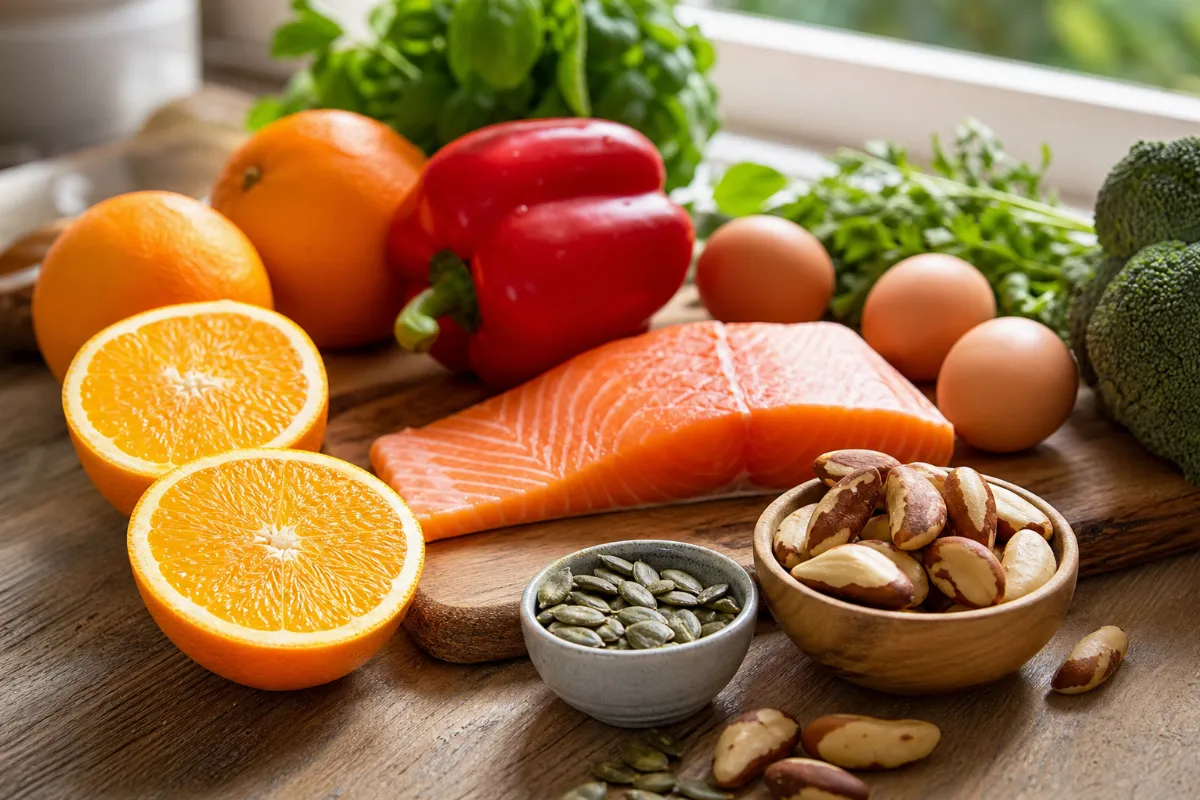
Why it may help: The NHS says adults should be able to get all the vitamin C, zinc, vitamin A and selenium they need from a varied, balanced diet. Vitamin C is found in citrus fruit, peppers, strawberries, blackcurrants, broccoli, Brussels sprouts and potatoes. Zinc is found in meat, shellfish, dairy foods, bread and cereal products. Selenium is found in Brazil nuts, fish, meat and eggs. A review of micronutrients and immunity says each of these has roles in the immune response.
How to apply it: Aim for fruit or vegetables at most meals, a protein food (meat, fish, eggs, beans or dairy) and wholegrain or fortified cereals. Vitamin C cannot be stored, so include a source every day.
Who it may suit: Most healthy adults.
Precautions: This rests on health-agency advice and on the role of these nutrients, not on trials showing food prevents infections. Needs differ in pregnancy, older age and illness; ask a clinician or dietitian.
6,11,1Taking vitamin D when advice says you should
Moderate certaintyAddresses: Prevents a shortage that weakens bones and muscles
Why it may help: The NHS says vitamin D helps regulate calcium and phosphate for bones, teeth and muscles, and that from October to early March people in the UK do not make enough from sunlight. UK government advice is that everyone should consider a daily supplement of 10 micrograms (400 IU) in autumn and winter, and that people who are rarely outdoors, are in care homes, cover most of their skin outdoors or have dark skin should consider one all year. The NHS page was last reviewed in 2020, and advice differs in other countries.
How to apply it: Check the advice for where you live. If you choose a supplement, 10 micrograms a day is enough for most people, according to the NHS. Do not take more than 100 micrograms (4,000 IU) a day as an adult.
Who it may suit: People with little sun exposure, people at higher risk of low levels, and anyone told to by a clinician.
Precautions: The reason for taking it is bone and muscle health. Its effect on infections is mixed (see below). Follow your doctor's advice if it differs. Babies and children have different amounts.
7Checking labels and totals before taking anything extra
Moderate certaintyAddresses: Avoids doubling up and exceeding upper limits
Why it may help: The NHS gives upper limits that apply to all sources of a nutrient: zinc supplements 25 mg a day unless a doctor advises otherwise, because high doses reduce copper absorption and can lead to anaemia and weakened bones; vitamin A 1.5 mg a day from food and supplements combined; vitamin D 100 micrograms (4,000 IU) a day; and vitamin C over 1,000 mg a day can cause stomach pain, diarrhoea and wind. Beta-carotene supplements should stay at or below 7 mg a day unless a doctor advises otherwise.
How to apply it: List every product you take, including multivitamins, immune blends, fish liver oil and fortified products, and compare them with the limits.
Who it may suit: Anyone taking more than one supplement.
Precautions: Limits are for generally healthy adults. A doctor may advise something different for you.
6,7,11,12Amounts and duplicate ingredients → Reading supplement labels →
Asking about a check if you may be short of something
Low certaintyAddresses: Finds a real shortage so it can be treated properly
Why it may help: The NHS says a lack of iron can lead to iron deficiency anaemia, that people with heavy periods are at higher risk, and to speak to a GP or registered dietitian. A micronutrient review says marginal shortage may impair immunity. We did not read a trial testing screening to prevent infections.
How to apply it: Book a visit if you are often tired or ill, follow a very restricted diet, have heavy periods, or have a condition that affects absorption, and ask which tests make sense.
Who it may suit: People with risk factors or symptoms of a shortage.
Precautions: Do not self-treat suspected iron or vitamin B12 shortage with supplements before a check. Iron over 20 mg can cause constipation, nausea and stomach pain, and very high doses can be fatal in children.
8,1Additional options
Taking vitamin C every day (not just when a cold starts)
Moderate certaintyAddresses: Slightly shorter colds
Why it may help: A Cochrane review of placebo-controlled trials (trials using at least 0.2 g a day) found regular vitamin C shortened colds by 8% in adults and 14% in children, and reduced severity, but did not reduce how often people caught colds in the general community (risk ratio 0.97). Taking it only after symptoms began showed no consistent effect on duration or severity.
How to apply it: The benefit is small and shown mainly for daily use over time. The NHS says adults aged 19 to 64 need 40 mg a day, which a normal diet provides.
Who it may suit: Adults and children who get frequent colds and want to test it for themselves.
Precautions: Over 1,000 mg a day can cause stomach pain, diarrhoea and wind, which fade after stopping. Trials used much more than the daily need, and this is not a recommendation to take a particular amount.
2,6Vitamin C for brief periods of heavy physical stress
Low certaintyAddresses: Fewer colds in a few small groups
Why it may help: In five trials with 598 marathon runners, skiers and soldiers on subarctic exercises, colds were roughly halved (risk ratio 0.48). The Cochrane authors say vitamin C may be useful for people exposed to brief periods of severe physical exercise.
How to apply it: Relevant only to unusual extremes of exercise or cold, not to everyday life.
Who it may suit: Athletes and others in short bursts of extreme exertion.
Precautions: Small numbers of participants and a narrow group of people. This does not apply to the general public.
2Zinc lozenges once a cold has started
Low certaintyAddresses: A cold that may end about 2 days sooner, with more mild side effects
Why it may help: In the 2024 Cochrane review, zinc used for treating colds may reduce the average duration by about 2.4 days (mean difference -2.37 days, 972 participants in 8 studies), but certainty is low and results varied widely between studies. Non-serious side effects were probably more common (risk ratio 1.34). The review counted unpleasant taste, loss of smell, vomiting, stomach cramps and diarrhoea.
How to apply it: Trials mostly used zinc gluconate lozenges at 45 to 276 mg of zinc a day for 4.5 to 21 days. Those are study amounts, not recommendations. They are far above the NHS limit of 25 mg a day for zinc supplements, which is the reason to ask a pharmacist before trying.
Who it may suit: Adults who want to try it for a cold that has just started, after checking with a pharmacist.
Precautions: Do not use long term. High zinc reduces copper absorption and can lead to anaemia and weakened bones. Ask first if pregnant, breastfeeding or taking regular medicines. Do not give to children without advice.
5,11Correcting a low vitamin D level
Mixed findingsAddresses: Fewer respiratory infections in people who started very low
Why it may help: A 2017 individual-participant analysis of 25 trials (10,933 participants) found fewer acute respiratory infections overall (odds ratio 0.88), with the strongest effect in people with baseline levels below 25 nmol/L who took vitamin D daily or weekly (odds ratio 0.30). The 2025 update of 40 trials (61,589 participants) did not find that baseline level, age or dose changed the effect and the overall result was not statistically significant (odds ratio 0.94, 95% CI 0.88 to 1.00).
How to apply it: Treating a proven shortage is sound for bones. Whether it also lowers infection risk is uncertain.
Who it may suit: People whose blood test shows a low level, as advised by a clinician.
Precautions: Do not use more than the NHS upper limit unless a doctor tells you to. Long-term excess can cause calcium to build up, which can weaken bones and damage the kidneys and heart.
3,4,7Still being studied
Daily vitamin D in older adults who were not selected for low levels
Low certaintyAddresses: No clear fall in upper respiratory infections
Why it may help: In the VITAL trial (15,804 men aged 50 or over and women aged 55 or over with baseline levels, mean age 68), 2,000 IU of vitamin D3 a day did not significantly change the risk of a recent upper respiratory infection (odds ratio 0.96, 95% CI 0.86 to 1.06). Only 2.4% had very low levels, and the subgroup analyses were limited.
How to apply it: This is a research finding, not a recommendation.
Who it may suit: People already known to be low should follow clinician advice instead.
Precautions: The trial used a self-reported outcome at one year. Do not copy trial amounts without advice.
13Combined multi-nutrient immune formulas
Low certaintyAddresses: Possible small effects; trials too varied to judge
Why it may help: A review of micronutrients and immunity concluded that supplementing with several immune-supporting micronutrients may modulate immune function and reduce infection risk, but said better human trials on dose and combination are needed. Two of its authors work for a multivitamin company. A separate systematic review of 39 randomised trials in healthy people found gaps that prevent firm conclusions.
How to apply it: If you take a multivitamin, check the totals against upper limits and do not add more products on top.
Who it may suit: People with a restricted diet for whom a clinician advises a multivitamin.
Precautions: Duplicated ingredients across products are a common way to exceed limits.
1,9Vitamin C for pneumonia
Not enough evidenceAddresses: Unknown
Why it may help: A 2021 Cochrane review found only five studies (2,655 participants) with very low-certainty evidence and said it is uncertain whether vitamin C helps prevent or treat pneumonia.
How to apply it: Do not use vitamin C in place of medical care for a chest infection.
Who it may suit: No one; this is a research gap.
Precautions: Pneumonia needs medical assessment.
14Food & nutrition
Vitamin C, zinc and vitamin D: where they come from
According to the NHS, vitamin C is found in a wide range of fruit and vegetables, zinc comes mostly from animal foods and cereals, and vitamin D comes from sunlight on skin plus a small number of foods. It also says adults aged 19 to 64 need 40 mg of vitamin C a day, about 9.5 mg of zinc a day for men and 7 mg for women, and 10 micrograms of vitamin D a day. Vitamin C cannot be stored, so it is needed every day.
- Vitamin C: oranges and orange juice, peppers, strawberries, blackcurrants, broccoli, Brussels sprouts and potatoes.
- Zinc: meat, shellfish, dairy foods such as cheese, bread, and cereal products such as wheatgerm.
- Vitamin D: oily fish such as salmon, sardines, trout, herring or mackerel; red meat; egg yolks; fortified foods such as some fat spreads and breakfast cereals. The NHS says to avoid liver in pregnancy.
- In the UK, cow's milk is generally not a good source of vitamin D because it is not fortified; in some other countries it is.
Other nutrients immune cells use
The NHS says vitamin A helps the immune system work properly and keeps the lining of the nose and other areas healthy. Selenium helps the immune system work properly, and iron is needed for red blood cells. A review of micronutrients and immunity lists these among the nutrients with roles in the immune response.
- Vitamin A: cheese, eggs, oily fish, milk and yoghurt; the body also makes it from beta-carotene in leafy greens, carrots, sweet potatoes, red peppers, mango and apricots.
- Selenium: Brazil nuts, fish, meat and eggs. The NHS says people who eat meat, fish or nuts should get all they need from diet.
- Iron: red meat, beans (such as kidney beans and chickpeas), nuts, dried fruit such as apricots, fortified breakfast cereals and soy bean flour. The NHS advises limiting red and processed meat because of the link with bowel cancer.
- Selenium has an upper amount too: the NHS says too much causes selenosis, which in its mildest form can cause loss of hair and nails.
Sun, season and vitamin D
The NHS says that from about late March or early April to the end of September most people in the UK can make the vitamin D they need from sunlight on their skin, but not between October and early March. It says you cannot overdose on vitamin D through sunlight, but you should still cover up or protect your skin if you are outdoors for long periods to reduce the risk of skin damage and skin cancer. Sun strength depends on where you live, so UK advice may not fit other places.
7Food first, supplements second
The NHS repeats for vitamin C, zinc, vitamin A, selenium and iron that most people can get what they need from a varied, balanced diet. We did not read trials showing that any single food or meal pattern prevents infections, so we make no claims about that here. Supplements are for a defined reason such as a diagnosed shortage or advised winter vitamin D, not as a general insurance policy.
6,11,8Remedies & supplements
Traditional use, laboratory findings and human trials are kept apart. "Natural" does not mean safe.
Vitamin C supplements
Moderate certaintyStudied form and route: Tablets, capsules, powders, fizzy drinks
Intended outcome: Slightly shorter colds with regular use; no reduction in how many colds most people catch
Human evidence: The Cochrane review pooled 29 trial comparisons (11,306 participants). Regular use shortened colds by 8% in adults and 14% in children, did not reduce colds in the general community (risk ratio 0.97), and halved colds in 598 marathon runners, skiers and soldiers on subarctic exercises. Taking it only once symptoms began showed no consistent effect. For pneumonia, a Cochrane review found the evidence too weak to judge.
Traditional use: We did not review traditional use for this nutrient.
Laboratory findings: We did not review laboratory studies for this page; our focus is human trials and health-agency advice.
Limits: Trials used at least 0.2 g a day, far above the NHS intake of 40 mg. Results in the general public are small. Starting it after a cold begins was not supported.
Interactions and precautions: Over 1,000 mg a day can cause stomach pain, diarrhoea and wind, which fade after stopping. Ask a pharmacist if you take regular medicines or have kidney problems.
Dose, only as reported in studies: The NHS says adults aged 19 to 64 need 40 mg a day from diet, and that under 1,000 mg a day of supplements is unlikely to cause harm.
2,6,14Vitamin D supplements
Mixed findingsStudied form and route: Tablets, capsules, drops
Intended outcome: Prevents shortage; effect on infections is mixed
Human evidence: A 2017 individual-participant analysis (25 trials, 10,933 participants) found fewer respiratory infections (odds ratio 0.88), strongest in those starting below 25 nmol/L. A 2025 update (40 trials, 61,589 participants) found the overall effect no longer statistically significant (odds ratio 0.94, 95% CI 0.88 to 1.00). In VITAL (15,804 older adults), 2,000 IU a day did not significantly change upper respiratory infection (odds ratio 0.96).
Traditional use: We did not review traditional use for this nutrient.
Laboratory findings: We did not review laboratory studies for this page; our focus is human trials and health-agency advice.
Limits: The trials differ in dose, schedule and population. Evidence for COVID-19 is not strong enough, according to the NHS.
Interactions and precautions: Long-term excess can cause calcium to build up, which can weaken bones and damage the kidneys and heart. Some medical conditions mean you may not be able to safely take as much, so ask your doctor.
Dose, only as reported in studies: UK government advice (NHS): 10 micrograms (400 IU) a day for adults and children from age 1 where a supplement is advised; do not exceed 100 micrograms (4,000 IU) a day for adults; 50 micrograms (2,000 IU) for ages 1 to 10; 25 micrograms (1,000 IU) for infants. If your doctor recommends a different amount, follow it.
3,4,13,7Zinc lozenges and supplements
Low certaintyStudied form and route: Lozenges, tablets, syrups, nasal products
Intended outcome: May shorten a cold already under way; little or no help preventing colds
Human evidence: The 2024 Cochrane review (34 studies, 8,526 participants) found zinc may have little or no effect on preventing colds (risk ratio 0.93, low certainty). For treatment, the average cold may be about 2.4 days shorter (low certainty, very varied results). Non-serious side effects were probably more common (risk ratio 1.34), including an unpleasant taste, loss of smell, vomiting, stomach cramps and diarrhoea.
Traditional use: We did not review traditional use for this nutrient.
Laboratory findings: We did not review laboratory studies for this page; our focus is human trials and health-agency advice.
Limits: Studies varied widely in zinc form, route and amount. Most lozenge studies used 45 to 276 mg of zinc gluconate a day for 4.5 to 21 days. The review did not test long-term use.
Interactions and precautions: The NHS says high doses reduce copper absorption and can lead to anaemia and weakened bones. Ask a pharmacist before use if pregnant, breastfeeding, giving it to a child, or taking regular medicines. Loss of smell was among the side effects the review counted; stop and ask a pharmacist if it happens.
Dose, only as reported in studies: The NHS says do not take more than 25 mg of zinc supplements a day unless advised by a doctor. The lozenge studies used much more, so these are study amounts, not a recommendation.
5,11Selenium and vitamin A supplements
Not enough evidenceStudied form and route: Tablets, capsules, fish liver oil
Intended outcome: Needed for normal immune function, but supplements are not shown to prevent infection
Human evidence: The NHS says selenium and vitamin A both help the immune system work properly, and most people get enough from food. The 39-trial systematic review included vitamin A among its ingredients and could not make firm statements about benefit in healthy people.
Traditional use: We did not review traditional use for this nutrient.
Laboratory findings: We did not review laboratory studies for this page; our focus is human trials and health-agency advice.
Limits: We did not read trial results specific to selenium for infections. The review found gaps that prevent firm conclusions.
Interactions and precautions: Too much selenium causes selenosis (hair and nail loss in its mildest form); the NHS says 350 micrograms a day or less of supplements is unlikely to cause harm. Vitamin A over 1.5 mg a day long term may affect bones, and liver and liver pate should be avoided in pregnancy.
11,12,9Multivitamin and immune-formula products
Low certaintyStudied form and route: Tablets, gummies, powders
Intended outcome: May cover gaps in a restricted diet; benefit for infections is unproven
Human evidence: A review of micronutrients and immunity found that multi-micronutrient supplementation may modulate immune function and reduce infection risk, although data are contradictory and two authors work for a multivitamin company. The 39-trial systematic review found gaps that preclude firm conclusions.
Traditional use: We did not review traditional use for this nutrient.
Laboratory findings: We did not review laboratory studies for this page; our focus is human trials and health-agency advice.
Limits: Combinations vary, and trials were not designed to test the specific products sold.
Interactions and precautions: Check totals against upper limits and avoid taking a second product with the same ingredients. Ask a pharmacist if you take medicines or are pregnant.
1,9Therapies & care
A doctor, pharmacist or registered dietitian can help you work out whether you are short of anything, which products are safe alongside your medicines, and whether repeated infections need investigation. Medicines for specific conditions are for a clinician to decide, and you should never stop a prescribed medicine on your own.
Review with a doctor or pharmacist
Not enough evidenceProfessional care They can look at your diet, medicines and symptoms, suggest tests if a shortage or another cause is likely, and check supplement totals and interactions.
Who it may suit: Anyone who is often ill or tired, takes regular medicines, is pregnant or breastfeeding, or is thinking of taking several products.
Precautions: Bring a list of every supplement and medicine. Do not stop a prescribed medicine on your own.
8,10Talking with a health professional → Medication interactions →
Registered dietitian advice
Not enough evidenceNutrition counselling The NHS suggests speaking with a GP or a registered dietitian about iron and diet. A dietitian can help with restricted diets, poor appetite or increased needs.
Who it may suit: People who avoid whole food groups, have a poor appetite or have a condition that affects absorption.
Precautions: Look for a registered professional. We did not read trials testing dietitian advice for infection outcomes.
8Vaccination and infection prevention
Not enough evidencePreventive care Vaccination and hygiene are covered on our linked page. Nutrients and supplements are not a substitute for them.
Who it may suit: Everyone, following local health-agency schedules.
Precautions: Talk to a clinician about which vaccines apply to you, especially if pregnant, older, or immunocompromised.
10What to avoid
Habits, products and claims that can get in the way. Never stop a prescribed medicine without talking to the professional who prescribed it.
Risks that apply to most people
Going over the upper limits
Moderate certaintyWhy: The NHS says high zinc doses reduce copper absorption, which can lead to anaemia and weakened bones; long-term excess vitamin D causes calcium build-up that can weaken bones and damage kidneys and heart; over 1,000 mg of vitamin C a day can cause stomach pain, diarrhoea and wind; and a long-term average above 1.5 mg of vitamin A a day may affect bones. Iron over 20 mg can cause constipation, nausea and stomach pain.
Who it applies to: Anyone taking supplements, especially several products.
Try instead: Stay at or below the NHS limits for zinc (25 mg a day), vitamin D (100 micrograms, 4,000 IU), and vitamin A (1.5 mg, from food and supplements combined), and add up every product. Ask a doctor if you think you need more.
11,7,6,12,8Stacking several products with the same ingredients
Moderate certaintyWhy: The NHS notes many multivitamins contain vitamin A, and fish liver oil is also high in vitamin A. Immune blends often combine vitamin C, D and zinc with other nutrients, so doses add up.
Who it applies to: People who take a multivitamin plus a separate immune product.
Try instead: Choose one product at a time, and show your list to a pharmacist.
12,9Personal triggers to check
Beta-carotene supplements if you smoke or have had asbestos exposure
Moderate certaintyWhy: The NHS says beta-carotene from food is not shown to be harmful, but supplements have been found to increase the risk of lung cancer in people who smoke or have been heavily exposed to asbestos at work, and that these people are advised not to take any beta-carotene supplements.
Who it applies to: Current or past smokers and people with asbestos exposure.
Try instead: Get beta-carotene from yellow, red and green vegetables and orange fruit.
11Vitamin A from liver or high-dose supplements, in pregnancy and in older adults
Moderate certaintyWhy: The NHS says to avoid liver and liver products such as pate in pregnancy, to limit them to once a week otherwise, and that a long-term average above 1.5 mg of vitamin A a day may make bones more likely to fracture, especially in older people at risk of osteoporosis.
Who it applies to: Pregnant women, postmenopausal women and older men, and regular liver eaters.
Try instead: Get vitamin A from eggs, dairy, oily fish and beta-carotene-rich vegetables, and ask a clinician before taking vitamin A supplements.
12Taking zinc supplements for a long time
Moderate certaintyWhy: The NHS says high doses of zinc reduce the amount of copper the body can absorb, which can lead to anaemia and weakening of the bones.
Who it applies to: Anyone using zinc products beyond a short course.
Try instead: Use zinc only briefly for a cold if at all, and keep the total below 25 mg a day unless a doctor advises otherwise.
11Products that need caution
Immune-booster blends and megadose packs
Not enough evidenceWhy: A systematic review of 39 randomised trials in healthy people found specific gaps that prevent firm statements about benefit for eight popular ingredients. Blends can contain several ingredients at once, which makes it hard to check limits or interactions.
Who it applies to: Anyone tempted by products promising to boost immunity.
Try instead: Spend on food first. If you want a supplement, choose a single, clearly labelled ingredient for a defined reason and check the label.
9High-dose vitamin C fizzy tablets and powders
Low certaintyWhy: The NHS says taking more than 1,000 mg a day can cause stomach pain, diarrhoea and wind. Regular use shortened colds only slightly in trials, and the review found no reduction in how many colds people caught in the general community.
Who it applies to: People taking vitamin C to try to avoid colds.
Try instead: If you want to try vitamin C, ask a pharmacist and keep the amount modest.
6,2Unsupported claims
"Vitamin C prevents colds"
Evidence againstWhy: A Cochrane review found regular vitamin C did not reduce the chance of catching a cold in the general community (risk ratio 0.97). Colds were fewer only in marathon runners, skiers and soldiers on subarctic exercises. The NHS says there is little evidence that vitamin C prevents colds or speeds recovery.
Who it applies to: General public.
Try instead: Eat a varied diet; if you want to test vitamin C, expect a small effect on cold length at most.
2,10"Vitamin D protects you from infections and COVID-19"
Mixed findingsWhy: The 2025 update of 40 trials found the overall effect on respiratory infection was not statistically significant. The NHS says there is not enough evidence to support taking vitamin D solely to prevent or treat COVID-19.
Who it applies to: People who are not known to be low in vitamin D.
Try instead: Take vitamin D for bone health as advised, and do not treat it as a shield.
4,7"Zinc stops or cures colds"
Low certaintyWhy: The 2024 Cochrane review found zinc may have little or no effect on preventing colds, and may shorten colds already under way with low certainty, with more non-serious side effects.
Who it applies to: People looking for a quick cold fix.
Try instead: Rest, fluids and symptom care are the main steps; zinc lozenges are optional and have side effects.
5"The more, the better"
Evidence againstWhy: Each of these nutrients has an upper limit above which harm is possible (see the NHS limits above), and the trials do not show larger amounts give larger protection.
Who it applies to: Anyone who thinks a bigger amount means more protection.
Try instead: Stay within the limits and focus on diet.
11,7,6Common mistakes
Waiting until you are ill to start vitamin C
Moderate certaintyWhy: In the Cochrane review, regular daily use shortened colds, but starting after symptoms began showed no consistent effect on duration or severity.
Who it applies to: People who take vitamin C only at the first symptom.
Try instead: If you try it at all, treat it as an experiment with modest expectations.
2Guessing at a shortage instead of checking
Low certaintyWhy: Symptoms such as tiredness or frequent colds can have many causes, including iron or vitamin B12 shortage and conditions that need medical care. A supplement may hide the real problem.
Who it applies to: People who are often tired or ill.
Try instead: Ask a clinician which tests are sensible before starting high-dose products.
8Using supplements in place of medical care or vaccination
Evidence againstWhy: The NHS says there is little evidence that vitamin C, echinacea or garlic prevent colds or help recovery, and lists signs that need a GP, such as a high temperature for more than 3 days or symptoms not improving after 10 days.
Who it applies to: Anyone who feels unwell for longer than a few days.
Try instead: Use supplements, if at all, alongside the care and prevention steps your clinician recommends.
10Evidence & safety
What the research shows
Vitamin C, vitamin D and zinc are needed for normal health, and correcting a real shortage is sensible. For cold prevention in the general public the evidence is weak or negative: regular vitamin C did not reduce colds except in a few extreme-exercise groups, the 2025 vitamin D update was not statistically significant, and zinc may have little or no effect on prevention. Regular vitamin C slightly shortened colds, and zinc lozenges may shorten colds already under way, but with low certainty and more side effects. Upper limits exist for each nutrient.
Limits of the evidence
- Most prevention trials were in the general public, not people known to be low in a nutrient, so results may differ for those with a shortage.
- Zinc studies varied greatly in form and dose, and certainty was low for treatment.
- We read abstracts and health-agency pages, not full texts, so our certainty labels are our own reading.
- The NHS pages used for amounts were last reviewed in August 2020 and were due for review in 2023. Advice differs between countries.
- We did not read results for vitamin E, selenium or iron on infection outcomes, so we make no claims about them beyond the NHS role and limit statements.
- One micronutrient review was written by authors linked to a multivitamin company.
Precautions and interactions
- Do not exceed the upper limits: zinc supplements 25 mg a day, vitamin D 100 micrograms (4,000 IU) a day, vitamin A 1.5 mg a day from all sources.
- Do not use supplements as a replacement for vaccination, medical care or prescribed medicines.
- Ask a pharmacist before starting anything if you take regular medicines, are pregnant or breastfeeding, have kidney problems, or have an immune or autoimmune condition. Immune-targeted supplements may interact with treatment or worsen autoimmune disease.
- Do not give supplements to babies and children without health-professional advice; the NHS gives separate vitamin D amounts for them.
Life-stage considerations
- Pregnancy and breastfeeding: the NHS says to avoid liver and liver products because of vitamin A, and recommends the same 10 micrograms of vitamin D a day. Ask a midwife or doctor before other supplements.
- Babies and children: the NHS gives specific vitamin D advice, with lower upper limits (50 micrograms a day for ages 1 to 10, 25 micrograms for infants). Do not give zinc or vitamin C supplements without advice.
- Older adults: vitamin D and iron needs and risks differ, vitamin A over 1.5 mg a day may affect bones, and medicine interactions are more likely. Ask a pharmacist.
- People with kidney disease, immune conditions, or on regular medicines: check with a clinician before any supplement.
Warning signs
- A high temperature lasting more than 3 days, symptoms that get worse, shortness of breath or chest pain, or no improvement after 10 days: see a doctor.
- High fever with a stiff neck or rash, confusion, trouble breathing or signs of dehydration, or any serious illness in a baby, older adult, pregnant woman or someone with a weakened immune system: get urgent care.
- Repeated or unusually severe infections: book a medical check.
- Digestive upset, loss of smell or other new symptoms after starting a supplement: stop and ask a pharmacist or doctor.
Claim checks
Vitamin C prevents colds.
Not supported in the general public
2,10Vitamin C shortens colds.
Slightly, with regular use
2Vitamin D prevents respiratory infections.
Mixed
3,4Vitamin D prevents or treats COVID-19.
Not enough evidence
7Zinc lozenges cure a cold.
May shorten, low certainty
5Supplements can boost your immune system.
Not proven
9Vitamin C helps prevent or treat pneumonia.
Unknown
14Questions people ask
Does vitamin C prevent colds?
Not in the general population, according to a Cochrane review, though colds were roughly halved in people under brief heavy physical stress such as marathon runners. Regular daily use shortened colds slightly (8% in adults, 14% in children).
Does vitamin D prevent respiratory infections?
Results are mixed. A 2017 meta-analysis found a reduction, strongest in people with very low levels, while a 2025 update of 40 trials found the overall effect just missed statistical significance. The main reason to take it is bone and muscle health.
Do zinc lozenges shorten a cold?
A 2024 Cochrane review found zinc may shorten colds already under way by about 2 days, with low certainty and more non-serious side effects such as an unpleasant taste or nausea. It found little or no effect on preventing colds.
What is the safe upper limit?
The NHS advises not exceeding 25 mg of zinc supplements and 4,000 IU (100 micrograms) of vitamin D a day for adults unless a doctor advises otherwise. It says over 1,000 mg of vitamin C a day can cause digestive upset, and that vitamin A from food and supplements together should stay under 1.5 mg a day.
Should I take vitamin D in winter?
UK government advice is that everyone should consider a 10 microgram (400 IU) supplement from autumn to early spring, and that some groups, such as people rarely outdoors or with dark skin, should consider it all year. Advice differs elsewhere, so ask a pharmacist or clinician.
Can I get everything I need from food?
For vitamin C, zinc, vitamin A, selenium and iron, the NHS says most adults can get what they need from a varied, balanced diet. Vitamin D is harder, because few foods contain much and sunlight is weak in winter at northern latitudes.
Are immune-booster supplements worth it?
A systematic review of 39 trials in healthy people could not make firm statements about benefit for the ingredients commonly sold for immunity. Blends also make it easy to exceed limits.
Is vitamin C safe in large amounts?
The NHS says under 1,000 mg a day is unlikely to cause harm, and that more can cause stomach pain, diarrhoea and wind, which settle after stopping.
Should I take zinc every day?
The NHS says to avoid more than 25 mg of zinc supplements a day unless a doctor advises, because high doses reduce copper absorption and can cause anaemia and weakened bones. Zinc lozenges in studies were used briefly for colds, not as a daily habit.
I keep getting sick. Will these nutrients fix it?
Not necessarily. Frequent infections can have causes that need a medical check, such as iron or vitamin B12 shortage or an immune condition. See our page on getting sick often and speak to a doctor.
Can I take these while pregnant or on medicines?
Ask a midwife, doctor or pharmacist first. In pregnancy the NHS advises avoiding liver and liver products because of vitamin A, and some supplements can interact with medicines or affect conditions such as kidney disease.
References
- Gombart AF, Pierre A, Maggini S. A review of micronutrients and the immune system: working in harmony to reduce the risk of infection. Nutrients. 2020. PMID 31963293. PubMed abstract read 2026-10-31. Two authors are employed by a multivitamin maker. source
- Hemila H, Chalker E. Vitamin C for preventing and treating the common cold. Cochrane Database Syst Rev. 2013. PMID 23440782. PubMed abstract read 2026-10-31. source
- Martineau AR, et al. Vitamin D supplementation to prevent acute respiratory tract infections: systematic review and meta-analysis of individual participant data. BMJ. 2017. PMID 28202713. PubMed abstract read 2026-10-31. source
- Jolliffe DA, et al. Vitamin D supplementation to prevent acute respiratory infections: systematic review and meta-analysis of stratified aggregate data. Lancet Diabetes Endocrinol. 2025. PMID 39993397. PubMed abstract read 2026-10-31. source
- Nault D, et al. Zinc for prevention and treatment of the common cold. Cochrane Database Syst Rev. 2024. PMID 38719213. PubMed abstract read 2026-10-31. source
- NHS. Vitamin C (page last reviewed 3 August 2020; next review due 3 August 2023). Read 2026-10-31. source
- NHS. Vitamin D (UK government advice; page last reviewed 3 August 2020; next review due 3 August 2023). Read 2026-10-31. source
- NHS. Iron (page last reviewed 3 August 2020). Read 2026-10-31. source
- Crawford C, et al. Select dietary supplement ingredients for preserving and protecting the immune system in healthy individuals: a systematic review. Nutrients. 2022. PMID 36364865. PubMed abstract read 2026-10-31. source
- NHS. Common cold. Read 2026-10-31. source
- NHS. Other vitamins and minerals, including zinc, selenium and beta-carotene (page last reviewed 3 August 2020). Read 2026-10-31. source
- NHS. Vitamin A (page last reviewed 3 August 2020). Read 2026-10-31. source
- Camargo CA Jr, et al. Effect of daily vitamin D supplementation on risk of upper respiratory infection in older adults: a randomized controlled trial. Clin Infect Dis. 2024. PMID 38113446. PubMed abstract read 2026-10-31. source
- Padhani ZA, et al. Vitamin C supplementation for prevention and treatment of pneumonia. Cochrane Database Syst Rev. 2021. PMID 34791642. PubMed abstract read 2026-10-31. source
Related on AlternativeMed
Related goals
Support Normal Immune Function → Build Everyday Immune-Supportive Habits → Prepare for Cold & Flu Season → Reduce Your Risk of Common Infections → Understand Why You Keep Getting Sick → Support Recovery From Common Illness → Return to Your Routine After Illness → Support Energy Through Nutrition →
Ingredients, foods and supplements
Vitamin C → Vitamin D → Zinc → Vitamin A → Selenium → Iron → Pumpkin seeds → Echinacea →
Research, safety and claim-check resources
Immune wellness safety and when to get help → Immune wellness research and evidence → How the immune system works → Echinacea, elderberry, garlic and mushrooms for immunity → Cough and sore throat remedies → Amounts and duplicate ingredients → Reading supplement labels → Medication interactions → Talking with a health professional →