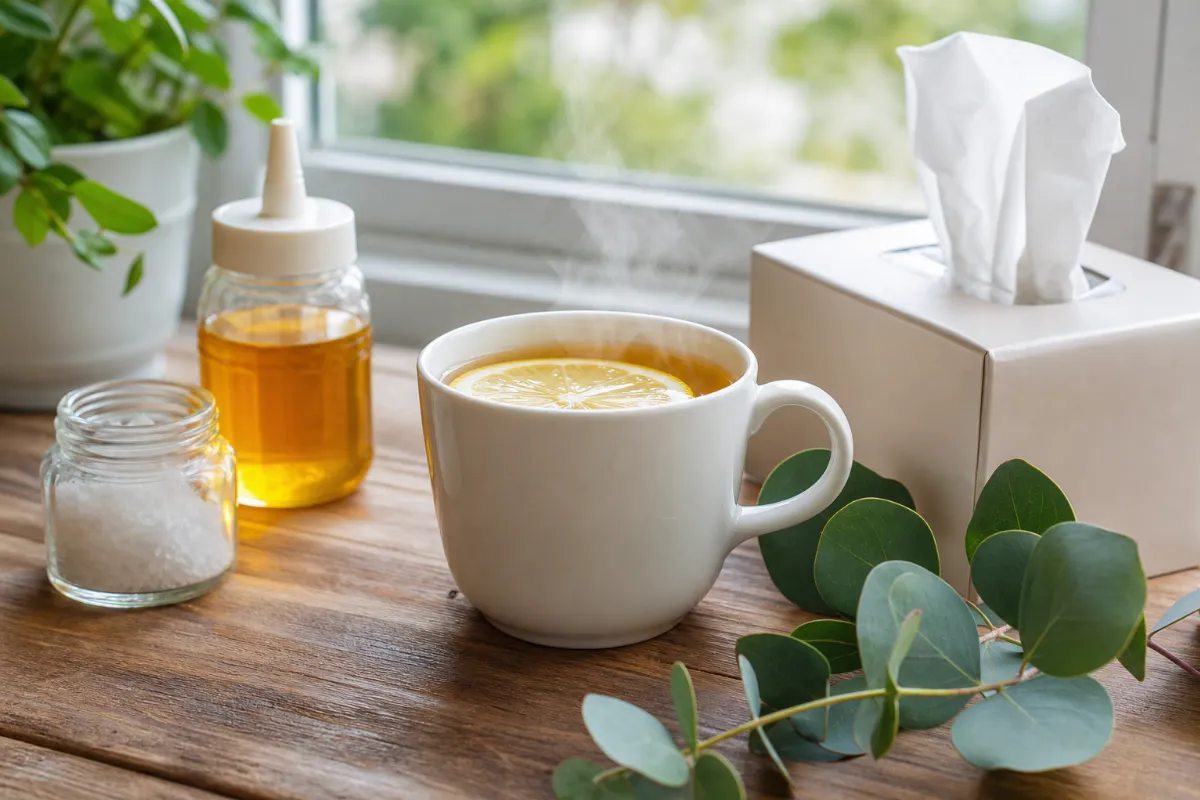
Breathe Easier
Manage Nasal Congestion
A blocked or stuffy nose is usually a short-lived part of a cold, an allergy or a sinus infection, and a few simple, well-checked steps can make it more comfortable while it passes. This page is about easing congestion itself and knowing when it needs a clinician; allergy season, indoor air, irritants and recovery after illness have their own pages.
General information, not medical advice. Last updated November 1, 2026. Written by the AlternativeMed editorial team. Not medically reviewed.
Start here
- If you try a saltwater rinse, use only distilled, sterile or previously boiled and cooled water, never straight tap water, and keep the device clean and dry between uses.
- Rest, drink plenty of fluids and, if you smoke, try not to: the NHS lists all three as part of looking after yourself with a cold or sinus infection.
- Note how long the blockage has lasted and what comes with it. Most colds ease in 1 to 2 weeks; a blocked nose that lasts longer, is on one side only, or comes with a loss of smell is worth a check.
Be careful with
- Do not use decongestant nasal sprays or drops for longer than the label allows. The NHS says no more than 5 days, because longer use can make a blocked nose worse.
- Do not rinse your nose with plain tap water. The FDA says tap water is not adequately filtered or treated for this and can carry organisms that cause serious, rarely fatal, infections.
- Check with a pharmacist before using decongestants of any kind if you are pregnant or breastfeeding, have high blood pressure, heart disease, diabetes, glaucoma, thyroid problems or an enlarged prostate, or take other medicines. Do not give them to children under 6, and do not let children breathe steam from a bowl of hot water.
Get help when
- Cold symptoms that do not get better after 10 days, a high temperature for more than 3 days, symptoms that get worse, or shortness of breath or chest pain (NHS common cold page).
- Sinus symptoms that do not improve after 7 days of pharmacy or GP treatment, or after 3 weeks of treating them yourself; sinus problems that keep coming back; or symptoms on one side of the face only (NHS sinusitis page).
- Feeling very unwell, painkillers not helping, or symptoms getting worse with sinus pain, especially if your immune system is weakened (for example during chemotherapy): the NHS says to get an urgent GP appointment or call 111 in the UK. Elsewhere, use your local urgent-care or emergency service.
- A blocked nose with a reduced sense of smell or taste, snoring and mucus dripping down the back of the throat that does not clear (possible nasal polyps), or any child or baby you are worried about.
About Manage Nasal Congestion
What this goal means
Nasal congestion is the feeling of a blocked, stuffy or full nose. The NHS lists a blocked or runny nose as the main symptom of a cold and also of sinusitis, where swelling of the lining of the sinuses stops mucus draining and makes you feel blocked up.
This goal is about easing that blocked feeling safely and knowing when it points to something that needs care. It is not about preventing colds or allergies, which have their own pages.
1,2What it can feel like
People describe breathing through the mouth, a heavy face or pressure around the cheeks, eyes and forehead, a reduced sense of smell, a nasal-sounding voice, snoring and poor sleep. The NHS also lists a feeling of pressure in the ears and face as a cold symptom.
Young children may be irritable, breathe through the mouth and have difficulty feeding or sleeping when they have a cold.
1,2What can cause it
Common causes are colds (viruses), sinusitis, which often follows a cold or flu, and allergic rhinitis, caused by things like pollen, house dust mites, pet dander, mould and some workplace dusts. The NHS notes non-allergic rhinitis can come from colds, very hot or cold temperatures and humidity.
Nasal polyps, soft painless growths inside the nose, can also block the nose and, unlike a cold, do not get better unless treated. The NHS says it is not clear what causes them, but asthma and aspirin sensitivity raise the risk.
1,2,3,4Conditions to know about
A cold usually clears in 1 to 2 weeks. Sinusitis usually clears on its own within 4 weeks, and the NHS says it is usually caused by a virus rather than bacteria. Allergic rhinitis comes on within minutes of contact with the trigger. Congestion that lasts for months, or keeps returning, may be chronic rhinosinusitis or polyps and should be assessed.
Blocked-nose breathing can also be part of broken sleep. If you snore loudly, gasp or stop breathing in your sleep, see the sleep apnea page rather than assuming it is only your nose.
1,2,3,4Realistic expectations
Nothing in our sources clears a cold or sinus infection quickly. The research we read shows small or uncertain relief from most self-care measures: saltwater rinsing, steam, decongestant sprays and warm drinks each helped some people a little in some studies, and the trials were usually small. The aim is comfort and sleep while your body recovers.
Mild congestion with a cold or sinus infection often needs only self-care. Congestion that does not follow the usual pattern is a reason to get checked, not to keep trying more products.
5,6,7,8Who this applies to
Most adults and older children with a cold, sinus infection or allergy. Babies, young children, pregnant or breastfeeding people, older adults, people with long-term heart, lung, kidney or immune conditions, and people on regular medicines have extra cautions; those appear throughout this page.
The NHS advises seeing a GP if you get cold symptoms and have a long-term medical condition such as diabetes or a heart, lung or kidney condition, or a weakened immune system.
1,9Related conditions and symptoms
Sleep apnea → Allergies vs colds → Colds, flu and respiratory infections →
A manageable starting plan
An educational starting point, not a personal prescription. Adjust it to your own situation and any advice from your clinician.
Your first actions
- Start with safe saline (if you rinse) and fluids, rest, and avoiding smoke for the first few days.
- Choose one thing at a time and keep notes on how your nose feels in the evening and at night.
- If you use a decongestant spray or drops, set an end date from the label (no more than 5 days per the NHS) before you start.
Optional additions
- Sit in a steamy bathroom, sip a warm drink, or try a menthol lozenge for a short sensory lift.
- Try a nasal strip at night if the blockage is mostly then.
What to track
- Day it started, fever, side with the blockage, sense of smell, sleep quality, what you used and how long.
- Anything that sets it off: pollen, pets, dust, damp, smoke, or a workplace exposure.
When to reassess
If a cold has not improved by 10 days, or sinus symptoms by 7 days of pharmacy treatment or 3 weeks of self-care, or the blockage keeps returning, book a clinician visit rather than adding more products.
When to seek professional support
- Ask a pharmacist first if you are pregnant, breastfeeding, older, on regular medicines or caring for a young child.
- See a GP for one-sided blockage, loss of smell, lasting polyps-type symptoms, or recurring sinus infections.
What helps
Ordered by how well the research supports each step. Evidence strength is shown on every card; precautions sit next to the advice.
Start here
A saltwater rinse or spray, made with safe water
Low certaintyAddresses: May ease a blocked nose and loosen thick mucus
Why it may help: Cochrane reviews of small trials found nasal saline irrigation possibly eased symptoms of acute upper respiratory infections (King 2015), allergic rhinitis (Head 2018: low-quality evidence of a large effect up to 3 months) and chronic rhinosinusitis (Chong 2016: some benefit from daily large-volume rinsing). The FDA says rinsing can remove dust, pollen and other debris and loosen thick mucus, and that nasal irrigation devices are usually safe and effective when used and cleaned properly.
How to apply it: Use distilled or sterile water, or tap water that has been boiled for 3 to 5 minutes and cooled to lukewarm (the FDA says it can be stored in a clean, closed container for 24 hours), or water passed through a filter designed to trap infectious organisms. The NHS gives a home recipe using cooled boiled water; follow the device instructions and wash and dry the device after each use.
Who it may suit: Most adults, and children if a paediatrician recommends it. Spray bottles give a fine mist that moisturises; irrigation devices flush better (FDA).
Precautions: Never use plain tap water. People with a weakened immune system should ask a health care provider first. Nosebleeds and mild nasal irritation were the side effects reported; in the one trial of daily large-volume rinsing, 23% of the saline group had side effects including nosebleeds. The NHS says home salt-water washes are not suitable for children.
10,5,6,11,2,4Rest and plenty of fluids
Not enough evidenceAddresses: Helps you cope while a cold or sinus infection runs its course
Why it may help: The NHS advises resting and drinking lots of fluid, such as water, to avoid dehydration, when you have a cold or sinusitis. We did not find trials showing that extra fluids clear congestion itself, so this is agency self-care advice rather than tested relief.
How to apply it: Keep a drink within reach through the day and rest when you can. Small children may lose their appetite for a few days; keep offering fluids.
Who it may suit: Anyone with a cold or sinus infection.
Precautions: If you have a heart or kidney condition on a fluid limit, follow your clinician's advice about how much to drink.
1,2Notice how long it lasts and what comes with it
Not enough evidenceAddresses: Helps you tell a cold from something that needs care
Why it may help: The NHS gives timelines: colds usually ease in 1 to 2 weeks, sinusitis within 4 weeks, nasal polyps do not clear without treatment, and allergic rhinitis flares within minutes of contact with a trigger. A simple note of days, fever, one-sided blockage and sense of smell makes a clinician visit more useful.
How to apply it: Write down the day it began, any fever, whether one side is worse, any change in smell, and what seems to bring it on or ease it.
Who it may suit: Anyone whose blocked nose is lasting or returning.
Precautions: This is a tracking habit, not a diagnosis; it does not replace a check.
1,2,4,3Additional options
A short course of a decongestant nasal spray or drops (a medicine class a pharmacist advises on)
Low certaintyAddresses: Quick, short-lived opening of a blocked nose
Why it may help: A Cochrane review of 15 trials (1,838 mostly adult participants) found repeated doses of nasal decongestants may have a small positive effect on how blocked the nose feels in a cold, from low-quality evidence, with no difference in short-term side effects; children were not well studied. The NHS says decongestants work by reducing swelling inside the nose and sinuses.
How to apply it: Follow the leaflet. The NHS says not to use decongestant sprays or drops for more than 5 days (one NHS page says a week), and not to use more than one decongestant at a time because many cough and cold products contain them.
Who it may suit: Adults with a cold or allergy-related blockage who need relief for sleep.
Precautions: The NHS says to speak to a GP or pharmacist first if you have high blood pressure, heart disease, diabetes, glaucoma, thyroid problems or an enlarged prostate, are breastfeeding or take other medicines, and not to use decongestants if you are pregnant. Decongestants should not be used by children under 6. Rebound blocking after long use is debated (see Claim checks), so keep to the label.
8,9,1A warm drink
Low certaintyAddresses: May make breathing through the nose feel easier for a while and ease other cold symptoms
Why it may help: In a small study of 30 people with colds or flu, a hot fruit drink did not change measured nasal airflow but improved how clear the nose felt and eased a runny nose, cough, sneezing, sore throat, chilliness and tiredness; the same drink at room temperature helped fewer symptoms. The authors discuss placebo and effects on secretions as possible reasons.
How to apply it: Sip a warm, tasty drink. For a sore throat, the NHS suggests a hot lemon and honey drink.
Who it may suit: Adults and older children with a cold.
Precautions: Do not give hot drinks to small children. Do not give honey to a child under 12 months old (NHS).
12,1Steam from a hot shower
Very low certaintyAddresses: Brief feeling of relief for some people
Why it may help: The NHS suggests sitting in the bathroom with a hot shower running to ease a blocked nose. A Cochrane review of six small trials (387 people) of heated, humidified air for colds could not tell whether it helps, found no difference in viral shedding, and reported minor nose irritation in some studies, so the evidence is weak.
How to apply it: Sit in a steamy bathroom for a few minutes with the shower running; you do not need to put your face over hot water.
Who it may suit: Adults and older children who find it soothing.
Precautions: Do not let children breathe in steam from a bowl of hot water: the NHS warns of scalding.
1,7Still being studied
A menthol lozenge for the feeling of airflow
Low certaintyAddresses: May make the nose feel more open without changing how open it is
Why it may help: In a randomised, double-blind trial of 62 people with a cold, a menthol lozenge improved the sensation of nasal airflow within 10 minutes compared with a candy lozenge, but measured resistance to airflow did not change.
How to apply it: The studied form was a single menthol lozenge sucked for relief; we do not give amounts.
Who it may suit: Adults who want a short-term sensory effect.
Precautions: Menthol changes sensation, not the swelling itself. Ask a pharmacist before using menthol products on babies or young children.
13An external nasal strip at night
Low certaintyAddresses: May improve breathing and sleep for people with night-time blockage
Why it may help: In an exploratory 28-day study of 70 adults with chronic night-time nasal congestion, a nasal dilator strip improved ease of breathing and sleep as they rated it, and lowered nasal resistance during sleep by about 39% in a crossover part, but sleep-lab measures were generally similar with and without it. The study was funded by a consumer-health company and had no placebo group in the main phase.
How to apply it: The strip is applied across the bridge of the nose at bedtime.
Who it may suit: Adults whose blockage is mainly at night.
Precautions: Peel it off gently; stop if the skin is irritated. Persistent night-time blockage or loud snoring needs a check.
14Chicken soup
Very low certaintyAddresses: May have a mild anti-inflammatory effect in the laboratory
Why it may help: A laboratory study found a traditional chicken soup slowed the movement of white blood cells in a dish. We did not find a human trial showing it clears congestion, so this is a laboratory finding only.
How to apply it: Eating warm soup is comfortable and keeps fluids up; do not expect it to treat the blockage.
Who it may suit: Anyone who enjoys it.
Precautions: Soups can be high in salt; check if you limit sodium.
15Food & nutrition
Fluids and warm drinks
The NHS advises drinking lots of fluid, such as water, with a cold to avoid dehydration, and eating healthy food; it is common for small children to lose their appetite for a few days.
A warm drink made some people with colds feel their nose was clearer in a small trial, though it did not change measured airflow. For a sore throat, the NHS suggests a hot lemon and honey drink; honey is not for children under 12 months, and hot drinks are not for small children.
- Water, plain or warm
- Warm lemon and honey drink for a sore throat (not under 12 months for honey)
- Clear soups and broths
Soup, spice and "mucus" foods
A laboratory study found chicken soup slowed white-cell movement, but we did not find a human trial showing it clears congestion. We also did not find good human trials showing that chilli, horseradish or garlic clear a blocked nose; any effect is brief and unproven, and the NHS says there is little evidence garlic helps colds.
We did not find a reliable source showing that cutting out a food group such as dairy reduces nasal congestion. If blockage comes on after certain foods or with itching, hives or swelling, talk to a clinician about allergy.
- Chicken or vegetable soup for comfort and fluids
- Spicy foods: brief effect, unstudied
Remedies & supplements
Traditional use, laboratory findings and human trials are kept apart. "Natural" does not mean safe.
Saline nasal rinse or spray
Low certaintyStudied form and route: Isotonic or hypertonic salt water in a spray, squeeze bottle or neti-style pot, made with distilled, sterile or boiled-and-cooled water
Intended outcome: Looser mucus and easier nasal breathing
Human evidence: Cochrane reviews: acute upper respiratory infections (five small trials, low quality, possible benefit, mostly no difference versus routine care); allergic rhinitis (14 studies, 747 people, low-quality evidence that saline may improve patient-reported severity up to 3 months); chronic rhinosinusitis (two trials, 116 adults, some benefit from daily 150 ml hypertonic rinses, none from low-volume nebulised saline versus steroid sprays).
Limits: Trials were small, short and mostly compared with usual care, not placebo; the effect sizes are uncertain.
Interactions and precautions: Water safety is essential. Ask a clinician first if your immune system is weak; nosebleeds and irritation can occur.
5,6,11,10Menthol (lozenge or inhaled)
Low certaintyStudied form and route: Menthol lozenge studied in adults with a cold
Intended outcome: A cooling sensation of airflow
Human evidence: One randomised trial in 62 people with a cold found menthol improved the sensation of airflow but did not change measured nasal resistance.
Limits: A sensory effect, not a decongestant; one old, small trial.
Interactions and precautions: Do not use strong menthol or camphor-type products on babies and young children without asking a pharmacist; the NHS says a pharmacist can advise on vapour rubs for babies and small children.
13,1Eucalyptus (inhaled steam or oil)
Not enough evidenceStudied form and route: Traditionally inhaled in steam or applied as a rub
Intended outcome: Feeling of clearer breathing
Human evidence: We did not find a human trial of eucalyptus for nasal congestion in the sources we read.
Traditional use: Eucalyptus leaf and oil have long been used in steam and chest rubs for colds in many traditions.
Limits: Plant oils are strong; the evidence gap is real.
Interactions and precautions: Never swallow essential oils. Steam from bowls scalds, especially in children. Ask a pharmacist before using eucalyptus on babies or young children.
1Zinc by mouth
Low certaintyStudied form and route: Lozenges, syrup or tablets studied for colds
Intended outcome: Possibly shorter colds, not specifically less congestion
Human evidence: A 2024 Cochrane review of 34 trials (8,526 people) found little or no reduction in the risk of catching a cold, and for treatment zinc may shorten a cold by about 2 days (low-certainty evidence). It did not measure congestion on its own, and non-serious side effects were reported.
Limits: Trials were often at unclear or high risk of bias and used different forms and amounts.
Interactions and precautions: Do not put zinc inside the nose (loss of smell reported). Ask a pharmacist about interactions and how long to use it.
16,17Vitamin C, echinacea and garlic
Low certaintyStudied form and route: Supplements or foods marketed for colds
Intended outcome: Faster recovery from colds
Human evidence: The NHS says there is little evidence that vitamin C, echinacea or garlic prevent colds or help you get better more quickly.
Limits: We found no source showing they clear a blocked nose in particular.
Interactions and precautions: Echinacea and garlic can interact with medicines; ask a pharmacist.
1Therapies & care
Established care for a blocked nose depends on the cause. The NHS says a pharmacist can advise on cold and sinus treatments and give the same treatments as a GP for sinusitis. A GP may prescribe steroid nasal sprays or drops to reduce swelling, antihistamines if allergy is the cause, and rarely antibiotics. A specialist (ENT) may be involved for long-lasting, recurring or one-sided problems. This page does not recommend or dose any medicine; ask a pharmacist or GP.
Pharmacist advice
Moderate certaintyPrimary care A pharmacist can recommend saline, decongestants, antihistamines or steroid sprays, check what you already take, and direct you to a GP if needed.
Who it may suit: Most adults and children aged 12 and over with a cold, allergy or suspected sinusitis.
Precautions: Tell the pharmacist about pregnancy, breastfeeding, heart, blood pressure, thyroid, eye or prostate conditions and other medicines.
2,9Steroid nose sprays or drops (prescribed or from a pharmacy)
Low certaintyMedical treatment (class) Used to reduce swelling in sinusitis, polyps and allergic rhinitis. In a small trial for people with polyps, steroid spray worked better than low-volume nebulised saline, but that evidence was very low quality.
Who it may suit: People with sinusitis, polyps or allergic rhinitis that self-care has not settled.
Precautions: Use exactly as directed and for as long as the clinician says; do not swap for decongestant sprays.
2,4,11Specialist assessment and surgery
Not enough evidenceSpecialist care The NHS says a GP may refer to an ENT specialist after 3 months of sinus treatment, if sinusitis keeps coming back or is on one side only; surgery (FESS) or polyp removal may be recommended for some people. Polyps often grow back, so sprays may continue.
Who it may suit: People with long-lasting, recurrent or one-sided blockage.
Precautions: Surgery needs general anaesthetic and a clinician's judgement.
2,4Treating the cause: allergy or irritants
Low certaintySelf-care and medical When allergy is behind the blockage, the NHS advises avoiding triggers and says a pharmacist can suggest antihistamines, steroid sprays or salt-water rinses.
Who it may suit: People whose blockage is seasonal or comes with sneezing and itching.
Precautions: See the allergy goal for details.
3What to avoid
Habits, products and claims that can get in the way. Never stop a prescribed medicine without talking to the professional who prescribed it.
Risks that apply to most people
Rinsing with plain tap water
High certaintyWhy: The FDA says tap water is not adequately filtered or treated and can contain organisms such as amoebas that are harmless to swallow but can cause potentially serious, in rare cases fatal, infections in the nose.
Who it applies to: Anyone using a neti pot, squeeze bottle or similar device.
Try instead: Use distilled or sterile water, previously boiled and cooled water, or water filtered by a filter designed to trap infectious organisms.
10Smoking
Moderate certaintyWhy: The NHS says smoking can make cold symptoms worse and lists not smoking as part of looking after sinusitis.
Who it applies to: Smokers with a cold or sinus problems.
Try instead: Avoid smoke if you can, and see the stop-smoking page for support.
1,2Using decongestant sprays or drops for longer than the label allows
Mixed findingsWhy: The NHS says use for more than 5 days can make a blocked nose worse and harder to improve. Some studies found no rebound after short courses, but the label limit is the safe rule.
Who it applies to: Anyone using these sprays, especially for allergy-type or long-lasting blockage.
Try instead: Stop at the label limit and ask a pharmacist or GP about steady, longer-term options such as saline or steroid sprays.
9,3,18,19Personal triggers to check
Staying in contact with allergens and irritants
Moderate certaintyWhy: The NHS lists pollen, house dust mites, pet dander, mould and some workplace dusts as causes of a blocked nose, and advises damp dusting, a HEPA vacuum, keeping pets out of bedrooms and keeping the home dry and ventilated.
Who it applies to: People whose blockage comes on at certain places, seasons or jobs.
Try instead: Work out the trigger; see the allergy, irritant and indoor-air pages for what to change.
3Improve Comfort During Allergy Season → Reduce Exposure to Respiratory Irritants → Improve Indoor Air Quality →
Products that need caution
Taking several cold products at once
Moderate certaintyWhy: The NHS says many cough and cold medicines contain decongestants and not to use more than one decongestant at a time; combined products can also double up with pain relievers.
Who it applies to: Anyone using shop-bought cold remedies.
Try instead: Read the active ingredients and ask a pharmacist for one product at a time.
9,1Oral decongestant tablets for the blocked feeling, without checking the ingredient
Mixed findingsWhy: Reviews found insufficient evidence that one commonly used oral decongestant ingredient works better than placebo for nasal congestion; the evidence for other oral decongestants is mixed. The NHS lists many people who need advice first.
Who it applies to: People with high blood pressure, heart disease, diabetes, glaucoma, thyroid problems, enlarged prostate, pregnancy or breastfeeding.
Try instead: Ask a pharmacist which product, if any, suits you; saline and short-course sprays are other options.
20,21,9Zinc gels or swabs put inside the nose
Low certaintyWhy: A case series described 17 people who lost their sense of smell after using zinc gluconate gel inside the nose, usually after sniffing deeply while applying it.
Who it applies to: Anyone tempted by intranasal zinc products for colds.
Try instead: Do not put zinc in the nose; see Remedies for zinc taken by mouth.
17Unsupported claims
"Steam or hot water kills the cold virus"
Moderate certaintyWhy: A Cochrane review found no difference in viral shedding with heated, humidified air and uncertain symptom benefit.
Who it applies to: Remedy articles and product claims.
Try instead: Enjoy steam for comfort only.
7"Vitamin C, echinacea or garlic clear a cold or a blocked nose"
Low certaintyWhy: The NHS says there is little evidence that vitamin C, echinacea or garlic prevent colds or help you get better more quickly.
Who it applies to: Supplement and food marketing.
Try instead: Treat them as optional, not as congestion treatment.
1"Green or yellow mucus means you need antibiotics"
High certaintyWhy: The NHS lists green or yellow mucus as a sinusitis symptom and says antibiotics are rarely needed because sinusitis is usually viral. A Cochrane review found antibiotics speed cure for only 5 to 11 more people per 100 and cause side effects.
Who it applies to: Anyone with a long cold or sinus infection.
Try instead: Ask a pharmacist or GP; seek care sooner if you are very unwell or symptoms last.
2,22Common mistakes
Treating a blockage that never clears as "just a cold"
Moderate certaintyWhy: The NHS says colds clear within days to 2 weeks but nasal polyps will not get better unless treated; one-sided symptoms or sinus symptoms lasting 3 months need a specialist's opinion.
Who it applies to: Anyone with blockage lasting weeks, with loss of smell or taste, or on one side only.
Try instead: See a GP and take your notes.
4,2Letting children breathe steam from a bowl, or giving honey to babies
Moderate certaintyWhy: The NHS warns of scalding from bowls of hot water and says not to give honey to children under 12 months old or hot drinks to small children.
Who it applies to: Parents and carers.
Try instead: Use a steamy bathroom, not a bowl, for older children; ask a pharmacist about babies.
1Using a rinse device that is dirty or filled with unsafe water
High certaintyWhy: The FDA says improper use of nasal irrigation devices can increase your risk of infection and tells users to wash and dry the device between uses.
Who it applies to: Anyone who rinses regularly.
Try instead: Wash and air-dry the device after each use and follow its instructions.
10Evidence & safety
What the research shows
For colds and sinus infections the best-checked self-care steps in our sources are modest. Saltwater rinsing has low-quality evidence of possible benefit; steam and warm drinks give brief comfort without clear measured effect; short courses of decongestant sprays have a small effect for adults; and antibiotics add little for most sinus infections. Safe water for rinses and sensible limits on sprays matter more than the product you choose. Persistent, one-sided or recurring blockage needs a clinician, not more remedies.
Limits of the evidence
- Most trials of rinses, steam and decongestants were small, short and compared with usual care rather than placebo, so confidence is low.
- The rebound-congestion question is unsettled: one panel doubted it, an industry-employee review found none after short use, but the NHS and labels still advise short courses.
- The nasal strip and hot-drink studies were small; the strip trial was funded by a consumer-health company.
- Zinc trials measured colds overall, not nasal blockage specifically.
Precautions and interactions
- Use only distilled, sterile or boiled-and-cooled water in nasal rinses, and clean the device after each use.
- Decongestants (sprays, drops or tablets) need advice first if you are pregnant, breastfeeding, or have high blood pressure, heart disease, diabetes, glaucoma, thyroid problems or an enlarged prostate. Do not combine several cold products.
- Do not put zinc in the nose, and ask a pharmacist before herbs, supplements or essential oils if you take medicines.
- Never stop or change a prescribed medicine, including nasal steroid sprays or asthma treatments, because of anything on this page.
Life-stage considerations
- Pregnancy: the NHS says not to use decongestants; ask a pharmacist or GP about saline and other options.
- Breastfeeding: talk to a pharmacist or GP before using decongestants.
- Babies and young children: decongestants are not for children under 6; do not use steam from a bowl; home salt-water washes are not suitable for children (NHS); the FDA says nasal rinse devices should be used in young children only if a paediatrician recommends it. Honey is not for children under 12 months.
- Older adults and people with long-term heart, lung, kidney or immune conditions: speak to a GP or pharmacist about cold symptoms and any decongestant.
Warning signs
- Shortness of breath or chest pain with cold symptoms.
- A high temperature for more than 3 days, or very high temperature, feeling very hot, cold or shivery.
- Cold symptoms not better after 10 days, or a cough for more than 3 weeks.
- Sinus symptoms with severe pain, painkillers not helping, symptoms getting worse, or a weakened immune system.
- One-sided symptoms, loss of smell or taste, or sinus symptoms lasting 3 months.
- Any child or baby you are worried about, or a child aged 11 or younger with sinusitis symptoms.
Claim checks
Saltwater rinses cure colds and sinus infections
Low certaintyCochrane reviews found saline irrigation possibly eases symptoms, but trials were small and low quality, and it has not been shown to cure or prevent infection.
5,6,11Steam clears congestion and kills the virus
Very low certaintyA Cochrane review found it uncertain whether heated humidified air helps symptoms and found no effect on viral shedding. Steam is a comfort measure and a scald risk for children.
7,1Decongestant sprays always cause rebound blocking
Mixed findingsEvidence is mixed: a French panel doubted rhinitis medicamentosa, a 4-week trial in 30 healthy adults found no rebound, and an industry-employee review found none after short courses, but the NHS says use beyond 5 days can make a blocked nose worse. Keep to the label.
19,23,18,9Antibiotics clear a blocked nose
High certaintyMost colds and sinus infections are viral. In a review of 3,057 people with acute rhinosinusitis, 64% were cured by 14 days without antibiotics, and antibiotics helped only 5 to 11 more people per 100 while causing more side effects.
22,1Zinc, vitamin C, echinacea or garlic will unblock your nose
Low certaintyZinc by mouth may modestly shorten colds in low-certainty trials; the NHS says there is little evidence for vitamin C, echinacea or garlic. None has been shown to treat nasal congestion itself.
16,1Questions people ask
Is it safe to use tap water in a neti pot?
No. The FDA says tap water is not adequately filtered or treated and can contain organisms that in rare cases cause fatal infections when they enter the nose. Use distilled or sterile water, or water that has been boiled for 3 to 5 minutes and cooled, or water passed through a filter designed to trap infectious organisms.
Does a saltwater rinse really work?
It may help a little. Cochrane reviews found possible symptom benefit in colds, allergic rhinitis and chronic sinus problems, but the trials were small and the evidence is low quality. It is not a cure.
How long can I use a decongestant spray?
The NHS says not to use decongestant nasal sprays or drops for more than 5 days (one NHS page says a week), because longer use can make the blockage worse. Follow the leaflet and ask a pharmacist if you need longer-term relief.
Does steam help a blocked nose?
The NHS suggests sitting in a steamy bathroom, and some people find it comforting. A Cochrane review could not tell whether it helps. Never let children breathe steam from a bowl of hot water.
Should I take antibiotics for a blocked nose?
Usually not. The NHS says antibiotics do not work for colds and are rarely needed for sinusitis, which is usually viral. A review found they speed recovery for only a few people in a hundred.
How long should a blocked nose last?
The NHS says colds ease in 1 to 2 weeks and sinusitis usually clears within 4 weeks. See a GP if a cold has not improved after 10 days or sinus symptoms last longer than the NHS guidance.
What if only one side is blocked?
One-sided symptoms are a reason for a GP visit; the NHS lists them among the reasons for ENT referral in sinusitis.
Can I use a decongestant while pregnant or breastfeeding?
The NHS says not to use decongestants if you are pregnant, and to speak to a GP or pharmacist first if you are breastfeeding. Ask about saline and other safer options.
What about children with a blocked nose?
Decongestants should not be used by children under 6, honey is not for babies under 12 months, and bowls of hot water cause scalds. Ask a pharmacist or GP about babies and small children.
Is it a cold or an allergy?
Allergic rhinitis comes on within minutes of contact with a trigger and often brings itching and sneezing, while colds come on gradually over 2 to 3 days. See our Allergies vs Colds guide and the allergy goal.
When does a blocked nose need a doctor?
When it lasts beyond 10 days (cold) or the NHS sinus timelines, is on one side, comes with loss of smell, shortness of breath or chest pain, a high temperature for more than 3 days, or you are very unwell or your immune system is weakened.
References
- NHS. Common cold (page last reviewed 22 March 2024). Read 2026-11-01. source
- NHS. Sinusitis (sinus infection) (page last reviewed 31 January 2024). Read 2026-11-01. source
- NHS. Allergic rhinitis (page last reviewed 8 January 2026). Read 2026-11-01. source
- NHS. Nasal polyps (page last reviewed 29 June 2023). Read 2026-11-01. source
- King D, et al. Saline nasal irrigation for acute upper respiratory tract infections. Cochrane Database Syst Rev. 2015. Read 2026-11-01. source
- Head K, et al. Saline irrigation for allergic rhinitis. Cochrane Database Syst Rev. 2018. Read 2026-11-01. source
- Singh M, et al. Heated, humidified air for the common cold. Cochrane Database Syst Rev. 2017. Read 2026-11-01. source
- Deckx L, et al. Nasal decongestants in monotherapy for the common cold. Cochrane Database Syst Rev. 2016. Read 2026-11-01. source
- NHS. Decongestants (page last reviewed 15 October 2026). Read 2026-11-01. source
- U.S. Food and Drug Administration. Rinsing Your Sinuses with Neti Pots Safely (content current as of 04/28/2025). Read 2026-11-01. source
- Chong LY, et al. Saline irrigation for chronic rhinosinusitis. Cochrane Database Syst Rev. 2016. Read 2026-11-01. source
- Sanu A, Eccles R. The effects of a hot drink on nasal airflow and symptoms of common cold and flu. Rhinology. 2008. Read 2026-11-01. source
- Eccles R, et al. The effects of oral administration of (-)-menthol on nasal resistance to airflow and nasal sensation of airflow in subjects suffering from nasal congestion associated with the common cold. J Pharm Pharmacol. 1990. Read 2026-11-01. source
- Wheatley JR, et al. Objective and subjective effects of a prototype nasal dilator strip on sleep in subjects with chronic nocturnal nasal congestion. Adv Ther. 2019. Read 2026-11-01. source
- Rennard BO, et al. Chicken soup inhibits neutrophil chemotaxis in vitro. Chest. 2000. Read 2026-11-01. source
- Nault D, et al. Zinc for prevention and treatment of the common cold. Cochrane Database Syst Rev. 2024. Read 2026-11-01. source
- Alexander TH, Davidson TM. Intranasal zinc and anosmia: the zinc-induced anosmia syndrome. Laryngoscope. 2006. Read 2026-11-01. source
- Hagen M, et al. Revisiting rhinitis medicamentosa: examining the evidence on topical nasal decongestants. J Pharm Pract. 2026 (authors employed by a consumer-health company). Read 2026-11-01. source
- Mortuaire G, et al. Rebound congestion and rhinitis medicamentosa: nasal decongestants in clinical practice. Critical review of the literature by a medical panel. Eur Ann Otorhinolaryngol Head Neck Dis. 2013. Read 2026-11-01. source
- Hatton RC, et al. Efficacy and safety of oral phenylephrine: systematic review and meta-analysis. Ann Pharmacother. 2007. Read 2026-11-01. source
- Livier Castillo J, et al. The use and efficacy of oral phenylephrine versus placebo treating nasal congestion over the years on adults: a systematic review. Cureus. 2023. Read 2026-11-01. source
- Lemiengre MB, et al. Antibiotics for acute rhinosinusitis in adults. Cochrane Database Syst Rev. 2018. Read 2026-11-01. source
- Watanabe H, et al. Oxymetazoline nasal spray three times daily for four weeks in normal subjects is not associated with rebound congestion or tachyphylaxis. Rhinology. 2003. Read 2026-11-01. source
Related on AlternativeMed
Related goals
Improve Comfort During Allergy Season → Reduce Exposure to Respiratory Irritants → Improve Indoor Air Quality → Build Comfortable Breathing Habits → Support Respiratory Recovery After Illness → Support Recovery From Common Illness → Get Support to Stop Smoking or Vaping → Improve Your Sleep Quality → Stay Hydrated for Daily Wellbeing →
Ingredients, foods and supplements
Neti pot and saline nasal rinse → Eucalyptus → Peppermint oil → Honey → Zinc → Vitamin C →
Research, safety and claim-check resources
Cough and sore throat remedies → Vitamin C, vitamin D and zinc → Echinacea, elderberry, garlic and mushrooms for immunity → Breathwork →