Fermented Foods · Fermented food
Skyr and Quark
Strained fermented dairy · also called Skyr-type yogurt, quark-type cheese, Icelandic-style strained yogurt, fresh cheese
Skyr is a thick fermented milk from Iceland, and quark is a fresh soft cheese. Both are known for protein. Small trials show a short-term rise in muscle protein building after quark, but no good trial shows they help weight, blood sugar or heart health. Skyr and quark are milk foods, so they are not safe in milk allergy.
General information, not medical advice. Last substantive update · Not medically reviewed. A named clinician has not signed off on this page. How this page is made
About Skyr and Quark
Skyr and quark are thick strained dairy foods. They are a source of protein, but the numbers we could read come from lab-made examples. The research on health effects is small and early. The clearest points are cautions: milk allergy, lactose, and pasteurisation in pregnancy.
What it is
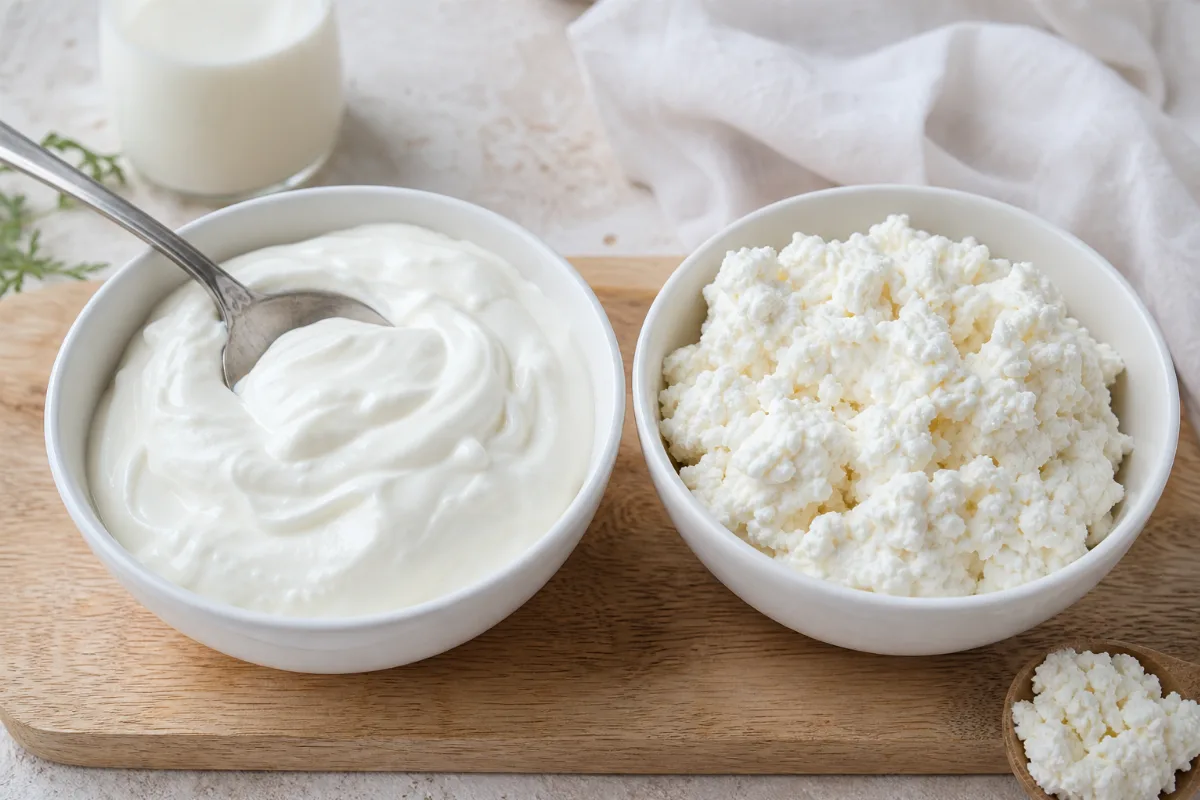
Skyr is a thick, spoonable fermented milk that comes from Iceland. Quark is a fresh, soft cheese made from soured milk. Research papers often call imitations 'skyr-type yogurt' and 'quark-type cheese', so what is sold under these names varies.
A 2024 review of Nordic fermented milks says they have been part of Nordic food culture for thousands of years, and that skyr is the one notable exception to milks fermented by mesophilic lactic acid bacteria. We read nothing more on how skyr or quark began.
What is in it (lab examples)
We could not read an official food-table entry for skyr or quark, so we give no per-portion table. The numbers below come from lab-made foods, per 100 g.
Quark-type cheese made from cow milk: full fat has 10.31 g protein and 13.95 g fat; reduced fat has 12.84 g protein and 10.39 g fat. Skyr-type yogurts made with three probiotic strains had 5.73 to 5.88 g protein and 2.31 to 2.53 g fat.
These are examples, not a guide to shop products. Fat, protein, salt and added sugar differ by brand, so read the Nutrition Facts label. The abstracts we read gave no lactose, calcium, sodium or vitamin values. A strained yogurt study found that the heat given to the milk and the straining time changed its fat, lactose and total solids.
What the research shows
Muscle: in a small 2023 trial, 14 young and 15 older healthy men ate quark with 30 g of protein after a leg workout. Blood amino acids rose and muscles built protein faster, more so in the exercised leg. This was a 4-hour measure and not a muscle-gain trial. A dairy company is listed as a grant source in the paper's record.
Fullness and weight: in a 12-week trial in 56 women with overweight, a 34 g protein breakfast raised fullness but did not change body fat, energy intake, blood fats or glucose tolerance. The report does not name skyr or quark.
Inflammation markers: in a 6-week crossover trial of 30 adults, 3 servings a day of milk, skyr and cheddar did not change IL-6, the main marker. TNF-alpha fell and IL-4 rose. Skyr was one of three foods, and the authors report ties to a dairy industry body.
Gut bacteria: in 49 women, daily skyr raised stool bacterial diversity and one bacterial family. These are markers, not health results.
Lab work: probiotic skyr-type yogurts lowered TNF-alpha in cell tests. That was never tested in people.
We found no trial of skyr or quark on blood sugar, blood pressure, cholesterol or heart disease.
Food versus other products
Everything here is about skyr and quark eaten as foods. Protein powders, flavoured dessert-style products and probiotic supplements are different products and are not covered. Skyr-type yogurts with added probiotic strains in the lab study are lab-made and may not match what you can buy.
At a glance
Traditional uses history, not proof
- Eaten as everyday dairy foods
- Long use as food is not proof that they treat any condition
Studied for research
- Protein content, low certainty (lab-made examples only)
- Muscle protein building after exercise, low certainty (one small quark trial in men)
- Fullness and weight, mixed (a high-protein breakfast, foods not named)
- Inflammation markers, very low certainty (mixed dairy diet)
- Gut bacteria markers, not enough evidence
- Probiotic skyr-type yogurt in cell tests, not enough evidence (lab only)
Main compounds
- Milk protein
- Milk fat
- Lactose
- Live cultures (varies by product)
Common forms
- Skyr and quark eaten as foods
- Lab-made skyr-type yogurt and quark-type cheese (the only composition numbers read)
- Flavoured or sweetened versions, protein powders and probiotic supplements are different products and are not covered
Research links: 2023 trial: quark and muscle protein building · 2025 trial: high-protein breakfast in women · 2026 trial: mixed dairy diet with skyr · Research Library · Genes & Biomarkers Library
What it is and its history
- Accepted scientific name
- Not a species. Skyr and quark are foods made from fermented milk.
- Common names
- Skyr (Icelandic); Quark (German); Skyr-type yogurt (English (used in research papers for imitations)); Quark-type cheese (English (used in research papers))
- Family or group
- Fermented dairy foods (strained)
- Native range
- Not verified from a source read.
- Harvest and processing
- Lab studies describe quark-type cheese made from cow milk, with the fat, heat treatment and homogenising of the milk changing the cheese. Skyr-type yogurts in research are fermented with chosen strains. A strained yogurt study found the heat given to the milk and the straining time changed fat, lactose and total solids, and that straining produces acid whey as a by-product. How shop products are made was not read.
- Look-alikes and adulterants
- Name: Greek yogurt and other strained yogurts; Note: Similar thick yogurts with their own composition; the Greek strained yogurt paper read here does not name skyr.; Name: Plain yogurt, kefir and cottage cheese; Note: Other fermented or soured dairy foods with different protein, water and lactose.; Name: Flavoured and dessert-style skyr or quark; Note: May have added sugar or sweeteners; not the plain foods studied.
Photographs
Traditional use and history history, not clinical proof
| Tradition or era | Documented use | Source |
|---|---|---|
| Nordic fermented milk | A 2024 review says fermented milk products have been an important part of the Nordic diet and food culture for thousands of years, and that skyr is the one notable exception to Nordic milks fermented by mesophilic lactic acid bacteria. We read nothing more on the history of skyr or quark. | Narvhus and Abrahamsen, Int Dairy J 2024 (abstract read via Europe PMC) |
Traditional use shows how it was used. It does not show that it works or is safe today.
What is inside, and how it may work
What it contains and how those compounds act in cells and animals. Laboratory and animal mechanisms are not proven effects in people.
Main compounds
| Compound | Family | Where it is concentrated | Activity studied | Level of evidence |
|---|---|---|---|---|
| Milk protein | protein | Lab-made examples per 100 g: quark-type cheese 10.31 to 12.84 g; skyr-type yogurt 5.73 to 5.88 g | Supplies amino acids. After a 30 g protein portion of quark, blood amino acids and muscle protein building rose in healthy men. 5 9 2 | Human data |
| Milk fat | lipid | Lab-made examples per 100 g: quark-type cheese 10.39 to 13.95 g; skyr-type yogurt 2.31 to 2.53 g | Part of the food's make-up. Not tested here as a treatment. 5 9 | Composition data |
| Lactose (milk sugar) | carbohydrate | Not found for skyr or quark. One quark-type cheese setting left more lactose than others. | Fed gut bacteria in lab tests; relevant to lactose intolerance. 5 3 4 | Lab |
Mechanisms, receptors and pathways
| Target or pathway | Gene or receptor | What was found | Level |
|---|---|---|---|
| Muscle protein building | Not specified in the abstract | Amino acids from quark protein raised muscle protein synthesis in healthy men, more in the exercised leg. 2 | Human data |
| Lactate-driven valerate production in the gut | Megasphaera | In lab and stool tests, lactose and lactate from fermented dairy fed Megasphaera, which made valerate. In women eating skyr daily, this showed only in those who carried the bacterium. 3 | Human and lab |
| Cytokine release in cells | TNF-alpha, IL-10 | Probiotic skyr-type yogurts lowered TNF-alpha by 32% and raised IL-10 in cell tests. 9 | Lab |
Absorption, metabolism and elimination
- Absorption
- Blood amino acids and leucine rose after eating quark in men.
- Distribution
- Not found.
- Metabolism
- Not found.
- Elimination
- Not found.
- Bioavailability
- Not established beyond the amino acid rise.
Isolated compounds versus whole extracts
Most research is on dairy protein or on mixed dairy diets, not on skyr or quark alone. The muscle trial used quark as a whole food. Protein powders, flavoured desserts and probiotic supplements are different products.
Nutritional composition
No USDA FoodData Central entry was read for skyr or quark (the public key was rate-limited and our files hold none), so no per-portion table is given. The only composition numbers read come from lab-made foods, per 100 g. Quark-type cheese, full fat (cow milk): 13.95 g fat, 10.31 g protein, 71.96% moisture. Quark-type cheese, reduced fat: 10.39 g fat, 12.84 g protein, 73.08% moisture. Skyr-type yogurts with three probiotic strains: 5.73 to 5.88 g protein and 2.31 to 2.53 g fat. These are lab examples and not a guide to shop products, which differ in fat, protein, salt and added sugar. Lactose, calcium, sodium and vitamins were not reported in the abstracts. Read the Nutrition Facts label of the product you buy.
1 mixed findings2 low certainty1 very low certainty2 not enough evidence
What was looked at
The 6 benefits and uses checked for Skyr and Quark, each with how strong the evidence is. Tap one to open it.
- Protein and basic make-up (lab examples)Low certainty
- Muscle protein building after exercise (quark)Low certainty
- Fullness and weight (high-protein breakfast)Mixed findings
- Inflammation markers (a mixed dairy diet including skyr)Very low certainty
- Gut bacteria (daily skyr)Not enough evidence
- Probiotic skyr-type yogurt in cell testsNot enough evidence
Lab markers tracked in the studies
Muscle protein synthesis rateBlood amino acids and leucineInterleukin-6 (IL-6, an inflammation signal)TNF-alpha (an inflammation signal)Interleukin-4 (IL-4)Fullness (self-rated)Body fat massStool bacterial diversity
What is Skyr and Quark good for?
The main studied uses and how strong the human evidence is for each. Most studies are small, and skyr is often one of several foods tested.
Benefits, one by one
Each card is a research question, not a promise. Tap a goal to filter. Open a card to see the studies, doses and limits.
Protein and basic make-up (lab examples)
Low certaintyNo official food table was read for skyr or quark. In lab-made examples, quark-type cheese had about 10 to 13 g of protein per 100 g, and skyr-type yogurt about 5.7 to 5.9 g per 100 g. Shop products will differ.
2 studiesQuark-type cheese (full and reduced fat) and skyr-type yogurt (contro…
Studies, doses and limits
What the trials found
No trial was needed for this: it is a composition fact. A 2021 lab study measured quark-type cheese made from cow milk. A 2025 lab study measured skyr-type yogurts made with three probiotic strains. Both are lab-made, not products from a shop.
Results
Quark-type cheese is richer in protein than the skyr-type yogurt tested. Real products depend on the milk, the straining and the brand.
Effect sizes as reported
Quark-type cheese per 100 g: full fat 10.31 g protein, 13.95 g fat, 71.96% moisture; reduced fat 12.84 g protein, 10.39 g fat, 73.08% moisture. Skyr-type yogurt per 100 g: 5.73 to 5.88 g protein, 2.31 to 2.53 g fat.
Why this rating
Low because the figures come from two lab-made examples, not from shop products or an official food table. We could not read a USDA entry for either food.
Form and dose studied
Quark-type cheese (full and reduced fat) and skyr-type yogurt (control and three probiotic versions), all made in labs.
Limits
Lab-made foods. The abstracts give no lactose, salt, calcium or vitamin values. Sweetened or flavoured versions were not measured.
Why researchers looked
People choose thick strained dairy foods for protein, so the first question is how much protein they hold.
Traditional use
Skyr and quark are eaten as everyday foods. Long use as food is not proof that they treat any condition.
Proposed mechanism Laboratory analysis
These are measured amounts in lab-made foods, not an effect on the body.
A proposed mechanism does not show that the effect happens in people.
Milk allergy and lactose are covered on the Safety tab.
Muscle protein building after exercise (quark)
Low certaintyIn a small trial, healthy men ate quark with 30 g of protein after a leg workout. Their muscles built protein faster than before eating, and faster again in the exercised leg. This was a 4-hour measure, not a trial of muscle gain.
1 studiesQuark as a food, one portion with 30 g of protein, after resistance e…
Studies, doses and limits
What the trials found
A 2023 randomised trial gave 14 young men (18-35) and 15 older men (65-85) quark with 30 g of protein after a one-leg resistance workout. Blood amino acids and leucine rose in both groups. Muscle protein building rose at rest and rose more in the exercised leg. Young and older men did not differ.
Results
A short-term rise in muscle protein building after eating quark, similar in young and older men. It does not show that eating quark builds muscle over weeks or months, and it did not compare quark with other foods.
Effect sizes as reported
Muscle protein synthesis, young men: 0.030 to 0.051 %/h at rest, 0.071 %/h in the exercised leg. Older men: 0.036 to 0.062 %/h at rest, 0.078 %/h in the exercised leg.
Why this rating
Low: one small trial of 29 healthy men, a single portion and a 4-hour measure. A dairy company (FrieslandCampina) is listed as a grant source in the paper's record.
Form and dose studied
Quark as a food, one portion with 30 g of protein, after resistance exercise.
Who was studied
Healthy men, young (18-35) and older (65-85).
Limits
Men only. No comparison food. Short measure, not muscle size or strength. Industry funding is listed in the record.
Why researchers looked
Muscles use the amino acids from protein foods to build and repair. Researchers wanted to know whether a whole dairy food does this as well as the protein powders usually studied.
Traditional use
Skyr and quark are eaten as everyday foods. Long use as food is not proof that they treat any condition.
Proposed mechanism Preliminary mechanism
Protein from food raises amino acids in the blood, and muscles use them to build protein. This was measured directly in this study.
A proposed mechanism does not show that the effect happens in people.
None specific beyond the milk allergy and lactose cautions on the Safety tab.
Fullness and weight (high-protein breakfast)
Mixed findingsIn 56 women with overweight, a 34 g protein breakfast for 12 weeks made them feel fuller than a 6 g protein breakfast. It made no difference to energy intake, body fat, blood fats or glucose tolerance. The report does not say the protein came from skyr or quark.
1 studiesA breakfast with 34 g or 6 g protein; foods not named in the abstract.
Studies, doses and limits
What the trials found
A 2025 randomised trial compared high- and low-protein breakfasts for 12 weeks in 56 women aged 18-30 with overweight. Fullness scores were higher with high protein (P = 0.02). Body composition, energy intake, blood fats and glucose tolerance did not differ between the groups. Bone mineral content tended to rise with high protein and fall with low protein.
Results
More fullness, but no change in body fat or other measures. The result is about a high-protein breakfast, not skyr or quark in particular.
Effect sizes as reported
Fullness P = 0.02; energy intake, body composition, lipids and glucose tolerance: all P > 0.10.
Why this rating
Mixed: a clear fullness result, with no benefit on weight, body fat or blood measures. Skyr and quark were not named in the abstract.
Form and dose studied
A breakfast with 34 g or 6 g protein; foods not named in the abstract.
Who was studied
Women aged 18-30 with overweight.
Limits
One trial, young women only, fullness self-reported. The foods used are not named in the abstract.
Why researchers looked
Protein-rich foods such as skyr and quark are often promoted for fullness and weight control.
Traditional use
Skyr and quark are eaten as everyday foods. Long use as food is not proof that they treat any condition.
Proposed mechanism Not established
Not tested in this trial.
A proposed mechanism does not show that the effect happens in people.
None specific.
Inflammation markers (a mixed dairy diet including skyr)
Very low certaintyIn 30 adults with overweight or obesity, three servings a day of a mix of milk, skyr and cheddar for 6 weeks did not change the main inflammation marker (IL-6) or body weight. One marker (TNF-alpha) went down and another (IL-4) went up.
1 studiesLow-fat milk, Skyr yogurt and full-fat cheddar, 3 servings a day in t…
Studies, doses and limits
What the trials found
A 2026 randomised crossover trial in 30 adults compared 6 weeks of a high-dairy diet (3 servings a day of low-fat milk, Skyr yogurt and full-fat cheddar) with 6 weeks of their usual low-dairy diet. The main outcome, IL-6, did not change. TNF-alpha fell (P = 0.042) and IL-4 rose (P = 0.026). Body weight, body fat, vascular and metabolic measures did not change. In men, IL-6, TNF-alpha, triglycerides and diastolic blood pressure were higher on the high-dairy diet than in women.
Results
Mixed. The main marker did not move, two secondary markers moved, and some results differed by sex. Skyr was one of three foods, so nothing can be put down to skyr alone.
Effect sizes as reported
IL-6 (primary): no condition-by-time effect. TNF-alpha P = 0.042 (lower); IL-4 P = 0.026 (higher).
Why this rating
Very low: a small crossover trial where the primary outcome showed nothing, skyr was one of three foods, and the authors report ties to a dairy industry body (Dairy Farmers of Canada).
Form and dose studied
Low-fat milk, Skyr yogurt and full-fat cheddar, 3 servings a day in total, 6 weeks.
Who was studied
Adults with overweight or obesity and heart-disease risk factors (18 women, 12 men).
Limits
Small. Many outcomes tested. Industry ties declared. The authors say more study is needed on differences between men and women.
Why researchers looked
Dairy foods contain protein and other substances that some researchers think may calm inflammation.
Traditional use
Skyr and quark are eaten as everyday foods. Long use as food is not proof that they treat any condition.
Proposed mechanism Not established
Not tested in this trial.
A proposed mechanism does not show that the effect happens in people.
Higher blood pressure and triglyceride results in men on the high-dairy diet are noted in the abstract.
Gut bacteria (daily skyr)
Not enough evidenceIn a study of 49 women with overweight or obesity, adding skyr every day raised the variety of bacteria in stool and one bacterial family. In the few women who carried a bacterium called Megasphaera, stool valerate rose. These are gut markers, not health results.
1 studiesDaily skyr (drained yogurt) added to the diet.
Studies, doses and limits
What the trials found
A 2025 study combined lab tests with a free-living group of 49 women who changed their dairy intake. Adding skyr gave higher stool bacterial diversity (p < 0.05) and more Streptococcaceae. About 30% of women carried Megasphaera. Those who carried it and ate skyr daily had higher stool valerate at week 6 than controls, and stool lactate was higher in the skyr group at 12 weeks.
Results
Changes in gut bacteria markers. The study did not measure digestion, symptoms, weight or disease, and the abstract does not say whether these changes are good or bad.
Effect sizes as reported
Diversity and Streptococcaceae higher (p < 0.05); valerate higher at week 6 in carriers of Megasphaera.
Why this rating
Not enough evidence: bacterial markers only, a mix of lab and human data, and no health outcome measured.
Form and dose studied
Daily skyr (drained yogurt) added to the diet.
Who was studied
Women with overweight or obesity.
Limits
Women only. Markers, not outcomes. The abstract gives no amounts and no effect sizes.
Why researchers looked
Fermented dairy foods carry lactic acid bacteria and milk sugar, so researchers ask whether they change the gut's bacteria.
Traditional use
Skyr and quark are eaten as everyday foods. Long use as food is not proof that they treat any condition.
Proposed mechanism Preliminary mechanism
The authors link lactose and lactate from fermented dairy to valerate production by Megasphaera in lab and stool-sample tests.
A proposed mechanism does not show that the effect happens in people.
None specific.
Probiotic skyr-type yogurt in cell tests
Not enough evidenceLab-made skyr-type yogurts made with probiotic strains lowered TNF-alpha by 32% and raised IL-10 in cell tests. This was never tested in people and the strains are not necessarily in shop products.
1 studiesLab-made skyr-type yogurt with Lactobacillus acidophilus LA5 or Lacti…
Studies, doses and limits
What the trials found
A 2025 lab study made skyr-type yogurt with three probiotic strains and tested it in cell models and with enzymes. It reported lower TNF-alpha (32%), lower nitric oxide (44% with one strain), higher IL-10 and enzyme inhibition after simulated digestion. No people were tested.
Results
Laboratory results only. They cannot tell us what happens when a person eats skyr.
Effect sizes as reported
TNF-alpha -32%; nitric oxide -44% (best strain); IL-10 14- to 18-fold higher (cell tests).
Why this rating
Not enough evidence: laboratory and cell research only.
Form and dose studied
Lab-made skyr-type yogurt with Lactobacillus acidophilus LA5 or Lactiplantibacillus plantarum 299v or LPLDL.
Limits
No human data. Lab-made strains and products.
Why researchers looked
Researchers are testing skyr-type yogurt as a carrier for probiotics.
Traditional use
Skyr and quark are eaten as everyday foods. Long use as food is not proof that they treat any condition.
Proposed mechanism Laboratory research
Cell and enzyme tests of lab-made yogurts after simulated digestion.
A proposed mechanism does not show that the effect happens in people.
None specific.
Connections to the rest of health
How Skyr and Quark connects to the rest of our health knowledge graph. Every link says what kind of connection it is. A safety link (for example to the liver) is a warning, not a benefit. A study that merely mentions a topic never creates a benefit link.
Explore every connection: goals, body systems, organs, symptoms, genes
A. Wellness goals
| Connected to | Kind of connection | Evidence status | Context | Studies |
|---|---|---|---|---|
| Preventive Wellness | Low certainty | Protein and basic make-up (lab examples): No official food table was read for skyr or quark. In lab-made examples, quark-type cheese had about 10 to 13 g of protein per 100 g, and skyr-type yogurt about 5.7 to 5.9 g per 100 g. Shop products will differ. | 5 9 | |
| Muscle Recovery | Low certainty | Muscle protein building after exercise (quark): In a small trial, healthy men ate quark with 30 g of protein after a leg workout. Their muscles built protein faster than before eating, and faster again in the exercised leg. This was a 4-hour measure, not a trial of muscle gain. | 2 | |
| Weight Management | Mixed findings | Fullness and weight (high-protein breakfast): In 56 women with overweight, a 34 g protein breakfast for 12 weeks made them feel fuller than a 6 g protein breakfast. It made no difference to energy intake, body fat, blood fats or glucose tolerance. The report does not say the protein came from skyr or quark. | 1 | |
| Inflammation Balance | Very low certainty | Inflammation markers (a mixed dairy diet including skyr): In 30 adults with overweight or obesity, three servings a day of a mix of milk, skyr and cheddar for 6 weeks did not change the main inflammation marker (IL-6) or body weight. One marker (TNF-alpha) went down and another (IL-4) went up. | 8 | |
| Gut Health | Preliminary mechanism | Not enough evidence | Gut bacteria (daily skyr): In a study of 49 women with overweight or obesity, adding skyr every day raised the variety of bacteria in stool and one bacterial family. In the few women who carried a bacterium called Megasphaera, stool valerate rose. These are gut markers, not health results. | 3 |
| Inflammation Balance | Preliminary mechanism | Not enough evidence | Probiotic skyr-type yogurt in cell tests: Lab-made skyr-type yogurts made with probiotic strains lowered TNF-alpha by 32% and raised IL-10 in cell tests. This was never tested in people and the strains are not necessarily in shop products. | 9 |
B. Body systems
| Connected to | Kind of connection | Evidence status | Context | Studies |
|---|---|---|---|---|
| Musculoskeletal System | Biological association | Low certainty | Studied for: Protein and basic make-up (lab examples) Studied for: Muscle protein building after exercise (quark) | 5 9 2 |
| Digestive System | Biological association | Mixed findings | Studied for: Fullness and weight (high-protein breakfast) Studied for: Gut bacteria (daily skyr) | 1 3 |
| Cardiovascular System | Biological association | Very low certainty | Studied for: Inflammation markers (a mixed dairy diet including skyr) | 8 |
| Immune System | Biological association | Not enough evidence | Studied for: Probiotic skyr-type yogurt in cell tests | 9 |
E. Health conditions
| Connected to | Kind of connection | Evidence status | Context | Studies |
|---|---|---|---|---|
| Cow milk allergy | Adverse effect or risk | Documented risk | Cows' milk is listed first among the most common allergic foods by the NHS. Skyr and quark are milk foods and are not safe in milk allergy. Preparation or compound: Milk protein in skyr and quark |
12 |
| Lactose intolerance | Adverse effect or risk | Documented risk | Lactose amounts were not found; tolerance differs by person. Preparation or compound: Lactose in skyr and quark |
15 14 |
| Listeriosis | Adverse effect or risk | Documented risk | The NHS says unpasteurised dairy may contain listeria; quark is not named. Preparation or compound: Unpasteurised dairy |
13 |
I. Biomarkers
| Connected to | Kind of connection | Evidence status | Context | Studies |
|---|---|---|---|---|
| Muscle protein synthesis rate | Biological association | Low certainty | Measured in trials: raised. A lab change is not the same as a health benefit. | 2 |
| Blood amino acids and leucine | Biological association | Low certainty | Measured in trials: raised. A lab change is not the same as a health benefit. | 2 |
| Interleukin-6 (IL-6, an inflammation signal) | Biological association | Very low certainty | Measured in trials: no significant change. A lab change is not the same as a health benefit. | 8 |
| TNF-alpha (an inflammation signal) | Biological association | Very low certainty | Measured in trials: lowered. A lab change is not the same as a health benefit. | 8 |
| Interleukin-4 (IL-4) | Biological association | Very low certainty | Measured in trials: raised. A lab change is not the same as a health benefit. | 8 |
| Fullness (self-rated) | Biological association | Low certainty | Measured in trials: raised. A lab change is not the same as a health benefit. | 1 |
| Body fat mass | Biological association | Low certainty | Measured in trials: no significant change. A lab change is not the same as a health benefit. | 1 |
| Stool bacterial diversity | Biological association | Not enough evidence | Measured in trials: raised. A lab change is not the same as a health benefit. | 3 |
K. Biological pathways
L. Active compounds
| Connected to | Kind of connection | Evidence status | Context | Studies |
|---|---|---|---|---|
| Milk protein | Biological association | Human | Supplies amino acids. After a 30 g protein portion of quark, blood amino acids and muscle protein building rose in healthy men. | 5 9 2 |
| Milk fat | Biological association | Composition data | Part of the food's make-up. Not tested here as a treatment. | 5 9 |
| Lactose (milk sugar) | Biological association | Lab | Fed gut bacteria in lab tests; relevant to lactose intolerance. | 5 3 4 |
Each connection is stored with the ingredient, the connected record, the kind of connection, the evidence status, the supporting studies, the preparation or compound involved, and a review date (last reviewed October 26, 2026).
Evidence at a glance: what changed in 6 lab markers
Tap a number to show only those markers. Counts are markers, not people.
The evidence
The research centre for Skyr and Quark. Every record here was checked against PubMed or the publisher's page; we never list a study we have not verified.
Evidence by outcome
Bars show how many studies we found for each outcome, not how well it works. People are added up across trials only (reviews are not added, to avoid double counting).
How we rate evidence
High certainty
Several well-run trials or reviews agree; further research is unlikely to change the picture much.
Moderate certainty
Good trials point the same way, but some doubt remains.
Low certainty
Small, short or inconsistent trials. The finding could change with better research.
Very low certainty
Very little or very weak human data. Treat as a possibility only.
Mixed findings
Trials or reviews disagree with each other.
Not enough evidence
Not enough human research to say either way.
Evidence against
Good research found no benefit, or found harm.
We take the reviewers' own risk-of-bias and GRADE statements where they exist, and otherwise judge from study size, design, consistency, directness and whether a product matches what is sold. Many publications do not make evidence high. Method note: We started from our existing summary for skyr and quark, re-read PubMed abstracts and health agency pages (NHS, NIDDK, NCCIH, WHO), and read two records through Europe PMC. Only abstracts were read for studies. Items we could not verify are flagged in the research gaps.
Study library: every study we checked 16
| Study | Design | People | Product, dose, length | Result |
|---|---|---|---|---|
| Dalgaard 2025 No effects of high- v. low-protein breakfast on body composition and cardiometabolic health in young women with overweight: the NewStart randomised trial Br J Nutr · PMID 39587799 · DOI |
Controlled trial |
56 56 women aged 18-30 with overweight |
A breakfast with 34 g protein (n 26) or 6 g protein (n 30). The abstract does not say which foods supplied the protein. High-protein breakfast (foods not named in the abstract) 34 g protein at breakfast vs 6 g 12 weeks · vs Low-protein breakfast (6 g) |
The high-protein group reported more fullness (P = 0.02). There were no group differences in energy intake, body composition, blood lipids or glucose tolerance (all P > 0.10). Bone mineral content tended to rise with high protein and fall with low protein (interaction P = 0.01). Fullness P = 0.02; all other group differences P > 0.10 (Not given in the abstract) Methods, limits and fundingOutcomes: Fat mass (primary), body composition, glucose tolerance, blood lipids, fullness and hunger, energy intake Limitations: Young women only. The abstract does not name skyr or quark, so this is a high-protein breakfast result and is not specific to either food. Fullness was self-reported. Funding and conflicts: The abstract says the corresponding author states no declaration of interest. Read: abstract |
| Hermans 2023 Acute Quark Ingestion Increases Muscle Protein Synthesis Rates at Rest with a Further Increase after Exercise in Young and Older Adult Males in a Parallel-Group Intervention Trial J Nutr · PMID 36913480 · DOI |
Controlled trial |
29 14 young (18-35 y) and 15 older (65-85 y) healthy men |
Quark providing 30 g of protein, eaten after a single-legged resistance workout Skyr or quark as food 30 g of protein, one portion 4 hours after eating (single session) |
Blood amino acids and leucine rose in both age groups. Muscle protein synthesis rose at rest (young 0.030 to 0.051 %/h; older 0.036 to 0.062 %/h) and rose further in the exercised leg (0.071 and 0.078 %/h). No difference between the age groups. Muscle protein synthesis at rest: +0.021 %/h in young men and +0.026 %/h in older men after quark (values as reported, means from the abstract; the differences are our subtraction). Exercised leg to 0.071 and 0.078 %/h. (Not given in the abstract (P < 0.001 for the condition effect)) Methods, limits and fundingOutcomes: Muscle protein synthesis at rest and after exercise; blood amino acids and leucine Limitations: Healthy men only. A 4-hour measure after a single portion, not a trial of muscle gain over time. No comparison food, so it cannot show that quark is better than other protein. Funding and conflicts: The abstract lists no funding or conflicts. Europe PMC's grant record for this paper lists FrieslandCampina (a dairy company), read 2026-10-26. Read: abstract |
| Huertas-Diaz 2025 Megasphaera contributes to lactate-driven valerate production in the human gut Microbiome · PMID 41121394 · DOI |
Laboratory and human cohort mixed |
49 Lab co-cultures, stool-sample fermentations (n = 20) and a free-living group of 49 women with overweight or obesity who changed their dairy intake |
Daily drained yogurt (skyr) in the human part of the study Skyr (drained yogurt) in a dairy-change study Daily 6 and 12 weeks · vs Controls who did not add skyr |
In the human part, adding skyr raised stool bacterial diversity (p < 0.05) and the Streptococcaceae family. Among the 30% of women who carried Megasphaera and ate skyr daily, stool valerate was higher at week 6 than in controls. Stool lactate was higher in the skyr group at 12 weeks. Diversity and Streptococcaceae higher (p < 0.05); valerate higher at week 6 in Megasphaera carriers (Not given in the abstract) Methods, limits and fundingOutcomes: Stool bacteria, valerate and lactate Limitations: Gut bacteria markers, not health outcomes. The paper is mostly about how valerate forms. Only women with overweight or obesity. Funding and conflicts: Funding is not stated in the abstract. Read: abstract |
| Karastamatis 2022 Effect of Modified Manufacturing Conditions on the Composition of Greek Strained Yogurt and the Quantity and Composition of Generated Acid Whey Foods · PMID 36553693 · DOI |
Laboratory analysis n/a |
Lab-made Greek strained yogurt from cow milk | Greek strained yogurt (a strained yogurt related to skyr; skyr is not named in the abstract) Greek strained yogurt, lab-made Straining immediately or after 24 hours |
Straining after 24 hours gave 8% more strained yogurt and about 11% less acid whey. The heat treatment of the milk changed the fat, lactose and total solids of the strained yogurt. Yield +8%; acid whey -11% (Not given in the abstract) Methods, limits and fundingOutcomes: Composition of strained yogurt and acid whey Limitations: Greek strained yogurt, not skyr or quark. The abstract gives no lactose values. Funding and conflicts: Funding is not stated in the abstract. Read: abstract |
| Lepesioti 2021 Quark-Type Cheese: Effect of Fat Content, Homogenization, and Heat Treatment of Cheese Milk Foods · PMID 33477549 · DOI |
Laboratory analysis n/a |
Quark-type cheeses made in a laboratory from cow milk | Quark-type cheese (full-fat and reduced-fat), lab-made Quark-type cheese made in a lab Storage was also tested (length not stated in the abstract) |
Mean composition of full-fat cheeses was 71.96% moisture, 13.95% fat and 10.31% protein. Reduced-fat cheeses were 73.08% moisture, 10.39% fat and 12.84% protein. More intense heating of the milk kept more moisture, and one heat setting left more lactose in the cheese. Per 100 g (percent by weight): full fat 13.95 g fat, 10.31 g protein; reduced fat 10.39 g fat, 12.84 g protein (Not applicable) Methods, limits and fundingOutcomes: Composition and texture of the cheese Limitations: Lab-made quark-type cheese from cow milk, not shop products. The abstract gives no lactose, salt, calcium or vitamin values. Funding and conflicts: The abstract says the authors declare no conflict of interest; funding is not stated. Read: abstract |
| Marco 2021 The International Scientific Association for Probiotics and Prebiotics (ISAPP) consensus statement on fermented foods Nat Rev Gastroenterol Hepatol · PMID 33398112 · DOI |
Consensus statement n/a |
Expert panel convened September 2019 | Fermented foods in general Fermented foods in general |
The panel defined fermented foods as foods made through desired microbial growth and enzymatic conversions of food components, and set them apart from probiotics. It also reviewed safety, risks and possible health benefits. No numbers in the abstract (Not applicable) Methods, limits and fundingOutcomes: Definition of fermented foods and how they differ from probiotics Limitations: A definition and overview, not a trial. The abstract does not mention skyr or quark. Funding and conflicts: Panel convened by ISAPP; funding is not stated in the abstract. Read: abstract |
| Pereira 2021 Influence of a prebiotic and natural sweeteners on the sensory profile of skyr yogurt with mango pulp J Food Sci · PMID 34077557 · DOI |
Laboratory analysis n/a |
Eight lab-made skyr formulations with mango pulp, tasted by consumers in two Brazilian regions | Skyr yogurt sweetened with sucrose, stevia or thaumatin, with or without fructooligosaccharide (FOS) Flavoured skyr with mango |
The type of sweetener changed sweetness, bitterness, aftertaste and metallic taste and how much consumers liked the skyr. Adding FOS did not change its characteristics. No numbers in the abstract (Not applicable) Methods, limits and fundingOutcomes: Taste profile and consumer liking Limitations: A taste study. It shows that flavoured skyr can be made with sucrose or other sweeteners; it says nothing about health effects. Funding and conflicts: Funding is not stated in the abstract. Read: abstract |
| Prowting 2026 Inflammatory Cytokine Responses to 6 Wks of Increased Dairy Intake in Individuals with Overweight and Obesity-A Randomized Crossover Trial J Nutr · PMID 41176279 · DOI |
Controlled trial |
30 30 adults (18 women, 12 men) with overweight or obesity and cardiometabolic risk factors |
A high-dairy diet of 3 servings a day, a mix of low-fat milk, Skyr yogurt and full-fat cheddar, versus their usual low-dairy diet Mixed dairy diet including Skyr yogurt 3 servings a day of mixed dairy 6 weeks per diet, with a washout of at least 4 weeks · vs Usual low-dairy diet (1 serving a day or less) |
No change in IL-6, the main outcome. TNF-alpha fell (P = 0.042) and IL-4 rose (P = 0.026) on the high-dairy diet. No other differences, including body weight or fat. In men, IL-6, TNF-alpha, triglycerides and diastolic blood pressure were higher on the high-dairy diet than in women (sex-by-diet interactions). TNF-alpha interaction P = 0.042; IL-4 P = 0.026; IL-6 (primary) no interaction (Not given in the abstract) Methods, limits and fundingOutcomes: IL-6 (primary), other cytokines, body composition, blood pressure, blood fats Limitations: Skyr was only one of three dairy foods, so effects cannot be pinned on skyr. Small crossover trial; several outcomes tested. The authors call the cytokine changes favourable, but they came with no change in weight, vascular or metabolic measures. Funding and conflicts: Conflict statement read in the PubMed record: several authors report support from Dairy Farmers of Canada, and one reports a relationship with Dairy Farmers of Canada (funding, advisory and speaking fees) and supplies from Lactalis Canada. Read: abstract |
| Zepeda-Hernandez 2025 Probiotic fermentation enhances the technological properties and health-promoting potential of skyr-type yogurts Int Dairy J · Source |
Laboratory analysis mixed |
Lab-made skyr-type yogurts with three probiotic strains and a control, plus cell tests | Skyr-type yogurt fermented with Lactobacillus acidophilus LA5, Lactiplantibacillus plantarum 299v or LPLDL Lab-made skyr-type yogurt · vs Control skyr-type yogurt |
The skyr-type yogurts had 5.73 to 5.88 g protein and 2.31 to 2.53 g fat per 100 g. Probiotic counts stayed above 7 log colony-forming units per mL after simulated digestion. In cell tests, two versions lowered TNF-alpha by 32%, and all raised IL-10. Protein 5.73-5.88 g/100 g; fat 2.31-2.53 g/100 g; TNF-alpha -32% (cell tests); IL-10 14- to 18-fold (cell tests) (Not given in the abstract) Methods, limits and fundingOutcomes: Composition, texture, probiotic survival after simulated digestion, enzyme tests, cell-culture tests Limitations: Laboratory and cell work only. Lab-made, not shop skyr; the strains are not necessarily in any product you can buy. Funding and conflicts: Funding is not stated in the record read. Read: abstract (Europe PMC record IND609072316) |
| s-narvhus-nordic-2024 Traditional and modern Nordic fermented milk products: A review (Narvhus and Abrahamsen), Int Dairy J 2024 · Source |
Review n/a |
Methods, limits and fundingRead: abstract | ||
| s-nccih-probiotics NCCIH: Probiotics: Usefulness and Safety · Source |
Health agency n/a |
Methods, limits and fundingRead: full-text | ||
| s-nhs-food-allergy NHS: Food allergy · Source |
Health agency n/a |
Methods, limits and fundingRead: full-text | ||
| s-nhs-foods-to-avoid NHS: Foods to avoid in pregnancy · Source |
Health agency n/a |
Methods, limits and fundingRead: full-text | ||
| s-nhs-lactose NHS: Lactose intolerance · Source |
Health agency n/a |
Methods, limits and fundingRead: full-text | ||
| s-niddk-lactose NIDDK: Eating, diet, and nutrition for lactose intolerance · Source |
Health agency n/a |
Methods, limits and fundingRead: full-text | ||
| s-who-healthy-diet WHO: Healthy diet fact sheet · Source |
Health agency n/a |
Methods, limits and fundingRead: full-text |
What we do not know yet
- No trial of skyr or quark was found for blood sugar, blood pressure, cholesterol or heart disease.
- The only muscle study is of quark in healthy men, and it measured 4 hours, not muscle gain.
- No official food-table values were read; composition numbers come from lab-made examples.
- Lactose, calcium, salt and vitamin amounts, tyramine, breastfeeding, young children and kidney disease were not researched.
- The CDC pregnancy and listeria pages could not be read, so nothing from them is used.
How new research is added
New studies are found by a saved PubMed search and placed in a review queue before the page changes.
Lab markers
What changed in blood or saliva tests during trials. A changed number is not the same as feeling or being healthier, and we give no "normal ranges".
Inflammatory 2
Interleukin-6 (IL-6, an inflammation signal)
No significant change in trials
A protein released by cells that rises with inflammation.
Very low certaintyResults and what it means
Why it was measured
It was the main outcome of the dairy trial.
Statistical vs. clinical meaning
The main marker did not change.
Safety implication
None specific.
| Study | Result | People | Product |
|---|---|---|---|
| 8 | No condition-by-time effect on IL-6 (primary endpoint); IL-6 was higher in men on the high-dairy diet in a sex-by-diet interaction (P = 0.011) | 30 adults with overweight or obesity | Milk, Skyr yogurt and cheddar, 3 servings a day, 6 weeks |
TNF-alpha (an inflammation signal)
Lowered in trials
A protein released by immune cells that rises with inflammation.
Very low certaintyResults and what it means
Why it was measured
A secondary marker of inflammation.
Statistical vs. clinical meaning
One of several secondary markers; mixed by sex.
Safety implication
None specific.
| Study | Result | People | Product |
|---|---|---|---|
| 8 | Fell on the high-dairy diet compared with the low-dairy diet (P = 0.042); a sex-by-diet interaction showed higher values in men (P < 0.001) | 30 adults with overweight or obesity | Milk, Skyr yogurt and cheddar, 3 servings a day, 6 weeks |
Other 6
Muscle protein synthesis rate
Raised in trials
How fast muscle cells are building new protein, measured with a tracer in blood and muscle samples.
Low certaintyResults and what it means
Why it was measured
It is a short-term sign that muscle is using the protein just eaten.
Statistical vs. clinical meaning
A short rise after one portion. It is not a measure of muscle gain.
Safety implication
None specific.
| Study | Result | People | Product |
|---|---|---|---|
| 2 | Rose after quark at rest (young 0.030 to 0.051 %/h; older 0.036 to 0.062 %/h) and further in the exercised leg (0.071 and 0.078 %/h) | 14 young and 15 older healthy men | Quark with 30 g protein after one-leg resistance exercise, 4-hour measure |
Blood amino acids and leucine
Raised in trials
Amino acids are the building blocks of protein. Leucine is one that strongly signals muscles to build protein.
Low certaintyResults and what it means
Why it was measured
They show how much of the protein eaten reaches the blood.
Statistical vs. clinical meaning
Shows the protein in quark was digested and absorbed in these men.
Safety implication
None specific.
| Study | Result | People | Product |
|---|---|---|---|
| 2 | Total amino acids and leucine rose in both age groups, with no difference between groups | 14 young and 15 older healthy men | Quark with 30 g protein |
Interleukin-4 (IL-4)
Raised in trials
A protein made by immune cells; it is often described as anti-inflammatory.
Very low certaintyResults and what it means
Why it was measured
A secondary marker in the dairy trial.
Statistical vs. clinical meaning
A small secondary finding.
Safety implication
None specific.
| Study | Result | People | Product |
|---|---|---|---|
| 8 | Rose on the high-dairy diet compared with the low-dairy diet (P = 0.026) | 30 adults with overweight or obesity | Milk, Skyr yogurt and cheddar, 3 servings a day, 6 weeks |
Fullness (self-rated)
Raised in trials
How full or hungry people say they feel, on a scale.
Low certaintyResults and what it means
Why it was measured
Protein-rich foods are often promoted for fullness.
Statistical vs. clinical meaning
A feeling reported by the women; it did not lead to less eating or weight change.
Safety implication
None specific.
| Study | Result | People | Product |
|---|---|---|---|
| 1 | Higher fullness scores with the high-protein breakfast (P = 0.02); energy intake did not differ | 56 women aged 18-30 with overweight | 34 g vs 6 g protein breakfast, 12 weeks |
Body fat mass
No significant change in trials
The weight of body fat, measured by a DXA scan.
Low certaintyResults and what it means
Why it was measured
It was the main outcome of the breakfast trial.
Statistical vs. clinical meaning
No weight-loss effect was shown.
Safety implication
None specific.
| Study | Result | People | Product |
|---|---|---|---|
| 1 | No group difference in body composition (all P > 0.10) | 56 women aged 18-30 with overweight | 34 g vs 6 g protein breakfast, 12 weeks |
Stool bacterial diversity
Raised in trials
How many kinds of bacteria are found in a stool sample.
Not enough evidenceResults and what it means
Why it was measured
A marker of change in the gut's bacteria.
Statistical vs. clinical meaning
A marker, not a health outcome.
Safety implication
None specific.
| Study | Result | People | Product |
|---|---|---|---|
| 3 | Higher with daily skyr (p < 0.05), with more Streptococcaceae | 49 women with overweight or obesity | Daily skyr, up to 12 weeks |
Safety
What studies and official sources say about side effects, medicines and who should check first. Each point shows what kind of evidence it comes from.
Main points to know 3
- Milk allergy: skyr and quark are milk foods. Cows' milk is listed first among the most common allergic foods by the NHS. Skyr and quark are made from milk, so they are not safe for someone with a milk allergy. Call your local emergency number (999 in the UK, 911 in the US) for a sudden swollen face, lips, tongue or throat, trouble breathing or swallowing, or blue, grey or pale skin. Authoritative guidance 12
- Pregnancy: choose pasteurised. The NHS lists pasteurised yoghurt and pasteurised soft cheeses such as cottage cheese and cream cheese as safe in pregnancy, and unpasteurised milk, cream and yoghurt as foods to avoid because of listeria. Quark and skyr are not named, so check the label for 'pasteurised'. Authoritative guidance 13
- Lactose: tolerance varies. Skyr and quark contain milk sugar (lactose) as other dairy foods do. NIDDK says many people with lactose intolerance can have about 12 g of lactose, and that some find yogurt easier than other dairy. We found no lactose values for skyr or quark. Authoritative guidance 15 14
Side effects 2
| Effect | How often | Severity and recovery | Evidence |
|---|---|---|---|
| Allergic reaction to cows' milk protein, from itching and hives to anaphylaxis The NHS page is about food allergy in general; it does not mention skyr or quark. | Not established | can be severe (anaphylaxis) Not described in the sources read. | Authoritative guidance 12 |
| Digestive upset from lactose in people with lactose intolerance Amounts of lactose in skyr and quark were not found. In a lab study of strained yogurt, the heat given to the milk changed its lactose content. | Not established | mild to moderate Not described for skyr or quark. | Authoritative guidance 15 14 |
Liver
No liver injury from eating skyr or quark was found in the sources read. LiverTox was not searched for these foods.
How often. No frequency was found.
Monitoring. No agency monitoring advice was found.
This is a safety connection. It is not evidence that Skyr and Quark supports liver health.
Medicines and supplements 2
| With | Why it matters | Importance | Evidence | What to do |
|---|---|---|---|---|
| MAOI antidepressants (monoamine oxidase inhibitors) prescription | Some fermented foods contain tyramine, which matters with these medicines. | We found no source on tyramine in skyr or quark, so we cannot say whether this applies. | Not established Not enough evidence | If you take an MAOI, ask your prescriber or pharmacist about fermented dairy foods. |
| Weakened immunity or severe illness (live-culture products) condition | NCCIH says the risk of harmful effects from probiotics is greater in people with severe illness or weakened immune systems. It does not mention skyr or quark, and not every skyr or quark product has live cultures. | Applies to probiotic products; unclear for ordinary skyr or quark. | Authoritative guidance Low certainty 11 6 | If you are seriously ill or immunocompromised, ask your care team about foods or products with live cultures. |
Who should check first 2
| Situation | Advice | Evidence |
|---|---|---|
| Cows' milk allergy | Avoid skyr, quark and other milk products unless an allergy specialist says otherwise. Read labels. | Authoritative guidance 12 |
| Pregnancy and unpasteurised dairy | The NHS lists unpasteurised yoghurt and milk among foods to avoid. Choose products labelled pasteurised. | Authoritative guidance 13 |
Overdose, product quality and regulators
Summary. No toxicity from skyr or quark as ordinary foods was found in the sources read. This is a food page and gives no amounts to eat.
Animal. Not reviewed.
Overdose response. Not found.
Genotoxicity. Not researched.
Listeria is the main food-safety question for dairy in pregnancy, according to the NHS. Other contamination (antibiotic residues, mould, heavy metals) and shelf life were not researched.
Listeria and unpasteurised dairy. The NHS says unpasteurised or soft ripened dairy foods may contain listeria, which can cause listeriosis, miscarriage or stillbirth, or make a newborn very unwell. 13
Added sugar and sweeteners in flavoured versions. A lab study shows skyr can be made with sucrose or other sweeteners such as stevia or thaumatin. WHO advises keeping free sugars under 10% of daily energy. Amounts in shop products were not read, so check the label. 7 16
| Body | Action | Date |
|---|---|---|
| NHS (UK) (United Kingdom) | Foods to avoid in pregnancy: pasteurised yoghurt and pasteurised soft cheeses such as cottage cheese and cream cheese are listed as safe; unpasteurised milk, cream and yoghurt are listed to avoid. Quark and skyr are not named. source | 2026-06-15 |
| WHO (International) | Healthy diet fact sheet: limit free sugars to less than 10% of total daily energy intake. source | 2026-01-26 |
When to get medical help
- Trouble breathing, wheezing, a tight throat or trouble swallowing, swelling of the lips, mouth, tongue or face, or blue, grey or pale skin: call your local emergency number (999 in the UK, 911 in the US) at once. Do not drive yourself to hospital.
- In pregnancy: if you feel unwell after eating unpasteurised dairy, contact a doctor or midwife (the NHS page names listeriosis as the risk).
Stop using the product and contact a clinician or emergency service. In the US, Poison Control is 1-800-222-1222.
General information only, not medical advice. Ask a clinician or pharmacist before use, especially with medicines, in pregnancy or with a health condition. See the Natural Remedy Safety guide.
Frequently asked questions
What is the difference between skyr and quark?
How much protein do skyr and quark have?
Does quark build muscle?
A small trial found that quark with 30 g of protein raised muscle protein building for 4 hours after a leg workout in healthy young and older men. That does not show muscle gain over weeks or months.
Does skyr or high-protein food help with weight loss?
A 12-week trial in women with overweight found a high-protein breakfast raised fullness but did not change body fat or energy intake. The report did not name skyr or quark.
Does skyr lower inflammation?
In one small trial, a diet with milk, skyr and cheddar did not change the main inflammation marker, IL-6. Two other markers moved. Skyr was one of three foods, so nothing can be put down to skyr alone.
Does skyr change gut bacteria?
In a study of 49 women, daily skyr raised stool bacterial diversity. These are markers. The study did not show a health benefit.
Do skyr and quark contain probiotics?
Are skyr and quark safe with a milk allergy?
No. They are made from milk, and cows' milk is listed first among the most common allergic foods by the NHS. Call your local emergency number for swelling of the face, lips or throat or trouble breathing.
Can I eat them if I am lactose intolerant?
Is quark safe in pregnancy?
Quark is not named by the NHS. It lists pasteurised soft cheeses such as cottage cheese and cream cheese as safe and unpasteurised milk, cream and yoghurt as foods to avoid. Choose products labelled pasteurised.
Is flavoured skyr healthy?
Is it safe if I take an MAOI or have a weak immune system?
We found no source on tyramine in skyr or quark, so ask your prescriber or pharmacist if you take an MAOI. NCCIH says harm from probiotics is more likely in people with severe illness or weakened immunity. It does not mention skyr or quark.
Explore by health goal
Inflammation BalancePreventive WellnessMuscle RecoveryWeight ManagementGut Health
Editorial transparency
- Written by
- AlternativeMed editorial team. Research compiled with AI assistance, then checked against the sources listed.
- Medical review
- None. This page has not been reviewed by a physician or pharmacist.
- First published
- 2026-10-26
- Last substantive update
- 2026-10-26
- How we research
- We started from our existing summary for skyr and quark, re-read PubMed abstracts and health agency pages (NHS, NIDDK, NCCIH, WHO), and read two records through Europe PMC. Only abstracts were read for studies. Items we could not verify are flagged in the research gaps.
- How we rate evidence
- See "How we rate evidence" in the Evidence tab.
- Independence
- No product is promoted on this page. No affiliate links are shown. A dairy company is listed as a grant source for the quark trial, and the authors of the mixed-dairy trial report ties to Dairy Farmers of Canada; this is stated where the studies are used.
Sources 16
Each source was opened and checked. Where we read only the abstract, it says so. The small numbers in the text point here.
- Dalgaard LB, Thams L, Skovgaard Jensen J, Jorgensen AA, et al.. No effects of high- v. low-protein breakfast on body composition and cardiometabolic health in young women with overweight: the NewStart randomised trial. Br J Nutr. 2025. PMID 39587799. DOI 10.1017/S0007114524003015. (abstract)
- Hermans WJ, Fuchs CJ, Nyakayiru J, Hendriks FK, et al.. Acute Quark Ingestion Increases Muscle Protein Synthesis Rates at Rest with a Further Increase after Exercise in Young and Older Adult Males in a Parallel-Group Intervention Trial. J Nutr. 2023. PMID 36913480. DOI 10.1016/j.tjnut.2022.10.003. (abstract)
- Huertas-Diaz L, Gezer ME, Marietou A, Hosek J, et al.. Megasphaera contributes to lactate-driven valerate production in the human gut. Microbiome. 2025. PMID 41121394. DOI 10.1186/s40168-025-02207-6. (abstract)
- Karastamatis S, Zoidou E, Moatsou G, Moschopoulou E. Effect of Modified Manufacturing Conditions on the Composition of Greek Strained Yogurt and the Quantity and Composition of Generated Acid Whey. Foods. 2022. PMID 36553693. DOI 10.3390/foods11243953. (abstract)
- Lepesioti S, Zoidou E, Lioliou D, Moschopoulou E, et al.. Quark-Type Cheese: Effect of Fat Content, Homogenization, and Heat Treatment of Cheese Milk. Foods. 2021. PMID 33477549. DOI 10.3390/foods10010184. (abstract)
- Marco ML, Sanders ME, Ganzle M, Arrieta MC, et al.. The International Scientific Association for Probiotics and Prebiotics (ISAPP) consensus statement on fermented foods. Nat Rev Gastroenterol Hepatol. 2021. PMID 33398112. DOI 10.1038/s41575-020-00390-5. (abstract)
- Pereira CTM, Pereira DM, Bolini HMA. Influence of a prebiotic and natural sweeteners on the sensory profile of skyr yogurt with mango pulp. J Food Sci. 2021. PMID 34077557. DOI 10.1111/1750-3841.15760. (abstract)
- Prowting JL, Fraschetti EC, Pereira TJ, Tucker JA, et al.. Inflammatory Cytokine Responses to 6 Wks of Increased Dairy Intake in Individuals with Overweight and Obesity-A Randomized Crossover Trial. J Nutr. 2026. PMID 41176279. DOI 10.1016/j.tjnut.2025.10.040. (abstract)
- Zepeda-Hernandez A, Rosales-De la Cruz MF, Antunes-Ricardo M, Ortega-Hernandez E, et al.. Probiotic fermentation enhances the technological properties and health-promoting potential of skyr-type yogurts. Int Dairy J. 2025. (abstract (Europe PMC record IND609072316))
- . Traditional and modern Nordic fermented milk products: A review (Narvhus and Abrahamsen), Int Dairy J 2024. . . (abstract)
- . NCCIH: Probiotics: Usefulness and Safety. . . (full-text)
- . NHS: Food allergy. . . (full-text)
- . NHS: Foods to avoid in pregnancy. . . (full-text)
- . NHS: Lactose intolerance. . . (full-text)
- . NIDDK: Eating, diet, and nutrition for lactose intolerance. . . (full-text)
- . WHO: Healthy diet fact sheet. . . (full-text)
Where to buy
Check the label first. Whatever you buy, look for these:
- Live and active cultures on the label, if that is what you want
- Refrigerated or shelf-stable, since shelf-stable versions may be heat treated
- Added sugar and sodium
- A best-by date
Talk to a pharmacist or doctor before you start any supplement, especially if you take medicines. See the Safety tab for interactions.
Support our free guides: as an Amazon Associate we earn from qualifying purchases. Full disclosure.


