Fruits · Fruit
Gooseberries
Ribes uva-crispa · also called Gooseberry, European gooseberry, grosella espinosa (Spanish)
Gooseberries are the tart berries of a thorny shrub in the gooseberry family, a close relative of currants. A cup of raw berries (150 g) has about 66 calories, 6.5 g of fibre and 41.6 mg of vitamin C. We found no trial of gooseberries in people, and the lab studies we read do not show a health benefit. They are an ordinary food, but they are not the same plant as Indian gooseberry (amla) or cape gooseberry. Any food can cause an allergic reaction.
General information, not medical advice. Last substantive update · Not medically reviewed. A named clinician has not signed off on this page. How this page is made
About Gooseberries
Gooseberries are tart, fibre-rich berries that supply some vitamin C. There is no human research on gooseberries themselves, so they are best seen as an ordinary, nutritious food rather than a remedy.
What it is
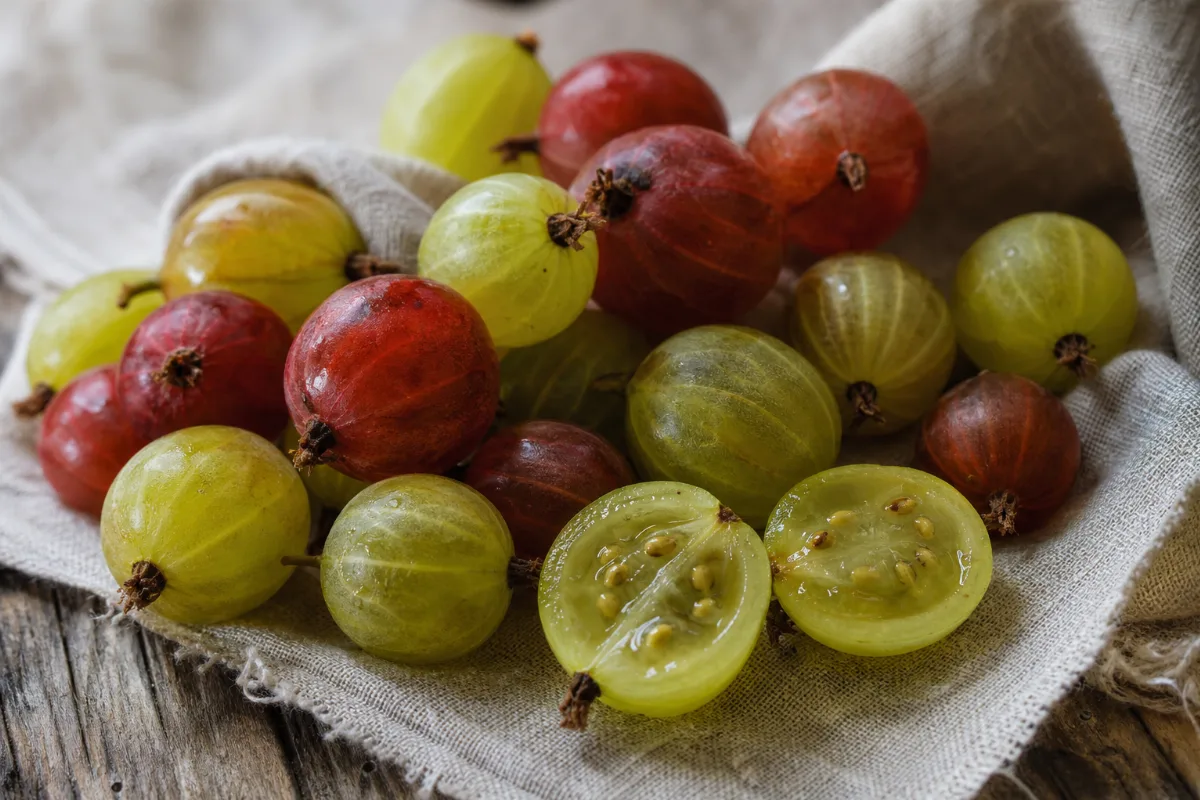
The gooseberry (Ribes uva-crispa) is the berry of a thorny shrub in the gooseberry family, which also holds the currants. The whole berry is eaten. Green types are tart and red or yellow ones are sweeter, so they are often cooked into jam, pies and sauces.
A cup of raw gooseberries (150 g) provides about 66 calories, 15.3 g of carbohydrate, 6.5 g of fibre, 41.6 mg of vitamin C and 297 mg of potassium (USDA). USDA lists no sugars or vitamin K value for this item.
Do not confuse it with Indian gooseberry (amla, Phyllanthus emblica) or cape gooseberry (Physalis peruviana). They are different plants and findings do not carry across.
What the research shows
We found no trial of gooseberries in people. A PubMed search for the plant name returned 24 records, none of them a human trial.
Vitamin C is essential and a lack causes scurvy. Gooseberries supply vitamin C, but that is a fact about the nutrient, not a test of the berry. Cooking and long storage can lower the vitamin C in foods.
Large studies link fruit and vegetables as a group with lower heart disease and early death, but gooseberries were not separated out. Laboratory studies show antioxidant activity in extracts, more in red than green berries, and one cell-culture study found a fruit extract reduced a respiratory virus. None of this shows a benefit in people.
At a glance
Traditional uses history, not proof
- Eaten raw when ripe, or cooked into jam, pie filling and sauce
- Plants of the Ribes family have been used in traditional medicine for heart, liver and stomach complaints, according to a 2025 review; it does not say which concerned gooseberry fruit
Studied for research
- Vitamin C supply and scurvy, a nutrient fact with no gooseberry trial, insufficient certainty for gooseberries
- Heart disease and early death in fruit-rich diets in general, low certainty and not specific to gooseberries
- Fibre and digestion, insufficient certainty
- Antioxidant and antiviral findings in the laboratory only, insufficient certainty
Main compounds
- Vitamin C (about 41.6 mg in a cup)
- Dietary fibre (about 6.5 g in a cup)
- Anthocyanins, red pigments, more in red berries
- Flavonoids and other phenols
Common forms
- Raw berries (the form the nutrition figures describe)
- Jam, pie filling and sauce, often sweetened
- Frozen whole berries
- Canned berries, often in syrup
- Laboratory extracts (not the same as the fruit)
Research links: USDA FoodData Central: raw gooseberries · NHS: Vitamin C · NHS: Food allergy · Review of Ribes (currant) plants (Plants, 2025) · Research Library · Genes & Biomarkers Library
What it is and its history
- Accepted scientific name
- Ribes uva-crispa
- Naming authority
- L. (GBIF accepted, usageKey 2986185)
- Synonyms
- Ribes grossularia (older name used in the existing nutrient-graph summary; not checked in GBIF)
- Common names
- Gooseberry (English); European gooseberry (English); Grosella espinosa (Spanish)
- Family or group
- Grossulariaceae (gooseberry family). The genus Ribes also holds the currants (black, red and white).
- Classification
- Plantae > Tracheophyta > Magnoliopsida > Saxifragales > Grossulariaceae > Ribes > Ribes uva-crispa
- Native range
- Not verified from a source read.
- Habitat
- Not verified.
- What it looks like
- Roots: Not verified.; Stems: The existing summary says a thorny shrub (not re-checked in a source).; Leaves: Not verified.; Flowers: Not verified.; Fruit: A berry eaten whole; green types are tart, red and yellow types are sweeter (existing summary, not re-checked).
- Cultivation
- Not verified from a source read.
- Harvest and processing
- Eaten raw when ripe, or cooked into jam, pie filling and sauce; sold fresh, frozen or canned (existing summary).
- Look-alikes and adulterants
- Name: Indian gooseberry / amla (Phyllanthus emblica); Note: A different plant with its own research and cautions. Do not apply findings across.; Name: Cape gooseberry / golden berry (Physalis peruviana); Note: A different plant. Do not apply findings across.; Name: Star gooseberry (Phyllanthus acidus); Note: A different plant; PubMed hits with this name were not used.
- Sustainability and conservation
- Not assessed.
Photographs
Traditional use and history history, not clinical proof
| Tradition or era | Documented use | Source |
|---|---|---|
| Traditional Ribes uses | The 2025 review says Ribes species have long been used in traditional medicine for cardiovascular disease, hepatitis, stomach and bowel complaints, high blood fats and detoxification. It does not tell us which of these concerned gooseberry fruit. | PubMed 41157753 (abstract read) |
Traditional use shows how it was used. It does not show that it works or is safe today.
What is inside, and how it may work
What it contains and how those compounds act in cells and animals. Laboratory and animal mechanisms are not proven effects in people.
Main compounds
| Compound | Family | Where it is concentrated | Activity studied | Level of evidence |
|---|---|---|---|---|
| Vitamin C (ascorbic acid) | vitamin | Fruit 27.7 mg per 100 g; about 41.6 mg in a US cup of 150 g (USDA) | Essential nutrient; a lack causes scurvy (NHS). Not tested as a gooseberry treatment. 12 11 | Composition data |
| Dietary fibre | carbohydrate | Fruit 4.3 g per 100 g; about 6.5 g in a US cup (USDA) | A normal nutrient role in fruit. Not tested for gooseberries. 12 | Composition data |
| Anthocyanins (red pigments such as cyanidin 3-glucoside) | flavonoid pigment | Fruit skin (red varieties) 1.86-3.63 mg/100 g in red and 1.14-1.79 mg/100 g in green Estonian gooseberry extracts | Antioxidant activity in a test tube only. 3 | Laboratory |
| Flavonoids and other phenols (rutin, quercetin 3-glucoside) | polyphenol | Fruit Total phenols 263-987 (red) and 162-392 (green) mg GAE/100 g in one extraction study | Antioxidant activity in a test tube only. 3 5 6 | Laboratory |
Mechanisms, receptors and pathways
| Target or pathway | Gene or receptor | What was found | Level |
|---|---|---|---|
| Free-radical scavenging in test-tube tests | Gooseberry extracts scored well in DPPH tests, red berries more than green. Nothing shows this happens in the body after eating the fruit. 3 5 | Lab | |
| Anti-RSV activity in cell culture | A fruit water extract reduced respiratory syncytial virus activity in cells. No animals or people were involved. 2 | Lab (cell culture) |
Absorption, metabolism and elimination
- Absorption
- Not researched.
- Distribution
- Not found.
- Metabolism
- Not found.
- Elimination
- Not found.
- Bioavailability
- Not established.
Isolated compounds versus whole extracts
The laboratory findings used extracts (citric-acid, water or methanol) and leaf extracts in one case. These are not the same as eating the berries.
Nutritional composition
Per 100 g of raw gooseberries (USDA FoodData Central record 173030, SR Legacy): 44 kcal, 87.9 g water, 0.88 g protein, 0.58 g fat, 10.2 g carbohydrate and 4.3 g fibre. One US cup (150 g) provides about 66 kcal, 6.5 g fibre, 41.6 mg vitamin C, 297 mg potassium and small amounts of copper, manganese and vitamin B6. USDA lists no sugars or vitamin K value for this item, so none is shown. Per-portion figures are the per-100 g values multiplied by 1.5. Values vary with variety, ripeness and storage. Cooking and storage can lower vitamin C (MedlinePlus).
1 low certainty5 not enough evidence
What was looked at
The 6 benefits and uses checked for Gooseberries, each with how strong the evidence is. Tap one to open it.
- Vitamin C supply and scurvy preventionNot enough evidence
- Heart disease and early death (fruit-rich diets in general)Low certainty
- Fibre and digestionNot enough evidence
- Antioxidant activity in the laboratoryNot enough evidence
- Activity against a virus (RSV) in cell cultureNot enough evidence
- Heart, liver, blood fats and other traditional Ribes usesNot enough evidence
What is Gooseberries good for?
The main studied uses and how strong the evidence is for each. For gooseberries there are no human trials, so most rows are about the nutrient, fruit in general or laboratory work, not proof that gooseberries prevent or treat anything.
Benefits, one by one
Each card is a research question, not a promise. Tap a goal to filter. Open a card to see the studies, doses and limits.
Vitamin C supply and scurvy prevention
Not enough evidenceGooseberries contain vitamin C. A lack of vitamin C causes scurvy, and the body does not store the vitamin, so it has to come from food. That is a fact about the nutrient. No trial has tested gooseberries to prevent or treat scurvy.
4 studiesRaw gooseberries (the form the USDA figures describe). Cooked, canned…
Studies, doses and limits
What the trials found
No gooseberry trial. The nutrient facts come from the NHS and MedlinePlus. USDA lists 27.7 mg of vitamin C per 100 g of raw gooseberries, about 41.6 mg in a US cup (150 g). The NHS says adults aged 19 to 64 need 40 mg a day.
Results
A cup of raw gooseberries has roughly the amount of vitamin C the NHS gives as an adult daily need. Cooking and storing vitamin C-rich foods can reduce it (MedlinePlus).
Why this rating
The link between vitamin C and scurvy is well established for the nutrient. For gooseberries themselves there is only food-composition data and no trial, so we rate the gooseberry-specific evidence as insufficient.
Form and dose studied
Raw gooseberries (the form the USDA figures describe). Cooked, canned or stored berries are expected to have less vitamin C.
Who was studied
General population; people who eat little fruit and vegetables are the ones at risk of low vitamin C.
Limits
No trial. Vitamin C content varies with variety and ripeness; a laboratory study of four gooseberry and five currant varieties reported a wide range of vitamin C values.
Why researchers looked
Gooseberries are a berry that is a source of vitamin C, so they appear on lists of vitamin C foods.
Proposed mechanism Established nutrient role
Vitamin C is needed for healthy skin, blood vessels, bones and cartilage and for wound healing (NHS).
A proposed mechanism does not show that the effect happens in people.
Large vitamin C amounts from supplements can upset the stomach; this is not about eating the berries (see the Safety tab).
Heart disease and early death (fruit-rich diets in general)
Low certaintyIn large studies that followed people over time, those who ate more fruit and vegetables had lower rates of heart disease and early death. These studies did not look at gooseberries on their own, so they say nothing certain about this berry.
2 studiesUsual dietary intake of fruit and vegetables.
Studies, doses and limits
What the trials found
A 2017 review of 95 prospective studies found that fruit and vegetables combined went with lower risk of heart disease and early death. The abstract names apples, pears, citrus fruit, leafy and cruciferous vegetables and salads. It does not name gooseberries.
Results
Lower risk with higher fruit and vegetable intake overall. Nothing specific to gooseberries.
Effect sizes as reported
Fruit and vegetables combined, per 200 g a day: cardiovascular disease RR 0.92 (95% CI 0.90-0.95); all-cause mortality RR 0.90 (0.87-0.93).
Why this rating
Observational studies only, and the result is for fruit and vegetables together, not gooseberries. People who eat more fruit may differ in other ways.
Form and dose studied
Usual dietary intake of fruit and vegetables.
Who was studied
Adults in cohort studies.
Limits
Association, not cause. Gooseberries were not isolated.
Why researchers looked
Researchers study fruit and vegetables as a group because most people eat many kinds.
Traditional use
A 2025 review says Ribes plants have long been used in traditional medicine for heart conditions, but it states that clinical trials are limited in number and rigour.
Proposed mechanism Preliminary mechanism
Not established. Fibre, potassium and plant compounds are often suggested.
A proposed mechanism does not show that the effect happens in people.
None specific to this finding.
Fibre and digestion
Not enough evidenceGooseberries are a fibre-rich fruit: raw ones have 4.3 g of fibre per 100 g. We found no trial of gooseberries for bowel health, so we cannot say they help.
2 studiesRaw whole berries (USDA figures).
Studies, doses and limits
Results
Nutrient values only.
Why this rating
Composition data only; no trial.
Form and dose studied
Raw whole berries (USDA figures).
Who was studied
Not studied.
Limits
No human data on gooseberries and bowel health.
Why researchers looked
Whole berries carry their fibre, and fibre is a normal part of how fruit supports digestion in general.
Traditional use
The 2025 Ribes review lists stomach and bowel complaints among traditional uses of the genus.
Proposed mechanism Established nutrient role
Fibre adds bulk to stool. This is a general nutrient role, not tested for gooseberries.
A proposed mechanism does not show that the effect happens in people.
None specific found. Jam, pie filling and canned berries often carry added sugar, so the label matters.
Antioxidant activity in the laboratory
Not enough evidenceIn test tubes, gooseberry extracts mop up free radicals, and red berries did so more than green. This does not show that eating gooseberries does anything for health.
3 studiesLaboratory extracts of the fruit.
Studies, doses and limits
Results
Estonian-grown red gooseberry extracts had more anthocyanins and total phenols and scored higher on the DPPH test than green. A Hungarian study found the water extract of gooseberry was its most active antioxidant extract.
Effect sizes as reported
Red vs green: DPPH 87-91% vs 73-86% inhibition; anthocyanins 1.86-3.63 vs 1.14-1.79 mg/100 g.
Why this rating
Laboratory work on extracts only. Test-tube antioxidant activity has not been shown to give a benefit in people.
Form and dose studied
Laboratory extracts of the fruit.
Limits
Extracts are not the fruit as eaten; no animals or people involved.
Why researchers looked
Gooseberries contain flavonoids, anthocyanins (red pigments) and other phenols, which score well in laboratory antioxidant tests.
Proposed mechanism Lab
Free-radical scavenging in a test tube (DPPH, ABTS and similar tests).
A proposed mechanism does not show that the effect happens in people.
None specific.
Activity against a virus (RSV) in cell culture
Not enough evidenceIn cells grown in a lab, a water extract of gooseberry fruit reduced the activity of respiratory syncytial virus. Nobody has tested this in animals or people, so it is not a reason to eat or take gooseberry for colds or infections.
1 studiesLaboratory water and methanol extracts of fruit and leaf.
Studies, doses and limits
Results
Fruit water extract: EC50 96.90 ug/mL and selectivity index 11.70, the best of four extracts tested. Leaf extracts and the fruit methanol extract were weaker.
Effect sizes as reported
Fruit water extract EC50 96.90 ug/mL, SI 11.70.
Why this rating
Cell culture only, one short communication.
Form and dose studied
Laboratory water and methanol extracts of fruit and leaf.
Limits
No animals or people. Leaf extracts are not food.
Why researchers looked
Researchers look for new anti-virus agents in plants used in traditional medicine; the authors say gooseberry fruits are used in Turkey for various disorders.
Traditional use
Per the authors, fruits are used in Turkey for various disorders.
Proposed mechanism Lab
Not studied. Cell-culture effect on RSV only.
A proposed mechanism does not show that the effect happens in people.
None specific.
Heart, liver, blood fats and other traditional Ribes uses
Not enough evidencePlants of the Ribes (currant and gooseberry) family have been used traditionally for heart problems, hepatitis, stomach complaints and high blood fats. The 2025 review says clinical trials are few and weak, and most attention goes to black currant, not gooseberry.
1 studiesVarious extracts and isolated compounds in the review.
Studies, doses and limits
What the trials found
The review draws on laboratory, animal and clinical studies of the genus. Its abstract does not describe a gooseberry fruit trial.
Results
The authors report that many Ribes species are poorly characterised, toxicology and pharmacokinetics are seldom studied, and clinical trials are limited in number and rigour.
Why this rating
No gooseberry trial; the review covers the genus and says the clinical evidence is limited.
Form and dose studied
Various extracts and isolated compounds in the review.
Limits
A narrative review of the whole genus.
Why researchers looked
Traditional medicine uses of the genus.
Traditional use
Traditional medicine uses listed by the review authors.
Proposed mechanism Unknown
Not established for gooseberry fruit.
A proposed mechanism does not show that the effect happens in people.
The authors note safety studies are rare.
Connections to the rest of health
How Gooseberries connects to the rest of our health knowledge graph. Every link says what kind of connection it is. A safety link (for example to the liver) is a warning, not a benefit. A study that merely mentions a topic never creates a benefit link.
Explore every connection: goals, body systems, organs, symptoms, genes
A. Wellness goals
| Connected to | Kind of connection | Evidence status | Context | Studies |
|---|---|---|---|---|
| Immune Support | Not enough evidence | Vitamin C supply and scurvy prevention: Gooseberries contain vitamin C. A lack of vitamin C causes scurvy, and the body does not store the vitamin, so it has to come from food. That is a fact about the nutrient. No trial has tested gooseberries to prevent or treat scurvy. | 12 11 9 6 | |
| Heart Health | Low certainty | Heart disease and early death (fruit-rich diets in general): In large studies that followed people over time, those who ate more fruit and vegetables had lower rates of heart disease and early death. These studies did not look at gooseberries on their own, so they say nothing certain about this berry. | 1 4 | |
| Digestive Health | Not enough evidence | Fibre and digestion: Gooseberries are a fibre-rich fruit: raw ones have 4.3 g of fibre per 100 g. We found no trial of gooseberries for bowel health, so we cannot say they help. | 12 4 | |
| Healthy Aging | Not enough evidence | Antioxidant activity in the laboratory: In test tubes, gooseberry extracts mop up free radicals, and red berries did so more than green. This does not show that eating gooseberries does anything for health. | 3 5 6 | |
| Immune Support | Not enough evidence | Activity against a virus (RSV) in cell culture: In cells grown in a lab, a water extract of gooseberry fruit reduced the activity of respiratory syncytial virus. Nobody has tested this in animals or people, so it is not a reason to eat or take gooseberry for colds or infections. | 2 | |
| Heart Health | Traditional use | Not enough evidence | Heart, liver, blood fats and other traditional Ribes uses: Plants of the Ribes (currant and gooseberry) family have been used traditionally for heart problems, hepatitis, stomach complaints and high blood fats. The 2025 review says clinical trials are few and weak, and most attention goes to black currant, not gooseberry. | 4 |
B. Body systems
| Connected to | Kind of connection | Evidence status | Context | Studies |
|---|---|---|---|---|
| Immune System | Biological association | Not enough evidence | Studied for: Vitamin C supply and scurvy prevention Studied for: Activity against a virus (RSV) in cell culture | 12 11 9 6 2 |
| Cardiovascular System | Biological association | Low certainty | Studied for: Heart disease and early death (fruit-rich diets in general) Studied for: Heart, liver, blood fats and other traditional Ribes uses | 1 4 |
| Digestive System | Biological association | Not enough evidence | Studied for: Fibre and digestion Studied for: Heart, liver, blood fats and other traditional Ribes uses | 12 4 |
| Cellular | Biological association | Not enough evidence | Studied for: Antioxidant activity in the laboratory | 3 5 6 |
E. Health conditions
| Connected to | Kind of connection | Evidence status | Context | Studies |
|---|---|---|---|---|
| Food allergy | Adverse effect or risk | General risk | The NHS says people can be allergic to any food. No gooseberry-specific source was found. The NHS says you can be allergic to any food. No gooseberry-specific source was found. Preparation or compound: Any food |
10 |
L. Active compounds
| Connected to | Kind of connection | Evidence status | Context | Studies |
|---|---|---|---|---|
| Vitamin C (ascorbic acid) | Biological association | Composition data | Essential nutrient; a lack causes scurvy (NHS). Not tested as a gooseberry treatment. Preparation or compound: Fruit |
12 11 |
| Dietary fibre | Biological association | Composition data | A normal nutrient role in fruit. Not tested for gooseberries. Preparation or compound: Fruit |
12 |
| Anthocyanins (red pigments such as cyanidin 3-glucoside) | Biological association | Laboratory | Antioxidant activity in a test tube only. Preparation or compound: Fruit skin (red varieties) |
3 |
| Flavonoids and other phenols (rutin, quercetin 3-glucoside) | Biological association | Laboratory | Antioxidant activity in a test tube only. Preparation or compound: Fruit |
3 5 6 |
Each connection is stored with the ingredient, the connected record, the kind of connection, the evidence status, the supporting studies, the preparation or compound involved, and a review date (last reviewed October 25, 2026).
Evidence at a glance: what the research found for 6 outcomes
Each outcome below is one thing researchers measured. Certainty is how far the evidence can be trusted, not how well it works. The full studies are on the next tab.
The evidence
The research centre for Gooseberries. Every record here was checked against PubMed or the publisher's page; we never list a study we have not verified.
Evidence by outcome
Bars show how many studies we found for each outcome, not how well it works. People are added up across trials only (reviews are not added, to avoid double counting).
How we rate evidence
High certainty
Several well-run trials or reviews agree; further research is unlikely to change the picture much.
Moderate certainty
Good trials point the same way, but some doubt remains.
Low certainty
Small, short or inconsistent trials. The finding could change with better research.
Very low certainty
Very little or very weak human data. Treat as a possibility only.
Mixed findings
Trials or reviews disagree with each other.
Not enough evidence
Not enough human research to say either way.
Evidence against
Good research found no benefit, or found harm.
We take the reviewers' own risk-of-bias and GRADE statements where they exist, and otherwise judge from study size, design, consistency, directness and whether a product matches what is sold. Many publications do not make evidence high. Method note: We started from our existing gooseberry summary, re-read the USDA FoodData Central record, and read PubMed abstracts and the NHS, MedlinePlus and FDA pages. Only abstracts were read for studies. Items we could not verify are flagged in the research gaps.
Study library: every study we checked 12
| Study | Design | People | Product, dose, length | Result |
|---|---|---|---|---|
| Aune 2017 Fruit and vegetable intake and the risk of cardiovascular disease, total cancer and all-cause mortality-a systematic review and dose-response meta-analysis of prospective studies. Int J Epidemiol · PMID 28338764 · DOI |
Systematic review (observational cohort studies) |
95 prospective studies (142 publications) of fruit and vegetable intake in adults | Usual dietary intake of fruit and vegetables; gooseberries are not named in the abstract fruit and vegetables |
For fruits and vegetables combined, each 200 g a day went with a lower risk: relative risk 0.92 for coronary heart disease, 0.84 for stroke, 0.92 for cardiovascular disease, 0.97 for total cancer and 0.90 for all-cause death. The authors say similar associations were seen for fruit and vegetables separately. Fruit and vegetables combined, per 200 g/day: cardiovascular disease RR 0.92 (95% CI 0.90-0.95); all-cause mortality RR 0.90 (0.87-0.93) (0.90-0.95 (cardiovascular disease, combined)) Methods, limits and fundingOutcomes: Cardiovascular disease, total cancer, all-cause mortality Limitations: Observational: shows an association, not cause. The abstract does not name gooseberries or any other berry, so nothing here is specific to gooseberries. Funding and conflicts: Not stated in the abstract read Read: abstract |
| Dogan 2020 Short Communication: Antiviral activity of Ribes uva-crispa L. extracts in vitro. Pak J Pharm Sci · PMID 33191245 |
In vitro (cell culture) lab (cell culture) |
Cell culture infected with respiratory syncytial virus (RSV) | Aqueous and methanol extracts of Ribes uva-crispa fruit and leaf fruit and leaf |
The fruit water extract had the highest anti-RSV activity (EC50 96.90 ug/mL, selectivity index 11.70). The leaf methanol extract (EC50 2527.41 ug/mL, SI 6.55), leaf water extract (EC50 1093.37 ug/mL, SI 1.40) and fruit methanol extract (EC50 11262.35 ug/mL, SI 0.56) were weaker. The authors say the fruit water and leaf methanol extracts are worth further study. Fruit water extract: EC50 96.90 ug/mL, SI 11.70 Methods, limits and fundingOutcomes: Cell toxicity and anti-RSV activity (XTT colour test) Limitations: Cell culture only: no animals or people. Extracts are not the same as eating the berries, and leaf extracts are not food. Funding and conflicts: Not stated in the abstract read Read: abstract |
| Hussain 2023 Natural pigments (anthocyanins and chlorophyll) and antioxidants profiling of European red and green gooseberry (Ribes uva-crispa L.) extracted using green techniques (UAE-citric acid-mediated extraction). Curr Res Food Sci · PMID 38034946 · DOI |
Laboratory extraction study lab (fruit extract) |
Estonian-grown red and green gooseberries | Citric-acid ultrasound extracts of gooseberry fruit fruit |
Red gooseberry extracts had more anthocyanins (1.86-3.63 mg/100 g) than green (1.14-1.79 mg/100 g), and more total phenols (263-987 versus 162-392 mg GAE/100 g). In the DPPH test-tube method, scavenging was 87-91% for red and 73-86% for green. The aim was natural food colourants, not health. Anthocyanins 1.86-3.63 (red) vs 1.14-1.79 mg/100 g (green); DPPH 87-91% vs 73-86% Methods, limits and fundingOutcomes: Pigment and phenol content; free-radical scavenging (DPPH test) Limitations: Laboratory extraction. Not a study in people, and test-tube antioxidant activity does not show a health benefit. Funding and conflicts: Authors report financial support from their universities (Estonian University of Life Sciences, Tallinn University of Technology); no company named in the abstract Read: abstract |
| Izteleuova 2025 The Current State of Knowledge on Ribes spp. (Currant) Plants. Plants (Basel) · PMID 41157753 · DOI |
Narrative review (laboratory, animal and clinical studies) human, animal and lab (review) |
Review of research on the genus Ribes, with most attention on black currant (R. nigrum) | Ribes extracts and isolated compounds various |
The authors say Ribes species have long been used in traditional medicine for cardiovascular disease, hepatitis, stomach and bowel complaints, high blood fats and detoxification. They also report that many Ribes species are poorly characterised chemically, toxicology and pharmacokinetics are seldom studied, and clinical trials are limited in number and rigour. Not applicable (narrative review) Methods, limits and fundingOutcomes: Traditional uses and laboratory, animal and clinical findings Limitations: Covers the whole genus, mostly black currant. The abstract does not describe gooseberry fruit findings. Funding and conflicts: No conflicts of interest declared Read: abstract |
| Laczko-Zold 2018 Extractability of polyphenols from black currant, red currant and gooseberry and their antioxidant activity. Acta Biol Hung · PMID 29888668 · DOI |
Laboratory extraction study lab (fruit extract) |
Black currant, red currant and gooseberry fruits | Methanol, 50% methanol and water extracts of the fruit fruit |
For gooseberry the water extract was the most active antioxidant in the DPPH test (IC50 5.9 mg/ml) and in the PCL test (41.84 umol AAE/g). Quercetin 3-O-glucoside was found in every sample. Gooseberry water extract: DPPH IC50 5.9 mg/ml; PCL 41.84 umol AAE/g Methods, limits and fundingOutcomes: Polyphenol, flavonoid and anthocyanin content; antioxidant tests (DPPH, ABTS, PCL) Limitations: Laboratory extraction. The work compares solvents; it is not a study in people. Funding and conflicts: Not stated in the abstract read Read: abstract |
| Orsavova 2019 Contribution of phenolic compounds, ascorbic acid and vitamin E to antioxidant activity of currant (Ribes L.) and gooseberry (Ribes uva-crispa L.) fruits. Food Chem · PMID 30744864 · DOI |
Laboratory analysis of fruit lab (fruit analysis) |
Berries of four gooseberry and five currant varieties | Ribes uva-crispa and currant berries analysed in the laboratory fruit |
Ascorbic acid ranged from 6.2 to 14.04 g per kg across the nine varieties, and the authors named red gooseberry 'Black Negus' and black currant 'Otelo' as most significant on antioxidant activity. This is a measurement of the fruit, not a study in people. Ascorbic acid 6.2-14.04 g/kg (all nine varieties together; gooseberry-only range not given in the abstract) Methods, limits and fundingOutcomes: Phenolic, vitamin C and vitamin E content; antioxidant activity by test-tube methods Limitations: Laboratory measurement only. Ranges combine gooseberries and currants. Funding and conflicts: Not stated in the abstract read Read: abstract |
| s-fda-produce-safely FDA: Selecting and Serving Produce Safely · Source |
Official consumer guidance n/a |
Methods, limits and fundingRead: full-text | ||
| s-gbif-ribes-uva-crispa GBIF Backbone: Ribes uva-crispa L. (usageKey 2986185) · Source |
Reference database n/a |
Methods, limits and fundingRead: full-text | ||
| s-medlineplus-vitamin-c MedlinePlus: Vitamin C · Source |
Official health guidance n/a |
Methods, limits and fundingRead: full-text | ||
| s-nhs-food-allergy NHS: Food allergy · Source |
Official health guidance n/a |
Methods, limits and fundingRead: full-text | ||
| s-nhs-vitamin-c NHS: Vitamin C · Source |
Official health guidance n/a |
Methods, limits and fundingRead: full-text | ||
| s-usda-fdc-173030 USDA FoodData Central: Gooseberries, raw (FDC 173030, SR Legacy) · Source |
Food composition database n/a |
Methods, limits and fundingRead: full-text |
What we do not know yet
- No trial in people has tested gooseberries (Ribes uva-crispa) for any health outcome.
- The large fruit-and-vegetable studies do not separate out gooseberries.
- The antioxidant and antiviral findings come from laboratory extracts and cell culture only.
- Pregnancy, breastfeeding, choking risk for young children, dental effects, bloating and kidney (potassium and oxalate) questions were not researched from a source.
- No gooseberry-specific allergy report, medicine interaction or pesticide source was found.
How new research is added
New studies are found by a saved PubMed search and placed in a review queue before the page changes.
Lab markers
What changed in blood or saliva tests during trials. A changed number is not the same as feeling or being healthier, and we give no "normal ranges".
Safety
What studies and official sources say about side effects, medicines and who should check first. Each point shows what kind of evidence it comes from.
Main points to know 4
- Gooseberries are an ordinary food; we found no gooseberry-specific warning. None of the official sources we read lists a warning, a medicine interaction or a liver concern for eating gooseberries. That is an absence of evidence, not proof of safety for every person. None found 10 4
- Any food can cause an allergic reaction. The NHS says you can be allergic to any type of food. We found no source naming gooseberry as an allergen. Swelling of the lips, mouth, throat or tongue, trouble breathing, a tight throat or fainting after eating needs emergency help: call 999 in the UK or 911 in the US. Authoritative guidance 10
- Not the same plant as Indian gooseberry (amla) or cape gooseberry. Indian gooseberry (Phyllanthus emblica) and cape gooseberry (Physalis peruviana) are different plants. Safety and research on them do not apply to the European gooseberry (Ribes uva-crispa), and the reverse is also true. Identification 8
- High vitamin C from supplements is a different matter from eating berries. The NHS says more than 1,000 mg a day of vitamin C from supplements can cause stomach pain, diarrhoea and flatulence. MedlinePlus says amounts above 2,000 mg a day are not recommended and can rarely cause kidney stones. A cup of gooseberries has about 41.6 mg (USDA). Authoritative guidance 11 9 12
Side effects 2
| Effect | How often | Severity and recovery | Evidence |
|---|---|---|---|
| Allergic reaction (any food) The NHS source is about food allergy in general. No gooseberry-specific case or frequency was found. | Not established | from mild to serious Mild symptoms usually pass; serious reactions need emergency treatment. | Authoritative guidance 10 |
| Stomach pain, diarrhoea and gas from very large vitamin C amounts taken as supplements This concerns vitamin C supplements, not berries. | Not established | mild The NHS says symptoms should disappear once you stop the supplements. | Authoritative guidance 11 9 |
Liver
No liver injury linked to eating gooseberries was found in the sources read. LiverTox was not checked.
How often. No frequency found.
This is a safety connection. It is not evidence that Gooseberries supports liver health.
Medicines and supplements 1
| With | Why it matters | Importance | Evidence | What to do |
|---|---|---|---|---|
| Prescription and over-the-counter medicines prescription | No source we read describes a medicine interaction with eating gooseberries. Absence of a report is not proof that none exists. | None found Not enough evidence | A pharmacist can check your own medicines. |
Who should check first 2
| Situation | Advice | Evidence |
|---|---|---|
| A known or suspected allergy to gooseberry or other Ribes berries (such as currants) | Avoid it and ask a doctor about an allergy check. Follow your own emergency plan if you have one. | Authoritative guidance 10 |
| Pregnancy and large vitamin C supplement amounts | MedlinePlus does not recommend large vitamin C supplement doses in pregnancy. This is about supplements, not berries. | Authoritative guidance 9 |
Overdose, product quality and regulators
Summary. Gooseberry fruit is an ordinary food. No toxic part of the fruit was identified in the sources read.
Animal. Not reviewed.
Human doses studied. No human trial of gooseberries was found. The 2025 Ribes review says safety studies are seldom done.
Overdose response. Not found.
Genotoxicity. Not reviewed.
Toxic or hazardous parts. Not checked in a source. The shrub has thorns; the leaves are not food and were not assessed for safety.
Like any fresh produce, gooseberries can carry bacteria or dirt. We found no gooseberry-specific pesticide, heavy-metal or mould-toxin source.
Bacteria on fresh produce. The FDA says to choose fruit that is not bruised, cut away damaged areas, throw away rotten produce, wash under running water without soap or produce wash, and refrigerate perishable produce at 40 F (about 4 C) or below. Washing reduces bacteria but does not remove all of them. 7
Pesticide residues. No gooseberry-specific residue source was found.
| Body | Action | Date |
|---|---|---|
| FDA (United States) | Consumer advice on washing and storing fresh produce source | 2026-10-25 (page read; page content current as of 03/05/2024) |
| NHS (UK) (United Kingdom) | Food allergy symptoms and emergency signs; vitamin C advice source | 2026-10-25 (pages read) |
| MedlinePlus (US National Library of Medicine) (United States) | Vitamin C side effects and pregnancy statement source | 2025-01-21 (review date on page) |
When to get medical help
- Swelling of the lips, face, mouth, tongue or throat
- Trouble breathing, wheezing or a tight throat or trouble swallowing
- Feeling faint or dizzy, or collapsing, after eating
- Spreading hives or a rash that is swollen, raised or itchy
Stop using the product and contact a clinician or emergency service. In the US, Poison Control is 1-800-222-1222.
General information only, not medical advice. Ask a clinician or pharmacist before use, especially with medicines, in pregnancy or with a health condition. See the Natural Remedy Safety guide.
Frequently asked questions
What are gooseberries good for?
Is a gooseberry the same as amla (Indian gooseberry)?
No. The gooseberry here is Ribes uva-crispa. Indian gooseberry (amla) is Phyllanthus emblica, a different plant with its own research. Cape gooseberry (Physalis peruviana) is also different.
Are gooseberries high in vitamin C?
Do gooseberries prevent scurvy?
How many calories and how much fibre are in gooseberries?
USDA lists raw gooseberries at 44 kcal and 4.3 g of fibre per 100 g. A cup (150 g) has about 66 kcal and 6.5 g of fibre.
Do gooseberries help heart health?
Large studies link fruit-rich diets with lower heart disease, but gooseberries were not separated out and it is an association, not proof. We found no trial of gooseberries.
Do gooseberries have antioxidants?
Can gooseberries fight viruses?
A fruit water extract reduced respiratory syncytial virus in cells in a lab. No animals or people were tested, so it is not a reason to use gooseberry for infections.
Are red and green gooseberries different?
In one lab study, red gooseberry extracts had more anthocyanins and total phenols and scored higher on an antioxidant test than green. That does not show a difference in health effects.
Are gooseberries safe to eat?
They are an ordinary food and we found no gooseberry-specific warning. Any food can cause an allergic reaction, so call emergency services for swollen lips, mouth or throat, or trouble breathing.
Do gooseberries interact with medicines?
We did not find a source describing a medicine interaction with eating gooseberries. A pharmacist can check your own medicines.
Should I wash gooseberries?
The FDA advises washing produce under running water without soap or produce wash, cutting away damaged parts, and refrigerating perishable produce at 40 F (about 4 C) or below.
Explore by health goal
Editorial transparency
- Written by
- AlternativeMed editorial team. Research compiled with AI assistance, then checked against the sources listed.
- Medical review
- None. This page has not been reviewed by a physician or pharmacist.
- First published
- 2026-10-25
- Last substantive update
- 2026-10-25
- How we research
- We started from our existing gooseberry summary, re-read the USDA FoodData Central record, and read PubMed abstracts and the NHS, MedlinePlus and FDA pages. Only abstracts were read for studies. Items we could not verify are flagged in the research gaps.
- How we rate evidence
- See "How we rate evidence" in the Evidence tab.
- Independence
- No product is promoted on this page. No affiliate links are shown.
Sources 12
Each source was opened and checked. Where we read only the abstract, it says so. The small numbers in the text point here.
- Aune D, Giovannucci E, Boffetta P, et al.. Fruit and vegetable intake and the risk of cardiovascular disease, total cancer and all-cause mortality-a systematic review and dose-response meta-analysis of prospective studies.. Int J Epidemiol. 2017. PMID 28338764. DOI 10.1093/ije/dyw319. (abstract)
- Dogan HH, Duman R, Dinc M. Short Communication: Antiviral activity of Ribes uva-crispa L. extracts in vitro.. Pak J Pharm Sci. 2020. PMID 33191245. (abstract)
- Hussain S, Sharma M, Jarg T, et al.. Natural pigments (anthocyanins and chlorophyll) and antioxidants profiling of European red and green gooseberry (Ribes uva-crispa L.) extracted using green techniques (UAE-citric acid-mediated extraction).. Curr Res Food Sci. 2023. PMID 38034946. DOI 10.1016/j.crfs.2023.100629. (abstract)
- Izteleuova EY, Zhumashova GT, Bekezhanova TS, et al.. The Current State of Knowledge on Ribes spp. (Currant) Plants.. Plants (Basel). 2025. PMID 41157753. DOI 10.3390/plants14203196. (abstract)
- Laczko-Zold E, Komlosi A, Ulkei T, et al.. Extractability of polyphenols from black currant, red currant and gooseberry and their antioxidant activity.. Acta Biol Hung. 2018. PMID 29888668. DOI 10.1556/018.69.2018.2.5. (abstract)
- Orsavova J, Hlavacova I, Mlcek J, et al.. Contribution of phenolic compounds, ascorbic acid and vitamin E to antioxidant activity of currant (Ribes L.) and gooseberry (Ribes uva-crispa L.) fruits.. Food Chem. 2019. PMID 30744864. DOI 10.1016/j.foodchem.2019.01.072. (abstract)
- . FDA: Selecting and Serving Produce Safely. . . (full-text)
- . GBIF Backbone: Ribes uva-crispa L. (usageKey 2986185). . . (full-text)
- . MedlinePlus: Vitamin C. . . (full-text)
- . NHS: Food allergy. . . (full-text)
- . NHS: Vitamin C. . . (full-text)
- . USDA FoodData Central: Gooseberries, raw (FDC 173030, SR Legacy). . . (full-text)


