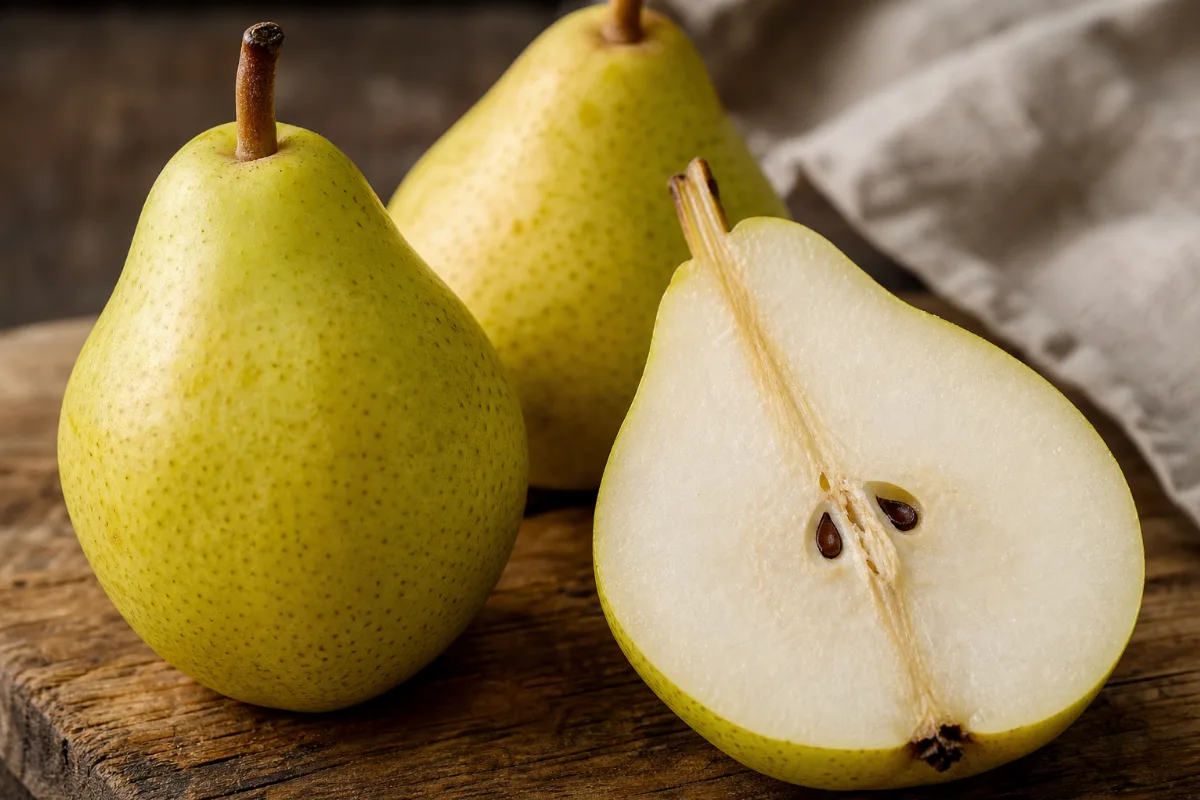
Fruits · Fruit
Pears
Pyrus communis · also called Pear, European pear, pera (Spanish)
The pear is the fruit of a tree in the rose family. The soft flesh is eaten, often with the skin. A medium pear has about 101 calories and 5.5 g of fibre. Large studies link fruit-rich diets, including apples and pears, with lower heart disease and diabetes risk, but those are links, not proof. There is only one small trial of whole pears. The main cautions are an itchy mouth from raw pear in people with birch-pollen allergy, and washing the fruit.
General information, not medical advice. Last substantive update · Not medically reviewed. A named clinician has not signed off on this page. How this page is made
About Pears
The pear is an everyday, fibre-rich fruit. Research on eating pears is mostly observational and the one trial of whole pears is small, so it is best seen as a nutritious food rather than a proven remedy.
What it is
The pear (Pyrus communis) is the fruit of a tree in the rose family, which also includes apples, peaches and cherries. The soft flesh is eaten, often with the skin.
A medium raw pear (178 g) provides about 101 calories, 5.5 g of fibre and 17.4 g of natural sugars, plus small amounts of vitamin C, potassium and copper (USDA). It is a good source of fibre and a small source of most vitamins. The NHS counts one medium pear as one 80 g portion of fruit.
What the research shows
Large studies that followed people over time link higher fruit and vegetable intake, including apples and pears, with lower rates of heart disease and early death. People who eat more fruit may differ in other ways, so this is not proof. A meta-analysis of five cohorts also linked the highest intake of apples and pears with about 18% lower type 2 diabetes risk. Pears were never studied on their own in these analyses.
The only trial of whole pears gave two a day for 12 weeks to 40 adults with metabolic syndrome. Pulse pressure, waist size and leptin changed slightly. The main outcome, systolic blood pressure, did not change by a clear amount. The trial was small and open-label.
We found no trial of pears for constipation. Claims about ulcers, alcohol metabolism and blood fats rest on animal studies.
Whole pear versus juice, canned and dried
The trial used whole fresh pears. Juice has less fibre than the fruit, and in diabetes studies fruit juice went the opposite way to whole fruit. The NHS says juice counts as at most one portion, dried fruit is high in sugar, and canned fruit is better in juice than syrup.
Pear extracts and powders were not studied in the sources read and are not covered on this page.
At a glance
Traditional uses history, not proof
- Eaten fresh, canned, dried or as juice
- No source we read documents a traditional medicinal use
Studied for research
- Heart disease and early death in diets rich in apples and pears, low certainty
- Blood pressure and body measures in metabolic syndrome, one small trial, very low certainty
- Type 2 diabetes risk (apples and pears together), very low certainty
- Fibre and bowel regularity, not enough evidence for pears
- Animal-only findings on ulcers, alcohol metabolism and blood fats, not enough evidence
Main compounds
- Dietary fibre (about 5.5 g in a medium pear)
- Natural sugars including fructose (about 17 g in a medium pear)
- Phenolic compounds, a family of plant compounds
- Vitamin C, potassium, copper and small amounts of other nutrients
Common forms
- Fresh pear, with or without skin (the form the nutrition figures describe)
- Canned pear halves, in juice or syrup
- Dried pear
- Pear juice
- Pear extracts (not the same as the fruit, and not studied here)
Research links: NHS: Food allergy · Pear trial in metabolic syndrome (Food & Function, 2019) · Apple and pear intake and type 2 diabetes, meta-analysis (Food & Function, 2017) · USDA FoodData Central: raw pear · Research Library · Genes & Biomarkers Library
What it is and its history
- Accepted scientific name
- Pyrus communis
- Naming authority
- L. (GBIF accepted, usageKey 5362573)
- Common names
- Pear (English); European pear (English); Pera (Spanish)
- Family or group
- Rosaceae (rose family), which also includes apple, peach, plum and cherry.
- Classification
- Plantae > Tracheophyta > Magnoliopsida > Rosales > Rosaceae > Pyrus > Pyrus communis
- Native range
- Not verified from a source read.
- Habitat
- Not verified.
- What it looks like
- Roots: Not verified.; Stems: Not verified.; Leaves: Not verified.; Flowers: Not verified.; Fruit: A fleshy fruit with a small core holding dark seeds; the flesh is eaten, often with the skin (existing site summary; not re-sourced).
- Cultivation
- Not verified from a source read.
- Harvest and processing
- Eaten fresh, canned (in juice or syrup), dried or as juice (existing site summary and the NHS portion page).
- Look-alikes and adulterants
- Name: Apple (Malus domestica); Note: A different fruit in the same family, often grouped with pear in studies ("apples and pears"). Evidence for one is not evidence for the other.; Name: Asian pear (Pyrus pyrifolia); Note: A related pear species listed as an alias in the existing summary; not assessed here, and results for P. communis should not be assumed to apply.
- Sustainability and conservation
- Not assessed.
Photographs
Traditional use and history history, not clinical proof
| Tradition or era | Documented use | Source |
|---|---|---|
| Everyday fruit | Pears are widely eaten fresh, canned, dried and as juice. No source read documents their history or traditional medicinal use, and nothing here is a claim that pears treat disease. | NOT verified (no source read) |
Traditional use shows how it was used. It does not show that it works or is safe today.
What is inside, and how it may work
What it contains and how those compounds act in cells and animals. Laboratory and animal mechanisms are not proven effects in people.
Main compounds
| Compound | Family | Where it is concentrated | Activity studied | Level of evidence |
|---|---|---|---|---|
| Dietary fibre | carbohydrate | Flesh and skin 3.1 g per 100 g; about 5.5 g in a medium pear (USDA) | Provides fibre in the diet. Not tested as a treatment. 13 | Composition data |
| Phenolic compounds (polyphenols) | plant compounds | Not verified 27 to 41 mg per 100 g (2015 review) | Described as antioxidants; animal studies only for health effects. 6 | Composition data and animal studies |
| Fructose (a fruit sugar) | sugar | Flesh Total sugars 9.75 g per 100 g (USDA); the fructose share was not read | A 2015 review says fibre and fructose in pears probably explain a laxative effect. 6 13 | Review (authors' reasoning) |
Mechanisms, receptors and pathways
| Target or pathway | Gene or receptor | What was found | Level |
|---|---|---|---|
| Antioxidant and other effects of pear phenolics | Described by a 2015 review from composition data and animal studies. No effect in people is shown by it. 6 | Lab and animal |
Absorption, metabolism and elimination
- Absorption
- Not researched.
- Distribution
- Not found.
- Metabolism
- Not found.
- Elimination
- Not found.
- Bioavailability
- Not established.
Isolated compounds versus whole extracts
The one pear trial used whole fresh pears. Population studies combine pears with apples or all fruit. Pear juice, canned and dried pears differ: the NHS says juice counts as at most one portion and dried fruit is high in sugar, and the diabetes review found fruit juice went the opposite way to whole fruit. Pear extracts and powders were not studied in the sources read.
Nutritional composition
Per 100 g of raw pear (USDA FoodData Central, SR Legacy): 57 kcal, 84.0 g water, 0.36 g protein, 0.14 g fat, 15.2 g carbohydrate of which 9.75 g are sugars, and 3.1 g fibre. A medium pear (178 g) provides about 101 kcal, 5.5 g fibre and 17.4 g sugars, with small amounts of vitamin C (7.7 mg), potassium (206 mg), copper (0.14 mg), vitamin K (7.8 micrograms) and folate (12 micrograms DFE). A pear is a good source of fibre and a small source of most vitamins. Per-portion figures are calculated from the per-100 g values. Values vary with variety, ripeness and storage. The NHS counts one medium pear as one 80 g portion of fruit.
1 low certainty2 very low certainty2 not enough evidence
What was looked at
The 5 benefits and uses checked for Pears, each with how strong the evidence is. Tap one to open it.
- Heart disease and early death (diets rich in fruit, apples and pears)Low certainty
- Blood pressure and body measures in metabolic syndrome (two fresh pears a day, one trial)Very low certainty
- Type 2 diabetes risk (apple and pear intake)Very low certainty
- Fibre and bowel regularityNot enough evidence
- Alcohol metabolism, ulcers, blood fats and antioxidant claims (animal and lab only)Not enough evidence
Lab markers tracked in the studies
Systolic blood pressurePulse pressureWaist circumference and waist-to-hip ratioLeptinType 2 diabetes (new cases)
What is Pears good for?
The main studied uses and how strong the human evidence is for each. Most results are links seen in eating habits or small changes in lab markers in one trial, not proof that pears prevent or treat a disease.
Benefits, one by one
Each card is a research question, not a promise. Tap a goal to filter. Open a card to see the studies, doses and limits.
Heart disease and early death (diets rich in fruit, apples and pears)
Low certaintyIn large groups of people followed over time, those who ate more fruit and vegetables, including apples and pears, had lower rates of heart disease and early death. This is a link seen across eating habits. It is not proof that pears protect the heart.
1 studiesEating whole fruit as part of the usual diet.
Studies, doses and limits
What the trials found
A 2017 review of 95 prospective studies found that fruit and vegetables combined went with lower cardiovascular disease and early death, and that apples and pears (grouped together) showed inverse associations with cardiovascular disease and all-cause mortality.
Results
Lower risk in people who ate more fruit. Pears were grouped with apples, so pears alone are not isolated.
Effect sizes as reported
Fruit and vegetables combined, per 200 g a day: cardiovascular disease RR 0.92 (0.90-0.95), all-cause mortality RR 0.90 (0.87-0.93). No pear-only figure in the abstract.
Why this rating
Observational data only. People who eat more fruit may differ in other ways. Pears are grouped with apples, and the strongest numbers are for all fruit and vegetables together.
Form and dose studied
Eating whole fruit as part of the usual diet.
Who was studied
Adults in cohort studies.
Limits
Association, not cause. No pear-specific effect size in the source read.
Why researchers looked
Fruit-rich diets have long been linked with better heart health, and pears are a common fruit that is often studied together with apples.
Proposed mechanism Preliminary mechanism
Possible routes include fibre, potassium and plant compounds called polyphenols. These ideas come from composition data and lab work and are unproven in people.
A proposed mechanism does not show that the effect happens in people.
None specific to this finding.
Blood pressure and body measures in metabolic syndrome (two fresh pears a day, one trial)
Very low certaintyIn one small trial of 40 adults with metabolic syndrome, eating two fresh pears a day for 12 weeks was followed by a lower pulse pressure, a slightly smaller waist and lower leptin than before or than on a calorie-matched drink. The main target, systolic (top) blood pressure, did not change by a clear amount.
1 studiesWhole fresh pears, two a day in the trial. This is what the study tes…
Studies, doses and limits
What the trials found
A 2019 randomised, open-label, crossover trial in 40 men and women aged 45 to 65 with metabolic syndrome compared two medium fresh pears a day with a calorie-matched drink, each for 12 weeks with a 4-week break between.
Results
Systolic blood pressure 130 vs 134 mmHg at baseline (P = 0.07, not significant). Pulse pressure 51 vs 54 (P < 0.05). Leptin lower than on the control drink. Waist circumference 107.7 vs 108.4 cm and waist-to-hip ratio 0.92 vs 0.93 (both P < 0.05). The authors call the changes modest.
Effect sizes as reported
Systolic BP 130 +/- 2 vs 134 +/- 2 mmHg (P = 0.07); pulse pressure 51 +/- 1 vs 54 +/- 1 (P < 0.05); waist 107.7 vs 108.4 cm (P < 0.05). Confidence intervals were not in the abstract.
Why this rating
One small open-label trial in a specific group, the main outcome (blood pressure) was not significant, and the other changes are small markers rather than heart events.
Form and dose studied
Whole fresh pears, two a day in the trial. This is what the study tested, not advice.
Who was studied
Adults aged 45 to 65 with metabolic syndrome.
Limits
Open-label, 40 people, no heart events measured, control was a drink. Funding not stated in the abstract.
Why researchers looked
Pears give fibre and plant compounds, and researchers wanted to see whether eating them daily changes heart and metabolic markers.
Proposed mechanism Unknown
Not tested in the trial abstract. Fibre and polyphenols are suggested routes in general, but they are not shown here.
A proposed mechanism does not show that the effect happens in people.
No safety problem was mentioned in the abstract read.
Type 2 diabetes risk (apple and pear intake)
Very low certaintyIn long-term studies of eating habits, people who ate the most apples and pears had a lower chance of developing type 2 diabetes than people who ate the least. Apples and pears were studied together, and this is a link, not proof.
2 studiesUsual intake of whole apples and pears. Fruit juice showed a positive…
Studies, doses and limits
What the trials found
A 2017 meta-analysis pooled 5 prospective cohort studies (228,315 people, 14,120 who developed type 2 diabetes). A 2021 review of 23 cohort studies reported inverse associations for apples and pears together but said most subtype findings rest on few studies.
Results
About 18% lower risk with the highest intake of apples and pears against the lowest, and about 3% lower for each extra serving a week. For fruit overall the 2021 review found a weak inverse link (RR 0.93).
Effect sizes as reported
Apples and pears, high vs low: about 18% lower risk (95% CI 0.75-0.88); per serving a week: 3% lower (0.96-0.98). All fruit: RR 0.93 (0.90-0.97, 20 studies).
Why this rating
Observational only, pears are not separated from apples, only five cohorts in the main analysis, and the later review says subtype results rest on few studies.
Form and dose studied
Usual intake of whole apples and pears. Fruit juice showed a positive (higher risk) association in the 2021 review.
Who was studied
Adults in cohort studies.
Limits
Association, not cause. No pear-only figure.
Why researchers looked
Whole fruit has fibre and a modest effect on blood sugar compared with sugary drinks, and earlier studies disagreed.
Proposed mechanism Unknown
Not established.
A proposed mechanism does not show that the effect happens in people.
People with diabetes should ask their care team how fruit and juice fit their plan.
Fibre and bowel regularity
Not enough evidencePears are a fibre-rich fruit, and fibre is part of eating for regular bowel movements. We did not find a trial that tested pears for constipation, so this is general fibre information, not a pear result.
2 studiesWhole fruit as a fibre source. Juice has less fibre.
Studies, doses and limits
What the trials found
No trial of pears for constipation or bowel regularity was found. The US NIDDK lists pears among fibre-rich fruits and advises adding fibre gradually; the 2015 review states that the effects of pears on gut health deserve study.
Results
No tested result for pears. General fibre guidance only.
Why this rating
No human study of pears on bowel outcomes was found; the sources give general fibre advice and a likely explanation, not a result.
Form and dose studied
Whole fruit as a fibre source. Juice has less fibre.
Limits
General fibre guidance applied to a food. Not a pear study.
Why researchers looked
Pears are often named as a fibre source, and one review suggests their fibre and fructose probably explain a laxative effect.
Proposed mechanism Preliminary mechanism
A 2015 review says the high fibre and fructose in pears probably explain their laxative properties. This is the authors' reasoning, not a tested result.
A proposed mechanism does not show that the effect happens in people.
NIDDK says to add fibre a little at a time so the body gets used to it.
Alcohol metabolism, ulcers, blood fats and antioxidant claims (animal and lab only)
Not enough evidenceReviews say animal studies suggest pears may affect alcohol metabolism, protect against ulcers and lower blood fats, and that pears contain antioxidant compounds. These are animal findings and composition measurements. They are not shown benefits in people.
1 studiesNot applicable.
Studies, doses and limits
Results
Animal studies only. Phenolics measured at 27 to 41 mg per 100 g of pear in the review.
Why this rating
Animal and composition data only; no human result.
Who was studied
Animals.
Limits
Animal results often do not carry over to people.
Why researchers looked
Pears contain phenolic compounds, and animal studies have been run to see what they do.
Proposed mechanism Preliminary mechanism
Antioxidant and other effects of pear phenolics, described from composition data and animal work.
A proposed mechanism does not show that the effect happens in people.
None specific.
Connections to the rest of health
How Pears connects to the rest of our health knowledge graph. Every link says what kind of connection it is. A safety link (for example to the liver) is a warning, not a benefit. A study that merely mentions a topic never creates a benefit link.
Explore every connection: goals, body systems, organs, symptoms, genes
A. Wellness goals
| Connected to | Kind of connection | Evidence status | Context | Studies |
|---|---|---|---|---|
| Heart Health | Low certainty | Heart disease and early death (diets rich in fruit, apples and pears): In large groups of people followed over time, those who ate more fruit and vegetables, including apples and pears, had lower rates of heart disease and early death. This is a link seen across eating habits. It is not proof that pears protect the heart. | 2 | |
| Heart Health | Very low certainty | Blood pressure and body measures in metabolic syndrome (two fresh pears a day, one trial): In one small trial of 40 adults with metabolic syndrome, eating two fresh pears a day for 12 weeks was followed by a lower pulse pressure, a slightly smaller waist and lower leptin than before or than on a calorie-matched drink. The main target, systolic (top) blood pressure, did not change by a clear amount. | 5 | |
| Blood Pressure Support | Very low certainty | Blood pressure and body measures in metabolic syndrome (two fresh pears a day, one trial): In one small trial of 40 adults with metabolic syndrome, eating two fresh pears a day for 12 weeks was followed by a lower pulse pressure, a slightly smaller waist and lower leptin than before or than on a calorie-matched drink. The main target, systolic (top) blood pressure, did not change by a clear amount. | 5 | |
| Metabolic Health | Very low certainty | Blood pressure and body measures in metabolic syndrome (two fresh pears a day, one trial): In one small trial of 40 adults with metabolic syndrome, eating two fresh pears a day for 12 weeks was followed by a lower pulse pressure, a slightly smaller waist and lower leptin than before or than on a calorie-matched drink. The main target, systolic (top) blood pressure, did not change by a clear amount. | 5 | |
| Blood Sugar Balance | Very low certainty | Type 2 diabetes risk (apple and pear intake): In long-term studies of eating habits, people who ate the most apples and pears had a lower chance of developing type 2 diabetes than people who ate the least. Apples and pears were studied together, and this is a link, not proof. | 3 4 | |
| Digestive Support | Not enough evidence | Fibre and bowel regularity: Pears are a fibre-rich fruit, and fibre is part of eating for regular bowel movements. We did not find a trial that tested pears for constipation, so this is general fibre information, not a pear result. | 6 12 |
B. Body systems
| Connected to | Kind of connection | Evidence status | Context | Studies |
|---|---|---|---|---|
| Cardiovascular System | Biological association | Low certainty | Studied for: Heart disease and early death (diets rich in fruit, apples and pears) Studied for: Blood pressure and body measures in metabolic syndrome (two fresh pears a day, one trial) | 2 5 |
| Endocrine System | Biological association | Very low certainty | Studied for: Type 2 diabetes risk (apple and pear intake) | 3 4 |
| Digestive System | Biological association | Not enough evidence | Studied for: Fibre and bowel regularity | 6 12 |
E. Health conditions
| Connected to | Kind of connection | Evidence status | Context | Studies |
|---|---|---|---|---|
| Food allergy | Adverse effect or risk | Documented risk | Pollen-food allergy can cause an itchy mouth after raw pear; severe reactions are uncommon but need emergency care. Pollen-food allergy can cause an itchy mouth after raw pear. Preparation or compound: Raw pear |
11 7 1 |
I. Biomarkers
| Connected to | Kind of connection | Evidence status | Context | Studies |
|---|---|---|---|---|
| Systolic blood pressure | Biological association | Very low certainty | Measured in trials: no clear change (trend downward). A lab change is not the same as a health benefit. | 5 |
| Pulse pressure | Biological association | Very low certainty | Measured in trials: lowered slightly. A lab change is not the same as a health benefit. | 5 |
| Waist circumference and waist-to-hip ratio | Biological association | Very low certainty | Measured in trials: lowered slightly. A lab change is not the same as a health benefit. | 5 |
| Leptin | Biological association | Very low certainty | Measured in trials: lowered. A lab change is not the same as a health benefit. | 5 |
| Type 2 diabetes (new cases) | Biological association | Very low certainty | Measured in trials: lower with higher apple and pear intake (association). A lab change is not the same as a health benefit. | 3 4 |
L. Active compounds
| Connected to | Kind of connection | Evidence status | Context | Studies |
|---|---|---|---|---|
| Dietary fibre | Biological association | Composition data | Provides fibre in the diet. Not tested as a treatment. Preparation or compound: Flesh and skin |
13 |
| Phenolic compounds (polyphenols) | Biological association | Composition data and animal studies | Described as antioxidants; animal studies only for health effects. Preparation or compound: Not verified |
6 |
| Fructose (a fruit sugar) | Biological association | Review (authors' reasoning) | A 2015 review says fibre and fructose in pears probably explain a laxative effect. Preparation or compound: Flesh |
6 13 |
Each connection is stored with the ingredient, the connected record, the kind of connection, the evidence status, the supporting studies, the preparation or compound involved, and a review date (last reviewed October 25, 2026).
Evidence at a glance: what changed in 1 lab markers
Tap a number to show only those markers. Counts are markers, not people.
The evidence
The research centre for Pears. Every record here was checked against PubMed or the publisher's page; we never list a study we have not verified.
Evidence by outcome
Bars show how many studies we found for each outcome, not how well it works. People are added up across trials only (reviews are not added, to avoid double counting).
How we rate evidence
High certainty
Several well-run trials or reviews agree; further research is unlikely to change the picture much.
Moderate certainty
Good trials point the same way, but some doubt remains.
Low certainty
Small, short or inconsistent trials. The finding could change with better research.
Very low certainty
Very little or very weak human data. Treat as a possibility only.
Mixed findings
Trials or reviews disagree with each other.
Not enough evidence
Not enough human research to say either way.
Evidence against
Good research found no benefit, or found harm.
We take the reviewers' own risk-of-bias and GRADE statements where they exist, and otherwise judge from study size, design, consistency, directness and whether a product matches what is sold. Many publications do not make evidence high. Method note: We started from our existing pear summary, re-read the USDA FoodData Central record, and read PubMed abstracts and the NHS, NIDDK and FDA pages. Only abstracts were read for studies. Items we could not verify are flagged in the research gaps.
Study library: every study we checked 13
| Study | Design | People | Product, dose, length | Result |
|---|---|---|---|---|
| Al-Shaikhly 2024 An International Delphi Consensus on the Management of Pollen-Food Allergy Syndrome: A Work Group Report of the AAAAI Adverse Reactions to Foods Committee. J Allergy Clin Immunol Pract · PMID 39488768 · DOI |
Expert consensus (Delphi) |
Panel of allergists, researchers and nutritionists from 25 institutions in 11 countries | n/a |
After two rounds the panel agreed on 14 statements. They advise avoiding the raw food responsible for the first reaction, not every possibly cross-reactive fruit or vegetable, counselling about the rare chance of more severe reactions, and epinephrine auto-injectors for people with severe symptoms or at risk of them. Consensus statements, not a trial Methods, limits and fundingOutcomes: Consensus statements on managing pollen-food allergy syndrome Limitations: Expert opinion. Pear is not named in the abstract. Funding and conflicts: Several panel members declared industry consulting or research support (listed in the paper) Read: abstract |
| Aune 2017 Fruit and vegetable intake and the risk of cardiovascular disease, total cancer and all-cause mortality-a systematic review and dose-response meta-analysis of prospective studies. Int J Epidemiol · PMID 28338764 · DOI |
Systematic review (observational cohort studies) |
95 prospective studies (142 publications) of fruit and vegetable intake in adults | Usual dietary intake of fruit and vegetables; apples and pears grouped as one fruit type fruit (flesh and usually skin) Follow-up varied by study · vs Lower intake |
For fruits and vegetables combined, each 200 g a day went with a lower risk: relative risk 0.92 for coronary heart disease, 0.84 for stroke, 0.92 for cardiovascular disease and 0.90 for all-cause death. Inverse associations were seen for apples and pears (grouped together) with cardiovascular disease and all-cause mortality; the abstract gives no figure for apples and pears alone. Fruit and vegetables combined, per 200 g/day: cardiovascular disease RR 0.92 (95% CI 0.90-0.95); all-cause mortality RR 0.90 (0.87-0.93) (0.90-0.95 (cardiovascular disease, combined)) Methods, limits and fundingOutcomes: Cardiovascular disease, total cancer, all-cause mortality Limitations: Observational: shows an association, not cause. Pears are grouped with apples, and the headline numbers are for all fruit and vegetables together. Heterogeneity was high for some outcomes (I2 up to 83%). Funding and conflicts: Not stated in the abstract read Read: abstract |
| Guo 2017 Apple and pear consumption and type 2 diabetes mellitus risk: a meta-analysis of prospective cohort studies. Food Funct · PMID 28186516 · DOI |
Meta analysis of prospective cohort studies |
228315 5 independent prospective cohorts: 228,315 participants and 14,120 people who developed type 2 diabetes |
Usual intake of apples and pears (analysed together) fruit Cohort follow-up · vs Lowest intake category |
The highest intake of apples and pears went with an 18% lower risk of type 2 diabetes than the lowest (95% CI for the relative risk 0.75-0.88; I2 0%). Each extra serving a week went with a 3% lower risk. Highest vs lowest intake: about 18% lower risk (95% CI 0.75-0.88); per extra serving a week: 3% lower risk (0.96-0.98) (0.75-0.88) Methods, limits and fundingOutcomes: Type 2 diabetes incidence Limitations: Observational. Apples and pears are combined, so a pear-only result is not available. Only five cohorts. People who eat more fruit may differ in other ways. Funding and conflicts: Not stated in the abstract read Read: abstract |
| Halvorsen 2021 Fruit and vegetable consumption and the risk of type 2 diabetes: a systematic review and dose-response meta-analysis of prospective studies. BMJ Nutr Prev Health · PMID 35028521 · DOI |
Systematic review (observational cohort studies) |
23 prospective cohort studies of fruit and vegetable intake and type 2 diabetes | Usual dietary intake; subtypes include apples and pears (together), fruit juice fruit Cohort follow-up · vs Lower intake |
Higher fruit intake went with slightly lower diabetes risk (relative risk 0.93, 95% CI 0.90-0.97, 20 studies, high vs low intake). Inverse associations were seen for apples and pears (together) among other fruits, while fruit juice showed a positive association. The authors say most subtype findings rest on few studies and need more research. All fruit, high vs low intake: RR 0.93 (95% CI 0.90-0.97, 20 studies). No pear-only figure in the abstract. (0.90-0.97 (all fruit)) Methods, limits and fundingOutcomes: Type 2 diabetes risk Limitations: Observational association. Subtype findings come from few studies, per the authors. Pears are not separated from apples. Funding and conflicts: No competing interests declared Read: abstract |
| Navaei 2019 Influence of daily fresh pear consumption on biomarkers of cardiometabolic health in middle-aged/older adults with metabolic syndrome: a randomized controlled trial. Food Funct · PMID 30720034 · DOI |
Randomised, open label, crossover trial |
40 40 men and women aged 45 to 65 with metabolic syndrome |
Fresh pears (two medium-sized a day) versus a calorie-matched control drink whole fresh fruit Two medium pears a day in the trial (a study condition, not advice) 12 weeks per period, 4-week washout between · vs Calorie-matched drink |
After 12 weeks of pears, systolic blood pressure tended to fall (130 vs 134 mmHg at baseline, P = 0.07, not significant). Pulse pressure fell significantly (51 vs 54, P < 0.05). Leptin was lower than in the control period and lower than baseline. Waist circumference (107.7 vs 108.4 cm) and waist-to-hip ratio (0.92 vs 0.93) fell by small amounts. The authors call these modest improvements. Systolic BP 130 +/- 2 vs 134 +/- 2 mmHg (P = 0.07); pulse pressure 51 +/- 1 vs 54 +/- 1 (P < 0.05); waist 107.7 vs 108.4 cm (P < 0.05) Methods, limits and fundingOutcomes: Blood pressure (primary), pulse pressure, leptin, waist circumference, waist-to-hip ratio and other cardiometabolic markers Limitations: Small (40 people), open-label (people knew which arm they were in), the primary outcome (blood pressure) did not reach significance, and the changes are small. The control was a drink, not another fruit. Only the abstract was read. Funding and conflicts: Not stated in the abstract read. Europe PMC lists NIH (NCATS) and US Department of Agriculture grants; the full paper was not read, so check the paper for other support. Registration: ClinicalTrials.gov NCT02228837 Read: abstract |
| Reiland 2015 Systematic Review of Pears and Health. Nutr Today · PMID 26663955 · DOI |
Systematic review (narrative; human, animal and composition data) mixed |
Studies on pear consumption and health found in PubMed and Agricola, 1970 to 2015 | Pears (genus Pyrus) as food fruit Varied · vs Varied |
The authors say pears are high in fibre (6 g per serving in their wording) and concentrated in fructose, and that this probably explains laxative properties. Pears have 27 to 41 mg of phenolics per 100 g. Animal studies suggest pears may regulate alcohol metabolism, protect against ulcers and lower blood lipids. They state that human feeding studies with pears had not been conducted (as of 2015), and that in population studies pears are combined with all fresh fruit or with apples. Qualitative Methods, limits and fundingOutcomes: Composition, gut effects, antioxidants, animal findings, epidemiology Limitations: Short review written as an undergraduate research project (per the author note); published before the 2019 pear trial in metabolic syndrome. Animal findings do not show effects in people. Funding and conflicts: Not stated in the abstract read Read: abstract |
| de Jong 2021 Birch Pollen Related Pear Allergy: A Single-Blind Oral Challenge TRIAL with 2 Pear Cultivars. Nutrients · PMID 33919631 · DOI |
Single blind oral food challenge study |
15 15 birch-pollen-allergic patients in the Netherlands with a history of pear allergy |
Raw pears of two varieties, 'Cepuna' (brand name Migo) and 'Conference', given as a supervised challenge fruit Challenge amounts were not given in the abstract Single challenges · vs The two varieties compared with each other |
All 15 patients were sensitised to one or both pears. 12 of 15 had symptoms with Cepuna and 14 of 15 with Conference. Objective symptoms occurred in 2 patients with Cepuna and 7 with Conference. The difference between varieties was not statistically significant, though the authors saw a likelihood of fewer and milder symptoms with Cepuna. Symptoms: 12/15 (Cepuna) vs 14/15 (Conference); objective symptoms 2 vs 7 (not significant) Methods, limits and fundingOutcomes: Type and severity of allergic symptoms during pear challenges Limitations: Only 15 people, all with a prior pear allergy, so it cannot tell how common pear reactions are in birch-allergic people generally. Single-blind. Abstract only. Funding and conflicts: The authors declare no conflict of interest Read: abstract |
| s-fda-produce-safely FDA: Selecting and Serving Produce Safely · Source |
Official consumer guidance n/a |
Methods, limits and fundingRead: full-text | ||
| s-gbif-pyrus-communis GBIF Backbone: Pyrus communis L. (usageKey 5362573) · Source |
Reference database n/a |
Methods, limits and fundingRead: full-text | ||
| s-nhs-5-a-day-portions NHS: 5 A Day portion sizes · Source |
Official health guidance n/a |
Methods, limits and fundingRead: full-text | ||
| s-nhs-food-allergy NHS: Food allergy (page last reviewed 20 August 2026 per the page) · Source |
Official health guidance n/a |
Methods, limits and fundingRead: full-text | ||
| s-niddk-constipation-diet NIDDK: Eating, Diet, & Nutrition for Constipation · Source |
Official health guidance n/a |
Methods, limits and fundingRead: full-text | ||
| s-usda-fdc-169118 USDA FoodData Central: Pears, raw (FDC 169118, SR Legacy) · Source |
Food composition database n/a |
Methods, limits and fundingRead: full-text |
What we do not know yet
- Only one small trial of whole pears exists in the sources read, and it has not been repeated.
- The large studies group pears with apples or other fruit, so a pear-only effect is not known.
- No trial of pears for constipation or gut health was found.
- Pregnancy, breastfeeding, choking risk for young children, bloating or sorbitol sensitivity, and pesticide residues were not researched.
- No source was found on medicine interactions with pears as a food.
How new research is added
New studies are found by a saved PubMed search and placed in a review queue before the page changes.
Lab markers
What changed in blood or saliva tests during trials. A changed number is not the same as feeling or being healthier, and we give no "normal ranges".
Other 5
Systolic blood pressure
No clear change (trend downward) in trials
The top number in a blood pressure reading, the pressure when the heart beats.
Very low certaintyResults and what it means
Why it was measured
A main marker of heart and stroke risk. It was the primary outcome of the trial.
Statistical vs. clinical meaning
The fall did not reach the usual cut-off for a real effect, so the trial did not show that pears lower blood pressure.
Safety implication
None specific.
| Study | Result | People | Product |
|---|---|---|---|
| 5 | 130 +/- 2 mmHg after 12 weeks of pears vs 134 +/- 2 at baseline (P = 0.07, not significant) | 40 adults with metabolic syndrome | Two fresh pears a day for 12 weeks vs a calorie-matched drink |
Pulse pressure
Lowered slightly in trials
The gap between the top and bottom blood pressure numbers.
Very low certaintyResults and what it means
Why it was measured
A wide gap can reflect stiffer arteries.
Statistical vs. clinical meaning
A small change in one small open-label trial. Its meaning for health is unknown.
Safety implication
None specific.
| Study | Result | People | Product |
|---|---|---|---|
| 5 | 51 +/- 1 after 12 weeks vs 54 +/- 1 at baseline (P < 0.05) | 40 adults with metabolic syndrome | Two fresh pears a day for 12 weeks |
Waist circumference and waist-to-hip ratio
Lowered slightly in trials
Simple tape-measure markers of fat around the middle of the body.
Very low certaintyResults and what it means
Why it was measured
Belly fat is part of the definition of metabolic syndrome.
Statistical vs. clinical meaning
Changes of under 1 cm. The authors call them modest.
Safety implication
None specific.
| Study | Result | People | Product |
|---|---|---|---|
| 5 | Waist 107.7 +/- 2.0 vs 108.4 +/- 2 cm at baseline; waist-to-hip ratio 0.92 vs 0.93 (both P < 0.05) | 40 adults with metabolic syndrome | Two fresh pears a day for 12 weeks |
Leptin
Lowered in trials
A hormone made by fat tissue that is involved in hunger and fullness signals.
Very low certaintyResults and what it means
Why it was measured
Often raised in people with excess body fat.
Statistical vs. clinical meaning
The abstract reports very similar values with wide ranges, so the size and meaning of the change are unclear.
Safety implication
None specific.
| Study | Result | People | Product |
|---|---|---|---|
| 5 | Lower after 12 weeks of pears than after the control drink and lower than at baseline (P < 0.05); the abstract gives wide ranges around similar median values | 40 adults with metabolic syndrome | Two fresh pears a day for 12 weeks vs a calorie-matched drink |
Type 2 diabetes (new cases)
Lower with higher apple and pear intake (association) in trials
How many people in a study developed type 2 diabetes over the follow-up period.
Very low certaintyResults and what it means
Why it was measured
A real health outcome rather than a lab marker.
Statistical vs. clinical meaning
A link in eating-habit studies; pears are not separated from apples and it cannot show cause.
Safety implication
None specific.
| Study | Result | People | Product |
|---|---|---|---|
| 3 | About 18% lower risk with the highest vs lowest apple and pear intake (95% CI 0.75-0.88); 3% lower per extra weekly serving | 228,315 adults in 5 cohorts | Usual intake of apples and pears together (observational) |
Safety
What studies and official sources say about side effects, medicines and who should check first. Each point shows what kind of evidence it comes from.
Main points to know 3
- Raw pear can cause an itchy mouth in people with birch-pollen allergy. Some people with hay fever, especially to birch pollen, react to raw fruit with an itchy mouth and throat. The NHS calls this oral allergy syndrome (pollen food syndrome): it is not usually serious and well-cooked fruit helps. In a small Dutch challenge study, 14 of 15 birch-allergic people with a history of pear allergy had symptoms after eating raw Conference pear, and 12 of 15 after Cepuna pear. The study could not say how common this is. An international expert panel (2024) advises avoiding the raw food that caused the reaction, not every possibly related fruit. Authoritative guidance 11 7 1
- A serious allergic reaction is an emergency. Sudden swelling of the lips, mouth, tongue or throat, fast or hard breathing, a tight throat, blue, grey or pale skin, sudden confusion or fainting after eating can be a serious allergic reaction. Call emergency services (911 in the US, 999 in the UK). People who have been prescribed an adrenaline auto-injector or nasal spray should use it straight away, as the NHS says. The expert panel recommends epinephrine auto-injectors for people with pollen-food allergy who have had severe symptoms. Authoritative guidance 11 1
- Wash fresh pears and keep cut fruit cold. The FDA says harmful bacteria can reach produce in the field or after harvest. It advises washing under running water, even if you will peel the fruit, without soap or produce wash, and keeping cut or pre-cut produce at 40 F (about 4 C) or colder. Authoritative guidance 8
Side effects 4
| Effect | How often | Severity and recovery | Evidence |
|---|---|---|---|
| Itchy mouth and throat after raw pear (pollen-food allergy) No frequency for the general population was in the sources read. In the 15-person challenge study, objective symptoms were seen in 7 people with Conference pear and 2 with Cepuna pear. | Not established | mild, usually Usually settles quickly; the NHS says well-cooked fruit and vegetables help. | Authoritative guidance 11 7 |
| Severe allergic reaction (anaphylaxis) The expert panel describes systemic reactions as a rare chance in pollen-food allergy. No pear-specific frequency was found. | Not established | severe Needs emergency treatment. | Authoritative guidance 1 11 |
| Loose stools or a laxative effect A 2015 review says pears' fibre and fructose probably explain laxative properties. This is the authors' reasoning, not a measured rate. The NIDDK advises adding fibre gradually. | Not established | mild Not studied. | Review 6 |
| Foodborne illness from unwashed or poorly handled fruit FDA says harmful bacteria can contaminate produce in the field or after harvest. | Not established | mild to severe Varies | Authoritative guidance 8 |
Liver
No liver injury linked to eating pears was found in the sources read. LiverTox was not checked.
How often. No frequency found.
This is a safety connection. It is not evidence that Pears supports liver health.
Medicines and supplements 1
| With | Why it matters | Importance | Evidence | What to do |
|---|---|---|---|---|
| Prescription and over-the-counter medicines prescription | No source read describes a medicine interaction with eating pears. Pear juice, dried pears and extracts were not checked for interactions. | None found Not enough evidence | A pharmacist can check your own medicines, especially if you take medicines for kidney, heart or blood-thinning conditions. |
Who should check first 2
| Situation | Advice | Evidence |
|---|---|---|
| Known allergy to pear that causes swelling or trouble breathing | Avoid pear and get an allergy assessment. Follow your own emergency plan. | Authoritative guidance 11 1 |
| Pollen-food allergy with a raw-pear reaction | The 2024 expert panel advises avoiding the raw food that caused the reaction. The NHS says well-cooked fruit often helps. An allergist can advise on your own case, including whether and how to test pears. | Authoritative guidance 1 11 7 |
Overdose, product quality and regulators
Summary. Pear flesh is an ordinary food. No toxicity concern for the flesh was found in the sources read.
Animal. Not reviewed.
Human doses studied. The one trial of whole pears (two a day for 12 weeks) mentioned no safety problem in the abstract read.
Overdose response. Not found.
Genotoxicity. Not reviewed.
Toxic or hazardous parts. Not assessed. Pear is in the rose family, whose seeds can contain cyanide-releasing compounds, but no source read gave a figure for pear seeds, so no claim is made.
Like any raw produce, pears can carry bacteria. Pesticide residue data, heavy metals and pear juice contamination were not researched.
Bacteria on produce. FDA says to cut away damaged areas, wash produce under running water even if you will peel it, without soap or produce wash, and keep it apart from raw meat, poultry and seafood. Washing reduces bacteria but does not remove all of them. Refrigerate pre-cut produce at 40 F (about 4 C) or below. 8
Pesticide residues. Not researched; no claim is made.
When to get medical help
- Swelling of the lips, face, tongue or throat
- Trouble breathing, wheezing or a tight throat
- Feeling faint, dizzy or very confused after eating
- Blue, grey or pale skin or lips after eating
- Spreading hives or a swollen face after eating pear
- A child who becomes limp, floppy or unresponsive after eating
Stop using the product and contact a clinician or emergency service. In the US, Poison Control is 1-800-222-1222.
General information only, not medical advice. Ask a clinician or pharmacist before use, especially with medicines, in pregnancy or with a health condition. See the Natural Remedy Safety guide.
Frequently asked questions
What are pears good for?
Do pears lower blood pressure?
Not clearly. In one 12-week trial of 40 adults with metabolic syndrome, systolic blood pressure fell from 134 to 130 mmHg, which did not reach significance (P = 0.07). Pulse pressure did fall slightly.
Do pears help prevent heart disease?
Large studies link more fruit, including apples and pears together, with lower heart disease and early death. They cannot show that pears are the cause, and pears were not studied on their own.
Do pears affect type 2 diabetes?
How many calories and how much fibre are in a pear?
USDA lists a medium raw pear (178 g) at about 101 calories, 5.5 g of fibre and 17.4 g of natural sugars.
Are pears good for constipation?
Is pear juice as healthy as a whole pear?
Why does raw pear make my mouth itch?
When is a pear reaction an emergency?
Should I wash pears?
Yes. The FDA advises rinsing produce under running water, even if you will peel it, without soap or produce wash, and keeping cut produce at 40 F (about 4 C) or colder. We did not read data on pesticide residues on pears.
Do pears interact with medicines?
We did not find a source describing a medicine interaction with eating pears. A pharmacist can check your own medicines.
Are canned or dried pears the same as fresh?
Not exactly. The NHS says canned fruit is better in natural juice than syrup, and that dried fruit is high in sugar and best eaten as part of a meal. How canning or drying changes pear nutrients was not found in the sources read.
Explore by health goal
Heart HealthBlood Pressure SupportMetabolic HealthBlood Sugar BalanceDigestive Support
Editorial transparency
- Written by
- AlternativeMed editorial team. Research compiled with AI assistance, then checked against the sources listed.
- Medical review
- None. This page has not been reviewed by a physician or pharmacist.
- First published
- 2026-10-25
- Last substantive update
- 2026-10-25
- How we research
- We started from our existing pear summary, re-read the USDA FoodData Central record, and read PubMed abstracts and the NHS, NIDDK and FDA pages. Only abstracts were read for studies. Items we could not verify are flagged in the research gaps.
- How we rate evidence
- See "How we rate evidence" in the Evidence tab.
- Independence
- No product is promoted on this page. No affiliate links are shown.
Sources 13
Each source was opened and checked. Where we read only the abstract, it says so. The small numbers in the text point here.
- Al-Shaikhly T, Cox A, Nowak-Wegrzyn A, et al.. An International Delphi Consensus on the Management of Pollen-Food Allergy Syndrome: A Work Group Report of the AAAAI Adverse Reactions to Foods Committee.. J Allergy Clin Immunol Pract. 2024. PMID 39488768. DOI 10.1016/j.jaip.2024.09.037. (abstract)
- Aune D, Giovannucci E, Boffetta P, et al.. Fruit and vegetable intake and the risk of cardiovascular disease, total cancer and all-cause mortality-a systematic review and dose-response meta-analysis of prospective studies.. Int J Epidemiol. 2017. PMID 28338764. DOI 10.1093/ije/dyw319. (abstract)
- Guo XF, Yang B, Tang J, Jiang JJ, Li D. Apple and pear consumption and type 2 diabetes mellitus risk: a meta-analysis of prospective cohort studies.. Food Funct. 2017. PMID 28186516. DOI 10.1039/c6fo01378c. (abstract)
- Halvorsen RE, Elvestad M, Molin M, Aune D. Fruit and vegetable consumption and the risk of type 2 diabetes: a systematic review and dose-response meta-analysis of prospective studies.. BMJ Nutr Prev Health. 2021. PMID 35028521. DOI 10.1136/bmjnph-2020-000218. (abstract)
- Navaei N, Pourafshar S, Akhavan NS, et al.. Influence of daily fresh pear consumption on biomarkers of cardiometabolic health in middle-aged/older adults with metabolic syndrome: a randomized controlled trial.. Food Funct. 2019. PMID 30720034. DOI 10.1039/c8fo01890a. (abstract)
- Reiland H, Slavin J. Systematic Review of Pears and Health.. Nutr Today. 2015. PMID 26663955. DOI 10.1097/NT.0000000000000112. (abstract)
- de Jong NW, Terlouw S, van Boven FE, et al.. Birch Pollen Related Pear Allergy: A Single-Blind Oral Challenge TRIAL with 2 Pear Cultivars.. Nutrients. 2021. PMID 33919631. DOI 10.3390/nu13041355. (abstract)
- . FDA: Selecting and Serving Produce Safely. . . (full-text)
- . GBIF Backbone: Pyrus communis L. (usageKey 5362573). . . (full-text)
- . NHS: 5 A Day portion sizes. . . (full-text)
- . NHS: Food allergy (page last reviewed 20 August 2026 per the page). . . (full-text)
- . NIDDK: Eating, Diet, & Nutrition for Constipation. . . (full-text)
- . USDA FoodData Central: Pears, raw (FDC 169118, SR Legacy). . . (full-text)
Where to buy
Check the label first. Whatever you buy, look for these:
- Unsweetened with no added sugar, if you want the fruit alone
- Sulfur dioxide (sulfites) listed on the label: some people react
- A best-by date and a resealable bag
- Dried fruit is high in sugar and calories, so watch portions
Talk to a pharmacist or doctor before you start any supplement, especially if you take medicines. See the Safety tab for interactions.
Support our free guides: as an Amazon Associate we earn from qualifying purchases. Full disclosure.


