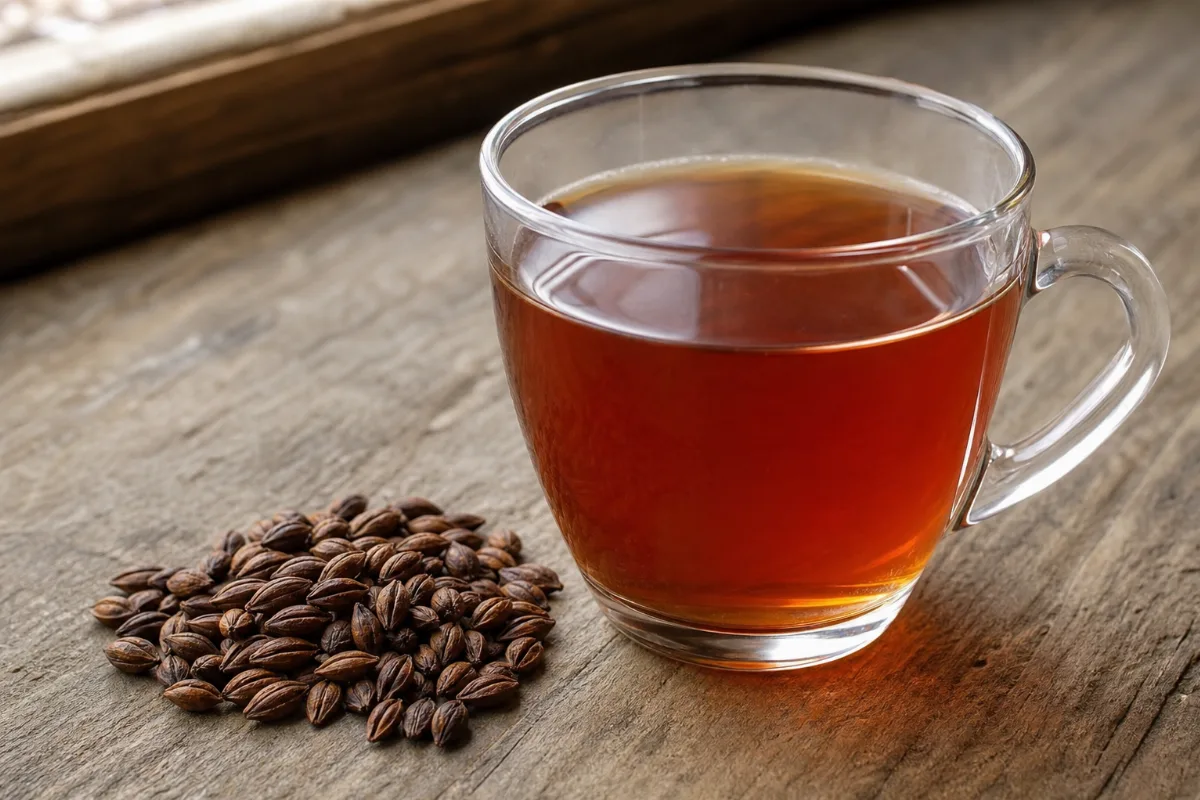
Herbal Teas & Extracts · Grain tea
Barley Tea (Mugicha)
Hordeum vulgare (roasted) · also called Mugicha, mugi-cha, roasted barley tea, highland barley tea.
Barley tea is roasted barley grain steeped in water, a traditional drink in Japan and elsewhere in East Asia. Two small trials of a roasted barley extract drink found the skin cooled less in cool rooms, but they were by a beverage company. Barley contains gluten, so ask first if you have coeliac disease.
General information, not medical advice. Last substantive update · Not medically reviewed. A named clinician has not signed off on this page. How this page is made
About Barley Tea (Mugicha)
Barley tea is roasted barley grain steeped in water. It tastes toasty and is a long-standing drink in Japan and elsewhere in East Asia. The research is small: two short trials of an extract drink on skin temperature. It is called caffeine-free by authors, but it contains gluten and roasting makes acrylamide.
What it is
Barley tea is made from the roasted grain of Hordeum vulgare, a grass in the family Poaceae. It is not made from the tea plant.
Roasting changes the grain. It leaves fibre and beta-glucan unchanged in the grain, lowers phenolic compounds and antioxidant activity, and forms acrylamide.
Tea, extract or whole grain?
The trials used a roasted barley extract drink with a measured compound. Home-made barley tea is roasted grain steeped in water and may differ. A mouse study used a polyphenol extract that is far more concentrated than a cup.
Whole barley as a food keeps its fibre. A lab study found the tea does not.
At a glance
Traditional uses history, not proof
- Papers call mugicha a traditional Japanese beverage.
- A 2024 paper says barley tea has cultural traditions in East Asia, valued for flavour, aroma and thirst-quenching.
Studied for research
- Skin temperature and blood flow in cool rooms, low (extract drink)
- Fibre and antioxidants in the brew, insufficient (the tea was not a source)
- Muscle damage and glycation, very low (mouse study)
- Sleep, blood sugar, weight, digestion, insufficient (no trials)
Main compounds
- Cyclo(D-Phe-L-Pro)
- Acrylamide (made in roasting)
- Phenolic compounds (lowered by roasting)
Common forms
- Loose roasted grain steeped or simmered
- Tea bags of milled roasted grain
- Cold or bottled barley tea (not covered in the sources we read)
- Roasted barley extract drink (used in the trials)
Research links: NHS: Coeliac disease · FDA: Acrylamide · Roasted barley extract and skin blood flow in air conditioning, 2018 (abstract) · Acrylamide in mugicha, 2016 (abstract) · Research Library · Genes & Biomarkers Library
What it is and its history
- Accepted scientific name
- Hordeum vulgare
- Naming authority
- L.
- Common names
- Barley tea (English); Mugicha (Japanese (romanised)); Mugi-cha (Japanese (romanised)); Roasted barley tea (English); Highland barley tea (English)
- Family or group
- Poaceae (the grass family)
- Classification
- Plantae > Poales > Poaceae > Hordeum > Hordeum vulgare
- Native range
- Not checked in the sources read.
- Habitat
- Not checked.
- What it looks like
- Stems: Not checked.; Flowers: Not checked.; Fruit: The grain (kernel) is the part used; roasted until dark.
- Cultivation
- Not checked.
- Harvest and processing
- Barley grain is roasted, in one lab paper in a drum roaster. Darker roast gave lower acrylamide in that paper. The grain may be left whole or milled and put in teabags.
- Look-alikes and adulterants
- Name: Naked (hulless) and highland barley; Note: Barley types used in some papers; the 2024 study used three naked varieties and the 2022 study highland barley.; Name: Other roasted grain drinks (buckwheat, corn); Note: Different plants; each has its own allergy and gluten questions. See the related pages.; Name: Roasted barley extract drinks; Note: The form used in the skin-temperature trials; contains a measured compound.
- Sustainability and conservation
- Not checked.
Photographs
Traditional use and history history, not clinical proof
| Tradition or era | Documented use | Source |
|---|---|---|
| Japan (mugicha) | A 2019 paper calls roasted barley extract a traditional Japanese beverage; a 2018 paper calls mugicha a well-known healthy non-caffeinated beverage and says it is reported to improve blood viscosity (author statement, not tested here). | p30814418 |
| East Asia | A 2024 paper calls barley tea a popular beverage with cultural traditions in East Asia, valued for flavour, aroma, thirst-quenching and perceived health benefits. | p38665632 |
| Korea | No Korean source was read, so we do not describe Korean tradition in detail. | p38665632 |
Traditional use shows how it was used. It does not show that it works or is safe today.
What is inside, and how it may work
What it contains and how those compounds act in cells and animals. Laboratory and animal mechanisms are not proven effects in people.
Main compounds
| Compound | Family | Where it is concentrated | Activity studied | Level of evidence |
|---|---|---|---|---|
| Cyclo(D-Phe-L-Pro) | 2,5-diketopiperazine | Roasted grain Not given in the abstracts. | Raised rat tail blood flow and relaxed rat aorta through nitric oxide release (lab and rat). 2 1 | Lab animal |
| Acrylamide | process contaminant | Roasted grain Not given in the abstracts. | Formed in roasting from sugars and asparagine; see the Safety tab. 5 8 | Lab |
| Dietary fibre and beta-glucan | fibre | Grain Unchanged by roasting in the grain; the tea was not a source. | Stays in the grain, not the drink. 4 | Lab |
| Phenolic compounds and flavonoids | polyphenols | Grain Lowered by roasting. | 12 phenolic compounds were identified in a highland barley tea extract; an extract reduced AGEs in mice. 4 6 | Lab animal |
Mechanisms, receptors and pathways
| Target or pathway | Gene or receptor | What was found | Level |
|---|---|---|---|
| Nitric oxide-mediated vessel relaxation | n/a | Cyclo(D-Phe-L-Pro) relaxed rat aorta through nitric oxide release from the vessel lining. 2 | Animal research |
| Maillard reaction in roasting | n/a | Sugars and asparagine form acrylamide in roasting; the level peaked at a surface temperature of 180-240 C, then fell. 5 | Lab |
| Glycation and SIRT3 | SIRT3 | A highland barley tea polyphenol extract raised SIRT3 protein and lowered AGEs in mouse muscle. 6 | Animal cell |
Absorption, metabolism and elimination
- Absorption
- Not studied.
- Distribution
- Not covered.
- Metabolism
- Not covered.
- Elimination
- Not covered.
- Bioavailability
- Not covered.
Isolated compounds versus whole extracts
Barley tea is roasted grain steeped in water. The trials used a roasted barley extract drink with a measured compound, and the mouse study used a polyphenol extract. These are not the same as a home-made cup. Whole barley grain, eaten as food, keeps its fibre; the tea does not.
Nutritional composition
A lab study found tea from three roasted naked barley varieties was not a source of fibre or antioxidants.
1 low certainty1 very low certainty2 not enough evidence
What was looked at
The 4 benefits and uses checked for Barley Tea (Mugicha), each with how strong the evidence is. Tap one to open it.
- Skin temperature and blood flow in cool roomsLow certainty
- Fibre and antioxidants in the brewNot enough evidence
- Muscle damage and glycation (mouse study)Very low certainty
- Sleep, blood sugar, weight and digestionNot enough evidence
Lab markers tracked in the studies
Skin temperatureSkin blood flowAdvanced glycation end-products (AGEs)
What is Barley Tea (Mugicha) good for?
The uses people ask about and how strong the human evidence is. For barley tea it is thin: two small trials of an extract drink, and the rest is lab work.
Benefits, one by one
Each card is a research question, not a promise. Tap a goal to filter. Open a card to see the studies, doses and limits.
Skin temperature and blood flow in cool rooms
Low certaintyTwo small Japanese trials gave people a roasted barley extract drink or a placebo while they sat in a cool room. The skin of the extract group cooled less. This is a skin measurement, not a symptom, and the trials were by a beverage company. Evidence is low.
3 studiesA roasted barley extract drink containing cyclo(D-Phe-L-Pro). Amounts…
Studies, doses and limits
What the trials found
Ashigai 2018: 15 people sat in an air-conditioned room after a roasted barley extract drink or a placebo, in a double-blind crossover. Ashigai 2019: men and women who felt cold in a room at about 25.5 C had an extract or placebo drink and were followed for 100 minutes (number of people not in the abstract). A third paper (Ashigai 2018b) reports rat work and a human check.
Results
2018: skin blood flow fell by 0.79 with the extract and 2.03 mL/min/100 g with placebo (p = 0.041). Skin temperature fell by 1.85 C with the extract and 3.02 C with placebo (p < 0.001). Among the 7 people who felt cold, the gaps were similar or larger. 2019: foot skin temperature fell by 3.67 C with the extract and 4.59 C with placebo. In men alone it fell 3.65 vs 4.55 C.
Effect sizes as reported
About 1 C less skin cooling in both trials. The 2018 trial measured blood flow too (smaller fall, p = 0.041).
Why this rating
Two small randomized, double-blind crossover trials with a placebo, but both are short single sessions, one has no head count in the abstract, the outcome is a skin measurement, the authors work for a beverage company, and the drink was an extract with a measured compound.
Form and dose studied
A roasted barley extract drink containing cyclo(D-Phe-L-Pro). Amounts are not given in the abstracts. It may differ from tea made at home.
Who was studied
Healthy adults; the 2018 trial had 15 people. No children, older adults or people with circulation problems.
Limits
Cannot say home-brewed barley tea does the same. No symptoms such as cold hands were scored in the abstracts. No long-term follow-up. The 7-person cold-feeling subgroup is very small.
Why researchers looked
Mugicha is a traditional Japanese drink said to help blood flow. Researchers tested whether a roasted barley extract keeps the skin warmer in air-conditioned or cold rooms.
Traditional use
Papers describe mugicha as a traditional Japanese beverage (2018, 2019) and barley tea as a drink with cultural traditions in East Asia (2024). No source we read describes a medicine use in detail.
Proposed mechanism Lab animal
The authors point to a compound made in roasting, cyclo(D-Phe-L-Pro). In rat aorta tissue it relaxed blood vessels through nitric oxide released by the vessel lining. That is lab work in rats, not proof of the same effect in people drinking tea.
A proposed mechanism does not show that the effect happens in people.
Barley contains gluten. See the Safety tab before drinking if you have coeliac disease.
Fibre and antioxidants in the brew
Not enough evidenceA lab study of tea made from three roasted naked barley varieties found it was not a source of fibre or antioxidants. Roasting lowered the plant compounds in the grain. The authors say people who want those benefits should eat whole-grain foods.
1 studiesTea steeped from roasted naked barley grain; amounts not in the abstr…
Studies, doses and limits
Results
The brewed tea was not a source of dietary fibre or antioxidants. No numbers are given in the abstract.
Effect sizes as reported
Not given in the abstract.
Why this rating
A lab analysis of three varieties; no human study; no numbers in the abstract. It reads as evidence against the idea that the tea gives the benefits of whole barley.
Form and dose studied
Tea steeped from roasted naked barley grain; amounts not in the abstract.
Limits
Three varieties only. Other barley tea products may differ.
Why researchers looked
Barley grain has fibre and plant compounds, so researchers asked how much reaches the cup after roasting and steeping.
Traditional use
The paper calls barley tea a popular drink with cultural traditions in East Asia, valued for flavour, aroma, thirst-quenching and perceived health benefits.
Proposed mechanism Lab analysis
Roasting did not change fibre or beta-glucan in the grain, but it lowered phenolics, especially flavonoids, and so lowered antioxidant activity. Fibre stays in the grain, not in the drink.
A proposed mechanism does not show that the effect happens in people.
See the Safety tab for gluten and acrylamide.
Muscle damage and glycation (mouse study)
Very low certaintyIn mice given a sugar that speeds ageing, a polyphenol extract of highland barley tea lowered advanced glycation end-products and raised muscle mass. This is a mouse and cell study of an extract. It says nothing yet about people drinking tea.
1 studiesPolyphenol extract of highland barley tea in mice; amounts not in the…
Studies, doses and limits
Results
High doses of the polyphenol extract lowered AGEs in serum and muscle and increased muscle mass in mice. No numbers are given in the abstract.
Effect sizes as reported
Not given in the abstract.
Why this rating
Animal and cell work only; a concentrated extract, not a tea drink; no human data.
Form and dose studied
Polyphenol extract of highland barley tea in mice; amounts not in the abstract.
Who was studied
Mice and muscle cells.
Limits
Cannot be applied to people. The extract is far more concentrated than a cup.
Why researchers looked
Highland barley tea is rich in polyphenol flavonoids, and glycation end-products are linked in the lab to muscle damage.
Traditional use
Not described in the sources read.
Proposed mechanism Animal cell
The authors report less AGE formation in the test tube, more SIRT3 protein and less muscle-weakness protein in mouse muscle, and more oxidative stress in muscle cells exposed to AGEs.
A proposed mechanism does not show that the effect happens in people.
No human safety information from this study.
Sleep, blood sugar, weight and digestion
Not enough evidenceWe found no trial of barley tea on sleep, blood sugar, weight or digestion. Any claim about these uses is not supported by research we could read.
0 studiesNot applicable.
Studies, doses and limits
Why this rating
No human studies of barley tea on these outcomes were found.
Limits
Absence of studies is not proof of no effect. The search was a short one, not a systematic review.
Why researchers looked
People often ask about these uses, so we searched for them.
Traditional use
Not described in the sources read.
Proposed mechanism None
Not applicable; no studies found.
A proposed mechanism does not show that the effect happens in people.
Do not use barley tea in place of care for diabetes, sleep problems or weight concerns; talk to a doctor.
Connections to the rest of health
How Barley Tea (Mugicha) connects to the rest of our health knowledge graph. Every link says what kind of connection it is. A safety link (for example to the liver) is a warning, not a benefit. A study that merely mentions a topic never creates a benefit link.
Explore every connection: goals, body systems, organs, symptoms, genes
A. Wellness goals
| Connected to | Kind of connection | Evidence status | Context | Studies |
|---|---|---|---|---|
| Healthy Circulation | Low certainty | Skin temperature and blood flow in cool rooms: Two small Japanese trials gave people a roasted barley extract drink or a placebo while they sat in a cool room. The skin of the extract group cooled less. This is a skin measurement, not a symptom, and the trials were by a beverage company. Evidence is low. | 1 3 2 | |
| Muscle Recovery | Very low certainty | Muscle damage and glycation (mouse study): In mice given a sugar that speeds ageing, a polyphenol extract of highland barley tea lowered advanced glycation end-products and raised muscle mass. This is a mouse and cell study of an extract. It says nothing yet about people drinking tea. | 6 |
B. Body systems
| Connected to | Kind of connection | Evidence status | Context | Studies |
|---|---|---|---|---|
| Heart Circulation | Biological association | Low certainty | Studied for: Skin temperature and blood flow in cool rooms | 1 3 2 |
| Bones Joints Muscles | Biological association | Very low certainty | Studied for: Muscle damage and glycation (mouse study) | 6 |
E. Health conditions
| Connected to | Kind of connection | Evidence status | Context | Studies |
|---|---|---|---|---|
| Celiac disease | Contraindication | Low certainty | Barley contains gluten; gluten in the brewed tea was not measured in sources read. Preparation or compound: Barley (gluten) |
9 7 |
I. Biomarkers
| Connected to | Kind of connection | Evidence status | Context | Studies |
|---|---|---|---|---|
| Skin temperature | Biological association | Low certainty | Measured in trials: lowered less. A lab change is not the same as a health benefit. | 1 3 |
| Skin blood flow | Biological association | Low certainty | Measured in trials: lowered less. A lab change is not the same as a health benefit. | 1 |
| Advanced glycation end-products (AGEs) | Biological association | Very low certainty | Measured in trials: lowered (in mice). A lab change is not the same as a health benefit. | 6 |
J. Genes, receptors and enzymes
| Connected to | Kind of connection | Evidence status | Context | Studies |
|---|---|---|---|---|
| SIRT3 | Preliminary mechanism | Animal | Raised in mouse muscle by a highland barley tea polyphenol extract. | 6 |
L. Active compounds
| Connected to | Kind of connection | Evidence status | Context | Studies |
|---|---|---|---|---|
| Acrylamide | Low certainty | Formed in roasting; found in the brew in one study, absent in another. Preparation or compound: Roasted barley |
5 4 8 | |
| Cyclo(D-Phe-L-Pro) | Biological association | Lab animal | Raised rat tail blood flow and relaxed rat aorta through nitric oxide release (lab and rat). Preparation or compound: Roasted grain |
2 1 |
| Acrylamide | Biological association | Lab | Formed in roasting from sugars and asparagine; see the Safety tab. Preparation or compound: Roasted grain |
5 8 |
| Dietary fibre and beta-glucan | Biological association | Lab | Stays in the grain, not the drink. Preparation or compound: Grain |
4 |
| Phenolic compounds and flavonoids | Biological association | Lab animal | 12 phenolic compounds were identified in a highland barley tea extract; an extract reduced AGEs in mice. Preparation or compound: Grain |
4 6 |
Each connection is stored with the ingredient, the connected record, the kind of connection, the evidence status, the supporting studies, the preparation or compound involved, and a review date (last reviewed October 25, 2026).
Evidence at a glance: what the research found for 4 outcomes
Each outcome below is one thing researchers measured. Certainty is how far the evidence can be trusted, not how well it works. The full studies are on the next tab.
The evidence
The research centre for Barley Tea (Mugicha). Every record here was checked against PubMed or the publisher's page; we never list a study we have not verified.
Evidence by outcome
Bars show how many studies we found for each outcome, not how well it works. People are added up across trials only (reviews are not added, to avoid double counting).
How we rate evidence
High certainty
Several well-run trials or reviews agree; further research is unlikely to change the picture much.
Moderate certainty
Good trials point the same way, but some doubt remains.
Low certainty
Small, short or inconsistent trials. The finding could change with better research.
Very low certainty
Very little or very weak human data. Treat as a possibility only.
Mixed findings
Trials or reviews disagree with each other.
Not enough evidence
Not enough human research to say either way.
Evidence against
Good research found no benefit, or found harm.
We take the reviewers' own risk-of-bias and GRADE statements where they exist, and otherwise judge from study size, design, consistency, directness and whether a product matches what is sold. Many publications do not make evidence high. Method note: We searched PubMed for barley tea, mugicha and roasted barley extract and read the abstracts of the papers cited, read the NHS and FDA pages, and checked the plant name in GBIF. Only abstracts were read for papers.
Study library: every study we checked 10
| Study | Design | People | Product, dose, length | Result |
|---|---|---|---|---|
| Ashigai 2018 Roasted barley extract (mugi-cha) containing cyclo(D-Phe-L-Pro) prevents lowering of the cutaneous blood flow and skin temperature under air conditioning: a randomized, double-blind, placebo-controlled, crossover study. J Agric Food Chem · PMID 29792425 · DOI |
Randomized crossover |
15 15 people sitting in an air-conditioned room; 7 of them felt cold |
Roasted barley extract drink (mugi-cha) containing cyclo(D-Phe-L-Pro) grain (roasted extract) Not given in the abstract One session in an air-conditioned room · vs Placebo drink |
Change in skin blood flow: -0.79 vs -2.03 mL/min/100 g (extract vs placebo, p = 0.041). Change in skin temperature: -1.85 vs -3.02 C (p < 0.001). In the 7 people who felt cold: blood flow -0.48 vs -2.56 (p = 0.008); skin temperature -1.46 vs -2.89 C (p = 0.009). Smaller drops in skin blood flow and skin temperature after the extract than after placebo. (Not given in the abstract) Methods, limits and fundingOutcomes: Cutaneous (skin) blood flow and skin temperature Limitations: Only 15 people; one short session; a skin measurement, not a symptom or health outcome; an extract drink with a measured compound, which may differ from home-made barley tea; the 7-person subgroup is very small. Funding and conflicts: The authors work for Kirin Company, Limited, a beverage maker (affiliations read in the PubMed record). The funding statement was not read. Read: abstract |
| Ashigai 2018 Roasted barley extract affects blood flow in the rat tail and increases cutaneous blood flow and skin temperature in humans. J Agric Food Chem · PMID 29338262 · DOI |
Mixed lab animal human rat and human |
Rats (tail blood flow, aorta tissue) and a small human check | Roasted barley extract (mugicha) and five 2,5-diketopiperazines from it grain (roasted extract) Not given in the abstract Not given in the abstract · vs Not given in the abstract |
Five 2,5-diketopiperazines were found in the extract. Cyclo(D-Phe-L-Pro) raised rat tail blood flow most and relaxed rat aorta through nitric oxide release from the vessel lining. The authors also report that the extract raised skin blood flow and skin temperature in humans. No numbers in the abstract. (Not given in the abstract) Methods, limits and fundingOutcomes: Rat tail blood flow, rat aorta relaxation, human skin blood flow and skin temperature Limitations: Mostly rat and lab work; the human part has no numbers in the abstract; extract, not home-made tea. Funding and conflicts: The authors work for Kirin Company, Limited, a beverage maker (affiliations read). The funding statement was not read. Read: abstract |
| Ashigai 2019 Roasted barley extract (mugicha) containing cyclo(D-Phe-L-Pro) prevents a decrease in skin temperature in cold conditions: a randomized, double-blind, placebo-controlled, crossover study. J Nutr Sci Vitaminol (Tokyo) · PMID 30814418 · DOI |
Randomized crossover |
Men and women who felt cold in a test room kept at about 25.5 C (number of people not given in the abstract) | Roasted barley extract drink containing cyclo(D-Phe-L-Pro) grain (roasted extract) Not given in the abstract One session, 100 minutes in the room · vs Placebo drink |
After 100 minutes skin temperature fell by 3.67 C with the extract and 4.59 C with placebo in all participants. In men alone: 3.65 vs 4.55 C. About 0.9 C less of a drop with the extract. (Not given in the abstract) Methods, limits and fundingOutcomes: Skin temperature of the left foot, measured every 5 minutes by infrared camera Limitations: Number of people not in the abstract; one short session; a foot skin temperature measure only; extract drink, not home-made tea. Funding and conflicts: The authors work for Kirin Company, Limited, a beverage maker (affiliations read in the PubMed record). The funding statement was not read. Read: abstract |
| Martinez-Subira 2024 Effects of roasting and steeping on nutrients and physiochemical compounds in organically grown naked barley teas. Food Chem X · PMID 38665632 · DOI |
Lab analysis lab |
Three commercial naked barley varieties, raw, roasted and brewed | Roasted naked barley grain and the tea steeped from it grain Not given in the abstract Not given in the abstract · vs Unroasted grain |
Roasting did not change total dietary fibre or beta-glucan in the grain. It lowered sugars, removed free amino acids, lowered total phenolics (especially flavonoids) and antioxidant activity, and gave high acrylamide in the grain. The brewed tea was not a source of fibre or antioxidants and contained no acrylamide. The authors urge people seeking those benefits to eat whole-grain foods. No numbers in the abstract. (Not given in the abstract) Methods, limits and fundingOutcomes: Fibre, beta-glucan, sugars, amino acids, phenolics, antioxidant activity, acrylamide Limitations: Three varieties only; lab analysis, not a human study; steeping conditions are not in the abstract. Funding and conflicts: Not stated in the abstract. Read: abstract |
| Mizukami 2016 Acrylamide elution from roasted barley grains into mugicha and its formation during roasting. Food Addit Contam Part A Chem Anal Control Expo Risk Assess · PMID 26678848 · DOI |
Lab analysis lab |
Roasted barley grain and mugicha prepared from it | Mugicha (roasted barley infusion) from teabags of milled grain and from loose grain; barley roasted in a drum roaster grain Not given in the abstract Different simmering and steeping times |
Acrylamide dissolved easily from milled roasted grain in teabags. From loose grain, acrylamide in the drink rose with longer simmering and steeping. In the roaster, grain acrylamide peaked at a surface temperature of 180-240 C and then fell. Darker roasted grain (lower L* value) held less acrylamide. Asparagine in the grain was a key factor. No concentration figures in the abstract. (Not given in the abstract) Methods, limits and fundingOutcomes: Acrylamide in grain and in the drink Limitations: Lab chemistry, not a health study; concentrations are not in the abstract; one set of samples. Funding and conflicts: Not stated in the abstract; the authors are from a Japanese tea research institute and a university (affiliations read). Read: abstract |
| Nie 2022 Polyphenols in highland barley tea inhibit the production of advanced glycosylation end-products and alleviate the skeletal muscle damage. Mol Nutr Food Res · PMID 35894228 · DOI |
Animal and cell mouse and cell |
Test tube, mice given a sugar (D-galactose) that speeds ageing, and muscle cells | Polyphenol extract of highland barley tea grain (extract) Different doses; amounts not in the abstract Not given in the abstract · vs Untreated mice |
The extract reduced AGE formation in the test tube. In mice, a high dose lowered AGEs in serum and muscle, raised muscle mass and raised SIRT3 protein. The abstract calls the tea a caffeine-free cereal tea. No numbers in the abstract. (Not given in the abstract) Methods, limits and fundingOutcomes: Advanced glycation end-products (AGEs) in serum and muscle, muscle mass, SIRT3 and muscle-weakness proteins Limitations: Mouse and cell study of a polyphenol extract, not a tea drink and not a human result. Funding and conflicts: Not stated in the abstract. Read: abstract |
| n/a 2018 FDA: Gluten and Food Labeling (content current as of 16 July 2018) n/a · Source |
Authoritative guidance n/a |
n/a | n/a |
Gluten occurs naturally in wheat, rye, barley and crossbreeds of these grains. A food labelled gluten-free must contain less than 20 parts per million of gluten and may not contain an ingredient that is a type of wheat, rye or barley unless processed to remove gluten. Methods, limits and fundingOutcomes: Gluten occurs naturally in wheat, rye, barley and crossbreeds of these grains. A food labelled gluten-free must contain less than 20 parts per million of gluten and may not contain an ingredient that is a type of wheat, rye or barley unless processed to remove gluten. Limitations: Labelling guidance for foods in general; barley tea is not named. Read on 2026-10-25. Read: full-text |
| n/a 2024 FDA: Acrylamide (content current as of 5 March 2024) n/a · Source |
Authoritative guidance n/a |
n/a | n/a |
Acrylamide forms from sugars and the amino acid asparagine in plant foods during high-temperature cooking such as frying, roasting and baking. High levels caused cancer in laboratory animals, at levels much greater than in human food. The page says there is no consistent epidemiological evidence on dietary acrylamide and cancer in humans. Methods, limits and fundingOutcomes: Acrylamide forms from sugars and the amino acid asparagine in plant foods during high-temperature cooking such as frying, roasting and baking. High levels caused cancer in laboratory animals, at levels much greater than in human food. The page says there is no consistent epidemiological evidence on dietary acrylamide and cancer in humans. Limitations: Regulator page about foods in general; barley tea is not named. Read on 2026-10-25. Read: full-text |
| n/a 2026 NHS: Coeliac disease n/a · Source |
Authoritative guidance n/a |
n/a | n/a |
Coeliac disease is an adverse reaction to gluten, a protein found in three cereals: wheat, barley and rye. Symptoms can include diarrhoea, abdominal pain and bloating. There is no cure; a gluten-free diet helps control symptoms and prevent complications. Methods, limits and fundingOutcomes: Coeliac disease is an adverse reaction to gluten, a protein found in three cereals: wheat, barley and rye. Symptoms can include diarrhoea, abdominal pain and bloating. There is no cure; a gluten-free diet helps control symptoms and prevent complications. Limitations: General condition page; barley tea is not named. Page text read on 2026-10-25; a page date was not captured. Read: full-text |
| n/a 2026 GBIF Backbone Taxonomy: Hordeum vulgare L. (usage key 2706056) n/a · Source |
Database record n/a |
n/a | n/a |
Accepted species name Hordeum vulgare L., family Poaceae, order Poales, genus Hordeum (status ACCEPTED, exact match). Methods, limits and fundingOutcomes: Accepted species name Hordeum vulgare L., family Poaceae, order Poales, genus Hordeum (status ACCEPTED, exact match). Limitations: Taxonomic database record via the GBIF API, retrieved 2026-10-25. Read: full-text |
What we do not know yet
- What the evidence supports: two small trials of an extract drink on skin temperature (low certainty).
- No trial of home-brewed barley tea on any outcome.
- No measured caffeine or gluten value for the brewed drink.
- Two acrylamide studies disagree about the brew.
- Nothing found on sleep, blood sugar, weight, pregnancy, children or medicines.
How new research is added
New studies are found by a saved PubMed search and are placed in a review queue. A person reads each one before it changes any evidence rating or safety wording. New publications never change ratings automatically.
Lab markers
What changed in blood or saliva tests during trials. A changed number is not the same as feeling or being healthier, and we give no "normal ranges".
Other 3
Skin temperature
Lowered less in trials
Temperature of the skin surface, here measured on the body or the foot by thermal imaging or sensors.
Low certaintyResults and what it means
Why it was measured
Used as a simple sign of how much warm blood reaches the skin in a cool room.
Statistical vs. clinical meaning
Unknown. A warmer skin surface is not the same as feeling warmer or better health.
Safety implication
None from the number.
Skin blood flow
Lowered less in trials
How much blood moves through the small vessels of the skin, measured at the skin surface.
Low certaintyResults and what it means
Why it was measured
Skin blood flow falls in the cold, so it was used to test whether the drink keeps vessels more open.
Statistical vs. clinical meaning
Unknown. One small trial by a beverage company.
Safety implication
None from the number.
| Study | Result | People | Product |
|---|---|---|---|
| 1 | Fell 0.79 with extract vs 2.03 mL/min/100 g with placebo (p = 0.041) | 15 adults in an air-conditioned room | Roasted barley extract drink |
Advanced glycation end-products (AGEs)
Lowered (in mice) in trials
Sticky compounds formed when sugars bind to proteins; they build up with ageing and high sugar.
Very low certaintyResults and what it means
Safety
What studies and official sources say about side effects, medicines and who should check first. Each point shows what kind of evidence it comes from.
Main points to know 4
- Barley contains gluten: ask first if you have coeliac disease. The NHS says gluten is found in wheat, barley and rye. The FDA says the same. We found no independent measurement of gluten in a cup of barley tea, so we cannot say it is gluten-free. People with coeliac disease or gluten sensitivity should ask a doctor or dietitian before drinking it. Authoritative guidance 9 7
- Roasting makes acrylamide, and two lab studies disagree about the brew. Acrylamide forms when barley is roasted. One Japanese study found it dissolved easily into mugicha, especially from milled grain in teabags and with longer simmering and steeping, and darker roasted grain held less. A 2024 study of three naked barley varieties found high acrylamide in the roasted grain but none in the tea. The FDA says high levels caused cancer in lab animals at amounts much higher than in human food, and there is no consistent human evidence from food. Lab analysis 5 4 8
- No measured caffeine value, but sources call it caffeine-free. The 2018 trial authors call roasted barley extract a non-caffeinated drink and a 2022 paper calls highland barley tea caffeine-free. Neither gives a measured value, so check the label if you avoid caffeine. Author statement 1 6
- The trials used an extract drink, not home-made tea. The skin-temperature results come from a roasted barley extract drink with a measured compound, made by a beverage company. Home-brewed barley tea may differ. Study limitation 1 3
Side effects 2
| Effect | How often | Severity and recovery | Evidence |
|---|---|---|---|
| Coeliac reaction to gluten: diarrhoea, abdominal pain, bloating The NHS lists these symptoms for coeliac disease. No report links them to barley tea itself. | Applies to people with coeliac disease; barley-tea-specific figures not found | mild to serious Symptoms ease on a gluten-free diet; complications can follow ongoing gluten | Authoritative guidance 9 |
| Side effects in the skin-temperature trials The abstracts do not mention side effects. Not described is not proof of none. | Not reported in the abstracts | unknown unknown | Study gap 1 3 |
Liver
We found no report of liver injury from barley tea and no liver safety study of it.
How often. No rate could be found.
Monitoring. No agency monitoring advice was read for barley tea.
This is a safety connection. It is not evidence that Barley Tea (Mugicha) supports liver health.
Medicines and supplements 1
| With | Why it matters | Importance | Evidence | What to do |
|---|---|---|---|---|
| Medicines in general prescription | No interaction mechanism or report for barley tea was found in the sources read. | Unknown. Not described is not proof of none. | None found Not enough evidence | Tell your pharmacist or doctor what herbal drinks you have regularly. |
Who should check first 4
| Situation | Advice | Evidence |
|---|---|---|
| Coeliac disease or gluten sensitivity | Barley contains gluten and no measurement of gluten in the tea was found. Ask a doctor or dietitian before drinking it. | Authoritative guidance 9 7 |
| Pregnancy and breastfeeding | No source we read covers barley tea in pregnancy or breastfeeding. Ask your midwife or doctor. | Study gap |
| Babies and children | No source we read covers barley tea for babies or children. Ask a paediatrician. | Study gap |
| Barley allergy | No source we read describes barley allergy from the tea. If you react to barley or other grains, ask a doctor. | Study gap |
Overdose, product quality and regulators
Summary. A cup of barley tea has no toxicity report in the sources read. No animal toxicity study of the drink was read.
Animal. The mouse study used a polyphenol extract and did not report safety in the abstract.
Human doses studied. Trials gave a single extract drink; amounts not in the abstracts.
High dose or long term signals. Not studied.
Overdose response. Not described in the sources read.
Genotoxicity. Not read.
Toxic or hazardous parts. Grain. No toxic part was identified in the sources read.
Acrylamide from roasting was the only quality issue we found sources for. Heavy metals, pesticides and mould toxins in barley tea were not covered in sources we read.
Acrylamide from roasting. Easily extracted into mugicha from milled roasted grain in teabags; rose with longer simmering and steeping of loose grain; lower in darker roasted grain. 5
Acrylamide in naked barley tea. High in roasted naked barley grain from three varieties, but none was found in the tea made from them. 4
Gluten. No independent measurement of gluten in the brewed tea was found. 9 7
| Body | Action | Date |
|---|---|---|
| NHS (UK) (United Kingdom) | Says coeliac disease is a reaction to gluten, found in wheat, barley and rye, and that a gluten-free diet controls symptoms. source | Read 2026-10-25 |
| FDA (United States) | Says gluten occurs naturally in wheat, rye and barley, and sets a gluten-free label limit of under 20 ppm. source | 2018-07-16 |
| FDA (United States) | Says acrylamide forms in high-temperature cooking including roasting; it caused cancer in animals at far higher levels than in food; no consistent human evidence from food. source | 2024-03-05 |
When to get medical help
- Severe or lasting stomach pain, diarrhoea or bloating after a drink in someone with coeliac disease
- Swelling of the lips or face, wheeze or trouble breathing after a drink (possible allergy): call emergency services
Stop using the product and contact a clinician or emergency service. In the US, Poison Control is 1-800-222-1222.
General information only, not medical advice. Ask a clinician or pharmacist before use, especially with medicines, in pregnancy or with a health condition. See the Natural Remedy Safety guide.
Frequently asked questions
What is barley tea?
Does barley tea have caffeine?
Is barley tea gluten-free?
Does barley tea contain acrylamide?
Is acrylamide dangerous?
The FDA says high levels caused cancer in lab animals at amounts much greater than in human food. It also says there is no consistent human evidence from food. No safe limit for barley tea is drawn here.
Does barley tea warm you up or help blood flow?
Does barley tea help with sleep, weight or blood sugar?
We found no trial of barley tea on sleep, weight or blood sugar. Evidence is insufficient.
Is barley tea a good source of fibre or antioxidants?
A lab study of tea made from three roasted naked barley varieties found it was not a source of fibre or antioxidants. The authors suggest whole-grain foods for those benefits.
Where does barley tea come from?
Is barley tea safe in pregnancy or for children?
No source we read covers barley tea in pregnancy, breastfeeding or childhood. Ask your midwife, doctor or paediatrician.
Can barley tea interact with medicines?
We found no interaction report for barley tea. Not described is not proof of none. Tell your pharmacist or doctor about herbal drinks you have often.
Explore by health goal
Editorial transparency
- Written by
- AlternativeMed editorial team. Research compiled with AI assistance, then checked against PubMed records.
- Medical review
- None. This page has not been reviewed by a physician or pharmacist.
- First published
- 2026-10-25
- Last substantive update
- 2026-10-25
- How we research
- We searched PubMed for barley tea, mugicha and roasted barley extract and read the abstracts of the papers cited, read the NHS and FDA pages, and checked the plant name in GBIF. Only abstracts were read for papers.
- How we rate evidence
- See "How we rate evidence" in the Evidence tab.
- Independence
- No product is promoted on this page. No affiliate links are shown. This page is information, not a recommendation to drink or take anything.
Sources 10
Each source was opened and checked. Where we read only the abstract, it says so. The small numbers in the text point here.
- Ashigai H, Mizutani M, Taniguchi Y, et al. Roasted barley extract (mugi-cha) containing cyclo(D-Phe-L-Pro) prevents lowering of the cutaneous blood flow and skin temperature under air conditioning: a randomized, double-blind, placebo-controlled, crossover study.. J Agric Food Chem. 2018. PMID 29792425. DOI 10.1021/acs.jafc.8b02485. (abstract)
- Ashigai H, et al. Roasted barley extract affects blood flow in the rat tail and increases cutaneous blood flow and skin temperature in humans.. J Agric Food Chem. 2018. PMID 29338262. DOI 10.1021/acs.jafc.7b04930. (abstract)
- Ashigai H, Mizutani M, Ikeshima E, et al. Roasted barley extract (mugicha) containing cyclo(D-Phe-L-Pro) prevents a decrease in skin temperature in cold conditions: a randomized, double-blind, placebo-controlled, crossover study.. J Nutr Sci Vitaminol (Tokyo). 2019. PMID 30814418. DOI 10.3177/jnsv.65.90. (abstract)
- Martinez-Subira M, Meints B, Tomasino E, et al. Effects of roasting and steeping on nutrients and physiochemical compounds in organically grown naked barley teas.. Food Chem X. 2024. PMID 38665632. DOI 10.1016/j.fochx.2024.101385. (abstract)
- Mizukami Y, Yoshida M, Ono H, et al. Acrylamide elution from roasted barley grains into mugicha and its formation during roasting.. Food Addit Contam Part A Chem Anal Control Expo Risk Assess. 2016. PMID 26678848. DOI 10.1080/19440049.2015.1128567. (abstract)
- Nie C, Li T, Fan M, et al. Polyphenols in highland barley tea inhibit the production of advanced glycosylation end-products and alleviate the skeletal muscle damage.. Mol Nutr Food Res. 2022. PMID 35894228. DOI 10.1002/mnfr.202200225. (abstract)
- n/a. FDA: Gluten and Food Labeling (content current as of 16 July 2018). n/a. 2018. (full-text)
- n/a. FDA: Acrylamide (content current as of 5 March 2024). n/a. 2024. (full-text)
- n/a. NHS: Coeliac disease. n/a. 2026. (full-text)
- n/a. GBIF Backbone Taxonomy: Hordeum vulgare L. (usage key 2706056). n/a. 2026. (full-text)
Where to buy
Check the label first. Whatever you buy, look for these:
- The herb is the first or only ingredient
- Organic or lab-tested if that matters to you
- Loose leaf or tea bags, and how long they have been stored
- If you take medicines or are pregnant, ask a pharmacist about the herb first
Talk to a pharmacist or doctor before you start any supplement, especially if you take medicines. See the Safety tab for interactions.
Support our free guides: as an Amazon Associate we earn from qualifying purchases. Full disclosure.


