Herbal Teas & Extracts · Tea
Hojicha
Camellia sinensis · also called Hojicha, houjicha, hoji-cha, roasted green tea. Not the same as green tea extract capsules.
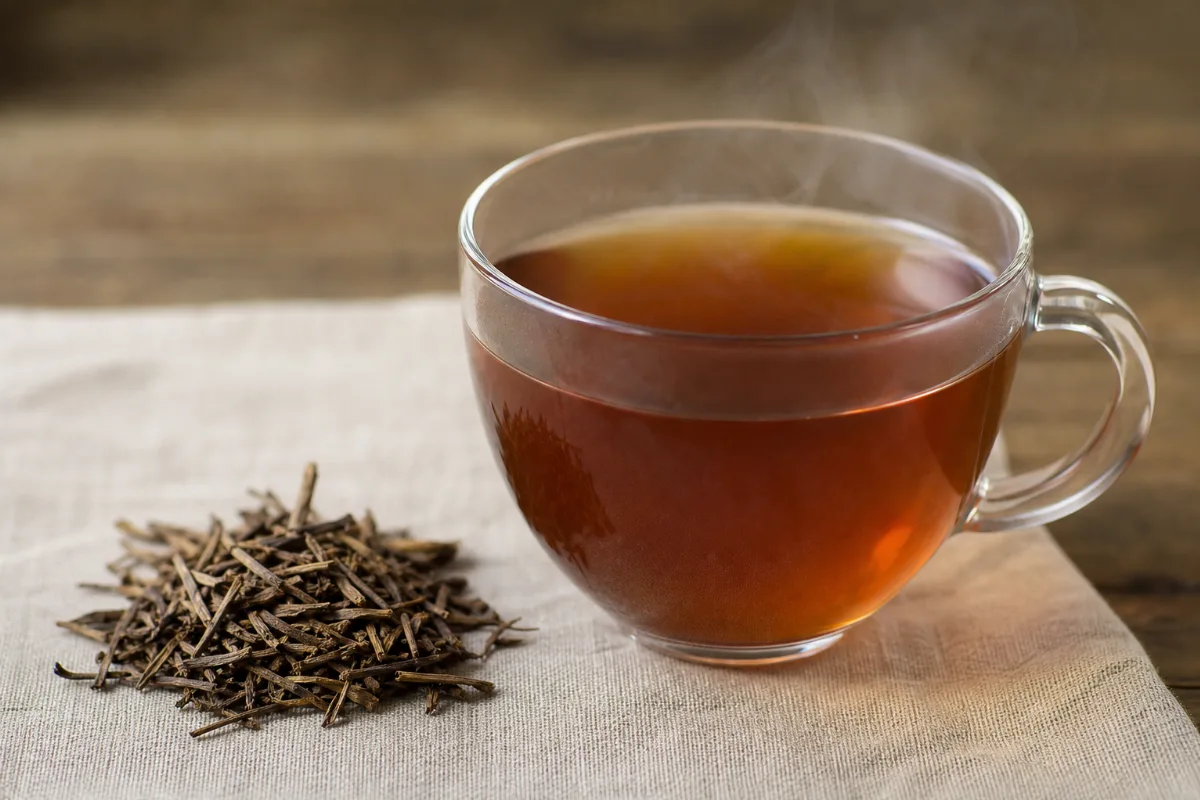
Hojicha is a Japanese green tea whose leaves have been roasted, which gives it a toasty smell. People drink it for its flavour and as a milder-tasting tea. Only one small human study of hojicha was found, so health benefits are unproven. It contains caffeine, and roasting makes a little acrylamide, a food-processing compound regulators watch.
General information, not medical advice. Last substantive update · Not medically reviewed. A named clinician has not signed off on this page. How this page is made
About Hojicha
Hojicha is green tea that has been roasted. It tastes toasty and is often thought of as gentle, but the research is very small. One 20-person study suggests the aroma may help refreshment. The sources we read give no caffeine figure for hojicha, and roasting makes a little acrylamide.
What it is
Hojicha is made from the leaves of Camellia sinensis, the tea plant, roasted at high heat. In one lab paper, the usual hojicha flavour formed with roasting at 160 C for 30 minutes or 180 C for 15 minutes. Two pyrazines were the key aroma compounds.
Roasting changes the tea. Lab studies show catechins break down, some amino acids and sugars fall, pyrazines form, and acrylamide forms. Another paper says roasting reduces bitterness.
Tea, extract or powder?
Hojicha is whole roasted leaf infused in water. A green tea extract capsule packs catechins into a concentrated pill, and the liver warnings belong to that form. A systematic review of 159 human studies tied liver events to concentrated preparations in large single doses, not to brewed tea. Matcha is a different product: the whole leaf ground to powder. Do not carry results from one form to another.
What the research shows
The only human study of hojicha we found had 20 young men doing mental arithmetic after hot water, green tea or hojicha. Tea gave lower blood-flow and brain-signal responses than hot water, and the authors link this to aroma. An author received consultant fees from the funder, and the abstract gives no numbers.
Everything else is chemistry: roasting lowers catechins and makes pyrazines and acrylamide, and a digestion model shows what polyphenols survive. Heart, weight, cholesterol and cancer results belong to green tea and extracts and have not been tested with hojicha.
What regulators say
No regulator statement about hojicha itself was found. NCCIH reports no safety concerns for green tea as a drink in adults, apart from caffeine. EFSA considers traditional green tea infusions generally safe, with rare liver reactions reported. The FDA and EFSA both treat acrylamide in food as a concern, and IARC classes very hot drinks as probably carcinogenic to the food pipe.
At a glance
Traditional uses history, not proof
- No source we read describes the traditional medicine use of hojicha.
- Papers on Japanese tea describe it as a popular variation of green tea with a roasted flavour and less bitterness.
Studied for research
- Refreshment, tiredness and mental tasks, very low
- Calm and relaxation from roasted aroma, insufficient
- Polyphenols in a lab digestion model, insufficient (lab only)
- Heart health, weight and cancer, not studied for hojicha (insufficient)
Main compounds
- Caffeine
- Catechins (lower after roasting)
- Pyrazines (roasted aroma)
- Acrylamide (formed in roasting)
Common forms
- Brewed tea from loose leaf or tea bags
- Bottled roasted green tea
- Powder (not covered in the sources we read)
Research links: NCCIH: Green Tea · Hojicha and green tea on human responses (abstract) · Roasting of green tea: acrylamide, odorants and catechins (abstract) · FDA: Acrylamide · FDA: How much caffeine is too much · NHS: Foods to avoid in pregnancy · Research Library · Genes & Biomarkers Library
What it is and its history
- Accepted scientific name
- Camellia sinensis
- Naming authority
- (L.) Kuntze
- Synonyms
- Camellia bohea (L.) Sweet; Camellia chinensis (Sims) Kuntze; Camellia cantonensis Lour.
- Common names
- Hojicha (Japanese (romanised)); Houjicha (Japanese (romanised)); Roasted green tea (English)
- Family or group
- Theaceae (the tea family)
- Classification
- Plantae > Ericales > Theaceae > Camellia > Camellia sinensis
- Native range
- Not checked in the sources read.
- Habitat
- Not checked.
- What it looks like
- Stems: Not checked.; Leaves: The leaf is the part used. Hojicha is green tea leaf that has been roasted.; Flowers: Not checked.; Fruit: Not checked.
- Cultivation
- Not checked.
- Harvest and processing
- Green tea leaf is roasted at high heat. In a lab paper, the typical hojicha flavour formed after roasting at 160 C for 30 minutes or 180 C for 15 minutes.
- Look-alikes and adulterants
- Name: Green tea, matcha, sencha, gyokuro; Note: Same plant, not roasted. Hojicha has been roasted, which lowers some catechins and creates roasted aroma compounds (pyrazines) and acrylamide in lab tests.; Name: Barley tea (mugi-cha); Note: A roasted grain drink with no tea plant. It is a different product with its own acrylamide measurements.; Name: Genmaicha; Note: Green tea with roasted rice; not the same as hojicha.
- Sustainability and conservation
- Not checked.
Photographs
Traditional use and history history, not clinical proof
| Tradition or era | Documented use | Source |
|---|---|---|
| Japanese tea processing (modern research) | A 2008 paper describes roasted green tea (houjicha) processing in which roasting settings were tuned to make the usual flavour aiming to cut acrylamide without hurting quality. A 2025 paper calls hojicha a popular variation of green tea whose roasting changes polyphenols and reduces bitterness. | p18298065 |
| Modern use | The 2025 digestion paper says roasting reduces bitterness and makes hojicha a popular variation of green tea. | p39856977 |
| Origin and traditional medicine use | Not described in the sources we read. No claim about origin date, place or traditional medicine use is made. | p18298065 |
Traditional use shows how it was used. It does not show that it works or is safe today.
What is inside, and how it may work
What it contains and how those compounds act in cells and animals. Laboratory and animal mechanisms are not proven effects in people.
Main compounds
| Compound | Family | Where it is concentrated | Activity studied | Level of evidence |
|---|---|---|---|---|
| Caffeine PubChem 2519 | purine alkaloid | Leaf No independent figure for hojicha. A lab study of roasted oolong found roasting changed caffeine only slightly. | Stimulant; see the Safety tab. 23 20 8 | Human data |
| Epigallocatechin gallate (EGCG) and other catechins PubChem 65064 | catechin (polyphenol) | Leaf Lower after roasting in lab studies; no hojicha vs green tea percentage given in the abstracts read. | Liver effects at high supplement doses (EFSA); other actions not established for hojicha. 24 10 5 16 2 | Lab and human |
| 2-Ethyl-3,5-dimethylpyrazine and 2-ethyl-3,6-dimethylpyrazine PubChem 26334 | pyrazine (roasted aroma compound) | Roasted leaf Identified as key hojicha odorants; amounts not given in the abstract. CID and formula shown are for 2-ethyl-3,5-dimethylpyrazine. | Smell only is established. A computer model of Longjing tea suggests binding to smell receptors; a separate study found a different pyrazine (2,3-dimethylpyrazine) alone did not change mood. 25 10 1 11 | Lab |
| Acrylamide PubChem 6579 | process-formed compound | Roasted leaf Tea drink 2.0 to 4.0 micrograms per litre in lab-roasted hojicha; see the Safety tab. | Formed from sugars and asparagine during roasting; a food-safety concern (FDA, EFSA). 26 10 16 19 | Lab and regulator |
| L-Theanine PubChem 439378 | amino acid | Leaf Most abundant amino acid across tea types in one study; roasted oolong had less after heavy roasting. No hojicha figure read. | Not studied for hojicha. 27 5 8 | Lab |
Mechanisms, receptors and pathways
| Target or pathway | Gene or receptor | What was found | Level |
|---|---|---|---|
| Maillard reaction (roasting chemistry) | n/a | Roasting sugars with amino acids makes the roasted aroma and acrylamide. In lab-roasted tea, amino acids and sugars fell during roasting and acrylamide peaked at medium roasting temperature. 16 19 | Lab |
| Catechin breakdown and epimerization | n/a | High heat degrades and epimerizes catechins, giving simple catechins and gallic acid; less breakdown at 160 C than at 180 C in a hojicha roasting test. 5 10 16 | Lab |
| Aroma-receptor binding (hypothesis) | OR1A1 and OR1D2 smell receptors (computer docking, Longjing tea) | Computer docking suggested roasting pyrazines bind these receptors. This is a computer result, not proof of any effect in a person. 1 | In silico |
| Aroma and the nervous system (hypothesis) | n/a | The authors of the one hojicha human study suggest tea aroma, not a measured compound, explains lower blood-flow and brain-signal responses. A separate study of other roasted-smell compounds read pupil and fingertip-temperature changes as relaxation. 6 11 | Hypothesis |
| Liver injury from concentrated EGCG | n/a | EFSA and a toxicology review tie liver effects to concentrated EGCG supplements, not to brewed tea. 2 3 | Lab and human |
Absorption, metabolism and elimination
- Absorption
- Not studied in people. In a lab digestion model, 56% of total polyphenols and 25% of flavonoids stayed bioaccessible with digestive enzymes.
- Distribution
- Not covered.
- Metabolism
- Not covered.
- Elimination
- Not covered.
- Bioavailability
- Not covered; bioaccessibility in a test tube is not absorption.
Isolated compounds versus whole extracts
Hojicha is whole roasted leaf infused in water. It is not a concentrated extract and not a powder (matcha is a different product). Results from catechin extracts and capsules do not carry over to hojicha, and results for unroasted green tea may not either, because roasting changes the chemistry.
Nutritional composition
Hojicha is not a source of essential nutrients in the sources read.
1 very low certainty3 not enough evidence
What was looked at
The 4 benefits and uses checked for Hojicha, each with how strong the evidence is. Tap one to open it.
- Refreshment, tiredness and mental tasksVery low certainty
- Calm and relaxation from the roasted smellNot enough evidence
- Polyphenols and antioxidant tests in a lab digestion modelNot enough evidence
- Heart health, weight, cancer and cholesterol (not studied for hojicha)Not enough evidence
Lab markers tracked in the studies
Tissue blood volume and flowNear-infrared brain signal (NIRS)Catechins in the leaf after roastingPolyphenols left after simulated digestion
What is Hojicha good for?
The uses people ask about and how strong the human evidence is. For hojicha it is thin: one small study, and the rest is lab chemistry.
Benefits, one by one
Each card is a research question, not a promise. Tap a goal to filter. Open a card to see the studies, doses and limits.
Refreshment, tiredness and mental tasks
Very low certaintyOne small experiment in 20 young men compared hojicha, green tea and hot water before mental arithmetic. The authors suggest the aroma of Japanese tea may help task performance and ease tiredness. It is one short study with an industry link, so the evidence is very thin.
1 studiesHojicha drink compared with green tea drink and hot water. Amounts no…
Studies, doses and limits
What the trials found
Kurosaka 2024: 20 healthy young men did a mental arithmetic task six times in a day after hot water, green tea or hojicha, on two separate days. Eleven body responses and self-rated fatigue, stress, mental workload and flow were measured.
Results
Tissue blood volume/flow and near-infrared brain-signal responses were lower after tea than after hot water. The authors conclude that the aroma of Japanese tea may enhance task performance, promote refreshment and ease feelings of fatigue. No numbers are given in the abstract.
Effect sizes as reported
Not given in the abstract.
Why this rating
One small study; young men only; one short session; abstract gives no numbers; aroma, caffeine and taste not separated; one author received consultant fees from the funder.
Form and dose studied
Hojicha drink compared with green tea drink and hot water. Amounts not given in the abstract.
Who was studied
20 healthy young men.
Limits
Cannot say hojicha did better than green tea; no long-term follow-up; no women, children or older adults.
Why researchers looked
Hojicha is a drink people have in the afternoon or evening. Researchers asked whether the smell and taste of Japanese tea change how people feel during a mentally tiring task.
Traditional use
Not described in the sources read.
Proposed mechanism Hypothesis
The authors think the aroma of the tea is responsible. This was not tested directly, and caffeine was not reported in the abstract.
A proposed mechanism does not show that the effect happens in people.
Hojicha has caffeine. See the Safety tab for pregnancy, children and sleep.
Calm and relaxation from the roasted smell
Not enough evidenceHojicha's roasted smell comes from pyrazines made during roasting. In a separate study, breathing in a roasted-food smell mixture lowered tension and anger scores, but the one pyrazine tested alone (2,3-dimethylpyrazine) did not change mood. Nobody has tested whether hojicha itself calms people.
3 studiesSmell compounds breathed in, not a drink.
Studies, doses and limits
What the trials found
Ohata 2020 studied people breathing in the smell of a glycine/glucose Maillard-reaction mixture, 2,3-dimethylpyrazine (3DP) and another roasted-smell compound (DMHF). The study did not use tea. The tea chemistry papers (Mizukami 2008, Chen 2026) identify the pyrazines in roasted green tea; 3DP is not the main hojicha pyrazine named in the hojicha paper.
Results
Tension-anxiety and anger-hostility scores fell after the Maillard mixture and DMHF. 3DP had no effect on mood. Pupil size and fingertip temperature rose after the mixture and both compounds, which the authors read as relaxing. In hojicha, 2-ethyl-3,5-dimethylpyrazine and 2-ethyl-3,6-dimethylpyrazine were the key aroma compounds.
Effect sizes as reported
Not given in the abstracts.
Why this rating
No study tested hojicha or its pyrazines on mood or relaxation. The related smell study used other compounds and a mixture, and the number of people is not in the abstract.
Form and dose studied
Smell compounds breathed in, not a drink.
Limits
Indirect evidence from different compounds; no trial of tea aroma on calm; lab chemistry papers do not measure feelings.
Why researchers looked
Roasting creates pyrazine aroma compounds, and roasted smells are often described as comforting. Researchers have tested a few of these smells on mood.
Traditional use
Not described in the sources read.
Proposed mechanism Human study observation
Smell compounds may act through the nervous system (the authors read the pupil and fingertip-temperature results as parasympathetic dominance). In a computer model of Longjing tea, roasting pyrazines bound two smell receptors. This does not show a calming effect.
A proposed mechanism does not show that the effect happens in people.
No safety issue from smell research. Hot-drink and caffeine cautions are on the Safety tab.
Polyphenols and antioxidant tests in a lab digestion model
Not enough evidenceIn a test-tube model of the stomach and gut, some of hojicha's polyphenols survived and stayed available. This is a lab result about chemistry, not a health benefit in people.
1 studiesHojicha infusion in a lab model.
Studies, doses and limits
Results
Stomach conditions cut total polyphenols about 2-fold and flavonoids more than 4-fold. With digestive enzymes, 56% of polyphenols and 25% of flavonoids stayed bioaccessible (52% and 20% without enzymes). Antioxidant activity kept was 31% with enzymes versus 19% without.
Effect sizes as reported
Percentages of lab-measured content that survived.
Why this rating
Test tube only; antioxidant tests do not show a health effect; no human study of hojicha polyphenol absorption was found.
Form and dose studied
Hojicha infusion in a lab model.
Limits
Bioaccessible is not the same as absorbed; no human or animal data in this paper.
Why researchers looked
Roasting changes tea polyphenols and reduces bitterness, so researchers asked what is left after digestion.
Traditional use
Not described in the sources read.
Proposed mechanism Laboratory research
Stomach acid destroyed part of the polyphenols; digestive enzymes helped keep more of them stable in the model.
A proposed mechanism does not show that the effect happens in people.
None from the lab result.
Heart health, weight, cancer and cholesterol (not studied for hojicha)
Not enough evidenceHealth claims for green tea come from studies of ordinary green tea and green tea extracts. We found no study of any of these outcomes for hojicha. NCCIH says definite conclusions on green tea itself cannot yet be reached.
2 studiesNot applicable.
Studies, doses and limits
What the trials found
NCCIH describes green tea research (not roasted green tea) and says definite conclusions cannot yet be reached.
Results
No hojicha result exists in the sources read.
Why this rating
No hojicha-specific human study found; green tea results come from a different product.
Limits
Roasting changes catechin content, so evidence about green tea cannot be applied to hojicha.
Why researchers looked
Green tea catechins have been studied for these outcomes. Roasting lowers some catechins, so results for green tea do not carry over automatically.
Traditional use
Not described in the sources read.
Proposed mechanism Not established
Not established for hojicha.
A proposed mechanism does not show that the effect happens in people.
See the Safety tab.
Connections to the rest of health
How Hojicha connects to the rest of our health knowledge graph. Every link says what kind of connection it is. A safety link (for example to the liver) is a warning, not a benefit. A study that merely mentions a topic never creates a benefit link.
Explore every connection: goals, body systems, organs, symptoms, genes
A. Wellness goals
| Connected to | Kind of connection | Evidence status | Context | Studies |
|---|---|---|---|---|
| Reduce Fatigue | Very low certainty | Refreshment, tiredness and mental tasks: One small experiment in 20 young men compared hojicha, green tea and hot water before mental arithmetic. The authors suggest the aroma of Japanese tea may help task performance and ease tiredness. It is one short study with an industry link, so the evidence is very thin. | 6 | |
| Better Focus | Very low certainty | Refreshment, tiredness and mental tasks: One small experiment in 20 young men compared hojicha, green tea and hot water before mental arithmetic. The authors suggest the aroma of Japanese tea may help task performance and ease tiredness. It is one short study with an industry link, so the evidence is very thin. | 6 | |
| Calm Relaxation | Not enough evidence | Calm and relaxation from the roasted smell: Hojicha's roasted smell comes from pyrazines made during roasting. In a separate study, breathing in a roasted-food smell mixture lowered tension and anger scores, but the one pyrazine tested alone (2,3-dimethylpyrazine) did not change mood. Nobody has tested whether hojicha itself calms people. | 11 10 1 | |
| Cellular Protection | Not enough evidence | Polyphenols and antioxidant tests in a lab digestion model: In a test-tube model of the stomach and gut, some of hojicha's polyphenols survived and stayed available. This is a lab result about chemistry, not a health benefit in people. | 13 | |
| Heart Health | Not enough evidence | Heart health, weight, cancer and cholesterol (not studied for hojicha): Health claims for green tea come from studies of ordinary green tea and green tea extracts. We found no study of any of these outcomes for hojicha. NCCIH says definite conclusions on green tea itself cannot yet be reached. | 21 5 | |
| Weight Management | Not enough evidence | Heart health, weight, cancer and cholesterol (not studied for hojicha): Health claims for green tea come from studies of ordinary green tea and green tea extracts. We found no study of any of these outcomes for hojicha. NCCIH says definite conclusions on green tea itself cannot yet be reached. | 21 5 |
B. Body systems
| Connected to | Kind of connection | Evidence status | Context | Studies |
|---|---|---|---|---|
| Brain Focus | Biological association | Very low certainty | Studied for: Refreshment, tiredness and mental tasks | 6 |
| Energy Fatigue | Biological association | Very low certainty | Studied for: Refreshment, tiredness and mental tasks | 6 |
| Stress Mood | Biological association | Not enough evidence | Studied for: Calm and relaxation from the roasted smell | 11 10 1 |
| Digestive System | Biological association | Not enough evidence | Studied for: Polyphenols and antioxidant tests in a lab digestion model | 13 |
| Cardiovascular System | Biological association | Not enough evidence | Studied for: Heart health, weight, cancer and cholesterol (not studied for hojicha) | 21 5 |
| Metabolism Weight | Biological association | Not enough evidence | Studied for: Heart health, weight, cancer and cholesterol (not studied for hojicha) | 21 5 |
C. Body parts and organs
| Connected to | Kind of connection | Evidence status | Context | Studies |
|---|---|---|---|---|
| Liver | Adverse effect or risk | Not enough evidence | Nothing found for hojicha. Preparation or compound: Concentrated green tea extract; rarely tea |
2 3 |
| Oesophagus | Adverse effect or risk | Low certainty | IARC Group 2A for drinks above 65 C. Preparation or compound: Very hot drinks |
18 |
E. Health conditions
| Connected to | Kind of connection | Evidence status | Context | Studies |
|---|---|---|---|---|
| Pregnancy | Contraindication | Low certainty | Counts toward the daily caffeine limit (NHS 200 mg). Preparation or compound: Hojicha (caffeine) |
22 21 |
| Breastfeeding | Low certainty | High caffeine can reach the baby. Preparation or compound: Hojicha (caffeine) |
21 | |
| Iron-deficiency anemia | Low certainty | Tea drinks lowered iron absorption in a meal study. Preparation or compound: Tea polyphenols (hojicha not tested) |
4 |
I. Biomarkers
| Connected to | Kind of connection | Evidence status | Context | Studies |
|---|---|---|---|---|
| Tissue blood volume and flow | Biological association | Very low certainty | Measured in trials: lowered. A lab change is not the same as a health benefit. | 6 |
| Near-infrared brain signal (NIRS) | Biological association | Very low certainty | Measured in trials: lowered. A lab change is not the same as a health benefit. | 6 |
| Catechins in the leaf after roasting | Biological association | Low certainty | Measured in trials: lowered. A lab change is not the same as a health benefit. | 10 5 16 |
| Polyphenols left after simulated digestion | Biological association | Not enough evidence | Measured in trials: lowered. A lab change is not the same as a health benefit. | 13 |
J. Genes, receptors and enzymes
| Connected to | Kind of connection | Evidence status | Context | Studies |
|---|---|---|---|---|
| OR1A1 | Preliminary mechanism | In silico | Smell receptor in a computer docking model of roasted Longjing pyrazines; no hojicha or human result. | 1 |
| OR1D2 | Preliminary mechanism | In silico | Smell receptor in the same docking model; no hojicha or human result. | 1 |
L. Active compounds
| Connected to | Kind of connection | Evidence status | Context | Studies |
|---|---|---|---|---|
| Acrylamide | Low certainty | Forms during roasting; measured in lab-roasted tea. Preparation or compound: Roasted green tea |
10 16 19 | |
| Caffeine | Adverse effect or risk | Low certainty | Amount in hojicha not given by an independent source. Preparation or compound: Hojicha drink |
20 |
| Caffeine | Biological association | Human | Stimulant; see the Safety tab. Preparation or compound: Leaf |
23 20 8 |
| Epigallocatechin gallate (EGCG) and other catechins | Biological association | Lab and human | Liver effects at high supplement doses (EFSA); other actions not established for hojicha. Preparation or compound: Leaf |
24 10 5 16 2 |
| 2-Ethyl-3,5-dimethylpyrazine and 2-ethyl-3,6-dimethylpyrazine | Biological association | Lab | Smell only is established. A computer model of Longjing tea suggests binding to smell receptors; a separate study found a different pyrazine (2,3-dimethylpyrazine) alone did not change mood. Preparation or compound: Roasted leaf |
25 10 1 11 |
| Acrylamide | Biological association | Lab and regulator | Formed from sugars and asparagine during roasting; a food-safety concern (FDA, EFSA). Preparation or compound: Roasted leaf |
26 10 16 19 |
| L-Theanine | Biological association | Lab | Not studied for hojicha. Preparation or compound: Leaf |
27 5 8 |
Each connection is stored with the ingredient, the connected record, the kind of connection, the evidence status, the supporting studies, the preparation or compound involved, and a review date (last reviewed October 25, 2026).
Evidence at a glance: what changed in 4 lab markers
Tap a number to show only those markers. Counts are markers, not people.
The evidence
The research centre for Hojicha. Every record here was checked against PubMed or the publisher's page; we never list a study we have not verified.
Evidence by outcome
Bars show how many studies we found for each outcome, not how well it works. People are added up across trials only (reviews are not added, to avoid double counting).
How we rate evidence
High certainty
Several well-run trials or reviews agree; further research is unlikely to change the picture much.
Moderate certainty
Good trials point the same way, but some doubt remains.
Low certainty
Small, short or inconsistent trials. The finding could change with better research.
Very low certainty
Very little or very weak human data. Treat as a possibility only.
Mixed findings
Trials or reviews disagree with each other.
Not enough evidence
Not enough human research to say either way.
Evidence against
Good research found no benefit, or found harm.
We take the reviewers' own risk-of-bias and GRADE statements where they exist, and otherwise judge from study size, design, consistency, directness and whether a product matches what is sold. Many publications do not make evidence high. Method note: We searched PubMed for hojicha and roasted green tea and read the abstracts of about 20 papers, read the NCCIH, FDA, EFSA and NHS pages and the IARC press release, checked the plant name in GBIF and compounds in PubChem. Only abstracts were read for papers. Certainty ratings are the compiler's own reading. One hojicha study declares a consultant-fee link to its funder; most other papers state no funding in the abstract. Health Canada's caffeine page did not load, so no figure from it is used.
Study library: every study we checked 28
| Study | Design | People | Product, dose, length | Result |
|---|---|---|---|---|
| Chen 2026 Roasting-induced transformations in Longjing tea: Sensory, chemical, and molecular insights into roasted aroma profiles. Food Research International · PMID 41763823 · DOI |
Laboratory food chemistry and computer model in-silico-and-lab |
Longjing (Chinese green tea) roasted for 10 to 30 minutes at 210 to 230 C | Roasted Longjing green tea leaf Roasting 10 to 30 min · vs Different roasting settings |
Pyrazines were enriched by roasting and tied to the roasted aroma, including 2-ethyl-3,5-dimethylpyrazine. Computer docking suggested the pyrazines bind the smell receptors OR1A1 and OR1D2. Harder roasting added roasted and burnt notes, more bitterness and astringency, and caused oxidation and epimerization of catechins. Roasting creates the pyrazine aroma (Not applicable) Methods, limits and fundingOutcomes: Taste, chemistry, aroma compounds, computer docking to smell receptors Limitations: Longjing, not hojicha; computer docking is not evidence of a body effect; no human outcome. Funding and conflicts: No competing interests declared. Read: abstract |
| EFSA Panel on Food Additives and Nutrient Sources added to Food (Younes 2018 Scientific opinion on the safety of green tea catechins. EFSA Journal · PMID 32625874 · DOI |
Regulatory scientific opinion human-and-regulatory |
Published literature on green tea catechins from infusions and food supplements | Green tea catechins (EGCG) from infusions and supplements leaf Not given here |
Catechins from green tea infusions prepared the traditional way, and drinks of equal make-up, are generally considered safe at intakes seen in Europe. Rare cases of liver injury were reported after green tea infusions, most probably an unusual individual reaction. Trials showed that high-dose EGCG taken as a food supplement raised liver enzymes versus control. Infusions generally safe; high-dose supplements raise liver enzymes (Not applicable) Methods, limits and fundingOutcomes: Liver safety Limitations: Opinion on green tea, not roasted green tea. Abstract only; the full opinion was not opened. Funding and conflicts: Independent EU food-safety panel. Read: abstract |
| Hu 2018 The safety of green tea and green tea extract consumption in adults - Results of a systematic review. Regulatory Toxicology and Pharmacology · PMID 29580974 · DOI |
Systematic review human-and-lab |
159 human intervention studies plus laboratory toxicology | Green tea and green tea extract preparations leaf (drink) and extracts Not given here |
Liver adverse events came from concentrated, catechin-rich preparations taken as large single doses, and not from brewed tea or extracts used in drinks or food. Liver risk tracks concentrated extract, not the drink (Not applicable) Methods, limits and fundingOutcomes: Liver and other adverse events Limitations: Green tea in general, not roasted. Abstract only. Funding and conflicts: Funding and conflicts are not stated in the abstract; an industry link of the authors is possible and was not checked. Read: abstract |
| Hurrell 1999 Inhibition of non-haem iron absorption in man by polyphenolic-containing beverages. British Journal of Nutrition · PMID 10999016 |
Crossover clinical trial |
Adults eating a bread meal with different drinks (number of people not given in the abstract) | Black tea, coffee, cocoa and herb teas with a meal leaf (drink) Servings differing in polyphenol content Single meals · vs Water |
All drinks cut iron absorption. Black tea cut it by 79 to 94%; peppermint tea 84%; camomile 47%. More polyphenols meant less absorption. Milk made little difference. Strong lowering of iron absorption by polyphenol drinks (Not applicable) Methods, limits and fundingOutcomes: Iron absorption from the meal (radio-iron) Limitations: Hojicha and green tea were not tested. Single-meal study. Funding and conflicts: No funding or conflict statement in the abstract. Read: abstract |
| Jiang 2020 Analytical strategy coupled to chemometrics to differentiate Camellia sinensis tea types based on phenolic composition, alkaloids, and amino acids. Journal of Food Science · PMID 32856300 · DOI |
Laboratory food analysis lab-food-analysis |
24 24 commercial teas of six types (white, green, oolong, black, dark, yellow) |
Tea types compared by chemistry leaf · vs Other tea types |
Catechin and amino acid levels fell with fermentation. The authors report that high-temperature processing (roasting) degrades and epimerizes catechins, giving epimerized catechins, simple catechins and gallic acid. Caffeine was one of the compounds that separated tea types. Roasting changes the catechin make-up (Not applicable) Methods, limits and fundingOutcomes: Catechins, amino acids, caffeine, gallic acid Limitations: Not a hojicha study; 24 teas of mixed types; chemistry only. Funding and conflicts: Government research grants listed in PubMed (China); no industry funding listed. Read: abstract |
| Kurosaka 2024 Effects of green tea and roasted green tea on human responses. Scientific Reports · PMID 38615105 · DOI |
Crossover experiment |
20 20 healthy young men doing a mental arithmetic task six times in a day, on two separate days |
Hot water, green tea, or roasted green tea (hojicha) taken before each task leaf (drink) Not given in the abstract (the authors say small amounts) One day per drink condition; six tasks a day · vs Hot water |
Tissue blood volume/flow and near-infrared brain-signal responses were lower after tea than after hot water. The authors conclude that the aroma of Japanese tea may help task performance, refreshment and fatigue. The abstract gives no numbers and does not report caffeine content. Small physical differences; the authors read them as a possible aroma effect (Not given in the abstract) Methods, limits and fundingOutcomes: Eleven body measures (heart rate pattern, blood volume/flow, near-infrared brain signal) plus self-rated fatigue, stress, mental workload and flow Limitations: Only 20 young men; one short experiment; the abstract does not say how the order was decided; the aroma was not separated from caffeine or taste; hojicha was not compared with green tea in the abstract; no long-term outcome. Funding and conflicts: Industry link: one author received consultant honoraria from the funding company (declared in the paper). The funder is not named in the abstract. Read: abstract |
| Liu 2008 Quantitative analysis of acrylamide in tea by liquid chromatography coupled with electrospray ionization tandem mass spectrometry. Food Chemistry · PMID 26059158 · DOI |
Food analysis food-analysis |
30 30 tea samples |
Teas of several types leaf |
All 30 samples were under 100 ng/g. Black, oolong, white and yellow teas were under 20 ng/g. Higher levels (46 to 94 ng/g) were found in baked, roasted and one sun-dried green tea. Roasted or baked green tea had more acrylamide than other tea types (Not applicable) Methods, limits and fundingOutcomes: Acrylamide in tea Limitations: 30 samples; not specific to Japanese hojicha; leaf measure. Funding and conflicts: No funding or conflict statement in the abstract (PubMed record lists none). Read: abstract |
| Liu 2021 Chemical characterization of Wuyi rock tea with different roasting degrees and their discrimination based on volatile profiles. RSC Advances · PMID 35423741 · DOI |
Laboratory food analysis lab-food-analysis |
12 12 Wuyi rock oolong teas at three roasting levels |
Roasted oolong tea leaf · vs Low, moderate and heavy roasting |
Roasting slightly changed caffeine and remarkably reduced catechins and free amino acids; high roasting reduced catechins and theanine. The abstract gives no caffeine figures. Roasting lowered catechins and theanine; caffeine changed only slightly (Not applicable) Methods, limits and fundingOutcomes: Polyphenols, catechins, caffeine, theanine Limitations: Oolong, not hojicha; 12 samples; not a statement about any one hojicha product. Funding and conflicts: No conflicts declared. Read: abstract |
| Malyszek 2025 Assessment of Fluoride Intake Risk via Infusions of Commercial Leaf Teas Available in Poland Using the Target Hazard Quotient Index Approach. Foods · PMID 40941060 · DOI |
Food analysis food-analysis |
98 98 leaf teas in Poland (black, green, oolong, white) |
Leaf tea infusions leaf (drink) |
All fluoride hazard scores stayed below the safety threshold; the highest were in elderly, low-weight women drinking green tea. The authors suggest older, low-weight women moderate intake of high-fluoride teas. Fluoride from tea is below the hazard threshold for most people (Not applicable) Methods, limits and fundingOutcomes: Fluoride and a health hazard score Limitations: No roasted green tea in the abstract; hazard-score model. Funding and conflicts: No conflicts declared. Read: abstract |
| Mizukami 2008 Changes in the concentrations of acrylamide, selected odorants, and catechins caused by roasting of green tea. Journal of Agricultural and Food Chemistry · PMID 18298065 · DOI |
Laboratory food chemistry lab-food-analysis |
Green tea roasted in the lab at set temperatures to make hojicha (houjicha) | Roasted green tea (hojicha) leaf Roasting at 160 C for 30 min or 180 C for 15 min · vs Different roasting settings |
Two pyrazines (2-ethyl-3,5-dimethylpyrazine and 2-ethyl-3,6-dimethylpyrazine) were the key aroma compounds. The usual hojicha flavour formed at 160 C for 30 min and 180 C for 15 min. Acrylamide in the tea drink was 2.0 and 4.0 micrograms per litre at those settings. Catechin breakdown was less at 160 C than at 180 C. Hotter roasting gave more acrylamide and more catechin loss in this lab test (Not applicable) Methods, limits and fundingOutcomes: Acrylamide in the tea drink, key aroma compounds, catechin breakdown Limitations: Lab-roasted samples, two settings; says nothing about commercial teas or about health effects in people. Funding and conflicts: No conflicts stated (the PubMed record lists none); funding not stated in the abstract. Read: abstract |
| Ohata 2020 2,3-Dimethylpyrazine (3DP) and 2,5-dimethyl-4-hydroxy-3(2H)-furanone (DMHF) generated by the Maillard reaction in foods affect autonomic nervous activity and central nervous activity in human. Bioscience, Biotechnology, and Biochemistry · PMID 32498601 · DOI |
Human inhalation experiment |
People breathing in test odours (number and health status not given in the abstract) | Smell of a Maillard-reaction mixture, 2,3-dimethylpyrazine (3DP) and a second roasted-smell compound (DMHF) Not given in the abstract |
Tension-anxiety and anger-hostility scores fell after the Maillard mixture and DMHF; 3DP alone had no effect on mood. Pupil constriction and fingertip temperature rose after the mixture and both compounds, which the authors read as a relaxing effect. This was not a tea study. Possible relaxing effect of roasted-food smells; not tested with tea (Not given in the abstract) Methods, limits and fundingOutcomes: Mood scores, pupil size, fingertip temperature, brain oxygen signal Limitations: Not tea. 3DP is not the main hojicha pyrazine found in the tea paper we read (a different pyrazine). Number of people and design not given in the abstract. Funding and conflicts: No funding or conflict statement in the abstract (the PubMed record lists none). Read: abstract |
| Pavlovic 2023 Fluoride and Aluminium in Tea (Camellia sinensis L.)-Tea Quality Indicators and Risk Factors for Consumers. Molecules · PMID 37687225 · DOI |
Food analysis food-analysis |
35 35 commercial teas in Slovenia |
Black and green tea infusions leaf (drink) |
Fluoride ranged from 0.34 to 4.79 mg/L and aluminium from 0.51 to 8.90 mg/L across the 35 infusions. The authors say drinking about 1 litre a day of tea with high fluoride and aluminium could pose a health risk. Tea drinks carry measurable fluoride and aluminium (Not applicable) Methods, limits and fundingOutcomes: Fluoride and aluminium in tea drinks Limitations: Black and green tea only; no roasted green tea reported in the abstract. Funding and conflicts: Slovenian Research Agency grants; no competing interests declared. Read: abstract |
| Qin 2025 Exploring the Bioaccessibility of Roasted Japanese Green Tea: Impact of Simulated Gastrointestinal Digestion. Foods · PMID 39856977 · DOI |
Laboratory digestion model in-vitro |
Hojicha (roasted green tea) infusions run through a two-step simulated stomach and gut in the lab | Hojicha infusion leaf (infusion) Stages of simulated digestion · vs Digestion with and without digestive enzymes |
The stomach step cut total polyphenols about 2-fold and flavonoids more than 4-fold. With digestive enzymes, 56% of polyphenols and 25% of flavonoids stayed bioaccessible (52% and 20% without enzymes); antioxidant activity retained was 31% with enzymes versus 19% without. Lab measure of what survives simulated digestion (Not applicable) Methods, limits and fundingOutcomes: Total polyphenols, total flavonoids and antioxidant tests at each stage Limitations: Test tube model, not people. Bioaccessible does not mean absorbed or useful. Antioxidant tests in a tube do not show a health effect. Funding and conflicts: No conflicts declared by the authors. Read: abstract |
| Takatsuki 2003 Determination of acrylamide in processed foods by LC/MS using column switching. Shokuhin Eiseigaku Zasshi (Journal of the Food Hygienic Society of Japan) · PMID 12846155 · DOI |
Food analysis food-analysis |
Processed foods bought in Japanese shops | Retail foods including roasted tea (hoji-cha) leaf |
Roasted foods (roasted sesame, roasted barley mugi-cha, roasted tea hoji-cha, coffee beans, curry powder) contained 116 to 567 ng/g acrylamide as a group. Potato chips and French fries were far higher (467 to 3,544 ng/g). The abstract does not give a separate figure for hoji-cha. Hojicha sits among foods with measurable acrylamide in the leaf (Not applicable) Methods, limits and fundingOutcomes: Acrylamide in foods Limitations: Old (2003) retail survey; the range covers several roasted foods; leaf rather than the drink. Funding and conflicts: No funding or conflict statement in the abstract (PubMed record lists none). Read: abstract |
| Taylor 1999 Probable antagonism of warfarin by green tea. Annals of Pharmacotherapy · PMID 10332534 · DOI |
Case report |
1 A 44-year-old man on warfarin with a mechanical heart valve |
Green tea drunk in very large amounts leaf (drink) Very large daily amounts (reported by the authors) About one week before the low reading |
INR fell from 3.79 to 1.37 after he began drinking a very large amount of green tea each day, and rose to 2.55 after he stopped. The authors suggest the vitamin K in green tea may have worked against warfarin. One case; possible interaction (Not applicable) Methods, limits and fundingOutcomes: INR (blood-clotting test) Limitations: A single case. Green tea, not roasted green tea. Cannot show cause. Funding and conflicts: No funding or conflict statement in the abstract. Read: abstract |
| Wang 2024 The variation of acrylamide and 5-hydroxymethylfurfural in tea with different roasting degrees and the effects of tea polyphenols on their formation. Journal of the Science of Food and Agriculture · PMID 39099404 · DOI |
Laboratory food chemistry lab-food-analysis |
Teas at different roasting degrees, plus a test-tube heating model | Roasted tea at different roasting temperatures leaf Roasting process · vs Different roasting degrees |
Medium-temperature roasted teas had the highest acrylamide (0.13 to 0.15 micrograms per gram) and 5-HMF (68.72 to 123.98 micrograms per gram). EGCG, EGC and EC fell during roasting. In the test-tube model, some catechins and gallic acid lowered acrylamide or 5-HMF formation. The abstract does not name the tea type. Roasting temperature set the acrylamide level (Not applicable) Methods, limits and fundingOutcomes: Acrylamide, 5-hydroxymethylfurfural (5-HMF), sugars, amino acids, catechins Limitations: The abstract does not say the tea is Japanese hojicha; test-tube model; no health outcome. Funding and conflicts: No conflicts stated (PubMed record lists none); funding not stated in the abstract. Read: abstract |
| n/a 2015 EFSA: Acrylamide (topic page; 2015 scientific opinion 'Acrylamide in food is a public health concern') n/a · Source |
Authoritative guidance n/a |
n/a | n/a |
EFSA's 2015 risk assessment found acrylamide in food a public health concern. For adults the main dietary sources are fried potato products and coffee or coffee substitutes, then bread, biscuits and crackers. Tea is not named as a main source on the page. Methods, limits and fundingOutcomes: EFSA's 2015 risk assessment found acrylamide in food a public health concern. For adults the main dietary sources are fried potato products and coffee or coffee substitutes, then bread, biscuits and crackers. Tea is not named as a main source on the page. Limitations: Topic page read on 2026-10-25; the full 2015 opinion was not opened. Read: full-text |
| n/a 2016 IARC (WHO), via PAHO: IARC Monographs evaluate drinking coffee, mate, and very hot beverages (15 June 2016) n/a · Source |
Authoritative guidance n/a |
n/a | n/a |
Drinking very hot beverages (above 65 C) was classed as probably carcinogenic to humans (Group 2A) for oesophageal cancer, based on limited human evidence. IARC says it is the temperature, rather than the drink, that appears responsible. Methods, limits and fundingOutcomes: Drinking very hot beverages (above 65 C) was classed as probably carcinogenic to humans (Group 2A) for oesophageal cancer, based on limited human evidence. IARC says it is the temperature, rather than the drink, that appears responsible. Limitations: Press release read through the PAHO copy on 2026-10-25. Read: full-text |
| n/a 2024 FDA: Acrylamide (content current as of 5 March 2024) n/a · Source |
Authoritative guidance n/a |
n/a | n/a |
Acrylamide forms from sugars and the amino acid asparagine in plant foods during high-temperature cooking such as frying, roasting and baking. It caused cancer in animals at very high doses; there is no consistent human evidence on dietary acrylamide and cancer. The US National Toxicology Program and the FAO/WHO expert committee JECFA consider acrylamide a human health concern. Methods, limits and fundingOutcomes: Acrylamide forms from sugars and the amino acid asparagine in plant foods during high-temperature cooking such as frying, roasting and baking. It caused cancer in animals at very high doses; there is no consistent human evidence on dietary acrylamide and cancer. The US National Toxicology Program and the FAO/WHO expert committee JECFA consider acrylamide a human health concern. Limitations: Regulator page about foods in general; tea is not named. Read on 2026-10-25. Read: full-text |
| n/a 2024 FDA: Spilling the Beans: How Much Caffeine Is Too Much? (content current as of 28 August 2024) n/a · Source |
Authoritative guidance n/a |
n/a | n/a |
Lists signs of too much caffeine (fast heartbeat, palpitations, high blood pressure, insomnia, anxiety, jitters, upset stomach, nausea, headache). Says people differ in sensitivity and some medicines and conditions raise it. Advises asking a health professional about limits if pregnant, trying to become pregnant or breastfeeding. Says the Dietary Guidelines for Americans advise avoiding caffeinated drinks for children under 2, and warns of heart, sleep and digestive effects of caffeine in children and teens. Methods, limits and fundingOutcomes: Lists signs of too much caffeine (fast heartbeat, palpitations, high blood pressure, insomnia, anxiety, jitters, upset stomach, nausea, headache). Says people differ in sensitivity and some medicines and conditions raise it. Advises asking a health professional about limits if pregnant, trying to become pregnant or breastfeeding. Says the Dietary Guidelines for Americans advise avoiding caffeinated drinks for children under 2, and warns of heart, sleep and digestive effects of caffeine in children and teens. Limitations: Consumer guidance, not a trial. Read in full on 2026-10-25. It lists green tea and black tea; it has no entry for hojicha. Read: full-text |
| n/a 2025 NCCIH (NIH): Green Tea: Usefulness and Safety (last updated February 2025) n/a · Source |
Authoritative guidance n/a |
n/a | n/a |
No safety concerns reported for green tea as a drink in adults, but it contains caffeine. Liver injury is uncommon and reported mainly with extract tablets or capsules. High doses of green tea lowered blood levels of the heart drug nadolol; an extract lowered atorvastatin levels; an NCCIH-funded study showed an interaction with raloxifene. Caffeine in pregnancy should not exceed moderate levels; high caffeine intake can cause fussiness and poor sleep in a breastfed baby. Says definite conclusions cannot yet be reached about green tea and health conditions. Methods, limits and fundingOutcomes: No safety concerns reported for green tea as a drink in adults, but it contains caffeine. Liver injury is uncommon and reported mainly with extract tablets or capsules. High doses of green tea lowered blood levels of the heart drug nadolol; an extract lowered atorvastatin levels; an NCCIH-funded study showed an interaction with raloxifene. Caffeine in pregnancy should not exceed moderate levels; high caffeine intake can cause fussiness and poor sleep in a breastfed baby. Says definite conclusions cannot yet be reached about green tea and health conditions. Limitations: Fact sheet about green tea, not roasted green tea. Page text read in full on 2026-10-25. Read: full-text |
| n/a 2026 NHS (UK): Foods to avoid in pregnancy (page last reviewed 15 June 2026) n/a · Source |
Authoritative guidance n/a |
n/a | n/a |
Says not to have more than 200 mg of caffeine a day in pregnancy, and notes caffeine is found in coffee, tea, cola, energy drinks, chocolate and some supplements. Methods, limits and fundingOutcomes: Says not to have more than 200 mg of caffeine a day in pregnancy, and notes caffeine is found in coffee, tea, cola, energy drinks, chocolate and some supplements. Limitations: Consumer health guidance for the UK. Read in full on 2026-10-25. It gives amounts for black or green tea in general and none for hojicha. Read: full-text |
| n/a 2026 PubChem: caffeine (CID 2519), formula C8H10N4O2 n/a · Source |
Database record n/a |
n/a | n/a |
Compound record confirmed through the PubChem API on 2026-10-25. Methods, limits and fundingOutcomes: Compound record confirmed through the PubChem API on 2026-10-25. Limitations: Database record only. Read: full-text |
| n/a 2026 PubChem: epigallocatechin gallate (CID 65064), formula C22H18O11 n/a · Source |
Database record n/a |
n/a | n/a |
Compound record confirmed through the PubChem API on 2026-10-25. Methods, limits and fundingOutcomes: Compound record confirmed through the PubChem API on 2026-10-25. Limitations: Database record only. Read: full-text |
| n/a 2026 PubChem: 2-ethyl-3,5-dimethylpyrazine (CID 26334), formula C8H12N2 n/a · Source |
Database record n/a |
n/a | n/a |
Compound record confirmed through the PubChem API on 2026-10-25. Methods, limits and fundingOutcomes: Compound record confirmed through the PubChem API on 2026-10-25. Limitations: Database record only. Read: full-text |
| n/a 2026 PubChem: acrylamide (CID 6579), formula C3H5NO n/a · Source |
Database record n/a |
n/a | n/a |
Compound record confirmed through the PubChem API on 2026-10-25. Methods, limits and fundingOutcomes: Compound record confirmed through the PubChem API on 2026-10-25. Limitations: Database record only. Read: full-text |
| n/a 2026 PubChem: L-theanine (CID 439378), formula C7H14N2O3 n/a · Source |
Database record n/a |
n/a | n/a |
Compound record confirmed through the PubChem API on 2026-10-25. Methods, limits and fundingOutcomes: Compound record confirmed through the PubChem API on 2026-10-25. Limitations: Database record only. Read: full-text |
| n/a 2026 GBIF Backbone Taxonomy: Camellia sinensis (L.) Kuntze (usage key 3189635), retrieved 2026-10-25 n/a · Source |
Database record n/a |
n/a | n/a |
Accepted species, family Theaceae, order Ericales, genus Camellia (status ACCEPTED, exact match). Methods, limits and fundingOutcomes: Accepted species, family Theaceae, order Ericales, genus Camellia (status ACCEPTED, exact match). Limitations: Taxonomic database record via the GBIF API. Read: full-text |
What we do not know yet
- What the evidence supports: a single small study of hojicha aroma and tiredness (very low certainty).
- No trial of hojicha on sleep, calm, mood or focus over days or weeks.
- No independent caffeine measurement for hojicha.
- No study of the health risk of acrylamide from drinking hojicha.
- No study of hojicha with medicines, in pregnancy or in children.
How new research is added
New studies are found by a saved PubMed search and are placed in a review queue. A person reads each one before it changes any evidence rating or safety wording. New publications never change ratings automatically.
Lab markers
What changed in blood or saliva tests during trials. A changed number is not the same as feeling or being healthier, and we give no "normal ranges".
Other 4
Tissue blood volume and flow
Lowered in trials
A skin-surface measure of how much blood is moving through small vessels, taken here during a mental task.
Very low certaintyResults and what it means
Why it was measured
The researchers used it as one sign of body arousal during mental work.
Statistical vs. clinical meaning
Unknown. The authors link it to the aroma of tea, but a lower blood-flow number is not a health benefit by itself.
Safety implication
None from the number.
| Study | Result | People | Product |
|---|---|---|---|
| 6 | Lower after tea (green tea or hojicha) than after hot water; no numbers in the abstract | 20 healthy young men | Hojicha or green tea drink before each mental arithmetic task |
Near-infrared brain signal (NIRS)
Lowered in trials
A light-based measure of changes in blood oxygen near the surface of the brain.
Very low certaintyResults and what it means
Why it was measured
To see whether the brain worked differently after tea than after hot water during the task.
Statistical vs. clinical meaning
Hard to interpret; the abstract does not say whether lower is better.
Safety implication
None from the number.
| Study | Result | People | Product |
|---|---|---|---|
| 6 | Lower after tea than after hot water; no numbers in the abstract | 20 healthy young men | Hojicha or green tea drink before each mental arithmetic task |
Catechins in the leaf after roasting
Lowered in trials
Catechins are the main polyphenols of green tea; EGCG is the best known.
Low certaintyResults and what it means
Why it was measured
Catechins are the compounds that most green tea research is about, so researchers measured how roasting changes them.
Statistical vs. clinical meaning
Roasting appears to lower catechins, but no study gave a finished-hojicha comparison with green tea in the abstracts we read.
Safety implication
The liver warning for green tea extracts is about concentrated EGCG; do not assume hojicha is the same or different.
| Study | Result | People | Product |
|---|---|---|---|
| 10 | Catechin breakdown was less when green tea was roasted at 160 C than at 180 C | Lab-roasted green tea | Roasting for hojicha |
| 5 | High-temperature roasting degrades and epimerizes catechins, giving simple catechins and gallic acid | 24 teas of six types | Roasting as part of tea production |
| 16 | EGCG, EGC and EC fell during roasting | Teas at several roasting degrees | Roasting |
Polyphenols left after simulated digestion
Lowered in trials
The share of polyphenols still dissolved and available after a lab copy of digestion.
Not enough evidenceResults and what it means
Why it was measured
To see how much of the tea's polyphenol content survives the stomach in a model.
Statistical vs. clinical meaning
Lab measure only.
Safety implication
None.
| Study | Result | People | Product |
|---|---|---|---|
| 13 | 56% of total polyphenols and 25% of flavonoids bioaccessible with enzymes | Hojicha infusion in a lab model | Two-step simulated digestion |
Safety
What studies and official sources say about side effects, medicines and who should check first. Each point shows what kind of evidence it comes from.
Main points to know 6
- Hojicha contains caffeine, and no source we read gives a figure for it. Hojicha is made from the tea plant, so it has caffeine. We found no independent measurement for hojicha itself, so we do not say it is low or high in caffeine. A lab study of roasted oolong found roasting changed caffeine only slightly. Count hojicha in your day's total caffeine from tea, coffee and other sources. The NHS says not to have more than 200 mg of caffeine a day in pregnancy. Authoritative guidance 20 22 21 8
- Roasting makes acrylamide. Acrylamide forms from sugars and the amino acid asparagine during roasting. In lab-roasted hojicha, the tea drink held 2.0 to 4.0 micrograms per litre depending on roasting settings; hotter roasting gave more. Roasted and baked green teas had higher acrylamide in the leaf than black, oolong, white or yellow tea. The FDA says acrylamide caused cancer in animals at very high doses and there is no consistent human evidence from food; EFSA calls it a public health concern in food generally. No source we read measured the risk from drinking hojicha. Lab analysis 10 14 7 16 19 17
- Very hot drinks and the food pipe. IARC classed drinking very hot beverages (above 65 C) as probably carcinogenic to the oesophagus and said the temperature, not the drink, appears responsible. Hojicha is usually drunk hot. Let a cup cool before drinking. Authoritative guidance 18
- A cup of tea is not a concentrated extract. The liver warnings for green tea belong mainly to concentrated catechin extracts in capsules or tablets. EFSA judged traditionally prepared green tea infusions generally safe, with rare individual liver reactions reported. A systematic review of 159 human studies tied liver events to concentrated preparations in large single doses, not brewed tea. None of this was tested on roasted green tea, whose catechins are lower after roasting in lab studies. Authoritative guidance 21 2 3 10
- Iron absorption. Polyphenol-rich drinks cut iron absorption from a meal in a radio-iron study (black tea 79 to 94%, herb teas 47 to 84%). Hojicha was not tested. If you have low iron, ask a clinician about drinking tea with meals. Controlled trial 4
- Medicines. Findings for green tea in general: a case report of weaker warfarin effect after very large amounts of green tea; lower blood levels of nadolol, atorvastatin (extract) and an interaction with raloxifene, per NCCIH. None of these was tested with hojicha. Ask a pharmacist if you take any regular medicine. Authoritative guidance 15 21
Side effects 5
| Effect | How often | Severity and recovery | Evidence |
|---|---|---|---|
| Caffeine effects: fast heartbeat, palpitations, jitters, trouble sleeping, anxiety, headache, upset stomach Listed by the FDA for caffeine from any source. A hojicha-specific rate is not available. | Depends on the amount of caffeine in the day and personal sensitivity | mild to moderate Reversible when caffeine is cut back | Authoritative guidance 20 |
| Sleep disruption if drunk late The FDA lists insomnia or sleep disruption among signs of too much caffeine. No hojicha sleep study was found, so the idea that hojicha is gentler at night is not supported by what we read. | No rate in the sources read | mild Reversible | Authoritative guidance 20 |
| Nausea, constipation, stomach discomfort and higher blood pressure NCCIH lists these for green tea extract supplements, not for the drink. | No rate in the sources read | mild Not stated | Authoritative guidance 21 |
| Rare liver injury EFSA notes rare cases after infusions, most probably an unusual individual reaction. Nothing read covers roasted green tea. | Uncommon; mostly with extract capsules or tablets | serious when it happens Not stated in the sources read | Authoritative guidance 21 2 |
| Burns and food-pipe risk from drinking very hot IARC links very hot drinks (above 65 C) to oesophageal cancer. | Not applicable | depends on temperature Not applicable | Authoritative guidance 18 |
Liver
Liver injury linked to green tea is uncommon and mostly tied to concentrated extracts. EFSA considers traditional green tea infusions generally safe but notes rare cases after infusions. We found no report of liver injury from hojicha, and no study of whether roasting changes the risk. Lab studies show roasting lowers some catechins, but that has not been tied to liver safety. 21 2 3
How often. No rate for hojicha drinkers could be found.
Monitoring. No agency monitoring advice was read for hojicha. NCCIH advises talking with a health care provider before using green tea supplements.
This is a safety connection. It is not evidence that Hojicha supports liver health.
Medicines and supplements 6
| With | Why it matters | Importance | Evidence | What to do |
|---|---|---|---|---|
| Warfarin prescription | The case authors suggested vitamin K in green tea may have worked against warfarin. | One 1999 case report: INR fell from 3.79 to 1.37 after a very large daily amount of green tea and rose to 2.55 after stopping. Not tested for hojicha. | Case report Very low certainty 15 | Tell your prescriber about big changes in tea habits so your clotting tests can be watched. |
| Nadolol (beta-blocker) prescription | Not described in the source read. | NCCIH says green tea at high doses reduced blood levels of nadolol. Not tested for hojicha. | Authoritative guidance Low certainty 21 | Ask your pharmacist if you take nadolol. |
| Atorvastatin prescription | Not described in the source read. | NCCIH says green tea extract can reduce blood levels of atorvastatin. This is about extract, not the drink. Not tested for hojicha. | Authoritative guidance Low certainty 21 | Ask your pharmacist if you take a statin. |
| Raloxifene prescription | Not described in the source read. | NCCIH reports an NCCIH-funded study showing an interaction between green tea and raloxifene. Not tested for hojicha. | Authoritative guidance Low certainty 21 | Ask your pharmacist if you take raloxifene. |
| Iron in food and iron-deficiency nutrient | Polyphenols bind iron in the meal. | Radio-iron study: black tea and several herb teas cut iron absorption from a meal. Not tested for hojicha. | Controlled trial Moderate certainty 4 | If you have low iron, ask a clinician when to drink tea relative to meals. |
| Other caffeine sources and stimulants caffeine | Caffeine adds up across drinks and products. | The FDA says caffeine sensitivity varies and some medicines raise it. No hojicha-specific interaction study was found. | Authoritative guidance Low certainty 20 | Count all caffeine in the day; ask a pharmacist about your medicines. |
Who should check first 7
| Situation | Advice | Evidence |
|---|---|---|
| Pregnancy | Hojicha is not banned in pregnancy, but its caffeine counts toward the daily limit. The NHS says not more than 200 mg of caffeine a day. NCCIH says caffeine should not exceed moderate levels in pregnancy. Ask your midwife or doctor. | Authoritative guidance 22 21 20 |
| Breastfeeding | Caffeine passes into breast milk. NCCIH says high caffeine intake can cause fussiness and poor sleep in a baby; low to moderate intake usually does not. We found no hojicha-specific source. | Authoritative guidance 21 |
| Babies and children | The FDA says the Dietary Guidelines for Americans advise avoiding caffeinated drinks for children under 2, and that too much caffeine in children and teens can cause fast heart rate, palpitations, anxiety, sleep and stomach problems. Ask your child's doctor. | Authoritative guidance 20 |
| Heart rhythm problems, high blood pressure or anxiety | The FDA lists palpitations, high blood pressure and anxiety among signs of too much caffeine, and says some conditions increase sensitivity. Ask your doctor. | Authoritative guidance 20 |
| Low iron or anaemia | Tea polyphenols lower iron absorption from meals in studies of other teas. Ask a clinician. | Controlled trial 4 |
| Taking warfarin or the other medicines listed | See the interactions above and ask a pharmacist. | Case report 15 21 |
| Tea allergy | No hojicha or tea allergy source was found. If you get hives, swelling or breathing trouble after tea, seek medical help. | Gap |
Overdose, product quality and regulators
Summary. A drink of brewed hojicha has no toxicity report in the sources read. Safety statements come from green tea in general. The main cautions are caffeine, hot-drink temperature and acrylamide made in roasting.
Animal. Not read for hojicha. The Hu systematic review says lab studies for green tea point to the liver when catechins are given in concentrated bolus form.
Human doses studied. EFSA found that high-dose EGCG taken as a food supplement raised liver enzymes in trials; this is about concentrated supplements. No hojicha trial of safety was found.
High dose or long term signals. Not studied for hojicha.
Overdose response. Not described in the sources read. The FDA lists signs of too much caffeine.
Genotoxicity. Not read.
Toxic or hazardous parts. Leaf. No toxic part was identified in the sources read.
Quality problems were looked up for fluoride, aluminium and acrylamide. We found no measured heavy-metal or pesticide figure for hojicha.
Acrylamide from roasting. In lab-roasted hojicha the drink had 2.0 to 4.0 micrograms per litre depending on roasting settings. A 2024 study found medium-temperature roasting gave the most acrylamide in roasted tea. Retail roasted foods including hoji-cha held 116 to 567 ng/g as a group. Roasted or baked green teas had 46 to 94 ng/g versus under 20 ng/g in black, oolong, white and yellow teas. The sources do not say how this adds up to a health risk from drinking the tea. 10 16 14 7
Fluoride and aluminium. Tea leaves carry fluoride and aluminium. A Slovenian study of 35 teas found fluoride 0.34 to 4.79 mg/L and aluminium 0.51 to 8.90 mg/L in infusions of black and green teas; a Polish study of 98 teas found all fluoride hazard scores below the safety threshold. Neither names hojicha. 12 9
Heavy metals and pesticides. No source read gave measured figures for hojicha.
| Body | Action | Date |
|---|---|---|
| NCCIH (NIH) (United States) | Says no safety concerns have been reported for green tea consumed as a beverage by adults, but it has caffeine; liver injury is uncommon and mainly with extracts; lists drug interactions; caffeine in pregnancy should not exceed moderate levels. source | 2025-02 |
| EFSA (European Union) | Opinion on safety of green tea catechins: traditional infusions are in general considered safe at EU intakes; rare liver injury after infusions; high-dose EGCG supplements raised liver enzymes. source | 2018-04 |
| EFSA (European Union) | Acrylamide in food is a public health concern (2015 risk assessment). Main adult sources are fried potato products and coffee; tea is not named as a main source on the page read. source | 2015-06 |
| FDA (United States) | Acrylamide forms during high-temperature cooking such as roasting; caused cancer in animals at very high doses; no consistent human evidence from food; NTP and JECFA consider it a human health concern. source | 2024-03 |
| FDA (United States) | Caffeine guidance: signs of too much caffeine; ask a health professional about limits if pregnant or breastfeeding; avoid caffeinated drinks for children under 2 (Dietary Guidelines). source | 2024-08 |
| NHS (UK) (United Kingdom) | Pregnancy: not more than 200 mg of caffeine a day; tea is listed as a caffeine source. source | 2026-06 |
| IARC (WHO), via PAHO (International) | Very hot beverages (above 65 C) probably carcinogenic to the oesophagus (Group 2A); the temperature, not the drink, appears responsible. source | 2016-06 |
When to get medical help
- Yellow skin or eyes, dark urine, pale stools, strong tiredness or pain in the upper right belly: stop drinking tea extracts and see a doctor.
- Chest pain, a racing or irregular heartbeat or fainting: get urgent medical help.
- Swelling of the lips or face, hives or trouble breathing after tea: call emergency services.
- Unusual bleeding or bruising if you take warfarin: contact your prescriber.
- A baby who is very unsettled and sleeps poorly while you are breastfeeding and having a lot of caffeine: speak to your midwife or doctor.
Stop using the product and contact a clinician or emergency service. In the US, Poison Control is 1-800-222-1222.
General information only, not medical advice. Ask a clinician or pharmacist before use, especially with medicines, in pregnancy or with a health condition. See the Natural Remedy Safety guide.
Frequently asked questions
What is hojicha?
Does hojicha have caffeine?
Is hojicha good for sleep or calming?
What does the research say about hojicha?
Does roasting make hojicha less healthy?
What is acrylamide in hojicha?
Acrylamide forms from sugars and asparagine during roasting. In lab-roasted hojicha, the drink held 2.0 to 4.0 micrograms per litre depending on roasting settings. The FDA says it caused cancer in animals at very high doses and there is no consistent human evidence from food. No study measured health risk from drinking hojicha.
Is hojicha safe in pregnancy?
Can children drink hojicha?
It has caffeine. The FDA says the Dietary Guidelines for Americans advise avoiding caffeinated drinks for children under 2, and that too much caffeine in children and teens can cause fast heart rate, anxiety and sleep problems. Ask your child's doctor.
Does hojicha interact with medicines?
Does hojicha affect the liver?
Should I drink hojicha very hot?
IARC says drinks above 65 C are probably carcinogenic to the food pipe, and the temperature, not the drink, appears responsible. Let a cup cool first.
Does tea affect iron?
Polyphenol drinks cut iron absorption from a meal in a radio-iron study, with black tea the strongest. Hojicha was not tested. If you have low iron, ask a clinician.
Explore by health goal
Reduce FatigueBetter FocusCalm RelaxationCellular ProtectionHeart HealthWeight Management
Editorial transparency
- Written by
- AlternativeMed editorial team. Research compiled with AI assistance, then checked against PubMed records.
- Medical review
- None. This page has not been reviewed by a physician or pharmacist.
- First published
- 2026-10-25
- Last substantive update
- 2026-10-25
- How we research
- We searched PubMed for hojicha and roasted green tea and read the abstracts of about 20 papers, read the NCCIH, FDA, EFSA and NHS pages and the IARC press release, checked the plant name in GBIF and compounds in PubChem. Only abstracts were read for papers. Certainty ratings are the compiler's own reading. One hojicha study declares a consultant-fee link to its funder; most other papers state no funding in the abstract. Health Canada's caffeine page did not load, so no figure from it is used.
- How we rate evidence
- See "How we rate evidence" in the Evidence tab.
- Independence
- No product is promoted on this page. No affiliate links are shown. This page is information, not a recommendation to drink or take anything.
Sources 28
Each source was opened and checked. Where we read only the abstract, it says so. The small numbers in the text point here.
- Chen Y, Liu X, Zhu W, et al. Roasting-induced transformations in Longjing tea: Sensory, chemical, and molecular insights into roasted aroma profiles.. Food Research International. 2026. PMID 41763823. DOI 10.1016/j.foodres.2026.118502. (abstract)
- EFSA Panel on Food Additives and Nutrient Sources added to Food (Younes M, Aggett P, Aguilar F, et al). Scientific opinion on the safety of green tea catechins.. EFSA Journal. 2018. PMID 32625874. DOI 10.2903/j.efsa.2018.5239. (abstract)
- Hu J, Webster D, Cao J, Shao A. The safety of green tea and green tea extract consumption in adults - Results of a systematic review.. Regulatory Toxicology and Pharmacology. 2018. PMID 29580974. DOI 10.1016/j.yrtph.2018.03.019. (abstract)
- Hurrell RF, Reddy M, Cook JD. Inhibition of non-haem iron absorption in man by polyphenolic-containing beverages.. British Journal of Nutrition. 1999. PMID 10999016. (abstract)
- Jiang H, Zhang M, Wang D, et al. Analytical strategy coupled to chemometrics to differentiate Camellia sinensis tea types based on phenolic composition, alkaloids, and amino acids.. Journal of Food Science. 2020. PMID 32856300. DOI 10.1111/1750-3841.15390. (abstract)
- Kurosaka C, Tagata C, Nakagawa S, et al. Effects of green tea and roasted green tea on human responses.. Scientific Reports. 2024. PMID 38615105. DOI 10.1038/s41598-024-59383-y. (abstract)
- Liu J, Zhao G, Yuan Y, et al. Quantitative analysis of acrylamide in tea by liquid chromatography coupled with electrospray ionization tandem mass spectrometry.. Food Chemistry. 2008. PMID 26059158. DOI 10.1016/j.foodchem.2007.11.015. (abstract)
- Liu X, Liu Y, Li P, et al. Chemical characterization of Wuyi rock tea with different roasting degrees and their discrimination based on volatile profiles.. RSC Advances. 2021. PMID 35423741. DOI 10.1039/d0ra09703a. (abstract)
- Malyszek A, Zawislak I, Kulus M, et al. Assessment of Fluoride Intake Risk via Infusions of Commercial Leaf Teas Available in Poland Using the Target Hazard Quotient Index Approach.. Foods. 2025. PMID 40941060. DOI 10.3390/foods14172944. (abstract)
- Mizukami Y, Sawai Y, Yamaguchi Y. Changes in the concentrations of acrylamide, selected odorants, and catechins caused by roasting of green tea.. Journal of Agricultural and Food Chemistry. 2008. PMID 18298065. DOI 10.1021/jf0731806. (abstract)
- Ohata M, Zhou L, Yada Y, et al. 2,3-Dimethylpyrazine (3DP) and 2,5-dimethyl-4-hydroxy-3(2H)-furanone (DMHF) generated by the Maillard reaction in foods affect autonomic nervous activity and central nervous activity in human.. Bioscience, Biotechnology, and Biochemistry. 2020. PMID 32498601. DOI 10.1080/09168451.2020.1775066. (abstract)
- Pavlovic A, Tavcar G, Ponikvar-Svet M. Fluoride and Aluminium in Tea (Camellia sinensis L.)-Tea Quality Indicators and Risk Factors for Consumers.. Molecules. 2023. PMID 37687225. DOI 10.3390/molecules28176396. (abstract)
- Qin W, Ketnawa S. Exploring the Bioaccessibility of Roasted Japanese Green Tea: Impact of Simulated Gastrointestinal Digestion.. Foods. 2025. PMID 39856977. DOI 10.3390/foods14020311. (abstract)
- Takatsuki S, Nemoto S, Sasaki K, et al. Determination of acrylamide in processed foods by LC/MS using column switching.. Shokuhin Eiseigaku Zasshi (Journal of the Food Hygienic Society of Japan). 2003. PMID 12846155. DOI 10.3358/shokueishi.44.89. (abstract)
- Taylor JR, Wilt VM. Probable antagonism of warfarin by green tea.. Annals of Pharmacotherapy. 1999. PMID 10332534. DOI 10.1345/aph.18238. (abstract)
- Wang L, Wen M, Zhou Y, et al. The variation of acrylamide and 5-hydroxymethylfurfural in tea with different roasting degrees and the effects of tea polyphenols on their formation.. Journal of the Science of Food and Agriculture. 2024. PMID 39099404. DOI 10.1002/jsfa.13760. (abstract)
- n/a. EFSA: Acrylamide (topic page; 2015 scientific opinion 'Acrylamide in food is a public health concern'). n/a. 2015. (full-text)
- n/a. IARC (WHO), via PAHO: IARC Monographs evaluate drinking coffee, mate, and very hot beverages (15 June 2016). n/a. 2016. (full-text)
- n/a. FDA: Acrylamide (content current as of 5 March 2024). n/a. 2024. (full-text)
- n/a. FDA: Spilling the Beans: How Much Caffeine Is Too Much? (content current as of 28 August 2024). n/a. 2024. (full-text)
- n/a. NCCIH (NIH): Green Tea: Usefulness and Safety (last updated February 2025). n/a. 2025. (full-text)
- n/a. NHS (UK): Foods to avoid in pregnancy (page last reviewed 15 June 2026). n/a. 2026. (full-text)
- n/a. PubChem: caffeine (CID 2519), formula C8H10N4O2. n/a. 2026. (full-text)
- n/a. PubChem: epigallocatechin gallate (CID 65064), formula C22H18O11. n/a. 2026. (full-text)
- n/a. PubChem: 2-ethyl-3,5-dimethylpyrazine (CID 26334), formula C8H12N2. n/a. 2026. (full-text)
- n/a. PubChem: acrylamide (CID 6579), formula C3H5NO. n/a. 2026. (full-text)
- n/a. PubChem: L-theanine (CID 439378), formula C7H14N2O3. n/a. 2026. (full-text)
- n/a. GBIF Backbone Taxonomy: Camellia sinensis (L.) Kuntze (usage key 3189635), retrieved 2026-10-25. n/a. 2026. (full-text)
Where to buy
Check the label first. Whatever you buy, look for these:
- The herb is the first or only ingredient
- Organic or lab-tested if that matters to you
- Loose leaf or tea bags, and how long they have been stored
- If you take medicines or are pregnant, ask a pharmacist about the herb first
Talk to a pharmacist or doctor before you start any supplement, especially if you take medicines. See the Safety tab for interactions.
Support our free guides: as an Amazon Associate we earn from qualifying purchases. Full disclosure.


