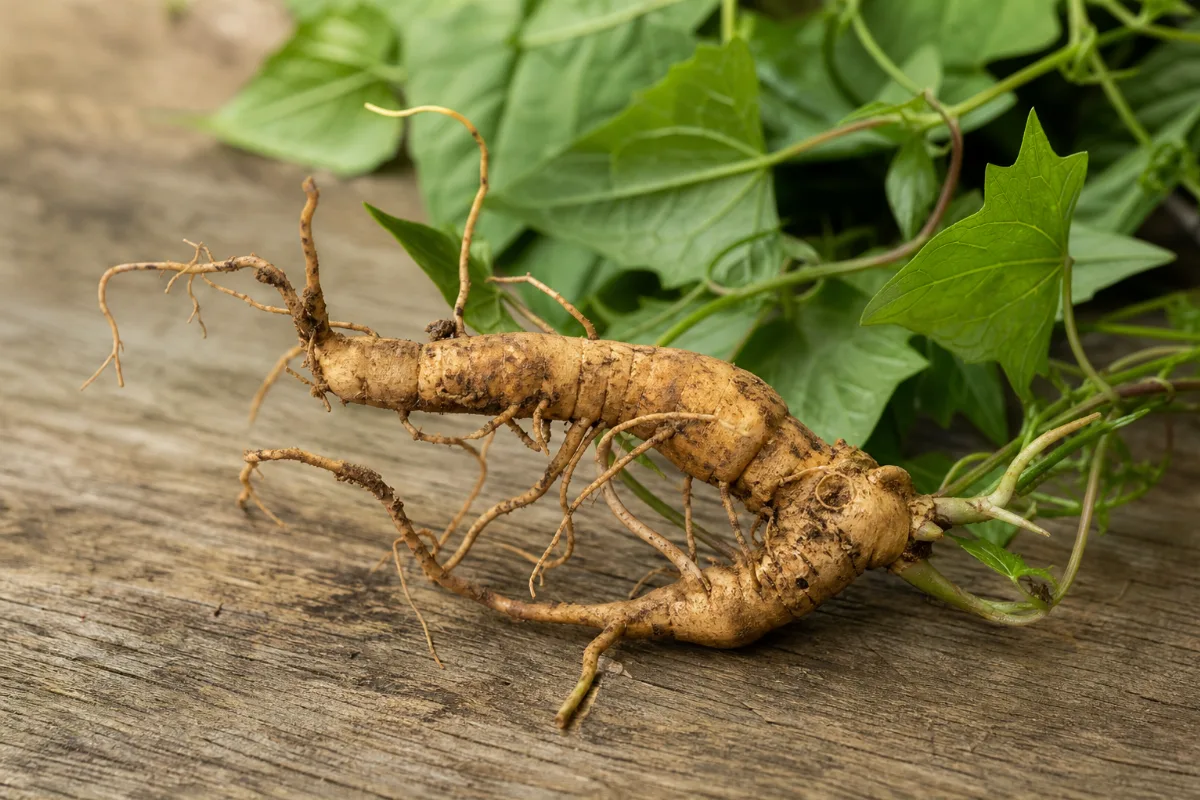
Herbs & Botanicals · Chinese arthritis herb, serious risks
Thunder god vine
Tripterygium wilfordii · also called Thunder god vine, lei gong teng, Tripterygium glycosides
Thunder god vine is a Chinese vine whose root extract is used by doctors for rheumatoid arthritis and other autoimmune diseases. Chinese and US trials show it can work about as well as methotrexate, but it has a narrow safety margin: it can harm the liver, kidneys, blood counts and fertility, has caused deaths, and is unsafe in pregnancy. It is not a supplement to try on your own.
General information, not medical advice. Last substantive update · Not medically reviewed. A named clinician has not signed off on this page. How this page is made
About Thunder god vine
Thunder god vine (Tripterygium wilfordii, lei gong teng) is a Chinese vine whose root extract is a prescription-style treatment for rheumatoid arthritis. It has real trial support and real toxicity. Read the safety tab first.
What it is
Thunder god vine is a perennial vine of the staff-vine family (Celastraceae) commonly grown in southeast China. Extracts have been used in traditional Chinese medicine for inflammation, fever and autoimmune diseases, and in China for rheumatoid arthritis since the 1960s.
Its best-known compounds are triptolide and celastrol. NCCIH warns triptolide may be toxic in people.
Why it is not an everyday herb
There is a narrow gap between a helpful and a harmful amount. Reported harms include kidney damage, liver problems, lowered white blood cells, missed periods, low sperm counts, infertility and rare deaths. It is unsafe in pregnancy.
The trials were run by rheumatologists, and the consensus guidance was written for doctors. Products vary, so results from one cannot be assumed for another. This page does not give any dose or preparation advice.
What research shows
Rheumatoid arthritis: in the TRIFRA trial of 207 Chinese adults, 55.1% on the extract reached a 50% improvement against 46.4% on methotrexate, and 76.8% on both. A 2023 consensus panel pooled 19 trials and found no obvious difference between extract and methotrexate (moderate certainty).
A US trial of 121 people found 65.0% improved on the extract against 32.8% on sulfasalazine, but fewer than half the participants had data at 24 weeks. A Cochrane review in 2011 said the extract may reduce some symptoms but oral use may bring several side effects.
A 2-year follow-up found X-ray joint damage progressed similarly to methotrexate. Lupus, osteoarthritis and kidney disease have thinner or lower-quality evidence.
At a glance
Traditional uses history, not proof
- Inflammation and fever (traditional Chinese medicine)
- Rheumatoid arthritis and other autoimmune diseases
- Kidney disorders linked to the immune system
Studied for research
- Rheumatoid arthritis: about as effective as methotrexate in trials (moderate certainty)
- Rheumatoid arthritis with methotrexate: better than methotrexate alone (moderate certainty)
- Lupus: lower disease activity in small trials (low certainty)
- Osteoarthritis, Crohn's disease, eczema: not enough evidence
Main compounds
- Triptolide (toxic; research compound)
- Celastrol
- Other diterpenoids and triterpenoids
Common forms
- Root extracts
- Tripterygium glycoside tablets (prescribed in China)
- Topical products (effect unclear)
Research links: 2023 international consensus guidance (J Autoimmun) · TRIFRA trial vs methotrexate (Ann Rheum Dis, 2015) · US trial vs sulfasalazine (Ann Intern Med, 2009) · Cochrane review of herbal therapy for RA (2011) · Reproductive toxicity review (2019) · NCCIH: Thunder God Vine · Research Library · Genes & Biomarkers Library
The plant and its history
- Accepted scientific name
- Tripterygium wilfordii Hook.fil.
- Naming authority
- Hook.fil.
- Common names
- Thunder god vine (English); Lei gong teng (Chinese (pinyin))
- Botanical family
- Celastraceae (staff-vine family)
- Classification
- Plantae > Celastrales > Celastraceae > Tripterygium > Tripterygium wilfordii
- Native range
- NCCIH says it is a perennial commonly grown in southeast China; native range not verified.
- Habitat
- Not verified in the sources read.
- What the plant looks like
- Roots: The extracts used in trials come from the root (NCCIH says 'extracts'; the part is not stated in the abstracts). Root bark versus inner wood not verified.; Stems: Described as a perennial vine (NCCIH).; Leaves: Not described.; Flowers: Pollen and nectar can contaminate honey and poison people (case series).; Fruit: Not described.; Seeds: Not described.
- Cultivation
- Commonly grown in southeast China (NCCIH).
- Harvest and processing
- Preparations vary (extracts, tablets, glycoside fractions); details not given in the sources read.
- Look-alikes and adulterants
- Name: Other Celastraceae plants; Note: Related plants (for example the Amazon tree chuchuhuasi) are sometimes mentioned alongside it. They are not substitutes and have not been tested in people.
- Sustainability and conservation
- Not assessed in the sources read.
Traditional use and history history, not clinical proof
| Tradition or era | Documented use | Source |
|---|---|---|
| Traditional Chinese medicine | Extracts used for inflammation, fever and a broad range of inflammatory and autoimmune diseases. | s-nccih |
| Modern China, since the 1960s | Extract used to treat rheumatoid arthritis, per the 2023 consensus guidance abstract. | p37967495 |
Traditional use shows how a plant was used. It does not show that a supplement works or is safe today.
What is inside, and how it may work
What the plant contains and how those compounds act in cells and animals. Laboratory and animal mechanisms are not proven effects in people.
Main compounds
| Compound | Family | Where it is concentrated | Activity studied | Level of evidence |
|---|---|---|---|---|
| Triptolide PubChem 107985 | diterpenoid triepoxide | root | Strong immune and inflammation suppressor in the lab; NCCIH says it may be toxic in people; chemistry review says toxicity and poor absorption limit drug use. 11 12 7 | Lab animal |
| Celastrol PubChem 122724 | pentacyclic triterpenoid | root | Anti-inflammatory in lab studies; not studied as a purified drug in people in the sources read. 11 | Lab animal |
Mechanisms, receptors and pathways
| Target or pathway | Gene or receptor | What was found | Level |
|---|---|---|---|
| Inflammatory cytokines and immune-cell proliferation | Not specified in sources read | Root extracts reduce pro-inflammatory molecules and block lymphocyte and synovial-cell growth in lab studies; a US trial found IL-6 fell in people taking the extract. 1 6 | Lab animal and human |
| Reproductive cell loss | Not specified | Reviewers link the fertility effects to apoptosis of reproductive cells and testis and ovary damage. 17 | Animal research |
Absorption, metabolism and elimination
- Absorption
- Triptolide has low water solubility and poor oral bioavailability (chemistry review).
- Distribution
- Not studied in the sources read.
- Metabolism
- Not described.
- Elimination
- Not described.
- Bioavailability
- Poor for purified triptolide (review).
Isolated compounds versus whole extracts
The trials used root extracts or glycoside tablets, not purified triptolide. Purified triptolide and derivatives are being developed as drugs in cancer and immune disease; no results of those trials were read.
Nutritional composition
Not a food or nutrient; no nutritional role.
2 moderate certainty5 low certainty3 not enough evidence
What is Thunder god vine good for?
What thunder god vine has been studied for and how strong the evidence is. All of this applies only to doctor-prescribed products in clinic settings, not to supplements you choose yourself.
Benefits, one by one
Each card is a research question, not a promise. Tap a goal to filter. Open a card to see the studies, doses and limits.
Rheumatoid arthritis: extract alone compared with methotrexate
Moderate certaintyIn Chinese trials, thunder god vine extract worked about as well as methotrexate, the usual first drug, for active rheumatoid arthritis. Doctors ran these trials. The extract also carries serious risks, so this is not a do-it-yourself remedy.
5 studiesTrials used standardised root extracts or tablets prescribed by docto…
Studies, doses and limits
What the trials found
A 2023 international consensus panel pooled 19 randomised trials (1795 people). In the TRIFRA trial (207 adults, open-label, 24 weeks) the extract was compared with methotrexate and with both together. A 2-year follow-up of TRIFRA followed 109 completers.
Results
Pooled: no obvious difference between extract and methotrexate for ACR20 (RR 1.06), ACR50 (RR 1.03) or ACR70 (RR 1.12). TRIFRA week 24: ACR50 55.1% on extract vs 46.4% on methotrexate (p=0.014). At 2 years: ACR50 58.0% vs 46.4%, with similar X-ray joint damage in each arm.
Effect sizes as reported
ACR20 RR 1.06 (95% CI 0.90-1.26, moderate); ACR50 RR 1.03 (0.80-1.34, moderate); ACR70 RR 1.12 (0.69-1.79, low).
Why this rating
The consensus panel grades ACR20 and ACR50 as moderate certainty (ACR70 low). We keep moderate for efficacy only; trials are mostly Chinese, often open-label and short.
Form and dose studied
Trials used standardised root extracts or tablets prescribed by doctors in hospital clinics. No product or amount is recommended here; this herb should only be used under specialist care.
Who was studied
Adults with active rheumatoid arthritis, mostly in China, many not yet on other arthritis drugs.
Limits
Open-label design; mostly Chinese hospital trials; 24 weeks to 2 years; only 109 of 207 finished the 2-year follow-up; safety trials were too small to rule out serious harm.
Why researchers looked
Rheumatoid arthritis is the use with by far the most human trials.
Traditional use
Root extracts have been used in traditional Chinese medicine since at least the 1960s for rheumatoid arthritis and other inflammatory diseases (NCCIH; consensus guidance).
Proposed mechanism Pharmacological theory
In lab and animal studies the plant's compounds (triptolide, celastrol) switch down inflammatory and immune-cell activity. This is a proposed mechanism, not proof of benefit in people.
A proposed mechanism does not show that the effect happens in people.
Narrow safety margin: liver, kidney, blood-cell, menstrual and sperm effects are documented, and it is unsafe in pregnancy. See the safety tab.
Rheumatoid arthritis: extract added to methotrexate
Moderate certaintyAdding thunder god vine extract to methotrexate helped more people reach a 50% improvement than methotrexate alone. This is the best-supported use, but it is a prescription-level treatment run by specialists.
4 studiesTrials used standardised root extracts or tablets prescribed by docto…
Studies, doses and limits
What the trials found
The consensus panel found 7 trials of methotrexate plus extract against methotrexate alone. TRIFRA's combination arm (69 people) is one of them.
Results
TRIFRA week 24: ACR50 76.8% with both vs 46.4% on methotrexate alone (p<0.001). Pooled combination vs methotrexate alone: ACR20 RR 1.44, ACR50 RR 1.88, ACR70 RR 2.12. At 2 years TRIFRA's combination arm was 50.7% (ACR50), no longer clearly different.
Effect sizes as reported
ACR20 RR 1.44 (1.28-1.62, moderate); ACR50 RR 1.88 (1.56-2.28, moderate); ACR70 RR 2.12 (1.40-3.19, low).
Why this rating
GRADE moderate for ACR20 and ACR50, low for ACR70 (consensus panel). The effect faded at 2 years in the one trial that followed people that long.
Form and dose studied
Trials used standardised root extracts or tablets prescribed by doctors in hospital clinics. No product or amount is recommended here; this herb should only be used under specialist care.
Who was studied
Adults with active rheumatoid arthritis on or starting methotrexate.
Limits
Few trials; open-label; the 2-year follow-up lost half the participants; pooled safety data cannot rule out liver, kidney or infection harm (wide intervals).
Why researchers looked
Doctors in China often combine the two, so trials tested the pair.
Traditional use
Root extracts have been used in traditional Chinese medicine since at least the 1960s for rheumatoid arthritis and other inflammatory diseases (NCCIH; consensus guidance).
Proposed mechanism Pharmacological theory
In lab and animal studies the plant's compounds (triptolide, celastrol) switch down inflammatory and immune-cell activity. This is a proposed mechanism, not proof of benefit in people.
A proposed mechanism does not show that the effect happens in people.
Narrow safety margin: liver, kidney, blood-cell, menstrual and sperm effects are documented, and it is unsafe in pregnancy. See the safety tab.
Rheumatoid arthritis: extract compared with sulfasalazine
Low certaintyIn one US trial more people improved on thunder god vine extract than on sulfasalazine, but many dropped out, so the result is shaky.
4 studiesTrials used standardised root extracts or tablets prescribed by docto…
Studies, doses and limits
What the trials found
A 2009 randomised trial in 121 US adults compared extract with sulfasalazine for 24 weeks. A Cochrane review (2011) noted one comparison with sulfasalazine and three with placebo, none pooled.
Results
ACR20 reached by 65.0% on the extract vs 32.8% on sulfasalazine (P=0.001) after filling in data for dropouts. Outcome data were available for only 62 of 121 at week 24. Adverse events were similar; 62% stayed on the extract and 41% on sulfasalazine.
Effect sizes as reported
ACR20 65.0% (51.6-76.9) vs 32.8% (21.3-46.0).
Why this rating
One trial with heavy dropout; sulfasalazine is a weaker comparator than methotrexate. A 2016 network meta-analysis favoured the extract but the authors rate confidence as low.
Form and dose studied
Trials used standardised root extracts or tablets prescribed by doctors in hospital clinics. No product or amount is recommended here; this herb should only be used under specialist care.
Who was studied
Adults with active rheumatoid arthritis in US clinics.
Limits
Many dropouts; one extract; 24 weeks; X-ray benefit was not statistically significant.
Why researchers looked
Tested in the United States to see if the Chinese extract works outside China.
Traditional use
Root extracts have been used in traditional Chinese medicine since at least the 1960s for rheumatoid arthritis and other inflammatory diseases (NCCIH; consensus guidance).
Proposed mechanism Pharmacological theory
In lab and animal studies the plant's compounds (triptolide, celastrol) switch down inflammatory and immune-cell activity. This is a proposed mechanism, not proof of benefit in people.
A proposed mechanism does not show that the effect happens in people.
Narrow safety margin: liver, kidney, blood-cell, menstrual and sperm effects are documented, and it is unsafe in pregnancy. See the safety tab.
Rheumatoid arthritis: slowing joint damage on X-ray
Low certaintyOne 2-year follow-up found X-ray joint damage progressed about as much on the extract as on methotrexate. It does not show the extract protects joints better.
2 studiesTrials used standardised root extracts or tablets prescribed by docto…
Studies, doses and limits
What the trials found
The 2-year TRIFRA follow-up scored X-rays (read by two radiologists unaware of treatment) in the 109 people who finished. The 2009 US trial reported X-ray progression as a secondary outcome.
Results
Changes in total Sharp score, erosion and joint-space narrowing were similar in the three TRIFRA groups (p>0.05). In the US trial, progression was lower with the extract but not significantly.
Effect sizes as reported
No significant difference between groups.
Why this rating
One non-blinded follow-up with half the participants lost; no placebo.
Form and dose studied
Trials used standardised root extracts or tablets prescribed by doctors in hospital clinics. No product or amount is recommended here; this herb should only be used under specialist care.
Who was studied
Adults with active rheumatoid arthritis followed for 2 years.
Limits
Small numbers at 2 years; no placebo group; the finding is equivalence, not benefit.
Why researchers looked
Slowing joint damage matters more than short-term symptom relief.
Traditional use
Root extracts have been used in traditional Chinese medicine since at least the 1960s for rheumatoid arthritis and other inflammatory diseases (NCCIH; consensus guidance).
Proposed mechanism Pharmacological theory
In lab and animal studies the plant's compounds (triptolide, celastrol) switch down inflammatory and immune-cell activity. This is a proposed mechanism, not proof of benefit in people.
A proposed mechanism does not show that the effect happens in people.
Narrow safety margin: liver, kidney, blood-cell, menstrual and sperm effects are documented, and it is unsafe in pregnancy. See the safety tab.
Rheumatoid arthritis: extract compared with methotrexate alongside a biologic drug
Low certaintyIn people not helped enough by methotrexate, extract plus adalimumab did about as well as methotrexate plus adalimumab. The trial was small.
1 studiesTrials used standardised root extracts or tablets prescribed by docto…
Studies, doses and limits
What the trials found
A 2024 open-label trial in China randomised 64 people for 24 weeks.
Results
Low disease activity: 43.8% vs 46.9% (p=.802); remission 28.1% vs 31.3%. No significant difference in adverse events.
Effect sizes as reported
No significant difference.
Why this rating
One small, open-label trial showing no difference.
Form and dose studied
Trials used standardised root extracts or tablets prescribed by doctors in hospital clinics. No product or amount is recommended here; this herb should only be used under specialist care.
Who was studied
Adults with rheumatoid arthritis who responded poorly to methotrexate.
Limits
Only 64 people; open-label; short; cannot show safety.
Why researchers looked
Asks whether the extract can replace methotrexate for people who cannot take it.
Traditional use
Root extracts have been used in traditional Chinese medicine since at least the 1960s for rheumatoid arthritis and other inflammatory diseases (NCCIH; consensus guidance).
Proposed mechanism Pharmacological theory
In lab and animal studies the plant's compounds (triptolide, celastrol) switch down inflammatory and immune-cell activity. This is a proposed mechanism, not proof of benefit in people.
A proposed mechanism does not show that the effect happens in people.
Narrow safety margin: liver, kidney, blood-cell, menstrual and sperm effects are documented, and it is unsafe in pregnancy. See the safety tab.
Lupus (systemic lupus erythematosus)
Low certaintyReviews of small Chinese trials suggest the tablets, added to usual lupus treatment, lower disease activity. The reviews have high risk of bias, and menstrual changes were more common.
2 studiesTrials used standardised root extracts or tablets prescribed by docto…
Studies, doses and limits
What the trials found
A 2023 meta-analysis of 8 trials (538 people) and a 2026 umbrella review of 4 meta-analyses.
Results
Lupus activity fell more with tablets plus usual treatment (mean difference -1.66); overall response RR 1.21; no difference in overall adverse reactions. The umbrella review found better kidney function, fewer reports of nausea, vomiting and rash, but more irregular menstruation, with all four reviews at high risk of bias.
Effect sizes as reported
Activity MD -1.66 (-2.07 to -1.26, low certainty); response RR 1.21 (1.11-1.32, moderate).
Why this rating
GRADE ranges low to moderate in the trials, but the umbrella review rates all four reviews as high risk of bias.
Form and dose studied
Trials used standardised root extracts or tablets prescribed by doctors in hospital clinics. No product or amount is recommended here; this herb should only be used under specialist care.
Who was studied
Adults with lupus, in China, on usual treatment.
Limits
Small trials; flawed reviews; computer-modelling parts of the umbrella review are not evidence in people.
Why researchers looked
Lupus is an autoimmune disease like rheumatoid arthritis, and Chinese doctors use the tablets there too.
Traditional use
Root extracts have been used in traditional Chinese medicine since at least the 1960s for rheumatoid arthritis and other inflammatory diseases (NCCIH; consensus guidance).
Proposed mechanism Pharmacological theory
In lab and animal studies the plant's compounds (triptolide, celastrol) switch down inflammatory and immune-cell activity. This is a proposed mechanism, not proof of benefit in people.
A proposed mechanism does not show that the effect happens in people.
Narrow safety margin: liver, kidney, blood-cell, menstrual and sperm effects are documented, and it is unsafe in pregnancy. See the safety tab.
Other rheumatic and immune diseases
Low certaintyA small meta-analysis pooled several rheumatic diseases and found fewer relapses when the tablets were added to usual drugs. The result is weak and mixed together.
2 studiesTrials used standardised root extracts or tablets prescribed by docto…
Studies, doses and limits
What the trials found
A 2025 meta-analysis of 11 trials in 1026 people with rheumatoid arthritis, lupus and Sjogren's syndrome. A 2025 systematic review of 14 trials of four plants in RA also supports adjunct benefit but does not separate thunder god vine.
Results
Lower risk of recurrence with tablets plus usual drugs (RR 1.07, 95% CI 1.01-1.15). The authors warn the studies were few and of limited quality.
Effect sizes as reported
RR 1.07 (1.01-1.15).
Why this rating
Diseases pooled; borderline interval; authors urge caution.
Form and dose studied
Trials used standardised root extracts or tablets prescribed by doctors in hospital clinics. No product or amount is recommended here; this herb should only be used under specialist care.
Who was studied
Adults with several immune-mediated diseases.
Limits
Mixed diseases and products; limited quality.
Why researchers looked
Doctors use the same tablets for several immune diseases.
Traditional use
Root extracts have been used in traditional Chinese medicine since at least the 1960s for rheumatoid arthritis and other inflammatory diseases (NCCIH; consensus guidance).
Proposed mechanism Pharmacological theory
In lab and animal studies the plant's compounds (triptolide, celastrol) switch down inflammatory and immune-cell activity. This is a proposed mechanism, not proof of benefit in people.
A proposed mechanism does not show that the effect happens in people.
Narrow safety margin: liver, kidney, blood-cell, menstrual and sperm effects are documented, and it is unsafe in pregnancy. See the safety tab.
Osteoarthritis
Not enough evidenceThe plant's compounds calm inflammation in cells and animals, but human evidence in osteoarthritis is limited and low quality.
1 studiesTrials used standardised root extracts or tablets prescribed by docto…
Studies, doses and limits
What the trials found
A 2026 systematic review pooled cell, animal and human work.
Results
Anti-inflammatory and cartilage-protecting effects in cell and animal models, together with dose-dependent liver and kidney toxicity and immune suppression. Clinical osteoarthritis evidence is limited and low quality.
Effect sizes as reported
No pooled human numbers.
Why this rating
No good human trials in osteoarthritis; benefits are lab and animal findings.
Form and dose studied
Trials used standardised root extracts or tablets prescribed by doctors in hospital clinics. No product or amount is recommended here; this herb should only be used under specialist care.
Who was studied
Not established.
Limits
Lab and animal findings dominate; toxicity concerns.
Why researchers looked
Osteoarthritis involves joint inflammation, so researchers tested the plant's compounds.
Traditional use
Root extracts have been used in traditional Chinese medicine since at least the 1960s for rheumatoid arthritis and other inflammatory diseases (NCCIH; consensus guidance).
Proposed mechanism Cell and animal
In lab and animal studies the plant's compounds (triptolide, celastrol) switch down inflammatory and immune-cell activity. This is a proposed mechanism, not proof of benefit in people.
A proposed mechanism does not show that the effect happens in people.
Narrow safety margin: liver, kidney, blood-cell, menstrual and sperm effects are documented, and it is unsafe in pregnancy. See the safety tab.
Kidney disorders (nephrotic syndrome, IgA nephropathy)
Not enough evidenceEarly reports suggest the tablets may help some kidney disorders, yet the same plant can damage the kidneys. We did not read the kidney trials ourselves.
1 studiesTrials used standardised root extracts or tablets prescribed by docto…
Studies, doses and limits
What the trials found
NCCIH says early reports suggest oral use might help some kidney disorders. Several 2024-2025 meta-analyses exist (membranous nephropathy, glomerulonephritis, diabetic kidney disease), which we found in PubMed but did not open.
Results
No kidney-trial figures were read for this page.
Effect sizes as reported
not extracted
Why this rating
Only a government summary was read; the kidney meta-analyses were not opened.
Form and dose studied
Trials used standardised root extracts or tablets prescribed by doctors in hospital clinics. No product or amount is recommended here; this herb should only be used under specialist care.
Who was studied
Not established here.
Limits
Summary-only; kidney damage is also a documented risk.
Why researchers looked
Chinese doctors use the tablets for immune-driven kidney disease.
Traditional use
Root extracts have been used in traditional Chinese medicine since at least the 1960s for rheumatoid arthritis and other inflammatory diseases (NCCIH; consensus guidance).
Proposed mechanism Pharmacological theory
In lab and animal studies the plant's compounds (triptolide, celastrol) switch down inflammatory and immune-cell activity. This is a proposed mechanism, not proof of benefit in people.
A proposed mechanism does not show that the effect happens in people.
Narrow safety margin: liver, kidney, blood-cell, menstrual and sperm effects are documented, and it is unsafe in pregnancy. See the safety tab.
Crohn's disease, eczema and other promoted uses
Not enough evidenceThunder god vine is also promoted for Crohn's disease and eczema, but there is not enough reliable evidence to say it works.
2 studiesNo product is recommended.
Studies, doses and limits
What the trials found
NCCIH says there is not enough reliable evidence for conditions other than rheumatoid arthritis and some kidney disorders. Triptolide and its derivatives are being studied as drugs, but a review says toxicity and poor absorption have limited clinical use.
Results
No human results read.
Effect sizes as reported
not applicable
Why this rating
No trials read for these uses.
Form and dose studied
No product is recommended.
Who was studied
Not established.
Limits
Lab and early drug-development work only.
Why researchers looked
Promoted because it dampens immune activity.
Traditional use
Root extracts have been used in traditional Chinese medicine since at least the 1960s for rheumatoid arthritis and other inflammatory diseases (NCCIH; consensus guidance).
Proposed mechanism Pharmacological theory
In lab and animal studies the plant's compounds (triptolide, celastrol) switch down inflammatory and immune-cell activity. This is a proposed mechanism, not proof of benefit in people.
A proposed mechanism does not show that the effect happens in people.
Narrow safety margin: liver, kidney, blood-cell, menstrual and sperm effects are documented, and it is unsafe in pregnancy. See the safety tab.
Connections to the rest of health
How Thunder god vine connects to the rest of our health knowledge graph. Every link says what kind of connection it is. A safety link (for example to the liver) is a warning, not a benefit. A study that merely mentions a topic never creates a benefit link.
Explore every connection: goals, body systems, organs, symptoms, genes
A. Wellness goals
| Connected to | Kind of connection | Evidence status | Context | Studies |
|---|---|---|---|---|
| Joint Support | Moderate certainty | Rheumatoid arthritis: extract alone compared with methotrexate: In Chinese trials, thunder god vine extract worked about as well as methotrexate, the usual first drug, for active rheumatoid arthritis. Doctors ran these trials. The extract also carries serious risks, so this is not a do-it-yourself remedy. Rheumatoid arthritis: extract added to methotrexate: Adding thunder god vine extract to methotrexate helped more people reach a 50% improvement than methotrexate alone. This is the best-supported use, but it is a prescription-level treatment run by specialists. | 19 10 21 15 12 6 3 9 14 13 | |
| Inflammation Balance | Low certainty | Lupus (systemic lupus erythematosus): Reviews of small Chinese trials suggest the tablets, added to usual lupus treatment, lower disease activity. The reviews have high risk of bias, and menstrual changes were more common. | 4 16 | |
| Immune Support | Low certainty | Other rheumatic and immune diseases: A small meta-analysis pooled several rheumatic diseases and found fewer relapses when the tablets were added to usual drugs. The result is weak and mixed together. Kidney disorders (nephrotic syndrome, IgA nephropathy): Early reports suggest the tablets may help some kidney disorders, yet the same plant can damage the kidneys. We did not read the kidney trials ourselves. | 14 13 12 | |
| Joint Support | Not enough evidence | Osteoarthritis: The plant's compounds calm inflammation in cells and animals, but human evidence in osteoarthritis is limited and low quality. | 20 | |
| Inflammation Balance | Not enough evidence | Crohn's disease, eczema and other promoted uses: Thunder god vine is also promoted for Crohn's disease and eczema, but there is not enough reliable evidence to say it works. | 12 7 |
B. Body systems
| Connected to | Kind of connection | Evidence status | Context | Studies |
|---|---|---|---|---|
| Bones Joints Muscles | Biological association | Moderate certainty | Studied for: Rheumatoid arthritis: extract alone compared with methotrexate Studied for: Rheumatoid arthritis: extract added to methotrexate | 19 10 21 15 12 6 3 9 14 13 20 |
| Immune System | Biological association | Moderate certainty | Studied for: Rheumatoid arthritis: extract alone compared with methotrexate Studied for: Rheumatoid arthritis: extract added to methotrexate | 19 10 21 15 12 6 3 9 4 16 14 13 7 |
| Kidney Urinary | Biological association | Low certainty | Studied for: Lupus (systemic lupus erythematosus) Studied for: Kidney disorders (nephrotic syndrome, IgA nephropathy) | 4 16 12 |
E. Health conditions
| Connected to | Kind of connection | Evidence status | Context | Studies |
|---|---|---|---|---|
| Male infertility | Low certainty | Reduced sperm count and motility reported in a review. Preparation or compound: root extract |
||
| Acute kidney injury | Moderate certainty | Case reports and case series. Preparation or compound: extract, overdose, contaminated honey |
I. Biomarkers
| Connected to | Kind of connection | Evidence status | Context | Studies |
|---|---|---|---|---|
| ACR20 / ACR50 / ACR70 response | Biological association | Moderate certainty | Measured in trials: raised. A lab change is not the same as a health benefit. | 19 10 6 |
| Disease activity score (DAS28) low activity / remission | Biological association | Low certainty | Measured in trials: lowered. A lab change is not the same as a health benefit. | 9 |
| X-ray joint damage (total Sharp score) | Biological association | Low certainty | Measured in trials: no clear change. A lab change is not the same as a health benefit. | 21 |
| Interleukin-6 (IL-6) in blood | Biological association | Low certainty | Measured in trials: lowered. A lab change is not the same as a health benefit. | 6 |
| Lupus disease activity score | Biological association | Low certainty | Measured in trials: lowered. A lab change is not the same as a health benefit. | 4 |
| Kidney function in lupus | Biological association | Low certainty | Measured in trials: improved. A lab change is not the same as a health benefit. | 16 |
K. Biological pathways
| Connected to | Kind of connection | Evidence status | Context | Studies |
|---|---|---|---|---|
| Cytokine signalling (IL-6) | Preliminary mechanism | Human | IL-6 fell in the US sulfasalazine-comparison trial. | 6 |
L. Active compounds
| Connected to | Kind of connection | Evidence status | Context | Studies |
|---|---|---|---|---|
| Triptolide | Moderate certainty | Toxic compound; NCCIH says it may be toxic in people. Toxic plant compound; NCCIH says it may be toxic in people. Preparation or compound: root extract; purified compound |
12 7 | |
| Triptolide | Biological association | Lab animal | Strong immune and inflammation suppressor in the lab; NCCIH says it may be toxic in people; chemistry review says toxicity and poor absorption limit drug use. Preparation or compound: root |
11 12 7 |
| Celastrol | Biological association | Lab animal | Anti-inflammatory in lab studies; not studied as a purified drug in people in the sources read. Preparation or compound: root |
11 |
Each connection is stored with the ingredient, the connected record, the kind of connection, the evidence status, the supporting studies, the preparation or compound involved, and a review date (last reviewed October 25, 2026).
Evidence at a glance: what changed in 4 lab markers
Tap a number to show only those markers. Counts are markers, not people.
The evidence
The research centre for Thunder god vine. Every record here was checked against PubMed or the publisher's page; we never list a study we have not verified.
Evidence by outcome
Bars show how many studies we found for each outcome, not how well it works. People are added up across trials only (reviews are not added, to avoid double counting).
How we rate evidence
High certainty
Several well-run trials or reviews agree; further research is unlikely to change the picture much.
Moderate certainty
Good trials point the same way, but some doubt remains.
Low certainty
Small, short or inconsistent trials. The finding could change with better research.
Very low certainty
Very little or very weak human data. Treat as a possibility only.
Mixed findings
Trials or reviews disagree with each other.
Not enough evidence
Not enough human research to say either way.
Evidence against
Good research found no benefit, or found harm.
We take the reviewers' own risk-of-bias and GRADE statements where they exist, and otherwise judge from study size, design, consistency, directness and whether a product matches what is sold. Many publications do not make evidence high. Method note: We built on our existing summary, read the NCCIH page, read PubMed abstracts, and checked GBIF and PubChem. Most studies were read as abstracts only.
Study library: every study we checked 21
| Study | Design | People | Product, dose, length | Result |
|---|---|---|---|---|
| Bao 2011 A Chinese herb Tripterygium wilfordii Hook F in the treatment of rheumatoid arthritis: mechanism, efficacy, and safety Rheumatol Int · PMID 21365177 · DOI |
Narrative review human/lab |
Narrative review of lab and clinical studies | Tripterygium wilfordii extract root extract not given here not given here · vs see results |
Describes anti-inflammatory and immune-suppressing effects in lab studies, and some randomised trials showing greater improvement than placebo or sulfasalazine. Authors call the extract an alternative DMARD for people not helped by usual drugs. not applicable Methods, limits and fundingOutcomes: Mechanism, efficacy, safety Limitations: Narrative review; older; authors favourable. Funding and conflicts: Not stated in abstract Read: abstract |
| Brown 2017 Kidney toxicity related to herbs and dietary supplements: Online table of case reports. Part 3 of 5 series Food Chem Toxicol · PMID 28755953 · DOI |
Case report table |
PubMed case reports of kidney harm from supplements, 1966 to May 2016 | Dietary supplements incl. thunder god vine (Tripterygium wilfordii) herb not given here not given here · vs see results |
Thunder god vine is among seven herbs with published kidney-injury case reports in this table. The abstract gives no case counts for it. not applicable Methods, limits and fundingOutcomes: Kidney injury case reports Limitations: Table of reports; excluded many mixed-herb reports; no counts in abstract. Funding and conflicts: Not stated in abstract Read: abstract |
| Cameron 2011 Herbal therapy for treating rheumatoid arthritis Cochrane Database Syst Rev · PMID 21328257 · DOI |
Systematic review |
22 herbal trials in rheumatoid arthritis (3 compared thunder god vine with placebo, 1 with sulfasalazine) | Tripterygium wilfordii products root extract not given here not given here · vs placebo; sulfasalazine |
Three studies compared Tripterygium wilfordii with placebo and one with sulfasalazine and indicated improvements in some outcomes, but data could not be pooled. One study reported serious side effects with oral use; in follow-up studies side effects were mild to moderate and resolved after stopping. The authors conclude Tripterygium products may reduce some RA symptoms, but oral use may bring several side effects. not pooled Methods, limits and fundingOutcomes: Pain, disability, adverse events Limitations: Older review; thunder god vine trials not pooled; many trials had design flaws. Funding and conflicts: None known Read: abstract |
| Chen 2023 Tripterygium glycosides for safely controlling disease activity in systemic lupus erythematosus: a systematic review with meta-analysis and trial sequential analysis Front Pharmacol · PMID 37601046 · DOI |
Meta-analysis |
538 8 randomised trials, 538 people with lupus |
Tripterygium glycoside tablets plus usual treatment root extract (tablets) not given here not given here · vs usual treatment alone |
Lupus activity fell more with the tablets (mean difference -1.66, 95% CI -2.07 to -1.26; low certainty); overall response rate RR 1.21 (1.11-1.32; moderate certainty). No statistical difference in overall adverse reactions. MD -1.66 (-2.07 to -1.26) (-2.07 to -1.26) Methods, limits and fundingOutcomes: Lupus disease activity, overall response, adverse reactions Limitations: Small, mainly Chinese trials; overall adverse-reaction count can hide specific harms such as menstrual effects. Funding and conflicts: No conflicts declared Read: abstract |
| GBIF 2026 GBIF species match: Tripterygium wilfordii Hook.fil. (key 5579615) GBIF · Source |
Registry or database plant |
not applicable | Thunder god vine (Tripterygium wilfordii) whole plant not given here not given here · vs see results |
GBIF API on 2026-10-25: Tripterygium wilfordii Hook.fil. is ACCEPTED (exact match), family Celastraceae, order Celastrales. not applicable Methods, limits and fundingOutcomes: see results Limitations: Taxonomy record; synonyms not listed in the match call. Funding and conflicts: not applicable Read: full-text |
| Goldbach-Mansky 2009 Comparison of Tripterygium wilfordii Hook F versus sulfasalazine in the treatment of rheumatoid arthritis: a randomized trial Ann Intern Med · PMID 19687490 · DOI |
Controlled trial |
121 121 US adults with active rheumatoid arthritis |
Thunder god vine (Tripterygium wilfordii Hook F) root extract (US-made extract) vs sulfasalazine root extract (extract made from the root; the abstract does not give more detail) not given here not given here · vs sulfasalazine |
By a method that filled in data for dropouts, 65.0% (95% CI 51.6 to 76.9) on the extract and 32.8% (21.3 to 46.0) on sulfasalazine reached ACR20 (P=0.001). Adverse events were similar between groups. Only 62% stayed on the extract and 41% on sulfasalazine for 24 weeks, and outcome data were available for only 62 of 121 people at week 24. X-ray progression was lower with the extract but not significantly. ACR20 65.0% vs 32.8% (P=0.001) (extract 51.6-76.9; sulfasalazine 21.3-46.0) Methods, limits and fundingOutcomes: ACR20 response at 24 weeks Limitations: Many dropouts; one extract and one US trial; sulfasalazine is a weaker comparator than methotrexate; 24 weeks. Funding and conflicts: US National Institutes of Health intramural research support Read: abstract |
| Hou 2019 Triptolide: Medicinal chemistry, chemical biology and clinical progress Eur J Med Chem · PMID 31121546 · DOI |
Narrative review compound/lab |
Review of triptolide and its derivatives | Triptolide and synthetic derivatives (purified compound, not a herbal product) isolated compound not given here not given here · vs see results |
The authors say low water solubility, poor oral absorption, severe toxicity and scarce supply have limited triptolide's clinical use, so chemists have made derivatives for cancer, inflammation and immune uses. The abstract names no specific trial results. not applicable Methods, limits and fundingOutcomes: Chemistry, targets, clinical progress Limitations: Chemistry review; the abstract gives no clinical trial data. Funding and conflicts: Not stated in abstract Read: abstract |
| Lu 2026 A severe case of rhabdomyolysis, acute kidney injury, cardiogenic shock, and chronic complications caused by an excessively large dose of Tripterygium glycoside Int Immunopharmacol · PMID 41759264 · DOI |
Case report |
1 A 50-year-old man with type 2 diabetes who took far more than the prescribed amount of Tripterygium glycoside tablets by mistake |
Tripterygium glycoside tablets root extract (tablets) not given here not given here · vs not applicable |
He developed muscle breakdown, acute kidney injury and heart-related shock. Six months later he had chronic kidney disease (stage 2), polyuria and irreversible nerve damage. The report notes other known complications: acute liver and kidney injury, infertility and lymphocyte suppression. single case (not applicable) Methods, limits and fundingOutcomes: Poisoning outcome Limitations: Single case with diabetes as a confounder. Funding and conflicts: No competing interests declared Read: abstract |
| Luo 2024 Efficacy of adalimumab combined with Tripterygium wilfordii Hook F in the treatment of patient with rheumatoid arthritis: A multicenter, open-label, randomized-controlled trial Int J Rheum Dis · PMID 38287544 · DOI |
Controlled trial |
64 64 adults with rheumatoid arthritis who responded poorly to methotrexate |
Thunder god vine (Tripterygium wilfordii Hook F) root extract plus adalimumab vs methotrexate plus adalimumab root extract not given here not given here · vs methotrexate plus adalimumab |
Low disease activity: 43.8% (extract group) vs 46.9% (methotrexate group), p=.802. Remission 28.1% vs 31.3%. No significant difference in efficacy or adverse events; the authors suggest the extract might be an option for people who cannot take methotrexate. 43.8% vs 46.9% low disease activity (p=.802) Methods, limits and fundingOutcomes: Low disease activity and remission at week 24 (DAS28) Limitations: Small (64); open-label; 24 weeks; 53 completed; shows no difference, not superiority. Funding and conflicts: Not stated in abstract Read: abstract |
| Lv 2015 Comparison of Tripterygium wilfordii Hook F with methotrexate in the treatment of active rheumatoid arthritis (TRIFRA): a randomised, controlled clinical trial Ann Rheum Dis · PMID 24733191 · DOI |
Controlled trial |
207 207 adults with active rheumatoid arthritis, 3 Chinese centres |
Thunder god vine (Tripterygium wilfordii Hook F) root extract (tablets) vs methotrexate vs both root extract not given here not given here · vs methotrexate; both together |
ACR50 was reached by 46.4% on methotrexate, 55.1% on the extract and 76.8% on both (extract vs methotrexate p=0.014; both vs methotrexate p<0.001). Irregular menstruation: 7 women on the extract, 3 on methotrexate, 5 on both (extract vs methotrexate p=0.216). 174 of 207 completed 24 weeks. ACR50 46.4% (methotrexate) vs 55.1% (extract) vs 76.8% (both) Methods, limits and fundingOutcomes: ACR50 response at week 24 (a 50% improvement in a standard set of joint measures) Limitations: Open-label (patients knew their treatment; assessors were unaware); China only; 24 weeks; the abstract does not say how liver and blood tests were followed. Funding and conflicts: Non-US government research support (from record type); no industry link stated in abstract Registration: NCT01613079 Read: abstract |
| NIH National Library of Medicine 2026 PubChem name lookups: triptolide and celastrol PubChem · Source |
Registry or database compounds |
not applicable | Triptolide, celastrol isolated compounds not given here not given here · vs see results |
PubChem API on 2026-10-25: triptolide CID 107985 (C20H24O6, molecular weight 360.4); celastrol CID 122724 (C29H38O4, molecular weight 450.6). not applicable Methods, limits and fundingOutcomes: see results Limitations: Identifier lookup only; says nothing about safety. Funding and conflicts: not applicable Read: full-text |
| National Center for Complementary and Integrative Health (NCCIH 2025 Thunder God Vine: Usefulness and Safety NCCIH · Source |
Consumer reference plant/human |
Patients and clinicians | Thunder god vine (oral and topical) extracts not given here not given here · vs see results |
Page re-read 2026-10-25. Says many low-to-moderate quality studies exist for rheumatoid arthritis and some kidney disorders; oral use might help some RA symptoms; unclear for topical use; side effects include digestive problems, diarrhoea, headache, dizziness, lowered white blood cell count, menstrual changes and skin redness; serious effects may include kidney damage and liver problems; rare deaths reported, possibly tied to specific preparations or high amounts; triptolide may be toxic in people; unsafe in pregnancy (possible birth defects); little known about breastfeeding; should not replace conventional RA care. Dietary supplements are not approved by the FDA before sale. not applicable Methods, limits and fundingOutcomes: see results Limitations: A government consumer page, not a primary study; no numbers. Funding and conflicts: Government Read: full-text |
| Piekarz 2025 Phytotherapy as an adjunct to the treatment of rheumatoid arthritis - a systematic review of clinical trials Phytomedicine · PMID 41005054 · DOI |
Systematic review |
14 randomised trials covering turmeric, ginger, thunder god vine and Salvia miltiorrhiza in rheumatoid arthritis | Thunder god vine (Tripterygium wilfordii Hook F) root extract with other plants root extract (with three other plants) not given here not given here · vs standard therapy alone |
Authors report better disease-activity scores with herb-assisted therapy than standard therapy alone in most trials, but note some trials were not significant. The abstract does not give thunder god vine numbers separately. not separated by plant Methods, limits and fundingOutcomes: Disease activity, symptoms, labs Limitations: Four plants mixed; thunder god vine results not separated in the abstract; no pooled numbers. Funding and conflicts: Authors declare no competing interests Read: abstract |
| Shu 2025 Efficacy and safety of Tripterygium wilfordii glycosides tablets combined with Western medicine for patients with rheumatic immune diseases World J Clin Cases · PMID 40012824 · DOI |
Meta-analysis |
1026 11 randomised trials, 1026 people with rheumatic immune diseases (rheumatoid arthritis, lupus, Sjogren's) |
Tripterygium glycoside tablets plus conventional drugs root extract (tablets) not given here not given here · vs conventional drugs alone |
Combined treatment lowered risk of disease recurrence (RR 1.07, 95% CI 1.01-1.15). The authors say the number and quality of studies were limited and results should be read with caution. RR 1.07 (1.01-1.15) (1.01-1.15) Methods, limits and fundingOutcomes: Relapse and safety Limitations: Mixed diseases pooled; limited quality; RR near 1; the abstract's wording on recurrence is unclear. Funding and conflicts: No conflicts declared Read: abstract |
| Wang 2016 Tripterygium wilfordii Hook F versus conventional synthetic disease-modifying anti-rheumatic drugs as monotherapy for rheumatoid arthritis: a systematic review and network meta-analysis BMC Complement Altern Med · PMID 27411429 · DOI |
Network meta analysis |
5255 22 trials, 5255 people with rheumatoid arthritis |
Thunder god vine (Tripterygium wilfordii Hook F) root extract vs standard drugs or placebo root extract not given here not given here · vs placebo and several standard drugs |
TwHF beat placebo and sulfasalazine on ACR20/50. Indirect comparisons ranked it above methotrexate and other drugs on ACR20, but the authors state that without head-to-head comparisons confidence in the estimates is low. TwHF did not cause more withdrawals than placebo. SUCRA ranking 92.0% (ACR20) Methods, limits and fundingOutcomes: ACR20/50/70 and withdrawals due to side effects Limitations: Indirect comparisons; authors rate confidence as low; mixed Chinese trial quality. Funding and conflicts: Not stated in abstract Read: abstract |
| Xiong 2026 Assessment of therapeutic effectiveness and underlying pharmacological mechanisms of Tripterygium glycosides for systemic lupus erythematosus: umbrella review and in silico study Zhongguo Zhong Yao Za Zhi · PMID 42011626 · DOI |
Umbrella review |
Four meta-analyses of Tripterygium glycosides plus usual treatment in lupus | Tripterygium glycosides root extract (glycosides) not given here not given here · vs usual treatment alone |
Tripterygium glycosides improved kidney function, immune markers, blood parameters and disease activity, with fewer reports of nausea, vomiting and rash, but raised the risk of irregular menstruation. All four reviews had a high risk of bias and half the evidence was moderate or low quality. Computer-modelling parts are predictions only. not given in abstract Methods, limits and fundingOutcomes: Kidney function, disease activity, adverse events Limitations: Umbrella review of flawed reviews; computer modelling is not evidence in people. Funding and conflicts: Not stated in abstract Read: abstract |
| Xu 2019 Overview of reproductive toxicity studies on Tripterygium wilfordii in recent 40 years Zhongguo Zhong Yao Za Zhi · PMID 31602902 · DOI |
Narrative review human/animal |
Review of 40 years of animal and clinical reports | Tripterygium glycosides, triptolide, tablets root extract and compounds not given here not given here · vs see results |
In men: lower sperm movement, low or absent sperm, reduced fertility or infertility, and with long use testicular shrinkage and lower sex drive. In women: menstrual disorders, lighter periods or amenorrhoea (no periods), lower sex drive and infertility. The authors link this to loss of reproductive cells and damage to testis and ovary. The abstract gives no frequencies and does not say whether all effects reverse. not applicable Methods, limits and fundingOutcomes: Reproductive toxicity Limitations: Narrative review (Chinese journal, English abstract); no rates; mixes animal and human work. Funding and conflicts: Not stated in abstract Read: abstract |
| Zhang 2016 Fatal Honey Poisoning Caused by Tripterygium wilfordii Hook F in Southwest China: A Case Series Wilderness Environ Med · PMID 27132027 · DOI |
Case series |
3 3 male construction workers who ate wild raw honey |
Honey contaminated with thunder god vine pollen honey (flower nectar/pollen) not given here not given here · vs not applicable |
All three had kidney damage; one died of acute kidney failure one day after admission. Pollen analysis showed the honey was heavily contaminated with thunder god vine pollen. one death in three (not applicable) Methods, limits and fundingOutcomes: Poisoning outcome Limitations: Three cases; wild honey, not a supplement. Funding and conflicts: Not stated in abstract Read: abstract |
| Zhang 2024 2023 International Consensus Guidance for the use of Tripterygium Wilfordii Hook F in the treatment of active rheumatoid arthritis J Autoimmun · PMID 37967495 · DOI |
Guideline |
1795 19 randomised trials, 1795 people with active rheumatoid arthritis |
Thunder god vine (Tripterygium wilfordii Hook F) root extract alone or with methotrexate root extract not given here not given here · vs methotrexate; sulfasalazine |
Extract vs methotrexate alone: no obvious difference for ACR20 (RR 1.06, 0.90-1.26, moderate certainty) or ACR50 (RR 1.03, 0.80-1.34, moderate). Methotrexate plus extract beat methotrexate alone for ACR20 (RR 1.44, 1.28-1.62, moderate), ACR50 (RR 1.88, 1.56-2.28, moderate) and ACR70 (RR 2.12, 1.40-3.19, low). No obvious difference in infection (RR 1.37, 0.84-2.23), liver dysfunction (RR 1.14, 0.71-1.85) or renal damage (RR 2.20, 0.50-9.72), but the intervals are wide and do not rule out harm. ACR50 RR 1.88 (1.56-2.28), combination vs methotrexate alone Methods, limits and fundingOutcomes: ACR20/50/70 and safety outcomes (GRADE) Limitations: Panel built the advice from short trials; wide intervals on kidney and infection outcomes; mostly Chinese trials. Funding and conflicts: Not stated in abstract Read: abstract |
| Zhao 2026 Exploring the Therapeutic Potential and Safety Profile of Tripterygium wilfordii Hook.f. in Osteoarthritis: Mechanisms, Toxicity, and Clinical Perspectives Endocr Metab Immune Disord Drug Targets · PMID 42576565 · DOI |
Systematic review human/animal |
Cell, animal and human studies of thunder god vine in osteoarthritis | Tripterygium wilfordii and its active compounds root extract and compounds not given here not given here · vs see results |
Active compounds show anti-inflammatory effects in cells and animals, but also dose-dependent liver toxicity, kidney toxicity and immune suppression. The review describes a narrow therapeutic window. Clinical evidence in osteoarthritis is limited and low quality; evidence is stronger for rheumatoid arthritis. not applicable Methods, limits and fundingOutcomes: Osteoarthritis effects and toxicity Limitations: Narrative synthesis; mostly lab and animal data. Funding and conflicts: Not stated in abstract Read: abstract |
| Zhou 2018 Comparison of the impact of Tripterygium wilfordii Hook F and Methotrexate treatment on radiological progression in active rheumatoid arthritis: 2-year follow up of a randomized, non-blinded, controlled study Arthritis Res Ther · PMID 29636089 · DOI |
Controlled trial |
207 207 DMARD-naive adults with active rheumatoid arthritis from the TRIFRA trial; 109 finished 2 years |
Thunder god vine (Tripterygium wilfordii Hook F) root extract vs methotrexate vs both root extract not given here not given here · vs methotrexate; both together |
At 2 years ACR50 was 46.4% (methotrexate), 58.0% (extract) and 50.7% (both). X-ray joint damage scores changed by similar amounts in all three groups. Adverse events were similar. Only 109 of 207 completed follow-up. ACR50 58.0% vs 46.4% (extract vs methotrexate, p=0.004) Methods, limits and fundingOutcomes: Disease activity and joint damage on X-ray (total Sharp score) at year 2 Limitations: Non-blinded; fewer than 60% completed; follow-up of one trial. Funding and conflicts: Non-US government research support (from record type); no industry link stated in abstract Registration: NCT01613079 Read: abstract |
What we do not know yet
- No large placebo-controlled trial outside China with long-term safety follow-up.
- Reproductive effects: frequency and reversibility not given in the abstracts read.
- No test of product quality or contamination.
- LiverTox, EMA and LactMed entries were not read.
- Kidney-disease trials were not opened.
- Which plant parts are safe is not verified.
How new research is added
New studies are found by a saved PubMed search and are placed in a review queue. A person reads each one before it changes any evidence rating or safety wording.
Lab markers
What changed in blood or saliva tests during trials. A changed number is not the same as feeling or being healthier, and we give no "normal ranges".
Other 6
ACR20 / ACR50 / ACR70 response
Raised in trials
The share of people whose swollen and tender joints and other measures improved by at least 20%, 50% or 70% on a standard scale.
Moderate certaintyResults and what it means
Why it was measured
The standard way rheumatoid arthritis trials report whether treatment helped.
Statistical vs. clinical meaning
Consistent across trials and graded moderate by the consensus panel for the main comparisons.
Safety implication
Responders still need monitoring for the toxicities on the safety tab.
Disease activity score (DAS28) low activity / remission
Lowered in trials
A combined score of 28 joints and blood inflammation; low scores mean quiet disease.
Low certaintyResults and what it means
Why it was measured
Shows how active the disease is, and whether remission is reached.
Statistical vs. clinical meaning
Small open-label trial; shows no difference.
Safety implication
None specific.
| Study | Result | People | Product |
|---|---|---|---|
| 9 | Low disease activity 43.8% vs 46.9%; remission 28.1% vs 31.3%; no significant difference. | 64 adults inadequately helped by methotrexate | Extract + adalimumab vs methotrexate + adalimumab, 24 weeks |
X-ray joint damage (total Sharp score)
No clear change in trials
A score read from hand and foot X-rays: erosions and narrowed joint spaces.
Low certaintyResults and what it means
Why it was measured
Measures lasting joint harm rather than symptoms.
Statistical vs. clinical meaning
Half the participants lost; no placebo.
Safety implication
None specific.
| Study | Result | People | Product |
|---|---|---|---|
| 21 | Similar change in all three groups over 2 years. | 109 people who finished 2 years | Extract vs methotrexate vs both |
Interleukin-6 (IL-6) in blood
Lowered in trials
A blood signal of inflammation.
Low certaintyResults and what it means
Why it was measured
The US trial checked whether the extract lowers inflammatory signals.
Statistical vs. clinical meaning
One trial; no numbers in the abstract.
Safety implication
None specific.
| Study | Result | People | Product |
|---|---|---|---|
| 6 | IL-6 fell rapidly and significantly on the extract (the abstract gives no values). | 121 US adults with active RA | Extract, 24 weeks |
Lupus disease activity score
Lowered in trials
A clinical score of how active lupus is.
Low certaintyResults and what it means
Why it was measured
Shows whether lupus is calming.
Statistical vs. clinical meaning
Low-certainty evidence from small trials.
Safety implication
None specific.
| Study | Result | People | Product |
|---|---|---|---|
| 4 | Mean difference -1.66 points (95% CI -2.07 to -1.26) with tablets plus usual treatment vs usual treatment alone. | 538 people with lupus in 8 trials | Tripterygium glycoside tablets plus usual treatment |
Kidney function in lupus
Improved in trials
Measures such as protein in urine and filtering ability.
Low certaintyResults and what it means
Why it was measured
Lupus can inflame the kidneys.
Statistical vs. clinical meaning
High risk of bias in the underlying reviews.
Safety implication
The same plant can damage the kidneys; kidney function needs checking by a doctor.
| Study | Result | People | Product |
|---|---|---|---|
| 16 | Better kidney function with glycosides added to usual treatment; all four reviews at high risk of bias. | Lupus, four meta-analyses | Tripterygium glycosides plus usual treatment |
Safety
What studies and official sources say about side effects, medicines and who should check first. Each point shows what kind of evidence it comes from.
Main points to know 6
- Narrow safety margin: serious organ harm and deaths are documented. NCCIH says some side effects may be serious, including kidney damage and liver problems, and that rare deaths have been reported, possibly linked to specific preparations or high amounts. A 2026 review describes a narrow therapeutic window with dose-dependent liver toxicity, kidney toxicity and immune suppression. Products vary widely, and nothing on this page tells you how much or which form to use. Regulator and review 12 20
- Fertility: menstrual disorders, no periods, low sperm counts. A review of 40 years of reports lists, in men, lower sperm movement, few or no sperm and reduced fertility or infertility, and with long use testicular shrinkage. In women it lists menstrual disorders, lighter periods or no periods (amenorrhoea) and infertility. In the TRIFRA trial irregular menstruation was reported by 7 women on the extract, 3 on methotrexate and 5 on both. The abstracts do not say how often these effects occur or whether they always reverse. Ovarian failure is not named in the abstracts we read. Narrative review and rct 17 10 16
- Not for pregnancy. NCCIH considers it unsafe in pregnancy because it may raise the risk of birth defects. Little is known about breastfeeding. Regulator 12
- Other parts of the plant and wild honey can kill. Three men who ate wild honey contaminated with thunder god vine pollen developed kidney damage, and one died of acute kidney failure within a day of admission. Which plant parts are safe is not settled in the sources we read: the idea that only the peeled root is used medicinally is widely stated but we did not verify it. Case series 18
- Overdose has caused muscle breakdown, kidney failure and shock. A man with diabetes who took far more tablets than prescribed developed rhabdomyolysis (muscle breakdown), acute kidney injury and cardiogenic shock, and six months later had chronic kidney disease and irreversible nerve damage. Case report 8
- Specialist care only; not a replacement for arthritis treatment. The trials were run in rheumatology clinics, and an international consensus panel wrote its advice for doctors. NCCIH says thunder god vine should not replace conventional care for rheumatoid arthritis, which can delay or prevent joint damage. Do not self-treat. This page gives no dose or preparation advice. Regulator and guideline 12 19
Side effects 8
| Effect | How often | Severity and recovery | Evidence |
|---|---|---|---|
| Digestive upset, diarrhoea, headache, dizziness, skin redness Listed by NCCIH; no rates given. | Not established | mild to moderate Not stated | Regulator 12 |
| Lower white blood cell count and immune suppression A bone-marrow effect was in the request brief but is not named in the abstracts we read; lowered white cells are. | Not established | moderate to serious Not stated | Regulator and review 12 20 8 |
| Irregular menstruation Extract vs methotrexate p=0.216 in a single open-label trial. | TRIFRA: 7 of 69 on extract, 3 of 69 on methotrexate, 5 of 69 on both | moderate Not reported in abstract | Controlled trial 10 16 |
| Reduced sperm count and motility, infertility (men) Review of reports; no frequencies. | Not established | serious Not stated in abstract | Narrative review 17 |
| Amenorrhoea and infertility (women) Review of reports; no frequencies. | Not established | serious Not stated in abstract | Narrative review 17 |
| Kidney damage, including acute kidney injury Thunder god vine appears among 7 herbs with published kidney-injury case reports. | Not established | serious Chronic kidney disease persisted in one overdose case | Case report and regulator 12 2 8 18 |
| Liver problems Trial data show no clear excess but the interval is wide and trials are short. | Trials: RR 1.14 for liver dysfunction (95% CI 0.71-1.85) with extract plus methotrexate vs methotrexate alone | serious Not stated | Regulator and meta analysis 12 19 20 |
| Stopping treatment because of side effects Cochrane noted one study with serious side effects and follow-up studies with mild to moderate effects that resolved after stopping. | US trial: 62% stayed on extract vs 41% on sulfasalazine at 24 weeks | mixed not applicable | Controlled trial 6 3 |
Liver
NCCIH lists liver problems among the possible serious effects, and a 2026 review describes dose-dependent liver toxicity. In pooled trials of extract plus methotrexate, liver dysfunction was not clearly more common than with methotrexate alone, but the confidence interval allows a large difference. We did not open the NIH LiverTox entry (not found or not read), so no LiverTox rating or case count is claimed. 12 19 20
How often. Unknown. Pooled trial figure: RR 1.14 (0.71-1.85) for liver dysfunction.
Monitoring. No official routine test schedule was found in the sources read. Yellow skin or eyes, dark urine, pale stools or belly pain need prompt medical review.
This is a safety connection. It is not evidence that Thunder god vine supports liver health.
Medicines and supplements 4
| With | Why it matters | Importance | Evidence | What to do |
|---|---|---|---|---|
| Methotrexate prescription | Used together in trials; both can affect the liver and blood counts. | Pooled trials found no obvious excess of liver, infection or kidney events, but intervals are wide. | Controlled trial Low certainty 19 10 | Only together under rheumatology supervision. |
| Other immune-suppressing medicines (biologics, steroids, azathioprine, etc.) prescription | Additive immune suppression; reasoning from the plant's effects. | NCCIH says adding thunder god vine to conventional therapy might increase side effects, though some research disagrees. One small trial combined it with adalimumab and found similar adverse events to methotrexate plus adalimumab. | Regulator and rct Very low certainty 12 9 | Tell every prescriber; do not combine on your own. |
| Liver- or kidney-toxic medicines and alcohol prescription | Added organ load, as reasoned from the plant's toxicity. | Theoretical; no study read. | Mechanism theory Very low certainty 12 | Avoid unless a specialist directs otherwise. |
| Enzyme (CYP) or transporter drugs prescription | Not studied in the sources read. | Unknown. | None Not enough evidence 12 | Ask a pharmacist. |
Who should check first 5
| Situation | Advice | Evidence |
|---|---|---|
| Pregnancy | Do not use. NCCIH: unsafe, may raise risk of birth defects. | Regulator 12 |
| Breastfeeding | Avoid; little is known (NCCIH). | Regulator 12 |
| Trying to conceive (either partner) | Avoid; documented effects on sperm, periods and fertility. | Narrative review 17 |
| Liver or kidney disease, low white blood cell count, active infection | Reasoned from the documented organ and immune effects; discuss with a specialist. No trial in these groups was read. | Mechanism theory 12 20 |
| Children | Not assessed in the sources read; do not use without a specialist. | None |
Overdose, product quality and regulators
Summary. The plant's compounds, especially triptolide, are toxic: NCCIH says triptolide may be toxic in people, and a 2019 chemistry review cites severe toxicity and poor absorption as barriers to drug development.
Animal. Lab and animal studies describe liver, kidney and reproductive toxicity (review level); animal papers were not individually opened.
Human doses studied. Not applicable; no dose advice is given on this page.
High dose or long term signals. Rare deaths may relate to specific preparations or high amounts (NCCIH). One overdose case ended in chronic kidney disease. Long use is linked to testicular shrinkage in the reproductive review.
Overdose response. Muscle breakdown, acute kidney injury and shock in one case; kidney failure and death after contaminated honey in a case series.
Genotoxicity. Not assessed in the sources read.
Toxic plant parts. Pollen/nectar (via honey) caused fatal poisoning. Safety of root bark versus the inner wood of the root was not verified in the sources read.
Products vary widely. NCCIH says deaths may be linked to specific preparations, and the US does not approve supplements before sale. We found no product-testing study, and wild honey from areas where the vine grows is a separate poison source.
Preparation differences. NCCIH links rare deaths to specific preparations or high amounts. 12
Contaminated honey. Honey heavily contaminated with thunder god vine pollen killed one of three men. 18
Supplement quality. Not tested in any study we read.
| Body | Action | Date |
|---|---|---|
| NCCIH (NIH) (US) | Consumer page: low-to-moderate quality studies; may help some RA symptoms; serious side effects and rare deaths; unsafe in pregnancy; not a replacement for conventional care. source | 2025 |
When to get medical help
- Passing little or no urine, swelling, or flank pain
- Yellow skin or eyes, dark urine, pale stools
- Muscle pain or weakness with dark urine
- Fever, chills or other signs of infection
- Severe vomiting or diarrhoea
- Chest pain, fainting or very low blood pressure after a suspected overdose
- Any illness after eating wild honey from an area where the vine grows
- Missed periods, or pregnancy while taking it
Stop the supplement and contact a clinician or emergency service. In the US, Poison Control is 1-800-222-1222.
General information only, not medical advice. Ask a clinician or pharmacist before use, especially with medicines, in pregnancy or with a health condition. See the Natural Remedy Safety guide.
Frequently asked questions
What is thunder god vine?
Does it work for rheumatoid arthritis?
Is it as good as methotrexate?
Does it stop joint damage?
One 2-year follow-up found X-ray damage progressed about the same as on methotrexate. It did not show extra protection, and half the participants dropped out.
What are the main dangers?
Can it make me infertile?
Is it safe in pregnancy or breastfeeding?
No. NCCIH calls it unsafe in pregnancy because of possible birth defects. Little is known about breastfeeding.
Can I buy it as a supplement?
It is sold as a dietary supplement in some countries, but products vary and some preparations are linked to serious harm. In the US supplements are not approved before sale. Use only under specialist care.
Who should use it?
Can it interact with other medicines?
Can wild honey be dangerous?
Yes. In a case series, honey contaminated with thunder god vine pollen caused kidney failure and one death.
Explore by health goal
Editorial transparency
- Written by
- AlternativeMed editorial team. Research compiled with AI assistance, then checked against PubMed records.
- Medical review
- None. This page has not been reviewed by a physician or pharmacist.
- First published
- 2026-10-25
- Last substantive update
- 2026-10-25
- How we research
- We built on our existing summary, read the NCCIH page, read PubMed abstracts, and checked GBIF and PubChem. Most studies were read as abstracts only.
- How we rate evidence
- See "How we rate evidence" in the Evidence tab.
- Independence
- No product is promoted on this page. No affiliate links are shown.
Sources 21
Each source was opened and checked. Where we read only the abstract, it says so. The small numbers in the text point here.
- Bao J, Dai SM. A Chinese herb Tripterygium wilfordii Hook F in the treatment of rheumatoid arthritis: mechanism, efficacy, and safety. Rheumatol Int. 2011. PMID 21365177. DOI 10.1007/s00296-011-1841-y. (abstract)
- Brown AC. Kidney toxicity related to herbs and dietary supplements: Online table of case reports. Part 3 of 5 series. Food Chem Toxicol. 2017. PMID 28755953. DOI 10.1016/j.fct.2016.07.024. (abstract)
- Cameron M, Gagnier JJ, Chrubasik S. Herbal therapy for treating rheumatoid arthritis. Cochrane Database Syst Rev. 2011. PMID 21328257. DOI 10.1002/14651858.CD002948.pub2. (abstract)
- Chen Y, Wang L, Li N, Zhou C et al.. Tripterygium glycosides for safely controlling disease activity in systemic lupus erythematosus: a systematic review with meta-analysis and trial sequential analysis. Front Pharmacol. 2023. PMID 37601046. DOI 10.3389/fphar.2023.1207385. (abstract)
- GBIF. GBIF species match: Tripterygium wilfordii Hook.fil. (key 5579615). GBIF. 2026. (full-text)
- Goldbach-Mansky R, Wilson M, Fleischmann R, Olsen N et al.. Comparison of Tripterygium wilfordii Hook F versus sulfasalazine in the treatment of rheumatoid arthritis: a randomized trial. Ann Intern Med. 2009. PMID 19687490. DOI 10.7326/0003-4819-151-4-200908180-00005. (abstract)
- Hou W, Liu B, Xu H. Triptolide: Medicinal chemistry, chemical biology and clinical progress. Eur J Med Chem. 2019. PMID 31121546. DOI 10.1016/j.ejmech.2019.05.032. (abstract)
- Lu S, Zhong H, Zhou K, Li W et al.. A severe case of rhabdomyolysis, acute kidney injury, cardiogenic shock, and chronic complications caused by an excessively large dose of Tripterygium glycoside. Int Immunopharmacol. 2026. PMID 41759264. DOI 10.1016/j.intimp.2026.116420. (abstract)
- Luo F, Gau SY, Wu YX, Liao HL et al.. Efficacy of adalimumab combined with Tripterygium wilfordii Hook F in the treatment of patient with rheumatoid arthritis: A multicenter, open-label, randomized-controlled trial. Int J Rheum Dis. 2024. PMID 38287544. DOI 10.1111/1756-185X.15031. (abstract)
- Lv QW, Zhang W, Shi Q, Zheng WJ et al.. Comparison of Tripterygium wilfordii Hook F with methotrexate in the treatment of active rheumatoid arthritis (TRIFRA): a randomised, controlled clinical trial. Ann Rheum Dis. 2015. PMID 24733191. DOI 10.1136/annrheumdis-2013-204807. (abstract)
- NIH National Library of Medicine. PubChem name lookups: triptolide and celastrol. PubChem. 2026. (full-text)
- National Center for Complementary and Integrative Health (NCCIH, NIH). Thunder God Vine: Usefulness and Safety. NCCIH. 2025. (full-text)
- Piekarz J, Picheta N, Pobideł J, Daniłowska K et al.. Phytotherapy as an adjunct to the treatment of rheumatoid arthritis - a systematic review of clinical trials. Phytomedicine. 2025. PMID 41005054. DOI 10.1016/j.phymed.2025.157285. (abstract)
- Shu H, Chen XY, Zhao J, Li P et al.. Efficacy and safety of Tripterygium wilfordii glycosides tablets combined with Western medicine for patients with rheumatic immune diseases. World J Clin Cases. 2025. PMID 40012824. DOI 10.12998/wjcc.v13.i6.95513. (abstract)
- Wang HL, Jiang Q, Feng XH, Zhang HD et al.. Tripterygium wilfordii Hook F versus conventional synthetic disease-modifying anti-rheumatic drugs as monotherapy for rheumatoid arthritis: a systematic review and network meta-analysis. BMC Complement Altern Med. 2016. PMID 27411429. DOI 10.1186/s12906-016-1194-x. (abstract)
- Xiong TT, Xiong YJ, Huang TS, Wan XL et al.. Assessment of therapeutic effectiveness and underlying pharmacological mechanisms of Tripterygium glycosides for systemic lupus erythematosus: umbrella review and in silico study. Zhongguo Zhong Yao Za Zhi. 2026. PMID 42011626. DOI 10.19540/j.cnki.cjcmm.20251119.501. (abstract)
- Xu Y, Fan YF, Zhao Y, Lin N et al.. Overview of reproductive toxicity studies on Tripterygium wilfordii in recent 40 years. Zhongguo Zhong Yao Za Zhi. 2019. PMID 31602902. DOI 10.19540/j.cnki.cjcmm.20190524.401. (abstract)
- Zhang Q, Chen X, Chen S, Liu Z et al.. Fatal Honey Poisoning Caused by Tripterygium wilfordii Hook F in Southwest China: A Case Series. Wilderness Environ Med. 2016. PMID 27132027. DOI 10.1016/j.wem.2016.01.002. (abstract)
- Zhang X, Xia J, Jiang Y, Pisetsky DS et al.. 2023 International Consensus Guidance for the use of Tripterygium Wilfordii Hook F in the treatment of active rheumatoid arthritis. J Autoimmun. 2024. PMID 37967495. DOI 10.1016/j.jaut.2023.103148. (abstract)
- Zhao J, Ma X, Yin Y, Zhang X et al.. Exploring the Therapeutic Potential and Safety Profile of Tripterygium wilfordii Hook.f. in Osteoarthritis: Mechanisms, Toxicity, and Clinical Perspectives. Endocr Metab Immune Disord Drug Targets. 2026. PMID 42576565. DOI 10.2174/0118715303454168260516214848. (abstract)
- Zhou YZ, Zhao LD, Chen H, Zhang Y et al.. Comparison of the impact of Tripterygium wilfordii Hook F and Methotrexate treatment on radiological progression in active rheumatoid arthritis: 2-year follow up of a randomized, non-blinded, controlled study. Arthritis Res Ther. 2018. PMID 29636089. DOI 10.1186/s13075-018-1563-6. (abstract)