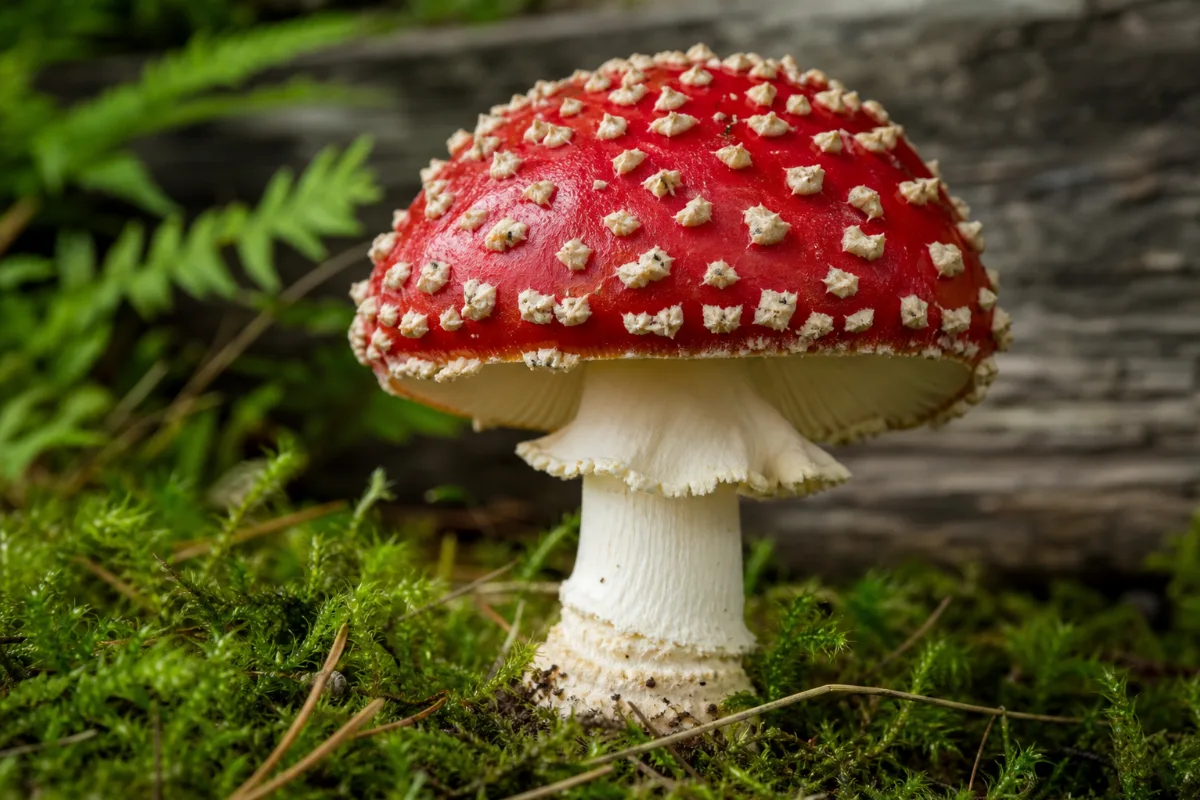
Psychedelic Therapy · Fungus
Amanita muscaria (Fly Agaric)
Amanita muscaria (L.) Lam. · also called Fly agaric; not the same as psilocybin mushrooms
Fly agaric (Amanita muscaria) is the red mushroom with white spots, and it is poisonous. Its poisons, ibotenic acid and muscimol, can cause confusion, vomiting, deep sleepiness, coma and, rarely, death. It is not a psilocybin mushroom, and no trial shows it helps any condition. Edibles sold as "Amanita" gummies are unregulated, the FDA warns against them, and tests found labels that did not match what was inside. If someone has eaten it, call a poison centre right away.
General information, not medical advice. Last substantive update · Not medically reviewed. A named clinician has not signed off on this page. How this page is made
About Amanita muscaria (Fly Agaric)
Amanita muscaria (fly agaric) is a poisonous mushroom, not a psilocybin mushroom. Poisoning can cause confusion, vomiting, deep sleepiness, coma and, rarely, death. Look-alikes in the same family, such as the death cap, are deadly. Edibles sold as "Amanita" gummies are unregulated; the FDA says the mushroom and its main compounds are not authorized in food and may be harmful, and lab tests found that labels often do not match contents. No clinical trial supports any health use.
Danger first: what it is and why it poisons
Amanita muscaria, the fly agaric, is the red mushroom with white spots. Medical reports call it a highly poisonous mushroom. Its main poisons are ibotenic acid and muscimol. Ibotenic acid excites nerve cells; muscimol calms them. Poisoning can show both at once: confusion and agitation, vomiting, deep sleepiness, tremors, trouble breathing and coma.
Many people recover, but not all cases are mild. A man who ate dried caps for their mind-altering effects died after a cardiac arrest, a 75-year-old needed a breathing tube after eating one cap by mistake, and in a US poison-centre series five of 34 patients were intubated. If someone has eaten it, call a poison centre right away.
Deadly look-alikes in the same family
The death cap (Amanita phalloides) and Amanita virosa belong to the same family and cause most deaths from mushroom poisoning, through liver-destroying amatoxins. Their symptoms can start many hours later, and may seem to settle before the liver fails. Reviews say some poisonous mushrooms cannot reliably be told from edible ones by their looks, and fly agaric itself has been mistaken for an edible species.
This page does not teach identification, and a photo or a name is never proof that a mushroom is safe.
Not a psilocybin mushroom
Fly agaric is often lumped in with "magic mushrooms", but it works differently. Muscimol acts on GABA receptors (like alcohol and sedatives); psilocybin acts mainly on serotonin receptors. Psilocybin is being tested in clinical trials. Fly agaric has no clinical evidence for any condition.
Edibles, gummies and what regulators say
In December 2024 the US FDA said A. muscaria, its extracts, and the compounds muscimol, ibotenic acid and muscarine are not authorized as ingredients in conventional food, do not meet the safety standard for food, and may be harmful. It recommended that people avoid foods with these ingredients and said it was evaluating their use in dietary supplements.
Lab tests of gummies, chocolates and "extracts" found that labels are often wrong. Products claiming Amanita extract often held no ibotenic acid or muscimol, and some contained psilocin, undisclosed THC or other drugs. In US poison-centre reports of mushroom edibles, hospital admission was linked with confusion, depressed nervous-system function and taking other substances at the same time.
What research exists
Almost all published human research is about poisoning: case reports, poison-centre series and reviews. No clinical trial tests the mushroom for any use. The only human trial of a compound, a 1978 study of pure muscimol in 10 people with Huntington disease, found no benefit. Lab work on muscimol continues, but it is not evidence about the mushroom.
The amount of poison varies hugely from one mushroom to the next. In five caps tested in Japan, muscimol ranged from 46 to 1,052 ppm, so no one can know how strong a given piece is.
Law and regulators
Laws differ by country and change. In the Schedule I list of US federal controlled substances (eCFR text current to 21 October 2026) we found no entry for muscimol, ibotenic acid or Amanita, while psilocybin is listed. That is a statement about one list, not legal advice, and food law, state law and other countries are separate questions. Several countries and states treat it differently according to a 2024 paper, which we have not checked against the law texts.
At a glance
Traditional uses history, not proof
- Described in reviews as used in ancient times and connected with mysticism (Michelot 2003).
- Eaten as an entheogen in Siberian shamanic cultures, according to a 2024 review of muscimol (Rivera-Illanes 2024).
- Today promoted online for stress, mood, sleep and pain, despite limited clinical evidence and well-known toxicity (Ordak 2026).
Studied for research
- Mood, anxiety and depression: no trial, not enough evidence
- Sleep, stress and relaxation: no trial, not enough evidence
- Pain and skin problems (self-reported online): not enough evidence
- Huntington disease movement (pure muscimol, 1978, 10 people): no benefit found
- Almost all human research is about poisoning, not benefit
Main compounds
- Ibotenic acid (excites nerve cells; partly turns into muscimol)
- Muscimol (calms nerve cells; the main psychoactive compound)
- Muscarine (cholinergic; amount varies, role debated)
Common forms
- Dried or fresh mushroom (unpredictable strength)
- Gummies and chocolates sold as edibles (unregulated; contents often not as labelled)
- Capsules, powders, vapes and "extracts" sold online (contents unverified)
Research links: FDA: Amanita muscaria in food (regulator update, 2024) · Poison Control (US): get help online or call 1-800-222-1222 · US poison-centre series of A. muscaria and A. pantherina cases (abstract) · Two severe cases including a death (abstract) · Gummy products tested in Portland (abstract) · Mushroom edibles reported to US poison centres 2023-2024 (abstract) · Research Library · Genes & Biomarkers Library
What it is and its history
- Accepted scientific name
- Amanita muscaria
- Naming authority
- (L.) Lam.
- Synonyms
- Agaricus muscarius L.; Agaricus imperialis Batsch; Agaricus aureolus Kalchbr.; Agaricus muscarius var. puella (Batsch) Sw.; Agaricus muscarius var. formosus (Pers.) Fr. (and several other older names)
- Common names
- Fly agaric (English); Fliegenpilz (German); Amanite tue-mouches (French); Matamoscas (Spanish); Ovolaccio (Italian); Красный мухомор (Russian); ベニテングタケ (Japanese)
- Family or group
- Amanitaceae, a family of fungi (this is a mushroom, not a plant). Part concerned: the fruiting body, which is the mushroom.
- Classification
- Fungi > Basidiomycota > Agaricomycetes > Agaricales > Amanitaceae > Amanita > Amanita muscaria
- Native range
- Wide northern-hemisphere distribution. A 2006 genetic study says Amanita muscaria in the broad sense occurs in Europe, Asia, Africa, Australia, New Zealand, and North, Central and South America, with an ancestral population that likely evolved in the Siberian-Beringian region. A 2024 paper describes it as widespread across temperate and boreal zones of the northern hemisphere. Native versus introduced status by country was not checked.
- Habitat
- Not checked beyond the above.
- What it looks like
- Part used: The fruiting body (the mushroom). In samples tested in Japan, the cap had much more ibotenic acid and muscimol than the stem. This page does not describe how to recognise the mushroom, on purpose; a photo or a name is never proof that a mushroom is safe.
- Look-alikes and adulterants
- Name: Amanita pantherina (panther cap); Note: A relative with the same main poisons; in one series it caused more symptoms than A. muscaria (Oregon) and more comas (Slovenia). GBIF lists it as an accepted species in Amanitaceae.; Name: Amanita phalloides (death cap) and Amanita virosa; Note: Same genus, but they contain amatoxins that destroy the liver and cause most deaths from mushroom poisoning. They are different poisonings, with symptoms that can start many hours later. GBIF lists both as accepted species in Amanitaceae.; Name: Edible mushrooms for which it has been mistaken; Note: A 2021 case report says fly agaric can sometimes be mistaken for edible species. Reviews say poisonous mushrooms cannot always be told from edible ones by looks.; Name: Products labelled as Amanita; Note: Tested gummies, chocolates and "extracts" often did not contain ibotenic acid or muscimol but held other drugs; the product is not necessarily the mushroom.
- Sustainability and conservation
- Not checked.
Traditional use and history history, not clinical proof
| Tradition or era | Documented use | Source |
|---|---|---|
| Ancient times; Siberian shamanic cultures | A review says use of the mushroom started in ancient times and is connected with mysticism. A 2024 review says muscimol use dates back to Siberian shamanic cultures, where the mushroom was eaten as an entheogen. We do not describe particular peoples' practices. | Michelot & Melendez-Howell 2003; Rivera-Illanes 2024 |
| Early 1960s | Muscimol was discovered. Danish and Australian neurochemists then developed it as a selective GABA receptor agonist, and it became a laboratory tool and the lead for later GABA-related drugs such as gaboxadol and tiagabine. | Rivera-Illanes 2024; Johnston 2014 |
| 1978 | Pure muscimol was tried by mouth in 10 people with Huntington disease in a double-blind study. It did not improve movement or thinking, and some patients had new symptoms. | Shoulson 1978 |
| 2006 | First chemical analysis of Amanita mushrooms and "extracts" sold in the drug market in Japan, showing very variable content and other drugs in the extracts. | Tsujikawa 2006 |
| 2012 | The FDA Bad Bug Book identified A. muscaria and its constituents as toxic agents that cause poisoning after ingestion. | FDA 2024 constituent update |
| 2022-2025 | Interest and online sales grew quickly. A 2024 paper reports Google searches about A. muscaria rose by 114% from 2022 to 2023 and that gummies, vapes and pre-rolls were being sold. Poison-centre and hospital reports of poisoning followed. | Leas 2024; Savickaite 2025; Jorgenson 2026 |
| December 2024 | FDA told food manufacturers that A. muscaria and its main constituents are not authorized as ingredients in conventional food. | FDA constituent update, 18 December 2024 |
Traditional use shows how it was used. It does not show that it works or is safe today.
What is inside, and how it may work
What it contains and how those compounds act in cells and animals. Laboratory and animal mechanisms are not proven effects in people.
Main compounds
| Compound | Family | Where it is concentrated | Activity studied | Level of evidence |
|---|---|---|---|---|
| Ibotenic acid PubChem 1233 | isoxazole amino acid | Cap more than stem (samples tested in Japan) Under 10 to 2,845 ppm in five caps tested in Japan (2006); 0.03-0.04% in two authentic samples in a 2025 lab study. These are different units, different samples and different methods, so they cannot be compared directly. | Acts at NMDA and metabotropic glutamate receptors (excitatory). Described as partly converted to muscimol in the body. Said by one paper not to be psychotropic itself. 36 6 26 9 10 | Review |
| Muscimol PubChem 4266 | isoxazole | Cap more than stem (samples tested in Japan) 46 to 1,052 ppm in five caps tested in Japan (2006); 0.01-0.02% in two authentic samples in a 2025 lab study (different units and methods). | A potent and selective agonist at GABA-A receptors (inhibitory). The main psychoactive compound. Not approved as a medicine. 37 7 19 6 | Review |
| Muscarine PubChem 9308 | quaternary ammonium (cholinergic) compound | Not stated 0.004% to 0.043% in samples in a 2025 analysis, far above the 0.0003% from an older study; 0.01-0.02% in two authentic samples in a second 2025 study. | A cholinergic compound; its role in poisoning is debated. Cholinergic signs were reported after eating the mushroom. 38 4 9 24 | Human data |
| Other substances | not specified | Not quantified. | A 2003 review says other substances probably take part in the psychotropic effects. 13 | Review |
Mechanisms, receptors and pathways
| Target or pathway | Gene or receptor | What was found | Level |
|---|---|---|---|
| GABA-A receptors | GABA-A receptor (ionotropic GABA receptor) | Muscimol is a remarkably selective agonist at ionotropic GABA receptors, the main inhibitory receptors in the brain. This is laboratory pharmacology and explains sedation and dampened nerve activity. It does not prove any benefit. 7 19 | Laboratory research |
| Glutamate receptors | NMDA and metabotropic glutamate receptors | Ibotenic acid is an agonist at NMDA and metabotropic glutamate receptors (excitatory). Laboratory pharmacology. 6 | Laboratory research |
| Acetylcholine receptors | muscarinic acetylcholine receptors | Muscarine is a cholinergic compound. Cholinergic symptoms such as salivation were reported in poisoning cases, and measured muscarine content varied widely. Its overall role is debated. 4 24 3 | Case report |
| Serotonin receptors | 5-HT2A receptor | Muscimol is described as not acting on the 5-HT2A receptor used by psilocybin and other classic psychedelics. Products sold as Amanita have nevertheless been found to contain psilocin. 10 1 | Review |
| Clinical pattern of poisoning | n/a | A. muscaria contains more of the excitatory ibotenic acid and less of the depressant muscimol than A. pantherina, and patients differ accordingly: A. muscaria patients were more often confused and agitated, A. pantherina patients more often comatose. 28 | Case series |
Absorption, metabolism and elimination
- Absorption
- Not established in human studies we read. In a US poison-centre series, all but one symptomatic patient developed symptoms within 6 hours of eating the mushroom.
- Distribution
- Not established.
- Metabolism
- A 2024 policy paper says ibotenic acid is partly converted to muscimol in the body (second-hand; the original studies were not read).
- Elimination
- Not established. Analytical methods can measure ibotenic acid and muscimol in urine and plasma, and a dog poisoning case found both in urine, but we read no human kinetic study.
- Bioavailability
- Not established.
Isolated compounds versus whole extracts
The mushroom, the isolated compounds and the consumer products are three different things. Human poisoning data are about the mushroom. The only human trial of a compound (pure muscimol, 1978, 10 patients) found no benefit. Consumer gummies, chocolates and "extracts" often contain none of the expected compounds and may hold other drugs. Nothing about one can be assumed for another.
Nutritional composition
Fly agaric is not a food or nutrient. FDA says it and its main constituents are not authorized as ingredients in conventional food and recommends that people avoid foods that contain them.
5 not enough evidence
What was looked at
The 5 benefits and uses checked for Amanita muscaria (Fly Agaric), each with how strong the evidence is. Tap one to open it.
- Mood, anxiety and depressionNot enough evidence
- Sleep, stress and relaxationNot enough evidence
- Traditional and ceremonial useNot enough evidence
- Pain and skin problemsNot enough evidence
- Movement symptoms in Huntington disease (pure muscimol, 1978)Not enough evidence
Lab markers tracked in the studies
Movement and thinking scores in Huntington disease
What is Amanita muscaria (Fly Agaric) good for?
The uses people ask about and how strong the human evidence is for each. None is proven. Read every row together with the Safety tab: this is a poisonous mushroom.
Benefits, one by one
Each card is a research question, not a promise. Tap a goal to filter. Open a card to see the studies, doses and limits.
Mood, anxiety and depression
Not enough evidenceSome people say they use fly agaric for low mood or anxiety. No trial in people has tested the mushroom for either. A 2024 public-health paper says it has no clinical evidence behind any health use, and warns it can delay proven care.
4 studiesNot covered. This page gives no amounts or ways of using it, and no t…
Studies, doses and limits
What the trials found
No controlled trial of the mushroom, or of muscimol, for mood or anxiety was found. What exists is self-reports posted in social media groups, where men most often named stress, low mood and poor sleep as their reasons.
Results
Nothing measured. In the self-report analysis of 684 people, reasons were counted, not outcomes. The authors of the 2024 policy paper say the mushroom has no clinical evidence supporting use for any health condition.
Why this rating
No trial. Only online self-reports and expert opinion. The reports cannot show that the mushroom helped, and the real poisoning risk is well documented.
Form and dose studied
Not covered. This page gives no amounts or ways of using it, and no trial tested the mushroom.
Who was studied
Adults who post in online groups; no clinical group has been studied.
Limits
Self-selected online posts, no checks on what was taken, no comparison group. Products sold as Amanita have been found to contain other drugs, so reported effects may come from something else.
Why researchers looked
Muscimol, the main psychoactive compound, switches on GABA-A receptors in the brain, the same receptor family that alcohol and sedative medicines act on. A calming effect is not a treatment. Online talk of treating anxiety or depression has grown faster than any research. Psilocybin mushrooms, which are being tested in clinical trials for depression, work in a different way and are a different product.
Traditional use
No traditional use for treating low mood is described in the sources we read.
Proposed mechanism Pharmacological theory
Muscimol is a GABA-A receptor agonist (laboratory and animal pharmacology). It does not act on the serotonin 5-HT2A receptor that classic psychedelics use. Ibotenic acid acts on glutamate receptors and is partly turned into muscimol in the body.
A proposed mechanism does not show that the effect happens in people.
This is a poisonous mushroom. Poisoning can cause confusion, vomiting, deep sleepiness, coma and, rarely, death. See the Safety tab first. Call a poison centre right away if someone has eaten it.
Sleep, stress and relaxation
Not enough evidenceFly agaric is marketed for sleep and stress. A 2026 review says it is promoted for sleep and stress despite limited clinical evidence. Poison-centre reports describe deep sleepiness as a poisoning sign, not a benefit.
3 studiesNot covered; no amounts are given on this page.
Studies, doses and limits
What the trials found
No sleep study exists. A narrative review (2026) says the mushroom is promoted for stress reduction, mood, sleep and pain despite limited clinical evidence and established toxicity risks. In the Oregon poison-centre series, nervous-system depression was seen in 35% of A. muscaria ingestions and excitement in 35%; both can happen in the same person.
Results
No sleep or stress outcome was measured. Reported adverse effects include drowsiness, headache and nausea (online self-reports).
Why this rating
No trials. Sleepiness in poison reports is a sign of toxicity, not evidence of a safe sleep effect.
Form and dose studied
Not covered; no amounts are given on this page.
Who was studied
Poison-centre patients and online self-reporters.
Limits
Poison reports and online posts cannot separate a benefit from an adverse effect. Doses and contents of what people took are unknown.
Why researchers looked
Because muscimol dampens nerve activity through GABA receptors, sleepiness and calm are expected effects. In poisoning reports that same dampening shows up as depression of the nervous system, up to coma.
Traditional use
Siberian shamanic use is described as ritual and as an entheogen, not as a sleep aid (see the history section).
Proposed mechanism Pharmacological theory
GABA-A receptor activation by muscimol (laboratory pharmacology) would be expected to cause sedation.
A proposed mechanism does not show that the effect happens in people.
This is a poisonous mushroom. Poisoning can cause confusion, vomiting, deep sleepiness, coma and, rarely, death. See the Safety tab first. Call a poison centre right away if someone has eaten it.
Traditional and ceremonial use
Not enough evidenceReviews say people in Siberian shamanic cultures used the mushroom for ritual and mind-altering effects, going back a very long time. That is cultural history, not proof that it is safe or helpful.
2 studiesNot covered. Traditional methods are not described or recommended her…
Studies, doses and limits
What the trials found
Historical and ethnographic descriptions only; no clinical research.
Results
No clinical outcome. Poison-centre reports show that serious outcomes, including death, occur.
Why this rating
Tradition describes use, not safety or benefit.
Form and dose studied
Not covered. Traditional methods are not described or recommended here.
Who was studied
Historical communities as described in secondary reviews.
Limits
We read two review abstracts only. Details of who used it, how and why need a cultural source, not a medical one.
Why researchers looked
Researchers write about it because of its long cultural record and because the same effects now drive modern recreational use and a growing market.
Traditional use
A review of the mushroom says its use started in ancient times and is connected with mysticism. A 2024 review of muscimol says it dates back to Siberian shamanic cultures, where it was eaten as an entheogen. We do not describe particular peoples' practices in detail.
Proposed mechanism Traditional use
Not applicable: tradition, not a medical claim.
A proposed mechanism does not show that the effect happens in people.
This is a poisonous mushroom. Poisoning can cause confusion, vomiting, deep sleepiness, coma and, rarely, death. See the Safety tab first. Call a poison centre right away if someone has eaten it.
Pain and skin problems
Not enough evidencePeople in online groups say they use fly agaric for pain and skin problems. No human trial tested it. Lab and animal research on isolated muscimol suggests it could one day matter for nerve pain, but that is not the mushroom and not proven in people.
3 studiesNot covered; no amounts are given on this page. The review about musc…
Studies, doses and limits
Results
No outcome measured in people.
Why this rating
No human trials; the animal and lab suggestions were reported second-hand in a review and not read in the original studies.
Form and dose studied
Not covered; no amounts are given on this page. The review about muscimol refers to the isolated compound, not to the mushroom.
Who was studied
Online posters; no patients studied.
Limits
Self-reports cannot be checked. Isolated muscimol results cannot be applied to a whole mushroom whose contents vary a lot.
Why researchers looked
Women in a social-media analysis most often gave pain relief and skin problems as their reasons. A 2024 chemistry review says recent research suggests muscimol might be useful for neuropathic pain, which is still research.
Traditional use
No traditional use for pain or skin is described in the sources we read.
Proposed mechanism Animal research
Not established in the sources we read. A review says recent research suggests a possible use in neuropathic pain; the original animal and laboratory studies were not read.
A proposed mechanism does not show that the effect happens in people.
This is a poisonous mushroom. Poisoning can cause confusion, vomiting, deep sleepiness, coma and, rarely, death. See the Safety tab first. Call a poison centre right away if someone has eaten it.
Movement symptoms in Huntington disease (pure muscimol, 1978)
Not enough evidenceIn 1978, 10 people with Huntington disease were given pure muscimol in a double-blind study. It did not improve movement or thinking, and some people had new problems. This was the isolated drug, not the mushroom.
2 studiesPure muscimol given by mouth in a trial; not the mushroom. No amounts…
Studies, doses and limits
What the trials found
One small double-blind study of 10 patients taking oral muscimol.
Results
No improvement in motor or cognitive function. Chorea improved in the most severely affected patient. In some patients dystonia, EEG changes and behaviour changes appeared.
Effect sizes as reported
No group-level benefit reported.
Why this rating
A single tiny study from 1978. It found no benefit; it is too small and old to say more.
Form and dose studied
Pure muscimol given by mouth in a trial; not the mushroom. No amounts are given here.
Who was studied
10 patients with Huntington disease.
Limits
Tiny, old, isolated compound. It tells us nothing about eating the mushroom, which has an unpredictable mix of compounds.
Why researchers looked
Researchers once hoped that a GABA-like drug could replace a deficit of GABA in Huntington disease.
Proposed mechanism Laboratory research
Muscimol is a selective GABA receptor agonist (history review, 2014).
A proposed mechanism does not show that the effect happens in people.
Even pure muscimol caused new neurological and behavioural problems in some patients in this trial. This is a poisonous mushroom. Poisoning can cause confusion, vomiting, deep sleepiness, coma and, rarely, death. See the Safety tab first. Call a poison centre right away if someone has eaten it.
Connections to the rest of health
How Amanita muscaria (Fly Agaric) connects to the rest of our health knowledge graph. Every link says what kind of connection it is. A safety link (for example to the liver) is a warning, not a benefit. A study that merely mentions a topic never creates a benefit link.
Explore every connection: goals, body systems, organs, symptoms, genes
B. Body systems
| Connected to | Kind of connection | Evidence status | Context | Studies |
|---|---|---|---|---|
| Nervous system | Adverse effect or risk | Low certainty | Confusion, agitation, tremor, coma; poisoning reports. Preparation or compound: Mushroom (ibotenic acid, muscimol) |
28 14 |
| Digestive system | Adverse effect or risk | Low certainty | Vomiting and stomach upset in about a third of A. muscaria cases in one series. Preparation or compound: Mushroom |
14 |
| Nervous System | Biological association | Not enough evidence | Studied for: Mood, anxiety and depression Studied for: Sleep, stress and relaxation | 15 10 16 1 14 13 19 23 7 |
| Integumentary System | Biological association | Not enough evidence | Studied for: Pain and skin problems | 15 19 16 |
C. Body parts and organs
| Connected to | Kind of connection | Evidence status | Context | Studies |
|---|---|---|---|---|
| Lungs and breathing | Adverse effect or risk | Low certainty | Respiratory failure; several patients intubated. Preparation or compound: Mushroom |
14 21 |
| Heart | Adverse effect or risk | Very low certainty | One fatal case began with cardiopulmonary arrest. Preparation or compound: Mushroom |
12 |
E. Health conditions
| Connected to | Kind of connection | Evidence status | Context | Studies |
|---|---|---|---|---|
| Mushroom poisoning | Adverse effect or risk | Low certainty | Poison-centre and hospital reports. Preparation or compound: Mushroom and edible products |
14 8 |
| Pregnancy and breastfeeding | Contraindication | Not enough evidence | No data; avoid. Preparation or compound: Mushroom |
14 |
I. Biomarkers
| Connected to | Kind of connection | Evidence status | Context | Studies |
|---|---|---|---|---|
| Movement and thinking scores in Huntington disease | Biological association | Not enough evidence | Measured in trials: no-change. A lab change is not the same as a health benefit. | 23 |
J. Genes, receptors and enzymes
| Connected to | Kind of connection | Evidence status | Context | Studies |
|---|---|---|---|---|
| GABA-A receptor | Preliminary mechanism | In vitro | Main target of muscimol (laboratory pharmacology). | 7 |
| NMDA and metabotropic glutamate receptors | Preliminary mechanism | In vitro | Targets of ibotenic acid (laboratory pharmacology). | 6 |
| Muscarinic acetylcholine receptors | Preliminary mechanism | Case report | Linked to muscarine and cholinergic signs; role debated. | 4 |
| 5-HT2A (serotonin) receptor | Preliminary mechanism | Review | Not a target of muscimol; the receptor for psilocybin. | 10 |
L. Active compounds
| Connected to | Kind of connection | Evidence status | Context | Studies |
|---|---|---|---|---|
| Ibotenic acid | Biological association | Review | Acts at NMDA and metabotropic glutamate receptors (excitatory). Described as partly converted to muscimol in the body. Said by one paper not to be psychotropic itself. Preparation or compound: Cap more than stem (samples tested in Japan) |
36 6 26 9 10 |
| Muscimol | Biological association | Review | A potent and selective agonist at GABA-A receptors (inhibitory). The main psychoactive compound. Not approved as a medicine. Preparation or compound: Cap more than stem (samples tested in Japan) |
37 7 19 6 |
| Muscarine | Biological association | Human | A cholinergic compound; its role in poisoning is debated. Cholinergic signs were reported after eating the mushroom. | 38 4 9 24 |
| Other substances | Biological association | Review | A 2003 review says other substances probably take part in the psychotropic effects. | 13 |
Each connection is stored with the ingredient, the connected record, the kind of connection, the evidence status, the supporting studies, the preparation or compound involved, and a review date (last reviewed October 25, 2026).
Evidence at a glance: what changed in 1 lab markers
Tap a number to show only those markers. Counts are markers, not people.
The evidence
The research centre for Amanita muscaria (Fly Agaric). Every record here was checked against PubMed or the publisher's page; we never list a study we have not verified.
Evidence by outcome
Bars show how many studies we found for each outcome, not how well it works. People are added up across trials only (reviews are not added, to avoid double counting).
How we rate evidence
High certainty
Several well-run trials or reviews agree; further research is unlikely to change the picture much.
Moderate certainty
Good trials point the same way, but some doubt remains.
Low certainty
Small, short or inconsistent trials. The finding could change with better research.
Very low certainty
Very little or very weak human data. Treat as a possibility only.
Mixed findings
Trials or reviews disagree with each other.
Not enough evidence
Not enough human research to say either way.
Evidence against
Good research found no benefit, or found harm.
We take the reviewers' own risk-of-bias and GRADE statements where they exist, and otherwise judge from study size, design, consistency, directness and whether a product matches what is sold. Many publications do not make evidence high. Method note: We searched PubMed and read the abstracts of 30 papers (one in full text from PubMed Central), read the FDA constituent update, the US eCFR Schedule I text and poison-help pages from the US, UK and Australia, and checked the scientific name and chemical identifiers in GBIF, Index Fungorum and PubChem. Where a statement came second-hand it is marked as unverified in our notes and left out of the regulator table.
Study library: every study we checked 38
| Study | Design | People | Product, dose, length | Result |
|---|---|---|---|---|
| Correia 2025 Quantitative analysis of recreational psychoactive mushroom gummies in Portland, Oregon. Clin Toxicol (Phila) · PMID 39977248 · DOI |
Laboratory analysis product analysis |
8 Eight "mushroom gummy" products bought from seven smoke and vape shops in Portland, Oregon |
Gummies sold as psychoactive mushroom products |
Neither ibotenic acid nor muscimol was found in the two products that said they contained A. muscaria extract. Those two contained psilocin and other tryptamines. One product labelled psilocybin-free contained psilocybin; one sold as a nootropic contained undisclosed delta-9 THC. Seven of the eight contained psilocin and six contained 4-AcO-DMT. The authors call the labelling inaccurate and expect serotonergic effects. Methods, limits and fundingOutcomes: Whether label claims matched contents Limitations: Only 8 products from one city; not a market survey. It shows labels can be wrong, not how often. Funding and conflicts: No funder statement in the abstract. Read: abstract |
| Diaz 2018 Amatoxin-Containing Mushroom Poisonings: Species, Toxidromes, Treatments, and Outcomes. Wilderness Environ Med · PMID 29325729 · DOI |
Review n/a |
Review of amatoxin-containing mushroom poisonings (Amanita, Lepiota and Galerina) | n/a |
Most mushroom poisonings are caused by unknown mushrooms, and most fatal mushroom poisonings are caused by amatoxin mushrooms. Amanita phalloides is responsible for most fatalities, followed by Amanita virosa and Amanita verna. Apart from liver transplantation, treatments are supportive and have not been tested in randomised trials. Patients with late-appearing digestive symptoms, with or without a false recovery before liver failure, should be referred to a centre that provides liver transplantation. Methods, limits and fundingOutcomes: Species, symptoms, treatment and outcomes Limitations: A narrative review that searched general internet engines; no randomised trial evidence exists for treatments. Funding and conflicts: Not stated in the abstract. Read: abstract |
| Ebbens 2024 Neurotoxicity associated with the medicinal mushroom product-Diamond Shruumz: A case report. Toxicol Rep · PMID 39386889 · DOI |
Case report |
1 A 17-year-old who ate a "Diamond Shruumz" chocolate bar, a product recalled for muscimol contamination |
Commercial chocolate bar sold as a medicinal mushroom product (recalled for muscimol) |
She arrived with altered mental status, dilated pupils, salivation and muscle jerks that did not respond to benzodiazepines. She was intubated to protect her airway, improved by herself within 8 hours and went home the next day. The authors say this is among the first reports of A. muscaria-type poisoning from a commercial "medicinal mushroom" product and that such products are not required to be checked for quality or contents. Methods, limits and fundingOutcomes: Clinical course Limitations: One case. Contamination was described as likely; the abstract does not give the lab result for the bar. Funding and conflicts: No competing interests declared. Read: abstract |
| Feeney 2025 An Examination of Cholinergic Symptoms Produced by the Fly Agaric Mushroom Amanita muscaria (Agaricomycetes): Revisiting the Role of Muscarine. Int J Med Mushrooms · PMID 40228215 · DOI |
Laboratory analysis human and mushroom samples |
Survey of 53 people who had cholinergic symptoms after A. muscaria, plus lab analysis of mushroom samples and a compilation of commercial test results | A. muscaria samples mushroom |
Mild to moderate cholinergic symptoms (signs of muscarine-like activity) were reported. Lab analysis found muscarine at 0.004% up to 0.043%, much higher than the 0.0003% from a 1950s study that long shaped the view that muscarine did not matter. The authors say the muscarine content must be seen as a broad range, from negligible to physiologically significant. Methods, limits and fundingOutcomes: Muscarine content and cholinergic symptoms Limitations: Small, partly self-selected survey; the number of mushrooms analysed is not clear from the abstract. Affiliations and funding were not read. Funding and conflicts: Not read. Read: abstract |
| Geml 2006 Beringian origins and cryptic speciation events in the fly agaric (Amanita muscaria). Mol Ecol · PMID 16367842 · DOI |
Laboratory analysis fungus (DNA) |
Specimens and DNA sequence data of A. muscaria from Alaska and elsewhere | n/a |
Genetic work confirmed three groups (Eurasian, Eurasian-alpine and North American) and found all three living together in Alaska, so the authors interpret them as cryptic species with partly overlapping ranges. The ancestral population likely evolved in the Siberian-Beringian region. Methods, limits and fundingOutcomes: Genetic groups within A. muscaria Limitations: Taxonomy and geography only; the study did not test toxins, so it cannot say whether poison content differs between the groups. Funding and conflicts: US government research support declared. Read: abstract |
| Günther 2026 Ibotenic Acid and Muscimol in Amanita muscaria: Chemistry, Sources of Variability, Analytical Determination, and Toxicological Significance. Molecules · PMID 42796518 · DOI |
Review n/a |
Review of ibotenic acid and muscimol in A. muscaria: chemistry, variability, analysis and toxicology | n/a |
Ibotenic acid acts at NMDA and metabotropic glutamate receptors; muscimol is a potent GABA agonist. The amount of each differs between species in the same group of Amanita, between tissues, and with drying and heating; results from different studies are hard to compare because methods differ. The authors say toxicological interpretation needs total dose, preparation, matrix, and individual susceptibility. Methods, limits and fundingOutcomes: Narrative review Limitations: Review; it describes why numbers vary, not a safe amount. Funding and conflicts: No conflicts declared. Read: abstract |
| Johnston 2014 Muscimol as an ionotropic GABA receptor agonist. Neurochem Res · PMID 24473816 · DOI |
Review n/a |
Historical overview of muscimol as a GABA receptor agonist | n/a |
Muscimol, a psychoactive isoxazole from A. muscaria and related mushrooms, is a remarkably selective agonist at ionotropic GABA receptors. It is widely used as a laboratory ligand and was the lead compound for later GABA-related drugs, including gaboxadol and tiagabine. Methods, limits and fundingOutcomes: Narrative review Limitations: A history article from 2014; it does not assess poisoning or clinical use. Funding and conflicts: Not stated in the abstract. Read: abstract |
| Jorgenson 2026 Psychoactive mushroom edibles: trends and toxicities reported to the United States National Poison Data System®, 2023-2024. Clin Toxicol (Phila) · PMID 41493095 · DOI |
Cohort study |
362 Psychoactive mushroom edible exposures reported to the US National Poison Data System, 2023-2024 (codes for A. muscaria edibles, psilocybin edibles, or unspecified) |
Mushroom edibles (gummies, chocolates and similar), mixed types |
Of 362 exposures, 78% involved a single substance and 58% were intentional. Hospital admission and moderate-or-worse toxicity were linked to taking more than one substance (admission aOR 2.58, 95% CI 1.23-5.40), confusion (aOR 3.06, 1.36-6.86) and nervous-system depression (aOR 2.55, 1.29-5.06). No deaths were reported. The authors say effects are unpredictable and these unregulated products often have unlisted ingredients. Methods, limits and fundingOutcomes: Admission to hospital and severity of toxicity Limitations: Self-reported calls to poison centres; the codes group A. muscaria, psilocybin and unspecified edibles together, so the findings are not specific to A. muscaria. Underreporting is likely. Funding and conflicts: Not stated in the abstract. Read: abstract |
| Katragunta 2025 Quantitative LC-QToF-MS Analysis of Mycochemicals in Amanita muscaria, Psilocybe spp. (Agaricomycetes), and Consumer Products. Int J Med Mushrooms · PMID 39717916 · DOI |
Laboratory analysis product analysis |
27 27 consumer products (14 gummies, 3 chocolates, 6 capsules, 1 tablet, 3 powders) compared with authentic mushroom samples |
Consumer products sold as Amanita or Psilocybe products |
Eleven of 14 gummies claimed to contain Amanita extract, but only muscimol and muscarine were found, without ibotenic acid. One gummy contained psilocin and psilocybin although its label said "no psilocybin". Eleven products contained psilocin and psilocybin as expected, and five products contained none of the target compounds. In two authentic A. muscaria samples, ibotenic acid was 0.03-0.04%, muscimol 0.01-0.02% and muscarine 0.01-0.02%. Methods, limits and fundingOutcomes: Levels of ibotenic acid, muscimol, muscarine, psilocin and psilocybin Limitations: Small sample of products and only two authentic samples. Funding and conflicts: Not stated in the abstract. Read: abstract |
| Leas 2024 Need for a Public Health Response to the Unregulated Sales of Amanita muscaria Mushrooms. Am J Prev Med · PMID 38864780 · DOI |
Review n/a |
Public health commentary on unregulated sales of A. muscaria in the US (full text read; the PubMed record has no abstract) | n/a |
The authors report that Google searches about A. muscaria rose by 114% from 2022 to 2023, that muscimol and ibotenic acid are toxic and sometimes fatal, that muscimol is a GABA-A agonist like alcohol and benzodiazepines and does not act on serotonin 5-HT2A receptors like psilocybin, that products are sold as gummies, vapes and pre-rolls, and that no accepted testing standards for muscimol exist. They state that the mushroom, muscimol and ibotenic acid are not scheduled under the US Controlled Substances Act, that some countries such as the Netherlands treat A. muscaria as controlled, that Louisiana lists it among prohibited substances, and that they found no public FDA GRAS or NDI notifications for these ingredients. Methods, limits and fundingOutcomes: Availability, safety, regulation Limitations: An opinion and policy paper (2024) that argues for regulation. Its statements about laws in the Netherlands and Louisiana are secondary and were not checked against the law text. Funding and conflicts: Funded by a California tobacco-related disease research programme and the US National Institute on Drug Abuse; the funders had no role; no conflicts declared. Read: full-text (author manuscript, PubMed Central) |
| LoParco 2026 Amanita Muscaria Mushrooms: An Online Retail Assessment of Branded Retailers, 2025. Subst Use Misuse · PMID 42762199 · DOI |
Survey n/a |
13 The 13 most-visited websites selling A. muscaria products, examined in April 2025 |
Online retail of A. muscaria products |
Gummies were sold on 12 of 13 sites and chocolate bars on 5. Eight asked for age and eight restricted shipping by state. Some products also contained THCP and delta-9 THC. All sites with product descriptions carried advertising and safety statements. The authors note that the FDA says edible products containing these ingredients are adulterated under federal law. Methods, limits and fundingOutcomes: Product types, age checks, marketing Limitations: A snapshot of websites, not of products tested in a lab. We do not repeat prices or amounts. Funding and conflicts: Not stated in the abstract. Read: abstract |
| Meisel 2022 Two Cases of Severe Amanita Muscaria Poisoning Including a Fatality. Wilderness Environ Med · PMID 36210279 · DOI |
Case report |
2 Two men (44 and 75 years old) with serious A. muscaria poisoning, one fatal |
Dried A. muscaria caps (case 1); one foraged cap (case 2) cap |
A 44-year-old man had a cardiopulmonary arrest about 10 hours after eating dried A. muscaria caps for their mind-altering effects. He was resuscitated but stayed unresponsive and died 9 days later. A 75-year-old man accidentally ate one large foraged cap, had hallucinations then lethargy, needed a breathing tube, and made a full recovery. The authors say ingestion should not be considered benign and name several high-risk features. Methods, limits and fundingOutcomes: Clinical course Limitations: Two cases only. They show that deaths and intensive-care-level poisoning occur, not how often. Funding and conflicts: Not stated in the abstract. Read: abstract |
| Michelot 2003 Amanita muscaria: chemistry, biology, toxicology, and ethnomycology. Mycol Res · PMID 12747324 · DOI |
Review n/a |
Review of the chemistry, biology, toxicology and ethnomycology of A. muscaria | n/a |
The "pantherina" poisoning syndrome is marked by central nervous system dysfunction. The main species responsible are A. muscaria and A. pantherina. Ibotenic acid and muscimol are the active components, and probably other substances take part in the psychotropic effects. The authors say use of the mushroom started in ancient times and is connected with mysticism. Methods, limits and fundingOutcomes: Narrative review Limitations: A narrative review from 2003; newer poisoning data exist. Funding and conflicts: Not stated in the abstract. Read: abstract |
| Moss 2019 Toxicity of muscimol and ibotenic acid containing mushrooms reported to a regional poison control center from 2002-2016. Clin Toxicol (Phila) · PMID 30073844 · DOI |
Case series |
34 Cases reported to a regional US poison center (Oregon) 2002-2016: 23 A. muscaria, 10 A. pantherina, 1 A. aprica |
A. muscaria and A. pantherina mushrooms (ingested) mushroom |
Of 34 cases, 25 were symptomatic and all but one developed symptoms within 6 hours. Reasons for ingestion: foraging 12, accidental 12, recreational 6, therapeutic 1, self-harm 1, unknown 2. Five patients were intubated. No patient had low blood pressure, seizures, kidney injury or liver injury, and no deaths were reported. Of the accidental ingestions by children, 4 (25%) were symptomatic; a 3-year-old who ate A. pantherina was intubated and spent 3 days in intensive care. A. pantherina ingestions caused more symptoms than A. muscaria (for example CNS depression 70% versus 35%). Methods, limits and fundingOutcomes: Symptoms, severity, time course Limitations: Small retrospective series from one poison center; only cases a mycologist identified or clearly described were included. Shows the range of outcomes, not how common each one is. Funding and conflicts: Not stated in the abstract. Read: abstract |
| Ordak 2023 Reasons, Form of Ingestion and Side Effects Associated with Consumption of Amanita muscaria. Toxics · PMID 37112610 · DOI |
Survey |
684 People in social media groups who posted about their use of A. muscaria (684 included after screening 5,600 comments) |
A. muscaria in several forms, self-reported mushroom |
Women mostly gave pain relief and skin problems as the reason; men mostly gave stress, low mood and trouble sleeping. Women mostly reported headaches; men reported nausea, vomiting, abdominal pain and drowsiness. Methods, limits and fundingOutcomes: Reasons for use, forms taken, side effects reported Limitations: Self-reports posted online, not verified, not a clinical study. Shows why people say they use it, not that it works. The comments could not be checked for what was actually taken. Funding and conflicts: No conflicts declared. Read: abstract |
| Ordak 2026 Amanita muscaria in the evolving novel psychoactive substances landscape - toxicological risks and clinical implications: a narrative review. Front Pharmacol · PMID 42272832 · DOI |
Review n/a |
Narrative review of A. muscaria in the landscape of novel psychoactive substances | n/a |
The author says A. muscaria is widely available online and on social media and is promoted for stress, mood, sleep and pain despite limited clinical evidence and established toxicity risks. Reports show heterogeneous use patterns and presentations from mild neurological symptoms to severe intoxication needing hospital care. Online narratives and informal harm-reduction advice may normalise use and underestimate risk. There are no standard management guidelines or systematic surveillance. Methods, limits and fundingOutcomes: Narrative review of toxicological risks and clinical implications Limitations: Narrative review by a single author; no systematic method described in the abstract. Funding and conflicts: No commercial or financial relationships declared. Read: abstract |
| Pelclová 2026 Trends in Amanita phalloides intoxications in the Czech Republic: how many antidotes are needed?. Cent Eur J Public Health · PMID 41973061 · DOI |
Cohort study |
45 Verified amatoxin (A. phalloides) poisonings reported to the Czech Toxicological Information Centre, 2019-2024 |
Amanita phalloides (death cap) mushrooms |
Among 45 proven amatoxin poisonings the death rate was 4.4% (2 people). Symptoms began on average about 10 hours after eating. The authors say deaths can be avoided, with the amount eaten, early treatment and evidence of amatoxin in blood and urine as key factors. Methods, limits and fundingOutcomes: Treatment and outcome Limitations: One country, 45 verified cases. Describes amatoxin poisoning from death cap mushrooms; it is not about A. muscaria. Funding and conflicts: Not stated in the abstract. Read: abstract |
| Rampolli 2021 The Deceptive Mushroom: Accidental Amanita muscaria Poisoning. Eur J Case Rep Intern Med · PMID 33768066 · DOI |
Case report |
1 One patient in Lugano, Switzerland, who fell into a coma after accidental A. muscaria poisoning |
Amanita muscaria (fly agaric) mushroom cap (not stated) |
The patient fell into a coma. Rapid identification of the mushroom allowed symptoms to improve, and the patient left hospital on the fourth day. The authors call A. muscaria a highly poisonous mushroom whose main effects are on the central nervous system, with coma in severe poisoning and death in rare cases, and say it can sometimes be mistaken for edible species. Methods, limits and fundingOutcomes: Clinical course after accidental ingestion Limitations: A single case. Shows that serious poisoning can happen by accident; cannot show how often. Funding and conflicts: No competing interests declared. Read: abstract |
| Rivera-Illanes 2024 Classics in Chemical Neuroscience: Muscimol. ACS Chem Neurosci · PMID 39254100 · DOI |
Review n/a |
Review of the history, chemistry and pharmacology of muscimol | n/a |
Muscimol is a GABA-A agonist related in structure to GABA. The authors say it dates back to Siberian shamanic cultures, is not approved for clinical use, is used as a research tool, and that recent research suggests possible use in neuropathic pain and other possible uses are being studied. Methods, limits and fundingOutcomes: Narrative review Limitations: A chemistry-and-history review; "possible uses" refer to laboratory and animal work, not to the mushroom and not to proven benefits. Funding and conflicts: Non-US government research support declared. Read: abstract |
| Romano 2019 Fatal Amanita muscaria poisoning in a dog confirmed by PCR identification of mushrooms. J Vet Diagn Invest · PMID 30957709 · DOI |
Case report dog |
1 A 5-year-old Labrador Retriever that died after eating mushrooms |
Amanita muscaria (fly agaric) mushroom mushroom |
The dog had vomiting, diarrhea, tremors, seizures and drowsiness and died on the way to an emergency clinic. DNA tests identified A. muscaria in the stomach, and ibotenic acid and muscimol were detected in the mushrooms, stomach contents and urine. Methods, limits and fundingOutcomes: Cause of death; identification of the mushroom Limitations: A single dog. Funding and conflicts: No conflicts declared. Read: abstract |
| Savickaitė 2025 Emerging Risks of Amanita Muscaria: Case Reports on Increasing Consumption and Health Risks. Acta Med Litu · PMID 40641545 · DOI |
Case series |
4 Four men hospitalised in Lithuania in 2023 after intentional recreational use, plus a PubMed literature search (27 publications) |
A. muscaria (recreational use) mushroom |
All four cases had tremors, respiratory failure, dizziness and paranoia, required hospital care, and were discharged in stable condition. The authors say A. muscaria is largely unregulated across most EU countries, that the European Food Safety Authority has flagged it as an emerging risk, that it remains largely unstudied in medical contexts, and that misleading online information reaches younger people. Methods, limits and fundingOutcomes: Clinical course; public health concern Limitations: Four cases plus a narrative literature search; not a measure of how often poisoning happens. Funding and conflicts: Not stated in the abstract. Read: abstract |
| Seljetun 2023 A retrospective evaluation of mushroom ingestions in 421 dogs in Norway (2011-2022). Vet Rec Open · PMID 37057032 · DOI |
Cohort study dog |
421 421 mushroom ingestions in dogs reported to the Norwegian Poison Information Center, 2011-2022 |
Various mushrooms, including A. muscaria |
Muscarinic mushrooms and mushrooms with isoxazoles (the group that includes A. muscaria) were among the most frequent toxin groups after digestive-upset mushrooms. 64% of cases were managed at home and 33% hospitalised. Survival was 98.6%; deaths followed ingestion of A. muscaria, Cortinarius rubellus, Amanita virosa and others. Methods, limits and fundingOutcomes: Which mushrooms, treatment and survival Limitations: Dogs in Norway only; calls to a poison centre. Funding and conflicts: No conflicts declared. Read: abstract |
| Shoulson 1978 Huntington's disease: treatment with muscimol, a GABA-mimetic drug. Ann Neurol · PMID 152602 · DOI |
Clinical trial |
10 10 patients with Huntington disease |
Oral muscimol versus placebo (double-blind) Not given in the abstract · vs Placebo |
In this double-blind study, oral muscimol did not improve motor or thinking function. It reduced chorea in the most severely affected patient. In some patients it was linked with dystonia, EEG changes and behavioural alterations. The authors conclude that GABA disturbance alone does not explain the illness. Methods, limits and fundingOutcomes: Motor and cognitive function; chorea; EEG and behaviour Limitations: A 1978 trial of 10 people with pure muscimol, not the mushroom. Too small and old to guide any use, and it shows no benefit. Funding and conflicts: US government (PHS) research support declared. Read: abstract |
| Stoeva-Grigorova 2025 Acute Amanita muscaria Toxicity: A Literature Review and Two Case Reports in Elderly Spouses Following Home Preparation. Toxins (Basel) · PMID 41441606 · DOI |
Case report |
2 Two elderly spouses with severe A. muscaria poisoning after home preparation of the mushroom, plus a literature review |
Amanita muscaria (fly agaric) mushroom mushroom |
Both cases had fast-onset digestive symptoms, profound depression of the nervous system and cholinergic features (signs of muscarine-type activity). They needed intensive supportive care and recovered fully. The authors call for more clinical vigilance, public education and better hospital preparedness. Methods, limits and fundingOutcomes: Clinical course Limitations: Two cases and a narrative review; no way to tell how common this pattern is. Funding and conflicts: No conflicts declared. Read: abstract |
| Tavassoli 2019 Toxicological profile of Amanita virosa - A narrative review. Toxicol Rep · PMID 30705830 · DOI |
Review n/a |
Narrative review of Amanita virosa poisoning | n/a |
The authors say toxic and non-toxic mushrooms often look alike, which misleads collectors, and that A. phalloides, A. virosa and A. verna can cause severe and life-threatening poisoning. They say no definite antidote has been introduced. Methods, limits and fundingOutcomes: Epidemiology, mechanisms, symptoms and management Limitations: Narrative review. Funding and conflicts: Not stated in the abstract. Read: abstract |
| Tsujikawa 2006 Analysis of hallucinogenic constituents in Amanita mushrooms circulated in Japan. Forensic Sci Int · PMID 16464551 · DOI |
Laboratory analysis product analysis |
11 Seven mushrooms sold as A. muscaria or A. pantherina and four "extracts purported to contain A. muscaria" circulating in Japan |
A. muscaria caps and products sold as A. muscaria extracts cap, stem |
In A. muscaria caps (five samples), ibotenic acid ranged from under 10 to 2,845 ppm and muscimol from 46 to 1,052 ppm. Content was higher in the flesh than the skin, and far lower in the stem than the cap. The four "extract" products had ibotenic acid and muscimol below detection or absent, but contained other psychoactive substances, including tryptamines, harmine and harmaline, and atropine and scopolamine. Methods, limits and fundingOutcomes: Ibotenic acid and muscimol content by GC/MS Limitations: Small 2006 sample from one country. Shows how widely content varies; says nothing about effects. Funding and conflicts: Not stated in the abstract. Read: abstract |
| Tuğcan 2025 Mushroom poisoning: An updated review. Turk J Emerg Med · PMID 39882097 · DOI |
Review n/a |
Review of mushroom poisoning syndromes, toxins and treatments | n/a |
The authors say some poisonous species cannot be told from edible ones by looks, which makes accidental poisoning an important public health problem. Mushrooms with amatoxin cause more than 90% of deaths from mushroom poisoning, and Amanita phalloides is responsible for many fatal cases. Methods, limits and fundingOutcomes: Narrative review Limitations: Narrative review; its statements are the authors' summary. Funding and conflicts: No conflicts declared. Read: abstract |
| Vendramin 2014 Amanita muscaria and Amanita pantherina poisoning: two syndromes. Toxicon · PMID 25173077 · DOI |
Case series |
49 32 patients poisoned by A. muscaria and 17 by A. pantherina, treated through the Ljubljana poison control centre (Slovenia) |
A. muscaria and A. pantherina mushrooms (ingested) mushroom |
A. muscaria patients were more often confused (26 of 32 versus 8 of 17) and agitated (20 of 32 versus 5 of 17). A. pantherina patients were more often comatose (5 of 17 versus 2 of 32). The authors suggest the poisoning can be split into two subtypes. Methods, limits and fundingOutcomes: Symptom pattern by species Limitations: Poison-centre series from one country; shows patterns, not rates in the whole population. Funding and conflicts: Not stated in the abstract. Read: abstract |
| n/a 2024 FDA: FDA Alerts Industry and Consumers about the Use of Amanita Muscaria or its Constituents in Food (constituent update, 18 December 2024) n/a · Source |
Authoritative guidance n/a |
n/a | n/a |
FDA issued a letter to food manufacturers saying A. muscaria, its extracts and certain constituents (muscimol, ibotenic acid and muscarine) are not authorized for use as ingredients in conventional food. FDA concluded they do not meet the safety standard for food, are not generally recognized as safe, are unapproved food additives, and that their use as food ingredients may be harmful. It recommends that people avoid eating foods with these ingredients and says it is evaluating their use in dietary supplements. It notes it chose to assess them because of adverse event reports, news reports and inquiries from state and local regulators, and that its 2012 Bad Bug Book already identified them as toxic agents causing poisoning. Methods, limits and fundingOutcomes: Regulatory position on A. muscaria in food Limitations: A regulator statement about food ingredients, not a trial. The dietary supplement review was still under way as of the page date; later FDA actions may exist and were not searched exhaustively. Read: full-text |
| n/a 2026 Poison Control (National Capital Poison Center): home page and call advice n/a · Source |
Authoritative guidance n/a |
n/a | n/a |
The page says to get Poison Control help online or call a poison center at 1-800-222-1222, free, expert and confidential, and to call 911 now if the person collapses, has a seizure, has trouble breathing or cannot be awakened. Methods, limits and fundingOutcomes: Where to get poison help in the US Limitations: A public help page; read 25 October 2026. Read: full-text |
| n/a 2026 NHS (UK): Poisoning n/a · Source |
Authoritative guidance n/a |
n/a | n/a |
The page says to call 999 for an ambulance if someone has lost consciousness, stopped breathing, has severe breathing difficulty or a seizure, and to call NHS 111 if you are not sure whether something swallowed is harmful. It advises taking the substance or its packaging to show doctors. Methods, limits and fundingOutcomes: What to do in suspected poisoning in the UK Limitations: A public help page; read 25 October 2026. Read: full-text |
| n/a 2026 NSW Poisons Information Centre (Australia): home page n/a · Source |
Authoritative guidance n/a |
n/a | n/a |
The page header shows the phone line 13 11 26 for the Poisons Information Centre. Methods, limits and fundingOutcomes: Poisons information phone number in Australia Limitations: Only the phone number was read, from the home page header. Read 25 October 2026. Read: partial |
| n/a 2026 US eCFR: 21 CFR 1308.11 Schedules of controlled substances, Schedule I (text current to 21 October 2026, read 25 October 2026) n/a · Source |
Registry or database n/a |
n/a | n/a |
In the text of the Schedule I section we searched for muscimol, ibotenic, muscarine, Amanita and mushroom and found no entry for any of them. Psilocybin does appear in the section. This is our reading of the published text, not legal advice, and it does not cover other schedules, state law or other countries. Methods, limits and fundingOutcomes: Whether A. muscaria, muscimol, ibotenic acid or muscarine are listed in federal Schedule I Limitations: A text search of one section of US federal regulations. It cannot show how a court or police would treat a product, and it says nothing about food law, state law or other countries. Read: full-text |
| n/a 2026 GBIF Backbone Taxonomy: Amanita muscaria (L.) Lam. (species key 8168319) n/a · Source |
Registry or database n/a |
n/a | n/a |
Accepted species in the GBIF backbone: Amanita muscaria (L.) Lam., family Amanitaceae, order Agaricales, class Agaricomycetes, phylum Basidiomycota, kingdom Fungi, with many synonyms (for example Agaricus muscarius L.) and four listed varieties. Read through the GBIF API on 25 October 2026. The same API lists Amanita phalloides (Vaill. ex Fr.) Link, Amanita virosa Bertill. and Amanita pantherina (DC.) Krombh. as accepted species in the same family. Methods, limits and fundingOutcomes: Accepted name, authority, family, synonyms Limitations: A database record; it does not address toxins. Read: full-text |
| n/a 2026 Index Fungorum: Amanita muscaria (L.) Lam. 1783 (record 161267) n/a · Source |
Registry or database n/a |
n/a | n/a |
The Index Fungorum name search lists Amanita muscaria, authors (L.) Lam., published 1783 (Encycl. Méth. Bot. 1: 111), record number 161267, current name record the same. Read through the Index Fungorum web service on 25 October 2026. MycoBank was not checked. Methods, limits and fundingOutcomes: Name, authors, year of publication Limitations: A name index entry; MycoBank was not checked. Read: partial |
| n/a 2026 PubChem: Ibotenic Acid (CID 1233) n/a · Source |
Registry or database n/a |
n/a | n/a |
PubChem lists ibotenic acid as CID 1233, formula C5H6N2O4, molecular weight 158.11, IUPAC name 2-amino-2-(3-oxo-1,2-oxazol-5-yl)acetic acid (REST API, 25 October 2026). Methods, limits and fundingOutcomes: Chemical identity Limitations: A chemical database record. Read: full-text |
| n/a 2026 PubChem: Muscimol (CID 4266) n/a · Source |
Registry or database n/a |
n/a | n/a |
PubChem lists muscimol as CID 4266, formula C4H6N2O2, molecular weight 114.10, IUPAC name 5-(aminomethyl)-1,2-oxazol-3-one (REST API, 25 October 2026). Methods, limits and fundingOutcomes: Chemical identity Limitations: A chemical database record. Read: full-text |
| n/a 2026 PubChem: Muscarine (CID 9308) n/a · Source |
Registry or database n/a |
n/a | n/a |
PubChem lists muscarine as CID 9308, formula C9H20NO2+, molecular weight 174.26 (REST API, 25 October 2026). Methods, limits and fundingOutcomes: Chemical identity Limitations: A chemical database record. Read: full-text |
What we do not know yet
- No clinical trial of the mushroom, or of any product sold as Amanita, for any use.
- No reliable count of poisonings, hospital admissions or deaths; poison-centre series are small and likely undercount.
- No studies in pregnancy, breastfeeding, children (beyond accidents), older adults or people on prescription medicines.
- Product tests are few (8 and 27 products) but show frequent label mismatches; there is no accepted testing standard.
- Law outside the US federal Schedule I list and the FDA food position was not checked against law texts.
How new research is added
New studies are found by a saved PubMed search and are placed in a review queue. A person reads each one before it changes this page. Regulator statements are rechecked on a schedule.
Lab markers
What changed in blood or saliva tests during trials. A changed number is not the same as feeling or being healthier, and we give no "normal ranges".
Other 1
Movement and thinking scores in Huntington disease
No clear change in trials
Clinical ratings of movement (including chorea) and thinking used to follow Huntington disease.
Not enough evidenceResults and what it means
Why it was measured
To see whether a GABA-like drug improves the disease.
Statistical vs. clinical meaning
Showed no benefit in a tiny trial; the abstract gives no numbers or statistics.
Safety implication
New dystonia and behaviour changes appeared in some patients.
| Study | Result | People | Product |
|---|---|---|---|
| 23 | No improvement in motor or cognitive function with oral muscimol. Chorea improved in one severely affected patient. New dystonia, EEG changes and behavioural alterations in some patients. | 10 patients with Huntington disease | Oral muscimol (isolated compound) in a double-blind study, 1978 |
Safety
What studies and official sources say about side effects, medicines and who should check first. Each point shows what kind of evidence it comes from.
Main points to know 13
- If someone has eaten it, call a poison centre now. Do not wait for symptoms to pass. In the US call Poison Help at 1-800-222-1222, or 911 if the person collapses, has a seizure, has trouble breathing or cannot be awakened. In the UK call NHS 111 if unsure and 999 in an emergency. In Australia the Poisons Information Centre line is 13 11 26. Keep the mushroom or package to show staff. Authoritative guidance 30 31 32
- It is a poisonous mushroom. Fly agaric is described in medical reports as a highly poisonous mushroom. The poison (ibotenic acid and muscimol) mainly affects the brain and nerves. In severe cases a person falls into a coma, and in rare cases dies. Poisoning has been reported after accidental eating, after eating for the mind-altering effects, and after eating edible products. Case report 18 12 13
- Serious and fatal cases are on record. A man who ate dried caps for their mind-altering effects had a cardiac arrest and died 9 days later. A 75-year-old who ate one cap by mistake needed a breathing tube. In a US poison-centre series of 34 cases, 5 people needed a breathing tube. In Lithuania in 2023, four men were hospitalised with tremors, respiratory failure and paranoia. Many people recover, but these reports show poisoning is not always mild. Case series 12 14 21
- Deadly look-alikes exist in the same family. Other Amanita species, especially the death cap (Amanita phalloides) and Amanita virosa, contain amatoxins that destroy the liver. Amatoxin mushrooms cause more than 90% of deaths from mushroom poisoning. Their symptoms can start about 10 hours later and may seem to settle before liver failure. Reviews say some poisonous mushrooms cannot reliably be told from edible ones by looks, and a photo or a name is never proof that a mushroom is safe. This page does not teach identification. Review 27 2 25 17 18
- Edibles and gummies sold as "Amanita" are unregulated, and the FDA warns about them. In December 2024 the US FDA said A. muscaria, its extracts, and muscimol, ibotenic acid and muscarine are not authorized as ingredients in conventional food, do not meet the safety standard for food, and may be harmful. FDA recommends that people avoid eating foods with these ingredients. A 2025 survey of the 13 busiest online sellers found gummies on 12 of them. Poison centres report that these edible products can cause hospital admission. Authoritative guidance 29 11 8
- Product labels are not reliable, and products may hold other drugs. In lab tests of gummies bought in Portland, neither ibotenic acid nor muscimol was found in the two products that claimed Amanita extract. They contained psilocin and other tryptamines instead, and one "psilocybin-free" product contained psilocybin. Another product contained undisclosed THC. In a 2025 test of 27 products, 11 of 14 gummies claimed Amanita extract but had no ibotenic acid, and 5 products had none of the target compounds. A 2006 Japanese study found "extracts" with other drugs, including atropine and scopolamine. A teenager was poisoned by a chocolate bar recalled for muscimol contamination. Authoritative guidance 1 9 26 3 11
- The strength of the mushroom varies hugely. In five mushroom caps sold in Japan, ibotenic acid ranged from under 10 to 2,845 ppm and muscimol from 46 to 1,052 ppm. A review says content varies between species, tissues and with drying and heating. This means that the same mushroom can be very different from one specimen to the next, and nobody can know how strong a given piece is. Authoritative guidance 26 6 9
- There is no safe amount, no safe preparation and no "detox" that we can give. We found no source that gives a safe amount, and none that shows that any way of drying, cooking, soaking or treating the mushroom makes it safe. This page gives no preparation, extraction, growing, foraging or sourcing advice and none will be added. Online harm-reduction tips may make people underestimate the risk. Authoritative guidance 29 16 6
- Symptoms usually start within hours and can swing between excitement and sleepiness. In a US poison-centre series, all but one symptomatic patient developed symptoms within 6 hours. Patients can show nervous-system excitement, depression, digestive upset, or a mix. A. muscaria patients were more often confused and agitated; A. pantherina patients (the panther cap, a similar mushroom) were more often comatose. Cases are not predictable in advance. Case series 14 28
- Taking it with other substances raises the risk. In poison-centre reports of mushroom edibles, exposures involving more than one substance had higher odds of hospital admission (adjusted odds ratio 2.58). Confusion and depression of the nervous system were also linked with admission. Alcohol, sedatives and other drugs have not been studied with Amanita, but muscimol acts like them on GABA receptors. Cohort study 8 10
- Children and pets are at risk from accidental ingestion. In the Oregon poison-centre series, a quarter of accidental ingestions by children caused symptoms, and a 3-year-old who ate the similar A. pantherina needed a breathing tube and 3 days in intensive care. Edible products can look like sweets. Dogs are also poisoned (a dog died in one report; see the pet poisoning page). Case series 14 11 20 22
- It is not a psilocybin mushroom. Fly agaric contains different compounds from psilocybin mushrooms. Muscimol acts on GABA receptors; psilocybin acts mainly on serotonin receptors. Psilocybin is being tested in clinical trials for some conditions; fly agaric has no clinical evidence for any condition. Do not assume anything known about psilocybin applies here. Review 10 13
- No proven medical use. No clinical trial supports use of A. muscaria for stress, mood, sleep, pain or any other condition. Relying on it could delay proven care. Ask a doctor or pharmacist about any symptom you are tempted to self-treat. Authoritative guidance 10 16
Side effects 9
| Effect | How often | Severity and recovery | Evidence |
|---|---|---|---|
| Confusion Confusion was also linked with hospital admission in US edible-product reports. | 26 of 32 A. muscaria patients in a Slovenian poison-centre series | moderate Usually passes as the poison wears off; some cases needed hospital care | Case series 28 |
| Agitation, excitement | 20 of 32 A. muscaria patients (Slovenia); 35% in a US series | moderate Passed in most reported cases | Case series 28 14 |
| Deep sleepiness, depressed breathing, coma | Coma in 2 of 32 A. muscaria patients (Slovenia); 5 of 34 mixed-species cases were intubated (Oregon) | severe Most patients recovered within a day or so with hospital care; some died | Case series 28 14 18 |
| Vomiting, nausea, stomach pain | 35% of A. muscaria ingestions in the Oregon series (80% for A. pantherina) | mild to moderate Reversible in reported cases | Case series 14 15 |
| Hallucinations, paranoia, dizziness | Reported in case reports; no rate known | moderate to severe Resolved in reported cases | Case report 12 21 |
| Tremors, muscle jerks, seizures | Tremors in all 4 Lithuanian cases; no seizures in 34 Oregon cases; seizures are listed in a 2024 review | moderate to severe Resolved in reported cases | Case series 21 3 10 14 |
| Cholinergic signs (for example salivation, dilated pupils) Muscarine content varies and its role is debated. | Not established; a survey of 53 people and two severe case reports describe them | mild to severe Resolved in reported cases with hospital care | Case report 24 4 3 |
| Cardiac arrest and death | Rare. One death in two reported severe cases; no deaths in 34 Oregon cases or 362 US edible-product exposures | fatal Not reversible | Case report 12 14 8 |
| Headache and drowsiness Self-reports from social media, not checked. | Reported by people in online groups; no rate | mild Self-reported as passing | Case series 15 |
Liver
In 34 US poison-centre cases of A. muscaria and A. pantherina no patient had liver injury. The poison of fly agaric (ibotenic acid and muscimol) is not known to damage the liver. The deadly look-alikes in the same family, such as the death cap, do: their amatoxins cause delayed liver failure, and many such patients need a liver transplant. 14 2 17
How often. Liver injury from fly agaric itself was not found in the series we read. Amatoxin liver failure is a separate poisoning from a different mushroom.
- Oregon poison-centre series, 34 cases (2002-2016). No liver injury (hepatotoxicity) was reported. 14
- Review of amatoxin mushrooms (Amanita phalloides, A. virosa, A. verna). Late digestive symptoms, sometimes a false recovery, then acute liver failure; about half of those with amatoxin liver failure will need a transplant. 2
This is a safety connection. It is not evidence that Amanita muscaria (Fly Agaric) supports liver health.
Medicines and supplements 5
| With | Why it matters | Importance | Evidence | What to do |
|---|---|---|---|---|
| Alcohol, sedatives, benzodiazepines, sleep aids, opioids prescription and non-prescription | Muscimol acts on the same GABA-A receptor family as alcohol and benzodiazepines, so sedation could add up. | Not studied in people. The concern is breathing and consciousness (poison reports show coma and intubation without any added drug). | Pharmacological theory Not enough evidence 10 14 | Do not combine. If someone has taken both, call a poison centre. |
| Other recreational or psychoactive substances (polysubstance use) recreational | Unknown; combined exposure may add to the confusion and nervous-system depression linked with hospital admission. | In US poison-centre data on mushroom edibles, exposure to more than one substance was linked with higher odds of admission and of moderate or worse toxicity. | Cohort study Low certainty 8 | Tell the poison centre or emergency team everything that was taken. |
| Serotonergic medicines (antidepressants such as SSRIs, MAO inhibitors) and psilocybin prescription | Muscimol is described as not acting on serotonin 5-HT2A receptors. However, products sold as Amanita have been found to contain psilocin and other tryptamines, and some contained harmine and harmaline (MAO inhibitors). | No interaction study of the real mushroom was found. The risk comes mainly from unlabelled ingredients in products. | Authoritative guidance Not enough evidence 10 1 26 | Ask your prescriber or pharmacist before using any mushroom product while on these medicines. Products with unknown ingredients cannot be assessed. |
| Cannabis and THC products recreational | Not studied. Some Amanita products were found to contain delta-9 THC or THCP that the label did not clearly state. | Hidden THC could add to dizziness and confusion; no interaction data. | Authoritative guidance Not enough evidence 1 11 | Treat any product claim as unreliable. |
| Prescription medicines in general prescription | No interaction studies of fly agaric with prescription medicines were found. | Unknown. | Authoritative guidance Not enough evidence 16 | Tell a clinician or pharmacist that you use or have used it. |
Who should check first 7
| Situation | Advice | Evidence |
|---|---|---|
| Anyone | There is no proven benefit, and FDA recommends that people avoid eating foods that contain A. muscaria or its constituents. | Authoritative guidance 29 |
| Pregnancy and breastfeeding | We found no human data on pregnancy or breastfeeding, so nothing can be said to be safe. Because it is a poison with no proven benefit, avoid it and ask a clinician if you have been exposed. | Pharmacological theory 14 |
| Children | Children can be poisoned by accident. About a quarter of accidental ingestions by children caused symptoms in a US series, and one child needed intensive care. Edible products can look like sweets and must be kept out of reach. | Case series 14 11 |
| Older adults | Two elderly spouses developed severe poisoning and a 75-year-old needed a breathing tube. Older adults may be at higher risk, but this has not been measured. | Case report 24 12 |
| History of psychosis, mania, seizures, heart or lung disease | Not studied. Hallucinations, paranoia, seizures and breathing failure are reported, so people with these conditions should talk to a clinician and avoid it. | Case series 12 21 |
| Driving and machinery | Not studied, but confusion, drowsiness, dizziness and hallucinations are reported. Do not drive or operate machinery. | Case series 28 15 |
| Pets | Fly agaric can poison dogs and other animals. Call a vet or animal poison service at once. | Case report 20 22 |
Overdose, product quality and regulators
Summary. Fly agaric contains ibotenic acid (which acts on glutamate receptors and excites nerve cells) and muscimol (which acts on GABA receptors and calms them), plus muscarine in amounts that vary. Poisoning can show excitement, depression of the nervous system, digestive upset, cholinergic signs, or a mix.
Amounts. No safe amount has been established in any source we read. Content in the mushroom and in products varies hugely, so amount cannot be judged by eye or from a label.
Onset and course. In a US poison-centre series, all but one symptomatic patient developed symptoms within 6 hours. Most symptoms lasted under 24 hours. Serious cases needed intubation and intensive care.
Repeated use. We found no controlled data on repeated or long-term use. A UK case report is described in a 2024 review of a woman hospitalised after repeated use of small amounts.
Animal data. Not reviewed in depth. A 2024 policy paper compares published mouse LD50 figures and concludes muscimol and ibotenic acid are more acutely toxic than several common psychoactive drugs; we did not read those animal studies.
Toxic parts. In samples sold in Japan, caps had much more ibotenic acid and muscimol than stems, and the flesh more than the skin. This is not guidance on parts to eat; all parts of the mushroom should be treated as poisonous.
Not read. Genotoxicity, reproductive toxicity and long-term toxicity were not found in the sources we read.
Mushroom edibles are unregulated products. Studies repeatedly found that labels do not match what is inside.
Label claims do not match contents. In Portland, neither ibotenic acid nor muscimol was found in the two gummies claiming Amanita extract; they held psilocin and other tryptamines. In a 27-product test, 11 of 14 gummies claiming Amanita extract had no ibotenic acid, and 5 products had none of the target compounds. 1 9
Other drugs in the product. Products have been found to contain psilocybin, psilocin, undisclosed delta-9 THC or THCP, and (in 2006 Japanese "extracts") tryptamines, harmine, harmaline, atropine and scopolamine. 1 11 26
A recalled chocolate bar. A 17-year-old was intubated after eating a "Diamond Shruumz" chocolate bar that the authors say was recalled for muscimol contamination. 3
No testing standard. A 2024 paper reports that there are no accepted testing standards or potency benchmarks for muscimol in products, and no mandated child protections such as child-resistant packaging. 10
Heavy metals. Not reviewed here. Metal content of the mushroom and of products was not assessed.
| Body | Action | Date |
|---|---|---|
| US Food and Drug Administration (FDA) (United States) | Told food manufacturers that Amanita muscaria, its extracts, and muscimol, ibotenic acid and muscarine are not authorized as ingredients in conventional food. FDA concluded they do not meet the "generally recognized as safe" standard, are unapproved food additives and may be harmful. It recommends that people avoid foods with these ingredients and says it is evaluating their use in dietary supplements. source | 2024-12-18 |
| US federal controlled-substance schedules (21 CFR 1308.11, Schedule I) (United States) | In the text of the Schedule I section (eCFR, current to 21 October 2026) we found no entry for muscimol, ibotenic acid, muscarine or Amanita. Psilocybin is listed there. This is our reading of one section of the law, not legal advice, and it says nothing about food or drug law, state law or other countries. source | 2026-10-21 |
When to get medical help
- If someone may have eaten this mushroom or a product that might contain it, call a poison centre right away, even if they seem fine. In the US call Poison Help at 1-800-222-1222 (free and confidential); call 911 now if the person collapses, has a seizure, has trouble breathing or cannot be awakened (Poison Control, poison.org).
- UK: call 999 if the person has lost consciousness, stopped breathing, has severe breathing difficulty or a seizure; call NHS 111 if you are not sure whether something swallowed is harmful (NHS). Australia: the Poisons Information Centre line is 13 11 26 (NSW Poisons Information Centre website). For other countries see the poison help by country page.
- Signs seen in reports: confusion, agitation, vomiting, deep sleepiness or being hard to wake, tremors or muscle jerks, hallucinations, dilated pupils, a lot of saliva, slow or difficult breathing. Several patients needed a breathing tube.
- Do not wait to see whether symptoms pass, and do not try to treat poisoning at home. Take the mushroom or package (or a photo of it) with you so staff can see what was eaten.
- If a wild mushroom of unknown type may have been eaten, go to hospital even if symptoms settle. Death cap type poisoning (amatoxins) can show first symptoms many hours later and may seem to improve before liver failure.
- Pets: dogs and other animals can be poisoned. Call a vet or an animal poison service immediately.
If someone may be poisoned or in a crisis, contact a clinician or emergency service straight away. In the US, Poison Control is 1-800-222-1222.
General information only, not medical advice. Ask a clinician or pharmacist before use, especially with medicines, in pregnancy or with a health condition. See the Natural Remedy Safety guide.
Frequently asked questions
Is Amanita muscaria (fly agaric) poisonous?
Yes. Medical reports call it a highly poisonous mushroom. Its poisons (ibotenic acid and muscimol) mainly affect the brain and nerves. Poisoning can cause confusion, vomiting, deep sleepiness, tremors, trouble breathing and coma, and in rare cases death. Many people recover with hospital care, but the outcome is not predictable.
What should I do if someone has eaten it?
Call a poison centre right away, even if the person seems fine. In the US call Poison Help at 1-800-222-1222 (free, confidential). Call 911 now if the person collapses, has a seizure, has trouble breathing or cannot be awakened. In the UK call NHS 111 if you are unsure, or 999 in an emergency. In Australia the Poisons Information Centre line is 13 11 26. Do not wait to see whether symptoms pass, and keep the mushroom or package to show staff.
Can it kill?
Rarely, but yes. In one report a man had a cardiac arrest about 10 hours after eating dried caps and died 9 days later. In a US poison-centre series of 34 cases and in 362 poison-centre exposures to mushroom edibles, no deaths were reported, but five people in the first series needed a breathing tube.
Are there deadly look-alikes?
Other Amanita species, mainly the death cap (Amanita phalloides) and Amanita virosa, contain amatoxins that destroy the liver. They cause most deaths from mushroom poisoning. Their symptoms can begin many hours after eating and may seem to settle before liver failure. Reviews say poisonous mushrooms cannot always be told from edible ones by looks, and a fly agaric can sometimes be mistaken for an edible species. Never rely on a photo or a name. This page does not help identify mushrooms.
Is Amanita muscaria a psychedelic like psilocybin mushrooms?
No. It contains different compounds. Muscimol acts on GABA receptors, as alcohol and sedative medicines do. Psilocybin acts mainly on serotonin receptors. Psilocybin is being studied in clinical trials for some conditions; fly agaric has no clinical evidence for any condition, and it is usually discussed as a poisoning.
Are Amanita gummies and chocolates safe and legal?
The US FDA says Amanita muscaria, its extracts and the compounds muscimol, ibotenic acid and muscarine are not authorized as ingredients in conventional food, do not meet the safety standard for food and may be harmful. It recommends people avoid foods with them and says it is evaluating dietary supplement use. Laws differ by country and change, so a seller's statement about legality is a marketing claim, not legal advice.
Do the products contain what the label says?
Often not. In Portland, the two gummies that claimed Amanita extract contained neither ibotenic acid nor muscimol but did contain psilocin and other tryptamines; one product contained undisclosed THC. A 2025 test of 27 products found 11 of 14 gummies claiming Amanita extract had no ibotenic acid, and five products had none of the target compounds. A teenager was poisoned by a chocolate bar recalled for muscimol contamination.
Does drying, cooking or a "detox" make it safe?
We found no source that shows this. Chemical content changes with drying and heating, but that does not make a mushroom safe, and amounts vary widely from one mushroom to the next. We give no preparation, dose or detox advice, and none will be added. Online harm-reduction tips may make people underestimate the risk.
Does it help with anxiety, depression, sleep or pain?
No trial has shown that. People post online that it helps, but those reports are unchecked and the real risks are well documented. A 2024 paper says it has no clinical evidence for any health condition. Please talk to a doctor or pharmacist about symptoms rather than treating them with an unregulated product.
Is muscimol studied as a medicine?
Pure muscimol is used in laboratories to study GABA receptors, and it was the starting point for other GABA-related drugs. It is not approved as a medicine. In a small 1978 trial of 10 people with Huntington disease it did not improve movement or thinking. Lab and animal work on nerve pain is still research, and none of this applies to eating the mushroom.
What about children, pets, pregnancy and older people?
About a quarter of accidental ingestions by children caused symptoms in one US series, and a 3-year-old who ate the similar panther cap needed intensive care. Dogs have died after eating it. We found no data on pregnancy or breastfeeding, so nothing can be said to be safe. Two elderly spouses had severe poisoning and a 75-year-old needed a breathing tube. Keep mushrooms and edibles away from children and pets.
Is "fly agaric" one species?
Genetic work found that Amanita muscaria in the broad sense includes three groups (Eurasian, Eurasian-alpine and North American) that the authors consider cryptic species with overlapping ranges. Whether their toxin content differs is not known from the studies we read, and toxin content also varies between individual mushrooms.
Explore by health goal
Editorial transparency
- Written by
- AlternativeMed editorial team. Research compiled with AI assistance, then checked against PubMed records and regulator pages.
- Medical review
- None. This page has not been reviewed by a physician or pharmacist.
- First published
- 2026-10-25
- Last substantive update
- 2026-10-25
- How we research
- We searched PubMed and read the abstracts of 30 papers (one in full text from PubMed Central), read the FDA constituent update, the US eCFR Schedule I text and poison-help pages from the US, UK and Australia, and checked the scientific name and chemical identifiers in GBIF, Index Fungorum and PubChem. Where a statement came second-hand it is marked as unverified in our notes and left out of the regulator table.
- How we rate evidence
- See "How we rate evidence" in the Evidence tab.
- Independence
- No product is promoted on this page. No affiliate links are shown, and none will be added for fly agaric or any Amanita product. This page gives no dose, preparation, foraging, growing or sourcing advice.
Sources 38
Each source was opened and checked. Where we read only the abstract, it says so. The small numbers in the text point here.
- Correia MS, Gonzaga MJ, Temple C, et al. Quantitative analysis of recreational psychoactive mushroom gummies in Portland, Oregon.. Clin Toxicol (Phila). 2025. PMID 39977248. DOI 10.1080/15563650.2025.2450240. (abstract)
- Diaz JH. Amatoxin-Containing Mushroom Poisonings: Species, Toxidromes, Treatments, and Outcomes.. Wilderness Environ Med. 2018. PMID 29325729. DOI 10.1016/j.wem.2017.10.002. (abstract)
- Ebbens EF, Williams SR, Bruccoleri RE, et al. Neurotoxicity associated with the medicinal mushroom product-Diamond Shruumz: A case report.. Toxicol Rep. 2024. PMID 39386889. DOI 10.1016/j.toxrep.2024.101748. (abstract)
- Feeney K, Kababick J, Wise S. An Examination of Cholinergic Symptoms Produced by the Fly Agaric Mushroom Amanita muscaria (Agaricomycetes): Revisiting the Role of Muscarine.. Int J Med Mushrooms. 2025. PMID 40228215. DOI 10.1615/IntJMedMushrooms.2025058603. (abstract)
- Geml J, Laursen GA, O'neill K, et al. Beringian origins and cryptic speciation events in the fly agaric (Amanita muscaria).. Mol Ecol. 2006. PMID 16367842. DOI 10.1111/j.1365-294X.2005.02799.x. (abstract)
- Günther A, Bednarczyk-Cwynar B, Tomczyk M. Ibotenic Acid and Muscimol in Amanita muscaria: Chemistry, Sources of Variability, Analytical Determination, and Toxicological Significance.. Molecules. 2026. PMID 42796518. DOI 10.3390/molecules31183232. (abstract)
- Johnston GA. Muscimol as an ionotropic GABA receptor agonist.. Neurochem Res. 2014. PMID 24473816. DOI 10.1007/s11064-014-1245-y. (abstract)
- Jorgenson DM, Santos Leon E, Vakkalanka JP, et al. Psychoactive mushroom edibles: trends and toxicities reported to the United States National Poison Data System®, 2023-2024.. Clin Toxicol (Phila). 2026. PMID 41493095. DOI 10.1080/15563650.2025.2599402. (abstract)
- Katragunta K, Avula B, Chittiboyina AG, et al. Quantitative LC-QToF-MS Analysis of Mycochemicals in Amanita muscaria, Psilocybe spp. (Agaricomycetes), and Consumer Products.. Int J Med Mushrooms. 2025. PMID 39717916. DOI 10.1615/IntJMedMushrooms.2024056373. (abstract)
- Leas EC, Satybaldiyeva N, Kepner W, et al. Need for a Public Health Response to the Unregulated Sales of Amanita muscaria Mushrooms.. Am J Prev Med. 2024. PMID 38864780. DOI 10.1016/j.amepre.2024.05.006. (full-text (author manuscript, PubMed Central))
- LoParco CR, Tillett KK, Rossheim ME, et al. Amanita Muscaria Mushrooms: An Online Retail Assessment of Branded Retailers, 2025.. Subst Use Misuse. 2026. PMID 42762199. DOI 10.1080/10826084.2026.2734264. (abstract)
- Meisel EM, Morgan B, Schwartz M, et al. Two Cases of Severe Amanita Muscaria Poisoning Including a Fatality.. Wilderness Environ Med. 2022. PMID 36210279. DOI 10.1016/j.wem.2022.06.002. (abstract)
- Michelot D, Melendez-Howell LM. Amanita muscaria: chemistry, biology, toxicology, and ethnomycology.. Mycol Res. 2003. PMID 12747324. DOI 10.1017/s0953756203007305. (abstract)
- Moss MJ, Hendrickson RG. Toxicity of muscimol and ibotenic acid containing mushrooms reported to a regional poison control center from 2002-2016.. Clin Toxicol (Phila). 2019. PMID 30073844. DOI 10.1080/15563650.2018.1497169. (abstract)
- Ordak M, Galazka A, Nasierowski T, et al. Reasons, Form of Ingestion and Side Effects Associated with Consumption of Amanita muscaria.. Toxics. 2023. PMID 37112610. DOI 10.3390/toxics11040383. (abstract)
- Ordak M. Amanita muscaria in the evolving novel psychoactive substances landscape - toxicological risks and clinical implications: a narrative review.. Front Pharmacol. 2026. PMID 42272832. DOI 10.3389/fphar.2026.1838212. (abstract)
- Pelclová D, Navrátil T, Kieslichová E, et al. Trends in Amanita phalloides intoxications in the Czech Republic: how many antidotes are needed?.. Cent Eur J Public Health. 2026. PMID 41973061. DOI 10.21101/cejph.a8787. (abstract)
- Rampolli FI, Kamler P, Carnevale Carlino C, et al. The Deceptive Mushroom: Accidental Amanita muscaria Poisoning.. Eur J Case Rep Intern Med. 2021. PMID 33768066. DOI 10.12890/2021_002212. (abstract)
- Rivera-Illanes D, Recabarren-Gajardo G. Classics in Chemical Neuroscience: Muscimol.. ACS Chem Neurosci. 2024. PMID 39254100. DOI 10.1021/acschemneuro.4c00304. (abstract)
- Romano MC, Doan HK, Poppenga RH, et al. Fatal Amanita muscaria poisoning in a dog confirmed by PCR identification of mushrooms.. J Vet Diagn Invest. 2019. PMID 30957709. DOI 10.1177/1040638719842897. (abstract)
- Savickaitė E, Laubner-Sakalauskienė G. Emerging Risks of Amanita Muscaria: Case Reports on Increasing Consumption and Health Risks.. Acta Med Litu. 2025. PMID 40641545. DOI 10.15388/Amed.2025.32.1.23. (abstract)
- Seljetun KO, Kragstad HR. A retrospective evaluation of mushroom ingestions in 421 dogs in Norway (2011-2022).. Vet Rec Open. 2023. PMID 37057032. DOI 10.1002/vro2.60. (abstract)
- Shoulson I, Goldblatt D, Charlton M, et al. Huntington's disease: treatment with muscimol, a GABA-mimetic drug.. Ann Neurol. 1978. PMID 152602. DOI 10.1002/ana.410040316. (abstract)
- Stoeva-Grigorova S, Yarabanova I, Radeva-Ilieva M, et al. Acute Amanita muscaria Toxicity: A Literature Review and Two Case Reports in Elderly Spouses Following Home Preparation.. Toxins (Basel). 2025. PMID 41441606. DOI 10.3390/toxins17120570. (abstract)
- Tavassoli M, Afshari A, Arsene AL, et al. Toxicological profile of Amanita virosa - A narrative review.. Toxicol Rep. 2019. PMID 30705830. DOI 10.1016/j.toxrep.2019.01.002. (abstract)
- Tsujikawa K, Mohri H, Kuwayama K, et al. Analysis of hallucinogenic constituents in Amanita mushrooms circulated in Japan.. Forensic Sci Int. 2006. PMID 16464551. DOI 10.1016/j.forsciint.2006.01.004. (abstract)
- Tuğcan MO, Akpınar AA. Mushroom poisoning: An updated review.. Turk J Emerg Med. 2025. PMID 39882097. DOI 10.4103/tjem.tjem_129_24. (abstract)
- Vendramin A, Brvar M. Amanita muscaria and Amanita pantherina poisoning: two syndromes.. Toxicon. 2014. PMID 25173077. DOI 10.1016/j.toxicon.2014.08.067. (abstract)
- n/a. FDA: FDA Alerts Industry and Consumers about the Use of Amanita Muscaria or its Constituents in Food (constituent update, 18 December 2024). n/a. 2024. (full-text)
- n/a. Poison Control (National Capital Poison Center): home page and call advice. n/a. 2026. (full-text)
- n/a. NHS (UK): Poisoning. n/a. 2026. (full-text)
- n/a. NSW Poisons Information Centre (Australia): home page. n/a. 2026. (partial)
- n/a. US eCFR: 21 CFR 1308.11 Schedules of controlled substances, Schedule I (text current to 21 October 2026, read 25 October 2026). n/a. 2026. (full-text)
- n/a. GBIF Backbone Taxonomy: Amanita muscaria (L.) Lam. (species key 8168319). n/a. 2026. (full-text)
- n/a. Index Fungorum: Amanita muscaria (L.) Lam. 1783 (record 161267). n/a. 2026. (partial)
- n/a. PubChem: Ibotenic Acid (CID 1233). n/a. 2026. (full-text)
- n/a. PubChem: Muscimol (CID 4266). n/a. 2026. (full-text)
- n/a. PubChem: Muscarine (CID 9308). n/a. 2026. (full-text)


