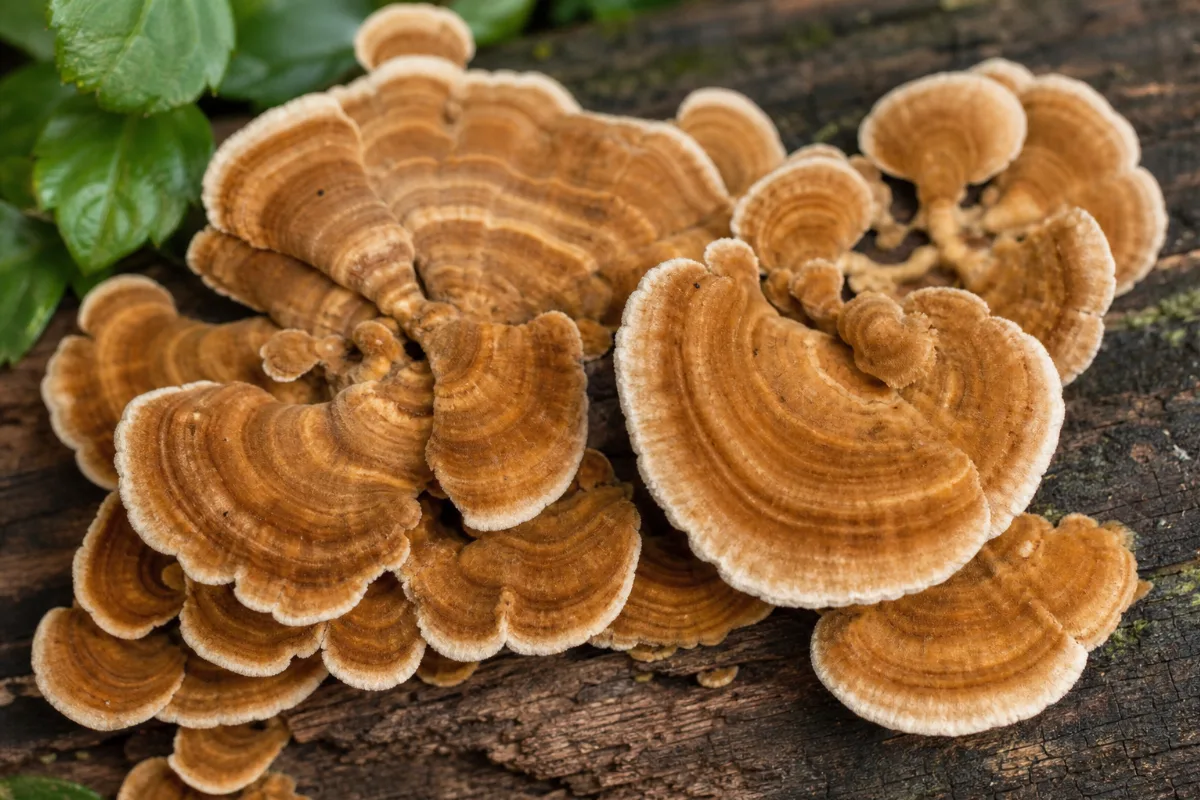
Mushrooms · Wild bracket fungus
False turkey tail
Stereum ostrea (related: Stereum hirsutum) · also called Hairy curtain crust is the related Stereum hirsutum, a separate species
False turkey tail is a tough, leathery wood fungus that looks like turkey tail but is a different fungus. It is not a food and we found no supplement made from it. The research is test-tube and cell-dish chemistry only, with no studies in people. Turkey tail research does not apply to it.
General information, not medical advice. Last substantive update · Not medically reviewed. A named clinician has not signed off on this page. How this page is made
About False turkey tail
False turkey tail is a thin, tough, banded bracket fungus on dead hardwood. It is named for its likeness to turkey tail, and it is not turkey tail. It is not a food, we found no supplement made from it, and there are no human studies. The research is chemistry done on lab cultures, extracts and cells. Do not use a wild fungus unless an expert has identified it.
What it is, and how it differs from turkey tail
Stereum ostrea belongs to the family Stereaceae, a group of wood-decay fungi. GBIF lists it as an accepted species, and also lists Stereum hirsutum (hairy curtain crust) as a separate accepted species. A Korean paper says the fungus grows in dense overlapping clusters on dead hardwoods, is inedible because of its tough, leathery texture, and is often called false turkey tail because it mimics turkey tail (Trametes versicolor).
Turkey tail is a different fungus, from a different group, and its research is about specific extracts known as PSK and PSP. None of the abstracts we read reports those compounds in Stereum, and no paper compares the two. So nothing found for turkey tail can be assumed for false turkey tail. Read the turkey tail page to see what that research does and does not show.
The related hairy curtain crust has its own chemistry. Where this page uses a result from it, the page says so.
What the research shows
Nothing has been tested in people. In 2007 a Korean group found that water and ethanol extracts of lab-grown Stereum ostrea slowed several bacteria and plant fungi on agar plates, at very high concentrations. A 2012 survey found a methanol extract of wild S. ostrea was antioxidant in chemical tests.
Chemists have also isolated compounds from S. ostrea cultures. Two ostalactones strongly blocked a fat-digesting enzyme in a test tube, and sterostrein A acted on cancer cell lines and the malaria parasite in culture. A 2020 review counts 238 compounds from the whole genus, most with lab activity only.
These results show interesting chemistry. They cannot show a health effect, because test-tube and cell-dish results often fail in people.
How strong is the evidence?
Every result is rated not enough evidence. It is lab work on pure compounds, cultures and extracts, mostly from abstracts, and it mixes two species. Culture extracts and fruiting-body extracts also behave differently: in a 2025 Polish screen, hairy curtain crust fruiting-body extracts were mostly inactive against five bacteria.
Forms and products
We found no consumer product made from false turkey tail, so we cannot say what one would contain. The lab work used cultures, pure compounds and solvent extracts, which are not tea, powder or capsules. For medicinal mushrooms in general, NCI says supplement ingredients may vary considerably from lot to lot. If a turkey tail product names Stereum rather than Trametes versicolor, ask the seller for proof of what is in it.
At a glance
Traditional uses history, not proof
- One paper says it has long been used in folk remedies but names no region, preparation or disease. We do not treat that as evidence.
Studied for research
- Germs in the lab, not enough evidence (agar plates only)
- Antioxidant tests, not enough evidence (chemical tests only)
- A fat-digesting enzyme, not enough evidence (test tube only)
- Cancer cells and malaria parasite, not enough evidence (cell dish only)
- Any use in people, not enough evidence (nothing found)
Main compounds
- Ostalactones (lactones from culture)
- Sterostreins (terpenoids from culture)
- Sesquiterpenes, including drimane and hirsutane types
Common forms
- Lab culture and solvent extracts (research only)
- Wild fruiting body (not eaten)
- No consumer product was found
Research links: Antibacterial and antifungal activities of Stereum ostrea (abstract) · Natural product discovery from Stereum species (review abstract) · Ostalactones from Stereum ostrea (abstract) · Sterostreins A-E from Stereum ostrea (abstract) · Antibacterial screen of corticioid fungi, 2025 (abstract) · NCI: Medicinal mushrooms (PDQ) · Research Library · Genes & Biomarkers Library
What it is and its history
- Accepted scientific name
- Stereum ostrea
- Naming authority
- (Blume & T.Nees) Fr. (GBIF)
- Common names
- False turkey tail (English); Hairy curtain crust (this is Stereum hirsutum, a related species) (English)
- Family or group
- Stereaceae (a fungus family), not a plant
- Classification
- Fungi > Basidiomycota > Agaricomycetes > Russulales > Stereaceae > Stereum > Stereum ostrea
- Native range
- The Korean paper (citing Kuo, 2005) says it is widely distributed in the world.
- Habitat
- Saprophytic on dead hardwoods, growing in dense overlapping clusters (Korean paper, full text).
- What it looks like
- Fruiting body: The Korean paper says it has a somewhat fuzzy cap with zones of brown and reddish brown, like true turkey tail, a relatively large size, and tends to grow as individual sliced-funnel-shaped fruit bodies rather than laterally fused flat ones. No identification advice is given here.
- Cultivation
- Grown in liquid and on solid culture in the lab (2007 paper). Not cultivated as a crop in the sources read.
- Harvest and processing
- Not found in the sources read.
- Look-alikes and adulterants
- Name: Turkey tail (Trametes versicolor); Note: The reason for the name. Turkey tail is a different fungus in a different group.; Name: Hairy curtain crust (Stereum hirsutum); Note: A related species of the same genus with its own chemistry. GBIF lists it as a separate accepted species.
- Sustainability and conservation
- Not checked.
Traditional use and history history, not clinical proof
| Tradition or era | Documented use | Source |
|---|---|---|
| Folk remedies (unspecified) | A 2007 Korean paper says the fungus has long been used for folk remedies and for healing human and plant diseases, but names no region, preparation or disease and adds that scientific evidence is not yet well known. We do not claim a traditional-medicine role; traditional use is not evidence. | p24015099 |
Traditional use shows how it was used. It does not show that it works or is safe today.
What is inside, and how it may work
What it contains and how those compounds act in cells and animals. Laboratory and animal mechanisms are not proven effects in people.
Main compounds
| Compound | Family | Where it is concentrated | Activity studied | Level of evidence |
|---|---|---|---|---|
| Ostalactones A-C (lactones) | lactone | Culture broth Not given in the abstract. | A and B strongly blocked human pancreatic lipase in a test. 4 | Laboratory research |
| Sterostreins A-E (terpenoids) | terpenoid (sesquiterpene) | Culture Not given in the abstract. | Sterostrein A was active against the malaria parasite and cancer cell lines in culture. 3 | Laboratory research |
| Methoxylaricinolic acid and laricinolic acid | drimane sesquiterpene | Fruiting body Not given in the abstract. | Structure only; no activity stated in the abstract. 5 | Lab analysis |
| Sterhirsutins C-L (S. hirsutum) | sesquiterpene (hirsutane type) | Culture Not given in the abstract. | Cytotoxic to two cell lines; one induced autophagy in HeLa cells. Related species, not S. ostrea. 10 | Laboratory research |
| Phenolic acids, fatty acids (mainly linoleic) and amentoflavone (S. hirsutum extracts) | phenolics, fatty acids, biflavonoid | Extracts Linoleic acid 40.00 % of fatty acids; unsaturated 71.91 %, saturated 26.96 % (abstract). | Linked by the authors to the antioxidant, enzyme-blocking and cell-toxic effects of the extracts. 7 | Lab analysis |
Mechanisms, receptors and pathways
| Target or pathway | Gene or receptor | What was found | Level |
|---|---|---|---|
| Bacterial and fungal growth | Culture extracts of S. ostrea slowed bacteria and plant fungi on agar plates; the mechanism was not given. 2 | Laboratory research | |
| Pancreatic lipase | Ostalactones A and B blocked the enzyme in a test tube. 4 | Laboratory research | |
| Cell and parasite growth | Sterostrein A reduced growth of the malaria parasite and cancer cell lines in culture. 3 | Laboratory research | |
| Autophagy (HeLa cells) and an interferon-beta promoter signal | IFN-beta promoter | Single S. hirsutum compounds induced autophagy in HeLa cells or inhibited activation of the IFN-beta promoter in virus-infected cells. 10 | Laboratory research |
| Acetylcholinesterase | An ethanol extract of S. hirsutum blocked the enzyme in a test tube. 7 | Laboratory research |
Absorption, metabolism and elimination
- Absorption
- Not found in the sources read.
- Distribution
- Not found in the sources read.
- Metabolism
- Not found in the sources read.
- Elimination
- Not found in the sources read.
- Bioavailability
- Not established.
Isolated compounds versus whole extracts
Most activity data are for pure compounds from lab cultures or for solvent extracts. None is a tea, powder or capsule, and no product comparison exists. Fruiting-body extracts and culture extracts can behave differently: in a 2025 screen, S. hirsutum fruiting-body extracts were mostly inactive against five bacteria.
Nutritional composition
False turkey tail is a tough, leathery bracket and not a food. We found no food-composition data and give no nutrition claim.
7 not enough evidence
What was looked at
The 7 benefits and uses checked for False turkey tail, each with how strong the evidence is. Tap one to open it.
- Germs in the lab (agar plates only)Not enough evidence
- Antioxidant tests (chemical tests only)Not enough evidence
- Any use in peopleNot enough evidence
- A fat-digesting enzyme (test tube only)Not enough evidence
- Cancer cells and malaria parasite in a dishNot enough evidence
- A nerve enzyme linked to memory (S. hirsutum, test tube only)Not enough evidence
- As a foodNot enough evidence
Lab markers tracked in the studies
Bacterial and fungal growth on an agar plateChemical antioxidant tests (ABTS, DPPH, reducing power)Pancreatic lipase activity in a test tubeCancer cell line growth and parasite growth in culture (IC50)Acetylcholinesterase inhibition in a test tube
What is False turkey tail good for?
The uses people ask about and how strong the human evidence is for each. None is shown in people. Read this together with the Safety tab.
Benefits, one by one
Each card is a research question, not a promise. Tap a goal to filter. Open a card to see the studies, doses and limits.
Germs in the lab (agar plates only)
Not enough evidenceExtracts of lab-grown Stereum ostrea slowed several bacteria and plant-disease fungi on agar plates. Fruiting-body extracts of the related hairy curtain crust were mostly inactive against five bacteria in a Polish screen. None of this was tested in animals or people.
3 studiesLab-grown culture filtrate and water, ethanol or methanol extracts. N…
Studies, doses and limits
Results
S. ostrea (culture extracts, Korea, 2007): water and ethanol extracts inhibited Gram-positive and Gram-negative bacteria; inhibition zones against Staphylococcus aureus were 23.6 mm (water) and 21.0 mm (ethanol); MIC 10 mg/ml for Bacillus subtilis and 40 mg/ml for two plant fungi. S. hirsutum (fruiting-body methanol extracts, Poland, 2025): three of four samples inhibited none of five bacteria; one inhibited one bacterium at 25 mg/mL.
Effect sizes as reported
Agar-plate inhibition at milligram-per-millilitre concentrations; no effect size in a body
Why this rating
Laboratory agar-plate work only, mostly on lab-grown culture, at very high concentrations, with results that differ between culture and fruiting body. No animal or human data.
Form and dose studied
Lab-grown culture filtrate and water, ethanol or methanol extracts. None of these is a product people can buy.
Who was studied
Bacteria and plant-disease fungi on agar plates
Limits
Two species (S. ostrea and S. hirsutum) in two different papers; culture versus fruiting body differ; concentrations are very high; no animals or people.
Why researchers looked
Wood fungi make chemicals to fight other microbes, so researchers screen them for germ-killing compounds.
Traditional use
One paper says the fungus has long been used for folk remedies but names no region, preparation or disease. We do not treat that as evidence.
Proposed mechanism Laboratory research
Not worked out in the abstracts. The 2020 review lists antibacterial and antifungal compounds in the genus (for example sesquiterpenes and vibralactones).
A proposed mechanism does not show that the effect happens in people.
No human safety data were found. See the Safety tab. Do not eat or use a wild fungus unless an expert has identified it.
Antioxidant tests (chemical tests only)
Not enough evidenceIn chemical tests, methanol extracts of wild S. ostrea and water or methanol extracts of S. hirsutum mopped up test radicals. A chemical test in a tube does not show a benefit in a body.
2 studiesMethanol, ethanol and water extracts made in a lab. Not a tea, powder…
Studies, doses and limits
Results
S. ostrea (wild-collected, methanol extract, Korea, 2012): potent antioxidant activity in all three chemical tests (ABTS, DPPH, reducing power); no figures in the abstract. S. hirsutum (extracts, Serbia, 2021): highest antioxidant activity in the polar (methanol and water) extracts.
Effect sizes as reported
Test-tube activity only; no figures in the abstracts
Why this rating
Two abstract-only chemical studies on two different species; the same extract that was antioxidant in the tube was also toxic to cells in the second study.
Form and dose studied
Methanol, ethanol and water extracts made in a lab. Not a tea, powder or capsule people can buy.
Who was studied
Chemical tests
Limits
Abstracts only; no numbers; different species; a chemical test cannot show benefit in people.
Why researchers looked
Antioxidant chemical tests are cheap and are run on many mushrooms.
Traditional use
One paper says the fungus has long been used for folk remedies but names no region, preparation or disease. We do not treat that as evidence.
Proposed mechanism Laboratory research
The ABTS and DPPH tests measure whether an extract can neutralise a test radical in a tube. They do not measure what happens in a body.
A proposed mechanism does not show that the effect happens in people.
No human safety data were found. See the Safety tab. Do not eat or use a wild fungus unless an expert has identified it.
Any use in people
Not enough evidenceWe found no human trial, case report, animal study of a health outcome or safety study of false turkey tail or hairy curtain crust. For every health claim the honest answer is: not enough evidence.
2 studiesNo consumer product was found.
Studies, doses and limits
Results
No human results to report.
Why this rating
No human study exists in the sources searched.
Form and dose studied
No consumer product was found.
Limits
Absence of evidence is not evidence of safety or of benefit.
Why researchers looked
Readers ask whether false turkey tail is a cheaper or wild version of turkey tail. Nothing shows that.
Traditional use
One paper says the fungus has long been used for folk remedies but names no region, preparation or disease. We do not treat that as evidence.
Proposed mechanism None
Not applicable.
A proposed mechanism does not show that the effect happens in people.
No human safety data were found. See the Safety tab. Do not eat or use a wild fungus unless an expert has identified it.
A fat-digesting enzyme (test tube only)
Not enough evidenceTwo pure compounds from the culture broth of Stereum ostrea strongly blocked human pancreatic lipase, an enzyme that digests fat, in a test tube. Nobody has tested the fungus or the compounds in animals or people.
1 studiesPure compounds isolated in a lab. Not a food, tea or supplement.
Studies, doses and limits
Results
Ostalactones A and B (pure compounds from Stereum ostrea culture broth, 2016) displayed potent inhibitory activity against human pancreatic lipase. No numbers in the abstract.
Effect sizes as reported
Test-tube activity only
Why this rating
One abstract-only enzyme assay of pure compounds from a lab culture.
Form and dose studied
Pure compounds isolated in a lab. Not a food, tea or supplement.
Who was studied
Isolated enzyme
Limits
Pure compounds in a tube; no animal or human data; amounts in the fungus unknown.
Why researchers looked
Lipase blockers are a drug target for weight control, so chemists test natural compounds against the enzyme.
Traditional use
One paper says the fungus has long been used for folk remedies but names no region, preparation or disease. We do not treat that as evidence.
Proposed mechanism Laboratory research
The compounds (ostalactones A and B) are lactones that blocked the enzyme in an assay. The abstract gives no figures.
A proposed mechanism does not show that the effect happens in people.
No human safety data were found. See the Safety tab. Do not eat or use a wild fungus unless an expert has identified it.
Cancer cells and malaria parasite in a dish
Not enough evidencePure compounds from cultures of Stereum ostrea (sterostrein A) and Stereum hirsutum (sterhirsutins) were toxic to cancer cell lines, and sterostrein A acted on the malaria parasite, in dishes. This shows the compounds are biologically active. It does not show a treatment.
3 studiesPure compounds from lab culture.
Studies, doses and limits
Results
Sterostrein A (S. ostrea culture, 2011): antimalarial activity (IC50 2.3 micrograms/mL) and cytotoxicity (IC50 5.3 to 38 micrograms/mL). Sterhirsutins C-L (S. hirsutum culture, 2015): cytotoxic against K562 and HCT116 cell lines; compound 9 induced autophagy in HeLa cells; compound 5 inhibited the IFN-beta promoter in virus-infected cells. The 2020 review lists cytotoxic, antiviral, autophagy-inducing and worm-killing compounds in the genus.
Effect sizes as reported
Cell-dish IC50 values for one pure compound; no whole-body effect
Why this rating
Cell-dish chemistry on pure compounds from cultures of two species; no animal or human data. Cytotoxic means harmful to cells.
Form and dose studied
Pure compounds from lab culture.
Who was studied
Cell lines and a parasite in culture
Limits
Abstract-only; different species in the two papers; cell toxicity is not a treatment and may harm healthy cells too.
Why researchers looked
Natural-product chemists test new compounds on cancer cell lines and parasites as a routine screen.
Traditional use
One paper says the fungus has long been used for folk remedies but names no region, preparation or disease. We do not treat that as evidence.
Proposed mechanism Laboratory research
Sterostrein A killed cells and parasites in culture; one S. hirsutum compound induced autophagy in HeLa cells and another dampened an immune signal in virus-infected cells. Cells in a dish are not a body.
A proposed mechanism does not show that the effect happens in people.
No human safety data were found. See the Safety tab. Do not eat or use a wild fungus unless an expert has identified it.
A nerve enzyme linked to memory (S. hirsutum, test tube only)
Not enough evidenceAn ethanol extract of the related hairy curtain crust blocked acetylcholinesterase, an enzyme that drugs for Alzheimer's disease also block, in a test tube. The same extract was toxic to liver cancer cells in a dish. This does not show any benefit for memory.
1 studiesEthanol extract made in a lab.
Studies, doses and limits
Results
Stereum hirsutum ethanol extract (2021): acetylcholinesterase inhibition 98.44 %; toxic to HepG2 cells (91.96 % at 900 micrograms/mL).
Effect sizes as reported
Test-tube inhibition and cell toxicity; no body data
Why this rating
One abstract-only laboratory paper on a related species. The authors' suggestion of a supplement for Alzheimer's care goes well beyond the data.
Form and dose studied
Ethanol extract made in a lab.
Who was studied
Enzyme and liver cancer cells
Limits
Different species from false turkey tail (S. ostrea); lab only; cell toxicity in the same extract.
Why researchers looked
Researchers look for natural enzyme blockers when searching for Alzheimer's drug leads.
Traditional use
One paper says the fungus has long been used for folk remedies but names no region, preparation or disease. We do not treat that as evidence.
Proposed mechanism Laboratory research
The extract inhibited the enzyme in an assay. The authors link this to phenolic acids, fatty acids and the biflavonoid amentoflavone.
A proposed mechanism does not show that the effect happens in people.
No human safety data were found. See the Safety tab. Do not eat or use a wild fungus unless an expert has identified it.
As a food
Not enough evidenceFalse turkey tail is not eaten. The Korean source calls it inedible because of its tough, leathery texture. We found no nutrient measurements for it.
1 studiesNot a food.
Studies, doses and limits
Results
The 2007 paper describes the fungus as inedible because of its tough, leathery texture.
Why this rating
One description of texture; no food-composition data.
Form and dose studied
Not a food.
Limits
Inedible because of texture is not the same as a safety finding.
Why researchers looked
Readers ask if it can be eaten like other mushrooms.
Traditional use
One paper says the fungus has long been used for folk remedies but names no region, preparation or disease. We do not treat that as evidence.
Proposed mechanism None
Not applicable.
A proposed mechanism does not show that the effect happens in people.
No human safety data were found. See the Safety tab. Do not eat or use a wild fungus unless an expert has identified it.
Connections to the rest of health
How False turkey tail connects to the rest of our health knowledge graph. Every link says what kind of connection it is. A safety link (for example to the liver) is a warning, not a benefit. A study that merely mentions a topic never creates a benefit link.
Explore every connection: goals, body systems, organs, symptoms, genes
A. Wellness goals
| Connected to | Kind of connection | Evidence status | Context | Studies |
|---|---|---|---|---|
| Immune Health | Preliminary mechanism | Not enough evidence | Germs in the lab (agar plates only): Extracts of lab-grown Stereum ostrea slowed several bacteria and plant-disease fungi on agar plates. Fruiting-body extracts of the related hairy curtain crust were mostly inactive against five bacteria in a Polish screen. None of this was tested in animals or people. | 2 12 11 |
| Healthy Aging | Preliminary mechanism | Not enough evidence | Antioxidant tests (chemical tests only): In chemical tests, methanol extracts of wild S. ostrea and water or methanol extracts of S. hirsutum mopped up test radicals. A chemical test in a tube does not show a benefit in a body. | 6 7 |
| Weight Management | Preliminary mechanism | Not enough evidence | A fat-digesting enzyme (test tube only): Two pure compounds from the culture broth of Stereum ostrea strongly blocked human pancreatic lipase, an enzyme that digests fat, in a test tube. Nobody has tested the fungus or the compounds in animals or people. | 4 |
| Memory Support | Preliminary mechanism | Not enough evidence | A nerve enzyme linked to memory (S. hirsutum, test tube only): An ethanol extract of the related hairy curtain crust blocked acetylcholinesterase, an enzyme that drugs for Alzheimer's disease also block, in a test tube. The same extract was toxic to liver cancer cells in a dish. This does not show any benefit for memory. | 7 |
B. Body systems
| Connected to | Kind of connection | Evidence status | Context | Studies |
|---|---|---|---|---|
| Immune System | Biological association | Not enough evidence | Studied for: Germs in the lab (agar plates only) | 2 12 11 |
| Cellular Protection | Biological association | Not enough evidence | Studied for: Antioxidant tests (chemical tests only) Studied for: Cancer cells and malaria parasite in a dish | 6 7 3 10 11 |
| Digestive System | Biological association | Not enough evidence | Studied for: A fat-digesting enzyme (test tube only) | 4 |
| Nervous System | Biological association | Not enough evidence | Studied for: A nerve enzyme linked to memory (S. hirsutum, test tube only) | 7 |
E. Health conditions
| Connected to | Kind of connection | Evidence status | Context | Studies |
|---|---|---|---|---|
| Pregnancy and breastfeeding | Contraindication | Not enough evidence | No safety data found. Preparation or compound: All false turkey tail products |
8 |
I. Biomarkers
| Connected to | Kind of connection | Evidence status | Context | Studies |
|---|---|---|---|---|
| Bacterial and fungal growth on an agar plate | Biological association | Not enough evidence | Measured in trials: slowed in culture extracts; mostly not in S. hirsutum fruiting-body extracts. A lab change is not the same as a health benefit. | 2 12 |
| Chemical antioxidant tests (ABTS, DPPH, reducing power) | Biological association | Not enough evidence | Measured in trials: active in tube. A lab change is not the same as a health benefit. | 6 7 |
| Pancreatic lipase activity in a test tube | Biological association | Not enough evidence | Measured in trials: blocked. A lab change is not the same as a health benefit. | 4 |
| Cancer cell line growth and parasite growth in culture (IC50) | Biological association | Not enough evidence | Measured in trials: reduced growth. A lab change is not the same as a health benefit. | 3 |
| Acetylcholinesterase inhibition in a test tube | Biological association | Not enough evidence | Measured in trials: blocked. A lab change is not the same as a health benefit. | 7 |
L. Active compounds
| Connected to | Kind of connection | Evidence status | Context | Studies |
|---|---|---|---|---|
| Ostalactones A-C (lactones) | Biological association | In vitro | A and B strongly blocked human pancreatic lipase in a test. Preparation or compound: Culture broth |
4 |
| Sterostreins A-E (terpenoids) | Biological association | In vitro | Sterostrein A was active against the malaria parasite and cancer cell lines in culture. Preparation or compound: Culture |
3 |
| Methoxylaricinolic acid and laricinolic acid | Biological association | Lab analysis | Structure only; no activity stated in the abstract. Preparation or compound: Fruiting body |
5 |
| Sterhirsutins C-L (S. hirsutum) | Biological association | In vitro | Cytotoxic to two cell lines; one induced autophagy in HeLa cells. Related species, not S. ostrea. Preparation or compound: Culture |
10 |
| Phenolic acids, fatty acids (mainly linoleic) and amentoflavone (S. hirsutum extracts) | Biological association | Lab analysis | Linked by the authors to the antioxidant, enzyme-blocking and cell-toxic effects of the extracts. Preparation or compound: Extracts |
7 |
Each connection is stored with the ingredient, the connected record, the kind of connection, the evidence status, the supporting studies, the preparation or compound involved, and a review date (last reviewed October 25, 2026).
Evidence at a glance: what the research found for 7 outcomes
Each outcome below is one thing researchers measured. Certainty is how far the evidence can be trusted, not how well it works. The full studies are on the next tab.
The evidence
The research centre for False turkey tail. Every record here was checked against PubMed or the publisher's page; we never list a study we have not verified.
Evidence by outcome
Bars show how many studies we found for each outcome, not how well it works. People are added up across trials only (reviews are not added, to avoid double counting).
How we rate evidence
High certainty
Several well-run trials or reviews agree; further research is unlikely to change the picture much.
Moderate certainty
Good trials point the same way, but some doubt remains.
Low certainty
Small, short or inconsistent trials. The finding could change with better research.
Very low certainty
Very little or very weak human data. Treat as a possibility only.
Mixed findings
Trials or reviews disagree with each other.
Not enough evidence
Not enough human research to say either way.
Evidence against
Good research found no benefit, or found harm.
We take the reviewers' own risk-of-bias and GRADE statements where they exist, and otherwise judge from study size, design, consistency, directness and whether a product matches what is sold. Many publications do not make evidence high. Method note: We read PubMed records and abstracts for 9 papers on Stereum ostrea and Stereum hirsutum (laboratory, chemistry and review papers) and read the open full text of two of them, checked the names in GBIF, and read the National Cancer Institute medicinal mushrooms page. LiverTox and LactMed were searched through NCBI Books and nothing was found. Certainty ratings are the compiler's own reading.
Study library: every study we checked 12
| Study | Design | People | Product, dose, length | Result |
|---|---|---|---|---|
| GBIF 2026 GBIF Backbone Taxonomy: Stereum ostrea and Stereum hirsutum GBIF · Source |
Database record n/a |
n/a | n/a |
On 2026-10-25 the GBIF match API gave Stereum ostrea (Blume & T.Nees) Fr. as ACCEPTED (key 2553044) and Stereum hirsutum (Willd.) Pers. as ACCEPTED (key 2553128), both in the family Stereaceae, order Russulales, class Agaricomycetes, phylum Basidiomycota. They are two separate accepted species. As described Methods, limits and fundingOutcomes: As described Limitations: Index Fungorum was not checked. Funding and conflicts: Not applicable Read: database record |
| Imtiaj 2007 Antibacterial and Antifungal Activities of Stereum ostrea, an Inedible Wild Mushroom. Mycobiology · PMID 24015099 · DOI |
Laboratory study (agar plate tests) Stereum ostrea (culture) |
Five bacteria and three plant-disease fungi on agar plates | Liquid culture filtrate, and water and ethanol extracts of solid culture of S. ostrea Lab-grown culture (not wild fruiting bodies) |
Water and ethanol extracts of lab-grown culture inhibited both Gram-positive and Gram-negative bacteria, and the water extract did better than the ethanol one. Inhibition zones against Staphylococcus aureus were 23.6 mm (water) and 21.0 mm (ethanol), and against Pseudomonas aeruginosa 26.3 mm and 22.3 mm. The lowest growth-stopping concentration (MIC) was 10 mg/ml for Bacillus subtilis and 40 mg/ml for two Colletotrichum plant fungi. The water extract was the best against the plant fungi. The full text (read through Europe PMC on 2026-10-25) says the fungus is inedible because of its tough, leathery texture, is often called 'False turkey tail' because it mimics Trametes versicolor, and 'has long been used for folk remedies' with no region, preparation or disease given. Antibacterial and antifungal activity on agar plates (lab only) Methods, limits and fundingOutcomes: Antibacterial and antifungal activity on agar plates (lab only) Limitations: Agar-plate work on lab-grown culture extracts at very high concentrations (milligrams per millilitre). No animal or human data. Does not show the fungus treats any infection. Funding and conflicts: Funding not stated in the abstract Read: abstract + full text (Europe PMC) |
| Isaka 2011 Sterostreins A-E, new terpenoids from cultures of the Basidiomycete Stereum ostrea BCC 22955. Organic Letters · PMID 21848293 · DOI |
Chemistry and cell assays Stereum ostrea (culture, strain BCC 22955) |
Malaria parasite and cancer cell lines in culture | Pure compound sterostrein A (and four related compounds) Lab culture |
Five new terpenoids were isolated from cultures. Sterostrein A showed antimalarial activity (IC50 2.3 micrograms/mL) and cytotoxicity (IC50 5.3 to 38 micrograms/mL). Antimalarial and cell-growth activity in culture Methods, limits and fundingOutcomes: Antimalarial and cell-growth activity in culture Limitations: Cell-dish results with a pure compound from a lab culture. Cytotoxic means it harms cells, including healthy ones; it is not evidence of a treatment. Funding and conflicts: Research support, non-US government (listed in PubMed) Read: abstract |
| Kang 2016 Ostalactones A-C, beta- and epsilon-Lactones with Lipase Inhibitory Activity from the Cultured Basidiomycete Stereum ostrea. Journal of Natural Products · PMID 28006918 · DOI |
Chemistry and enzyme assay Stereum ostrea (culture) |
Test-tube enzyme assay (human pancreatic lipase) | Three pure compounds (ostalactones A-C) from the culture broth Lab culture broth, not fruiting body |
Three new lactone compounds were isolated from the culture broth. Ostalactones A and B displayed potent inhibitory activity against human pancreatic lipase. No numbers are given in the abstract. Pancreatic lipase inhibition in a test tube Methods, limits and fundingOutcomes: Pancreatic lipase inhibition in a test tube Limitations: Pure compounds in a test tube. Not tested in animals or people; the abstract does not say how much the fungus itself contains. Funding and conflicts: Funding not stated in the abstract Read: abstract |
| Kim 2006 Methoxylaricinolic acid, a new sesquiterpene from the fruiting bodies of Stereum ostrea. The Journal of Antibiotics · PMID 17025020 · DOI |
Chemistry Stereum ostrea (fruiting body) |
Chemical isolation from fruiting bodies | Methoxylaricinolic acid and laricinolic acid Fruiting body |
Methoxylaricinolic acid, a new drimane sesquiterpene, was isolated from fruiting bodies of S. ostrea together with the known laricinolic acid. The abstract states the structure and no activity. Structure only Methods, limits and fundingOutcomes: Structure only Limitations: Structure only; no health activity is stated in the abstract. Funding and conflicts: Research support, non-US government (listed in PubMed) Read: abstract |
| Kim 2012 Mushrooms collected from deogyu mountain, muju, Korea and their antioxidant activity. Mycobiology · PMID 22870057 · DOI |
Laboratory and field survey Stereum ostrea (wild fruiting body, methanol extract) |
33 wild mushroom species from a Korean mountain; chemical antioxidant tests | Methanol extracts Wild-collected mushrooms |
The methanol extracts of Stereum ostrea, Laetiporus sulphureus var. miniatus and Tyromyces sambuceus showed potent antioxidant activity in all three chemical tests used. The abstract gives no figures. Chemical antioxidant activity (ABTS, DPPH, reducing power) Methods, limits and fundingOutcomes: Chemical antioxidant activity (ABTS, DPPH, reducing power) Limitations: Test-tube chemistry; no numbers in the abstract; a chemical test does not show a benefit in a body. Funding and conflicts: Funding not stated in the abstract Read: abstract |
| Miskovic 2021 Mushroom Species Stereum hirsutum as Natural Source of Phenolics and Fatty Acids as Antioxidants and Acetylcholinesterase Inhibitors. Chemistry & Biodiversity · PMID 34467660 · DOI |
Laboratory study Stereum hirsutum (extracts) |
Extracts tested in test tubes and on HepG2 liver cancer cells | Water, ethanol, methanol and polysaccharide extracts Mushroom (part not stated in the abstract) |
The ethanol extract was the most potent at blocking acetylcholinesterase (98.44 %) and was toxic to HepG2 cells (91.96 % at 900 micrograms/mL). The best antioxidant activity came from the polar (methanol and water) extracts. The main fatty acid was linoleic (40.00 %); the authors report phenolic acids and the biflavonoid amentoflavone. The authors call it a possible food supplement for Alzheimer's palliative care, which a test-tube study cannot support. Enzyme inhibition, antioxidant tests and cell toxicity Methods, limits and fundingOutcomes: Enzyme inhibition, antioxidant tests and cell toxicity Limitations: Test-tube and cell-dish work on a different species (S. hirsutum, not S. ostrea). The authors' supplement and Alzheimer's suggestion goes beyond the data. A strongly cell-toxic extract is a warning, not a benefit. Funding and conflicts: Funding not stated in the abstract Read: abstract |
| NCBI Bookshelf 2026 NCBI Books search for LiverTox and LactMed entries (Stereum, false turkey tail, turkey tail) NCBI Bookshelf · Source |
Database search n/a |
n/a | n/a |
A search of NCBI Books on 2026-10-25 for Stereum, for 'false turkey tail' and for 'turkey tail', each combined with LiverTox or LactMed, returned no result. No LiverTox or LactMed entry was found. As described Methods, limits and fundingOutcomes: As described Limitations: A name search is not a full review. EMA, NCCIH and MSK pages were not checked. Funding and conflicts: Not applicable Read: search result |
| National Cancer Institute 2024 NCI PDQ: Medicinal Mushrooms (health professional version) National Cancer Institute · Source |
Authoritative guidance n/a |
n/a | n/a |
Page text read on 2026-10-25 (it shows 'Updated: November 6, 2024'). It says dietary supplement ingredients may vary considerably from lot to lot and there is no guarantee that label ingredients are present, and that the FDA has not approved medicinal mushrooms as a treatment for cancer or any other medical condition. The word Stereum does not appear on the page. As described Methods, limits and fundingOutcomes: As described Limitations: General to medicinal mushrooms; nothing about this fungus. Funding and conflicts: Not applicable Read: page text |
| Qi 2015 Stucturally Diverse Sesquiterpenes Produced by a Chinese Tibet Fungus Stereum hirsutum and Their Cytotoxic and Immunosuppressant Activities. Organic Letters · PMID 26068271 · DOI |
Chemistry and cell assays Stereum hirsutum (culture) |
Cancer cell lines (K562, HCT116, HeLa) and virus-infected cells | Ten pure sesquiterpene compounds (sterhirsutins C-L) Lab culture |
Compounds 1 to 10 showed cytotoxicity against K562 and HCT116 cell lines. Compound 9 induced autophagy in HeLa cells. Compound 5 inhibited activation of the IFN-beta promoter in Sendai-virus-infected cells. The abstract gives no figures. Cell toxicity, autophagy and an immune signal Methods, limits and fundingOutcomes: Cell toxicity, autophagy and an immune signal Limitations: Cell-dish results on pure compounds from a different species (S. hirsutum). Not a treatment signal. Funding and conflicts: Research support, non-US government (listed in PubMed) Read: abstract |
| Tian 2020 In Depth Natural Product Discovery from the Basidiomycetes Stereum Species. Microorganisms · PMID 32679785 · DOI |
Narrative review of chemistry Stereum genus (10 known species plus unidentified) |
238 secondary metabolites from 10 known species of Stereum and several unidentified species | Compounds isolated from Stereum cultures and fruiting bodies Mostly cultures |
The review says the genus is a source of bioactive compounds including sesquiterpenoids, polyketides, vibralactones, triterpenoids, sterols, carboxylic acids and saccharides. Most showed lab activity: cytotoxic, antibacterial, antifungal, antiviral, radical scavenging, autophagy inducing, inhibiting pancreatic lipase, against the malaria parasite and nematocidal (worm-killing). It summarises 238 metabolites over seven decades. Lists compounds and their lab activities Methods, limits and fundingOutcomes: Lists compounds and their lab activities Limitations: Abstract only (the earlier site text read the full review). A chemistry review; it does not test anything in people and mixes several Stereum species and unidentified ones. Funding and conflicts: Funding not stated in the abstract Read: abstract |
| Yurchenko 2025 Investigation of the Possible Antibacterial Effects of Corticioid Fungi Against Different Bacterial Species. Int J Mol Sci · PMID 40244126 · DOI |
Laboratory screening Stereum hirsutum (fruiting body; four samples) |
Methanol extracts of 58 corticioid (thin crust-like) wood fungi from Poland against five bacteria | Methanol extracts of fruiting bodies redissolved in DMSO Fruiting body |
The abstract does not name Stereum. In the open full text (read through Europe PMC on 2026-10-25) four Stereum hirsutum fruiting-body samples were tested: three showed no inhibition of any of the five bacteria and one showed inhibition at 25 mg/mL for one bacterium. S. ostrea was not among the species tested. The authors note that cultures of S. hirsutum can be active when fruiting-body extracts are not. Antibacterial activity of crust fungi (S. hirsutum among them) Methods, limits and fundingOutcomes: Antibacterial activity of crust fungi (S. hirsutum among them) Limitations: Table read in the open full text; very high concentrations (25 to 50 mg/mL) were needed for full inhibition in the study overall. Fruiting-body extracts of S. hirsutum were mostly inactive here, unlike some culture-based reports. Funding and conflicts: Funding not stated in the abstract Read: abstract + full text table (Europe PMC) |
What we do not know yet
- No human trial and no human safety study of false turkey tail or hairy curtain crust were found.
- No animal study of any health outcome was found.
- Most compounds come from lab cultures, and amounts in wild fruiting bodies are unknown.
- The lab papers cover two species (Stereum ostrea and Stereum hirsutum), so they cannot be combined.
- No test of heavy metals, pesticides or mould toxins. LiverTox and LactMed entries were not found; EMA, NCCIH and MSK pages were not checked.
How new research is added
New studies are found by a saved PubMed search and placed in a review queue. A person reads each one before it changes any evidence rating or safety wording. New publications never change ratings automatically.
Lab markers
What changed in blood or saliva tests during trials. A changed number is not the same as feeling or being healthier, and we give no "normal ranges".
Other 5
Bacterial and fungal growth on an agar plate
Slowed in culture extracts; mostly not in S. hirsutum fruiting-body extracts in trials
Whether microbes grow or are held back (a clear zone around the sample) when an extract is added in a lab test.
Not enough evidenceResults and what it means
Why it was measured
A first screen for germ-killing chemistry.
Statistical vs. clinical meaning
Lab screening result only.
Safety implication
Not a measure of safety or of treating infection.
| Study | Result | People | Product |
|---|---|---|---|
| 2 | S. ostrea culture extracts gave inhibition zones of 23.6 mm (water) and 21.0 mm (ethanol) against S. aureus; MIC 10 mg/ml for B. subtilis. | Bacteria and fungi on agar | Lab-grown culture extracts |
| 12 | Four S. hirsutum fruiting-body samples: three showed no inhibition of five bacteria; one inhibited one bacterium at 25 mg/mL. | Five bacteria | Methanol extract of fruiting body |
Chemical antioxidant tests (ABTS, DPPH, reducing power)
Active in tube in trials
How well an extract neutralises a test radical or donates electrons in a tube.
Not enough evidenceResults and what it means
Why it was measured
A quick chemical test often used as a first look at antioxidant potential.
Statistical vs. clinical meaning
Says nothing about health effects in people.
Safety implication
The same S. hirsutum ethanol extract was toxic to liver cancer cells in a dish.
Pancreatic lipase activity in a test tube
Blocked in trials
How much a compound blocks the enzyme that digests fat, measured in a lab assay.
Not enough evidenceResults and what it means
Why it was measured
Screens for lipase-blocking drug leads.
Statistical vs. clinical meaning
Lab screening result only.
Safety implication
Not a measure of safety.
| Study | Result | People | Product |
|---|---|---|---|
| 4 | Ostalactones A and B displayed potent inhibitory activity against human pancreatic lipase; no figures in the abstract. | Isolated enzyme | Pure compounds from S. ostrea culture broth |
Cancer cell line growth and parasite growth in culture (IC50)
Reduced growth in trials
The concentration of a compound that cuts cell or parasite growth by half in a dish.
Not enough evidenceResults and what it means
Why it was measured
A first screen for toxic or drug-lead compounds.
Statistical vs. clinical meaning
Shows activity in cells only.
Safety implication
Toxic to cells in a dish; this is a warning about the chemistry, not a benefit.
| Study | Result | People | Product |
|---|---|---|---|
| 3 | Sterostrein A: antimalarial IC50 2.3 micrograms/mL; cytotoxicity IC50 5.3 to 38 micrograms/mL. | Parasite and cancer cell lines in culture | Pure compound from S. ostrea culture |
Acetylcholinesterase inhibition in a test tube
Blocked in trials
How strongly an extract blocks a nerve enzyme in a lab assay.
Not enough evidenceResults and what it means
Why it was measured
A screen for Alzheimer's drug leads.
Statistical vs. clinical meaning
Lab screen on a related species.
Safety implication
The same extract was toxic to HepG2 cells.
| Study | Result | People | Product |
|---|---|---|---|
| 7 | Ethanol extract of S. hirsutum inhibited the enzyme 98.44 %. | Isolated enzyme | Ethanol extract (related species) |
Safety
What studies and official sources say about side effects, medicines and who should check first. Each point shows what kind of evidence it comes from.
Main points to know 5
- No human safety data were found. We found no clinical trial, case report, poison-centre report or allergy report for false turkey tail (Stereum ostrea) or hairy curtain crust (Stereum hirsutum). That means the risks are unknown, not that there are none. Nothing here is a safety all-clear. None 11 8
- It is not a food, and it is not turkey tail. The Korean paper that uses the name says the fungus is inedible because of its tough, leathery texture and that it is called false turkey tail because it mimics real turkey tail (Trametes versicolor). It is a different fungus in a different group. Research on real turkey tail (PSK, PSP and the cancer-care trials) does not apply to it. See the turkey tail pages. Identification caution 2
- Some Stereum compounds are toxic to cells and worms in tests. The 2020 review lists cytotoxic and nematocidal (worm-killing) compounds in the genus, and an extract of the related hairy curtain crust killed most liver cancer cells in a dish. That shows the chemistry is biologically active. It is not evidence of what happens if a person eats or takes the fungus. Laboratory research 11 3 7
- Wild fungus: identify with an expert, do not guess. Wild fungi cannot be safely identified from text, photos or apps, and this page gives no identification help. Look-alikes of turkey tail are common. Do not eat, brew or apply a wild fungus unless a trained local expert has identified it. Identification caution 2
- No known consumer product, so label quality cannot be judged. We found no supplement made from false turkey tail. For medicinal mushrooms in general, NCI says ingredients may vary considerably from lot to lot and there is no guarantee that label ingredients are present. A 'turkey tail' product should list Trametes versicolor; if it names Stereum, ask the seller for proof. Authoritative guidance 9
Side effects 1
| Effect | How often | Severity and recovery | Evidence |
|---|---|---|---|
| No adverse effects have been reported, but none have been looked for in people Absence of reports in the sources we read is not proof of safety. | Unknown | unknown Not applicable | None |
Liver
We found no case report or trial linking Stereum ostrea or S. hirsutum to liver injury. A search of NCBI Books on 2026-10-25 returned no LiverTox entry. One lab study found that an ethanol extract of S. hirsutum was toxic to liver cancer cells (HepG2) in a dish, which is a cell result and not a report in people. 8 7
How often. No liver reports found; this is not proof of liver safety.
Monitoring. No agency monitoring advice exists in the sources we read. People with liver disease should ask a doctor before using any medicinal fungus.
This is a safety connection. It is not evidence that False turkey tail supports liver health.
Medicines and supplements 3
| With | Why it matters | Importance | Evidence | What to do |
|---|---|---|---|---|
| Any medicine, including blood thinners and immune-suppressing medicines prescription | Unknown. No interaction study or case report was found. | None Not enough evidence | Ask your prescriber or pharmacist before using any medicinal fungus. | |
| Herbal products and other supplements supplement | Unknown. No interaction study or case report was found. | None Not enough evidence | Tell your pharmacist about every product you use. | |
| Food and alcohol food | Unknown. The fungus is not a food. | None Not enough evidence | Not applicable. |
Who should check first 4
| Situation | Advice | Evidence |
|---|---|---|
| Pregnancy and breastfeeding | No safety data were found, so it is not known whether it is safe. Ask a doctor. Our NCBI Books search found no LactMed entry. | None 8 |
| Children and babies | No safety data were found. A wild fungus eaten by a child needs medical advice. | None |
| Mushroom allergy, asthma or a history of reactions to fungi or moulds | Allergy to this fungus has not been studied. Take extra care and ask a doctor. This is general caution, not from a Stereum source. | General caution |
| Before surgery, or with immune disease or an organ transplant | Nothing is known. Ask your doctor before using any medicinal fungus. | None |
Overdose, product quality and regulators
Summary. No toxicity study in people or animals was found. Cell-dish and worm tests show that some Stereum compounds are toxic to cells.
Human doses studied. No human study. This page gives no amounts and none are advised.
Overdose response. No description was found. If someone becomes unwell after eating any wild fungus, seek medical help or call poison control and keep a sample if you can.
Toxic parts. Not described in the sources read.
We found no test of heavy metals, pesticides or mould toxins in these species. As a general rule, wild fungi can take up substances from the wood and surroundings.
Heavy metals and wild growth. No data for these species were found. This is a general caution about wild fungi, not a finding about false turkey tail.
Mislabelling in turkey tail products. We found no source reporting that Stereum has been sold as turkey tail. The risk is stated as a question to ask a seller about, not as something found.
| Body | Action | Date |
|---|---|---|
| US National Cancer Institute (PDQ) (United States) | States that the FDA has not approved medicinal mushrooms as a treatment for cancer or any other medical condition, and that supplement ingredients may vary considerably from lot to lot. The page does not mention Stereum. source | 2024-11-06 |
| LiverTox / LactMed (US NIH) (United States) | No entry found for Stereum, false turkey tail or turkey tail by NCBI Books search. source | 2026-10-25 |
When to get medical help
- Itching, hives, swelling of the lips, tongue or face, wheeze or trouble breathing after eating, handling or inhaling a fungus: get emergency help now (general advice, not from a Stereum source).
- Repeated vomiting, severe stomach pain, diarrhoea, confusion or yellow skin or eyes after eating any wild fungus: get medical help now and call your local poison control number (in the US, Poison Help 1-800-222-1222). Keep a sample of the fungus if you can.
- A wound that bleeds heavily, looks infected, or does not heal: do not rely on any fungus; get medical care.
If someone may be poisoned or in a crisis, contact a clinician or emergency service straight away. In the US, Poison Control is 1-800-222-1222.
General information only, not medical advice. Ask a clinician or pharmacist before use, especially with medicines, in pregnancy or with a health condition. See the Natural Remedy Safety guide.
Frequently asked questions
What is false turkey tail?
Is it the same as turkey tail?
No. Turkey tail is Trametes versicolor, a different fungus in a different group. Turkey tail research, including PSK and PSP, does not apply to false turkey tail, and no paper compares the two.
Is it edible?
It is described as inedible because of its tough, leathery texture. We found no food or safety data. Never eat a wild fungus because of a description.
Does it have proven health benefits?
Is false turkey tail safe?
Is hairy curtain crust the same thing?
Does it fight germs or infections?
Is it an antioxidant?
Only in chemical tests. A methanol extract of wild Stereum ostrea scored well in three tube tests, but a chemical test does not show a benefit in a body.
Does it treat cancer?
Can I tell it from turkey tail by looking?
No. Wild fungi cannot be safely identified from text, photos or an app, and look-alikes are common. Ask a trained local expert.
Does it interact with medicines?
Unknown. No interaction study or case report was found. Ask a pharmacist before using any medicinal fungus.
Can I buy a false turkey tail supplement?
We found no product. Check the Latin name on any turkey tail product (real turkey tail is Trametes versicolor), and for mushroom supplements in general NCI says label contents are not guaranteed.
Explore by health goal
Editorial transparency
- Written by
- AlternativeMed editorial team. Research compiled with AI assistance, then checked against PubMed records.
- Medical review
- None. This page has not been reviewed by a physician or pharmacist.
- First published
- 2026-10-25
- Last substantive update
- 2026-10-25
- How we research
- We read PubMed records and abstracts for 9 papers on Stereum ostrea and Stereum hirsutum (laboratory, chemistry and review papers) and read the open full text of two of them, checked the names in GBIF, and read the National Cancer Institute medicinal mushrooms page. LiverTox and LactMed were searched through NCBI Books and nothing was found. Certainty ratings are the compiler's own reading.
- How we rate evidence
- See "How we rate evidence" in the Evidence tab.
- Independence
- No product is promoted on this page. No affiliate links are shown. This page is information, not a recommendation to use false turkey tail.
Sources 12
Each source was opened and checked. Where we read only the abstract, it says so. The small numbers in the text point here.
- GBIF. GBIF Backbone Taxonomy: Stereum ostrea and Stereum hirsutum. GBIF. 2026. (database record)
- Imtiaj A, Jayasinghe C, Lee GW, Lee TS. Antibacterial and Antifungal Activities of Stereum ostrea, an Inedible Wild Mushroom.. Mycobiology. 2007. PMID 24015099. DOI 10.4489/MYCO.2007.35.4.210. (abstract + full text (Europe PMC))
- Isaka M, Srisanoh U, Choowong W, Boonpratuang T. Sterostreins A-E, new terpenoids from cultures of the Basidiomycete Stereum ostrea BCC 22955.. Organic Letters. 2011. PMID 21848293. DOI 10.1021/ol2019778. (abstract)
- Kang HS, Kim JP. Ostalactones A-C, beta- and epsilon-Lactones with Lipase Inhibitory Activity from the Cultured Basidiomycete Stereum ostrea.. Journal of Natural Products. 2016. PMID 28006918. DOI 10.1021/acs.jnatprod.6b00647. (abstract)
- Kim YH, Yun BS, Ryoo IJ, Kim JP, Koshino H, Yoo ID. Methoxylaricinolic acid, a new sesquiterpene from the fruiting bodies of Stereum ostrea.. The Journal of Antibiotics. 2006. PMID 17025020. DOI 10.1038/ja.2006.61. (abstract)
- Kim SE, Lee IK, Jung YA, Yeom JH, Ki DW, Lee MS, Song JG, Jin YJ, Seok SJ, Yun BS. Mushrooms collected from deogyu mountain, muju, Korea and their antioxidant activity.. Mycobiology. 2012. PMID 22870057. DOI 10.5941/MYCO.2012.40.2.134. (abstract)
- Miskovic J, Raseta M, Capelja E, Krsmanovic N, Novakovic A, Karaman M. Mushroom Species Stereum hirsutum as Natural Source of Phenolics and Fatty Acids as Antioxidants and Acetylcholinesterase Inhibitors.. Chemistry & Biodiversity. 2021. PMID 34467660. DOI 10.1002/cbdv.202100409. (abstract)
- NCBI Bookshelf. NCBI Books search for LiverTox and LactMed entries (Stereum, false turkey tail, turkey tail). NCBI Bookshelf. 2026. (search result)
- National Cancer Institute. NCI PDQ: Medicinal Mushrooms (health professional version). National Cancer Institute. 2024. (page text)
- Qi QY, Ren JW, Sun LW, He LW, Bao L, Yue W, Sun QM, Yao YJ, Yin WB, Liu HW. Stucturally Diverse Sesquiterpenes Produced by a Chinese Tibet Fungus Stereum hirsutum and Their Cytotoxic and Immunosuppressant Activities.. Organic Letters. 2015. PMID 26068271. DOI 10.1021/acs.orglett.5b01356. (abstract)
- Tian M, Zhao P, Li G, Zhang K. In Depth Natural Product Discovery from the Basidiomycetes Stereum Species.. Microorganisms. 2020. PMID 32679785. DOI 10.3390/microorganisms8071049. (abstract)
- Yurchenko E, Krasowska M, Kowczyk-Sadowy M, Zapora E. Investigation of the Possible Antibacterial Effects of Corticioid Fungi Against Different Bacterial Species.. Int J Mol Sci. 2025. PMID 40244126. DOI 10.3390/ijms26073292. (abstract + full text table (Europe PMC))


