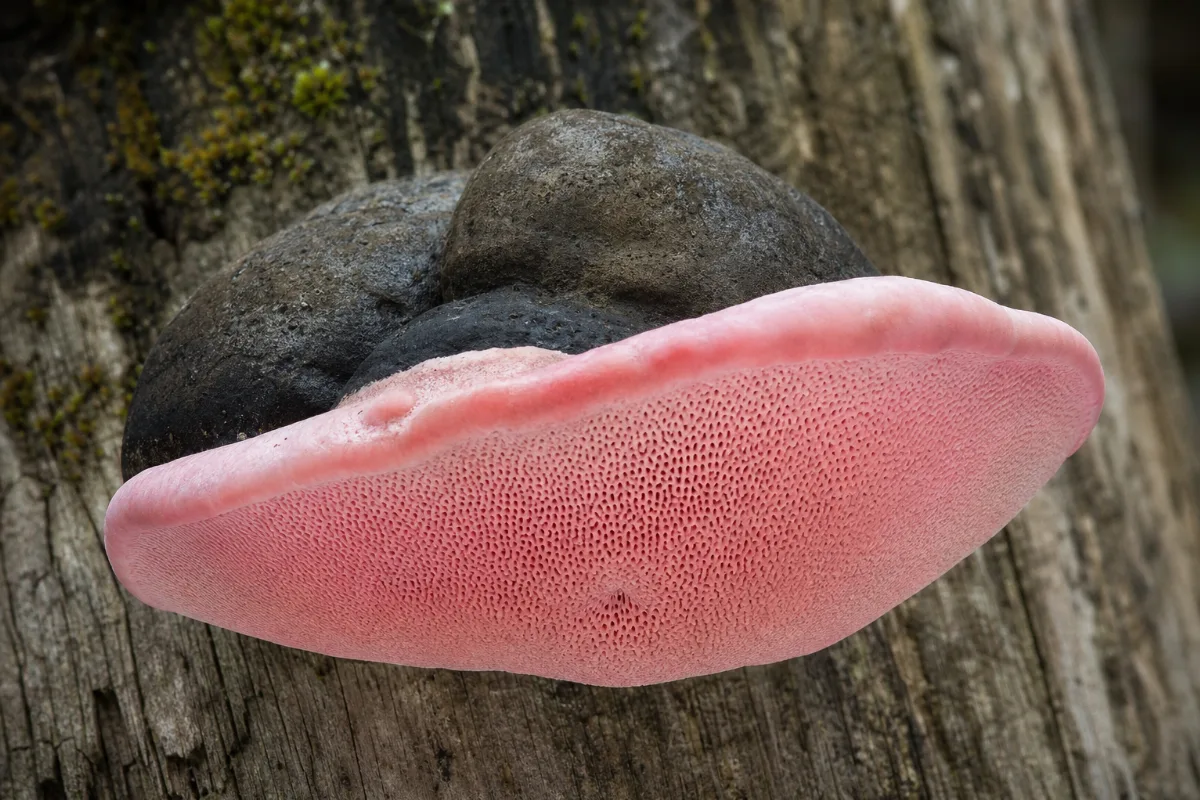
Mushrooms · Medicinal wild polypore
Rosy conk
Fomitopsis rosea (Rhodofomes roseus) · also called Rosy polypore, pink polypore; the common name is also used for the close relative Rhodofomes cajanderi
Rosy conk is a hard, pink-flushed bracket fungus that rots dead conifer wood. It is not a food and we found no supplement made from it. The research is very thin: a few laboratory studies, and none in people. Do not use a wild fungus unless an expert has identified it.
General information, not medical advice. Last substantive update · Not medically reviewed. A named clinician has not signed off on this page. How this page is made
About Rosy conk
Rosy conk is a woody, pink-flushed bracket fungus that grows on dead conifer wood. Human research does not exist. The little that is known comes from test-tube work on isolated molecules, and the common name is shared by more than one species. We found no safety data, no identification guide and no product. Do not use a wild fungus without an expert.
What it is, and the naming problem
Rosy conk is a perennial wood-decay fungus in the family Fomitopsidaceae. GBIF treats Rhodofomes roseus as the accepted name and Fomitopsis rosea as an older name for it. A 2024 DNA study folds the genus Rhodofomes into Fomitopsis, so both names are in use.
The common name is not settled. Wikipedia's summaries use rosy conk for Rhodofomes cajanderi and pink polypore for R. roseus, and other sources use rosy conk for both. A result on one species cannot be assumed for the other, so check the Latin name on anything you read or buy.
Two papers call Fomitopsis rosea a threatened wood-decay fungus. Collecting it for products could harm local populations.
What the research shows
Nothing has been tested in people. A 2009 paper isolated two new and three known triterpenes and a sterol derivative from an active extract. All five triterpenes showed antibacterial activity against Staphylococcus aureus in a test, but none had antiradical activity in the DPPH test.
A 2022 study found strong antioxidant activity in a methanol extract of a close relative, Rhodofomes cajanderi. Two earlier chemistry papers on Fomes cajanderi describe new compounds but tested no health effect.
These results show the fungus has interesting chemistry. They cannot show a health effect, because test-tube results often fail in people.
How strong is the evidence?
Every result is rated insufficient. It is abstract-only laboratory and chemistry work, with no numbers in the abstracts, and the papers concern different species names and different material. The rest of the literature is taxonomy and ecology.
Forms and products
We found no consumer product made from rosy conk, so we cannot say what one would contain. The lab work used solvent extracts, which are not tea, powder or capsules. For medicinal mushrooms in general, NCI says supplement ingredients may vary considerably from lot to lot.
At a glance
Traditional uses history, not proof
- No traditional medicinal or food use of rosy conk was found in the sources we read.
Studied for research
- Germs in the lab, not enough evidence (test tube only)
- Antioxidant tests, not enough evidence (mixed lab results)
- Any use in people, not enough evidence (nothing found)
Main compounds
- Lanostane triterpenes (waxy molecules fungi make)
- An epidioxy sterol derivative
Common forms
- Solvent extracts (laboratory only)
- No consumer product was found
Research links: Antibacterial triterpenes from Fomitopsis rosea (abstract) · Antioxidant tests of wild mushrooms including Rhodofomes cajanderi (abstract) · The genus Fomitopsis reconsidered (abstract) · Genetics of the threatened fungus Fomitopsis rosea (abstract) · NCI: Medicinal mushrooms (PDQ) · Research Library · Genes & Biomarkers Library
What it is and its history
- Accepted scientific name
- Rhodofomes roseus
- Naming authority
- (Alb. & Schwein.) Kotl. & Pouzar (GBIF)
- Synonyms
- Fomitopsis rosea (Alb. & Schwein.) P.Karst. (GBIF lists this as a synonym); Fomes roseus (older name)
- Common names
- Rosy conk (English); Rosy polypore (English); Pink polypore (English)
- Family or group
- Fomitopsidaceae (a fungus family), not a plant
- Classification
- Fungi > Basidiomycota > Agaricomycetes > Polyporales > Fomitopsidaceae > Rhodofomes (a 2024 DNA study folds it into Fomitopsis) > Rhodofomes roseus
- Native range
- Western North America and Europe (Wikipedia summary); Nordic populations were studied in a 2003 paper.
- Habitat
- Wood-decay fungus on dead conifer wood. The 2003 and 2009 papers call it threatened.
- What it looks like
- Fruiting body: Rose-coloured pore surface is the feature the common name refers to (Wikipedia summary of R. cajanderi). No other description was read from a source.
- Cultivation
- Not found in the sources read.
- Harvest and processing
- Not found in the sources read.
- Look-alikes and adulterants
- Name: Fomitopsis incarnatus (Korea); Note: A 2007 paper says it looks like F. rosea and F. cajanderi but differs in pore surface colour, pore size and shape and sterigmata count.; Name: Rhodofomes cajanderi; Note: A close relative that some sources also call rosy conk.
Traditional use and history history, not clinical proof
| Tradition or era | Documented use | Source |
|---|---|---|
| Traditional use | No traditional medicinal or food use of rosy conk was found in the sources read. | p19264113 |
Traditional use shows how it was used. It does not show that it works or is safe today.
What is inside, and how it may work
What it contains and how those compounds act in cells and animals. Laboratory and animal mechanisms are not proven effects in people.
Main compounds
| Compound | Family | Where it is concentrated | Activity studied | Level of evidence |
|---|---|---|---|---|
| Lanostane triterpenes from Fomitopsis rosea (two new, three known) | triterpenoid | Fungus extract Not given in the abstract. | All showed antibacterial activity against S. aureus in a test and no activity against DPPH radicals. 9 | Laboratory research |
| An epidioxy sterol derivative (compound 6) | sterol | Fungus extract Not given in the abstract. | Isolated and structurally identified; its activity is not stated in the abstract. 9 | Lab analysis |
| Fomlactones A to C (ketal lactones; from Fomes cajanderi) | triterpene lactone | Fungus ether extract Not given in the abstract. | Structures only; no activity tested in the abstract. Close relative, not R. roseus. 2 | Lab analysis |
| 15 compounds from Fomes cajanderi | mixed secondary metabolites | Fungus Not given in the abstract. | Structures only; one naturally occurring new metabolite and three new derivatives. Close relative, not R. roseus. 3 | Lab analysis |
Mechanisms, receptors and pathways
| Target or pathway | Gene or receptor | What was found | Level |
|---|---|---|---|
| Bacterial growth (Staphylococcus aureus) | Isolated triterpenes slowed S. aureus in a test. How was not stated in the abstract. 9 | Laboratory research | |
| DPPH radical scavenging | No activity from the pure triterpenes of F. rosea; strong activity from a methanol extract of the relative R. cajanderi. 9 4 | Laboratory research |
Absorption, metabolism and elimination
- Absorption
- Not found in the sources read.
- Distribution
- Not found in the sources read.
- Metabolism
- Not found in the sources read.
- Elimination
- Not found in the sources read.
- Bioavailability
- Not established.
Isolated compounds versus whole extracts
The only activity data are for isolated triterpenes from a solvent extract (2009) and a methanol extract of a relative (2022). Neither is a tea, powder or capsule. No product comparison exists.
Nutritional composition
Rosy conk is a woody perennial bracket and not a food. We found no food-composition data and give no nutrition claim.
3 not enough evidence
What was looked at
The 3 benefits and uses checked for Rosy conk, each with how strong the evidence is. Tap one to open it.
- Germs in the lab (test tube only)Not enough evidence
- Antioxidant tests (mixed lab results)Not enough evidence
- Any use in peopleNot enough evidence
Lab markers tracked in the studies
Staphylococcus aureus growth in a test tubeDPPH radical scavenging (chemical antioxidant test)
What is Rosy conk good for?
The uses people ask about and how strong the human evidence is for each. None is shown in people. Read this together with the Safety tab.
Benefits, one by one
Each card is a research question, not a promise. Tap a goal to filter. Open a card to see the studies, doses and limits.
Germs in the lab (test tube only)
Not enough evidenceFive triterpenes isolated from an extract of the fungus slowed Staphylococcus aureus bacteria in a test tube. Nothing was tested in animals or people, so this does not show that it treats any infection.
1 studiesSolvent extract and isolated molecules made in a lab. This is not a t…
Studies, doses and limits
Results
No human results. In a test tube, two new and three known triterpenes all showed antibacterial activity against S. aureus (2009 paper). The abstract gives no figures.
Effect sizes as reported
Test-tube activity only; no size of effect given
Why this rating
One abstract-only laboratory paper on isolated molecules. It cannot show an effect in a body.
Form and dose studied
Solvent extract and isolated molecules made in a lab. This is not a tea, powder or capsule and no such product was found.
Who was studied
Bacteria in a test tube (S. aureus)
Limits
Single paper; abstract only; no numbers; no animal or human data; the part of the fungus used is not stated in the abstract.
Why researchers looked
Chemists screened an active extract of this threatened fungus to find out which molecules did the work.
Traditional use
No traditional medicinal or food use of rosy conk was found in the sources we read.
Proposed mechanism Laboratory research
Lanostane triterpenes (waxy molecules that fungi make) were the active group. The exact way they act on the bacteria was not given in the abstract.
A proposed mechanism does not show that the effect happens in people.
No human safety data were found. See the Safety tab. Do not use a wild fungus unless an expert has identified it.
Antioxidant tests (mixed lab results)
Not enough evidenceIn a test tube the pure triterpenes from rosy conk did not mop up test radicals. A methanol extract of a close relative (Rhodofomes cajanderi, also called rosy conk by some) did, in another study. Neither shows a benefit in people.
2 studiesMethanol extract (lab) and pure molecules. Not a product people use.
Studies, doses and limits
Results
Rosy conk (Fomitopsis rosea) pure triterpenes: no antiradical activity against DPPH (2009). A methanol extract of Rhodofomes cajanderi, a different species, showed strong antioxidant activity by IC50 in the DPPH test alongside Ganoderma extracts; the abstract gives no figures (2022).
Effect sizes as reported
Test-tube results disagree by species and material; no size given
Why this rating
Results point both ways and come from different species and different material (pure molecules versus crude extract).
Form and dose studied
Methanol extract (lab) and pure molecules. Not a product people use.
Who was studied
Chemical tests; one computer-docking study
Limits
Different species in the two papers. Abstracts only. The 2022 authors' conclusion about oxidative stress diseases goes beyond a chemical test.
Why researchers looked
Antioxidant tests are cheap and common, so researchers run them on many fungi.
Traditional use
No traditional medicinal or food use of rosy conk was found in the sources we read.
Proposed mechanism Laboratory research
The chemical DPPH test measures whether a substance can neutralise a test radical in a tube. It does not measure what happens in a body.
A proposed mechanism does not show that the effect happens in people.
No human safety data were found. See the Safety tab. Do not use a wild fungus unless an expert has identified it.
Any use in people
Not enough evidenceWe found no human trial, case report, animal study of a health outcome or safety study of rosy conk. For every health claim the honest answer is: not enough evidence.
1 studiesNo consumer product was found.
Studies, doses and limits
Results
No human results to report.
Why this rating
No human study exists in the sources we searched.
Form and dose studied
No consumer product was found.
Limits
Absence of evidence is not evidence of safety or of benefit.
Why researchers looked
Readers ask whether rosy conk is a medicinal mushroom like reishi or red-belted conk. For rosy conk the research simply is not there.
Traditional use
No traditional medicinal or food use of rosy conk was found in the sources we read.
Proposed mechanism None
Not applicable.
A proposed mechanism does not show that the effect happens in people.
No human safety data were found. See the Safety tab. Do not use a wild fungus unless an expert has identified it.
Connections to the rest of health
How Rosy conk connects to the rest of our health knowledge graph. Every link says what kind of connection it is. A safety link (for example to the liver) is a warning, not a benefit. A study that merely mentions a topic never creates a benefit link.
Explore every connection: goals, body systems, organs, symptoms, genes
A. Wellness goals
| Connected to | Kind of connection | Evidence status | Context | Studies |
|---|---|---|---|---|
| Immune Health | Preliminary mechanism | Not enough evidence | Germs in the lab (test tube only): Five triterpenes isolated from an extract of the fungus slowed Staphylococcus aureus bacteria in a test tube. Nothing was tested in animals or people, so this does not show that it treats any infection. | 9 |
| Healthy Aging | Preliminary mechanism | Not enough evidence | Antioxidant tests (mixed lab results): In a test tube the pure triterpenes from rosy conk did not mop up test radicals. A methanol extract of a close relative (Rhodofomes cajanderi, also called rosy conk by some) did, in another study. Neither shows a benefit in people. | 9 4 |
B. Body systems
| Connected to | Kind of connection | Evidence status | Context | Studies |
|---|---|---|---|---|
| Immune System | Biological association | Not enough evidence | Studied for: Germs in the lab (test tube only) | 9 |
| Cellular Protection | Biological association | Not enough evidence | Studied for: Antioxidant tests (mixed lab results) | 9 4 |
E. Health conditions
| Connected to | Kind of connection | Evidence status | Context | Studies |
|---|---|---|---|---|
| Pregnancy and breastfeeding | Contraindication | Not enough evidence | No safety data found. Preparation or compound: All rosy conk products |
7 |
I. Biomarkers
| Connected to | Kind of connection | Evidence status | Context | Studies |
|---|---|---|---|---|
| Staphylococcus aureus growth in a test tube | Biological association | Not enough evidence | Measured in trials: slowed. A lab change is not the same as a health benefit. | 9 |
| DPPH radical scavenging (chemical antioxidant test) | Biological association | Not enough evidence | Measured in trials: mixed. A lab change is not the same as a health benefit. | 9 4 |
L. Active compounds
| Connected to | Kind of connection | Evidence status | Context | Studies |
|---|---|---|---|---|
| Lanostane triterpenes from Fomitopsis rosea (two new, three known) | Biological association | In vitro | All showed antibacterial activity against S. aureus in a test and no activity against DPPH radicals. Preparation or compound: Fungus extract |
9 |
| An epidioxy sterol derivative (compound 6) | Biological association | Lab analysis | Isolated and structurally identified; its activity is not stated in the abstract. Preparation or compound: Fungus extract |
9 |
| Fomlactones A to C (ketal lactones; from Fomes cajanderi) | Biological association | Lab analysis | Structures only; no activity tested in the abstract. Close relative, not R. roseus. Preparation or compound: Fungus ether extract |
2 |
| 15 compounds from Fomes cajanderi | Biological association | Lab analysis | Structures only; one naturally occurring new metabolite and three new derivatives. Close relative, not R. roseus. Preparation or compound: Fungus |
3 |
Each connection is stored with the ingredient, the connected record, the kind of connection, the evidence status, the supporting studies, the preparation or compound involved, and a review date (last reviewed October 25, 2026).
Evidence at a glance: what changed in 1 lab markers
Tap a number to show only those markers. Counts are markers, not people.
The evidence
The research centre for Rosy conk. Every record here was checked against PubMed or the publisher's page; we never list a study we have not verified.
Evidence by outcome
Bars show how many studies we found for each outcome, not how well it works. People are added up across trials only (reviews are not added, to avoid double counting).
How we rate evidence
High certainty
Several well-run trials or reviews agree; further research is unlikely to change the picture much.
Moderate certainty
Good trials point the same way, but some doubt remains.
Low certainty
Small, short or inconsistent trials. The finding could change with better research.
Very low certainty
Very little or very weak human data. Treat as a possibility only.
Mixed findings
Trials or reviews disagree with each other.
Not enough evidence
Not enough human research to say either way.
Evidence against
Good research found no benefit, or found harm.
We take the reviewers' own risk-of-bias and GRADE statements where they exist, and otherwise judge from study size, design, consistency, directness and whether a product matches what is sold. Many publications do not make evidence high. Method note: We read PubMed records and abstracts for 7 papers (2 laboratory or chemistry studies on the species or its close relative, 2 older chemistry papers, 3 on naming and ecology), checked the names in GBIF, read short Wikipedia summaries for the common-name use, and read the National Cancer Institute medicinal mushrooms page. Full texts were not opened, so abstracts give no numbers. LiverTox and LactMed were searched through NCBI Books and nothing was found. Certainty ratings are the compiler's own reading.
Study library: every study we checked 11
| Study | Design | People | Product, dose, length | Result |
|---|---|---|---|---|
| GBIF 2026 GBIF Backbone Taxonomy: Rhodofomes roseus and Fomitopsis rosea GBIF · Source |
Database record n/a |
n/a | n/a |
On 2026-10-25 the GBIF match API gave Rhodofomes roseus (Alb. & Schwein.) Kotl. & Pouzar as ACCEPTED (key 8179389), family Fomitopsidaceae. Fomitopsis rosea (Alb. & Schwein.) P.Karst. is listed as a SYNONYM of it. Rhodofomes cajanderi (P.Karst.) B.K.Cui, M.L.Han & Y.C.Dai is a separate ACCEPTED species (key 9739681). Names checked Methods, limits and fundingOutcomes: As described Limitations: Index Fungorum was not checked. Other authors (for example the 2024 Studies in Mycology paper) fold Rhodofomes into Fomitopsis. Funding and conflicts: Not applicable Read: database record |
| He 2003 Fomlactones A-C, novel triterpene sactones from Fomes cajanderi. Journal of Natural Products · PMID 14510609 · DOI |
Chemistry (isolation) study Fomes cajanderi (now Rhodofomes cajanderi) |
Neutral ether extract of the fungus | Chemical isolation Fungus |
Three novel ketal lactones, named fomlactones A, B and C, were isolated from the neutral ether extracts of Fomes cajanderi and identified by spectroscopy. The structure of fomlactone C was confirmed by X-ray diffraction. Chemistry only; no activity tested in the abstract Methods, limits and fundingOutcomes: Chemistry only; no activity tested in the abstract Limitations: Structures only. No biological test in the abstract. Close relative (Rhodofomes cajanderi), not R. roseus. Funding and conflicts: Funding not stated in the abstract Read: abstract |
| He 2006 Secondary metabolites from fungus Fomes cajanderi. Natural Product Research · PMID 16835094 · DOI |
Chemistry (isolation) study Fomes cajanderi (now Rhodofomes cajanderi) |
Fungus collected in Jilin province, China, 1997 | Chemical isolation Fungus |
The team isolated 15 compounds from Fomes cajanderi, of which compound 5 is a naturally occurring new metabolite and 9, 11 and 12 are new derivatives. Structures were identified by MS, NMR and X-ray crystallography. Chemistry only; no activity tested in the abstract Methods, limits and fundingOutcomes: Chemistry only; no activity tested in the abstract Limitations: Structures only. No biological test, so no health claim is possible. Fomes cajanderi is an older name of Rhodofomes cajanderi, the close relative. Funding and conflicts: Funding not stated in the abstract Read: abstract |
| Hossen 2022 Profiling of phytochemical and antioxidant activity of wild mushrooms: Evidence from the in vitro study and phytoconstituent's binding affinity to the human erythrocyte catalase and human glutathione reductase. Food Science & Nutrition · PMID 35035912 · DOI |
Laboratory and computer study Rhodofomes cajanderi (not R. roseus) |
Seven wild mushrooms from a university campus in Bangladesh; test-tube DPPH assay and computer docking | Methanol extracts Wild-collected fungus |
The methanol extract of Rhodofomes cajanderi, with two Ganoderma species, showed strong antioxidant activity by an IC50 value in the DPPH test. Docking of compounds reported earlier from these mushrooms onto two human enzymes showed binding in the computer model. The abstract gives no IC50 figures for R. cajanderi. Antioxidant in a chemical test; computer binding only Methods, limits and fundingOutcomes: Antioxidant in a chemical test; computer binding only Limitations: Chemical and computer work only. Rhodofomes cajanderi is a close relative, listed separately from R. roseus (Fomitopsis rosea); the result cannot be carried across. The authors' conclusion that these mushrooms 'can be a strong source' for oxidative stress diseases goes beyond what a test-tube assay shows. Funding and conflicts: The authors declare no competing interests Read: abstract |
| Kauserud 2003 Genetic structure of Fennoscandian populations of the threatened wood-decay fungus Fomitopsis rosea (Basidiomycota). Mycological Research · PMID 12747326 · DOI |
Population genetics Fomitopsis rosea |
Five Fennoscandian (Nordic) populations of the fungus | n/a |
The authors describe the fungus as a threatened wood-decay fungus. DNA markers pointed to an outcrossing fungus with large populations and a high level of gene flow between them, and mating tests showed a bipolar heterothallic mating system. Ecology only; no health information Methods, limits and fundingOutcomes: Ecology only; no health information Limitations: Genetics of wild populations, nothing on health or safety. Funding and conflicts: Funding not stated in the abstract Read: abstract |
| Kim 2007 Fomitopsis incarnatus sp. nov. based on generic evaluation of Fomitopsis and Rhodofomes. Mycologia · PMID 18333507 · DOI |
Taxonomy Fomitopsis incarnatus (look-alike) |
A new polypore from Kangwon Province, Korea | n/a |
A new polypore was found that looked like Fomitopsis rosea and F. cajanderi. Its pinkish-white pore surface, pore size and shape and number of sterigmata set it apart, and it was named Fomitopsis incarnatus. Shows that pink conks are easy to confuse Methods, limits and fundingOutcomes: Shows that pink conks are easy to confuse Limitations: Taxonomy only. Shows look-alike species exist; it is not a safety or identification guide. Funding and conflicts: Funding not stated in the abstract Read: abstract |
| NCBI Bookshelf 2026 NCBI Books search for LiverTox and LactMed entries (rosy conk, Fomitopsis rosea, Rhodofomes) NCBI Bookshelf · Source |
Database search n/a |
n/a | n/a |
A search of NCBI Books on 2026-10-25 for Fomitopsis rosea and for Rhodofomes returned no result. No LiverTox or LactMed entry for this fungus was found. No entry found Methods, limits and fundingOutcomes: As described Limitations: A search for a name is not a full review. MSK, EMA and NCCIH pages were not checked. Funding and conflicts: Not applicable Read: search result |
| National Cancer Institute 2024 NCI PDQ: Medicinal Mushrooms (health professional version) National Cancer Institute · Source |
Authoritative guidance n/a |
n/a | n/a |
Page text read on 2026-10-25 (updated 6 November 2024). It says supplement ingredients may vary considerably from lot to lot with no guarantee that label ingredients are present, and that the FDA has not approved medicinal mushrooms as a treatment for cancer or any other medical condition. It has no section on rosy conk. General regulatory caution; nothing specific to rosy conk Methods, limits and fundingOutcomes: As described Limitations: Not about rosy conk; applies by analogy only. Funding and conflicts: Not applicable Read: page text |
| Popova 2009 Antibacterial triterpenes from the threatened wood-decay fungus Fomitopsis rosea. Fitoterapia · PMID 19264113 · DOI |
Laboratory study Fomitopsis rosea (now Rhodofomes roseus) |
Test-tube assays (Staphylococcus aureus; DPPH test radicals) | Extract of the fungus, then five isolated triterpenes and one sterol derivative Fungus (fruiting body not specified in the abstract) |
From a biologically active extract the authors isolated two new lanostane triterpenes and three known triterpenes, plus an epidioxy sterol derivative. All the triterpenes showed antibacterial activity against S. aureus but no antiradical activity against DPPH radicals. The abstract gives no numbers. Antibacterial in a test tube (S. aureus); not antioxidant in the DPPH test Methods, limits and fundingOutcomes: Antibacterial in a test tube (S. aureus); not antioxidant in the DPPH test Limitations: Abstract only; no figures given. A test-tube result does not show a benefit or safety in people. We could not tell from the abstract which part of the fungus was used. Funding and conflicts: Funding not stated in the abstract Read: abstract |
| Spirin 2024 The genus Fomitopsis (Polyporales, Basidiomycota) reconsidered. Studies in Mycology · PMID 38600960 · DOI |
Taxonomy (DNA classification) n/a |
Family Fomitopsidaceae | n/a |
The authors argue for keeping only three genera in the family (Anthoporia, Antrodia, Fomitopsis). Rhodofomes is listed among the genus names treated as synonyms of Fomitopsis. This means that in this scheme the pink conks stay in Fomitopsis, while other databases such as GBIF use Rhodofomes. Naming only Methods, limits and fundingOutcomes: Naming only Limitations: Taxonomy, not health. The abstract does not name rosy conk itself. Other authorities (GBIF) use Rhodofomes, so both names are in use. Funding and conflicts: No conflict of interest declared Read: abstract |
| Wikipedia 2026 Wikipedia: Rhodofomes roseus and Rhodofomes cajanderi (summaries) Wikipedia · Source |
Encyclopedia n/a |
n/a | n/a |
The summary of Rhodofomes roseus calls it a pink polypore found in western North America and Europe and says its close relative, the rosy conk, is another pink conk. It says R. cajanderi is a plant pathogen and R. roseus is a detritivore. The summary of Rhodofomes cajanderi says it is commonly known as the rosy conk because of its rose-coloured pore surface, and that it causes brown pocket rot in conifers. Common-name use Methods, limits and fundingOutcomes: As described Limitations: Wikipedia is a general source and was read only as the short summaries (2026-10-25). Used only for which species the common name points to and the rough range. Funding and conflicts: Not applicable Read: summary text |
What we do not know yet
- No human trial and no human safety study of rosy conk were found.
- No animal study of any health outcome was found.
- The lab papers cover different species names (F. rosea and R. cajanderi), so they cannot be combined.
- No identification, edibility, look-alike or harvest guide for rosy conk was read.
- No test of heavy metals, pesticides or mould toxins. LiverTox and LactMed entries were not found; EMA, NCCIH and MSK pages were not checked.
How new research is added
New studies are found by a saved PubMed search and placed in a review queue. A person reads each one before it changes any evidence rating or safety wording. New publications never change ratings automatically.
Lab markers
What changed in blood or saliva tests during trials. A changed number is not the same as feeling or being healthier, and we give no "normal ranges".
Other 2
Staphylococcus aureus growth in a test tube
Slowed in trials
Whether bacteria grow or are slowed when the molecule is added in a lab assay.
Not enough evidenceResults and what it means
Why it was measured
A first screen for germ-killing chemistry.
Statistical vs. clinical meaning
Lab screening result only.
Safety implication
Not a measure of safety or of treating infection.
| Study | Result | People | Product |
|---|---|---|---|
| 9 | All five isolated triterpenes showed antibacterial activity against S. aureus. No figures in the abstract. | Bacteria in a test | Triterpenes isolated from a Fomitopsis rosea extract |
DPPH radical scavenging (chemical antioxidant test)
Mixed results in trials
How well a substance neutralises a purple test radical in a tube.
Not enough evidenceResults and what it means
Why it was measured
A quick chemical test often used as a first look at antioxidant potential.
Statistical vs. clinical meaning
Disagreement between species and between pure molecules and crude extract.
Safety implication
The test says nothing about health effects in people.
Safety
What studies and official sources say about side effects, medicines and who should check first. Each point shows what kind of evidence it comes from.
Main points to know 5
- No human safety data were found. We found no clinical trial, case report or poison-centre report for rosy conk. That means the risks are unknown, not that there are none. Nothing here is a safety all-clear. None 9 7
- Wild fungus: identify with an expert, do not guess. Rosy conk is a wild, woody bracket fungus. Pink-flushed conks look alike, and a 2007 paper described a new Korean species that looks like Fomitopsis rosea and F. cajanderi. We found no identification or edibility guide for rosy conk itself, so none is given. Do not eat, brew or apply a wild fungus unless a trained local expert has identified it. Identification caution 6
- The name points to more than one species. Rosy conk is used for Rhodofomes cajanderi in some sources and the pink polypore Rhodofomes roseus (formerly Fomitopsis rosea) is a close relative. A result on one species cannot be assumed for the other. Check the Latin name on anything you read or buy. Naming 1 11
- No known consumer product, so label quality cannot be judged. We found no supplement made from rosy conk. For medicinal mushrooms in general, NCI says ingredients may vary considerably from lot to lot and there is no guarantee that label ingredients are present. Authoritative guidance 8
- Conservation: it is described as threatened. Two papers call Fomitopsis rosea a threatened wood-decay fungus. Collecting it for products could harm local populations. We did not check a formal red list. Ecology 9 5
Side effects 1
| Effect | How often | Severity and recovery | Evidence |
|---|---|---|---|
| No adverse effects have been reported, but none have been looked for in people Absence of reports in the sources we read is not proof of safety. | Unknown | unknown Not applicable | None |
Liver
We found no case report or trial linking rosy conk to liver injury. A search of NCBI Books on 2026-10-25 returned no LiverTox entry for Fomitopsis rosea or Rhodofomes. 7
How often. No liver reports found; this is not proof of liver safety.
Monitoring. No agency monitoring advice exists in the sources we read. People with liver disease should ask a doctor before using any medicinal fungus.
This is a safety connection. It is not evidence that Rosy conk supports liver health.
Medicines and supplements 3
| With | Why it matters | Importance | Evidence | What to do |
|---|---|---|---|---|
| Any medicine, including blood thinners and immune-suppressing medicines prescription | Unknown. No interaction study or case report was found. | None Not enough evidence | Ask your prescriber or pharmacist before using any medicinal fungus. | |
| Herbal products and other supplements supplement | Unknown. | None Not enough evidence | Tell your pharmacist about every product you use. | |
| Food and alcohol food | Unknown. Rosy conk is not a food. | None Not enough evidence | Not applicable. |
Who should check first 4
| Situation | Advice | Evidence |
|---|---|---|
| Pregnancy and breastfeeding | No safety data were found, so it is not known whether it is safe. Ask a doctor. Our NCBI Books search found no LactMed entry. | None 7 |
| Children and babies | No safety data were found. Ask a doctor before giving any medicinal fungus to a child. | None |
| Mushroom allergy, asthma or a history of reactions to fungi or moulds | Allergy to this fungus has not been studied. Take extra care and ask a doctor. This is general caution, not from a rosy conk source. | General caution |
| Before surgery, or with immune disease or an organ transplant | Nothing is known. Ask your doctor before using any medicinal fungus. | None |
Overdose, product quality and regulators
Summary. No toxicity study in people or animals was found.
Human doses studied. No human study. This page gives no amounts and none are advised.
Overdose response. No description was found. If someone becomes unwell after eating any wild fungus, seek medical help or call poison control and keep a sample if you can.
Toxic parts. Not described in the sources read.
We found no test of heavy metals, pesticides or mould toxins in rosy conk. Wild fungi can take up substances from their wood and surroundings, as a general rule.
Heavy metals and wild growth. No data for this species were found. This is a general caution about wild fungi, not a finding about rosy conk.
| Body | Action | Date |
|---|---|---|
| US National Cancer Institute (PDQ) (United States) | States that the FDA has not approved medicinal mushrooms as a treatment for cancer or any other medical condition, and that supplement ingredients may vary considerably from lot to lot. The page has no rosy conk section. source | 2024-11-06 |
| LiverTox / LactMed (US NIH) (United States) | No entry found for Fomitopsis rosea or Rhodofomes by NCBI Books search. source | 2026-10-25 |
When to get medical help
- Itching, hives, swelling of the lips, tongue or face, wheeze or trouble breathing after eating, handling or inhaling a fungus: get emergency help now (general advice, not from a rosy conk source).
- Repeated vomiting, severe stomach pain, diarrhoea, confusion or yellow skin or eyes after eating any wild fungus: get medical help now and call your local poison control number. Keep a sample of the fungus if you can.
- A wound that bleeds heavily, looks infected, or does not heal: do not rely on any fungus; get medical care.
If someone may be poisoned or in a crisis, contact a clinician or emergency service straight away. In the US, Poison Control is 1-800-222-1222.
General information only, not medical advice. Ask a clinician or pharmacist before use, especially with medicines, in pregnancy or with a health condition. See the Natural Remedy Safety guide.
Frequently asked questions
What is rosy conk?
Is it the same as red-belted conk?
No. They are related woody conks but different species. See the red-belted conk page for its own evidence and cautions.
Which species is called rosy conk?
Does rosy conk have proven health benefits?
No. The research is a few laboratory papers. One found its triterpenes slowed a common bacterium in a test tube. That does not show a benefit in people.
Is rosy conk edible?
We found no source that says it is edible, and it is a woody conk. We give no advice to eat it. Do not eat a wild fungus without an expert's identification.
Is rosy conk safe?
Does it fight germs or infections?
Not shown. Isolated triterpenes slowed Staphylococcus aureus in a test tube. Nobody tested it on an infection in an animal or a person.
Is it an antioxidant?
Can I tell rosy conk from look-alikes myself?
No. Pink-tinted woody brackets are easy to confuse, and a 2007 paper described a new Korean species that looks like Fomitopsis rosea and F. cajanderi. Ask a trained local expert; do not rely on text or an app.
Is rosy conk rare?
Does it interact with medicines?
Unknown. No interaction study or case report was found. Ask a pharmacist before using any medicinal fungus.
Can I buy a rosy conk supplement?
We found no consumer product made from it. Be careful with any product that claims to contain it; for mushroom supplements in general NCI says label contents are not guaranteed.
Explore by health goal
Editorial transparency
- Written by
- AlternativeMed editorial team. Research compiled with AI assistance, then checked against PubMed records.
- Medical review
- None. This page has not been reviewed by a physician or pharmacist.
- First published
- 2026-10-25
- Last substantive update
- 2026-10-25
- How we research
- We read PubMed records and abstracts for 7 papers (2 laboratory or chemistry studies on the species or its close relative, 2 older chemistry papers, 3 on naming and ecology), checked the names in GBIF, read short Wikipedia summaries for the common-name use, and read the National Cancer Institute medicinal mushrooms page. Full texts were not opened, so abstracts give no numbers. LiverTox and LactMed were searched through NCBI Books and nothing was found. Certainty ratings are the compiler's own reading.
- How we rate evidence
- See "How we rate evidence" in the Evidence tab.
- Independence
- No product is promoted on this page. No affiliate links are shown. This page is information, not a recommendation to use rosy conk.
Sources 11
Each source was opened and checked. Where we read only the abstract, it says so. The small numbers in the text point here.
- GBIF. GBIF Backbone Taxonomy: Rhodofomes roseus and Fomitopsis rosea. GBIF. 2026. (database record)
- He J, Feng XZ, Lu Y, Zhao B. Fomlactones A-C, novel triterpene sactones from Fomes cajanderi.. Journal of Natural Products. 2003. PMID 14510609. DOI 10.1021/np0301994. (abstract)
- He J, Feng XZ, Ji TF, Lu Y, Zhao B. Secondary metabolites from fungus Fomes cajanderi.. Natural Product Research. 2006. PMID 16835094. DOI 10.1080/14786410500185667. (abstract)
- Hossen SMM, Hossain MS, Yusuf ATM, Chaudhary P, Emon NU, Janmeda P. Profiling of phytochemical and antioxidant activity of wild mushrooms: Evidence from the in vitro study and phytoconstituent's binding affinity to the human erythrocyte catalase and human glutathione reductase.. Food Science & Nutrition. 2022. PMID 35035912. DOI 10.1002/fsn3.2650. (abstract)
- Kauserud H, Schumacher T. Genetic structure of Fennoscandian populations of the threatened wood-decay fungus Fomitopsis rosea (Basidiomycota).. Mycological Research. 2003. PMID 12747326. DOI 10.1017/s0953756203007214. (abstract)
- Kim KM, Lee JS, Jung HS. Fomitopsis incarnatus sp. nov. based on generic evaluation of Fomitopsis and Rhodofomes.. Mycologia. 2007. PMID 18333507. DOI 10.3852/mycologia.99.6.833. (abstract)
- NCBI Bookshelf. NCBI Books search for LiverTox and LactMed entries (rosy conk, Fomitopsis rosea, Rhodofomes). NCBI Bookshelf. 2026. (search result)
- National Cancer Institute. NCI PDQ: Medicinal Mushrooms (health professional version). National Cancer Institute. 2024. (page text)
- Popova M, Trusheva B, Gyosheva M, Tsvetkova I, Bankova V. Antibacterial triterpenes from the threatened wood-decay fungus Fomitopsis rosea.. Fitoterapia. 2009. PMID 19264113. DOI 10.1016/j.fitote.2009.02.008. (abstract)
- Spirin V, Runnel K, Vlasak J, Viner I, Barrett MD, Ryvarden L, Bernicchia A, Rivoire B, Ainsworth AM, Grebenc T, Cartabia M, Niemela T, Larsson KH, Miettinen O. The genus Fomitopsis (Polyporales, Basidiomycota) reconsidered.. Studies in Mycology. 2024. PMID 38600960. DOI 10.3114/sim.2024.107.03. (abstract)
- Wikipedia. Wikipedia: Rhodofomes roseus and Rhodofomes cajanderi (summaries). Wikipedia. 2026. (summary text)


