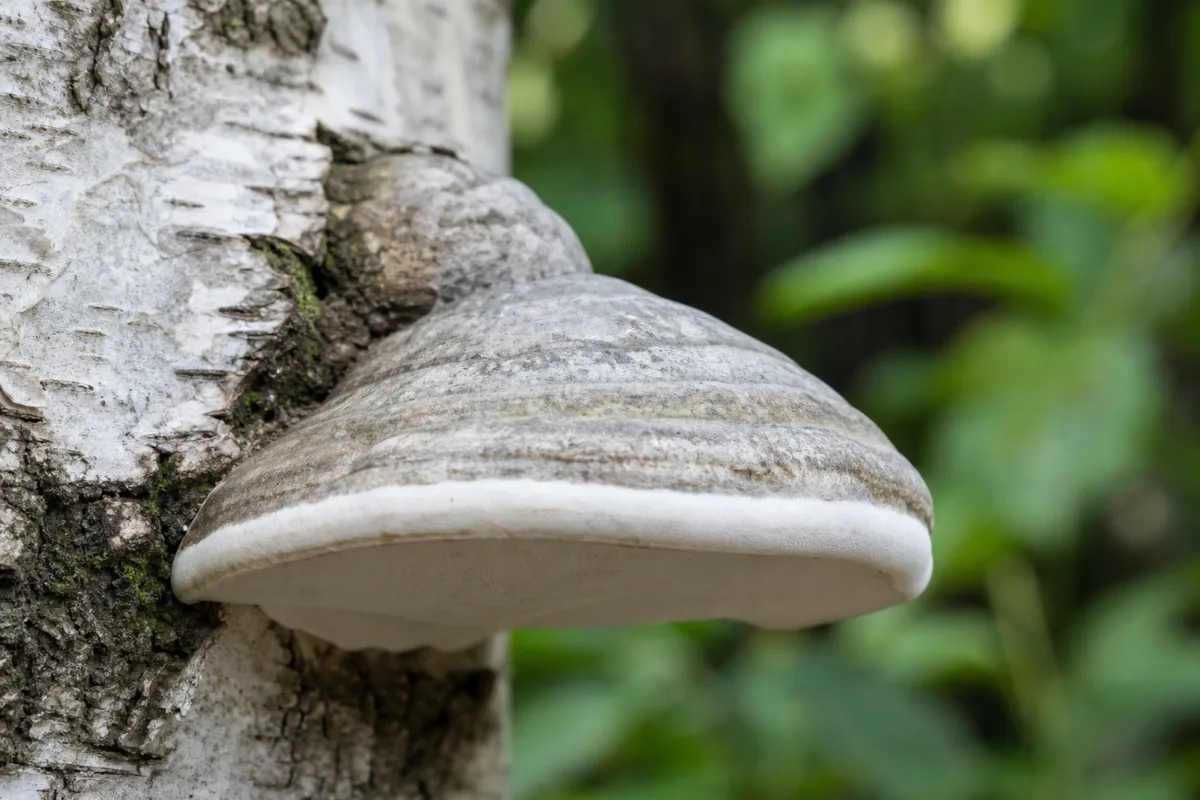
Mushrooms · Medicinal wild polypore
Birch polypore
Fomitopsis betulina · also called Birch bracket, Iceman's fungus, razor strop fungus; older scientific name Piptoporus betulinus
Birch polypore is a pale, hoof-shaped fungus that grows on birch trees. It has a long folk-medicine history, and pieces were found with Otzi, a man who lived more than 5,000 years ago. We found no human trial of it, only lab and animal work. No safety studies in people were found either, so the risks are unknown. Do not use a wild fungus without an expert's identification.
General information, not medical advice. Last substantive update · Not medically reviewed. A named clinician has not signed off on this page. How this page is made
About Birch polypore
Birch polypore is a pale bracket fungus on birch trees, best known because pieces were found with Otzi the Iceman. Human research does not exist: what is known comes from cells in dishes, a mouse-ear test and a rat test. No safety studies in people were found. Wild fruiting bodies can carry arsenic and radiocaesium from their surroundings, products are not standardised, and we found no look-alike or identification source, so do not use wild fungus without an expert.
What it is
Birch polypore (Fomitopsis betulina) is a fungus that causes brown rot in birch wood. Its annual white to brownish fruiting bodies grow on trees in the northern hemisphere. For a long time it was named Piptoporus betulinus, and that name is still on many papers. GBIF lists it as an old name for the same fungus.
It can also be grown as mycelium, and one 2016 team grew mature fruiting bodies indoors on birch sawdust, although only one of four strains fruited.
The Iceman and folk use
Pieces of the fungus were among the equipment of Otzi, the Tyrolean Iceman, a glacier mummy who lived more than 5,000 years ago. A review says two polypore species were found among his items, and that polypores were used for things from food and tinder to medicinal-spiritual purposes.
He had whipworm and a stomach infection. A 2021 review lists a birch polypore and an anti-worm fern as potential remedies he carried, and a 2019 paper suggests care and treatment were already common in his time. These are interpretations. Nobody can show why he carried it or that it worked.
Folk medicine in central Europe also used birch polypore for many complaints, and as a wound dressing and tea. Traditional use is not proof that it works.
What the research shows
Nothing has been tested in people. Extracts killed cancer cells in dishes, with less effect on the normal cells tested in a 2024 review of 5 studies. A water extract raised immune signals in human cells. Isolated triterpene acids cut swelling in a mouse-ear test. A purified glucan helped cells move into a scratch. Oral extracts did not change blood pressure in healthy rats.
These results show the fungus has active chemistry. They cannot show a health effect, because dish and mouse results often fail in people.
How strong is the evidence?
Every result for benefit is rated insufficient: laboratory or animal work only. The reviews are written from that work, and none describes a human trial. Lab extracts are made with water, alcohol or alkali and are not tea or capsules. In one study the mycelium and the fruiting body acted differently.
Forms and products
Traditional forms are dried slices or powder for tea and fresh pieces on wounds. Products may be fruiting body or mycelium, and NCI says supplement ingredients may vary considerably from lot to lot. We found no study that compared forms and no standard strength.
Rules and regulators
NCI says the FDA has not approved medicinal mushrooms as a treatment for cancer or any other medical condition. Its page has no birch polypore section. We found no entry for it in LiverTox or LactMed and could not confirm an MSK or EMA page.
At a glance
Traditional uses history, not proof
- Folk medicine in central Europe for conditions such as period pain, haemorrhoids, bladder disorders, fever, cough, cancer and rheumatism (2014 review).
- Wound dressing and tea in folk use (reviews). No test of either was found.
- Carried by the Iceman, Otzi, over 5,000 years ago. Some authors suggest it was a remedy for gut worms; why he carried it is not known for sure.
Studied for research
- Cancer cells, not enough evidence (cells in dishes only)
- Immune cells, not enough evidence (cells in dishes only)
- Inflammation, not enough evidence (mouse ear and cell tests)
- Germs in the lab, not enough evidence (tube tests)
- Antioxidant tests, not enough evidence (chemical tests)
- Wound care, not enough evidence (one dish test of a purified glucan)
- Blood pressure, not enough evidence (no change in healthy rats)
- Gut worms (Iceman theory), not enough evidence (not tested)
Main compounds
- Triterpene acids such as polyporenic acids
- Betulin and betulinic acid
- Beta-glucans and other polysaccharides
Common forms
- Dried slices or powder for tea (traditional)
- Water, ethanol or methanol extracts (laboratory)
- Capsules or powders, which may be fruiting body or mycelium
- Fresh fruiting body pieces (traditional wound dressing)
Research links: Review: Fomitopsis betulina, the Iceman's polypore (abstract) · Review: European medicinal polypores and traditional uses (abstract) · Review: cytotoxic activity against normal and cancer cells (abstract) · Effects on human immune cells in a dish (abstract) · Arsenic in birch polypore from two sites (abstract) · NCI: Medicinal mushrooms (PDQ) · Research Library · Genes & Biomarkers Library
What it is and its history
- Accepted scientific name
- Fomitopsis betulina
- Naming authority
- (Bull.) B.K.Cui, M.L.Han & Y.C.Dai (GBIF)
- Synonyms
- Piptoporus betulinus (Bull.) P.Karst. (GBIF lists this as a synonym)
- Common names
- Birch polypore (English); Birch bracket (English); Iceman's fungus (English); Razor strop fungus (English)
- Family or group
- Fomitopsidaceae (a fungus family), not a plant
- Classification
- Fungi > Basidiomycota > Agaricomycetes > Polyporales > Fomitopsidaceae > Fomitopsis > Fomitopsis betulina
- Native range
- A 2017 review abstract says the fruiting bodies can be found on trees in the northern hemisphere.
- Habitat
- A 2017 review abstract says the fungus causes brown rot of birch wood.
- What it looks like
- Fruiting body: A 2017 review abstract describes annual white to brownish fruiting bodies on trees. Size and shape details were not read from a source.
- Cultivation
- A 2016 paper reports the first indoor production of mature fruiting bodies on birch sawdust: one of four strains fruited, biological efficiency 12 to 16%, fruiting bodies 50 to 120 g.
- Harvest and processing
- Not found in the sources read. Most research used wild-collected fruiting bodies.
- Look-alikes and adulterants
- Name: Not documented; Note: No source we read lists look-alikes. See the Safety tab: do not use wild fungus without expert identification.
- Sustainability and conservation
- Not found in the sources read.
Traditional use and history history, not clinical proof
| Tradition or era | Documented use | Source |
|---|---|---|
| Copper Age, found with the Tyrolean Iceman (Otzi) | Pieces of the fruiting body were among the Iceman's items; a review says two polypore species were found among them and that polypores had uses from food and tinder to medicinal-spiritual uses, going back more than 5,000 years. A 2021 review lists a birch polypore and an anti-worm fern as potential remedies he carried (whipworm was found in him), and a 2019 paper suggests care and treatment were already common in his time. These are interpretations. We cannot say why he carried it. | p24786572 |
| Central European folk medicine | A 2014 review says birch polypore and four other polypores were widely used in central European folk medicine for conditions such as period pain, haemorrhoids, bladder disorders, fever, cough, cancer and rheumatism. Traditional use is not proof that it works. | p24786572 |
| Modern research | A 2017 review says folk medicine used it as an antimicrobial, anticancer and anti-inflammatory agent, and that modern work is lab and animal based. | p28378220 |
Traditional use shows how it was used. It does not show that it works or is safe today.
What is inside, and how it may work
What it contains and how those compounds act in cells and animals. Laboratory and animal mechanisms are not proven effects in people.
Main compounds
| Compound | Family | Where it is concentrated | Activity studied | Level of evidence |
|---|---|---|---|---|
| Polyporenic acids and other lanostane-type triterpene acids | triterpenoid | Fruiting body Content not given in the abstracts read. | Isolated acids cut mouse-ear swelling by 49 to 86% in one test; several killed leukaemia cells in dishes. 13 new triterpenoids were described in 2021. 8 20 | Animal research |
| Betulin PubChem 72326 | triterpene alcohol | Fruiting body Not given in the abstracts read. | Named as one active compound in an ethanol extract acting on melanoma cells in a dish. 1 21 | Laboratory research |
| Betulinic acid PubChem 64971 | triterpenoid acid | Fruiting body and mycelium Measured by HPLC in one study; the abstract gives no numbers. | Measured along with betulin; no activity of its own is tested in the abstract. 21 | Lab analysis |
| Ergosterol PubChem 444679 | sterol | Fruiting body and mycelium Measured by HPLC in one study; the abstract gives no numbers. | Listed among sterols measured; no activity of its own is reported in the abstract. 21 | Lab analysis |
| Beta-glucans | polysaccharide | Fruiting body Described as high compared with other well-known culinary or medicinal mushrooms; no number in the abstract. A purified beta-(1-3)-D-glucan had an average weight of 250,000 daltons. | A fraction slowed tumour cell migration by 38% in a dish; a purified glucan helped cells move in a scratch test. 19 24 | Laboratory research |
| Polyamines (spermidine, spermine, putrescine) | polyamine | Fruiting body Spermidine 60.21, spermine 41.71, putrescine 0.97 mg/kg dry weight in one methanol extract. | Named in a 2025 paper with phenolics and enzyme-blocking activity in a tube. 17 | Lab analysis |
Mechanisms, receptors and pathways
| Target or pathway | Gene or receptor | What was found | Level |
|---|---|---|---|
| Immune cells (IFN-gamma, IL-8, dendritic cell maturation) | IFN-gamma, IL-8 | Water extract raised these in human immune cells in a dish. 7 | Laboratory research |
| Neutrophil phagocytosis | Ethanol extract raised phagocytosis of isolated human neutrophils in a chemiluminescence test. 3 | Laboratory research | |
| Inflammation enzymes | COX-2 | Biomass extract lowered COX-2 in activated lung cells; isolated triterpene acids cut mouse-ear swelling. 21 8 | Animal research |
| Cancer cell growth and movement | Extracts and isolated triterpenoids slowed or killed cancer cell lines with less effect on the normal cell lines tested; a glucan fraction blocked tumour cell migration. The exact mechanism is not shown. 13 20 19 | Laboratory research | |
| Blood-pressure enzyme | ACE | Hot-alkali extract blocked ACE in a tube; oral extracts did not change blood pressure in healthy rats. 22 4 | Laboratory research |
| Memory enzyme | Acetylcholinesterase | Methanol extract blocked acetylcholinesterase in a tube. 17 | Laboratory research |
Absorption, metabolism and elimination
- Absorption
- Not found in the sources read.
- Distribution
- Not found in the sources read.
- Metabolism
- Not found in the sources read.
- Elimination
- Not found in the sources read.
- Bioavailability
- Not established.
Isolated compounds versus whole extracts
Lab studies use water, ethanol, methanol, hot-alkali and cold-salt extracts, purified glucans and individual triterpenoids. These pull out different compounds and are not the same as dried slices, tea, capsules or mycelium. In one study, mycelium and fruiting-body extracts differed in chemistry and in cell effects. No study compared the lab extracts with any product people use.
Nutritional composition
Birch polypore is not a normal food. One paper's title calls it edible, but we found no source on eating or cooking it. Minerals were measured in one wild collection (calcium, iron, magnesium and zinc), and no nutrition claim is made.
9 not enough evidence
What was looked at
The 9 benefits and uses checked for Birch polypore, each with how strong the evidence is. Tap one to open it.
- Cancer cells (laboratory work only)Not enough evidence
- Immune systemNot enough evidence
- InflammationNot enough evidence
- Germs (bacteria and others, in the lab)Not enough evidence
- Antioxidant activity (chemical tests)Not enough evidence
- Wound care (traditional use; one dish test)Not enough evidence
- Blood pressure and heart (rat test; enzyme test)Not enough evidence
- Brain and memory enzymes (lab test only)Not enough evidence
- Gut worms (Iceman theory, not tested)Not enough evidence
Lab markers tracked in the studies
Interferon-gamma release by T cells (in a dish)Neutrophil phagocytosis (in a dish)COX-2 level in activated lung cells (in a dish)Ear swelling in miceACE inhibition (enzyme test)Mean arterial pressure in healthy ratsCell migration in a scratch assay
What is Birch polypore good for?
The uses people ask about and how strong the human evidence is for each. None is shown in people. Read this together with the Safety tab.
Benefits, one by one
Each card is a research question, not a promise. Tap a goal to filter. Open a card to see the studies, doses and limits.
Cancer cells (laboratory work only)
Not enough evidenceExtracts of birch polypore slowed or killed cancer cells in dishes, and in the studies reviewed they spared normal cells more. No animal or human trial was found in the papers we read. This is not a cancer treatment.
7 studiesStudies use water, ethanol or methanol extracts and purified fraction…
Studies, doses and limits
Results
No human results to report. In dishes: a 2024 review of 5 cell-line studies found selective toxicity to cancer cells with the strongest effects in prostate cancer and melanoma lines; a water extract was toxic to cancer cells and spared four normal cell lines; an ethanol extract acted on melanoma cells in a dose-dependent way; a purified fraction blocked tumour cell movement by 38% in a scratch test.
Effect sizes as reported
Dish results only; no human effect measured
Why this rating
Every result is from cells in dishes. Dish results often fail in animals and people, and extracts are not what people drink or swallow.
Form and dose studied
Studies use water, ethanol or methanol extracts and purified fractions made in a lab. These are not the same as dried slices, tea or capsules.
Who was studied
Cell lines (prostate, melanoma, lung, colon, breast, leukaemia) and some normal cell lines
Limits
No animal or human data in the sources we read. A different batch, extract or cell line can give a different result. Mycelium and fruiting body extracts behaved differently in one study.
Why researchers looked
Folk medicine used the fungus for cancer, and its triterpenes and glucans kill cells in lab tests, so researchers screen it as a source of new compounds.
Traditional use
Folk medicine in central and northern Europe used the fungus on wounds and as a tea (reviews 2014 and 2017). Traditional use is not proof that it works.
Proposed mechanism Laboratory research
Triterpene acids (such as polyporenic acids) and glucans, and betulin in an ethanol extract, are credited with the effects in cell lines. These are laboratory findings, not proof of a health effect.
A proposed mechanism does not show that the effect happens in people.
Do not use birch polypore in place of cancer care. Tell your care team about any fungus product. No human safety data were found. See the Safety tab, including the cautions about wild collecting.
Immune system
Not enough evidenceWater extract made human immune cells in a dish release more signalling proteins and neutrophils more active. Whether this helps or harms in a person is not known. No human trial was found.
3 studiesWater extract and methanol or ethanol extracts made in a lab.
Studies, doses and limits
Results
In a dish, a water extract strongly raised IFN-gamma release from human T cells, triggered IL-8 from monocytes and dendritic cells and matured dendritic cells, while not changing T-cell proliferation or activation. In another lab study an ethanol extract raised neutrophil phagocytosis (158% in the order given in the abstract), as one of five of 27 polypore species to do so.
Effect sizes as reported
Dish measures only; no human health effect measured
Why this rating
Only cells in dishes. A rise in immune signals does not show better protection, and extra immune activity can matter for people with immune disease or on immune medicines.
Form and dose studied
Water extract and methanol or ethanol extracts made in a lab.
Who was studied
Isolated human cells (T cells, monocytes, dendritic cells, neutrophils)
Limits
Dish tests with extracts. The authors of the 27-species screen preferred two other species as most promising.
Why researchers looked
The fungus is called immune-enhancing in folk use and reviews, and its beta-glucans and other compounds can act on immune cells in the lab.
Traditional use
Folk medicine in central and northern Europe used the fungus on wounds and as a tea (reviews 2014 and 2017). Traditional use is not proof that it works.
Proposed mechanism Laboratory research
A water extract raised IFN-gamma and IL-8 release and dendritic cell maturation in human cells, and ethanol extracts raised neutrophil phagocytosis. These are laboratory findings, not proof of a health effect.
A proposed mechanism does not show that the effect happens in people.
Extra immune activity is a theoretical concern for people with autoimmune disease or on immune-suppressing medicines. Ask a doctor or pharmacist. No human safety data were found. See the Safety tab, including the cautions about wild collecting.
Inflammation
Not enough evidenceTriterpene acids from the fungus cut swelling in a mouse-ear test, and an extract lowered an inflammation enzyme (COX-2) in lung cells in a dish. Nothing was tested in people.
3 studiesPurified triterpene acids and a lab-made extract of mycelial biomass.…
Studies, doses and limits
Results
Six isolated triterpene acids suppressed TPA-induced mouse ear swelling by 49 to 86% at 400 nmol per ear. A biomass extract significantly lowered COX-2 levels in lipopolysaccharide-activated A549 lung cells (no numbers in the abstract).
Effect sizes as reported
Mouse-ear and dish effects only
Why this rating
The mouse test used isolated compounds put on the ear. It does not show that swallowing the fungus lowers inflammation in people.
Form and dose studied
Purified triterpene acids and a lab-made extract of mycelial biomass. Not tea or powder.
Who was studied
Mice (ear skin); human lung cell line in a dish
Limits
Isolated compounds on skin in mice; no oral animal or human study of inflammation in the papers read.
Why researchers looked
Folk medicine used it as an anti-inflammatory, and its lanostane-type triterpene acids are the main compound group studied.
Traditional use
Folk medicine in central and northern Europe used the fungus on wounds and as a tea (reviews 2014 and 2017). Traditional use is not proof that it works.
Proposed mechanism Animal research
Polyporenic acids and related triterpene acids reduced ear swelling in mice; a biomass extract lowered COX-2 in activated lung cells in a dish. These are laboratory and animal findings.
A proposed mechanism does not show that the effect happens in people.
No human safety data were found. See the Safety tab, including the cautions about wild collecting.
Germs (bacteria and others, in the lab)
Not enough evidenceExtracts stopped bacteria growing in tubes, including a hard-to-treat bacterium, and reviews report antiviral and anti-malarial lab effects. Not shown to treat any infection in people.
3 studiesLab extracts (hot-water, partially purified, hot-alkali), not the fun…
Studies, doses and limits
Results
In tubes: hot-alkali extract MIC 0.156 mg/ml and minimum bactericidal concentration 1.25 mg/ml against Enterococcus faecalis. Reviews summarise other lab findings without human data.
Effect sizes as reported
Tube results only
Why this rating
Germ-killing in a tube is a very long way from treating an infection in a person.
Form and dose studied
Lab extracts (hot-water, partially purified, hot-alkali), not the fungus as sold.
Who was studied
Bacterial cultures
Limits
Tube tests; real infections need medical treatment.
Why researchers looked
The fungus is studied as a source of antibiotic-type compounds, and folk use put it on wounds.
Traditional use
Folk medicine in central and northern Europe used the fungus on wounds and as a tea (reviews 2014 and 2017). Traditional use is not proof that it works.
Proposed mechanism Laboratory research
A hot-alkali extract stopped Enterococcus faecalis growth in a tube test (minimum inhibitory concentration 0.156 mg/ml). Reviews list antibacterial, antiviral and anti-malarial lab activity.
A proposed mechanism does not show that the effect happens in people.
Do not use it instead of antibiotics or first aid. No human safety data were found. See the Safety tab, including the cautions about wild collecting.
Antioxidant activity (chemical tests)
Not enough evidenceExtracts mopped up free radicals in chemical tests and contain phenols. This does not show that taking the fungus protects the body.
3 studiesLab methanol and alkali extracts.
Studies, doses and limits
Results
Chemical tests (DPPH, ABTS, FRAP) reported activity in extracts; the abstract of one study repeats a ferric-reducing result with two different numbers, so none is quoted. Another study measured polyamines (spermidine 60.21, spermine 41.71, putrescine 0.97 mg/kg dry weight).
Effect sizes as reported
Chemical test results only
Why this rating
Chemical antioxidant tests do not predict effects inside the body.
Form and dose studied
Lab methanol and alkali extracts.
Who was studied
No living organism tested
Limits
Chemical tests only.
Why researchers looked
Antioxidant tests are a common first screen for mushrooms.
Traditional use
Folk medicine in central and northern Europe used the fungus on wounds and as a tea (reviews 2014 and 2017). Traditional use is not proof that it works.
Proposed mechanism Laboratory research
Hot-alkali extract scavenged DPPH radicals and had strong ferric-reducing power; a methanol extract had antioxidant capacity (DPPH, ABTS) and gallic and quinic acids.
A proposed mechanism does not show that the effect happens in people.
No human safety data were found. See the Safety tab, including the cautions about wild collecting.
Wound care (traditional use; one dish test)
Not enough evidenceFolk use put the fresh fungus on wounds. In a dish, a purified glucan helped cells move into a scratch. No wound study was found.
2 studiesA purified glucan, not the fungus.
Studies, doses and limits
Results
The glucan was not toxic to Caco-2 cells up to 1000 ug/mL and promoted cell migration in the scratch test.
Effect sizes as reported
Dish effect only
Why this rating
A scratch test on cells is a rough lab model; it is not a wound in skin.
Form and dose studied
A purified glucan, not the fungus.
Who was studied
Human colon cancer cell line
Limits
Not tested on skin cells or wounds.
Why researchers looked
Folk medicine used pieces of the fungus as a wound dressing, so researchers tested its glucan on cells.
Traditional use
Folk medicine in central and northern Europe used the fungus on wounds and as a tea (reviews 2014 and 2017). Traditional use is not proof that it works.
Proposed mechanism Laboratory research
A purified beta-(1-3)-D-glucan (about 250,000 daltons) promoted cell migration in a scratch assay on a colon-cancer-derived cell line.
A proposed mechanism does not show that the effect happens in people.
Do not put wild fungus on open wounds; it is not sterile. Seek medical care for wounds. No human safety data were found. See the Safety tab, including the cautions about wild collecting.
Blood pressure and heart (rat test; enzyme test)
Not enough evidenceAn extract did not change blood pressure or heart measures in healthy rats. A lab enzyme test (ACE) showed activity, which has not been tested in animals or people.
2 studiesLab ethanol extract and fractions, stigmasterol, and a hot-alkali ext…
Studies, doses and limits
Results
Rats: acute oral crude ethanol extract and fractions did not change mean arterial pressure; 14 days of oral extract, fractions and stigmasterol did not change cardiovascular measures. Tube test: ACE inhibition EC50 0.06 mg/ml.
Effect sizes as reported
No change in healthy rats; tube enzyme effect
Why this rating
The rat test showed no effect, and the enzyme test is a tube result. Together they do not support a blood pressure claim.
Form and dose studied
Lab ethanol extract and fractions, stigmasterol, and a hot-alkali extract.
Who was studied
Healthy rats; enzyme in a tube
Limits
No blood-pressure-lowering test in rats with high pressure; no human data.
Why researchers looked
Researchers checked for heart effects after folk use, and screened extracts for ACE inhibition, the target of some blood pressure medicines.
Traditional use
Folk medicine in central and northern Europe used the fungus on wounds and as a tea (reviews 2014 and 2017). Traditional use is not proof that it works.
Proposed mechanism Animal research
ACE inhibition in a tube test (hot-alkali extract, EC50 0.06 mg/ml). In healthy rats, oral extracts and stigmasterol did not change mean arterial pressure.
A proposed mechanism does not show that the effect happens in people.
The rat result is not proof of heart safety in people. No human safety data were found. See the Safety tab, including the cautions about wild collecting.
Brain and memory enzymes (lab test only)
Not enough evidenceA methanol extract blocked acetylcholinesterase, an enzyme linked to memory medicines, in a tube. Nothing was tested on memory or the brain.
1 studiesLab methanol extract.
Studies, doses and limits
Results
The methanol extract inhibited acetylcholinesterase by 99.03 +/- 5.52% in the test; the amount used is not given in the abstract.
Effect sizes as reported
Enzyme result in a tube
Why this rating
An enzyme test says nothing about memory or thinking in a living person.
Form and dose studied
Lab methanol extract.
Who was studied
Chemical test
Limits
No cell, animal or human test of brain effects in the papers read.
Why researchers looked
Enzyme tests are a quick screen for possible brain effects in natural extracts.
Traditional use
Folk medicine in central and northern Europe used the fungus on wounds and as a tea (reviews 2014 and 2017). Traditional use is not proof that it works.
Proposed mechanism Laboratory research
Acetylcholinesterase inhibition by a methanol extract in a chemical test.
A proposed mechanism does not show that the effect happens in people.
No human safety data were found. See the Safety tab, including the cautions about wild collecting.
Gut worms (Iceman theory, not tested)
Not enough evidenceOtzi had whipworm and carried a birch polypore, and some authors suggest it was an anti-worm remedy. That is an interpretation of a find, not a test. No trial or lab test of worm-killing was found in the papers we read.
3 studiesDried fruiting body pieces, as found
Studies, doses and limits
Results
The Iceman had Trichuris trichiura worm infestation and Helicobacter pylori infection (review). Authors list a birch polypore and an anthelmintic fern as potential remedies he carried.
Effect sizes as reported
A historical interpretation, not a measured effect
Why this rating
The idea comes from what was found with one mummy. Another review lists other uses of polypores, such as tinder, and says the medicinal-spiritual use is one possibility.
Form and dose studied
Dried fruiting body pieces, as found
Who was studied
One mummy
Limits
The purpose of the pieces can not be shown.
Why researchers looked
Researchers who studied the Iceman asked why he carried the fungus.
Traditional use
Pieces were found in the equipment of Otzi, a man who lived more than 5,000 years ago (reviews 2014 and 2021). Why he carried them is not known for sure.
Proposed mechanism Hypothesis
No mechanism is shown. Authors call the fungus a "potential remedy" for worms because of what he carried; a 2019 paper also links it to care and treatment in his time.
A proposed mechanism does not show that the effect happens in people.
Do not treat worms yourself with a wild fungus; see a doctor for any suspected parasite.
Connections to the rest of health
How Birch polypore connects to the rest of our health knowledge graph. Every link says what kind of connection it is. A safety link (for example to the liver) is a warning, not a benefit. A study that merely mentions a topic never creates a benefit link.
Explore every connection: goals, body systems, organs, symptoms, genes
A. Wellness goals
| Connected to | Kind of connection | Evidence status | Context | Studies |
|---|---|---|---|---|
| Cellular Protection | Preliminary mechanism | Not enough evidence | Cancer cells (laboratory work only): Extracts of birch polypore slowed or killed cancer cells in dishes, and in the studies reviewed they spared normal cells more. No animal or human trial was found in the papers we read. This is not a cancer treatment. Antioxidant activity (chemical tests): Extracts mopped up free radicals in chemical tests and contain phenols. This does not show that taking the fungus protects the body. | 13 14 1 15 19 20 21 22 17 |
| Immune Support | Preliminary mechanism | Not enough evidence | Immune system: Water extract made human immune cells in a dish release more signalling proteins and neutrophils more active. Whether this helps or harms in a person is not known. No human trial was found. | 7 3 16 |
| Inflammation Balance | Preliminary mechanism | Not enough evidence | Inflammation: Triterpene acids from the fungus cut swelling in a mouse-ear test, and an extract lowered an inflammation enzyme (COX-2) in lung cells in a dish. Nothing was tested in people. | 8 21 10 |
| Healthy Skin | Preliminary mechanism | Not enough evidence | Wound care (traditional use; one dish test): Folk use put the fresh fungus on wounds. In a dish, a purified glucan helped cells move into a scratch. No wound study was found. | 24 6 |
| Blood Pressure Support | Not enough evidence | Blood pressure and heart (rat test; enzyme test): An extract did not change blood pressure or heart measures in healthy rats. A lab enzyme test (ACE) showed activity, which has not been tested in animals or people. | 4 22 | |
| Gut Health | Not enough evidence | Gut worms (Iceman theory, not tested): Otzi had whipworm and carried a birch polypore, and some authors suggest it was an anti-worm remedy. That is an interpretation of a find, not a test. No trial or lab test of worm-killing was found in the papers we read. | 12 23 6 |
B. Body systems
| Connected to | Kind of connection | Evidence status | Context | Studies |
|---|---|---|---|---|
| Immune system | Preliminary mechanism | Not enough evidence | Raised IFN-gamma and IL-8 release and dendritic cell maturation in cells; no human data. Theoretical caution for immune-suppressing medicines. Raised IFN-gamma and IL-8 release and dendritic cell maturation in cells; no human data. Preparation or compound: Water extract (human immune cells in a dish) |
7 3 |
| Cardiovascular system | Not enough evidence | No change in blood pressure or heart measures in rats; ACE enzyme blocked in a tube. No change in blood pressure or heart measures in rats; ACE blocked in a tube. Preparation or compound: Oral ethanol extract and fractions (healthy rats) |
4 22 | |
| Digestive system | Not enough evidence | Authors suggest a remedy for gut worms; an interpretation, not tested. Preparation or compound: Fruiting body carried by the Iceman |
12 23 | |
| Immune System | Biological association | Not enough evidence | Studied for: Cancer cells (laboratory work only) Studied for: Immune system | 13 14 1 15 19 20 21 7 3 16 8 10 22 |
| Integumentary System | Biological association | Not enough evidence | Studied for: Wound care (traditional use; one dish test) | 24 6 |
| Cardiovascular System | Biological association | Not enough evidence | Studied for: Blood pressure and heart (rat test; enzyme test) | 4 22 |
| Nervous System | Biological association | Not enough evidence | Studied for: Brain and memory enzymes (lab test only) | 17 |
| Digestive System | Biological association | Not enough evidence | Studied for: Gut worms (Iceman theory, not tested) | 12 23 6 |
E. Health conditions
| Connected to | Kind of connection | Evidence status | Context | Studies |
|---|---|---|---|---|
| Pregnancy and breastfeeding | Contraindication | Not enough evidence | No safety data found. Preparation or compound: All birch polypore products |
11 |
I. Biomarkers
| Connected to | Kind of connection | Evidence status | Context | Studies |
|---|---|---|---|---|
| Interferon-gamma release by T cells (in a dish) | Biological association | Not enough evidence | Measured in trials: raised. A lab change is not the same as a health benefit. | 7 |
| Neutrophil phagocytosis (in a dish) | Biological association | Not enough evidence | Measured in trials: raised. A lab change is not the same as a health benefit. | 3 |
| COX-2 level in activated lung cells (in a dish) | Biological association | Not enough evidence | Measured in trials: lowered. A lab change is not the same as a health benefit. | 21 |
| Ear swelling in mice | Biological association | Not enough evidence | Measured in trials: lowered. A lab change is not the same as a health benefit. | 8 |
| ACE inhibition (enzyme test) | Biological association | Not enough evidence | Measured in trials: lowered. A lab change is not the same as a health benefit. | 22 |
| Mean arterial pressure in healthy rats | Biological association | Not enough evidence | Measured in trials: unchanged. A lab change is not the same as a health benefit. | 4 |
| Cell migration in a scratch assay | Biological association | Not enough evidence | Measured in trials: mixed. A lab change is not the same as a health benefit. | 24 19 |
J. Genes, receptors and enzymes
| Connected to | Kind of connection | Evidence status | Context | Studies |
|---|---|---|---|---|
| COX-2 | Preliminary mechanism | In vitro | Lowered by a biomass extract in activated lung cells. | 21 |
| ACE | Preliminary mechanism | In vitro | Blocked by a hot-alkali extract in a tube. | 22 |
| Acetylcholinesterase | Preliminary mechanism | In vitro | Blocked by a methanol extract in a tube. | 17 |
K. Biological pathways
| Connected to | Kind of connection | Evidence status | Context | Studies |
|---|---|---|---|---|
| IFN-gamma, IL-8 | Preliminary mechanism | In vitro | Raised by a water extract in human immune cells in a dish. | 7 |
L. Active compounds
| Connected to | Kind of connection | Evidence status | Context | Studies |
|---|---|---|---|---|
| Polyporenic acids and other lanostane-type triterpene acids | Biological association | Animal | Isolated acids cut mouse-ear swelling by 49 to 86% in one test; several killed leukaemia cells in dishes. 13 new triterpenoids were described in 2021. Preparation or compound: Fruiting body |
8 20 |
| Betulin | Biological association | In vitro | Named as one active compound in an ethanol extract acting on melanoma cells in a dish. Preparation or compound: Fruiting body |
1 21 |
| Betulinic acid | Biological association | Lab analysis | Measured along with betulin; no activity of its own is tested in the abstract. Preparation or compound: Fruiting body and mycelium |
21 |
| Ergosterol | Biological association | Lab analysis | Listed among sterols measured; no activity of its own is reported in the abstract. Preparation or compound: Fruiting body and mycelium |
21 |
| Beta-glucans | Biological association | In vitro | A fraction slowed tumour cell migration by 38% in a dish; a purified glucan helped cells move in a scratch test. Preparation or compound: Fruiting body |
19 24 |
| Polyamines (spermidine, spermine, putrescine) | Biological association | Lab analysis | Named in a 2025 paper with phenolics and enzyme-blocking activity in a tube. Preparation or compound: Fruiting body |
17 |
Each connection is stored with the ingredient, the connected record, the kind of connection, the evidence status, the supporting studies, the preparation or compound involved, and a review date (last reviewed October 25, 2026).
Evidence at a glance: what changed in 6 lab markers
Tap a number to show only those markers. Counts are markers, not people.
The evidence
The research centre for Birch polypore. Every record here was checked against PubMed or the publisher's page; we never list a study we have not verified.
Evidence by outcome
Bars show how many studies we found for each outcome, not how well it works. People are added up across trials only (reviews are not added, to avoid double counting).
How we rate evidence
High certainty
Several well-run trials or reviews agree; further research is unlikely to change the picture much.
Moderate certainty
Good trials point the same way, but some doubt remains.
Low certainty
Small, short or inconsistent trials. The finding could change with better research.
Very low certainty
Very little or very weak human data. Treat as a possibility only.
Mixed findings
Trials or reviews disagree with each other.
Not enough evidence
Not enough human research to say either way.
Evidence against
Good research found no benefit, or found harm.
We take the reviewers' own risk-of-bias and GRADE statements where they exist, and otherwise judge from study size, design, consistency, directness and whether a product matches what is sold. Many publications do not make evidence high. Method note: We read PubMed records and abstracts for 22 papers (6 reviews or history papers, 11 laboratory studies, 2 animal studies and 3 wild-fungus analyses), checked the species in GBIF and three compounds in PubChem, and read the National Cancer Institute medicinal mushrooms page. Full texts were not opened, so numbers come from abstracts. LiverTox and LactMed were searched through NCBI Books and nothing was found. Certainty ratings are the compiler's own reading.
Study library: every study we checked 24
| Study | Design | People | Product, dose, length | Result |
|---|---|---|---|---|
| Bożek 2022 Effects of Piptoporus betulinus Ethanolic Extract on the Proliferation and Viability of Melanoma Cells and Models of Their Cell Membranes. International journal of molecular sciences · PMID 36430391 · DOI |
Laboratory research cell lines (in vitro) |
Two melanoma cell lines (WM115, A375) and Hs27 skin fibroblasts; model cell membranes | Piptoporus betulinus ethanolic extract; betulin isolated from it Fruiting body |
The extract affected cancer cells in a dose-dependent way with low toxicity to normal cells. Betulin was identified as one active compound and its cell-killing effect was compared with the extract. Membrane-model tests were done to study how the extract acts. Dose-dependent effect on melanoma cells in a dish Methods, limits and fundingOutcomes: Cell proliferation and viability; total phenols; antioxidant power by FRAP; membrane models Limitations: Cell lines and artificial membranes only. The abstract gives no numbers for the viability results. Funding and conflicts: Funding not stated in the abstract Read: abstract |
| Button 2020 Arsenic speciation in the bracket fungus Fomitopsis betulina from contaminated and pristine sites. Environmental geochemistry and health · PMID 31897873 · DOI |
Other fungus (wild-collected) |
Birch polypore collected next to a contaminated former mine in the UK and at an uncontaminated site in Quebec | Wild fruiting bodies analysed for arsenic Cap, centre and pores |
Total arsenic was about ten times higher at the contaminated site, with a maximum of 1.6 mg/kg. The authors call accumulation low relative to some soil-dwelling species. Seven arsenic forms were found at the contaminated site, mainly inorganic arsenite and arsenate. Birch polypore took up some arsenic where soil was contaminated, at low levels compared with some other fungi Methods, limits and fundingOutcomes: Total arsenic and arsenic forms Limitations: Two sites only. The abstract does not say what a safe level would be. Funding and conflicts: Funding not stated in the abstract Read: abstract |
| Doskocil 2016 In vitro immunomodulatory activity, cytotoxicity and chemistry of some central European polypores. Pharmaceutical biology · PMID 26984176 · DOI |
Laboratory research human cells in vitro |
Isolated human neutrophils and two colon cell lines in the laboratory (27 polypore species) | Ethanol extracts of 27 polypore species including Piptoporus betulinus Fruiting body |
Seventeen extracts enhanced phagocytosis or respiratory burst. Five species significantly raised phagocytosis in granulocytes by 205, 181, 158, 155 and 141%; Piptoporus betulinus was listed third (158%). The authors suggest the most promising extracts were from other species (Neolentinus lepideus and Polyporus squamosus). Neutrophil activity rose in a dish; birch polypore was one of five species that did this Methods, limits and fundingOutcomes: Phagocytosis (neutrophil activity) and cell-killing activity Limitations: Dish tests. Birch polypore was not the authors' top candidate. Results do not show a health benefit. Funding and conflicts: Funding not stated in the abstract Read: abstract |
| Fajemiroye 2017 Preclinical Assessment of Cardiovascular Alterations Induced by Birch Polypore Mushroom, Piptoporus betulinus (Agaricomycetes). International journal of medicinal mushrooms · PMID 28605341 · DOI |
Animal research rat |
Normotensive male Wistar rats | Crude ethanolic extract, hexane/ethyl acetate/water fractions, and stigmasterol, by mouth Fruiting body |
Acute oral crude extract and all fractions did not change mean arterial pressure compared with control. Fourteen days of oral extract, fractions and stigmasterol did not change cardiovascular measures. The authors conclude the organic extracts did not induce cardiovascular alterations. No change in blood pressure or heart measures in healthy rats Methods, limits and fundingOutcomes: Mean arterial pressure, heart rate, blood flow in kidney and artery Limitations: Healthy rats only, so it does not test any blood-pressure-lowering claim. This is a null result for a possible side effect in rats, not proof of heart safety in people. Funding and conflicts: Funding not stated in the abstract Read: abstract |
| GBIF Secretariat 2026 GBIF Backbone Taxonomy: Fomitopsis betulina (Bull.) B.K.Cui, M.L.Han & Y.C.Dai Global Biodiversity Information Facility · Source |
Registry or database n/a |
Taxonomy record (GBIF keys 9819973 and 9173916) | n/a |
GBIF lists Fomitopsis betulina (Bull.) B.K.Cui, M.L.Han & Y.C.Dai as ACCEPTED (key 9819973), family Fomitopsidaceae, order Polyporales, class Agaricomycetes, phylum Basidiomycota. Piptoporus betulinus (Bull.) P.Karst. (key 9173916) is listed as a SYNONYM pointing to it. Checked by API on 2026-10-25. Name check Methods, limits and fundingOutcomes: As described Limitations: Index Fungorum was not checked. Funding and conflicts: Not applicable Read: database record |
| Grienke 2014 European medicinal polypores--a modern view on traditional uses. Journal of ethnopharmacology · PMID 24786572 · DOI |
Review review |
Review of five European medicinal polypores including Piptoporus betulinus | Crude extracts and isolated compounds Fruiting body |
The review says these polypores have been used in central European folk medicine for conditions such as dysmenorrhoea, haemorrhoids, bladder disorders, fever, cough, cancer and rheumatism. It notes artefacts more than 5,000 years old, including two polypore species found among the Iceman's items, and uses ranging from food and tinder to medicinal-spiritual uses. Extracts and compounds show anti-inflammatory, cytotoxic and antimicrobial activity. Traditional-use and lab-activity review; no human trial Methods, limits and fundingOutcomes: Traditional uses, chemistry and biological activity Limitations: Covers five species, not only birch polypore. The traditional uses listed are not evidence that the fungus works. Funding and conflicts: Funding not stated in the abstract Read: abstract |
| Grunewald 2018 Effects of Birch Polypore Mushroom, Piptoporus betulinus (Agaricomycetes), the "Iceman's Fungus", on Human Immune Cells. International journal of medicinal mushrooms · PMID 30806295 · DOI |
Laboratory research human cells in vitro |
Primary human immune cells (T cells, monocytes, dendritic cells) in the laboratory | Piptoporus betulinus water extract and methanol extract Fruiting body |
Neither extract significantly changed cell death, T-cell proliferation or T-cell activation. The water extract caused a strong increase in IFN-gamma release, was slightly protective against monocyte cell death, triggered IL-8 release from monocytes and dendritic cells, and made dendritic cells mature. The authors conclude the water extract has immune-enhancing properties. Immune cells in a dish released more signalling proteins; no effect on health shown Methods, limits and fundingOutcomes: Cell death, T-cell activation and proliferation, IFN-gamma and IL-8 release, dendritic cell maturation Limitations: Cells from donors tested in a dish. A rise in immune signals is not proof of better protection, and could in principle be unwanted in some conditions. Funding and conflicts: Funding not stated in the abstract Read: abstract |
| Kamo 2003 Anti-inflammatory lanostane-type triterpene acids from Piptoporus betulinus. Journal of natural products · PMID 12932134 · DOI |
Animal research mouse |
Mouse ears with inflammation caused by TPA | Six isolated lanostane-type triterpene acids (polyporenic acids A and C, derivatives, and one new compound) Fruiting body |
All six isolated compounds suppressed TPA-induced ear swelling by 49 to 86% at 400 nmol per ear. Less swelling in a mouse skin test when applied to the ear Methods, limits and fundingOutcomes: Ear swelling (edema) Limitations: Isolated compounds applied to mouse skin, not the whole fungus swallowed by people. Mouse ear swelling is a short test model. Funding and conflicts: Funding not stated in the abstract Read: abstract |
| Krejsa 2021 Detrimental and essential elements in fruiting bodies of mushrooms with ecological relationship to birch (Betula sp.) collected in the Bohemian Forest, the Czech Republic. Environmental science and pollution research international · PMID 34268685 · DOI |
Other fungus (wild-collected) |
Four birch-associated macrofungi collected near Vimperk, Bohemian Forest, Czech Republic | Wild fruiting bodies analysed for 21 elements (Fomitopsis betulina and Inonotus obliquus among them) Fruiting body |
In Fomitopsis betulina the abstract reports calcium 400 +/- 190, iron 110 +/- 30, magnesium 1100 +/- 300 and zinc 220 +/- 90 mg per kg dry matter. The abstract gives no values for toxic metals in this species; it describes silver, cadmium and caesium accumulation in the two Leccinum species. Mineral content of one wild collection; toxic-metal values for birch polypore not given in the abstract Methods, limits and fundingOutcomes: Content of detrimental and essential elements Limitations: One location, a small number of samples. Full text not read, so toxic-metal values for birch polypore are not known to us. Funding and conflicts: Funding not stated in the abstract Read: abstract |
| Li 2024 Secondary Metabolites of Fomitopsis betulina: Chemical Structures, Biological Activity and Application Prospects. Journal of fungi (Basel, Switzerland) · PMID 39330376 · DOI |
Review review |
Review of compounds from Fomitopsis betulina | Birch polypore compounds Fruiting body |
The review describes more than 100 secondary metabolites (terpenoids, phenols and others) and reports anti-cancer, anti-inflammatory, antimicrobial, antiviral and anti-malarial activities, plus cultivation methods and a genome analysis of terpene-making enzymes. Chemistry and lab activity review; no human data Methods, limits and fundingOutcomes: Chemistry and reported laboratory activities Limitations: Review of compounds and lab findings. Abstract does not describe human studies. Read as an abstract only. Funding and conflicts: Funding not stated in the abstract Read: abstract |
| National Cancer Institute 2024 NCI PDQ: Medicinal Mushrooms (health professional version) National Cancer Institute · Source |
Authoritative guidance n/a |
General statement on medicinal mushrooms | n/a |
Page text read on 2026-10-25 (updated 6 November 2024). It says supplement ingredients may vary considerably from lot to lot with no guarantee that label ingredients are present, and that the FDA has not approved medicinal mushrooms as a treatment for cancer or any other medical condition. It has no section on birch polypore. General regulatory caution; nothing specific to birch polypore Methods, limits and fundingOutcomes: As described Limitations: Not about birch polypore; applies by analogy only. Funding and conflicts: Not applicable Read: database record |
| Nerlich 2021 [The Iceman : Life scenarios and pathological findings from 30 years of research on the glacier mummy "Ötzi"]. Der Pathologe · PMID 34240239 · DOI |
Review human remains (historical) |
Review of 30 years of research on the Iceman (Otzi) | Birch polypore carried by the Iceman (interpretation) Fruiting body pieces |
The review lists intestinal infection with Helicobacter pylori and Trichuris trichiura worm infestation. It says that as potential remedies he carried some anthelmintic (anti-worm) substances: a birch polypore and an anthelmintic fern. Describes what he carried; does not test whether it worked Methods, limits and fundingOutcomes: Findings about his health, last days and possible remedies Limitations: Review in German (English abstract read). It states the remedy idea as a possibility ("potential remedies"). Funding and conflicts: Funding not stated in the abstract Read: abstract |
| Nowotarska 2024 Cytotoxic activity of Fomitopsis betulina against normal and cancer cells - a comprehensive literature review. Contemporary oncology (Poznan, Poland) · PMID 39512529 · DOI |
Review cell lines (in vitro) |
Cancer and normal cell-line studies of Fomitopsis betulina (5 of 450 screened articles met the inclusion rules) | Fomitopsis betulina extracts, mostly methanol and ethanol Fruiting body and mycelial culture |
Of 450 articles screened, 5 were included. The extracts were selectively toxic to cancer cells with minimal effect on healthy cells in those studies. The strongest effects were in prostate cancer and melanoma cell lines. The authors credit triterpenes and glucans and say more research is needed. Selective killing of cancer cells in dishes; no animal or human result in this review Methods, limits and fundingOutcomes: Cell-killing (cytotoxic) activity in cancer versus normal cells Limitations: Cell lines only. Only 5 studies qualified. Results in a dish do not predict results in people. Funding and conflicts: Funding not stated in the abstract Read: abstract |
| Nowotarska 2024 Mushroom against Cancer: Aqueous Extract of Fomitopsis betulina in Fight against Tumors. Nutrients · PMID 39408283 · DOI |
Laboratory research cell lines and plants (in vitro) |
Nine cancer cell lines and four normal cell lines, plus garden cress and onion | Fomitopsis betulina aqueous (water) extract Fruiting body |
The extract was selectively toxic to cancer cells and spared normal cells, with effects at lower amounts in lung cancer, melanoma and colon cancer cells. It also inhibited seed germination and root growth in the plant tests. Selective killing of cancer cells in dishes; no animal or human test Methods, limits and fundingOutcomes: Cell viability by MTT, SRB and clonogenic assays; seed germination and root growth in cress and onion Limitations: Cell lines only. The plant tests show the extract can disturb growth in other organisms, which is not proof of a mechanism in people. Funding and conflicts: Funding not stated in the abstract Read: abstract |
| Pleszczyńska 2016 Cultivation and utility of Piptoporus betulinus fruiting bodies as a source of anticancer agents. World journal of microbiology & biotechnology · PMID 27465851 · DOI |
Laboratory research cell lines (in vitro) |
Four birch polypore strains grown indoors; colon, lung and breast cancer cell lines | Water and ethanol extracts of cultured and wild fruiting bodies Cultured and wild fruiting bodies |
Only one of four strains produced mature fruiting bodies indoors on birch sawdust; its biological efficiency was 12 to 16% and fruiting bodies weighed 50 to 120 g. All extracts slowed cell growth and movement in the cell lines, with the strongest effects from ethanol extracts of cultured fruiting bodies. The authors say cultured bodies are at least as valuable as wild ones for this purpose. Indoor cultivation is possible; extracts slowed cancer cells in dishes Methods, limits and fundingOutcomes: Success of indoor cultivation; antiproliferative and antimigrative effects Limitations: Cell lines only. The abstract gives no cell-killing numbers. Funding and conflicts: Funding not stated in the abstract Read: abstract |
| Pleszczyńska 2017 Fomitopsis betulina (formerly Piptoporus betulinus): the Iceman's polypore fungus with modern biotechnological potential. World journal of microbiology & biotechnology · PMID 28378220 · DOI |
Review review |
Review of research on Fomitopsis betulina (Piptoporus betulinus) | Birch polypore preparations (various) Fruiting body and cultured mycelium |
The abstract says the fungus has a long folk-medicine tradition as an antimicrobial, anticancer and anti-inflammatory agent, and that pieces of the fruiting body were carried by Otzi the Iceman. It says pharmacological studies support antibacterial, anti-parasitic, antiviral, anti-inflammatory, anticancer, neuroprotective and immunomodulating activities of preparations, and calls the fungus a promising source for new products. Narrative summary of lab and animal findings; no health effect in people shown Methods, limits and fundingOutcomes: Traditional uses and laboratory/animal activities Limitations: Narrative review. Its wording that modern research "confirms" benefits refers to laboratory and animal work. No human trial is described in the abstract. Funding and conflicts: Funding not stated in the abstract Read: abstract |
| Rašeta 2025 Bioactive fingerprint of Fomitopsis betulina: linking polyamines, phenolics, and functional activities. Natural product research · PMID 41422539 · DOI |
Laboratory research chemical tests (in vitro) |
Chemical and enzyme tests of a methanol extract | 80% methanol extract of fruiting bodies Fruiting body |
The extract contained spermidine (60.21 +/- 0.97 mg/kg dry weight), spermine (41.71 +/- 2.56) and putrescine (0.97 +/- 0.10), gallic acid and quinic acid, and showed antioxidant capacity and strong acetylcholinesterase inhibition (99.03 +/- 5.52%). The authors call it promising for antioxidant and neuroprotective potential. Chemical and enzyme test results only Methods, limits and fundingOutcomes: Polyamines, phenolics, antioxidant capacity, acetylcholinesterase inhibition Limitations: Test-tube enzyme result; the amount of extract used is not given in the abstract. It does not show any effect on memory or the brain. Funding and conflicts: Funding not stated in the abstract Read: abstract |
| Rückert 1987 [Increased levels of cesium-137 and cesium-134 in 34 mushroom species following the reactor accident at Chernobyl]. Zeitschrift fur Lebensmittel-Untersuchung und -Forschung · PMID 3660949 · DOI |
Other fungus (wild-collected) |
85 85 samples of 34 wild mushroom species collected in Germany after the 1986 Chernobyl accident |
Wild mushrooms measured for caesium-137, caesium-134 and potassium-40 by gamma spectrometry Whole fruiting bodies Samples collected September to December 1986 |
Radiocaesium varied by species and area. For Piptoporus betulinus growing on birch wood the Cs-137 to Cs-134 ratio reached 11.8, which the authors read as the wood holding radiocaesium from before the accident. The abstract gives no amount for birch polypore. Shows birch polypore can take up radiocaesium from wood; no amount given in the abstract Methods, limits and fundingOutcomes: Radiocaesium levels and isotope ratio Limitations: Old (1987) German-language paper, English abstract read. No level for birch polypore is given. Funding and conflicts: Funding not stated in the abstract Read: abstract |
| Sari 2020 The Birch Bracket Medicinal Mushroom, Fomitopsis betulina (Agaricomycetes) - Bioactive Source for Beta-Glucan Fraction with Tumor Cell Migration Blocking Ability. International journal of medicinal mushrooms · PMID 32463994 · DOI |
Laboratory research cell lines (in vitro) |
Wild fruiting bodies at different growth stages; tumour cells in a scratch-wound assay | Cold sodium chloride extract, ultrafiltration fractions Fruiting body |
All samples had high beta-glucan values compared with other well-known culinary or medicinal mushrooms. None of the fractions caused significant toxicity after 48 hours at up to 1 mg/mL. A fraction above 300 kDa blocked tumour cell migration by 38% against solvent control at 0.33 mg/mL after 48 hours. High beta-glucan; one fraction slowed tumour cell movement in a dish Methods, limits and fundingOutcomes: Beta-glucan content; cell toxicity; tumour cell migration Limitations: Dish test of a purified fraction, not tea or powder. Which species the comparison mushrooms were is not given in the abstract. Funding and conflicts: Funding not stated in the abstract Read: abstract |
| Sofrenić 2021 Cytotoxic triterpenoids and triterpene sugar esters from the medicinal mushroom Fomitopsis betulina. Phytochemistry · PMID 33166752 · DOI |
Laboratory research cell lines (in vitro) |
HL60 leukaemia cells and MRC-5 healthy cells | Isolated triterpenoids (polyporenic acids, fomitosides and known analogues) Fruiting body |
Thirteen new triterpenoids and seventeen known ones were isolated. Fomitoside L and N were toxic to HL60 cells (IC50 15.8 and 23.7 micromolar). Among known compounds, pachymic acid had IC50 11.0 micromolar and a selectivity index of 9.8 against healthy cells. New compounds described; some killed leukaemia cells in a dish Methods, limits and fundingOutcomes: Structure of new compounds; cell-killing activity Limitations: Isolated compounds in two cell lines. Not whole fungus, not animals, not people. Funding and conflicts: Funding not stated in the abstract Read: abstract |
| Sułkowska-Ziaja 2018 Chemical composition and biological activity of extracts from fruiting bodies and mycelial cultures of Fomitopsis betulina. Molecular biology reports · PMID 30317427 · DOI |
Laboratory research cell lines (in vitro) |
Human cancer cell lines and lipopolysaccharide-activated lung cells (A549) | Extracts of fruiting bodies and of mycelial cultures Fruiting body and mycelium |
The mycelium extract was significantly toxic to prostate cancer cells; the fruiting body extract had a moderate effect on melanoma and prostate cancer cell viability. Biomass extract significantly lowered cyclooxygenase-2 (COX-2) levels in activated lung cells. Phenolic acids, indoles, sterols (including ergosterol), triterpenes (betulinic acid, betulin) and fatty acids were measured. Cancer-cell toxicity and lower COX-2 in dish tests; chemistry listed Methods, limits and fundingOutcomes: Metabolite content; cell-killing activity (LDH test); COX-2 and other inflammation enzymes Limitations: Cells in a dish. The abstract gives no numbers for the effects. Mycelium and fruiting body behaved differently. Funding and conflicts: Funding not stated in the abstract Read: abstract |
| Vunduk 2015 Did the Iceman Know Better? Screening of the Medicinal Properties of the Birch Polypore Medicinal Mushroom, Piptoporus betulinus (Higher Basidiomycetes). International journal of medicinal mushrooms · PMID 26854098 · DOI |
Laboratory research chemical and cell tests (in vitro) |
Laboratory tests of birch polypore extracts | Hot-water, partially purified and hot-alkali extracts Fruiting body |
All extracts showed moderate cell-killing activity; the hot-water extract was most effective (IC50 0.8 +/- 0.1 mg/ml for HeLa cells). The hot-alkali extract was a good free-radical scavenger and had the strongest ferric-reducing power. Hot alkali extraction contributed most to ACE inhibition (EC50 0.06 mg/ml) and to antimicrobial activity, especially against Enterococcus faecalis (minimum inhibitory concentration 0.156 mg/ml). The authors say earlier studies indicated the fungus was probably used as a religious and medicinal item. Several lab activities seen in tubes and dishes; nothing tested in people or animals Methods, limits and fundingOutcomes: Antioxidant, antimicrobial, cell-killing and ACE (angiotensin I-converting enzyme) inhibiting activity Limitations: Laboratory tests only. The abstract repeats the ferric-reducing sentence with two different numbers, so that figure is not quoted here. A lab enzyme test does not show lower blood pressure. Funding and conflicts: Funding not stated in the abstract Read: abstract |
| Zink 2019 Possible evidence for care and treatment in the Tyrolean Iceman. International journal of paleopathology · PMID 30098946 · DOI |
Other human remains (historical) |
1 The Tyrolean Iceman (Otzi), a glacier mummy |
Birch polypore and fern found in his equipment and intestines (interpretation) Fruiting body pieces |
The authors re-examined his joint, gut and artery problems and compared them with the positions of his tattoos. Together with the finding of what they call medically effective fungi and plants, such as the birch polypore or fern, they suggest that care and treatment was already common in his time. A suggestion about prehistoric care, not a test of the fungus Methods, limits and fundingOutcomes: Re-evaluation of the Iceman's health problems, tattoo positions and finds Limitations: Historical interpretation of one mummy. The abstract does not show why he carried the fungus or that it worked. Read as an abstract only. Funding and conflicts: Funding not stated in the abstract Read: abstract |
| de Jesus 2018 Chemical characterization and wound healing property of a β-D-glucan from edible mushroom Piptoporus betulinus. International journal of biological macromolecules · PMID 29274425 · DOI |
Laboratory research cell line (in vitro) |
Human colon carcinoma cell line (Caco-2) in a scratch-wound assay | Purified water-soluble beta-D-glucan from fruiting bodies Fruiting body |
The glucan (average molecular weight 2.5 x 10^5 Da, beta-(1-3) linked) showed no toxicity on Caco-2 cells up to 1000 ug/mL and promoted cell migration in the scratch assay, which the authors call a potential wound healing capacity. Purified glucan helped cells move into a scratch in a dish Methods, limits and fundingOutcomes: Chemical structure; cell toxicity; cell migration Limitations: A purified compound on cancer-derived cells in a dish. No wound or animal test. The title calls the fungus edible, but the paper does not test eating it. Funding and conflicts: Funding not stated in the abstract Read: abstract |
What we do not know yet
- No human trial and no human safety study of birch polypore were found.
- No animal study of cancer or immune outcomes was found; the cancer work is cell lines.
- Lab extracts were not compared with tea, slices or capsules, and nothing is known about absorption.
- No look-alike, identification, edibility or harvest source was read.
- No test of heavy metals, pesticides or mould toxins in products. LiverTox and LactMed entries were not found; MSK and EMA pages were not found or not checked.
How new research is added
New studies are found by a saved PubMed search and placed in a review queue. A person reads each one before it changes any evidence rating or safety wording. New publications never change ratings automatically.
Lab markers
What changed in blood or saliva tests during trials. A changed number is not the same as feeling or being healthier, and we give no "normal ranges".
Other 7
Interferon-gamma release by T cells (in a dish)
Raised in trials
A signalling protein made by immune T cells. Here it was measured in cells taken from donors and treated in a laboratory dish.
Not enough evidenceResults and what it means
Why it was measured
Used to see whether an extract switches immune cells on.
Statistical vs. clinical meaning
Described as strong in the abstract, but it is a dish result.
Safety implication
A higher signal in a dish is not a health benefit and could matter in immune disease.
| Study | Result | People | Product |
|---|---|---|---|
| 7 | The water extract caused a strong increase in IFN-gamma release by human T cells. The methanol extract and other measures (cell death, proliferation, activation) did not change significantly. The abstract gives no numbers. | Primary human immune cells in a dish | Piptoporus betulinus water extract added to cells |
Neutrophil phagocytosis (in a dish)
Raised in trials
How actively white blood cells called neutrophils engulf particles, measured by a light signal in the lab.
Not enough evidenceResults and what it means
Why it was measured
Used to screen mushroom extracts for effects on the first-line immune cells.
Statistical vs. clinical meaning
Significant in a dish for five species; birch polypore was not the authors' top pick.
Safety implication
None for this test.
| Study | Result | People | Product |
|---|---|---|---|
| 3 | An ethanol extract of Piptoporus betulinus was one of five of 27 polypore species that significantly raised phagocytosis in granulocytes (205, 181, 158, 155 and 141% in the order given in the abstract; birch polypore was the third species named). | Isolated human neutrophils in a dish | Ethanol extracts of 27 polypore species |
COX-2 level in activated lung cells (in a dish)
Lowered in trials
Cyclooxygenase-2, an enzyme linked to inflammation, measured in a human lung cell line stimulated with a bacterial toxin.
Not enough evidenceResults and what it means
Why it was measured
Used to see whether an extract damps an inflammation signal in cells.
Statistical vs. clinical meaning
Significant in a dish only.
Safety implication
None for this test.
| Study | Result | People | Product |
|---|---|---|---|
| 21 | Incubation of lung epithelial (A549) cells with a biomass extract significantly decreased COX-2 levels compared with activated cells. The abstract gives no numbers. | Human lung cell line in a dish | Extract of fungal biomass added to cells |
Ear swelling in mice
Lowered in trials
Thickening and fluid in a mouse ear after a skin irritant (TPA) is applied. A standard quick test for anti-inflammatory compounds.
Not enough evidenceResults and what it means
Why it was measured
Used to screen compounds for anti-inflammatory activity.
Statistical vs. clinical meaning
Strong in the mouse-ear test, but this is an animal screening model.
Safety implication
None for this test.
| Study | Result | People | Product |
|---|---|---|---|
| 8 | Six isolated triterpene acids suppressed TPA-induced ear swelling by 49 to 86% at 400 nmol per ear. | Mice | Isolated triterpene acids applied to the ear |
ACE inhibition (enzyme test)
Lowered in trials
Angiotensin I-converting enzyme (ACE) helps raise blood pressure. This measures whether an extract blocks it in a tube.
Not enough evidenceResults and what it means
Why it was measured
Screening for possible blood-pressure-lowering compounds.
Statistical vs. clinical meaning
Active in a tube.
Safety implication
A tube result does not mean lower blood pressure; the rat test showed no change.
| Study | Result | People | Product |
|---|---|---|---|
| 22 | Hot alkali extraction contributed significantly to ACE inhibitory activity (EC50 0.06 mg/ml). | Chemical test, no cells or animals | Hot-alkali extract |
Mean arterial pressure in healthy rats
Unchanged in trials
The average blood pressure measured in anaesthetised rats after the extract was given by mouth.
Not enough evidenceResults and what it means
Why it was measured
Used to look for a heart or blood pressure effect or side effect.
Statistical vs. clinical meaning
No difference from control.
Safety implication
Neither a benefit nor a harm was seen in healthy rats.
| Study | Result | People | Product |
|---|---|---|---|
| 4 | Acute oral crude ethanol extract and all fractions did not alter mean arterial pressure versus vehicle; 14 days of oral extract, fractions and stigmasterol did not alter cardiovascular parameters. | Normotensive male Wistar rats | Oral ethanol extract, fractions or stigmasterol |
Cell migration in a scratch assay
Mixed results in trials
How fast cells move to close a scratch in a layer grown in a dish.
Not enough evidenceResults and what it means
Why it was measured
Used as a rough model for wound closure, or for blocking tumour cell spread.
Statistical vs. clinical meaning
Movement went up in one study and down in another, depending on cells and fraction.
Safety implication
None for this test.
| Study | Result | People | Product |
|---|---|---|---|
| 24 | A purified beta-D-glucan promoted cell migration in the scratch assay and was not toxic up to 1000 ug/mL. | Caco-2 cells in a dish | Purified glucan |
| 19 | A fraction above 300 kDa blocked tumour cell migration by 38% against solvent control at 0.33 mg/mL after 48 hours (movement slowed in tumour cells, the opposite direction). | Tumour cells in a dish | Ultrafiltrated cold-salt extract fraction |
Safety
What studies and official sources say about side effects, medicines and who should check first. Each point shows what kind of evidence it comes from.
Main points to know 5
- No human safety studies of birch polypore were found. We found no clinical trial, case report or poison-centre report for birch polypore in the papers and databases we checked. That means the risks are unknown, not that there are none. Nothing here can be taken as a safety all-clear. None 16 10
- Wild fungus: identify with an expert, do not guess. Birch polypore grows wild on birch trees and most of what is known comes from wild-collected fruiting bodies. We found no source that lists look-alikes or gives identification, cooking or edibility advice, so none is given here. Do not eat, brew or apply a wild fungus unless an expert has identified it. This is a caution, not tested advice. Insufficient 6
- Wild fruiting bodies can carry metals and radiocaesium from their surroundings. Birch polypore from a site beside a former mine had about ten times more arsenic than birch polypore from a clean site, with a maximum of 1.6 mg/kg; the authors call this low compared with some soil fungi. A German study after the 1986 Chernobyl accident found a Cs-137 to Cs-134 ratio of 11.8 in birch polypore on birch wood, which the authors read as old radiocaesium held in the wood. Amounts of toxic metals in birch polypore from the Czech study were not given in the abstract. Lab analysis 2 18 9
- Immune effects in a dish are a possible concern for some people. A water extract strongly raised immune signalling in human cells in a dish. It is not known whether anything like this happens in a person. People with autoimmune disease or on immune-suppressing medicines should ask a doctor or pharmacist before using any medicinal fungus. This is a theoretical caution. Pharmacological theory 7
- Products are not standardised. NCI says medicinal mushroom supplement ingredients may vary considerably from lot to lot, with no guarantee that label ingredients are present. In the lab, mycelium and fruiting-body extracts of birch polypore acted differently, so a label saying only 'birch polypore' does not tell you what is inside. Authoritative guidance 11 21
Side effects 3
| Effect | How often | Severity and recovery | Evidence |
|---|---|---|---|
| No adverse effects have been reported, but none have been looked for in people Absence of reports in the sources we read is not proof of safety. | Unknown | unknown Not applicable | None |
| No change in blood pressure or heart measures in healthy rats given extracts by mouth, including for 14 days The abstract reports no change; it does not report other organs or toxicity tests. | Rat study; not applicable to people | none seen Not applicable | Animal research 4 |
| Plant growth was inhibited (seed germination and root growth of garden cress and onion) by a water extract This shows the extract is biologically active; it was not tested for harm in people or animals. | One lab study | unknown meaning Not applicable | Laboratory research 14 |
Liver
We found no case report or trial linking birch polypore to liver injury. A search of NCBI Books on 2026-10-25 for a LiverTox entry returned no result for Fomitopsis, Piptoporus or birch polypore.
How often. No liver reports found; this is not proof of liver safety.
Monitoring. No agency monitoring advice exists in the sources we read. People with liver disease should ask a doctor before using any medicinal fungus. See the urgent signs below.
This is a safety connection. It is not evidence that Birch polypore supports liver health.
Medicines and supplements 4
| With | Why it matters | Importance | Evidence | What to do |
|---|---|---|---|---|
| Immune-suppressing medicines (for example after a transplant or for autoimmune disease) prescription | A water extract raised IFN-gamma release and matured dendritic cells in human cells in a dish. | Unknown. No interaction study was found; this is a theoretical concern only. | Pharmacological theory Very low certainty 7 | Ask your prescriber or pharmacist before using it. |
| Blood pressure medicines prescription | A hot-alkali extract blocked the ACE enzyme in a tube. In healthy rats, extracts did not change blood pressure. | Unknown. The tube result has not been followed up in animals with high pressure or in people. | Pharmacological theory Very low certainty 22 4 | Ask your prescriber or pharmacist before using it. |
| Blood thinners and diabetes medicines prescription | No data. Folk medicine used the fresh fungus to slow bleeding, but this was not tested in the papers we read. | Not studied. | None Not enough evidence 6 | Ask your prescriber or pharmacist before using any medicinal fungus. |
| Cancer treatments prescription | No data. Extracts act on cancer cells in dishes. | Not studied in animals or people. | None Not enough evidence 13 11 | Tell your cancer care team about any fungus product before starting it. |
Who should check first 5
| Situation | Advice | Evidence |
|---|---|---|
| Pregnancy and breastfeeding | No safety data were found, so it is not known whether it is safe. Ask a doctor. A LactMed search on NCBI Books returned no entry. | None |
| Children and babies | No safety data were found. Ask a doctor before giving any medicinal fungus to a child. | None |
| Autoimmune disease, organ transplant or any immune-suppressing medicine | Ask a doctor first. The caution is theoretical, from immune effects seen in a dish. | Pharmacological theory 7 |
| Open wounds | Do not put a wild fungus on a wound. It is not sterile and wound use was never tested. Seek medical care for wounds that bleed or do not heal. | Traditional use 24 6 |
| Before surgery, or if on cancer care | Tell the care team about any fungus product. The effects on bleeding and on treatments are unknown. | None 11 |
Overdose, product quality and regulators
Summary. No toxicity study in people was found. In healthy rats, oral extracts for up to 14 days did not alter blood pressure or heart measures. Unknowns remain for the liver, kidneys, allergy and long-term use.
Animal. Oral ethanol extract, its fractions and stigmasterol did not change cardiovascular measures in normotensive rats acutely or over 14 days. The abstract does not report other toxicity tests.
Human doses studied. No human study. This page gives no amounts and none are advised.
Overdose response. No description was found. If someone becomes unwell after eating any wild fungus, seek medical help or call poison control.
Genotoxicity. Not found in the sources read.
Toxic or hazardous parts. Fruiting body only was studied. No toxic parts have been identified, and toxicity of the species has not been studied.
Almost all research uses wild-collected fruiting bodies, and wild fungi take up substances from their wood and soil. We found no test of heavy metals, pesticides or mould toxins in birch polypore products.
Arsenic. Total arsenic was about ten times higher at a site beside a former mine than at a clean site, with a maximum of 1.6 mg/kg in the fungus. Seven forms of arsenic were found, mainly inorganic arsenite and arsenate at the contaminated site. The authors call accumulation low relative to some soil-dwelling species. 2
Radiocaesium. In 1986 German samples the Cs-137 to Cs-134 ratio reached 11.8 in Piptoporus betulinus on birch wood, which the authors read as radiocaesium that was already in the wood before the accident. The abstract gives no amount for birch polypore, and this is old data. 18
Minerals in one wild collection. Czech Bohemian Forest samples contained calcium, iron, magnesium and zinc (for example magnesium 1100 +/- 300 mg/kg dry matter). The abstract does not state toxic-metal values for birch polypore. 9
Fruiting body or mycelium. Mycelial culture extracts and fruiting-body extracts differed in chemistry and cell effects in one study, and the fungus can be fruited indoors on birch sawdust (one of four strains fruited). A product may therefore be wild fruiting body, cultivated fruiting body or mycelium, and these are not interchangeable. 21 15
Supplement quality. NCI says supplement contents may vary considerably from lot to lot, with no guarantee that label ingredients are present. Check what a product says it contains and who tested it. 11
Look-alikes and wild collecting. We found no source listing look-alikes or giving identification advice. Do not use fungi picked from trees without an expert's identification. This is a caution, not tested advice.
| Body | Action | Date |
|---|---|---|
| US National Cancer Institute (PDQ) (United States) | States that the FDA has not approved medicinal mushrooms as a treatment for cancer or any other medical condition, and that supplement ingredients may vary considerably from lot to lot. The page has no birch polypore section. source | 2024-11-06 |
When to get medical help
- Itching, hives, swelling of the lips, tongue or face, wheeze or trouble breathing after eating, handling or inhaling a fungus: get emergency help now (general advice, not from a birch polypore source).
- Repeated vomiting, severe stomach pain, diarrhoea, confusion or yellow skin or eyes after eating any wild fungus: get medical help now and call your local poison control number. Keep a sample of the fungus if you can.
- A wound that bleeds heavily, looks infected, or does not heal: do not rely on any fungus; get medical care.
If someone may be poisoned or in a crisis, contact a clinician or emergency service straight away. In the US, Poison Control is 1-800-222-1222.
General information only, not medical advice. Ask a clinician or pharmacist before use, especially with medicines, in pregnancy or with a health condition. See the Natural Remedy Safety guide.
Frequently asked questions
What is birch polypore?
What does Otzi the Iceman have to do with it?
Is birch polypore safe?
Is birch polypore edible?
We could not confirm it. One paper's title calls it an edible mushroom, but we found no source about eating or cooking it, so we give no advice. Do not eat a wild fungus without an expert's identification.
Does birch polypore fight cancer?
Does it boost the immune system?
Is it anti-inflammatory?
Can I put it on a wound?
Does it kill gut worms or germs?
Does it lower blood pressure?
Is birch polypore the same as chaga?
Explore by health goal
Cellular ProtectionImmune SupportInflammation BalanceHealthy SkinBlood Pressure SupportGut Health
Editorial transparency
- Written by
- AlternativeMed editorial team. Research compiled with AI assistance, then checked against PubMed records.
- Medical review
- None. This page has not been reviewed by a physician or pharmacist.
- First published
- 2026-10-25
- Last substantive update
- 2026-10-25
- How we research
- We read PubMed records and abstracts for 22 papers (6 reviews or history papers, 11 laboratory studies, 2 animal studies and 3 wild-fungus analyses), checked the species in GBIF and three compounds in PubChem, and read the National Cancer Institute medicinal mushrooms page. Full texts were not opened, so numbers come from abstracts. LiverTox and LactMed were searched through NCBI Books and nothing was found. Certainty ratings are the compiler's own reading.
- How we rate evidence
- See "How we rate evidence" in the Evidence tab.
- Independence
- No product is promoted on this page. No affiliate links are shown. This page is information, not a recommendation to use birch polypore.
Sources 24
Each source was opened and checked. Where we read only the abstract, it says so. The small numbers in the text point here.
- Bożek J, Tomala J, Wójcik S, et al. Effects of Piptoporus betulinus Ethanolic Extract on the Proliferation and Viability of Melanoma Cells and Models of Their Cell Membranes.. International journal of molecular sciences. 2022. PMID 36430391. DOI 10.3390/ijms232213907. (abstract)
- Button M, Koch I, Watts MJ, et al. Arsenic speciation in the bracket fungus Fomitopsis betulina from contaminated and pristine sites.. Environmental geochemistry and health. 2020. PMID 31897873. DOI 10.1007/s10653-019-00506-0. (abstract)
- Doskocil I, Havlik J, Verlotta R, et al. In vitro immunomodulatory activity, cytotoxicity and chemistry of some central European polypores.. Pharmaceutical biology. 2016. PMID 26984176. DOI 10.3109/13880209.2016.1156708. (abstract)
- Fajemiroye JO, Mourão AA, Marques SM, et al. Preclinical Assessment of Cardiovascular Alterations Induced by Birch Polypore Mushroom, Piptoporus betulinus (Agaricomycetes).. International journal of medicinal mushrooms. 2017. PMID 28605341. DOI 10.1615/IntJMedMushrooms.v19.i3.80. (abstract)
- GBIF Secretariat. GBIF Backbone Taxonomy: Fomitopsis betulina (Bull.) B.K.Cui, M.L.Han & Y.C.Dai. Global Biodiversity Information Facility. 2026. (database record)
- Grienke U, Zöll M, Peintner U, et al. European medicinal polypores--a modern view on traditional uses.. Journal of ethnopharmacology. 2014. PMID 24786572. DOI 10.1016/j.jep.2014.04.030. (abstract)
- Grunewald F, Steinborn C, Huber R, et al. Effects of Birch Polypore Mushroom, Piptoporus betulinus (Agaricomycetes), the "Iceman's Fungus", on Human Immune Cells.. International journal of medicinal mushrooms. 2018. PMID 30806295. DOI 10.1615/IntJMedMushrooms.2018029154. (abstract)
- Kamo T, Asanoma M, Shibata H, et al. Anti-inflammatory lanostane-type triterpene acids from Piptoporus betulinus.. Journal of natural products. 2003. PMID 12932134. DOI 10.1021/np0300479. (abstract)
- Krejsa J, Šíma J, Kobera M, et al. Detrimental and essential elements in fruiting bodies of mushrooms with ecological relationship to birch (Betula sp.) collected in the Bohemian Forest, the Czech Republic.. Environmental science and pollution research international. 2021. PMID 34268685. DOI 10.1007/s11356-021-13762-4. (abstract)
- Li J, Li Z, Duan Y, et al. Secondary Metabolites of Fomitopsis betulina: Chemical Structures, Biological Activity and Application Prospects.. Journal of fungi (Basel, Switzerland). 2024. PMID 39330376. DOI 10.3390/jof10090616. (abstract)
- National Cancer Institute. NCI PDQ: Medicinal Mushrooms (health professional version). National Cancer Institute. 2024. (database record)
- Nerlich AG, Egarter Vigl E, Fleckinger A, et al. [The Iceman : Life scenarios and pathological findings from 30 years of research on the glacier mummy "Ötzi"].. Der Pathologe. 2021. PMID 34240239. DOI 10.1007/s00292-021-00961-6. (abstract)
- Nowotarska P, Janeczek M, Wiatrak B. Cytotoxic activity of Fomitopsis betulina against normal and cancer cells - a comprehensive literature review.. Contemporary oncology (Poznan, Poland). 2024. PMID 39512529. DOI 10.5114/wo.2024.144223. (abstract)
- Nowotarska P, Janeczek M, Wiatrak B. Mushroom against Cancer: Aqueous Extract of Fomitopsis betulina in Fight against Tumors.. Nutrients. 2024. PMID 39408283. DOI 10.3390/nu16193316. (abstract)
- Pleszczyńska M, Wiater A, Siwulski M, et al. Cultivation and utility of Piptoporus betulinus fruiting bodies as a source of anticancer agents.. World journal of microbiology & biotechnology. 2016. PMID 27465851. DOI 10.1007/s11274-016-2114-4. (abstract)
- Pleszczyńska M, Lemieszek MK, Siwulski M, et al. Fomitopsis betulina (formerly Piptoporus betulinus): the Iceman's polypore fungus with modern biotechnological potential.. World journal of microbiology & biotechnology. 2017. PMID 28378220. DOI 10.1007/s11274-017-2247-0. (abstract)
- Rašeta M, Mišković J, Čapelja E, et al. Bioactive fingerprint of Fomitopsis betulina: linking polyamines, phenolics, and functional activities.. Natural product research. 2025. PMID 41422539. DOI 10.1080/14786419.2025.2602192. (abstract)
- Rückert G, Diehl JF. [Increased levels of cesium-137 and cesium-134 in 34 mushroom species following the reactor accident at Chernobyl].. Zeitschrift fur Lebensmittel-Untersuchung und -Forschung. 1987. PMID 3660949. DOI 10.1007/BF01850085. (abstract)
- Sari M, Toepler K, Roth C, et al. The Birch Bracket Medicinal Mushroom, Fomitopsis betulina (Agaricomycetes) - Bioactive Source for Beta-Glucan Fraction with Tumor Cell Migration Blocking Ability.. International journal of medicinal mushrooms. 2020. PMID 32463994. DOI 10.1615/IntJMedMushrooms.2019033291. (abstract)
- Sofrenić I, Anđelković B, Todorović N, et al. Cytotoxic triterpenoids and triterpene sugar esters from the medicinal mushroom Fomitopsis betulina.. Phytochemistry. 2021. PMID 33166752. DOI 10.1016/j.phytochem.2020.112580. (abstract)
- Sułkowska-Ziaja K, Szewczyk A, Galanty A, et al. Chemical composition and biological activity of extracts from fruiting bodies and mycelial cultures of Fomitopsis betulina.. Molecular biology reports. 2018. PMID 30317427. DOI 10.1007/s11033-018-4420-4. (abstract)
- Vunduk J, Klaus A, Kozarski M, et al. Did the Iceman Know Better? Screening of the Medicinal Properties of the Birch Polypore Medicinal Mushroom, Piptoporus betulinus (Higher Basidiomycetes).. International journal of medicinal mushrooms. 2015. PMID 26854098. DOI 10.1615/intjmedmushrooms.v17.i12.10. (abstract)
- Zink A, Samadelli M, Gostner P, et al. Possible evidence for care and treatment in the Tyrolean Iceman.. International journal of paleopathology. 2019. PMID 30098946. DOI 10.1016/j.ijpp.2018.07.006. (abstract)
- de Jesus LI, Smiderle FR, Ruthes AC, et al. Chemical characterization and wound healing property of a β-D-glucan from edible mushroom Piptoporus betulinus.. International journal of biological macromolecules. 2018. PMID 29274425. DOI 10.1016/j.ijbiomac.2017.12.107. (abstract)


