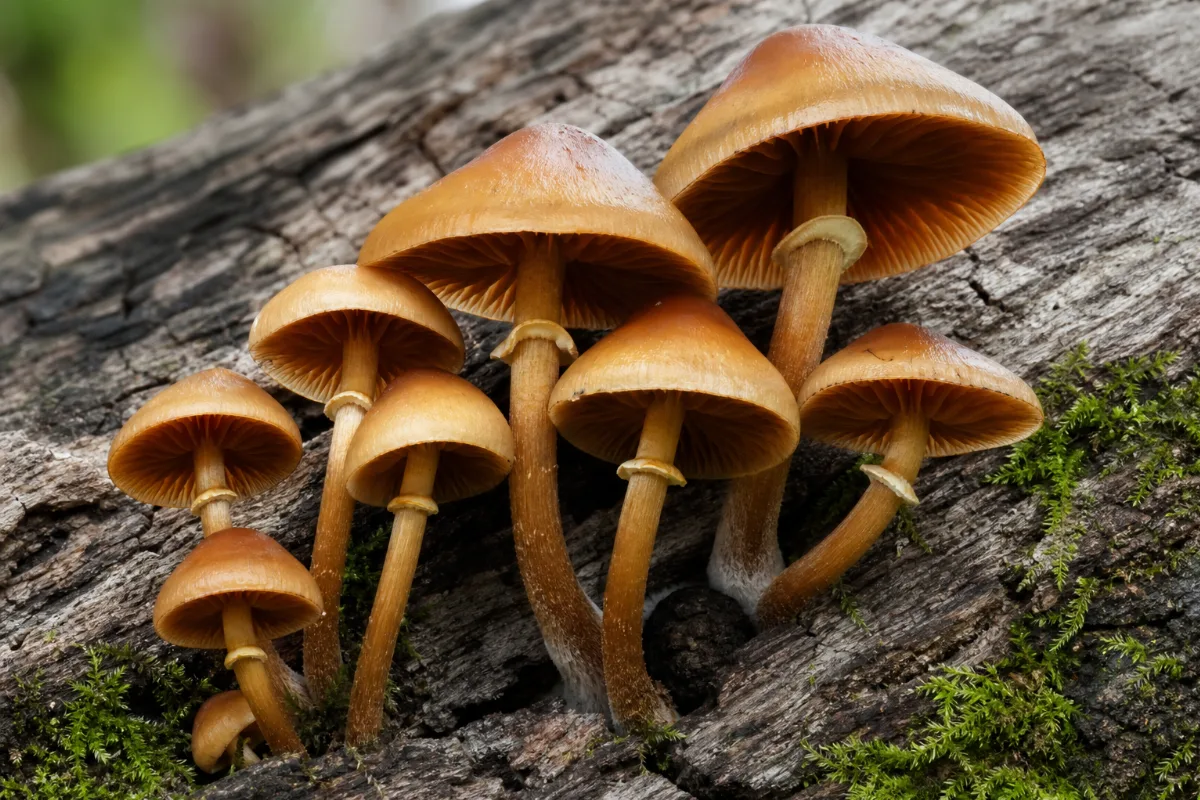
Mushrooms · Poisonous mushroom
Funeral bell
Galerina marginata (Batsch) Kühner · also called Funeral bell, deadly skullcap, deadly galerina
The funeral bell is a small wild mushroom that is deadly poisonous. It contains amatoxins, the same family of poisons as the death cap, which destroy liver cells and also injure the kidneys. Symptoms can start many hours or even days after eating, can seem to ease, and then return as organ failure. Cooking, drying or freezing does not make it safe, and there is no antidote. It is not a food or a supplement and has no known benefit. If anyone may have eaten a wild mushroom, call your poison centre or emergency number now.
General information, not medical advice. Last substantive update · Not medically reviewed. A named clinician has not signed off on this page. How this page is made
About Funeral bell
The funeral bell is a deadly poisonous wild mushroom. It contains amatoxins, which destroy liver cells and injure the kidneys. Illness can start late and can seem to ease before the liver fails. No part of this mushroom has a studied use. This page is a safety profile, not a guide, and it gives no help identifying mushrooms.
What it is
Galerina marginata is a fungus in the family Hymenogastraceae. GBIF lists it as an accepted species and lists Galerina autumnalis as a synonym. Some toxin papers group several named Galerina species into one complex, while GBIF keeps a few separate, so sources disagree on the exact boundaries. It is a wood-rotting fungus. Only a safety profile is given here; no description of its appearance is given.
Traditional and current uses
We found no traditional medicinal use and no food use. It has no known benefit, and the evidence points against ever eating it.
What the research shows
The research is about poisoning and toxin content. In western Canada, amatoxins were found in all 24 funeral bell group samples tested. In 27 French fruiting bodies the amatoxin amount varied about three-fold, with some Galerina holding more than some death caps, and no phallotoxins were found. Turkish samples had more beta- than alpha-amanitin.
The detailed case reports mostly describe relatives: a 13-person canteen outbreak and a 15-person outbreak in China (Galerina sulciceps and a similar species), a 60-year-old man in Japan, and a 6-year-old boy in Japan with a Galerina species where alpha-amanitin was found. Their illnesses ranged from gut illness to kidney failure to late liver damage. A 12-patient series of Galerina autumnalis poisoning described a long delay, a short false recovery and serious liver and clotting problems.
Forms and cooking
There is no safe form. A poison-centre page states that cooking, canning, pickling, freezing and drying do not remove the toxins of poisonous mushrooms.
At a glance
Traditional uses history, not proof
- No traditional medicinal or food use was found in the sources we read, so none is claimed.
Studied for research
- Any benefit in people: none studied, evidence against
- Poisoning: documented in case reports and reviews (the reason this page exists)
Main compounds
- Alpha-amanitin and beta-amanitin (amatoxins), found in the funeral bell group; gamma-amanitin in some samples
- No phallotoxins were found in French or Turkish samples
Common forms
- None. It is not a food or supplement, and no preparation makes it safe.
Research links: Review: amatoxin-containing mushroom poisonings (abstract) · Treatment of amatoxin poisoning, 20-year review (abstract) · Amatoxin mushroom poisoning: an update (abstract) · Amatoxins across Galerina species (abstract) · Amatoxins in Galerina marginata, France (abstract) · Poison-centre page on poisonous mushrooms · Research Library · Genes & Biomarkers Library
What it is and its history
- Accepted scientific name
- Galerina marginata
- Naming authority
- (Batsch) Kuhner (GBIF)
- Synonyms
- Name: Galerina autumnalis; Note: Listed as a synonym of G. marginata in GBIF.
- Common names
- Funeral bell (English); Deadly skullcap (English); Deadly galerina (English)
- Family or group
- Hymenogastraceae (a fungus family), not a plant
- Classification
- Fungi > Basidiomycota > Agaricomycetes > Agaricales > Hymenogastraceae > Galerina > Galerina marginata
- Native range
- Specimens studied came from France, Turkey and western Canada; the full range was not checked.
- Habitat
- A wood-rotting fungus (a French study found it on both hardwood and softwood hosts).
- What it looks like
- Fruiting body: Not described here, on purpose: identification must never be done from text.
- Look-alikes and adulterants
- Name: Edible wild mushrooms; Note: Published poisonings describe people eating wild mushrooms they had not identified. No identification advice is given here, and none should be taken from any single page.
- Sustainability and conservation
- Not checked.
What is inside, and how it may work
What it contains and how those compounds act in cells and animals. Laboratory and animal mechanisms are not proven effects in people.
Main compounds
| Compound | Family | Where it is concentrated | Activity studied | Level of evidence |
|---|---|---|---|---|
| Alpha-amanitin | amatoxin (bicyclic octapeptide) | Fruiting body Varies between specimens and places; no figures are quoted here. | Binds RNA polymerase II and blocks protein making in liver and kidney cells. 6 1 5 | Chemical analysis |
| Beta-amanitin | amatoxin | Fruiting body Higher than alpha-amanitin in Turkish samples. | Same family and action as alpha-amanitin. 1 6 | Chemical analysis |
| Gamma-amanitin | amatoxin | Fruiting body Found in French samples; below detection in Turkish samples. | Same family as alpha-amanitin. 6 1 | Chemical analysis |
Mechanisms, receptors and pathways
| Target or pathway | Gene or receptor | What was found | Level |
|---|---|---|---|
| RNA polymerase II | RNA polymerase II | Amatoxins bind RNA polymerase II irreversibly and damage liver and kidney (Enjalbert 2002 abstract). Block of messenger RNA synthesis leads to liver cell death (Yin 1993 abstract). 5 13 | Human case review |
Absorption, metabolism and elimination
- Absorption
- Not found in the abstracts read.
- Distribution
- One abstract says toxins are absorbed from the gut and reach the liver (Yin 1993).
- Metabolism
- Not found.
- Elimination
- Not found.
- Bioavailability
- Not established.
Nutritional composition
Not a food. No nutrition claim is made.
1 evidence against
What was looked at
The 1 benefits and uses checked for Funeral bell, each with how strong the evidence is. Tap one to open it.
What is Funeral bell good for?
The uses people ask about and how strong the human evidence is for each. For this mushroom the honest answer is that there is no benefit, only harm. Read this together with the Safety tab.
Benefits, one by one
Each card is a research question, not a promise. Tap a goal to filter. Open a card to see the studies, doses and limits.
Eating it for any health purpose
Evidence againstNo study has tested the funeral bell as a food, medicine or supplement, and none could be done safely. The research is entirely about poisoning. It contains amatoxins, the same family of poisons found in the death cap, which destroy liver cells.
3 studiesIt is not a food or a supplement. There is no safe amount to eat, and…
Studies, doses and limits
Results
No benefit results exist. Poisoning reports: see the Safety tab.
Why this rating
No benefit has been shown, and the mushroom is a documented cause of severe poisoning and death.
Form and dose studied
It is not a food or a supplement. There is no safe amount to eat, and nothing on this page tells anyone how to use it.
Limits
Absence of benefit research is not the main point: the documented harm is.
Why researchers looked
It is studied as a cause of poisoning and for its toxins, not for any benefit.
Traditional use
No traditional medicinal or food use was found in the sources we read, so none is claimed.
Proposed mechanism Human case review
Amatoxins bind a cell enzyme (RNA polymerase II) and block cells from making proteins, which damages the liver and the kidney (Enjalbert 2002 abstract). This is a poisoning mechanism, not a benefit.
A proposed mechanism does not show that the effect happens in people.
Deadly poisonous. See the Safety tab first.
Connections to the rest of health
How Funeral bell connects to the rest of our health knowledge graph. Every link says what kind of connection it is. A safety link (for example to the liver) is a warning, not a benefit. A study that merely mentions a topic never creates a benefit link.
Explore every connection: goals, body systems, organs, symptoms, genes
E. Health conditions
| Connected to | Kind of connection | Evidence status | Context | Studies |
|---|---|---|---|---|
| Amatoxin mushroom poisoning | High certainty | Documented cause of severe poisoning and death. Preparation or compound: Wild fruiting body |
4 3 5 | |
| Acute liver failure | Moderate certainty | Liver failure and transplant are described in amatoxin poisoning; funeral-bell-specific reports are limited. Liver failure and transplant are described in amatoxin poisoning. Preparation or compound: Wild fruiting body |
4 13 8 |
L. Active compounds
| Connected to | Kind of connection | Evidence status | Context | Studies |
|---|---|---|---|---|
| Alpha-amanitin | Biological association | Chemical analysis | Binds RNA polymerase II and blocks protein making in liver and kidney cells. Preparation or compound: Fruiting body |
6 1 5 |
| Beta-amanitin | Biological association | Chemical analysis | Same family and action as alpha-amanitin. Preparation or compound: Fruiting body |
1 6 |
| Gamma-amanitin | Biological association | Chemical analysis | Same family as alpha-amanitin. Preparation or compound: Fruiting body |
6 1 |
Each connection is stored with the ingredient, the connected record, the kind of connection, the evidence status, the supporting studies, the preparation or compound involved, and a review date (last reviewed October 25, 2026).
Evidence at a glance: what the research found for 1 outcome
Each outcome below is one thing researchers measured. Certainty is how far the evidence can be trusted, not how well it works. The full studies are on the next tab.
The evidence
The research centre for Funeral bell. Every record here was checked against PubMed or the publisher's page; we never list a study we have not verified.
Evidence by outcome
Bars show how many studies we found for each outcome, not how well it works. People are added up across trials only (reviews are not added, to avoid double counting).
How we rate evidence
High certainty
Several well-run trials or reviews agree; further research is unlikely to change the picture much.
Moderate certainty
Good trials point the same way, but some doubt remains.
Low certainty
Small, short or inconsistent trials. The finding could change with better research.
Very low certainty
Very little or very weak human data. Treat as a possibility only.
Mixed findings
Trials or reviews disagree with each other.
Not enough evidence
Not enough human research to say either way.
Evidence against
Good research found no benefit, or found harm.
We take the reviewers' own risk-of-bias and GRADE statements where they exist, and otherwise judge from study size, design, consistency, directness and whether a product matches what is sold. Many publications do not make evidence high. Method note: We read PubMed records and abstracts for 11 papers (reviews of amatoxin poisoning, lab measurements of Galerina toxins, a DNA and toxin study, and case reports and outbreaks), a poison-centre web page, and checked the names in GBIF. Full texts were not opened, and Index Fungorum was not checked. Certainty ratings are the compiler's own reading.
Study library: every study we checked 13
| Study | Design | People | Product, dose, length | Result |
|---|---|---|---|---|
| Akata 2020 Toxin components and toxicological importance of Galerina marginata from Turkey. Toxicon · PMID 32866473 · DOI |
Lab measurement Galerina marginata |
Galerina marginata from three regions of Turkey | Fruiting bodies analysed by HPLC-UV and LC-MS/MS fruiting body Not shown here |
Abstract: amatoxins can cause fatal poisoning; beta-amanitin was higher than alpha-amanitin in samples from all three regions; gamma-amanitin was below the detection limit and no phallotoxins were found. The authors say more studies in other parts of the world are needed. Methods, limits and fundingOutcomes: Alpha-, beta-, gamma-amanitin, phalloidin, phallacidin Limitations: Abstract read only; small regional sample. Funding and conflicts: Not stated in the abstract Read: abstract |
| Cao 2024 An outbreak of Galerina sulciceps-like (Galerina cf. sulciceps) mushroom poisoning. Clinical Toxicology · PMID 39301580 · DOI |
Case series Galerina cf. sulciceps |
15 15 people in one mass poisoning, Sichuan, China |
Galerina cf. sulciceps (a relative; species not confirmed) fruiting body Not shown here |
Abstract: stomach and gut symptoms came first after a mean of 13.4 hours; 86.7% had nausea, vomiting and diarrhoea; 66.7% had liver dysfunction and 26.7% low platelets; 10 mild and 5 severe cases; all recovered. The mushrooms held alpha-, beta- and gamma-amanitin. Methods, limits and fundingOutcomes: Symptoms, labs, severity, outcome Limitations: One outbreak, one hospital, a relative of the funeral bell. Abstract read only. Funding and conflicts: Not stated in the abstract Read: abstract |
| Caré 2024 [Amatoxin-containing mushroom poisoning: An update]. La Revue de Medecine Interne · PMID 37949692 · DOI |
Narrative review Amanita, Lepiota, Galerina |
Update on amatoxin-containing mushroom poisoning (French-language review) | Amatoxin-containing mushrooms (Amanita, Lepiota, Galerina) fruiting body Not shown here |
Abstract: Amanita phalloides is responsible for more than 90% of mushroom-related deaths. Symptoms are severe delayed gut problems more than six hours after eating, then often severe hepatitis that can progress to liver failure and need a transplant; acute kidney failure is common. There is no antidote; early hospital care is essential and combined silibinin and N-acetylcysteine is recommended. Mortality is currently less than 10%. Suspected cases should be referred to a poison control centre. Methods, limits and fundingOutcomes: Clinical course, diagnosis, treatment, prognosis Limitations: Mainly about Amanita. Abstract read only (French-language journal). Funding and conflicts: Not stated in the abstract Read: abstract |
| Diaz 2018 Amatoxin-Containing Mushroom Poisonings: Species, Toxidromes, Treatments, and Outcomes. Wilderness & Environmental Medicine · PMID 29325729 · DOI |
Narrative review Amanita, Lepiota, Galerina (G. marginata named) |
Review of amatoxin-containing mushroom poisonings (Amanita, Lepiota, Galerina) | Amatoxin-containing mushrooms fruiting body Not shown here |
Abstract: most mushroom poisonings are caused by unknown mushrooms and most fatal ones by amatoxin mushrooms. Amanita species cause more deaths than Galerina or Lepiota; the most frequently reported fatal Galerina ingestions are due to Galerina marginata. Apart from liver transplantation, treatments are supportive and have not been tested in randomized trials. People with late-appearing gut symptoms, with or without a false recovery before acute liver insufficiency, should be referred to a liver transplant centre. About half of those with amatoxin-induced acute liver failure will need a transplant. Methods, limits and fundingOutcomes: Species involved, toxidromes, treatments and outcomes Limitations: Review of published reports, not a systematic trial. Abstract read only. Funding and conflicts: Not stated in the abstract Read: abstract |
| Enjalbert 2002 Treatment of amatoxin poisoning: 20-year retrospective analysis. Journal of Toxicology: Clinical Toxicology · PMID 12475187 · DOI |
Retrospective review Amanita, Galerina, Lepiota |
2108 2108 hospitalized amatoxin poisoning exposures reported in the medical literature, North America and Europe, last 20 years |
Amatoxin-containing mushrooms (Amanita, Galerina, Lepiota); treatments given in hospital fruiting body Not shown here |
Abstract: amatoxins are alpha-, beta- and gamma-amanitin; they damage liver and kidney by irreversibly binding RNA polymerase II. Benzylpenicillin was used most but showed little efficacy; no benefit was found for thioctic acid or steroids. Silybin and N-acetylcysteine were supported as the most effective modes in the authors' comparison, and they call for confirming research. Methods, limits and fundingOutcomes: Mortality by treatment given Limitations: Pooled published case reports, not controlled trials, and mostly Amanita cases. Abstract read only. Treatment choices were made by doctors, so groups are not comparable. Funding and conflicts: Not stated in the abstract Read: abstract |
| Enjalbert 2004 Amatoxins in wood-rotting Galerina marginata. Mycologia · PMID 21148893 · DOI |
Lab measurement Galerina marginata |
27 27 Galerina marginata fruiting bodies from different French sites and hosts, compared with 17 death cap specimens |
Wood-growing Galerina marginata fruiting bodies analysed by HPLC fruiting body Not shown here |
Abstract: amatoxins (alpha-, beta- and gamma-amanitin) were found in every Galerina marginata fruiting body, and phallotoxins in none. The amount varied roughly three-fold between samples, and some Galerina specimens held more amanitin than some death caps. The authors report that DNA studies show G. autumnalis, G. marginata, G. oregonensis, G. unicolor and G. venenata are the same species, supporting a G. marginata complex. Methods, limits and fundingOutcomes: Amatoxins and phallotoxins Limitations: French specimens only. The abstract prints the unit as micrograms per milligram, which looks like a misprint, so no absolute figure is quoted on the page. Abstract read only. Funding and conflicts: Not stated in the abstract Read: abstract |
| GBIF 2026 GBIF Backbone Taxonomy: Galerina marginata, G. autumnalis, G. venenata, G. castaneipes GBIF API (checked 2026-10-25) · Source |
Taxonomy record n/a |
n/a | n/a Not shown here |
Galerina marginata (Batsch) Kuhner is ACCEPTED (key 8118872, family Hymenogastraceae). Galerina autumnalis (Peck) A.H.Sm. & Singer is listed as a SYNONYM of it. Galerina venenata A.H.Sm. (key 2533937) and Galerina castaneipes A.H.Sm. & Singer (key 3342707) are listed as separate ACCEPTED species. Methods, limits and fundingOutcomes: Accepted names and classification Limitations: Index Fungorum was not checked. Toxin papers treat several of these names as one complex, so the sources disagree on how many species there are. Funding and conflicts: n/a Read: record read |
| Kaneko 2001 Amatoxin poisoning from ingestion of Japanese Galerina mushrooms. Journal of Toxicology: Clinical Toxicology · PMID 11527238 · DOI |
Case report Galerina species (probably G. fasciculata) |
1 6-year-old boy, Japan |
Wild mushrooms later identified as a Galerina species, most likely Galerina fasciculata fruiting body Not shown here |
Abstract: cholera-like diarrhoea followed by late-onset severe liver deterioration. Alpha-amanitin was found in the leftover mushroom. The authors call it the first reported case of poisoning by a Japanese Galerina species in which an amatoxin was shown to be responsible. Methods, limits and fundingOutcomes: Symptoms and toxin Limitations: Single case. Abstract read only. The species is a relative, not G. marginata. Funding and conflicts: Not stated in the abstract Read: abstract |
| Landry 2021 Phylogenetic analysis of the distribution of deadly amatoxins among the little brown mushrooms of the genus Galerina. PLoS One · PMID 33566818 · DOI |
Lab measurement Galerina marginata sensu lato and other Galerina |
70 70 samples of Galerina and close relatives from western British Columbia, Canada, plus DNA analysis of 438 taxa |
Dried or fresh fruiting bodies analysed for amatoxins by LC-MS fruiting body Not shown here |
Abstract: some but not all Galerina species contain amatoxins at concentrations equalling those in the death cap. Amatoxins were detected in all 24 samples of the Galerina marginata sensu lato group tested. The authors note that Galerina species are notoriously difficult to identify by morphology. Methods, limits and fundingOutcomes: Which Galerina contain amatoxins Limitations: Specimens from one region. Abstract read only. Funding and conflicts: The authors declared that no competing interests exist. Read: abstract |
| Nagayama 2023 Amatoxin poisoning caused by Galerina sulciceps, a species with no prior record of identification in Japan: a case report. Toxicon · PMID 37119858 · DOI |
Case report Galerina sulciceps |
1 60-year-old man, Japan |
Galerina sulciceps (a relative, not the funeral bell) fruiting body Not shown here |
Abstract: he ate 30 caps of an unidentified wild mushroom and developed gastroenteritis, shock and acute kidney failure needing kidney replacement therapy; mild liver injury came late; he recovered and was transferred for rehabilitation on day 47. The leftover mushrooms held alpha- and beta-amanitin. The authors say the lack of liver dysfunction may reflect the ratio of the two toxins in this species. Methods, limits and fundingOutcomes: Clinical course and toxin analysis Limitations: Single case of a related species. Abstract read only. Funding and conflicts: The authors declare no known competing financial interests. Read: abstract |
| University of Kansas Health System Poison Control Center 2026 Poisonous Mushrooms (University of Kansas Health System Poison Control Center) Web page (read 2026-10-25) · Source |
Authoritative guidance Poisonous wild mushrooms in general |
n/a | n/a Not shown here |
States that poison centres in America get more than 9,000 mushroom calls a year; that even very experienced gatherers can have a hard time telling whether a mushroom is safe; that symptoms may not appear for a couple of days, by which time serious damage may have occurred; that cooking, canning, pickling, freezing and drying do not remove toxins; and that people should not pick and eat wild mushrooms. If someone eats a wild mushroom, call the Poison Help Line at 1-800-222-1222 straight away, do not wait for symptoms, and save a piece of the mushroom if you can. Methods, limits and fundingOutcomes: Public poison-centre guidance on wild mushrooms Limitations: General page about poisonous mushrooms, not about Galerina. The phone number is the US Poison Help line (the page says it can be called from anywhere in Kansas). It does not name a number for other countries. Funding and conflicts: n/a Read: web page read |
| Xiang 2018 Investigation and analysis of Galerina sulciceps poisoning in a canteen. Clinical Toxicology · PMID 29052443 · DOI |
Case series Galerina sulciceps |
13 13 employees, company canteen, Guizhou, China |
Galerina sulciceps (a relative, not the funeral bell) fruiting body Not shown here |
Abstract: symptoms ranged from gastroenteritis to liver and kidney dysfunction, with liver enzymes peaking at 48 to 72 hours. All 13 had hemodialysis at 48 hours plus supportive care and recovered fully by 30 days. The authors say the best prevention is to educate people not to gather and eat unidentified wild mushrooms. Methods, limits and fundingOutcomes: Symptoms, labs, treatment, recovery Limitations: One outbreak of a relative; treatment was combined so no single treatment can be judged. Abstract read only. Funding and conflicts: Not stated in the abstract Read: abstract |
| Yin 1993 [A clinical analysis of twelve patients with Galerina autumnalis poisoning]. Zhonghua Nei Ke Za Zhi · PMID 8033656 |
Case series Galerina autumnalis (G. marginata group) |
12 12 patients with Galerina autumnalis poisoning (China) |
Galerina autumnalis (now treated as part of the G. marginata group) fruiting body Not shown here |
Abstract: toxins block messenger RNA synthesis and damage liver cells, causing hepatitis, liver necrosis, serious clotting problems and DIC. The course has a long latent period, a short "pseudo-remission" and serious liver dysfunction, confirmed at autopsy. The authors advise treatment as early as possible and special attention to the pseudo-remission. Methods, limits and fundingOutcomes: Clinical course and management Limitations: 1993 Chinese-language journal; abstract read only. G. autumnalis is a synonym of G. marginata in GBIF. Funding and conflicts: Not stated in the abstract Read: abstract |
What we do not know yet
- No study of any benefit exists.
- Most detailed case reports are of relatives, not the funeral bell itself.
- No randomized trial of any treatment for amatoxin poisoning.
- No regulator statement about this mushroom was found, and no source for poison-centre numbers outside the US.
How new research is added
New studies are found by a saved PubMed search and placed in a review queue. A person reads each one before it changes any evidence rating or safety wording.
Lab markers
What changed in blood or saliva tests during trials. A changed number is not the same as feeling or being healthier, and we give no "normal ranges".
Safety
What studies and official sources say about side effects, medicines and who should check first. Each point shows what kind of evidence it comes from.
Main points to know 4
- Deadly poisonous. Do not eat it.. The funeral bell group contains amatoxins, the same family of poisons as the death cap. Amatoxins destroy liver cells and also injure the kidneys. In reviews, the most frequently reported fatal Galerina poisonings are due to Galerina marginata. Reviews say most deaths from mushroom poisoning are caused by amatoxin mushrooms. There is no antidote. Human case review 4 3 5 9
- Symptoms can start late, then seem to ease, then return as organ failure. Amatoxin poisoning is marked by a long delay before symptoms, then stomach and gut illness, sometimes a short false recovery, then liver damage. A poison-centre page says symptoms may not appear for a couple of days and that serious damage may already have happened by then. In a group of 15 people poisoned by a relative of this mushroom, gut symptoms began after about 13 hours on average. Feeling well early on is not a sign of safety. Human case review 13 4 2 11
- Cooking, drying and freezing do not make it safe. A poison-centre page states that cooking, canning, pickling, freezing and drying do not remove the toxins of poisonous mushrooms. The same page says even very experienced gatherers can have a hard time telling whether a mushroom is safe, and that people should not pick and eat wild mushrooms. Authoritative guidance 11
- This page gives no identification help, on purpose. Galerina species are described as notoriously difficult to tell apart even by specialists. Never decide a wild mushroom is safe from a photo, an app, a book or a web page. If someone has eaten a wild mushroom, see the urgent signs below. Authoritative guidance 9 11
Side effects 5
| Effect | How often | Severity and recovery | Evidence |
|---|---|---|---|
| Delayed vomiting and diarrhoea Dehydration can be severe: one man was in shock with acute kidney failure. | 86.7% of 15 people in one outbreak of a relative (Galerina cf. sulciceps) | moderate to severe Usually settles, but may be followed by organ damage | Human case series 2 12 8 |
| Liver damage and liver failure Findings from amatoxin mushrooms overall and from relatives; the funeral bell itself has fewer detailed reports. | 66.7% had liver dysfunction in the 15-person outbreak; about half of people with amatoxin acute liver failure need a transplant (review) | severe, can be fatal Some recover with intensive care; some need a liver transplant | Human case review 4 3 2 13 |
| Kidney injury Amatoxins damage liver and kidney (Enjalbert 2002 abstract). | Reported in a 13-person canteen outbreak and in a 60-year-old man (both a relative, Galerina sulciceps) | moderate to severe Resolved within about 10 to 47 days in these cases, with dialysis in some | Human case series 12 10 5 |
| Clotting problems and low platelets | Low platelets in 26.7% of 15 people (relative); clotting abnormalities in 12 patients (G. autumnalis) | severe Not described in the abstracts | Human case series 2 13 |
| Death Do not read the figure as a safe odds: it reflects hospital care and mostly another genus. | Mortality in amatoxin poisoning is described as currently less than 10% with modern intensive care (mostly Amanita data); outcomes vary by case and by treatment access | fatal Not applicable | Human case review 3 4 |
Liver
Amatoxins bind RNA polymerase II and block protein making, causing liver cell death, hepatitis, liver necrosis and clotting failure (Yin 1993 and Enjalbert 2002 abstracts). Not every case shows liver injury: one man poisoned by a relative had only mild late liver injury, which the authors link to the toxin mix of that species. 13 5 8 10
How often. Exact rates for the funeral bell are unknown.
Monitoring. Hospital monitoring only. Anyone who may have eaten it needs emergency care, not home watching.
- .
- .
- .
This is a safety connection. It is not evidence that Funeral bell supports liver health.
Medicines and supplements 1
| With | Why it matters | Importance | Evidence | What to do |
|---|---|---|---|---|
| Any medicine, herb or supplement general | No interaction reports found. The question is not meaningful for a poison. | Not applicable. Anyone who may have eaten it needs emergency care. | None Not enough evidence | Tell the emergency team about every medicine the person takes. |
Who should check first 3
| Situation | Advice | Evidence |
|---|---|---|
| Everyone | Do not eat it. There is no safe amount and no safe preparation. | Human case review 4 11 |
| Pregnancy, breastfeeding and children | No source we read describes the funeral bell in pregnancy or breastfeeding. A 6-year-old boy had severe late liver deterioration after a related Galerina meal. Treat any possible ingestion as an emergency at any age. | Human case report 8 |
| Anyone who cannot be certain what a wild mushroom is | Do not eat it. A poison-centre page says even very experienced gatherers can have a hard time telling. | Authoritative guidance 11 |
Overdose, product quality and regulators
Summary. Amatoxin poisoning. Toxins found in funeral bell group samples include alpha- and beta-amanitin (and gamma-amanitin in some). No phallotoxins were found in 27 French specimens or in Turkish samples.
Animal. Not reviewed.
Human doses studied. No human study. This page gives no amounts.
Overdose response. Call your local poison centre or emergency number at once. Do not wait for symptoms. Hospital care is supportive; reviews report that some clinicians use silibinin and N-acetylcysteine, and some patients need a liver transplant. Evidence for the extra medicines is limited and not from randomized trials.
Genotoxicity. Not studied here.
Toxic or hazardous parts. Whole fruiting body. Amatoxins were found in every funeral bell group fruiting body tested.
Not relevant: it is not a food or supplement. The toxin amount varies between specimens.
Amatoxin content varies. In 27 French fruiting bodies the amatoxin amount varied about three-fold, and some Galerina specimens held more amanitin than some death caps. Turkish samples had more beta- than alpha-amanitin. In western Canada amatoxins were found in all 24 funeral bell group samples tested. 6 1 9
When to get medical help
- Anyone who has eaten a wild mushroom and you are worried: call your local poison centre or emergency number now. Do not wait for symptoms. In the US, a poison-centre page gives the Poison Help Line as 1-800-222-1222 and says to save a piece of the mushroom if you can. We did not find a source stating numbers for other countries.
- Vomiting, watery diarrhoea or stomach pain starting hours to a couple of days after a wild mushroom meal, even if you felt fine at first: get emergency help.
- Feeling better after the stomach illness does not mean the danger has passed: amatoxin poisoning can have a quiet period before liver damage.
- Yellow skin or eyes, bleeding or bruising easily, passing very little urine, or confusion after a wild mushroom meal: emergency care now.
If someone may be poisoned or in a crisis, contact a clinician or emergency service straight away. In the US, Poison Control is 1-800-222-1222.
General information only, not medical advice. Ask a clinician or pharmacist before use, especially with medicines, in pregnancy or with a health condition. See the Natural Remedy Safety guide.
Frequently asked questions
What is the funeral bell?
How dangerous is it?
What does the poison do?
How fast do symptoms start?
Can someone feel better and still be in danger?
Is there an antidote?
Does cooking, drying or freezing make it safe?
No. A poison-centre page states that cooking, canning, pickling, freezing and drying do not remove the toxins of poisonous mushrooms.
Can a photo, an app or this page tell me whether a mushroom is safe?
Does it have any health benefit?
Is it the same as the death cap?
What should I do if someone may have eaten a wild mushroom?
Call your local poison centre or emergency number right away and do not wait for symptoms. A US poison-centre page gives the Poison Help Line as 1-800-222-1222 and says to save a piece of the mushroom if you can. We did not find a source for numbers in other countries.
Explore by health goal
Editorial transparency
- Written by
- AlternativeMed editorial team. Research compiled with AI assistance, then checked against PubMed records.
- Medical review
- None. This page has not been reviewed by a physician or pharmacist.
- First published
- 2026-10-25
- Last substantive update
- 2026-10-25
- How we research
- We read PubMed records and abstracts for 11 papers (reviews of amatoxin poisoning, lab measurements of Galerina toxins, a DNA and toxin study, and case reports and outbreaks), a poison-centre web page, and checked the names in GBIF. Full texts were not opened, and Index Fungorum was not checked. Certainty ratings are the compiler's own reading.
- How we rate evidence
- See "How we rate evidence" in the Evidence tab.
- Independence
- No product is promoted on this page. No affiliate links are shown. This page is information, not a recommendation to eat any wild mushroom.
Sources 13
Each source was opened and checked. Where we read only the abstract, it says so. The small numbers in the text point here.
- Akata I, Yilmaz I, Kaya E, et al. Toxin components and toxicological importance of Galerina marginata from Turkey.. Toxicon. 2020. PMID 32866473. DOI 10.1016/j.toxicon.2020.08.017. (abstract)
- Cao M, Luo S, Kang T, et al. An outbreak of Galerina sulciceps-like (Galerina cf. sulciceps) mushroom poisoning.. Clinical Toxicology. 2024. PMID 39301580. DOI 10.1080/15563650.2024.2402501. (abstract)
- Caré W, Bruneau C, Rapior S, et al. [Amatoxin-containing mushroom poisoning: An update].. La Revue de Medecine Interne. 2024. PMID 37949692. DOI 10.1016/j.revmed.2023.10.459. (abstract)
- Diaz JH. Amatoxin-Containing Mushroom Poisonings: Species, Toxidromes, Treatments, and Outcomes.. Wilderness & Environmental Medicine. 2018. PMID 29325729. DOI 10.1016/j.wem.2017.10.002. (abstract)
- Enjalbert F, Rapior S, Nouguier-Soulé J, et al. Treatment of amatoxin poisoning: 20-year retrospective analysis.. Journal of Toxicology: Clinical Toxicology. 2002. PMID 12475187. DOI 10.1081/clt-120014646. (abstract)
- Enjalbert F, Cassanas G, Rapior S, et al. Amatoxins in wood-rotting Galerina marginata.. Mycologia. 2004. PMID 21148893. DOI 10.1080/15572536.2005.11832920. (abstract)
- GBIF. GBIF Backbone Taxonomy: Galerina marginata, G. autumnalis, G. venenata, G. castaneipes. GBIF API (checked 2026-10-25). 2026. (record read)
- Kaneko H, Tomomasa T, Inoue Y, et al. Amatoxin poisoning from ingestion of Japanese Galerina mushrooms.. Journal of Toxicology: Clinical Toxicology. 2001. PMID 11527238. DOI 10.1081/clt-100105164. (abstract)
- Landry B, Whitton J, Bazzicalupo AL, et al. Phylogenetic analysis of the distribution of deadly amatoxins among the little brown mushrooms of the genus Galerina.. PLoS One. 2021. PMID 33566818. DOI 10.1371/journal.pone.0246575. (abstract)
- Nagayama T, Kamijo Y, Fukiharu T, et al. Amatoxin poisoning caused by Galerina sulciceps, a species with no prior record of identification in Japan: a case report.. Toxicon. 2023. PMID 37119858. DOI 10.1016/j.toxicon.2023.107139. (abstract)
- University of Kansas Health System Poison Control Center. Poisonous Mushrooms (University of Kansas Health System Poison Control Center). Web page (read 2026-10-25). 2026. (web page read)
- Xiang H, Zhou Y, Zhou C, et al. Investigation and analysis of Galerina sulciceps poisoning in a canteen.. Clinical Toxicology. 2018. PMID 29052443. DOI 10.1080/15563650.2017.1388386. (abstract)
- Yin W, Yang ZR. [A clinical analysis of twelve patients with Galerina autumnalis poisoning].. Zhonghua Nei Ke Za Zhi. 1993. PMID 8033656. (abstract)


