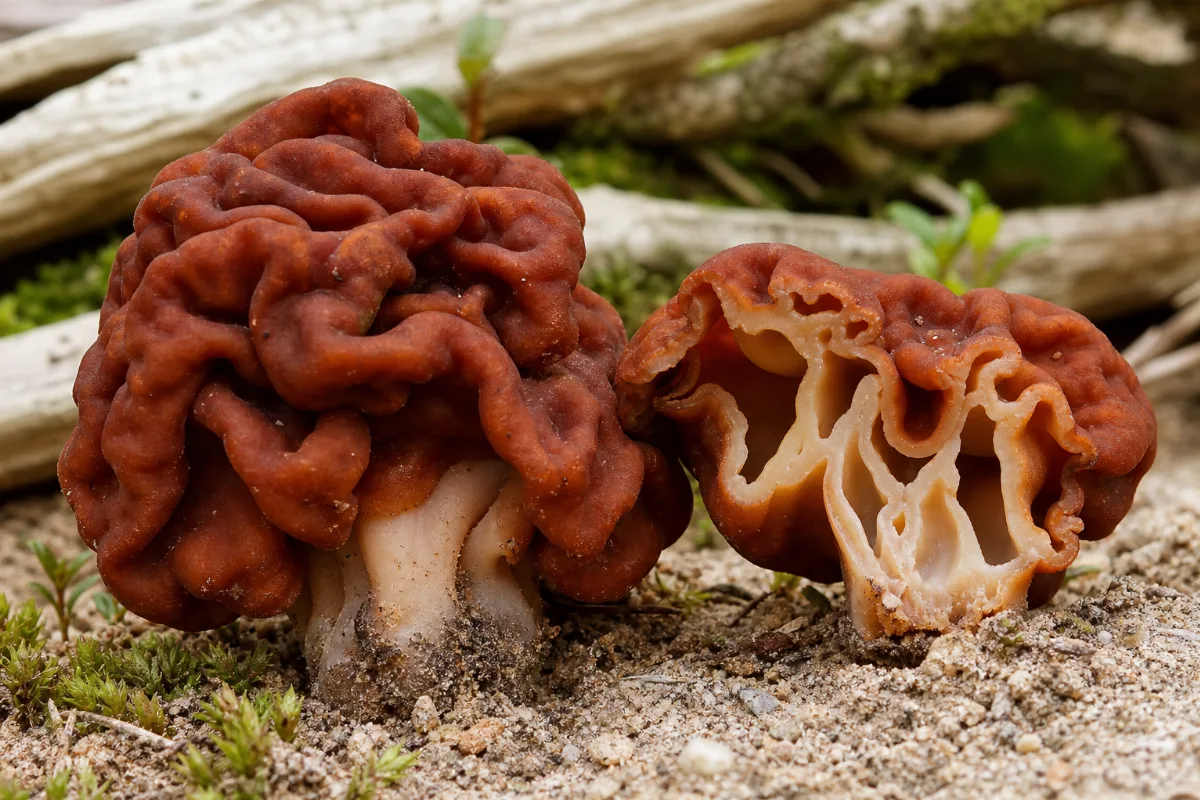
Mushrooms · Poisonous mushroom
False Morel
Gyromitra esculenta (Pers. ex Fr.) · also called False morel, lorchel, beefsteak morel; not the same as true morels
False morel (Gyromitra esculenta) is a poisonous mushroom. Its toxin, gyromitrin, is turned in the body into a hydrazine that can harm the gut, liver and nervous system. Poisoning usually starts with vomiting and diarrhoea many hours later, and liver injury, seizures and deaths are reported. It has no proven health use. If anyone may have eaten one, call a poison centre now (US: 1-800-222-1222).
General information, not medical advice. Last substantive update · Not medically reviewed. A named clinician has not signed off on this page. How this page is made
About False Morel
False morel (Gyromitra esculenta) is a poisonous mushroom. Its toxin gyromitrin becomes monomethylhydrazine in the body. Reports describe delayed stomach illness, liver injury, nerve effects, seizures and deaths, and published case reports probably overstate the risk because severe cases are written up more often. It has no proven health use. This page gives no identification help, no preparation advice and no amounts.
Danger first: what it is and why it poisons
False morel is a mushroom of the genus Gyromitra. It contains gyromitrin, which is split in the stomach into N-methylhydrazine (MMH). MMH ties up the active form of vitamin B6, so the brain makes less GABA, a calming signal. Reviews link this to the nerve effects and seizures seen in severe cases. The exact mechanism of toxicity is not fully known.
Poisoning usually begins with vomiting, diarrhoea and stomach pain after a delay. In 201 published ingestions the median onset was about 9 hours. Liver injury was reported in 53.7% and nervous-system effects in 51.7%. The reported death rate was 28.9%, but those are published case reports that lean towards severe cases. A Michigan poison centre that counted every case it received (118 cases) reported no deaths.
What the reports show
Michigan poison centre, 2002 to 2020: of 83 people with symptoms, 74.7% had stomach and gut symptoms, 26.5% nervous-system symptoms and 16.9% liver injury. Most (70%) needed only supportive care. Pyridoxine (vitamin B6) was used in 7 people with liver or nerve effects.
A first stomach upset that seems to pass is not a sign of safety, because liver and nerve effects can follow. Reactions differ between people and between collections of mushrooms; the authors point to differences in the amount eaten, in the mushroom species and in people's genes.
Cooking, drying and special preparation
Gyromitrin is volatile and dissolves in water. Reviews say boiling or long drying only lowers it partly, that the processing used in Scandinavia has long been reported as inefficient, and that breathing vapours released during cooking can itself cause poisoning. This page gives no preparation advice and no figure that could be read as a safe amount.
What regulators are reported to say
We did not read these regulators' own pages. A 2020 review reports that the Finnish Food Authority advised that pregnant and breastfeeding women and children should not eat it because toxin residues remain after drying or cooking, that FDA groups Gyromitra with other toxic false morels and uses import alerts for true morels from France that may be mixed with it, and that France and Finland have proposed edible lists that include it. Treat these as the review's account, not current official wording.
A possible long-term question: ALS
Researchers who studied 14 ALS cases in a French Alps hamlet found that eating false morels was reported only by people with ALS. The mushrooms were later re-identified as Gyromitra esculenta and G. venenata, with measurable gyromitrin. Most of the 7 patients gene-tested were predicted slow or intermediate acetylators. This is a hypothesis from a very small cluster, not an established cause.
Mix-ups with true morels
True morels are a different genus. Poison-centre authors say resemblance between true and false morels has led to Gyromitra being eaten as Morchella. That is a statement about poisoning reports. This page does not help anyone tell mushrooms apart, and nothing replaces a poison centre's advice.
At a glance
Traditional uses history, not proof
- Eaten as a delicacy in parts of Europe; a 2020 review says it is sold in Scandinavian countries after local processing that has long been reported as inefficient (Lagrange & Vernoux 2020).
- A 2020 review says it appears as edible on mushroom lists proposed in France and Finland (second-hand; the lists were not read).
- A 2025 interview study in Andorra found it among the five most-cited wild edible mushrooms there (Álvarez-Puig 2025).
Studied for research
- Eating it as food: evidence against, reports show harm
- Possible link to ALS (a hypothesis about harm): insufficient evidence
- Any health benefit: none studied
Main compounds
- Gyromitrin, the main toxin
- N-methylhydrazine (MMH), the toxic breakdown product formed in the body
- N-methyl-N-formylhydrazine (MFH), an intermediate
Common forms
- Wild mushroom, fresh
- Dried or parboiled in some countries (reviews call this unreliable and do not treat it as making the mushroom safe)
Research links: Poison Control (US): get help online or call 1-800-222-1222 · NHS: Poisoning (UK) · Review of 201 false morel ingestions, 2025 (abstract) · Michigan poison-centre series, 2024 (abstract) · Three liver-injury cases, 2019 (abstract) · Review on false and true morels, 2020 (abstract) · Research Library · Genes & Biomarkers Library
What it is and its history
- Accepted scientific name
- Gyromitra esculenta
- Naming authority
- Pers. ex Fr.
- Common names
- False morel (English); Lorchel (English); Beefsteak morel (English)
- Family or group
- Discinaceae, a family of fungi (this is a mushroom, not a plant). Part concerned: the fruiting body.
- Classification
- Fungi > Ascomycota > Pezizomycetes > Pezizales > Discinaceae > Gyromitra > Gyromitra esculenta
- Native range
- Not checked in detail. Sources describe cases in North America and Europe, and sale in Scandinavian countries.
- Habitat
- Not checked.
- What it looks like
- Part used: The fruiting body (the mushroom). This page does not describe how to recognise it.
- Look-alikes and adulterants
- Name: True morels (genus Morchella); Note: A different genus. Poison-centre authors say resemblance between true and false morels has led to Gyromitra being eaten as Morchella. This is a statement about poisoning reports, not a way to tell them apart.; Name: Other false morels (for example Gyromitra venenata, Verpa bohemica); Note: The name 'false morel' covers other fungi with similar toxins in the sources we read. A 2024 laboratory study found gyromitrin in the Gyromitra esculenta group and in G. leucoxantha; four German G. gigas specimens had none detected. That is laboratory chemistry, not a safety rating.
- Sustainability and conservation
- Not checked.
Traditional use and history history, not clinical proof
| Tradition or era | Documented use | Source |
|---|---|---|
| Cuisine in parts of Europe | A 2020 review says it is found as edible on mushroom lists proposed in France and Finland and is eaten in the Scandinavian countries after local processing that is thought to partly remove the toxin; the review says this processing has long been reported as inefficient. A 2025 interview study in Andorra lists it among the five most-cited wild edible mushrooms there. | Lagrange & Vernoux 2020; Álvarez-Puig 2025 |
| Medical literature | A 1991 review describes poisonings and deaths, with vomiting and diarrhoea followed by jaundice, convulsions and coma. A 2020 review says its toxic status was long disputed because people react differently. | Michelot & Toth 1991; Lagrange & Vernoux 2020 |
Traditional use shows how it was used. It does not show that it works or is safe today.
What is inside, and how it may work
What it contains and how those compounds act in cells and animals. Laboratory and animal mechanisms are not proven effects in people.
Main compounds
| Compound | Family | Where it is concentrated | Activity studied | Level of evidence |
|---|---|---|---|---|
| Gyromitrin (acetaldehyde N-methyl-N-formylhydrazone) | hydrazone | Fruiting body Single laboratory measurements: 909 and 2,444 mg/kg dried mushroom in two G. esculenta specimens from France (2024 study). Not typical values; they vary by specimen, species and handling, and are not a measure of safety. | Toxin. Volatile and water-soluble; split in the stomach into N-methyl-N-formylhydrazine and N-methylhydrazine. 6 3 7 | Review |
| N-methylhydrazine (MMH) | hydrazine | Formed in the body from gyromitrin | The compound mainly held responsible for the acute poisoning. Ties up active vitamin B6 (pyridoxal phosphate), lowering GABA synthesis; tumour-causing in older animal studies. 3 7 6 | Review |
Mechanisms, receptors and pathways
| Target or pathway | Gene or receptor | What was found | Level |
|---|---|---|---|
| Vitamin B6 and GABA synthesis | Pyridoxal phosphate-dependent glutamic acid decarboxylase | MMH forms hydrazones with active vitamin B6, so less GABA, a calming signal in the brain, is made. This is the proposed route to the nerve effects and seizures. The review says the exact mechanism of toxicity is not fully known. 3 4 | Review of animal and lab work |
| Liver cell damage | Not specified | Reactive intermediates and glutathione depletion are described in isolated liver cells and microsomes; the review links this to liver injury. 3 | Laboratory research |
| Slow acetylation and susceptibility | NAT2 | Authors propose that people who clear the toxic breakdown product slowly may be more at risk of nerve and genotoxic effects. Proposed, not shown. 6 10 | Hypothesis |
Absorption, metabolism and elimination
- Absorption
- Gyromitrin is quickly split in the acid stomach into easily absorbed hydrazines (review statement). Poisoning can also follow breathing cooking vapours.
- Distribution
- Not established.
- Metabolism
- The conversion in the stomach depends on acidity and is not complete; hydrazines are further converted in the liver to reactive intermediates. Fast and slow acetylator types are discussed.
- Elimination
- Not established in sources we read.
- Bioavailability
- Not established.
Isolated compounds versus whole extracts
The wild mushroom is the only form in the sources we read. No supplement, extract or tested consumer product was found. The toxin gyromitrin itself is studied in the laboratory.
Nutritional composition
False morel is not a nutrient source and the laboratory reports give no composition that could count as a reason to eat it.
2 not enough evidence1 evidence against
What is False Morel good for?
The uses people ask about and how strong the human evidence is for each. None is proven. Read every row together with the Safety tab: this is a poisonous mushroom.
Benefits, one by one
Each card is a research question, not a promise. Tap a goal to filter. Open a card to see the studies, doses and limits.
Eaten as food (a delicacy in some places)
Evidence againstFalse morel is eaten in some countries as a delicacy, but it is a poisonous mushroom. No study has shown a health benefit from eating it. Poison-centre and hospital reports show harm, including a 28.9% death rate in published case reports (which probably overstates the risk) and no deaths in a Michigan poison-centre series.
4 studiesNot covered. This page gives no amounts, preparation or ways of eatin…
Studies, doses and limits
What the trials found
Only case reports, case series and poison-centre records. No trial and no study of benefit.
Results
Nothing measured as a benefit. In 201 published ingestions 88.1% had stomach and gut symptoms (median onset 9 hours), 53.7% liver effects and 51.7% nervous-system effects. In a Michigan poison-centre series (118 cases, 83 with symptoms) 74.7% had stomach symptoms, 16.9% liver injury and 26.5% nervous-system symptoms, and there were no deaths.
Effect sizes as reported
None. No outcome was measured as a benefit.
Why this rating
Reports describe harm. Published case reports lean towards severe cases, while the Michigan series counted all cases to one poison centre; both are observational and cannot give a safe level.
Form and dose studied
Not covered. This page gives no amounts, preparation or ways of eating the mushroom.
Who was studied
People who ate it (adults and children). Reviews say the elderly and people taking isoniazid may be more susceptible (review statement, not tested).
Limits
Voluntary reports and published cases; reports rarely identify the exact species eaten; amounts eaten are unknown.
Why researchers looked
People ask about it because it is sold and eaten in parts of Scandinavia and Eastern Europe and is sometimes mistaken for true morels. The research is about poisoning, not about benefit.
Traditional use
A 2020 review says it is found as edible in mushroom lists proposed in France and Finland and is deliberately eaten in the Scandinavian countries, and a 2025 interview study in Andorra found it among the most-cited wild edible mushrooms there. The same review says the local processing used to justify this has long been reported as inefficient.
Proposed mechanism Preliminary mechanism
Gyromitrin is split in the stomach into N-methylhydrazine (MMH), which ties up active vitamin B6 and lowers GABA production. The exact mechanism of toxicity is not fully known.
A proposed mechanism does not show that the effect happens in people.
This is a poisonous mushroom. Eating it can cause delayed vomiting and diarrhoea, liver injury, nerve effects and seizures, and deaths are reported. Do not eat it.
Possible link to ALS (a hypothesis about harm)
Not enough evidenceResearchers asked whether eating false morels could play a part in sporadic ALS (motor neurone disease) in some people. It rests on one small cluster in the French Alps and a few mushroom samples. It is not established.
2 studiesNot covered.
Studies, doses and limits
What the trials found
One small cluster report with a later laboratory re-check of the mushrooms and gene testing of 7 patients. No cohort study or trial.
Results
The mushrooms were re-identified as Gyromitra esculenta and G. venenata, which had measurable gyromitrin (909 and 2,444 mg/kg dried mushroom in two G. esculenta specimens, single specimens). Of 7 patients tested, 4 were predicted slow, 1 intermediate and 2 fast acetylators.
Effect sizes as reported
None reported.
Why this rating
One small cluster, no comparison of cause, authors partly the same group that proposed the link.
Form and dose studied
Not covered.
Who was studied
A small group of long-term residents in one French Alps hamlet.
Limits
Tiny numbers; the first report had the species wrong; the specimens are not necessarily what patients ate decades earlier; association is not proof of cause.
Why researchers looked
In a French Alps hamlet, 14 people were diagnosed with ALS between 1990 and 2018. In interviews with 13 living patients and 48 matched neighbours, eating false morels was reported only by people with ALS.
Traditional use
Not applicable.
Proposed mechanism Preliminary mechanism
The authors propose that the toxic breakdown product MMH has genotoxic potential, and that people who clear it slowly (slow-acetylator NAT2 type) could be at higher risk. This is a proposed mechanism.
A proposed mechanism does not show that the effect happens in people.
This is a hypothesis about harm, not a benefit. It is not established.
Health benefits (none studied)
Not enough evidenceNo trial has tested false morel for any health purpose. It is not a supplement and has no proven health use. Laboratory work has measured its toxin, not a benefit.
2 studiesNot covered.
Studies, doses and limits
What the trials found
None.
Results
Gyromitrin content varies by specimen and species. It tells you nothing about safety or effects.
Effect sizes as reported
Not applicable.
Why this rating
No human or animal study of benefit.
Form and dose studied
Not covered.
Who was studied
None.
Limits
Laboratory measurements on dried specimens only.
Why researchers looked
Chemists measured gyromitrin to understand the poisoning and which species hold it. A 2023 laboratory study found gyromitrin in all tested specimens of the Gyromitra esculenta group and of G. leucoxantha and called its spread among false morels limited.
Traditional use
Not applicable.
Proposed mechanism Preliminary mechanism
Not applicable. The laboratory work is chemical measurement.
A proposed mechanism does not show that the effect happens in people.
No health use is recommended.
Connections to the rest of health
How False Morel connects to the rest of our health knowledge graph. Every link says what kind of connection it is. A safety link (for example to the liver) is a warning, not a benefit. A study that merely mentions a topic never creates a benefit link.
Explore every connection: goals, body systems, organs, symptoms, genes
B. Body systems
| Connected to | Kind of connection | Evidence status | Context | Studies |
|---|---|---|---|---|
| Nervous system | Adverse effect or risk | Low certainty | Dizziness, unsteadiness, delirium, seizures and coma are described, mainly in severe cases. Preparation or compound: Mushroom (gyromitrin, MMH) |
9 5 |
| Digestive System | Biological association | Evidence against | Studied for: Eaten as food (a delicacy in some places) | 9 10 5 15 |
| Nervous System | Biological association | Not enough evidence | Studied for: Possible link to ALS (a hypothesis about harm) | 6 5 |
| Metabolic System | Biological association | Not enough evidence | Studied for: Health benefits (none studied) | 2 6 |
E. Health conditions
| Connected to | Kind of connection | Evidence status | Context | Studies |
|---|---|---|---|---|
| Food poisoning | Adverse effect or risk | Moderate certainty | Delayed vomiting and diarrhoea are the most common effect in case reports and poison-centre series. Preparation or compound: Mushroom (gyromitrin) |
9 10 |
| Acute liver failure | Adverse effect or risk | Low certainty | Liver injury and liver failure are documented in case reports. Preparation or compound: Mushroom (gyromitrin) |
1 9 |
J. Genes, receptors and enzymes
| Connected to | Kind of connection | Evidence status | Context | Studies |
|---|---|---|---|---|
| NAT2 (N-acetyltransferase 2) | Preliminary mechanism | Hypothesis | Fast, intermediate and slow acetylator types; 4 of 7 tested ALS patients in one cluster were predicted slow acetylators. Proposed link only. | 6 |
L. Active compounds
| Connected to | Kind of connection | Evidence status | Context | Studies |
|---|---|---|---|---|
| Gyromitrin (acetaldehyde N-methyl-N-formylhydrazone) | Biological association | Review | Toxin. Volatile and water-soluble; split in the stomach into N-methyl-N-formylhydrazine and N-methylhydrazine. Preparation or compound: Fruiting body |
6 3 7 |
| N-methylhydrazine (MMH) | Biological association | Review | The compound mainly held responsible for the acute poisoning. Ties up active vitamin B6 (pyridoxal phosphate), lowering GABA synthesis; tumour-causing in older animal studies. Preparation or compound: Formed in the body from gyromitrin |
3 7 6 |
Each connection is stored with the ingredient, the connected record, the kind of connection, the evidence status, the supporting studies, the preparation or compound involved, and a review date (last reviewed October 25, 2026).
The evidence
The research centre for False Morel. Every record here was checked against PubMed or the publisher's page; we never list a study we have not verified.
Evidence by outcome
Bars show how many studies we found for each outcome, not how well it works. People are added up across trials only (reviews are not added, to avoid double counting).
How we rate evidence
High certainty
Several well-run trials or reviews agree; further research is unlikely to change the picture much.
Moderate certainty
Good trials point the same way, but some doubt remains.
Low certainty
Small, short or inconsistent trials. The finding could change with better research.
Very low certainty
Very little or very weak human data. Treat as a possibility only.
Mixed findings
Trials or reviews disagree with each other.
Not enough evidence
Not enough human research to say either way.
Evidence against
Good research found no benefit, or found harm.
We take the reviewers' own risk-of-bias and GRADE statements where they exist, and otherwise judge from study size, design, consistency, directness and whether a product matches what is sold. Many publications do not make evidence high. Method note: We read the PubMed records and abstracts of 11 papers, the full text of four reviews and studies, the US Poison Control and NHS poisoning pages, and checked the name in GBIF. Statements by regulators come from a 2020 review and are marked as not read at source. Anything we could not check is flagged.
Study library: every study we checked 15
| Study | Design | People | Product, dose, length | Result |
|---|---|---|---|---|
| Arłukowicz-Grabowska 2019 Acute liver injury, acute liver failure and acute on chronic liver failure: A clinical spectrum of poisoning due to Gyromitra esculenta. Ann Hepatol · PMID 31014949 · DOI |
Case report |
3 Three patients with liver injury after Gyromitra esculenta poisoning |
n/a n/a n/a n/a · vs n/a |
Three cases: acute liver injury, acute liver failure and acute-on-chronic liver failure. Patients arrived with encephalopathy and signs of liver failure. Two recovered completely with supportive care; the one with existing liver disease developed multi-organ failure and died. Methods, limits and fundingOutcomes: Liver outcomes Limitations: Three cases; cannot give how often liver failure happens. Funding and conflicts: Not stated in the abstract. Read: abstract |
| Dirks 2023 Not all bad: Gyromitrin has a limited distribution in the false morels as determined by a new ultra high-performance liquid chromatography method. Mycologia · PMID 36541902 · DOI |
Laboratory laboratory |
66 66 fungus specimens from the lorchel family (Discinaceae), 105 tests |
n/a n/a n/a n/a · vs n/a |
Gyromitrin was detected in all tested specimens of the Gyromitra esculenta group and of G. leucoxantha. The authors say gyromitrin production in the family is discontinuous and more limited than previously thought. Methods, limits and fundingOutcomes: Gyromitrin detection by 2,4-dinitrobenzaldehyde derivatisation and LC analysis; species by DNA Limitations: Laboratory chemistry on dried specimens; it says nothing about what is safe to eat. It does not make any false morel safe. Funding and conflicts: Research Support, Non-U.S. Gov't and U.S. Gov't (per PubMed). Read: abstract |
| Gouvinhas 2024 The most dreadful mushroom toxins: a review of their toxicological mechanisms, chemical structural characteristics, and treatment. EXCLI J · PMID 39165585 · DOI |
Narrative review human and animal |
Review of the most dangerous mushroom toxins; gyromitrin section read in full text | n/a n/a n/a n/a · vs n/a |
Gyromitrin is volatile and water-soluble. It is split in the stomach into N-methyl-N-formylhydrazine and N-methylhydrazine (MMH); this depends on stomach acidity and is not complete. The exact mechanism of toxicity is unknown, but MMH lowers GABA production by tying up active vitamin B6. MMH and its precursors caused tumours in mice and hamsters; no human cancer reports were found. Hepatic and renal damage may be fatal in 2-4% of cases (as the review cites older work). Activated charcoal has been advocated without effectiveness evidence; intravenous pyridoxine is used for severe nerve toxicity and benzodiazepines for seizures; folinic acid and N-acetylcysteine are suggested without controlled studies. Methods, limits and fundingOutcomes: Mechanism, toxicity and treatment of gyromitrin Limitations: Narrative review citing older work; treatment statements are for clinicians. Funding and conflicts: Not stated in the abstract. Read: full-text |
| Jo 2014 Toxicological profiles of poisonous, edible, and medicinal mushrooms. Mycobiology · PMID 25346597 · DOI |
Narrative review |
Review of toxic mushroom groups | n/a n/a n/a n/a · vs n/a |
Full text of the gyromitrin passage read. It says eating Gyromitra, and even breathing the vapours made while it is cooked, can cause poisoning; symptoms start 8 to 12 h after eating; hydrazines formed in the stomach have convulsant, cytotoxic and irritating properties; carcinogenesis is another adverse effect; pyridoxine is the antidote. Methods, limits and fundingOutcomes: Toxin groups, symptoms and treatment Limitations: Short narrative review from 2014. Funding and conflicts: Not stated in the abstract. Read: full-text |
| Lagrange 2020 Warning on False or True Morels and Button Mushrooms with Potential Toxicity Linked to Hydrazinic Toxins: An Update. Toxins (Basel) · PMID 32751277 · DOI |
Narrative review |
Review of reports on false morels, true morels and button mushrooms | n/a n/a n/a n/a · vs n/a |
Full text read. Says the toxic status of Gyromitra esculenta was long disputed because people differ in susceptibility; gives early stomach symptoms within about 4 to 6 h, rarely followed by nerve effects; says elderly people and people taking isoniazid may be more susceptible; says parboiling used in Scandinavia has long been reported as inefficient; reports that the Finnish Food Authority only advised that pregnant and breastfeeding women and children should not eat it, that FDA lumps Gyromitra, Helvella and Verpa bohemica together as toxic false morels, and that France and Finland have proposed edible lists that include it. These regulator statements are the review's account, not read at source. Methods, limits and fundingOutcomes: Edibility, toxicity, processing and regulatory notes Limitations: Narrative review; some points rest on older papers; regulator statements are second-hand. Funding and conflicts: Not stated in the abstract. Read: full-text |
| Lagrange 2024 Corrected speciation and gyromitrin content of false morels linked to ALS patients with mostly slow-acetylator phenotypes. eNeurologicalSci · PMID 38770222 · DOI |
Laboratory and cluster report human and laboratory |
Fungus specimens linked to a cluster of 14 ALS cases in a French Alps hamlet (13 living patients and 48 matched controls interviewed earlier); 7 patients had NAT2 gene testing | n/a n/a n/a n/a · vs n/a |
Food use of false morels was reported only by people with ALS. The fungi were re-identified as Gyromitra esculenta and G. venenata (not G. gigas). Gyromitrin was measured at 909 and 2,444 mg/kg dried mushroom in two G. esculenta specimens, 1,067 and 11,237 mg/kg in two G. venenata, and was not detected in four German G. gigas. Of 7 patients tested, 4 were predicted slow, 1 intermediate and 2 fast acetylators. Methods, limits and fundingOutcomes: Species of the fungi, gyromitrin content, patient NAT2 type Limitations: Small cluster, single specimens, no proof that the fungi caused ALS. The authors present gyromitrin's genotoxic potential as a proposed mechanism only. Funding and conflicts: Not stated in the abstract. Authors include researchers who earlier proposed the link. Read: full-text |
| Michelot 1991 Poisoning by Gyromitra esculenta--a review. J Appl Toxicol · PMID 1939997 |
Narrative review human and animal |
Review of poisonings and toxicology of Gyromitra esculenta and relatives | n/a n/a n/a n/a · vs n/a |
Poisoning is marked by vomiting and diarrhoea, then jaundice, convulsions and coma; frequent consumption can cause hepatitis and nerve disease. Gyromitrin turns in the body into N-methyl-N-formylhydrazine and then N-methylhydrazine, which are mainly liver-toxic and even carcinogenic in animal and cell experiments. Methods, limits and fundingOutcomes: Clinical picture, toxin chemistry, animal toxicity Limitations: Old review (1991); animal and cell work is not proof of the same effect in people. Funding and conflicts: Not stated in the abstract. Read: abstract |
| Perisetti 2018 Mushroom Poisoning Mimicking Painless Progressive Jaundice: A Case Report with Review of the Literature. Cureus · PMID 29896444 · DOI |
Case report |
1 69-year-old woman after false morel poisoning |
n/a n/a n/a n/a · vs n/a |
Report of false morel poisoning leading to liver injury with painless jaundice and biochemical pancreatitis. The abstract says severity varies with place, amount of toxin and the mushroom's genetics. Methods, limits and fundingOutcomes: Liver and pancreas findings Limitations: One case; the abstract is short. Funding and conflicts: Not stated in the abstract. Read: abstract |
| Simon 2025 A narrative review of toxicity after exposure to true morel (Morchella genus) and false morel (Gyromitra genus) mushroom ingestions. Clin Toxicol (Phila) · PMID 40905838 · DOI |
Narrative review |
201 Gyromitra ingestions (84 articles; 52 Morchella) Published human case reports of Gyromitra spp. and Morchella spp. ingestion up to 31 December 2024 |
n/a n/a n/a n/a · vs n/a |
Of 201 Gyromitra ingestions, 88.1% had stomach and gut symptoms, often delayed (median onset 9 h, range 6-12 h). Liver effects were reported in 53.7% and nervous-system effects in 51.7%. Seizures were reported in 13.9%, mostly (82.1%) in fatal cases later in the illness. Hemolysis (red-cell breakdown) was reported in 2.5%. Reported death rate was 28.9% for Gyromitra (7.7% for Morchella). Methods, limits and fundingOutcomes: Symptoms, onset and outcome after eating false morel Limitations: Narrative review of published case reports. The authors name reporting and publication bias: severe cases are more likely to be written up, so the death rate probably overstates the risk for everyone who eats it. Funding and conflicts: Not stated in the abstract. Read: abstract |
| Vohra 2024 A 19-year longitudinal assessment of gyromitrin-containing (Gyromitra spp.) mushroom poisonings in Michigan. Toxicon · PMID 38908526 · DOI |
Case series |
118 Cases reported to the Michigan Poison & Drug Information Center, 2002-2020; 108 involved Gyromitra esculenta; 83 had symptoms |
n/a n/a n/a n/a · vs n/a |
Of 83 people with symptoms, 74.7% (62) had stomach and gut symptoms, 26.5% (22) nervous-system symptoms and 16.9% (14) liver injury. 70% (58) needed only symptomatic and supportive care. Pyridoxine was used in 7 people (8.4%) with liver or nervous-system effects. Outcomes ranged from minor to major; no deaths were reported. The authors say presentations vary with dose, geography, and genetic differences in both people and mushroom species. Methods, limits and fundingOutcomes: Symptoms, treatment and outcome Limitations: Voluntary poison-centre reports from one state; the authors call for species-level identification of what was eaten, and amounts eaten are unknown. Funding and conflicts: Not stated in the abstract. Authors include a mycology laboratory (University of Michigan). Read: abstract |
| Zaraf'iants 2016 [Forensic medical diagnostics of intoxication with certain poisonous mushrooms in the case of the lethal outcome in a hospital]. Sud Med Ekspert · PMID 27030094 |
Forensic case series |
15 15 forensic examination reports of hospital deaths from acute mushroom poisoning (death cap and early false morels, Gyromitra esculenta and G. gigas) |
n/a n/a n/a n/a · vs n/a |
Poisoning by Gyromitra esculenta and G. gigas produced a gyromitrin intoxication syndrome. In group poisonings the death rate was 28.6%. 40% of the people who died had eaten mushrooms together with alcohol. Methods, limits and fundingOutcomes: Season, group poisoning, alcohol Limitations: Small forensic series mixing death cap and false morel deaths; English abstract only (Russian text not read); it does not show that alcohol caused the deaths. Funding and conflicts: Not stated in the abstract. Read: abstract |
| n/a 2026 Poison Control (National Capital Poison Center): home page and call advice n/a · Source |
Authoritative guidance n/a |
n/a | n/a n/a n/a n/a · vs n/a |
The home page gives the poison help number 1-800-222-1222 (free, expert and confidential) and says to call 911 if the person collapses, has a seizure, has trouble breathing or cannot be awakened. Read 25 October 2026. Methods, limits and fundingOutcomes: What to do in a suspected poisoning in the US Limitations: A public help page; it is not about false morels specifically. Read: full-text |
| n/a 2026 NHS: Poisoning n/a · Source |
Authoritative guidance n/a |
n/a | n/a n/a n/a n/a · vs n/a |
Says to call 999 or go to A&E if someone may have swallowed something harmful, has lost consciousness, has stopped breathing, has severe difficulty breathing or has a seizure, and to call NHS 111 if you are not sure whether something swallowed is harmful. Read 25 October 2026. Methods, limits and fundingOutcomes: What to do in a suspected poisoning in the UK Limitations: A general poisoning page. Read: full-text |
| n/a 2026 GBIF Backbone Taxonomy: Gyromitra esculenta Pers. ex Fr. n/a · Source |
Registry or database n/a |
n/a | n/a n/a n/a n/a · vs n/a |
GBIF species match (API, read 25 October 2026) returns Gyromitra esculenta Pers. ex Fr. as ACCEPTED, species key 5258510, in the fungal phylum Ascomycota, class Pezizomycetes, order Pezizales, family Discinaceae, genus Gyromitra. Methods, limits and fundingOutcomes: Accepted name and classification Limitations: One name authority only. Index Fungorum and MycoBank were not checked. Read: full-text |
| Álvarez-Puig 2025 Andorran ethnomycology: culinary uses and beyond. J Ethnobiol Ethnomed · PMID 41219773 · DOI |
Interview survey |
131 131 informants in Andorra |
n/a n/a n/a n/a · vs n/a |
Gyromitra esculenta was one of the five most-cited wild edible mushrooms among the informants. The abstract does not report any poisoning outcome. Methods, limits and fundingOutcomes: Wild mushroom uses and names Limitations: Interview study of reported use. It shows people still eat this mushroom; it does not show it is safe. Funding and conflicts: Not stated in the abstract. Read: abstract |
What we do not know yet
- No data on how much gyromitrin reaches the blood or what level causes serious poisoning.
- Published case reports lean towards severe cases, so the true risk of a meal is unknown.
- Reports rarely name the exact species eaten.
- Regulator positions are known only through a 2020 review; current official wording was not read.
- No studies in pregnancy, breastfeeding or children.
- The ALS question rests on one small cluster.
How new research is added
New studies are found by a saved PubMed search and are placed in a review queue. A person reads each one before it changes this page. Regulator statements are rechecked on a schedule.
Lab markers
What changed in blood or saliva tests during trials. A changed number is not the same as feeling or being healthier, and we give no "normal ranges".
Safety
What studies and official sources say about side effects, medicines and who should check first. Each point shows what kind of evidence it comes from.
Main points to know 4
- If someone has eaten it, call a poison centre now. Do not wait for symptoms. In the US call Poison Help at 1-800-222-1222 (free and confidential), or 911 if the person collapses, has a seizure, has trouble breathing or cannot be awakened. In the UK call 999 for a seizure, loss of consciousness or breathing trouble, and NHS 111 if you are not sure. In other countries call your local poison centre or emergency number. A first stomach upset that seems to pass is not a sign of safety, because liver and nerve effects can follow. Authoritative guidance 12 13 9
- False morel is a poisonous mushroom. Gyromitra esculenta contains gyromitrin, which the body turns into N-methylhydrazine (MMH). Reports describe delayed stomach and gut illness, liver injury, nerve effects and seizures. In 201 published ingestions the reported death rate was 28.9%; in a Michigan poison-centre series of 118 cases there were no deaths. Published case reports lean towards severe cases, so the first figure probably overstates the risk, but you cannot predict who will be badly affected. Case series 9 10 1
- Cooking, drying or special preparation do not make it reliably safe. Gyromitrin is volatile and water-soluble. Reviews say boiling or long drying only lowers it partly, that the processing used in Scandinavia has long been reported as inefficient, and that breathing the vapours made during cooking can itself cause poisoning. This page gives no preparation advice. Review 3 5 4
- Do not try to identify wild mushrooms from text, photos or apps. Poison-centre reports describe false morels eaten after being mistaken for true morels. This page does not help anyone identify a mushroom, and nothing here is a way to tell mushrooms apart. Case series 10
Side effects 8
| Effect | How often | Severity and recovery | Evidence |
|---|---|---|---|
| Delayed stomach and gut illness (vomiting, diarrhoea, abdominal pain) Median onset about 9 hours (range 6 to 12 h) in the published reports; one review gives about 4 to 6 h and another 8 to 12 h, so timing varies. | 88.1% of 201 published ingestions; 74.7% (62) of 83 symptomatic people in a Michigan poison-centre series | moderate to severe Many people recover within days with supportive care | Case series 9 10 |
| Liver injury, up to acute liver failure Reviews describe hospital care for liver failure; this page gives no treatment advice. | 53.7% of 201 published ingestions; 16.9% (14) of 83 symptomatic people in Michigan | severe Two of three patients in one report recovered fully; the third, who already had liver disease, died | Case report 9 10 1 8 |
| Nervous-system effects (dizziness, unsteadiness, delirium, coma) | 51.7% of 201 published ingestions; 26.5% (22) of 83 symptomatic people in Michigan | severe Varies; coma is mostly described in fatal cases | Case series 9 10 5 |
| Seizures Classic teaching stresses seizures, but the Michigan series found stomach and liver effects were more common than nerve effects. | 13.9% of 201 published ingestions, mostly (82.1%) in fatal cases later in the illness | severe Not established | Case series 9 |
| Red-cell breakdown (hemolysis) | 2.5% of 201 published ingestions | severe Not established | Case series 9 |
| Death A Russian forensic series of 15 hospital deaths (death cap and false morels together) reported a 28.6% death rate in group poisonings; 40% of the people who died had also had alcohol. This does not show that alcohol caused the deaths. | 28.9% of 201 published ingestions (publication bias likely); none among 118 Michigan poison-centre cases | fatal Not applicable | Case series 9 10 |
| Poisoning from breathing the vapours released during cooking | Not quantified | unknown Not established | Review 4 3 |
| Cancer (animal finding) No human cancer reports were found by the review. Animal findings do not show the same effect in people. | Tumours in mice and hamsters given gyromitrin-related compounds or raw Gyromitra esculenta in older experiments | unknown for people Not applicable | Animal research 3 7 |
Liver
Liver injury is a documented effect of false morel poisoning, from raised liver tests to acute liver failure. One report describes three patients: two recovered fully with supportive care and one with existing liver disease died of multi-organ failure. 9 10 1 8
How often. 53.7% of 201 published ingestions reported liver effects; 16.9% of symptomatic Michigan cases. The published reports lean towards severe cases.
Monitoring. A hospital team checks liver tests after exposure. This is for clinicians; do not try to monitor at home.
- Polish report of three patients. Acute liver injury, acute liver failure and acute-on-chronic liver failure after Gyromitra esculenta poisoning, with encephalopathy on arrival. 1
- US case report with review. A 69-year-old woman with painless jaundice and biochemical pancreatitis after false morel poisoning. 8
- Michigan poison-centre series. Liver injury in 14 of 83 symptomatic people (16.9%). 10
This is a safety connection. It is not evidence that False Morel supports liver health.
Medicines and supplements 3
| With | Why it matters | Importance | Evidence | What to do |
|---|---|---|---|---|
| Isoniazid (a tuberculosis medicine) prescription | Isoniazid is a hydrazine-type medicine; a 2020 review says people taking it, and elderly people, may be more susceptible to nerve effects from gyromitrin. This is a review statement citing older work. | Not tested in people for false morel specifically. | Review statement Not enough evidence 5 3 | Anyone on isoniazid who may have eaten a false morel should call a poison centre now and tell the team about the medicine. |
| Alcohol non-prescription | Not known. | In a small Russian forensic series of 15 hospital deaths (death cap and false morel together), 40% of those who died had eaten the mushrooms with alcohol. It does not show alcohol made the poisoning worse. English abstract only was read. | Case series Not enough evidence 11 | Tell the emergency team about any alcohol taken. |
| Vitamin B6 (pyridoxine) hospital treatment | MMH ties up active vitamin B6, which lowers GABA production. Reviews describe high-dose intravenous pyridoxine given by hospital teams as an antidote for severe nerve toxicity. | In the Michigan series pyridoxine was used in 7 of 83 symptomatic people (8.4%). | Review statement Low certainty 10 3 4 | This is a hospital decision. Do not try to treat poisoning with vitamin B6 supplements at home. |
Who should check first 4
| Situation | Advice | Evidence |
|---|---|---|
| Anyone | There is no proven benefit and the mushroom is poisonous. The 2020 review that we read says some countries still list or sell it; that does not make it safe. | Review 5 9 |
| Pregnancy and breastfeeding | A 2020 review reports that the Finnish Food Authority said pregnant and breastfeeding women and children should not eat it because toxin residues remain after drying or cooking. We did not read the authority's own page. No pregnancy or lactation studies were found. | Regulator statement second hand 5 |
| Children | Reviews expect children to be more vulnerable. The same Finnish statement, as reported by the review, advises children not to eat it. Call a poison centre immediately after any ingestion. | Regulator statement second hand 5 |
| People with liver disease, the elderly, and people taking isoniazid | One report of a death was in a patient with existing liver disease, and a review says elderly people and people on isoniazid may be more susceptible. Avoid entirely; call a poison centre after any ingestion. | Case report 1 5 |
Overdose, product quality and regulators
Summary. Gyromitrin is split in the stomach into N-methyl-N-formylhydrazine and N-methylhydrazine (MMH), which damage the gut, liver and nervous system. The conversion depends on stomach acidity and is not complete. The exact mechanism of toxicity is not fully known.
Amounts. No safe amount has been established in any source we read. Gyromitrin content differs widely between specimens and species (single laboratory measurements are listed in the identity notes), and people differ in how they handle the toxin. We give no figure that could be read as a safe or toxic amount.
Onset and course. Stomach symptoms usually come first and are often delayed: a median of about 9 hours in 201 published ingestions; another review gives 8 to 12 hours. Liver and nerve effects can follow.
Repeated use. A 1991 review says frequent consumption can cause hepatitis and nerve disease. No modern long-term study was found.
Animal data. Older experiments in mice, rats, rabbits and hamsters show convulsions, liver damage and tumours; chickens appeared insensitive in one study. These are animal results.
Toxic parts. Not assessed here. Treat the whole mushroom as poisonous.
Not read. Individual regulator pages were not read except Poison Control and the NHS poisoning page. Reproductive toxicity in people was not found.
No tested consumer product, supplement or extract of false morel was found. The quality concerns are mix-ups and sale of the wild mushroom itself.
Mix-ups with true morels. Poison-centre authors say resemblance between true and false morels has led to Gyromitra being eaten as Morchella. A 2020 review adds that FDA import alerts exist for true morels from France because they might be mixed with Gyromitra esculenta and Verpa bohemica (review's account; the alert itself was not read). 10 5
Sale as food. The same review says the processed mushroom is packaged and sold regularly on markets in Scandinavian countries. 5
| Body | Action | Date |
|---|---|---|
| Poison Control (National Capital Poison Center), USA (United States) | Gives the poison help number 1-800-222-1222 and says to call 911 if the person collapses, has a seizure, has trouble breathing or cannot be awakened. The home page is general and does not mention false morel. source | 2026-10-25 |
| NHS (UK) (United Kingdom) | Says to call 999 or go to A&E if someone may have swallowed something harmful, has lost consciousness, stopped breathing, has severe breathing difficulty or a seizure, and to call NHS 111 if you are not sure whether it is harmful. A general poisoning page, not about false morel. source | 2026-10-25 |
When to get medical help
- If someone may have eaten a false morel, or any wild mushroom you cannot be sure about, call a poison centre right away, even if they seem fine. In the US call Poison Help at 1-800-222-1222 (free, expert and confidential); call 911 now if the person collapses, has a seizure, has trouble breathing or cannot be awakened (Poison Control, poison.org).
- UK: call 999 if the person has lost consciousness, stopped breathing, has severe breathing difficulty or a seizure; call NHS 111 if you are not sure whether something swallowed is harmful (NHS). For other countries see the poison help by country page.
- Do not wait for symptoms: stomach illness can start many hours later, liver and nerve effects can follow, and a first upset that seems to pass is not proof of safety (published case reports).
If someone may be poisoned or in a crisis, contact a clinician or emergency service straight away. In the US, Poison Control is 1-800-222-1222.
General information only, not medical advice. Ask a clinician or pharmacist before use, especially with medicines, in pregnancy or with a health condition. See the Natural Remedy Safety guide.
Frequently asked questions
Is false morel poisonous?
What should I do if someone has eaten one?
Call a poison centre right away, even if the person seems fine. In the US call Poison Help at 1-800-222-1222 (free and confidential). Call 911 now if the person collapses, has a seizure, has trouble breathing or cannot be awakened. In the UK call 999 in an emergency or NHS 111 if you are not sure. Elsewhere call your local poison centre or emergency number.
How fast do symptoms start?
What are the main dangers?
How common is death?
Is there an antidote?
Does cooking or drying make it safe?
Is false morel the same as a true morel?
No. They are different genera. Poison-centre authors say people have eaten false morels thinking they were true morels. This page cannot help anyone tell mushrooms apart.
What do regulators say?
A 2020 review reports that the Finnish Food Authority advised pregnant and breastfeeding women and children not to eat it, and that FDA groups it with toxic false morels. The same review notes France and Finland have proposed edible lists that include it. We did not read the regulators' own pages, so check current official wording.
Is it safe in pregnancy or for children?
No safety data exist. The Finnish advice reported in a 2020 review is that pregnant and breastfeeding women and children should not eat it. After any ingestion call a poison centre immediately.
Does false morel cause ALS?
Not shown. One small French Alps cluster of ALS cases was linked to eating false morels, and researchers proposed a mechanism, but this is a hypothesis from very few people and samples.
Explore by health goal
Editorial transparency
- Written by
- AlternativeMed editorial team. Research compiled with AI assistance, then checked against PubMed records and poison-help pages.
- Medical review
- None. This page has not been reviewed by a physician or pharmacist.
- First published
- 2026-10-25
- Last substantive update
- 2026-10-25
- How we research
- We read the PubMed records and abstracts of 11 papers, the full text of four reviews and studies, the US Poison Control and NHS poisoning pages, and checked the name in GBIF. Statements by regulators come from a 2020 review and are marked as not read at source. Anything we could not check is flagged.
- How we rate evidence
- See "How we rate evidence" in the Evidence tab.
- Independence
- No product is promoted on this page. No affiliate links are shown. This page gives no dose, preparation, identification, picking or sourcing advice.
Sources 15
Each source was opened and checked. Where we read only the abstract, it says so. The small numbers in the text point here.
- Arłukowicz-Grabowska M, Wójcicki M, Raszeja-Wyszomirska J, Szydłowska-Jakimiuk M, Piotuch B, Milkiewicz P. Acute liver injury, acute liver failure and acute on chronic liver failure: A clinical spectrum of poisoning due to Gyromitra esculenta.. Ann Hepatol. 2019. PMID 31014949. DOI 10.1016/j.aohep.2018.11.009. (abstract)
- Dirks AC, Mohamed OG, Schultz PJ, Miller AN, Tripathi A, James TY. Not all bad: Gyromitrin has a limited distribution in the false morels as determined by a new ultra high-performance liquid chromatography method.. Mycologia. 2023. PMID 36541902. DOI 10.1080/00275514.2022.2146473. (abstract)
- Gouvinhas I, Silva J, Alves MJ, Garcia J. The most dreadful mushroom toxins: a review of their toxicological mechanisms, chemical structural characteristics, and treatment.. EXCLI J. 2024. PMID 39165585. DOI 10.17179/excli2024-7257. (full-text)
- Jo WS, Hossain MA, Park SC. Toxicological profiles of poisonous, edible, and medicinal mushrooms.. Mycobiology. 2014. PMID 25346597. DOI 10.5941/MYCO.2014.42.3.215. (full-text)
- Lagrange E, Vernoux JP. Warning on False or True Morels and Button Mushrooms with Potential Toxicity Linked to Hydrazinic Toxins: An Update.. Toxins (Basel). 2020. PMID 32751277. DOI 10.3390/toxins12080482. (full-text)
- Lagrange E, Loriot MA, Chaudhary NK, Schultz P, Dirks AC, Guissart C, James TY, Vernoux JP, Camu W, Tripathi A, Spencer PS. Corrected speciation and gyromitrin content of false morels linked to ALS patients with mostly slow-acetylator phenotypes.. eNeurologicalSci. 2024. PMID 38770222. DOI 10.1016/j.ensci.2024.100502. (full-text)
- Michelot D, Toth B. Poisoning by Gyromitra esculenta--a review.. J Appl Toxicol. 1991. PMID 1939997. (abstract)
- Perisetti A, Raghavapuram S, Sheikh AB, Yendala R, Rahman R, Shanshal M. Mushroom Poisoning Mimicking Painless Progressive Jaundice: A Case Report with Review of the Literature.. Cureus. 2018. PMID 29896444. DOI 10.7759/cureus.2436. (abstract)
- Simon MW, Kuai D, Yeh M, Yip L. A narrative review of toxicity after exposure to true morel (Morchella genus) and false morel (Gyromitra genus) mushroom ingestions.. Clin Toxicol (Phila). 2025. PMID 40905838. DOI 10.1080/15563650.2025.2524618. (abstract)
- Vohra V, Dirks A, Bonito G, James T, Carroll DK. A 19-year longitudinal assessment of gyromitrin-containing (Gyromitra spp.) mushroom poisonings in Michigan.. Toxicon. 2024. PMID 38908526. DOI 10.1016/j.toxicon.2024.107825. (abstract)
- Zaraf'iants GN. [Forensic medical diagnostics of intoxication with certain poisonous mushrooms in the case of the lethal outcome in a hospital].. Sud Med Ekspert. 2016. PMID 27030094. (abstract)
- n/a. Poison Control (National Capital Poison Center): home page and call advice. n/a. 2026. (full-text)
- n/a. NHS: Poisoning. n/a. 2026. (full-text)
- n/a. GBIF Backbone Taxonomy: Gyromitra esculenta Pers. ex Fr.. n/a. 2026. (full-text)
- Álvarez-Puig C, Garnatje T, Niell M, Gras A, Vallès J. Andorran ethnomycology: culinary uses and beyond.. J Ethnobiol Ethnomed. 2025. PMID 41219773. DOI 10.1186/s13002-025-00829-6. (abstract)