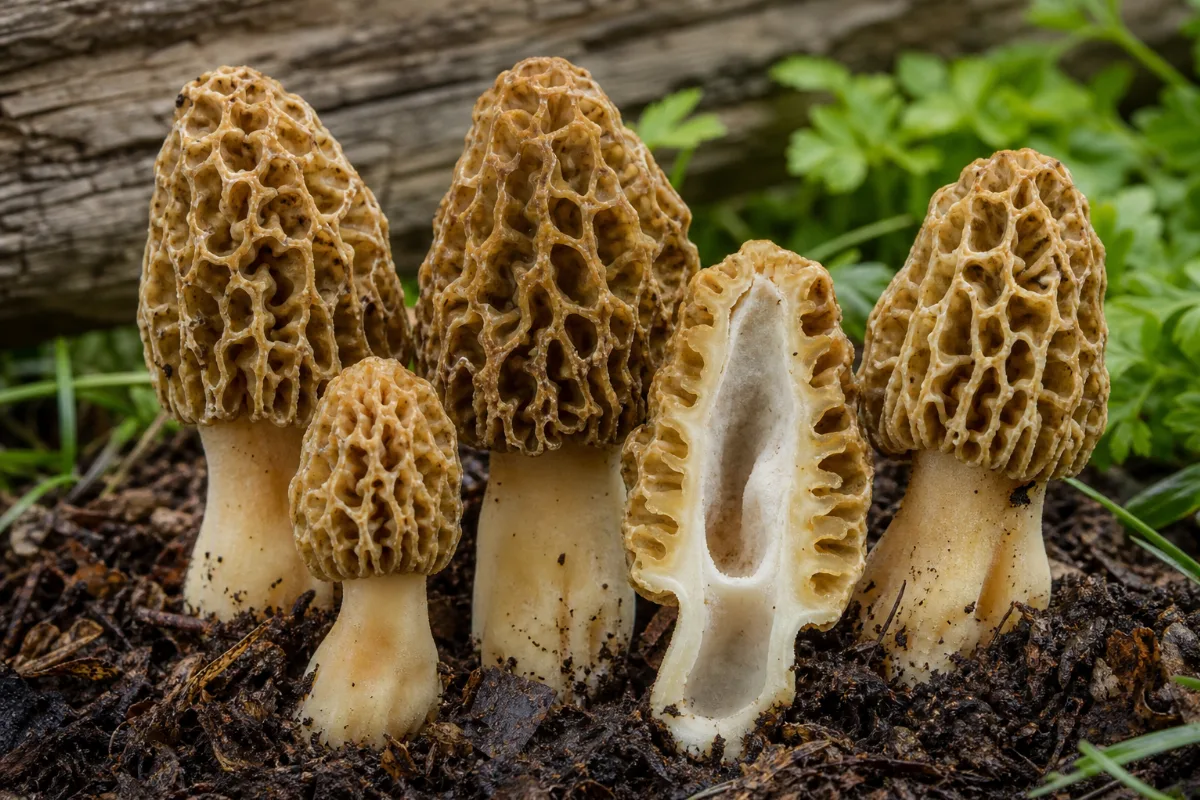
Mushrooms · Wild culinary mushroom
Morel
Morchella esculenta, M. importuna and other Morchella species · also called True morel, yellow morel, black morel, gucchi (names used in the papers we read)
Morel is a mushroom of the genus Morchella, valued for its flavour and always eaten cooked. There is no human trial of morel for any health use; the claims come from lab and animal work. The main caution is safety: raw or undercooked morels were linked to a 2023 outbreak in Montana that made 51 people ill and killed two. False morels, a different and more dangerous mushroom, are sometimes mistaken for morels, so never eat a wild mushroom unless an expert has identified it in person.
General information, not medical advice. Last substantive update · Not medically reviewed. A named clinician has not signed off on this page. How this page is made
About Morel
Morel is a valued edible mushroom, but not a risk-free one. Raw and undercooked morels have caused outbreaks and deaths, and false morels are a more dangerous look-alike. There is no human trial showing a health benefit, and health claims rest on lab and mouse studies.
What it is
Morels are the fruiting bodies of fungi in the genus Morchella, family Morchellaceae, a group of sac fungi, not plants. GBIF accepts Morchella esculenta (L.) Pers. and Morchella importuna as separate species, and the genus has many more. Labels and papers often say only morel, so the species is rarely certain. False morels such as Gyromitra esculenta belong to a different family (Discinaceae).
Traditional and current uses
A review says morels have been used in traditional medicine for centuries and are appreciated worldwide for their flavour. A survey in Doda District, India, describes dried gucchi used for stomach problems, as a tonic, for wounds and for joint pain, mainly in the hills. Today morel is mainly a cooking ingredient. Cultivation is limited, so morels are wild-harvested or grown as fermented culture, and cultivated morels have outsold wild ones in France since 2006.
What the research shows
We searched PubMed and found no human trial of morel for any health use. What exists is review-level lists of lab activities, one mouse study in which a Morchella esculenta fruit body lowered the liver-enzyme rise caused by alcohol, and one cell and animal-tissue study in which an extract reduced heart injury from doxorubicin. None shows an effect in people. Composition studies, including a 2026 analysis of four Chilean species, show morels hold minerals such as potassium and phosphorus; cadmium and lead stayed within safe limits there and arsenic was not detected.
Fresh, dried, cultivated and extract are different
The safety reports concern the whole mushroom eaten raw, undercooked or poorly cooked, fresh or dried. The lab findings used extracts or fruit body given to mice. Results do not carry over between these forms. Imported or farmed morels are not automatically safe: the Montana and French deaths were attributed to imported cultivated morels.
Legal and regulatory status
We found no morel monograph from EMA, NCCIH, LiverTox, LactMed or WHO. The CDC and FDA web pages were not readable. What we did read, in PubMed abstracts by CDC, FDA and Montana authors, is food-safety advice after the 2023 outbreak: avoid raw morels, cook them thoroughly, and consider labelling and consumer outreach.
At a glance
Traditional uses history, not proof
- A review says morels have been used in traditional medicine for centuries (Tietel 2018).
- In Doda District, India, collectors use dried or fresh gucchi (Morchella esculenta) for stomach problems and indigestion, as a tonic, to help heal wounds and to reduce joint pain (Paul 2018). Tradition is not evidence.
Studied for research
- Nutrition and flavour as a food (composition only, no health outcome), insufficient
- Antioxidant, immune and other activities in the lab (reviews), insufficient
- Liver protection against alcohol injury in mice, insufficient
- Protection of heart cells from doxorubicin in cells and animal tissue, insufficient
- Traditional use for stomach problems and as a tonic, insufficient
Main compounds
- Polysaccharides, the compounds reviews credit for most lab activity
- Phenolic compounds, tocopherols, ascorbic acid and vitamin D
- Minerals, especially potassium and phosphorus
Common forms
- Fresh morel, cooked thoroughly
- Dried morel (also needs thorough cooking)
- Cultivated or wild-harvested morel
- Extracts and polysaccharides (lab research only)
Research links: 2023 Montana morel outbreak report (CDC, abstract) · Raw morel risks after the outbreak (FDA and CDC authors, abstract) · Severe morel poisonings in France 2010 to 2020 (abstract) · True morel and false morel toxicity review, 2025 (abstract) · Morel nerve syndrome in French poison centres (abstract) · Morel review: composition, health claims, flavour (abstract) · Research Library · Genes & Biomarkers Library
What it is and its history
- Accepted scientific name
- Morchella esculenta (L.) Pers., and other Morchella species (the genus has many species)
- Naming authority
- (L.) Pers. (GBIF)
- Synonyms
- Morchella importuna M.Kuo, O'Donnell & T.J.Volk (accepted in GBIF); Morchella spp. (genus Morchella Dill. ex Pers., accepted in GBIF)
- Common names
- Morel (English); True morel (English); Yellow morel (English); Black morel (English); Gucchi / thunthoo (Hindi and Bhaderwahi (Doda District, India; as spelled in a paper))
- Family or group
- Morchellaceae (a fungus family, sac fungi), not a plant
- Classification
- Fungi > Ascomycota > Pezizomycetes > Pezizales > Morchellaceae > Morchella > Morchella esculenta
- Native range
- Not checked in the sources read.
- Habitat
- Not checked. Reviews say morels are wild-harvested or grown as fermented culture and that cultivation is limited; a Chilean paper describes Morchella fruiting in forest plantations and native forests.
- What it looks like
- Fruiting body: No description was read, and none is given here.
- Cultivation
- Tietel 2018 says morel cultivation is limited and morels are either wild-harvested or fermented in culture; Vodovar 2024 says cultivated morels have outsold wild ones since 2006.
- Harvest and processing
- Paul 2018 says collectors in Doda District, India, mostly dry the morel (gucchi) in the sun or the kitchen.
- Look-alikes and adulterants
- Name: False morels (Gyromitra esculenta and relatives); Note: A different genus in a different family (Discinaceae in GBIF). Reported to be more dangerous: mortality 28.9% for Gyromitra versus 7.7% for Morchella in published cases (Simon 2025). This page gives no identification help; do not rely on text, photos or apps.; Name: Verpa bohemica; Note: Lagrange 2020 suggests this other false morel is also inedible.
- Sustainability and conservation
- Not checked.
Traditional use and history history, not clinical proof
| Tradition or era | Documented use | Source |
|---|---|---|
| General traditional medicine | A review says morels have been used in traditional medicine for centuries because of reported health benefits; the abstract does not name regions. | p28350213 |
| Doda District, Jammu and Kashmir, India | Gucchi (Morchella esculenta) is a wild-collected, expensive food, mostly dried; traditionally used for stomach problems and indigestion, as a tonic, to help heal wounds and to reduce joint pain. | p29953359 |
| Traditional Chinese medicine (as described in a review) | A review says mushrooms have been known for centuries in traditional Chinese medicine, and that M. esculenta is used as a food and food-flavouring in soups and sauces. | p35940783 |
Traditional use shows how it was used. It does not show that it works or is safe today.
What is inside, and how it may work
What it contains and how those compounds act in cells and animals. Laboratory and animal mechanisms are not proven effects in people.
Main compounds
| Compound | Family | Where it is concentrated | Activity studied | Level of evidence |
|---|---|---|---|---|
| Polysaccharides | polysaccharide | Fruiting body Not given in the abstracts read. | Reviews attribute the reported immune and antioxidant effects mainly to polysaccharides; lab only. 17 15 | Laboratory research |
| Phenolic compounds, tocopherols, ascorbic acid and vitamin D | phytochemicals and vitamins | Fruiting body Not given in the abstracts read. | Named by Tietel 2018 as contributors to the reported health activities; not shown to matter in people. 17 | Composition analysis |
| Minerals (potassium, phosphorus, nickel, zinc; cadmium and lead in small amounts) | minerals and metals | Fruiting body Potassium and phosphorus accumulated strongly in four Chilean species; cadmium and lead within safe limits and arsenic undetectable (numbers in the full paper were not read). | Content reflects soil, forest environment and species. 3 | Composition analysis |
| Gyromitrin (false morels only, not true morels) | hydrazone toxin | Gyromitra fruiting body Not given. | Turns into monomethylhydrazine, which blocks activation of vitamin B6 and lowers GABA; toxic to brain, liver and kidney. 12 19 | Clinical reference |
Mechanisms, receptors and pathways
| Target or pathway | Gene or receptor | What was found | Level |
|---|---|---|---|
| Cause of true morel poisoning | Not known | The Montana and CDC report says the toxins in morels that might cause illness are not fully understood. Thorough cooking might help limit adverse effects. 2 16 | Human observational |
| Gyromitrin to monomethylhydrazine (false morel) | Pyridoxal phosphokinase; GABA synthesis | Monomethylhydrazine inhibits pyridoxal phosphokinase, which activates vitamin B6, the cofactor for making GABA. GABA falls and the brain is over-excited; the toxin also injures liver and kidney. 12 | Clinical reference |
| Nrf-2 and NF-kB signalling in mouse liver | Nrf-2, NF-kB | In mice, the Morchella esculenta fruit body shifted antioxidant and inflammation signalling in alcohol-injured liver. 9 | Animal research |
Absorption, metabolism and elimination
- Absorption
- Not found in the sources read.
- Distribution
- Not found.
- Metabolism
- Not found.
- Elimination
- Not found.
- Bioavailability
- Not established in people.
Isolated compounds versus whole extracts
Lab and animal findings used extracts or isolated compounds (the heart-cell study and review-listed polysaccharides) or fed fruit body to mice. Nothing links them to cooked morel eaten as food, and the poisoning reports concern the whole mushroom eaten raw or poorly cooked.
Nutritional composition
Reviews and a Chilean analysis report protein, fibre, minerals (especially potassium and phosphorus), vitamin D and antioxidants in morels. No source read shows a health result from these when eating morels. USDA values were not re-opened for this page.
6 not enough evidence
What was looked at
The 6 benefits and uses checked for Morel, each with how strong the evidence is. Tap one to open it.
- Nutrition and flavour as a foodNot enough evidence
- Antioxidant, anti-inflammatory and immune effects (lab reports)Not enough evidence
- Traditional use for stomach problems, as a tonic and for joint painNot enough evidence
- Liver protection against alcohol injury (mice)Not enough evidence
- Protection of heart cells from doxorubicin (cells and animal tissue)Not enough evidence
- Blood sugar, tumour, parasite and virus effects (lab reports)Not enough evidence
Lab markers tracked in the studies
ALT and AST liver enzymes (in mice)Cardiac injury markers (CK-MB, troponin I) after doxorubicin (lab)
What is Morel good for?
The uses people ask about and how strong the human evidence is for each. None is proven. Read this together with the Safety tab.
Benefits, one by one
Each card is a research question, not a promise. Tap a goal to filter. Open a card to see the studies, doses and limits.
Nutrition and flavour as a food
Not enough evidenceMorel is eaten for its flavour, not as a treatment. Reviews list what it contains: protein, fibre, minerals such as potassium and phosphorus, vitamin D, vitamin C, tocopherols and phenolic compounds. No human study shows a health result from eating it.
3 studiesFresh or dried fruiting bodies (wild-collected or cultivated) and lab…
Studies, doses and limits
Results
Composition only: a 2026 analysis of four Chilean Morchella species found large amounts of potassium and phosphorus and said protein and fibre were elevated, similar to morels from other places. No health result.
Why this rating
There is no study of what eating morels does to anyone's health. Composition data show what is in the mushroom, not what it does in the body.
Form and dose studied
Fresh or dried fruiting bodies (wild-collected or cultivated) and lab extracts. This page gives no amounts.
Who was studied
Not studied in people
Limits
Nutrient content depends on species, soil and place, and the studies are small and regional.
Why researchers looked
Morels are valued worldwide for their savoury flavour, so researchers have measured what they contain.
Traditional use
A review says morels have been used in traditional medicine for centuries (Tietel 2018).
Proposed mechanism Composition analysis
No health mechanism was tested in people. Composition studies simply measure nutrients and other compounds.
A proposed mechanism does not show that the effect happens in people.
Morels must be thoroughly cooked. See the Safety tab for the 2023 outbreak linked to raw and undercooked morels and for the danger of false morels.
Antioxidant, anti-inflammatory and immune effects (lab reports)
Not enough evidenceReviews say morel extracts and polysaccharides show antioxidant, anti-inflammatory and immune-stimulating effects in the lab. The abstracts do not describe any human trial, so this tells us nothing yet about eating morels.
2 studiesExtracts and purified polysaccharides, not the cooked mushroom. This …
Studies, doses and limits
Results
Qualitative only. The review abstracts list effects without numbers.
Why this rating
Evidence comes from reviews of test-tube and animal work. No human trial was found.
Form and dose studied
Extracts and purified polysaccharides, not the cooked mushroom. This page gives no amounts.
Who was studied
Cells and animals
Limits
We read only the review abstracts, not the studies behind them. Lab concentrations do not match food amounts.
Why researchers looked
Mushroom polysaccharides and phenolic compounds are often tested for antioxidant and immune activity.
Traditional use
Traditional medicine use for centuries is mentioned in a review (Tietel 2018).
Proposed mechanism Laboratory research
Reviews attribute the activity mainly to polysaccharides and to phenolic compounds, tocopherols, ascorbic acid and vitamin D. These are lab findings, not shown to happen in people.
A proposed mechanism does not show that the effect happens in people.
A lab finding is not a reason to eat morels raw or to take extracts. See the Safety tab.
Traditional use for stomach problems, as a tonic and for joint pain
Not enough evidenceIn Doda District, India, collectors describe using dried or fresh morel (gucchi) for stomach problems and indigestion, as a tonic, to help heal wounds and to reduce joint pain. This is tradition, not evidence that it works.
2 studiesSun-dried or kitchen-dried morel is described. This page gives no amo…
Studies, doses and limits
What the trials found
A survey of traditional knowledge only. No trial.
Results
Descriptive
Why this rating
Traditional use is not evidence of benefit, and no study tested these uses.
Form and dose studied
Sun-dried or kitchen-dried morel is described. This page gives no amounts.
Who was studied
Collectors and families in one district of India
Limits
One regional survey; abstract only.
Why researchers looked
A survey recorded the knowledge of local collectors.
Traditional use
Paul 2018 says these medicinal uses are restricted to the hills and far-flung areas.
Proposed mechanism None
No mechanism was tested.
A proposed mechanism does not show that the effect happens in people.
Morels that are eaten raw or poorly cooked, fresh or dried, have caused illness. See the Safety tab.
Liver protection against alcohol injury (mice)
Not enough evidenceIn mice given alcohol for 14 days, the Morchella esculenta fruit body lowered the alcohol-induced rise in liver enzymes. This is a mouse study. It does not show liver protection in people and does not test morels together with alcohol in people.
2 studiesWhole M. esculenta fruit body fed to mice. This page gives no amounts.
Studies, doses and limits
Results
Mice given the fruit body for 14 days did not show the alcohol-induced rise in ALT and AST; the abstract gives no numbers.
Effect sizes as reported
Not given in the abstract
Why this rating
One mouse study, no human data.
Form and dose studied
Whole M. esculenta fruit body fed to mice. This page gives no amounts.
Who was studied
C57BL/6 mice
Limits
Mouse model; the abstract has no numbers; other lab papers on morel polysaccharides and alcohol injury exist but were not read.
Why researchers looked
Reviews list liver-protective activity for morel, so researchers tested it against alcohol-induced liver injury in mice.
Traditional use
Not described in the sources read.
Proposed mechanism Animal research
The authors link the effect to antioxidant and anti-inflammatory signalling (Nrf-2 and NF-kB) in mouse liver.
A proposed mechanism does not show that the effect happens in people.
Nothing here means morels make alcohol safer. No human report of morel and alcohol together was found.
Protection of heart cells from doxorubicin (cells and animal tissue)
Not enough evidenceA bioactive extract of Morchella esculenta reduced damage from the cancer drug doxorubicin to heart muscle cells in the lab and lowered heart injury markers in animal tissue. No person was tested, and people having chemotherapy should not read this as advice.
1 studiesA bioactive extract, not cooked morel. This page gives no amounts.
Studies, doses and limits
Results
Less doxorubicin-induced cell death at the tested concentrations (p<0.05 and p<0.01), lower cardiac injury markers (p<0.01), antioxidants restored.
Effect sizes as reported
Not given as effect sizes in the abstract
Why this rating
Cell and animal work in one paper; no human data.
Form and dose studied
A bioactive extract, not cooked morel. This page gives no amounts.
Who was studied
Heart muscle cells and animal heart tissue (animal species not stated in the abstract)
Limits
Single lab; the authors' suggestion of clinical use is theirs, not supported by human data. Whether the extract changes how chemotherapy works against cancer was not tested in the abstract.
Why researchers looked
Doxorubicin can damage the heart, so researchers look for protective compounds.
Traditional use
Not described.
Proposed mechanism Laboratory research
The extract restored antioxidant levels (SOD, GPx, GSH) in heart tissue after doxorubicin, which the authors link to less oxidative stress.
A proposed mechanism does not show that the effect happens in people.
Anyone having chemotherapy should ask their cancer team before using any mushroom product.
Blood sugar, tumour, parasite and virus effects (lab reports)
Not enough evidenceA 2022 review says Morchella esculenta and its compounds show antidiabetic, antitumour, antiparasitic, antibacterial and antiviral properties, plus cardiovascular protection. Its abstract does not describe a human trial, and we found none.
1 studiesExtracts and compounds. This page gives no amounts.
Studies, doses and limits
Results
Qualitative list only.
Why this rating
Only review-level statements about lab and animal work were read.
Form and dose studied
Extracts and compounds. This page gives no amounts.
Who was studied
Cells and animals
Limits
Abstract only. No claim here is shown in people.
Why researchers looked
Reviews collect lab activities of mushroom compounds.
Traditional use
Not described.
Proposed mechanism Laboratory research
Not detailed in the abstract.
A proposed mechanism does not show that the effect happens in people.
None of these findings supports using morel instead of medical care.
Connections to the rest of health
How Morel connects to the rest of our health knowledge graph. Every link says what kind of connection it is. A safety link (for example to the liver) is a warning, not a benefit. A study that merely mentions a topic never creates a benefit link.
Explore every connection: goals, body systems, organs, symptoms, genes
B. Body systems
| Connected to | Kind of connection | Evidence status | Context | Studies |
|---|---|---|---|---|
| Digestive system | Adverse effect or risk | Documented | Vomiting and diarrhoea in outbreaks and poison-centre cases. Vomiting and diarrhoea in the 2023 outbreak and in poison-centre cases. Preparation or compound: Raw or undercooked morel (Morchella) |
2 18 14 |
| Nervous system | Adverse effect or risk | Documented | Dizziness, unsteadiness and coordination problems. Dizziness and unsteadiness reported. Preparation or compound: Morel (Morchella), often after large helpings |
13 11 14 |
| Digestive System | Biological association | Not enough evidence | Studied for: Nutrition and flavour as a food Studied for: Traditional use for stomach problems, as a tonic and for joint pain | 17 15 3 10 9 |
| Immune System | Biological association | Not enough evidence | Studied for: Antioxidant, anti-inflammatory and immune effects (lab reports) Studied for: Blood sugar, tumour, parasite and virus effects (lab reports) | 17 15 |
| Cardiovascular System | Biological association | Not enough evidence | Studied for: Protection of heart cells from doxorubicin (cells and animal tissue) | 1 |
C. Body parts and organs
| Connected to | Kind of connection | Evidence status | Context | Studies |
|---|---|---|---|---|
| Liver | Adverse effect or risk | Documented | Liver injury is common with false morels and uncommon with true morels. Liver injury is common with false morels, uncommon with true morels. Preparation or compound: False morel (Gyromitra), and rarely true morel with other organ involvement |
14 19 |
I. Biomarkers
| Connected to | Kind of connection | Evidence status | Context | Studies |
|---|---|---|---|---|
| ALT and AST liver enzymes (in mice) | Biological association | Not enough evidence | Measured in trials: lowered. A lab change is not the same as a health benefit. | 9 |
| Cardiac injury markers (CK-MB, troponin I) after doxorubicin (lab) | Biological association | Not enough evidence | Measured in trials: lowered. A lab change is not the same as a health benefit. | 1 |
K. Biological pathways
| Connected to | Kind of connection | Evidence status | Context | Studies |
|---|---|---|---|---|
| Vitamin B6 (pyridoxal phosphate) activation and GABA synthesis | Preliminary mechanism | Clinical reference | Blocked by the false morel toxin metabolite, not shown for true morels. | 12 |
| Nrf-2 and NF-kB signalling | Preliminary mechanism | Animal | Changed by the fruit body in alcohol-injured mouse liver. | 9 |
L. Active compounds
| Connected to | Kind of connection | Evidence status | Context | Studies |
|---|---|---|---|---|
| Polysaccharides | Biological association | In vitro | Reviews attribute the reported immune and antioxidant effects mainly to polysaccharides; lab only. Preparation or compound: Fruiting body |
17 15 |
| Phenolic compounds, tocopherols, ascorbic acid and vitamin D | Biological association | Composition analysis | Named by Tietel 2018 as contributors to the reported health activities; not shown to matter in people. Preparation or compound: Fruiting body |
17 |
| Minerals (potassium, phosphorus, nickel, zinc; cadmium and lead in small amounts) | Biological association | Composition analysis | Content reflects soil, forest environment and species. Preparation or compound: Fruiting body |
3 |
| Gyromitrin (false morels only, not true morels) | Biological association | Clinical reference | Turns into monomethylhydrazine, which blocks activation of vitamin B6 and lowers GABA; toxic to brain, liver and kidney. Preparation or compound: Gyromitra fruiting body |
12 19 |
Each connection is stored with the ingredient, the connected record, the kind of connection, the evidence status, the supporting studies, the preparation or compound involved, and a review date (last reviewed October 25, 2026).
Evidence at a glance: what changed in 2 lab markers
Tap a number to show only those markers. Counts are markers, not people.
The evidence
The research centre for Morel. Every record here was checked against PubMed or the publisher's page; we never list a study we have not verified.
Evidence by outcome
Bars show how many studies we found for each outcome, not how well it works. People are added up across trials only (reviews are not added, to avoid double counting).
How we rate evidence
High certainty
Several well-run trials or reviews agree; further research is unlikely to change the picture much.
Moderate certainty
Good trials point the same way, but some doubt remains.
Low certainty
Small, short or inconsistent trials. The finding could change with better research.
Very low certainty
Very little or very weak human data. Treat as a possibility only.
Mixed findings
Trials or reviews disagree with each other.
Not enough evidence
Not enough human research to say either way.
Evidence against
Good research found no benefit, or found harm.
We take the reviewers' own risk-of-bias and GRADE statements where they exist, and otherwise judge from study size, design, consistency, directness and whether a product matches what is sold. Many publications do not make evidence high. Method note: We read PubMed records and abstracts for 15 papers (an outbreak report and its follow-up, two poison-centre case series, one case report, one clinical reference chapter on false morels, one Michigan false-morel series, one narrative toxicity review, one toxicology review, two reviews of composition and lab activity, one survey of traditional use, one mouse study, one cell and animal-tissue study, and one mineral analysis), and checked species names in GBIF. We searched PubMed for human trials, alcohol and allergy reports and found none about morel. CDC and FDA web pages were not readable, and EMA, NCCIH, LiverTox, LactMed and WHO entries were not found or not read. Mostly abstracts were read, so numbers come from abstracts. Certainty ratings are the compiler's own reading.
Study library: every study we checked 19
| Study | Design | People | Product, dose, length | Result |
|---|---|---|---|---|
| Das 2022 Bioactive Extract of Morel Mushroom, Morchella esculenta (Ascomycota) Attenuates Doxorubicin-Induced Oxidative Stress Leading to Myocardial Injury. International Journal of Medicinal Mushrooms · PMID 35997093 · DOI |
In vitro and animal in-vitro |
Heart muscle cells in culture and heart tissue from animals given doxorubicin (species not stated in the abstract) | Bioactive extract of Morchella esculenta fruiting body (not stated) Not reproduced here · vs Doxorubicin only |
The extract reduced doxorubicin-induced cell death at the concentrations tested (p<0.05 and p<0.01), lowered the raised cardiac injury markers (p<0.01) and restored antioxidant levels. The authors suggest the mushroom might be used to prevent chemotherapy heart injury. Protective signals in cells and animal tissue Methods, limits and fundingOutcomes: Cell survival, cardiac injury markers (CK-MB, troponin I), antioxidants, heart tissue Limitations: Cells and animals only; the authors' suggestion of clinical use is not supported by any human data. People having chemotherapy should not read this as advice. Funding and conflicts: Not stated in the abstract. Read: abstract |
| Demorest 2024 Outbreak Linked to Morel Mushroom Exposure - Montana, 2023. MMWR Morb Mortal Wkly Rep · PMID 38483842 · DOI |
Case control outbreak |
51 51 people who ate at one restaurant in Bozeman, Montana in March-April 2023 and reported gastrointestinal illness |
Morel mushrooms served at a restaurant (raw, partly cooked or cooked) fruiting body One meal · vs Matched restaurant patrons who were not ill |
Morel eating was strongly associated with illness. A dose-response relationship was found, and raw morels were more strongly linked to illness than morels that were at least partly cooked. Three people were hospitalised and two died. The abstract says the toxins in morels are not fully understood and that thorough cooking might limit harm. Strong link between eating morels (especially raw) and illness Methods, limits and fundingOutcomes: Gastrointestinal illness, hospitalisation, death; link with morel eating, dose-response, raw versus cooked Limitations: Single restaurant outbreak; numbers for the case-control comparison are not in the abstract; the toxin is not identified. Funding and conflicts: Government public-health authors; no conflicts disclosed. Read: abstract |
| Escobar-Hernandez 2026 Mineral Composition and Quality Traits of Morchella spp. Harvested from Forest Plantations and Native Forests in South-Central Chile. Journal of Fungi (Basel) · PMID 42646116 · DOI |
Composition analysis fungus |
Four Morchella species (M. eximia, M. importuna, M. tridentina, M. andinensis) collected in Chile | Wild-fruiting Morchella ascocarps analysed in the lab fruiting body |
Morels accumulated a lot of potassium and phosphorus. Cadmium and lead stayed within internationally accepted safe limits and arsenic was undetectable. The authors call these preliminary results and say mineral content reflects soil, forest environment and genotype. Metal levels were within limits in these Chilean samples Methods, limits and fundingOutcomes: Minerals, metals, protein, fibre, phenolics Limitations: One region and few samples; results do not apply to morels grown or picked elsewhere. Funding and conflicts: Not stated in the abstract. Read: abstract |
| GBIF Secretariat 2026 GBIF: Morchella esculenta (L.) Pers. GBIF Backbone Taxonomy (API) · Source |
Database record n/a |
n/a | n/a |
Accepted species, key 2594602; family Morchellaceae, order Pezizales, class Pezizomycetes, phylum Ascomycota. Methods, limits and fundingOutcomes: Accepted name and rank Limitations: Taxonomy database only; says nothing about health. Status for the other species names on this page is in the notes. Funding and conflicts: n/a Read: database record, checked 2026-10-25 |
| GBIF Secretariat 2026 GBIF: Morchella importuna M.Kuo, O'Donnell & T.J.Volk GBIF Backbone Taxonomy (API) · Source |
Database record n/a |
n/a | n/a |
Accepted species, key 8426492; family Morchellaceae. Methods, limits and fundingOutcomes: Accepted name and rank Limitations: Taxonomy database only; says nothing about health. Funding and conflicts: n/a Read: database record, checked 2026-10-25 |
| GBIF Secretariat 2026 GBIF: Morchella Dill. ex Pers. (genus) GBIF Backbone Taxonomy (API) · Source |
Database record n/a |
n/a | n/a |
Accepted genus, key 2594601; family Morchellaceae, order Pezizales. Methods, limits and fundingOutcomes: Accepted name and rank Limitations: Taxonomy database only; says nothing about health. Funding and conflicts: n/a Read: database record, checked 2026-10-25 |
| GBIF Secretariat 2026 GBIF: Gyromitra esculenta Pers. ex Fr. GBIF Backbone Taxonomy (API) · Source |
Database record n/a |
n/a | n/a |
Accepted species, key 5258510; family Discinaceae, order Pezizales (a different family from Morchellaceae). Methods, limits and fundingOutcomes: Accepted name and rank Limitations: Taxonomy database only; says nothing about health. Funding and conflicts: n/a Read: database record, checked 2026-10-25 |
| Lagrange 2020 Warning on False or True Morels and Button Mushrooms with Potential Toxicity Linked to Hydrazinic Toxins: An Update. Toxins (Basel) · PMID 32751277 · DOI |
Narrative review |
Review of the edibility and toxicity of false morels, true morels and Agaricus mushrooms | Morchella, Gyromitra, Verpa and Agaricus mushrooms fruiting body |
The authors found a temporary neurological syndrome with cerebellar signs after high consumption of fresh or dried true morels, and a gut syndrome after crude or poorly cooked fresh or dried morels. They suggest the false morel Verpa bohemica is also inedible. Their safety conclusion is to avoid true morels when crude or poorly cooked, fresh or dried. Cook morels thoroughly, fresh or dried Methods, limits and fundingOutcomes: Toxic syndromes Limitations: Narrative review; mainly about the hydrazine-type toxins of other mushrooms. Funding and conflicts: No conflict of interest declared. Read: abstract (open full text not read) |
| Meng 2019 Hepatoprotective Effects of Morchella esculenta against Alcohol-Induced Acute Liver Injury in the C57BL/6 Mouse Related to Nrf-2 and NF-kB Signaling. Oxidative Medicine and Cellular Longevity · PMID 31396303 · DOI |
Animal research animal |
Mice given alcohol for 14 days to cause liver injury | Morchella esculenta fruit body fruiting body Not reproduced here 14 days · vs Alcohol-only mice |
In mice, giving the fruit body for 14 days prevented the alcohol-induced rise in ALT and AST, and changed inflammation and antioxidant signals (Nrf-2, NF-kB). The authors conclude the mushroom protected the liver against alcohol injury in mice. Mouse liver markers were better with the mushroom Methods, limits and fundingOutcomes: ALT, AST, fats, inflammation and antioxidant signals in liver and blood Limitations: Mouse study. It does not test what happens when people eat morels and drink alcohol, and does not show liver protection in people. Funding and conflicts: No conflict declared. Read: abstract |
| Paul 2018 Traditional Knowledge of Gucchi, Morchella esculenta (Ascomycetes), in Doda District, Jammu and Kashmir, India. International Journal of Medicinal Mushrooms · PMID 29953359 · DOI |
Ethnobotanical survey |
Mushroom collectors in Doda District, Jammu and Kashmir, India | Morchella esculenta (gucchi), fresh or dried fruiting body |
Gucchi is a wild-collected, expensive food, often sun-dried at home. The abstract says it has traditionally been used for stomach problems and indigestion, as a tonic, to help heal wounds and to reduce joint pain, mainly in hill areas. Elders pass on knowledge of how to tell it from poisonous mushrooms. Records traditional use; not evidence of benefit Methods, limits and fundingOutcomes: Traditional collection, drying and uses Limitations: Describes tradition, not effect; abstract read only. Funding and conflicts: Not stated. Read: abstract |
| Pfab 2008 Cerebellar effects after consumption of edible morels (Morchella conica, Morchella esculenta). Clinical Toxicology · PMID 18344109 · DOI |
Case report |
6 Six people who ate Morchella esculenta or M. conica |
Edible morels fruiting body |
Six people developed cerebellar effects 6 to 12 hours after eating the mushrooms. The symptoms were self-limited and disappeared after one day. Short-lived balance problems in six people Methods, limits and fundingOutcomes: Cerebellar (balance and coordination) effects Limitations: Short case report; abstract only. Funding and conflicts: Not stated. Read: abstract |
| Regina 2024 Gyromitra Mushroom Toxicity. StatPearls · PMID 29262102 |
Clinical reference |
Clinical reference chapter | Gyromitra esculenta (false morel) fruiting body |
Says Gyromitra esculenta resembles true morels and can be confused with them. The syndrome starts with gut symptoms more than 5 hours after eating, can bring acute liver injury over two days and sometimes kidney injury, confusion, and in the most severe cases seizures. The toxic product monomethylhydrazine (from gyromitrin) blocks activation of vitamin B6, which depletes GABA and excites the brain. Explains how false morel toxin works Methods, limits and fundingOutcomes: Mechanism and clinical picture Limitations: Reference text, not a study. Funding and conflicts: No relevant financial relationships (authors). Read: abstract |
| Saviuc 2010 Can morels (Morchella sp.) induce a toxic neurological syndrome? Clinical Toxicology · PMID 20507248 · DOI |
Case series |
275 Morel poisonings reported to French Poison Control Centers 1976 to 2006: 146 with a gastrointestinal syndrome and 129 with a neurological syndrome |
Morels eaten fruiting body |
Median onset was 5 hours for the gastrointestinal syndrome and 12 hours for the neurological syndrome (tremor, dizziness or inebriation, unsteadiness or ataxia). In the neurological group 67% also had gut symptoms and others had vision disorders (26%), tingling (7%), drowsiness or confusion (6%) and muscle disorders (6%). Those patients more often ate a large quantity. Confusion with Gyromitra was ruled out. A separate nerve syndrome follows some morel meals Methods, limits and fundingOutcomes: Time to onset and symptom pattern Limitations: Retrospective; numbers 146 and 129 are the groups described, and the total is their sum as reported. Funding and conflicts: Not stated in the abstract. Read: abstract |
| Simon 2025 A narrative review of toxicity after exposure to true morel (Morchella genus) and false morel (Gyromitra genus) mushroom ingestions. Clinical Toxicology · PMID 40905838 · DOI |
Narrative review |
84 articles describing 201 Gyromitra and 52 Morchella ingestions | Morchella and Gyromitra mushroom ingestions fruiting body |
For Morchella (52 ingestions) mortality in the articles was 7.7%. Neurological effects were most common (65.4%; dizziness or unsteadiness 51.9%; median onset 12 hours), gut effects 50.0% (median onset 2.3 hours), liver effects 17.3%. No fatalities were reported until 2024, when three articles reported critical illness and deaths, with early severe vomiting and diarrhoea, sometimes shock, bleeding in the gut and multi-organ failure. For Gyromitra (201 ingestions) mortality was 28.9%, with delayed gut (88.1%), liver (53.7%) and nerve (51.7%) effects. False morels were reported far more deadly than true morels in published reports Methods, limits and fundingOutcomes: Symptoms, onset times and outcomes Limitations: Narrative review of published case reports, so reporting and publication bias; percentages are of reported cases, not of all eaters. Funding and conflicts: Authors include CDC staff; no funding detail in the abstract. Read: abstract |
| Sunil 2022 Mycochemical profile and health-promoting effects of morel mushroom Morchella esculenta (L.) - A review. Food Research International · PMID 35940783 · DOI |
Narrative review review |
Review of Morchella esculenta chemistry and bioactivities | Morchella esculenta fruiting body and compounds fruiting body |
Lists vitamins, proteins, steroids, minerals, polysaccharides and polynucleotides in the fruiting body, and says M. esculenta and its compounds show cardiovascular-protective, antitumour, immunomodulatory, antiparasitic, hepatoprotective, antibacterial, antiviral and antidiabetic properties. The abstract does not describe any human trial. Wide list of lab-level activities; no human trial described Methods, limits and fundingOutcomes: Composition and reported bioactivity Limitations: Narrative review; abstract read only. Funding and conflicts: Not stated in the abstract. Read: abstract |
| Tesfai 2025 Understanding the Potential Risks of Consuming Raw Morel Mushrooms: Challenges and Lessons Learned from a Recent Outbreak Linked to Raw Morel Mushrooms. Food Protection Trends · PMID 41574286 |
Outbreak investigation report |
51 The same 2023 Montana outbreak (51 ill, 3 hospitalised, 2 deaths) |
Raw and undercooked morels imported from China fruiting body |
The outbreak was linked to undercooked and raw morels imported from China. The authors (FDA Human Foods Program, Montana and CDC staff) say public advice since then is to avoid raw morels and cook them thoroughly. The investigation found industry knowledge gaps in safe preparation, and the authors suggest regulatory guidance, voluntary labelling and consumer outreach. Raw or undercooked morels were the outbreak source Methods, limits and fundingOutcomes: Outbreak source, industry knowledge gaps, food-safety advice Limitations: Report on one outbreak; abstract only was read. Funding and conflicts: Authors are from FDA, CDC and the Montana health department. Read: abstract |
| Tietel 2018 True morels (Morchella)-nutritional and phytochemical composition, health benefits and flavor: A review. Critical Reviews in Food Science and Nutrition · PMID 28350213 · DOI |
Narrative review review |
Review of the morel literature | Morchella fruiting bodies, mycelium and extracts fruiting body, mycelium |
Morels have been used in traditional medicine for centuries, and research has shown antioxidant, anti-inflammatory, immune-stimulating and anti-tumour activity. Benefits are attributed mainly to polysaccharides and to phenolic compounds, tocopherols, ascorbic acid and vitamin D. Cultivation is limited, so morels are wild-harvested or grown as fermented culture. Lists lab-reported activities; no human trial in the abstract Methods, limits and fundingOutcomes: Composition and reported bioactivity Limitations: Narrative review; abstract read only, so the studies behind the claims were not checked. Funding and conflicts: Not stated in the abstract. Read: abstract |
| Vodovar 2024 Severe morel mushroom poisonings in France - a nationwide French poison centres study 2010-2020. Clinical Toxicology · PMID 38912890 · DOI |
Case series |
446 446 exposures in the French National Database of Poisonings in which morels were the only mushroom involved |
Morels (Morchella spp.) eaten fruiting body |
83.6% developed gastrointestinal symptoms and 53.3% neurological symptoms. Eight developed shock attributed to severe gastrointestinal symptoms, and two died. The deaths were attributed to imported cultivated morels. The authors note that cultivated morels have outsold wild ones since 2006 and say this may have played a role. They call for cautious consumption, particularly of raw or undercooked morels. Poisoning is mostly gut and nerve symptoms; severe cases and deaths occur Methods, limits and fundingOutcomes: Gastrointestinal and neurological symptoms, shock, death Limitations: Poison-centre reports show who got ill, not how often illness happens among all morel eaters. Preparation details are not in the abstract. Funding and conflicts: No conflicts stated in the abstract. Read: abstract |
| Vohra 2024 A 19-year longitudinal assessment of gyromitrin-containing (Gyromitra spp.) mushroom poisonings in Michigan. Toxicon · PMID 38908526 · DOI |
Case series |
118 118 cases reported to the Michigan Poison and Drug Information Center 2002 to 2020 (83 symptomatic) |
Gyromitra mushrooms (false morels), 91.5% Gyromitra esculenta fruiting body |
Among 83 symptomatic people, 74.7% had gut symptoms, 26.5% neurological symptoms and 16.9% liver toxicity. Most (70%) had supportive care; vitamin B6 (pyridoxine) was used in seven. Outcomes ranged from minor to major with no deaths. The abstract says resemblance between true and false morels has resulted in misidentification of Gyromitra as edible morels. False morel poisoning is mostly gut illness, sometimes liver and nerve harm Methods, limits and fundingOutcomes: Gut, nerve and liver symptoms and outcomes Limitations: Reports to one poison centre; species identity was often unconfirmed. Funding and conflicts: No conflicts declared. Read: abstract |
What we do not know yet
- No human trial of morel for any health outcome was found.
- The toxin responsible for true morel poisoning is not identified.
- No data on how often poisoning happens among all morel eaters.
- No source covers morel with alcohol or medicines, or in pregnancy, breastfeeding or children.
- CDC and FDA web pages and regulator monographs were not read.
How new research is added
New studies are found by a saved PubMed search and placed in a review queue. A person reads each one before it changes any evidence rating or safety wording. New publications never change ratings automatically.
Lab markers
What changed in blood or saliva tests during trials. A changed number is not the same as feeling or being healthier, and we give no "normal ranges".
Other 2
ALT and AST liver enzymes (in mice)
Lowered in trials
Enzymes that rise in the blood when liver cells are damaged.
Not enough evidenceResults and what it means
Why it was measured
Standard markers of liver injury.
Statistical vs. clinical meaning
Mouse result only.
Safety implication
None for people; see the Safety tab for the real morel risks.
| Study | Result | People | Product |
|---|---|---|---|
| 9 | The alcohol-induced rise in ALT and AST was prevented by the fruit body; numbers are not in the abstract. | C57BL/6 mice with alcohol-induced liver injury | Morchella esculenta fruit body for 14 days |
Cardiac injury markers (CK-MB, troponin I) after doxorubicin (lab)
Lowered in trials
Blood or tissue markers that rise when heart muscle is injured.
Not enough evidenceResults and what it means
Why it was measured
Used to see whether a compound protects the heart from a toxic drug.
Statistical vs. clinical meaning
Cell and animal result only.
Safety implication
Not a reason for people on chemotherapy to use a morel product.
| Study | Result | People | Product |
|---|---|---|---|
| 1 | Markers raised by doxorubicin were significantly lowered by the extract (p<0.01). | Heart muscle cells and animal heart tissue | Bioactive extract of Morchella esculenta |
Safety
What studies and official sources say about side effects, medicines and who should check first. Each point shows what kind of evidence it comes from.
Main points to know 5
- Never eat morels raw or undercooked: a 2023 outbreak killed two people. In March and April 2023, 51 people got gastrointestinal illness after eating at one restaurant in Bozeman, Montana. Three were hospitalised and two died. A case-control study by Montana and CDC staff found morel eating was strongly linked to illness, with a dose-response pattern, and raw morels were more strongly linked than partly cooked ones. The follow-up report says the outbreak was linked to undercooked and raw morels imported from China. The toxins in morels are not fully understood, and the authors advise thorough cooking. Outbreak investigation 2 16
- Severe and fatal morel poisoning is now reported, often after raw or undercooked morels. In French poison centres from 2010 to 2020, 446 exposures involved morels alone. 83.6% had gut symptoms and 53.3% nerve symptoms; eight developed shock and two died. The authors say the deaths were attributed to imported cultivated morels. A 2025 review says no deaths from Morchella were reported before 2024, then three 2024 articles described critical illness and deaths, with early severe vomiting and diarrhoea, sometimes shock, bleeding in the gut and multi-organ failure. Case series 18 14
- False morels (Gyromitra) are a separate, more dangerous mushroom that is mistaken for morels. A Michigan poison-centre paper says that resemblance between true and false morels has led to Gyromitra being misidentified as edible morels. In a 2025 review of published cases, mortality was 28.9% for Gyromitra and 7.7% for Morchella. Gyromitra poisoning typically starts with gut symptoms after 5 or more hours, can injure the liver and kidneys, and can cause confusion and, in severe cases, seizures. This page cannot help you tell them apart. Do not rely on a book, a website or an app. Do not eat a wild mushroom unless an experienced local expert has identified it in person. Case series 19 14 12
- Cooking matters for dried morels too, and a nerve syndrome can follow large meals. A toxicology review says a gut illness followed crude or poorly cooked morels, fresh or dried, and a temporary nerve syndrome with balance and coordination problems followed high consumption of fresh or dried morels. French data from 1976 to 2006 found that people with the nerve syndrome more often ate a large quantity; its median onset was 12 hours after the meal. Six people in a German report had balance effects 6 to 12 hours after eating, which cleared in a day. Case series 8 13 11
- Imported or farmed morels are not automatically safe. Both the Montana outbreak and the French deaths were attributed to imported cultivated morels. The French authors note that cultivated morels have outsold wild ones since 2006 and suggest this may have played a role. The sources do not say what in the product caused the severe cases. Case series 16 18
Side effects 4
| Effect | How often | Severity and recovery | Evidence |
|---|---|---|---|
| Gut illness: vomiting, diarrhoea, stomach pain (raw, undercooked or poorly cooked morels) These percentages are of people who were reported as ill, not of everyone who eats morels. | 83.6% of 446 French poison-centre exposures; 50.0% of 52 published Morchella cases (early, median onset 2.3 hours). | moderate to serious Usually recovered in reports; shock and deaths have occurred | Case series 18 14 2 |
| Nerve effects: dizziness, unsteadiness, loss of coordination, tremor, vision disorders, drowsiness or confusion A French paper lists dizziness or inebriation among the signs, so it can look like drunkenness. | 53.3% of French exposures (2010 to 2020); 65.4% of 52 published Morchella cases. Median onset about 12 hours. | moderate A German report of six people found it cleared within a day | Case series 18 14 13 11 |
| Shock and death after severe early vomiting and diarrhoea Reported cases involved raw or undercooked, often imported cultivated, morels. | 8 shock cases and 2 deaths among 446 French exposures; 2 deaths among 51 ill in Montana. | life-threatening Not reversible in the fatal cases | Case series 18 2 |
| Liver effects Much more common with false morels (53.7% of 201 Gyromitra cases). | 17.3% of 52 published Morchella cases, only when other organs were also involved. | serious Not stated | Narrative review 14 |
Liver
A 2025 review found liver effects in 17.3% of 52 published Morchella ingestions, and only when other organ systems were involved. False morels are much more liver-toxic: 53.7% of 201 published Gyromitra cases, and 16.9% of 83 symptomatic people in Michigan. We found no report of liver injury from properly cooked true morels. Reviews also describe mouse studies in which morel protected the liver against alcohol injury; that is not evidence for people. 14 19 9
How often. 17.3% of 52 published Morchella cases; not a rate among all eaters.
- p40905838.
This is a safety connection. It is not evidence that Morel supports liver health.
Medicines and supplements 3
| With | Why it matters | Importance | Evidence | What to do |
|---|---|---|---|---|
| Alcohol alcohol | Unknown. A PubMed search for morel (Morchella) with alcohol found only mouse studies of morel extract against alcohol liver injury, and no human report of a reaction when both are taken. A French paper does list dizziness or inebriation among morel poisoning signs, so a poisoning could be mistaken for drunkenness. | None found Not enough evidence 9 13 | No source supports or rules out an alcohol interaction. If you feel dizzy, unsteady or sick after a morel meal, do not assume it is the drink: ask for medical advice. | |
| Cancer chemotherapy (doxorubicin) prescription | A morel extract reduced doxorubicin heart toxicity in cells and animal tissue. | Unknown. It is not known whether a morel product would change how chemotherapy works against cancer. | Laboratory research Very low certainty 1 | Tell your cancer team before using any mushroom product. |
| Blood thinners, immune-suppressing medicines, diabetes medicines and other prescriptions prescription | No interaction study or case report was found for morel with any medicine. Reviews list lab antidiabetic and immune activity, which is not evidence of an interaction. | None found Not enough evidence 15 | If you take regular medicines, ask your pharmacist or doctor before using morel extract products. Morel eaten as a cooked food has no documented medicine interaction in the papers we read. |
Who should check first 5
| Situation | Advice | Evidence |
|---|---|---|
| Raw or undercooked morels, fresh or dried | Do not eat. The Montana outbreak and the French poison reports involved raw or undercooked morels, and a toxicology review advises avoiding true morels when crude or poorly cooked, fresh or dried. | Outbreak investigation 2 8 18 |
| Wild mushrooms that no experienced person has identified in person, including any mushroom sold or picked as morel | Do not eat. False morels are reported to be more dangerous, and Gyromitra has been misidentified as morel. Photos, apps and text descriptions are not safe ways to tell them apart. | Case series 19 14 |
| Very large helpings | French data link the nerve syndrome to eating a large quantity. The sources do not give a safe amount, and this page gives none. | Case series 13 8 |
| Pregnancy, breastfeeding and children | No source we read covers morel in pregnancy, breastfeeding or children. Because of the poisoning reports, ask a doctor or pharmacist before eating morels, and be especially strict about cooking. | None found |
| Morel extracts, powders and capsules | No human safety study was found. Lab extracts are not the same as a cooked mushroom. | None found 15 |
Overdose, product quality and regulators
Summary. Morels are generally considered edible, but raw and undercooked morels have caused outbreaks and deaths. The toxin responsible has not been identified: the CDC-led report says the toxins are not fully understood.
Animal. Not reviewed for toxicity. The animal papers read were about protective effects.
Human doses studied. No trial. This page gives no amounts and none are advised.
High dose or long term signals. French poison-centre data link the nerve syndrome to a large quantity eaten. No long-term safety study was found.
Overdose response. See the urgent signs below.
Genotoxicity. Not read for true morel. Reviews say monomethylhydrazine from the false morel toxin gyromitrin is neurotoxic and toxic to the liver and kidney.
Toxic or hazardous parts. Fungus, fruiting body. Wild mushrooms sold or picked as morels can be false morels, which are more dangerous. This page gives no identification help. If someone has eaten a wild mushroom, call poison control or emergency services.
The main hazard is the food itself when raw or undercooked, not a contaminant. Wild mushrooms can take up metals from soil; the one analysis we read found cadmium and lead within safe limits in Chilean samples.
Raw or undercooked imported morels. The 2023 Montana outbreak was linked to undercooked and raw morels imported from China. The authors found gaps in industry knowledge of safe preparation and suggest labelling and consumer outreach. 2 16
Metals from soil. In four Morchella species collected in Chile, cadmium and lead stayed within internationally accepted safe limits and arsenic was undetectable. The authors say the results are preliminary and depend on soil and place. 3
False morel look-alikes. A Michigan paper says false morels (Gyromitra) have been misidentified as edible morels, causing poisoning. 19
| Body | Action | Date |
|---|---|---|
| CDC with Montana public health authorities (MMWR report) (United States) | Reported that morel eating was strongly linked to illness in the 2023 Montana outbreak; raw morels more strongly than partly cooked; proper preparation including thorough cooking might help limit adverse effects. source | 2024-03-14 |
| FDA Human Foods Program, with CDC and Montana (Food Protection Trends article) (United States) | The authors, including FDA staff, say public food-safety messages since the outbreak advise avoiding raw morels and cooking them thoroughly, and suggest labelling and consumer outreach. source | 2025-05-01 |
When to get medical help
- After eating morels or any wild mushroom: severe or repeated vomiting or diarrhoea, especially soon after the meal, fainting, cold sweaty skin or a racing heart (possible shock).
- Dizziness, unsteady walking, loss of balance or coordination, tremor, vision problems, drowsiness or confusion, which may start about 12 hours after the meal.
- Seizures, or yellow skin or eyes, dark urine or severe belly pain, which are reported with false morels.
- Blood in vomit or stool.
- Call poison control or emergency services at once. Tell them what was eaten and how it was cooked. Do not wait for symptoms to settle.
If someone may be poisoned or in a crisis, contact a clinician or emergency service straight away. In the US, Poison Control is 1-800-222-1222.
General information only, not medical advice. Ask a clinician or pharmacist before use, especially with medicines, in pregnancy or with a health condition. See the Natural Remedy Safety guide.
Frequently asked questions
What is morel?
Is morel safe to eat?
Can you eat morels raw?
Are dried morels safe without cooking?
A toxicology review advises avoiding true morels when raw or poorly cooked, fresh or dried. Drying does not remove the need for thorough cooking.
What is a false morel?
Can I tell a morel from a false morel myself?
Are cultivated or imported morels safer than wild ones?
Can morel poisoning feel like being drunk?
Is it safe to combine morel with alcohol or medicines?
Does morel have health benefits?
Does morel contain heavy metals?
Wild mushrooms can take up metals from soil. In four Chilean Morchella species, cadmium and lead stayed within internationally accepted safe limits and arsenic was undetectable, but this is one region and the authors call it preliminary.
What symptoms need urgent help after eating morels?
Explore by health goal
Editorial transparency
- Written by
- AlternativeMed editorial team. Research compiled with AI assistance, then checked against PubMed records.
- Medical review
- None. This page has not been reviewed by a physician or pharmacist.
- First published
- 2026-10-25
- Last substantive update
- 2026-10-25
- How we research
- We read PubMed records and abstracts for 15 papers (an outbreak report and its follow-up, two poison-centre case series, one case report, one clinical reference chapter on false morels, one Michigan false-morel series, one narrative toxicity review, one toxicology review, two reviews of composition and lab activity, one survey of traditional use, one mouse study, one cell and animal-tissue study, and one mineral analysis), and checked species names in GBIF. We searched PubMed for human trials, alcohol and allergy reports and found none about morel. CDC and FDA web pages were not readable, and EMA, NCCIH, LiverTox, LactMed and WHO entries were not found or not read. Mostly abstracts were read, so numbers come from abstracts. Certainty ratings are the compiler's own reading.
- How we rate evidence
- See "How we rate evidence" in the Evidence tab.
- Independence
- No product is promoted on this page. No affiliate links are shown. This page is information, not a recommendation to eat or use morel.
Sources 19
Each source was opened and checked. Where we read only the abstract, it says so. The small numbers in the text point here.
- Das S, Janardhanan KK, Thampi BSH. Bioactive Extract of Morel Mushroom, Morchella esculenta (Ascomycota) Attenuates Doxorubicin-Induced Oxidative Stress Leading to Myocardial Injury.. International Journal of Medicinal Mushrooms. 2022. PMID 35997093. DOI 10.1615/IntJMedMushrooms.2022044516. (abstract)
- Demorest H, Hinnenkamp R, Cook-Shimanek M, et al. Outbreak Linked to Morel Mushroom Exposure - Montana, 2023.. MMWR Morb Mortal Wkly Rep. 2024. PMID 38483842. DOI 10.15585/mmwr.mm7310a1. (abstract)
- Escobar-Hernandez T, Segura R, Munoz-Espinoza C, et al. Mineral Composition and Quality Traits of Morchella spp. Harvested from Forest Plantations and Native Forests in South-Central Chile.. Journal of Fungi (Basel). 2026. PMID 42646116. DOI 10.3390/jof12080588. (abstract)
- GBIF Secretariat. GBIF: Morchella esculenta (L.) Pers.. GBIF Backbone Taxonomy (API). 2026. (database record, checked 2026-10-25)
- GBIF Secretariat. GBIF: Morchella importuna M.Kuo, O'Donnell & T.J.Volk. GBIF Backbone Taxonomy (API). 2026. (database record, checked 2026-10-25)
- GBIF Secretariat. GBIF: Morchella Dill. ex Pers. (genus). GBIF Backbone Taxonomy (API). 2026. (database record, checked 2026-10-25)
- GBIF Secretariat. GBIF: Gyromitra esculenta Pers. ex Fr.. GBIF Backbone Taxonomy (API). 2026. (database record, checked 2026-10-25)
- Lagrange E, Vernoux JP. Warning on False or True Morels and Button Mushrooms with Potential Toxicity Linked to Hydrazinic Toxins: An Update.. Toxins (Basel). 2020. PMID 32751277. DOI 10.3390/toxins12080482. (abstract (open full text not read))
- Meng B, Zhang Y, Wang Z, et al. Hepatoprotective Effects of Morchella esculenta against Alcohol-Induced Acute Liver Injury in the C57BL/6 Mouse Related to Nrf-2 and NF-kB Signaling.. Oxidative Medicine and Cellular Longevity. 2019. PMID 31396303. DOI 10.1155/2019/6029876. (abstract)
- Paul N, Slathia PS, Vaid A, et al. Traditional Knowledge of Gucchi, Morchella esculenta (Ascomycetes), in Doda District, Jammu and Kashmir, India.. International Journal of Medicinal Mushrooms. 2018. PMID 29953359. DOI 10.1615/IntJMedMushrooms.2018025995. (abstract)
- Pfab R, Haberl B, Kleber J, et al. Cerebellar effects after consumption of edible morels (Morchella conica, Morchella esculenta).. Clinical Toxicology. 2008. PMID 18344109. DOI 10.1080/15563650701206715. (abstract)
- Regina AC, Kong EL, Horowitz BZ. Gyromitra Mushroom Toxicity.. StatPearls. 2024. PMID 29262102. (abstract)
- Saviuc P, Harry P, Pulce C, et al. Can morels (Morchella sp.) induce a toxic neurological syndrome?. Clinical Toxicology. 2010. PMID 20507248. DOI 10.3109/15563651003698034. (abstract)
- Simon MW, Kuai D, Yeh M, et al. A narrative review of toxicity after exposure to true morel (Morchella genus) and false morel (Gyromitra genus) mushroom ingestions.. Clinical Toxicology. 2025. PMID 40905838. DOI 10.1080/15563650.2025.2524618. (abstract)
- Sunil C, Xu B. Mycochemical profile and health-promoting effects of morel mushroom Morchella esculenta (L.) - A review.. Food Research International. 2022. PMID 35940783. DOI 10.1016/j.foodres.2022.111571. (abstract)
- Tesfai A, Hinnenkamp R, Weed B, et al. Understanding the Potential Risks of Consuming Raw Morel Mushrooms: Challenges and Lessons Learned from a Recent Outbreak Linked to Raw Morel Mushrooms.. Food Protection Trends. 2025. PMID 41574286. (abstract)
- Tietel Z, Masaphy S. True morels (Morchella)-nutritional and phytochemical composition, health benefits and flavor: A review.. Critical Reviews in Food Science and Nutrition. 2018. PMID 28350213. DOI 10.1080/10408398.2017.1285269. (abstract)
- Vodovar D, Le Visage L, Care W, et al. Severe morel mushroom poisonings in France - a nationwide French poison centres study 2010-2020.. Clinical Toxicology. 2024. PMID 38912890. DOI 10.1080/15563650.2024.2367657. (abstract)
- Vohra V, Dirks A, Bonito G, et al. A 19-year longitudinal assessment of gyromitrin-containing (Gyromitra spp.) mushroom poisonings in Michigan.. Toxicon. 2024. PMID 38908526. DOI 10.1016/j.toxicon.2024.107825. (abstract)


