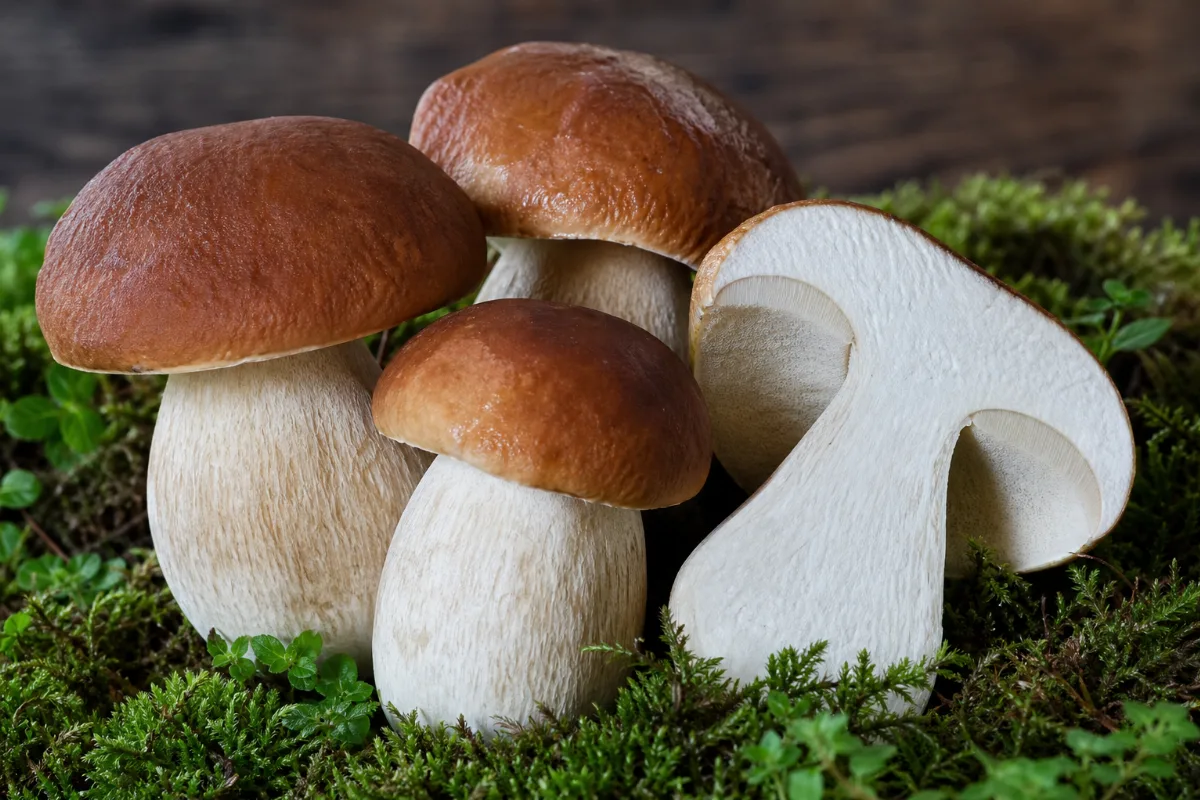
Mushrooms · Wild culinary mushroom
Porcini
Boletus edulis · also called King bolete, penny bun, cep, steinpilz
Porcini is a prized wild mushroom, eaten fresh or dried. It is a nutritious food, but we found no human trial showing a health benefit from eating it. The main cautions are mistaking it for other boletes, and metals and radioactive caesium that wild and dried mushrooms can carry, depending on where they grew.
General information, not medical advice. Last substantive update · Not medically reviewed. A named clinician has not signed off on this page. How this page is made
About Porcini
Porcini, or king bolete, is a wild edible mushroom prized for its taste. It is a nutritious food, and its research is mostly about what is in it, not what it does for health. We found no human health trial. The cautions are practical: wild boletes can be mistaken for each other, and wild and dried mushrooms can carry cadmium and radioactive caesium depending on where they grew.
What it is
Porcini is a fungus, Boletus edulis, in the family Boletaceae. GBIF lists the name as accepted. It is also called king bolete, penny bun, cep and steinpilz. The word 'porcini' on a food label may cover related species; we did not find a source that says which.
It forms a partnership with tree roots, so it is collected wild. The part eaten is the mushroom itself, the cap and stalk.
Food use and traditional use
A 2013 review calls porcini a highly valued, tasty edible mushroom. Porcini is sold fresh and dried. We found no traditional medicine use in the sources we read, so none is claimed.
What the research shows
A 2022 narrative review describes porcini as rich in carbohydrates, protein, minerals and taste compounds, and lists lab-type activities of extracts such as antioxidant, anti-inflammatory and liver-protecting. The authors say the potential as a functional food or medicine needs to be confirmed. A separate review says ergothioneine, found in mushrooms, shows antioxidant action in lab systems. We found no human trial of porcini for any health outcome; our search was not exhaustive.
Metals, radioactive caesium and dried products
In a 2026 survey of 164 dried commercial mushrooms from Poland, Boletus edulis had the highest cadmium of the six species. Most median levels were inside the authors' thresholds, but suppliers varied, and organic-certified samples had lower mercury and arsenic. A 2013 review table gives cadmium in porcini caps of 0.23 to 52 mg per kg dry matter across earlier studies. Dried mushroom is concentrated, so always check whether a figure is per fresh or per dried weight.
Caesium-137 depends on place. In Yunnan, China, porcini caps held 5.2 to 10 Bq per kg dry matter, while boletes from European sites showed two to four orders of magnitude more. In a Polish study, button-stage caps held about fourteen times more than older ones. In a cooking study, removing the juice took out up to 29 percent of the caesium from chanterelles and less for boletes. Dried porcini also differ in flavour quality between products.
Legal and regulatory status
We did not read EFSA, FDA or national limits for cadmium or radiocaesium in mushrooms, so none is stated here. The two guidance pages we did read (Missouri Department of Conservation and Penn State Extension) are not regulator statements about porcini. Rules differ by country and change.
At a glance
Traditional uses history, not proof
- Eaten as a highly valued, tasty wild mushroom, fresh or dried (2013 review).
- No traditional medicine use was confirmed in the sources we read.
Studied for research
- Nutrition as a food (potassium, protein, low fat), insufficient evidence of any health effect
- Ergothioneine as an antioxidant food source, insufficient (compound and lab evidence only)
- Lab and animal-type activities of extracts, insufficient (no human trial found)
Main compounds
- Ergothioneine, an antioxidant amino acid found in mushrooms
- Polysaccharides, phenolic compounds and phytosterols
- Potassium and other minerals; also cadmium and radioactive caesium taken up from the soil
Common forms
- Fresh, cooked mushroom
- Dried mushroom, soaked before use
- Powder used as a flavouring
- Extracts and capsules (not assessed in the sources we read)
Research links: Missouri Department of Conservation: Bitter bolete · Penn State Extension: Preparing and preserving mushrooms · Dried commercial mushrooms: toxic elements (abstract) · Radioactive contamination in Boletus (abstract) · Porcini narrative review (abstract) · Neoboletus poisoning report (abstract) · Research Library · Genes & Biomarkers Library
What it is and its history
- Accepted scientific name
- Boletus edulis
- Naming authority
- Bull. (GBIF)
- Synonyms
- Boletus edulis Fr. (GBIF synonym); Boletus bulbosus Schaeff. (GBIF synonym); Boletus citrinus A.Venturi (GBIF synonym)
- Common names
- Porcini (Italian (used in English)); King bolete (English); Penny bun (English); Cep / cepe (French); Steinpilz (German)
- Family or group
- Boletaceae (a fungus family; boletes), not a plant
- Classification
- Fungi > Basidiomycota > Agaricomycetes > Boletales > Boletaceae > Boletus > Boletus edulis
- Native range
- Not checked in the sources read. Studies read sampled Poland, Romania, other European sites and Yunnan, China.
- Habitat
- The Missouri page says boletes are mycorrhizal: the fungus lives as a network on tree roots and forms the mushroom above ground. That page is about the bitter bolete, and says the same of boletes in general.
- What it looks like
- Fruiting body: Not described here. Identification of wild mushrooms must be done in person by an expert, so no field description is given.
- Cultivation
- Porcini is wild-collected in the sources read; no cultivation source was read.
- Harvest and processing
- Sold fresh or dried and soaked; drying concentrates metals per gram (see Safety). Details not checked.
- Look-alikes and adulterants
- Name: Bitter bolete (Tylopilus felleus); Note: The Missouri Department of Conservation lists it as not edible and extremely bitter, and says it resembles the king bolete.; Name: Other boletes; Note: The same page says other boletes may look alike and some may be edible. A 2026 report describes poisonings from Neoboletus boletes. No source we read names poisonous red-pored look-alikes of porcini.
- Sustainability and conservation
- Not checked.
Traditional use and history history, not clinical proof
| Tradition or era | Documented use | Source |
|---|---|---|
| Food use | A 2013 review calls porcini a highly valued, tasty edible mushroom. No traditional medicine history source was read, so none is stated. | p23179616 |
Traditional use shows how it was used. It does not show that it works or is safe today.
What is inside, and how it may work
What it contains and how those compounds act in cells and animals. Laboratory and animal mechanisms are not proven effects in people.
Main compounds
| Compound | Family | Where it is concentrated | Activity studied | Level of evidence |
|---|---|---|---|---|
| Ergothioneine PubChem 5351619 | sulphur-containing amino acid | Fruiting body (mushrooms in general) A summary figure for porcini was not re-opened and is not stated. | Antioxidant behaviour in lab systems; a selective human transporter (SLC22A4) exists (Borodina 2020). 1 12 | Laboratory research |
| Polysaccharides, phenolic compounds and phytosterols | mixed groups | Fruiting body Not given in the abstract read. | Named in a narrative review as the groups behind reported lab activities. 14 | Laboratory research |
| Potassium | mineral | Fruiting body About 24,000 to 26,000 mg per kg dry matter in the table rows read (Falandysz and Borovicka 2013). | Nutrient; not a supplement claim. 5 | Compositional analysis |
| Cadmium (contaminant) | toxic metal | Cap more than stalk in some species 0.23 to 52 mg per kg dry matter in porcini caps across earlier studies (review table). | Contaminant taken up from the soil. 5 4 | Compositional analysis |
| Caesium-137 (contaminant) | radionuclide | Whole fruiting body 5.2 to 10 Bq per kg dry matter in Yunnan caps; two to four orders of magnitude more in European samples (Falandysz 2015). | Contaminant from old fallout. 6 8 | Compositional analysis |
Mechanisms, receptors and pathways
| Target or pathway | Gene or receptor | What was found | Level |
|---|---|---|---|
| Oxidative stress (antioxidant action of ergothioneine) | SLC22A4 (ergothioneine transporter) | Ergothioneine is taken up by a selective human transporter and shows antioxidant action in lab systems. No porcini study of this was read. 1 | Laboratory research |
| Reported lab activities of extracts | not specified | A narrative review lists antioxidant, anti-inflammatory, liver-protecting, antibacterial, antiviral, anti-tumour and constipation-preventing activities. The abstract does not say which came from cells and which from animals. None is a human finding. 14 | Laboratory research |
Absorption, metabolism and elimination
- Absorption
- Not found for porcini.
- Distribution
- Not found.
- Metabolism
- Not found.
- Elimination
- Not found.
- Bioavailability
- Not established.
Isolated compounds versus whole extracts
Porcini is eaten as a whole food, fresh or dried. Extracts and compounds in the lab research are not the same as the whole mushroom. No porcini capsule, powder or extract was assessed in the sources read.
Nutritional composition
Porcini is described as rich in carbohydrates, protein and minerals and low in fat and calories (Tan 2022). USDA has no porcini entry in the files we hold, so no nutrient table is given.
3 not enough evidence
What was looked at
The 3 benefits and uses checked for Porcini, each with how strong the evidence is. Tap one to open it.
What is Porcini good for?
The uses people ask about and how strong the human evidence is for each. None is proven for porcini. Read this together with the Safety tab.
Benefits, one by one
Each card is a research question, not a promise. Tap a goal to filter. Open a card to see the studies, doses and limits.
Nutrition as a food
Not enough evidencePorcini is a tasty, nutritious wild mushroom. A review describes it as rich in carbohydrates, protein, minerals and taste compounds and low in fat and calories. Its potassium is high. This describes what is in it. No trial shows a health benefit from eating it.
2 studiesFresh, dried and powder forms exist. Drying removes water, so figures…
Studies, doses and limits
What the trials found
No human trial of eating porcini was found. A table in a 2013 mineral review lists potassium of about 24,000 to 26,000 mg per kg dry matter for Boletus edulis (rows from earlier studies).
Results
Potassium about 24 to 26 g per kg dry matter in the table rows read. USDA has no porcini entry in the files we hold, so no nutrient table is given.
Why this rating
Composition data only; no study measured a health effect of eating porcini.
Form and dose studied
Fresh, dried and powder forms exist. Drying removes water, so figures per gram of dried mushroom are far higher than per gram of fresh. Always check which basis a number uses.
Who was studied
General food use
Limits
Wild samples differ by place and age. The review figures are adapted from older studies.
Why researchers looked
Porcini is mainly a food. Most research measures what is in it rather than what it does in people.
Traditional use
No traditional medicine use was confirmed in the sources we read.
Proposed mechanism Compositional analysis
Not applicable: this is a composition fact, not a mechanism.
A proposed mechanism does not show that the effect happens in people.
Wild and dried porcini can also carry cadmium and radiocaesium; see the Safety tab.
Ergothioneine (an antioxidant compound) as a food source
Not enough evidenceMushrooms, including porcini, contain ergothioneine, a sulphur-containing amino acid with antioxidant behaviour. A review says mushrooms or ergothioneine 'seem' to protect against oxidative stress in many lab systems. No trial tested porcini.
2 studiesNot assessed.
Studies, doses and limits
Results
No result for porcini. A summary figure for porcini ergothioneine was not re-opened and is not stated here.
Why this rating
Compound-level and lab evidence only; no porcini trial.
Form and dose studied
Not assessed.
Limits
Presence of a compound does not show a health effect.
Why researchers looked
Ergothioneine is made by fungi, not by plants or animals, so mushrooms are a main diet source.
Proposed mechanism Laboratory research
Humans have a selective transporter for ergothioneine, called SLC22A4. Antioxidant action is shown in lab systems (Borodina 2020). Whether eating porcini changes body levels or health was not found.
A proposed mechanism does not show that the effect happens in people.
The review says regulators have passed ergothioneine as safe; that is about the pure compound, not about wild mushrooms.
Laboratory-type activities (antioxidant, anti-inflammatory, liver-protective, anti-tumour, antibacterial, antiviral, constipation prevention)
Not enough evidenceA 2022 review lists these activities for porcini extracts and compounds. They are lab-type findings. The review says the potential as a functional food and medicine still needs to be confirmed. No human trial was found.
1 studiesExtracts, not whole cooked mushrooms. No supplement was assessed.
Studies, doses and limits
Results
No human results. Activities are those the review lists for extracts and compounds.
Why this rating
Lab and animal-type evidence only, from a narrative review whose abstract was read.
Form and dose studied
Extracts, not whole cooked mushrooms. No supplement was assessed.
Limits
Narrative review, abstract only. Findings with extracts do not carry over to eating the mushroom.
Why researchers looked
Researchers test mushroom extracts in cells and animals to look for possible effects.
Proposed mechanism Laboratory research
The review names polysaccharides, phenolic compounds and phytosterols as the active groups. The abstract does not give the type of study behind each activity.
A proposed mechanism does not show that the effect happens in people.
Nothing here supports using porcini as a treatment.
Connections to the rest of health
How Porcini connects to the rest of our health knowledge graph. Every link says what kind of connection it is. A safety link (for example to the liver) is a warning, not a benefit. A study that merely mentions a topic never creates a benefit link.
Explore every connection: goals, body systems, organs, symptoms, genes
E. Health conditions
| Connected to | Kind of connection | Evidence status | Context | Studies |
|---|---|---|---|---|
| Mushroom poisoning | Adverse effect or risk | Low certainty | Bitter bolete resembles porcini; Neoboletus poisoning report. Preparation or compound: Look-alike boletes |
17 11 |
| Mushroom allergy | Adverse effect or risk | Low certainty | Occupational asthma letter; title-only sources. Preparation or compound: Porcini allergens |
3 10 |
F. Functional actions
| Connected to | Kind of connection | Evidence status | Context | Studies |
|---|---|---|---|---|
| Antioxidant | Biological association | Not enough evidence | Lab-level only; no porcini trial. Preparation or compound: Ergothioneine (food source) |
1 |
G. Root causes and contributing factors
| Connected to | Kind of connection | Evidence status | Context | Studies |
|---|---|---|---|---|
| Heavy metal exposure | Moderate certainty | Cadmium and nickel accumulation; varies by site and supplier. Preparation or compound: Wild and dried porcini |
4 5 2 | |
| Environmental toxins | Moderate certainty | Region-dependent caesium-137. Caesium-137 depends strongly on region. Preparation or compound: Wild porcini (radiocaesium) |
6 8 7 |
K. Biological pathways
| Connected to | Kind of connection | Evidence status | Context | Studies |
|---|---|---|---|---|
| SLC22A4 (ergothioneine transporter) | Preliminary mechanism | In vitro | Human transporter for ergothioneine, found in mushrooms. | 1 |
L. Active compounds
| Connected to | Kind of connection | Evidence status | Context | Studies |
|---|---|---|---|---|
| Ergothioneine | Biological association | In vitro | Antioxidant behaviour in lab systems; a selective human transporter (SLC22A4) exists (Borodina 2020). Preparation or compound: Fruiting body (mushrooms in general) |
1 12 |
| Polysaccharides, phenolic compounds and phytosterols | Biological association | In vitro | Named in a narrative review as the groups behind reported lab activities. Preparation or compound: Fruiting body |
14 |
| Potassium | Biological association | Compositional analysis | Nutrient; not a supplement claim. Preparation or compound: Fruiting body |
5 |
| Cadmium (contaminant) | Biological association | Compositional analysis | Contaminant taken up from the soil. Preparation or compound: Cap more than stalk in some species |
5 4 |
| Caesium-137 (contaminant) | Biological association | Compositional analysis | Contaminant from old fallout. Preparation or compound: Whole fruiting body |
6 8 |
Each connection is stored with the ingredient, the connected record, the kind of connection, the evidence status, the supporting studies, the preparation or compound involved, and a review date (last reviewed October 25, 2026).
Evidence at a glance: what the research found for 3 outcomes
Each outcome below is one thing researchers measured. Certainty is how far the evidence can be trusted, not how well it works. The full studies are on the next tab.
The evidence
The research centre for Porcini. Every record here was checked against PubMed or the publisher's page; we never list a study we have not verified.
Evidence by outcome
Bars show how many studies we found for each outcome, not how well it works. People are added up across trials only (reviews are not added, to avoid double counting).
How we rate evidence
High certainty
Several well-run trials or reviews agree; further research is unlikely to change the picture much.
Moderate certainty
Good trials point the same way, but some doubt remains.
Low certainty
Small, short or inconsistent trials. The finding could change with better research.
Very low certainty
Very little or very weak human data. Treat as a possibility only.
Mixed findings
Trials or reviews disagree with each other.
Not enough evidence
Not enough human research to say either way.
Evidence against
Good research found no benefit, or found harm.
We take the reviewers' own risk-of-bias and GRADE statements where they exist, and otherwise judge from study size, design, consistency, directness and whether a product matches what is sold. Many publications do not make evidence high. Method note: We read PubMed records for 13 papers: abstracts for 11 (seven contamination surveys or lab studies including a 2013 mineral review whose tables we also read, one narrative review of porcini, one review of ergothioneine, one case report of bolete poisoning, one dried-porcini taste study) and title-and-record only for two letters (mushroom allergy and occupational asthma). We also read two guidance pages in full (Missouri Department of Conservation and Penn State Extension), and checked the name in GBIF and ergothioneine in PubChem. Index Fungorum, EFSA, FDA and poison-centre statements were not read. Only abstracts were read for most papers, so numbers come from abstracts. Certainty ratings are the compiler's own reading.
Study library: every study we checked 17
| Study | Design | People | Product, dose, length | Result |
|---|---|---|---|---|
| Borodina 2020 The biology of ergothioneine, an antioxidant nutraceutical. Nutrition Research Reviews · PMID 32051057 · DOI |
Narrative review review (compound) |
Review of the compound ergothioneine across organisms | Ergothioneine (not porcini specifically) Not shown here |
The abstract says ergothioneine is made by fungi (including in mushroom fruiting bodies) and some bacteria but not by plants or animals, which get it from soil and diet. Humans have a selective transporter for it (SLC22A4). It says mushroom or ergothioneine consumption 'seems to provide significant prevention against oxidative stress in a large variety of systems', that its level is lower in a number of chronic inflammatory diseases, and that regulatory agencies have passed it as safe. Ergothioneine is a compound in mushrooms with antioxidant behaviour; this review is not about porcini Methods, limits and fundingOutcomes: Biology and effects of ergothioneine Limitations: Review of the compound in general, not of porcini; most evidence it discusses is lab or association data. Abstract only was read. The graph summary that porcini holds more than 7 mg per g dry weight was not re-opened and is not repeated here. Funding and conflicts: Academic review; funding not stated in the abstract Read: abstract |
| Bucurica 2024 Heavy Metals and Associated Risks of Wild Edible Mushrooms Consumption: Transfer Factor, Carcinogenic Risk, and Health Risk Index. Journal of Fungi · PMID 39728340 · DOI |
Laboratory survey lab (food samples) |
228 mushroom and 114 soil samples from Romania, six wild edible species | Wild Boletus edulis among six species fruiting body Not shown here |
Boletus edulis was the species that accumulated the most nickel relative to its soil (22.694%, as worded in the abstract). Cadmium and chromium were highest in Macrolepiota procera, copper in M. excoriata and lead in Armillaria mellea. Caps and stipes differed. The authors estimated that the daily intake of toxic metals from these mushrooms was about 1.5 times higher for children than for adults. Metal uptake depends on species, part and site Methods, limits and fundingOutcomes: Cadmium, chromium, copper, nickel and lead in mushrooms and soil Limitations: Romania only; modelled risk estimates, not measured harm. Abstract only was read. Funding and conflicts: Authors declare no competing interests Read: abstract |
| Castillo 2013 Protein identification of two allergens of Boletus edulis causing occupational asthma. American Journal of Respiratory and Critical Care Medicine · PMID 23675726 · DOI |
Case report human (letter) |
Letter on occupational asthma from Boletus edulis | Boletus edulis allergens (handling) fruiting body Not shown here |
Only the title and record were available. The title says two allergens of Boletus edulis were identified in occupational asthma. Title only Methods, limits and fundingOutcomes: Occupational asthma Limitations: A letter; no abstract or figures read. Funding and conflicts: Not stated Read: title and record only |
| Domagalska 2026 Evaluation of Toxic Elements in Commercial Dried Mushrooms from the Polish Market: Exposure Assessment and Health Risk Characterization. Molecules · PMID 42280168 · DOI |
Laboratory survey lab (food samples) |
164 samples of commercial dried mushrooms, six species, Poland | Dried commercial mushrooms incl. Boletus edulis fruiting body Not shown here |
Contamination depended on species, supplier and certification. Median levels for most species were within the safety thresholds the authors used. Boletus edulis had the highest cadmium and Suillus species the highest arsenic. One extreme arsenic result (369.048 mg per kg) was found in Imleria badia, not in porcini, with a hazard index of 63.57 against a limit of 1. Organic-certified samples had significantly lower mercury and arsenic. The authors say moderate consumption of most batches is safe but producers vary a lot and outliers exist. Highest cadmium among six species for B. edulis; big variation between suppliers Methods, limits and fundingOutcomes: Cadmium, lead, mercury and arsenic Limitations: Poland only; commercial samples of unknown origin; thresholds are the authors' own choices. Abstract only was read. Funding and conflicts: Authors declare no competing interests Read: abstract |
| Falandysz 2013 Macro and trace mineral constituents and radionuclides in mushrooms: health benefits and risks. Applied Microbiology and Biotechnology · PMID 23179616 · DOI |
Narrative review fungus (review) |
Wild and cultivated edible mushrooms in general | Mineral and radionuclide data from many species incl. Boletus edulis fruiting body Not shown here |
Abstract: mushrooms hold useful minerals but also co-occurring hazardous elements (Cd, Pb, Hg, Ag, As) and radionuclides. In the full text, a table lists Boletus edulis caps with a total cadmium range of 0.23 to 52 mg per kg dry matter across the studies cited, and the text says wild mushrooms often contain more than 2 mg per kg dry matter but rarely above 10. Another table row gives potassium of about 24,000 to 26,000 mg per kg dry matter for B. edulis, and one row shows caesium-137 of 5,100 to 13,000 Bq per kg dry matter for B. edulis. Wide variation in metal and radiocaesium levels between sites Methods, limits and fundingOutcomes: Mineral constituents, cadmium, caesium, radiocaesium Limitations: Review that adapts tables from earlier studies; figures come from different places and years and may not match any product on sale. Abstract and parts of the full text were read. Funding and conflicts: Academic review; funding not stated in the abstract Read: full text (tables) and abstract |
| Falandysz 2015 Evaluation of the radioactive contamination in fungi genus Boletus in the region of Europe and Yunnan Province in China. Applied Microbiology and Biotechnology · PMID 26048471 · DOI |
Laboratory survey lab (food samples) |
Boletus mushrooms from Europe (1995-2010) and Yunnan, China (2011-2014) | Wild Boletus edulis and related boletes fruiting body Not shown here |
B. edulis from Yunnan had very weak caesium-137 contamination: 5.2 to 10 Bq per kg dry matter in caps and 4.7 to 5.5 in stipes. Boletes from European sites (B. badius, B. edulis, B. impolitus, B. luridus, B. pinophilus, B. reticulatus) showed two to four orders of magnitude more caesium-137. Region matters more than species Methods, limits and fundingOutcomes: Caesium-137 and potassium-40 Limitations: Different years and sites; no safety limit applied in the abstract. Abstract only was read. Funding and conflicts: Not stated in the abstract Read: abstract |
| Falandysz 2017 Radioactive artificial 137Cs and natural 40K activity in 21 edible mushrooms of the genus Boletus species from SW China. Environmental Science and Pollution Research · PMID 28150146 · DOI |
Laboratory survey lab (food samples) |
21 Boletus species, 87 composite samples, 807 fruiting bodies, SW China | Wild Boletus species (this paper is not porcini-only) fruiting body Not shown here |
Caesium-137 ranged from below 4.4 to 83 Bq per kg dry biomass in caps. Estimated internal dose from eating 1 kg a year was below 0.0031 to 0.047 microsieverts for caesium-137. The authors call the overall intake low because contamination was low. Low in this region Methods, limits and fundingOutcomes: Caesium-137 and potassium-40 Limitations: SW China only; does not apply to heavily contaminated areas. Abstract only was read. Funding and conflicts: Not stated in the abstract Read: abstract |
| Falandysz 2021 137Caesium, 40K and total K in Boletus edulis at different maturity stages: Effect of braising and estimated radiation dose intake. Chemosphere · PMID 33359994 · DOI |
Laboratory survey lab (food samples) |
Boletus edulis from northern Poland, four maturity stages, 2019 | Wild Boletus edulis, raw and braised fruiting body Not shown here |
Raw button-stage caps held 36 Bq per kg wet weight (360 dry) of caesium-137, about fourteen times more than older, larger stages (2.5 Bq per kg wet weight raw). Braising raised the wet-weight figure, by 110 percent for caesium-137 on average, because the mushrooms lost water. Young caps held much more caesium-137 Methods, limits and fundingOutcomes: Caesium-137 and potassium-40 by maturity Limitations: One region and year; abstract only was read. Funding and conflicts: Authors declare no competing interests Read: abstract |
| GBIF 2026 GBIF Backbone Taxonomy: Boletus edulis Bull. (species match, key 5954958), checked 2026-10-25 GBIF API · Source |
Taxonomy record n/a |
n/a | n/a Not shown here |
GBIF returns Boletus edulis Bull. as ACCEPTED (key 5954958), kingdom Fungi, phylum Basidiomycota, class Agaricomycetes, order Boletales, family Boletaceae, genus Boletus. Its synonym list includes Boletus edulis Fr., B. bulbosus Schaeff., B. citrinus A.Venturi, and many forms and subspecies. Methods, limits and fundingOutcomes: Accepted name and classification Limitations: A database record; Index Fungorum was not checked. It does not say which species any 'porcini' product holds. Funding and conflicts: Public database Read: full record |
| Lee Qiyu 2026 Edible mushroom allergy: a clinically heterogeneous and under-recognized condition. European Annals of Allergy and Clinical Immunology · PMID 42788552 · DOI |
Letter human (letter) |
Edible mushrooms in general | Edible mushrooms (not porcini-specific) fruiting body Not shown here |
Only the title and record were available; no abstract. The title says edible mushroom allergy is varied and under-recognised. Title only Methods, limits and fundingOutcomes: Allergy Limitations: No abstract or figures read; says nothing specific about porcini. Funding and conflicts: Not stated Read: title and record only |
| Li 2026 Beyond gastroenteritis: first evidence of systemic biochemical disturbances, predominantly coagulation dysfunction, in Neoboletus poisoning. Toxicon · PMID 42476469 · DOI |
Case report |
Two poisoning episodes in Yunnan, China (2022 and 2023), eight people who ate wild boletes | Wild mushrooms of the bolete genus Neoboletus (N. obscureumbrinus, N. multipunctatus), not porcini fruiting body Not shown here |
In the first episode four adults ate one wild species and one had abdominal pain, dizziness and sweating that settled within an hour. In the second, a mixed wild meal was eaten by four people and three had vomiting and tiredness. In the two men who ate most, blood tests showed longer thrombin time (up to 37.5 seconds), high blood sugar (up to 11.3 mmol/L), raised creatine kinase, and mild liver and kidney or metabolic changes. Severity rose with the estimated amount eaten. The authors say N. obscureumbrinus is traditionally eaten in parts of China and that the safety of the genus needs attention. Dose-related multi-system blood changes, mainly clotting Methods, limits and fundingOutcomes: Symptoms and blood tests Limitations: Two small incidents; species identified by shape and gene analysis; not porcini and not a statement about what porcini look-alikes are. Abstract only was read. Funding and conflicts: Authors declare no competing interests Read: abstract |
| PubChem 2026 PubChem: Ergothioneine (CID 5351619), checked 2026-10-25 PubChem API · Source |
Chemistry record n/a |
n/a | n/a Not shown here |
PubChem lists Ergothioneine as CID 5351619, formula C9H15N3O2S. Methods, limits and fundingOutcomes: Compound identity Limitations: A chemistry record only. Funding and conflicts: Public database Read: record |
| Steinhauser 2016 A Simple and Rapid Method for Reducing Radiocesium Concentrations in Wild Mushrooms (Cantharellus and Boletus) in the Course of Cooking. Journal of Food Protection · PMID 28221918 · DOI |
Laboratory study lab (food samples) |
Wild chanterelles and Boletus edulis | Wild Boletus edulis and chanterelles, cooked fruiting body Not shown here |
The juice that comes out during cooking holds a relatively high share of the caesium. Removing it took out up to 29 percent of the radiocaesium from chanterelles. Boletes have a lower affinity for caesium, had lower activity, and a lower share of their caesium in the juice. Some caesium is lost with the juice; less so for boletes Methods, limits and fundingOutcomes: Radiocaesium in cooking juice Limitations: Small lab study; abstract only was read. Not advice for any person to follow. Funding and conflicts: Not stated in the abstract Read: abstract |
| Tan 2022 Chemical profiles and health-promoting effects of porcini mushroom (Boletus edulis): A narrative review. Food Chemistry · PMID 35597089 · DOI |
Narrative review fungus (review) |
Research on Boletus edulis over about two decades | Boletus edulis extracts and compounds fruiting body Not shown here |
The abstract says B. edulis is rich in carbohydrates, proteins, minerals and taste compounds and low in fat and calories, and holds polysaccharides, phenolic compounds and phytosterols. Extracts and compounds are reported to have constipation-preventing, antioxidant, antineoplastic, anti-inflammatory, liver-protecting, antibacterial and antiviral activities. The authors say its potential as a functional food and medicine needs further investigation and confirmation. Lab-type activities listed; no human health outcome in the abstract Methods, limits and fundingOutcomes: Nutrients, taste compounds, bioactive compounds, reported activities Limitations: Narrative review (not systematic); abstract only was read; the abstract does not say which activities came from cells, animals or people, and none is described as a human trial. Funding and conflicts: Academic review; funding not stated in the abstract Read: abstract |
| Zhang 2020 Multivariate relationships among sensory attributes and volatile components in commercial dry porcini mushrooms (Boletus edulis). Food Research International · PMID 32466923 · DOI |
Laboratory study human (taste panel) |
Commercial dry porcini samples, trained panel and consumers | Commercial dried Boletus edulis fruiting body Not shown here |
Liking of dried porcini was tied partly to aromas such as seasoning-like, roasted, cacao-like and smoky notes (compounds such as 3-(methylthio)propanal and pyrazines). Lower liking was tied to raw-mushroom-like, cardboard-like and sweaty notes (1-octen-3-ol, octanal, 2-pentylfuran, 3-methylbutanoic acid). The authors say the work could help quality control of commercial porcini. Flavour quality varies between commercial dried porcini Methods, limits and fundingOutcomes: Aroma and consumer liking Limitations: Taste and smell study, not a safety study. PubMed tags it as a randomised trial; it is a sensory analysis. Abstract only was read. Funding and conflicts: Authors declare no competing interests Read: abstract |
| n/a 2024 Penn State Extension: Preparing and Preserving Mushrooms (updated 22 November 2024) extension.psu.edu · Source |
Authoritative guidance n/a |
n/a | n/a Not shown here |
Page text read on 2026-10-25. Says only an expert can tell poisonous from edible mushrooms, that unless you are an expert you should not forage your own, and that no matter how much you cook or dry mushrooms, you will not destroy their toxins. It says not to can wild mushrooms. Methods, limits and fundingOutcomes: Mushroom identification and safety statements Limitations: University extension page about mushrooms in general; US food-safety guidance, not specific to porcini. Funding and conflicts: University extension (public) Read: full text |
| n/a 2026 Missouri Department of Conservation: Bitter Bolete (field guide page) mdc.mo.gov · Source |
Authoritative guidance n/a |
n/a | n/a Not shown here |
Page text read on 2026-10-25. Lists the bitter bolete (Tylopilus felleus) as 'Not recommended/not edible' and says it can be extremely bitter. It says this species resembles the choice king bolete (Boletus edulis), which does not grow in Missouri but can sometimes be found in stores. It says to be absolutely sure of the ID of any mushroom and to eat only a small amount the first time. Methods, limits and fundingOutcomes: Mushroom identification and safety statements Limitations: State conservation agency field guide, written for Missouri; not a poison-centre or regulator statement; the page shows no date. Funding and conflicts: Public agency Read: full text |
What we do not know yet
- No human trial of porcini for any health outcome was found.
- No source naming poisonous red-pored look-alikes of porcini was read.
- No regulatory limits for cadmium or radiocaesium in mushrooms were read.
- No data on porcini allergy rates, pregnancy or breastfeeding, and no test of porcini powders, extracts or capsules.
- Survey figures are for particular places and years and may not match any product you buy.
How new research is added
New studies are found by a saved PubMed search and placed in a review queue. A person reads each one before it changes any evidence rating or safety wording. New publications never change ratings automatically.
Lab markers
What changed in blood or saliva tests during trials. A changed number is not the same as feeling or being healthier, and we give no "normal ranges".
Safety
What studies and official sources say about side effects, medicines and who should check first. Each point shows what kind of evidence it comes from.
Main points to know 4
- Wild porcini can be mistaken for bad-tasting or poisonous boletes. Several bolete mushrooms can look alike to a beginner. The Missouri Department of Conservation lists the bitter bolete as not edible and extremely bitter, and says it resembles the king bolete (porcini). A 2026 report describes poisonings in China from other bolete mushrooms of the genus Neoboletus, with changes in blood clotting and blood sugar. Penn State Extension says cooking or drying does not destroy mushroom toxins and that only an expert can tell poisonous from edible mushrooms. Never pick and eat a wild mushroom on the strength of a web page or an app. We read no source naming particular red-pored look-alikes, so none is named here. Authoritative guidance 17 11 16
- Wild and dried porcini can carry cadmium and other metals. In a 2026 survey of 164 dried commercial mushrooms from Poland, Boletus edulis had the highest cadmium of six species, although median levels for most species were inside the authors' thresholds, and levels varied a great deal between suppliers. A 2013 review table gives a cadmium range of 0.23 to 52 mg per kg dry matter for porcini caps across earlier studies. Where it grew and who sold it matter most. Laboratory survey 4 5 2
- Wild porcini can hold radioactive caesium from old fallout. Porcini from Yunnan, China had very low caesium-137 (5.2 to 10 Bq per kg dry matter in caps), while boletes from European sites showed two to four orders of magnitude more. Young button-stage caps in a Polish study held about fourteen times more than older ones. Laboratory survey 6 8 7
- Allergy is possible. Edible mushroom allergy is described as varied and under-recognised (2026 letter, title only). A letter from 2013 identified two porcini allergens in occupational asthma. We read no figures on how common porcini allergy is. Case report 10 3
Side effects 2
| Effect | How often | Severity and recovery | Evidence |
|---|---|---|---|
| Poisoning from look-alike boletes (sickness, dizziness, sweating; clotting changes in poisonings by other bolete species) The report is about Neoboletus boletes, not porcini, and it does not say they look like porcini. | Not found for porcini look-alikes; the 2026 Neoboletus report covers 8 people | mild to moderate in the report; not stated for other species The first episode settled within an hour; follow-up of the second was not in the abstract | Case report 11 |
| Allergic reactions or asthma from handling or eating Only titles and records were read. | Not found | unknown unknown | Case report 3 10 |
Liver
No liver injury from eating porcini was found in the sources read. Mild liver and kidney blood-test changes occurred in a Neoboletus poisoning report, which was a different mushroom. 11
Monitoring. Seek medical care for poisoning signs; no routine monitoring is suggested by the sources read.
- p42476469.
This is a safety connection. It is not evidence that Porcini supports liver health.
Medicines and supplements 2
| With | Why it matters | Importance | Evidence | What to do |
|---|---|---|---|---|
| Prescription and over-the-counter medicines prescription | No interaction report for porcini was found in the sources read. This is absence of evidence, not proof of safety. | None found Not enough evidence | Ask a pharmacist if you take regular medicines and plan to eat large amounts of any wild mushroom. | |
| Potassium limits (for example advanced kidney disease or some medicines that raise potassium) condition | Inference only from composition: a 2013 table gives about 24 to 26 g potassium per kg dry matter for porcini. | No source linked porcini to a potassium problem. Raised only because dried mushrooms are potassium-dense. | Theoretical Very low certainty 5 | If your doctor has told you to limit potassium, ask before eating large amounts of dried mushroom. |
Who should check first 3
| Situation | Advice | Evidence |
|---|---|---|
| Anyone who cannot be sure of the mushroom's identity | Do not eat it. Only an expert can separate poisonous from edible mushrooms, and cooking or drying does not destroy toxins (Penn State Extension). | Authoritative guidance 16 17 |
| Known mushroom allergy or occupational asthma from mushrooms | Ask an allergy specialist before eating or handling. | Case report 3 10 |
| Pregnancy, breastfeeding and young children | No porcini-specific safety data were found. A Romanian study estimated metal intake from wild mushrooms to be about 1.5 times higher for children than adults. Ask a clinician about wild or dried mushrooms in these groups. | Laboratory survey 2 |
Overdose, product quality and regulators
Summary. Porcini is an edible mushroom. The main hazards in the sources read are mistaken identity of wild boletes, metals, radiocaesium, allergy and poor-quality products, not a toxin in porcini itself.
Animal. Not reviewed.
Human doses studied. No dose studies. No amounts are advised here.
High dose or long term signals. Metal and radiocaesium intake would add up with frequent large servings of contaminated mushrooms; the studies model this, they do not measure harm.
Genotoxicity. Not read.
Toxic or hazardous parts. Fungus: the cap and stalk are eaten. A Romanian study found caps and stipes differ in metal content for some species.
Porcini is wild-collected, so what it carries depends on the soil and the year. Dried products are concentrated: drying removes water, so a result per kg of dried mushroom is far higher than a per-kg-fresh figure for the same mushroom, which is why every number must be read with its basis.
Cadmium and other metals in commercial dried mushrooms. Among 164 Polish samples of six species, Boletus edulis had the highest cadmium. Medians were mostly inside the authors' thresholds, but suppliers varied. One extreme arsenic value was in another species (Imleria badia). Organic-certified samples had lower mercury and arsenic. 4
Metals in wild porcini and soil. A 2013 review table gives a cadmium range of 0.23 to 52 mg per kg dry matter for caps across earlier studies, and the text says wild mushrooms often exceed 2 but rarely 10. A 2024 Romanian study found porcini took up the most nickel relative to soil of six species. 5 2
Radioactive caesium. Strongly region-dependent: very weak in Yunnan, 2 to 4 orders of magnitude higher in European samples; button-stage caps held about fourteen times more than older ones in a Polish study. The estimated dose from 1 kg a year of SW China boletes was tiny. No safety limit was compared. 6 7 8
Fresh, braised and the cooking juice. Braising raised the per-gram wet-weight figure because water is lost. In a cooking study, removing the juice took out up to 29 percent of radiocaesium from chanterelles; boletes held less and gave up a smaller share. This is a lab finding, not cooking advice. 8 13
Dried product quality. A taste and smell study of commercial dried porcini found marked differences in aroma and liking between products. The sources read give no test results for mould, pesticides or adulteration, and say nothing about powders or extracts. 15 4
| Body | Action | Date |
|---|---|---|
| Missouri Department of Conservation (United States (state)) | Field guide page lists the bitter bolete as not edible and extremely bitter, and says it resembles the king bolete. Not a regulator statement about porcini itself. source | 2026-10-25 |
| Penn State Extension (United States (university)) | Says only an expert can separate poisonous from edible mushrooms, that cooking or drying will not destroy toxins, and not to can wild mushrooms. source | 2024-11-22 |
When to get medical help
- Severe or repeated vomiting, diarrhoea or belly pain, dizziness, confusion or heavy sweating after eating a wild mushroom: get emergency medical help or call your local poison service now. Do not wait for it to pass.
- Unusual bleeding, easy bruising, passing very little urine, yellow skin or eyes, or dark urine after eating wild mushrooms: get medical help now.
- Wheezing, chest tightness, swelling of the lips or face, or hives after handling or eating mushrooms: treat as an emergency.
If someone may be poisoned or in a crisis, contact a clinician or emergency service straight away. In the US, Poison Control is 1-800-222-1222.
General information only, not medical advice. Ask a clinician or pharmacist before use, especially with medicines, in pregnancy or with a health condition. See the Natural Remedy Safety guide.
Frequently asked questions
What is porcini?
Is porcini healthy?
Does porcini have medicinal benefits?
Lab-type studies of extracts report antioxidant, anti-inflammatory and other activities, but the authors say these need confirming and we found no human trial. Porcini is not a treatment for any condition.
What mushrooms look like porcini?
Can look-alike boletes poison you?
Do porcini contain heavy metals?
They can. In a survey of 164 dried commercial mushrooms, Boletus edulis had the highest cadmium of six species, though most medians were inside the authors' thresholds. Levels varied by supplier. A review table gives a cadmium range of 0.23 to 52 mg per kg dry matter in porcini caps across studies.
Are wild porcini radioactive?
Does cooking remove radiocaesium or metals?
Is dried porcini different from fresh?
Can you be allergic to porcini?
Is porcini safe in pregnancy, breastfeeding or for children?
No porcini-specific safety data were found. A Romanian study estimated metal intake from wild mushrooms to be about 1.5 times higher for children than adults. Ask a clinician about wild or dried mushrooms in these groups.
Does porcini interact with medicines?
No interaction report was found in the sources we read, which is not proof of safety. Porcini is rich in potassium, so ask your doctor if you have been told to limit potassium.
Explore by health goal
Editorial transparency
- Written by
- AlternativeMed editorial team. Research compiled with AI assistance, then checked against PubMed records.
- Medical review
- None. This page has not been reviewed by a physician or pharmacist.
- First published
- 2026-10-25
- Last substantive update
- 2026-10-25
- How we research
- We read PubMed records for 13 papers: abstracts for 11 (seven contamination surveys or lab studies including a 2013 mineral review whose tables we also read, one narrative review of porcini, one review of ergothioneine, one case report of bolete poisoning, one dried-porcini taste study) and title-and-record only for two letters (mushroom allergy and occupational asthma). We also read two guidance pages in full (Missouri Department of Conservation and Penn State Extension), and checked the name in GBIF and ergothioneine in PubChem. Index Fungorum, EFSA, FDA and poison-centre statements were not read. Only abstracts were read for most papers, so numbers come from abstracts. Certainty ratings are the compiler's own reading.
- How we rate evidence
- See "How we rate evidence" in the Evidence tab.
- Independence
- No product is promoted on this page. No affiliate links are shown. This page is information, not a recommendation to eat wild mushrooms.
Sources 17
Each source was opened and checked. Where we read only the abstract, it says so. The small numbers in the text point here.
- Borodina I, Kenny LC, McCarthy CM, et al. The biology of ergothioneine, an antioxidant nutraceutical.. Nutrition Research Reviews. 2020. PMID 32051057. DOI 10.1017/S0954422419000301. (abstract)
- Bucurica IA, Dulama ID, Radulescu C, et al. Heavy Metals and Associated Risks of Wild Edible Mushrooms Consumption: Transfer Factor, Carcinogenic Risk, and Health Risk Index.. Journal of Fungi. 2024. PMID 39728340. DOI 10.3390/jof10120844. (abstract)
- Castillo C, Lara B, Cruz MJ, Munoz X. Protein identification of two allergens of Boletus edulis causing occupational asthma.. American Journal of Respiratory and Critical Care Medicine. 2013. PMID 23675726. DOI 10.1164/rccm.201211-2110LE. (title and record only)
- Domagalska J, Rusin M, Rogala D, et al. Evaluation of Toxic Elements in Commercial Dried Mushrooms from the Polish Market: Exposure Assessment and Health Risk Characterization.. Molecules. 2026. PMID 42280168. DOI 10.3390/molecules31111865. (abstract)
- Falandysz J, Borovicka J. Macro and trace mineral constituents and radionuclides in mushrooms: health benefits and risks.. Applied Microbiology and Biotechnology. 2013. PMID 23179616. DOI 10.1007/s00253-012-4552-8. (full text (tables) and abstract)
- Falandysz J, Zalewska T, Krasinska G, et al. Evaluation of the radioactive contamination in fungi genus Boletus in the region of Europe and Yunnan Province in China.. Applied Microbiology and Biotechnology. 2015. PMID 26048471. DOI 10.1007/s00253-015-6668-0. (abstract)
- Falandysz J, Zhang J, Zalewska T. Radioactive artificial 137Cs and natural 40K activity in 21 edible mushrooms of the genus Boletus species from SW China.. Environmental Science and Pollution Research. 2017. PMID 28150146. DOI 10.1007/s11356-017-8494-7. (abstract)
- Falandysz J, Saba M, Strumińska-Parulska D. 137Caesium, 40K and total K in Boletus edulis at different maturity stages: Effect of braising and estimated radiation dose intake.. Chemosphere. 2021. PMID 33359994. DOI 10.1016/j.chemosphere.2020.129336. (abstract)
- GBIF. GBIF Backbone Taxonomy: Boletus edulis Bull. (species match, key 5954958), checked 2026-10-25. GBIF API. 2026. (full record)
- Lee Qiyu ML, Song Chia J. Edible mushroom allergy: a clinically heterogeneous and under-recognized condition.. European Annals of Allergy and Clinical Immunology. 2026. PMID 42788552. DOI 10.23822/EurAnnACI.1764-1489.452. (title and record only)
- Li J, Lu YT, Li XJ, et al. Beyond gastroenteritis: first evidence of systemic biochemical disturbances, predominantly coagulation dysfunction, in Neoboletus poisoning.. Toxicon. 2026. PMID 42476469. DOI 10.1016/j.toxicon.2026.109224. (abstract)
- PubChem. PubChem: Ergothioneine (CID 5351619), checked 2026-10-25. PubChem API. 2026. (record)
- Steinhauser G, Steinhauser V. A Simple and Rapid Method for Reducing Radiocesium Concentrations in Wild Mushrooms (Cantharellus and Boletus) in the Course of Cooking.. Journal of Food Protection. 2016. PMID 28221918. DOI 10.4315/0362-028X.JFP-16-236. (abstract)
- Tan Y, Zeng NK, Xu B. Chemical profiles and health-promoting effects of porcini mushroom (Boletus edulis): A narrative review.. Food Chemistry. 2022. PMID 35597089. DOI 10.1016/j.foodchem.2022.133199. (abstract)
- Zhang H, Huang D, Pu D, et al. Multivariate relationships among sensory attributes and volatile components in commercial dry porcini mushrooms (Boletus edulis).. Food Research International. 2020. PMID 32466923. DOI 10.1016/j.foodres.2020.109112. (abstract)
- n/a. Penn State Extension: Preparing and Preserving Mushrooms (updated 22 November 2024). extension.psu.edu. 2024. (full text)
- n/a. Missouri Department of Conservation: Bitter Bolete (field guide page). mdc.mo.gov. 2026. (full text)


