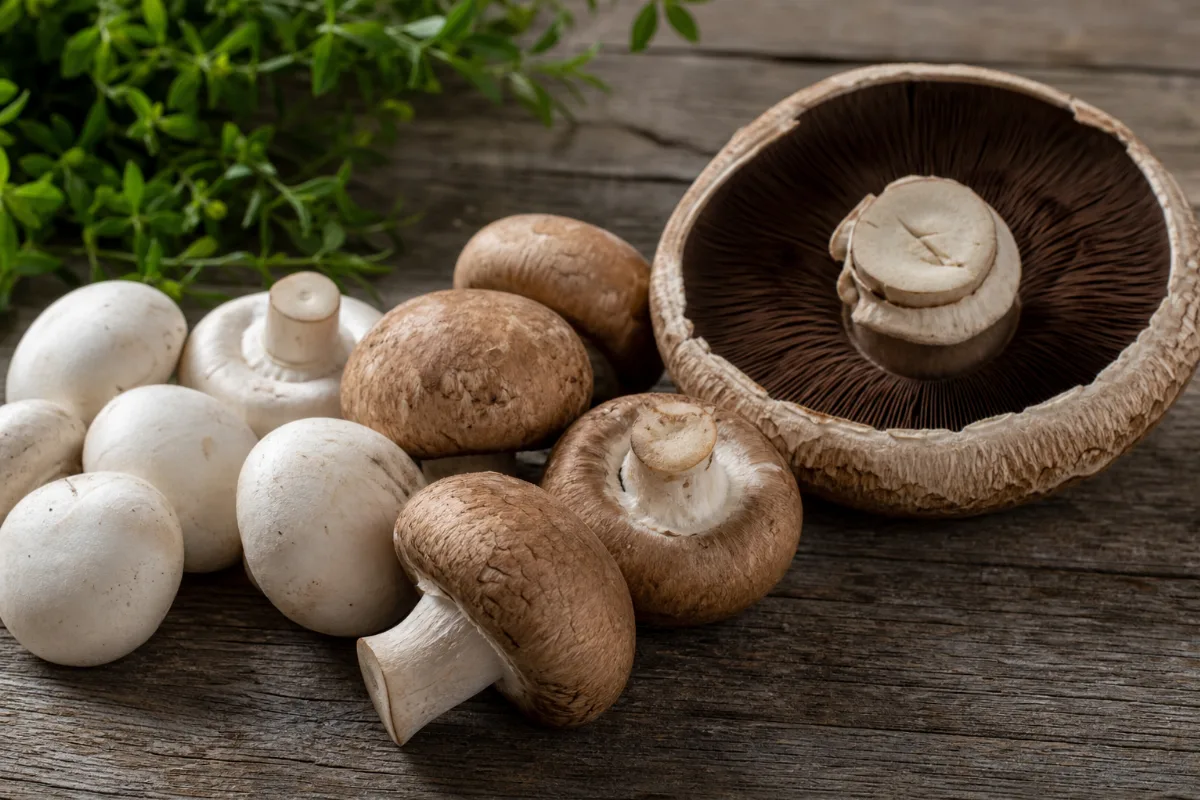
Mushrooms · Culinary mushroom
Button, cremini and portobello mushrooms
Agaricus bisporus · also called White button mushroom, cremini (crimini), portobello (portabella), Swiss brown, champignon
Button, cremini and portobello are the common supermarket forms of one mushroom, Agaricus bisporus. It is a food, and no source we read shows it treats any illness. The best-supported point is vitamin D: mushrooms exposed to UV light hold a lot and ordinary ones almost none, though blood tests in trials were mixed. The main caution is that raw cultivated mushrooms contain agaritine, so cooking is the careful choice, and wild look-alikes can be deadly.
General information, not medical advice. Last substantive update · Not medically reviewed. A named clinician has not signed off on this page. How this page is made
About Button, cremini and portobello mushrooms
Button, cremini and portobello are three forms of Agaricus bisporus, the most eaten mushroom in the world. Human research is small and short, and most results are modest or mixed. UV-exposed mushrooms are a food source of vitamin D, but blood tests in trials varied. Raw cultivated mushrooms contain agaritine, which cooking lowers, and a review advises against eating them crude or poorly cooked. Allergy is rare but can be severe, and wild mushrooms can be deadly look-alikes.
What it is
Agaricus bisporus (J.E.Lange) Imbach is the accepted name in the GBIF database, in the fungus family Agaricaceae. A 2024 allergy review says it comprises the button, portobello and Swiss brown varieties, and a 2020 scoping review calls it the world's most commonly consumed mushroom. USDA lists white, crimini (brown) and portabella as separate foods.
We did not read a source that sets out how cremini and portobello relate to white button in strain or age, so this page treats the research as being about Agaricus bisporus as the studies named it, mostly white button. It is not the same as Agaricus subrufescens, a different species sold as a supplement. Index Fungorum was not checked.
Use as a food
No source we read describes a traditional medicinal use of the button mushroom, so this is a food page. Raw, per 100 g, USDA lists about 22 kcal, 2.1 to 3.1 g of protein, 0.6 to 1.3 g of fibre, 318 to 448 mg of potassium and 9.3 to 26 ug of selenium. Figures differ between mushroom types and between datasets, so each is one sample, not a fixed value.
Mushrooms are one of the richest food sources of the antioxidant ergothioneine. USDA Foundation Foods lists 4.25 mg per 100 g in white button, 1.25 mg in crimini and 2.333 mg in portabella.
Vitamin D depends on UV light
Mushrooms make vitamin D2 only when UV light turns their ergosterol into it. In USDA records, raw ordinary white, crimini and portabella mushrooms hold 0.1 to 0.3 ug of vitamin D2 per 100 g, and newer Foundation Foods analyses show 0 to 0.02 ug. UV-exposed raw mushrooms hold 26.2 ug (white), 31.9 ug (crimini) and 28.4 ug (portabella). Grilled UV-exposed portabella held 13.1 ug, so cooking can lower it.
A 2016 lab study found artificial UV-B gave 67.1 ug of vitamin D2 per g of dry weight against 3.9 ug in sunlight, and vitamin D4 also formed. Check the label rather than assuming a mushroom has had UV treatment.
What the research shows
A meta-analysis of 6 randomised trials of UV-exposed mushrooms found blood 25-hydroxyvitamin D was not significantly raised overall, with very uneven results. It rose by 15.2 nmol/L in the 3 European trials, where people started low, and did not rise in the 3 US trials, where people started higher. The D2 form rose and the D3 form fell. A 2020 scoping review called vitamin D the strongest human finding for this mushroom but gave no figures.
Other findings are single small studies. In 32 healthy adults, a mushroom breakfast gave slightly less hunger and more fullness than meat, with no change in later food intake. In 60 adults, button and oyster mushrooms in a Mediterranean-style diet were linked to a small drop in fasting glucose, and nothing else changed because of the mushrooms. A systematic review of edible mushrooms found limited evidence for lower triglycerides and hs-CRP only, with most studies rated poor quality. Two authors of that review reported research funds from The Mushroom Council.
No source we read supports using button mushrooms to treat any disease.
Fresh, cooked, UV-exposed and powder are different
Eating the mushroom is not the same as taking an extract or powder, and trial results do not carry over between them. The trials we read used fresh mushrooms in meals, UV-exposed mushrooms, and in one pilot a meal with mushroom powder. Cooking changes agaritine and vitamin D2, and amounts differ between samples, harvests and storage.
Official statements
We read no regulator statement on button mushrooms as a health product. The USDA FoodData Central database lists food composition values. It is not a safety ruling. We did not read EMA, EFSA, FDA, LiverTox or LactMed entries for this mushroom, so none is stated here.
At a glance
Traditional uses history, not proof
- No source we read describes traditional medicinal use of the button mushroom.
- It is described as the world's most commonly consumed mushroom, eaten as a food (2020 scoping review).
- Growers can expose mushrooms to UV light after harvest to raise their vitamin D2 (2016 laboratory study).
Studied for research
- Vitamin D status from UV-exposed mushrooms, low (mixed trials)
- Fullness after a meal (one small trial), low
- Fasting blood sugar (one trial with two mushroom species; a review found none), mixed
- Cholesterol, blood pressure, triglycerides and inflammation markers, very low
- Breast cancer risk (observational, mushrooms in general), very low
- Antioxidant ergothioneine (absorbed; no health outcome shown), insufficient
- Immune and gut health (scoping review, no figures), insufficient
Main compounds
- Ergosterol, which turns into vitamin D2 under UV light
- Ergothioneine and glutathione (antioxidants)
- Beta-glucans, chitin and flavonoid-type antioxidants
- Agaritine, a compound that cooking lowers
Common forms
- Fresh, cooked (the usual way to eat it)
- Fresh, raw (in salads; see the agaritine caution)
- UV-exposed fresh mushrooms (check the label)
- Dried or powdered mushroom used as a food ingredient
- Canned (listed separately by USDA; its values are not used here)
Research links: Scoping review of Agaricus bisporus health effects (abstract) · UV-exposed mushrooms and vitamin D: meta-analysis (abstract) · Agaritine and cooking in Agaricus mushrooms (abstract) · Review: button mushrooms eaten crude or poorly cooked (abstract) · Button mushroom anaphylaxis, case report and review (abstract) · USDA FoodData Central · Research Library · Genes & Biomarkers Library
What it is and its history
- Accepted scientific name
- Agaricus bisporus
- Naming authority
- (J.E.Lange) Imbach (GBIF)
- Synonyms
- Agaricus hortensis (Cooke) Pilat (GBIF synonym); Agaricus campestris var. hortensis Cooke (GBIF synonym); Agaricus campestris var. bisporus (GBIF synonym); Agaricus bisporus var. hortensis (Cooke) Anon. (GBIF synonym)
- Common names
- White button mushroom, button mushroom (English); Cremini (crimini); USDA names it 'brown, italian, or crimini' (English); Portobello (portabella) (English); Swiss brown (English); Champignon, table mushroom (English)
- Family or group
- Agaricaceae (a fungus family), not a plant
- Classification
- Fungi > Basidiomycota > Agaricomycetes > Agaricales > Agaricaceae > Agaricus > Agaricus bisporus
- Native range
- Not checked in the sources read.
- Habitat
- Not checked in the sources read. Shop mushrooms are cultivated; Urbain 2016 describes commercial production.
- What it looks like
- Fruiting body: Not described in the sources read. Do not use this page to identify mushrooms.
- Cultivation
- Cultivated commercially; growers can expose mushrooms to UV light after harvest to raise vitamin D2 (Urbain 2016). Mushrooms picked in later crops (flushes) held more ergothioneine and glutathione in one study.
- Harvest and processing
- Fresh, cooked, UV-exposed, dried or powdered, and canned forms are sold. USDA lists canned separately; those values are not used here.
- Look-alikes and adulterants
- Name: Agaricus xanthodermus (yellow stainer); Note: A wild relative whose fruiting bodies hold enough phenol to account for its toxicity (Gill 1984).; Name: Amanita phalloides and other amatoxin mushrooms; Note: A review says some poisonous mushrooms cannot be told from edible ones by shape alone, and amatoxin mushrooms cause more than 90% of mushroom deaths. The reviews we read do not say how often they are mistaken for button mushrooms.; Name: Agaricus subrufescens (a supplement mushroom); Note: A different species sold as a supplement. Findings on button mushrooms do not carry over to it.
- Sustainability and conservation
- Not checked.
Photographs

Traditional use and history history, not clinical proof
| Tradition or era | Documented use | Source |
|---|---|---|
| Modern food | A 2020 scoping review calls Agaricus bisporus the world's most commonly consumed mushroom. It is eaten as a food in white, brown (cremini or Swiss brown) and large (portobello) forms. | p32653808 |
| Traditional medicine | No source we read describes traditional medicinal use of the button mushroom. It is a food, not a traditional remedy. | p32653808 |
Traditional use shows how it was used. It does not show that it works or is safe today.
What is inside, and how it may work
What it contains and how those compounds act in cells and animals. Laboratory and animal mechanisms are not proven effects in people.
Main compounds
| Compound | Family | Where it is concentrated | Activity studied | Level of evidence |
|---|---|---|---|---|
| Ergosterol (provitamin D2) and vitamin D2 PubChem 444679 | sterol | Fruiting body USDA Foundation Foods raw ergosterol: 55.6 mg (white), 55.35 mg (crimini), 48.92 mg (portabella) per 100 g. Vitamin D2 in ordinary mushrooms 0 to 0.3 ug per 100 g; with UV exposure 26.2 (white), 31.9 (crimini), 28.4 (portabella) ug per 100 g (SR Legacy). | Turns into vitamin D2 (ergocalciferol, CID 5280793) under UV light; some vitamin D4 is also made (Urbain 2016). 20 18 21 | Food chemistry |
| Ergothioneine PubChem 5351619 | sulfur-containing amino acid | Fruiting body; higher in cap than stem in some species USDA Foundation Foods raw per 100 g: 4.25 mg (white), 1.25 mg (crimini), 2.333 mg (portabella). A lab study found 0.15 to 7.27 mg per g dry weight across mushroom species. | Antioxidant in the lab; taken up into red blood cells after a mushroom meal in 10 men. No health outcome shown. 20 8 19 | Human absorption |
| Agaritine PubChem 439517 | hydrazine derivative of glutamic acid | Cap skin and gills (lowest in the stem) 200 to 500 mg per kg fresh weight in cultivated A. bisporus; 165 to 457 mg per kg in 28 supermarket Agaricus samples. | Described as a precursor to a suspected rodent carcinogen; weakly genotoxic as a purified extract in mice; lowered by cooking, storage and UV exposure. 13 12 14 18 21 | Animal research |
| Beta-glucans, glutathione, flavonoid-type antioxidants and chitin | polysaccharides, tripeptide and others | Fruiting body USDA Foundation Foods raw beta-glucan per 100 g: 0.75 g (white), 0.9167 g (crimini), 1.15 g (portabella); glutathione 4.3 mg, 5.7 mg and 5.0 mg. | Named as bioactive compounds in a scoping review; effects were seen in cells and animals and it is unclear whether they happen in people. 3 20 | Laboratory research |
Mechanisms, receptors and pathways
| Target or pathway | Gene or receptor | What was found | Level |
|---|---|---|---|
| Conversion of ergosterol to vitamin D2 and D4 | Not applicable (food chemistry) | UV-B converts ergosterol in the mushroom to vitamin D2, and vitamin D4 rises with D2. Artificial UV-B gave far more D2 than sunlight in sliced mushrooms. 18 | Food chemistry |
| Agaritine activation and breakdown | Gamma-glutamyl transpeptidase (enzyme) | Agaritine is activated by gamma-glutamyl transpeptidase in the lab, and its metabolites include diazonium ions and free radicals. The activating enzyme did not raise the mutagenicity of whole-mushroom extracts, so agaritine may not drive extract mutagenicity. 11 9 | Laboratory research |
| Red blood cell uptake of ergothioneine | Not stated in the abstract | Ergothioneine from a mushroom meal rose in red blood cells in 10 men. 19 | Human data |
| Immune and gut effects of beta-glucans and other compounds | Not stated in the abstract | The scoping review says evidence for health effects comes from cell and animal models and that it is unclear whether they occur in humans. 3 | Laboratory research |
Absorption, metabolism and elimination
- Absorption
- Ergothioneine was absorbed (red blood cell uptake) after a mushroom meal in 10 men. No data on other compounds.
- Distribution
- Red blood cell concentration was measured; no other tissues.
- Metabolism
- UV-exposed mushrooms raised 25(OH)D2 and lowered 25(OH)D3 in a meta-analysis of 5 trials. Agaritine's breakdown in the body in humans was not found.
- Elimination
- Not found in the sources read.
- Bioavailability
- Ergothioneine is bioavailable; bioavailability of vitamin D2 from UV mushrooms is described only through changes in blood 25(OH)D2.
Isolated compounds versus whole extracts
Most findings are about eating the whole mushroom, fresh or cooked. UV-exposed mushrooms differ greatly from ordinary ones in vitamin D2. A purified agaritine extract behaved differently from whole-mushroom diets in mice. The abstracts did not study extracts or powders as supplements, apart from a meal with mushroom powder in 10 men.
Nutritional composition
Raw, per 100 g (USDA): about 22 kcal, protein 2.1 to 3.1 g, fibre 0.6 to 1.3 g, potassium 318 to 448 mg, selenium 9.3 to 26 ug, riboflavin 0.13 to 0.49 mg. Figures differ by type and by dataset (SR Legacy versus Foundation Foods), so each is one sample, not a fixed property.
1 mixed findings2 low certainty2 very low certainty2 not enough evidence
What was looked at
The 7 benefits and uses checked for Button, cremini and portobello mushrooms, each with how strong the evidence is. Tap one to open it.
- Vitamin D from UV-exposed mushroomsLow certainty
- Fullness after a mealLow certainty
- Fasting blood sugarMixed findings
- Cholesterol, blood pressure, triglycerides and inflammation markersVery low certainty
- Ergothioneine and antioxidantsNot enough evidence
- Cancer risk (breast cancer, observational)Very low certainty
- Immune and gut health (beta-glucans and other compounds)Not enough evidence
Lab markers tracked in the studies
Serum 25-hydroxyvitamin D [25(OH)D] (vitamin D status)Fasting blood glucoseTriglycerides and hs-CRPCholesterol, lipoproteins and blood pressureRed blood cell ergothioneineORAC(total) antioxidant capacity
What is Button, cremini and portobello mushrooms good for?
The uses people ask about and how strong the human evidence is for each. These are food findings. None is proven. Read this together with the Safety tab.
Benefits, one by one
Each card is a research question, not a promise. Tap a goal to filter. Open a card to see the studies, doses and limits.
Vitamin D from UV-exposed mushrooms
Low certaintyMushrooms hold almost no vitamin D unless they are exposed to UV light. UV-exposed button, cremini and portobello mushrooms hold a lot. Trials of UV-exposed mushrooms are mixed: blood vitamin D rose in some, mainly in people who started low, and not in others.
4 studiesOnly mushrooms exposed to UV light after harvest. Ordinary mushrooms …
Studies, doses and limits
What the trials found
A 2016 meta-analysis of 6 randomised trials in healthy people found serum 25-hydroxyvitamin D was not significantly raised overall (P = 0.12, with very uneven results between trials). In the 3 European trials, where people started with an average of 38.6 nmol/L, it rose by 15.2 nmol/L (95% CI 1.5 to 28.8). In the 3 US trials, where people started higher (81.5 nmol/L), it did not change. The D2 form rose and the D3 form fell. A 2020 scoping review of Agaricus bisporus called better vitamin D status the strongest human finding and said UVB-exposed mushrooms may raise 25(OH)D similar to supplements, but gave no figures in the abstract. The abstracts do not say which mushroom species each trial used.
Results
USDA analyses, raw per 100 g, vitamin D2: white 0.2 ug, crimini 0.1 ug, portabella 0.3 ug without UV; with UV white 26.2 ug, crimini 31.9 ug, portabella 28.4 ug. UV-exposed portabella grilled held 13.1 ug. Foundation Foods analyses of ordinary (not UV-exposed) mushrooms show 0 to 0.02 ug. In a lab study, artificial UV-B gave 67.1 ug per g dry weight against 3.9 ug per g in sunlight. Meta-analysis: +15.2 nmol/L in the 3 European trials, no change in the 3 US trials.
Effect sizes as reported
+15.2 nmol/L (95% CI 1.5 to 28.8) in 3 European trials; no significant overall effect in all 6 trials
Why this rating
A meta-analysis of only 6 trials with very high heterogeneity (87%), a non-significant overall result, species not stated, and a scoping review that gives no figures. The USDA and lab values are measurements of content, not of health effects.
Form and dose studied
Only mushrooms exposed to UV light after harvest. Ordinary mushrooms hold almost none. The label should say if UV was used. Amounts are not advised here.
Who was studied
Healthy adults in the trials; a benefit is more plausible where blood vitamin D starts low
Limits
No trial in the abstracts measured bones, fractures or deficiency treatment. The fall in 25(OH)D3 means the picture is not a simple gain. Cooking can lower the vitamin D2 left (grilled UV portabella held less than raw in USDA records).
Why researchers looked
The mushroom holds ergosterol, which turns into vitamin D2 under UV light. Growers can expose mushrooms to UV after harvest, so mushrooms can become a food source of vitamin D.
Traditional use
No traditional medicinal use for button mushroom was found in the sources we read. It is a food.
Proposed mechanism Food chemistry
Ergosterol (provitamin D2) in the mushroom is converted to vitamin D2 by UV light, and some vitamin D4 is also made. This is food chemistry that has been measured in the laboratory (Urbain 2016).
A proposed mechanism does not show that the effect happens in people.
Vitamin D from UV mushrooms is a food source. People with a vitamin D blood test result or a medicine that affects vitamin D should ask their doctor. See the Safety tab for raw mushrooms and allergy.
Fullness after a meal
Low certaintyIn one small trial, healthy adults felt a little less hungry and a little fuller after a mushroom breakfast than after a meat breakfast. They did not eat less at lunch or over ten days.
1 studiesFresh mushrooms eaten as a meal. This was a food swap, not a suppleme…
Studies, doses and limits
What the trials found
A randomised crossover trial in 32 healthy adults compared a protein-matched breakfast of Agaricus bisporus mushrooms (226 g) with meat (28 g), then each food for nine more days. After the mushroom breakfast people rated less hunger (p = 0.045), more fullness (p = 0.05) and less urge to eat more (p = 0.03). Satisfaction did not differ. Food eaten at lunch and in diet diaries did not differ, and total energy intake over the ten days did not change.
Results
Hunger p = 0.045; fullness p = 0.05; prospective consumption p = 0.03; satisfaction p = 0.10; energy intake day 1 p = 0.61, day 2 p = 0.77, day 10 p = 0.69.
Effect sizes as reported
Small differences in ratings (no effect sizes in the abstract); no difference in intake
Why this rating
One small open-label trial with p-values close to 0.05 and no change in what people actually ate. No weight outcome was measured.
Form and dose studied
Fresh mushrooms eaten as a meal. This was a food swap, not a supplement.
Who was studied
Healthy adults, 17 women and 15 men
Limits
Open-label; the mushroom portion was far larger than the meat portion; short; healthy people only.
Why researchers looked
Mushrooms are low in energy and hold some fibre, and are sometimes used in place of meat in meals.
Proposed mechanism Not established
Not established. The authors do not offer a proven reason in the abstract.
A proposed mechanism does not show that the effect happens in people.
No safety findings were reported in the abstract. See the Safety tab for the points that apply to button mushrooms.
Fasting blood sugar
Mixed findingsOne 8-week trial found a small drop in fasting blood sugar when button and oyster mushrooms were added to a Mediterranean-style diet. A wider review found no improvement in glucose control. The result is mixed.
2 studiesFresh button and oyster mushrooms in meals; the result applies to the…
Studies, doses and limits
What the trials found
In a randomised trial in 60 adults without diabetes, a Mediterranean-style diet with 84 g a day of white button and oyster mushrooms lowered fasting glucose by 2.9 mg/dL, while it rose by 0.6 mg/dL without mushrooms (P = 0.034). Many measures were tested and no others changed because of the mushrooms. A 2023 systematic review of edible mushrooms found limited experimental evidence did not show better fasting glucose or HbA1c.
Results
Glucose change -2.9 +/- 1.18 versus +0.6 +/- 1.10 mg/dL (time x group P = 0.034). Review: no improvement in glucose control measures.
Effect sizes as reported
About 3.5 mg/dL difference between groups, in people with normal glucose
Why this rating
One positive result among many outcomes in healthy people, in a mix of two mushroom species, against a review that found no benefit.
Form and dose studied
Fresh button and oyster mushrooms in meals; the result applies to the mix, not to button mushrooms alone.
Who was studied
Adults without diagnosed disease, overweight or obese, normal fasting glucose
Limits
Two species eaten together; short; no people with diabetes in this trial; the reviewers rated most studies poor quality.
Why researchers looked
Mushrooms have little digestible carbohydrate and some fibre, so researchers have asked whether they help blood sugar.
Proposed mechanism Not established
Not established in the abstracts.
A proposed mechanism does not show that the effect happens in people.
People with diabetes who take glucose-lowering medicine should not change medicines because of any food finding. Ask your doctor.
Cholesterol, blood pressure, triglycerides and inflammation markers
Very low certaintyA review found limited evidence that eating mushrooms lowers triglycerides and one inflammation marker, but not other blood fats or blood pressure. Most studies were low quality, and the 8-week trial with button mushrooms found no change in these measures.
3 studiesFresh and powdered mushrooms eaten as food.
Studies, doses and limits
What the trials found
A systematic review of 22 articles on edible mushrooms (11 experimental, 11 observational) found limited experimental evidence for lower triglycerides and hs-CRP, but not for other lipids, lipoproteins, fasting glucose, HbA1c or blood pressure. Observational studies found no link with cholesterol or with heart disease or type 2 diabetes. Most articles were rated poor quality. In the 60-person trial of button and oyster mushrooms, only fasting glucose changed because of mushrooms; the Mediterranean diet itself lowered total cholesterol and also lowered HDL cholesterol and raised lipoprotein(a). In a 10-man pilot, the rise in triglycerides after a mushroom meal showed a trend towards being smaller.
Results
Review: triglycerides and hs-CRP improved in limited experimental evidence; blood pressure, HbA1c, fasting glucose and other lipids not improved. 2024 trial: no other change attributable to mushrooms.
Effect sizes as reported
No pooled effect sizes in the abstracts
Why this rating
Mixed mushroom species, mostly poor-quality studies, small trials in healthy people, and an industry-linked review (The Mushroom Council).
Form and dose studied
Fresh and powdered mushrooms eaten as food.
Who was studied
Mostly healthy adults
Limits
No trial of button mushrooms alone in people with heart disease. Funding by an industry body was reported for the review's authors.
Why researchers looked
Mushrooms are a low-energy, low-fat food that can replace meat in meals.
Proposed mechanism Not established
Not established in the abstracts.
A proposed mechanism does not show that the effect happens in people.
No medicine interaction was found in the sources we read. Do not stop or change heart or cholesterol medicines because of food findings.
Ergothioneine and antioxidants
Not enough evidenceButton mushrooms contain ergothioneine and glutathione, two antioxidants. A small trial showed that ergothioneine from the mushroom gets into red blood cells. No health benefit has been shown, and one antioxidant test went down after the meal.
3 studiesMushroom powder meals in the trial; fresh mushrooms in the USDA analy…
Studies, doses and limits
What the trials found
In a pilot study of 10 healthy men, a meal with Agaricus bisporus mushroom powder raised ergothioneine in red blood cells. A trend towards a smaller rise in triglycerides after the meal was seen. The ORAC(total) antioxidant reading went down, not up, after the mushroom meals. A laboratory study found glutathione and ergothioneine vary a lot between mushroom species, are higher in the cap than the stem in some species, and were higher in A. bisporus from a third picking than from the first.
Results
Ergothioneine: bioavailable by red blood cell uptake. ORAC(total): decreased after both mushroom meals. USDA Foundation Foods raw, per 100 g: ergothioneine 4.25 mg (white), 1.25 mg (crimini), 2.333 mg (portabella). Lab content across species: glutathione 0.11 to 2.41 and ergothioneine 0.15 to 7.27 mg per g dry weight.
Effect sizes as reported
Absorption shown; no outcome measured
Why this rating
Absorption in 10 men is not a health outcome. The only antioxidant-capacity reading in the trial went down. Content figures describe the food, not an effect.
Form and dose studied
Mushroom powder meals in the trial; fresh mushrooms in the USDA analyses. No amounts are advised here.
Who was studied
10 healthy men
Limits
Pilot study, single meals, no health outcome, no comparison with other foods. Content depends on type, part and picking.
Why researchers looked
Mushrooms are the highest dietary source of ergothioneine, a sulfur-containing amino acid that works as an antioxidant in the lab.
Proposed mechanism Human absorption
Ergothioneine acts as an antioxidant. In 10 men it was taken up into red blood cells after a mushroom meal (Weigand-Heller 2012). Whether this changes health is not shown.
A proposed mechanism does not show that the effect happens in people.
No safety issue was reported in the abstract. See the Safety tab.
Cancer risk (breast cancer, observational)
Very low certaintyPeople who reported eating more mushrooms of any kind had a slightly lower risk of breast cancer in observational studies. Such studies cannot show that mushrooms caused the difference. No study showed that button mushrooms treat or prevent cancer.
2 studiesMushrooms eaten as food, any type.
Studies, doses and limits
What the trials found
A 2014 meta-analysis of 10 observational studies (8 case-control, 2 cohort; 6890 breast cancer cases) found that each extra 1 g a day of mushrooms was linked to a relative risk of 0.97 (95% CI 0.96 to 0.98). The summary relative risk was 0.96 (0.91 to 1.00) before the menopause and 0.94 (0.91 to 0.97) after. The abstract does not say which mushroom types were included. The authors say large prospective studies are needed. The 2020 scoping review of Agaricus bisporus lists cancer among areas with beneficial effects but gives no figures in its abstract.
Results
RR 0.97 per 1 g/day (0.96 to 0.98); postmenopausal summary RR 0.94 (0.91 to 0.97).
Effect sizes as reported
RR 0.97 per 1 g a day
Why this rating
Observational, mostly case-control studies, mushroom type not stated, and diet reporting is unreliable. It cannot show cause and effect.
Form and dose studied
Mushrooms eaten as food, any type.
Who was studied
Adult women; studies included in the meta-analysis
Limits
Recall bias, other lifestyle differences, mixed mushroom types, no trial. Published 2014.
Why researchers looked
Researchers look at whether diet patterns are linked to cancer risk in large groups of people.
Proposed mechanism Not established
Not established. The abstract offers no proven reason.
A proposed mechanism does not show that the effect happens in people.
This is not a reason to use mushrooms in place of cancer care. See the Safety tab on raw mushrooms.
Immune and gut health (beta-glucans and other compounds)
Not enough evidenceButton mushrooms hold beta-glucans and other compounds that act on cells in the lab. A scoping review says effects on immune function and gut health were reported, but it is unclear whether they happen in people, and it gave no figures.
2 studiesMushroom eaten as food. No supplement was studied in the abstract.
Studies, doses and limits
What the trials found
The 2020 scoping review lists beneficial effects of A. bisporus on metabolic syndrome, immune function, gut health and cancer, and calls for replication in other groups. The abstract gives no number of studies, no participant numbers and no figures. USDA Foundation Foods records list beta-glucan at 0.75 g (white), 0.9167 g (crimini) and 1.15 g (portabella) per 100 g raw.
Results
No figures in the abstract. Beta-glucan per 100 g raw (USDA Foundation Foods): white 0.75 g, crimini 0.9167 g, portabella 1.15 g.
Effect sizes as reported
Not reported in the abstract
Why this rating
A scoping review does not weigh the studies, and its abstract gives no results we can check. Lab and animal findings are not shown in people.
Form and dose studied
Mushroom eaten as food. No supplement was studied in the abstract.
Limits
We read only the abstract. No trial on infections or gut symptoms with button mushrooms was identified by us.
Why researchers looked
Beta-glucans from mushrooms are studied for effects on immune cells and gut bacteria.
Traditional use
No traditional medicinal use for button mushroom was found in the sources we read.
Proposed mechanism Laboratory research
The scoping review says the evidence for health effects comes from cell and animal models, and that it is unclear whether similar effects occur in humans.
A proposed mechanism does not show that the effect happens in people.
No safety finding in the abstract. Allergy to cooked mushroom is documented; see the Safety tab.
Connections to the rest of health
How Button, cremini and portobello mushrooms connects to the rest of our health knowledge graph. Every link says what kind of connection it is. A safety link (for example to the liver) is a warning, not a benefit. A study that merely mentions a topic never creates a benefit link.
Explore every connection: goals, body systems, organs, symptoms, genes
A. Wellness goals
| Connected to | Kind of connection | Evidence status | Context | Studies |
|---|---|---|---|---|
| Bone Health | Low certainty | Vitamin D from UV-exposed mushrooms: Mushrooms hold almost no vitamin D unless they are exposed to UV light. UV-exposed button, cremini and portobello mushrooms hold a lot. Trials of UV-exposed mushrooms are mixed: blood vitamin D rose in some, mainly in people who started low, and not in others. | 4 3 18 20 | |
| Weight Management | Low certainty | Fullness after a meal: In one small trial, healthy adults felt a little less hungry and a little fuller after a mushroom breakfast than after a meat breakfast. They did not eat less at lunch or over ten days. | 6 | |
| Blood Sugar Balance | Mixed findings | Fasting blood sugar: One 8-week trial found a small drop in fasting blood sugar when button and oyster mushrooms were added to a Mediterranean-style diet. A wider review found no improvement in glucose control. The result is mixed. | 17 16 | |
| Heart Health | Very low certainty | Cholesterol, blood pressure, triglycerides and inflammation markers: A review found limited evidence that eating mushrooms lowers triglycerides and one inflammation marker, but not other blood fats or blood pressure. Most studies were low quality, and the 8-week trial with button mushrooms found no change in these measures. | 16 17 19 | |
| Healthy Aging | Not enough evidence | Ergothioneine and antioxidants: Button mushrooms contain ergothioneine and glutathione, two antioxidants. A small trial showed that ergothioneine from the mushroom gets into red blood cells. No health benefit has been shown, and one antioxidant test went down after the meal. | 19 8 20 | |
| Preventive Wellness | Biological association | Very low certainty | Cancer risk (breast cancer, observational): People who reported eating more mushrooms of any kind had a slightly lower risk of breast cancer in observational studies. Such studies cannot show that mushrooms caused the difference. No study showed that button mushrooms treat or prevent cancer. | 10 3 |
| Immune Support | Not enough evidence | Immune and gut health (beta-glucans and other compounds): Button mushrooms hold beta-glucans and other compounds that act on cells in the lab. A scoping review says effects on immune function and gut health were reported, but it is unclear whether they happen in people, and it gave no figures. | 3 20 | |
| Gut Health | Not enough evidence | Immune and gut health (beta-glucans and other compounds): Button mushrooms hold beta-glucans and other compounds that act on cells in the lab. A scoping review says effects on immune function and gut health were reported, but it is unclear whether they happen in people, and it gave no figures. | 3 20 |
B. Body systems
| Connected to | Kind of connection | Evidence status | Context | Studies |
|---|---|---|---|---|
| Bones Joints Muscles | Biological association | Low certainty | Studied for: Vitamin D from UV-exposed mushrooms | 4 3 18 20 |
| Metabolism Weight | Biological association | Low certainty | Studied for: Fullness after a meal | 6 |
| Blood Sugar Support | Biological association | Mixed findings | Studied for: Fasting blood sugar | 17 16 |
| Heart Circulation | Biological association | Very low certainty | Studied for: Cholesterol, blood pressure, triglycerides and inflammation markers | 16 17 19 |
| Longevity Aging | Biological association | Not enough evidence | Studied for: Ergothioneine and antioxidants | 19 8 20 |
| Wellness Prevention | Biological association | Very low certainty | Studied for: Cancer risk (breast cancer, observational) | 10 3 |
| Immune System | Biological association | Not enough evidence | Studied for: Immune and gut health (beta-glucans and other compounds) | 3 20 |
| Digestive System | Biological association | Not enough evidence | Studied for: Immune and gut health (beta-glucans and other compounds) | 3 20 |
E. Health conditions
| Connected to | Kind of connection | Evidence status | Context | Studies |
|---|---|---|---|---|
| Mushroom allergy | Adverse effect or risk | Low certainty | Anaphylaxis case report with 27 other published cases; cross-reaction with other edible mushrooms. Anaphylaxis case report with 27 other published cases. Preparation or compound: Cooked Agaricus bisporus (button, portobello, Swiss brown) |
1 |
| Spore asthma | Adverse effect or risk | Very low certainty | One case report in a market vendor. Preparation or compound: Mushroom spores (oyster mushroom in the case) |
2 |
| Wild mushroom poisoning | Contraindication | Low certainty | Do not eat a wild mushroom you cannot identify with certainty. Preparation or compound: Wild look-alikes, including Agaricus xanthodermus and amatoxin mushrooms |
15 5 |
I. Biomarkers
| Connected to | Kind of connection | Evidence status | Context | Studies |
|---|---|---|---|---|
| Vitamin D (25-hydroxyvitamin D) | Low certainty | Meta-analysis of 6 trials: not significant overall; a rise in the 3 lower-starting-level European trials. Preparation or compound: UV-exposed mushrooms only; ordinary mushrooms hold almost none |
4 3 20 | |
| Blood glucose | Mixed findings | One 8-week trial found a small drop in fasting glucose; a review found no better glucose control. Preparation or compound: Button plus oyster mushrooms in a Mediterranean-style diet |
17 16 | |
| Triglycerides and hs-CRP | Very low certainty | Limited experimental evidence in a review of mostly poor-quality studies. Preparation or compound: Edible mushrooms in general |
16 | |
| Serum 25-hydroxyvitamin D [25(OH)D] (vitamin D status) | Biological association | Low certainty | Measured in trials: mixed. A lab change is not the same as a health benefit. | 4 3 |
| Fasting blood glucose | Biological association | Mixed findings | Measured in trials: mixed. A lab change is not the same as a health benefit. | 17 16 |
| Triglycerides and hs-CRP | Biological association | Very low certainty | Measured in trials: lowered. A lab change is not the same as a health benefit. | 16 |
| Cholesterol, lipoproteins and blood pressure | Biological association | Very low certainty | Measured in trials: no-change. A lab change is not the same as a health benefit. | 17 16 |
| Red blood cell ergothioneine | Biological association | Low certainty | Measured in trials: raised. A lab change is not the same as a health benefit. | 19 |
| ORAC(total) antioxidant capacity | Biological association | Very low certainty | Measured in trials: lowered. A lab change is not the same as a health benefit. | 19 |
J. Genes, receptors and enzymes
| Connected to | Kind of connection | Evidence status | Context | Studies |
|---|---|---|---|---|
| Gamma-glutamyl transpeptidase | Preliminary mechanism | In vitro | Activates agaritine in lab tests. | 11 |
K. Biological pathways
| Connected to | Kind of connection | Evidence status | Context | Studies |
|---|---|---|---|---|
| Serum 25-hydroxyvitamin D | Preliminary mechanism | Human | Raised in lower-starting-level trials after UV-exposed mushrooms. | 4 |
L. Active compounds
| Connected to | Kind of connection | Evidence status | Context | Studies |
|---|---|---|---|---|
| Agaritine | Adverse effect or risk | Very low certainty | Weakly genotoxic in mice as a purified extract; no human data; lowered by cooking. Preparation or compound: Raw cultivated Agaricus bisporus |
13 12 14 9 |
| Ergosterol (provitamin D2) and vitamin D2 | Biological association | Food chemistry | Turns into vitamin D2 (ergocalciferol, CID 5280793) under UV light; some vitamin D4 is also made (Urbain 2016). Preparation or compound: Fruiting body |
20 18 21 |
| Ergothioneine | Biological association | Human absorption | Antioxidant in the lab; taken up into red blood cells after a mushroom meal in 10 men. No health outcome shown. Preparation or compound: Fruiting body; higher in cap than stem in some species |
20 8 19 |
| Agaritine | Biological association | Animal | Described as a precursor to a suspected rodent carcinogen; weakly genotoxic as a purified extract in mice; lowered by cooking, storage and UV exposure. Preparation or compound: Cap skin and gills (lowest in the stem) |
13 12 14 18 21 |
| Beta-glucans, glutathione, flavonoid-type antioxidants and chitin | Biological association | In vitro | Named as bioactive compounds in a scoping review; effects were seen in cells and animals and it is unclear whether they happen in people. Preparation or compound: Fruiting body |
3 20 |
Each connection is stored with the ingredient, the connected record, the kind of connection, the evidence status, the supporting studies, the preparation or compound involved, and a review date (last reviewed October 25, 2026).
The evidence
The research centre for Button, cremini and portobello mushrooms. Every record here was checked against PubMed or the publisher's page; we never list a study we have not verified.
Evidence by outcome
Bars show how many studies we found for each outcome, not how well it works. People are added up across trials only (reviews are not added, to avoid double counting).
How we rate evidence
High certainty
Several well-run trials or reviews agree; further research is unlikely to change the picture much.
Moderate certainty
Good trials point the same way, but some doubt remains.
Low certainty
Small, short or inconsistent trials. The finding could change with better research.
Very low certainty
Very little or very weak human data. Treat as a possibility only.
Mixed findings
Trials or reviews disagree with each other.
Not enough evidence
Not enough human research to say either way.
Evidence against
Good research found no benefit, or found harm.
We take the reviewers' own risk-of-bias and GRADE statements where they exist, and otherwise judge from study size, design, consistency, directness and whether a product matches what is sold. Many publications do not make evidence high. Method note: We read PubMed records and abstracts for 19 papers (three trials including one pilot, two meta-analyses, two systematic or scoping reviews, two narrative reviews, two case reports, and eight laboratory, animal or food-survey papers), checked the species name and synonyms in GBIF and four compound identities in PubChem, and read USDA FoodData Central values from a local copy of the bulk files (SR Legacy 2018 and Foundation Foods 2025-12-18). Only abstracts were read for papers, so numbers come from abstracts. Certainty ratings are the compiler's own reading. Some earlier notes on this mushroom came from a summary we did not re-open; every PubMed paper cited here was re-checked.
Study library: every study we checked 22
| Study | Design | People | Product, dose, length | Result |
|---|---|---|---|---|
| Ali 2024 Agaricus bisporus mushroom anaphylaxis: A case report and review of the literature. Journal of Allergy and Clinical Immunology: Global · PMID 39282616 · DOI |
Case report |
1 A 77-year-old woman with severe low blood pressure (grade 3 anaphylaxis) after a mushroom omelette, plus 27 other published cases |
Cooked Agaricus bisporus (button, portobello and Swiss brown types) Fruiting body (the mushroom itself) |
Skin tests to boiled button mushroom were positive, and also to portobello, Swiss brown, enoki, oyster and shiitake. The review of 27 other cases found an average age of 28.8 years, no sex difference, and A. bisporus in 10 of 27 cases (37%). Cross-reaction between edible mushroom species was seen but no clear pattern. Allergens named in some cases included alpha-mannosidase, alpha-trehalose, mannitol and a ribosomal protein. The authors say clinicians should consider mushroom as a cause of anaphylaxis, especially in people without other allergies. Rare but serious allergy to cooked button mushroom is documented Methods, limits and fundingOutcomes: Skin prick and blood tests; literature review Limitations: A case report and a review of case reports; this cannot give how often it happens. Funding and conflicts: No funding received; no conflicts declared by the authors Read: abstract |
| Baldassarre 2016 Occupational asthma in a fruit and vegetables vendor. Medicina del Lavoro · PMID 27015024 |
Case report |
1 One 40-year-old woman with atopy who sold fruit and vegetables for 26 years |
Spores of fresh oyster mushroom (Pleurotus ostreatus), not button mushroom Spores 3 years of symptoms |
She had cough, wheeze and breathlessness; a skin test to fresh oyster mushroom was positive and aeroallergen tests were negative. After she stopped handling mushrooms she had no asthma symptoms over seven years of follow-up. The authors say mushroom spores (basidiospores) can cause contact dermatitis, rhinitis, asthma and hypersensitivity pneumonitis. Spore asthma can happen with mushrooms handled at work (oyster mushroom in this report) Methods, limits and fundingOutcomes: Lung function and skin prick tests Limitations: One case, a different species (oyster), so it only shows that spore allergy to cultivated mushrooms exists. Funding and conflicts: Not stated Read: abstract |
| Blumfield 2020 Examining the health effects and bioactive components in Agaricus bisporus mushrooms: a scoping review. Journal of Nutritional Biochemistry · PMID 32653808 · DOI |
Systematic review |
Human studies of Agaricus bisporus consumption, any design; number of studies not stated in the abstract | Agaricus bisporus eaten as food (button, portobello and other types) Fruiting body (the mushroom itself) Not shown here Varied · vs Varied |
The authors say they found beneficial effects on metabolic syndrome, immune function, gut health and cancer, with the strongest evidence for better vitamin D status in humans. UVB-exposed mushrooms may raise and keep blood 25(OH)D at a level similar to vitamin D supplements. The mushroom holds beta-glucans, ergosterol, ergothioneine, vitamin D and an antioxidant usually reported as flavonoids, in amounts that vary by type, cooking method and time, and UVB exposure. The abstract says it is unclear whether effects seen in cells and animals also happen in people and asks for replication in other groups. Strongest finding: better vitamin D status after UV-exposed mushrooms (no figures in the abstract) Methods, limits and fundingOutcomes: Health effects (metabolic syndrome, immune function, gut health, cancer, vitamin D status) and bioactive compounds (ergosterol, ergothioneine, flavonoids, glucans, chitin) Limitations: A scoping review does not weigh trials or pool results. The abstract gives no study counts, sizes or effect figures, so we could not check these claims against the trials. The vitamin D finding is more mixed in the later meta-analysis (Cashman 2016). Funding and conflicts: Funding not stated in the abstract (authors are from Nutrition Research Australia; we did not read the full text) Read: abstract |
| Cashman 2016 Effect of Ultraviolet Light-Exposed Mushrooms on Vitamin D Status: Liquid Chromatography-Tandem Mass Spectrometry Reanalysis of Biobanked Sera from a Randomized Controlled Trial and a Systematic Review plus Meta-Analysis. Journal of Nutrition · PMID 26865648 · DOI |
Meta-analysis |
Healthy participants in 6 randomised trials of UV-exposed edible mushrooms (3 European, 3 US) | UV-exposed edible mushrooms (the abstract does not name the species in each trial) Fruiting body, UV-exposed Not shown here Varied |
Pooling all 6 trials, serum 25(OH)D was not significantly raised (P = 0.12; heterogeneity I2 = 87%). In the 3 European trials (average starting level 38.6 nmol/L) it rose by a weighted mean 15.2 nmol/L (95% CI 1.5 to 28.8; P = 0.03). In the 3 US trials (average starting level 81.5 nmol/L) there was no significant effect (P = 0.83). 25(OH)D2 rose (WMD 20.6 nmol/L; 95% CI 8.0 to 33.3) and 25(OH)D3 fell (WMD -13.3 nmol/L; 95% CI -15.8 to -10.7). The authors conclude UV-exposed mushrooms may raise 25(OH)D when the starting level is low. Overall result not significant; a rise only in the lower-starting-level (European) trials (WMD 15.2 nmol/L (1.5 to 28.8) in the 3 European trials) Methods, limits and fundingOutcomes: Serum total 25-hydroxyvitamin D [25(OH)D], and its D2 and D3 forms Limitations: Very high heterogeneity (I2 87% to 99%). Only 6 trials, in healthy people. Species and UV doses differ and are not listed in the abstract. The fall in 25(OH)D3 means total vitamin D status is not a simple gain. One author (Urbain) also wrote the lab study of UV and agaritine used on this page. Funding and conflicts: Funding not stated in the abstract Read: abstract |
| Gill 1984 Constituents of Agaricus xanthodermus Genevier: the first naturally endogenous azo compound and toxic phenolic metabolites. Zeitschrift fur Naturforschung C · PMID 6543409 · DOI |
Other food-chemistry |
Laboratory extraction of fresh Agaricus xanthodermus (yellow stainer) | Agaricus xanthodermus, a wild relative of the button mushroom Fruiting body (the mushroom itself) |
Extracts yielded 4,4'-dihydroxy-azobenzene, phenol, p-quinol and 4,4'-dihydroxybiphenyl. Phenol is present in the fruiting bodies in a concentration high enough to account for the toxicity of A. xanthodermus. A wild Agaricus relative contains a toxic phenol Methods, limits and fundingOutcomes: Chemical constituents and toxicity Limitations: A 1984 laboratory paper. The abstract does not describe symptoms in people. Funding and conflicts: Funding not stated in the abstract Read: abstract |
| Hess 2017 Impact of Agaricus bisporus mushroom consumption on satiety and food intake. Appetite · PMID 28647383 · DOI |
Controlled trial |
32 32 healthy adults (17 women, 15 men) |
Agaricus bisporus mushrooms (226 g) versus meat (28 g), protein-matched breakfast, then each food for 9 more days Fruiting body (the mushroom itself) Not shown here 10 days per arm (crossover) · vs Meat serving |
After the mushroom breakfast people reported less hunger (p = 0.045), more fullness (p = 0.05) and less urge to eat more (prospective consumption, p = 0.03). Satisfaction did not differ (p = 0.10). Energy intake at the lunch three hours later and in diet diaries on days 1, 2 and 10 did not differ. Fibre intake was higher on mushroom days, significantly on day 2. Mushrooms did not change energy intake over the ten days. Small, borderline differences in ratings after one meal; no change in how much people ate Methods, limits and fundingOutcomes: Hunger and fullness ratings (visual analogue scales), energy intake at lunch and in diet diaries Limitations: Small, open-label (no blinding), healthy adults, p-values close to 0.05, a very large mushroom portion compared with a small meat portion. No weight measure. Funding and conflicts: Funding not stated in the abstract Read: abstract |
| Huang 2015 Market Survey and Risk Assessment for Trace Metals in Edible Fungi and the Substrate Role in Accumulation of Heavy Metals. Journal of Food Science · PMID 26077507 · DOI |
Other food-chemistry |
285 285 market samples of 9 edible fungi species (including Agaricus bisporus) from Beijing, China, plus samples from 7 cultivation bases |
Edible fungi including Agaricus bisporus Fruiting body (the mushroom itself) |
All the fungi held trace metals, in amounts that varied by species. Cadmium, lead and arsenic in the mushrooms rose and fell with the metal content of their growing substrate. Across all species the ranges were cadmium 0.005 to 13.8 mg per kg, arsenic up to 1.62, mercury up to 0.506 and lead 0.011 to 22.1 mg per kg dry weight. The estimated weekly intake of each metal from edible fungi was below the provisional tolerable weekly intake. Trace metals are present and depend on the growing substrate; estimated intakes were under the limits Methods, limits and fundingOutcomes: Cadmium, arsenic, mercury, lead, iron and zinc, and estimated weekly intake versus WHO/FAO limits Limitations: One city's market in China. The abstract does not give separate figures for Agaricus bisporus. Says nothing about other countries or growers. Funding and conflicts: Funding not stated in the abstract Read: abstract |
| Kalaras 2017 Mushrooms: A rich source of the antioxidants ergothioneine and glutathione. Food Chemistry · PMID 28530594 · DOI |
Other food-chemistry |
Laboratory analysis of several mushroom species (number of samples not stated in the abstract) | Several mushroom species including Agaricus bisporus Cap (pileus) and stem (stipe) tissue Not shown here |
Glutathione varied more than 20-fold between mushrooms (0.11 to 2.41 mg per g dry weight) and ergothioneine varied widely (0.15 to 7.27 mg per g dry weight); the two rose together (r = 0.62). Both were higher in the cap than the stem in selected species. Agaricus bisporus picked in the third crop (flush) held more of both than the first flush. Content differs widely by species, part and picking Methods, limits and fundingOutcomes: Ergothioneine and glutathione content Limitations: Laboratory content only. Says nothing about what the body does with it. Funding and conflicts: Funding not stated in the abstract Read: abstract |
| Lagrange 2020 Warning on False or True Morels and Button Mushrooms with Potential Toxicity Linked to Hydrazinic Toxins: An Update. Toxins · PMID 32751277 · DOI |
Narrative review review |
Review of false and true morels and Agaricus mushrooms including the button mushroom (an erratum was published in 2022) | Agaricus bisporus (button mushroom) and morels Fruiting body (the mushroom itself) |
Agaritine, a water-soluble hydrazine toxin related to gyromitrin, is present in Agaricus including the button mushroom, with metabolites that include diazonium ions and free radicals, and in mice after ingestion. It is a potential weak carcinogen in mice. No human data are available, but the authors estimate a lifetime extra cancer risk in humans of about 10 to the power of minus 5 (roughly 1 in 100,000). They conclude that a safety measure is to avoid eating true morels or button mushrooms crude or poorly cooked, fresh or dried. Review advises avoiding raw or poorly cooked button mushrooms Methods, limits and fundingOutcomes: Toxicity and edibility; agaritine and related hydrazine compounds Limitations: Narrative review. The human risk is an estimate, not a measurement. We read the abstract only. Funding and conflicts: No competing interests declared Read: abstract |
| Li 2014 Dietary mushroom intake may reduce the risk of breast cancer: evidence from a meta-analysis of observational studies. PLoS ONE · PMID 24691133 · DOI |
Meta-analysis |
10 observational studies (8 case-control, 2 cohort), 6890 breast cancer cases | Dietary mushrooms in general (the abstract does not say which types) Fruiting body (the mushroom itself) Not shown here · vs Lower versus higher mushroom intake |
Each extra 1 g per day of mushrooms was linked to a relative risk of 0.97 (95% CI 0.96 to 0.98), with moderate heterogeneity (I2 56.3%). Summary relative risks were 0.96 (0.91 to 1.00) before the menopause and 0.94 (0.91 to 0.97) after. The authors say the link needs to be confirmed in large prospective studies. Small inverse association in observational studies; not proof of cause (RR 0.97 per 1 g/day (0.96 to 0.98)) Methods, limits and fundingOutcomes: Breast cancer risk Limitations: Mostly case-control studies, which are prone to recall bias; people who eat more mushrooms may differ in other ways. Mushroom types not specified. Published in 2014; we did not search for newer analyses. Funding and conflicts: Funding not stated in the abstract; no competing interests that affect the content (one author is an editorial board member of the journal) Read: abstract |
| Papaparaskeva 1991 Agaritine does not mediate the mutagenicity of the edible mushroom Agaricus bisporus. Mutagenesis · PMID 1679191 · DOI |
Laboratory research in-vitro |
Bacterial test (Salmonella typhimurium) with mushroom extracts | Ethanol extracts of Agaricus bisporus and other mushrooms Fruiting body (the mushroom itself) |
Ethanol extracts of A. bisporus were directly mutagenic in several bacterial strains. Mutagenic response was very similar between mushroom types with different agaritine levels and did not track agaritine. The enzyme that activates agaritine did not raise the response. The authors conclude agaritine is not responsible for the mutagenicity of mushroom extracts. Laboratory finding that argues against agaritine as the cause of extract mutagenicity Methods, limits and fundingOutcomes: Mutagenic response of extracts in bacteria versus their agaritine content (0.3 to 6.5 g per kg fresh weight) Limitations: Bacterial test of ethanol extracts, which is not the same as eating the whole mushroom. Does not show harm or safety in people. Funding and conflicts: Funding not stated in the abstract Read: abstract |
| Schulzova 2002 Influence of storage and household processing on the agaritine content of the cultivated Agaricus mushroom. Food Additives and Contaminants · PMID 12396396 · DOI |
Other food-chemistry |
28 28 supermarket samples of cultivated Agaricus mushrooms; the abstract names Agaricus bitorquis and A. hortensis (GBIF lists A. hortensis as a synonym of A. bisporus, but the abstract does not say which sample was which) |
Cultivated Agaricus mushrooms, raw, stored and cooked in the laboratory Fruiting body (the mushroom itself) Storage and cooking tests · vs Raw mushrooms |
Supermarket samples held 165 to 457 mg agaritine per kg (average 272 +/- 69). Freshly picked early-flush A. bitorquis held around 700 mg per kg. Most agaritine was in the cap skin and gills, least in the stem. Storage in the fridge or freezer, and drying, cut agaritine by about 20 to 75%; freeze-drying did not. Boiling moved about half into the broth and broke down 20 to 25%; two hours of boiling left about 10%. Dry baking cut it by about 25%, frying 35 to 70%, and microwaving to one third. The authors conclude exposure is substantially less from cooked than raw mushrooms, and that it is not known what agaritine breaks down into during cooking. Cooking and storage lower agaritine by different amounts Methods, limits and fundingOutcomes: Agaritine content after storage, freezing, drying and household cooking Limitations: Chemistry only: no health outcomes. Species named in the abstract are not clearly A. bisporus. Degradation products during cooking are unknown. Funding and conflicts: Funding not stated in the abstract Read: abstract |
| Schulzova 2009 Agaritine content of 53 Agaricus species collected from nature. Food Additives and Contaminants Part A · PMID 19680875 · DOI |
Other food-chemistry |
53 wild Agaricus species collected in the Czech Republic, 1998 to 2001, identified by a mycologist | Wild and cultivated Agaricus species Fruiting body (the mushroom itself) |
Cultivated Agaricus bisporus commonly holds 200 to 500 mg agaritine per kg fresh weight. 24 of the 53 species held more than 1000 mg per kg, up to 10,000 mg per kg in A. elvensis; 20 species were in between and 9 below 100 mg per kg. Some low-agaritine species might be candidates for future strain development. Wild Agaricus species can hold much more agaritine than cultivated button mushrooms Methods, limits and fundingOutcomes: Agaritine content (described as a precursor to a suspected rodent carcinogen) Limitations: Chemistry only. No health outcome. Funding and conflicts: Funding not stated in the abstract Read: abstract |
| Shephard 1995 Genotoxicity of agaritine in the lacI transgenic mouse mutation assay: evaluation of the health risk of mushroom consumption. Food and Chemical Toxicology · PMID 7737599 · DOI |
Animal research mouse |
Pairs of female lacI (Big Blue) transgenic mice fed for 15 weeks | Fresh Agaricus bisporus (3 days a week), freeze-dried A. bisporus (25% of diet), or a mushroom extract with 30% agaritine Fruiting body (the mushroom itself) Averaged agaritine daily doses of 30, 80 and 120 mg per kg body weight (mouse doses, not advice) 15 weeks · vs Positive control chemicals and normal chow |
Only the crude agaritine extract caused significant effects: mutant frequency rose 100% in the kidney and 50% in the forestomach. The two whole-mushroom diets showed slightly, not significantly, raised values in the kidney. The authors call agaritine weakly genotoxic in vivo, found no other genotoxic activity in A. bisporus, and estimated from a mouse-based relationship that the agaritine in an average 4 g per day of mushrooms would add a lifetime cancer risk of about 2 cases per 100,000. Weak mutation signal in mice from purified extract, not from the mushroom diets Methods, limits and fundingOutcomes: Mutant frequency in forestomach, kidney, liver, lung and glandular stomach Limitations: Mice, high agaritine doses, a modelled risk estimate rather than a human measurement. It does not test cooked mushrooms. Published 1995. Funding and conflicts: Funding not stated in the abstract Read: abstract |
| Tugcan 2025 Mushroom poisoning: An updated review. Turkish Journal of Emergency Medicine · PMID 39882097 · DOI |
Narrative review review |
Review of poisonous mushroom syndromes (not specific to button mushrooms) | Poisonous wild mushrooms in general Fruiting body (the mushroom itself) |
The review says some poisonous species cannot be told from edible species by their shape alone, so accidental poisoning is a public health problem. Mushrooms that contain amatoxins (cyclopeptides) cause more than 90% of deaths from mushroom poisoning, and Amanita phalloides is responsible for many fatal cases. Wild mushroom look-alikes can be deadly; do not pick by appearance alone Methods, limits and fundingOutcomes: Mushroom poisoning syndromes, toxins and treatment Limitations: A general review: it does not say which look-alikes are mistaken for button mushrooms. Abstract only. Funding and conflicts: No conflict declared Read: abstract |
| Uffelman 2023 An Assessment of Mushroom Consumption on Cardiometabolic Disease Risk Factors and Morbidities in Humans: A Systematic Review. Nutrients · PMID 36904079 · DOI |
Systematic review |
22 articles (11 experimental and 11 observational) on edible mushrooms in general | Edible mushrooms of several kinds (not only Agaricus bisporus) Fruiting body (the mushroom itself) Not shown here Varied · vs Varied |
Limited experimental evidence suggests mushrooms lower triglycerides and hs-CRP but not other lipids, lipoproteins, fasting glucose, HbA1c or blood pressure. Observational evidence (7 of 11 articles) found no link between mushroom intake and cholesterol, glucose, or cardiovascular disease, coronary disease or type 2 diabetes. Other outcomes were rated inconsistent or insufficient. Most articles were rated poor quality on the NHLBI tool. Limited evidence for lower triglycerides and hs-CRP; none for most other measures Methods, limits and fundingOutcomes: Blood lipids, glucose control, blood pressure, hs-CRP, and heart and diabetes outcomes Limitations: Mixed mushroom types. Most included articles rated poor quality. The abstract gives no pooled numbers. Funding and conflicts: Industry-linked: two authors were supported in part by research funds from The Mushroom Council (funders had no role in the review, per the authors) Read: abstract |
| Uffelman 2024 Consuming Mushrooms When Adopting a Healthy Mediterranean-Style Dietary Pattern Does Not Influence Short-Term Changes of Most Cardiometabolic Disease Risk Factors in Healthy Middle-Aged and Older Adults. Journal of Nutrition · PMID 38135005 · DOI |
Controlled trial |
60 60 adults (36 women, 24 men; mean age 46) without diagnosed heart or metabolic disease, overweight or obese, clinically normal cardiometabolic health |
Mediterranean-style diet with white button (Agaricus bisporus, 4 days a week) and oyster (Pleurotus ostreatus, 3 days a week) mushrooms, 84 g a day Fruiting body (the mushroom itself) Not shown here 8 weeks · vs Same Mediterranean-style diet with breadcrumbs instead of mushrooms |
Fasting glucose fell by 2.9 +/- 1.18 mg/dL with mushrooms versus a rise of 0.6 +/- 1.10 mg/dL in the control group (time x group P = 0.034). The Mediterranean diet itself, with or without mushrooms, lowered total cholesterol (-10.2 mg/dL) and also lowered HDL cholesterol and apolipoprotein A1 and raised lipoprotein(a). No other risk factor changed. One small glucose difference out of many measures; nothing else changed with mushrooms Methods, limits and fundingOutcomes: Blood pressure, fasting lipids, lipoproteins, glucose, insulin, and exploratory inflammation and lipoprotein-size measures Limitations: Button and oyster mushrooms were eaten together, so the result cannot be credited to button mushrooms alone. Many outcomes were tested, so one P of 0.034 could be chance. Healthy people with normal glucose; short trial. Funding and conflicts: Funding not stated in the abstract. The same research group's 2023 review reported research funds from The Mushroom Council Read: abstract |
| Urbain 2016 Impact on Vitamin D2, Vitamin D4 and Agaritine in Agaricus bisporus Mushrooms after Artificial and Natural Solar UV Light Exposure. Plant Foods for Human Nutrition · PMID 27323764 · DOI |
Other food-chemistry |
Sliced button mushrooms (Agaricus bisporus) in a laboratory; sample number not stated in the abstract | Agaricus bisporus (button), sliced, exposed to artificial UV-B or natural sunlight Fruiting body (the mushroom itself) Artificial UV-B dose 0.53 J/cm2 (laboratory setting, not advice) Single exposures · vs Natural solar exposure |
Artificial UV-B raised vitamin D2 to 67.1 +/- 9.9 ug per g dry weight, versus 3.9 +/- 0.8 ug per g after sun exposure (P < 0.001). Vitamin D4 ranged from 0 to 20.9 ug per g dry weight after artificial UV and tracked D2. Agaritine varied widely, stayed within normal ranges, and dropped sharply with all UV-B doses, probably because it is unstable. The authors note vitamin D from UV mushrooms reflects two forms (D2 and D4). Food-chemistry result, not a human outcome Methods, limits and fundingOutcomes: Vitamin D2, vitamin D4 and agaritine content Limitations: Laboratory analysis of treated slices; says nothing about health effects. Sample size not in the abstract. Funding and conflicts: Funding not stated in the abstract Read: abstract |
| Weigand-Heller 2012 The bioavailability of ergothioneine from mushrooms (Agaricus bisporus) and the acute effects on antioxidant capacity and biomarkers of inflammation. Preventive Medicine · PMID 22230474 · DOI |
Controlled trial |
10 10 healthy men (pilot study) |
Test meal containing 8 g or 16 g of Agaricus bisporus mushroom powder Fruiting body powder Not shown here Single meals; blood sampled over hours (randomised crossover) · vs Meal with 0 g mushroom powder |
Ergothioneine was bioavailable: it rose in red blood cells after the meal. There was a trend towards a smaller rise in triglycerides after the meal with both amounts. ORAC(total) values decreased after both mushroom meals, even though ergothioneine is an antioxidant. Absorption shown; no health benefit shown; one antioxidant reading fell Methods, limits and fundingOutcomes: Red blood cell ergothioneine, plasma glucose and blood fats, C-reactive protein, ORAC(total) Limitations: Pilot, 10 men, single meals. A 'trend' is not a confirmed effect. ORAC is a test-tube measure, not a health outcome. Funding and conflicts: Funding not stated in the abstract Read: abstract |
| n/a 2025 USDA FoodData Central: white, crimini and portabella mushroom records (SR Legacy 2018; Foundation Foods 2025-12-18), read from the project's local bulk-download file n/a · Source |
Database record n/a |
n/a | n/a |
Raw, per 100 g. White button (SR Legacy 169251): 22 kcal, protein 3.09 g, fibre 1.0 g, potassium 318 mg, selenium 9.3 ug, vitamin D2 0.2 ug. Crimini (168434): 22 kcal, protein 2.5 g, fibre 0.6 g, potassium 448 mg, selenium 26 ug, vitamin D2 0.1 ug. Portabella (169255): 22 kcal, protein 2.11 g, fibre 1.3 g, potassium 364 mg, selenium 18.6 ug, vitamin D2 0.3 ug. UV-exposed raw: white 26.2 ug (169376), crimini 31.9 ug (168557), portabella 28.4 ug (170143) vitamin D2; UV-exposed portabella grilled 13.1 ug (169377) versus 0.3 ug grilled without UV (169243). Foundation Foods raw: vitamin D2 0.02 ug (white), 0 (crimini), 0 (portabella); ergothioneine 4.25, 1.25 and 2.333 mg; beta-glucan 0.75, 0.9167 and 1.15 g; ergosterol 55.6, 55.35 and 48.92 mg. Methods, limits and fundingOutcomes: Food composition per 100 g edible portion Limitations: Each record is one analysed sample set. Values vary with strain, growing method, harvest, storage and cooking. SR Legacy and Foundation Foods values for the same type differ. Read from a local copy of the bulk files, not from the FoodData Central web pages. Funding and conflicts: Independent public data source (US Department of Agriculture) Read: full text |
| n/a 2026 PubChem name lookups: ergothioneine (CID 5351619), ergosterol (CID 444679), agaritine (CID 439517), ergocalciferol (CID 5280793) (API checked 2026-10-25) n/a · Source |
Database record n/a |
n/a | n/a |
Ergothioneine C9H15N3O2S (CID 5351619); ergosterol C28H44O (CID 444679); agaritine C12H17N3O4 (CID 439517); ergocalciferol (vitamin D2) C28H44O (CID 5280793). Methods, limits and fundingOutcomes: Compound identity Limitations: A database record that confirms identity only. Funding and conflicts: Independent public or hospital information source Read: full text |
| n/a 2026 GBIF Backbone Taxonomy species match and synonym list: Agaricus bisporus (API checked 2026-10-25) n/a · Source |
Database record n/a |
n/a | n/a |
Agaricus bisporus (J.E.Lange) Imbach is ACCEPTED (usage key 5243447; Fungi, Basidiomycota, Agaricomycetes, Agaricales, Agaricaceae), published in Mitt. Naturf. Ges. Luzern 15: 15 (1946). Synonyms listed include Agaricus hortensis (Cooke) Pilat, Agaricus campestris var. hortensis Cooke, Agaricus campestris var. bisporus, Agaricus bisporus var. hortensis, Agaricus bisporus var. burnettii Kerrigan & Callac and Agaricus bisporus var. eurotetrasporus Callac & Guinb. Methods, limits and fundingOutcomes: Accepted name and synonyms Limitations: A database record; names change as research updates. Index Fungorum was not checked. Funding and conflicts: Independent public or hospital information source Read: full text |
What we do not know yet
- No trial measured bones or treated vitamin D deficiency with UV-exposed button mushrooms; vitamin D findings are blood tests, and trial results differ.
- The fullness and blood sugar findings are single small trials, and the blood sugar trial mixed two mushroom species.
- No human study of agaritine from eating raw or cooked button mushrooms; the risk figures are estimates from mouse work.
- No pesticide, microbe or mould tests in button mushrooms were read, and pregnancy, breastfeeding and children were not covered.
- How cremini and portobello relate to white button, and whether they act differently, was not found in a source we read. EMA, EFSA, FDA, LiverTox, LactMed and Index Fungorum were not read.
How new research is added
New studies are found by a saved PubMed search and placed in a review queue. A person reads each one before it changes any evidence rating or safety wording. New publications never change ratings automatically.
Lab markers
What changed in blood or saliva tests during trials. A changed number is not the same as feeling or being healthier, and we give no "normal ranges".
Metabolic 1
Fasting blood glucose
Mixed results in trials
Blood sugar measured after not eating overnight.
Mixed findingsResults and what it means
Why it was measured
A basic marker of blood sugar control.
Statistical vs. clinical meaning
One small difference in a normal-glucose group, against a review with no benefit.
Safety implication
Do not change diabetes medicines because of a food finding.
| Study | Result | People | Product |
|---|---|---|---|
| 17 | -2.9 +/- 1.18 mg/dL with mushrooms versus +0.6 +/- 1.10 mg/dL without (P = 0.034). | 60 adults without diagnosed disease | Mediterranean-style diet with white button and oyster mushrooms for 8 weeks versus the same diet without |
| 16 | Limited experimental evidence did not show improved fasting glucose or HbA1c. | Mixed adults, 22 articles on mushrooms in general | Edible mushrooms of several kinds |
Other 5
Serum 25-hydroxyvitamin D [25(OH)D] (vitamin D status)
Mixed results in trials
The blood test that shows how much vitamin D the body holds. It includes a D2 form (from mushrooms and some supplements) and a D3 form (from sun and animal foods).
Low certaintyResults and what it means
Why it was measured
It is the usual test of vitamin D status.
Statistical vs. clinical meaning
Statistically significant in the lower-starting-level trials; not significant overall.
Safety implication
Ordinary mushrooms hold almost no vitamin D, so they do not raise this test.
| Study | Result | People | Product |
|---|---|---|---|
| 4 | All 6 trials pooled: not significantly raised (P = 0.12). 3 European trials: +15.2 nmol/L (95% CI 1.5 to 28.8). 3 US trials: no effect (P = 0.83). 25(OH)D2 +20.6 nmol/L, 25(OH)D3 -13.3 nmol/L. | Healthy adults | UV-exposed edible mushrooms versus no UV mushrooms (species per trial not stated in the abstract) |
Triglycerides and hs-CRP
Lowered in trials
Triglycerides are a type of blood fat. hs-CRP is a blood marker of low-level inflammation.
Very low certaintyResults and what it means
Why it was measured
Both are used as markers of heart and metabolic risk.
Statistical vs. clinical meaning
Limited evidence from a review that did not pool figures in its abstract.
Safety implication
No safety implication found in the abstract.
| Study | Result | People | Product |
|---|---|---|---|
| 16 | Limited experimental evidence suggested lower triglycerides and hs-CRP with mushroom intake; observational evidence on triglycerides was inconsistent and on hs-CRP insufficient. Most articles were rated poor quality. | Adults; 22 articles on edible mushrooms in general | Edible mushrooms of several kinds |
Cholesterol, lipoproteins and blood pressure
No clear change in trials
Standard heart-risk measures: total, LDL and HDL cholesterol, other lipoproteins, and blood pressure.
Very low certaintyResults and what it means
Why it was measured
They are used to estimate heart disease risk.
Statistical vs. clinical meaning
No benefit shown for these measures.
Safety implication
Do not change cholesterol or blood pressure medicines because of a food finding.
| Study | Result | People | Product |
|---|---|---|---|
| 17 | No change attributed to mushrooms. The Mediterranean diet on its own lowered total cholesterol (-10.2 mg/dL), and lowered HDL cholesterol and apolipoprotein A1 while raising lipoprotein(a). | 60 adults without diagnosed disease | Mediterranean-style diet with white button and oyster mushrooms versus the same diet without |
| 16 | Limited experimental evidence found no improvement in other lipids, lipoproteins or blood pressure. | Adults; 22 articles on edible mushrooms in general | Edible mushrooms of several kinds |
Red blood cell ergothioneine
Raised in trials
The amount of ergothioneine inside red blood cells. It shows that the compound was absorbed.
Low certaintyResults and what it means
Why it was measured
Used here to see whether ergothioneine from the mushroom enters the body.
Statistical vs. clinical meaning
Shows absorption. It does not show a health benefit.
Safety implication
None reported in the abstract.
| Study | Result | People | Product |
|---|---|---|---|
| 19 | Ergothioneine was bioavailable: red blood cell levels rose after the mushroom meal. No figures are given in the abstract. | 10 healthy men | Meal with 8 g or 16 g of Agaricus bisporus powder versus 0 g |
ORAC(total) antioxidant capacity
Lowered in trials
A test-tube test of how well blood plasma can mop up reactive molecules. It is not a measure of health.
Very low certaintyResults and what it means
Why it was measured
Used in the trial to see whether the antioxidant in the mushroom raised blood antioxidant capacity.
Statistical vs. clinical meaning
A fall in a test-tube measure; the meaning is not known.
Safety implication
None reported in the abstract.
| Study | Result | People | Product |
|---|---|---|---|
| 19 | ORAC(total) values decreased after the 8 g and 16 g mushroom meals, despite the antioxidant properties of ergothioneine. | 10 healthy men | Meal with Agaricus bisporus powder versus none |
Safety
What studies and official sources say about side effects, medicines and who should check first. Each point shows what kind of evidence it comes from.
Main points to know 5
- Raw button mushrooms contain agaritine; cooking lowers it. Cultivated Agaricus bisporus commonly holds 200 to 500 mg of agaritine per kg fresh weight, a compound described as a precursor to a suspected rodent carcinogen. In mice a purified agaritine extract was weakly genotoxic, but whole-mushroom diets were not significantly so. A 2020 review found no human data, estimated a lifetime extra cancer risk of about 1 in 100,000, and advised avoiding button mushrooms eaten crude or poorly cooked. Boiling, baking, frying and microwaving lower agaritine by different amounts. We found no study showing harm in people from eating raw button mushrooms. A separate lab study found the mutagenicity of mushroom extracts did not follow agaritine levels, so the compound may not be the cause. Review and animal 13 12 9 14 11
- Never pick a wild mushroom by its look, and wild Agaricus relatives can be toxic. Some poisonous mushrooms cannot be told from edible ones by shape alone, and mushrooms with amatoxins cause more than 90% of mushroom-poisoning deaths. A wild relative of the button mushroom, Agaricus xanthodermus (yellow stainer), holds enough phenol to account for its toxicity. Some wild Agaricus species hold far more agaritine than shop mushrooms. This page gives no identification help; shop-bought button, cremini and portobello mushrooms are cultivated. Narrative review 15 5 13
- Allergy to cooked button mushroom is rare but can be severe. A 2024 case report describes anaphylaxis with low blood pressure in a 77-year-old woman after cooked button mushroom, and the authors found 27 other published cases, 10 of them with Agaricus bisporus. Skin tests also reacted to portobello, Swiss brown, enoki, oyster and shiitake. Mushroom spores can also cause asthma in people who handle mushrooms at work (an oyster mushroom case). Case report 1 2
- No medicine interaction was found, which is not proof of safety. We read no source that documents an interaction between eating button mushrooms and a medicine. That is absence of evidence. Ask a pharmacist if you are unsure. Gap
- Pregnancy, breastfeeding and children are not covered by the sources we read. The sources we read do not describe button mushrooms as a food in pregnancy, breastfeeding or childhood. The advice to avoid crude or poorly cooked button mushrooms applies to everyone. Ask a clinician if you have questions. Insufficient 9
Side effects 3
| Effect | How often | Severity and recovery | Evidence |
|---|---|---|---|
| Allergic reaction, including anaphylaxis Cross-reaction with other edible mushrooms was seen. | Rare; no rate could be found. The review counted 28 published cases in total. | serious Treated as an emergency in the case report; the woman avoided mushroom afterwards | Case report 1 |
| Spore-related asthma, rhinitis or skin problems in people who handle mushrooms Reported with oyster mushroom, not button mushroom. | Described in one case report (oyster mushroom spores); no rate found | moderate Symptoms stopped after she stopped handling mushrooms; no symptoms over seven years | Case report 2 |
| Harm from agaritine in people Risk is an estimate from mouse work, not a measurement in people. | No human data found | unknown Not applicable | Gap 9 |
Liver
We found no report of liver injury from eating button mushrooms in the sources read. That is absence of evidence. Wild mushrooms with amatoxins can destroy the liver, and the review of mushroom poisoning notes that amatoxin mushrooms cause most deaths. Shop-bought button mushrooms are not amatoxin mushrooms, but a wild look-alike could be. 15
How often. No case reports of liver injury with Agaricus bisporus as a food were found in the sources read.
Monitoring. Nothing to monitor for ordinary cooked button mushrooms. After eating any wild mushroom, yellow skin or eyes, dark urine or severe vomiting needs urgent care.
This is a safety connection. It is not evidence that Button, cremini and portobello mushrooms supports liver health.
Medicines and supplements 2
| With | Why it matters | Importance | Evidence | What to do |
|---|---|---|---|---|
| Medicines in general prescription | No interaction between eating button mushrooms and a medicine was found. The only pharmacology we read is about agaritine in mice and lab chemistry, not about medicines. | Gap Not enough evidence | Ask a pharmacist if you take regular medicines and eat large amounts of any mushroom. | |
| Vitamin D supplements and medicines that affect vitamin D supplement | UV-exposed mushrooms raise 25(OH)D2 and lower 25(OH)D3 in trials, so the blood test mix changes. | No interaction was reported. This is a note about how to read a vitamin D blood test, not a known interaction. | Meta-analysis Very low certainty 4 | Tell your doctor if you eat UV-exposed mushrooms regularly and have vitamin D tests, so the D2 and D3 numbers can be read properly. |
Who should check first 8
| Situation | Advice | Evidence |
|---|---|---|
| Eating button mushrooms raw or poorly cooked | A 2020 review advises against eating button mushrooms crude or poorly cooked. Cooking lowers agaritine by different amounts depending on the method. | Narrative review 9 12 |
| A past allergic reaction to any edible mushroom | Avoid button, cremini and portobello mushrooms until an allergy doctor has advised you. Cross-reaction with other edible mushrooms was seen in skin tests. | Case report 1 |
| Asthma or spore allergy when handling or growing mushrooms | Mushroom spores can trigger asthma in people who work with them. Ask a doctor if you cough or wheeze around mushrooms. | Case report 2 |
| Wild or foraged look-alikes | Do not eat a wild mushroom unless an expert has identified it. Some deadly mushrooms look like edible ones, and Agaricus xanthodermus is toxic. | Narrative review 15 5 |
| Pregnancy | Button mushrooms as food in pregnancy are not described in the sources we read. Avoid eating them raw or poorly cooked and ask a clinician. | Insufficient 9 |
| Breastfeeding | Not described in the sources we read. We could not read the LactMed entry. Ask a clinician. | Insufficient |
| Children | Not described in the sources we read. The advice against crude or poorly cooked button mushrooms applies to all ages. | Insufficient 9 |
| A diet that limits potassium (for example some kidney conditions) | Raw mushrooms hold 318 to 448 mg of potassium per 100 g in USDA records. If your doctor has limited your potassium, ask how mushrooms fit. This is the compiler's reasoning from the USDA numbers; no mushroom-specific source on kidney disease was read. | Food composition 20 |
Overdose, product quality and regulators
Summary. Cooked shop-bought button mushrooms are an everyday food and we read no report of serious harm from them. The open question is agaritine in raw mushrooms, where the evidence is mouse and lab work only.
Animal. In lacI transgenic mice fed for 15 weeks, a crude extract with 30% agaritine raised mutations in the kidney (100%) and forestomach (50%); fresh and freeze-dried mushroom diets did not significantly do so. The review calls agaritine a potential weak carcinogen in mice.
Human doses studied. Trials ran from single meals to 8 weeks. This page gives no amounts and none are advised.
High dose or long term signals. No human long-term data on agaritine were found. The 1995 mouse study estimated about 2 extra cancer cases per 100,000 over a lifetime for an average 4 g a day of mushrooms in Switzerland, and the 2020 review about 10 to the power of minus 5. These are modelled estimates.
Overdose response. No overdose description was found for button mushrooms. After a wild mushroom, see the urgent signs below.
Genotoxicity. Weakly genotoxic as purified agaritine in mice; extract mutagenicity in bacteria did not follow agaritine (1991). Cooked mushrooms were not tested in these abstracts.
Toxic or hazardous parts. Fungus: the fruiting body is eaten. In one study of Agaricus mushrooms, agaritine was highest in the cap skin and gills and lowest in the stem. No part is described as poisonous for cultivated button mushrooms.
A market survey in Beijing found trace metals in all edible fungi tested, including Agaricus bisporus, with levels linked to the growing substrate. Estimated weekly intakes were below the WHO/FAO limits. We read no pesticide or microbe test.
Heavy metals. In 285 market samples of 9 edible fungi (including Agaricus bisporus), cadmium, arsenic, mercury, lead, iron and zinc were found. Across species cadmium ranged from 0.005 to 13.8 mg per kg and lead from 0.011 to 22.1 mg per kg dry weight. Estimated weekly intake of each metal was below the provisional tolerable weekly intake. The abstract gives no separate figures for A. bisporus. 7
Growing substrate. Cadmium, lead and arsenic in the mushrooms rose and fell with the levels in their growing substrate. This was found in Chinese cultivation bases; other countries were not tested. 7
UV-exposed and ordinary mushrooms. UV-exposed mushrooms hold much more vitamin D2 than ordinary ones, so the label matters if vitamin D is the reason for buying them. UV exposure lowered agaritine in one lab study. 20 18
Wild Agaricus mushrooms. Some wild Agaricus species hold much more agaritine than cultivated button mushrooms (up to 10,000 mg per kg in A. elvensis). 13
| Body | Action | Date |
|---|---|---|
| US Department of Agriculture, FoodData Central (United States) | Publishes measured food composition values for white button, crimini and portabella mushrooms, with UV-exposed foods listed separately. This is a food database, not a safety ruling or approval. source | 2025-12-18 |
When to get medical help
- After eating any wild or unknown mushroom: repeated vomiting or diarrhoea, confusion, seizure or collapse. Call emergency services or Poison Help (1-800-222-1222 in the US) right away.
- After eating mushrooms: swelling of the lips, tongue or throat, trouble breathing, widespread hives, or feeling faint. This can be anaphylaxis; get emergency help.
- Wheezing or an asthma attack when handling or cleaning mushrooms: stop and get medical help.
- Yellow skin or eyes, dark urine or severe belly pain after eating a wild mushroom: get urgent medical care.
If someone may be poisoned or in a crisis, contact a clinician or emergency service straight away. In the US, Poison Control is 1-800-222-1222.
General information only, not medical advice. Ask a clinician or pharmacist before use, especially with medicines, in pregnancy or with a health condition. See the Natural Remedy Safety guide.
Frequently asked questions
What are button, cremini and portobello mushrooms?
Are cremini and portobello different from button mushrooms?
Is it safe to eat button mushrooms raw?
Raw cultivated Agaricus mushrooms contain agaritine, a precursor to a suspected rodent carcinogen. A 2020 review found no human data, estimated a lifetime extra cancer risk of about 1 in 100,000, and advised avoiding button mushrooms crude or poorly cooked. We found no study showing harm in people from raw button mushrooms. Cooking lowers agaritine, so it is the careful choice.
Does cooking remove agaritine?
It lowers it by different amounts. In a Czech study of cultivated Agaricus mushrooms, boiling broke down 20 to 25% and moved about half into the water, dry baking cut it by about 25%, frying by 35 to 70%, and microwaving to one third. Fridge storage and drying also lowered it. The authors said it is not known what agaritine turns into when cooked.
Is agaritine proven to cause cancer?
Do mushrooms give you vitamin D?
Do button mushrooms help blood sugar or cholesterol?
The evidence is weak. One trial found a small fall in fasting glucose with button and oyster mushrooms together. A systematic review found limited evidence for triglycerides and one inflammation marker, and none for most other blood fats, glucose control or blood pressure. Most studies were poor quality.
Do mushrooms help you feel full?
In one small trial, healthy adults felt slightly less hungry and fuller after a mushroom breakfast than after a protein-matched meat breakfast. They did not eat less later or over ten days.
Can you be allergic to button mushrooms?
Yes, though it is rare. A 2024 case report describes anaphylaxis after cooked button mushroom, with 27 other published cases. Skin tests also reacted to portobello, Swiss brown, enoki, oyster and shiitake. Mushroom spores can also cause asthma in people who handle them at work. Get emergency help for swelling or trouble breathing.
Can wild mushrooms be mistaken for button mushrooms?
Some poisonous mushrooms cannot be told from edible ones by shape alone, and amatoxin mushrooms cause most mushroom-poisoning deaths. A wild Agaricus relative, the yellow stainer, is toxic. We do not give identification help. Shop-bought button mushrooms are cultivated. If someone may have eaten an unknown mushroom, call Poison Help (1-800-222-1222 in the US) at once.
Do button mushrooms interact with medicines?
We read no source that documents an interaction between eating button mushrooms and a medicine. That is absence of evidence, not proof of safety. If you take regular medicines, ask a pharmacist.
Are button mushrooms safe in pregnancy or breastfeeding?
The sources we read do not describe them as a food in pregnancy, breastfeeding or childhood. The advice to avoid crude or poorly cooked button mushrooms applies to everyone. Ask a doctor or midwife if you have questions.
Explore by health goal
Bone HealthWeight ManagementBlood Sugar BalanceHeart HealthHealthy AgingPreventive WellnessImmune SupportGut Health
Editorial transparency
- Written by
- AlternativeMed editorial team. Research compiled with AI assistance, then checked against PubMed records.
- Medical review
- None. This page has not been reviewed by a physician or pharmacist.
- First published
- 2026-10-25
- Last substantive update
- 2026-10-25
- How we research
- We read PubMed records and abstracts for 19 papers (three trials including one pilot, two meta-analyses, two systematic or scoping reviews, two narrative reviews, two case reports, and eight laboratory, animal or food-survey papers), checked the species name and synonyms in GBIF and four compound identities in PubChem, and read USDA FoodData Central values from a local copy of the bulk files (SR Legacy 2018 and Foundation Foods 2025-12-18). Only abstracts were read for papers, so numbers come from abstracts. Certainty ratings are the compiler's own reading. Some earlier notes on this mushroom came from a summary we did not re-open; every PubMed paper cited here was re-checked.
- How we rate evidence
- See "How we rate evidence" in the Evidence tab.
- Independence
- No product is promoted on this page. No affiliate links are shown. This page is information, not a recommendation to eat or avoid any food.
Sources 22
Each source was opened and checked. Where we read only the abstract, it says so. The small numbers in the text point here.
- Ali SB, Smith W. Agaricus bisporus mushroom anaphylaxis: A case report and review of the literature.. Journal of Allergy and Clinical Immunology: Global. 2024. PMID 39282616. DOI 10.1016/j.jacig.2024.100324. (abstract)
- Baldassarre A, Dragonieri S, Luisi V, et al. Occupational asthma in a fruit and vegetables vendor.. Medicina del Lavoro. 2016. PMID 27015024. (abstract)
- Blumfield M, Abbott K, Duve E, et al. Examining the health effects and bioactive components in Agaricus bisporus mushrooms: a scoping review.. Journal of Nutritional Biochemistry. 2020. PMID 32653808. DOI 10.1016/j.jnutbio.2020.108453. (abstract)
- Cashman KD, Kiely M, Seamans KM, Urbain P. Effect of Ultraviolet Light-Exposed Mushrooms on Vitamin D Status: Liquid Chromatography-Tandem Mass Spectrometry Reanalysis of Biobanked Sera from a Randomized Controlled Trial and a Systematic Review plus Meta-Analysis.. Journal of Nutrition. 2016. PMID 26865648. DOI 10.3945/jn.115.223784. (abstract)
- Gill M, Strauch RJ. Constituents of Agaricus xanthodermus Genevier: the first naturally endogenous azo compound and toxic phenolic metabolites.. Zeitschrift fur Naturforschung C. 1984. PMID 6543409. DOI 10.1515/znc-1984-11-1203. (abstract)
- Hess JM, Wang Q, Kraft C, Slavin JL. Impact of Agaricus bisporus mushroom consumption on satiety and food intake.. Appetite. 2017. PMID 28647383. DOI 10.1016/j.appet.2017.06.021. (abstract)
- Huang Q, Jia Y, Wan Y, et al. Market Survey and Risk Assessment for Trace Metals in Edible Fungi and the Substrate Role in Accumulation of Heavy Metals.. Journal of Food Science. 2015. PMID 26077507. DOI 10.1111/1750-3841.12923. (abstract)
- Kalaras MD, Richie JP, Calcagnotto A, Beelman RB. Mushrooms: A rich source of the antioxidants ergothioneine and glutathione.. Food Chemistry. 2017. PMID 28530594. DOI 10.1016/j.foodchem.2017.04.109. (abstract)
- Lagrange E, Vernoux JP. Warning on False or True Morels and Button Mushrooms with Potential Toxicity Linked to Hydrazinic Toxins: An Update.. Toxins. 2020. PMID 32751277. DOI 10.3390/toxins12080482. (abstract)
- Li J, Zou L, Chen W, et al. Dietary mushroom intake may reduce the risk of breast cancer: evidence from a meta-analysis of observational studies.. PLoS ONE. 2014. PMID 24691133. DOI 10.1371/journal.pone.0093437. (abstract)
- Papaparaskeva C, Ioannides C, Walker R. Agaritine does not mediate the mutagenicity of the edible mushroom Agaricus bisporus.. Mutagenesis. 1991. PMID 1679191. DOI 10.1093/mutage/6.3.213. (abstract)
- Schulzova V, Hajslova J, Peroutka R, Gry J, Andersson HC. Influence of storage and household processing on the agaritine content of the cultivated Agaricus mushroom.. Food Additives and Contaminants. 2002. PMID 12396396. DOI 10.1080/02652030210156340. (abstract)
- Schulzova V, Hajslova J, Peroutka R, et al. Agaritine content of 53 Agaricus species collected from nature.. Food Additives and Contaminants Part A. 2009. PMID 19680875. DOI 10.1080/02652030802039903. (abstract)
- Shephard SE, Gunz D, Schlatter C. Genotoxicity of agaritine in the lacI transgenic mouse mutation assay: evaluation of the health risk of mushroom consumption.. Food and Chemical Toxicology. 1995. PMID 7737599. DOI 10.1016/0278-6915(94)00142-b. (abstract)
- Tugcan MO, Akpinar AA. Mushroom poisoning: An updated review.. Turkish Journal of Emergency Medicine. 2025. PMID 39882097. DOI 10.4103/tjem.tjem_129_24. (abstract)
- Uffelman CN, Chan NI, Davis EM, et al. An Assessment of Mushroom Consumption on Cardiometabolic Disease Risk Factors and Morbidities in Humans: A Systematic Review.. Nutrients. 2023. PMID 36904079. DOI 10.3390/nu15051079. (abstract)
- Uffelman CN, Schmok JN, Campbell RE, et al. Consuming Mushrooms When Adopting a Healthy Mediterranean-Style Dietary Pattern Does Not Influence Short-Term Changes of Most Cardiometabolic Disease Risk Factors in Healthy Middle-Aged and Older Adults.. Journal of Nutrition. 2024. PMID 38135005. DOI 10.1016/j.tjnut.2023.12.026. (abstract)
- Urbain P, Valverde J, Jakobsen J. Impact on Vitamin D2, Vitamin D4 and Agaritine in Agaricus bisporus Mushrooms after Artificial and Natural Solar UV Light Exposure.. Plant Foods for Human Nutrition. 2016. PMID 27323764. DOI 10.1007/s11130-016-0562-5. (abstract)
- Weigand-Heller AJ, Kris-Etherton PM, Beelman RB. The bioavailability of ergothioneine from mushrooms (Agaricus bisporus) and the acute effects on antioxidant capacity and biomarkers of inflammation.. Preventive Medicine. 2012. PMID 22230474. DOI 10.1016/j.ypmed.2011.12.028. (abstract)
- n/a. USDA FoodData Central: white, crimini and portabella mushroom records (SR Legacy 2018; Foundation Foods 2025-12-18), read from the project's local bulk-download file. n/a. 2025. (full text)
- n/a. PubChem name lookups: ergothioneine (CID 5351619), ergosterol (CID 444679), agaritine (CID 439517), ergocalciferol (CID 5280793) (API checked 2026-10-25). n/a. 2026. (full text)
- n/a. GBIF Backbone Taxonomy species match and synonym list: Agaricus bisporus (API checked 2026-10-25). n/a. 2026. (full text)
Where to buy
Check the label first. Whatever you buy, look for these:
- Fruiting body versus mycelium on grain: the label should say which
- The extract type and the beta-glucan amount, if stated
- A third-party testing mark
- Interactions: ask a pharmacist if you take medicines or blood thinners
Talk to a pharmacist or doctor before you start any supplement, especially if you take medicines. See the Safety tab for interactions.
Support our free guides: as an Amazon Associate we earn from qualifying purchases. Full disclosure.


