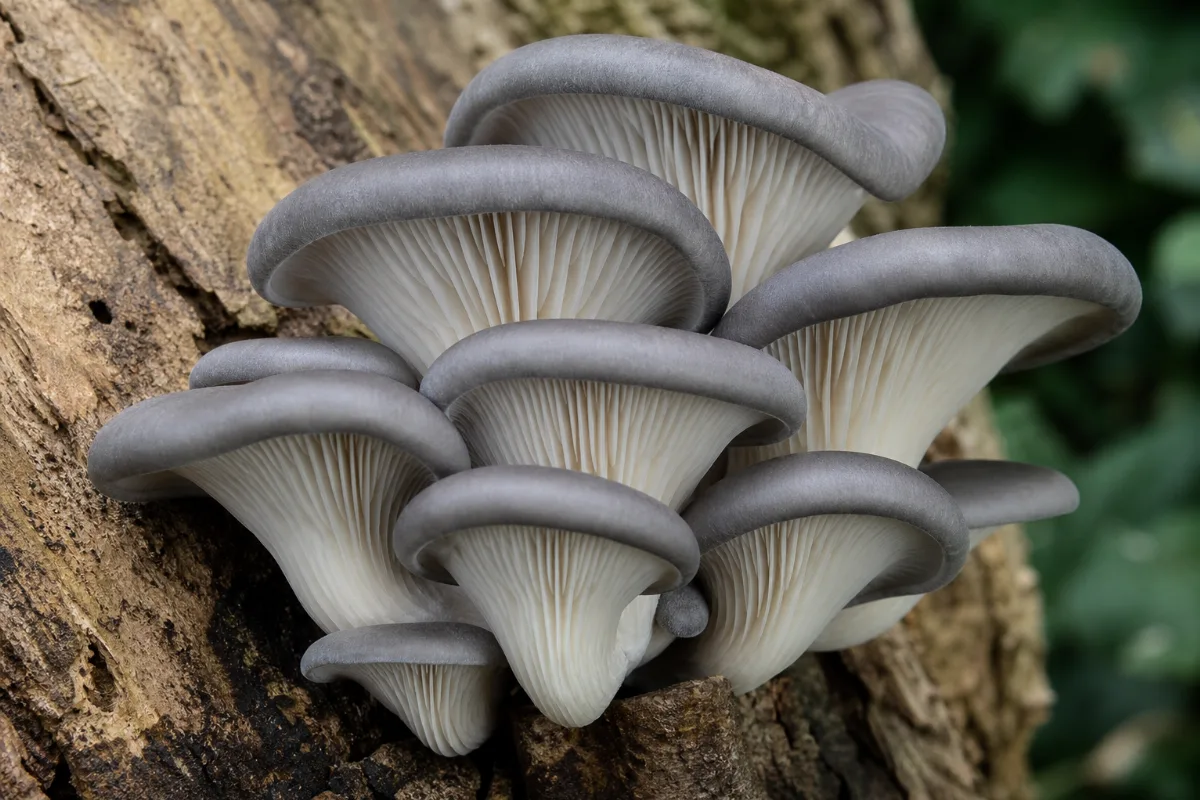
Mushrooms · Culinary mushroom
Oyster mushroom
Pleurotus ostreatus · also called Pearl oyster mushroom
Oyster mushroom is a common cooking mushroom with a mild taste and some protein, fibre and B vitamins. Small trials suggest it may help memory and mood in healthy older adults, but this has not been repeated. A purified extract from it was tested in children with frequent infections, which is not the same as eating the mushroom. The main caution is allergy: spores can cause asthma in people who grow or pack it, and food allergy is reported rarely.
General information, not medical advice. Last substantive update · Not medically reviewed. A named clinician has not signed off on this page. How this page is made
About Oyster mushroom
Oyster mushroom is a widely eaten cooking mushroom. Human research is small. Two trials from one group found better memory recall and steadier mood in healthy older adults, and trials in children used a purified extract, not the mushroom. A one-meal trial found no change in blood sugar. The main cautions are spore asthma in people who work with it, rare food allergy, toxic wild look-alikes, and no safety data for pregnancy.
What it is
Oyster mushroom is Pleurotus ostreatus, a fungus of the family Pleurotaceae. GBIF lists the name as accepted. A review says Pleurotus mushrooms grow on fallen wood, can be farmed on many kinds of farm waste, and make up about a quarter of all cultivated mushrooms.
As a food it is low in calories. USDA lists, per 100 g raw, about 33 kcal, 2.9 g protein and 2.85 g fibre, with B vitamins and 14 mg of ergothioneine. 'Oyster mushroom' is also used for related species such as king oyster; results for one do not carry over to another.
Traditional and current uses
We did not read a source that describes a traditional medicinal use of oyster mushroom, so we do not describe one. Today it is mainly a food. Researchers have also tested a purified beta-glucan from it, called pleuran, in children.
What the research shows
Two trials gave children with frequent infections a purified pleuran product with vitamins or minerals. Infections were somewhat lower in the pleuran groups, and a third trial found better asthma control in younger children. These products are not the mushroom, the trials come mostly from one group, and the newer one was funded by a pleuran company.
Whole oyster mushroom has been tested in healthy older adults. After 12 weeks of regular meals, delayed word recall and mood were better than with placebo. A one-meal study was mixed, and a brain growth-factor marker was lower after the mushroom, which was unexpected.
A single meal with oyster mushroom powder did not change blood sugar in 22 adults with impaired glucose tolerance. A review of mushrooms in general found limited evidence for heart markers and rated most studies poor. Lab measurements of lovastatin disagree and no cholesterol benefit is shown.
Mushroom, powder, pleuran and mycelium are different
The children's trials used purified pleuran, the older-adult trials used whole mushroom meals, and the meal trial used dried powder. A result for one form cannot be applied to another. Blanching lowered polyphenols and antioxidant activity in one lab study.
Products made from mycelium grown on grain are not the same as the mushroom. One food-safety study found lower peptide toxins in the mycelium of one strain than in the fruiting body, but said strains can differ.
Legal and regulatory status
Oyster mushroom is a common food. We did not read any regulator statement (such as EMA, FDA or NCCIH) about it as a remedy, so none is stated here. Rules differ by country and change.
At a glance
Traditional uses history, not proof
- No source we read describes a traditional medicinal use of oyster mushroom, so none is described here.
Studied for research
- Colds and chest infections in children, with a purified extract (pleuran), low
- Memory and mood in healthy older adults, low
- Asthma control in children, with pleuran, low
- Blood fats and gut hormones after one meal, very low
- Heart and blood sugar markers, insufficient
- Antioxidants and lovastatin in the mushroom (lab only), insufficient
Main compounds
- Beta-glucans, including pleuran
- Ergothioneine, an antioxidant
- Polyphenols, and traces of lovastatin that vary between studies
Common forms
- Fresh or cooked mushroom (food)
- Dried fruiting body and powder
- Purified pleuran beta-glucan, usually with added vitamins or minerals
- Mycelium on grain (different from the mushroom)
Research links: Children's infections trial, 2013 (abstract) · Children's infections trial, 2025 (abstract) · Memory and mood trial in older adults, 12 weeks (abstract) · Meal trial in impaired glucose tolerance (abstract) · Occupational anaphylaxis case report (abstract) · USDA FoodData Central: oyster mushroom · Research Library · Genes & Biomarkers Library
What it is and its history
- Accepted scientific name
- Pleurotus ostreatus
- Naming authority
- (Jacq.) P.Kumm.
- Synonyms
- GBIF lists many older synonyms, for example Agaricus glandulosus Bull. and Agaricus limpidus Fr.
- Common names
- Oyster mushroom (English); Pearl oyster mushroom (English)
- Family or group
- Pleurotaceae (a fungus family), not a plant
- Classification
- Fungi > Basidiomycota > Agaricomycetes > Agaricales > Pleurotaceae > Pleurotus > Pleurotus ostreatus
- Native range
- Not checked in the sources read.
- Habitat
- A review says Pleurotus species are mostly found in tropical forests, grow on fallen branches, dead stumps and wet logs, and cause wood decay.
- What it looks like
- Fruiting body: Not described in the sources read; this page does not teach identification.
- Cultivation
- The review says Pleurotus species grow easily on many farm waste materials and account for about 25% of all cultivated mushrooms worldwide. Growing material affects nutrient content and metal uptake.
- Harvest and processing
- Blanching lowered polyphenols and antioxidant activity in another (Lam and Okello).
- Look-alikes and adulterants
- Name: Toxic wild look-alikes such as the jack-o'-lantern mushroom (Omphalotus); Note: Summary-only: the project's own profile says poisonings usually follow mistaking it for oyster mushrooms or chanterelles. Never eat a wild mushroom without in-person expert identification.
- Sustainability and conservation
- Not checked.
What is inside, and how it may work
What it contains and how those compounds act in cells and animals. Laboratory and animal mechanisms are not proven effects in people.
Main compounds
| Compound | Family | Where it is concentrated | Activity studied | Level of evidence |
|---|---|---|---|---|
| Beta-glucans (including pleuran) | polysaccharide | Fruiting body 23.9% of dry matter in raw P. ostreatus (Lam and Okello); USDA lists 1.92 g per 100 g raw. Assay differences were not checked. | Described as immune-active in trials of purified pleuran; also a fibre. 10 20 7 | Human data |
| Ergothioneine | amino-acid derivative | Fruiting body USDA lists 14.0 mg per 100 g raw. Chen et al. reported 1829.4 mg/kg (Korea sample) and 1458.4 mg/kg (Taiwan sample) in dry fruiting bodies; the Pleurotus genus was among the highest in the survey. | An antioxidant in lab work; whether eating it changes health outcomes is unproven. 20 5 15 | Laboratory research |
| Polyphenols | polyphenol | Fruiting body 487.12 mg gallic acid equivalents per 100 g dry matter in raw P. ostreatus (Lam and Okello). | Antioxidant activity in lab assays; blanching lowered it. 10 | Laboratory research |
| Lovastatin | statin-type compound | Fruiting body Conflicting: not detected (Lam and Okello), about 1.11 mg/kg dry sample on wheat straw (Tsiantas, table values from the project's earlier reading), 606.5 mg/kg in a Japan sample (Chen). None is resolved. | Statins lower cholesterol as medicines; no source read shows oyster mushroom does. 10 15 5 | Laboratory research |
| Peptide toxins (ostreatin, ostreolysin, pleurotolysin A and B) | protein | Fruiting body (higher) and mycelium (lower) Not given in the abstract. | Known from the species; the food-safety paper says the fruiting body is already considered safe to eat. 23 | Laboratory research |
Mechanisms, receptors and pathways
| Target or pathway | Gene or receptor | What was found | Level |
|---|---|---|---|
| Immune cells (pattern-recognition receptors) | Not specified in the abstract | The 2025 trial authors say pleuran beta-glucan acts through pathogen-pattern receptors; the 2013 trial reported changed immune blood measures. 8 7 | Human mechanistic |
| Gut hormone release after a meal | GLP-1 | GLP-1 over 4 hours was 17% higher after a meal with oyster mushroom powder in 22 adults. 6 | Human mechanistic |
| Metal uptake | Heavy metal transporter genes | One of 13 identified transporters (gene 24093) took up cadmium and mercury in a lab study. 11 | Lab |
Absorption, metabolism and elimination
- Absorption
- Not found in the sources read.
- Distribution
- Not found.
- Metabolism
- Not found.
- Elimination
- Not found.
- Bioavailability
- Not established. Beta-glucans are not digested in the upper gut and are fermented in the large intestine (as stated for fungal beta-glucans in a systematic review abstract).
Isolated compounds versus whole extracts
Results differ by form. The infection and asthma trials used a purified pleuran beta-glucan with added vitamins or minerals. The memory and mood trials used whole oyster mushroom eaten as food. The meal trial used dried powder. A result for one form cannot be applied to another.
Nutritional composition
Oyster mushroom is a low-calorie food. USDA lists, per 100 g raw, about 33 kcal, 2.9 g protein, 0.19 g fat, 6.9 g carbohydrate, 2.85 g fibre and 14 mg ergothioneine, with B vitamins such as riboflavin and niacin. A review describes Pleurotus mushrooms as rich in protein, fibre, amino acids, water-soluble vitamins and minerals. The two USDA records disagree on a few values, for example vitamin D2 (0.04 versus 0.7 micrograms) and potassium (282 versus 420 mg); no explanation was found.
3 low certainty1 very low certainty2 not enough evidence
What was looked at
The 6 benefits and uses checked for Oyster mushroom, each with how strong the evidence is. Tap one to open it.
- Colds and respiratory infections in children (pleuran, a purified part)Low certainty
- Memory and mood in healthy older adults (whole mushroom)Low certainty
- Asthma control in children (pleuran, a purified part)Low certainty
- Blood sugar, fats and fullness after a meal (oyster mushroom powder)Very low certainty
- Heart and metabolic risk markersNot enough evidence
- Antioxidants in the mushroom itselfNot enough evidence
Lab markers tracked in the studies
Number of respiratory infectionsDelayed word recall (RAVLT)Asthma control scoreGLP-1 after a mealFasting blood glucose
What is Oyster mushroom good for?
The uses people ask about and how strong the human evidence is for each. None is proven. Read this together with the Safety tab.
Benefits, one by one
Each card is a research question, not a promise. Tap a goal to filter. Open a card to see the studies, doses and limits.
Colds and respiratory infections in children (pleuran, a purified part)
Low certaintySeveral trials gave children with frequent chest and throat infections a purified beta-glucan called pleuran, taken from oyster mushroom and mixed with vitamins or minerals. Some found fewer infections than placebo. This is a purified product, not the mushroom you cook.
3 studiesA purified pleuran beta-glucan in a syrup (2013) or chewable (2025), …
Studies, doses and limits
What the trials found
In 175 children with frequent infections (2013), 36% of the pleuran-and-vitamin-C group had no respiratory infection during treatment, against 21% on vitamin C alone. In 249 children (2025), the pleuran-vitamin D-zinc group had fewer infections over 3 months than the vitamin D-zinc group. A systematic review of 34 trials of fungal beta-glucans (several fungi, including this one) says infection results were promising but immune-cell results were inconsistent.
Results
2013: no respiratory infection in 36% versus 21% (p<0.05). 2025: total infections 2.35 versus 2.77 over 3 months (P = 0.042), a 15.2% reduction; common colds 1.53 versus 1.88 (P = 0.040).
Effect sizes as reported
Small reductions in infection counts in children
Why this rating
Two randomised, placebo-controlled trials with a small difference, both of commercial pleuran products, both from a mostly overlapping research group. The 2025 trial was funded by a pleuran company. Both control groups received vitamins or minerals, so the difference is pleuran added on top. Only abstracts were read. None of this tests eating the mushroom.
Form and dose studied
A purified pleuran beta-glucan in a syrup (2013) or chewable (2025), combined with vitamin C (2013) or vitamin D and zinc (2025). Not oyster mushroom as food or powder.
Who was studied
Children with recurrent respiratory infections (average age about 5.7 years in 2013)
Limits
Cannot be applied to adults, to the whole mushroom, or to other pleuran products. The 2025 abstract notes the effect was clearer in children over 6 years.
Why researchers looked
Beta-glucans from fungal cell walls are thought to act on immune cells, so pleuran was tested in children who catch many infections.
Traditional use
No traditional medicinal use of oyster mushroom was found in the sources read.
Proposed mechanism Laboratory research
The 2025 trial authors say beta-glucans such as pleuran act through receptors on immune cells that detect fungal and microbial patterns. The 2013 trial also reported changes in immune blood measures. This is the authors' explanation, not something the trials proved.
A proposed mechanism does not show that the effect happens in people.
Both trials reported the products as well tolerated, with only mild side effects in the 2025 trial. Children should not be given supplements without a doctor's advice.
Memory and mood in healthy older adults (whole mushroom)
Low certaintyTwo small trials from one UK group fed healthy older adults oyster mushroom as part of meals. After 12 weeks, the mushroom group did better on a delayed word-recall test and reported less negative mood than the placebo group. A one-meal trial found mixed results.
2 studiesWhole oyster mushroom eaten in meals (a noodle soup in the one-meal t…
Studies, doses and limits
What the trials found
A 12-week trial in 80 healthy adults aged 60 to 80 found the mushroom group beat placebo on delayed word recall and recognition and on some negative-mood scores. In a one-meal crossover study of 33 older adults, thinking tests gave mixed results with no consistent pattern, mood held steady after mushroom meals while it dipped after the control meal, and a brain growth-factor marker was lower after mushroom.
Results
12 weeks: better RAVLT delayed word recall and recognition, and lower PANAS-X sadness and shyness and DASS-21 anxiety, than placebo (abstract gives no effect sizes). One meal: no consistent thinking-test pattern; mood maintained; inflammatory markers lower; brain-derived neurotrophic factor lower in a dose-related way.
Effect sizes as reported
Not given in the abstracts
Why this rating
One 12-week randomised trial with a positive memory result and one one-meal trial with mixed results, from the same group, in healthy people. No repeat by another group. Only abstracts were read, and the lower brain growth-factor marker was unexpected and unexplained.
Form and dose studied
Whole oyster mushroom eaten in meals (a noodle soup in the one-meal trial). Not a supplement or extract.
Who was studied
Healthy adults aged 60 to 80
Limits
Healthy people only; no result for memory loss or dementia. Effect sizes and funding are not in the abstracts. Many outcomes were measured, so some chance findings are possible.
Why researchers looked
Oyster mushroom is a rich food source of ergothioneine, an antioxidant that has shown brain effects in animal work when given as an extract.
Proposed mechanism Laboratory research
The authors point to ergothioneine as a likely active part, but neither trial showed that ergothioneine caused the results. The 12-week trial also reports lower inflammation markers in a rodent cell model.
A proposed mechanism does not show that the effect happens in people.
The abstracts report no safety problems, but mushroom allergy is possible (see the Safety tab).
Asthma control in children (pleuran, a purified part)
Low certaintyOne trial in children with partly controlled asthma, who stayed on their usual asthma treatment, found better asthma control in younger children and fewer infections in older children with a pleuran product than with vitamin C alone.
1 studiesA purified pleuran and vitamin C combination in capsules, taken along…
Studies, doses and limits
What the trials found
In 230 children aged 7 to 17 on standard asthma treatment, those under 12 on pleuran-and-vitamin-C had better asthma control scores and fewer exacerbations than placebo after 24 weeks. Children 12 and over had fewer respiratory infections. At 48 weeks, 84.7% of the pleuran group showed improved asthma control against 67.0% on vitamin C alone.
Results
Under 12: asthma control 21.8 versus 20.3 (P = 0.02); exacerbations 2.5 versus 3.3 (P = 0.05). 12 and over: infections 0.7 versus 1.9 (P = 0.002). 48 weeks: improved control in 84.7% versus 67.0% (P = 0.01).
Effect sizes as reported
Small differences in a control score; fewer infections in older children
Why this rating
One randomised, placebo-controlled trial from the same group as the infection trials, of a purified pleuran product. Results differ by age group, and only the abstract was read. Funding is not stated in the PubMed record.
Form and dose studied
A purified pleuran and vitamin C combination in capsules, taken alongside usual asthma treatment.
Who was studied
Children aged 7 to 17 with partly controlled perennial allergic asthma
Limits
Not a replacement for asthma medicine; nothing here shows oyster mushroom itself helps asthma. Asthma needs medical care.
Why researchers looked
Infections often set off asthma in children, and pleuran was already being tested for infections.
Traditional use
No traditional medicinal use of oyster mushroom was found in the sources read.
Proposed mechanism Unknown
Not explained in the abstract. The authors link it to pleuran's immune effects.
A proposed mechanism does not show that the effect happens in people.
The abstract reports the product as safe and well tolerated, with no related serious adverse events.
Blood sugar, fats and fullness after a meal (oyster mushroom powder)
Very low certaintyIn one small crossover trial of adults with impaired glucose tolerance, a meal made with oyster mushroom powder did not change blood sugar or insulin. It did change some gut hormone and blood fat measures for a few hours after the meal.
1 studiesOven-dried oyster mushroom powder added to one test meal.
Studies, doses and limits
What the trials found
In 22 adults with impaired glucose tolerance, blood sugar (the main measure), insulin, triglycerides and two other hormones did not differ between the mushroom meal and the plain meal. The blood fat measure NEFA was 14% lower, GLP-1 17% higher, and hunger 22% lower after the mushroom meal. Other appetite ratings did not differ.
Results
Glucose AUC: no difference. NEFA AUC 14% lower (P = 0.026); GLP-1 AUC 17% higher (P = 0.001); hunger AUC 22% lower (P = 0.031).
Effect sizes as reported
Secondary measures changed; main measure did not
Why this rating
One small crossover trial of one meal. The main outcome (blood sugar) did not change, and the changes found were in secondary measures, so they may be chance. No long-term result.
Form and dose studied
Oven-dried oyster mushroom powder added to one test meal.
Who was studied
Adults with impaired glucose tolerance
Limits
One meal only. Nothing here shows oyster mushroom treats prediabetes or diabetes. People who take diabetes medicine should ask their doctor before changing their diet.
Why researchers looked
Oyster mushroom is rich in beta-glucans, a type of fibre that can slow how the body takes up sugar and fat.
Proposed mechanism Human mechanistic
The authors suggested beta-glucans could change gut hormone release after a meal. The trial found a rise in GLP-1 after the mushroom meal, which fits this idea but does not prove it.
A proposed mechanism does not show that the effect happens in people.
The abstract reports no safety findings.
Heart and metabolic risk markers
Not enough evidenceMushrooms in general have been studied for cholesterol, blood sugar and blood pressure, with little to show. A review judged most studies poor. One 8-week diet trial that used button and oyster mushrooms together found a small drop in fasting blood sugar and no other change.
5 studiesWhole mushrooms eaten as food.
Studies, doses and limits
What the trials found
A systematic review of 22 articles (11 experimental, 11 observational), about mushrooms in general, found limited evidence for lower triglycerides and hs-CRP, none for other blood fats, blood sugar control or blood pressure, and rated most articles poor quality. An 8-week trial in 60 adults ate a Mediterranean-style diet with or without daily servings of button and oyster mushrooms and found a small fall in fasting glucose with mushrooms and no change in other markers.
Results
Review: limited evidence for triglycerides and hs-CRP, none for the rest. Trial: fasting glucose -2.9 mg/dL with mushrooms versus +0.6 without (time x group P = 0.034); no other risk factor differed.
Effect sizes as reported
Very small change in one marker in one trial
Why this rating
The review is about mushrooms in general, was funded by the Mushroom Council, and rated most studies poor. The one trial used two mushrooms together, so oyster alone cannot be separated.
Form and dose studied
Whole mushrooms eaten as food.
Who was studied
Middle-aged and older adults, most overweight or obese but without diagnosed heart or metabolic disease
Limits
Cannot be assigned to oyster mushroom alone. No evidence that oyster mushroom lowers cholesterol.
Why researchers looked
Mushrooms are low in calories and contain fibre and beta-glucans, so researchers wondered about heart and metabolic health.
Proposed mechanism Laboratory research
Not established. Lovastatin, a statin-type compound, has been measured in oyster mushroom, but amounts differ widely between studies and no source read links it to a cholesterol effect.
A proposed mechanism does not show that the effect happens in people.
None reported in the abstracts.
Antioxidants in the mushroom itself
Not enough evidenceLaboratory work has measured ergothioneine and polyphenols, which act as antioxidants in test tubes, in oyster mushroom. No study read shows that these change health in people who eat it.
4 studiesRaw and processed fruiting body in lab analyses.
Studies, doses and limits
Results
Lab measurements only; no human outcome.
Why this rating
Laboratory measurements only; no human health outcome tested.
Form and dose studied
Raw and processed fruiting body in lab analyses.
Limits
Measured amounts depend on strain, growing material, drying and the lab method. Blanching lowered polyphenols and antioxidant activity in one study.
Why researchers looked
Mushrooms are among the richer food sources of ergothioneine.
Proposed mechanism Laboratory research
Ergothioneine and polyphenols can neutralise reactive molecules in lab assays.
A proposed mechanism does not show that the effect happens in people.
None.
Connections to the rest of health
How Oyster mushroom connects to the rest of our health knowledge graph. Every link says what kind of connection it is. A safety link (for example to the liver) is a warning, not a benefit. A study that merely mentions a topic never creates a benefit link.
Explore every connection: goals, body systems, organs, symptoms, genes
A. Wellness goals
| Connected to | Kind of connection | Evidence status | Context | Studies |
|---|---|---|---|---|
| Immune Support | Preliminary mechanism | Low certainty | Colds and respiratory infections in children (pleuran, a purified part): Several trials gave children with frequent chest and throat infections a purified beta-glucan called pleuran, taken from oyster mushroom and mixed with vitamins or minerals. Some found fewer infections than placebo. This is a purified product, not the mushroom you cook. Asthma control in children (pleuran, a purified part): One trial in children with partly controlled asthma, who stayed on their usual asthma treatment, found better asthma control in younger children and fewer infections in older children with a pleuran product than with vitamin C alone. | 7 8 18 9 |
| Memory Support | Potential benefit | Low certainty | Memory and mood in healthy older adults (whole mushroom): Two small trials from one UK group fed healthy older adults oyster mushroom as part of meals. After 12 weeks, the mushroom group did better on a delayed word-recall test and reported less negative mood than the placebo group. A one-meal trial found mixed results. | 3 4 |
| Brain Health | Potential benefit | Low certainty | Memory and mood in healthy older adults (whole mushroom): Two small trials from one UK group fed healthy older adults oyster mushroom as part of meals. After 12 weeks, the mushroom group did better on a delayed word-recall test and reported less negative mood than the placebo group. A one-meal trial found mixed results. | 3 4 |
| Mood Balance | Potential benefit | Low certainty | Memory and mood in healthy older adults (whole mushroom): Two small trials from one UK group fed healthy older adults oyster mushroom as part of meals. After 12 weeks, the mushroom group did better on a delayed word-recall test and reported less negative mood than the placebo group. A one-meal trial found mixed results. | 3 4 |
| Blood Sugar Balance | Preliminary mechanism | Very low certainty | Blood sugar, fats and fullness after a meal (oyster mushroom powder): In one small crossover trial of adults with impaired glucose tolerance, a meal made with oyster mushroom powder did not change blood sugar or insulin. It did change some gut hormone and blood fat measures for a few hours after the meal. | 6 |
| Weight Management | Preliminary mechanism | Very low certainty | Blood sugar, fats and fullness after a meal (oyster mushroom powder): In one small crossover trial of adults with impaired glucose tolerance, a meal made with oyster mushroom powder did not change blood sugar or insulin. It did change some gut hormone and blood fat measures for a few hours after the meal. | 6 |
| Heart Health | Not enough evidence | Heart and metabolic risk markers: Mushrooms in general have been studied for cholesterol, blood sugar and blood pressure, with little to show. A review judged most studies poor. One 8-week diet trial that used button and oyster mushrooms together found a small drop in fasting blood sugar and no other change. | 16 17 10 15 5 | |
| Cholesterol Balance | Not enough evidence | Heart and metabolic risk markers: Mushrooms in general have been studied for cholesterol, blood sugar and blood pressure, with little to show. A review judged most studies poor. One 8-week diet trial that used button and oyster mushrooms together found a small drop in fasting blood sugar and no other change. | 16 17 10 15 5 | |
| Blood Sugar Balance | Not enough evidence | Heart and metabolic risk markers: Mushrooms in general have been studied for cholesterol, blood sugar and blood pressure, with little to show. A review judged most studies poor. One 8-week diet trial that used button and oyster mushrooms together found a small drop in fasting blood sugar and no other change. | 16 17 10 15 5 | |
| Cellular Protection | Not enough evidence | Antioxidants in the mushroom itself: Laboratory work has measured ergothioneine and polyphenols, which act as antioxidants in test tubes, in oyster mushroom. No study read shows that these change health in people who eat it. | 10 15 5 20 |
B. Body systems
| Connected to | Kind of connection | Evidence status | Context | Studies |
|---|---|---|---|---|
| Immune system | Adverse effect or risk | Low certainty | Rare allergic reactions, including a food-challenge-confirmed reaction and a Kounis syndrome case. Preparation or compound: Oyster mushroom (eaten) or spores |
13 14 |
| Immune system | Potential benefit | Low certainty | Fewer infections in children in two trials of a purified product; not shown for the mushroom. Preparation or compound: Purified pleuran (with vitamins or minerals) |
7 8 |
| Brain and memory | Potential benefit | Low certainty | Better delayed word recall in healthy older adults in one 12-week trial. Preparation or compound: Whole oyster mushroom meals |
3 4 |
| Immune System | Biological association | Low certainty | Studied for: Colds and respiratory infections in children (pleuran, a purified part) Studied for: Asthma control in children (pleuran, a purified part) | 7 8 18 9 |
| Respiratory System | Biological association | Low certainty | Studied for: Colds and respiratory infections in children (pleuran, a purified part) Studied for: Asthma control in children (pleuran, a purified part) | 7 8 18 9 |
| Nervous System | Biological association | Low certainty | Studied for: Memory and mood in healthy older adults (whole mushroom) | 3 4 |
| Digestive System | Biological association | Very low certainty | Studied for: Blood sugar, fats and fullness after a meal (oyster mushroom powder) | 6 |
| Endocrine System | Biological association | Very low certainty | Studied for: Blood sugar, fats and fullness after a meal (oyster mushroom powder) | 6 |
| Cardiovascular System | Biological association | Not enough evidence | Studied for: Heart and metabolic risk markers | 16 17 10 15 5 |
C. Body parts and organs
G. Root causes and contributing factors
| Connected to | Kind of connection | Evidence status | Context | Studies |
|---|---|---|---|---|
| Heavy metal exposure | Very low certainty | Cadmium and mercury were taken up in a laboratory study; shop products were not tested. Cadmium and mercury concentrated in the caps in a lab study. Preparation or compound: Mushroom grown on metal-spiked medium (lab) |
11 |
I. Biomarkers
| Connected to | Kind of connection | Evidence status | Context | Studies |
|---|---|---|---|---|
| Number of respiratory infections | Biological association | Low certainty | Measured in trials: lowered. A lab change is not the same as a health benefit. | 8 7 |
| Delayed word recall (RAVLT) | Biological association | Low certainty | Measured in trials: raised. A lab change is not the same as a health benefit. | 3 |
| Asthma control score | Biological association | Low certainty | Measured in trials: raised. A lab change is not the same as a health benefit. | 9 |
| GLP-1 after a meal | Biological association | Very low certainty | Measured in trials: raised. A lab change is not the same as a health benefit. | 6 |
| Fasting blood glucose | Biological association | Not enough evidence | Measured in trials: lowered. A lab change is not the same as a health benefit. | 17 6 |
K. Biological pathways
| Connected to | Kind of connection | Evidence status | Context | Studies |
|---|---|---|---|---|
| GLP-1 | Preliminary mechanism | Human mechanistic | Higher after a meal with oyster mushroom powder in a small trial. | 6 |
L. Active compounds
| Connected to | Kind of connection | Evidence status | Context | Studies |
|---|---|---|---|---|
| Beta-glucans (including pleuran) | Biological association | Human | Described as immune-active in trials of purified pleuran; also a fibre. Preparation or compound: Fruiting body |
10 20 7 |
| Ergothioneine | Biological association | In vitro | An antioxidant in lab work; whether eating it changes health outcomes is unproven. Preparation or compound: Fruiting body |
20 5 15 |
| Polyphenols | Biological association | In vitro | Antioxidant activity in lab assays; blanching lowered it. Preparation or compound: Fruiting body |
10 |
| Lovastatin | Biological association | In vitro | Statins lower cholesterol as medicines; no source read shows oyster mushroom does. Preparation or compound: Fruiting body |
10 15 5 |
| Peptide toxins (ostreatin, ostreolysin, pleurotolysin A and B) | Biological association | In vitro | Known from the species; the food-safety paper says the fruiting body is already considered safe to eat. Preparation or compound: Fruiting body (higher) and mycelium (lower) |
23 |
Each connection is stored with the ingredient, the connected record, the kind of connection, the evidence status, the supporting studies, the preparation or compound involved, and a review date (last reviewed October 25, 2026).
The evidence
The research centre for Oyster mushroom. Every record here was checked against PubMed or the publisher's page; we never list a study we have not verified.
Evidence by outcome
Bars show how many studies we found for each outcome, not how well it works. People are added up across trials only (reviews are not added, to avoid double counting).
How we rate evidence
High certainty
Several well-run trials or reviews agree; further research is unlikely to change the picture much.
Moderate certainty
Good trials point the same way, but some doubt remains.
Low certainty
Small, short or inconsistent trials. The finding could change with better research.
Very low certainty
Very little or very weak human data. Treat as a possibility only.
Mixed findings
Trials or reviews disagree with each other.
Not enough evidence
Not enough human research to say either way.
Evidence against
Good research found no benefit, or found harm.
We take the reviewers' own risk-of-bias and GRADE statements where they exist, and otherwise judge from study size, design, consistency, directness and whether a product matches what is sold. Many publications do not make evidence high. Method note: We read PubMed records and abstracts for 18 papers (seven trials, two systematic reviews, four case reports, two laboratory papers on metal uptake and food safety, two on food chemistry, and a review of Pleurotus cultivation). We also used the GBIF species record, two USDA FoodData Central records through the project's saved copies, and one older Europe PMC abstract. A few items are marked summary-only. EMA, FDA, NCCIH, LiverTox and LactMed were not read. Only abstracts were read for papers, so numbers come from abstracts. Certainty ratings are the compiler's own reading.
Study library: every study we checked 23
| Study | Design | People | Product, dose, length | Result |
|---|---|---|---|---|
| Baldassarre 2016 Occupational asthma in a fruit and vegetables vendor. Medicina del Lavoro · PMID 27015024 |
Case report |
1 A 40-year-old atopic woman who sold fruit and vegetables at a market stall for 26 years |
Exposure to mushroom spores at the stall spores in air Not shown here 3-year history; 7 years of follow-up |
Spirometry showed a severe mixed deficit with a clear response to salbutamol; the prick-to-prick test with fresh Pleurotus ostreatus was positive; poor air exchange at the stall. After she stopped handling and selling mushrooms she had no symptoms over seven years. One case of occupational asthma due to oyster mushroom spores Methods, limits and fundingOutcomes: Symptoms, spirometry, skin tests, workplace inspection Limitations: A single case; a PubMed DOI was not listed. Funding and conflicts: Not applicable Read: abstract |
| Branicka 2021 A case of anaphylactic reaction following oyster mushroom (Pleurotus ostreatus) inhalation. International Journal of Occupational Medicine and Environmental Health · PMID 33630827 · DOI |
Case report |
1 A healthy 32-year-old non-atopic woman running an oyster mushroom farm |
Exposure to Pleurotus ostreatus spores while harvesting and packing spores in air Not shown here Repeated exposures over weeks |
After 10 to 30 minutes she had breathlessness, weakness, fast pulse and hives. Spirometry showed airway narrowing after exposure; standard skin prick tests were negative, a prick-to-prick test with oyster mushroom was positive (12 mm wheal), total IgE 78 iu/ml. Diagnosed with occupational anaphylaxis and work-related asthma. One case of occupational anaphylaxis and asthma Methods, limits and fundingOutcomes: Symptoms, spirometry, skin tests, IgE Limitations: A single case; cannot show how common. Funding and conflicts: Not applicable Read: abstract |
| Cha 2026 A randomised controlled study to investigate the cognitive, mood, metabolic and anti-inflammatory effects of chronic oyster mushroom intervention in healthy older adults. Food & Function · PMID 42299921 · DOI |
Controlled trial |
80 80 healthy adults aged 60 to 80 (EEG in a subset of 40) |
Whole oyster mushroom (Pleurotus ostreatus) eaten as food, four portions a week fruiting body, eaten as food Not shown here 12 weeks · vs Placebo |
The oyster mushroom group outperformed placebo on delayed word recall and recognition, and had lower PANAS-X sadness and shyness and DASS-21 anxiety; the placebo group slowed on task switching. Inflammatory markers were reduced in a rodent microglial cell model. Better episodic memory and steadier mood than placebo; no effect sizes in the abstract Methods, limits and fundingOutcomes: Cognition (including RAVLT delayed recall), mood (PANAS-X, DASS-21), serum markers, EEG Limitations: Healthy people only; effect sizes not in the abstract; one research group; funding not in the PubMed record. Funding and conflicts: Funding not stated in the PubMed record Read: abstract |
| Cha 2026 A randomised controlled study to investigate the cognitive, mood, metabolic and anti-inflammatory effects of acute oyster mushroom intervention in healthy older adults. Food & Function · PMID 41416984 · DOI |
Rct crossover |
33 33 healthy older adults |
Noodle soup with 0.5, 1 or 2 servings of oyster mushroom versus a calorie-matched control soup fruiting body, eaten as food Not shown here Four test days one week apart, measures at 2, 4 and 6 hours · vs Control soup |
Positive affect fell and mental fatigue rose after the control soup, but mood was steady after mushroom soups. Thinking-test results were mixed with no consistent pattern. Inflammatory markers (nitrite, NADPH oxidase 2, iNOS) were lower after mushroom; brain-derived neurotrophic factor was dose-dependently lower. Mood maintained, thinking tests mixed Methods, limits and fundingOutcomes: Cognition, mood, appetite, inflammatory markers, serum samples Limitations: One-meal effects only; the lower brain growth factor was unexpected. Only the abstract was read. Funding and conflicts: Funding not stated in the PubMed record Read: abstract |
| Chen 2012 Contents of lovastatin, gamma-aminobutyric acid and ergothioneine in mushroom fruiting bodies and mycelia. LWT - Food Science and Technology · Source · DOI |
Lab study fungus |
Fruiting bodies and mycelia of many mushrooms | Mushroom samples fruiting body and mycelium |
Among fruiting bodies, P. ostreatus (Japan) was among the highest for lovastatin (606.5 mg/kg). P. ostreatus (Korea) and (Taiwan) were among the highest for ergothioneine (1829.4 and 1458.4 mg/kg). Ergothioneine was found in all samples, and the Pleurotus genus held considerably high amounts. Methods, limits and fundingOutcomes: Lovastatin, GABA and ergothioneine contents Limitations: Not in PubMed; abstract read through Europe PMC (IND44694983). Dry or fresh basis and methods are not in the abstract. Contradicts other lovastatin measurements. Funding and conflicts: Not stated in the Europe PMC record Read: abstract (Europe PMC) |
| Dicks 2022 Fortifying a meal with oyster mushroom powder beneficially affects postprandial glucagon-like peptide-1, non-esterified free fatty acids and hunger sensation in adults with impaired glucose tolerance: a double-blind randomized controlled crossover trial. European Journal of Nutrition · PMID 34505919 · DOI |
Rct crossover |
22 22 adults with impaired glucose tolerance |
Meal enriched with oven-dried oyster mushroom powder (a beta-glucan source) dried powder of Pleurotus ostreatus Not shown here One meal, blood samples over 4 hours · vs Control meal without mushroom |
Glucose, insulin, triglycerides, GIP and ghrelin did not differ. NEFA AUC 14% lower (P = 0.026), GLP-1 AUC 17% higher (P = 0.001), hunger AUC 22% lower (P = 0.031). Secondary measures changed; the primary measure did not Methods, limits and fundingOutcomes: Glucose AUC (primary), insulin, triglycerides, NEFA, GLP-1, GIP, ghrelin, appetite scales Limitations: Single meal, small, a secondary-outcome finding; effect over time unknown. Funding and conflicts: Public research grants (a German state ministry and the federal research ministry) per the PubMed record Registration: German Clinical Trials Register DRKS00015244 Read: abstract |
| Jesenak 2013 Immunomodulatory effect of pleuran (beta-glucan from Pleurotus ostreatus) in children with recurrent respiratory tract infections. International Immunopharmacology · PMID 23261366 · DOI |
Controlled trial |
175 175 children (average age 5.65) with more than 5 respiratory infections in the previous 12 months |
Pleuran (beta-glucan from Pleurotus ostreatus) with vitamin C in a syrup (Imunoglukan P4H) purified extract of fruiting body (not stated in abstract) Not shown here Treatment with 3 visits across 12 months · vs Vitamin C only (placebo) |
36% of the active group had no respiratory infection against 21% on placebo (p<0.05); flu and flu-like illness and lower respiratory infections were less frequent; immune measures changed. Fewer infections in a minority of children; abstract gives no confidence interval Methods, limits and fundingOutcomes: Respiratory infections, flu-like illness, lower respiratory infections, immune blood measures Limitations: Product-specific. Control had vitamin C. The abstract does not give funding. Same research group as the later trials. Funding and conflicts: Funding not stated in the PubMed record Read: abstract |
| Jesenak 2025 Novel Chewable Pleuran-Based Supplement Decreases Respiratory Tract Infections in Children: A Randomised Controlled Trial. Advances in Therapy · PMID 41085920 · DOI |
Controlled trial |
249 249 children with recurrent respiratory infections from Slovakia, Czech Republic and Serbia; 217 completed |
Chewable pleuran supplement with vitamin D and zinc purified pleuran (from Pleurotus ostreatus) Not shown here 3 months in infection season · vs Vitamin D and zinc (active placebo) |
Total infections 2.35 versus 2.77 (P = 0.042), 15.2% fewer; common colds 1.53 versus 1.88 (P = 0.040); tonsillopharyngitis frequency (P = 0.003) and duration (P = 0.009) lower; mild adverse events only. 15.2% fewer total infections over 3 months Methods, limits and fundingOutcomes: Total respiratory tract infections; infection types, duration, missed school days, safety Limitations: Product-specific; the abstract says the effect was clearer in children over 6 years; some results are from post hoc analysis. Only the abstract was read. Funding and conflicts: Industry: PubMed lists Pleuran s.r.o. as a grant source Registration: ClinicalTrials.gov NCT06974747 Read: abstract |
| Jesenak 2025 Beneficial effects of pleuran on asthma control and respiratory tract-infection frequency in children with perennial asthma. Scientific Reports · PMID 40021713 · DOI |
Controlled trial |
230 230 children aged 7 to 17 with partially controlled perennial allergic asthma on standard treatment; 206 completed |
Pleuran with vitamin C, 2 capsules a day purified pleuran (beta-glucan from Pleurotus ostreatus) Not shown here 24 weeks treatment, 24 weeks follow-up · vs Vitamin C only |
Under 12: better asthma control (21.8 versus 20.3, P = 0.02) and fewer exacerbations (2.5 versus 3.3, P = 0.05). 12 and over: fewer infections (0.7 versus 1.9, P = 0.002). At 48 weeks improved control in 84.7% versus 67.0% (P = 0.01). No related serious adverse events. Better asthma control in under-12s; fewer infections in 12 and over Methods, limits and fundingOutcomes: Asthma control, respiratory infections, exacerbations, quality of life, spirometry, FeNO, safety Limitations: Results differ by age group; purified product only; only the abstract was read. Funding and conflicts: Funding not stated in the PubMed record Read: abstract |
| Lam 2015 Determination of Lovastatin, beta-glucan, Total Polyphenols, and Antioxidant Activity in Raw and Processed Oyster Culinary-Medicinal Mushroom, Pleurotus ostreatus (Higher Basidiomycetes). International Journal of Medicinal Mushrooms · PMID 25746617 · DOI |
Lab study fungus |
Raw and blanched Pleurotus ostreatus | Raw and blanched mushroom, and mushroom rolls fruiting body Not shown here · vs Raw versus processed |
Dry matter 8%. Lovastatin not detected. Beta-glucan 23.9% and polyphenols 487.12 mg gallic acid equivalents per 100 g of dry matter. Blanching did not change beta-glucan but lowered polyphenols and antioxidant activity. Food-chemistry measurements Methods, limits and fundingOutcomes: Lovastatin, beta-glucan, polyphenols, antioxidant assays Limitations: One sample set; food-chemistry only; no human outcome. Funding and conflicts: Funding not stated in the PubMed record Read: abstract |
| Liu 2024 Enrichment characteristics of Cd and Hg and regulation of heavy metal transporter signaling in Pleurotus ostreatus. Science of the Total Environment · PMID 39426543 · DOI |
Lab study fungus |
Pleurotus ostreatus grown on media spiked with cadmium and mercury | Cadmium chloride and mercury chloride added to the growing medium fruiting body (mostly cap) Not shown here Growing cycle · vs Unspiked medium |
Metals at up to 20 mg/L did not affect growth or yield. In the highest group the caps held about 4.4 mg/kg cadmium and 2.7 mg/kg mercury, mostly in the most toxic ion-exchange state. Thirteen transporter genes were found; one (24093) took up both metals. Metals concentrated in the cap Methods, limits and fundingOutcomes: Growth, fruiting body yield, metal content and transporter genes Limitations: Spiked medium in a lab, not a measurement of shop products; abstract only. Funding and conflicts: Funding not stated in the PubMed record Read: abstract |
| Raman 2020 Cultivation and Nutritional Value of Prominent Pleurotus spp.: An Overview. Mycobiology · PMID 33536808 · DOI |
Review fungus |
Review of Pleurotus mushrooms | Pleurotus species fruiting body Not shown here |
Pleurotus mushrooms account for about 25% of cultivated mushrooms worldwide; they grow on tropical forest wood and many farm wastes; they are rich in protein, fibre, essential amino acids, water-soluble vitamins and minerals. Descriptive review Methods, limits and fundingOutcomes: Cultivation and nutrition Limitations: Narrative review, not a trial; covers the genus, not only this species. Funding and conflicts: Funding not stated in the PubMed record Read: abstract |
| Rangkakulnuwat 2023 Trehalose phosphorylase as a novel potential allergen in a case of allergic reaction due to oyster mushroom (Pleurotus ostreatus) ingestion. Journal of Allergy and Clinical Immunology: Global · PMID 37780800 · DOI |
Case report |
1 One person with an allergic reaction after eating oyster mushroom |
Oral food challenge with oyster mushroom cooked fruiting body (not stated in the abstract) Not shown here Single challenge |
The authors say this is, to their knowledge, the first case report of an allergic reaction to oyster mushroom ingestion confirmed by an oral food challenge, and they identify trehalose phosphorylase as a possible allergen. One confirmed food allergy case Methods, limits and fundingOutcomes: Allergic reaction, IgE immunoblotting, mass spectrometry Limitations: A single case; the abstract is two sentences. Funding and conflicts: Not applicable Read: abstract |
| Tepetam 2016 A patient with mushroom allergy; a new etiological agent of Kounis syndrome. Tuberkuloz ve Toraks · PMID 27481084 · DOI |
Case report |
1 A 31-year-old woman who ate Pleurotus ostreatus |
Ingestion of Pleurotus ostreatus fruiting body Not shown here Single event |
Two hours after eating she had nausea, stomach ache, vomiting, breathlessness and chest pain. ECG showed ST elevation and troponin was raised. Kounis syndrome (allergic heart event) was diagnosed; the prick-to-prick test with the mushroom was positive. One case of an allergic heart event after eating oyster mushroom Methods, limits and fundingOutcomes: Symptoms, ECG, blood tests, skin prick-to-prick test Limitations: A single case. Funding and conflicts: Not applicable Read: abstract |
| Tsiantas 2021 On the Identification and Quantification of Ergothioneine and Lovastatin in Various Mushroom Species: Assets and Challenges of Different Analytical Approaches. Molecules · PMID 33805096 · DOI |
Lab study fungus |
Agaricus bisporus, Pleurotus ostreatus and P. citrinopileatus on three growing materials | Mushrooms grown on wheat straw, grape marc and olive by-products fruiting body Not shown here · vs Method comparison |
LC-MS was the better method. P. citrinopileatus had the most ergothioneine (822.1 mg/kg dry); A. bisporus the most lovastatin (1.39 mg/kg). Growing material changed the amounts. The oyster values quoted on this page come from the open-access table as read earlier (summary-only). Amounts depend on species, growing material and method Methods, limits and fundingOutcomes: Ergothioneine and lovastatin by UV-Vis and LC-MS Limitations: The abstract does not give oyster-specific values; they come from a table read earlier and not re-opened. Funding and conflicts: Government research support per the PubMed record Read: abstract (table values summary-only) |
| Uffelman 2023 An Assessment of Mushroom Consumption on Cardiometabolic Disease Risk Factors and Morbidities in Humans: A Systematic Review. Nutrients · PMID 36904079 · DOI |
Systematic review |
22 articles (11 experimental, 11 observational) on mushroom intake and heart and metabolic outcomes | Mushrooms of several kinds edible mushrooms Not shown here Varied · vs Varied |
Limited experimental evidence for lower triglycerides and hs-CRP, not for other lipids, glucose control or blood pressure; observational evidence found no association with cholesterol, glucose or heart disease; most articles rated poor quality. Limited evidence for two markers; most studies poor Methods, limits and fundingOutcomes: Blood fats, glucose, blood pressure, hs-CRP, disease outcomes Limitations: About mushrooms in general, not oyster alone; most articles rated poor. Funding and conflicts: Mushroom Council, an industry group, per the PubMed record Read: abstract |
| Uffelman 2024 Consuming Mushrooms When Adopting a Healthy Mediterranean-Style Dietary Pattern Does Not Influence Short-Term Changes of Most Cardiometabolic Disease Risk Factors in Healthy Middle-Aged and Older Adults. Journal of Nutrition · PMID 38135005 · DOI |
Controlled trial |
60 60 adults (average age 46) without diagnosed heart or metabolic disease, mostly overweight |
Mediterranean-style diet with white button (Agaricus bisporus) and oyster (Pleurotus ostreatus) mushrooms, about one serving a day fruiting body, eaten as food Not shown here 8 weeks · vs Same diet with breadcrumbs instead |
Fasting glucose improved (-2.9 versus +0.6 mg/dL, P = 0.034). The diet itself lowered total cholesterol irrespective of mushrooms. No other differences. Small glucose change; nothing else Methods, limits and fundingOutcomes: Blood pressure, lipids, lipoproteins, glucose, insulin, inflammation indexes Limitations: Two mushroom types together; oyster cannot be separated out; short; people with normal cardiometabolic health. Funding and conflicts: NIDDK (US National Institutes of Health) grant per the PubMed record; other funding not seen Registration: ClinicalTrials.gov NCT04259229 Read: abstract |
| Vlassopoulou 2021 Effects of fungal beta-glucans on health - a systematic review of randomized controlled trials. Food & Function · PMID 33876798 · DOI |
Systematic review |
34 randomised trials of oral fungal beta-glucans in healthy people or patients | Beta-glucans from several fungi (yeast, Aureobasidium, Pleurotus ostreatus, Lentinula edodes, Ganoderma lucidum) various Not shown here Up to 6.5 months · vs Placebo or control |
Most trials looked at immune outcomes; reports of fewer colds, flu and respiratory infections and better allergic symptoms, but immune-cell and molecular findings were inconsistent; no adverse event causally linked to glucans; more studies needed. Promising but inconsistent; not specific to oyster mushroom Methods, limits and fundingOutcomes: Immune outcomes, infections, allergy symptoms, mood, weight and others Limitations: Mixes many fungi and products; the abstract does not grade the quality of the trials. Funding and conflicts: Funding not stated in the PubMed record Read: abstract |
| n/a 2018 USDA FoodData Central, SR Legacy, FDC ID 168580, Mushrooms, oyster, raw USDA FoodData Central · Source |
Food composition fungus |
n/a | n/a |
Per 100 g raw: protein 3.31 g, fibre 2.3 g, potassium 420 mg, copper 0.244 mg, riboflavin 0.349 mg, niacin 4.956 mg, folate 38 micrograms, selenium 2.6 micrograms, vitamin D2 0.7 micrograms. Some values differ from the Foundation Foods record. Methods, limits and fundingOutcomes: Identity or composition Limitations: Older record; values differ from the Foundation Foods record for some nutrients. Funding and conflicts: Public government database Read: project's saved copy |
| n/a 2025 USDA FoodData Central, Foundation Foods, FDC ID 1999627, Mushroom, oyster USDA FoodData Central · Source |
Food composition fungus |
n/a | n/a |
Per 100 g raw: 33 kcal, protein 2.9 g, fat 0.19 g, carbohydrate 6.9 g, fibre 2.85 g, beta-glucan 1.92 g, ergothioneine 14.0 mg, glutathione 17.5 mg, riboflavin 0.24 mg, niacin 5.75 mg. Methods, limits and fundingOutcomes: Identity or composition Limitations: An analytical mean of sampled foods; varies between specimens and says nothing about effects or safety. Funding and conflicts: Public government database Read: project's saved copy |
| n/a 2026 Project profile of the jack-o'-lantern mushroom (Omphalotus), summarising published reports of poisoning from mistaking it for oyster mushrooms n/a · Source |
Secondary summary fungus |
n/a | n/a |
The project's earlier profile says published reports describe poisoning usually following the mistaking of jack-o'-lantern for oyster mushrooms and chanterelles. The sources it cites (Tom Volk, 1997; Penn State Extension) were not re-opened for this page. Methods, limits and fundingOutcomes: Look-alike poisoning Limitations: Summary-only: not re-read for this page. Funding and conflicts: n/a Read: summary-only |
| n/a 2026 GBIF Backbone Taxonomy: Pleurotus ostreatus (Jacq.) P.Kumm., species key 2526530 GBIF · Source |
Taxonomy record fungus |
n/a | n/a |
Status ACCEPTED; family Pleurotaceae; order Agaricales; class Agaricomycetes; phylum Basidiomycota. Read through the GBIF API on 2026-10-25. Methods, limits and fundingOutcomes: Identity or composition Limitations: A taxonomy database, not a medical source. Funding and conflicts: Public government database Read: API record |
| van Dam 2024 GastronOmics: Edibility and safety of mycelium of the oyster mushroom Pleurotus ostreatus. Current Research in Food Science · PMID 39429921 · DOI |
Lab study fungus |
One strain of Pleurotus ostreatus (M2191): fruiting body and mycelium | Genome sequencing, toxin screening, nutrition analysis and a taste panel fruiting body and mycelium Not shown here · vs Fruiting body versus mycelium |
No regulated mycotoxins in either. Four peptide toxins known from this species (ostreatin, ostreolysin, pleurotolysin A and B) were lower in mycelium than in fruiting bodies. Computer analysis suggested low allergenicity. Strains vary genetically, so safety may differ between strains. Mycelium of one strain looked as safe as the fruiting body Methods, limits and fundingOutcomes: Regulated mycotoxins, peptide toxins, allergenicity prediction, nutrition Limitations: One strain, laboratory and computer analysis; the allergenicity prediction conflicts with real case reports of allergy. Funding and conflicts: Funding not stated in the PubMed record Read: abstract |
What we do not know yet
- No trial tested whole oyster mushroom against infections; the infection trials used a purified extract with vitamins or minerals.
- The memory and mood findings come from one group and have not been repeated.
- How common spore asthma and food allergy are is unknown; only case reports exist.
- No study of liver safety, medicine interactions, pregnancy or breastfeeding was found.
- Lovastatin measurements disagree, and no regulator statement was read.
How new research is added
New studies are found by a saved PubMed search and placed in a review queue. A person reads each one before it changes any evidence rating or safety wording. New publications never change ratings automatically.
Lab markers
What changed in blood or saliva tests during trials. A changed number is not the same as feeling or being healthier, and we give no "normal ranges".
Metabolic 1
Fasting blood glucose
Lowered in trials
Blood sugar after not eating for several hours.
Not enough evidenceResults and what it means
Why it was measured
A standard marker of blood sugar control.
Statistical vs. clinical meaning
A very small change in one trial that used two mushroom types.
Safety implication
None reported.
| Study | Result | People | Product |
|---|---|---|---|
| 17 | Change from baseline -2.9 mg/dL with mushrooms versus +0.6 mg/dL without (time x group P = 0.034). | 60 healthy-range adults, mostly overweight | Mediterranean-style diet with button and oyster mushrooms versus the same diet without, 8 weeks |
| 6 | Blood sugar after the meal did not differ. | 22 adults with impaired glucose tolerance | Meal with oyster powder versus plain meal |
Other 4
Number of respiratory infections
Lowered in trials
How many colds, flu-like illnesses and chest or throat infections a child had during the study, counted by parents and doctors.
Low certaintyResults and what it means
Why it was measured
The main practical question: does the product mean fewer illnesses?
Statistical vs. clinical meaning
Statistically significant but small, from industry-linked trials of purified products.
Safety implication
Mild side effects only in the 2025 trial.
| Study | Result | People | Product |
|---|---|---|---|
| 8 | Total infections 2.35 versus 2.77 over 3 months (P = 0.042); common colds 1.53 versus 1.88 (P = 0.040). | 249 children with recurrent infections (217 completed) | Chewable pleuran-vitamin D-zinc versus vitamin D-zinc, 3 months |
| 7 | 36% had no infection during treatment versus 21% on placebo (p<0.05). | 175 children with recurrent infections | Pleuran-vitamin C syrup versus vitamin C, up to 12 months of follow-up |
Delayed word recall (RAVLT)
Raised in trials
A memory test: people hear a list of words, then are asked to recall them after a delay.
Low certaintyResults and what it means
Why it was measured
A standard test of short-term episodic memory.
Statistical vs. clinical meaning
Reported as a significant between-group difference in one trial.
Safety implication
None reported in the abstract.
| Study | Result | People | Product |
|---|---|---|---|
| 3 | The mushroom group outperformed placebo on delayed word recall and recognition at 12 weeks (no numbers in the abstract). | 80 healthy adults aged 60 to 80 | Four oyster mushroom portions a week versus placebo, 12 weeks |
Asthma control score
Raised in trials
A questionnaire that scores how well asthma symptoms are controlled; a higher score means better control.
Low certaintyResults and what it means
Why it was measured
The usual way to track day-to-day asthma control.
Statistical vs. clinical meaning
Small difference in younger children only, in one trial.
Safety implication
No related serious adverse events reported.
| Study | Result | People | Product |
|---|---|---|---|
| 9 | Children under 12: 21.8 versus 20.3 with placebo at 24 weeks (P = 0.02). | 230 children aged 7 to 17 with partly controlled asthma | Pleuran with vitamin C versus vitamin C alone, 24 weeks |
GLP-1 after a meal
Raised in trials
A gut hormone released after eating that helps control blood sugar and the feeling of fullness.
Very low certaintyResults and what it means
Why it was measured
Beta-glucans may change gut hormone release.
Statistical vs. clinical meaning
A secondary measure in one small single-meal trial; blood sugar itself did not change.
Safety implication
None reported.
| Study | Result | People | Product |
|---|---|---|---|
| 6 | GLP-1 over 4 hours was 17% higher after the oyster powder meal (P = 0.001). | 22 adults with impaired glucose tolerance | Meal with oven-dried oyster mushroom powder versus plain meal |
Safety
What studies and official sources say about side effects, medicines and who should check first. Each point shows what kind of evidence it comes from.
Main points to know 3
- Spores can cause asthma and anaphylaxis in people who grow, pack or sell oyster mushrooms. Two case reports describe work-related asthma. A woman who opened an oyster mushroom farm had breathing trouble, itching and hives while harvesting and packing, and a skin test with oyster mushroom was positive. A market vendor developed asthma from the spores, and her symptoms stopped after she stopped handling mushrooms. These are single cases, so how often this happens is not known. Case report 2 1
- Allergy after eating oyster mushroom has been reported, rarely. One report describes an allergic reaction to oyster mushroom confirmed by a supervised food challenge. Another describes a young woman with nausea, vomiting, breathing trouble and chest pain two hours after eating oyster mushroom, diagnosed as an allergic heart event called Kounis syndrome. Both are single case reports. Case report 13 14
- Wild mushrooms can be mistaken for dangerous look-alikes. Cultivated oyster mushrooms from a shop are a different matter from mushrooms picked in the wild. A summary of published reports says poisonings with the toxic jack-o'-lantern mushroom usually follow mistaking it for oyster mushrooms or chanterelles. Do not pick and eat a wild mushroom unless an expert has identified it in person. Secondary summary 21
Side effects 4
| Effect | How often | Severity and recovery | Evidence |
|---|---|---|---|
| Work-related asthma, wheeze and breathlessness from spores Affects people who work with the mushroom, not usual shoppers. | Two case reports; frequency unknown | moderate to severe The vendor's symptoms stopped over seven years of follow-up after she stopped handling mushrooms | Case report 1 2 |
| Anaphylaxis (hives, breathlessness, weakness, fast pulse) after inhaling spores Happened to a woman who had no earlier allergies. | One case report | severe Not described in the abstract | Case report 2 |
| Allergic reaction after eating the mushroom, including Kounis syndrome (allergy-triggered heart event) in one report Rare reports; the abstract of the first calls it the first food-challenge-confirmed case it knew of. | Two case reports; frequency unknown | moderate to severe Not described in the abstracts | Case report 13 14 |
| Mild side effects in children given a purified pleuran supplement A purified product, not the mushroom. The asthma trial reported no related serious adverse events. | Described only as mild adverse events; no rate in the abstract | mild Not described | Controlled trial 8 |
Liver
No case of liver injury from oyster mushroom was found in the sources read. We did not search LiverTox for oyster mushroom, so absence of a report here is not proof of safety.
How often. Unknown; not searched in a liver database.
Monitoring. No monitoring advice was found.
This is a safety connection. It is not evidence that Oyster mushroom supports liver health.
Medicines and supplements 4
| With | Why it matters | Importance | Evidence | What to do |
|---|---|---|---|---|
| Asthma medicines prescription | The 2025 asthma trial gave pleuran to children who stayed on standard asthma treatment, and reported no related serious adverse events. This says nothing about the mushroom itself. | Controlled trial Low certainty 9 | Do not stop or change asthma medicine without a doctor. | |
| Medicines that suppress the immune system prescription | Pleuran and other beta-glucans are described as immune-active in trials. This is a theoretical reason for caution, not a reported interaction. | No source read reports an interaction between oyster mushroom and immune medicines. | Pharmacological theory Very low certainty 7 | If you take immune-suppressing medicine, ask the prescriber before using purified beta-glucan or mushroom supplements. Eating oyster mushroom as food has no reported problem in the sources we read. |
| Cholesterol-lowering statin medicines prescription | Lovastatin, a statin, has been measured in oyster mushroom in some labs, from not detected to about 600 mg per kg dry weight. | No source read shows that eating oyster mushroom affects statin treatment or cholesterol. | Insufficient Very low certainty 5 10 15 | No reason to change statin treatment because of food mushrooms; ask your pharmacist if unsure. |
| Blood thinners, diabetes medicines and other prescriptions prescription | Not studied. | No oyster mushroom interaction study was found. The single-meal trial in people with impaired glucose tolerance found no blood sugar change. | Insufficient Not enough evidence 6 | Tell your doctor or pharmacist about any supplement made from oyster mushroom. |
Who should check first 8
| Situation | Advice | Evidence |
|---|---|---|
| Known allergy to mushrooms, or past reaction to oyster mushroom | Avoid oyster mushroom and seek medical advice; reactions after eating have been reported. | Case report 13 14 |
| Working with or growing oyster mushrooms (farms, packing, markets) | Spores have caused asthma and anaphylaxis. One report suggests monitoring spores in the workplace, and another found poor air exchange at the stall. Ask an occupational health doctor about breathing symptoms at work. | Case report 2 1 |
| Asthma | People with asthma who handle large amounts of mushrooms or notice wheeze near them should ask a doctor. Food oyster mushroom in a normal meal has no asthma warning in the sources read. | Case report 1 |
| Pregnancy | No pregnancy safety study of oyster mushroom was found in the sources read. Cooked oyster mushroom as part of a normal meal is a food question for a clinician; purified beta-glucan or mushroom supplements have not been tested in pregnancy in the sources we read. | Insufficient |
| Breastfeeding | No data were found in the sources read. We did not look up a LactMed entry for oyster mushroom, so this is not verified. Ask a clinician. | Insufficient |
| Children | Pleuran products were tested in children aged about 5 to 17 in trials, with mild side effects only, but these were purified products given under study conditions. Do not give children mushroom supplements without a doctor's advice. | Controlled trial 7 8 9 |
| Taking immune-suppressing medicines | Ask the prescriber before using concentrated beta-glucan or mushroom extracts; there is no reported interaction, but beta-glucans are described as immune-active. | Pharmacological theory 7 |
| Picking wild mushrooms | Never eat a wild mushroom unless an expert has identified it in person. Photos, books and apps are not enough. | Secondary summary 21 |
Overdose, product quality and regulators
Summary. Cultivated oyster mushroom is a widely eaten food. A food-safety study found no regulated mycotoxins in either the fruiting body or grown mycelium of one strain. The same study notes the species makes four peptide toxins (ostreatin, ostreolysin and pleurotolysin A and B), which were lower in mycelium than in the fruiting body that is already considered safe to eat.
Animal. Not reviewed.
Human doses studied. Trials gave oyster mushroom as meals for 12 weeks or less, and purified pleuran for up to 12 months. This page gives no amounts and advises none.
High dose or long term signals. No long-term safety study of large amounts was found.
Overdose response. No overdose description was found. Seek medical help for the urgent signs below.
Genotoxicity. Not read.
Toxic or hazardous parts. Fungus. The fruiting body is the food. The spores are what cause breathing allergy in people who handle the mushroom.
The sources read describe how oyster mushroom takes up metals from what it is grown on. We did not read a test of retail products for metals, pesticides or mould toxins.
Cadmium and mercury from the growing material. In a laboratory study that added cadmium and mercury to the growing medium, Pleurotus ostreatus took them up, mostly into the cap, at about 4.4 mg/kg cadmium and 2.7 mg/kg mercury at the highest level tested. Shop mushrooms were not measured. 11
Mycelium products versus the mushroom. A food-safety study of one strain found no regulated mycotoxins in fruiting body or mycelium, and lower peptide toxins in mycelium. The authors also say different strains may differ in food safety. Products sold as mycelium on grain are different from the mushroom, and we found no oyster measurement of grain starch in such products. 23
Wild versus cultivated. Wild mushrooms can be confused with toxic look-alikes (secondary summary, not re-opened). 21
| Body | Action | Date |
|---|
When to get medical help
- Trouble breathing, wheeze, swelling of the lips, face or throat, hives, or collapse after eating or handling oyster mushrooms: call emergency services.
- Chest pain, fast heartbeat or faintness together with an allergic-type reaction after eating a mushroom: call emergency services.
- Repeated wheeze, cough or breathlessness at work around mushrooms: see a doctor and tell them about the mushrooms.
- Vomiting, severe belly pain or confusion after eating a wild mushroom: call a poison centre or emergency services at once and keep a sample if you can.
If someone may be poisoned or in a crisis, contact a clinician or emergency service straight away. In the US, Poison Control is 1-800-222-1222.
General information only, not medical advice. Ask a clinician or pharmacist before use, especially with medicines, in pregnancy or with a health condition. See the Natural Remedy Safety guide.
Frequently asked questions
What is oyster mushroom?
Does oyster mushroom have health benefits?
Is oyster mushroom safe?
Can oyster mushrooms cause allergic reactions?
Does oyster mushroom boost the immune system or prevent colds?
Does oyster mushroom help memory?
Does oyster mushroom lower blood sugar or cholesterol?
Does oyster mushroom contain a statin?
Is oyster mushroom safe in pregnancy or breastfeeding?
No study was found. Cooked mushrooms in a normal meal are a food question to ask a clinician about, and supplements made from oyster mushroom have not been tested in pregnancy in the sources we read. We did not check LactMed.
Is it safe for children?
Can oyster mushroom interact with medicines?
Is it safe to pick wild oyster mushrooms?
Not unless an expert has identified the mushroom in person. A summary of published reports says toxic jack-o'-lantern mushrooms are often mistaken for oyster mushrooms. Shop-bought cultivated mushrooms are a different matter.
Explore by health goal
Immune SupportBlood Sugar BalanceMemory SupportBrain HealthMood BalanceWeight ManagementHeart HealthCholesterol BalanceCellular Protection
Editorial transparency
- Written by
- AlternativeMed editorial team. Research compiled with AI assistance, then checked against PubMed records.
- Medical review
- None. This page has not been reviewed by a physician or pharmacist.
- First published
- 2026-10-25
- Last substantive update
- 2026-10-25
- How we research
- We read PubMed records and abstracts for 18 papers (seven trials, two systematic reviews, four case reports, two laboratory papers on metal uptake and food safety, two on food chemistry, and a review of Pleurotus cultivation). We also used the GBIF species record, two USDA FoodData Central records through the project's saved copies, and one older Europe PMC abstract. A few items are marked summary-only. EMA, FDA, NCCIH, LiverTox and LactMed were not read. Only abstracts were read for papers, so numbers come from abstracts. Certainty ratings are the compiler's own reading.
- How we rate evidence
- See "How we rate evidence" in the Evidence tab.
- Independence
- No product is promoted on this page. No affiliate links are shown. This page is information, not a recommendation to use oyster mushroom.
Sources 23
Each source was opened and checked. Where we read only the abstract, it says so. The small numbers in the text point here.
- Baldassarre A, Dragonieri S, Luisi V, et al. Occupational asthma in a fruit and vegetables vendor.. Medicina del Lavoro. 2016. PMID 27015024. (abstract)
- Branicka O, Rozlucka L, Gawlik R. A case of anaphylactic reaction following oyster mushroom (Pleurotus ostreatus) inhalation.. International Journal of Occupational Medicine and Environmental Health. 2021. PMID 33630827. DOI 10.13075/ijomeh.1896.01610. (abstract)
- Cha S, Bell L, Eastwood J, et al. A randomised controlled study to investigate the cognitive, mood, metabolic and anti-inflammatory effects of chronic oyster mushroom intervention in healthy older adults.. Food & Function. 2026. PMID 42299921. DOI 10.1039/d5fo04951b. (abstract)
- Cha S, Bell L, Fisher DR, et al. A randomised controlled study to investigate the cognitive, mood, metabolic and anti-inflammatory effects of acute oyster mushroom intervention in healthy older adults.. Food & Function. 2026. PMID 41416984. DOI 10.1039/d5fo03075g. (abstract)
- Chen SY, Ho KJ, Hsieh YJ, et al. Contents of lovastatin, gamma-aminobutyric acid and ergothioneine in mushroom fruiting bodies and mycelia.. LWT - Food Science and Technology. 2012. DOI 10.1016/j.lwt.2012.01.019. (abstract (Europe PMC))
- Dicks L, Jakobs L, Sari M, et al. Fortifying a meal with oyster mushroom powder beneficially affects postprandial glucagon-like peptide-1, non-esterified free fatty acids and hunger sensation in adults with impaired glucose tolerance: a double-blind randomized controlled crossover trial.. European Journal of Nutrition. 2022. PMID 34505919. DOI 10.1007/s00394-021-02674-1. (abstract)
- Jesenak M, Majtan J, Rennerova Z, et al. Immunomodulatory effect of pleuran (beta-glucan from Pleurotus ostreatus) in children with recurrent respiratory tract infections.. International Immunopharmacology. 2013. PMID 23261366. DOI 10.1016/j.intimp.2012.11.020. (abstract)
- Jesenak M, Prokopova E, Bozensky J, et al. Novel Chewable Pleuran-Based Supplement Decreases Respiratory Tract Infections in Children: A Randomised Controlled Trial.. Advances in Therapy. 2025. PMID 41085920. DOI 10.1007/s12325-025-03393-3. (abstract)
- Jesenak M, Hrubisko M, Chudek J, et al. Beneficial effects of pleuran on asthma control and respiratory tract-infection frequency in children with perennial asthma.. Scientific Reports. 2025. PMID 40021713. DOI 10.1038/s41598-025-91830-2. (abstract)
- Lam YS, Okello EJ. Determination of Lovastatin, beta-glucan, Total Polyphenols, and Antioxidant Activity in Raw and Processed Oyster Culinary-Medicinal Mushroom, Pleurotus ostreatus (Higher Basidiomycetes).. International Journal of Medicinal Mushrooms. 2015. PMID 25746617. DOI 10.1615/intjmedmushrooms.v17.i2.30. (abstract)
- Liu Q, Zheng X, Du R, et al. Enrichment characteristics of Cd and Hg and regulation of heavy metal transporter signaling in Pleurotus ostreatus.. Science of the Total Environment. 2024. PMID 39426543. DOI 10.1016/j.scitotenv.2024.176909. (abstract)
- Raman J, Jang KY, Oh YL, et al. Cultivation and Nutritional Value of Prominent Pleurotus spp.: An Overview.. Mycobiology. 2020. PMID 33536808. DOI 10.1080/12298093.2020.1835142. (abstract)
- Rangkakulnuwat P, Aluksanasuwan S, Somsuan K, et al. Trehalose phosphorylase as a novel potential allergen in a case of allergic reaction due to oyster mushroom (Pleurotus ostreatus) ingestion.. Journal of Allergy and Clinical Immunology: Global. 2023. PMID 37780800. DOI 10.1016/j.jacig.2023.100095. (abstract)
- Tepetam FM, Dagdeviren B, Bulut I, et al. A patient with mushroom allergy; a new etiological agent of Kounis syndrome.. Tuberkuloz ve Toraks. 2016. PMID 27481084. DOI 10.5578/tt.9411. (abstract)
- Tsiantas K, Tsiaka T, Koutrotsios G, et al. On the Identification and Quantification of Ergothioneine and Lovastatin in Various Mushroom Species: Assets and Challenges of Different Analytical Approaches.. Molecules. 2021. PMID 33805096. DOI 10.3390/molecules26071832. (abstract (table values summary-only))
- Uffelman CN, Chan NI, Davis EM, et al. An Assessment of Mushroom Consumption on Cardiometabolic Disease Risk Factors and Morbidities in Humans: A Systematic Review.. Nutrients. 2023. PMID 36904079. DOI 10.3390/nu15051079. (abstract)
- Uffelman CN, Schmok JN, Campbell RE, et al. Consuming Mushrooms When Adopting a Healthy Mediterranean-Style Dietary Pattern Does Not Influence Short-Term Changes of Most Cardiometabolic Disease Risk Factors in Healthy Middle-Aged and Older Adults.. Journal of Nutrition. 2024. PMID 38135005. DOI 10.1016/j.tjnut.2023.12.026. (abstract)
- Vlassopoulou M, Yannakoulia M, Pletsa V, et al. Effects of fungal beta-glucans on health - a systematic review of randomized controlled trials.. Food & Function. 2021. PMID 33876798. DOI 10.1039/d1fo00122a. (abstract)
- n/a. USDA FoodData Central, SR Legacy, FDC ID 168580, Mushrooms, oyster, raw. USDA FoodData Central. 2018. (project's saved copy)
- n/a. USDA FoodData Central, Foundation Foods, FDC ID 1999627, Mushroom, oyster. USDA FoodData Central. 2025. (project's saved copy)
- n/a. Project profile of the jack-o'-lantern mushroom (Omphalotus), summarising published reports of poisoning from mistaking it for oyster mushrooms. n/a. 2026. (summary-only)
- n/a. GBIF Backbone Taxonomy: Pleurotus ostreatus (Jacq.) P.Kumm., species key 2526530. GBIF. 2026. (API record)
- van Dam L, Cruz-Morales P, Rodriguez Valeron N, et al. GastronOmics: Edibility and safety of mycelium of the oyster mushroom Pleurotus ostreatus.. Current Research in Food Science. 2024. PMID 39429921. DOI 10.1016/j.crfs.2024.100866. (abstract)
Where to buy
Check the label first. Whatever you buy, look for these:
- Fruiting body versus mycelium on grain: the label should say which
- The extract type and the beta-glucan amount, if stated
- A third-party testing mark
- Interactions: ask a pharmacist if you take medicines or blood thinners
Talk to a pharmacist or doctor before you start any supplement, especially if you take medicines. See the Safety tab for interactions.
Support our free guides: as an Amazon Associate we earn from qualifying purchases. Full disclosure.


