Mushrooms · Medicinal mushroom
Lion's mane
Hericium erinaceus · also called Yamabushitake, bearded tooth, monkey head mushroom, white pom pom
Lion's mane is an edible mushroom with long, white spines, used in East Asian cooking and medicine. It is sold as powders, extracts and capsules for memory and mood. Human trials are small: a few report higher memory-test scores in older adults, and healthy young adults mostly show no change. Allergic reactions have been reported, including one serious lung reaction, and little is known about pregnancy or medicine interactions.
General information, not medical advice. Last substantive update · Not medically reviewed. A named clinician has not signed off on this page. How this page is made
About Lion's mane
Lion's mane is an edible mushroom sold for memory and mood. Human research is small and short, with mixed results. Allergy has been reported, and many questions about safety are unanswered.
What it is
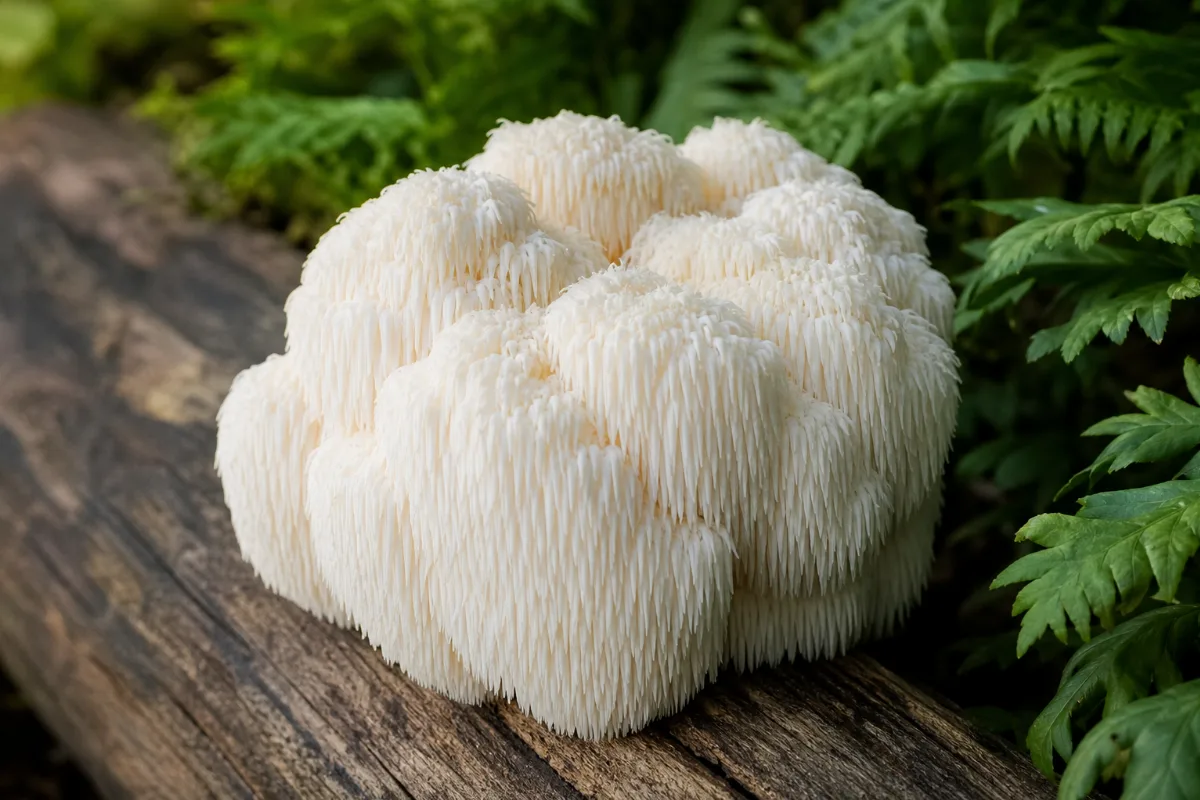
Lion's mane is a fungus (Hericium erinaceus) that grows on dead hardwood trees. It has long, white spines that hang down like a mane. It is eaten as a food and also sold as supplements.
Hericenones are found mainly in the fruiting body and erinacines mainly in the mycelium, in one lab paper. This is why products can differ.
What people use it for, and what the research shows
Memory is the most studied use. Two small Japanese trials reported higher memory-test scores in older adults with mild impairment; one showed the effect fading after stopping. A pilot of a special mycelium product reported better scores in mild Alzheimer disease.
Mood and sleep studies are small and mostly self-rated. Nerve growth claims come from lab and animal work.
None of this shows it treats any condition.
How strong is the research?
The best human source is a 2025 systematic review of five randomised trials and several smaller studies. Its pooled MMSE gain was about one point from two trials. The review's own conclusion is more positive than the small trials support.
Trials in healthy adults found mostly no overall effect. Most studies did not run long enough to say anything about dementia prevention.
Fruiting body, mycelium and extracts
Products use the fruiting body (the mushroom), mycelium grown on grain, or extracts. Grain-grown mycelium contains leftover grain. A special erinacine A-enriched mycelium was used in the Alzheimer pilot and is not the same as shop products.
One lab-method paper by company authors reported that many finished products had marker compounds below what the method could measure (summary-only), so labels do not guarantee contents.
At a glance
Traditional uses history, not proof
- Used in East Asian medical systems to improve general health (MSK).
- Used in traditional Chinese medicine as a food and an herbal medication (LiverTox).
- MSK reports a long history of use in Native American and East Asian systems for infections, anxiety, stress and depression.
Studied for research
- Memory-test scores in mild cognitive impairment, low
- Mild Alzheimer disease (pilot of a special mycelium product), very low
- Thinking speed in healthy young adults, mixed
- Low mood, anxiety and sleep, very low
- Nerve growth and repair, insufficient (lab and animal only)
- Cancer, ALS, gut bacteria, insufficient (no human data read)
Main compounds
- Hericenones (fruiting body)
- Erinacines (mycelium)
- Beta-glucans and other polysaccharides
- Ergothioneine and ergosterol
Common forms
- Cooked or dried fruiting body
- Hot-water, alcohol or dual extracts
- Mycelium grown on grain
- Erinacine A-enriched mycelium (used in one trial)
- Capsules, tablets, powders, tea and coffee blends
Research links: Memorial Sloan Kettering: Lion's mane mushroom · LiverTox: Lion's mane · Systematic review (2025, abstract) · Mild cognitive impairment trial (abstract) · Severe lung reaction case report (abstract) · ALSUntangled: Lion's mane (abstract) · Research Library · Genes & Biomarkers Library
What it is and its history
- Accepted scientific name
- Hericium erinaceus
- Naming authority
- (Bull.) Pers. (GBIF)
- Synonyms
- Hericium caput-medusae (Bull.) Pers.; Hericium erinaceus subsp. caput-medusae (Bull.) Nikol.; Dryodon erinaceus (Bull.) P.Karst.; Clavaria erinaceus (Bull.) Paulet
- Common names
- Lion's mane (English); Yamabushitake (Japanese); Bearded tooth (English); Monkey head mushroom (English); White pom pom (English); Hongo melena de león (Spanish)
- Family or group
- Hericiaceae (a fungus family; tooth fungi), not a plant
- Classification
- Fungi > Basidiomycota > Agaricomycetes > Russulales > Hericiaceae > Hericium > Hericium erinaceus
- Native range
- LiverTox says it is found most abundantly in East Asia. Other ranges were not checked.
- Habitat
- MSK says it grows on dead hardwood trees.
- What it looks like
- Fruiting body: MSK describes distinctive long, white spines that dangle downward, resembling a lion's mane.
- Cultivation
- Products use cultivated fruiting bodies or mycelium grown on grain such as oats (toxicology and analytical papers). Growing methods were not checked.
- Harvest and processing
- Not checked in the sources read.
- Look-alikes and adulterants
- Name: Other Hericium species (for example coral tooth); Note: A related species, Hericium coralloides, appears in another paper's title. We read no source on how to tell species apart; do not pick wild mushrooms without expert teaching.
- Sustainability and conservation
- Not checked.
Traditional use and history history, not clinical proof
| Tradition or era | Documented use | Source |
|---|---|---|
| East Asia | MSK says lion's mane is used in East Asian medical systems to improve general health, and that it is an edible mushroom used in East Asian cuisine. | s-msk-lions-mane |
| Traditional Chinese medicine | LiverTox says lion's mane has been used widely as a food and as an herbal medication in traditional Chinese medicine. | s-livertox-lions-mane |
| East Asian and Native American medical systems | MSK says it has a long history of use in Native American as well as East Asian medical systems for infections, anxiety, stress and depression. | s-msk-lions-mane |
| Recent decades | LiverTox says it has recently been purported to improve cognition and relieve anxiety and depression. | s-livertox-lions-mane |
Traditional use shows how it was used. It does not show that it works or is safe today.
What is inside, and how it may work
What it contains and how those compounds act in cells and animals. Laboratory and animal mechanisms are not proven effects in people.
Main compounds
| Compound | Family | Where it is concentrated | Activity studied | Level of evidence |
|---|---|---|---|---|
| Hericenones | phenolic compounds (aromatic) | Fruiting body Reported amounts in one lab-method paper's raw materials were small and varied between samples (summary-only). | In cell and animal studies they promote nerve growth factor production (MSK). No human effect shown. 17 14 | Laboratory research |
| Erinacines (for example erinacine A) | cyathane diterpenoids | Mycelium Erinacine A was reported in a mycelial finished product and not detected in fruiting-body samples in one lab-method paper (summary-only). | Neuroprotective, anti-inflammatory and nerve-growth effects in rodent and cell models (systematic review); used in the enriched-mycelium Alzheimer pilot. 12 14 3 | Animal research |
| Hericenes | related to hericenones | Fruiting body Measured in raw materials in one lab-method paper (summary-only). | MSK says hericene A raised neurotrophin signals and memory in mice. Animal finding only. 17 14 | Animal research |
| Polysaccharides including beta-glucans | polysaccharide | Fruiting body USDA: about 2.75 g beta-glucan per 100 g fresh mushroom (summary-only, FoodData Central FDC 1999626). | Described as bioactive polysaccharides in the 2025 review abstract; the rat study used a beta-glucan extract. 6 1 16 | Review |
| Ergothioneine | amino acid derivative | Fruiting body USDA: about 17 mg per 100 g fresh mushroom (summary-only). | A food antioxidant; no lion's mane trial tested it. 16 | Theory |
| Ergosterol | sterol | Fruiting body Measured in raw materials in one lab-method paper (summary-only). | Chemistry only. 14 | Theory |
Mechanisms, receptors and pathways
| Target or pathway | Gene or receptor | What was found | Level |
|---|---|---|---|
| Nerve growth factor synthesis | NGF | Hericenones and erinacines promote nerve growth factor synthesis and secretion in preclinical studies (MSK). Cell and animal finding only. 17 | Laboratory research |
| Blood-brain barrier | Preclinical studies found hericenones and erinacines cross the blood-brain barrier (MSK). 17 | Animal research | |
| Antioxidant response | Nrf2 | Erinacines A and C increased Nrf2, a regulator of the antioxidant response, in cell and rodent models (systematic review). 12 | Animal research |
| Hippocampal memory signals in mice | Neurotrophin signalling | Lion's mane extract and hericene A increased neurotrophin expression and enhanced hippocampal memory in mice (MSK). 17 | Animal research |
| Blood pro-BDNF | BDNF precursor | Circulating pro-BDNF rose in people with overweight or obesity after 8 weeks, with no significant change in BDNF. 15 | Human biomarker |
| Gut microbiota | A 2025 review abstract and MSK say it may increase gut microbiome diversity and bacteria that make short-chain fatty acids; the underlying studies were not read. 6 17 | Review |
Absorption, metabolism and elimination
- Absorption
- Not found in the sources read.
- Distribution
- Preclinical studies suggest hericenones and erinacines cross the blood-brain barrier (MSK).
- Metabolism
- Not found in the sources read.
- Elimination
- Not found in the sources read.
- Bioavailability
- Not established in people.
Isolated compounds versus whole extracts
Products differ widely: cooked or dried fruiting body, hot-water or alcohol extracts, mycelium grown on grain, and an erinacine A-enriched mycelium capsule used in one Alzheimer pilot. Hericenones appear mainly in the fruiting body and erinacines in the mycelium in one analytical paper, so results with one product do not carry over to another.
Nutritional composition
Lion's mane is eaten as a food. USDA data for fresh mushroom list about 4.4 g fibre, about 2.75 g beta-glucan and about 17 mg ergothioneine per 100 g (summary-only; from 8 samples that vary widely). A food value says nothing about supplements.
1 mixed findings1 low certainty3 very low certainty4 not enough evidence
What was looked at
The 9 benefits and uses checked for Lion's mane, each with how strong the evidence is. Tap one to open it.
- Mild cognitive impairment (memory and thinking tests)Low certainty
- Mild Alzheimer disease (pilot trial of a special mycelium product)Very low certainty
- Thinking speed and focus in healthy young adultsMixed findings
- Low mood and anxietyVery low certainty
- Sleep qualityVery low certainty
- Nerve growth and 'nerve repair' claimsNot enough evidence
- Gut bacteriaNot enough evidence
- CancerNot enough evidence
- ALS and other nerve diseasesNot enough evidence
Lab markers tracked in the studies
Revised Hasegawa Dementia Scale (HDS-R)Mini-Mental State Examination (MMSE)Stroop task speedPro-BDNF (blood)BDNF (blood)Depression scale (CES-D)
What is Lion's mane good for?
The uses people ask about and how strong the human evidence is for each. None is proven. Read this together with the Safety tab.
Benefits, one by one
Each card is a research question, not a promise. Tap a goal to filter. Open a card to see the studies, doses and limits.
Mild cognitive impairment (memory and thinking tests)
Low certaintyTwo small Japanese trials in older adults reported better scores on thinking tests with lion's mane than with placebo. In one, the scores fell again four weeks after people stopped. Both trials are tiny, and no larger trial has repeated them.
4 studiesMori used tablets of dried mushroom powder; Saitsu used supplements c…
Studies, doses and limits
What the trials found
Mori and colleagues gave 30 Japanese adults aged 50 to 80 with mild cognitive impairment either lion's mane tablets (96% dried powder) or placebo for 16 weeks. Scores on a dementia scale (the revised Hasegawa scale) were higher than placebo at weeks 8, 12 and 16, then fell significantly four weeks after stopping. Saitsu and colleagues ran a 12-week placebo-controlled trial of supplements made from the fruiting body; of three tests, only the Mini-Mental State Examination (MMSE) improved. The 2025 systematic review reports a combined average MMSE rise of 1.17 points from one randomised trial and one pilot trial.
Results
Mori 2009: higher scores than placebo at weeks 8, 12 and 16; scores fell after stopping. Saitsu 2019: MMSE improved, the other two tests did not (abstract). Review: combined MMSE rise 1.17 (one trial plus one pilot).
Effect sizes as reported
Small score gains on screening tests; not shown to change daily life
Why this rating
Two small trials (30 people in one; the other does not give its size in the abstract) that point the same way, but no confidence intervals in the abstracts, no repeat by independent teams, and effects that faded after stopping.
Form and dose studied
Mori used tablets of dried mushroom powder; Saitsu used supplements containing the fruiting body. Other products may not behave the same.
Who was studied
Japanese adults aged about 50 to 80 with mild cognitive impairment or mild memory difficulties
Limits
Very small trials; screening-test scores are not the same as better memory in daily life; funding is not stated in the abstracts; the Saitsu abstract gives no group sizes. People with memory problems need a medical check, not self-treatment.
Why researchers looked
Lion's mane is a food mushroom marketed for memory. Lab studies suggested its compounds may affect nerve cells, so researchers tested it in older adults with early memory problems.
Traditional use
MSK says lion's mane has a long history of use in East Asian and Native American medical systems, including for anxiety, stress and depression. Memory is a modern marketing claim.
Proposed mechanism Laboratory research
Compounds from the mushroom (hericenones and erinacines) make nerve cells release a growth protein in lab dishes and animals (MSK). No human study here shows nerves are repaired or grown. This is a laboratory finding, not proof of a health effect.
A proposed mechanism does not show that the effect happens in people.
Lion's mane has few reported problems, but allergy and one serious lung reaction have been reported, and products vary. See the Safety tab.
Mild Alzheimer disease (pilot trial of a special mycelium product)
Very low certaintyOne small pilot trial gave a mycelium product rich in a compound called erinacine A to people with mild Alzheimer disease for 49 weeks. Some test scores were better than in the placebo group. It is a pilot, and this product is not the same as the lion's mane sold in shops. It is not a treatment.
3 studiesA mycelium product with a stated erinacine A content; it is not the s…
Studies, doses and limits
What the trials found
Li and colleagues randomised people with mild Alzheimer disease to three capsules a day of erinacine A-enriched lion's mane mycelia or identical placebo for 49 weeks. The mycelia group scored better on the Mini-Mental State Examination, and the Cognitive Abilities Screening Instrument score fell in the placebo group. The groups differed on an everyday-activities scale and on contrast sensitivity. Four people dropped out because of abdominal discomfort, nausea and skin rash.
Results
Placebo group: CASI score fell significantly. Mycelia group: MMSE improved significantly. Group difference on the Instrumental Activities of Daily Living scale and on contrast sensitivity. No other adverse events beyond the four dropouts (abstract).
Effect sizes as reported
Higher scores on some scales than placebo in one pilot trial; no effect sizes in the abstract
Why this rating
One pilot trial, a special product (erinacine A-enriched mycelium), many outcomes tested, group size not stated in the abstract, and no repeat trial.
Form and dose studied
A mycelium product with a stated erinacine A content; it is not the same as fruiting-body powder.
Who was studied
Adults with mild Alzheimer disease (registered trial NCT04065061)
Limits
Pilot design; results cannot be carried over to other lion's mane products; the abstract does not give sample size or who funded it.
Why researchers looked
Erinacine A is a compound found in lion's mane mycelium that has been studied in lab and animal models of Alzheimer disease.
Traditional use
No traditional use for Alzheimer disease is described in the sources we read.
Proposed mechanism Animal research
Erinacines (from the mycelium) are studied in rodent models for effects on nerve survival and inflammation. A 2025 systematic review of preclinical work found benefits in rodent behaviour tests (animal findings only).
A proposed mechanism does not show that the effect happens in people.
Lion's mane has few reported problems, but allergy and one serious lung reaction have been reported, and products vary. See the Safety tab. Four dropouts in this trial were due to stomach upset, nausea and rash.
Thinking speed and focus in healthy young adults
Mixed findingsTwo small trials in healthy adults under 45 found mostly no overall change in thinking tests. A few single tests were quicker in each trial (a Stroop test an hour after a dose in one, a pegboard test in the other), but many tests were run and most showed nothing.
2 studiesOne trial used a mushroom supplement (28 days); the other a 10:1 frui…
Studies, doses and limits
What the trials found
Docherty and colleagues tested 41 healthy adults aged 18 to 45 for a single dose and then 28 days. After one dose people were quicker on the Stroop task (p = 0.005). After 28 days there was only a trend towards less subjective stress (p = 0.051), and the authors say null and limited negative findings were also seen. Surendran and colleagues tested 18 healthy adults aged 18 to 35 in a crossover trial of a fruiting-body extract: there was no significant effect on overall thinking or mood scores, although one pegboard test was better 90 minutes after the dose.
Results
Docherty 2023: Stroop faster (p = 0.005) after one dose; stress trend after 28 days (p = 0.051); other measures null. Surendran 2025: no significant effect on composite scores; pegboard better at 90 minutes.
Effect sizes as reported
Isolated faster scores on single tests; no overall improvement
Why this rating
Both trials are small, tested many outcomes, found mainly null results, and the authors themselves call the findings tentative.
Form and dose studied
One trial used a mushroom supplement (28 days); the other a 10:1 fruiting-body extract (single dose).
Who was studied
Healthy adults aged 18 to 45
Limits
Small samples; single-test wins among many tests may be chance; short follow-up; funding not stated in the abstracts.
Why researchers looked
Lion's mane is sold to healthy people as a focus aid, but most older research was in people with memory problems, so newer trials tested healthy volunteers.
Traditional use
No traditional use for focus in healthy adults is described in the sources we read.
Proposed mechanism Insufficient
Not established in people. The animal and cell findings are described under nerve growth on the Health tab.
A proposed mechanism does not show that the effect happens in people.
Lion's mane has few reported problems, but allergy and one serious lung reaction have been reported, and products vary. See the Safety tab.
Low mood and anxiety
Very low certaintyTwo small trials reported lower depression and anxiety scores after weeks of lion's mane. One used cookies for 4 weeks in 30 women and the other a supplement for 8 weeks in 77 people with overweight or obesity on a diet. Both are small and early, and neither shows lion's mane treats depression.
4 studiesCookies containing the mushroom (Nagano); a supplement (Vigna); produ…
Studies, doses and limits
What the trials found
In Nagano's trial, 30 women were randomised to lion's mane cookies or placebo cookies for 4 weeks. Depression (CES-D) and an indefinite-complaints score were lower after intake than before; compared with placebo, two items of the complaints index (including 'palpitation') were lower, and concentration, irritation and anxiety tended to be lower. In Vigna's study, 77 people with overweight or obesity and mood, sleep or binge-eating problems, on a low-calorie diet, took lion's mane for 8 weeks; depression, anxiety and sleep disorders decreased. The abstract does not say whether there was a placebo group. In Docherty's trial in healthy young adults, there was only a trend towards less subjective stress after 28 days (p = 0.051).
Results
Nagano 2010: CES-D lower after than before intake (within-group); two complaint-index items lower than placebo. Vigna 2019: lower depression and anxiety scores after 8 weeks. Docherty 2023: stress trend p = 0.051.
Effect sizes as reported
Lower questionnaire scores; no effect sizes in the abstracts
Why this rating
Small trials (30 and 77 people), self-rated questionnaires, within-group changes, unclear control group in one, and no independent repeat.
Form and dose studied
Cookies containing the mushroom (Nagano); a supplement (Vigna); products differ.
Who was studied
Women with 'indefinite complaints'; adults with overweight or obesity on a low-calorie diet; healthy young adults
Limits
Questionnaire scores can change with expectation alone; weight loss on a diet can itself lift mood; small samples. This is not evidence that lion's mane treats depression or anxiety. Anyone with ongoing low mood or anxiety should talk to a doctor.
Why researchers looked
Traditional use for anxiety and depression is described by MSK, and people link the mushroom to mood through nerve growth proteins.
Traditional use
MSK says lion's mane has a long history of use in East Asian and Native American medical systems for infections, anxiety, stress and depression.
Proposed mechanism Insufficient
Not established in people. The Vigna trial measured a growth-factor precursor (pro-BDNF) in blood, which rose, but the main nerve growth factor (BDNF) did not change.
A proposed mechanism does not show that the effect happens in people.
Few problems are reported, but allergy and one serious lung reaction have been reported. See the Safety tab.
Sleep quality
Very low certaintyOne 8-week study in people with overweight or obesity reported better sleep scores. It is one small study with unclear controls, so the evidence is very weak.
1 studiesA lion's mane supplement; details not shown here.
Studies, doses and limits
What the trials found
Vigna and colleagues reported that 8 weeks of lion's mane decreased sleep disorders and improved the quality of night-time rest in 77 people with overweight or obesity.
Results
Sleep disorder scores decreased after 8 weeks (abstract; no numbers given).
Effect sizes as reported
Not given in the abstract
Why this rating
One study, self-rated sleep, people also on a diet, and it is unclear whether a placebo group existed.
Form and dose studied
A lion's mane supplement; details not shown here.
Who was studied
Adults with overweight or obesity and a mood or sleep problem
Limits
A single study with a special group of people; no sleep measured with a device.
Why researchers looked
Sleep was one of several mood-related measures in the obesity study.
Traditional use
No traditional use for sleep is described in the sources we read.
Proposed mechanism Insufficient
Not established.
A proposed mechanism does not show that the effect happens in people.
Few problems are reported, but allergy and one serious lung reaction have been reported. See the Safety tab.
Nerve growth and 'nerve repair' claims
Not enough evidenceLab and animal work shows compounds from lion's mane can encourage nerve cells to grow and survive. No human study we read shows that nerves are repaired or regrown.
3 studiesHericenones come mainly from the fruiting body and erinacines from th…
Studies, doses and limits
Results
Rodent models: benefits in motor, cognitive and depression-like behaviours that depended on dose (review). People: pro-BDNF up, BDNF unchanged (one study).
Why this rating
The evidence is lab and animal work; the human blood-marker finding is from one small study.
Form and dose studied
Hericenones come mainly from the fruiting body and erinacines from the mycelium (see the Science tab).
Who was studied
Cells and rodents; one human blood-marker study
Limits
Cell and animal results often do not carry over to people. Mycelium and fruiting body products differ.
Why researchers looked
This lab finding is the main reason the mushroom is sold for brain health.
Traditional use
Not part of traditional use; this is a modern laboratory idea.
Proposed mechanism Animal research
MSK says hericenones and erinacines cross the blood-brain barrier and promote nerve growth factor production in preclinical studies; a 2025 systematic review of rodent and cell studies found erinacine A and C increased a protective protein (Nrf2), were anti-inflammatory and improved behaviour in rodents.
A proposed mechanism does not show that the effect happens in people.
Few problems are reported, but allergy and one serious lung reaction have been reported. See the Safety tab.
Gut bacteria
Not enough evidenceMSK and a systematic review say lion's mane may increase gut microbiome diversity, but the sources we read give no details. Treat this as unproven.
2 studiesNot stated.
Studies, doses and limits
What the trials found
MSK says clinical findings suggest lion's mane may increase gut microbiome diversity. The 2025 review abstract says the mushroom increased gut microbiota diversity and short-chain-fatty-acid-producing bacteria. We did not open the underlying studies.
Results
Not shown in the sources we read.
Effect sizes as reported
Not given
Why this rating
Summary statements only; the underlying human data were not read and may include lab work.
Limits
A change in gut bacteria is not the same as better health.
Why researchers looked
Mushroom fibres and beta-glucans can feed gut bacteria in principle.
Proposed mechanism Insufficient
The review links the mushroom to more bacteria that make short-chain fatty acids (reviewer's summary; the underlying studies were not opened).
A proposed mechanism does not show that the effect happens in people.
Few problems are reported, but allergy and one serious lung reaction have been reported. See the Safety tab.
Cancer
Not enough evidenceNo studies in people show lion's mane has anti-cancer effects. Lab studies on cancer cells exist but do not show an effect in people. It is not a cancer treatment.
2 studiesNot applicable
Studies, doses and limits
What the trials found
MSK says there are no studies in humans that show lion's mane has anti-cancer effects.
Results
No human results exist in the sources read.
Why this rating
No human studies; only cell work.
Who was studied
Cancer cell lines
Limits
People having cancer treatment should tell their cancer team about any mushroom supplement.
Why researchers looked
Mushroom compounds are often tested on cancer cells in dishes.
Traditional use
MSK notes long use for infections; cancer treatment is not described as traditional use in the sources we read.
Proposed mechanism Laboratory research
In dishes, erinacine A from the mycelium reduced the spread of two gastric cancer cell lines and switched on cell-death enzymes (review abstract). This is lab work only.
A proposed mechanism does not show that the effect happens in people.
Few problems are reported, but allergy and one serious lung reaction have been reported. See the Safety tab.
ALS and other nerve diseases
Not enough evidenceThe ALSUntangled group found no studies of lion's mane in people with ALS and said there is not enough information to support its use. It is not a treatment for ALS.
1 studiesNot applicable
Studies, doses and limits
What the trials found
ALSUntangled #73 (2024) found no studies in ALS cells, animals or humans. It notes the one small memory trial in mild cognitive impairment has not been repeated and that one anaphylactic case was reported after eating fresh mushroom.
Results
No ALS data.
Why this rating
No studies in ALS.
Limits
An expert review, not a trial.
Why researchers looked
People with ALS ask about lion's mane because of the nerve growth claims.
Proposed mechanism Laboratory research
Anti-inflammatory and neurite-growth effects in cell and animal models, none in ALS models.
A proposed mechanism does not show that the effect happens in people.
Few problems are reported, but allergy and one serious lung reaction have been reported. See the Safety tab. The one anaphylaxis case mentioned involved fresh mushroom.
Connections to the rest of health
How Lion's mane connects to the rest of our health knowledge graph. Every link says what kind of connection it is. A safety link (for example to the liver) is a warning, not a benefit. A study that merely mentions a topic never creates a benefit link.
Explore every connection: goals, body systems, organs, symptoms, genes
A. Wellness goals
| Connected to | Kind of connection | Evidence status | Context | Studies |
|---|---|---|---|---|
| Memory Support | Potential benefit | Low certainty | Mild cognitive impairment (memory and thinking tests): Two small Japanese trials in older adults reported better scores on thinking tests with lion's mane than with placebo. In one, the scores fell again four weeks after people stopped. Both trials are tiny, and no larger trial has repeated them. | 7 11 6 17 |
| Memory Support | Preliminary mechanism | Very low certainty | Mild Alzheimer disease (pilot trial of a special mycelium product): One small pilot trial gave a mycelium product rich in a compound called erinacine A to people with mild Alzheimer disease for 49 weeks. Some test scores were better than in the placebo group. It is a pilot, and this product is not the same as the lion's mane sold in shops. It is not a treatment. Nerve growth and 'nerve repair' claims: Lab and animal work shows compounds from lion's mane can encourage nerve cells to grow and survive. No human study we read shows that nerves are repaired or regrown. | 3 6 12 15 17 |
| Cognitive Performance | Mixed findings | Thinking speed and focus in healthy young adults: Two small trials in healthy adults under 45 found mostly no overall change in thinking tests. A few single tests were quicker in each trial (a Stroop test an hour after a dose in one, a pegboard test in the other), but many tests were run and most showed nothing. | 2 13 | |
| Mood Balance | Potential benefit | Very low certainty | Low mood and anxiety: Two small trials reported lower depression and anxiety scores after weeks of lion's mane. One used cookies for 4 weeks in 30 women and the other a supplement for 8 weeks in 77 people with overweight or obesity on a diet. Both are small and early, and neither shows lion's mane treats depression. | 9 15 2 17 |
| Anxiety Support | Potential benefit | Very low certainty | Low mood and anxiety: Two small trials reported lower depression and anxiety scores after weeks of lion's mane. One used cookies for 4 weeks in 30 women and the other a supplement for 8 weeks in 77 people with overweight or obesity on a diet. Both are small and early, and neither shows lion's mane treats depression. | 9 15 2 17 |
| Better Sleep | Very low certainty | Sleep quality: One 8-week study in people with overweight or obesity reported better sleep scores. It is one small study with unclear controls, so the evidence is very weak. | 15 |
B. Body systems
| Connected to | Kind of connection | Evidence status | Context | Studies |
|---|---|---|---|---|
| Brain Focus | Biological association | Low certainty | Studied for: Mild cognitive impairment (memory and thinking tests) Studied for: Mild Alzheimer disease (pilot trial of a special mycelium product) | 7 11 6 17 3 12 2 13 |
| Nervous System | Biological association | Low certainty | Studied for: Mild cognitive impairment (memory and thinking tests) Studied for: Mild Alzheimer disease (pilot trial of a special mycelium product) | 7 11 6 17 3 12 15 8 |
| Stress Mood | Biological association | Very low certainty | Studied for: Low mood and anxiety | 9 15 2 17 |
| Sleep Recovery | Biological association | Very low certainty | Studied for: Sleep quality | 15 |
| Digestive System | Biological association | Not enough evidence | Studied for: Gut bacteria | 17 6 |
C. Body parts and organs
| Connected to | Kind of connection | Evidence status | Context | Studies |
|---|---|---|---|---|
| Lungs | Adverse effect or risk | Very low certainty | One case of acute respiratory distress syndrome with an immune reaction to the extract. Preparation or compound: A commercial lion's mane extract |
10 |
| Skin | Adverse effect or risk | Very low certainty | Occupational contact dermatitis (1999 report) and rash listed by MSK. Preparation or compound: Mushroom handling; supplement |
4 17 |
| Gut | Adverse effect or risk | Low certainty | Mild abdominal discomfort and nausea. Preparation or compound: Supplements |
17 3 |
| Liver | Low certainty | No liver injury has been linked to lion's mane (LiverTox). Preparation or compound: Supplements |
18 |
I. Biomarkers
| Connected to | Kind of connection | Evidence status | Context | Studies |
|---|---|---|---|---|
| Revised Hasegawa Dementia Scale (HDS-R) | Biological association | Low certainty | Measured in trials: raised. A lab change is not the same as a health benefit. | 7 |
| Mini-Mental State Examination (MMSE) | Biological association | Low certainty | Measured in trials: raised. A lab change is not the same as a health benefit. | 11 3 6 |
| Stroop task speed | Biological association | Very low certainty | Measured in trials: lowered. A lab change is not the same as a health benefit. | 2 |
| Pro-BDNF (blood) | Biological association | Very low certainty | Measured in trials: raised. A lab change is not the same as a health benefit. | 15 |
| BDNF (blood) | Biological association | Very low certainty | Measured in trials: no-change. A lab change is not the same as a health benefit. | 15 |
| Depression scale (CES-D) | Biological association | Very low certainty | Measured in trials: lowered. A lab change is not the same as a health benefit. | 9 |
J. Genes, receptors and enzymes
| Connected to | Kind of connection | Evidence status | Context | Studies |
|---|---|---|---|---|
| Nerve growth factor (NGF) | Preliminary mechanism | In vitro | Hericenones and erinacines raise its production in cell and animal studies. | 17 |
| Brain-derived neurotrophic factor (BDNF) and pro-BDNF | Preliminary mechanism | Human biomarker | Pro-BDNF rose in blood in one small human study; BDNF did not change. | 15 |
K. Biological pathways
| Connected to | Kind of connection | Evidence status | Context | Studies |
|---|---|---|---|---|
| Nrf2 antioxidant pathway | Preliminary mechanism | Animal | Raised by erinacines A and C in rodent and cell models. | 12 |
L. Active compounds
| Connected to | Kind of connection | Evidence status | Context | Studies |
|---|---|---|---|---|
| Hericenones | Biological association | In vitro | In cell and animal studies they promote nerve growth factor production (MSK). No human effect shown. Preparation or compound: Fruiting body |
17 14 |
| Erinacines (for example erinacine A) | Biological association | Animal | Neuroprotective, anti-inflammatory and nerve-growth effects in rodent and cell models (systematic review); used in the enriched-mycelium Alzheimer pilot. Preparation or compound: Mycelium |
12 14 3 |
| Hericenes | Biological association | Animal | MSK says hericene A raised neurotrophin signals and memory in mice. Animal finding only. Preparation or compound: Fruiting body |
17 14 |
| Polysaccharides including beta-glucans | Biological association | Review | Described as bioactive polysaccharides in the 2025 review abstract; the rat study used a beta-glucan extract. Preparation or compound: Fruiting body |
6 1 16 |
| Ergothioneine | Biological association | Theory | A food antioxidant; no lion's mane trial tested it. Preparation or compound: Fruiting body |
16 |
| Ergosterol | Biological association | Theory | Chemistry only. Preparation or compound: Fruiting body |
14 |
Each connection is stored with the ingredient, the connected record, the kind of connection, the evidence status, the supporting studies, the preparation or compound involved, and a review date (last reviewed October 25, 2026).
Evidence at a glance: what changed in 6 lab markers
Tap a number to show only those markers. Counts are markers, not people.
The evidence
The research centre for Lion's mane. Every record here was checked against PubMed or the publisher's page; we never list a study we have not verified.
Evidence by outcome
Bars show how many studies we found for each outcome, not how well it works. People are added up across trials only (reviews are not added, to avoid double counting).
How we rate evidence
High certainty
Several well-run trials or reviews agree; further research is unlikely to change the picture much.
Moderate certainty
Good trials point the same way, but some doubt remains.
Low certainty
Small, short or inconsistent trials. The finding could change with better research.
Very low certainty
Very little or very weak human data. Treat as a possibility only.
Mixed findings
Trials or reviews disagree with each other.
Not enough evidence
Not enough human research to say either way.
Evidence against
Good research found no benefit, or found harm.
We take the reviewers' own risk-of-bias and GRADE statements where they exist, and otherwise judge from study size, design, consistency, directness and whether a product matches what is sold. Many publications do not make evidence high. Method note: We read PubMed records and abstracts for 15 papers (seven trials or studies in people, one systematic review, one preclinical systematic review, one expert review, two case reports of which one has a title only, two rat toxicology studies and one laboratory-method paper), the LiverTox entry and the Memorial Sloan Kettering page in full, and checked species names in GBIF. Food data (USDA) and some product numbers were reused from an earlier read (marked summary-only). EMA, FDA, LactMed and WHO were not read. Only abstracts were read for papers, so numbers come from abstracts. Certainty ratings are the compiler's own reading.
Study library: every study we checked 19
| Study | Design | People | Product, dose, length | Result |
|---|---|---|---|---|
| Chen 2022 Subchronic toxicity and genotoxicity studies of Hericium erinaceus beta-glucan extract preparation. Current Research in Toxicology · PMID 35341120 · DOI |
Animal research animal |
Sprague Dawley rats (12 per sex per group) and genotoxicity tests | Hericium erinaceus beta-glucan extract preparation 0, 500, 1000, 2000 mg/kg body weight/day by gavage (animal figure) 90 days · vs Control |
No treatment-related adverse effects; no genotoxicity in bacteria, in vitro chromosome tests or mouse micronucleus test. NOAEL was the highest dose tested, 2000 mg/kg a day. No toxic effects found in rats (n/a) Methods, limits and fundingOutcomes: Clinical signs, blood tests, organ weights, pathology, genotoxicity Limitations: Animal study of one extract; good laboratory practice; does not set a human amount. Funding and conflicts: Funding not stated in the abstract Read: abstract |
| Docherty 2023 The Acute and Chronic Effects of Lion's Mane Mushroom Supplementation on Cognitive Function, Stress and Mood in Young Adults: A Double-Blind, Parallel, Placebo-Controlled Trial. Nutrients · PMID 38004235 · DOI |
Controlled trial |
41 41 healthy adults aged 18 to 45 |
Hericium erinaceus supplement Not shown here Single dose (60 minutes) and 28 days · vs Placebo |
One hour after a single dose, people were faster on the Stroop task (p = 0.005). After 28 days there was a trend towards less subjective stress (p = 0.051). Null and limited negative findings were also observed. Faster on one test; no overall effect (p-values only) Methods, limits and fundingOutcomes: Cognitive tests, subjective stress and mood Limitations: Pilot; small sample; many outcomes; authors urge caution. Funding and conflicts: Funding not stated in the abstract Read: abstract |
| Li 2020 Prevention of Early Alzheimer's Disease by Erinacine A-Enriched Hericium erinaceus Mycelia Pilot Double-Blind Placebo-Controlled Study. Frontiers in Aging Neuroscience · PMID 32581767 · DOI |
Controlled trial |
People with mild Alzheimer disease (group size not stated in the abstract) | Erinacine A-enriched Hericium erinaceus mycelia capsules (3 per day; 5 mg/g erinacine A) mycelia Not shown here 49 weeks · vs Placebo capsules |
CASI fell significantly in the placebo group; MMSE improved significantly in the mycelia group; IADL differed between groups; contrast sensitivity was better in the mycelia group. Four people dropped out because of abdominal discomfort, nausea and skin rash; no other adverse events. Higher scores on some scales than placebo (Not given in the abstract) Methods, limits and fundingOutcomes: Cognitive scores (CASI, MMSE, IADL), contrast sensitivity, blood biomarkers, brain imaging Limitations: Pilot; mycelium product not comparable with shop products; many outcomes; sample size not in the abstract. Funding and conflicts: Registered trial NCT04065061; funding not stated in the abstract Registration: NCT04065061 Read: abstract |
| Maes 1999 Occupational allergic contact dermatitis from the mushroom White Pom Pom (Hericium erinaceum). Contact Dermatitis · PMID 10344494 · DOI |
Case report |
1 Occupational case (details not available; PubMed has no abstract) |
Hericium erinaceum (White Pom Pom) mushroom |
Title only: reports occupational allergic contact dermatitis from the mushroom. One case of allergic skin reaction (n/a) Methods, limits and fundingOutcomes: Allergic contact dermatitis Limitations: Only the title was read; no abstract is available. Funding and conflicts: Not stated Read: title only |
| Mahadevan 2025 A toxicological assessment of Hericium erinaceus (Lion's mane) and Trametes versicolor (Turkey tail) mushroom powders. Frontiers in Toxicology · PMID 41230556 · DOI |
Animal research animal |
Rats; in vitro and in vivo genotoxicity tests | Organic Lion's Mane powder (H. erinaceus mycelial biomass and fruiting body cultured on oats) mycelium and fruiting body on oats Up to 2000 mg/kg body weight/day in rats (animal figure) Acute and subchronic · vs Control |
No acute toxicity, no subchronic toxicity at doses up to 2000 mg/kg a day, and no genotoxicity in vitro or in vivo. No toxic effects found in rats (n/a) Methods, limits and fundingOutcomes: Acute and subchronic toxicity and genotoxicity (OECD guidelines) Limitations: Animal study of one commercial powder; does not give a safe human amount. Funding and conflicts: Funding not stated in the abstract Read: abstract |
| Menon 2025 Benefits, side effects, and uses of Hericium erinaceus as a supplement: a systematic review. Frontiers in Nutrition · PMID 40959699 · DOI |
Systematic review review |
Five randomised trials, three pilot trials, one cohort study, one case report and 15 laboratory studies (PubMed searched January 2000 to June 2024) | Hericium erinaceus products (fruiting body and mycelia) fruiting body and mycelia Not shown here Varies · vs Various |
MMSE scores from one randomised trial and one pilot trial gave a combined weighted mean increase of 1.17 points. Possible side effects include stomach discomfort, headache and allergic reactions, though commonly unreported. Small pooled rise on one screening test (Not given in the abstract) Methods, limits and fundingOutcomes: Cognition, mood, gut bacteria, side effects Limitations: Small trials of mixed products; the authors' conclusion that it is 'effective' is stronger than the small, varied trials support; registered on PROSPERO (CRD42024571250). Funding and conflicts: Not stated in the abstract Read: abstract |
| Mori 2009 Improving effects of the mushroom Yamabushitake (Hericium erinaceus) on mild cognitive impairment: a double-blind placebo-controlled clinical trial. Phytotherapy Research · PMID 18844328 · DOI |
Controlled trial |
30 30 Japanese men and women aged 50 to 80 with mild cognitive impairment, 15 per group |
Hericium erinaceus dry powder tablets (96% powder) Not shown here 16 weeks, then 4 weeks of follow-up · vs Placebo |
Scores were significantly higher than placebo at weeks 8, 12 and 16; four weeks after stopping, scores decreased significantly. Laboratory tests showed no adverse effect. Higher scores while taking it; faded after stopping (Not given in the abstract) Methods, limits and fundingOutcomes: Score on the revised Hasegawa Dementia Scale (HDS-R) Limitations: Very small; no confidence intervals in the abstract; single trial; the authors' wording ('effective') is stronger than the data. Funding and conflicts: Funding not stated in the abstract Read: abstract |
| Muhanna 2024 ALSUntangled #73: Lion's Mane. Amyotrophic Lateral Sclerosis and Frontotemporal Degeneration · PMID 38141002 · DOI |
Narrative review review |
Expert review of the evidence on lion's mane for ALS | Hericium erinaceus |
No studies in ALS cell or animal models or in people with ALS. One very small mild-cognitive-impairment trial showed temporary benefit that has not been replicated. Powder or capsule appears safe, but one anaphylactic case was reported after fresh mushroom. Not enough information to support its use in ALS. No ALS evidence (n/a) Methods, limits and fundingOutcomes: Evidence in ALS; safety Limitations: Expert opinion; not a trial; abstract only. Funding and conflicts: Research support from a non-US government source per the record Read: abstract |
| Nagano 2010 Reduction of depression and anxiety by 4 weeks Hericium erinaceus intake. Biomedical Research · PMID 20834180 · DOI |
Controlled trial |
30 30 women with a variety of indefinite complaints (Japan) |
Hericium erinaceus cookies Not shown here 4 weeks · vs Placebo cookies |
CES-D and the complaints index were significantly lower after intake than before. Two complaint-index items were significantly lower than placebo; concentration, irritation and anxiety tended to be lower than placebo. Lower scores within the group; few items better than placebo (Not given in the abstract) Methods, limits and fundingOutcomes: Kupperman Menopausal Index, CES-D depression scale, Pittsburgh Sleep Quality Index, Indefinite Complaints Index Limitations: Very small; mostly within-group changes; self-rated; four-week study; the authors suggest the effect is not through nerve growth factor. Funding and conflicts: Funding not stated in the abstract Read: abstract |
| Nakatsugawa 2003 Hericium erinaceum (yamabushitake) extract-induced acute respiratory distress syndrome monitored by serum surfactant proteins. Internal Medicine · PMID 14714963 · DOI |
Case report |
1 A 63-year-old man with severe acute respiratory failure |
Hericium erinaceum extract sold as a diet food Not shown here Taken about four months before onset |
Lymphocyte stimulation test showed strong reactivity to the extract; lavage fluid had a high percentage of lymphocytes. He recovered with steroid pulse therapy under mechanical ventilation. The authors call this the first report suggesting a causal link. One severe, probably allergic-type, reaction (n/a) Methods, limits and fundingOutcomes: Cause of acute respiratory distress syndrome Limitations: Single case; cause is suggested rather than proven. Funding and conflicts: Not stated in the abstract Read: abstract |
| Saitsu 2019 Improvement of cognitive functions by oral intake of Hericium erinaceus. Biomedical Research · PMID 31413233 · DOI |
Controlled trial |
Adults taking part in a multicentre trial in Japan (size not stated in the abstract) | Supplement containing Hericium erinaceus fruiting body fruiting body Not shown here 12 weeks · vs Placebo |
MMSE alone showed significant improvement with lion's mane; the other two tests did not show it in the abstract's account. Improvement on 1 of 3 tests (Not given in the abstract) Methods, limits and fundingOutcomes: MMSE, Benton visual retention test, standard verbal paired-associate learning test Limitations: Group sizes not in the abstract; 1 of 3 tests positive; the secondary description in LiverTox differs from the abstract, so only the abstract is used here. Funding and conflicts: Funding not stated in the abstract Read: abstract |
| Spangenberg 2025 Unveiling the role of erinacines in the neuroprotective effects of Hericium erinaceus: a systematic review in preclinical models. Frontiers in Pharmacology · PMID 40626304 · DOI |
Systematic review animal |
Cellular and rodent studies of erinacines and Hericium erinaceus mycelial formulations | Erinacines and Hericium erinaceus mycelial formulations mycelia Not shown here Varies · vs Various |
Mycelial formulations and erinacines gave dose-dependent benefits in motor, cognitive and depression-like behaviours in animal models; erinacines A and C uniquely increased Nrf2 and were anti-inflammatory and improved cognitive and behavioural outcomes in vivo. Animal-only benefits (n/a) Methods, limits and fundingOutcomes: Motor, cognitive and depression-like behaviour in animal models; antioxidant and anti-inflammatory signalling Limitations: Cell and rodent work; does not show effects in people; abstract only. Funding and conflicts: Not stated in the abstract Read: abstract |
| Surendran 2025 Acute effects of a standardised extract of Hericium erinaceus (Lion's Mane mushroom) on cognition and mood in healthy younger adults: a double-blind, placebo-controlled, crossover study. Frontiers in Nutrition · PMID 40276537 · DOI |
Controlled trial |
18 18 healthy adults aged 18 to 35 |
Hericium erinaceus fruiting body extract (10:1) fruiting body Not shown here Single dose, tested at 90 minutes · vs Placebo (crossover) |
No significant effect on composite measures of global cognitive function and mood. Performance on the pegboard test was better 90 minutes after the dose. No overall effect (Not given in the abstract) Methods, limits and fundingOutcomes: Composite scores of cognition and mood; individual cognitive tests Limitations: Very small; one acute dose only; many outcomes. Funding and conflicts: Funding not stated in the abstract Read: abstract |
| Tang 2026 Simultaneous UHPLC-UV Determination of Hericenones, Hericenes, Erinacines and Ergosterol in Hericium erinaceus Raw Materials or Products. Molecules · PMID 41683546 · DOI |
Lab analysis n/a |
Hericium erinaceus raw materials and finished products | Hericium erinaceus raw materials and finished products fruiting body and mycelial materials |
The abstract describes a single-laboratory validated method for hericenones, hericenes, erinacine A and ergosterol. It does not give amounts per product. From an earlier read of the full text (summary-only): erinacine A was found in a mycelial finished product (about 0.2 mg/g) and not in the fruiting-body samples; hericenones and hericenes were mostly in fruiting bodies. Method paper only (n/a) Methods, limits and fundingOutcomes: A validated method to measure marker compounds in raw materials and finished products Limitations: Single laboratory; the earlier read of the tables was partial (sample numbers and dry-weight basis not confirmed); authors work for an ingredient company, so the paper is not independent. Funding and conflicts: Authors from Applied Food Sciences, Inc. (earlier read; summary-only) Read: abstract plus summary-only full-text notes |
| Vigna 2019 Hericium erinaceus Improves Mood and Sleep Disorders in Patients Affected by Overweight or Obesity: Could Circulating Pro-BDNF and BDNF Be Potential Biomarkers? Evidence-Based Complementary and Alternative Medicine · PMID 31118969 · DOI |
Other |
77 77 volunteers with overweight or obesity and a mood, sleep or binge-eating problem, on a low-calorie diet (Milan, Italy) |
Hericium erinaceus supplement Not shown here 8 weeks |
Depression, anxiety and sleep disorders decreased after 8 weeks. Pro-BDNF rose; BDNF did not change significantly. Lower scores on self-rated questionnaires (Not given in the abstract) Methods, limits and fundingOutcomes: Depression, anxiety, sleep and binge-eating questionnaires; circulating pro-BDNF and BDNF Limitations: The abstract does not say there was a placebo group; participants were also on a diet; self-rated scores. Funding and conflicts: Funding not stated in the abstract Read: abstract |
| n/a 2021 USDA FoodData Central, Foundation Foods: Mushroom, lion's mane (FDC 1999626), values from an earlier read n/a · Source |
Database record n/a |
n/a | n/a |
About 4.4 g fibre, about 2.75 g beta-glucan and about 17 mg ergothioneine per 100 g fresh mushroom (from 8 analysed samples that vary widely). Methods, limits and fundingOutcomes: About 4.4 g fibre, about 2.75 g beta-glucan and about 17 mg ergothioneine per 100 g fresh mushroom (from 8 analysed samples that vary widely). Limitations: Values read through the FDC data service earlier; not re-opened for this page (summary-only). The records do not say whether the mushroom was raw or cooked. Food values say nothing about supplements. Funding and conflicts: Public database (US government) Read: summary-only |
| n/a 2024 Memorial Sloan Kettering Cancer Center: Lion's Mane Mushroom (About Herbs; page last updated 5 June 2024) n/a · Source |
Authoritative guidance n/a |
n/a | n/a |
Says limited clinical data suggest lion's mane may improve memory and mood in overweight people, mild cognitive impairment, older adults and mild Alzheimer disease, and mood in menopausal women; says no human study shows anti-cancer effects. Lists abdominal discomfort, nausea and skin rash as side effects. Says lion's mane may interact with some medicines, without naming any. Methods, limits and fundingOutcomes: Says limited clinical data suggest lion's mane may improve memory and mood in overweight people, mild cognitive impairment, older adults and mild Alzheimer disease, and mood in menopausal women; says no human study shows anti-cancer effects. Lists abdominal discomfort, nausea and skin rash as side effects. Says lion's mane may interact with some medicines, without naming any. Limitations: Information page from a cancer centre, not a regulator; written for cancer patients; secondary source for the trials it lists. Funding and conflicts: Independent public or hospital information source Read: full text |
| n/a 2024 LiverTox: Clinical and Research Information on Drug-Induced Liver Injury. Lion's Mane (NIDDK; PubMed book record PMID 38289992, updated 5 January 2024) n/a · Source |
Authoritative guidance n/a |
n/a | n/a |
Says lion's mane is generally recognised as safe and has not been linked to serum enzyme elevations during therapy nor to clinically apparent liver injury. Its bibliography notes no lion's mane cases in the US DILIN, the Spanish DILI registry or a Swedish adverse-reaction registry. Methods, limits and fundingOutcomes: Says lion's mane is generally recognised as safe and has not been linked to serum enzyme elevations during therapy nor to clinically apparent liver injury. Its bibliography notes no lion's mane cases in the US DILIN, the Spanish DILI registry or a Swedish adverse-reaction registry. Limitations: Database entry that describes some trials briefly and, in places, differently from their abstracts; absence of cases is not proof of safety. Funding and conflicts: Independent public or hospital information source Read: full text |
| n/a 2026 GBIF Backbone Taxonomy species match: Hericium erinaceus (API checked 2026-10-25) n/a · Source |
Database record n/a |
n/a | n/a |
Hericium erinaceus (Bull.) Pers. is ACCEPTED (key 5248508; Fungi, Basidiomycota, Agaricomycetes, Russulales, Hericiaceae). Many synonyms are listed, including Hericium caput-medusae and Dryodon erinaceus. English vernacular name: Bearded Tooth; Japanese: Yamabusi-take. Methods, limits and fundingOutcomes: Hericium erinaceus (Bull.) Pers. is ACCEPTED (key 5248508; Fungi, Basidiomycota, Agaricomycetes, Russulales, Hericiaceae). Many synonyms are listed, including Hericium caput-medusae and Dryodon erinaceus. English vernacular name: Bearded Tooth; Japanese: Yamabusi-take. Limitations: A database record; names change as research updates. Says nothing about effects or safety. Funding and conflicts: Independent public or hospital information source Read: full text |
What we do not know yet
- No large, long, independent trial exists for memory, mood or sleep.
- No human study shows nerves are repaired or regrown.
- Safety in pregnancy, breastfeeding and children is unknown.
- Interactions with named medicines have not been studied.
- Product contents vary and are rarely tested by independent labs.
How new research is added
New studies are found by a saved PubMed search and placed in a review queue. A person reads each one before it changes any evidence rating or safety wording. New publications never change ratings automatically.
Lab markers
What changed in blood or saliva tests during trials. A changed number is not the same as feeling or being healthier, and we give no "normal ranges".
Other 6
Revised Hasegawa Dementia Scale (HDS-R)
Raised in trials
A short Japanese memory and thinking screening test scored out of 30; higher is better.
Low certaintyResults and what it means
Why it was measured
A quick way to track changes in memory and thinking in older adults.
Statistical vs. clinical meaning
Statistically significant in one very small trial; the effect faded after stopping.
Safety implication
Laboratory tests showed no adverse effect (abstract).
| Study | Result | People | Product |
|---|---|---|---|
| 7 | Scores were significantly higher than placebo at weeks 8, 12 and 16, then decreased significantly four weeks after stopping. | 30 adults aged 50 to 80 with mild cognitive impairment | Lion's mane tablets versus placebo, 16 weeks |
Mini-Mental State Examination (MMSE)
Raised in trials
A 30-point screening test of memory, attention and language; higher is better.
Low certaintyResults and what it means
Why it was measured
A standard screening test used in dementia research.
Statistical vs. clinical meaning
A rise of about one point is small, and the products differ between trials.
Safety implication
No serious adverse events reported in these abstracts.
| Study | Result | People | Product |
|---|---|---|---|
| 11 | MMSE alone improved with lion's mane (the other two tests did not). | Adults with mild cognitive difficulties (size not stated in the abstract) | Fruiting-body supplement versus placebo, 12 weeks |
| 3 | MMSE improved significantly in the mycelia group over 49 weeks. | People with mild Alzheimer disease | Erinacine A-enriched mycelia capsules versus placebo |
| 6 | Combined weighted average rise of 1.17 points from one randomised trial and one pilot trial. | Participants with and without dementia | Lion's mane products (various) |
Stroop task speed
Lowered in trials
A computer test of how fast you name the colour of a word when the word spells a different colour; lower times are faster.
Very low certaintyResults and what it means
Why it was measured
A common measure of attention and thinking speed.
Statistical vs. clinical meaning
One test out of many in a small pilot; no overall improvement.
Safety implication
None reported in the abstract.
| Study | Result | People | Product |
|---|---|---|---|
| 2 | Participants were quicker on the Stroop task 60 minutes after a single dose (p = 0.005); null and limited negative findings were also observed over 28 days. | 41 healthy adults aged 18 to 45 | Lion's mane versus placebo, single dose then 28 days |
Pro-BDNF (blood)
Raised in trials
The inactive precursor of brain-derived neurotrophic factor, a nerve growth protein, measured in blood.
Very low certaintyResults and what it means
Why it was measured
Lion's mane is claimed to raise nerve growth factors, so researchers looked at this blood marker.
Statistical vs. clinical meaning
A blood marker moved; this does not show a change in the brain or in how people feel.
Safety implication
None reported.
| Study | Result | People | Product |
|---|---|---|---|
| 15 | Circulating pro-BDNF rose after 8 weeks, with no significant change in BDNF. | 77 people with overweight or obesity and mood or sleep problems | Lion's mane supplement, 8 weeks, on a low-calorie diet |
BDNF (blood)
No clear change in trials
Brain-derived neurotrophic factor, a protein that supports nerve cells, measured in blood.
Very low certaintyResults and what it means
Why it was measured
Often used as a stand-in for nerve growth activity, although blood levels do not show what happens in the brain.
Statistical vs. clinical meaning
No change seen.
Safety implication
None reported.
| Study | Result | People | Product |
|---|---|---|---|
| 15 | No significant change in circulating BDNF. | 77 people with overweight or obesity | Lion's mane supplement, 8 weeks |
Depression scale (CES-D)
Lowered in trials
A 20-question self-rated scale of low-mood symptoms; lower is better.
Very low certaintyResults and what it means
Why it was measured
A common way to track depressive symptoms in trials.
Statistical vs. clinical meaning
Within-group change in a small trial; not shown to beat placebo.
Safety implication
None reported in the abstract.
| Study | Result | People | Product |
|---|---|---|---|
| 9 | CES-D scores were significantly lower after intake than before; the abstract does not show a significant difference from placebo on this scale. | 30 women | Lion's mane cookies versus placebo cookies, 4 weeks |
Safety
What studies and official sources say about side effects, medicines and who should check first. Each point shows what kind of evidence it comes from.
Main points to know 5
- Allergy: skin, breathing and anaphylaxis have been reported. A 63-year-old man in Japan developed acute respiratory distress syndrome (a severe lung injury) after taking a lion's mane extract sold as a diet food. A blood test showed his immune cells reacted strongly to the extract, and he recovered with steroid treatment on a ventilator. An expert review (ALSUntangled) mentions one anaphylactic case after eating fresh lion's mane. A 1999 report describes occupational allergic contact dermatitis in a worker handling the mushroom. These are single reports, so how often they happen is unknown. Case report 10 8 4
- Mild stomach upset, nausea and rash are the usual complaints. MSK lists abdominal discomfort, nausea and skin rash. In the 49-week Alzheimer pilot, four people left the study because of stomach discomfort, nausea or rash. The 2025 systematic review lists stomach discomfort, headache and allergic reactions as possible, though commonly unreported. Authoritative guidance 17 3 6
- No liver injury has been linked to lion's mane so far. The US LiverTox database (updated January 2024) says lion's mane has not been linked to liver enzyme rises or clinically apparent liver injury, and that no cases were attributed to it in large liver-injury registries it reviewed. Absence of reports does not prove it is risk free. Authoritative guidance 18
- Almost nothing is known about pregnancy, breastfeeding, children or interactions. No source we read addresses pregnancy, breastfeeding or use in children. MSK says lion's mane can interact with some medicines and affect how they work but names none. Until more is known, people who are pregnant, breastfeeding or on regular medicines should ask a doctor or pharmacist before using supplements. Insufficient 17
- Eating it as food is a different matter from supplements. MSK says it is generally safe to use lion's mane in food and tea, but to talk with healthcare providers before supplements, which are stronger than cooking amounts. Supplements vary in whether they use fruiting body or mycelium grown on grain. Authoritative guidance 17 5
Side effects 8
| Effect | How often | Severity and recovery | Evidence |
|---|---|---|---|
| Abdominal discomfort Listed by MSK; LiverTox describes mild abdominal discomfort and diarrhoea in one trial. | No rate in the abstracts; contributed to dropouts in the Alzheimer pilot | mild Not described as lasting | Authoritative guidance 17 3 18 |
| Nausea Listed by MSK and seen in the Alzheimer pilot. | Not given | mild Not described as lasting | Authoritative guidance 17 3 |
| Diarrhoea LiverTox describes mild abdominal discomfort and diarrhoea in one trial (secondary description; not in the trial abstract). | Not given | mild Not described as lasting | Authoritative guidance 18 |
| Skin rash Listed by MSK. | Contributed to dropouts in the Alzheimer pilot | mild Not stated | Authoritative guidance 17 3 |
| Headache The 2025 review abstract lists headache as a possible, commonly unreported effect. | Not given | mild Not stated | Systematic review 6 |
| Occupational allergic contact dermatitis The 1999 record has a title only in PubMed; the details of the case were not read. | One case report | moderate Not stated (no abstract) | Case report 4 |
| Severe lung injury (acute respiratory distress syndrome), probably an allergic-type immune reaction The extract was taken for about four months before the illness began. | One case report | serious Recovered with steroid treatment under mechanical ventilation | Case report 10 |
| Anaphylaxis after eating fresh lion's mane Mentioned in an expert review; we did not open the original report. | One case mentioned | serious Not stated | Narrative review 8 |
Liver
LiverTox (NIDDK) says lion's mane is generally recognised as safe and has not been linked to serum enzyme elevations or to clinically apparent liver injury. It lists no liver injury cases attributed to lion's mane in the US Drug-Induced Liver Injury Network or the Spanish DILI registry, and the trial it describes reported normal liver tests (Mori trial). This is a lack of reports, not a guarantee. 18 7
How often. No liver injury case reports were found in the sources we read.
Monitoring. No monitoring is advised in the sources read. Anyone with liver disease should still ask a doctor before using supplements. Seek help for yellow skin or eyes, dark urine or severe itching.
This is a safety connection. It is not evidence that Lion's mane supports liver health.
Medicines and supplements 5
| With | Why it matters | Importance | Evidence | What to do |
|---|---|---|---|---|
| Unspecified medicines prescription | MSK says herbal supplements can interact with some medicines and change how they work, without naming any for lion's mane. | Unknown. No named interaction was found. | Authoritative guidance Not enough evidence 17 | Tell your prescriber or pharmacist about any mushroom supplement. |
| Blood thinners (warfarin-type) and antiplatelet medicines prescription | No mechanism or case report was found in the sources read. | Not described. A lack of reports does not show it is safe. | Insufficient Not enough evidence | Ask your prescriber or pharmacist before combining. |
| Diabetes medicines prescription | Some mushrooms have been studied for blood sugar; no lion's mane source we read reports an effect or interaction. | Not described. | Insufficient Not enough evidence | Ask your prescriber or pharmacist before combining. |
| Medicines that calm or suppress the immune system prescription | Mushroom beta-glucans are described as immune-active in general. The lung reaction case involved an immune response to the extract. | Not studied for lion's mane. | Pharmacological theory Not enough evidence 10 | Ask the prescribing doctor before use. |
| Cancer treatment (chemotherapy, radiotherapy) prescription | No interaction was studied. | Unknown. MSK says no human study shows anti-cancer effects. | Insufficient Not enough evidence 17 | Tell the cancer team about any mushroom supplement. |
Who should check first 7
| Situation | Advice | Evidence |
|---|---|---|
| Past allergy to lion's mane or other mushrooms | Avoid lion's mane products; allergic skin, lung and anaphylaxis reactions have been reported. | Case report 10 8 4 |
| Asthma or lung disease | Ask a doctor first. A severe lung reaction was reported after an extract; no source we read gives asthma-specific advice. | Case report 10 |
| Pregnancy or breastfeeding | No safety data were found in the sources read. Ask a doctor or midwife before using supplements. | Insufficient 17 |
| Children | No safety data in children were found in the sources read. | Insufficient 17 |
| Taking regular medicines, especially blood thinners, diabetes or immune medicines | Ask a prescriber or pharmacist; interactions are unstudied rather than ruled out. | Authoritative guidance 17 |
| Memory loss or a dementia diagnosis | Do not use a supplement in place of a medical assessment. The trials are small and the effects faded after stopping. | Controlled trial 7 3 |
| Before surgery | No source we read gives surgery advice for lion's mane; tell the surgical team about all supplements as a general rule. | Insufficient |
Overdose, product quality and regulators
Summary. No poisoning from eating or taking lion's mane was described in the sources we read, apart from the allergic reactions above. Rat studies of a mushroom powder and a beta-glucan extract found no toxic effects at the highest amounts tested.
Animal. A 90-day rat study of a lion's mane beta-glucan extract found no treatment-related harm and a no-observed-adverse-effect level at the highest dose tested (2000 mg/kg a day), with no gene damage in three tests. A rat study of a lion's mane powder (mycelium and fruiting body grown on oats) found no acute or subchronic toxicity and no genotoxicity up to 2000 mg/kg a day. Rat results do not set a safe amount for people.
Human doses studied. Trials ran from a single dose to 49 weeks. This page does not give amounts, and none are advised.
High dose or long term signals. Long-term safety beyond about a year is not known. The lung reaction case followed about four months of an extract.
Overdose response. No overdose description was found in the sources read. Seek medical help for the urgent signs below.
Genotoxicity. Negative in the two rat/mouse toxicology studies above (animal and lab tests).
Toxic or hazardous parts. Fungus: the fruiting body (the spiny mushroom) and mycelium are both used. Lion's mane is an edible mushroom. No toxic part was identified in the sources read.
Lion's mane supplements are not checked like medicines. The sources we read show that products differ in what part of the fungus they contain and in how much of the marker compounds they hold.
Fruiting body versus mycelium on grain. One test powder in a toxicology study was mycelium plus fruiting body grown on oats, so it contains grain as well. In a 2026 lab-method paper, erinacine A was found in a mycelial finished product but not in the fruiting-body samples, while hericenones and hericenes were mostly in fruiting bodies (summary-only, from an earlier read of that paper's tables). 5 14
Label amounts may not match contents. The 2026 lab-method paper (written by company authors) reports that many finished products had marker compounds below the limit the method could measure. The tables were only partly read earlier, so this is flagged as summary-only and does not show the whole market is the same. 14
Heavy metals, pesticides, mould. Not covered in the sources we read. Mushrooms can take up metals from what they grow on; we did not verify lion's mane figures.
Wild picking and look-alikes. MSK says lion's mane grows on dead hardwood trees and has long white spines. We read no source on look-alikes. Anyone picking wild mushrooms should be taught by an experienced local expert; this page cannot identify mushrooms. 17
| Body | Action | Date |
|---|---|---|
| US National Library of Medicine, LiverTox (NIDDK) (United States) | Says lion's mane is generally recognised as safe and has not been linked to liver enzyme rises or clinically apparent liver injury. source | 2024-01-05 |
| Memorial Sloan Kettering Cancer Center (United States) | Lists abdominal discomfort, nausea and skin rash as side effects; says lion's mane in food and tea is generally safe, advises talking to healthcare providers before supplements; says it can interact with some medicines without naming them. Not a regulator; an information page. source | 2024-06-05 |
When to get medical help
- Trouble breathing, wheeze, cough with fever, or chest tightness after using a lion's mane product: stop it and get emergency medical help now.
- Swelling of the lips, tongue or throat, hives, or feeling faint after eating or taking lion's mane: call emergency services now.
- A spreading or itchy rash, or blistering skin: stop the product and see a doctor.
- Severe or lasting stomach pain, vomiting or diarrhoea: stop the product and ask a doctor or pharmacist.
If someone may be poisoned or in a crisis, contact a clinician or emergency service straight away. In the US, Poison Control is 1-800-222-1222.
General information only, not medical advice. Ask a clinician or pharmacist before use, especially with medicines, in pregnancy or with a health condition. See the Natural Remedy Safety guide.
Frequently asked questions
What is lion's mane?
Does lion's mane improve memory?
Does lion's mane grow or repair nerves?
Can it help with anxiety, depression or sleep?
Can it treat Alzheimer disease?
No. One pilot trial of a special erinacine A-enriched mycelium product reported better scores on some scales over 49 weeks. It has not been repeated, and shop products are different.
Does it help with cancer or ALS?
What are the side effects?
Can lion's mane cause allergic reactions?
Yes, in rare cases. A man developed a severe lung reaction after a lion's mane extract, an expert review mentions an anaphylactic case after fresh mushroom, and a 1999 report describes occupational contact dermatitis. If you are allergic to mushrooms, avoid it. Get urgent help for trouble breathing or swelling.
Is it safe for the liver?
LiverTox says lion's mane has not been linked to liver enzyme rises or clinically apparent liver injury. That reflects a lack of reports, not proof of safety. Get help for yellow skin or eyes or dark urine.
Does it interact with medicines?
MSK says it can interact with some medicines but names none. Interactions with blood thinners, diabetes medicines and immune medicines have not been studied. Ask your prescriber or pharmacist before combining.
Is it safe in pregnancy, breastfeeding or for children?
We found no safety data for pregnancy, breastfeeding or children. Ask a doctor, midwife or pharmacist before using supplements. Eating the mushroom as food is a separate question from taking concentrated products.
Is fruiting body different from mycelium?
Explore by health goal
Memory SupportCognitive PerformanceMood BalanceAnxiety SupportBetter Sleep
Editorial transparency
- Written by
- AlternativeMed editorial team. Research compiled with AI assistance, then checked against PubMed records.
- Medical review
- None. This page has not been reviewed by a physician or pharmacist.
- First published
- 2026-10-25
- Last substantive update
- 2026-10-25
- How we research
- We read PubMed records and abstracts for 15 papers (seven trials or studies in people, one systematic review, one preclinical systematic review, one expert review, two case reports of which one has a title only, two rat toxicology studies and one laboratory-method paper), the LiverTox entry and the Memorial Sloan Kettering page in full, and checked species names in GBIF. Food data (USDA) and some product numbers were reused from an earlier read (marked summary-only). EMA, FDA, LactMed and WHO were not read. Only abstracts were read for papers, so numbers come from abstracts. Certainty ratings are the compiler's own reading.
- How we rate evidence
- See "How we rate evidence" in the Evidence tab.
- Independence
- No product is promoted on this page. No affiliate links are shown. This page is information, not a recommendation to use lion's mane.
Sources 19
Each source was opened and checked. Where we read only the abstract, it says so. The small numbers in the text point here.
- Chen SN, Chang CS, Yang MF, et al. Subchronic toxicity and genotoxicity studies of Hericium erinaceus beta-glucan extract preparation.. Current Research in Toxicology. 2022. PMID 35341120. DOI 10.1016/j.crtox.2022.100068. (abstract)
- Docherty S, Doughty FL, Smith EF. The Acute and Chronic Effects of Lion's Mane Mushroom Supplementation on Cognitive Function, Stress and Mood in Young Adults: A Double-Blind, Parallel, Placebo-Controlled Trial.. Nutrients. 2023. PMID 38004235. DOI 10.3390/nu15224842. (abstract)
- Li IC, Chang HH, Lin CH, et al. Prevention of Early Alzheimer's Disease by Erinacine A-Enriched Hericium erinaceus Mycelia Pilot Double-Blind Placebo-Controlled Study.. Frontiers in Aging Neuroscience. 2020. PMID 32581767. DOI 10.3389/fnagi.2020.00155. (abstract)
- Maes MF, van Baar HM, van Ginkel CJ. Occupational allergic contact dermatitis from the mushroom White Pom Pom (Hericium erinaceum).. Contact Dermatitis. 1999. PMID 10344494. DOI 10.1111/j.1600-0536.1999.tb06073.x. (title only)
- Mahadevan K, Daoust J, Brendler T, et al. A toxicological assessment of Hericium erinaceus (Lion's mane) and Trametes versicolor (Turkey tail) mushroom powders.. Frontiers in Toxicology. 2025. PMID 41230556. DOI 10.3389/ftox.2025.1651442. (abstract)
- Menon A, Jalal A, Arshad Z, et al. Benefits, side effects, and uses of Hericium erinaceus as a supplement: a systematic review.. Frontiers in Nutrition. 2025. PMID 40959699. DOI 10.3389/fnut.2025.1641246. (abstract)
- Mori K, Inatomi S, Ouchi K, et al. Improving effects of the mushroom Yamabushitake (Hericium erinaceus) on mild cognitive impairment: a double-blind placebo-controlled clinical trial.. Phytotherapy Research. 2009. PMID 18844328. DOI 10.1002/ptr.2634. (abstract)
- Muhanna M, Lund I, Bromberg M, et al. ALSUntangled #73: Lion's Mane.. Amyotrophic Lateral Sclerosis and Frontotemporal Degeneration. 2024. PMID 38141002. DOI 10.1080/21678421.2023.2296557. (abstract)
- Nagano M, Shimizu K, Kondo R, et al. Reduction of depression and anxiety by 4 weeks Hericium erinaceus intake.. Biomedical Research. 2010. PMID 20834180. DOI 10.2220/biomedres.31.231. (abstract)
- Nakatsugawa M, Takahashi H, Takezawa C, et al. Hericium erinaceum (yamabushitake) extract-induced acute respiratory distress syndrome monitored by serum surfactant proteins.. Internal Medicine. 2003. PMID 14714963. DOI 10.2169/internalmedicine.42.1219. (abstract)
- Saitsu Y, Nishide A, Kikushima K, et al. Improvement of cognitive functions by oral intake of Hericium erinaceus.. Biomedical Research. 2019. PMID 31413233. DOI 10.2220/biomedres.40.125. (abstract)
- Spangenberg ET, Moneypenny A, Bozzo GG, et al. Unveiling the role of erinacines in the neuroprotective effects of Hericium erinaceus: a systematic review in preclinical models.. Frontiers in Pharmacology. 2025. PMID 40626304. DOI 10.3389/fphar.2025.1582081. (abstract)
- Surendran G, Saye J, Binti Mohd Jalil S, et al. Acute effects of a standardised extract of Hericium erinaceus (Lion's Mane mushroom) on cognition and mood in healthy younger adults: a double-blind, placebo-controlled, crossover study.. Frontiers in Nutrition. 2025. PMID 40276537. DOI 10.3389/fnut.2025.1405796. (abstract)
- Tang Y, Kahraman O, Goos AJ, et al. Simultaneous UHPLC-UV Determination of Hericenones, Hericenes, Erinacines and Ergosterol in Hericium erinaceus Raw Materials or Products.. Molecules. 2026. PMID 41683546. DOI 10.3390/molecules31030569. (abstract plus summary-only full-text notes)
- Vigna L, Morelli F, Agnelli GM, et al. Hericium erinaceus Improves Mood and Sleep Disorders in Patients Affected by Overweight or Obesity: Could Circulating Pro-BDNF and BDNF Be Potential Biomarkers?. Evidence-Based Complementary and Alternative Medicine. 2019. PMID 31118969. DOI 10.1155/2019/7861297. (abstract)
- n/a. USDA FoodData Central, Foundation Foods: Mushroom, lion's mane (FDC 1999626), values from an earlier read. n/a. 2021. (summary-only)
- n/a. Memorial Sloan Kettering Cancer Center: Lion's Mane Mushroom (About Herbs; page last updated 5 June 2024). n/a. 2024. (full text)
- n/a. LiverTox: Clinical and Research Information on Drug-Induced Liver Injury. Lion's Mane (NIDDK; PubMed book record PMID 38289992, updated 5 January 2024). n/a. 2024. (full text)
- n/a. GBIF Backbone Taxonomy species match: Hericium erinaceus (API checked 2026-10-25). n/a. 2026. (full text)
Where to buy
Check the label first. Whatever you buy, look for these:
- Fruiting body versus mycelium on grain: the label should say which
- The extract type and the beta-glucan amount, if stated
- A third-party testing mark
- Interactions: ask a pharmacist if you take medicines or blood thinners
Talk to a pharmacist or doctor before you start any supplement, especially if you take medicines. See the Safety tab for interactions.
Support our free guides: as an Amazon Associate we earn from qualifying purchases. Full disclosure.


