Maitake
Maitake (Grifola frondosa, also called hen of the woods) as a food and supplement: blood sugar and warfarin cautions first, then what small trials found and what is still unknown.
Content last updated . This page has not been medically reviewed.
Safety first. Supplements can cause side effects and interact with medicines. Read mushroom safety and interactions before you use any mushroom product.
Documented analytical data
Each group below is one study's measurement of the stated specimen or preparation. It is not a typical value for the species or product, varies between specimens, and says nothing about effects or safety. 26 values from 2 sources.
U.S. Department of Agriculture. FoodData Central, SR Legacy, FDC ID 169403, Mushrooms, maitake, raw. https://fdc.nal.... (11 values)
Source: U.S. Department of Agriculture. FoodData Central, SR Legacy, FDC ID 169403, Mushrooms, maitake, raw. https://fdc.nal.usda.gov/fdc-app.html#/food-details/169403/nutrients. Public domain. Laboratory: USDA Nutrient Data Laboratory. Method: as in USDA record. Date: SR Legacy 2018.
| Specimen or preparation | Analyte | Value | What it is | Sample size and scope |
|---|---|---|---|---|
| Maitake, raw (USDA SR Legacy FDC 169403) | Copper | 0.252 mg per 100 g (fresh, raw) | mean (reported) | see FDC record. USDA analytical value for the sampled food |
| Maitake, raw (USDA SR Legacy FDC 169403) | Dietary fibre | 2.7 g per 100 g (fresh, raw) | mean (reported) | see FDC record. USDA analytical value for the sampled food |
| Maitake, raw (USDA SR Legacy FDC 169403) | Energy | 31 kcal per 100 g (fresh, raw) | mean (reported) | see FDC record. USDA analytical value for the sampled food |
| Maitake, raw (USDA SR Legacy FDC 169403) | Niacin | 6.585 mg per 100 g (fresh, raw) | mean (reported) | see FDC record. USDA analytical value for the sampled food |
| Maitake, raw (USDA SR Legacy FDC 169403) | Pantothenic acid | 0.27 mg per 100 g (fresh, raw) | mean (reported) | see FDC record. USDA analytical value for the sampled food |
| Maitake, raw (USDA SR Legacy FDC 169403) | Potassium | 204 mg per 100 g (fresh, raw) | mean (reported) | see FDC record. USDA analytical value for the sampled food |
| Maitake, raw (USDA SR Legacy FDC 169403) | Protein | 1.94 g per 100 g (fresh, raw) | mean (reported) | see FDC record. USDA analytical value for the sampled food |
| Maitake, raw (USDA SR Legacy FDC 169403) | Riboflavin | 0.242 mg per 100 g (fresh, raw) | mean (reported) | see FDC record. USDA analytical value for the sampled food |
| Maitake, raw (USDA SR Legacy FDC 169403) | Selenium | 2.2 ug per 100 g (fresh, raw) | mean (reported) | see FDC record. USDA analytical value for the sampled food |
| Maitake, raw (USDA SR Legacy FDC 169403) | Thiamin | 0.146 mg per 100 g (fresh, raw) | mean (reported) | see FDC record. USDA analytical value for the sampled food |
| Maitake, raw (USDA SR Legacy FDC 169403) | Vitamin D2 (ergocalciferol) | 28.1 ug per 100 g (fresh, raw; UV exposure of sample not stated in the data file) | mean (reported) | see FDC record. USDA analytical value for the sampled food |
U.S. Department of Agriculture. FoodData Central, Foundation Foods, FDC ID 2003602, Mushroom, maitake. https://fdc.na... (15 values)
Source: U.S. Department of Agriculture. FoodData Central, Foundation Foods, FDC ID 2003602, Mushroom, maitake. https://fdc.nal.usda.gov/fdc-app.html#/food-details/2003602/nutrients. Public domain. Laboratory: USDA Nutrient Data Laboratory. Method: as in USDA record. Date: Foundation Foods 2025-12-18 release.
| Specimen or preparation | Analyte | Value | What it is | Sample size and scope |
|---|---|---|---|---|
| Maitake (USDA Foundation Foods FDC 2003602) | Beta-glucan | 2.26 g per 100 g (fresh, raw) | mean (reported) | see FDC record. USDA analytical value for the sampled food |
| Maitake (USDA Foundation Foods FDC 2003602) | Biotin | 32.57 ug per 100 g (fresh, raw) | mean (reported) | see FDC record. USDA analytical value for the sampled food |
| Maitake (USDA Foundation Foods FDC 2003602) | Copper | 0.2719 mg per 100 g (fresh, raw) | mean (reported) | see FDC record. USDA analytical value for the sampled food |
| Maitake (USDA Foundation Foods FDC 2003602) | Dietary fibre | 3.071 g per 100 g (fresh, raw) | mean (reported) | see FDC record. USDA analytical value for the sampled food |
| Maitake (USDA Foundation Foods FDC 2003602) | Energy (Atwater general factors) | 37.615 kcal per 100 g (fresh, raw) | mean (reported) | see FDC record. USDA analytical value for the sampled food |
| Maitake (USDA Foundation Foods FDC 2003602) | Ergosterol | 59.26 mg per 100 g (fresh, raw) | mean (reported) | see FDC record. USDA analytical value for the sampled food |
| Maitake (USDA Foundation Foods FDC 2003602) | Ergothioneine | 2.25 mg per 100 g (fresh, raw) | mean (reported) | see FDC record. USDA analytical value for the sampled food |
| Maitake (USDA Foundation Foods FDC 2003602) | Glutathione | 26 mg per 100 g (fresh, raw) | mean (reported) | see FDC record. USDA analytical value for the sampled food |
| Maitake (USDA Foundation Foods FDC 2003602) | Niacin | 6.763 mg per 100 g (fresh, raw) | mean (reported) | see FDC record. USDA analytical value for the sampled food |
| Maitake (USDA Foundation Foods FDC 2003602) | Potassium | 260 mg per 100 g (fresh, raw) | mean (reported) | see FDC record. USDA analytical value for the sampled food |
| Maitake (USDA Foundation Foods FDC 2003602) | Protein | 2.2031 g per 100 g (fresh, raw) | mean (reported) | see FDC record. USDA analytical value for the sampled food |
| Maitake (USDA Foundation Foods FDC 2003602) | Riboflavin | 0.2694 mg per 100 g (fresh, raw) | mean (reported) | see FDC record. USDA analytical value for the sampled food |
| Maitake (USDA Foundation Foods FDC 2003602) | Selenium | 3.269 ug per 100 g (fresh, raw) | mean (reported) | see FDC record. USDA analytical value for the sampled food |
| Maitake (USDA Foundation Foods FDC 2003602) | Thiamin | 0.0099 mg per 100 g (fresh, raw) | mean (reported) | see FDC record. USDA analytical value for the sampled food |
| Maitake (USDA Foundation Foods FDC 2003602) | Vitamin D2 (ergocalciferol) | 1.596 ug per 100 g (fresh, raw; UV exposure of sample not stated in the data file) | mean (reported) | see FDC record. USDA analytical value for the sampled food |
What is Maitake good for?
What the body uses it for, and how strong the evidence is. A normal job in the body is not proof that extra supplements add benefit; each card says which.
As a food (nutrition)
Preliminary or mixedCooked maitake is a low-calorie food with some fibre, potassium, copper, niacin and riboflavin. USDA lists about 31 kcal per 100 g raw.
Supplements: Not applicable to supplements: the food role comes from eating a normal portion.
Immune markers (immune modulation)
Preliminary or mixedSmall human studies show maitake preparations change immune measures. In 34 breast cancer survivors the changes went both up and down; in healthy adults one strain was linked to fewer fever and runny-nose days but total infections did not differ.
Supplements: Changes in blood markers are not proof of fewer illnesses; effects were strain and form specific.
Side effects of chemoradiotherapy (D-fraction)
Preliminary or mixedOne randomized trial of 141 people with advanced laryngeal or pharyngeal cancer reported fewer severe treatment-related adverse events and better quality of life with D-fraction capsules than placebo during chemoradiotherapy.
Supplements: A single trial; needs repeating. Tell the oncology team about any product.
Thinking skills in older adults
Preliminary or mixedIn 47 healthy Japanese adults aged 60 and over, bread containing 50 g of maitake strain Y10M for 18 weeks improved a cognitive score versus placebo; strain C5304 did not.
Supplements: Small trial in healthy people; not shown in people with dementia.
Blood sugar
Lab or animal research onlyMSK says maitake can lower blood sugar and may add to the effect of diabetes medicines. MSK lists diabetes and cholesterol among purported uses and says other uses have not been studied.
Supplements: No good human trial read; do not treat as a diabetes remedy.
Ergothioneine and antioxidant content
Lab or animal research onlyUSDA Foundation Foods lists ergothioneine (2.25 mg per 100 g) and glutathione (26 mg per 100 g) in maitake. A 2025 review names hen of the woods among mushrooms with high ergothioneine.
Supplements: Whether ergothioneine supplements or extracts help health is unproven.
Vitamin D2 from UV exposure
Preliminary or mixedOne USDA sample of raw maitake (SR Legacy) held 28.1 ug vitamin D2 per 100 g; a newer Foundation Foods sample held 1.6 ug.
Supplements: Applies to the mushroom as food, only when exposed to UV or sun; check the product label.
Connected topics
Open a group to see how each topic connects and how strong the evidence is.
Health goals (3)
- Immune SupportPreliminary or mixed
Small trials show maitake changes immune markers, in both directions, and one strain was linked to fewer fever and runny-nose days. It did not reduce total infections, so benefit is unproven.
- Brain HealthPreliminary or mixed
One small 18-week trial in healthy older adults found a strain-specific improvement in a cognitive score; a second strain showed none.
- Cognitive PerformancePreliminary or mixed
Same single small trial (n=47) as above; strain-specific and not replicated in the sources read.
Body systems (4)
- Blood Sugar SupportDocumented risk
MSK warns that maitake may lower blood sugar and add to diabetes medicines; this is a caution, not an established benefit.
- Immune SupportPreliminary or mixed
Same evidence as the immune system link: marker changes, mixed direction, no proof of fewer illnesses.
- Immune SystemPreliminary or mixed
Immune measures changed in small human studies; clinical meaning unproven.
- Brain & FocusPreliminary or mixed
A single small trial of one strain in healthy older adults reported a better cognitive score.
Body parts (2)
- Immune SystemPreliminary or mixed
Natural killer cell activity and other immune measures changed in small trials; effect on illness unproven.
- BrainPreliminary or mixed
One small strain-specific trial of cognition in healthy older adults.
Functional actions (2)
- Immune ModulationPreliminary or mixed
Human studies show maitake preparations change immune measures up and down. The authors of the breast cancer trial warn it may depress as well as enhance immune function.
- AntioxidantLab or animal research only
USDA lists ergothioneine and glutathione in maitake as a food; an antioxidant role in people from eating or supplementing is not shown.
Root causes (1)
- Medication Side EffectsDocumented risk
Maitake can raise bleeding risk with warfarin and add to the effect of diabetes medicines (MSK; a case report of raised INR).
Biomarkers (2)
- Blood GlucoseDocumented risk
MSK says maitake can lower blood sugar; people on diabetes medicines should check with a clinician.
- White Blood Cell CountDocumented risk
MSK lists a higher white blood cell count and asymptomatic eosinophilia among reported effects.
Conditions & symptoms (2)
- Diabetes Mellitus, Non-Insulin-DependentDocumented risk
MSK says maitake may increase the effects of diabetes medicines in type 2 diabetes. No controlled trial showing it treats diabetes was read.
- EosinophiliaDocumented risk
MSK lists asymptomatic eosinophilia as an effect seen in a myelodysplastic syndrome study.
Documented risks and interactions (4)
- Risk: blood thinners (warfarin). MSK says maitake can increase bleeding risk and cites a case report of raised INR when maitake extract was taken with warfarin.
- Risk: diabetes medicines. MSK says maitake can lower blood sugar so taking it with diabetes medicines may not be safe, and may increase their effects in type 2 diabetes.
- Risk: blood count changes and reactions. MSK lists higher white blood cell count and asymptomatic eosinophilia. In the breast cancer trial two people withdrew for mild nausea, joint swelling, rash or itching.
- Risk: quality, safe identification and surgery. Supplement ingredient amounts can vary between lots (NCI). Wild mushrooms cannot be identified safely from a description. Pregnancy, breastfeeding, children, liver, kidney and allergy were not described in the sources read.
Safety first. Memorial Sloan Kettering Cancer Center (MSK) advises talking with your healthcare provider if you take blood thinners such as warfarin (maitake can increase bleeding risk) or medicines that lower blood sugar (maitake can lower blood sugar too, so taking both may not be safe). [1] MSK cites a case report of a raised INR (a clotting blood test) when maitake extract was combined with warfarin. [1][2] Anyone with diabetes, on anticoagulants, or facing surgery should ask a pharmacist or clinician first. See medicine interactions and mushrooms, surgery and bleeding.
What it is
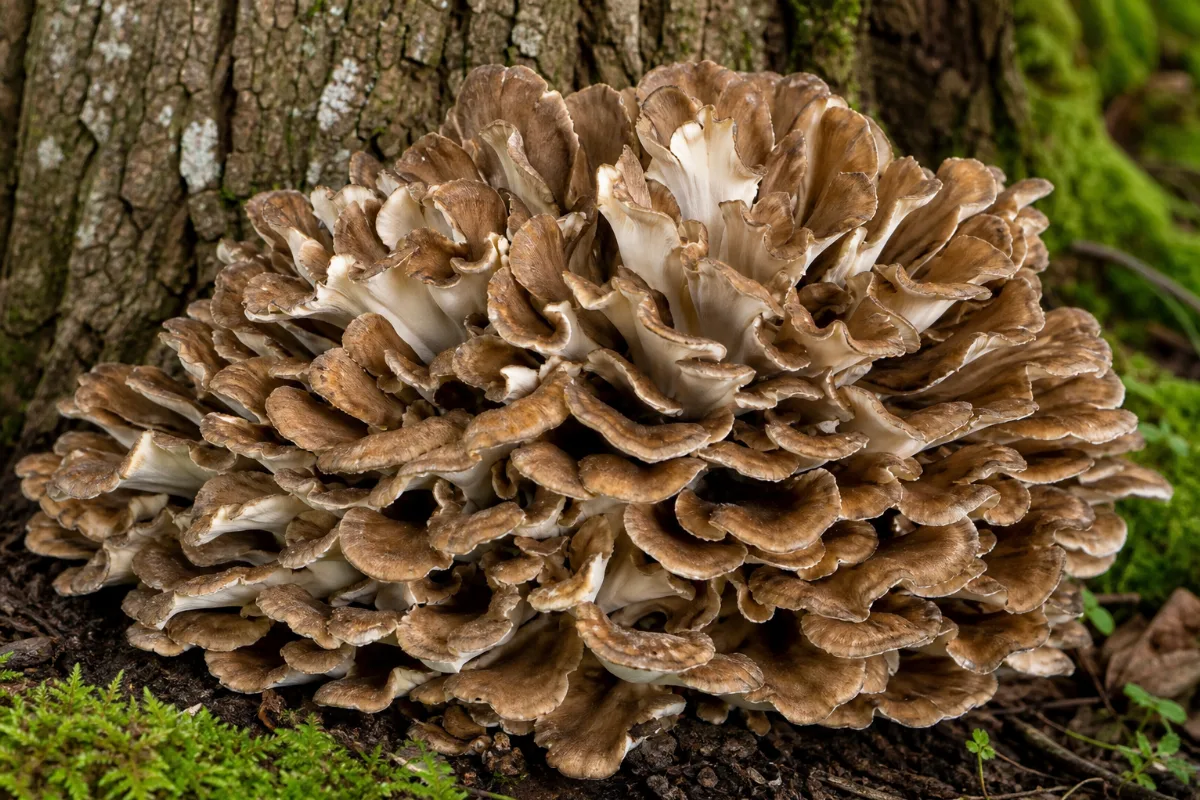
Maitake is Grifola frondosa (Dicks.) Gray, an accepted species in the family Grifolaceae. [3] MSK lists "hen of the woods" among its other common names. [1] It is an edible mushroom that is widely consumed in Asia, and it is also sold as capsules, powders and liquid extracts. [1] "D-fraction" is a proteoglycan (sugar-and-protein) preparation used in some studies, according to one trial report; it is a specific preparation, not the same as eating the mushroom. [4]Wild mushrooms cannot be safely identified from a description, and this guide offers no identification help. For any wild mushroom that was eaten, call Poison Help at 1-800-222-1222 in the US. See mushroom poisoning and urgent help.
Traditional use
Traditional use only, not proof. MSK says maitake is used in traditional medicine for diabetes and high blood pressure. [1] No other region-specific history was described in the sources we read.What research shows
| Use | What the source found | Strength of evidence | Form and population |
|---|---|---|---|
| Immune markers in breast cancer survivors | A phase I/II trial of 34 postmenopausal women found the extract changed immune measures, some up and some down, with a non-monotonic dose response. The authors warn it may depress as well as enhance immune function. [5] | Biomarker only; safety trial | Liquid polysaccharide extract, 3 weeks |
| Side effects of chemoradiotherapy | A randomized trial of 141 people with advanced laryngeal or pharyngeal cancer reported fewer severe treatment-related adverse events and better quality of life with D-fraction than with placebo. [4] | Promising but limited (single trial) | D-fraction capsules, during treatment |
| Thinking skills in older adults | A 2026 trial of 47 healthy older Japanese adults ate bread with 50 g of one maitake strain (Y10M) for 18 weeks. That strain improved a cognitive score; a second strain (C5304) did not. [6] | Promising but limited; strain-specific | Mushroom in bread, healthy adults aged 60 and over |
| Upper respiratory infections | A 2026 trial found no difference in the overall number of infection episodes, with fewer days of fever and runny nose in the Y10M group. [7] | Mixed | Mushroom in bread, young and older adults |
| Blood sugar | MSK notes that maitake may lower blood glucose levels and advises caution with diabetes medicines. [1] Proper evidence not found for a controlled trial of blood sugar outcomes in the sources we read. | Insufficient evidence; lab findings only in the sources we read | Various |
| Cancer treatment | MSK says clinical data are limited and more studies are underway. [1] | Insufficient evidence | Extracts |
Results depend on the strain and form: the two bread trials used strains Y10M and C5304 and found different effects. [6][7] Do not assume a capsule matches any of them. For product types see mushroom extracts and mushroom powder vs extract.
Official statements
The National Cancer Institute's PDQ mushroom summary (2024) lists maitake among commonly used medicinal mushrooms and says the US FDA has not approved medicinal mushrooms as a treatment for cancer or any other medical condition. [8]Lab data and chemistry
What the laboratory literature reports in this mushroom. Wikidata (CC0, imported from the LOTUS natural-products initiative) lists 46 compounds as "found in" Grifola frondosa. [9] The list is dominated by sterols, fats and a few sugars; the source file gives no paper for each entry, and an entry means "reported in at least one study of this species", not "present in every product". The well-known beta-glucans and the D-fraction are large sugar polymers, so they are not on this small-molecule list. Compounds below are a selection.| Compound or group | Class | Where in the mushroom / form | Identity | Source |
|---|---|---|---|---|
| Ergosterol | Sterol (the plant-like "vitamin D2 precursor") | Fruiting body; becomes vitamin D2 under UV light | Wikidata Q143263; ChEBI 16933 | [9] |
| Ergosterol endoperoxide | Oxidised sterol | Reported in the species | Wikidata Q5385831; ChEBI 65858 | [9] |
| Cerevisterol | Sterol | Reported in the species | Wikidata Q15410887; ChEBI 68083 | [9] |
| Lanosterol | Sterol (triterpene type) | Reported in the species | Wikidata Q414996; ChEBI 16521 | [9] |
| Ergosta-4,6,8(14),22-tetraen-3-one | Sterol derivative | Reported in the species | Wikidata Q27104972; ChEBI 69431 | [9] |
| Alpha,alpha-trehalose | Sugar | Reported in the species | Wikidata Q421773; ChEBI 16551 | [9] |
| Erythorbic acid | Vitamin C-related acid | Reported in the species | Wikidata Q424531; ChEBI 51438 | [9] |
| Glyceryl trioleate; 1,3-linolein-2-olein | Fats (triglycerides) | Reported in the species | Wikidata Q413929 (ChEBI 53753); Q76416424 (ChEBI 170799) | [9] |
| Grifolaone A | Phenolic compound | Reported in the species | Wikidata Q77310923; ChEBI 201818 | [9] |
| 2,4-Dihydroxy-6-methylbenzaldehyde | Phenolic aldehyde | Reported in the species | Wikidata Q27251742; ChEBI 155863 | [9] |
| Ceramide-type compounds (for example N-[(R)-2-hydroxytricosanoyl]phytosphingosine) | Sphingolipids | Reported in the species | Wikidata Q77513823 (ChEBI 227692) | [9] |
| Ergothioneine | Sulfur-containing dietary antioxidant | Fruiting body (measured by USDA, see below) | Not on the LOTUS list; named for hen of the woods in a review | [10][11] |
| Beta-glucans and D-fraction | Large sugar polymers; D-fraction is sugar plus protein | Fruiting body; extracts | Measured by USDA (below) | [4][11][12] |
Measured values. USDA publishes two maitake samples, per 100 g of the edible portion. They come from different datasets and disagree on several numbers, so both are shown. [11]
| Measure | Value | Basis | Sample | Source |
|---|---|---|---|---|
| Energy | 31 kcal | Fresh, raw | USDA SR Legacy, FDC 169403 | [11] |
| Energy (general Atwater factors) | 37.6 kcal | Fresh | USDA Foundation Foods, FDC 2003602 | [11] |
| Protein | 1.94 g / 2.20 g | Fresh | SR Legacy / Foundation | [11] |
| Dietary fibre | 2.7 g / 3.07 g | Fresh | SR Legacy / Foundation | [11] |
| Beta-glucan | 2.26 g | Fresh | Foundation only; SR Legacy has no value | [11] |
| Vitamin D2 | 28.1 ug (1,123 IU) | Fresh, raw | SR Legacy, FDC 169403 | [11] |
| Vitamin D2 | 1.6 ug (64 IU) | Fresh | Foundation Foods, FDC 2003602 | [11] |
| Ergothioneine | 2.25 mg | Fresh | Foundation only | [11] |
| Glutathione | 26 mg | Fresh | Foundation only | [11] |
| Ergosterol | 59.3 mg | Fresh | Foundation only | [11] |
| Riboflavin | 0.24 mg / 0.27 mg | Fresh | SR Legacy / Foundation | [11] |
| Niacin | 6.59 mg / 6.76 mg | Fresh | SR Legacy / Foundation | [11] |
| Pantothenic acid | 0.27 mg | Fresh | SR Legacy only | [11] |
| Potassium | 204 mg / 260 mg | Fresh | SR Legacy / Foundation | [11] |
| Copper | 0.25 mg / 0.27 mg | Fresh | SR Legacy / Foundation | [11] |
| Selenium | 2.2 ug / 3.3 ug | Fresh | SR Legacy / Foundation | [11] |
The two vitamin D2 values differ about 18-fold. Mushrooms turn ergosterol into vitamin D2 when exposed to ultraviolet light or sun, and MedlinePlus notes that store-bought mushrooms can contain more because they were exposed to UV light. [10][13] The data file does not say how the high SR Legacy sample was grown or handled, so we cannot tell you what a mushroom you buy contains; unexposed mushrooms are expected to be much lower. Open measured values for triterpenes, heavy metals or beta-glucan in supplements: no open measured value found.
What the numbers do and do not mean
- Values vary by strain, substrate, harvest, drying and extraction. Two USDA samples of the same species disagree, most strongly for vitamin D2.
- A compound present in a mushroom does not show a health effect. Most beta-glucan and D-fraction findings come from cell or animal work, with only small human trials. [4][5]
- A food portion and a supplement are different things: the USDA numbers describe eating the mushroom, not capsules or extracts.
- "Standardised to X% beta-glucan" depends on the test. Enzymatic beta-glucan and total polysaccharide are different measures, and mycelium-on-grain powders can count leftover grain starch. See fruiting body vs mycelium and mycelium grown on grain.
- The D-fraction used in the chemoradiotherapy trial is a specific preparation, not the same as the whole mushroom. [4]
Frequently asked questions
Is maitake the same as hen of the woods?
MSK lists "hen of the woods" as a common name for maitake. [1] Never rely on a name or photo to pick wild mushrooms.
Does maitake lower blood sugar?
Possibly; MSK says it can lower blood sugar and advises caution with diabetes medicines. [1]
Can I take maitake with warfarin?
Ask your prescriber or pharmacist; there is a case report of INR elevation. [1]
Does maitake support immunity?
Small studies show changes in immune markers, in both directions. [5] Whether this prevents illness is unproven. [7]
Does maitake treat cancer?
No. MSK describes clinical data as limited. [1] Tell your oncology team about any product; see mushrooms and cancer.
More details: evidence, limits and cautions
The details behind this page: cautions, limits of the evidence and where sources disagree. Open any note to read it.
Safety in more detail
- Blood sugar medicines: MSK says maitake may increase their effects in people with type 2 diabetes. [1]
- Warfarin: one case report of INR elevation. [1][2]
- Blood tests: MSK lists higher white blood cell count and asymptomatic eosinophilia (raised eosinophils, a type of white blood cell) as effects. [1]
- Skin and stomach reactions: in the breast cancer trial, two people withdrew for mild side effects (nausea and joint swelling in one, rash and itching in the other). [5]
- Pregnancy, breastfeeding, children, older adults: not described in the sources we read. See pregnancy and breastfeeding.
- Liver, kidney and allergy: not described in the sources we read.
- Quality: supplement ingredient amounts can vary from lot to lot per the National Cancer Institute. [8] See quality testing and certifications.
References
- Memorial Sloan Kettering Cancer Center, Maitake, About Herbs Read 2026-10-23.
- INR elevation with maitake extract in combination with warfarin. Ann Pharmacother 2010 Read 2026-10-23.
- GBIF Backbone Taxonomy, Grifola frondosa (Dicks.) Gray Read 2026-10-23.
- Effect of Maitake D-fraction in advanced laryngeal and pharyngeal cancers during concurrent chemoradiotherapy: a randomized clinical trial. Acta Biochim Pol 2022 Read 2026-10-23.
- Deng G et al. A phase I/II trial of a polysaccharide extract from Grifola frondosa (Maitake mushroom) in breast cancer patients: immunological effects. J Cancer Res Clin Oncol 2009 Read 2026-10-23.
- Maitake Mushroom (Grifola frondosa) Enhances Cognitive Function in Healthy Older Japanese: A Randomized, Double-Blind, Placebo-Controlled Trial. J Nutr Sci Vitaminol 2026 Read 2026-10-23.
- Maitake mushroom supplementation modulates upper respiratory symptoms and immune responses in healthy adults: a randomized, double-blind, placebo-controlled trial. Food Funct 2026 Read 2026-10-23.
- National Cancer Institute, Medicinal Mushrooms (PDQ), Health Professional Version, updated November 6, 2024 Read 2026-10-23.
- Wikidata (CC0), compounds listed as found in taxon Grifola frondosa (Q1165686), LOTUS initiative imports, retrieved 2026-10-23 (46 compounds). ChEBI identifiers from Wikidata.
- Mushrooms as Nutritional Powerhouses: A Review of Their Bioactive Compounds, Health Benefits, and Value-Added Products. Foods 2025 Read 2026-10-23 (first part of the text).
- U.S. Department of Agriculture, FoodData Central: Mushrooms, maitake, raw (SR Legacy, FDC ID 169403) and Mushroom, maitake (Foundation Foods, FDC ID 2003602), https://fdc.nal.usda.gov/. Public domain. Values read from the bulk download Read 2026-10-23.
- National Cancer Institute, Medicinal Mushrooms (PDQ), beta-glucan background, updated November 6, 2024 Read 2026-10-23 (first part).
- MedlinePlus, Vitamin D Read 2026-10-23.